
Chorleywood Bread Process vs craft bulk-fermentation: how Britain's two bread traditions diverged and what each demands from flour and improvers
Britain bakes two completely different loaves. Roughly eight in ten UK loaves are made by the Chorleywood Bread Process (CBP) — invented in 1961 at the Chorleywood research station, it swaps the old several-hour bulk fermentation for a burst of intense mechanical mixing (about 11 Wh/kg in ~3 minutes) plus a fast oxidant (ascorbic acid), a little hard fat, extra water and extra yeast. The other, roughly 3% of the market and growing under the "Real Bread" banner, is craft bulk-fermentation: time, not machinery or additives, builds the flavour, gluten and open crumb. This dossier is written for the British home market: it explains exactly how the two processes diverge and what each demands from your flour, improver and fat; it gets the UK rulebook right — the Bread and Flour Regulations 1998 (mandatory calcium, iron, thiamin and niacin) and the 2024 amendment adding folic acid — and it settles the "sourdough vs sourfaux" labelling debate. Every requirement is wired to the Domson catalogue a UK baker actually orders (strong bread flour, a UK-made bread improver, vital wheat gluten, high-melt shortening, fresh yeast and British diastatic malt) with first-party spec sheets, and cross-linked to the Pillar A craft science behind it (A5-dough-mixing-methods, A5-bulk-fermentation, A3-what-is-a-bread-improver, A3-ascorbic-acid-oxidants-reductants, A3-emulsifiers-in-bread, A3-vital-wheat-gluten, A1-protein-gluten-and-strength, A4-fat-types-and-selection) and its British siblings (B7-flour-landscape, B7-sourdough-real-bread, B7-malted-grain-baking).
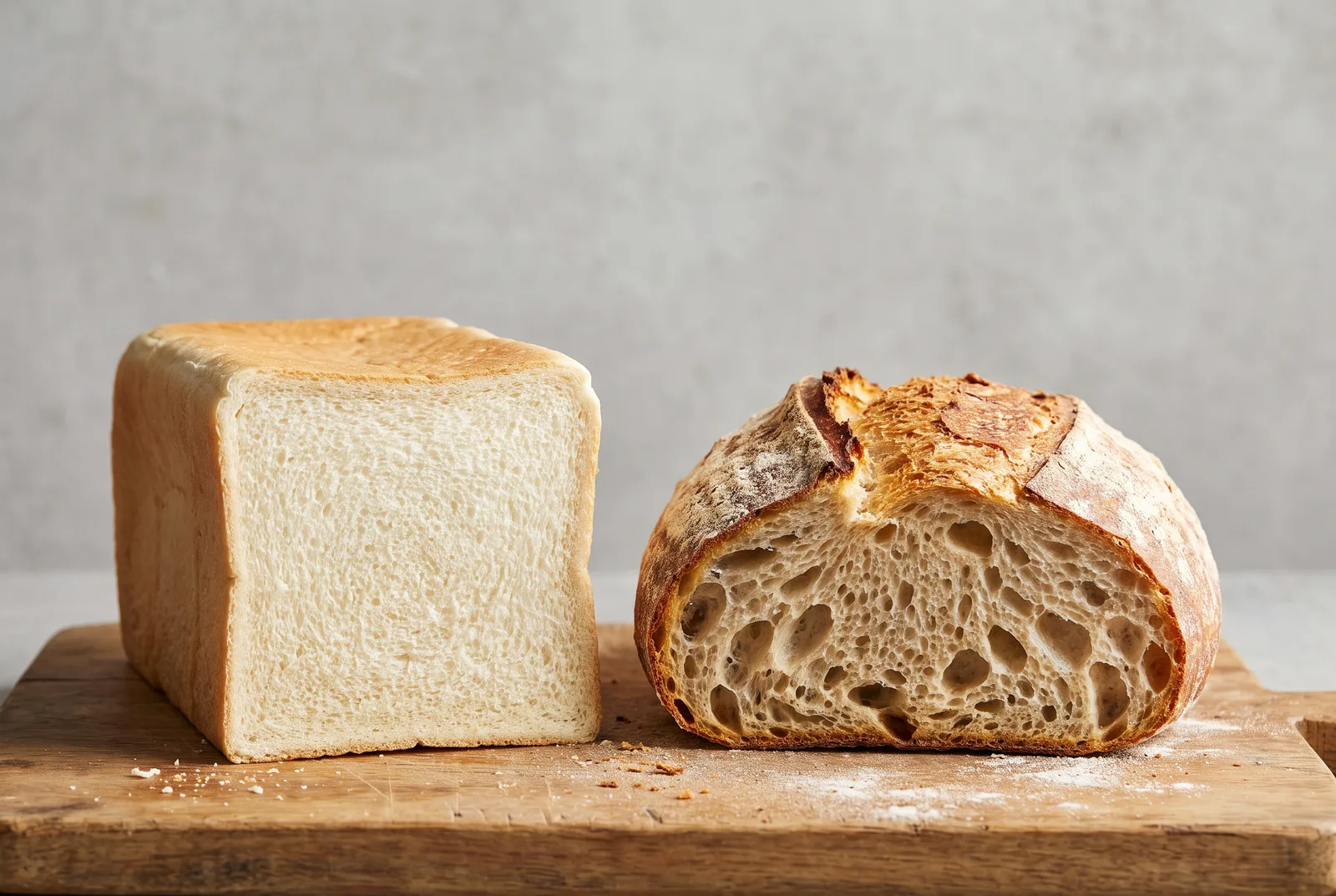
Two traditions, one shelf
Walk into any British supermarket and you can hold both of Britain's bread traditions in your two hands. In one hand: a soft, square, thin-crusted white sliced loaf with a crumb so even it looks extruded. In the other: a floured, thick-crusted craft bloomer or tin loaf with an open, irregular crumb. They share four ingredients — flour, water, yeast, salt — but almost nothing else. One is the product of the Chorleywood Bread Process (CBP), the method behind roughly eight in ten UK loaves. The other is craft bulk-fermentation, the older tradition that now accounts for around 3% of the market but is growing fast under the "Real Bread" banner.
For a British baker this is not an academic distinction. It decides which flour you buy, whether you need a bread improver at all, what fat does in your dough, how much water and yeast you use, how long your process takes, and how your loaf is allowed to be labelled. This dossier walks through the divergence and, crucially, what each route demands from your flour and improvers — with the exact Domson catalogue products to order for each.
A short history: 1961 and the Chorleywood revolution
The CBP was developed in 1961 at the British Baking Industries Research Association (BBIRA) in Chorleywood, Hertfordshire — the work is credited to Bill Collins, George Elton and Norman Chamberlain. Post-war Britain wanted plentiful, cheap, soft, long-keeping sliced bread, and it wanted to bake it from the lower-protein wheat that grows well in the British climate rather than relying on expensive strong imported wheat.
Their insight was to replace time with energy. Traditional bulk fermentation develops gluten and flavour over several hours; Chorleywood develops the gluten in one intense burst of high-speed mechanical mixing to a fixed work input of about 11 Wh/kg of dough (12–13 Wh/kg or more for stronger flours), delivered in roughly 3 minutes. Add a fast-acting oxidant (originally including potassium bromate; today ascorbic acid), a small proportion of hard fat, extra water and extra yeast, and you get a fully developed dough that goes straight from mixer to divider with no bulk fermentation at all — a so-called "no-time dough". The whole run, flour to sliced and packaged loaf, takes under about four hours.
The economics were transformational. Because intense mixing does the work that fermentation used to do, CBP can be run on lower-protein home-grown wheat: according to Campden BRI (the institute that grew out of the process's birthplace, and the single source for this specific figure), around 80% of the wheat used for UK bread is now UK-grown, against about 30% before CBP. The Federation of Bakers puts today's market at roughly 85% plant bakeries, 12% in-store (supermarket) bakeries and 3% craft bakers, with over 13 million loaves and bakery packs sold every day. Most of that plant bread is Chorleywood.
How the two processes actually differ
The single biggest difference is where dough development comes from: a machine (CBP) or the clock (craft). Everything else follows from that. (The figures below show the process comparison and the energy-vs-time trade-off; the full attribute table is below.)
- Chorleywood / no-time dough. Weigh flour, water, yeast, salt, improver and fat; mix intensely to target work input in ~3 minutes; divide immediately; mould; final prove ~45–55 minutes; bake; cool; slice. Fine even crumb, thin soft crust, mild flavour, stays soft for days.
- Craft bulk fermentation. Mix to a smooth dough; bulk ferment 2–3 hours (or hold a sponge for several hours) with a knock-back or two; divide; bench rest; shape; final prove; bake with steam. Open irregular crumb, thicker crust, fuller flavour. This is the stage CBP removes, and it is exactly what our Pillar A dossier A5-bulk-fermentation covers in depth; the mixing side is in A5-dough-mixing-methods (which compares straight dough, sponge-and-dough, Chorleywood and activated dough development directly).
CBP trades craft skill and time for capital and additives; craft trades capital for time and skill. Neither is "better" in the abstract — they are engineered for different products and different price points. The scaling questions between them are the subject of A5-scaling-artisan-to-industrial.
What each route demands from flour, improvers and fat
This is the heart of the matter for a working baker, and it is where the Domson catalogue earns its place. (The diagrams below show a UK improver's contents and why CBP needs a high-melt fat.)
Flour: strength and protein
Craft bulk-fermentation rewards a strong, well-matured flour (around 12–13% protein) because the long ferment relies on an extensible, resilient gluten network — see A1-protein-gluten-and-strength and the parameters (ash, protein, falling number) in A1-key-quality-parameters. CBP's whole reason for existing is that it will make an acceptable loaf from weaker, lower-protein flour, because the mixer forces gluten development that fermentation would otherwise coax out slowly.
A dependable base for either route is a strong wheat bread flour such as Bread Flour Type 750. Its first-party datasheet specifies ash ≤0.82%, falling number ≥220 s, wet gluten ≥26% and protein around 11.6 g/100 g — and, tellingly for this article, it carries the UK statutory fortification premix (see next section). For choosing between flours by application, our A1-wheat-flour-types-by-application and the British-specific B7-flour-landscape go deeper.
Vital wheat gluten: reinforcing weak flour for the mixer
When flour is too weak for the crumb structure you need — or when you are adding fibre, seeds or wholemeal that dilute the gluten — you add vital wheat gluten (VWG). This is the classic lever for making lower-protein flour behave under intense CBP mixing. BeneoPro VWG 75 is min 75% protein (N×5.7) with a water-binding capacity of ~140–170 g per 100 g — dosed typically at a few percent on flour. The dedicated dossier is A3-vital-wheat-gluten.
The improver: an oxidant plus an emulsifier (and often enzymes)
A bulk-fermented craft loaf may use no improver at all — time does the conditioning. A CBP loaf almost always uses one, because the process depends on a fast-acting oxidant to build gluten strength in seconds rather than hours. The archetypal UK product is Puratos S500, and its spec sheet is a perfect anatomy lesson in what a British bread improver is:
- Ascorbic acid (E300) at 0.9–1.1% — the fast oxidant (vitamin C). This is the modern, permitted replacement for the banned oxidants (below). Full theory in A3-ascorbic-acid-oxidants-reductants.
- DATEM (E472e) — a dough-strengthening emulsifier. See A3-emulsifiers-in-bread.
- Calcium sulphate (E516) anti-caking agent, and rapeseed oil.
- A wheat-flour carrier that itself lists the statutory fortificants (calcium carbonate, iron, nicotinamide, thiamine).
- Country of origin: GB. Dose: up to 2% on flour weight.
That is the general-purpose improver behind a great deal of British sandwich bread. For the underlying "what and why", read A3-what-is-a-bread-improver; for the enzyme side (amylases, xylanases that give softness and shelf life), A3-enzymes-in-bread and A5-bread-improvers-enzymes; and if your positioning is cleaner, the enzyme-only route is covered in A3-clean-label-improvers. To pick a dose and product for a given job, use A3-improver-selection-guide.
A note on banned oxidants (food-safety / regulatory). Two agents that older recipes may still name are illegal in British bread. Potassium bromate was prohibited as a flour improver from 1 April 1990 — by SI 1990/399 in England and Wales, with a parallel instrument (SI 1990/395) taking effect the same day in Scotland, so the ban is UK-wide. It is an IARC Group 2B possible carcinogen and is still permitted in the US. Azodicarbonamide (E927a) is likewise banned in the UK and EU (it can generate semicarbazide/urethane on baking) but remains permitted in the US. If you inherit a formula quoting either, replace the oxidation function with ascorbic acid, which is what modern improvers use. (See the comparison table below.)
Fat: why CBP needs a hard fat
Craft loaves often use no fat, or a little butter for softness. CBP specifies a small proportion of hard fat for a structural reason: the intense mixing creates an enormous number of tiny gas nuclei, and a fat that stays solid at proof and early-oven temperatures coats and stabilises those fine cells to give the characteristic close, even crumb (see the diagram below). A fat's slip melting point is the number that matters here. Cardowan's Coronet NHAV HR high-ratio shortening, made in Glasgow, has a slip melting point of 44.0°C — well above proof temperature — with a distilled monoglyceride emulsifier (E471) and ~12% incorporated air. That is exactly the high-melt profile the process was designed around. The science of melting point, plasticity and shortening is in A4-fat-types-and-selection.
Yeast and malt
CBP uses more yeast than a bulk-fermented dough, because there is no fermentation time for the population to grow — the gas must come fast. Lesaffre Benevia fresh yeast is standard: pure Saccharomyces cerevisiae, dry matter >29%, fermentative activity 125 ± 10 ml CO₂. Yeast formats and dosing are compared in A2-yeast-types-comparison.
Both routes can use diastatic malt for colour, flavour and fermentable sugars — and Britain has a proud maltster tradition. EDME's HDA White Bread Malt Flour, milled in Mistley, Essex, is 100% malted barley with a diastatic power of 165–220 °IOB (target 180) — meaning it is enzyme-active and supplies amylase, sugars and that malty crust note. Non-diastatic and diastatic malt selection is covered in A3-malt-and-malt-extracts, and the British malt story in B7-malted-grain-baking.
The Bread and Flour Regulations: the home-market rulebook
This is the one section a British baker cannot afford to get wrong. Regardless of process, all non-wholemeal wheat flour milled in the UK must be fortified under the Bread and Flour Regulations 1998. The statutory minima, per 100 g of flour, are (see the diagram and table below):
- Calcium (as calcium carbonate/chalk): 235–390 mg
- Iron: ≥ 1.65 mg
- Thiamin (Vitamin B1): ≥ 0.24 mg
- Niacin (Vitamin B3) (nicotinic acid or nicotinamide): ≥ 1.60 mg
You do not have to take a regulator's word for it — you can read those exact numbers off a bag. The Bread Flour Type 750 datasheet declares a "micronutrient premix" of calcium carbonate 235–390 mg, iron ≥1.65 mg, thiamin ≥0.24 mg and nicotinic acid ≥1.60 mg per 100 g — the statutory figures, line for line. Wholemeal flour is exempt, because retained bran and germ are natural sources of these nutrients (see A1-wholemeal-and-high-extraction).
New for the home market (food-safety / regulatory): folic acid. The Bread and Flour (Amendment) (England) Regulations 2024 (SI 2024/1162) add mandatory folic acid at 250 micrograms per 100 g of non-wholemeal wheat flour, with full compliance required by 13 December 2026. Wholemeal flour and small mills producing under 500 tonnes a year are exempt. The public- health aim is to help prevent around 200 neural-tube-defect-affected pregnancies each year. For most bakers this changes nothing operationally — your miller adds it — but it changes your labelling and is worth knowing when a customer asks.
The Real Bread Campaign takes a pointed view of all this, arguing the word "fortification" flatters a practice that only restores "five lost micronutrients" stripped out by roller milling. You do not have to share their politics to use their factual summaries, which are accurate on what is added and to what.
Sourdough, sourfaux and the Real Bread revival
Here is a fact that surprises many bakers: UK law contains no legal definition of "bread" or "sourdough". Anything can be called bread, and — until recently — anything vaguely tangy could be called sourdough. On 31 January 2023 the Association of Bakery Ingredient Manufacturers (ABIM), endorsed by the UK Association of Producers of Yeast, the Federation of Bakers and the Craft Bakers Association, published a voluntary "UK Baking Industry Code of Practice for the Labelling of Sourdough Bread and Rolls". Read it carefully, because it is tiered (labelling / regulatory): its top "Sourdough" tier permits only a small amount of baker's yeast (up to about 0.2%) and no additives beyond the mandatory flour fortificants, whereas its lower "...with sourdough" and "sourdough flavour" tiers do allow baker's yeast as the principal leaven together with permitted additives. So the word "sourdough" alone does not license yeast and additives — but the qualified lower tiers effectively let a heavily yeasted, additive-containing loaf carry "sourdough" somewhere on its label, which is the crux of the dispute below.
The Real Bread Campaign rejects this. Its definition of genuine sourdough is bread leavened only by a live sourdough starter culture and made without additives; it calls anything else "sourfaux" and campaigns for a legally binding "Honest Crust Act". For a craft baker this is a commercial opportunity as much as a semantic dispute: a genuinely starter-leavened, additive-free loaf is a premium product with a story, and the label "Real Bread" means "made without any processing aids or other additives". The microbiology behind it is in A2-sourdough-cultures-science and A5-sourdough-technology; the British revival, the code and positioning are the subject of the sibling dossier B7-sourdough-real-bread.
Choosing your route — and buying for it
There is no single right answer; there is a right answer for a given product (see the diagram below; the three worked formulas are below).
- High-volume sliced sandwich bread, soft rolls, burger buns → Chorleywood / no-time dough. Strong bread flour (Type 750), an all-purpose improver (S500-type, ascorbic + DATEM) at up to 2%, a high-melt shortening at 1–2%, extra yeast (~2.5–3%), and vital wheat gluten if your flour is weak. See the formula below.
- Premium craft tin loaves and bloomers → bulk fermentation or sponge-and-dough. Strong, well-matured flour, 1–1.5% yeast, 2–3 hours bulk ferment, little or no improver, optional 0.2–0.5% diastatic malt for colour. See the formula below; preferments in A2-preferments-poolish-biga-sponge and lean formulas in A8-lean-bread-formulas.
- Sourdough / Real Bread positioning → live starter, long ferment, no additives. Command a premium and label it honestly. See the formula below.
The catalogue "shopping list" for all three routes is shown in the diagram below and tabulated in the table below: strong Bread Flour Type 750, Puratos S500 improver, BeneoPro VWG 75 vital wheat gluten, Cardowan high-ratio shortening, Lesaffre Benevia fresh yeast and EDME diastatic malt flour — each backed by a first-party spec sheet.
Allergen and food-safety note
- Gluten is everywhere in this dossier. Wheat flour, vital wheat gluten (wheat), diastatic malt flour (barley) and the improver's flour carrier all declare cereal gluten. None of these products is suitable for coeliacs; the S500 improver spec explicitly states "not suitable for coeliacs" and flags egg, soya and milk as possible cross-contamination.
- The Cardowan shortening is declared free of all 14 legal allergens; Benevia yeast carries no declared allergen. Its spec states that the sulphites belong to the production molasses rather than the finished yeast — a first-party position that is not independently verified, so do not make a "sulphite-free" claim without confirming it with the supplier and against the current spec sheet.
- Fortificants and any declarable processing aids (e.g. ascorbic acid carried in some flour batches) must be handled per UK food-information law (retained Regulation (EU) 1169/2011). The folic-acid mandate and the fortification minima are legal requirements, not options — confirm current wording with your miller and the FSA before finalising labels.
Related reading
Pillar A (the craft science): A5-dough-mixing-methods · A5-bulk-fermentation · A5-sourdough-technology · A5-scaling-artisan-to-industrial · A5-bread-improvers-enzymes · A5-shelf-life-and-staling · A3-what-is-a-bread-improver · A3-ascorbic-acid-oxidants-reductants · A3-emulsifiers-in-bread · A3-enzymes-in-bread · A3-vital-wheat-gluten · A3-clean-label-improvers · A3-malt-and-malt-extracts · A3-improver-selection-guide · A1-protein-gluten-and-strength · A1-key-quality-parameters · A1-wheat-flour-types-by-application · A1-wholemeal-and-high-extraction · A2-yeast-types-comparison · A2-preferments-poolish-biga-sponge · A2-sourdough-cultures-science · A4-fat-types-and-selection · A8-lean-bread-formulas.
British siblings (Pillar B7): B7-flour-landscape · B7-sourdough-real-bread · B7-malted-grain-baking.
Figures
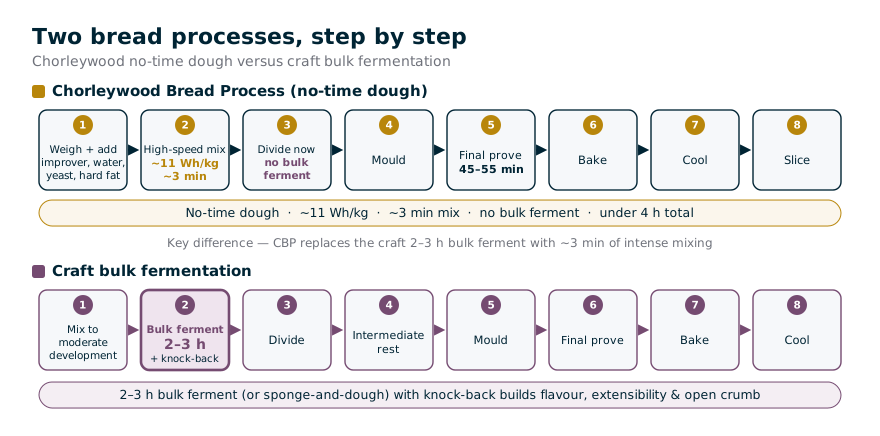 Two stacked flowcharts comparing the Chorleywood no-time dough process against a craft bulk-fermentation process step by step
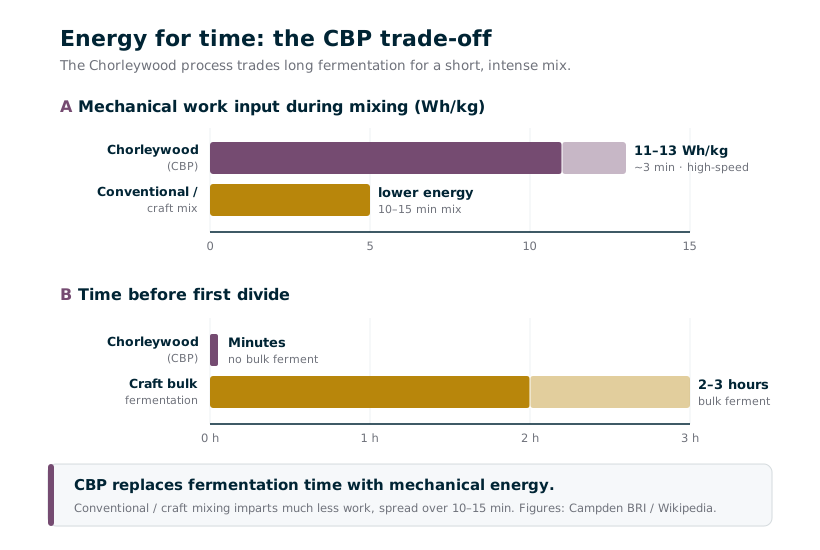 Comparison chart showing Chorleywood's high mechanical energy input and near-zero fermentation time versus craft's lower energy and long bulk ferment
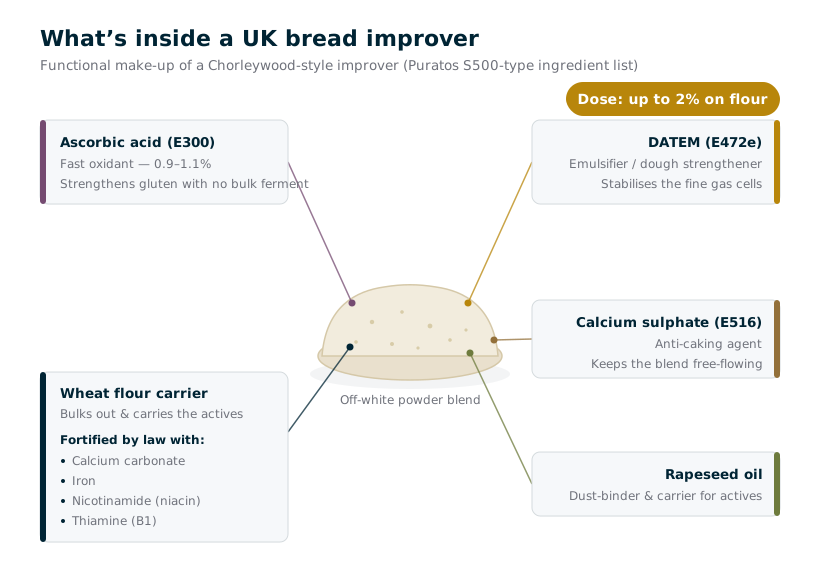 Labelled diagram of the components of a UK bread improver: ascorbic acid oxidant, DATEM emulsifier, fortified flour carrier and oil, dosed up to 2% on flour
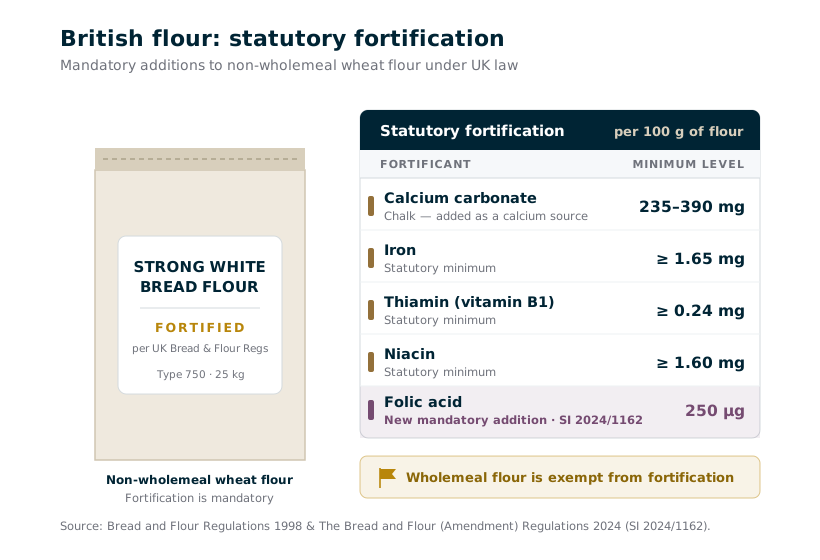 Diagram of a British flour bag showing statutory fortification levels for calcium, iron, thiamin, niacin and the new folic acid addition, noting wholemeal is exempt
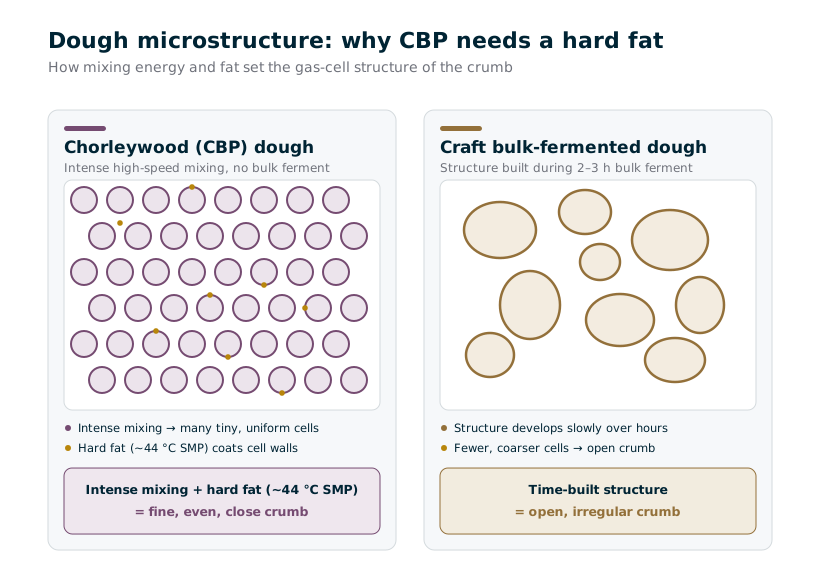 Diagram contrasting the fine fat-stabilised gas-cell structure of a Chorleywood dough with the coarser open cell structure of a bulk-fermented craft dough
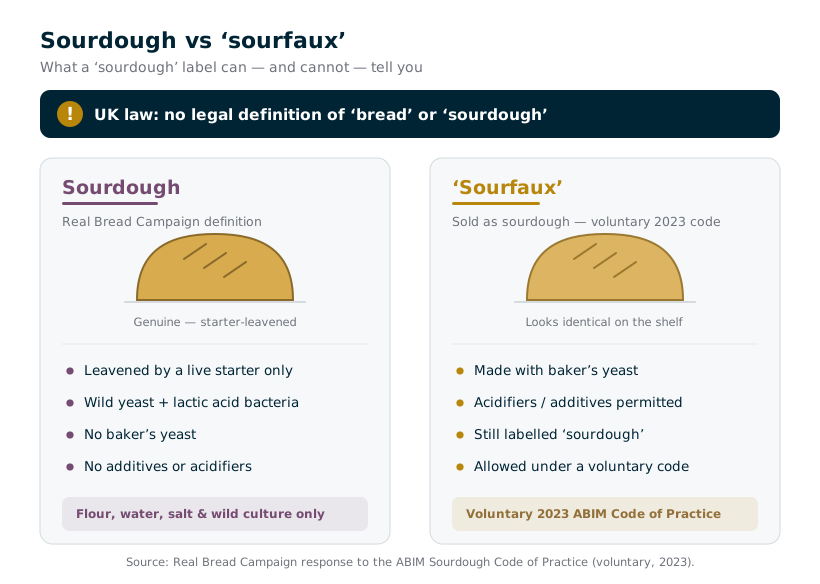 Explainer comparing genuine starter-only sourdough against additive-and-yeast sourfaux, noting no legal UK definition of sourdough
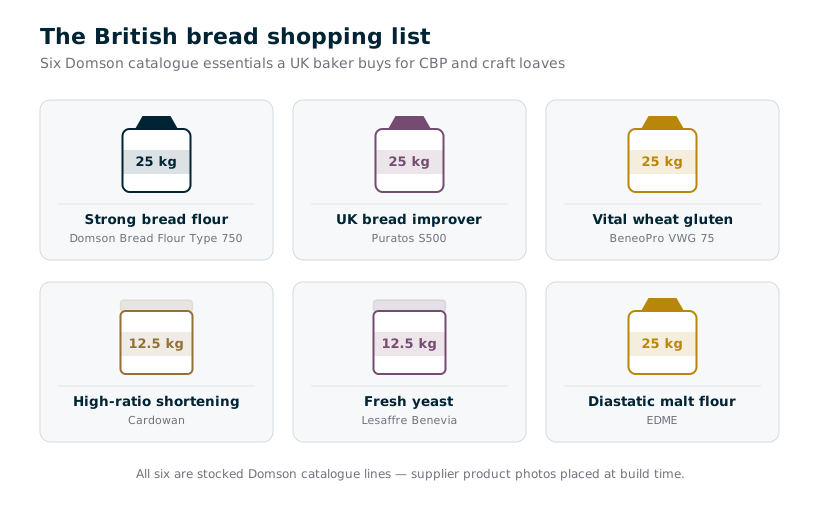 Grid of Domson catalogue products for British bread making: strong flour, bread improver, vital wheat gluten, shortening, fresh yeast and diastatic malt flour
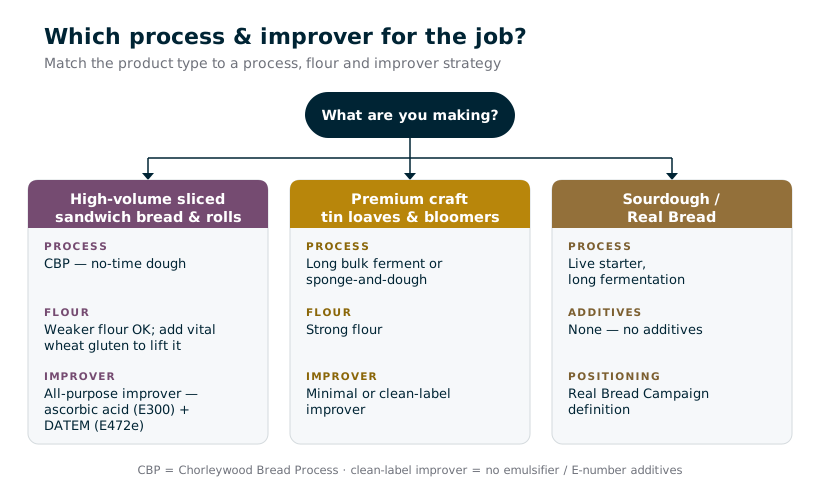 Decision flowchart mapping product type to process choice and improver strategy across Chorleywood, craft and sourdough routes
Chorleywood-style white tin loaf (no-time dough) — baker's %
| Ingredient | Baker's % | Weight |
|---|---|---|
| Strong white bread flour — e.g. Bread Flour Type 750; lower-protein wheat tolerated with VWG | 100 | |
| Water — 62–64%; CBP runs slightly wetter than a hand dough | 62 | |
| Fresh yeast — 2.5–3%; higher than bulk-ferment loaf (no time for growth) | 2.5 | |
| Salt — 1.8–2.0% | 1.9 | |
| Bread improver (S500 type) — up to 2%; supplies ascorbic acid E300 + DATEM | 1.5 | |
| Hard/high-melt fat or shortening — 1–2%; ~44°C SMP fat stabilises the fine crumb | 1.5 | |
| Vital wheat gluten (optional) — 1–2% to reinforce weaker flour | 1 |
- Mix all ingredients in a high-speed mixer to a fixed work input (~11 Wh/kg) in ~3 minutes; the dough is fully developed with no bulk fermentation. Divide, round, first (intermediate) rest a few minutes, mould, pan, final prove ~45–55 min at ~40–43°C / high humidity, bake ~220–230°C ~25–30 min, cool, slice.
Yield: Plant/semi-plant sliced bread; scale to tin size
Ascorbic acid enters via the improver, not weighed separately. Emulsifier/enzymes improve softness and shelf life.
Craft bulk-fermented white tin loaf — baker's %
| Ingredient | Baker's % | Weight |
|---|---|---|
| Strong white bread flour — well-matured strong flour, ~12–13% protein preferred | 100 | |
| Water — 64–66% | 65 | |
| Fresh yeast — 1–1.5%; time, not extra yeast, does the work | 1.2 | |
| Salt | 2 | |
| Fat / butter (optional) — 0–2%; for softness and keeping | 1.5 | |
| Diastatic malt flour (optional) — 0.2–0.5% for colour, flavour and fermentation | 0.5 |
- Mix to a smooth, well-developed dough (spiral ~8–10 min). Bulk ferment 2–3 hours at ~24–26°C with one or two knock-backs (or use a sponge held 3–16 h). Divide, pre-shape, bench rest, shape, pan, final prove ~60–75 min, bake with steam ~230°C falling to ~210°C, ~30–35 min, cool.
Yield: Craft / in-store; 800 g tin loaves
No improver required; flavour and structure come from the bulk ferment. Cross-link A5-bulk-fermentation and A2-preferments-poolish-biga-sponge.
British long-ferment sourdough (Real Bread) — baker's %
| Ingredient | Baker's % | Weight |
|---|---|---|
| Strong white / high-extraction flour — often blended with wholemeal or rye | 100 | |
| Water — 68–75% depending on flour | 70 | |
| Live sourdough starter (levain) — as % of flour; no baker's yeast in genuine sourdough | 20 | |
| Salt | 2 |
- Mix, autolyse, develop by stretch-and-fold; bulk ferment 3–5 h (or cold-retard overnight). Shape, final prove or retard, bake with steam ~240°C. No additives, no baker's yeast — the definition of genuine sourdough / Real Bread.
Yield: Craft artisan bloomer/batard
Contrast with 'sourfaux': products labelled sourdough that also use baker's yeast/acidifiers under the voluntary 2023 code. Cross-link B7-sourdough-real-bread and A5-sourdough-technology.
| Attribute | Chorleywood Bread Process (CBP) | Craft bulk fermentation |
|---|---|---|
| Origin | Developed 1961 at the BBIRA, Chorleywood (Collins, Elton, Chamberlain) | Centuries-old British craft practice; sponge-and-dough refined in the 19th–20th c. |
| Gluten development | Mechanical — intense high-speed mixing | Biological + mechanical — time plus moderate mixing |
| Mixing work / time | ~11 Wh/kg (12–13+ for strong flour) in ~3 min (2–4 min) | Lower energy over 10–15 min, then time does the work |
| Bulk (first) fermentation | None — 'no-time dough'; straight to divider | 2–3 hours (or a sponge held for several hours) |
| Total flour-to-loaf time | Under ~4 hours (≈3.5 h) | Typically 5–7+ hours (bulk ferment alone 3–5 h+) |
| Oxidant / improver | Required — ascorbic acid (E300) plus improver (up to ~2% on flour) | Optional / minimal; clean-label or none in Real Bread |
| Added fat | Small proportion of hard/high-melt fat needed for structure | Optional; often none in a lean loaf |
| Flour protein needed | Works with lower-protein (weaker) home-grown wheat | Prefers stronger, well-matured flour for extensibility |
| Crumb | Fine, even, close, soft — machine-uniform | Open, irregular, chewier |
| Crust | Thin, pale, soft (sandwich loaf) | Thicker, darker, blistered |
| Flavour | Mild; little fermentation flavour | Fuller, more acidic/complex from long ferment |
| Keeping quality | Soft for days (high water + emulsifier/enzyme); stales quickly once cut | Firmer; often better crust, drier faster without additives |
| Capital & skill | High capital (high-speed mixer, plant line); low craft skill per loaf | Low capital; high craft skill and time |
| Typical products | Sliced sandwich bread, soft rolls, burger buns, plant-baked loaves | Tin loaves, bloomers, cottage loaves, batons, sourdough |
| Share of UK bread | ~80% of UK bread (most plant bread; ~85% plant overall) | ~3% craft; long-ferment revival growing under 'Real Bread' |
| Nutrient | Form | Minimum per 100 g of non-wholemeal wheat flour | Notes |
|---|---|---|---|
| Calcium | Calcium carbonate (chalk) | 235–390 mg | Added since WWII; range set by regulation |
| Iron | Iron / iron compounds | ≥ 1.65 mg | Restores milling losses |
| Thiamin (Vitamin B1) | Thiamin | ≥ 0.24 mg | ≈0.21 mg thiamin equivalent |
| Niacin (Vitamin B3) | Nicotinic acid or nicotinamide | ≥ 1.60 mg | |
| Folic acid | Folic acid | 250 µg | Mandatory from 2024 (SI 2024/1162); full compliance by 13 Dec 2026 |
| Wholemeal flour | — | Exempt | Bran + germ are natural sources; small mills (<500 t/yr) exempt from folic acid |
| Agent | Role | UK status | Notes |
|---|---|---|---|
| Ascorbic acid (E300, vitamin C) | Fast-acting oxidant — strengthens gluten | Permitted | Standard CBP oxidant; in most UK improvers (e.g. S500 at 0.9–1.1%) |
| Potassium bromate | Slow oxidant | Banned UK-wide from 1 April 1990 (SI 1990/399 England & Wales; SI 1990/395 Scotland) | IARC Group 2B possible carcinogen; still used in the US |
| Azodicarbonamide (E927a) | Oxidant / dough conditioner | Banned in UK/EU | Can form semicarbazide/urethane on baking; still permitted in the US |
| L-cysteine (E920) | Reducing agent — relaxes gluten | Permitted | Used in some doughs to shorten mixing / improve extensibility |
| DATEM (E472e) | Emulsifier / dough strengthener | Permitted | Common CBP emulsifier; in S500 |
| Enzymes (amylase, xylanase, etc.) | Dough conditioning, softness, shelf life | Permitted (processing aids) | Backbone of clean-label improvers; not always label-declared |
| Product | Brand | Key spec | Role / process fit |
|---|---|---|---|
| Bread Flour Type 750 (strong) | Komplexmłyn / Domson | Ash ≤0.82%, FN ≥220 s, wet gluten ≥26%, protein ~11.6% | Base strong flour for both CBP and craft loaves |
| S500 SG UK Bread Improver | Puratos | Ascorbic acid E300 0.9–1.1% + DATEM E472e; dose up to 2% | All-purpose CBP/plant improver |
| BeneoPro VWG 75 Vital Wheat Gluten | Beneo (Hortimex) | ≥75% protein (N×5.7); WBC ~140–170 g/100 g | Lift weaker flour for high-speed mixing / high-fibre loaves |
| Coronet NHAV HR Shortening | Cardowan (Glasgow) | Slip melting point 44.0°C, E471, ~12% air | High-melt hard fat for CBP crumb structure; also cake/pastry |
| Benevia Fresh Yeast | Lesaffre | S. cerevisiae, dry matter >29%, 125±10 ml CO2 | Extra yeast for no-time dough; standard for craft loaves |
| HDA White Bread Malt Flour | EDME (Mistley, Essex) | Diastatic power 165–220 °IOB (target 180); 100% malted barley | Diastatic malt — amylase activity, sugars, flavour, crust colour |
| Fault | Likely cause | Remedy |
|---|---|---|
| CBP loaf collapses / sidewall keyholing | Over-oxidation or dough too slack; final prove too long | Trim improver/ascorbic dose; tighten proof time; check water |
| Dense, tight CBP crumb | Insufficient mixing work input; weak flour without gluten support | Reach target Wh/kg; add 1–2% vital wheat gluten |
| Pale, soft crust on a craft loaf | No malt / low sugar; oven too cool or no steam | Add 0.2–0.5% diastatic malt flour; bake hotter with steam |
| Craft loaf dense / under-risen | Bulk ferment too short or dough too cold | Extend bulk to 2–3 h at 24–26°C; warm the dough |
| Craft loaf stales fast | No fat/emulsifier and no enzymes (lean, additive-free) | Add 1–2% fat; accept shorter shelf life as a Real Bread trade-off |
| Sourdough won't rise / too sour | Weak or over-ripe starter; ferment too warm/long | Refresh starter; control temperature and bulk time (see A2-sourdough-cultures-science) |
- Type:
- Premium all-purpose bread improver (bakery improver)
- Dosage:
- up to 2% on flour weight
- Ascorbic acid E300:
- 0.9–1.1%
- Emulsifier:
- DATEM (E472e)
- Anti caking:
- calcium sulphate (E516)
- Other:
- rapeseed oil; wheat-flour carrier with statutory fortificants
- Country of origin:
- GB
- Allergens:
- cereals containing gluten (ingredient); egg/soya/milk possible cross-contamination
- Dietary:
- vegan-suitable; not suitable for coeliacs; kosher & halal certified
- Protein:
- min 75% (N×5.7) / min 82% (N×6.25)
- Water binding capacity:
- ~140–170 g/100 g (AACC 56-30)
- Moisture:
- max 8%
- Fat:
- max 2%
- Ash:
- max 1%
- Allergens:
- wheat gluten only
- Dietary:
- vegan
- Ash:
- max 0.82%
- Falling number:
- min 220 s
- Wet gluten:
- min 26%
- Protein:
- ~11.6 g/100 g (label min 10%)
- Moisture:
- max 15%
- Fortification per 100g:
- calcium carbonate 235–390 mg; iron ≥1.65 mg; thiamin ≥0.24 mg; nicotinic acid ≥1.60 mg
- Processing aids:
- some batches contain ascorbic acid (E300) + enzymes
- Allergens:
- cereal gluten (trace soy/lupin/mustard risk)
- Slip melting point:
- 44.0°C
- Fat:
- 100% (saturates 38.1 g/100 g)
- Ingredients:
- palm + rapeseed oil; distilled monoglyceride emulsifier (E471)
- Air content:
- ~12%
- Certification:
- RSPO segregated; BRC; vegan; kosher
- Allergens:
- none of the 14 legal allergens
- Diastatic power:
- 165–220 °IOB (target 180); D.U. 60–90
- Composition:
- 100% malted barley (roller-milled wholegrain)
- Colour:
- 3–8 °EBC
- Sugars:
- ~19.3 g/100 g
- Allergens:
- cereal gluten from barley
- Organism:
- Saccharomyces cerevisiae (fresh compressed)
- Dry matter:
- >29%
- Fermentative activity:
- 125 ± 10 ml CO2 (Lesaffre risograph)
- Shelf life:
- 35 days; store 1–10°C
- Allergens:
- none (sulphites present in molasses used in production)