
British flour in depth: protein grades, the Bread and Flour Regulations, and choosing the right flour for every application
A working baker's guide to the British flour system — the home market. Unlike Poland, Germany or Bulgaria, Britain does NOT grade flour by an ash-based type number: it grades by PROTEIN (strength) and colour, using descriptive names — very strong, strong/bread, plain, self-raising, soft/pastry, cake, wholemeal and brown. It sets out the protein ladder (extra strong/Canadian 14-16%, strong/bread 12-14%, plain 9-11%, soft 7.5-9.5%) with the exact first-party datasheet numbers for the Domson UK-stock flours a British baker actually buys — Carr's Titan and Coniston strong bakers, Verace pizza, Domson plain and self-raising, Whitworth Top Flight cake and Golden Jewel pastry, Doves wholemeal and spelt, Maltster malted brown, and the EDME malt flours. Its regulatory core — get this right, it is the home market — is the Bread and Flour Regulations 1998: the mandatory fortification of white and brown flour with calcium carbonate (235-390 mg/100g), iron (1.65 mg), thiamin (0.24 mg) and niacin (1.60 mg), which flours are exempt (wholemeal, spelt, calcium-sufficient self-raising), and the 2024 England amendment that BOTH raised those levels (calcium carbonate 235-390->300-455 mg, iron 1.65->2.10 mg, niacin 1.60->2.40 mg, thiamin unchanged at 0.24 mg) and added folic acid (250 µg/100g) — full compliance by 13 Dec 2026, with parallel measures in Scotland and Wales. It explains why British flour is so often a "treated" flour — the Chorleywood Bread Process, ascorbic acid and added vital wheat gluten that let UK bakers make bread from lower-protein home-grown wheat — and the Real Bread / "sourfaux" sourdough labelling debate. All numbers are cited; regulatory, food-safety and allergen points are flagged.
Britain reads flour by strength, not by a number
If you have baked in Poland, Germany, Bulgaria or Romania, you learned to buy flour by an ash-based type number — the milligrams of mineral ash per 100 g of dry flour, printed on the sack (Type 500, 550, 1150). Britain does not do this. The UK grades flour by protein content — that is, by strength — and by colour, using descriptive names: very strong, strong (bread), plain, self-raising, soft, pastry, cake, brown and wholemeal. There is no legal type number on a British flour sack; what a British datasheet gives you instead is a protein percentage plus a Hagberg falling number and a water absorption figure. If you trained on the ash system, this dossier's crosswalk and the Pillar A reference Flour type numbers decoded: Polish T-codes, French T45–T150, German 550, Italian 00 bridge the two.
Protein matters because it roughly tracks the amount and quality of gluten the flour can form: more protein means a stronger, more elastic dough that traps gas and rises tall; less protein means a weaker, more extensible, tender crumb Protein content, gluten quality and flour strength: what the numbers mean for your dough. Bread wants strength; cakes, pastry and biscuits want weakness. The whole British system is organised around that one trade-off.
The British flour ladder
Read from strong (top) to soft (bottom), the ladder and its typical protein bands are :
- Extra strong / very strong (14-16% protein) — milled from Canadian or other North American hard wheat, the highest-protein flour available. For bagels, very open bloomers, and for blending up a weaker flour. The catalogue's Centurion Canadian Very Strong (G43252) sits here. A strong flour is what gives a British tin loaf or bloomer its tall, open, springy crumb.
- Strong / bread flour (12-14%) — the everyday bread grade. Carr's Titan Strong Bakers (G45538) is specified at protein 12.7-13.3%, water absorption 57-62%, and reaches that strength partly with added wheat gluten (~2.5% of the flour). Allied Mills Coniston Strong White (G44142) runs protein 12.5-14.5%, Hagberg falling number minimum 250 s, water absorption 58-61%, ash ~0.8%, with no added gluten. Matthews' Windrush Strong White (G43025) is another strong-white option.
- Strong white, standard (~11.7-12.4%) — Carr's Topspin Strong White (G45539) is 11.7-12.3%, and the pizza-specific Verace (G45537) is 11.7-12.4%.
- Plain / general-purpose (9-11%) — a softer, all-round flour. ADM's Domson Plain (G43247) is protein 8.0-10.2% (target 9.1), water absorption 50-56% — comfortably a soft flour.
- Self-raising (9-11% + raising agents) — plain-grade flour with baking powder milled in (see below).
- Soft / pastry (7.5-9.5%) — Whitworth Golden Jewel Pastry (G43079) is 7.5-9.5% (target 8.5) .
- Cake / sponge (7.8-9.2%, heat-treated) — the weakest of all; Whitworth Top Flight (G44731) is 7.8-9.2% and is heat-treated and partially rehumidified (see below).
- Wholemeal / brown (12-13%, whole grain) — treated separately below.
For how these strengths behave in the dough — extensibility, elasticity, the farinograph and alveograph — see Protein content, gluten quality and flour strength: what the numbers mean for your dough and Reading the flour spec sheet: ash content, Hagberg falling number, Zeleny, farinograph and alveograph; for matching a strength to a job, Choosing the right wheat flour: bread, pastry, cake, pizza, pasta and laminated doughs. The full catalogue numbers, read from the datasheets this session, are in.
White, brown and wholemeal: what the extraction rate does
The second axis is colour, which is really the extraction rate — how much of the wheat grain ends up in the flour From grain to bag: how wheat is milled and what extraction rate means. On a roller mill, the miller separates the grain into many streams: white flour is taken from the early streams (mostly the starchy endosperm, roughly 72-75% extraction); brown flour uses most of the streams (roughly 85%); and wholemeal is produced when all the streams — bran, germ and flour — are blended back together with nothing removed (100%). The more of the bran and germ you keep, the more fibre, flavour, vitamins and minerals — but the weaker the flour bakes, because bran fragments interrupt the gluten network. That "bran interference" problem, and how to manage it, is the subject of Wholemeal and high-extraction flours: nutrition, flavour and the bran interference problem.
Doves Farm Organic Strong Wholemeal Bread Flour (G45112) is a clean example: 100% wholemeal, protein 12.6 g/100 g, fibre 11.2 g/100 g — and, tellingly, its ingredient list is wheat flour only, with no added nutrients. The reason is regulatory, and it is the heart of this dossier.
What UK law puts in your flour: the Bread and Flour Regulations 1998
This is the home-market section to get exactly right. Under the Bread and Flour Regulations 1998, most white and brown (non-wholemeal) wheat flour milled or sold in the UK must by law be fortified — originally with four nutrients, and, since the 2024 England amendment (below), a fifth (folic acid), which also raised three of the four original levels:
| Addition | 1998 Regulations (per 100 g) | Revised — England, 2024 amendment (per 100 g) |
|---|---|---|
| Calcium carbonate (chalk) | 235-390 mg | 300-455 mg |
| Iron | not less than 1.65 mg | not less than 2.10 mg |
| Thiamin (vitamin B1) | not less than 0.24 mg | not less than 0.24 mg (unchanged) |
| Niacin (nicotinic acid / nicotinamide) | 1.60 mg | not less than 2.40 mg |
| Folic acid | not required | 250 µg (new — see below) |
The 1998 figures are stated identically by the Federation of Bakers, the government's response to the 2022 consultation and the Committee on Toxicity — but note they have moved: the Bread and Flour (Amendment) (England) Regulations 2024 (SI 2024/1162) substituted Schedule 1 and raised the calcium carbonate, iron and niacin levels (thiamin unchanged) as well as adding folic acid, with full compliance required by 13 December 2026. So the exact mandatory levels are now nation- and date-dependent — the higher figures apply in England, with parallel measures in Scotland and Wales and separate 1998-based regulations in Northern Ireland; treat the precise current per-nation levels as provisional pending verification. Iron, thiamin and niacin are set to restore what milling strips out; the calcium carbonate is different — it was added to raise dietary calcium in wartime, when dairy was scarce, and has stayed ever since. You can see the law working on the catalogue datasheets: every white and brown flour here declares "Wheat Flour, Calcium Carbonate, Niacin, Iron, Thiamin" and states plainly that these are added "to comply with … the Bread and Flour Regulations 1998". ADM's Domson Plain prints resulting typical values of calcium 180 mg, iron 2.5 mg, niacin 2.45 mg, thiamin 0.26 mg per 100 g — its iron and niacin already sit above the higher 2024 England minima.
What is exempt?Wholemeal flour is exempt from all of it — which is why the Doves wholemeal above carries no added nutrients. Calcium carbonate is also not required for certain self-raising flours that already contain enough calcium. Crucially, brown flour is NOT exempt — being brown, not wholemeal, Carr's Maltster Malted Brown (G45546) carries the full calcium-carbonate-plus-vitamins fortification just like a white flour. And flour milled from non-common wheat species — spelt, emmer, einkorn, durum, khorasan — sits outside the requirement, which is why Doves White Spelt (G45179) lists only spelt flour with no fortificants.
The 2024 England amendment: higher levels and folic acid
The regulations have just changed. The Bread and Flour (Amendment) (England) Regulations 2024 (SI 2024/1162) substitute a new Schedule 1 that does two things. First, it raises three of the four existing levels — calcium carbonate to 300-455 mg, iron to not less than 2.10 mg and niacin to not less than 2.40 mg per 100 g (thiamin stays at ≥0.24 mg). Second, it adds a fifth mandatory addition — folic acid at 250 micrograms per 100 g of non-wholemeal wheat flour. Full compliance is required by 13 December 2026; the amendment applies in England, with parallel measures in Scotland and Wales. The purpose of the folic acid is public health: it reduces neural tube defects such as spina bifida, and the government estimates the measure will prevent around 200 cases of brain and spine defects in babies each year — a reduction it has characterised as roughly a fifth. The amendment also tidies up the exemptions: small mills producing under 500 tonnes a year (the genuinely new carve-out), non-common wheat (spelt, emmer, einkorn, durum, khorasan — outside the regulations' "common wheat" definition) and calcium-sufficient self-raising flour all sit outside the requirement. (The precise per-nation instruments, coming-into-force dates, revised levels and exemption wording should be independently verified — Northern Ireland has its own 1998 regulations and separate arrangements, and the 1998 levels remain the baseline wherever a nation has not yet substituted its Schedule 1.)
Why British flour is so often a "treated" flour
Here is the part that surprises bakers from strong-wheat countries. Britain's climate grows mostly soft, lower-protein wheat; historically, to bake a decent loaf you needed imported high-protein North American / Canadian hard wheat. That changed in 1961, when the British Baking Industries Research Association at Chorleywood, Hertfordshire (Bill Collins, George Elton and Norman Chamberlain) developed the Chorleywood Bread Process (CBP). Instead of a long bulk fermentation, the CBP develops the gluten by high-speed, high-energy mechanical mixing (up to ~400 rpm for 3-5 minutes) with an added oxidant (ascorbic acid, vitamin C), hard fat, extra yeast and extra water, taking dough to baked loaf in under two hours versus roughly 3-5 hours for a traditionally bulk-fermented dough. Today about 80% of UK bread is made this way.
Its lasting effect on flour is this: the CBP allowed British bakers to make bread from lower-protein home-grown wheat, because the mechanical energy and the oxidant did the work that flour strength used to do. That legacy is baked into the flours you buy. It is why:
- UK strong flours are often gluten-fortified — Titan and Maltster carry ~2.5% added vital wheat gluten on their datasheets, and Golden Jewel and Domson Plain note that gluten "may be added" to hit the protein spec. You can do the same in the bakery to lift a weak flour — see and Vital wheat gluten: fortifying weak flours and high-fibre doughs from 2% to 12%.
- Many UK bread and pizza flours arrive already improved. Carr's Verace pizza flour declares added ascorbic acid and fungal alpha-amylase right on the sheet — an oxidant plus an enzyme, built into the flour. If your flour is already treated, factor that into your own improver dosing so you don't over-oxidise: see What is a bread improver and why does every commercial bakery use one?, Oxidants and reductants in dough: ascorbic acid (E300), L-cysteine (E920), glucose oxidase and potassium bromate alternatives and Baking enzymes demystified: amylases, xylanases, lipases, proteases and oxidoreductases.
- Potassium bromate, the old oxidant, is banned in the UK — ascorbic acid (E300) is used instead Oxidants and reductants in dough: ascorbic acid (E300), L-cysteine (E920), glucose oxidase and potassium bromate alternatives.
The counter-tradition — long, slow, craft bulk fermentation on stronger flour, championed by the Craft Bakers Association and the artisan revival — is the mirror image, and the full contrast is the subject of the sibling dossier Chorleywood Bread Process vs craft bulk-fermentation: how Britain's two bread traditions diverged and what each demands from flour and improvers. For the mixing science itself, see Mixing methods compared: straight dough, sponge-and-dough, Chorleywood and activated dough development.
Specialist British flours
Self-raising flour is a British staple: plain-grade flour with baking powder milled in. ADM's Domson Premium Self-Raising (G43198) declares raising agents E450 (diphosphates) and E500 (sodium carbonates) as a baking powder (<5%), gives a Total CO2 of 0.6-0.85%, and — because of the raising agents — carries a raised salt content (~2.22 g/100 g) and a shorter 6-month shelf life than plain flour. Use it for scones, sponges and quick cakes; the leavening chemistry is in Chemical Leaveners: Baking Soda, Baking Powder, Ammonium Bicarbonate & Choosing the Right Acid, and the scone/teatime applications in Scones, crumpets and English muffins: the chemistry of baking-powder rise, griddle baking and the cream-tea format. Allied Mills' Perfect Self Raising (G43012) is an alternative.
Cake and pastry flours go the other way — as weak as possible. Whitworth Top Flight (G44731) is a super-premium cake flour that is heat-treated and partially rehumidified: heat treatment (which in the UK replaced the old chlorination of cake flour) lets a weak soft-wheat flour carry the high sugar and liquid loads of a high-ratio cake without collapsing. Its numbers tell the story — protein 7.8-9.2%, low moisture 8.5-11.1%, Hagberg ~450 s (very low enzyme activity). Golden Jewel Pastry (G43079) is a blended wheat-plus-maize pastry flour at 7.5-9.5% for tender shortcrust, shortbread and biscuits. The fine, short crumb of a Victoria sponge or a shortbread finger is exactly what a low-protein soft flour delivers — the shortbread and biscuit family is covered in Shortbread and the British biscuit family: formulation, fat selection and commercial production from shortbread through digestives to ginger snaps, and the celebration-cake flours in British fruit cake: from Dundee to Christmas and wedding cakes — fruit maceration, baking curves, marzipan application and royal icing.
Wholemeal, brown and malted-grain flours. Beyond the Doves wholemeal, Carr's Maltster Malted Brown (G45546) is the classic British granary-style flour: wheat (~79%) plus malted wheat flakes (~15%), malted barley flour (~3%) and added wheat gluten (~2.5%), at protein 12.6-13.2%, fibre 4.7 g — a brown flour, so it is fortified. Allied Mills' Grampian Wholemeal (G45396) is a straight wholemeal.
Malt flours are a British speciality worth understanding, because one word covers two opposite ingredients Malt and malt extracts in baking: diastatic vs. non-diastatic, enzymatic activity and crust colour:
- Diastatic (enzyme-active) malt flour — EDME's HDA White Bread Malt Flour (G44810) is a pale malted-barley flour (colour 3-8 °EBC) with high enzyme activity (diastatic power 165-220 °IOB). Added at a low dose (~0.1-1%) it supplies amylase and sugars that speed fermentation and deepen crust colour.
- Non-diastatic (colouring) malt flour — EDME Dark Malt Flour (G44469) is a roasted barley flour, very dark (1000-1350 °EBC), with its enzymes destroyed by roasting. It adds colour and malty flavour only, for dark and malted loaves.
The full malted-grain repertoire is the sibling dossier Malted flours, malt extract and malted-grain bakes: using enzymatic and kilned malt to add flavour, colour and crust character to British loaves. Spelt — Doves White Spelt (G45179), milled from Triticum spelta at protein 10-14% — and the other heritage grains belong to Rye, spelt, emmer and heritage wheats: baking behaviour and blending rules. And for coeliac customers, dedicated gluten-free blends such as Doves Gluten Free White Bread Flour (G45114) are the exception to everything above; blend design is in Gluten-free flour systems: rice, oat, buckwheat, teff and blend design principles.
The Real Bread and "sourfaux" debate
Two labelling arguments matter to British bakers positioning their products. First, "Real Bread" — the Real Bread Campaign's term for bread made without processing aids or other artificial additives, the opposite of a Chorleywood loaf. Second, and sharper, is sourdough labelling. In the UK there is no legal definition of "sourdough" — the word is not protected on a label. In January 2023 the Association of Bakery Ingredient Manufacturers (ABIM) published a voluntary UK Baking Industry Code of Practice for the Labelling of Sourdough Bread and Rolls, which permits the use of baker's yeast and/or additives in products still labelled "sourdough". The Real Bread Campaign calls such shortcut products "sourfaux", defines genuine sourdough as leavened only by a live sourdough starter culture, without additives, and is campaigning for a legal "Honest Crust Act" to fix the definition. The starter microbiology behind a true sourdough is in Sourdough Starter Cultures: Microbiology, Maintenance, Types & What Goes Wrong, and the British artisan positioning in The British Real Bread and sourdough revival: the UK Sourdough Code of Practice, long-ferment technique and artisan positioning. (This is the Real Bread Campaign's advocacy position; the legal-status wording should be independently verified.)
Buying the right flour: a crosswalk and catalogue picks
If you trained on a Continental type system, translate in your head from ash number to protein + colour Flour type numbers decoded: Polish T-codes, French T45–T150, German 550, Italian 00. Roughly: a Polish/German white bread flour (T550) is a UK strong white ~12%; a very fine soft flour (T405/T45, Italian 00 soft) is a UK soft/cake flour ~8%; a semi-dark T1150 is a UK brown; a T2000/Vollkorn is a UK wholemeal. Ash bands overlap between countries, so in the UK let protein be your guide, not the colour name alone.
Practical picks from Domson stock:
- Crusty bread, bloomers, enriched buns → strong flour 12-14%: Coniston (G44142), Titan (G45538), Windrush (G43025).
- Pizza, ciabatta → strong / 00-style: Verace (G45537), Topspin (G45539).
- Scones, sponges → Domson Self-Raising (G43198) or Perfect SR (G43012); high-ratio cakes → Top Flight Cake (G44731).
- Shortcrust, shortbread, biscuits → soft/pastry: Golden Jewel (G43079), Domson Plain (G43247).
- Wholemeal / brown → Doves Organic Wholemeal (G45112), Grampian Wholemeal (G45396); malted / granary → Maltster Malted Brown (G45546) (add a touch of EDME diastatic (G44810) or dark malt (G44469) for flavour and colour).
- Heritage → White Spelt (G45179), Wholemeal Spelt (G45141). Gluten-free → Doves GF White Bread Flour (G45114).
- A shade too weak for the job? Lift it with vital wheat gluten (Beneo VWG 75, G22839) rather than changing grade Vital wheat gluten: fortifying weak flours and high-fibre doughs from 2% to 12%.
For storing these 16 kg and 25 kg sacks — note the varied shelf lives on the datasheets (plain flour ~12 months; self-raising only 6 months because the raising agents degrade; Verace bulk flour within 6 weeks to avoid compaction) — see Flour storage, conditioning and shelf life: how temperature, moisture and time degrade quality; and to turn any formula into ratios you can scale, Baker's percentage: the universal language of professional formulas.
Food safety and allergens
Every wheat, spelt and barley-malt flour named here contains gluten and is unsuitable for people with coeliac disease — the dedicated gluten-free blends (e.g. Doves G45114) are the only exception . The malted brown flour and both malt flours additionally declare BARLEY (a cereal containing gluten), and several UK mills flag an adventitious cross-contamination risk from barley, soya, maize or seeds handled elsewhere in the supply chain — so the exact declaration must be read off the current datasheet for the specific product, not assumed. Flour is a raw ingredient: it must be cooked or baked before eating — it is not made to a microbiological specification and can carry pathogens such as E. coli or Salmonella. Self-raising flour carries added raising agents (E450, E500) and a higher salt content; declare them. And the statutory fortificants (calcium carbonate, iron, thiamin, niacin, and from 2026 folic acid) are labelled additives, not hidden processing aids — they belong in your ingredient declaration. Treat all allergen, fortification, folic-acid, food-safety and legal-status statements in this dossier as requiring independent verification before any customer-facing use.
Figures
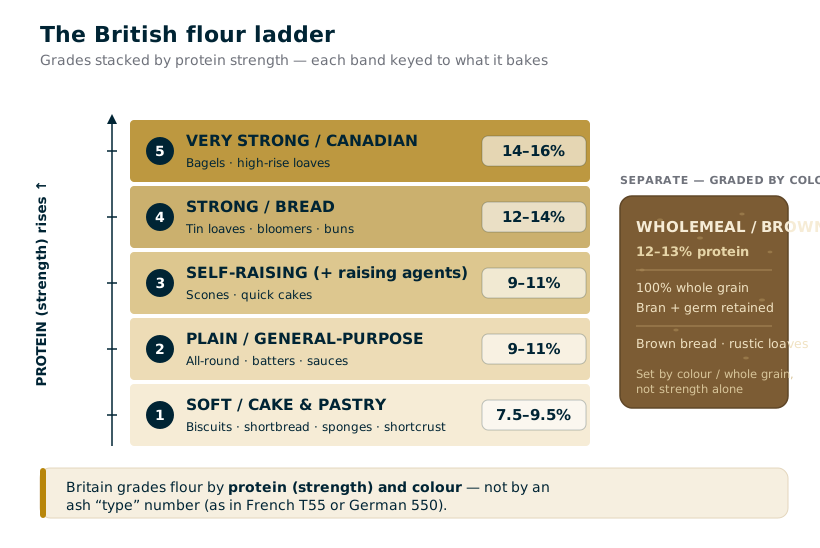 Orientation diagram stacking British flour grades by protein: soft/cake ~8%, plain 9-11%, self-raising 9-11%, strong/bread 12-14%, very strong/Canadian 14-16%, plus wholemeal/brown 12-13% — each band labelled with typical bakes (biscuits, sponges, scones, tin loaves, bagels, brown bread).
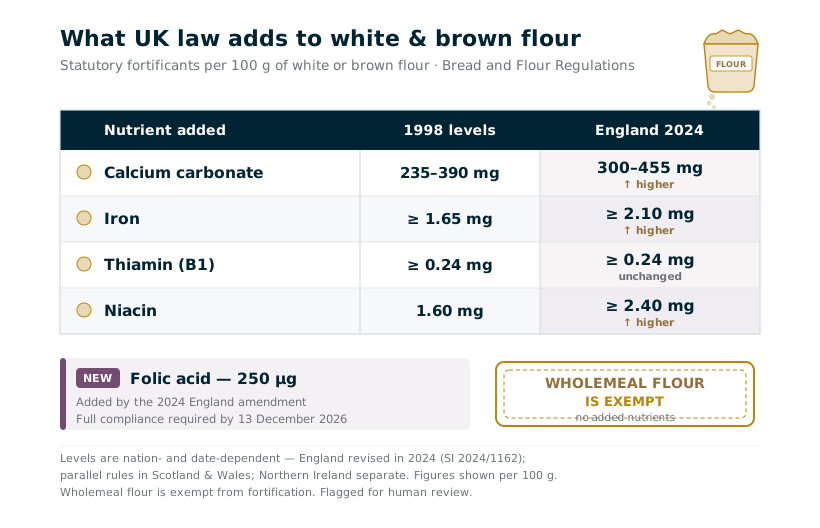 Infographic of the statutory flour fortificants per 100 g — calcium carbonate, iron, thiamin and niacin, shown at both the 1998 levels and the higher levels set by the 2024 England amendment (calcium carbonate 300-455 mg, iron 2.10 mg, niacin 2.40 mg, thiamin unchanged at 0.24 mg) — plus the new folic acid 250 µg addition, with a note that wholemeal flour is exempt and levels are nation- and date-dependent.
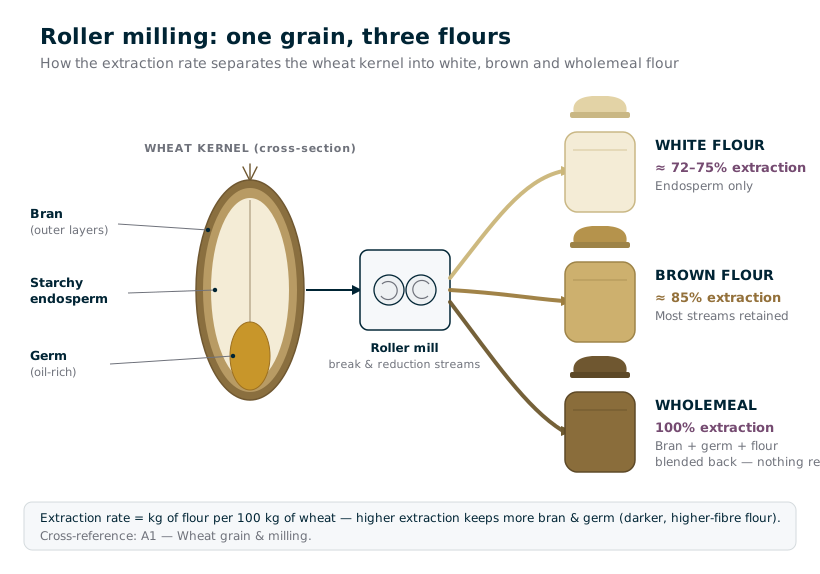 Cutaway wheat grain (bran, endosperm, germ) with arrows to three sacks: WHITE (~72-75% extraction, endosperm), BROWN (~85%, most streams), WHOLEMEAL (100%, whole grain, nothing removed).
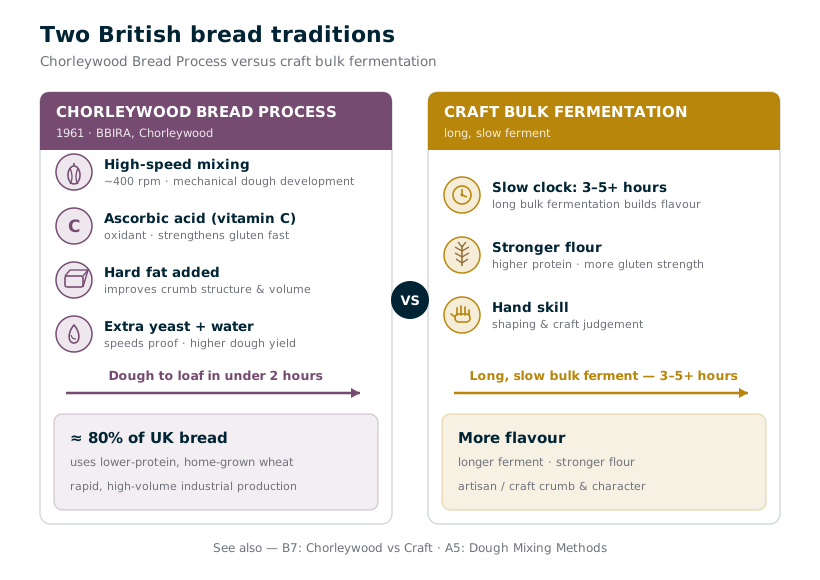 Two-column comparison: Chorleywood Bread Process (1961, high-speed mixing, ascorbic acid + fat + extra yeast/water, under 2 hours, ~80% of UK bread, lower-protein home-grown wheat) versus craft bulk fermentation (long slow ferment, 3-5+ hours, stronger flour, more flavour).
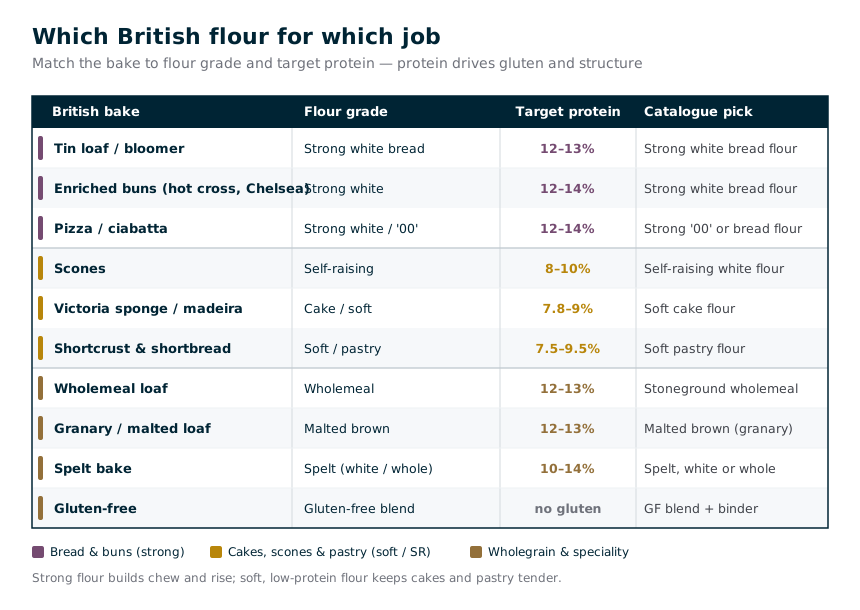 Product-to-flour decision grid: tin loaf/bloomer -> strong 12-13%; enriched buns -> strong white; pizza -> strong/00; scones -> self-raising; sponge/madeira -> cake flour; shortcrust/shortbread -> soft/pastry 7.5-9.5%; wholemeal loaf -> wholemeal; granary -> malted brown.
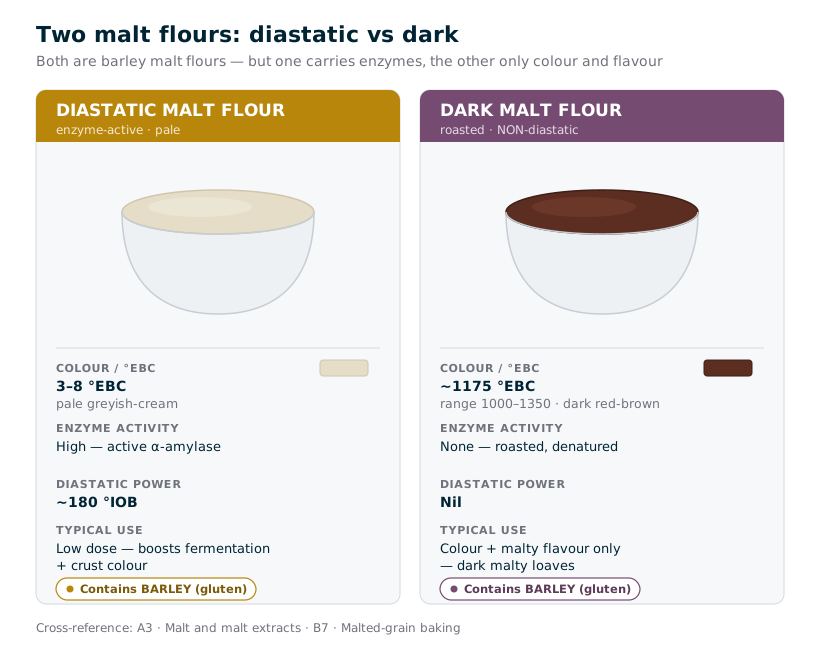 Comparison of two barley malt flours: pale diastatic malt flour (3-8 °EBC, high enzyme activity, low dose to boost fermentation and crust colour) beside very dark roasted colouring malt flour (1000-1350 °EBC, no enzymes, for dark malty loaves).
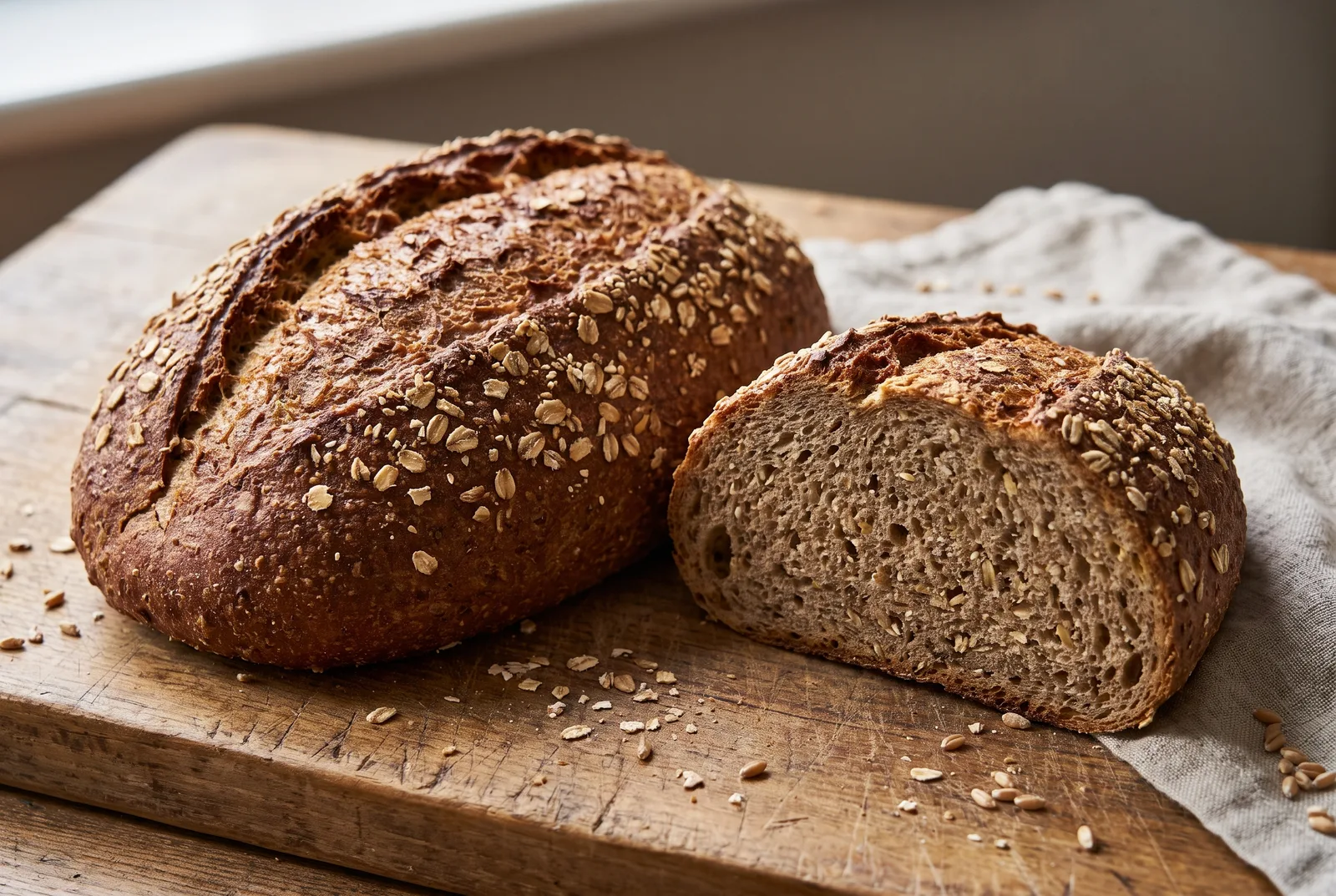 A domed malted brown loaf, its crust and crumb speckled with visible malted wheat flakes, illustrating a malted-brown / granary-style flour.
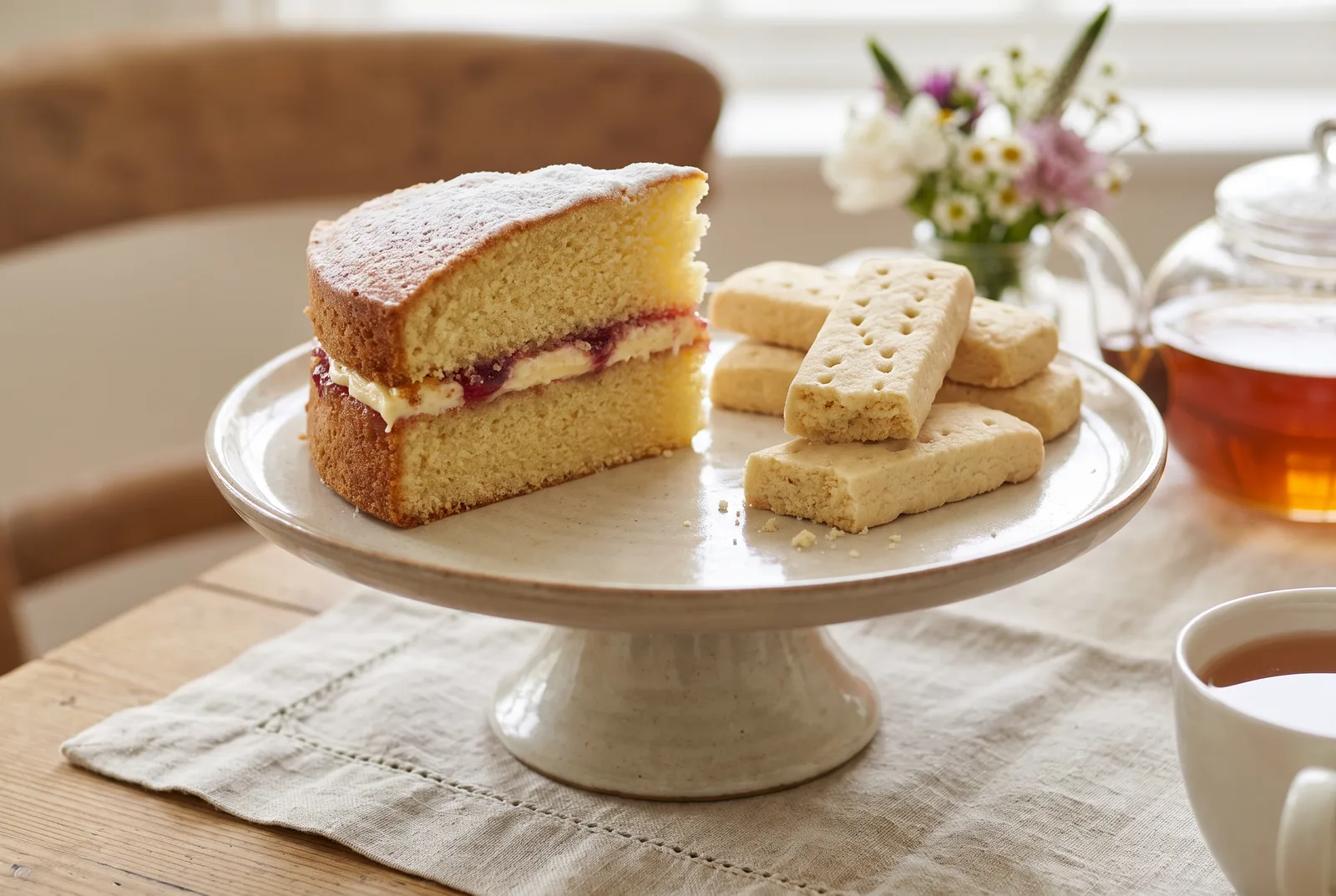 A light Victoria sponge cut to show a fine, tender crumb, beside pale shortbread fingers — both made from soft, low-protein British flour (7.5-9.5% protein).
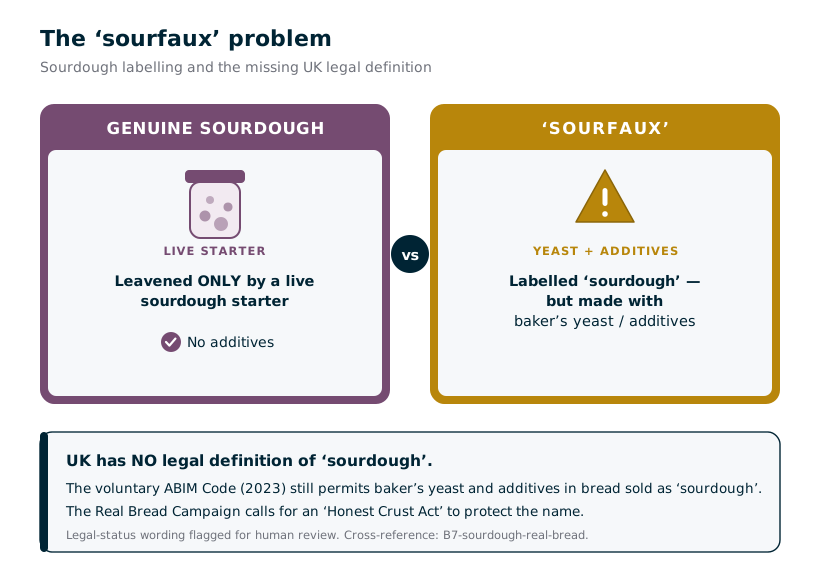 Concept diagram contrasting genuine sourdough (leavened only by a live starter, no additives) with 'sourfaux' (labelled sourdough but made with baker's yeast/additives), noting the UK has no legal definition of sourdough.
Choosing a British flour — the working baker's decision path
| Ingredient | Baker's % | Weight |
|---|---|---|
| Bread that must rise tall and hold gas: STRONG flour, protein 12-14% (Coniston G44142, Titan G45538). | ||
| Everyday / pizza / ciabatta: strong white 11.5-12.5% (Topspin G45539, Verace G45537). | ||
| Cakes, sponges, scones: SELF-RAISING or soft/heat-treated cake flour, protein 7.8-10% (Domson SR G43198, Top Flight G44731). | ||
| Pastry, shortbread, biscuits: SOFT/plain, protein 7.5-9.5% (Golden Jewel G43079, Domson Plain G43247). | ||
| Wholemeal/brown/granary: wholemeal or malted brown, protein 12-13% (Doves G45112, Maltster G45546). | ||
| Heritage/rustic: spelt (G45179 / G45141). Gluten-free: dedicated blend (G45114 / G45156). |
- Decide the JOB: does it need a strong gluten network (bread, enriched, pizza) or a tender, short result (cake, pastry, biscuit)? Strength first.
- Read the datasheet for PROTEIN % + Hagberg falling number, not an ash type number — that is how UK flour is specified (c9).
- Check whether the flour is treated: a UK strong/pizza flour may already carry ascorbic acid and enzymes (as Verace does, c16) — factor that into your improver dosing (see A3-what-is-a-bread-improver).
- If your flour is a touch weak for the job, lift it with vital wheat gluten rather than switching grade (see fc-strengthen-weak-flour and A3-vital-wheat-gluten).
- Remember the label: all these flours (except gluten-free) carry the statutory fortificants unless wholemeal/spelt-exempt, and all must be baked before eating (c1, c8).
A selection method, not a recipe. Anchored on the UK protein bands (Doves Farm, Veg Patch Kitchen) and the first-party datasheets. The single most important British point: buy by PROTEIN (strength) and colour, not by a type number.
Lifting a weak British flour with vital wheat gluten
| Ingredient | Baker's % | Weight |
|---|---|---|
| Base flour: your weaker white flour (say 10-11% protein) | ||
| Vital wheat gluten (e.g. Beneo VWG 75, G22839): each 1% added by flour weight lifts finished protein by roughly 0.6-0.9 percentage points | ||
| Extra water: vital wheat gluten is thirsty — increase hydration slightly |
- Work in baker's percentage on the flour weight. To move an 11% flour toward ~13%, add roughly 2-3% vital wheat gluten (verify against the VWG datasheet — the exact lift depends on the gluten's own protein).
- Dry-blend the gluten thoroughly into the flour before adding water so it hydrates evenly and does not clump.
- Add a little extra water to hydrate the added gluten; mix to full development.
- Do not over-dose: too much gluten gives a tight, rubbery, small-volume loaf. Prefer buying the right strong grade for the job where you can (see A3-vital-wheat-gluten).
British soft wheat is naturally lower in protein than Canadian hard wheat, which is exactly why UK mills add vital wheat gluten to hit a strong-flour spec — Titan (G45538) and Maltster (G45546) carry ~2.5% added gluten on their datasheets, and Golden Jewel and Domson Plain note gluten 'may be added' to meet protein (c13, c20, c22). You can do the same in the bakery. Rule of thumb only; see A3-vital-wheat-gluten for full dosing and A8-bakers-percentage-fundamentals for the maths.
| UK name | Typical protein | Wheat type | What it makes | Catalogue example (datasheet protein) |
|---|---|---|---|---|
| Extra strong / Very strong | 14-16% | Canadian / North American hard spring | Bagels, high-rise bloomers, pizza that must hold, blending up weak flour | Centurion Canadian Very Strong (G43252) |
| Strong / Bread flour | 12-14% | Hard wheat, often blended, sometimes gluten-fortified | Tin loaves, bloomers, rolls, enriched buns | Titan Strong Bakers 12.7-13.3% (G45538); Coniston Strong White 12.5-14.5% (G44142) |
| Strong white (standard) | ~11.7-12.4% | UK/Canadian blend | Everyday bread, pizza, ciabatta | Topspin Strong White 11.7-12.3% (G45539); Verace Pizza 11.7-12.4% (G45537) |
| Plain / general-purpose | 9-11% | Softer blend | Shortcrust, batters, sauces, biscuits, all-round | Domson Plain 8.0-10.2% (G43247) |
| Self-raising | 9-11% + raising agents | Plain-grade + baking powder | Scones, sponges, Victoria sandwich, quick cakes | Domson Premium Self-Raising 9.5-10.5% (G43198) |
| Soft / pastry | 7.5-9.5% | Soft (weak) wheat | Shortcrust, pastry, shortbread, sweet biscuits | Golden Jewel Pastry 7.5-9.5% (G43079) |
| Cake / sponge (heat-treated) | 7.8-9.2% | Soft wheat, heat-treated | High-ratio cakes, sponges, madeira | Top Flight Cake 7.8-9.2% (G44731) |
| Wholemeal / brown | 12-13% (whole grain) | Whole grain (100% / ~85% extraction) | Wholemeal loaves, granary-style, brown rolls | Doves Organic Strong Wholemeal 12.6% (G45112); Maltster Malted Brown 12.6-13.2% (G45546) |
Britain grades flour by PROTEIN and colour, using descriptive names, not by an ash-based type code (c9). Protein bands from Doves Farm and corroborated by Veg Patch Kitchen and the first-party datasheets read this session. Protein roughly tracks gluten strength: more protein = stronger dough. Bands overlap and are indicative.
| Product (SKU) | Grade | Protein | Water absorption | Hagberg / notes | Statutory additions |
|---|---|---|---|---|---|
| Titan Strong Bakers (G45538) | Strong bakers (gluten-fortified) | 12.7-13.3% | 57-62% | + added wheat gluten ~2.5% | Ca carbonate, niacin, iron, thiamin (BFR 1998) |
| Coniston Strong White (G44142) | Strong white | 12.5-14.5% | 58.0-61.0% | Hagberg min 250 s; ash ~0.8%; no added gluten | Calcium, iron, niacin, thiamin |
| Topspin Strong White (G45539) | Strong white | 11.7-12.3% | 57-62% | Added gluten 0-1.2% | Ca carbonate, niacin, iron, thiamin |
| Verace Pizza (G45537) | Pizza / 00-style (treated) | 11.7-12.4% (t 12.2) | 59-61% | Bran-speck-free; starch damage ~30; + ascorbic acid + fungal alpha-amylase | Calcium, iron, niacin, thiamin (BFR 1998) |
| Domson Plain (G43247) | Plain / general-purpose (soft) | 8.0-10.2% (t 9.1) | 50-56% | Fortified values/100g: Ca 180mg, Fe 2.5mg, niacin 2.45mg, thiamin 0.26mg | Ca carbonate, niacin, iron, thiamin |
| Domson Premium Self-Raising (G43198) | Self-raising | 9.5-10.5% | 52-58% | Raising agents E450+E500; Total CO2 0.6-0.85%; salt 2.22g/100g; 6-mth shelf life | Ca carbonate, niacin, iron, thiamin + raising agents |
| Top Flight Cake (G44731) | Cake (heat-treated) | 7.8-9.2% | n/a | Heat-treated + rehumidified; moisture 8.5-11.1%; Hagberg ~450 s | Calcium, iron, niacin, thiamin (BFR 1998) |
| Golden Jewel Pastry (G43079) | Pastry (wheat + maize) | 7.5-9.5% (t 8.5) | n/a | Blended with maize flour; vital wheat gluten may be added | Ca carbonate + Vitamix (BFR 1998) |
| Doves Organic Strong Wholemeal (G45112) | Organic wholemeal | 12.6 g/100g | n/a | Fibre 11.2g; NO added nutrients (wholemeal + organic exempt) | None (exempt) |
| Maltster Malted Brown (G45546) | Malted brown (granary-style) | 12.6-13.2% | n/a | Wheat 79% + malted wheat flakes 15% + malted barley 3% + gluten 2.5%; fibre 4.7g | Ca carbonate + Vitamix (brown = NOT exempt) |
| White Spelt (G45179) | Spelt (Triticum spelta) | 10.0-14.0% | n/a | Ancient wheat; NO added fortificants (non-common wheat) | None (exempt) |
All figures read verbatim this session from the on-disk product-spec PDFs (spec-* sources), one datasheet per product, first-party single-source. UK datasheets quote protein % (N x 5.7 unless noted) plus Hagberg falling number and water absorption — NOT wet gluten % or an ash type number. Water absorption is an analytical monitoring figure and may not equal full-scale bakery production (per the datasheets).
| Addition | 1998 level / 100 g | Revised — England 2024 / 100 g | Why | Applies to / exempt |
|---|---|---|---|---|
| Calcium carbonate (chalk) | 235-390 mg | 300-455 mg | Dietary calcium (added in wartime when dairy was scarce) | All flour EXCEPT wholemeal and certain calcium-sufficient self-raising |
| Iron | ≥ 1.65 mg | ≥ 2.10 mg | Restore iron lost in milling | White + brown non-wholemeal; wholemeal exempt |
| Thiamin (vitamin B1) | ≥ 0.24 mg | ≥ 0.24 mg (unchanged) | Restore B1 lost in milling | White + brown non-wholemeal; wholemeal exempt |
| Niacin (nicotinic acid / nicotinamide) | 1.60 mg | ≥ 2.40 mg | Restore niacin lost in milling | White + brown non-wholemeal; wholemeal exempt |
| Folic acid (NEW in 2024) | not required | 250 µg | Reduce neural tube defects (spina bifida) in babies (~200 cases/yr prevented, government estimate) | Non-wholemeal wheat flour; exempt: mills <500 t/yr, non-common wheat (spelt/emmer/einkorn/durum/khorasan), calcium-sufficient self-raising |
Levels per 100 g of flour. The 1998 figures are cross-checked across the Federation of Bakers, the gov.uk government response and the Committee on Toxicity. The REVISED England levels and folic acid are from the Bread and Flour (Amendment) (England) Regulations 2024 (SI 2024/1162, Schedule 1, read from legislation.gov.uk this session), corroborated by Campden BRI and UK Flour Millers: the 2024 amendment BOTH raised calcium carbonate, iron and niacin AND added folic acid, with full compliance by 13 Dec 2026. Levels are now nation- and date-dependent (England revised; parallel Scotland/Wales measures; Northern Ireland separate 1998 regs). REGULATORY / SAFETY — the exact current per-nation levels should be independently verified before any customer-facing use.
| You are making | Choose | Target protein | Catalogue pick(s) |
|---|---|---|---|
| Crusty tin loaf, bloomer, cob | Strong / strong white bread flour | 12-13% | Coniston (G44142), Titan (G45538), Topspin (G45539) |
| Enriched buns — hot cross, Chelsea, teacakes | Strong white (carries fat/sugar, pulls soft) | 12-13% | Titan (G45538), Coniston (G44142) |
| Pizza / ciabatta | Strong / 00-style pizza flour | 11.5-13% | Verace Pizza (G45537), Topspin (G45539) |
| Scones | Self-raising (or plain + baking powder) | 9-11% | Domson Self-Raising (G43198), Perfect SR (G43012) |
| Victoria sponge / madeira / cupcakes | Self-raising or heat-treated cake flour | 7.8-10% | Top Flight Cake (G44731), Domson Self-Raising (G43198) |
| Shortcrust, sweet pastry, biscuits, shortbread | Soft / plain / pastry flour | 7.5-9.5% | Golden Jewel Pastry (G43079), Domson Plain (G43247) |
| Wholemeal loaf / brown rolls | Wholemeal or brown flour | 12-13% | Doves Organic Wholemeal (G45112), Grampian Wholemeal (G45396) |
| Granary-style / malted-grain loaf | Malted brown flour + a touch of diastatic/colour malt | 12.5-13% | Maltster Malted Brown (G45546) + EDME malt flours |
| Rustic / heritage bake | Spelt (white or wholemeal) | 10-14% | White Spelt (G45179), Wholemeal Spelt (G45141) |
| Gluten-free bread/cakes | Dedicated gluten-free blend | n/a | Doves GF White Bread Flour (G45114), GF Plain Blend (G45156) |
A selection guide, not a fixed recipe. Match the JOB to the strength first (protein), then the colour/extraction. Catalogue picks are the closest Domson UK-stock products with first-party datasheets. Full product methods live in the sibling B7 dossiers.
| UK name | Approx. protein | Approx. colour / ash | ~PL/DE type | ~French T | ~Italian |
|---|---|---|---|---|---|
| Soft / cake / pastry | 7.5-9.5% | White, low ash | PL 450 / DE 405 | T45 | 00 (soft) |
| Plain / general-purpose | 9-11% | White | PL 500 / DE 550 | T55 | 00 / 0 |
| Strong / strong white bread | 12-14% | White | PL 550-650 / DE 550-812 | T55-T65 | 0 / Manitoba-style |
| Very strong / Canadian | 14-16% | White | PL 750 (strong) / Manitoba | - | Manitoba |
| Brown | 12-13% | ~85% extraction | PL 1400-1850 / DE 1050-1370 | T110-T130 | 1 / 2 |
| Wholemeal | 12-14% | 100% extraction | PL 2000 / DE Vollkorn | T150 | integrale |
British bakers who trained on Polish, Bulgarian, German, French or Italian type numbers need the crosswalk in reverse: the UK sells by protein/strength and by colour name, not by an ash number. This is an approximate bridge (c9, c10); ash bands overlap and protein is the surer guide in the UK. See A1-flour-classification-systems for the full treatment.
| Type | Example | Colour | Enzyme (diastatic) activity | Dose & purpose |
|---|---|---|---|---|
| Diastatic (enzyme-active) malt flour | EDME HDA White Bread Malt Flour (G44810) | Pale (3-8 °EBC) | High — diastatic power 165-220 °IOB | Low dose (~0.1-1%): boosts fermentation, flavour, crust colour by supplying amylase + sugars |
| Non-diastatic (colouring / roasted) malt flour | EDME Dark Malt Flour (G44469) | Very dark (1000-1350 °EBC) | None — roasting destroys the enzymes | Colour + flavour only, for dark/malted loaves and malt bread; no enzyme effect |
The word 'malt flour' covers two opposite ingredients. Numbers read from the EDME datasheets this session; diastatic-vs-non-diastatic principle corroborated by Shipton Mill. Both are barley-derived, so both carry the BARLEY allergen. See A3-malt-and-malt-extracts for the enzyme science.
| Product | Fault | Likely flour cause | Fix |
|---|---|---|---|
| Tin loaf / bloomer | Poor volume, dense crumb | Flour too weak (protein below ~11-12%) | Move to a strong flour 12-14% (Coniston G44142, Titan G45538), or lift with vital wheat gluten |
| Sponge / cake | Tough, tight, shrunken crumb | Flour too strong (used bread flour) | Use self-raising or soft/heat-treated cake flour 7.8-10% (Domson SR G43198, Top Flight G44731) |
| Shortcrust / shortbread | Hard, chewy, shrinks in the tin | Plain flour too strong / over-worked gluten | Use a soft/pastry flour 7.5-9.5% (Golden Jewel G43079); mix minimally, rest chilled |
| Scones | Flat, no lift | Plain flour with no raising agent, or stale self-raising | Use fresh self-raising (G43198, 6-month shelf life) or plain + fresh baking powder (see A2-chemical-leaveners-baking-powder) |
| Pizza base | Won't stretch / tears / shrinks back | Flour under-strength or gluten under-rested | Use a strong/pizza flour (Verace G45537); rest the dough so gluten relaxes |
| Wholemeal loaf | Coarse, low, heavy | Wholemeal bakes weaker by nature (bran interference) | Expected — allow more hydration/time, or blend with strong white; see A1-wholemeal-and-high-extraction |
| Any loaf from a treated flour | Over-tight / small if you also add improver | Flour already carries ascorbic acid + enzymes (e.g. Verace) | Read the declaration; reduce or omit your own improver dose (see A3-what-is-a-bread-improver) |
Links a common defect to the flour choice. General diagnostic guidance; see A5-bread-faults-causes-remedies for the full bread-fault map.