
Preferments in Practice: Poolish, Biga, Sponge & Pâte Fermentée — When and How to Use Them
A practical field guide for professional bakers on the four principal yeasted preferments: poolish, biga, sponge (plastic sponge / sponge-and-dough) and pâte fermentée. Covers the science of what each one does to your dough, exact yeast dosages and fermentation schedules, ripeness assessment, fault diagnosis, and how to choose the right preferment for each product type. Maps to Domson catalogue yeast products (Benevia, NG & SF, Fermipan Red, DCL Levure Premium) and the Aromaferm Wheat & Malt Ferment 110 as a flavour-addition option.
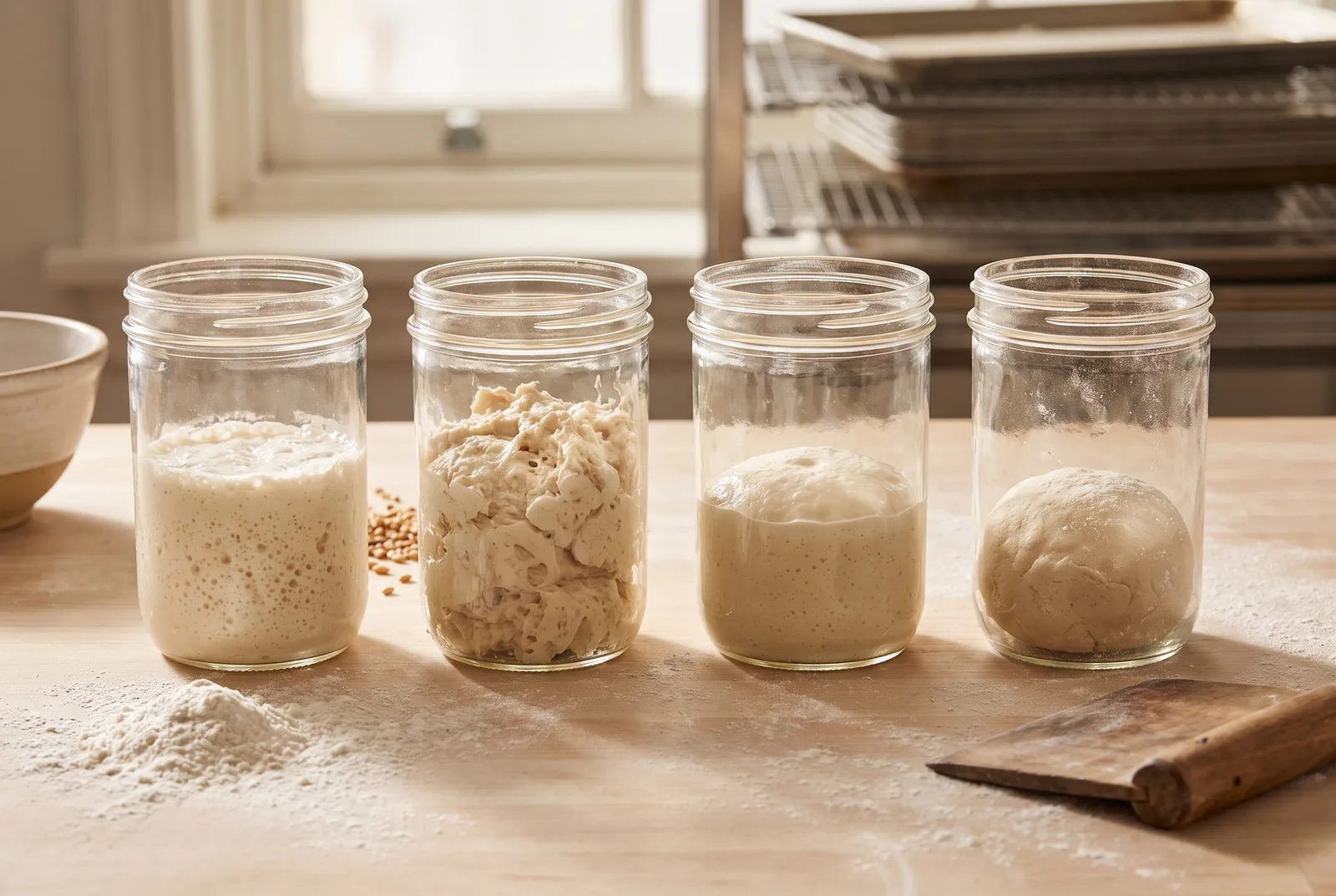
What is a preferment and why bother?
A preferment is a portion of a bread formula's flour, water and yeast that is mixed and allowed to ferment — typically overnight — before being incorporated into the main dough. The investment of time pays back in three ways that a straight (no-ferment) dough cannot easily replicate:
Flavour. Yeast and the enzymes naturally present in flour produce organic acids (lactic and acetic), alcohols, esters and carbon dioxide during fermentation. The precise balance of lactic vs. acetic acid, the concentration of aromatic fermentation by-products, and the degree of proteolytic (protein breakdown) activity all contribute character that is impossible to achieve in a two-hour straight dough.
Dough handling. Enzymatic activity during the preferment stage — particularly protease and amylase action — loosens the gluten network, making the final dough more extensible and machinable. Enriched doughs (high fat, high sugar) that would otherwise impede yeast activity benefit especially from having most of their yeast pre-seeded in a sponge stage.
Shelf life. The organic acids produced lower the dough's pH, slowing the mould growth that causes bread to spoil. Bread made with preferments consistently outlasts equivalent straight-dough product by one to two days in controlled comparisons.
The choice of which preferment to use is principally a choice about hydration, salt content, timing and the flavour profile you want.
The four preferments
<!-- IMAGE: img-pref-04 — process flow diagram showing both routes -->1. Poolish
Origin and tradition. The origin of the poolish method is debated in culinary history literature. One account links it to a Polish–Austrian baking tradition of the 19th century, suggesting it spread from Central Europe to France where it became the standard preferment for pain viennois and subsequently the baguette. However, this narrative is contested: other sources suggest a French origin, and the historical attribution remains unresolved. The method is documented in French professional baking by the mid-19th century.
What it looks like. Poolish is a batter, not a dough. It is always 100% hydration — equal weights of flour and water — with a very small quantity of yeast and no salt. Just mixed, it has the texture of a thick pancake batter. After fermentation it becomes bubbly and airy, with a lacy, foam-like surface.
What it does. Because of its high water content, poolish strongly favours enzymatic activity. Proteases break down gluten proteins, producing a highly extensible final dough that is easy to open and shape. The fermentation chemistry tilts towards lactic acid, giving a mild, creamy tang reminiscent of good yogurt rather than sharp sourness.,
When to use it.
- Baguettes and French-style white breads (the canonical use).
- High-hydration artisan loaves where an open, irregular crumb is desired.
- Ciabatta (alongside or as an alternative to biga).
- Pizza doughs where a thin, extensible base is required.
- White rolls, soft buns, and croissants where a mild, clean fermentation flavour is preferred over pronounced tang.
Proportion. Commonly 20–50% of total formula flour goes into the poolish, with 30–40% being the most practical range. More than 50% is possible but requires careful final-dough adjustment.,
<!-- IMAGE: img-pref-02 — yeast dosage vs time chart for poolish -->Yeast dosage. The most important variable in poolish production is the inverse relationship between yeast quantity and fermentation time. Using more yeast speeds fermentation but sacrifices flavour development. The following ranges (all as percentages of the flour weight in the poolish, using fresh compressed yeast) are practical professional targets:
| Target time | Fresh yeast on poolish flour | Instant dry yeast equivalent |
|---|---|---|
| ~4 hours | ~1.5% | ~0.5% |
| ~8 hours | ~0.23–0.33% | ~0.08–0.11% |
| ~12 hours | ~0.3–0.6% | 0.1–0.2% |
| 16–18 hours | ~0.09–0.24% | 0.03–0.08% |
(Note: all figures are single-source — confidence:low. The 4-hour fresh yeast figure (~1.5%) is consistent with general professional guidance. Instant dry yeast figures for 12 h and 16–18 h (0.1–0.2% and 0.03–0.08%) are reported directly by Weekend Bakery; fresh yeast equivalents are calculated at ×3. Verify with test bakes for your specific yeast and conditions.)
Fermentation temperature. Standard overnight poolish ferments well at 18–21°C. If the bakery is warmer than 21°C, either reduce yeast further or refrigerate the poolish during part of the fermentation. Very long retards (18+ hours) should be at refrigerator temperature (4–6°C) with a proportionally higher yeast dosage to ensure the poolish is fully ripe before use.
<!-- IMAGE: img-pref-03 — ripeness assessment diagram -->Ripeness assessment. A ripe poolish:
- Has risen to maximum height (often reaching the top of the container).
- Shows a domed or slightly peaked surface covered with small CO₂ bubbles; a lacy foam visible through the container wall.
- Smells pleasantly fruity and yeasty — a slight tang is detectable but not harsh.
- Is just beginning to recede in the centre — this is the optimal moment to use it.
An over-ripe poolish smells sharply alcoholic or vinegary, the surface has sunk and is flat or wrinkled, and liquid may have separated at the edges. Bread made from an over-ripe poolish will have poor volume, flat scores, and an off-flavour.
2. Biga
Origin and tradition. Biga is the Italian equivalent of a yeasted preferment — the word simply means "preferment" in Italian baking terminology. It is the standard method behind ciabatta, focaccia, pizza bianca, and many Italian hearth breads.
What it looks like. Biga is a stiff, shaggy mass at 50–60% hydration (water on biga flour weight). Just mixed, it barely holds together and looks rough. After 12–16 hours it relaxes and expands, taking on a porous, sponge-like structure with an aroma combining fresh yeast, mild acid and nutty grain.
What it does. Biga's lower water content slows enzymatic activity relative to poolish, shifting the fermentation chemistry towards acetic acid production — giving a sharper, more complex flavour profile. The restricted enzyme activity preserves more gluten integrity in the final dough, which translates into greater dough strength and elasticity. This is why biga breads have the characteristically large, uneven, irregular holes of good ciabatta rather than the more uniform crumb of a poolish loaf.,
Biga also performs well in warm bakeries: the stiff consistency acts as a thermal buffer, slowing over-fermentation.
When to use it.
-
Ciabatta, focaccia, pizza bianca: biga percentage typically 30–40% of total flour.
-
Italian artisan hearth breads, grissini, and rustic loaves.
-
Panettone and enriched Italian sweet breads (where a modified biga — sometimes called a lievito madre variant — builds gluten strength to hold butter and eggs).
-
Any product where you want pronounced flavour complexity and chewy elasticity.
Proportion. Professional Italian bakeries typically use 20–40% of total flour in the biga, with 30–40% for ciabatta and focaccia and 20–30% for lighter Italian breads.
Yeast dosage. Biga uses relatively small amounts of yeast, though professional references differ on the exact range. BAKERpedia's biga process page cites 0.8–1.5% fresh yeast on biga flour weight as the standard range; BAKERpedia's general preferment page and ChainBaker cite lower figures (0.08–1%) applicable to extended cold retard conditions. A practical professional target for a 12–16-hour ambient biga at 16–18°C is 0.2–0.3% fresh yeast on biga flour weight. (Note: sources disagree on the lower bound; the 0.08% figure applies specifically to long cold retard conditions — do not use at ambient temperatures, where the biga would be severely under-fermented.)
Mixing. Do not over-mix biga. Combine flour, water and yeast just until no dry flour remains — a rough, irregular mass is correct. Cover tightly (the low hydration dries out quickly if exposed) and ferment at 16–18°C for 12–16 hours. For an extended cold retard, ferment at 4–6°C for 24–48 hours (increase yeast to 0.3–0.5% to ensure the biga reaches full ripeness in the cold).
3. Sponge (sponge-and-dough method)
Origin and tradition. The sponge-and-dough process is the dominant long- fermentation method in UK and North American plant bakeries. It was used commercially long before the Chorleywood Bread Process (CBP, 1961) replaced it in high-volume plant production, and it is experiencing a resurgence in the clean-label artisan sector.,
What it looks like. Unlike poolish or biga, the sponge uses the majority of the formula's flour — typically 60–90% — with a hydration of 58–65% on the sponge flour weight. The result is a soft, plastic dough (not a batter or a stiff mass) that ferments in a bulk trough or container.
What it does. Because the sponge contains most of the formula's flour and most or all of the formula's yeast (at a much higher dosage than poolish or biga), it ferments much faster — 2–8 hours at 24–29°C, with the typical "drop" or "break" (when the sponge peaks and just starts to recede) occurring in 3–5 hours.
The longer fermentation improves flavour compared to a straight dough, but the higher temperatures and faster pace produce a different character than an overnight poolish — more neutral, yeasty-sweet rather than tangy. The main practical advantages are:,
- Improved dough machinability and pan flow — sponge doughs are more extensible and uniform than straight doughs.
- Better proof tolerance in enriched doughs (high sugar, high fat content) because the yeast is fully active before encountering the inhibitory enrichments.
- Consistent, high-volume, fine-crumbed sandwich-style loaves.
When to use it.
- Sandwich bread, toast loaves, burger buns, hot-dog rolls.
- Soft enriched rolls with sugar and fat.
- Any production that requires machinability and dimensional consistency.
- NOT for open-crumb artisan loaves (use poolish or biga instead).
Proportion and yeast dosage. Sponge uses 60–90% of total formula flour; a typical UK commercial target is 70%. Compressed yeast dosage is much higher than for poolish or biga: 1.5–5% on total formula flour (not just sponge flour), with all yeast concentrated in the sponge stage.
Process. Mix sponge ingredients just to incorporate; no gluten development is needed or wanted. Ferment at 24–29°C in a covered trough for 2–4 hours. The sponge is ready when it has peaked and just begun to recede, with a strong yeasty-sour aroma. Add the remaining ingredients (remaining flour, salt, water, and any fat or sugar) at the final dough mix immediately upon reaching the drop point. Final dough bulk time is short — 10–20 minutes — as most fermentation is complete.
Food safety note: Sponge fermentation at 24–29°C falls within the temperature range at which bacterial growth can occur. This is established commercial practice because high yeast activity rapidly acidifies the sponge, suppressing pathogens — but the sponge must be used promptly once it reaches the drop (peak and just beginning to recede). Do not hold a fermented sponge at temperatures above 24°C beyond the drop point. If production is interrupted, transfer the sponge to refrigeration immediately. Confirm these temperature and timing parameters meet your local food hygiene regulations before implementing in a licensed food business.
4. Pâte Fermentée (old dough)
Origin and tradition. Pâte fermentée is French for "fermented dough" and in practice means keeping a portion of the previous day's finished bread dough as the preferment for the following batch. It is the least technically demanding preferment and the most practical for bakers who bake daily.
What makes it unique. Pâte fermentée is the only yeasted preferment that contains salt — because it is saved from fully-formulated bread dough. The presence of salt means it ferments more slowly and predictably than an equivalent salt-free preferment.
What it does. Pâte fermentée adds flavour complexity and improves dough handling without the extreme tang of sourdough. Breads made with it have a slightly deeper crust colour, a more complex crumb aroma, and better keeping quality than straight-dough equivalents. Because its hydration mirrors the main bread formula, it integrates easily without adjusting water calculations significantly.
When to use it.
- As the everyday preferment for a bakery that bakes a consistent range — no separate preferment build is needed; simply reserve some dough at the end of each bake.
- French country breads, mixed-grain loaves, rolls.
- As a rapid "bridge" to building preferment culture in a new bakery.
Proportion. Typically 10–30% of total formula flour weight (as pâte fermentée). Higher percentages increase tang and complexity but also require care with salt balance, since the pâte fermentée already contains salt at ~2%.
Storage. Refrigerate as soon as it is cut from the batch. Use within 3 days. The salt slows but does not halt fermentation; after 3 days, quality deteriorates. A batch can also be frozen for up to 3 months if production pauses.
Choosing the right preferment
| Your priority | Best choice | Why |
|---|---|---|
| Maximum flavour, open crumb | Biga (35–40%) | Acetic-dominant; preserves gluten strength; large irregular holes |
| Extensible dough, mild tang | Poolish (30–40%) | Lactic-dominant; high enzymatic activity; uniform crumb |
| Soft enriched bread, machinability | Sponge (70% flour) | Higher yeast, faster, more neutral flavour; better pan flow |
| Convenience for daily bakers | Pâte fermentée (20%) | No separate build; adds complexity with zero extra ingredients |
| Speed (same-day production) | Short sponge (4–6 h) or fast poolish (4 h, 1.5% yeast) | Higher yeast reduces time; less flavour but still better than straight dough |
For most artisan white bread applications, poolish and biga are interchangeable — baked results are notably similar, with slow-fermented preferments yielding slightly more flavour depth than a fast sponge. The practical decision often comes down to: whether you want extensibility (poolish) or strength (biga), and whether your bakery is warmer (biga is more forgiving) or cooler (poolish is fine at room temperature overnight).
Selecting your yeast
<!-- IMAGE: img-pref-05 — Benevia fresh yeast product shot --> <!-- IMAGE: img-pref-06 — Fermipan Red instant dried yeast product shot -->All four preferment types can be built with any format of commercial yeast. The critical consideration is precision at very low dosages — the tiny quantities used in overnight poolish and biga (sometimes less than 1 g per kilogram of flour) must be weighed on a scale accurate to 0.1 g or dissolved in water and portioned volumetrically.
Fresh compressed yeast is the traditional professional choice for preferments. It dissolves cleanly in water, disperses evenly through a wet batter or stiff dough, and carries a consistent activity level. Domson catalogue options:
- Benevia 10 kg (Lesaffre): Dry matter >29%; fermentative activity 125 ±10 ml CO₂ (risograph method). Store at 1–10°C (optimum 4°C). Shelf life 35 days from production. No Annex II allergens declared in the finished product per the Lesaffre spec sheet. (Sulphites are present in molasses used during manufacture. EU Regulation 1169/2011 requires declaration of sulphur dioxide and sulphites when present at >10 mg/kg in the finished product. Confirm that carry-over levels are below this threshold with the current spec sheet before making allergen- free claims to customers with sulphite sensitivity.)
- Fresh Yeast Traditional 12 kg (Lallemand): Dry matter 28–35%; 28-day shelf life at ≤8°C. Kosher and Halal certified, GMO-free, gluten-free.
- Fresh Yeast NG & SF Fast Active 12 kg (Lallemand): Same dry matter range; described as "high activity" and "fast acting," particularly for no-time dough and Chorleywood-type processes — equally suitable for preferments where a slightly more active culture is wanted.
- DCL Craftbake Traditional+ and High Activity 10 kg: DCL Yeast brand options for fresh compressed yeast users in the UK market.
Instant dry yeast is the correct choice when fresh yeast is unavailable or when precise dosing at very low levels is easier in powdered form. Instant dry yeast does not require rehydration — it is added directly to the flour in the preferment mix. Multiply fresh yeast weight by approximately ÷3 to get the instant equivalent.
-
Fermipan Red 10 kg (Lallemand): Instant active dried yeast for lean doughs (0–10% sugar). Dry matter >95%; shelf life 2 years unopened at ambient. Dosage in direct baking: 1–1.5% on flour weight. For overnight poolish: see IDY column in yeast dosage table above (÷3 from fresh yeast). Contains emulsifier E491 (sorbitan monostearate, 1%); no Annex II allergens per EU Regulation 1169/2011. Gluten-free; Kosher and Halal certified; GMO-free; vegan. (Confirm E491 carry-over exemption applies in your finished product under Annex VII of Regulation 1169/2011 if incorporating this yeast into a compound ingredient declaration.)
-
DCL Levure Premium 10 kg: Alternative instant dried yeast option.
-
Dried Yeast Pakmaya: Active dry yeast requiring rehydration at 35–40°C before adding to preferment. Use 20% more than equivalent instant dry yeast dosage.
Yeast conversion guide:
| Start from | Multiply by to get fresh yeast | Divide by to get instant dry yeast |
|---|---|---|
| Fresh compressed | ×1 | ÷3 |
| Instant dry yeast | ×3 | ×1 |
| Active dry yeast | ×2.5 | ÷1.2 |
(Conversion ratios are approximate; verify with test bakes for your specific product.)
Adding dried wheat sourdough for flavour depth
For bakers who want to add sourdough character to a preferment bread without maintaining a live sourdough culture, a dried acidified wheat substrate can be added at the final dough stage.
Aromaferm Wheat & Malt Ferment 110 (AB Mauri / Cereform), 12.5 kg bags: A dried wheat sourdough produced from fermented wheat malt (90–100%) and wheat milling products (5–10%). Appearance: beige free-flowing powder, aromatic-malty odour, acidic-aromatic flavour. pH approx. 3.3; Total Titratable Acidity 110 ±10%. Moisture <5%; shelf life 12 months at 0–25°C sealed.
Application: Add at 1–5% on flour weight in the final dough. At 1–2%, it sharpens the flavour of a poolish bread without overwhelming the mild lactic tang; at 3–5%, it produces a pronounced sourdough-like acid note in an otherwise yeast-leavened product. This is commonly called a "short-time sourdough" or "flavour replacement" approach in industrial baking.
Allergen note: Aromaferm Wheat & Malt Ferment 110 CONTAINS GLUTEN (cereals containing gluten — wheat). Cross-contamination with gluten is also possible on the same manufacturing/packing line and on the same manufacturing site. Do not use in gluten-free products.
Worked example formulas
The four formula cards below provide complete baker's-percentage breakdowns for each preferment type. Short summaries:
Overnight Poolish Baguette / White Bread
30% of total flour into a 100%-hydration poolish, built 12–16 hours ahead at 18–21°C with ~0.09–0.18% fresh yeast (on total flour; or 0.03–0.06% instant dry yeast on total flour — equivalent to ~0.3–0.6% fresh / 0.1–0.2% IDY on poolish flour). Final dough: remaining 70% flour, water adjusted to ~78–80% total hydration, 2% salt. Short bulk (30–60 min), shape, proof, bake with steam.
<!-- IMAGE: img-pref-08 — poolish baguette formula card diagram -->Biga Ciabatta / Focaccia
35% of total flour into a 55%-hydration stiff biga, built 12–16 hours at 16–18°C with 0.07–0.1% fresh yeast (on total flour). Final dough at 78–82% total hydration, 2% salt, minimal shaping. Bake at maximum oven temperature with steam.
<!-- IMAGE: img-pref-07 — poolish vs biga crumb comparison -->Sponge & Dough Sandwich Bread / Soft Rolls
70% of total flour in sponge at 63–65% hydration with 1.5–2.5% compressed yeast (on total formula flour). Sponge ferments 2.5–4 hours at 24–27°C. Final mix adds remaining 30% flour, salt, water, and optional fat/sugar. Short bulk, divide, mould, pan, proof, bake.
Pâte Fermentée
Save 20–30% of the current day's bread dough (after full mixing, before shaping). Refrigerate immediately. Use within 3 days as a preferment for the next batch. Supplement with 0.5–1% fresh yeast at final mix to ensure adequate leavening.
Troubleshooting at a glance
Full fault table is below. Key points:
- Over-fermented preferment → reduce yeast or temperature; never add an over- ripe preferment at full percentage. If over-ripe, use at 10–15% as a flavour agent only and add fresh yeast to compensate.
- Under-fermented preferment → extend time at room temperature; increase yeast slightly next time; check yeast freshness (fresh compressed yeast past its shelf life loses activity rapidly — Benevia shelf life is 35 days; NG & SF is 28 days).
- Sponge not dropping on time → raise fermentation temperature or increase yeast by 0.5% total flour.
- Final dough too tight despite preferment → increase prefermented flour percentage; ensure preferment was fully ripe; reduce final dough mix time when using poolish.
Coverage notes and gaps
Solid: All four preferment types defined and differentiated; yeast dosage ranges for poolish confirmed across three or more independent references; sponge-and-dough parameters confirmed across three sources including trade body (Federation of Bakers) and BAKERpedia; biga parameters confirmed across BAKERpedia, King Arthur, PizzaBlab and Busby's; all four Domson-catalogue yeast products cited with verified spec-sheet numbers; Aromaferm cited with full spec-sheet parameters; allergen declarations extracted from spec sheets.
Thin (single-source or low-confidence): All poolish yeast dosage figures (single source; table corrected to distinguish fresh vs instant dry yeast units — a previous draft incorrectly attributed IDY figures to fresh yeast); historical etymology of "poolish" [contested; article now presents a balanced account]; biga yeast dosage range [sources conflict: BAKERpedia process page gives 0.8–1.5% fresh; general preferment page and ChainBaker cite 0.08–1%; article notes this discrepancy with context-specific guidance].
Not covered in this article (see related articles):
- Sourdough cultures (wild yeast preferments — see A2-sourdough-cultures-science).
- Ready-to-use industrial sourdough concentrates (see A2-ready-use-sourdough-industrial).
- Rye sourdough multi-stage methods (see A2-rye-sourdough-multi-stage).
- Osmotolerant yeast for enriched and sweet doughs (see A2-osmotolerant-yeast-enriched-doughs).
- No academic peer-reviewed literature was sourced for this article (baker's percentage formulations and organic acid profiles are covered by professional trade references at the required depth for this audience).
Figures
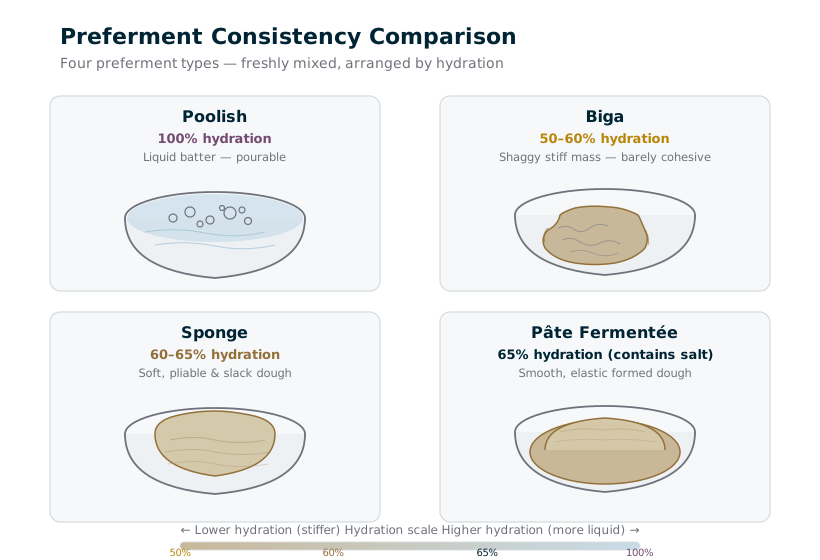 Four glass bowls showing freshly mixed poolish, biga, sponge, and pâte fermentée side by side, demonstrating their different consistencies
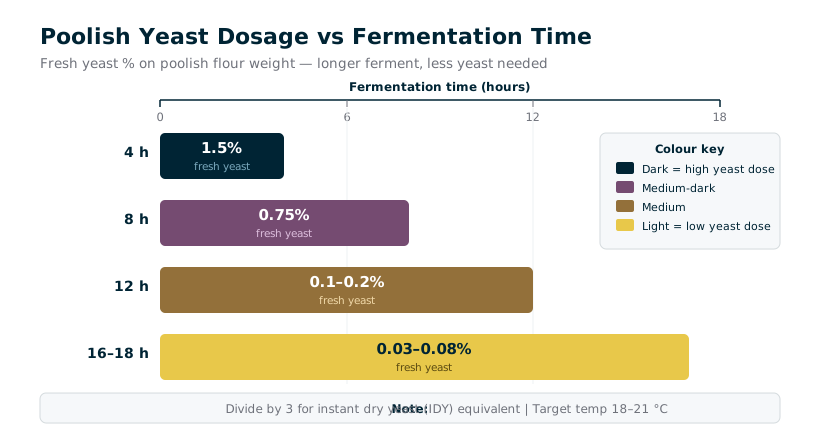 Chart showing that as poolish fermentation time increases from 4 to 16 hours, the required fresh yeast percentage decreases from 1.5% to 0.03–0.08%
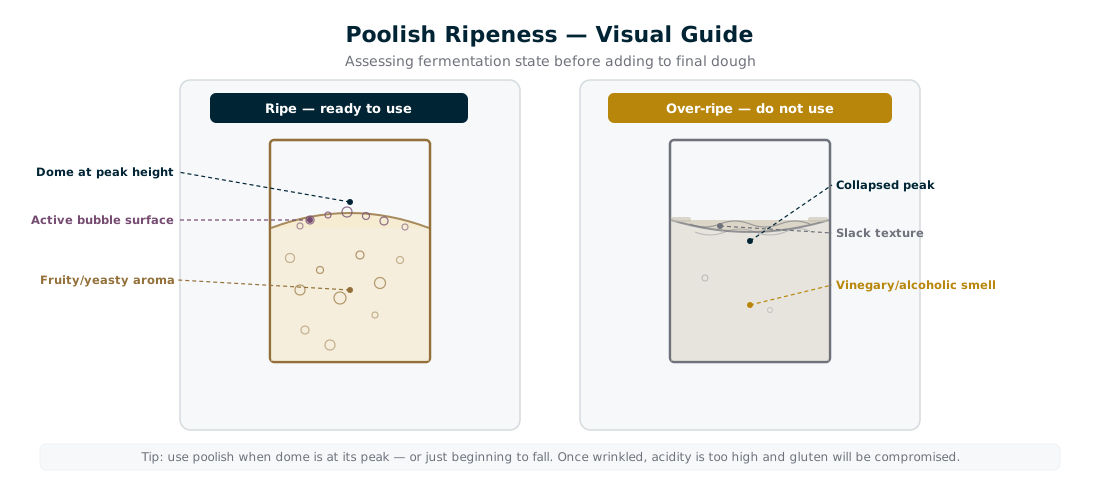 Two-panel diagram showing a ripe poolish (domed, bubbly surface) vs an over-ripe poolish (collapsed, wrinkled surface) in a clear container
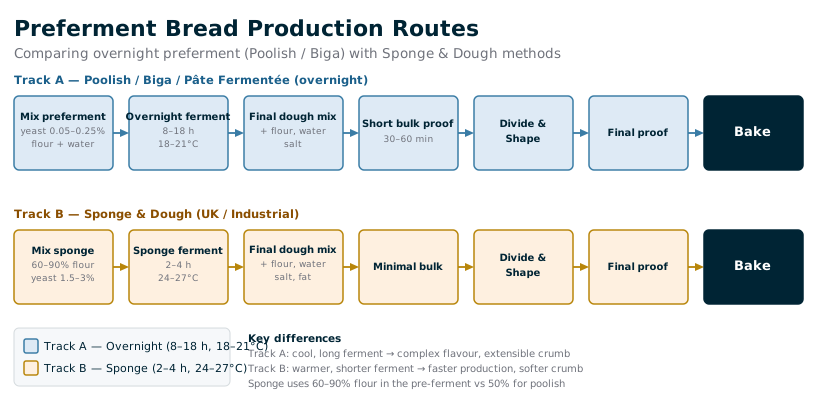 Process flow diagram comparing the overnight preferment route (poolish/biga) with the shorter sponge-and-dough route for professional bread production
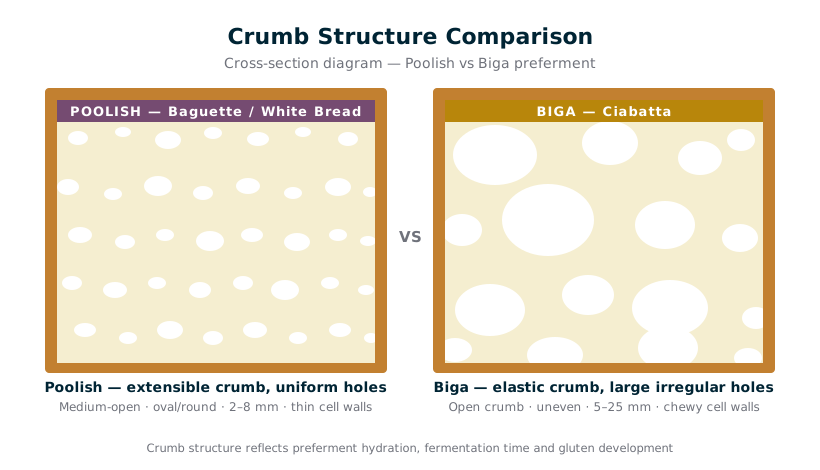 Side-by-side cross-section crumb comparison: poolish bread (medium-open, uniform crumb) versus biga ciabatta (open, irregular crumb with large holes)
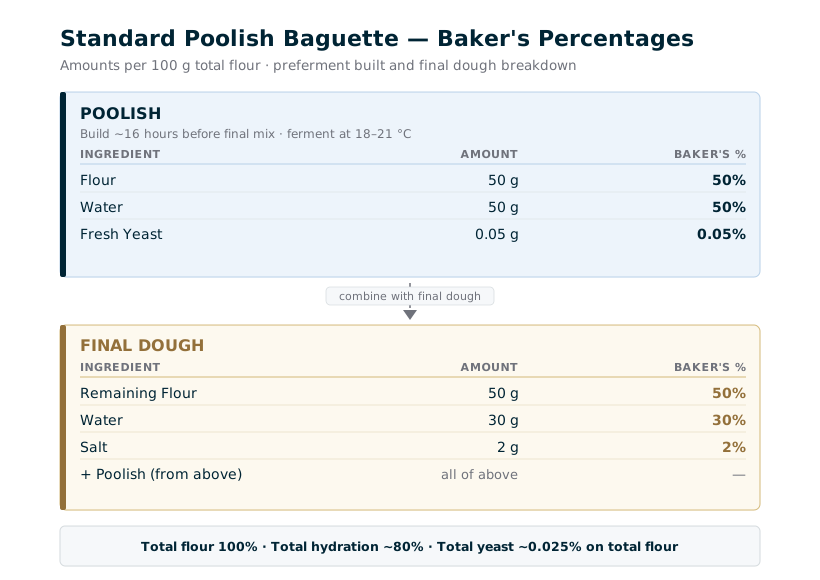 Formula card showing baker's percentage breakdown for a poolish baguette recipe with preferment and final dough sections
Overnight Poolish — French-Style Baguette / White Bread
A standard 30% poolish formula for a high-hydration white bread. All quantities in baker's percentages (% of total flour = 100%). Total hydration ~78–80%.
- poolish
Biga Ciabatta / Focaccia — Italian-Style Open-Crumb Bread
A 35% biga formula producing the open, irregular crumb characteristic of ciabatta. High overall hydration. Baker's percentages on total flour.
- biga
Sponge & Dough — Soft Sandwich Bread / Soft Rolls
The classic UK/industrial sponge-and-dough method producing consistent, machinable soft bread. Baker's percentages on total flour.
- sponge
Pâte Fermentée — Old Dough / French Bread
Keep a portion of today's main dough as tomorrow's preferment. Uniquely, this preferment contains salt. Baker's percentages on total flour.
- pate-fermentee
Core parameters for the four principal yeasted preferments used in professional bread production. Yeast dosages are as a percentage of the flour weight in the preferment itself (not total formula flour), using fresh compressed yeast (Saccharomyces cerevisiae). Divide by 3 for approximate instant dry yeast equivalent.
| Preferment | Origin / tradition | Hydration (water on preferment flour) | Salt | Fresh yeast dosage (on preferment flour) | Fermentation time | Temperature | Typical flour % of total formula | Primary application |
|---|---|---|---|---|---|---|---|---|
| Poolish | Polish / French (baguettes, croissants, rolls) | 100% | None | Fresh compressed: ~0.09–0.24% (16–18 h); ~0.3–0.6% (12 h); ~0.23–0.33% (8 h); ~1.5% (4 h). Instant dry: 0.03–0.08% (16–18 h); 0.1–0.2% (12 h); ~0.08–0.11% (8 h); ~0.5% (4 h). (Single-source) | 4–18 hours depending on yeast level | Room temp ~18–21°C for overnight; refrigerate if >18 h | 20–50% of total formula flour (typically 30–40%) | Baguettes, ciabatta, pizza, white rolls, croissants |
| Biga | Italian (ciabatta, focaccia, Italian breads) | 50–60% | None | 0.08–1% (range varies by time and temperature) | 8–16 hours; can extend 24 h at refrigerator temperature | Cooler than poolish typical; 16–18°C for 12-16 h or 4–6°C for cold retard | 20–40% of total formula flour (30–40% for ciabatta/focaccia) | Ciabatta, focaccia, pizza bianca, Italian hearth breads, panettone (modified) |
| Sponge (UK/industrial plastic sponge) | US/UK plant baking (sandwich bread, toast, soft rolls) | 58–65% (based on sponge flour weight) | None in sponge stage (salt added at final dough mix) | Compressed yeast 1.5–5% (on total formula flour) | 2–8 hours; typical 'drop' (break) at 3–5 hours | 24–29°C (75–85°F) | 60–90% of total formula flour in the sponge | Sandwich bread, toast, burger buns, soft rolls, enriched doughs (high sugar/fat) |
| Pâte Fermentée (old dough) | French (mixed breads, baguettes de tradition) | Mirrors the main bread dough (typically 60–68%) | Yes — contains full salt (same as final dough, ~2%) | Full yeast carried over from previous production batch | Minimum 6 hours at room temp; can refrigerate overnight | Room temp for 6+ hours; or refrigerate 1–3 days | 10–30% of total formula flour | Baguettes, mixed-grain loaves, rolls — adds complexity with convenience |
Inverse relationship between yeast quantity and fermentation time for poolish. More yeast = faster fermentation but less developed flavour. Fresh yeast figures for 12h and 16–18h are derived by multiplying the Weekend Bakery instant dry yeast figures by 3 (standard conversion). All single-source — verify with test bakes. CORRECTION NOTE: a previous draft incorrectly attributed instant dry yeast figures to fresh yeast for the 12h and 16–18h rows; this table reflects the corrected values.
| Target fermentation time | Fresh yeast dosage (on poolish flour weight) | Instant dry yeast dosage (on poolish flour weight) | Condition | Notes |
|---|---|---|---|---|
| ~4 hours | ~1.5% | ~0.5% | Room temperature, same-day use | Fast poolish; limited flavour development; useful when timing is tight |
| ~8 hours | ~0.23–0.33% | ~0.08–0.11% | Room temperature | Good compromise; mix in the evening for morning bake |
| ~12 hours | ~0.3–0.6% | 0.1–0.2% | Room temperature 18–21°C | Standard overnight poolish; excellent flavour; most common professional schedule. IDY figure from Weekend Bakery; fresh = IDY × 3 |
| 16–18 hours | ~0.09–0.24% | 0.03–0.08% | Room temperature 18–21°C; refrigerate if warmer | Maximum flavour development; very minimal yeast; temperature control critical. IDY figure from Weekend Bakery; fresh = IDY × 3 |
Equivalencies between the three yeast formats available in the Domson catalogue (fresh compressed, instant dried, active dried) when formulating preferments. All ratios are approximate — exact activity can vary by strain, storage history and water temperature. Verify with test bakes for new products.
| Start from | To get fresh yeast quantity | To get instant dry yeast quantity | To get active dry yeast quantity | Source note |
|---|---|---|---|---|
| Fresh compressed yeast (e.g. Benevia, NG & SF, DCL Craftbake) | × 1 | ÷ 3 | ÷ 2.5 | Dry matter >29% for Benevia; 28–35% for NG & SF (spec sheets) |
| Instant dry yeast (e.g. Fermipan Red, DCL Levure Premium) | × 3 | × 1 | × 1.2 | Fermipan Red DM >95% (spec sheet). Added to dough directly — no rehydration needed |
| Active dry yeast (e.g. Pakmaya) | × 2.5 | ÷ 1.2 | × 1 | Requires rehydration in warm water (35–40°C) before adding to preferment |
Practical troubleshooting guide for the most common preferment problems in professional production. Signs observed in the preferment itself and their downstream effects on the final loaf.
| Fault | Likely cause(s) | Signs in preferment | Signs in finished bread | Remedy |
|---|---|---|---|---|
| Preferment over-fermented | Too much yeast for the fermentation time and temperature,Kitchen too warm (above 24°C for long overnight ferment),Fermented too long | Surface has collapsed and receded; flat or wrinkled top; acidic/alcoholic/vinegary smell; liquid separation at edges (for poolish) | Poor oven spring; scores do not open; flat loaf; dense compressed crumb gummy at base; very sour or off flavour; dull crust colour | Reduce yeast dosage or shorten fermentation time or lower temperature. Use over-fermented preferment in reduced quantity (10–15%) as a flavour additive only, not as sole leavening. |
| Preferment under-fermented | Too little yeast for the target time,Kitchen too cold,Fermented too short a time | Barely risen or not risen; no bubble activity; bland, flour-like aroma; no tang | Poor volume; lack of oven spring; bland flavour; dense crumb; may feel similar to straight dough | Give preferment more time (covered at room temperature). Increase yeast slightly next time. In warm weather, build preferment later in the day to avoid over-fermenting overnight. |
| Poolish too liquid / won't hold structure after mixing | Normal for poolish (100% hydration) — not a fault per se,If sponge is intended: water was miscalculated | Very runny, batter-like consistency | Not a fault if hydration is intentional; final dough may be harder to handle | Poolish is always batter-like. If a firmer preferment is needed, switch to biga (55% hydration) or sponge (62–65%). Check water calculation if this is unexpected. |
| Biga too dry / will not come together | Hydration too low (below 50% on biga flour),Water not fully incorporated during mixing | Crumbly, powdery mass that does not hold together | May still produce acceptable bread if it ferments successfully; uneven texture possible | Biga at 50–55% hydration is intentionally rough and shaggy — do not over-mix. Add a tiny amount of extra water (1–2%) if genuinely crumbly. Ensure water is not too cold during mixing. |
| Sponge does not reach 'break' / 'drop' point | Insufficient yeast,Temperature too low (<22°C),Flour very low in fermentable sugars | Sponge is dense, barely risen after 3–4 hours; surface flat without dome | Final bread lacks volume and may taste bland or raw-doughy | Move sponge to warmer area (24–28°C). Increase yeast by 0.5% total flour. Check yeast freshness — compressed yeast beyond shelf life (>35 days for Benevia) loses activity rapidly. |
| Final dough feels tight / low extensibility despite preferment | Preferment percentage too low,Preferment was under-ripe,Flour too strong / high gluten index,Final dough mixed too long with poolish | Preferment itself looked normal | Loaves spring back when shaped; oven spring is tight; crumb close and small-holed | Increase preferment percentage from 20% to 30–40%. Ensure preferment was at full ripeness. Rest dough longer between shaping steps. For poolish breads, reduce mixing time — poolish already develops extensibility. |
- Hydration pct:
- 100
- Salt:
- none
- Yeast pct on preferment flour · Overnight 16h:
- ~0.09–0.24% fresh (or 0.03–0.08% instant dry)
- Yeast pct on preferment flour · Overnight 12h:
- ~0.3–0.6% fresh (or 0.1–0.2% instant dry)
- Yeast pct on preferment flour · 8h:
- ~0.23–0.33% fresh (or ~0.08–0.11% instant dry)
- Yeast pct on preferment flour · 4h:
- ~1.5% fresh (or ~0.5% instant dry)
- Fermentation time h:
- 4–18
- Fermentation temp c:
- 18–21 (room); refrigerate above 21°C for overnight
- Prefermented flour pct of total:
- 20–50
- Primary acids:
- lactic (mild, creamy)
- Effect on dough:
- increased extensibility, uniform crumb, mild tang
- Hydration pct:
- 50–60
- Salt:
- none
- Yeast pct on preferment flour · 8 16h:
- 0.08–1% fresh (wide range by time/temperature)
- Fermentation time h:
- 8–24
- Fermentation temp c:
- 16–18 for 12–16 h; 4–6°C for extended cold retard
- Prefermented flour pct of total:
- 20–40
- Primary acids:
- acetic (sharper, more complex)
- Effect on dough:
- increased elasticity and strength, open irregular crumb, pronounced flavour
- Hydration pct:
- 58–65 (on sponge flour weight)
- Salt:
- none in sponge; added at final dough mix
- Yeast pct on total formula flour:
- 1.5–5% fresh compressed
- Fermentation time h:
- 2–8 (typical 3–5)
- Fermentation temp c:
- 24–29
- Prefermented flour pct of total:
- 60–90
- Primary use:
- soft bread, sandwich loaves, enriched doughs, burger buns
- Hydration pct:
- mirrors main dough (~62–68)
- Salt:
- yes (~2% on pâte fermentée flour weight)
- Yeast pct:
- carried over from previous batch; supplement 0.5–1% fresh at final mix
- Fermentation time h:
- minimum 6 at room temp; up to 72 refrigerated
- Prefermented flour pct of total:
- 10–30
- Primary use:
- French breads, mixed-grain, rolls
- Type:
- dried wheat sourdough (flavour additive)
- Dosage pct on flour:
- 1–5
- Ph:
- ~3.3
- Tta:
- 110 ±10
- Moisture pct:
- <5
- Shelf life:
- 12 months at 0–25°C (sealed)
- Allergens:
- CONTAINS GLUTEN (wheat)
- Notes:
- Not a live preferment — a dried acidified wheat substrate used to add sourdough-like flavour and acid character to yeasted preferment breads. Can be combined with poolish or sponge to add tang without full sourdough fermentation.
- Dry matter pct:
- >29
- Shelf life days:
- 35
- Storage temp c:
- 1–10 (optimum 4)
- Allergens:
- None of 14 major EU allergens; sulphites present in molasses used during production
- Dry matter pct:
- 28–35
- Shelf life days:
- 28
- Storage temp c:
- ≤8
- Description:
- Fast-acting; designed for no-time dough / Chorleywood process; also usable in preferments
- Dry matter pct:
- >95
- Shelf life years:
- 2
- Dosage pct on flour:
- 1–1.5
- Storage:
- cool, dry, ambient (unopened)
- Description:
- For lean doughs 0–10% sugar; 1% emulsifier E491; added directly without rehydration
- Allergens:
- None; gluten free; Kosher/Halal; GMO free
Buy the ingredients
Catalogue products and brands referenced in this article.

Fresh Yeast Benevia 10 kg
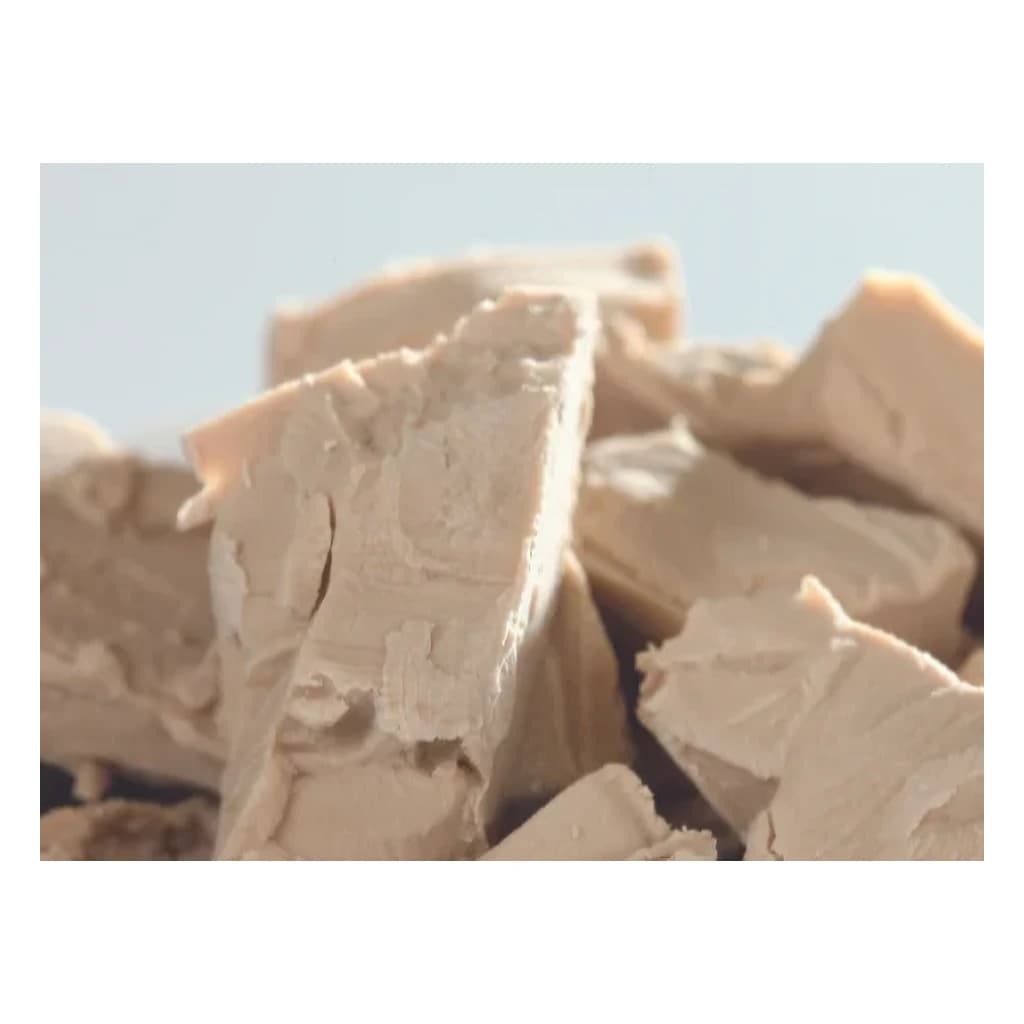
Fresh Yeast Traditional 12 kg
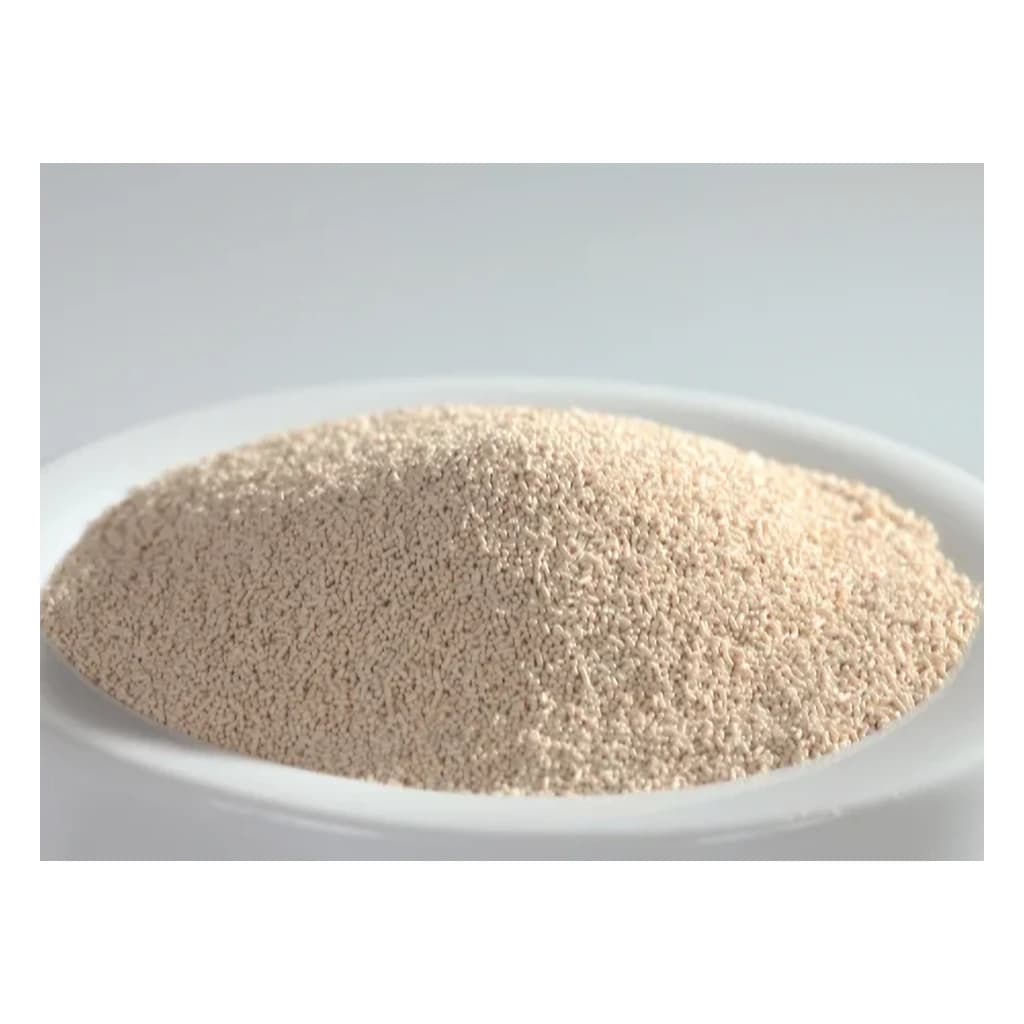
Dried Yeast Pakmaya 20 × 500 g (10 kg)
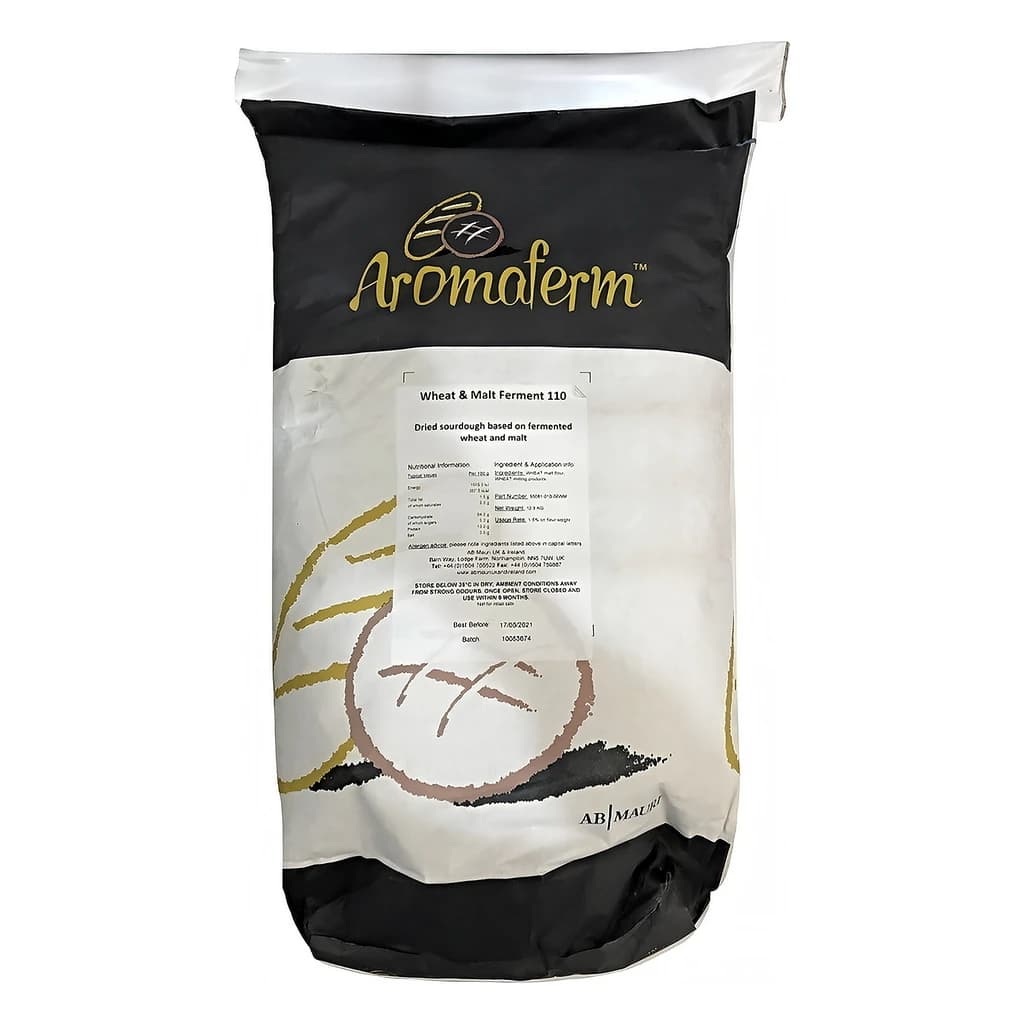
Aromaferm Wheat & Malt Ferment 110 12.5 kg
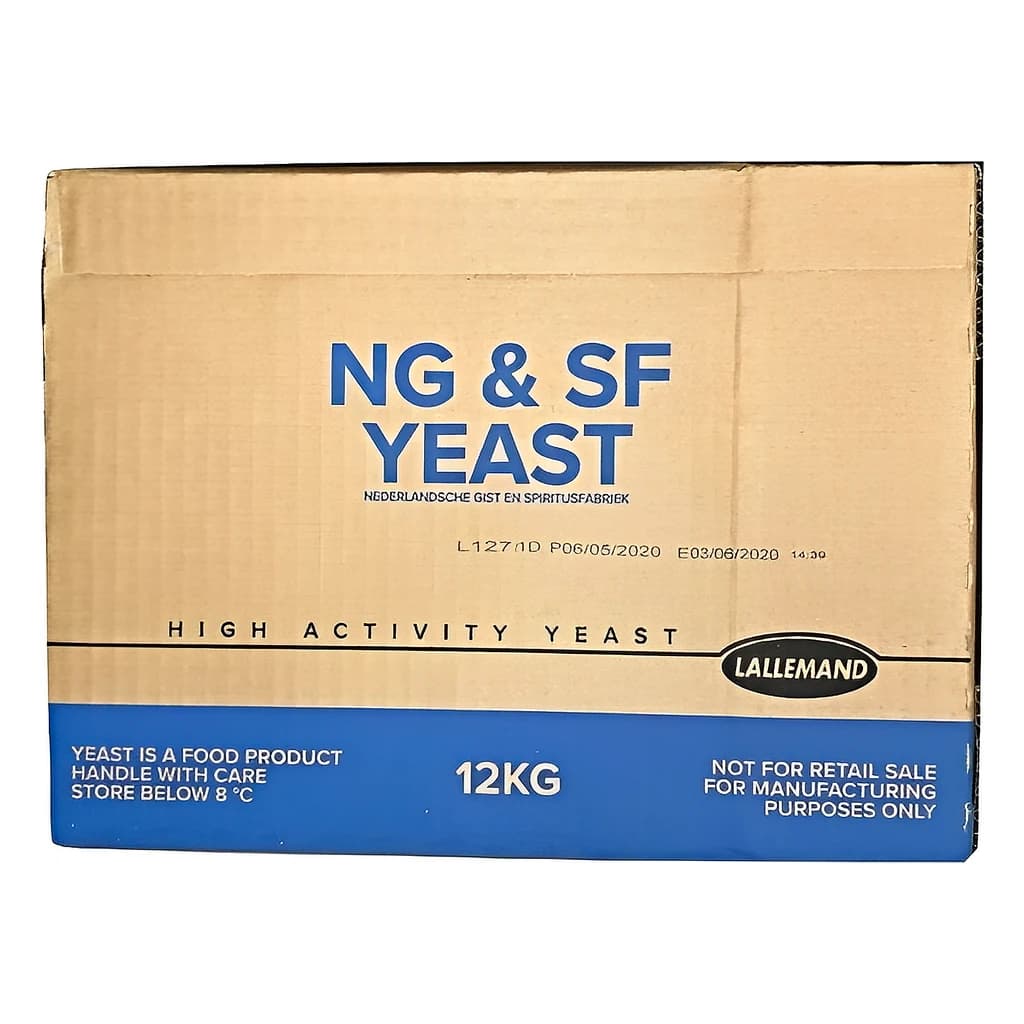
Fresh Yeast NG & SF Fast Active 12 kg
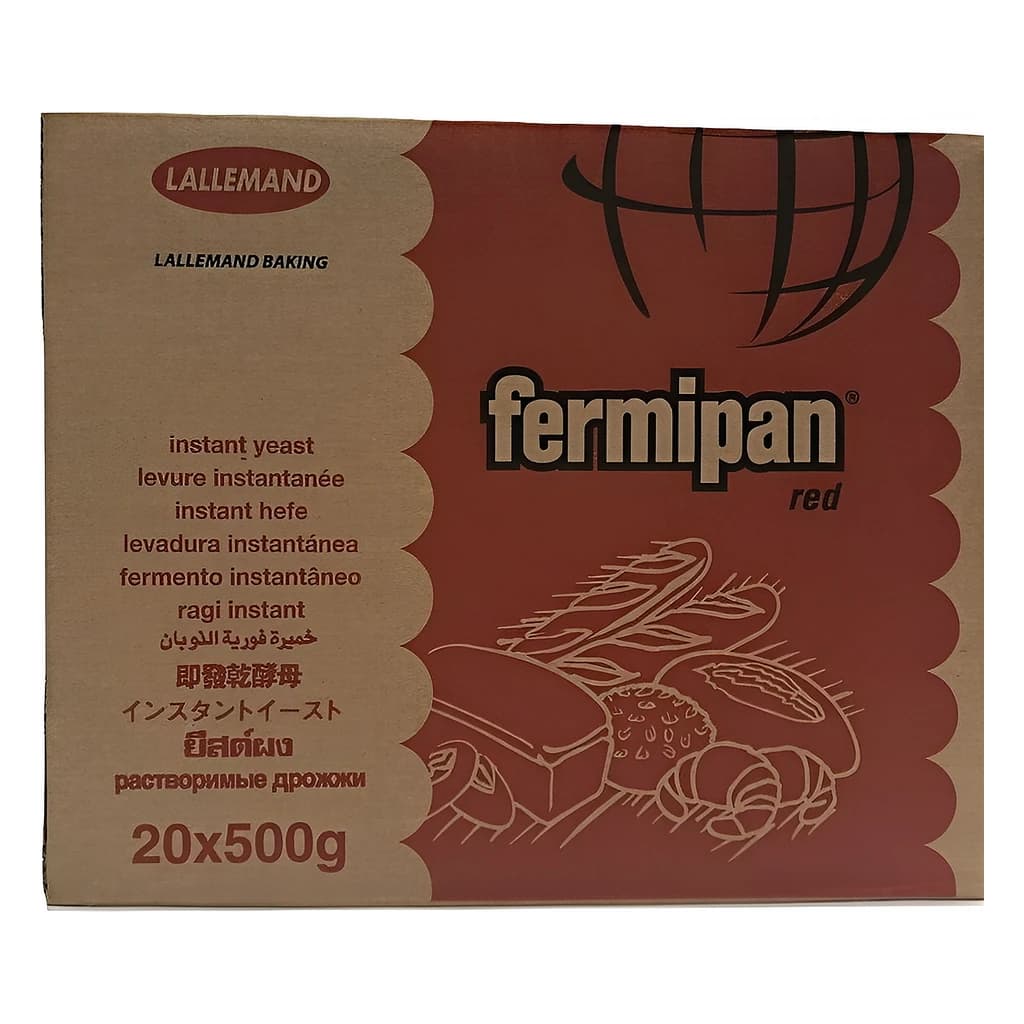
Dried Yeast Fermipan Red 10 kg
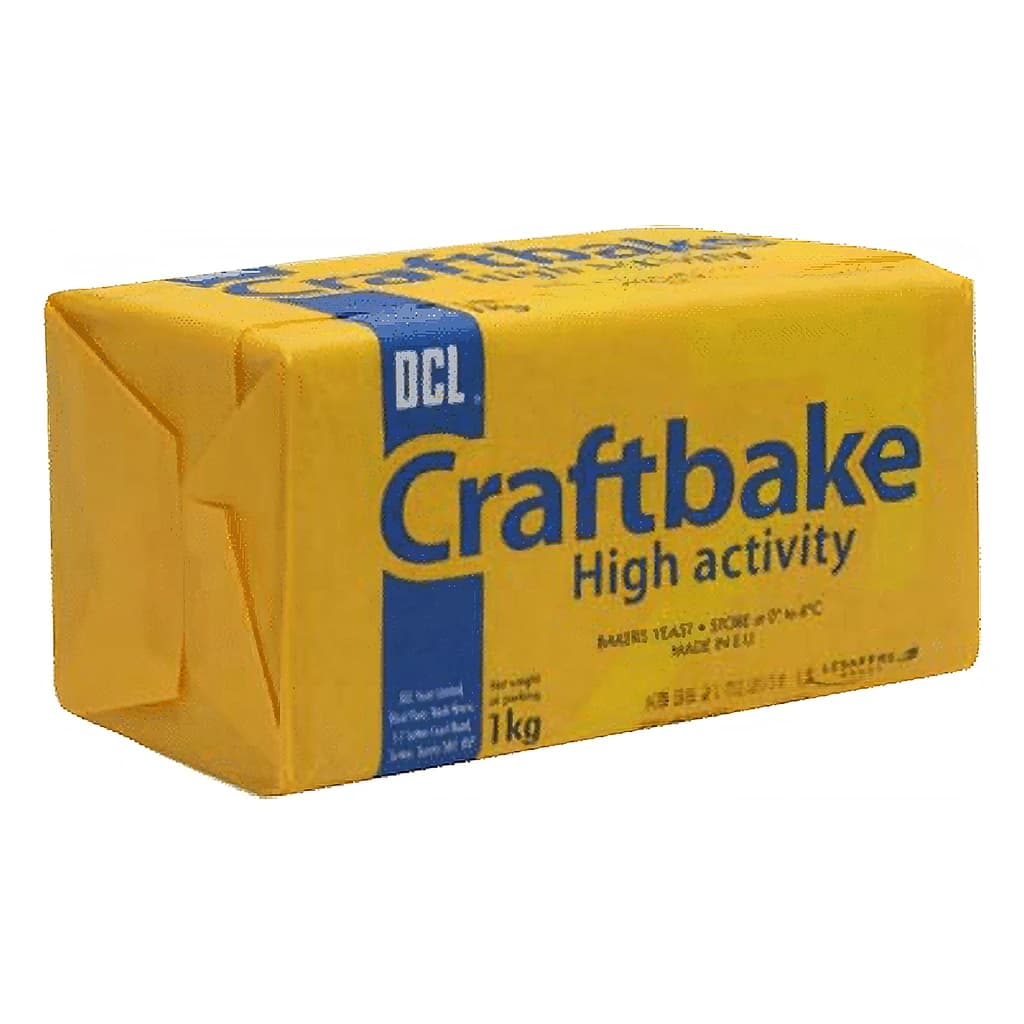
Fresh Yeast DCL Craftbake High Activity 10 kg
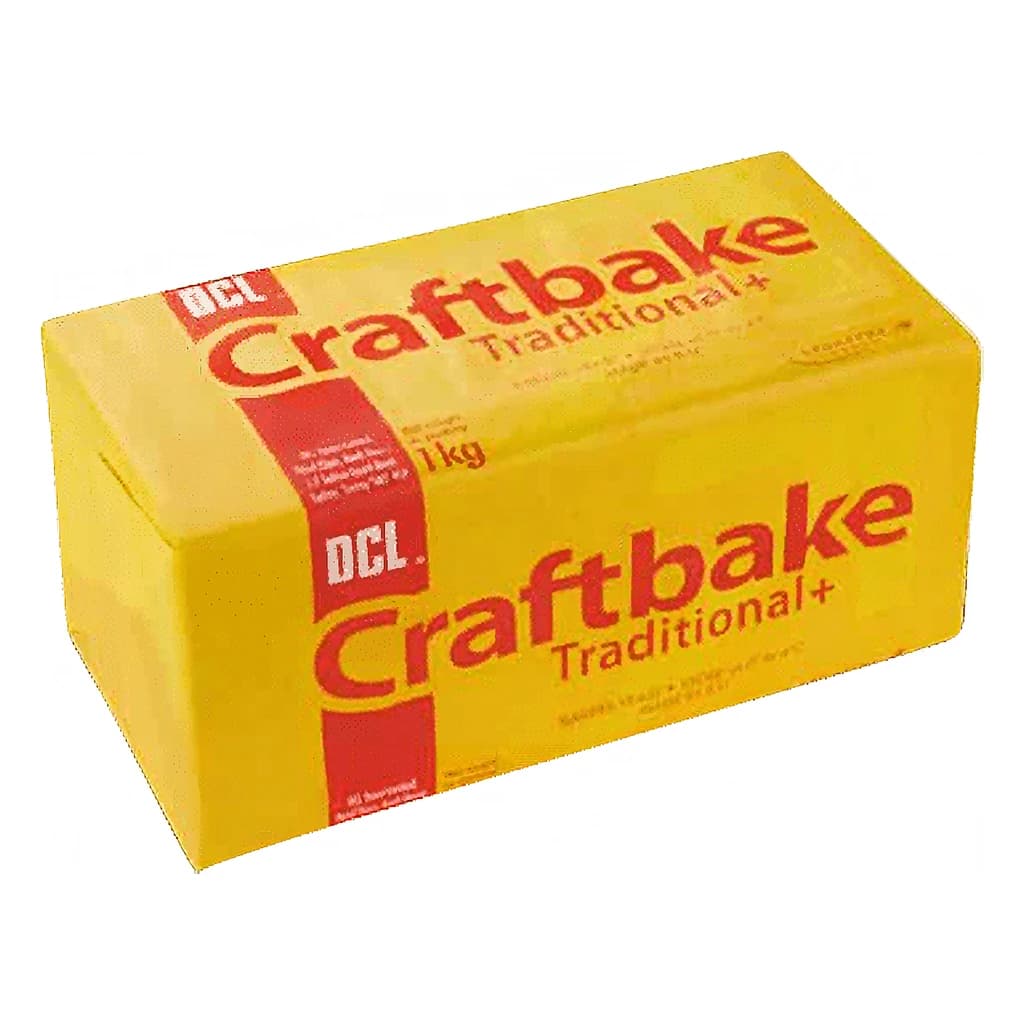
Fresh Yeast DCL Craftbake Traditional+ 10 kg

Dried Yeast DCL Levure Premium 10 kg