
Bread improvers and enzyme technology: what they contain, how they work and when to use them
A deep-technical guide for professional bakers on the science inside bread improvers: the chemistry of ascorbic acid oxidation, how specific enzyme classes alter dough rheology and crumb structure at a molecular level, what emulsifiers do to the gluten network and starch granules, and when each component is actually needed. Covers the full ingredient anatomy of powder, paste and liquid improvers with dosage data from first-party spec sheets (Zeelandia Optimax Free, Rye Stabil Free, Gamma GP; Puratos Pronto; Berliner 10 Free). Includes a seven-enzyme comparison table, emulsifier HLB classification, application-decision guide and a twelve-fault troubleshooting table.
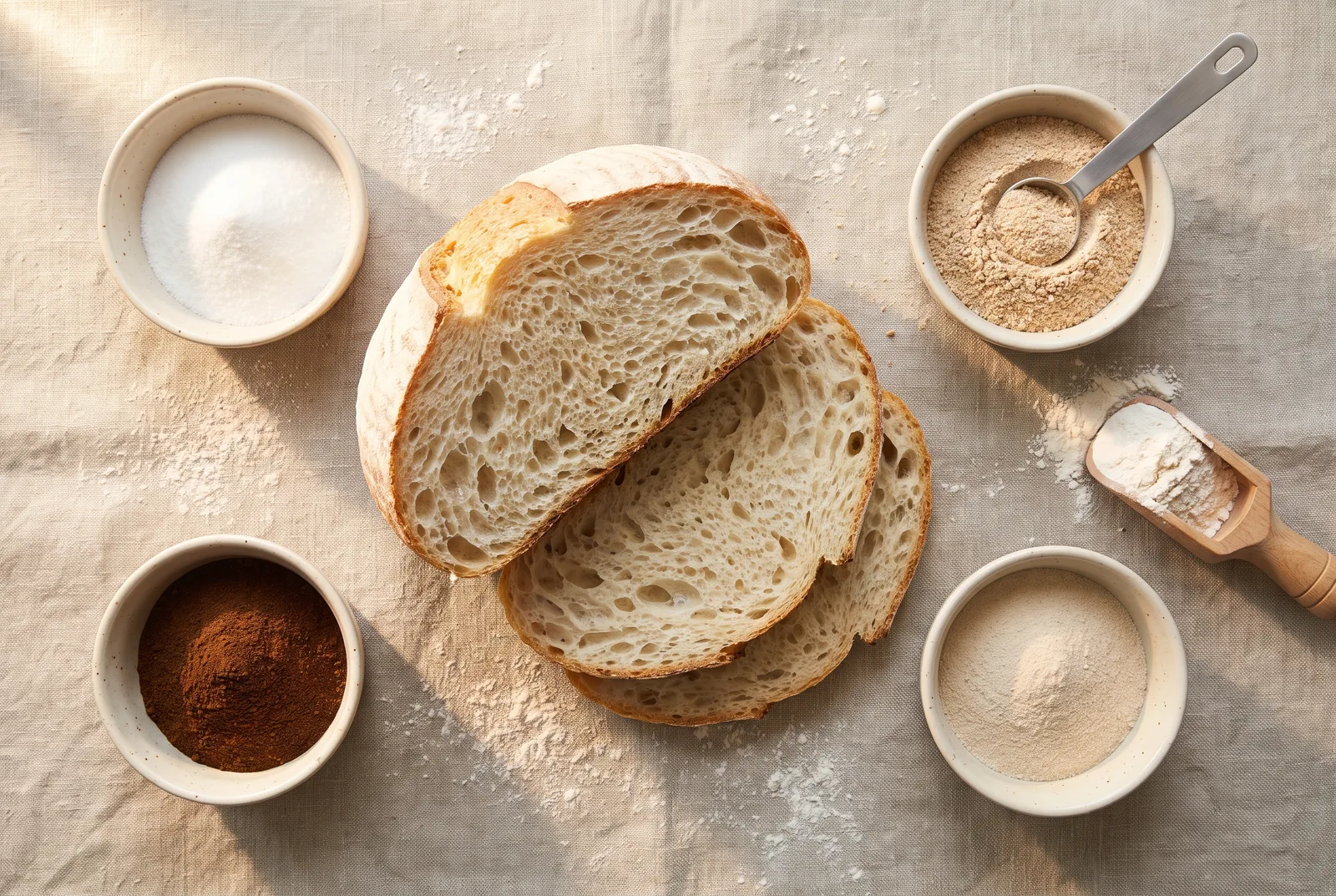
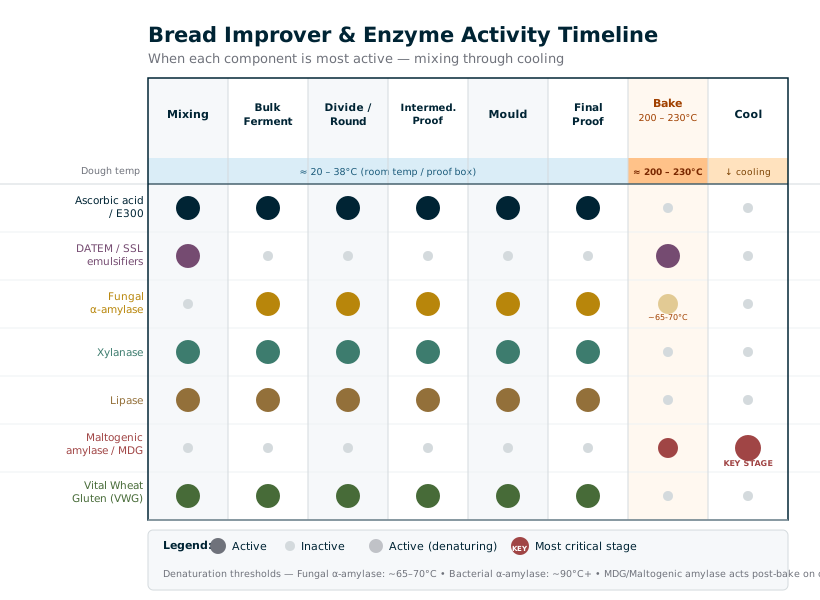 Bread production process timeline showing when each bread improver component is most active
1. The problem bread improvers solve
Bread is made from four ingredients: flour, water, yeast and salt. But the proteins, starches, enzymes and lipids in flour vary with every harvest, every milling run and every season. A professional bakery producing 10,000 loaves a day cannot afford that variability. Neither can a craft baker who needs every baguette to have the same volume as the last.
A bread improver is a pre-blended package of functional substances — some additives with E-numbers, some food ingredients, some processing aids — designed to:
- Strengthen or relax the gluten network to match the process (fast mixer, retarder, sheeter).
- Control gas retention so the dough holds the CO₂ produced by yeast through proof and into the oven.
- Modify starch behaviour during and after baking to extend freshness.
- Compensate for flour variability so that a consistent process gives a consistent result.
This article goes beyond the "what is an improver" introduction. It examines the chemistry and biology of each functional component class in detail, then maps those mechanisms to specific bakery situations and catalogue products.
2. Anatomy of a bread improver
2.1 The carrier matrix
Most powder bread improvers are between 80% and 95% inert carrier by weight. The active ingredients — ascorbic acid, enzymes, emulsifiers — are present at low concentrations and must be diluted to ensure even distribution through a dough.
Common carriers are:
- Wheat flour — universally compatible; provides some native enzyme activity. Zeelandia Gamma GP uses wheat flour as its primary carrier.
- Vital wheat gluten (VWG) — the carrier itself becomes a functional ingredient. The Zeelandia Optimax Free is 50% VWG and 39% rye flour; the Zeelandia Rye Stabil Free is 78% VWG and 20% pre-gelatinised wheat flour. In rye breads, where the carrier would otherwise just dilute the improver, using VWG as carrier means every gram of the product contributes structural protein.
- Pre-gelatinised starch — absorbs water quickly, useful in improvers designed for high-moisture rye doughs.
The choice of carrier communicates the intended application: a plain wheat-flour carrier is for standard wheat bread; a VWG-dominant carrier signals rye or high-fibre bread.
2.2 Why the same product looks different on the bag label
Enzymes used as processing aids are not required to appear on the finished product label if they are technologically inactive in the final food. In EU/UK law this exemption applies when the enzyme is derived from permitted sources and leaves no detectable residue of activity in the baked bread. This is why the Zeelandia Gamma GP ingredient list reads: Wheat Flour, Vegetable Oil (Rapeseed), Flour Treatment Agent E300, Enzyme [WHEAT] — the enzyme type (xylanase? amylase? lipase?) is not disclosed.
Emulsifiers and oxidising agents, by contrast, carry E-numbers and must appear on both the improver label and the finished product label if they are present at technologically effective levels. This regulatory distinction drives the clean-label movement: replace E-number emulsifiers with enzymes, and those ingredients fall off the consumer label.
3. Oxidants: strengthening the gluten network
3.1 Ascorbic acid (E300) — the workhorse oxidant
Ascorbic acid (Vitamin C) is present in virtually every commercial bread improver. It behaves counterintuitively in dough: dry, it is an antioxidant; wet, in the presence of oxygen and dough enzymes, it is converted to dehydroascorbic acid (DHAA), which is an oxidant.
The pathway:
Ascorbic acid + O₂ → Dehydroascorbic acid (DHAA) + H₂O₂
 (catalysed by flour's native ascorbic acid oxidase)

DHAA + 2 R-SH (gluten free thiols) → Ascorbic acid + R-S-S-R (disulphide crosslinks)
The disulphide bonds formed in the second step are covalent crosslinks between gluten protein chains. More crosslinks = tighter, stronger gluten network = better gas retention = higher loaf volume.
Critical detail for bakers: This reaction requires dissolved oxygen. If the dough is overmixed in a sealed bowl or under vacuum, ascorbic acid does not work effectively. This is why the Chorleywood Bread Process, developed in 1961, specifies a minimum oxygen content in the mixer headspace: ascorbic acid was the key additive that made CBP viable.
Dosage: BAKERpedia reports typical usage up to 150 ppm with the US FDA maximum set at 200 ppm under 21 CFR 137.105 (enriched flour) and 21 CFR 137.200 (whole wheat flour). In the EU/UK, ascorbic acid (E300) in bread category 07.1 is regulated at quantum satis under Regulation (EC) No 1333/2008 Annex II — there is no fixed numeric ceiling. Formulations should be optimised for technical need, not pushed to a legal maximum. The 200 ppm figure is a US-specific ceiling; EU/UK bakers operate under quantum satis with no equivalent numeric limit.
3.2 Glucose oxidase — the clean-label oxidant
Glucose oxidase (GOX) is an oxidoreductase enzyme that catalyses:
Glucose + O₂ → Gluconolactone + H₂O₂
The hydrogen peroxide produced in situ functions as a direct oxidant on gluten thiol groups, mimicking the effect of DHAA from ascorbic acid. The mechanism also includes contributions from dityrosine crosslinks between arabinoxylan-bound proteins, though the relative importance of these pathways is not fully characterised in the academic literature.
GOX carries no E-number (used as processing aid) and produces no label declaration on the finished product. This makes it the primary clean-label replacement for excess ascorbic acid when a baker wants to remove the "Flour Treatment Agent E300" declaration from the loaf label.
Practical limitation: GOX requires oxygen — just like ascorbic acid. Also, GOX is more sensitive to elevated mixing temperatures than ascorbic acid. In intensive mixers that generate significant heat, verify with the enzyme supplier that the specific GOX preparation retains activity at the expected dough temperature.
3.3 Reductants: L-Cysteine (E920) and glutathione
Where oxidants tighten gluten, reducing agents cleave disulphide bonds and relax it:
E920 (L-Cysteine, –SH) + R-S-S-R' → R-SH + R'-S-S-Cysteine
The resulting dough is more extensible and less resistant to mechanical deformation — valuable for:
- Thin pizza bases and flatbreads that need to be sheeted without springing back
- Crackers and semi-sweet biscuits that need to hold shape after the roll pass
- Viennoiserie laminated doughs where relaxation reduces tearing during fold cycles
- Correction of very high-protein imported flour that is too tight for standard process
Glutathione (GSH) from inactive autolysed yeast acts via the same thiol-disulphide exchange and is used as a clean-label alternative to E920. The yeast is heat-killed to destroy fermentation activity but not the GSH content.
Sourcing and certification note: L-Cysteine (E920) can be derived from animal hair, feathers or via fermentation. Verify source with supplier for Halal, Kosher or vegan compliance. Synthetic or microbially derived L-Cysteine is available and avoids this issue.
4. Enzymes: biology in the dough
Enzymes are biological catalysts — proteins that accelerate specific chemical reactions without being consumed. Each enzyme class acts on a specific substrate (the molecule it modifies). The lock-and-key specificity of enzymes is what makes them so useful: you can select exactly which dough component you want to modify.
All bakery enzymes have a temperature optimum and are irreversibly denatured by heat. This is critical: an enzyme that modifies starch during fermentation is destroyed during baking. Its job is done; it leaves no active residue — hence the processing-aid exemption.
4.1 Alpha-amylase — fermentation fuel and crust colour
Substrate: Starch (amylose and amylopectin), cleaving internal α-1,4 glycosidic bonds.
Products: Dextrins (short starch fragments), then maltose and glucose as further hydrolysis proceeds.
Effect in dough:
- Releases fermentable sugars from starch, feeding yeast during long proof periods.
- Increases the concentration of reducing sugars for Maillard browning during baking (the golden-brown crust colour).
- Softens starch structure in the crumb slightly, contributing to anti-staling.
Two types and why it matters:
| Type | Source | Inactivation temperature | Risk of overdose |
|---|---|---|---|
| Fungal alpha-amylase | Aspergillus oryzae | ~60–65°C (inactivated early in bake) | Lower — inactivated before dough centre reaches baking temperature |
| Bacterial alpha-amylase | Bacillus subtilis or B. amyloliquefaciens | ~90–95°C (survives through starch gelatinisation zone) | High — can cause sticky, gummy crumb (stickiness from over-hydrolysed starch) |
Practical rule: Use fungal alpha-amylase for standard bread production. Bacterial alpha-amylase is reserved for specialist applications where its higher temperature stability is needed, and only with careful dosage control.
Most commercial improver specs declare only "enzymes" without specifying type. For standard powder improvers like the Zeelandia Gamma GP, the enzyme is almost certainly fungal alpha-amylase and/or xylanase — the most universally applied classes.
4.2 Maltogenic amylase — the anti-staling enzyme
Substrate: Starch (preference for amylopectin branch points).
Products: Primarily maltose and short oligosaccharides.
Maltogenic amylase is structurally similar to alpha-amylase but has a significantly higher temperature optimum (active up to approximately 80–90°C, though inactivation temperature varies by preparation) and a different action pattern. It preferentially cleaves at the branch points of amylopectin, producing short oligomers that interfere with the recrystallisation (retrogradation) of starch chains during bread cooling and storage.
Regulatory note: Because maltogenic amylase may retain partial activity in the cooled bread, its classification as a technologically inactive processing aid — and the related exemption from finished-product label declaration under EU/UK Regulation (EC) No 1333/2008 — requires verification against current EFSA/FSA guidance for the specific enzyme preparation in use.
Bread staling science: Freshly baked crumb contains amylose and amylopectin in a disordered, gelatinised state. As the bread cools, amylose chains (short, linear) recrystallise first, making the crumb firm within the first few hours. Amylopectin (branched) recrystallises slowly over days, causing the progressive firmness we call staling. Maltogenic amylase, by shortening the branch chains, leaves fewer long sequences available to recrystallise — the crumb stays softer.
Bakels states that anti-staling maltogenic amylase can extend crumb softness by several days in packaged bread — an effect that MDG emulsifier (E471) also contributes to but via a different mechanism.
4.3 Xylanase (hemicellulase / pentosanase) — volume and machinability
Substrate: Arabinoxylan (AX) — the principal hemicellulose in wheat cell walls. AX makes up 2–3% of wheat flour dry weight yet holds a disproportionate amount of dough water: despite comprising only 2–3% of flour dry weight, AX accounts for approximately 25% of total dough water absorption (several times its own dry weight).
Products: Xylose, arabinose, shorter xylan oligomers.
Effect in dough:
- Releases water bound to AX chains, increasing free water in the dough system. This reduces apparent dough stiffness and improves extensibility and machinability.
- Improves gluten network formation by reducing the interference of long AX chains with gluten-protein hydration.
- Increases loaf volume — AB Enzymes reports a 5–15% volume increase from xylanase addition. (Note: this is a supplier claim; the range depends strongly on flour type and xylanase dose — confidence low for any specific figure.)
Especially valuable in:
- Wholemeal and high-extraction breads (more AX from bran)
- Rye-blend breads (rye has very high pentosan content)
- High-absorption ciabatta and baguette doughs
Zeelandia positions xylanase as central to its Bread Improver Technology (BIT) system and uses enzyme mapping to identify the right xylanase substrate specificity for each bread type.
4.4 Lipase — the clean-label emulsifier
Substrate: Flour lipids — primarily glycolipids and phospholipids in the starch granule surface and chloroplast membranes.
Products: Lysophospholipids and lyso-glycolipids (monoacyl forms).
Why this matters: Lysophospholipids are natural surface-active agents with similar properties to added emulsifiers (DATEM E472e, SSL E481). They orient at the water-starch interface, strengthen the gluten-film around gas bubbles, and complex with starch chains to slow retrogradation — all without any E-number declaration.
Lesaffre's technical data shows that a lipase-based improver can replace DATEM, SSL and MDG functionally in many bread applications, with the finished product label reading only "enzymes" rather than "Emulsifiers E472e, E481, E471." This is the primary enzymatic route to clean-label bread production.
Limitation: Lipase activity depends on the flour's native lipid content and quality. Improvers relying on in-situ lipase activity may show less consistent results when flour source changes. Cross-check with the enzyme supplier when switching flour origin.
4.5 Protease — dough relaxation
Substrate: Gluten proteins at peptide bonds (serine, cysteine or metalloprotease subtypes depending on the preparation).
Effect: Partial hydrolysis of gluten proteins reduces dough tenacity (resistance to extension). Dough becomes more plastic and extensible without the tearing that causes problems when sheeting or moulding.
Where it is needed:
- Pizza dough and flatbread that must be stretched without springback
- Cracker doughs that need to hold their cut shape
- Rich doughs (brioche, Danish) where fat and sugar weaken the gluten but excessive protein from very strong flour can cause toughness
- Correction of imported flour with very high protein levels (>14%) that is too tight for a standard process
Critical caution: Protease is the most dangerous enzyme to overdose. Excess protease produces slack, sticky, unworkable dough with poor gas retention. Dose conservatively — start at the minimum and adjust. Never add protease unless dough tightness has been confirmed as the problem.
4.6 Glucose oxidase (revisited as enzyme, not additive)
See Section 3.2 above. Glucose oxidase strengthens gluten by generating oxidative conditions in the dough without adding an E-number to the label. In the enzyme tables below, GOX appears alongside the other enzyme classes for completeness.
4.7 Transglutaminase — protein crosslinking
Substrate: Glutamine and lysine residues on gluten proteins.
Products: Isopeptide crosslinks between protein chains.
Transglutaminase (TG) catalyses a non-disulphide covalent crosslink between gluten proteins. The resulting network is stronger and more resistant to extensional force than a standard gluten network. Applications include:
- Very high-hydration doughs (ciabatta, focaccia) where the gluten network needs maximum strength to hold the open crumb
- Gluten-fortified products where VWG has been added and the TG crosslinks the VWG proteins into the native network
TG is not common in standard powder improvers but appears in specialist enzyme preparations. It carries no E-number as a processing aid in EU/UK.
5. Emulsifiers: the molecular bridge-builders
Emulsifiers are amphiphilic molecules — one end is hydrophilic (water-loving), the other hydrophobic (fat-loving). In bread dough, where water, gluten proteins, starch granules and small amounts of lipid coexist, emulsifiers act at every interface.
5.1 Classification by HLB and function
The Hydrophile-Lipophile Balance (HLB) scale runs from 0 (completely fat-soluble) to 20 (completely water-soluble). Bread emulsifiers fall into two functional groups:
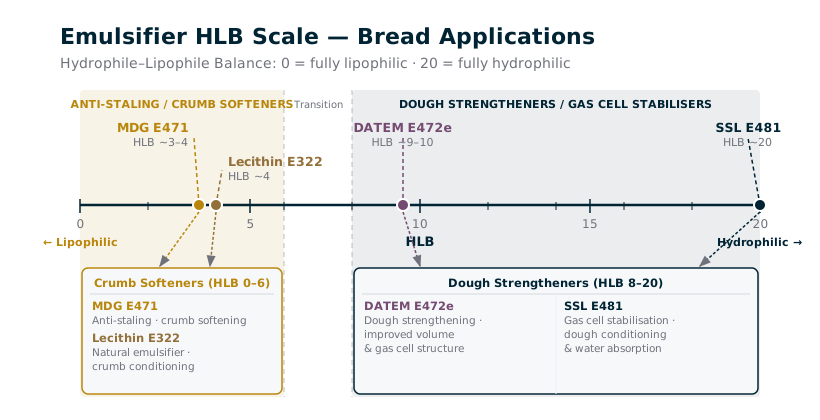 Emulsifier HLB scale showing DATEM and SSL as dough-strengthening emulsifiers and MDG and lecithin as crumb-softening emulsifiers in bread production
| Emulsifier | E-number | HLB group | Primary bread function |
|---|---|---|---|
| DATEM (diacetyl tartaric acid esters of mono-/diglycerides) | E472e | Dough strengthener | Gluten network reinforcement; improved oven spring; dough tolerance |
| SSL (sodium stearoyl lactylate) | E481 | Dual (strengthener + softener) | Gluten strengthening + starch complexing; anti-staling |
| CSL (calcium stearoyl lactylate) | E482 | Dual | Functionally similar to SSL; used in kosher/halal contexts |
| MDG (mono- and diglycerides of fatty acids) | E471 | Crumb softener | Anti-staling via amylose complexing |
| Lecithin (soya or sunflower) | E322 | Natural emulsifier | Dough lubrication; water-in-oil emulsification; machinability |
5.2 How DATEM works at the molecular level
DATEM molecules adsorb at the water-gluten protein interface. The hydrophilic tartaric acid groups face the water phase; the hydrophobic acyl chains embed in the lipid environment of the gluten protein surface. This monolayer at the gluten-water interface:
- Increases the viscoelastic strength of the gluten film around each CO₂ bubble.
- Reduces bubble coalescence during proof (small, uniform bubbles produce fine, even crumb).
- Improves dough tolerance to mechanical abuse — shaping, dividing, proving.
The result: better oven spring, improved volume, and a more consistent crumb structure from piece to piece.
Typical use level: DATEM is typically used at 0.1–0.5% on flour weight (BAKERpedia states 0.1–0.5%; other industry sources cite up to 0.6%). This figure is inferred from general industry literature (IREKS Compendium, BAKERpedia) — no catalogue spec sheet reviewed explicitly states the in-recipe DATEM concentration.
5.3 How MDG slows bread staling
Monoglycerides (E471) intercalate into the helical cavity of amylose chains during starch gelatinisation (the rapid hydration and swelling of starch granules that occurs from about 60°C upwards during baking). The MDG molecule occupies the amylose helix, blocking chain segments from folding back on themselves during cooling — the process that causes amylose to recrystallise and the crumb to firm.
The resulting crumb is:
- Softer on day 1 (immediately after baking)
- Markedly softer on days 2–5 compared to an untreated control
- Less brittle when sliced (important for packaged sandwich bread)
MDG and maltogenic amylase act by different mechanisms on different targets (amylose helix vs amylopectin branches) and are additive in effect when both are present in an improver formula.
5.4 Why emulsifier pastes behave differently
The Puratos Pronto (catalogue item: Puratos Pronto Dough Conditioner 10 kg) is an emulsifier paste intended for confectionery products — sponge cake, roulades, babka — not for bread. Its composition is: sorbitol syrup (E420ii), propylene glycol (E1520), water, mono- and diglycerides of fatty acids (E471), esters of fatty acids and polyglycerol (E475). It contains no gluten allergens and no E300. It aerates batters by stabilising air cells in the fat-continuous phase of a batter rather than the water-continuous phase of a bread dough.
This distinction — batter emulsifier paste vs bread dough emulsifier powder — is important. Using a confectionery emulsifier paste in a bread dough at pastry dosages will give the wrong texture. Bread improver emulsifiers are delivered at low concentrations via the powder format and act at the gluten-water interface; confectionery paste emulsifiers are delivered at 0.5–3% of dough weight and act in a fat-continuous batter system.
6. Vital wheat gluten and structural carriers
Vital Wheat Gluten (VWG) is not a processing aid or additive; it is a food ingredient and must appear on the label. It is the functional protein fraction extracted from wheat flour by wet washing, then carefully dried to preserve the viscoelastic gliadin-glutenin network.
6.1 Composition and performance
From first-party spec sheets:
- Beneo BeneoPro VWG 75: minimum 75% protein (N×5.7 factor), equivalent to approximately 82% by N×6.25 conversion. Water-binding capacity approximately 140–170 g water per 100 g VWG (method AACC 56-30; indicated, not guaranteed). Shelf life 36 months at cool/dry conditions.
- Zeelandia Rye Stabil Free (78% VWG carrier): delivers 60.8 g protein per 100 g of product.
- Zeelandia Optimax Free (50% VWG carrier): delivers 40.7 g protein per 100 g of product.
6.2 When to use VWG
| Situation | Reason VWG helps |
|---|---|
| Rye or rye-wheat bread (rye >40% of flour) | Rye protein does not form a functional gluten network; VWG provides the structural matrix |
| Wholemeal or high-fibre bread (bran addition >10%) | Bran particles mechanically cut and dilute the gluten network; VWG compensates |
| Very high-hydration doughs (>75% water) | Additional protein improves network strength enough to hold the open crumb |
| High-speed intensive mixing | VWG improves mixing tolerance — dough is less damaged by extended mixing |
| Fortified bread (added protein, health claim) | VWG is recognised as a protein supplement at bakery scale |
Typical addition rate: 1–12% on flour weight (1–4% for most yeast-raised doughs; up to 12% in high-fibre formulations). This range is single-source (BAKERpedia) — confidence low.
7. Malt: enzyme and flavour in one natural ingredient
Diastatic malt is kiln-dried malted barley (or wheat) in which the endogenous amylase enzymes have been preserved. It provides both active alpha- and beta-amylase and fermentable sugars in a form that millers and bakers have used for centuries.
Action in dough:
- Alpha-amylase cleaves damaged starch → releases sugars → feeds yeast → improves oven spring
- Beta-amylase cleaves from the end of starch chains → produces maltose specifically → feeds yeast and improves crust colour
- Maillard reaction between reducing sugars (from malt) and amino acids → golden-brown crust
Diastatic vs non-diastatic malt:
- Diastatic: active enzymes; use carefully — overdose → sticky dough → gummy crumb (same risk as excess bacterial alpha-amylase)
- Non-diastatic: heat-processed → enzyme activity destroyed; provides colour, flavour and fermentable sugars only
Catalogue products include Rye Malt Extract 14 kg, Lithuanian Dark Rye Malt 25 kg, and IREKS Somex Liquid Malt Extract 15 kg.
Falling Number check before malt addition: If the flour's Hagberg Falling Number is already low (<250 s), it has excess native alpha-amylase activity. Adding diastatic malt on top will cause runny, sticky, unworkable dough. Always check the Falling Number from the flour spec before choosing improver components with malt or enzyme additions.
8. Reading the spec sheet: five products analysed
8.1 Zeelandia Gamma GP — the minimalist general-purpose powder
Ingredients: Wheat flour, rapeseed oil, ascorbic acid E300, enzyme [WHEAT].
This is an enzyme-and-oxidant improver with no emulsifiers. Its simplicity means it is clean-label in the sense of minimal E-numbers, but the enzyme is from wheat-sourced material (declared as allergen). It is suitable where:
- The flour protein is adequate (no need for VWG)
- No anti-staling extension is required
- No dough softening or crumb-softener emulsifier is needed
Dosage from spec sheet (on flour weight):
- White tin bread: 0.5–0.75%
- White bloomers: 1%
- White soft rolls: 1.5%
- White crusty rolls and wholemeal: 2%
The increasing dosage for crusty and wholemeal products reflects the need for more oxidant and enzyme support as the gluten network faces greater challenges (dense ferment, high bran content).
Shelf life: 12 months from manufacture. Storage: below 25°C, dry.
8.2 Zeelandia Optimax Free — enzyme-only rye improver
Ingredients: Wheat gluten 50%, rye flour 39%, potato starch 10%, ascorbic acid E300 <1%, enzyme <1%.
"Free" in the product name means free from E-number emulsifiers. The formula provides:
- VWG (50%) → structural network for the rye proportion of the dough
- Rye flour (39%) → additional rye flavour contribution and body
- Potato starch (10%) → water absorption aid in the high-moisture rye dough environment
- E300 → standard oxidant for gluten tightening
- Enzyme → unspecified (likely xylanase and/or amylase)
Dosage calculated from application recipe: The spec sheet provides a recipe using 1.0 kg wheat flour type 850 + 5.0 kg rye flour type 720 + 0.1 kg Optimax Free. Improver on total flour = 0.1 / (1.0 + 5.0) = approximately 1.7% on flour.
Application from spec: Bake at 250°C reducing to 230°C, steam for first 5 minutes, total bake 45 minutes. The high initial temperature and steam are characteristic of rye bread baking.
Allergens: Confirmed wheat gluten; confirmed rye (ingredient); possible cross-contamination from barley, oat, spelt, eggs, soya, milk, sesame. Not suitable for coeliacs.
8.3 Zeelandia Rye Stabil Free — high-VWG rye stabiliser
Ingredients: Wheat gluten 78%, pre-gelatinised wheat flour 20%, wheat flour 1%, ascorbic acid E300 1%, enzymes <1%.
The composition is dominated by VWG (78%). The spec translates as: every 1 kg of Rye Stabil Free delivers approximately 780 g of functional vital wheat gluten into the dough. This creates a continuous gluten matrix even in doughs where rye comprises over 50% of the flour.
Nutritional result: 60.8 g protein per 100 g product — this is among the highest protein contents of any standard bakery improver, reflecting the VWG dominance.
Dosage calculated from application recipe: 3.1 kg wheat flour + 4.2 kg rye flour + 0.2 kg Rye Stabil Free. Improver on total flour = 0.2 / (3.1 + 4.2) = approximately 2.7% on flour.
Baking parameters: Spec states 240°C reducing to 210°C, steam injection, steam vented after 10 minutes, baking time approximately 45 minutes.
Storage requirement: Below 20°C, relative humidity max 70%. This is more stringent than the Optimax Free or Gamma GP (both 25°C max). The pre-gelatinised starch in the Rye Stabil formulation may be the reason: pre-gelatinised starches can absorb atmospheric moisture more readily than native starch.
8.4 Berliner 10% Doughnut Improver Free — frying application
Ingredients: Wheat flour, whey powder (milk), soy flour, egg yolk powder, vinegar powder, spice (turmeric), enzyme (wheat), vegetable oil (rapeseed), rye flour.
This is an improver for a fried sweet dough (Berliner doughnut), not baked bread. Its design reflects the different challenges of a sweet, rich fried dough:
- Whey powder and egg yolk contribute to a rich, yellow crumb and emulsification support for the fat
- Vinegar powder acidifies the dough slightly, supporting fermentation balance and crust colour
- Turmeric adds a natural yellow tint to the crumb (replacing egg yolk colour at lower cost)
- Soy flour provides additional emulsification and protein
- Enzyme supports dough extensibility for a soft, airy doughnut crumb
- No E-number emulsifiers (hence "Free")
Dosage: 10% by weight of flour. This high dosage reflects the fact that the improver is supplying structural and flavour ingredients, not just functional additives.
Application parameters: Dough temperature 26–28°C. First proof 15 min. Final proof 35 min in chamber + 20 min outside. Fry at 180°C for 7 minutes with double turning.
Regulatory note — Acrylamide: EU Regulation 2017/2158 requires food businesses producing fried dough products (including doughnuts) to implement and document acrylamide mitigation measures. Sweet fried dough at 180°C is a high-risk acrylamide formation category. Any operational guidance for Berliner-type production must reference this obligation. Verify current mitigation plans with a food safety professional before commercial publication.
Allergens: Contains wheat, rye, milk (whey), eggs, soya. Cross-contamination risk from barley, oat, sesame.
8.5 Zeelandia Gamma GP vs Zeelandia Optimax Free — comparative summary
| Attribute | Gamma GP | Optimax Free |
|---|---|---|
| Carrier | Wheat flour | Wheat gluten 50% + rye flour 39% + potato starch 10% |
| Ascorbic acid | Yes (E300) | Yes (E300) |
| Emulsifiers | None | None |
| VWG contribution | None | ~50% of product = significant protein addition |
| Best for | White/wholemeal wheat bread | Mixed and rye breads |
| Dosage | 0.5–2% depending on product | ~1.7% (calculated) |
| Shelf life | 12 months | 180 days |
| Allergens | Wheat only (confirmed); production line allergens various | Wheat + Rye (confirmed) |
9. Application guide: matching improver components to the product
The following matrix summarises which functional component to reach for in each common situation. See the comparison table below for the full version.
| Bread type / problem | Ascorbic acid | DATEM/SSL emulsifier | MDG E471 | Maltogenic amylase | Xylanase | VWG | Malt |
|---|---|---|---|---|---|---|---|
| Standard white tin bread | Essential | Helpful | Optional | Optional | Optional | No | Optional |
| Crusty baguette/bloomer | Essential | Optional | No | No | Helpful | No | Yes (crust) |
| Soft roll / burger bun | Essential | Essential | Essential | Helpful | Optional | No | Optional |
| Wholemeal / seeded bread | Higher dose | Helpful | Helpful | Helpful | Very helpful | Helpful | Optional |
| Rye or wheat-rye bread | Essential | No (clean label) | No | No | Very helpful | Essential | Yes |
| Packaged long-life loaf | Essential | Essential | Essential | Essential | Optional | Optional | No |
| Pizza / flatbread (sheeted) | None or low | None | No | No | Optional | No | Optional |
| Rich sweet dough (brioche) | Low | Optional | Essential | Optional | No | No | No |
10. Clean-label pathways
Consumer preference for shorter ingredient lists has driven a decade of reformulation. The practical enzyme-for-additive substitutions are:
| E-number additive to remove | Enzyme replacement | Mechanism |
|---|---|---|
| DATEM (E472e) | Lipase | In-situ lysophospholipid production replicates DATEM function |
| SSL (E481) | Lipase + glucose oxidase | Lysophospholipid + oxidative crosslinking replaces dual SSL action |
| MDG (E471) | Maltogenic amylase | Modified amylopectin retrogradation replicates MDG anti-staling |
| Enzyme-active soya flour | Glucose oxidase | GOX replaces lipoxygenase oxidation without soya allergen |
| L-Cysteine (E920) | Inactive yeast (GSH) | Glutathione provides same thiol-disulphide reduction without E-number |
The trade-off: Enzyme-only formulas require tighter process control. The Zeelandia Optimax Free demonstrates this: it is emulsifier-free and clean-label but performs best in a specific rye dough recipe at a specific temperature and proof time. Enzyme activity is pH-, temperature- and substrate-concentration-dependent in ways that a chemical additive (ascorbic acid, DATEM) is not.
Lesaffre's technical framework recommends a phased approach to clean-label migration: remove L-cysteine first (lowest functional risk), then replace DATEM with lipase (medium risk), then optimise the remaining ascorbic acid and GOX doses.
11. Fault analysis: when the improver is part of the problem
The following table covers faults that can result from improper improver use. Other causes (flour quality, yeast activity, process temperature, oven problems) must be excluded first. Full data including additional faults is in the fault table below.
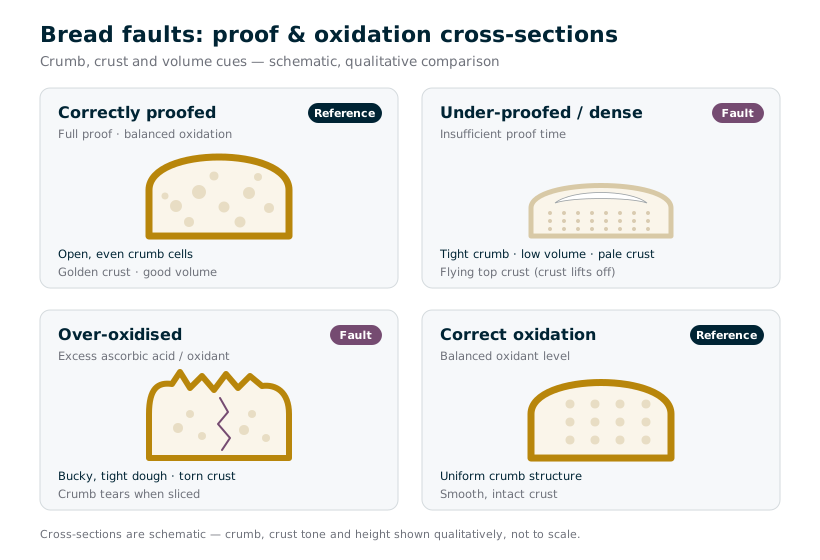 Four-panel bread fault comparison showing correctly proofed, under-proofed, over-oxidised and correctly oxidised loaves
| Fault | Symptom | Improver-related cause | First check | Remedy |
|---|---|---|---|---|
| Dense crumb, low volume | Bread does not fill the tin; crumb tight | Insufficient oxidant (E300 dose too low); weak emulsifier | Check improver dosage; check flour protein | Increase improver dose; verify flour Hagberg >250 s |
| Excessive oven spring, flying crust | Top separates from crust in oven | Under-proof + too much ascorbic acid (gluten too strong for gas pressure) | Review proof time; check E300 level | Reduce oxidant; extend proof; reduce mixing |
| Dough tears when moulded | Surface cracks; pieces distort | Over-oxidation (excess E300 or GOX) | Reduce improver dose; check flour protein | Add small amount of inactive yeast (GSH) or reduce oxidant |
| Sticky, slack, unworkable dough | Dough flows off bench; poor gas retention | Excess protease or excess bacterial amylase; low Falling Number flour | Check enzyme type and dose; check Falling Number | Remove or reduce protease; verify flour Falling Number >250 s |
| Pale crust, poor Maillard colour | Crust is white-grey rather than golden | Insufficient reducing sugars; over-proof consuming all fermentable sugar | Check diastatic malt presence; check proof time | Add diastatic malt at 0.5% on flour; reduce proof time |
| Crumb firms within 24 h (rapid staling) | Bread feels stale the day after baking | Insufficient maltogenic amylase; no MDG in formula | Check improver composition | Switch to improver with maltogenic amylase and/or E471 |
| White, bleached crumb (when yellow is expected) | Crumb whiter than usual | Lipoxygenase from enzyme-active soya flour bleaching carotenoids | Check improver for soya flour | Switch to enzyme-only improver (e.g. Optimax Free) |
| Grey or discoloured crust | Unusual crust colour | Excess malt (overdose of diastatic malt); excess amylase | Check malt addition rate | Reduce malt to 0.5% or less on flour |
| Mould after 3 days (packaged bread) | Visible mould on pre-packed loaf | Insufficient preservative; bread too warm when packed | Check packaging temperature (<35°C); check E282 level | Add calcium propionate E282 (verify legal limit); cool to <35°C before packaging. |
| Uneven crumb with large holes | Random tunnels or open structure | Uneven distribution of improver in dough; possible emulsifier overdose | Check mixing time; check improver dispersion | Pre-blend improver with flour; check mixer coverage |
| Doughnut collapses after frying | Flat, dense centre | Under-proof; frying oil too hot or too cold; wrong improver | Check oil temperature (target 180°C); check proof | Verify oil temperature; use a purpose-designed frying improver |
| Rich dough (brioche) too tough | Dense, heavy crumb | Too much oxidant for fat-weakened gluten; over-mixing | Reduce E300 dose; add emulsifier MDG E471 | Reduce improver dose; add crumb-softener component |
12. Regulatory notes
Regulatory note: The following is a high-level orientation. All regulatory claims require verification against the current text of the applicable legislation before any commercial use.
EU/UK food additive framework:
- E-number additives in bread improvers are governed by Regulation (EC) No 1333/2008 on food additives (EU) and the retained UK equivalent. Annex II lists permitted additives and their maximum levels by food category. Bread typically falls under Category 07.1 (ordinary bread and rolls).
- Ascorbic acid E300 in Category 07.1: quantum satis (no numeric maximum set under EU rules).
- DATEM, SSL, MDG: permitted in bread but with quantitative limits that must be verified in current Annex II.
- Calcium propionate E282: permitted only in pre-packaged bread in most EU/UK applications; legal limits are expressed per final product weight, not flour weight.
Processing aids:
- Enzymes used as processing aids are not required to be declared on the finished product label if they are derived from permitted sources and perform no technological function in the final food (Directive 89/107/EEC principle, maintained in UK retained law). The improver spec sheet will declare them, but the bakery's loaf label does not need to.
Allergen labelling:
- All powder bread improvers reviewed contain wheat gluten. Most carry cross-contamination risks for rye, barley, oat, spelt, eggs, soya, milk, sesame and/or lupin. Full allergen matrices are in each spec sheet and must be reviewed by a qualified food technologist before use.
Coverage notes and gaps
Solid in this article:
- Reaction chemistry of ascorbic acid, GOX, lipase, xylanase, maltogenic amylase (multi-source, high confidence)
- Emulsifier mechanisms at molecular level (DATEM/MDG) (multi-source, high confidence)
- First-party composition data for five catalogue improvers (spec-sheet data, high confidence)
- Dosage data: Gamma GP (stated in spec); Optimax Free, Rye Stabil (calculated from recipes — medium confidence, single-source)
- Fault table: twelve faults with causes and remedies
Thin / single-source:
- Xylanase volume improvement "5–15%": AB Enzymes supplier claim only. No independent academic figure confirmed. Confidence: low.
- VWG dosage range 1–12%: BAKERpedia only. Confidence: low.
- Typical emulsifier use levels (0.1–0.5% on flour for DATEM; other emulsifiers vary): inferred from literature; no catalogue spec sheet states these concentrations directly.
- Transglutaminase: covered briefly; limited to one academic source.
- EU Regulation 1333/2008 Annex II specifics for DATEM, SSL, MDG in Category 07.1: not read directly.
Follow-up recommended:
- Read EU Regulation 1333/2008 Annex II Category 07.1 to add verified legal limits for DATEM E472e, SSL E481, MDG E471 and E282 in bread.
- Read spec sheets for IREKS Voltex, IREKS Soft Roll 7, Puratos S500 Sense, Puratos Tigris SG — all have confirmed specs in the A3 article but are not re-read here.
- Confirm enzyme dosage ranges (ppm) from a published academic source for xylanase volume claim.
Figures
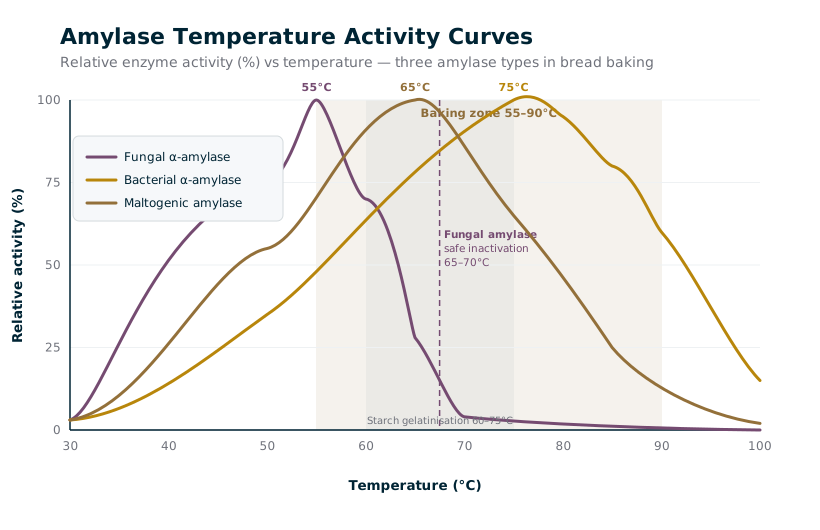 Temperature activity curves for fungal amylase, bacterial amylase and maltogenic amylase in bread baking
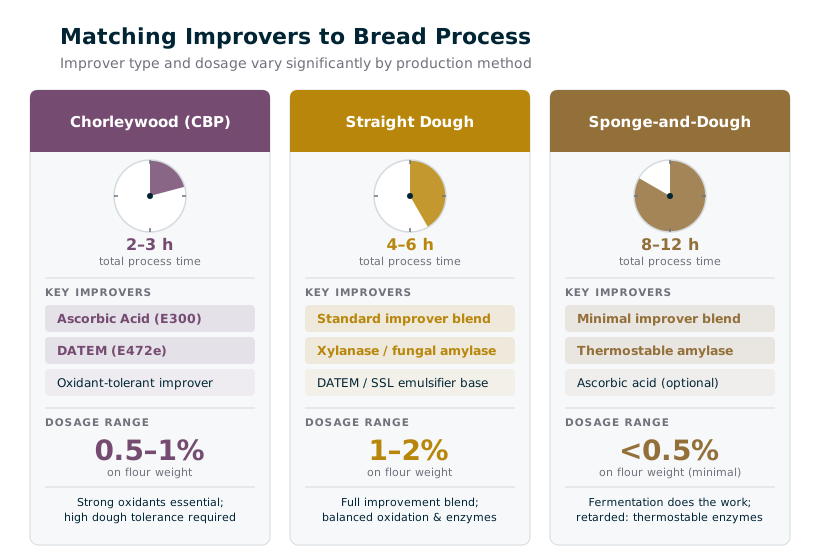 Comparison of improver requirements for CBP, straight dough and sponge-and-dough bread processes
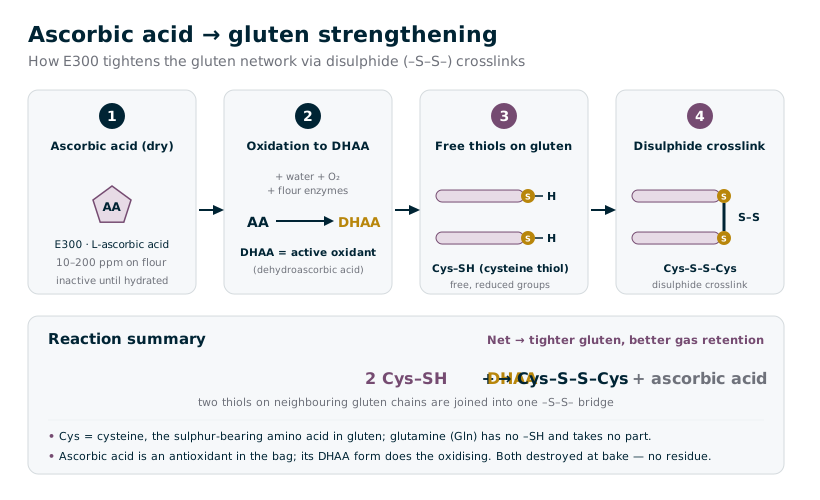 Mechanism diagram showing how ascorbic acid is converted to dehydroascorbic acid which then strengthens gluten by forming disulphide crosslinks
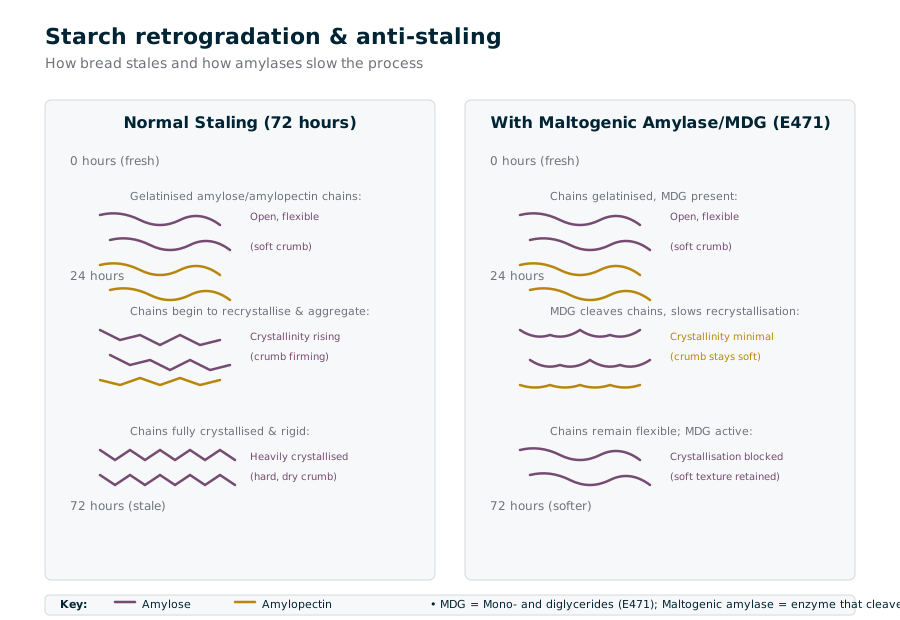 Diagram comparing normal starch retrogradation (staling) with staling inhibited by maltogenic amylase and MDG E471
White Tin Bread — Zeelandia Gamma GP at 0.5%
Derived from Gamma GP spec sheet dosage guidance. Baker's percentage on flour weight. Represents a minimal-improver CBP-compatible approach for high-speed straight white tin bread.
| Ingredient | Baker's % | Weight |
|---|---|---|
| Strong wheat flour (type T550 or equivalent) | 100% | |
| Water | 62–65% | |
| Fresh compressed yeast | 2% | |
| Salt | 2% | |
| Zeelandia Gamma GP | 0.5–0.75% |
- Mix all ingredients 5 min slow + 4 min fast. Dough temp target 27–28°C. Bulk ferment 45–60 min at ambient. Divide, round; intermediate proof 10 min. Mould into tins. Final proof 45–60 min at 38°C / 80–85% RH. Bake 220°C (deck) or 200°C (fan) for 25–30 min.
Yield: 800 g dough weight per standard 400 g tin loaf
Mixed Rye-Wheat Bread — Zeelandia Optimax Free (Emulsifier-Free)
Application recipe directly from Optimax Free spec sheet, converted to baker's percentage (flour base = wheat + rye flour combined). Suitable for bakeries requiring E-number-free emulsifier labelling on rye bread.
| Ingredient | Baker's % | Weight |
|---|---|---|
| Wheat flour type T850 | 16.7% | 1.0 kg |
| Rye flour type T720 | 83.3% | 5.0 kg |
| Rye sourdough (ready-made) | — | 6.4 kg |
| Salt | 3.8% | 0.23 kg |
| Fresh yeast | 4.2% | 0.25 kg |
| Zeelandia Optimax Free | ~1.7% | 0.10 kg |
| Water (approx.) | ~93% | 5.6 kg |
- Mix all ingredients 8 min low speed + 2 min high speed. Dough temp approx. 28°C. First proof approx. 15 min. Place dough (0.58 kg pieces) directly into greased baking forms — do not shape. Final proof approx. 50 min. Bake at 250°C reducing to 230°C with steam for first 5 min; 45 min total bake.
Yield: Tin rye-wheat loaf; approx. 0.58 kg dough per form
Premium Rye Bread — Zeelandia Rye Stabil Free
Application recipe from Rye Stabil Free spec sheet, converted to baker's percentage. Designed for high-value everyday and artisan rye bread. Higher VWG content (78% of improver) provides stronger structural support than Optimax Free.
| Ingredient | Baker's % | Weight |
|---|---|---|
| Wheat flour type T850 | 42.5% | 3.1 kg |
| Rye flour type T720 | 57.5% | 4.2 kg |
| Rye sourdough (ready-made) | — | 4.6 kg |
| Salt | 3.0% | 0.22 kg |
| Fresh yeast | 2.7% | 0.20 kg |
| Zeelandia Rye Stabil Free | ~2.7% | 0.20 kg |
| Water (approx.) | ~79% | 5.8 kg |
- Mix all ingredients 3 min slow + 5 min fast. Dough temp 27–29°C. First proof (pre-fermentation) 30 min. Divide into pieces of approx. 0.9 kg; round, elongate and place on boards, racks or in proving baskets. Final proof approx. 60 min. Bake at 240°C reducing to 210°C with steam; release steam after 10 min. Total baking time approx. 45 min.
Yield: Artisan rye loaf; 0.9 kg dough pieces
French Baguette — Puratos Easy Baguette SG
Usage rate directly from Easy Baguette SG spec sheet. This concentrate contains the salt (20-30% of product) — do NOT add separate salt unless recipe instructs. Contains DATEM emulsifier, barley malt flour, dry rye sourdough and enzymes as processing aid.
| Ingredient | Baker's % | Weight |
|---|---|---|
| Strong wheat flour (UK bread flour, protein ≥13%) | 100% | |
| Puratos Easy Baguette SG concentrate — Contains salt — omit separate salt | 6% | |
| Fresh yeast | 2–3% | |
| Water | 65–70% |
- Mix flour, Easy Baguette SG and yeast with water (incorporate E472e and E300 from concentrate). Mix 5 min slow + 5–6 min fast. Dough temp 24–26°C. Bulk ferment 30–45 min at ambient; optional overnight retard at 4–6°C for better flavour development. Divide into 350 g pieces. Pre-shape; rest 10–15 min. Final shape into baguettes. Final proof 45–60 min. Score; bake with steam at 230–240°C for 20–25 min; vent steam in last 5 min for crust crunch.
Yield: Classic 350g baguette. Ascorbic acid in product targets 300–500 ppm in concentrate — at 6% usage this delivers approximately 18–30 ppm on flour, well within the functional range.
Each enzyme class listed with its substrate, the stage of bread-making at which it is most active, practical effect, overdose risk and temperature stability. Enzyme concentrations in commercial improvers are not disclosed (processing-aid practice); ppm figures below are order-of-magnitude estimates from published academic literature and supplier technical documentation. Exact commercial dosages are proprietary. All enzyme temperature figures should be verified against the specific supplier's technical data before commercial use.
| Enzyme class | E-number status | Primary substrate | Most active stage | Inactivation temperature (approx.) | Practical effect on bread | Overdose risk |
|---|---|---|---|---|---|---|
| Fungal alpha-amylase | Processing aid (not required on label) | Starch (amylose and amylopectin chains) | Bulk fermentation and early baking (up to ~60-65°C) | ~60–65°C | Releases fermentable sugars for yeast; boosts oven spring; improves crust browning (Maillard reaction); improves extensibility at dough stage | Sticky, extensible dough; gummy crumb; excessive crust darkening |
| Bacterial alpha-amylase | Processing aid | Starch chains | Bulk fermentation and throughout baking (remains active to ~90°C+) | ~90°C+ | Same sugar-releasing action as fungal but continues acting in the oven during starch gelatinisation; used for longer shelf life | High: gummy or ropey crumb, doughy texture; remains active past safe gelatinisation window — must be dosed with care |
| Maltogenic amylase | Processing aid (regulatory grey area — some markets classify differently) | Amylopectin branch points | Baking (overlaps starch gelatinisation zone 60–75°C); continues into cooling | ~80–90°C (varies by product; partial activity may persist in cooled bread — verify processing-aid label-exemption status against EFSA/FSA guidance for the specific preparation) | Modifies amylopectin to produce maltose; the modified amylopectin crystallises less readily on cooling → crumb stays softer longer. Primary anti-staling enzyme. | Very soft crumb that may compress too easily; possible slight sweetness at very high levels |
| Xylanase (hemicellulase / pentosanase) | Processing aid | Arabinoxylan (pentosan) chains in wheat cell wall | Mixing and bulk fermentation | ~60–70°C | Hydrolyses arabinoxylans (2–3% of flour dry weight), releasing water bound to pentosans; improves dough extensibility, machinability and loaf volume. AB Enzymes claim 5–15% volume improvement (single supplier source). | Sticky dough; overly extensible, difficult to mould; can weaken structure at high levels |
| Lipase | Processing aid | Flour lipids (triglycerides, galactolipids) | Mixing and bulk fermentation | ~60–70°C | Hydrolysis produces lysophospholipids in situ — these function as endogenous emulsifiers equivalent to DATEM/SSL. Primary tool for clean-label emulsifier replacement. | Soapy or rancid off-notes; weakening of gluten structure at excessive levels |
| Protease | Processing aid | Gluten proteins (peptide bonds) | Mixing (primarily) through bulk fermentation | ~60–80°C (varies by type) | Partial hydrolysis reduces dough tenacity; improves extensibility and sheeting; reduces mixing time. Used in cracker, pizza and flatbread doughs. | High: sticky, weak, unworkable dough; gas retention fails; flat product |
| Glucose oxidase | Processing aid | Glucose + oxygen | Mixing and bulk fermentation (requires oxygen availability) | ~70°C | Oxidises glucose to produce H₂O₂ in situ; H₂O₂ acts as oxidant on free thiol (–SH) groups on gluten proteins, forming disulphide crosslinks. Clean-label oxidant alternative to ascorbic acid. | Over-strengthened gluten; reduced dough extensibility; dough tears on moulding |
| Transglutaminase | Processing aid | Glutamine residues in gluten proteins | Mixing and fermentation | ~70°C | Cross-links gluten proteins at glutamine-lysine bonds; can significantly strengthen dough structure; used in certain high-protein or high-fibre breads | Extremely tight, inelastic dough; potential coeliac risk considerations (digestibility of transglutaminase-crosslinked gluten requires regulatory review) |
| Asparaginase | Processing aid | Asparagine (amino acid in dough) | Mixing and fermentation (before baking) | ~60°C | Converts asparagine to aspartate, reducing the precursor to acrylamide formation during high-temperature baking. Not a textural improver; a food safety tool. | Minimal textural impact; ensure complete inactivation before baking |
A practical guide for selecting the appropriate improver profile for each bread production method. Dosage recommendations are general; always follow the specific product spec sheet. References to catalogue products are illustrative — confirm suitability with the specific product data.
| Process type | Total process time (approx.) | Key improver needs | Key components | Typical dosage range (% on flour) | Notes | Relevant catalogue product examples |
|---|---|---|---|---|---|---|
| Chorleywood Bread Process (CBP) / intensive mechanical | 2–3 hours total | Strong oxidant to replace slow fermentation; emulsifier for dough tolerance; enzyme package for volume and colour | Ascorbic acid E300 (essential); DATEM E472e or SSL E481; fungal amylase | 0.5–1.5% | CBP uses intensive mixing (typically 150+ kJ/kg work input) that develops gluten rapidly but does not deliver fermentation flavour. Ascorbic acid is mandatory — without it, the weak gluten cannot retain gas from high-speed mixing. | Zeelandia Gamma GP 0.5–0.75% (tin bread); Puratos Tigris SG 2% |
| Straight dough (no sponge) | 4–6 hours total | Balanced oxidant + emulsifier; optional maltogenic amylase for shelf life | E300; DATEM or lipase; optional maltogenic amylase or MDG | 1–2% | Standard workhorse process. Fermentation contributes more flavour than CBP; improver principally handles dough tolerance and consistency rather than replacing fermentation. | Zeelandia Gamma GP 1–2% (soft rolls, wholemeal); IREKS Voltex 1–2% |
| Sponge-and-dough | 8–12 hours total | Reduced oxidant needs (fermentation strengthens gluten); good anti-staling package | Low-level E300; DATEM optional; maltogenic amylase for shelf life | 0.5–1% | Long sponge fermentation naturally strengthens gluten and develops flavour. Improver needs are lower because the process does much of the work. Anti-staling is the primary remaining need. | Lighter general-purpose powder; IREKS Crumb Softener 1.5% |
| Retarded (overnight cold) dough | 12–24 hours retard; then final proof and bake | Enzyme stability at low temperature; yeast activity controlled; gluten must survive extended time without over-relaxing | Moderate E300; cold-stable xylanase; minimal or no protease | 1–2% | Dough retarded at 2–8°C overnight. Enzymes continue to act slowly in the cold (protease especially dangerous at extended low temperatures). Gluten must remain workable after retarding. Puratos Easy Baguette (6% concentrate including salt) is designed for crusty retarded-style baguettes. | Puratos Easy Baguette SG 6% (includes salt); general multi-purpose powder at reduced level |
| Frozen dough | Bake from frozen; variable | Freeze-thaw stable gluten; anti-staling post-thaw; yeast must survive freezing | Higher E300; VWG for gluten stability; maltogenic amylase | 1.5–3% | Ice crystal formation during freezing damages gluten network and yeast cells. More VWG and oxidant stabilise the gluten structure. Enzyme choice must balance pre-freeze activity with post-thaw performance. Use osmotolerant or freeze-resistant yeast alongside the improver. | Rye Stabil Free ~2.7% (wheat gluten base; adapts for frozen rye-wheat); any VWG-enriched improver |
| Rye and wheat-rye bread | Typically 3–5 hours including sourdough activation | Vital wheat gluten network (rye has no gluten); acid stability; rye sourdough integration | VWG (primary structural component); E300; enzyme; rye sourdough in recipe | 1.7–3% | Rye starch gelatinises earlier than wheat starch (~60°C) and at much higher water levels. The improver provides the structural network that rye flour cannot. Optimax Free (~1.7%) and Rye Stabil (~2.7%) are purpose-designed for this. | Zeelandia Optimax Free ~1.7%; Zeelandia Rye Stabil Free ~2.7% |
| High-fibre and multigrain bread | Typically straight dough 4–6 hours | VWG to compensate for bran diluting gluten; xylanase to free water bound to arabinoxylans in bran | VWG 2–4% additional; xylanase; E300 | 2–3% | Every 1% added bran roughly requires 0.5–1% VWG to compensate for gluten dilution. Xylanase is especially valuable in wholegrain formulas because bran contains high arabinoxylan levels. | Any VWG-enriched general-purpose improver; Cereform Stasoft; IREKS Voltex at higher end of range |
| Soft rolls, burger buns, hot-dog rolls | Typically 2–4 hours; enriched doughs | Crumb softness and anti-staling; dairy flavour; sugar-compatible yeast activity | SSL E481; MDG E471; maltogenic amylase; dextrose; dairy (whey) | 2–7% (high-dosage products supply sugar, salt and dairy as part of formula) | High-dosage 'full-service' improvers like IREKS Soft Roll 7 (7%) supply emulsifiers, sugars, salt and dairy as a combined package. The baker reduces or eliminates separate sugar and dairy additions. | IREKS Soft Roll 7 at 7%; IREKS Toast & Buns 2% |
Data extracted directly from first-party supplier spec sheets for Zeelandia Gamma GP, Zeelandia Optimax Free, Zeelandia Rye Stabil Free and Puratos Easy Baguette SG. Dosages for Optimax Free and Rye Stabil are calculated from application recipes in the spec sheets, not explicitly stated dosage lines — treat as indicative, not absolute. Allergen data is a summary; full allergen matrix is in each product spec sheet. Verify before customer-facing use.
| Product | Brand | Format | Dosage (% on flour) | Key functional additives | Application | Shelf life | Allergen headline |
|---|---|---|---|---|---|---|---|
| Zeelandia Gamma GP 12.5 kg | Zeelandia | Powder | 0.5–0.75% (tin), 1% (bloomers), 1.5% (soft rolls), 2% (crusty/wholemeal) | E300 (ascorbic acid), enzyme (wheat-derived) | General purpose — breads and morning goods. Simple, clean-label formula. | 12 months | Wheat present; rye/barley/oat/spelt/egg/soya/milk/sesame/lupin cross-contamination |
| Zeelandia Optimax Free 20 kg | Zeelandia | Powder | ~1.7% calculated (0.1 kg per 6.0 kg flour in recipe) | E300; enzyme; NO emulsifiers. Carrier: 50% wheat gluten + 39% rye flour + 10% potato starch. | Mixed and rye-wheat breads. Enzyme-only (emulsifier-free) formula. | 180 days | Wheat AND rye present; barley/oat/spelt/egg/sesame/soya/milk cross-contamination |
| Zeelandia Rye Stabil Free 25 kg | Zeelandia | Powder | ~2.7% calculated (0.2 kg per 7.3 kg flour in recipe; 0.2÷7.3 = 2.74%) | E300; enzyme; NO emulsifiers. Carrier: 78% wheat gluten + 20% pre-gelatinised wheat flour. | High-value rye bread for everyday and premium use. VWG-intensive for structural support. | 270 days | Wheat present; rye/barley/oat/spelt/egg/soya/milk/sesame cross-contamination |
| Puratos Easy Baguette SG 15 kg | Puratos | Powder concentrate | 6% on flour (includes salt — do NOT add separate salt) | E472e (DATEM emulsifier 5–10%); E300 (target 300–500 ppm in product); barley malt flour; dry rye sourdough; enzymes (undeclared processing aid). | Baguettes and other continental crusty specialities. | 9 months | Wheat, barley (malt) present; milk/egg/soya cross-contamination |
Mapping of conventional bread improver additives to their enzyme-based clean-label equivalents, based on Lesaffre technical documentation and academic literature. 'Functional equivalence' is approximate — enzyme replacement requires formulation adjustment and process trials. Claims of functional equivalence are primarily from supplier sources; independent academic verification is partial.
| Conventional additive | E-number | Function | Enzyme replacement | Equivalence confidence | Limitations |
|---|---|---|---|---|---|
| DATEM | E472e | Dough strengthener; gas bubble stabilisation | Lipase (produces lysophospholipids in situ) | Medium — functional parity in most white bread applications; may require higher dosage for wholemeal | Lipase activity depends on flour lipid composition; effect can vary between flour types |
| SSL (Sodium stearoyl-2-lactylate) | E481 | Dual: gluten strengthening + anti-staling | Glucose oxidase (for strengthening) + maltogenic amylase (for anti-staling) | Medium — two enzymes required to cover both functions; not a single-enzyme replacement | Glucose oxidase requires oxygen availability (aeration during mixing); maltogenic amylase adds cost |
| MDG — mono- and diglycerides (E471) | E471 | Anti-staling via starch complexation | Maltogenic amylase (modifies starch retrogradation pattern) | Medium-high — maltogenic amylase is the primary anti-staling tool in clean-label formulations; well-documented | Maltogenic amylase acts differently from MDG — modifies amylopectin rather than complexing amylose; may require adjustment in soft roll formulas |
| L-Cysteine (reductant) | E920 | Dough relaxation; mixing time reduction | Protease (gentle); glutathione from inactive yeast | Medium — protease can provide relaxation but requires very careful dosing to avoid over-softening | Protease overdose risk higher than L-cysteine; glutathione from inactive yeast is gentler but may require higher addition level |
| Enzyme-active soya flour (lipoxygenase) | Not an additive — ingredient; soya allergen declaration required | Crumb whitening; secondary gluten strengthening | Glucose oxidase (for strengthening); no direct clean enzyme replacement for whitening | Low for whitening — no single enzyme cleanly replicates carotenoid bleaching; glucose oxidase replaces the oxidative strengthening aspect only | Crumb whitening effect of lipoxygenase not fully replicable by current clean-label enzymes; industry has largely abandoned this function rather than replacing it |
Focused on faults where the improver or enzyme choice is a contributing factor. Many faults are multi-causal; this table assumes flour quality and process parameters are first-checked before adjusting the improver. References follow IREKS Compendium format.
| Fault | Symptom | Likely cause (process/improver related) | Remedy |
|---|---|---|---|
| Low loaf volume; dense crumb; poor oven spring | Compact crumb, no open structure; loaf shorter than expected; poor crust bloom | Insufficient oxidant (ascorbic acid) → weak gluten cannot hold gas during oven spring. Or: correct improver dosage but flour protein below 12% (check flour). Or: under-mixed dough at CBP production speed. | Increase improver dosage (stay within product range); verify flour protein ≥12% for tin bread; for wholemeal/high-bran, add VWG 2–3% on flour; check mixing time and energy input. |
| Dough tears during moulding | Dough surface cracks or tears on moulding machine or by hand; rough surface on baked loaf | Over-oxidation from excess ascorbic acid or glucose oxidase — gluten too tight. Or: too much VWG without adequate hydration time. | Reduce improver dosage by 0.1–0.2% steps; consider adding a small amount of dough relaxer (inactive yeast GSH or L-cysteine E920); check hydration is adequate for VWG addition. |
| Sticky, unworkable dough; poor gas retention | Dough sticks to equipment; stretches rather than holds shape; breads spread flat; gummy crumb | Excess protease enzyme (over-relaxed gluten). Or: overdose of diastatic malt or fungal alpha-amylase → excessive starch degradation. Or: flour Falling Number too low (already over-active endogenous amylase). | Verify flour Falling Number >250 s (if below 200 s, investigate flour source before adding more amylase); reduce or eliminate fungal amylase; check protease content of improver; switch to a non-protease formula. |
| Pale, under-coloured crust | Crust is cream or white rather than golden-brown; no Maillard browning; insipid appearance | Insufficient residual sugars at oven entry due to fully-consumed fermentable sugars; no added dextrose or malt; yeast consumed all sugar in long proof. | Add diastatic malt flour (0.5–1% on flour) or malt extract; shorten final proof; add dextrose (1–2%) to the formula; use a concentrate with integrated malt (e.g. Easy Baguette SG contains barley malt flour). |
| Crumb stales rapidly within 24 hours | Crumb firms quickly; loaf feels old by end of day; poor softness retention on packaged product | Starch retrogradation (amylopectin recrystallisation) not inhibited; no maltogenic amylase or MDG (E471) in improver formula. | Select an improver specifically marketed for anti-staling / shelf-life extension; add a crumb-softener concentrate alongside base improver; for packaged bread: add MDG E471 at 0.2–0.5% on flour and/or maltogenic amylase. |
| Over-proofed collapse — loaves flatten in oven | Good volume in prover; collapse when loaded into oven; flat baked loaf with dense, wet crumb under thin crust | Insufficient emulsifier or oxidant to stabilise the gluten film around gas bubbles during oven-spring expansion. Or: gluten weakened by excess protease or reductant. Or: proof time too long. | Ensure DATEM E472e or SSL E481 in improver (or add lipase for clean-label equivalent); reduce proof time; check process for draught or temperature spike at oven loading; reduce yeast level slightly. |
| Gummy or ropey crumb in packaged bread | Crumb sticks to knife on slicing; unusual stretch; off-texture within 2–3 days of baking | Bacterial alpha-amylase overdose (remains active into starch gelatinisation zone) OR Bacillus subtilis ropy bread disease (unrelated to improver — microbiological). | If improver contains bacterial amylase: reduce dosage or switch to fungal amylase version (inactivated by 70°C, safe). If ropy bread disease suspected: investigate flour source and bakery hygiene (Bacillus grows in warm, dirty environments). |
| Mould within 3–5 days of packaging | Visible surface mould on packaged bread; shelf life below target | Insufficient calcium propionate or other preservative; bread packaged while still warm (condensation inside pack); high water activity. | Add calcium propionate E282 (check legal maximum for product category); ensure bread core temperature below 35°C before packaging; check water activity ≤0.95; consider modified atmosphere packaging. |
| Crust separates from crumb (flying top crust) | Upper crust lifts away from crumb after baking; void under top crust | Over-proofed loaf entering oven; yeast activity continued in oven before gluten set (rapid gas production before starch gelatinisation set the structure); insufficient steam in first part of bake to keep crust extensible. | Reduce proof by 10–15%; increase steam in first 3–5 minutes of bake; check improver has adequate dough tolerance components (DATEM/SSL or lipase equivalent). |
| Large uneven holes in crumb (Swiss cheese effect) | Random large voids in crumb; uneven open structure; poor sliceability | Gas bubble instability during proof — emulsifier insufficient to stabilise gas cells; xylanase overdose (very extensible, gas-retaining issues); dough over-relaxed. | Increase DATEM or lipase level; reduce xylanase dosage; check dough temperature (high temperature accelerates enzyme action); ensure intermediate proof allows gas cells to stabilise. |
- Value:
- 60–65
- Unit:
- °C
- Confidence:
- medium
- Note:
- External consensus from peer-reviewed literature places near-complete inactivation at approximately 60-65°C in standard dough conditions (moist matrix, pH 5-6). The specific threshold varies by enzyme preparation and moisture content — verify with supplier. Earlier drafts contained an internal inconsistency (55-60°C vs 65-70°C); resolved to 60-65°C.
- Value:
- >90
- Unit:
- °C
- Confidence:
- medium
- Note:
- IntechOpen academic source; single source. Bacterial amylase is significantly more thermostable than fungal. Used in rye bread technology where its extended activity is desired; overdose risk is high in white wheat bread.
- Value:
- up to 150 ppm typical; 200 ppm US FDA maximum
- Unit:
- ppm on flour weight
- Confidence:
- low
- Note:
- BAKERpedia states typical usage up to 150 ppm; US FDA maximum is 200 ppm under 21 CFR 137.105 (enriched flour) and 21 CFR 137.200 (whole wheat flour). EU/UK: E300 in bread category 07.1 is quantum satis under Regulation (EC) 1333/2008 Annex II — no fixed numeric ceiling. Practical in-formula concentrations for standard bread typically 20–100 ppm on flour; higher end for CBP applications. The 200 ppm ceiling is US-specific; EU/UK bakers operate under quantum satis.
- Value:
- 2–3
- Unit:
- % of flour dry weight
- Confidence:
- medium
- Note:
- IntechOpen academic literature and BAKERpedia confirm 2.0–3.0% of total flour dry weight. Proportion varies by flour extraction rate — wholemeal flour has higher arabinoxylans than white flour.
- Value:
- 0.5–2.0
- Unit:
- % on flour
- Confidence:
- high
- Note:
- Directly stated in Zeelandia Gamma GP spec sheet: 0.5–0.75% white tin; 1% bloomers; 1.5% soft rolls; 2% crusty rolls and wholemeal.
- Value:
- ~1.7
- Unit:
- % on flour
- Confidence:
- medium
- Note:
- Calculated from application recipe: 100g Optimax Free per 6,000g flour (1.0kg wheat + 5.0kg rye). Indicative, not an explicit dosage statement.
- Value:
- ~2.7
- Unit:
- % on flour
- Confidence:
- medium
- Note:
- Calculated from application recipe: 200g Rye Stabil per 7,300g flour (3.1kg wheat + 4.2kg rye). Arithmetic: 0.2÷7.3 = 2.74% ≈ 2.7%. Indicative, not an explicit dosage statement. Earlier drafts incorrectly stated ~2.8% (rounding error).
- Value:
- 6
- Unit:
- % on flour weight (includes salt)
- Confidence:
- high
- Note:
- Directly stated in Puratos Easy Baguette SG spec sheet. Product contains 20–30% salt — do not add separate salt.
- Value:
- 300–500
- Unit:
- ppm (in concentrate)
- Confidence:
- high
- Note:
- Ascorbic acid level tested every batch: target 300/500 ppm in the concentrate. At 6% usage on flour, this delivers approximately 18–30 ppm E300 on flour weight, within the typical functional range.
- Value:
- 60.8
- Unit:
- g/100g product
- Confidence:
- high
- Note:
- Consistent with 78% vital wheat gluten content. Nutritional value in spec sheet.
- Value:
- 40.7
- Unit:
- g/100g product
- Confidence:
- high
- Note:
- Consistent with 50% vital wheat gluten content. Nutritional value in spec sheet.
- Value:
- 5–15
- Unit:
- % volume increase (supplier claim)
- Confidence:
- low
- Note:
- AB Enzymes supplier claim; single commercial source. Actual improvement depends on flour type, xylanase dose and process. Independent academic verification not available in sources reviewed.
Buy the ingredients
Catalogue products and brands referenced in this article.
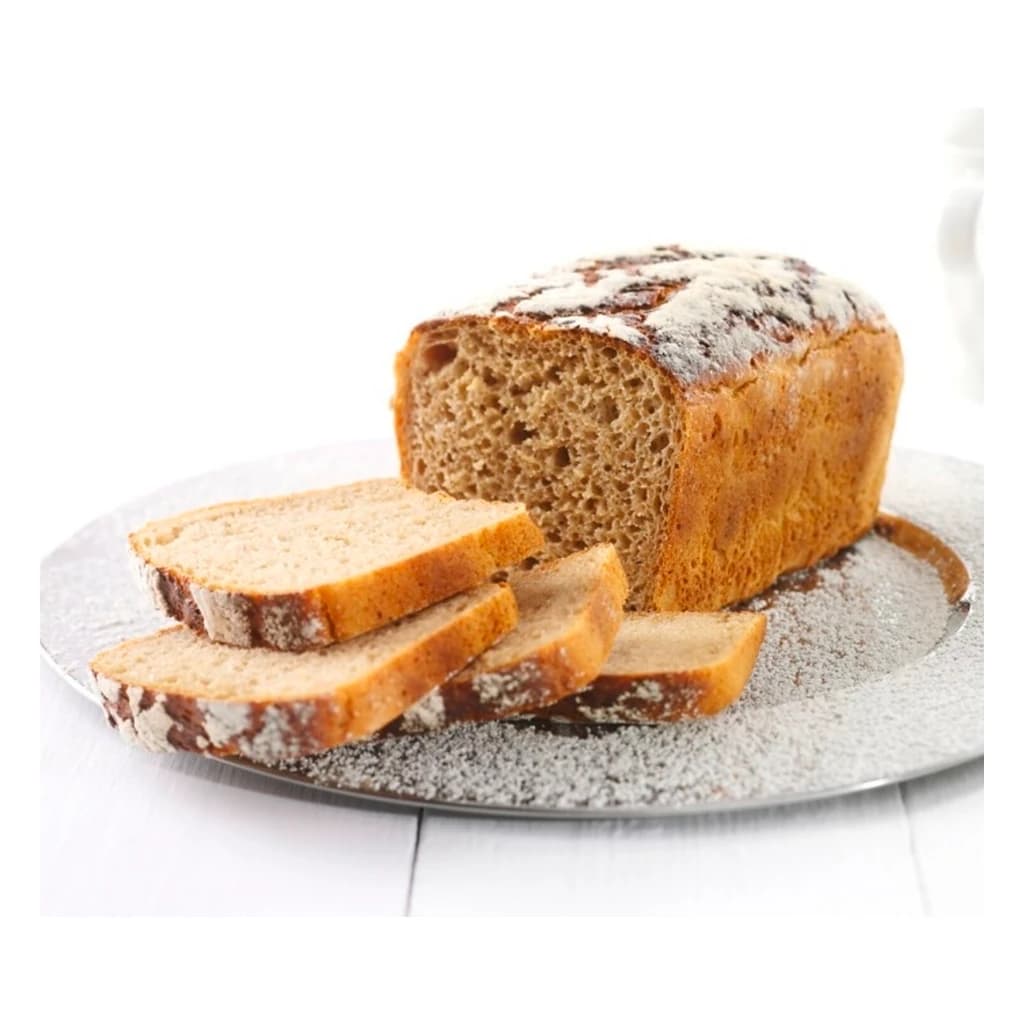
Optimax Free Bread Improver 20 kg
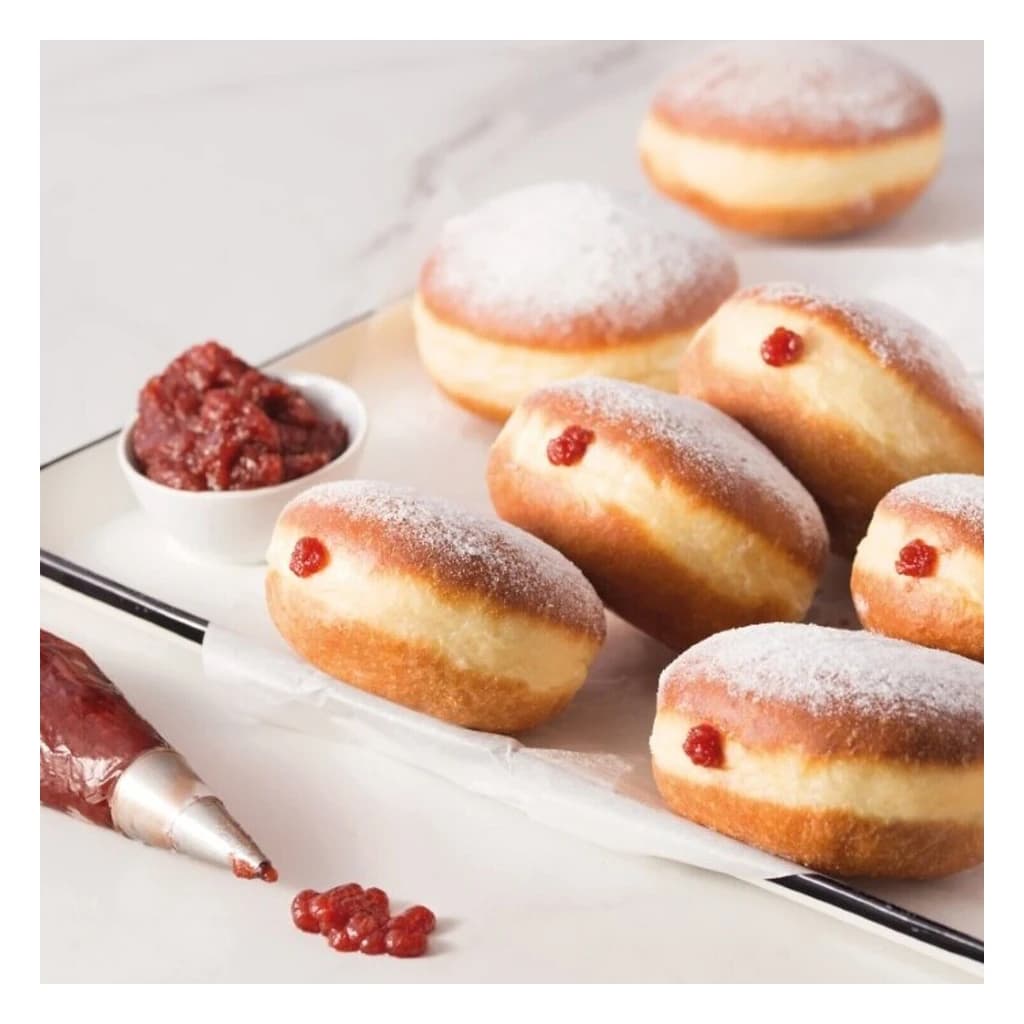
Berliner 10% Doughnut Improver Free 25 kg
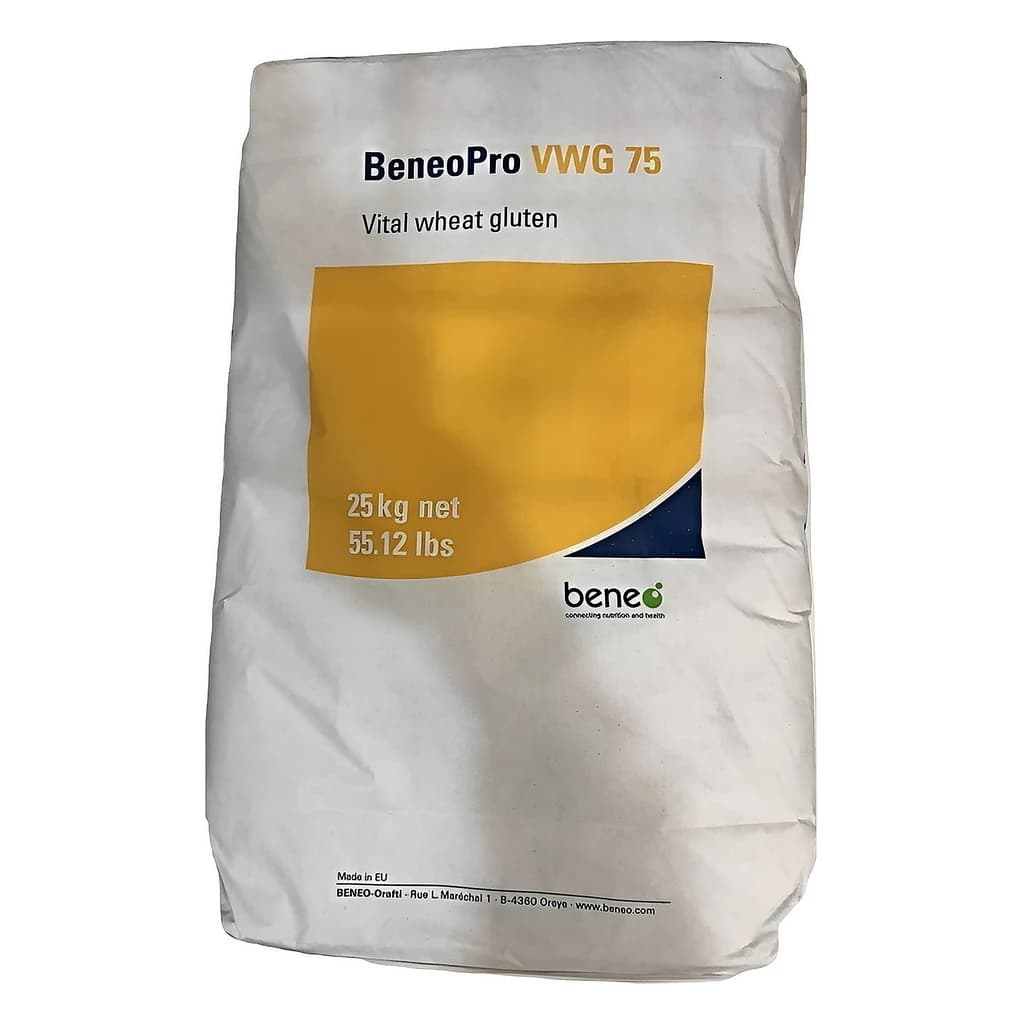
Beneo BeneoPro VWG 75 Vital Wheat Gluten 25 kg
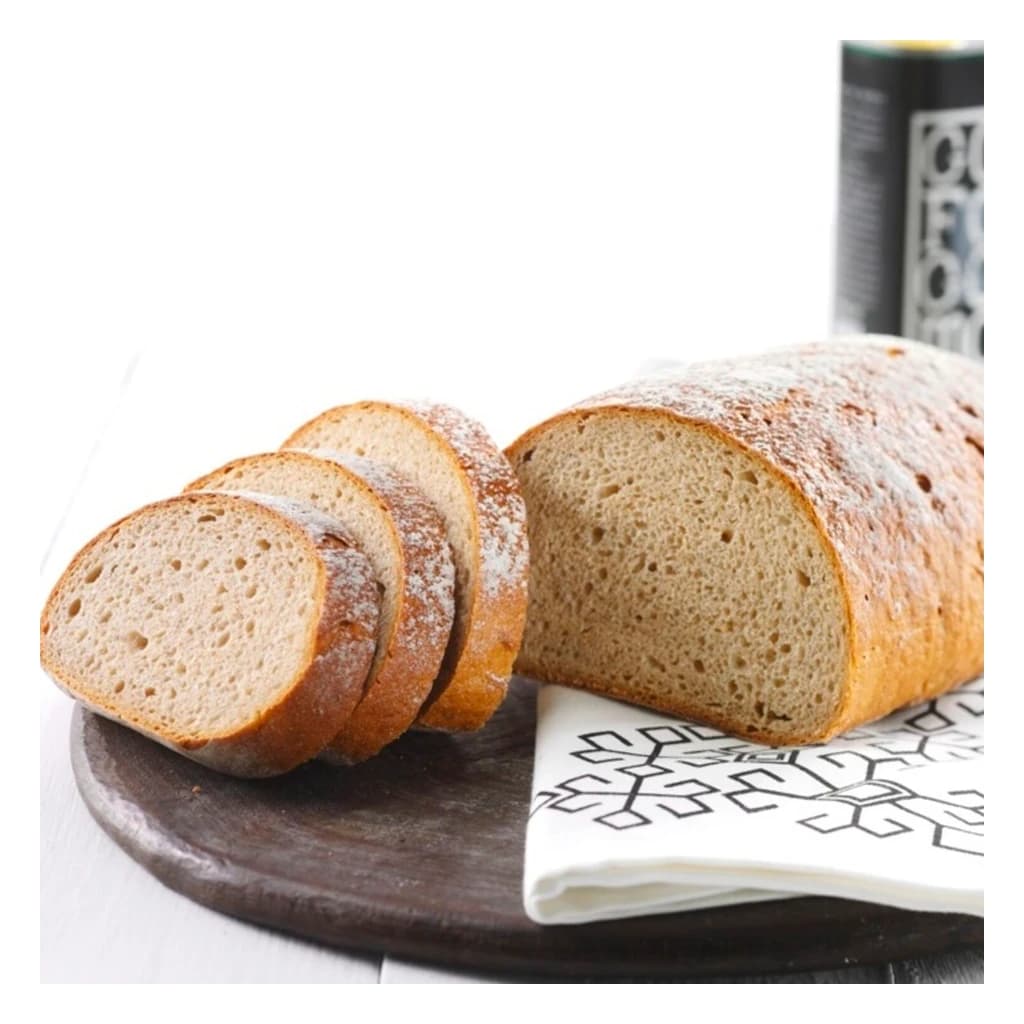
Rye Stabil Improver 25 kg
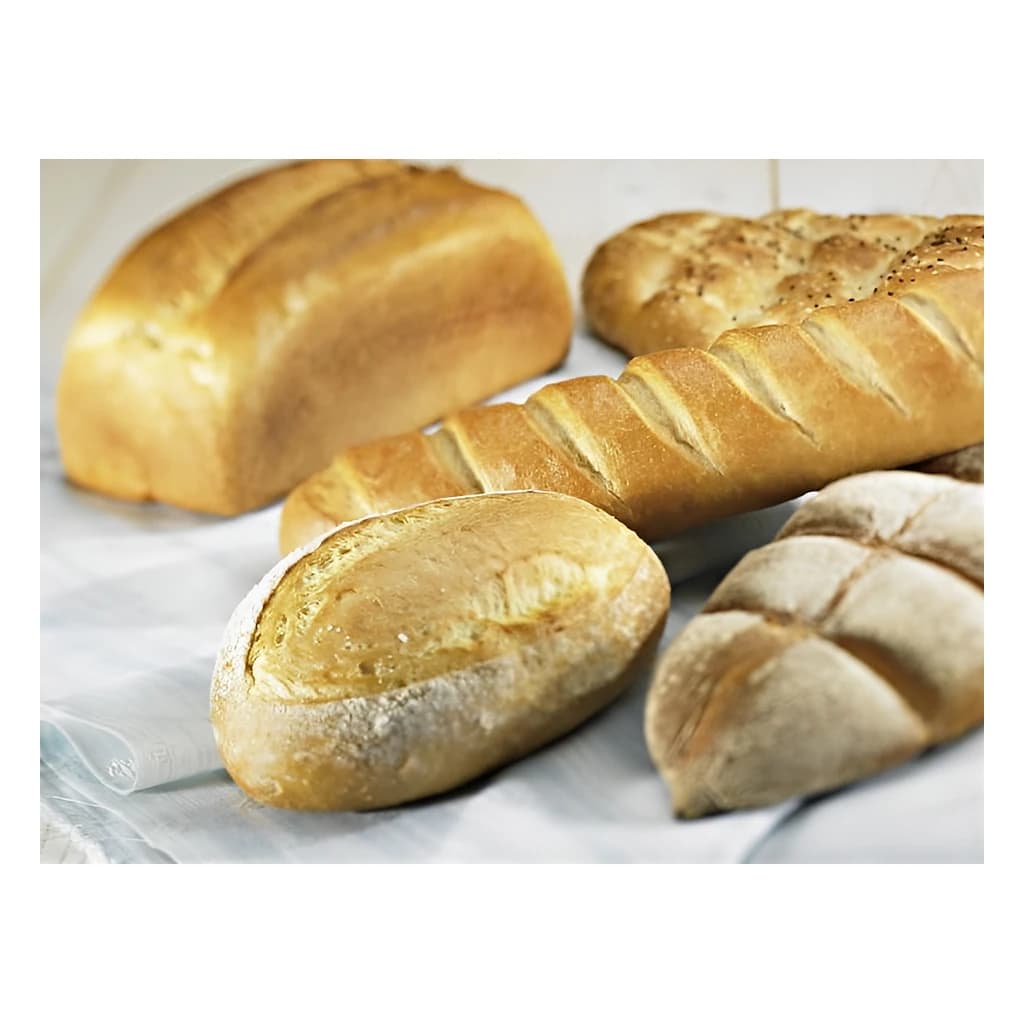
Intenso Extra Bread Improver 25 kg
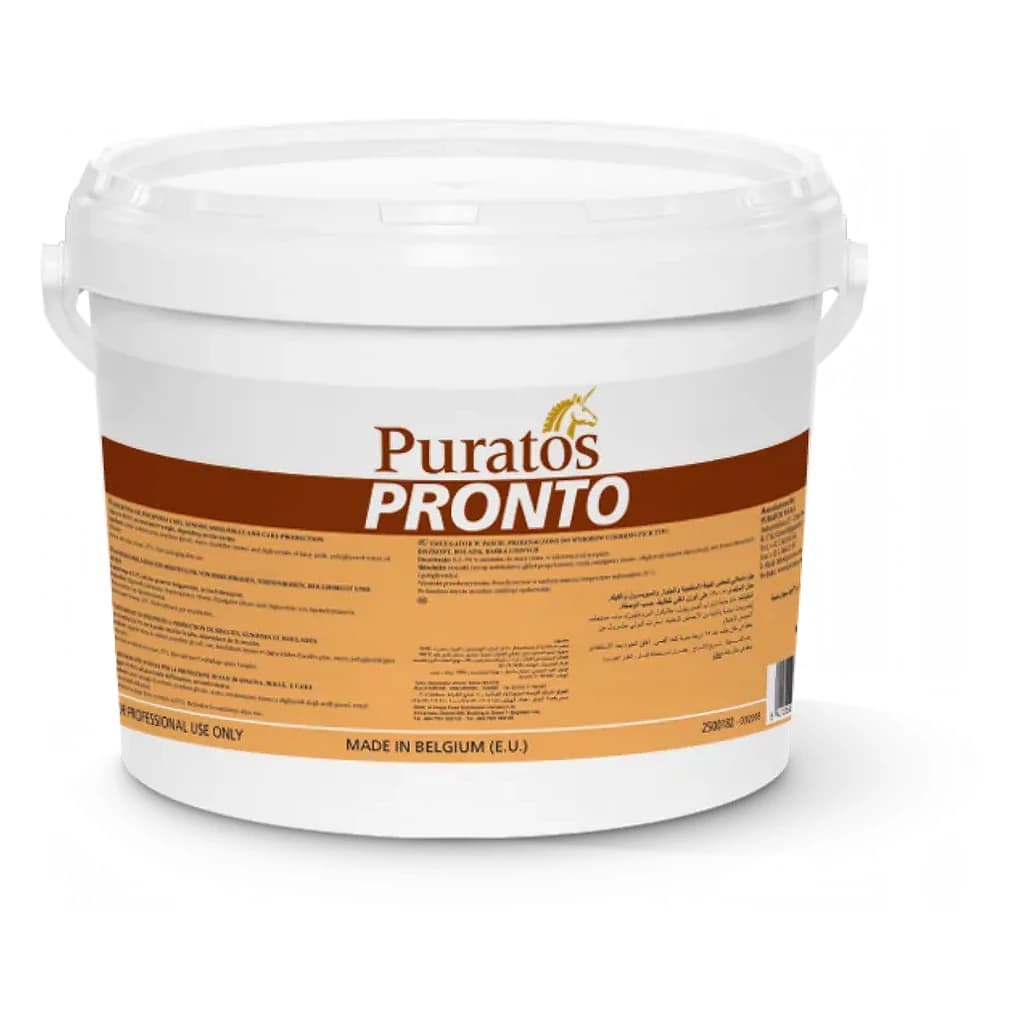
Puratos Pronto Dough Conditioner 10 kg
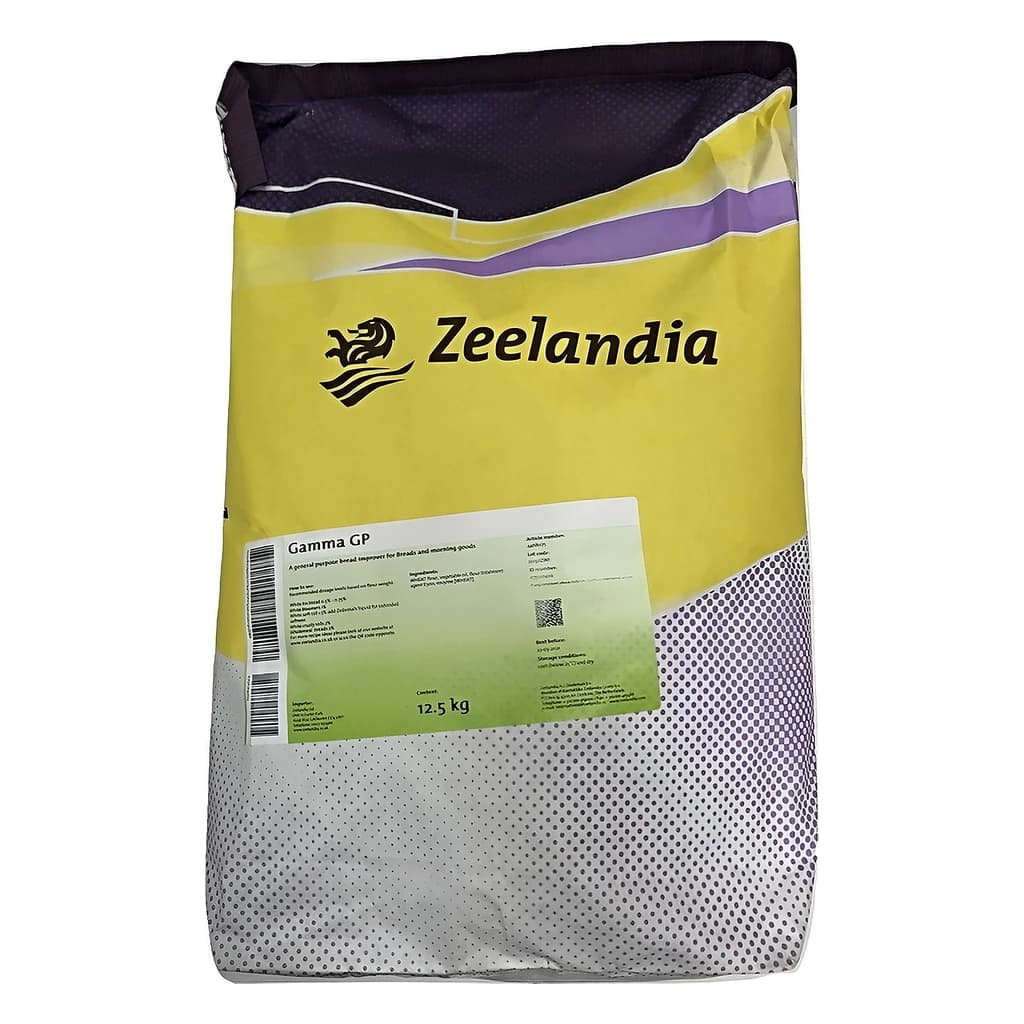
Zeelandia Gamma GP Bread Improver 12.5 kg
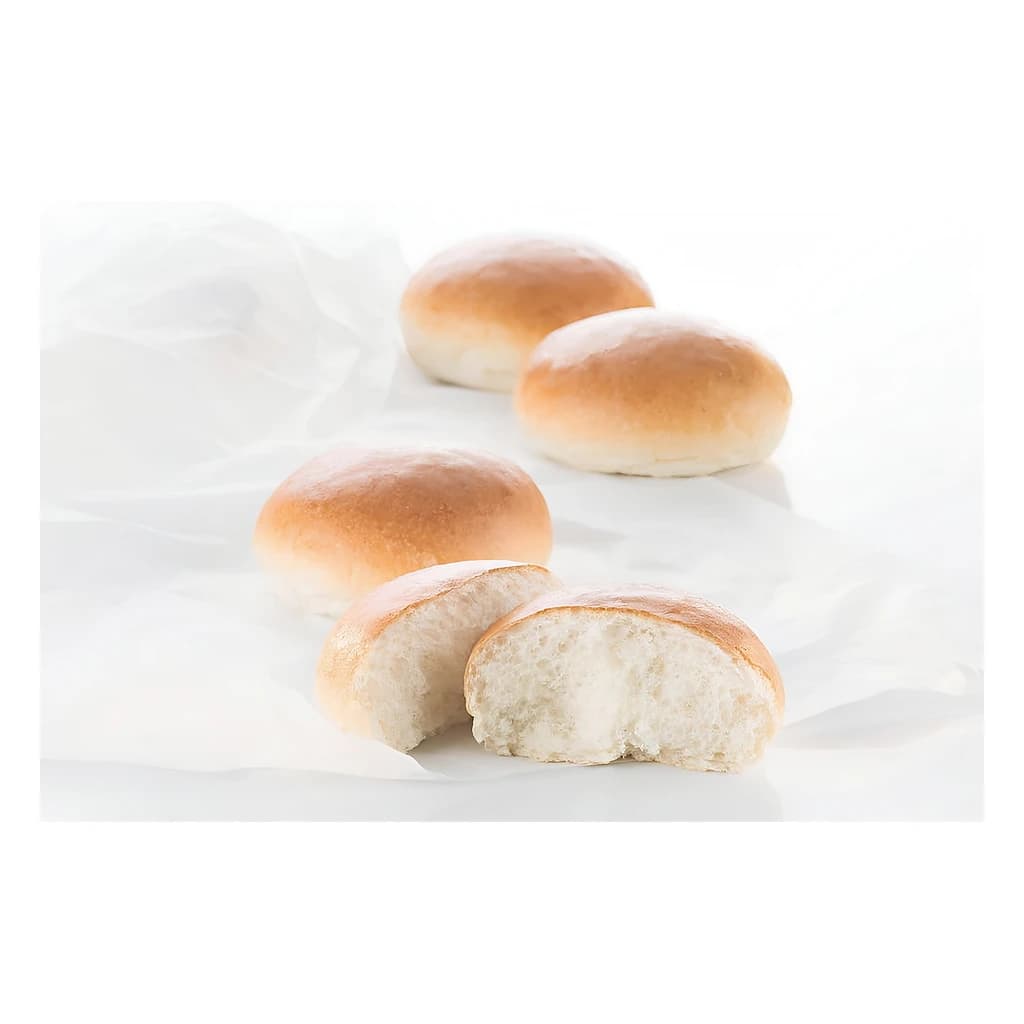
IREKS Soft Roll 7 Bread Improver 25 kg
IREKS Voltex Multipurpose Bread Improver 25 kg
Puratos Tigris SG 2% Bread Improver 16 kg
Puratos S500 Sense SG Bread Improver 12.5 kg

Puratos S500 SG Bread Improver 12.5 kg (Kosher)
IREKS Toast & Buns Bread Improver 25 kg