
Fresh, Active Dry & Instant Yeast: Formats, Performance & When to Use Each
A practical field guide for professional bakers covering every commercial baker's yeast format — fresh compressed, instant dry, active dry, cream yeast — plus chemical leaveners (baking powder, bicarbonate of soda) and ready-to-use sourdough concentrates. Built on first-party spec sheets from nine products in the Domson catalogue (Lesaffre, Lallemand, Bowika, CSM Ingredients, AB Mauri/Aromaferm, Puratos, Zeelandia, ULDO) and cross-checked against Bakerpedia, King Arthur Baking, Kansas State University, IREKS Compendium, and peer-reviewed sourdough microbiology. Includes full comparison tables, substitution ratios, fault diagnosis, and allergen flags for every product.
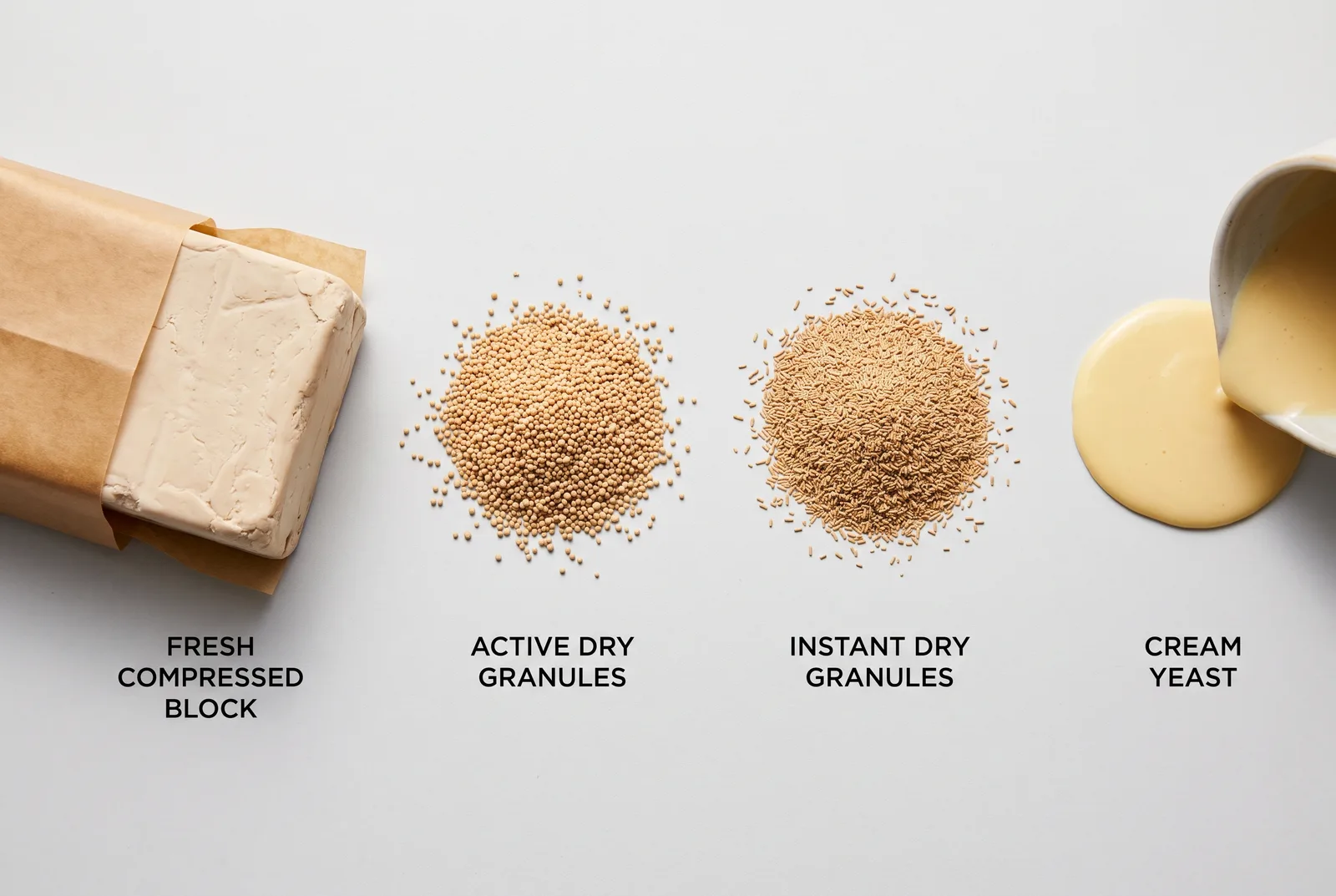
Four formats of baker's yeast side by side: fresh compressed block, active dry granules, instant dry granules, and cream yeast
What this article covers
This dossier compares every commercial leavening format a professional baker is likely to encounter: fresh compressed yeast, instant dry yeast (IDY), active dry yeast (ADY), cream yeast, baking powder, sodium bicarbonate, and ready-to-use sourdough concentrates. It is grounded in the spec sheets of products stocked by Domson and cross-checked against independent trade and academic sources. Where sources disagree on a value, both ranges are presented with attribution.
For the underlying biochemistry of yeast fermentation, see the companion article A2-yeast-fermentation-science. For enriched-dough and osmotolerant yeast applications, see A2-osmotolerant-yeast-enriched-doughs. For preferments (poolish, biga, sponge), see A2-preferments-poolish-biga-sponge.
1. What baker's yeast is
All commercial baker's yeast is Saccharomyces cerevisiae — a single-celled fungus that converts fermentable sugars into carbon dioxide (CO2) and ethanol via anaerobic respiration. The CO2 inflates the gluten network, producing rise; the ethanol evaporates in the oven; the fermentation by-products contribute flavour.
The different formats on the market are all the same organism, processed to different moisture levels for different shelf lives and handling characteristics.
2. Fresh compressed yeast
How it is made
Fresh compressed yeast is produced by fermenting a pure strain of Saccharomyces cerevisiae in a growth medium of molasses or other sugar sources supplemented with nutrients (mono-ammonium phosphate, ammonia, water). The fermentation wort is centrifuged to produce cream yeast, which is then dehydrated by vacuum filter pressing. The resulting compressed cake is extruded, cut into blocks, and paper- or wax-wrapped.
What it looks like
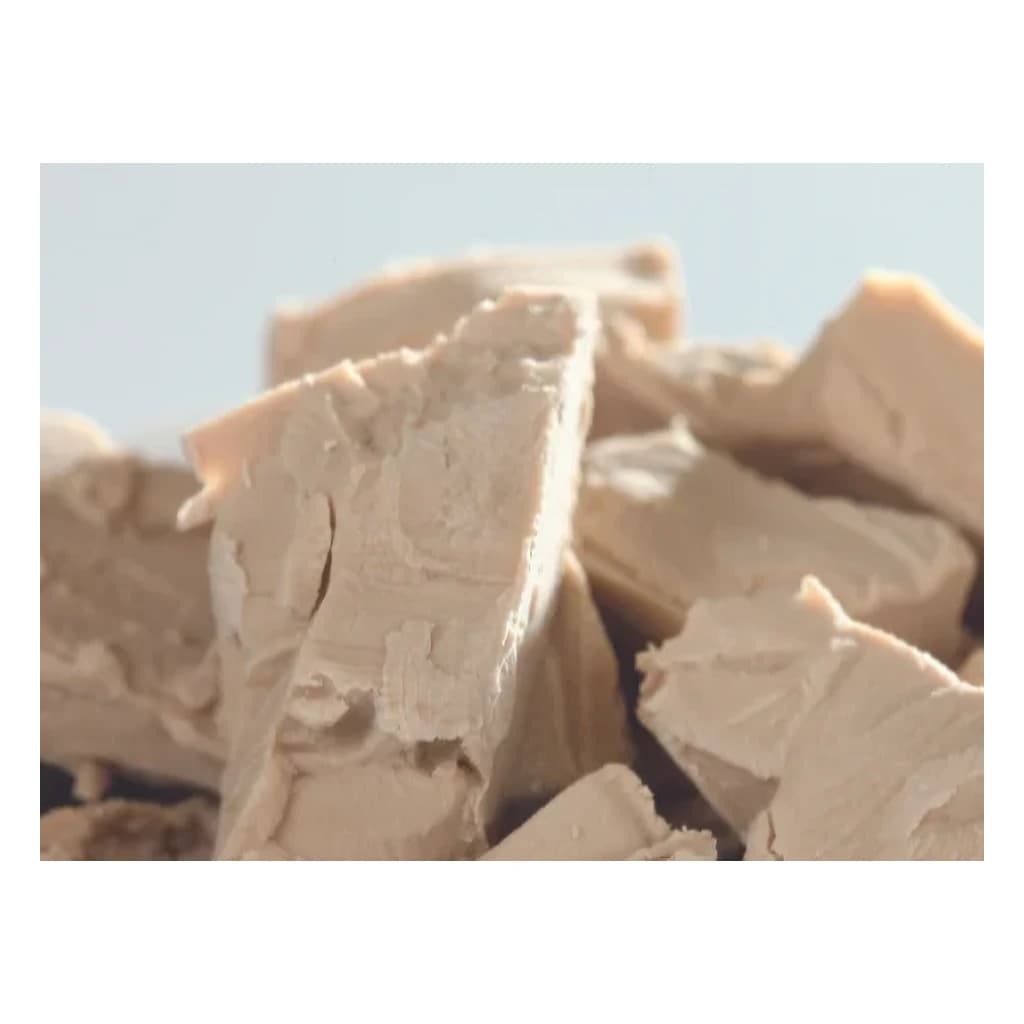
Fresh compressed yeast is a semi-solid block, pale beige to light brown, with a characteristic clean yeasty smell and taste. It crumbles cleanly when broken, and the texture — a matrix of live yeast cells and water — distinguishes it from dried formats.
Key spec data (from first-party spec sheets)
Lesaffre Benevia 10 kg:
- Dry matter: >29%
- Fermentative activity: 125 ±10 ml CO2 (risograph, Lesaffre method); max 100 minutes (PN-A-79002)
- Shelf life: 35 days from date of production
- Storage: 1–10°C, optimum 4°C; protect from moisture and foreign odours
- Allergens: None declared as present in product. Note: sulphur dioxide and sulphites are present in the molasses used during production (not declared as allergen at product level per spec sheet — operators with sulphite-sensitive customers should verify directly with Lesaffre). ⚠️ food safety flag
- Protein: 15 g/100g (fresh weight basis)
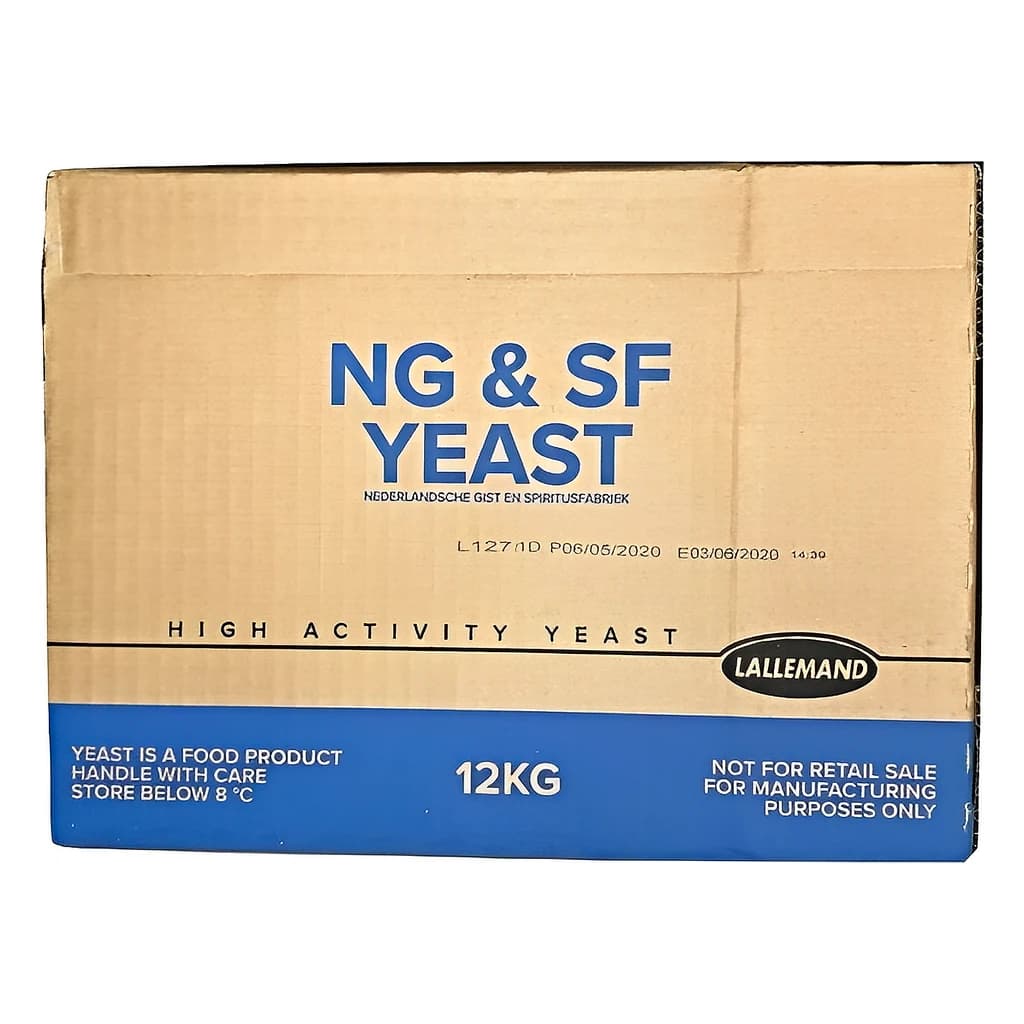
Lallemand NG & SF Fast Active 12 kg:
- Dry matter: 28–35%
- Moisture: ~69%
- Shelf life: 28 days from packing
- Storage: max 8°C, dry chill store; do not freeze
- Description: "Compressed, fast acting fresh yeast suitable for use in a Chorleywood type baking process"
- Certifications: Kosher and Halal certified; gluten free; suitable for vegan and vegetarian diets
Note on protein values: Benevia reports 15 g protein/100g on a fresh-weight basis (70% moisture), while NG & SF's older Product Information Sheet reports 17.4 g protein and the Technical Data Sheet reports 8.4 g protein. These differ because the two sheets use different calculation methods. Do not compare fresh yeast protein values directly with dry yeast values — the moisture content makes the numbers incomparable on a per-100g-as-supplied basis.
How to use fresh compressed yeast
Fresh yeast can be crumbled directly into the dough flour or dissolved in a small amount of cool water (max 38°C) before incorporating. It requires no proofing step, but some bakers proof in warm water (30–35°C) for 5–10 minutes to confirm viability. Avoid dissolving in water hotter than 38°C, which risks partial deactivation; above approximately 55–60°C yeast is killed.
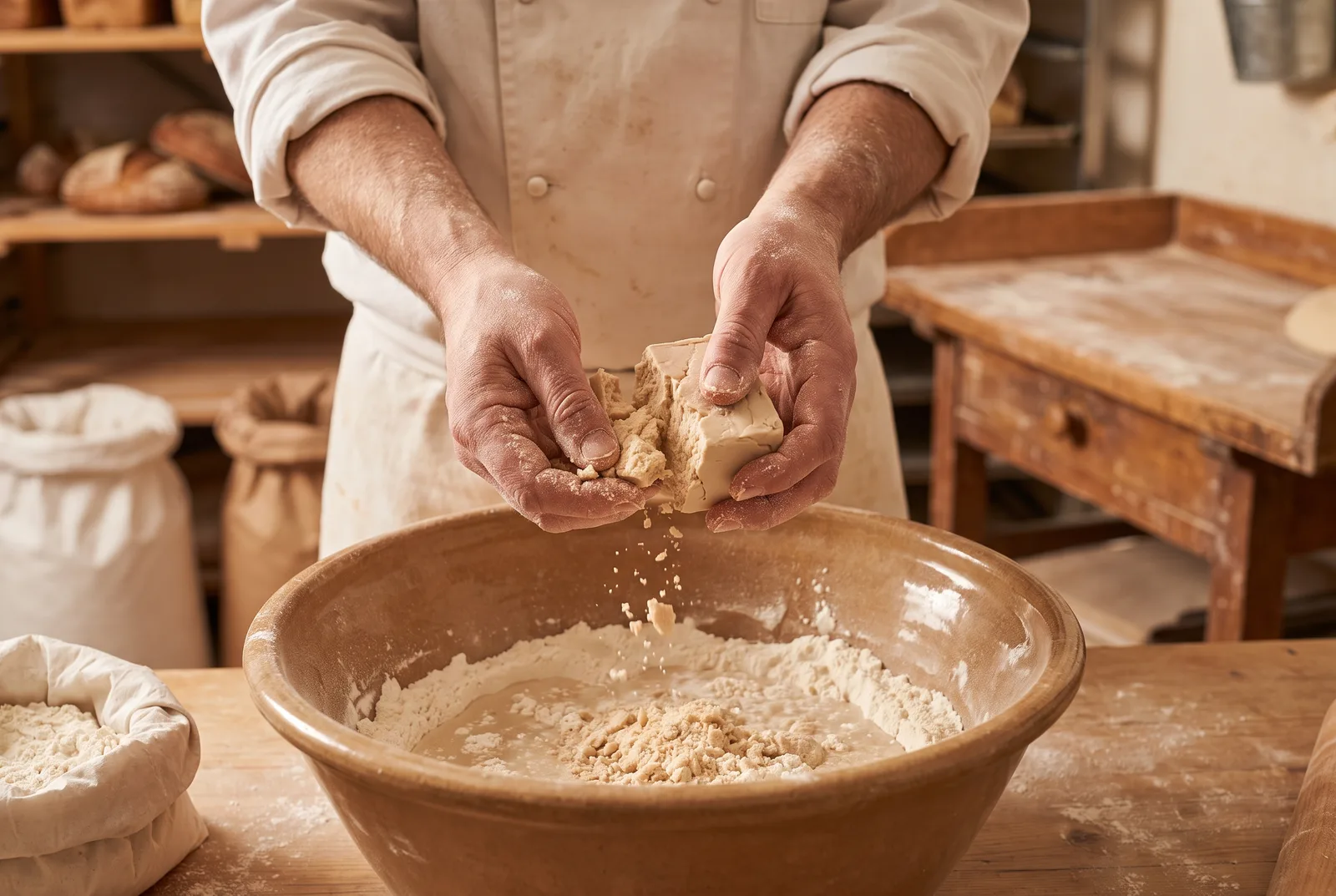 Baker's hands crumbling fresh compressed yeast block into dough, showing the moist, crumbly texture
Do not allow fresh yeast to come into direct contact with undiluted salt before mixing — high salt concentration dehydrates yeast cells osmotically. Add salt and yeast on opposite sides of the bowl.
Storage and chain of custody
Fresh yeast is a living product with a short window. Lesaffre Benevia: 35 days from production at 4°C. Lallemand NG & SF: 28 days from packing at max 8°C. Verify the packing date (printed on packaging) on receipt. Yeast held above 10°C begins to lose activity and will autolyse if held too warm for extended periods, producing off-flavours. Do not freeze fresh yeast — ice crystal formation ruptures cell membranes, destroying viability.
3. Instant dry yeast (IDY)
How it is made
Cream yeast is further dehydrated — first through vacuum filters, then through hot-air dryers — to reduce moisture to approximately 5% (dry matter 93–98%). The resulting dried yeast is sieved to produce small oblong, rod-shaped particles with a porous internal structure. This porous structure is the key engineering feature: it allows rapid water absorption during dough mixing without a separate rehydration step.
A small amount of sorbitan monostearate (E491, approximately 1%) is incorporated as an emulsifier. Its function is to protect yeast cell membranes during rapid rehydration and to improve dispersion in dough. The presence of E491 is declared on the ingredient list of these products. ⚠️ Note: E491 is permitted in dried active yeasts under EU Regulation (EC) No 1333/2008 up to a maximum of 1%; operators should verify current product labels confirm the E-number declaration is present and compliant.
Key spec data (from first-party spec sheets)
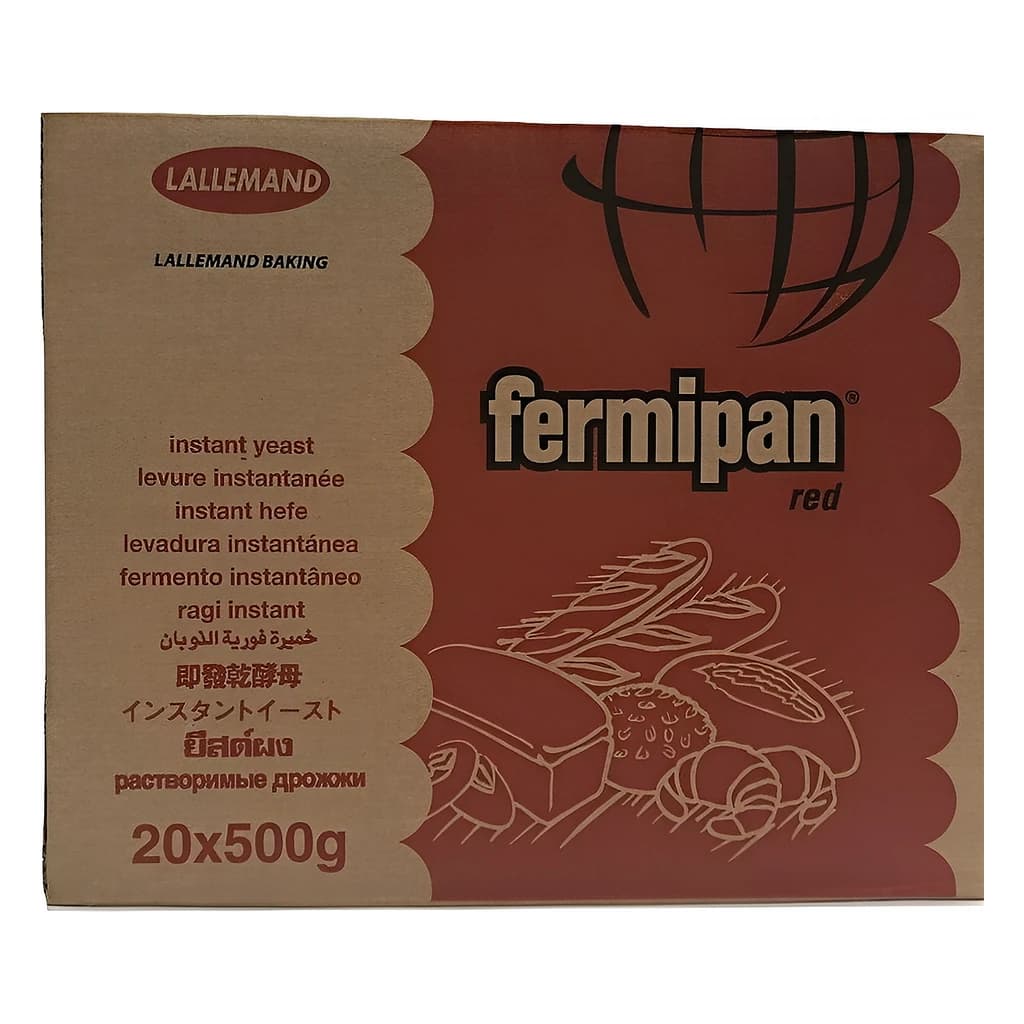
Lallemand Fermipan Red 10 kg:
- Dry matter: 93–98%
- Shelf life: 2 years at ambient temperature, unopened, in vacuum-packed aluminium laminate
- Application: "Instant active dried yeast for lean dough bread types with limited sugar contents (0–10%) requiring high fermentation power"
- Typical dosage: 1–1.5% of flour weight
- Allergens: None. Does not contain egg, soya, dairy, animal products, artificial colours, or preservatives. Kosher and Halal certified; gluten free; suitable for vegans.
- Protein: 40–50 g/100g on dry matter basis (COFALEC method, N×6.25)
- Energy: 363 kcal/100g
Lallemand DCL Levure Premium 10 kg:
- Dry matter: >95%
- Shelf life: 2 years
- Dosage: 1–1.5% of flour weight
- Allergens: None. Gluten free; suitable for Halal and Kosher; vegan.
- Protein: 40.44 g/100g
- Energy: 325 kcal/100g
Note on protein values: Fermipan Red reports 363 kcal vs DCL Levure's 325 kcal per 100g. Both are on a dry-weight basis. The minor difference reflects different lots and measurement methods. Neither figure is nutritionally significant at typical use levels (≤1.5% of flour weight).
How to use instant dry yeast
IDY is designed to be added directly to the dry flour before mixing — no separate hydration or proofing is required. Ensure it is well distributed through the flour before adding water, to prevent localised clumping. Avoid dissolving in cold water (below 20°C) as this can shock and damage the yeast cells.
Dosage is typically 1–1.5% of flour weight. For very long fermentation (retarded overnight doughs), some bakers use as little as 0.1–0.3%; for rapid production schedules, up to 1.5% may be appropriate. Baking trials are recommended to confirm optimum dosage for each application.
Substitution ratios
Replacing fresh yeast with IDY, or converting a recipe between IDY and active dry yeast, requires a dosage adjustment.
- King Arthur Baking states that instant yeast can be substituted 1:1 by weight for active dry yeast. IDY is more active per unit weight due to its lower moisture content and higher viable cell density, but the practical substitution ratio at typical dosage levels is broadly 1:1. Always confirm with baking trials — performance varies by recipe, dough temperature, and fermentation schedule. Confidence: medium (single source).
- For fresh-to-IDY conversion, the broadly cited rule of thumb is 1 g IDY ≈ 3 g fresh yeast (i.e., use roughly one-third the weight of IDY compared to fresh). This is consistent with the dry matter ratio (fresh ~30% DM, IDY ~95% DM ≈ 1:3.2 by weight). Confirm with your supplier.
| Converting from | Converting to | Multiply by |
|---|---|---|
| Fresh compressed yeast | Instant dry yeast | ÷ 3 (approx.) |
| Instant dry yeast | Fresh compressed yeast | × 3 (approx.) |
| Active dry yeast | Instant dry yeast | × 1 (approx.; see note) |
| Instant dry yeast | Active dry yeast | × 1 (approx.; see note) |
These are indicative conversions. The IDY–ADY ratio is approximately 1:1 by weight per King Arthur Baking. Always confirm with baking trials and supplier guidance.
4. Active dry yeast (ADY) — format overview
Active dry yeast is processed differently from instant dry yeast: the yeast cream is dried at higher temperatures and to a coarser granule size (approximately 0.5–1 mm vs. the finer, elongated IDY particles). The higher drying temperature deactivates the outer cell layer of each granule, which acts as a protective shell — but this also means the granule must be rehydrated before use to allow the viable cells at the centre to re-activate.
Rehydration method for ADY: dissolve in water at 38–43°C (blood-warm) with a pinch of sugar; allow to stand for 5–10 minutes until foamy.
Active dry yeast is not currently sold by Domson as a standalone product in the catalogue reviewed for this article. The format information is included here for professional reference and cross-recipe conversion. Bakers using ADY from other suppliers should follow the manufacturer's rehydration instructions and apply the conversion ratios in the table above.
5. Cream yeast — industrial format
Cream yeast is the liquid intermediate in the fresh yeast manufacturing process: centrifuged yeast cream at approximately 15–20% dry matter is chilled in tanks and transported to large industrial bakeries via a temperature-controlled tanker or direct dosing system.
This format is not stocked by Domson (it requires dedicated refrigerated delivery infrastructure and in-line dosing pumps) but is mentioned here for professional context. Industrial bread plants running continuous Chorleywood-type processes frequently use cream yeast for its precision dosing and consistent activity.
6. How temperature, pH and sugar affect yeast performance
Understanding yeast's environmental sensitivity is as important as choosing the right format.
Temperature
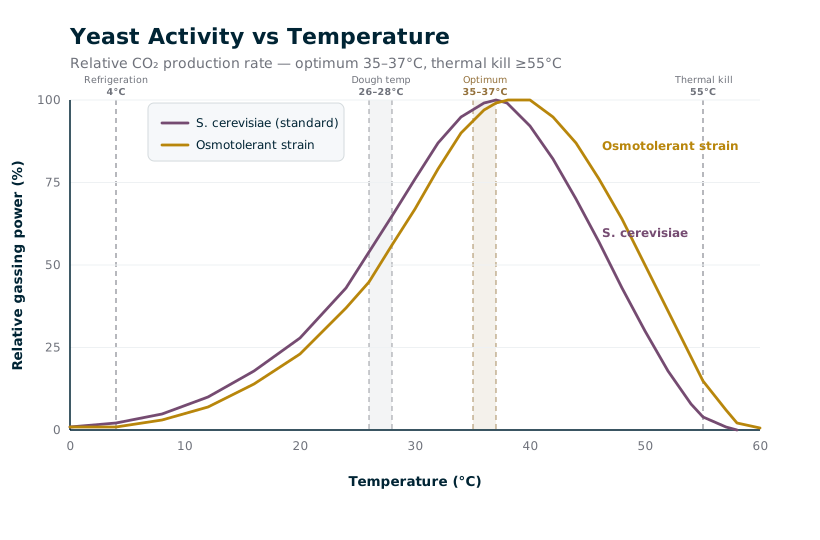 Graph showing baker's yeast CO2 production activity peaks at 35–37°C and drops to zero above 55°C
Yeast CO2 production increases from approximately 10°C and reaches a biological peak broadly in the 35–50°C range before protein denaturation and cell death begin. At approximately 55–60°C yeast is killed.
Practical dough temperature targets are 26–28°C for most lean breads — well below the biological CO2 peak, because bakers prioritise controllable fermentation speed and flavour development over maximum gassing rate. Every 5°C change in dough temperature can roughly halve or double fermentation time — maintain consistent dough temperature using the DDT (desired dough temperature) formula.
Yeast inhibition below 10°C
Storage at 4°C (recommended for fresh yeast) nearly arrests fermentation. This is exploited in retarded dough methods: shaped pieces can be held overnight at 4°C with very little yeast activity, baked fresh in the morning.
pH effects
Yeast prefers a slightly acidic environment (optimal pH approximately 4.5–5.5). Performance is reduced in alkaline doughs (e.g., when excess bicarbonate is present). This is why combining baking powder or bicarbonate with yeast in the same formula is rarely done.
Sugar (osmotic pressure)
Standard Saccharomyces cerevisiae strains tolerate sugar up to approximately 10% of flour weight without significant performance reduction. Above this level, osmotic stress draws water out of yeast cells and inhibits fermentation. For enriched doughs (brioche, panettone, doughnuts) with sugar levels exceeding 10%, osmotolerant yeast strains provide a meaningful activity advantage over standard strains — one trade source (BAKERpedia) cites approximately 10–20%, though the actual difference varies by formulation and strain. See the companion article A2-osmotolerant-yeast-enriched-doughs for full coverage.
7. Chemical leavening: baking powder and sodium bicarbonate
Chemical leaveners produce CO2 through acid-base chemistry rather than biological fermentation. They are instantaneous, require no fermentation time, and are entirely appropriate for quick breads, cakes, scones, muffins, and any product where yeast flavour is undesirable and a rapid production cycle is needed.
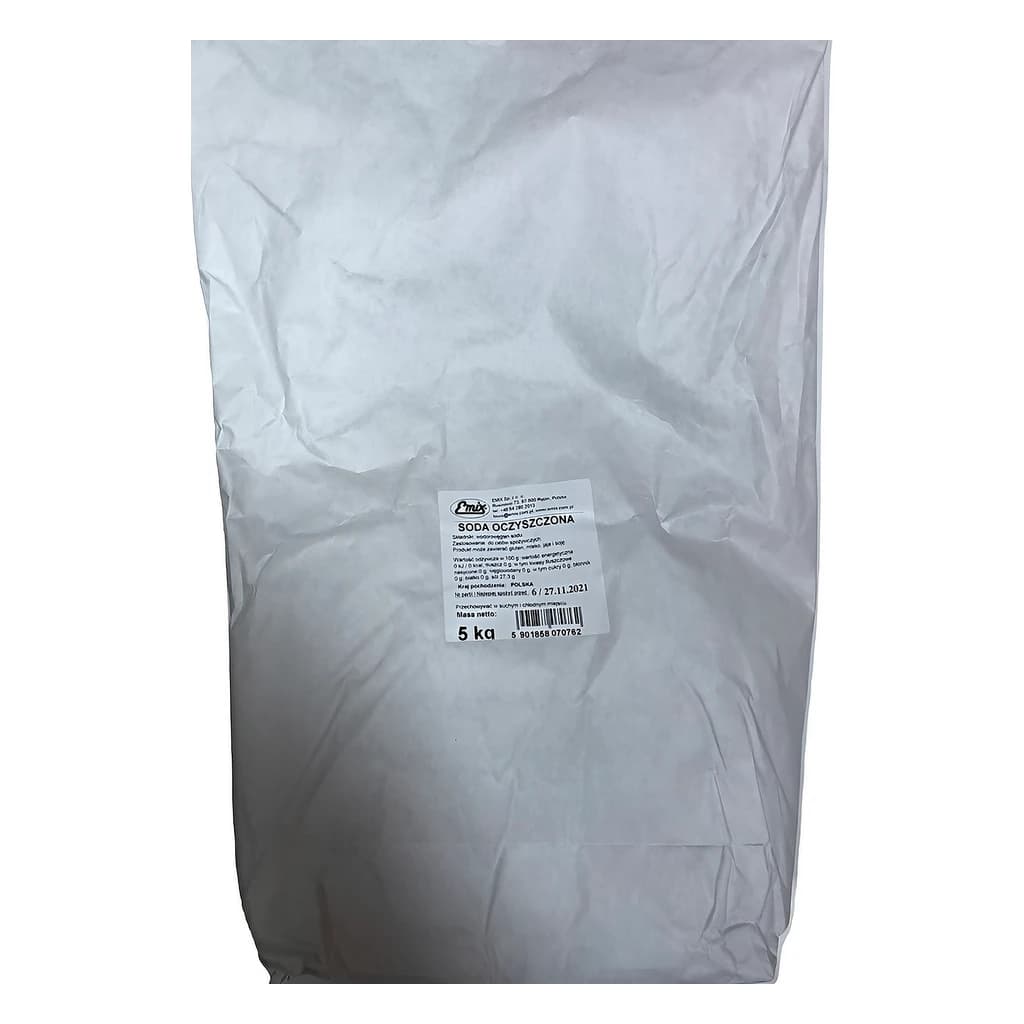
Sodium bicarbonate (baking soda)
Sodium bicarbonate (NaHCO3, E500ii) is the base component in all chemical leavening systems. On its own, it requires an acidic ingredient in the formula (buttermilk, yoghurt, natural cocoa, citric acid, cream of tartar) to react and produce CO2. Without a sufficient acid, residual sodium carbonate produces a soapy, bitter taste and may cause yellow discolouration in baked goods.
Bowika Sodium Bicarbonate E500(ii) 5 kg:
- Purity: min 99.3% sodium bicarbonate
- pH of 1% solution: max 8.5
- Shelf life: 24 months
- Origin: Turkey
- Allergens: None
- Storage: max 30°C, max 75% RH
Typical usage rate: approximately 0.5–1.5% of flour weight, depending on the acid source. This is a single-source estimate — confirm with formulation-specific baking trials.
Baking powder: a self-contained system
Baking powder combines sodium bicarbonate with one or more dry acids (typically phosphate salts) and a starch filler to prevent premature reaction. This makes it self-contained — no additional acid source is required in the recipe.
Double-acting mechanism:
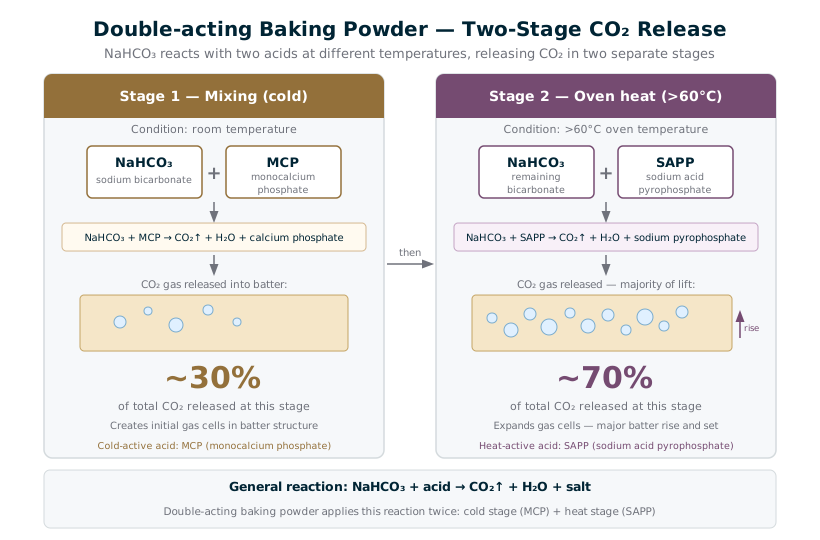 Diagram showing double-acting baking powder releases CO2 in two stages: when mixed and again when heated in the oven
Modern baking powders are "double-acting": they release CO2 in two stages:
- Stage 1 (cold, on hydration): monocalcium phosphate (MCP) or similar fast-acting acid reacts with bicarbonate immediately on contact with water, releasing an initial portion of CO2. This sets the cell structure before the batter reaches the oven.
- Stage 2 (heat, in oven): sodium acid pyrophosphate (SAPP) or diphosphate (E450) reacts with remaining bicarbonate above approximately 50–60°C, releasing the bulk of CO2 and driving final rise.
Bowika Baking Powder 5 kg:
- Ingredients: Sodium bicarbonate E500(ii) + disodium diphosphate E450(i) + wheat flour
- Total phosphate content: 18.02–18.45% as P₂O₅ (m/m)
- Recommended dosage: 1 kg per 32 kg flour (~3.1% baker's percentage)
- Shelf life: 9 months from production
- ALLERGEN: Contains wheat (gluten). Not suitable for gluten-free applications. ⚠️
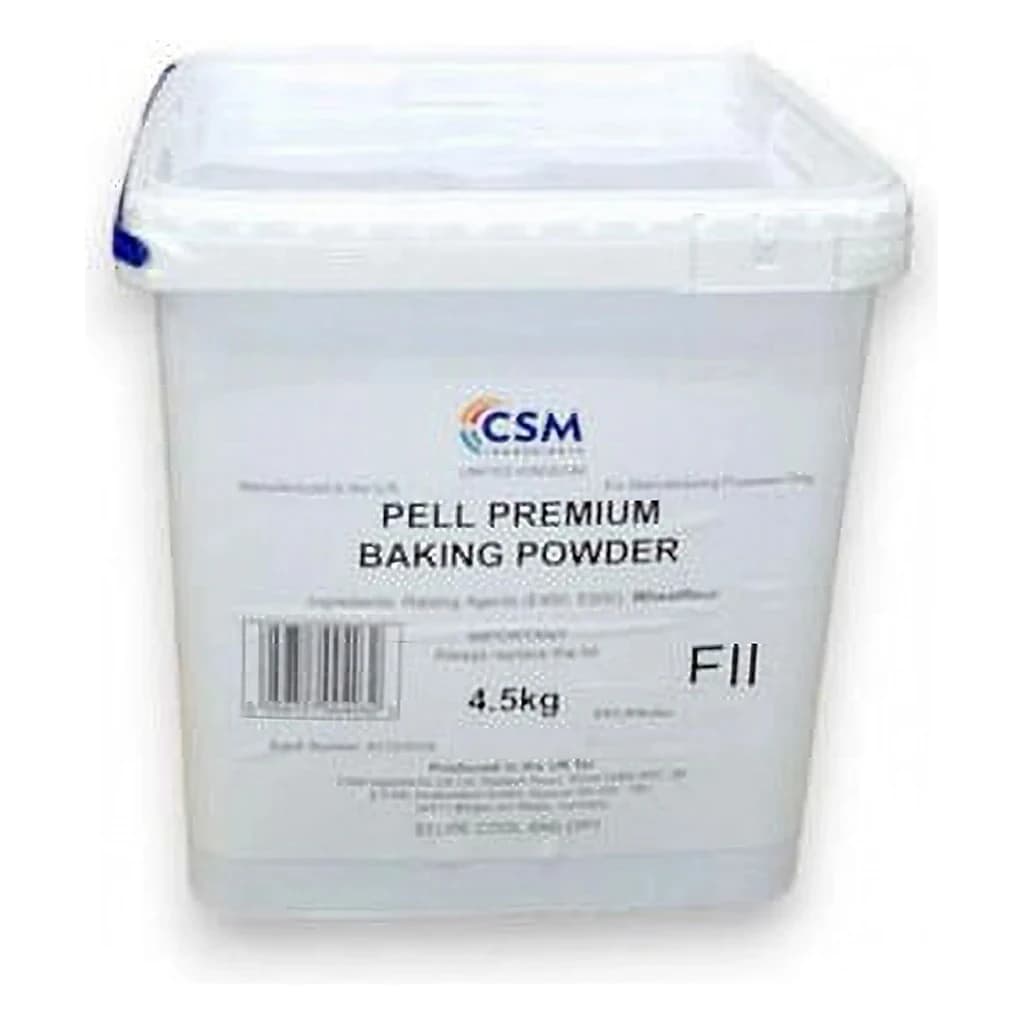
CSM Pell Premium Baking Powder 4.5 kg:
- Ingredients: Diphosphates E450(i) + sodium carbonates E500(ii) + wheat flour
- CO2 content: 17.5–18.5%
- Shelf life: 365 days at < 25°C
- Certifications: Kosher and Halal certified
- ALLERGEN: Contains wheat (gluten). ⚠️
Allergen note: Both baking powders in the Domson catalogue contain wheat as a carrier/filler. This is standard industry practice, but it means they are NOT suitable for gluten-free formulations. Bakers producing gluten-free products must source a certified gluten-free baking powder from a dedicated specialist (not currently in the Domson catalogue at time of research — 2026-06-25). ⚠️ food safety flag
Handling and storage of baking powder
Baking powder is hygroscopic — moisture absorption triggers premature CO2 release, reducing leavening power in the finished product. Always store sealed in cool, dry conditions (max 25°C, max 75% RH) and measure out over a cold, dry surface. Never measure over a steaming kettle or mixing bowl.
8. Ready-to-use sourdough concentrates
Sourdough concentrates are manufactured sourdough preparations — fermented wheat, rye or other grain substrates that have been partially or fully dried — sold as working ingredients to enable consistent sourdough flavour without maintaining a live culture or running a full 12–24 hour sourdough cycle. They occupy a spectrum from "active" (contain live micro-organisms) to "devitalised" (micro-organisms inactivated by drying, providing flavour acids only).
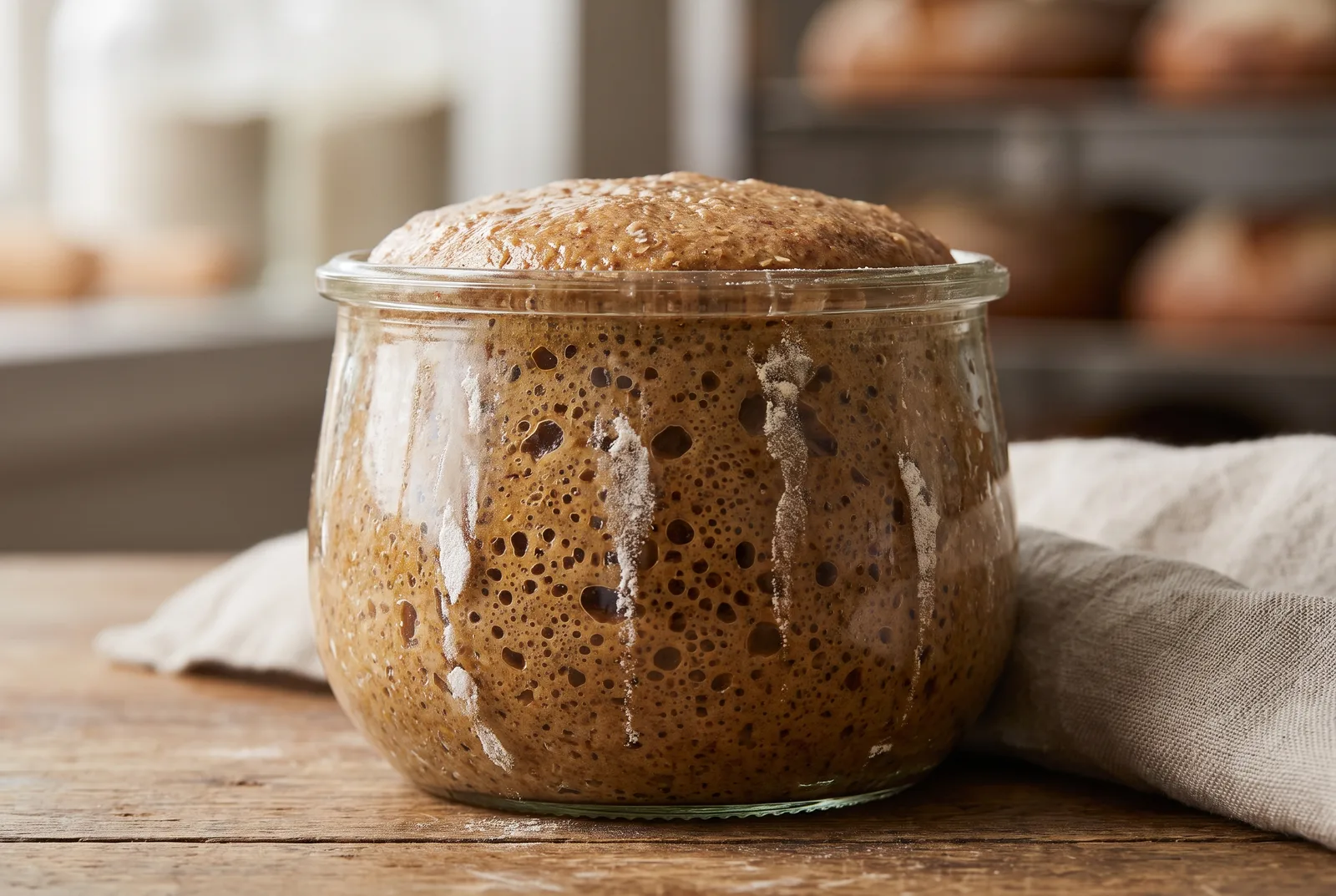 Actively fermenting rye sourdough starter in a glass jar, showing abundant bubbles and risen dome
For the science of sourdough cultures, fermentation stages, and the biology of lactic acid bacteria and wild yeast, see the companion article A2-sourdough-cultures-science.
Types of ready-to-use sourdough in the Domson catalogue
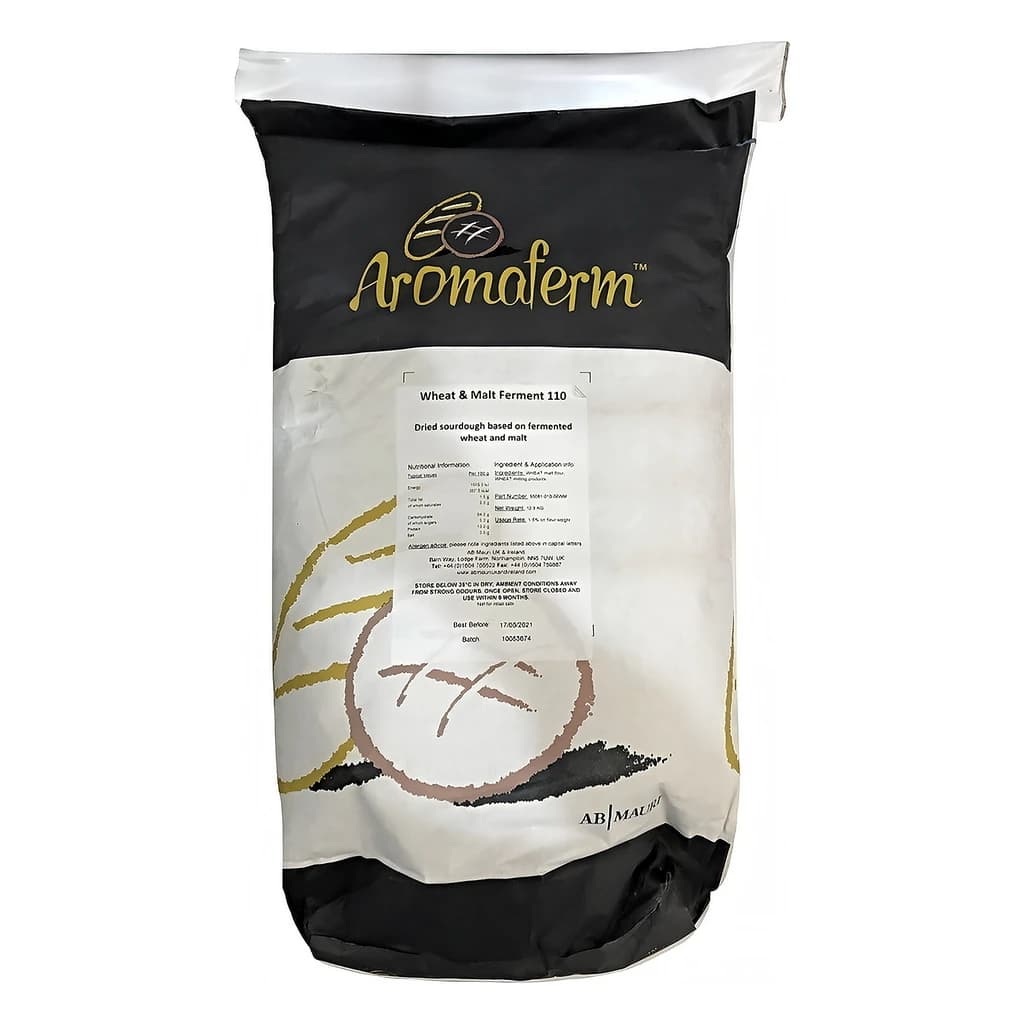
Aromaferm Wheat & Malt Ferment 110 — 12.5 kg
AB Mauri (Mauri Technology) describes this as "a dried wheat sourdough designed for the production of baked goods". It is a devitalised/dried concentrate used with baker's yeast.
- Composition: wheat malt 90–100%, wheat milling products 5–10%
- pH: approximately 3.3
- Total titratable acidity: 110 ±10%
- Moisture: <5%
- Dosage: 1–5% on flour weight
- Shelf life: 12 months at 0–25°C, dry
- Contains gluten (wheat). Halal, Kosher, Vegan.
- Note: Aromaferm provides sourdough flavour and acidity. It does not provide leavening — baker's yeast is still required.
Puratos O-tentic Durum Sourdough Concentrate 10 × 1 kg
An "active bakery component based on sourdough" from Puratos. Unlike Aromaferm, O-tentic Durum contains live yeast and is characterised by gassing power activity — meaning it can contribute to leavening as well as flavour.
- Ingredients: dried durum wheat sourdough, yeast, ascorbic acid (E300), enzymes
- Dry matter: 94–100%
- Total acidity: 45–65 ml/10g (acid-base titration)
- Usage rate: 4% on flour weight with addition of water and salt
- Storage: 16–20°C, max 65% RH. After opening: max 1 week at 0–7°C sealed — discard if this window is exceeded or if the product has been stored above 7°C. ⚠️ food safety flag
- Shelf life: 12 months
- Contains wheat (gluten). Vegan suitable. GFSI certified.
- Flavour profile: "typical Mediterranean taste profile" — aimed at durum-based and ciabatta-style breads
Zeelandia Bioferm Dark Liquid Sourdough 19 kg
A liquid rye sourdough concentrate for mixed rye and full rye breads.
⚠️ Important: the available specification for this product is dated 2011 (last modified 2011) — 15 years old. All values below are from that dated spec sheet. Zeelandia must be contacted for a current specification before any customer-facing use, especially the allergen declaration.
- pH: 2.4–2.8 (spec dated 2011 — unverified current)
- Acidity: SH° 250–260 (spec dated 2011 — unverified current)
- Dosage: 2.5–4% depending on rye/wheat ratio
- ALLERGEN (unconfirmed — 2011 spec): Contains wheat, rye (gluten), and MILK. Obtain current allergen declaration from Zeelandia before relying on this information. ⚠️ food safety flag
ULDO W/43 Dark Sauer Concentrate 25 kg
A paste-format dark rye sourdough concentrate.
- Ingredients: rye bran, water, rye flour, acidity regulators (citric acid, lactic acid, acetic acid), barley malt
- pH: 2.5–4.5
- Dosage: 2–8%
- Shelf life: 9 months at max 30°C
- Contains gluten. Possible traces of milk, sesame, soya, lupins, eggs. ⚠️
See A2-ready-use-sourdough-industrial for a full dossier on industrial sourdough systems.
9. Comparison tables
The tables below give the full machine-readable detail. The three tables are:
- table-yeast-formats — Benevia, NG & SF, Fermipan Red, DCL Levure side-by-side on dry matter, shelf life, storage, emulsifiers, allergens, and protein.
- table-leaveners-comparison — Bowika baking powder, CSM Pell Premium, Bowika sodium bicarbonate, Aromaferm Wheat & Malt Ferment side-by-side.
- table-sourdough-concentrates — O-tentic Durum, Aromaferm, Bioferm Dark, ULDO Dark Sauer side-by-side.
10. Dosage reference
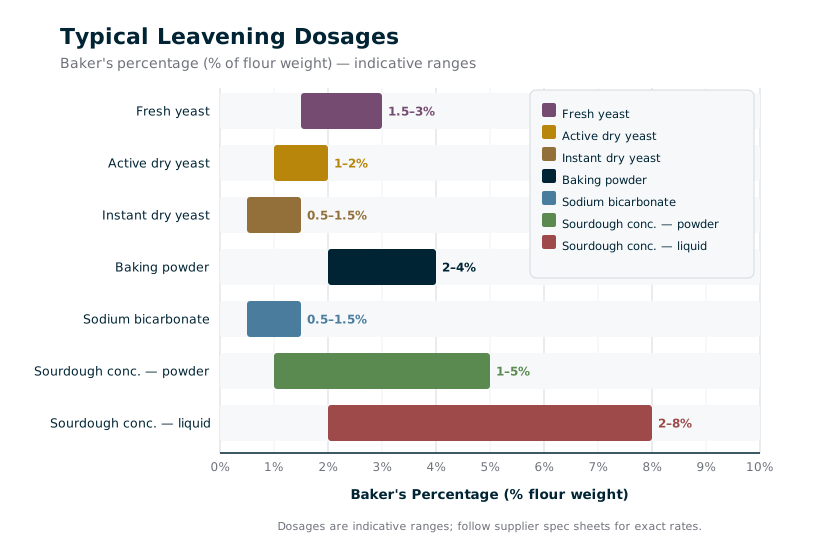 Bar chart showing typical dosage ranges for different leavening agents: fresh yeast 1.5–3%, instant dry yeast 0.5–1.5%, baking powder 2–4%
| Leavening format | Typical dosage (% of flour weight) | Source |
|---|---|---|
| Fresh compressed yeast | 1.5–3% | Trade reference (indicative) |
| Instant dry yeast (IDY) | 1–1.5% | Fermipan Red spec sheet; DCL Levure spec sheet |
| Active dry yeast (ADY) | 1–2% (indicative) | Trade reference |
| Baking powder | ~3.1% (Bowika spec); 2–4% typical range | Bowika spec sheet |
| Sodium bicarbonate | 0.5–1.5% (with acid present) | Trade reference (single source) |
| Aromaferm Wheat & Malt Ferment 110 | 1–5% | AB Mauri spec sheet |
| Puratos O-tentic Durum | 4% | Puratos spec sheet |
| Zeelandia Bioferm Dark (liquid) | 2.5–4% | Zeelandia spec sheet |
| ULDO Dark Sauer (paste) | 2–8% | ULDO spec sheet |
Always follow the supplier spec sheet for the specific product. Dosages interact with dough temperature, fermentation time, sugar content, and salt level.
11. Allergen summary
⚠️ This section must be verified by a qualified food technologist before use in customer-facing communications. Formulations change; always refer to current spec sheets.
| Product (Domson catalogue) | Gluten | Dairy | Egg | Soya | Sulphites |
|---|---|---|---|---|---|
| Benevia fresh yeast | No | No | No | No | Production note (molasses) |
| NG & SF fast active | No | No | No | No | No |
| Fermipan Red IDY | No | No | No | No | No |
| DCL Levure Premium IDY | No | No | No | No | No |
| Bowika Baking Powder | Yes (wheat) | No | No | No | No |
| CSM Pell Premium | Yes (wheat) | No | No | No | No |
| Bowika Bicarbonate of Soda | No | No | No | No | No |
| Aromaferm Wheat & Malt Ferment 110 | Yes (wheat) | No | No | No | No |
| Puratos O-tentic Durum | Yes (wheat) | No | No | No | No |
| Zeelandia Bioferm Dark Liquid | Yes (wheat, rye) | Yes (2011 spec — verify with Zeelandia) ⚠️ | No | No | No |
| ULDO Dark Sauer Concentrate | Yes (gluten) | Traces possible | Traces possible | Traces possible | No |
12. Choosing the right leavener: a decision guide
Use fresh compressed yeast when:
- You want maximum flavour and fermentation flexibility.
- You have reliable cold chain and can turn stock within 28–35 days.
- You are running a traditional or craft bakery process.
- The formula is a lean or moderately enriched dough (≤10% sugar).
Use instant dry yeast when:
- Storage simplicity and long ambient shelf life (2 years) are priorities.
- You are running a Chorleywood-type high-speed process.
- You need precise, reproducible dosing without cold-chain dependency.
- The formula is a lean to moderately enriched dough (≤10% sugar).
- Fermipan Red and DCL Levure Premium are described for "lean dough bread types with limited sugar content (0–10%)".
Use osmotolerant yeast when:
- Sugar content exceeds 10% of flour weight (brioche, panettone, doughnuts, sweet buns).
- See A2-osmotolerant-yeast-enriched-doughs for product selection.
Use baking powder when:
- No fermentation time is available or desired (cakes, scones, muffins, quick breads).
- Yeast flavour is not wanted.
- Gluten-free is NOT required (both Domson baking powders contain wheat). ⚠️
Use sodium bicarbonate when:
- The recipe contains a significant acid component (buttermilk, yoghurt, cocoa, citric acid).
- A quick and direct CO2 reaction is needed.
- You want to avoid phosphate additives (which are present in baking powder).
Use sourdough concentrates when:
- You need consistent sourdough flavour on a straight-dough production schedule.
- You want to eliminate or reduce the live-culture maintenance overhead.
- Use Aromaferm (devitalised, flavour only) with baker's yeast for leavening.
- Use O-tentic Durum (active, contains live yeast) when some contribution to leavening is also needed.
13. Formula cards
Three reference formula cards are given below:
- formula-fresh-yeast-lean-bread — lean white bread baker's percentage with fresh compressed yeast.
- formula-baking-powder-scone — plain scone with Bowika baking powder.
- formula-aromaferm-wheat-bread — sourdough-flavoured wheat bread using Aromaferm with baker's yeast.
14. Fault diagnosis
Full fault tables are given below:
- fault-yeast — no rise, over-proof, uneven crumb, yeasty off-flavour.
- fault-chemical-leaveners — bitter/soapy taste, insufficient rise, yellow discolouration.
Coverage notes and gaps
Solid:
- Fresh compressed yeast specs (Lesaffre Benevia, Lallemand NG & SF) — full spec sheets, high confidence.
- Instant dry yeast specs (Fermipan Red, DCL Levure Premium) — full spec sheets, high confidence.
- Baking powder specs (Bowika, CSM Pell Premium) — full spec sheets.
- Sodium bicarbonate (Bowika) — full spec sheet.
- Aromaferm, O-tentic Durum — full spec sheets.
Thin or single-source:
- Active dry yeast: no Domson product; covered for context using BAKERpedia and King Arthur Baking only. Confidence: medium.
- Substitution ratios (IDY↔ADY, IDY↔fresh): King Arthur Baking is a single high-quality source; the 1:3 fresh-to-IDY rule is widely cited but treat as approximate.
- Osmotolerant yeast 10–20% activity advantage: single-source (BAKERpedia). Flagged medium confidence.
- Sourdough LAB:yeast 100:1 ratio: single peer-reviewed source.
Needs follow-up:
- Zeelandia Bioferm Dark spec dated 2011 — request updated spec from Zeelandia before publishing.
- Benevia sulphite note: confirm with Lesaffre whether sulphites should be declared for operators with sulphite-sensitive customers.
- Gluten-free baking powder alternatives are needed for the catalogue — not currently stocked.
- Cream yeast and liquid yeast: not stocked by Domson; content is for professional context only.
Lean white bread with fresh compressed yeast (baker's %)
Reference starting formula for standard lean bread using fresh compressed yeast. Adjust yeast quantity for ambient temperature, dough temperature, and desired fermentation time. Dough temperature target 26–28°C.
| Ingredient | Baker's % | Weight |
|---|---|---|
| Strong bread flour (min 12% protein) | 100% | |
| Water | 60–65% | |
| Salt | 1.8–2% | |
| Fresh compressed yeast (e.g. Benevia or NG & SF) | 1.5–3% |
Lower yeast (1.5%) for long bulk fermentation (4–6 h at 26°C) or retarded overnight method.,Higher yeast (3%) for standard no-time or 1.5–2 h bulk at 26°C.,Replace fresh yeast with instant dry yeast at 0.5–1% (roughly 1:3 ratio; source: King Arthur Baking). Use spec-sheet dosage range (1–1.5%) as upper limit for IDY.,Source for ratio guidance: King Arthur Baking — Active Dry vs. Instant Yeast.
Plain scone formula using baking powder (baker's %)
Standard scone formula illustrating baking powder as sole leavener. Based on Bowika dosage guidance (1 kg per 32 kg flour = ~3.1% baker's percentage).
| Ingredient | Baker's % | Weight |
|---|---|---|
| Soft flour (T450 or UK soft; 9–10% protein) | 100% | |
| Baking powder (e.g. Bowika 5 kg) | 3–4% | |
| Butter (cold, cubed) | 25–33% | |
| Milk or buttermilk | 40–50% | |
| Salt | 0.5% |
Baking powder dosage from spec sheet: 1 kg per 32 kg flour (~3.1%). Range extended to 4% for very light results; avoid over-dosing (soapy or bitter metallic aftertaste).,GLUTEN ALLERGEN: both baking powder products and flour contain wheat.,CSM Pell Premium contains diphosphates (E450i) and sodium carbonate — check local labelling requirements.,Mix minimally after liquid addition — baking powder releases CO2 immediately on hydration (Stage 1).
Sourdough-flavoured wheat bread using Aromaferm Wheat & Malt Ferment 110
Combines devitalised sourdough powder with baker's yeast for sourdough flavour on a straight-dough production schedule.
| Ingredient | Baker's % | Weight |
|---|---|---|
| Wheat flour T750 or strong bread flour | 100% | |
| Water | 62–67% | |
| Salt | 1.8–2% | |
| Aromaferm Wheat & Malt Ferment 110 | 2–3% | |
| Fresh yeast or instant dry yeast | 1.5–2% fresh / 0.5–0.7% IDY |
Aromaferm dosage from spec sheet: 1–5%. Use 2–3% for moderate sourdough flavour, up to 5% for pronounced note.,Aromaferm contains WHEAT (gluten). No other declared allergens.,The Aromaferm provides acidity (pH ~3.3, TTA 110) and fermented flavour but does NOT provide leavening — the baker's yeast is still required.,Long fermentation or retardation can enhance the flavour even further.
Key parameters extracted from first-party spec sheets in the Domson catalogue (Lesaffre Benevia, Lallemand NG & SF, Fermipan Red, DCL Levure Premium) supplemented by BAKERpedia reference data. Moisture and dry-matter figures are specification limits from spec sheets. Shelf life from spec sheets assumes recommended cold/ambient storage.
| Parameter | Fresh compressed (Benevia) | Fresh compressed high-activity (NG & SF) | Instant dry yeast (Fermipan Red) | Instant dry yeast (DCL Levure Premium) | Notes |
|---|---|---|---|---|---|
| Species | Saccharomyces cerevisiae | Saccharomyces cerevisiae | Saccharomyces cerevisiae | Saccharomyces cerevisiae | |
| Dry matter (%) | >29% | 28–35% | 93–98% | >95% | |
| Moisture (%) | <71% (derived) | ~69% | ~5.08% | ~5% (derived from DM >95%) | |
| Emulsifier | None | None | Sorbitan monostearate E491 (~1%) | Sorbitan monostearate E491 (~1%) | |
| Shelf life (unopened, correct storage) | 35 days from production | 28 days from packing | 2 years at ambient | 2 years at ambient | |
| Storage conditions | 1–10°C, optimum 4°C; do not freeze | Max 8°C dry chill; do not freeze | Cool, dry ambient; vacuum pack required | Cool, dry ambient; vacuum pack required | |
| Rehydration required before use? | No — crumble directly into dough | No — designed for no-time dough (Chorleywood) | No — mix directly into dry ingredients | No — mix directly into dry ingredients | |
| Typical dosage (% flour weight) | Per own recipe (fresh yeast reference: 1.5–3%) | Per own recipe; spec notes baking trials needed | 1–1.5% (spec sheet) | 1–1.5% (spec sheet) | |
| Sugar tolerance (lean/enriched) | Standard — suitable lean and moderate sugar | Standard — designed for lean Chorleywood-type | 0–10% sugar (standard, not osmotolerant) | Standard lean dough types | |
| Allergens (as ingredient) | None (sulphites note: SO2 present in production molasses — not declared as allergen at product level) | None (gluten free, halal, kosher) | None (gluten free, halal, kosher) | None (gluten free, halal, kosher) | |
| Protein (g/100g) | 15 g (fresh weight basis) | 8.4–17.4 g (fresh weight, two spec sheets differ) | 40–50 g (dry matter basis, COFALEC method N×6.25) | 40.44 g | Values not directly comparable: fresh yeasts reported on fresh weight (70% moisture); dry yeasts on dry weight basis |
| Energy (kcal/100g as supplied) | 111 kcal | 105–111 kcal (fresh weight) | 363 kcal | 325 kcal | |
| Kosher / Halal certified | Not stated in spec (Lesaffre maintains Kosher/Halal across range — verify with supplier) | Yes — both Kosher and Halal | Yes — both Kosher and Halal | Yes — both Kosher and Halal |
Comparison of non-biological leavening formats available in the Domson catalogue. Dosage data from supplier spec sheets; chemistry data from BAKERpedia and Kansas State University.
| Parameter | Baking powder (Bowika 5 kg) | Baking powder (CSM Pell Premium 4.5 kg) | Sodium bicarbonate (Bowika 5 kg) | Aromaferm Wheat & Malt Ferment 110 (dried sourdough) |
|---|---|---|---|---|
| Leavening mechanism | Chemical: acid + bicarbonate → CO2 | Chemical: acid + bicarbonate → CO2 | Chemical: requires dietary acid in formulation | Biochemical: fermented wheat/malt providing flavour acids; used with baker's yeast |
| Ingredients / composition | Sodium bicarbonate E500(ii), disodium diphosphate E450(i), wheat flour (GLUTEN) | Diphosphates E450(i), sodium carbonates E500(ii), wheat flour (GLUTEN) | Sodium bicarbonate E500(ii) min 99.3% purity | Wheat malt 90–100%, wheat milling products 5–10% (both GLUTEN) |
| Key physicochemical parameter | Total phosphate 18.02–18.45% as P₂O₅ | CO2 content 17.5–18.5% | Purity min 99.3%; pH of 1% solution max 8.5 | pH approx 3.3; Total titratable acidity 110 ±10% |
| Typical dosage (% flour weight) | ~3.125% (1 kg per 32 kg flour — spec sheet guidance) | Ready to use (follow product guidance) | 0.5–1.5% (requires balancing acid; single-source estimate — verify with formulation) | 1–5% (spec sheet) |
| Shelf life | 9 months from production | 365 days | 24 months | 12 months |
| Storage conditions | Max 25°C, max 75% RH; dry, ventilated | Cool (< 25°C), dry | Max 30°C, max 75% RH | 0–25°C, dry, away from direct sunlight |
| Allergens (as ingredient) | Contains gluten (wheat). Cross-contamination possible: nuts, celery, mustard, sesame (storage/production environment) | Contains gluten (wheat) | None | Contains gluten (wheat). No other allergens declared |
| Suitable applications | Cakes, scones, muffins, pancakes, shortbreads, chemical-leavened bread | Cakes, scones, batter products, confectionery | Soda bread, gingerbread, recipes with acidic liquids (buttermilk, yoghurt, cocoa) | Wheat and rye breads requiring sourdough flavour without full fermentation cycle |
Industrial sourdough concentrates and semi-concentrates. Parameters from first-party spec sheets. Dosages and pH values are direct spec-sheet data. The Bioferm Dark spec sheet is dated 2011 and is noted as lower reliability due to age.
| Product | Format | Usage rate (% flour wt) | pH | Acidity | Shelf life | Key allergens | Notes |
|---|---|---|---|---|---|---|---|
| Puratos O-tentic Durum | Dry powder concentrate | 4% | Not stated (total acidity 45–65 ml/10g) | 45–65 ml/10g (acid-base titration) | 12 months; 16–20°C, max 65% RH. After opening: 1 week 0–7°C | Contains wheat (gluten) | Active sourdough component — contains live yeast. Mediterranean flavour profile. GFSI certified. |
| Aromaferm Wheat & Malt Ferment 110 | Dry powder (devitalised) | 1–5% | ~3.3 | 110 ±10% total titratable acidity | 12 months; 0–25°C | Contains wheat (gluten) | Used in combination with baker's yeast for leavening. Provides flavour acids only. Halal, Kosher, Vegan. |
| Zeelandia Bioferm Dark Liquid | Liquid concentrate | 2.5–4% (varies with rye/wheat ratio) | 2.4–2.8 | SH° 250–260 | 12 months; 0–25°C, do not freeze | Contains gluten (wheat, rye); contains milk | Designed for mixed rye/wheat and full rye breads. Older spec (2011) — confirm current data with supplier. |
| ULDO W/43 Dark Sauer Concentrate | Paste | 2–8% | 2.5–4.5 | Total acidity 140–150° | 9 months; max 30°C | Contains gluten; traces of milk, sesame, soya, lupins, eggs possible | Dark rye bread and mixed rye. Lactic, acetic acid and citric acid blend with barley malt. |
| Fault | Likely cause(s) | Remedy |
|---|---|---|
| No rise / very slow fermentation | Fresh yeast dead or past shelf life,Dough too cold (below 10°C inhibits yeast strongly),Yeast killed by direct contact with hot water or hot ingredients (>55°C lethal),Too much salt in direct contact with yeast before mixing,Instant dry yeast not properly incorporated (clumps) | Check fresh yeast: should smell clean yeasty, break cleanly, be within date,Raise dough temperature to 26–28°C,Add water at max 38°C; never use boiling or hot liquids,Add salt on opposite side of bowl from yeast,Disperse IDY in dry flour before adding liquids |
| Over-proof — collapsed or dense crumb | Dough temperature too high (>30°C accelerates fermentation),Too much yeast,Fermentation time too long for conditions | Reduce dough temperature to 26–28°C,Reduce yeast dosage or shorten proof time,Use retarded proof (4°C overnight) for better control |
| Uneven crumb / large irregular holes | Incomplete degassing after bulk fermentation,Poor shaping,Excess yeast causing too rapid CO2 production | Fold dough during bulk; degas thoroughly before shaping,Tighten shaping technique,Reduce yeast dosage |
| Yeasty or off-flavour | Excess yeast dosage,Autolysis of fresh yeast (stored too long above 8°C) | Reduce yeast by 20–30%; compensate with slightly longer proof,Use yeast within date at correct storage temperature |
| Fault | Likely cause(s) | Remedy |
|---|---|---|
| Bitter, soapy or metallic aftertaste | Excess baking powder — over-dose of bicarbonate leaves residual sodium carbonate,Excess baking soda without sufficient acid to neutralise | Reduce baking powder dosage; stay within spec-sheet guidance (~3.1–4%),Ensure acid source (buttermilk, yoghurt, cocoa, citric acid) is sufficient to neutralise bicarbonate |
| Insufficient rise / dense texture | Under-dose of leavener,Baking powder wet before use (absorbed moisture, pre-reacted),Bicarbonate of soda with no acid source,Over-mixing after hydration (CO2 driven off) | Follow spec-sheet dosage; sift baking powder into flour,Store baking powder sealed in cool dry conditions; do not measure over steam,Add acid component (cream of tartar, buttermilk) when using bicarbonate alone,Mix minimally after liquid addition; bake immediately |
| Yellow/green discolouration in baked goods | Excess bicarbonate reacts with flavonoid pigments in flour (especially in white or cream-coloured batters) | Reduce bicarbonate dose; ensure sufficient acid balance in formula |
- Dry matter pct · Benevia:
- >29
- Dry matter pct · Ngsf:
- 28–35
- Moisture pct · Benevia:
- <71 (derived)
- Moisture pct · Ngsf:
- ~69
- Shelf life days · Benevia:
- 35
- Shelf life days · Ngsf:
- 28
- Storage temp C · Benevia:
- 1–10 (opt 4)
- Storage temp C · Ngsf:
- max 8
- Fermentative activity benevia:
- 125 ±10 ml CO2 (risograph, Lesaffre method), max 100 min (PN-A-79002)
- Dry matter pct · Fermipan red:
- 93–98
- Dry matter pct · Dcl levure:
- >95
- Shelf life years:
- 2
- Storage:
- Cool dry ambient unopened; vacuum packaging
- Emulsifier:
- Sorbitan monostearate E491 (~1%)
- Dosage pct flour:
- 1–1.5
- Bowika phosphate p2o5 pct:
- 18.02–18.45
- Pell co2 content pct:
- 17.5–18.5
- Bowika dosage kg per kg flour:
- 1:32 (~3.1%)
- Shelf life months · Bowika:
- 9
- Shelf life months · Pell premium:
- 12
- Purity min pct:
- 99.3
- Shelf life months:
- 24
- Origin:
- Turkey
- pH 1pct solution:
- max 8.5
- pH:
- ~3.3
- Total titratable acidity:
- 110 ±10%
- Moisture pct:
- <5
- Dosage pct flour:
- 1–5
- Shelf life months:
- 12
- Total acidity ml per 10g:
- 45–65
- Dry matter pct:
- 94–100
- Dosage pct flour:
- 4
- Shelf life months:
- 12
- Storage temp C:
- 16–20
Buy the ingredients
Catalogue products and brands referenced in this article.
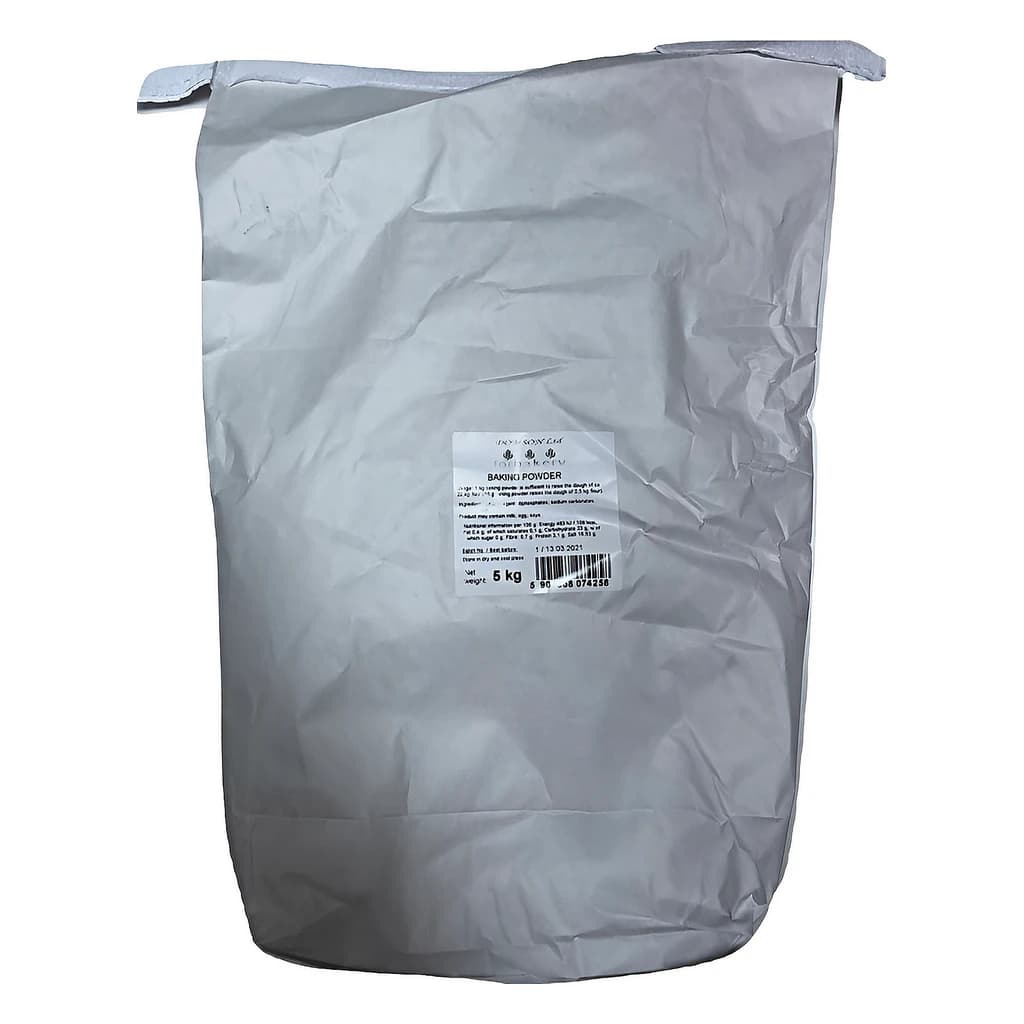
Baking Powder 5 kg
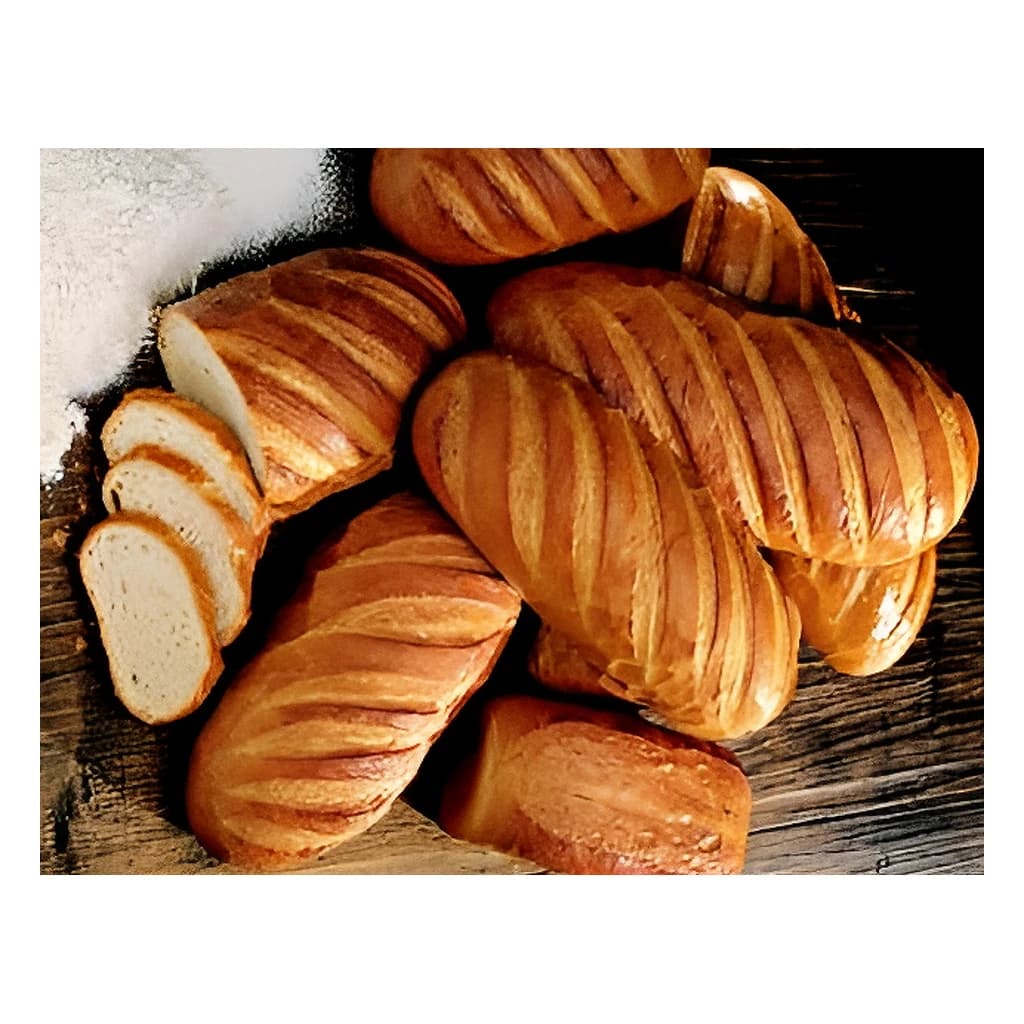
Sauer Dark Rye Sourdough Concentrate 25 kg
Bicarbonate of Soda 5 kg

Fresh Yeast Benevia 10 kg
Fresh Yeast Traditional 12 kg
Aromaferm Wheat & Malt Ferment 110 12.5 kg
Fresh Yeast NG & SF Fast Active 12 kg
Dried Yeast Fermipan Red 10 kg

Puratos O-tentic Durum Sourdough Concentrate 10 × 1 kg
CSM Pell Premium Baking Powder 4.5 kg

Dried Yeast DCL Levure Premium 10 kg
Zeelandia Bioferm Dark Liquid Sourdough 19 kg