
Choosing the right wheat flour: bread, pastry, cake, pizza, pasta and laminated doughs
A practical field guide for professional bakers: how to match the right wheat flour to every application from fine pastry and sponge cake through white bread, sourdough, pizza, pasta and laminated viennoiserie. Built on first-party spec sheets from 19 products in the Domson catalogue across five millers (Wągrowiec Mill, GoodMills Polska, Matthews Cotswold Flour, Whitworth Bros, Allied Mills / ADM Milling) plus the Polish T-type classification system and UK standards. Includes full comparison tables, a fault guide, formula notes, and allergen declarations for every product covered.
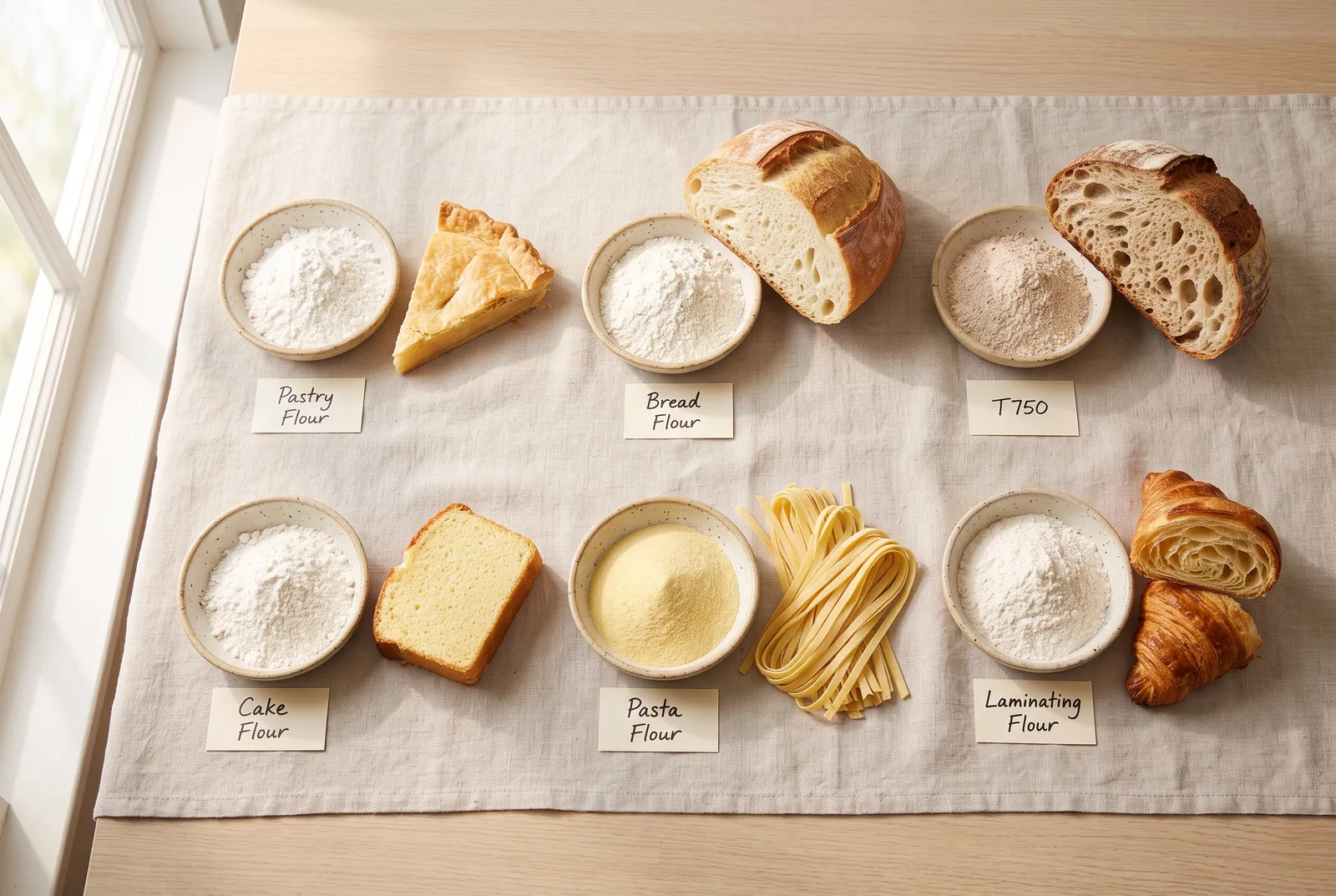
Why flour choice is your most important production decision
Every grain of wheat that passes through a mill emerges as a different flour. The difference is not just branding — it is a measurable change in protein content, ash level, enzyme activity, and gluten quality. Choose the wrong flour and you will fight the process at every step: dough that tears or refuses to relax, bread that collapses, pastry that shrinks back in the tin, cakes with a rubbery crumb.
This guide gives you the practical framework for matching the right wheat flour to every application in a professional bakery. It is built on first-party specification data from 19 flour products in the Domson catalogue, covering five millers and three countries of origin.
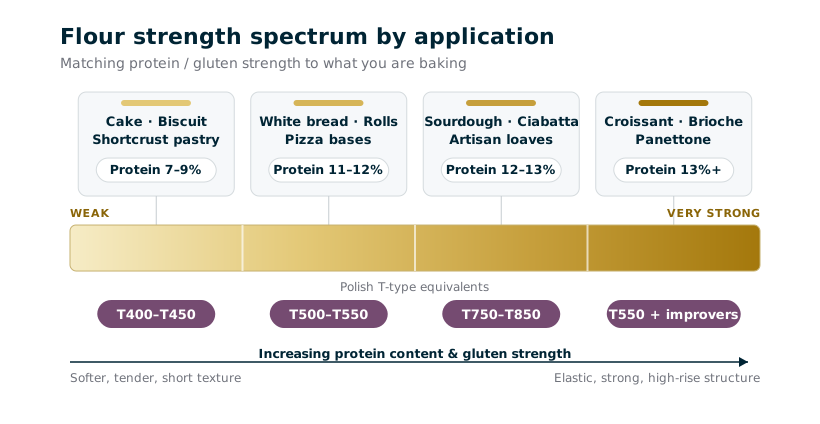 Horizontal axis diagram showing wheat flour applications from weak (cake flour, pastry) to very strong (panettone, brioche) with protein percentage ranges annotated
1. The foundation: what flour actually is
A wheat grain has three parts:
- Endosperm — approximately 83% of the grain weight. Starchy, pale, low in minerals and fibre. This is the part that makes white flour white.
- Bran — approximately 14.5%. Dark, rich in fibre, minerals and ash. The bran layers are significantly richer in mineral ash than the endosperm — this is the physical basis for the T-type classification system.
- Germ — approximately 2.5%. Rich in oils, vitamins and enzymes.
When a miller grinds wheat and sifts the result, they separate these fractions. A very white flour (T450) retains almost none of the bran. A wholemeal flour (T1850 Graham) puts almost everything back in.
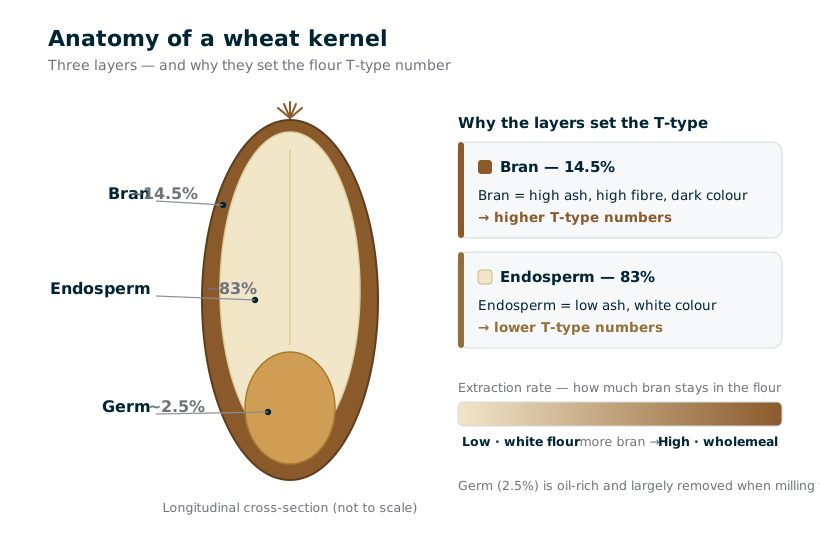 Labelled cross-section of a wheat grain showing the bran, endosperm and germ with percentage proportions
The T-type numbering system
The Polish classification system (and broadly the European continental system) encodes this directly: the type number is the ash content in milligrams per 100 g of dry flour. T550 means approximately 550 mg ash per 100 g dry flour = 0.55% ash.
This makes comparing flours simple: higher T-number = more bran = darker colour = stronger flavour = more minerals. Lower T-number = purer endosperm = whiter colour = more neutral taste = less interference with fine structure.
How Polish T-types align with French, German, Italian and UK naming conventions is shown in the table below.
2. The protein story: gluten strength and application
Protein content is the second major flour parameter. Wheat flour proteins — gliadin and glutenin — combine when hydrated and mixed to form gluten, the viscoelastic network that traps gas during fermentation and sets in the oven to give bread its structure.
- High protein (12–14%): strong gluten, tolerates long fermentation and mechanical mixing, gives good volume in bread.
- Medium protein (10–12%): versatile — suitable for pizza, rolls, enriched doughs, some pasta.
- Lower protein (7–9%): weak gluten, produces tender, crumbly, short textures — ideal for pastry, biscuits and cakes.
Important distinction: Protein quantity (measured by Kjeldahl × 5.7) is not the same as protein quality. Two flours with 11% protein can behave very differently depending on their variety, growing conditions and harvest. For a deeper treatment of gluten quality parameters (wet gluten content, gluten index, Zeleny sedimentation), see the companion article Reading the flour spec sheet: ash content, Hagberg falling number, Zeleny, farinograph and alveograph.
3. Polish wheat flour types — the complete range
The Domson catalogue covers the full range from T400 to T1850. Here is what each type is for, with confirmed spec-sheet data.
T400 — fine pasta grade
Ash max 0.50%, wet gluten min 18%, gluten index 55–100. Falling number is deliberately not standardised for this product — it is a pasta-grade flour where starch behaviour matters more than fermentation enzyme activity. The lower gluten minimum (18% vs 23% for T450 bread flour) is intentional: pasta gluten must be extensible without tearing during extrusion or rolling.
Colour: cream to light yellow — characteristic of pasta flour.
Use for: extruded pasta shapes, fresh pasta sheets, pierogi skins, dumpling wrappers.
Catalogue: Wheat Flour T400 Macaroni Grade 25 kg.
Note (single-source): The Gluten Index range of 55–100 is wide; this allows both extensible (low GI, good for rolling) and stronger (high GI) batches within the spec. Pasta manufacturers often specify a tighter target — request your supplier's typical or Certificate of Analysis GI.
T450 — fine pastry, shortcrust, biscuits
Ash max 0.48%, moisture max 15%, falling number ≥220 s, wet gluten min 23%, protein min 8.0%.
T450 is the whitest, most neutral Polish wheat flour. Its low ash means minimal bran interference, giving a very clean flavour and brilliant white colour (white with yellow tint — confirmed by spec). The protein minimum of 8.0% is the specification floor stated on the supplier spec sheet; typical actual protein is higher. (This is a commercial specification minimum; no independent regulatory protein minimum for individual T-types under Polish law was confirmed.)
Use for: shortcrust pastry, sweet pastry (pâte sucrée), fine biscuits, butter biscuits, crackers, fine semolina noodles, pierogi, pasta sheets.
Not for: bread — the gluten minimum of 23% wet gluten is adequate for pastry structure but will not trap enough gas for good bread volume.
Catalogue: Wheat Flour T450 25 kg.
ALLERGEN: Contains GLUTEN (wheat). Cross-contamination risk: soy, lupine, mustard. GMO-free.
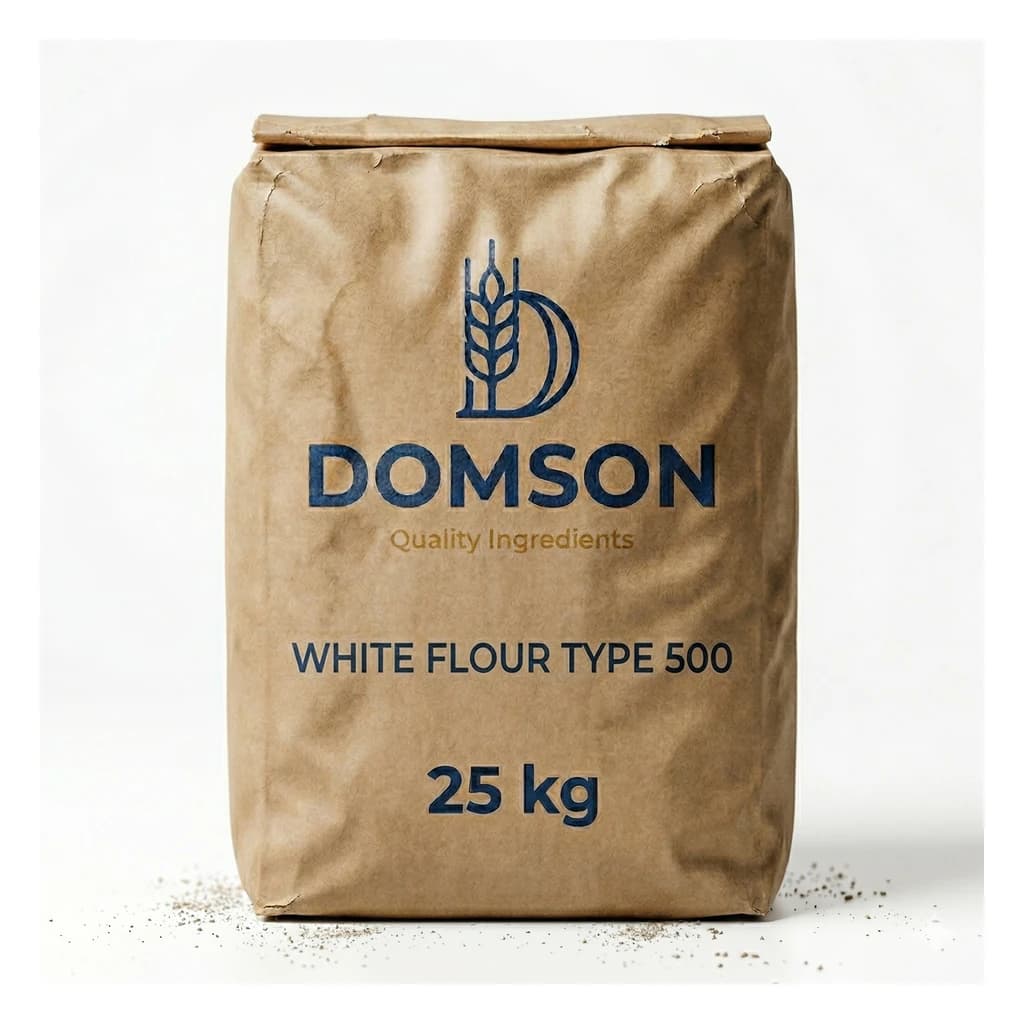
T500 — general purpose, sponge, soft rolls
Ash max 0.52%, moisture max 15%, falling number ≥220 s, wet gluten min 23%, protein min 8.0%.
T500 sits just above T450 in extraction — marginally more mineral content, essentially the same functional profile. It is the Polish equivalent of a general-purpose or plain flour. The 0.52% ash maximum gives a cream-white colour and a barely perceptible mineral note compared to T450.
Use for: sponge cakes (biszkopt), soft rolls, enriched doughs (brioche-style), crepes, batters, pastry, general-purpose baking.
Catalogue: Domson White Flour T500 25 kg.
ALLERGEN: Contains GLUTEN (wheat). Cross-contamination risk: soy, lupine, mustard.
T550 — the workhorse of European bread baking
The T550 grade is the most widely used professional bread flour in Poland, Germany, France (approx.) and across continental Europe. Two T550 products are in the Domson catalogue — and they demonstrate how different two flours of the same type can be.
GoodMills Polska T550 Fortified: Ash 0.51–0.58% d.m., moisture max 15%, wet gluten 28–32%, protein 11.5–12.5%, gluten index 75–99, falling number ≥220 s.
This is a strong T550 — the 11.5–12.5% protein range and gluten index of 75–99 confirm it is suitable for commercial bread production including long fermentation sourdough. The flour is fortified with calcium (235–390 mg/100 g), iron (≥1.65 mg/100 g), thiamin B1 (≥0.24 mg/100 g) and niacin (≥1.60 mg/100 g). These levels match the UK Bread and Flour Regulations 1998 mandatory minimums. Fortification at these levels is not required by Polish or EU regulation, so it represents voluntary alignment with the UK standard for flour sold in Poland. If this flour is supplied for sale or use in England or Scotland, the fortification levels may be mandatory under the 1998 Regulations — confirm with your legal adviser.
Komplexmłyn T550: Ash max 0.58%, moisture max 15%, wet gluten min 25%, protein min 8.0%, falling number ≥220 s.
The 8.0% protein minimum is the specification floor stated on the spec sheet — actual delivered flour will typically land higher, but the spec makes no guarantee above 8%. If you need confirmed high protein for a demanding process, the GoodMills fortified T550 (which specifies 11.5–12.5%) gives more assurance. Request the Certificate of Analysis on delivery if protein is critical.
Use for: white sandwich bread, rolls, pizza bases, yeasted buns, enriched bread doughs.
Catalogue: GoodMills Wheat Flour T550 Fortified 25 kg; Komplexmłyn Wheat Flour T550 25 kg.
ALLERGEN: Contains GLUTEN (wheat). Cross-contamination risk: soy, lupine, mustard. GMO-free.
T750 — rustic bread, artisan sourdough
Ash max 0.82%, moisture max 15%, falling number ≥220 s, wet gluten min 26%, protein min 10.0%.
T750 contains more bran than T550, giving a beige-cream colour, a more complex mineral and cereal flavour, and additional fermentation nutrition from the extra minerals. The higher minimum wet gluten (26%) ensures the flour can cope with the longer fermentation times typical of rustic bread.
Use for: artisan sourdough, bâtard-style bread, Polish rustic bread (chleb wiejski), mixed wheat-rye loaves where a fuller flavour is wanted without the heaviness of wholemeal.
Tip: T750 pairs well with a 30–60 minute autolyse — the extra bran can interfere with gluten development, so allowing time for full hydration before intensive mixing reduces mixing time and improves extensibility.
Catalogue: Domson Bread Flour T750 25 kg.
ALLERGEN: Contains GLUTEN (wheat). Cross-contamination risk: soy, lupine, mustard. GMO-free.
T850 — brown bread, high-bran loaves
Ash max 0.90%, moisture max 15%, falling number ≥220 s, wet gluten min 26%.
T850 produces a noticeably darker crumb than T750, with a pronounced cereal flavour. At this extraction level, the bran particles begin to visibly break gluten strands during mixing — the practical effect is that dough handles somewhat more roughly and requires more careful development. Vital wheat gluten supplementation (typically 1–3% on flour weight) or a strong bread improver can compensate.
Use for: brown bread, wholegrain-style loaves, high-fibre rolls, mixed-grain breads.
Catalogue: Wheat Flour T850 25 kg.
ALLERGEN: Contains GLUTEN (wheat). GMO-free.
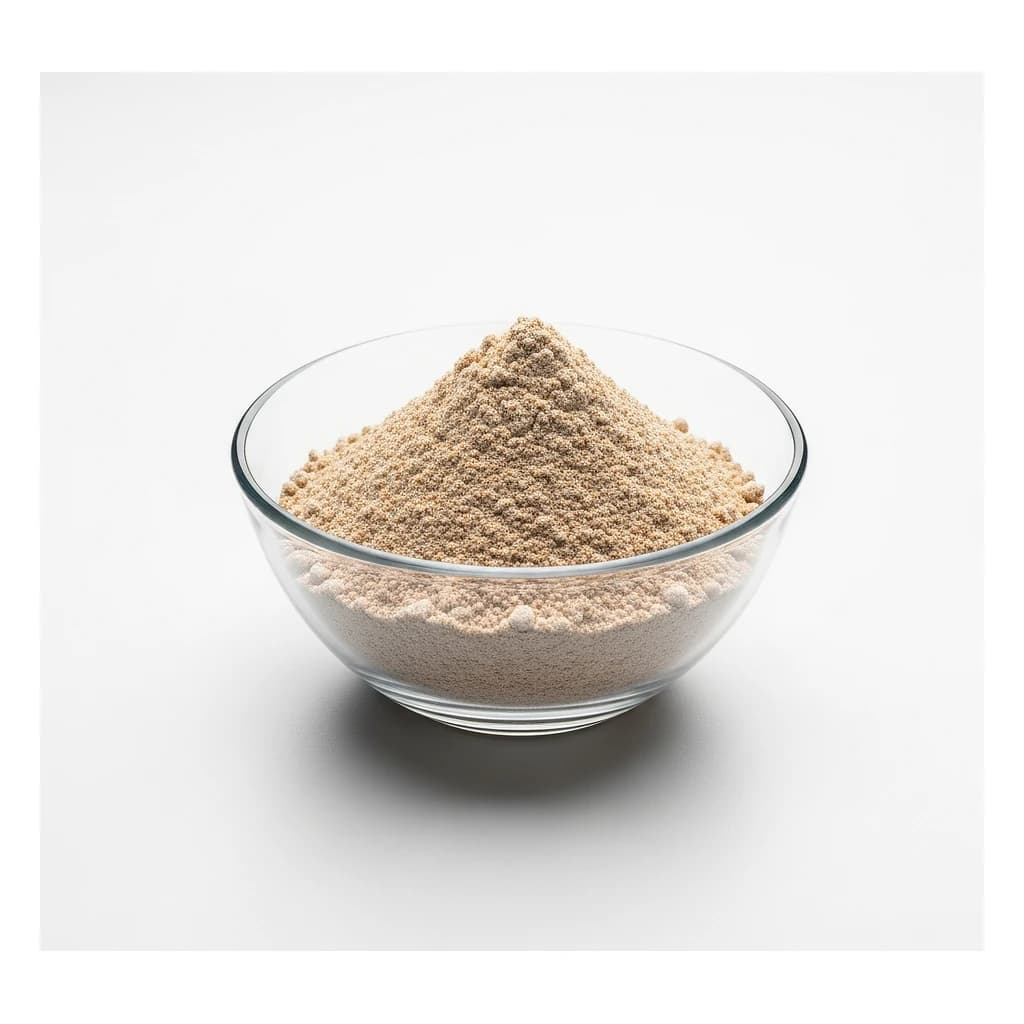
T1850 (Graham) — wholemeal wheat, Polish Graham bread
Ash max 2.0%, moisture max 15%, falling number >180 s, protein 12.3 g/100 g (typical nutritional value). Fibre 12.3 g/100 g (typical).
Graham flour (T1850) is the Polish equivalent of a strong wholemeal flour — it contains the full wheat grain fractions in their natural proportions, producing a grey-beige coloured, dense, fibre-rich flour. The falling number minimum of >180 s (lower than the >220 s standard for white flours) accommodates the natural enzyme activity in whole grain.
Note: the protein value of 12.3 g/100 g is a typical nutritional label figure from the GoodMills spec — it is not a specification minimum. Actual protein can vary by season and grain origin.
Use for: traditional Polish Graham bread (chleb graham), high-fibre loaves, seeded wholemeal loaves, dense sandwich bread.
Production note: Graham flour absorbs significantly more water than white flour. Add 3–8% more water to your white-flour recipe water calculation. Autolyse is highly recommended (30–45 min before mixing). The bran acts as a physical gluten cutter — do not overmix.
Catalogue: Graham Wheat Flour Type 1850 40 kg.
ALLERGEN: Contains GLUTEN (wheat).
4. UK wheat flours — bread, pastry and specialist grades
UK flours do not use the Polish T-type system. Instead, they are described by application (bread, pastry, plain, self-raising) and characterised by protein content and water absorption rather than ash class. UK white flours are required by the Bread and Flour Regulations 1998 to be fortified with calcium, iron, niacin and thiamin at specified minimum levels.
Strong white bread flours
Three strong white bread flours are in the Domson catalogue, each optimised for different uses:
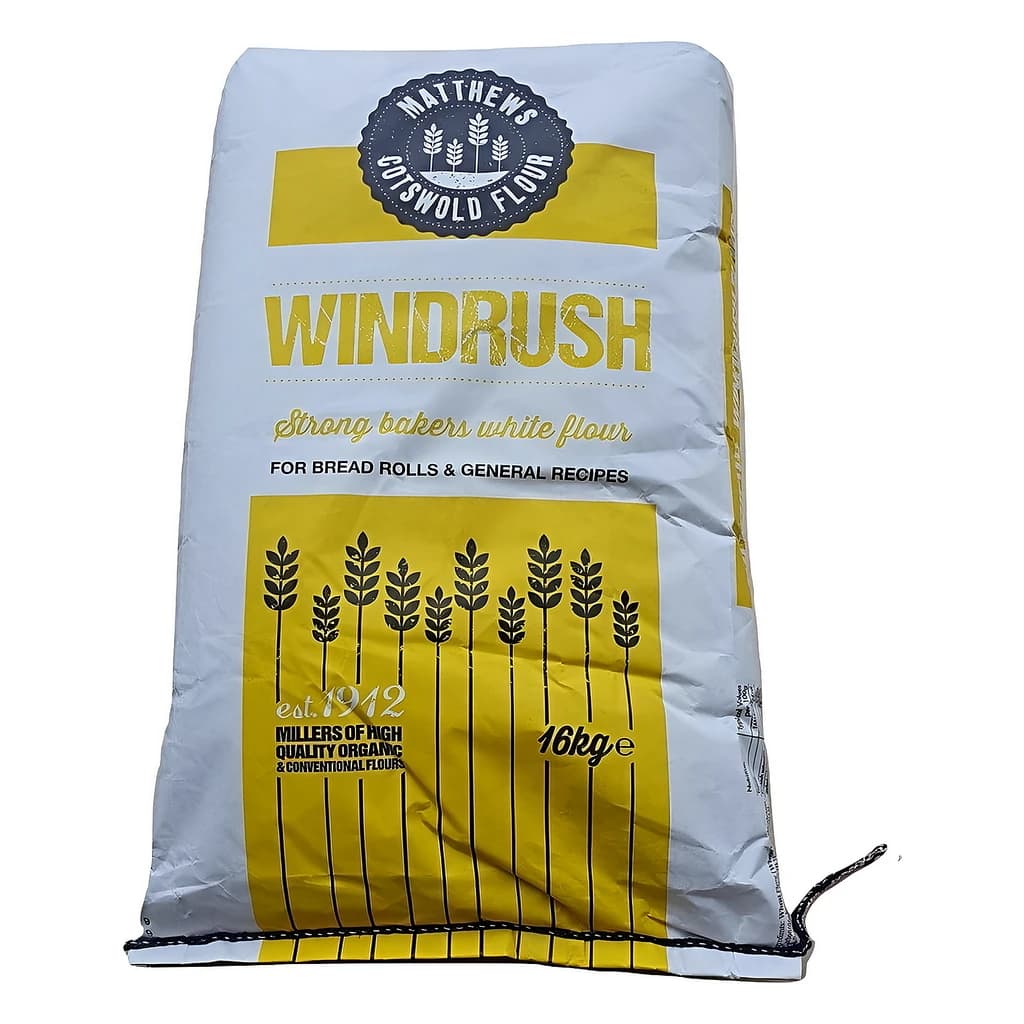
Windrush Strong White Bread Flour (Matthews Cotswold Flour): Protein 12.0–12.5% (target 12.2%), moisture 13.5–15.0%, HFN 250–400 s (target 350 s), water absorption 55–61% (target 58%).
The HFN target of 350 s positions this flour for premium bread and sourdough where controlled, balanced enzyme activity is needed. Added vital wheat gluten (<1.5%) and Creta Plus (calcium carbonate 0.31%) are listed on the spec — the gluten addition is used to meet the protein specification; calcium carbonate fortification is mandatory under the UK Bread and Flour Regulations 1998. Vital wheat gluten is a declarable ingredient and must appear on the flour's ingredient list. Origin: UK or Germany.
Coniston Strong White Flour (Allied Mills): Protein 12.5–14.5%, moisture 13.6–14.6%, HFN minimum 250 s, water absorption 58–61%.
Coniston is a higher-protein flour than Windrush — the 12.5–14.5% range suggests this is optimised for high-output production where a strong, tolerant gluten network is required. Shelf life 365 days. Origin: USA wheat milled in UK.
Domson PN Wheat Flour (ADM Milling): Protein 12.4–13.0% (target 12.7%), moisture max 15%, water absorption 58.4–61.0% (target 59.7%).
Domson PN is a professionally specified UK bread flour positioned between Windrush and Coniston in protein target. It may include up to 1% added vital wheat gluten to meet specification. Shelf life 12 months.
Use for: all three are suitable for white sandwich bread, crusty rolls, sourdough, pizza, brioche and croissant dough (as the wheat base).
ALLERGEN (all three): Contains GLUTEN (wheat). Soy cross-contamination risk noted (supply chain). Statutory fortification per UK Bread & Flour Regulations 1998.
Plain / all-purpose flour
Domson Plain Flour / GD Plain (ADM Milling): Protein 8.0–10.2% (target 9.1%), moisture max 15%, water absorption 50–56% (target 53%).
This is the UK equivalent of a general-purpose or T500/T550 low-protein flour. The lower water absorption (50–56% vs 58–61% for bread flour) is directly useful: when scaling down hydration from a bread recipe, or formulating a batter or sauce, this flour works with less water, giving a tighter texture.
Use for: pastry, batters, coating mixes, sauces, soft rolls, general cake making.
ALLERGEN: Contains GLUTEN (wheat).
Pastry and blended flours
Golden Jewel Pastry Flour (Whitworth Bros): Protein 7.5–9.5% (target 8.5%), moisture 13.0–15.0%. Formulated as a blend of wheat flour and maize flour.
The maize flour content dilutes the wheat gluten fraction, reducing total gluten development and giving pastry a more tender, snapping texture. Vital wheat gluten may be added by Whitworth Bros to meet the protein specification; if added, it is a declarable ingredient and must appear in the ingredient list. Fortified per UK Bread & Flour Regulations 1998.
Use for: shortcrust pastry, biscuits, shortbread, savoury pastry, pie crusts.
ALLERGEN: Contains GLUTEN (wheat).
Heat-treated cake flour
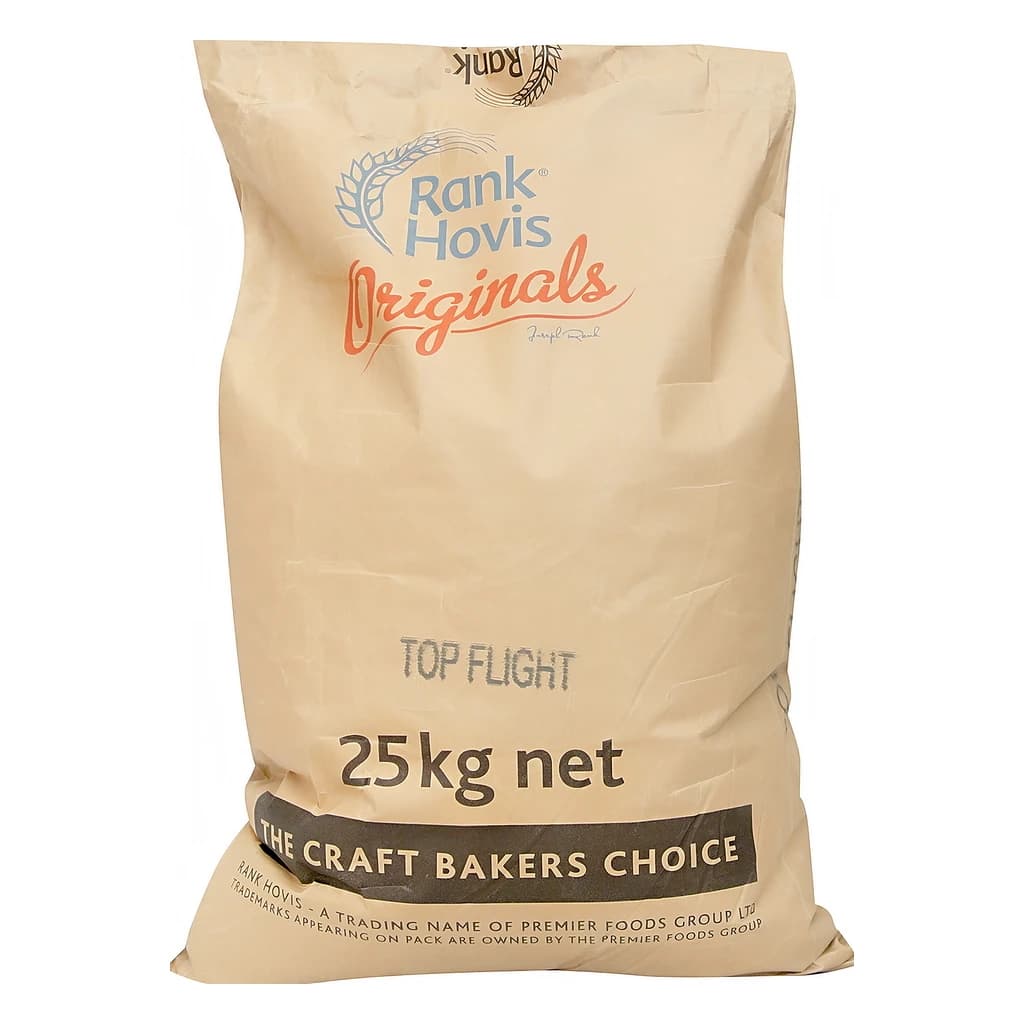
Top Flight Cake Flour (Whitworth Bros): Described as "a super premium white flour produced by roller milling followed by heat treatment and partial rehumidification." No protein specification is published on the reviewed spec pages, but the heat treatment process is the defining feature.
What heat treatment does: At standard moisture and elevated temperature, heat treatment partially denatures the flour proteins, reducing their ability to form a tough gluten network during mixing. This allows the baker to use high-ratio formulations (more sugar and fat than flour by weight) that would otherwise produce a collapsed, greasy crumb. Heat-treated cake flours also have superior emulsification capacity.
Use for: high-ratio cakes, Victoria sponge, chiffon cake, angel food cake, commercial cake mixes, fine bakery goods where a very tender crumb is essential.
Important production note: Do NOT use heat-treated cake flour for bread — the denatured proteins cannot form a functional gluten network for gas retention.
ALLERGEN: Contains GLUTEN (wheat). Statutory fortification per UK Bread & Flour Regulations 1998.
Self-raising flour
Self-raising flour is plain/soft wheat flour with pre-added raising agents. Two products are in the catalogue:
Perfect Self Raising Flour / Allied Mills 4111: Protein 8.7–9.3%, HFN minimum 150 s, moisture 13.6–14.6%, water absorption 52.6–55.2%, CO2 yield 0.45–0.7%. Raising agents: E500 (sodium bicarbonate) and E341 (monocalcium phosphate).
Domson Premium Self-Raising Flour (ADM Milling 4411): Protein 9.5–10.5%, moisture max 14.8%, water absorption 52–58%, CO2 yield 0.6–0.85%. Raising agents: E450 (diphosphates) and E500. Shelf life 6 months.
The CO2 yield specifications are key — they confirm the amount of gas the raising agent blend can release, which directly determines the lift in scones and cakes. Domson Premium SR specifies CO2 0.6–0.85%, which is higher than the Allied Mills product (0.45–0.7%), suggesting more leavening power per unit of flour.
Important storage note: Self-raising flour has a shorter shelf life than plain flour because the raising agents gradually lose CO2 potency over time, especially at elevated humidity. Allied Mills 4111 has 12-month shelf life unopened; Domson Premium SR has 6 months. Use within 1 month of opening both.
Use for: scones, Victoria sponge, muffins, teacakes, pancakes, drop scones — UK baking tradition.
Do not use for: yeast-leavened bread, croissants, or any application where the baker controls leavening independently.
ALLERGEN: Contains GLUTEN (wheat). Statutory fortification per UK Bread & Flour Regulations 1998.
5. Spelt flour — an ancient grain with modern complexity
Spelt (Triticum spelta) is a hulled wheat species. It contains gluten and must be declared under EU Regulation 1169/2011 Annex II and UK Food Information Regulations 2014 (which list wheat, including spelt, as a major allergen). Best practice — and most retailer codes of practice — require naming the specific grain (e.g. "WHEAT (spelt)" or "spelt wheat flour") rather than declaring only the generic "wheat" allergen, so that consumers with wheat sensitivity can make informed choices.
Food safety note (flagged for review): The strict legal minimum under Annex II is satisfied by declaring "wheat"; however, naming spelt specifically is strongly recommended for consumer transparency and is required by many retailers. Confirm the labelling approach with your legal adviser and retail customer requirements.
Two spelt flours are in the catalogue:
Light Spelt Flour (Matthews Cotswold Flour): Protein 9.0–13.0% (target 11.0%), moisture 13.5–15.0%, HFN min 220 s, water absorption 53–65%. Ingredients: Spelt Flour only — no additives.
Wholemeal Spelt Flour (Doves Farm Foods): Protein 11.8–17.0%, moisture 11.5–14.5%. Stoneground. Fibre 8.5 g/100 g (typical). Shelf life 9 months.
The full comparison is in the table below. The key differences for the baker:
Spelt gluten is weaker and more fragile than wheat gluten. The protein content figures are comparable (or even higher for wholemeal spelt), but spelt proteins form a gluten network that is more extensible and less elastic — it tears more easily if you over-mix or over-ferment. The wide water absorption range for light spelt (53–65%) reflects this variability.
Practical implications:
- Reduce mixing time by 30–40% compared to wheat flour. Mix to 'just developed' — stop when the dough comes together smoothly, not when it becomes highly elastic.
- Reduce fermentation time or temperature. Over-fermented spelt dough loses structure rapidly.
- Expect more variation batch to batch — the 9–13% protein range for light spelt means the gluten character of different deliveries may differ noticeably.
- Add more water: spelt absorbs water differently from wheat; start 5% above your wheat recipe water and adjust.
Allergen notice (flagged for review): Spelt must be declared under the GLUTEN allergen category on all downstream products. The strict legal minimum (EU Reg 1169/2011 Annex II / UK Food Information Regulations 2014) is met by declaring "wheat", as spelt is listed as a type of wheat. However, best practice and most retailer codes require naming the grain specifically — e.g. "WHEAT (spelt)" or "spelt wheat flour" — to give wheat-sensitive consumers full information. Confirm your labelling approach with your legal adviser.
Catalogue: Stoneground White Spelt Flour 16 kg (Matthews); Wholemeal Spelt Flour 25 kg (Doves Farm). Also available: Zeelandia Spelt Bread Mix 25 kg and Ireks Spelt & Honey Bread Mix 25 kg for ready-to-use spelt blends.
6. Oat flour — the non-wheat addition
Oat flour (Agrol) is in a separate category: it is not wheat flour and forms no gluten network on its own. However, oats are classified as a gluten-containing cereal under EU and UK law, and the Agrol facility handles multiple gluten-containing cereals — the spec declares gluten cross-contamination risk.
Specifications: Moisture max 11% (tighter than wheat — oats' lipid profile increases rancidity risk at higher moisture), protein 13 g/100 g (typical), fibre 10.3 g/100 g (typical), fat 7.9 g/100 g.
Use: Oat flour is always used in combination with wheat flour (typically 10–30% substitution) for oat bread, oatcakes, cookies, granola bars, oat-enriched muffins. It reduces gluten network strength — compensate by adding vital wheat gluten or using a stronger base flour (Coniston, Domson PN).
Storage note: The 11% moisture maximum is critical. Oat flour at higher moisture will go rancid faster than wheat flour — do not store alongside high-moisture ingredients. Shelf life 6 months (confirmed Agrol spec).
ALLERGEN: Contains GLUTEN (gluten-containing cereal). Declare on all downstream products containing oat flour.
7. Pizza flour — a special case
Pizza flour sits between bread and pasta flour in specification. There is no single universal pizza flour standard. The market offers several approaches:
Neapolitan-style pizza (00 / T400–T450 range): Traditional Neapolitan pizza uses a very fine milled wheat flour (Italian tipo 00), ash ~0.40–0.50%, protein 11–12.5%, high extensibility, low tenacity (easy to stretch without springing back). The GoodMills T400 Macaroni Grade (ash max 0.50%, wet gluten min 18%) is not specified for pizza use, but its ash profile and cream colour are consistent with this category.
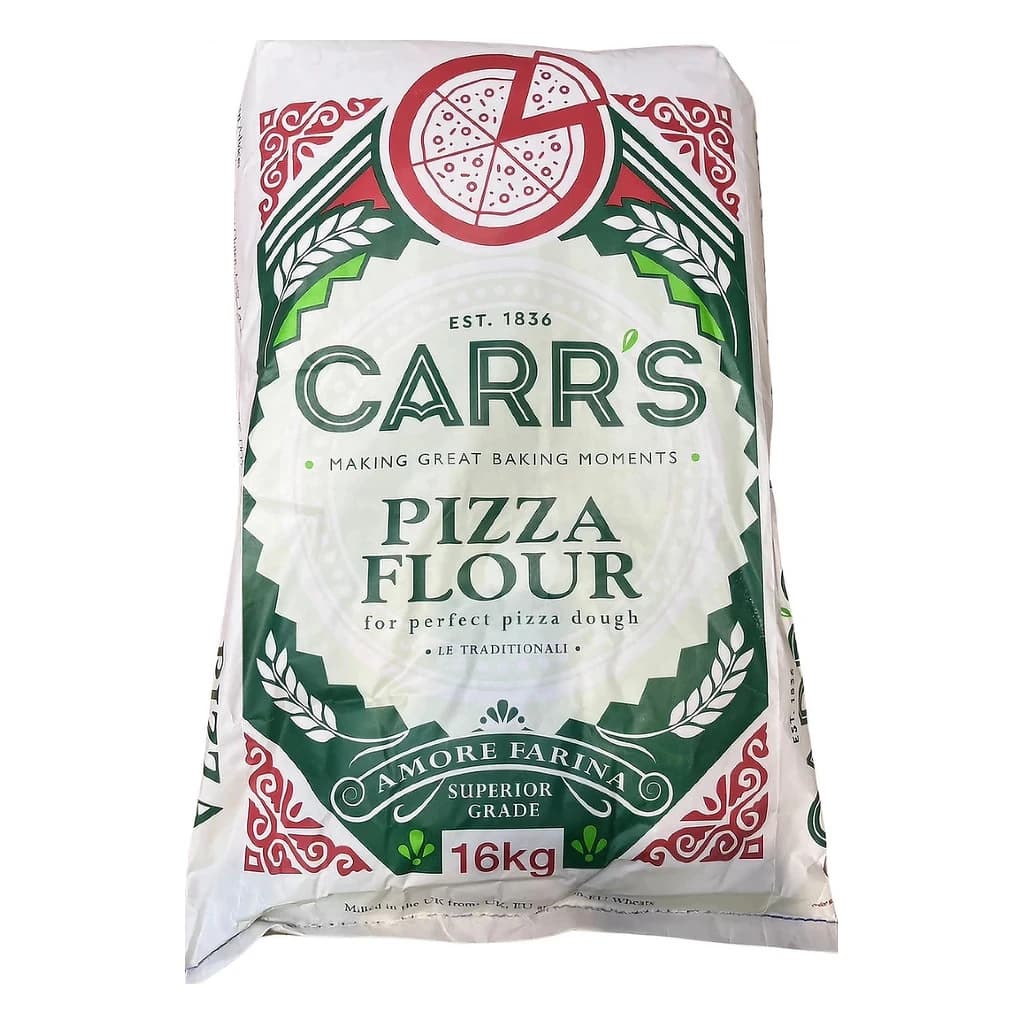
For confirmed pizza performance, the Domson catalogue includes the Verace Pizza Flour 16 kg — a dedicated product from the Whitworth Bros range. The reviewed spec pages focus on the physical analysis for other Whitworth products; request the Verace spec directly from your account manager for confirmed analytical data on this product.
All-day / artisan pizza (T550 range): Many professional pizzerias — particularly outside Naples — use T550 or UK strong white bread flour for pizza. GoodMills T550 (protein 11.5–12.5%, gluten index 75–99) works well for hand-stretched and machine-sheeted pizza. Domson PN (protein 12.4–13.0%, WA 58.4–61.0%) provides more protein strength if you prefer a tougher, chewier crust.
Key adjustment for pizza with bread flour: reduce water slightly (pizza dough is typically 60–65% hydration vs 65–75% for sourdough bread). Allow a long cold fermentation (24–72 h at 4°C) to develop extensibility. Avoid over-kneading — gluten at 12–13% protein and high hydration will develop sufficiently with minimal mixing and a long rest.
8. Laminated doughs — croissant, Danish and puff pastry
Laminated doughs require a specific flour profile: enough gluten to hold the dough together during rolling and folding without fighting the sheeter, but not so strong that the dough springs back hard and tears the fat layer.
Ideal flour for laminated yeast doughs (croissant, Danish):
- Protein: 10–12.5% (medium to medium-strong; professional references suggest 10–11% on a 14% moisture basis as optimal, though many bakeries successfully use T550 at 11.5–12.5%)
- Ash: T550 range (not higher — bran particles can rupture fat layers)
- Gluten character: good extensibility, not over-tenacious
Note (single-source): BAKERpedia's Dough Lamination reference recommends 10.0–11.0% protein (14% moisture basis) as the optimal range for laminated doughs. Many professional bakeries operate successfully with flour at 11.5–12.5% (e.g. GoodMills T550 Fortified) — the wider range reflects differing process conditions and sheeting equipment. Request your miller's recommendation for your specific process.
GoodMills T550 Fortified (protein 11.5–12.5%, gluten index 75–99) is well suited. Windrush (12.0–12.5% protein, water absorption 55–61%) works for UK operations.
Puff pastry: Puff pastry (détrempe without yeast) requires a flour that can be rolled very thin without tearing but still provides enough gluten for the paste to hold steam during baking. Medium-protein flour (9–11%) is commonly used; some operations use a 50/50 blend of strong bread flour and pastry flour to fine-tune extensibility. T550 or UK plain flour works well.
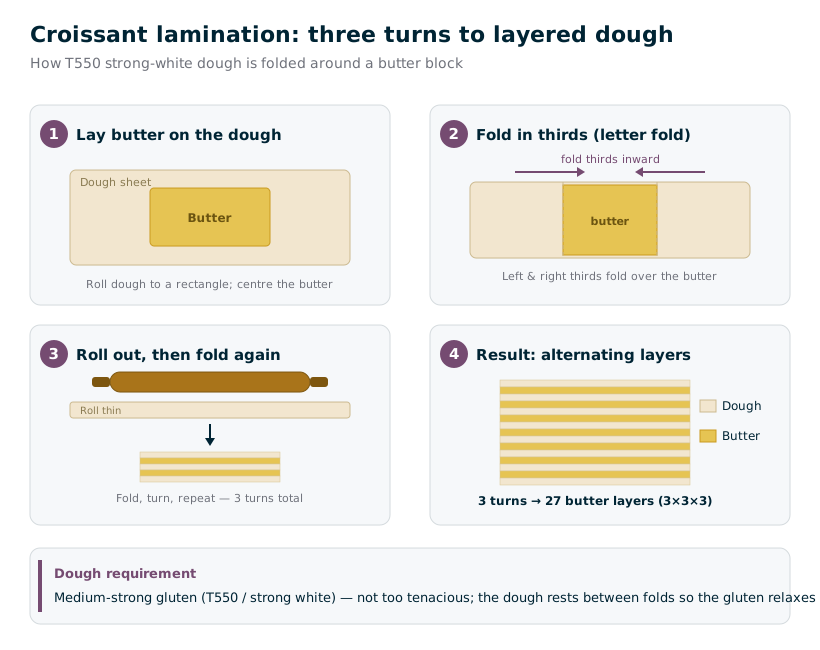 Diagram showing croissant dough lamination: three successive folds of dough around a butter block creating multiple alternating dough and fat layers
Temperature discipline is more important than flour for laminated doughs: The flour choice sets the structure; the fat temperature determines whether layers survive. Fat must remain between 14–18°C throughout lamination. Dough must rest at 4°C between folds to relax gluten tension. Flour choice cannot compensate for warm fat or insufficient resting.
See also: A4 Baking Fats — roll-in fats and butter for lamination.
9. Choosing between Polish T-types and UK flours
Bakeries in this platform's customer base work in both contexts. Here is a practical decision tree:
| You are producing | Use Polish T-type | Use UK flour |
|---|---|---|
| Polish bread (chleb, bułki) | T550 GoodMills or Komplexmłyn | — |
| Rustic Polish sourdough | T750 Domson Bread | — |
| Graham/wholemeal Polish bread | T1850 | — |
| Pasta and pierogi | T400 Macaroni | Durum semolina |
| Scones, Victoria sponge (UK) | — | Self-raising (Allied Mills / Domson Premium SR) |
| White sandwich loaf (UK style) | T550 | Windrush / Coniston / Domson PN |
| High-volume UK bread production | — | Coniston or Domson PN |
| Artisan sourdough (UK or Polish) | T750 | Windrush or Coniston |
| Pastry (UK style) | T450 | Golden Jewel / GD Plain |
| Cake (UK high-ratio) | — | Top Flight (heat-treated) |
| Spelt bread | Light Spelt / Wholemeal Spelt | Light Spelt / Wholemeal Spelt |
The two systems are complementary. For most bread applications, a T550 with confirmed high protein (11.5%+) is functionally equivalent to a UK strong white bread flour. For pastry, T450 is approximately equivalent to UK plain/pastry flour. For wholemeal bread, T1850 Graham is the Polish equivalent of UK wholemeal.
The full decision matrix, including catalogue product recommendations, is in the table below.
10. Full comparison table
The complete specification comparison across all 19 products in this dossier is in the table below.
11. Common faults from wrong flour choice
The full fault table is below. The most common production errors:
- Using pastry flour for bread — insufficient gas retention, flat loaves.
- Using bread flour for shortcrust — dough shrinks, tough texture.
- Using heat-treated cake flour for anything leavened by yeast — denatured proteins cannot form working gluten.
- Over-mixing spelt dough — gluten collapses; treat spelt like a fragile partner.
- Using self-raising flour as a drop-in for plain flour — the pre-added raising agents conflict with your own leavening control.
12. Allergen summary — every product in this dossier
GLUTEN is the primary declared allergen in every flour covered by this article. Under EU Regulation 1169/2011 Annex II and equivalent UK food law, gluten must be emphasised in the ingredients list of all downstream products.
Additional cross-contamination risks by product (as declared on supplier spec sheets):
Food safety note (flagged for review): The cross-contamination risks below are as declared by suppliers on specification sheets; they reflect agricultural or supply-chain co-handling of allergens. Under EU Regulation 1169/2011 and UK Food Information Regulations 2014, precautionary allergen labelling ("may contain") for unintentional cross-contamination of this kind is advisory best practice, not a legally mandated declaration in the same way as intentional allergen ingredients. Downstream food businesses should assess their risk and take appropriate "may contain" labelling decisions with their legal adviser.
| Product group | Supplier-declared cross-contamination risk |
|---|---|
| All Wągrowiec Mill flours (T450/T500/T550/T750/T850) | Soy, lupine, mustard (agricultural co-cultivation) |
| GoodMills T550 Fortified | Soy, lupine, mustard (agricultural co-cultivation) |
| GoodMills Rye T720 | Confirmed gluten (rye) — no additional cross-contamination notes on spec |
| GoodMills T1850 Graham | Confirmed gluten (wheat) |
| Matthews Windrush | Soy (supply chain) |
| Matthews Light Spelt | Soy (supply chain); naming spelt specifically on downstream labels is best practice |
| Doves Farm Wholemeal Spelt | No soy/nuts/milk on plant; naming spelt specifically on downstream labels is best practice |
| Allied Mills / ADM flours | Soy (supply chain) |
| Agrol Oat Flour | Gluten cross-contamination from facility handling; GLUTEN must be declared on downstream products |
Food safety note — raw flour: All flour must be fully cooked or baked before consumption. Raw flour can harbour E. coli and Salmonella. This is confirmed explicitly in multiple spec sheets (GoodMills, Allied Mills). Never provide raw dough or batter for direct consumption without adequate heat treatment.
Coverage notes and gaps
Solid: Polish T-type ash and falling number data confirmed from eight Wągrowiec Mill and GoodMills spec sheets. UK bread flour protein and water absorption data confirmed from three Allied Mills / ADM specs and one Matthews spec. Spelt specs confirmed from Matthews and Doves Farm. Oat spec confirmed from Agrol.
Single-source data: Graham T1850 protein and fibre are typical nutritional label values, not specification minima (GoodMills spec). Top Flight Cake Flour heat-treatment description is from spec; protein specification not stated in reviewed pages. Verace Pizza Flour spec was not read — refer directly to supplier.
Gap: Water absorption is not specified for any Polish T-type flour in the Domson catalogue — only UK flours include farinograph WA% on spec sheets. Polish millers report wet gluten content instead. If water absorption is critical for your process, request it from GoodMills or Wągrowiec Mill on your next order.
Gap: No alveograph (W, P/L) data appears on any reviewed spec sheet — this is normal for Polish and UK milling. If you are running a fully automated sheeting line that requires tight P/L control, request alveograph data separately. See Reading the flour spec sheet: ash content, Hagberg falling number, Zeleny, farinograph and alveograph for full explanation of alveograph parameters.
Gap: Rye flour coverage in this article is limited to a brief mention of T720 for context; a dedicated rye flour guide (A1-rye-flour-guide) covers rye T720, T2000 wholemeal, and rye malt in depth.
Figures
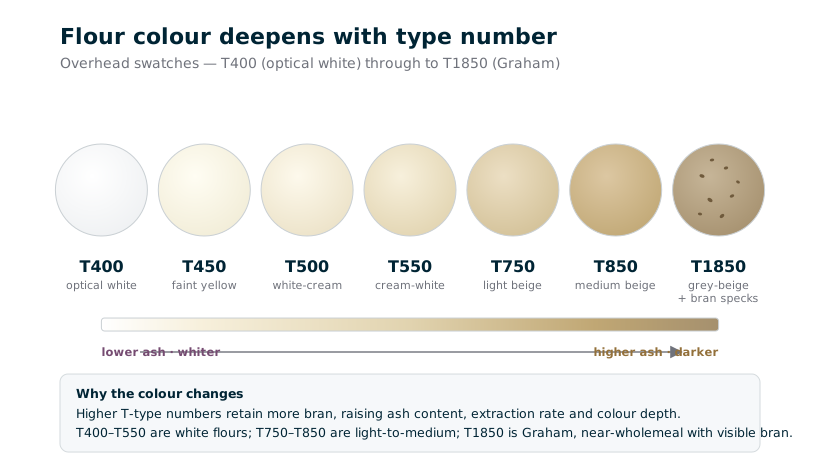 Side-by-side colour swatches of wheat flour from type 400 (bright white) to type 1850 (dark grey-beige) with type numbers labelled
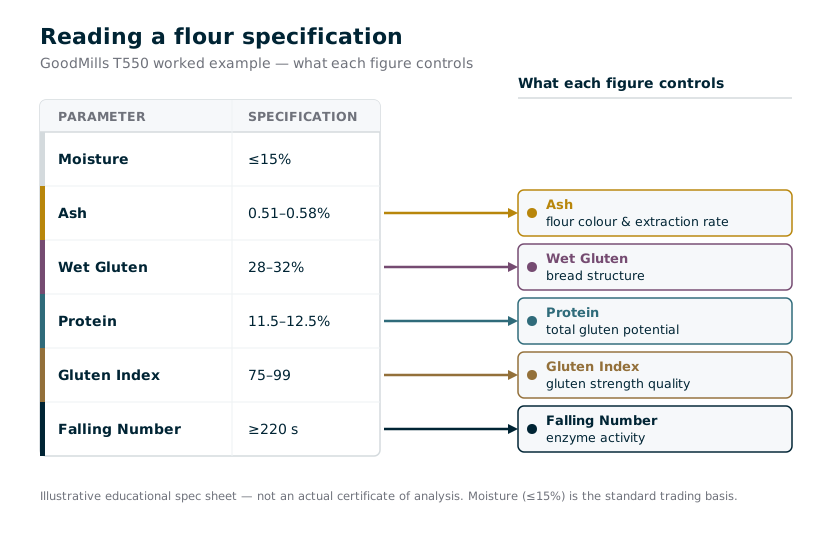 Annotated flour specification sheet showing the meaning of ash content, falling number, wet gluten, protein and gluten index parameters with explanatory callouts
Neapolitan-style pizza dough (direct method)
Requires strong flour with medium extensibility. GoodMills T550 or a dedicated pizza flour recommended.
| Ingredient | Baker's % | Weight |
|---|---|---|
| Wheat flour T550 (or 00-style pizza flour) | 100 | |
| Water (cold) | 60 | |
| Salt | 2.5 | |
| Fresh yeast | 0.2 |
Long cold fermentation 24–72 h at 4°C. Do not add oil to Neapolitan-style dough. Bake at 430–480°C (deck/Neapolitan oven) for 60–90 seconds. Baker's % derived from practitioner convention; verify with your process.
Classic croissant dough (laminated)
Detrempe (dough base). T550 or UK strong white. Fat layer (beurrage) is separate.
| Ingredient | Baker's % | Weight |
|---|---|---|
| Wheat flour T550 or strong white bread flour | 100 | |
| Water (cold) | 42 | |
| Milk (cold) | 10 | |
| Salt | 2 | |
| Sugar | 10 | |
| Butter (in dough) | 6 | |
| Fresh yeast | 3 | |
| Roll-in butter (beurrage) | 45 |
Mix detrempe to medium development. Rest 1 h at 4°C. 27 layers (3 × 3 folds). Proof at 27°C/80% RH until doubled. Bake 185–195°C. Baker's % derived from practitioner convention.
Core spec parameters extracted from first-party supplier spec sheets in the Domson catalogue, supplemented by trade references. Ash and FN values are specification limits (max or min as stated); protein values are specification minima or ranges. UK flours report water absorption (WA%) instead of ash class.
| Flour type / product | Polish T-type | Ash content (%) | Protein % (spec) | Wet gluten % (spec) | Falling number (s) | Water abs. % | Primary applications |
|---|---|---|---|---|---|---|---|
| Wheat T400 Macaroni Grade | T400 | max 0.50 | not specified | ≥18 | not standardised | — | Pasta, semolina substitute, fine pastry |
| Wheat T450 | T450 | max 0.48 | ≥8.0 | ≥23 | ≥220 | — | Shortcrust pastry, fine biscuits, pasta sheets, pierogi |
| Domson White Flour T500 | T500 | max 0.52 | ≥8.0 | ≥23 | ≥220 | — | General-purpose, sponge cake, soft rolls, enriched doughs |
| GoodMills T550 Fortified | T550 | 0.51–0.58 | 11.5–12.5 | 28–32 | ≥220 | — | White sandwich bread, rolls, pizza, yeasted buns |
| Komplexmłyn T550 | T550 | max 0.58 | ≥8.0 | ≥25 | ≥220 | — | White bread, rolls, general bread production |
| Domson Bread Flour T750 | T750 | max 0.82 | ≥10.0 | ≥26 | ≥220 | — | Rustic/artisan bread, sourdough, mixed-grain loaves |
| Wheat T850 | T850 | max 0.90 | not specified | ≥26 | ≥220 | — | Brown bread, high-bran loaves, wholegrain blends |
| Graham Wheat Flour T1850 | T1850 | max 2.0 | 12.3 g/100g (typical) | — | >180 | — | Graham bread, high-fibre loaves, wholemeal blends |
| Windrush Strong White (Matthews) | UK bread flour (no T-type) | not reported (FCG 1.5–3.5) | 12.0–12.5 | — | 250–400 (target 350) | 55–61 (target 58) | Premium bread, sourdough, high-hydration doughs, rolls |
| Coniston Strong White (Allied Mills) | UK bread flour (no T-type) | not reported | 12.5–14.5 | — | ≥250 | 58–61 | High-output bread production, sandwich loaves |
| Domson PN (ADM) | UK bread flour (no T-type) | not reported | 12.4–13.0 | — | — | 58.4–61.0 | Bread, rolls, pizza, enriched doughs |
| GD Plain (ADM) | UK plain/all-purpose (no T-type) | not reported | 8.0–10.2 | — | — | 50–56 | Pastry, sauces, general-purpose baking, batters |
| Golden Jewel Pastry (Whitworth Bros) | UK pastry blend (no T-type) | not reported | 7.5–9.5 | — | — | — | Pastry, biscuits, shortbread, crackers |
| Top Flight Cake Flour (Whitworth Bros) | UK heat-treated cake flour (no T-type) | not reported | not specified | — | — | — | High-ratio cakes, sponges, fine bakery goods |
| Perfect Self Raising / Domson Premium SR | UK self-raising (no T-type) | not reported | 8.7–10.5 | — | ≥150 | 52–58 | Scones, Victoria sponge, teacakes, muffins (UK tradition) |
| Light Spelt (Matthews) | Light spelt (no T-type) | FCG target 1.5, max 3.0 | 9.0–13.0 | — | ≥220 | 53–65 | Spelt bread, rolls, mixed-grain loaves, sourdough |
| Wholemeal Spelt (Doves Farm) | Wholemeal spelt (no T-type) | not reported | 11.8–17.0 | — | — | — | Wholemeal spelt bread, crackers, dense loaves |
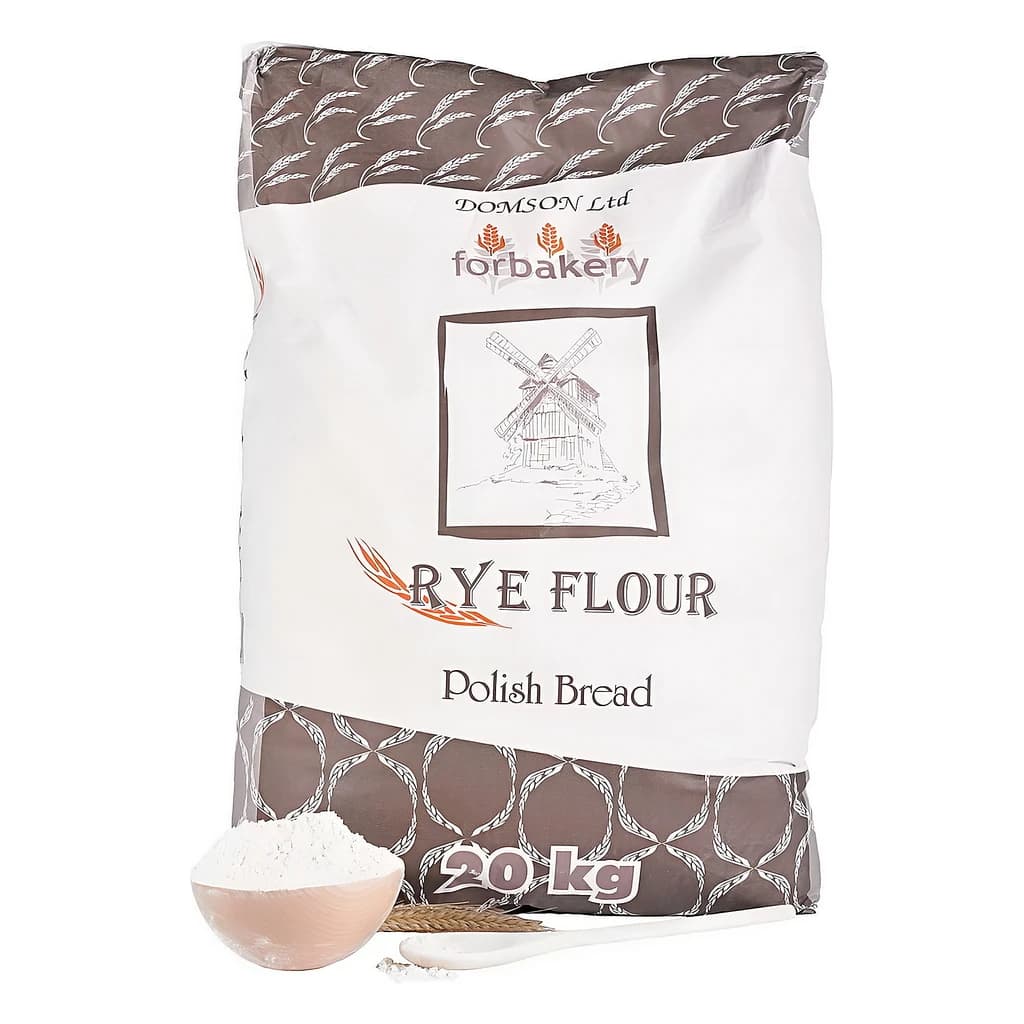
| Rye T720 (GoodMills) | Rye T720 | <0.78 | 6.5 g/100g (typical) | — | >90 | — | Light rye bread, mixed rye-wheat loaves |
| Oat Flour (Agrol) | No T-type (oat, not wheat) | not specified | 13 g/100g (typical) | — | — | — | Oat bread, oatcakes, blends, cookies |
Quick-reference for bakery production decisions. Protein ranges are from spec sheets and trade references (King Arthur Baking, BAKERpedia). Where a Domson catalogue product matches, it is listed.
| Product type | Key gluten requirement | Protein target (%) | Recommended Polish type | Recommended UK type | Catalogue option(s) |
|---|---|---|---|---|---|
| Fine shortcrust pastry, tart shells | Weak — minimum development | 7–9 | T400–T450 | Pastry / plain | Wheat T450, GD Plain |
| Sponge / genoise cake | Very weak — air-raised, no gluten structure | 7–9 (typical; heat-treated cake flours vary by mill) | T450–T500 | Heat-treated cake flour | Top Flight Cake Flour, Domson White T500 |
| Scones, Victoria sponge (UK tradition) | Weak — chemical raising, tender crumb | 8–10 | T450–T500 | Self-raising flour | Perfect Self Raising Flour, Domson Premium SR |
| Biscuits / shortbread / cookies | Weak — snap texture desired | 7–9 | T450 | Pastry blend / plain | Wheat T450, Golden Jewel Pastry, GD Plain |
| White sandwich bread / rolls | Medium-strong — gas retention, fine crumb | 11–13 | T550 | Strong white bread flour | GoodMills T550, Komplexmłyn T550, Windrush, Domson PN, Coniston |
| Rustic / artisan sourdough wheat bread | Strong — long fermentation tolerance | 12–13+ | T750–T850 | Strong white or wholemeal bread flour | Domson Bread T750, T850, Windrush, Coniston |
| Pizza (Neapolitan style) | Medium-strong, high extensibility, low tenacity | 11–13 | T550 | Strong white (or specialist pizza flour) | GoodMills T550, Verace Pizza Flour |
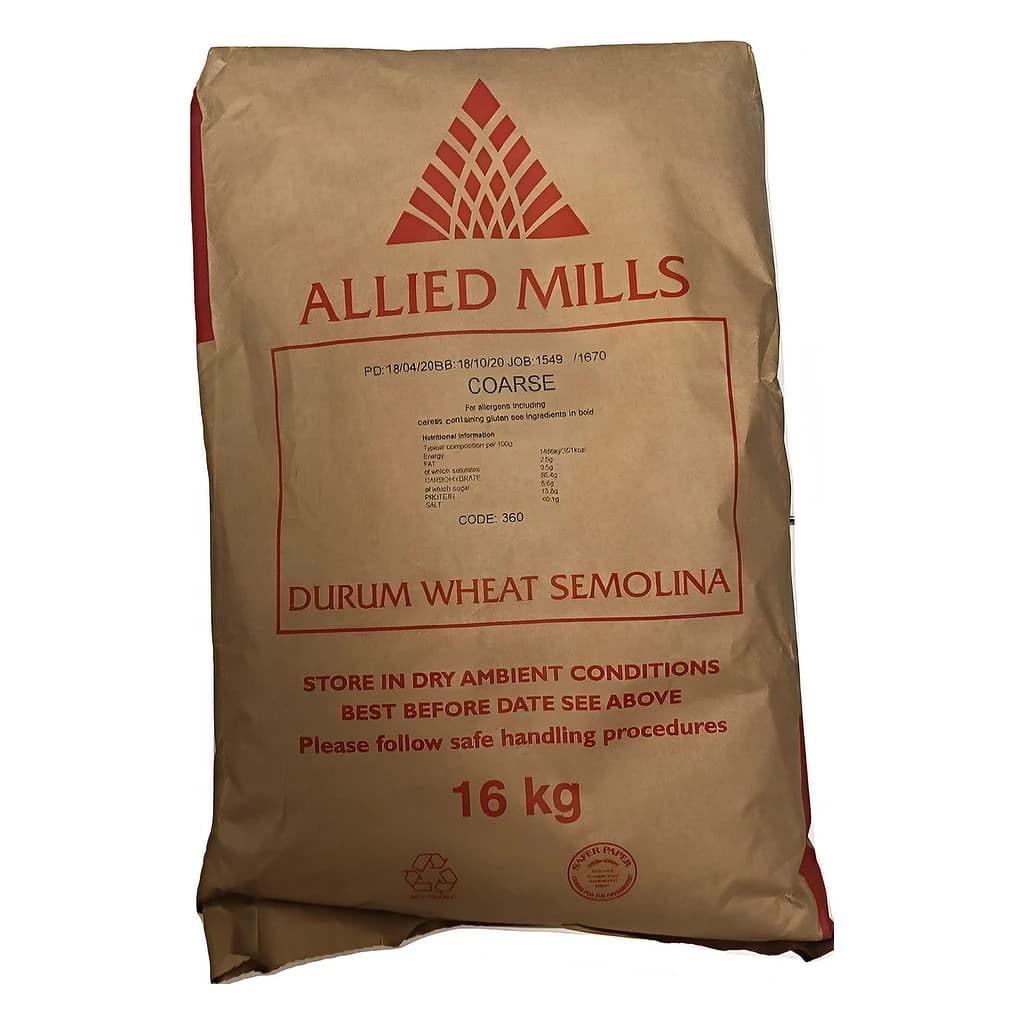
| Pasta (extruded / fresh) | Medium, cream colour, extensible without brittleness | 11–13 | T400 Macaroni Grade | Durum semolina preferred; strong white acceptable | Wheat Flour T400 Macaroni Grade, Durum Wheat Semolina |
| Croissant / pain au chocolat (laminated yeast) | Medium — extensible, not over-tenacious; handles rolling | 11–12.5 | T550 | Strong white bread flour | GoodMills T550, Windrush |
| Danish pastry / puff pastry (laminated) | Medium — even layering, not too elastic | 10–12 | T550 | Strong white bread flour | GoodMills T550, Windrush |
| Graham / wholemeal bread (Polish) | Medium-strong with bran interference | 12–13 (flour fraction) | T1850 or T750/T850 blend | Wholemeal bread flour | Graham Wheat T1850, Domson Bread T750 |
| Spelt bread | Delicate — spelt gluten weaker and more fragile than wheat | 9–13 | No Polish T-type; use light spelt or wholemeal spelt | Light spelt or wholemeal spelt | Light Spelt (Matthews), Wholemeal Spelt (Doves Farm), Stoneground White Spelt |
| Oat-enriched bread / oatcakes | Oat adds no gluten; base wheat flour provides structure | Blend: wheat at 11–12% + oat flour 10–30% | T550 or T750 as carrier | Strong white as carrier | Oat Flour (Agrol) — blend with wheat flour |
Approximate equivalences based on ash content ranges. Sources: BAKERpedia, Sourdough Geeks (medium reliability), spec sheets. Note that within a type number proteins and quality can vary significantly. This table is a guide, not a precise standard.
| Polish type | Ash % (approx.) | French T-type (approx.) | German type (approx.) | Italian tipo (approx.) | UK equivalent name |
|---|---|---|---|---|---|
| T400–T450 | 0.40–0.48 | T45–T55 | 405 | 00 / 0 | Extra-fine / pastry |
| T500 | 0.48–0.52 | T55 | 550 | 0 | Plain / all-purpose |
| T550 | 0.51–0.58 | T55–T65 | 550 | 0 / 1 | Plain / strong white |
| T750 | 0.72–0.82 | T80 | 812 | 1 | Strong brown / light wholemeal |
| T850 | 0.82–0.90 | T80–T110 | 1050 | 2 | Brown bread flour |
| T1850 (Graham) | up to 2.0 | T150 | 1700+ | Integrale | Wholemeal |
Practical comparison for bakers switching between wheat and spelt. Protein values from spec sheets (Matthews, Doves Farm).
| Parameter | Wheat flour (T550 typical) | Light spelt (Matthews) | Wholemeal spelt (Doves Farm) |
|---|---|---|---|
| Protein % | 11.5–12.5 | 9–13 (target 11) | 11.8–17 |
| Gluten character | Strong, elastic, tolerant | Weaker, more extensible, fragile | Very extensible, fragile, tears if over-mixed |
| Water absorption % | 55–65 (typical) | 53–65 | Higher (bran absorbs water) |
| Mixing tolerance | High — tolerates over-mixing | Low — stop at dough formation | Very low |
| Flavour | Neutral cereal | Slightly nutty, mild | Nutty, earthy, distinct |
| Falling number spec | ≥220 s | ≥220 s | Not specified |
| Allergen status | GLUTEN (wheat) — EU Reg 1169/2011 Annex II | GLUTEN (spelt) — named allergen | GLUTEN (spelt) — named allergen |
| Fault | Likely cause | Correct flour choice |
|---|---|---|
| Bread flat, dense crumb, poor oven spring | Flour protein too low (used pastry/cake flour for bread) | Switch to T550 or stronger bread flour (≥11% protein) |
| Pastry shrinks back in the tin, tough texture | Flour protein too high (used bread flour for shortcrust) | Switch to T450 or UK pastry flour (≤9% protein) |
| Croissant layers burst and lose definition | Dough too strong — high tenacity fights the sheeter | Reduce protein by blending T550 with T450; allow longer rest between folds |
| Spelt dough tears during shaping | Over-mixed — spelt gluten collapses quickly | Reduce mixing time by 30–40%; mix to 'just developed' and handle gently |
| Pasta sheet tears during rolling (fresh pasta) | Flour protein too low or ash too high for pasta grade | Use T400 macaroni grade or durum semolina; add eggs to compensate |
| Cake too tough, not tender | Over-developed gluten (bread flour used; or over-mixing with plain flour) | Use heat-treated cake flour (Top Flight) or limit mixing; add fat before flour sifting |
| Self-raising scones flat / dense | Flour CO2 yield depleted (old flour) or protein too high | Check flour freshness; use self-raising spec with CO2 ≥0.45% (Allied Mills spec); do not use bread flour |
| Graham bread crumbles, no cohesion | Bran particles cut gluten strands in T1850; insufficient water | Add 2–5% vital wheat gluten; hydrate bran before mixing; use autolyse |
- Ash max pct:
- 0.48
- Moisture max pct:
- 15
- Falling number min s:
- 220
- Wet gluten min pct:
- 23
- Protein min pct:
- 8
- Shelf life months:
- 5
- Allergens:
- GLUTEN (wheat)
- Cross contamination risk:
- soy, lupine, mustard
- Gmo free:
- true
- Ash max pct:
- 0.52
- Moisture max pct:
- 15
- Falling number min s:
- 220
- Wet gluten min pct:
- 23
- Protein min pct:
- 8
- Shelf life months:
- 5
- Allergens:
- GLUTEN (wheat)
- Cross contamination risk:
- soy, lupine, mustard
- Gmo free:
- true
- Ash range pct:
- 0.51–0.58
- Moisture max pct:
- 15
- Falling number min s:
- 220
- Wet gluten range pct:
- 28–32
- Protein range pct:
- 11.5–12.5
- Gluten index range:
- 75–99
- Fortification · Calcium mg per 100g min:
- 235
- Fortification · Calcium mg per 100g max:
- 390
- Fortification · Iron mg per 100g min:
- 1.65
- Fortification · Thiamin mg per 100g min:
- 0.24
- Fortification · Niacin mg per 100g min:
- 1.6
- Shelf life months:
- 5
- Allergens:
- GLUTEN (wheat)
- Cross contamination risk:
- soy, lupine, mustard
- Gmo free:
- true
- Ash max pct:
- 0.82
- Moisture max pct:
- 15
- Falling number min s:
- 220
- Wet gluten min pct:
- 26
- Protein min pct:
- 10
- Shelf life months:
- 5
- Allergens:
- GLUTEN (wheat)
- Cross contamination risk:
- soy, lupine, mustard
- Gmo free:
- true
- Ash max pct:
- 0.9
- Moisture max pct:
- 15
- Falling number min s:
- 220
- Wet gluten min pct:
- 26
- Shelf life months:
- 5
- Allergens:
- GLUTEN (wheat)
- Gmo free:
- true
- Ash max pct:
- 0.5
- Moisture max pct:
- 15.3
- Falling number:
- not standardised
- Wet gluten min pct:
- 18
- Gluten index range:
- 55–100
- Shelf life months:
- 5
- Allergens:
- GLUTEN (wheat)
- Cross contamination risk:
- soy, lupine, mustard
- Gmo free:
- true
- Protein range pct:
- 12.0–12.5
- Falling number range s:
- 250–400
- Falling number target s:
- 350
- Water absorption range pct:
- 55–61
- Water absorption target pct:
- 58
- Added vwg max pct:
- 1.5
- Fortification:
- Creta Plus (CaCO3) 0.31% — statutory per UK Bread & Flour Regulations 1998
- Allergens:
- GLUTEN (wheat)
- Cross contamination risk:
- soy
- Protein range pct:
- 7.5–9.5
- Protein target pct:
- 8.5
- Moisture range pct:
- 13.0–15.0
- Allergens:
- GLUTEN (wheat)
- Protein range pct:
- 9.0–13.0
- Protein target pct:
- 11
- Moisture range pct:
- 13.5–15.0
- Falling number min s:
- 220
- Water absorption range pct:
- 53–65
- Allergens:
- GLUTEN (spelt — named allergen EU Reg 1169/2011 Annex II)
- Cross contamination risk:
- soy
- Ash max pct:
- 0.78
- Moisture max pct:
- 15
- Falling number min s:
- 90
- Allergens:
- GLUTEN (rye)
- Moisture max pct:
- 11
- Protein typical g per 100g:
- 13
- Fibre typical g per 100g:
- 10.3
- Allergens:
- GLUTEN — oats are a gluten-containing cereal under EU/UK law; facility also handles gluten-containing cereals
- Gmo free:
- true
Buy the ingredients
Catalogue products and brands referenced in this article.
Wheat Flour Type 450 25 kg
Wheat Flour Type G 550 25 kg

Rye Flour Type 720 20 kg
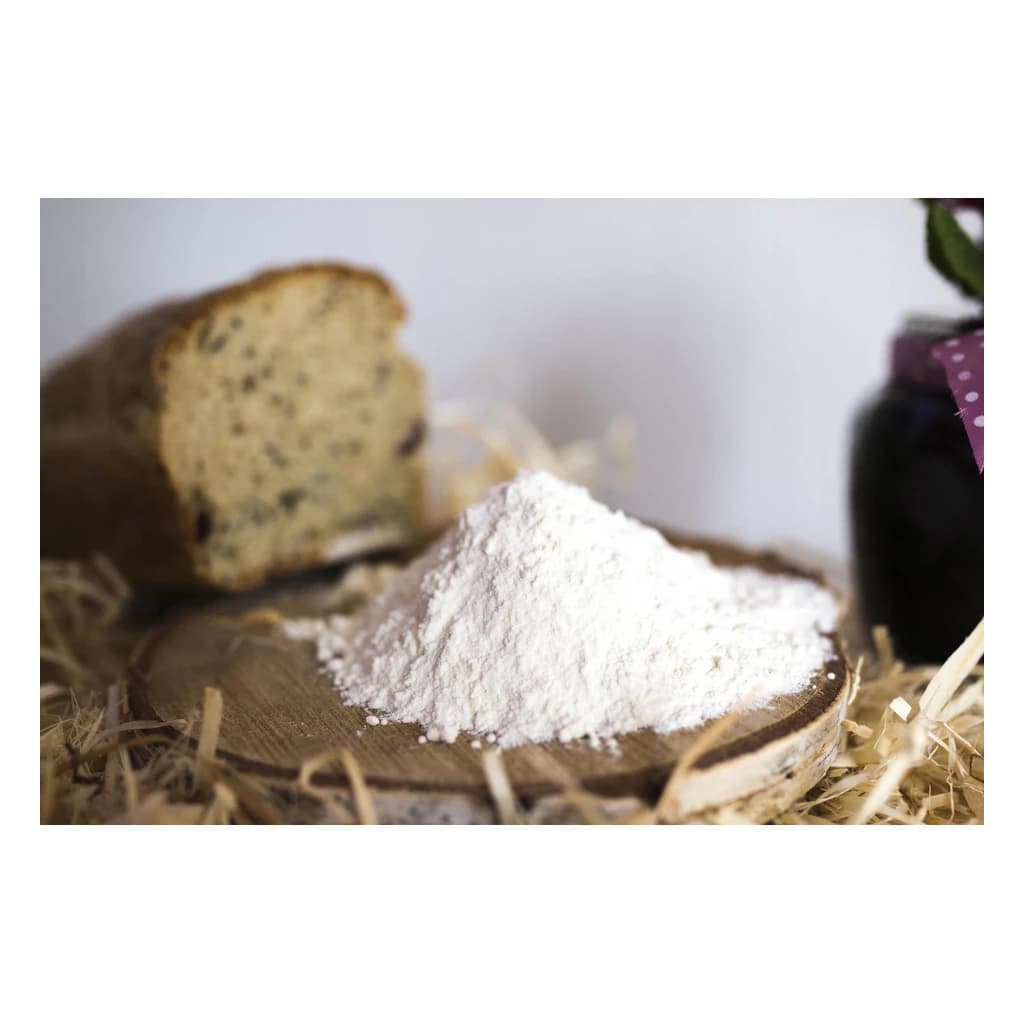
Wheat Flour Type 850 25 kg
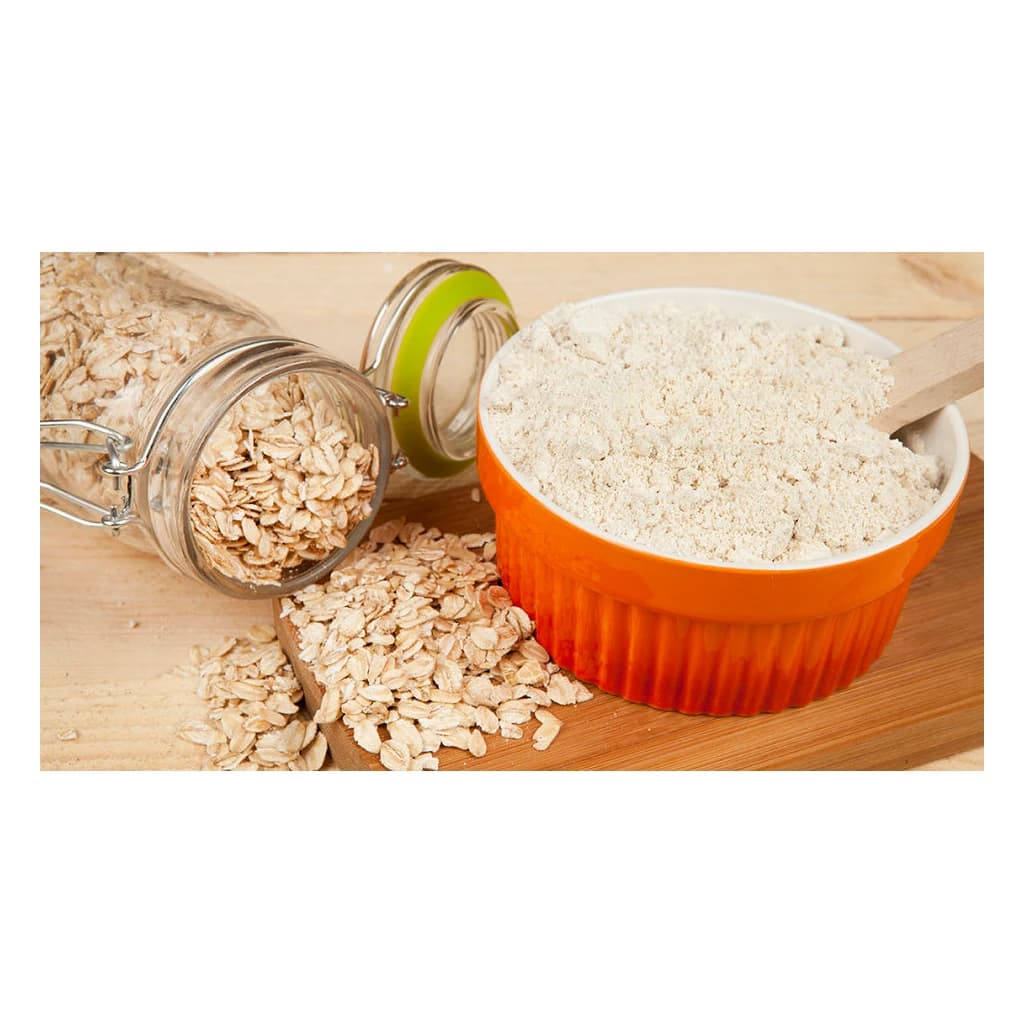
Oat Flour 25 kg
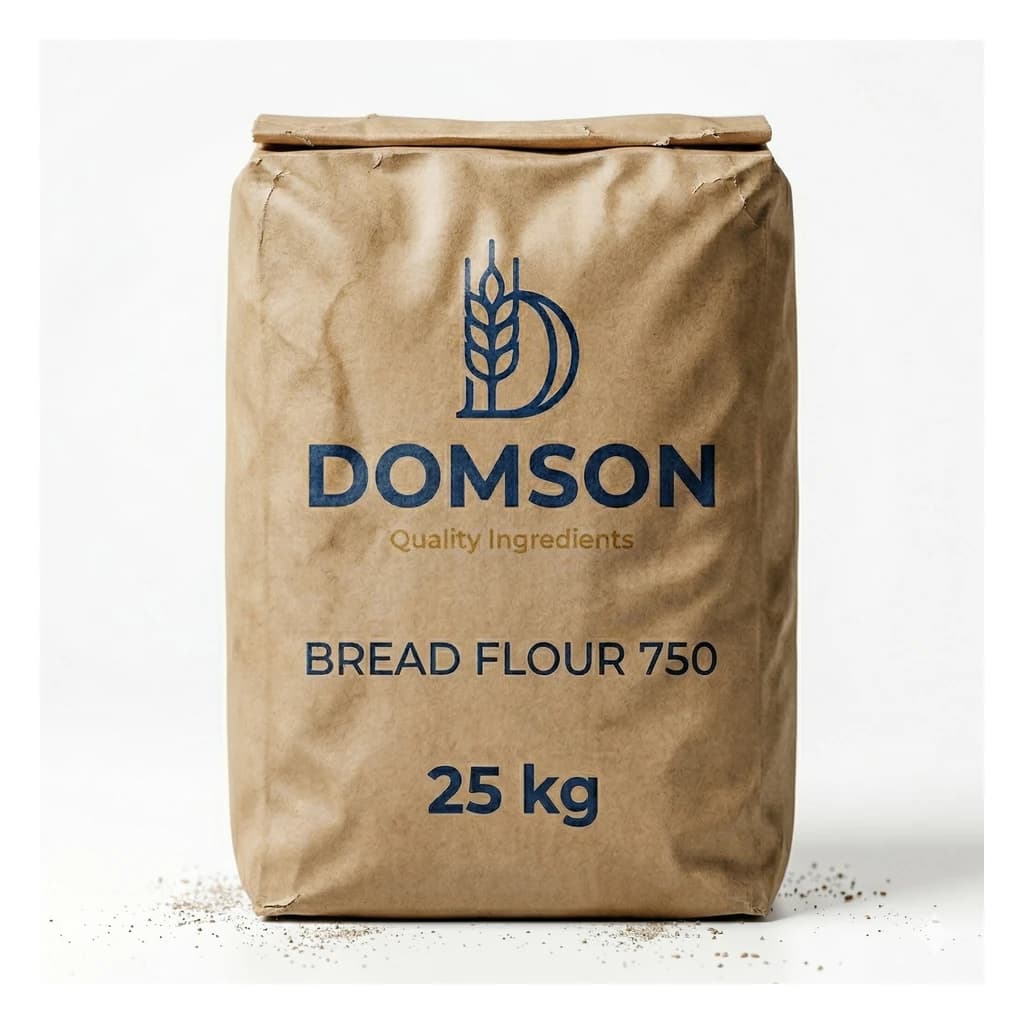
Domson Bread Flour Type 750 25 kg
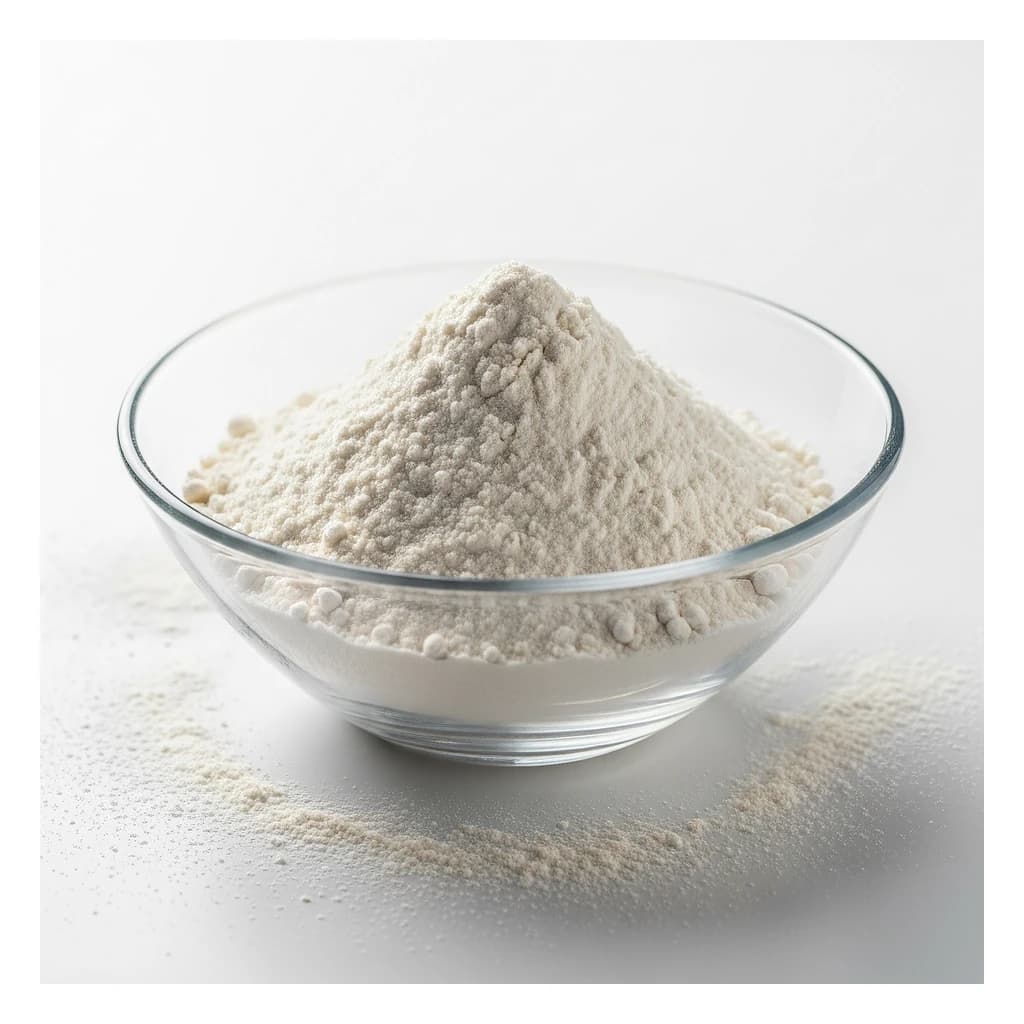
Komplexmłyn Wheat Flour Type 550 25 kg
Domson White Flour Type 500 25 kg
Rye Flour Type 720 25 kg
Graham Wheat Flour Type 1850 40 kg
Windrush Strong White Bread Flour 16 kg
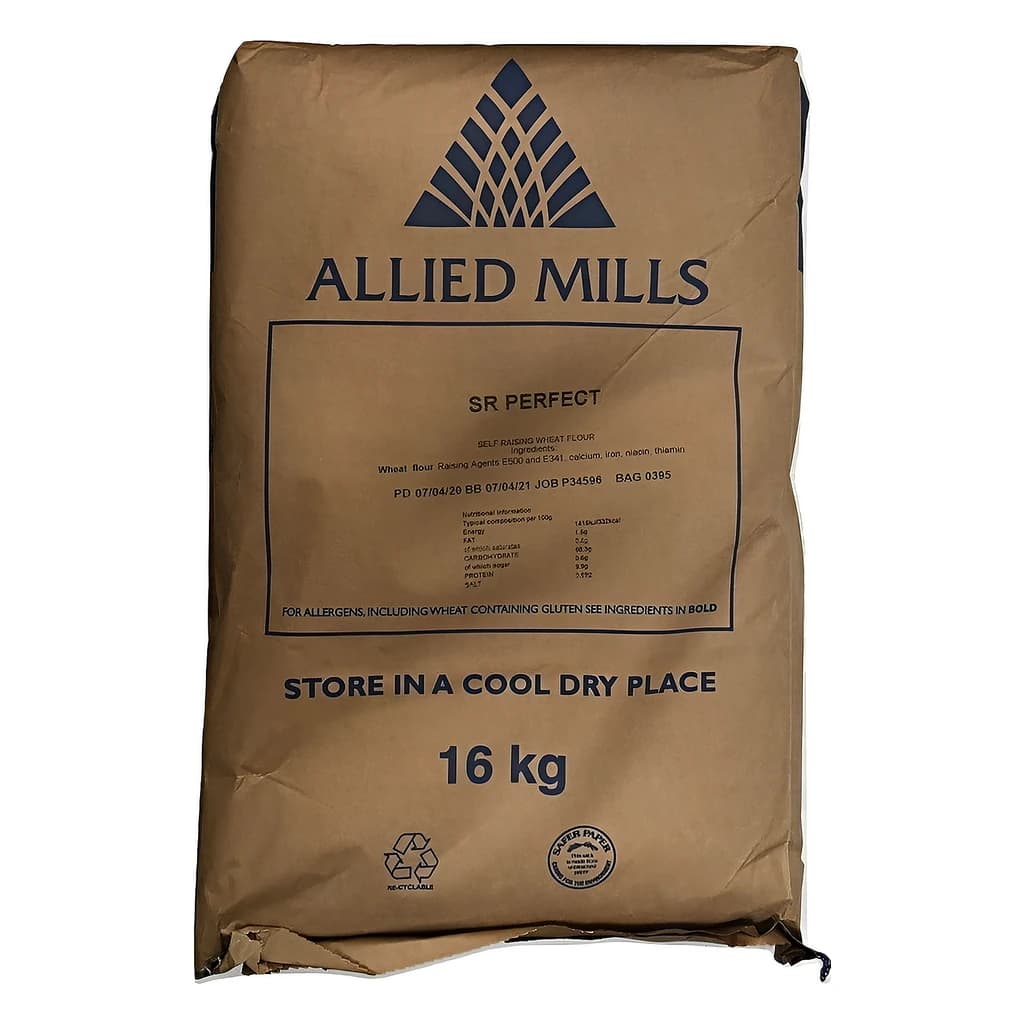
Perfect Self Raising Flour 16 kg
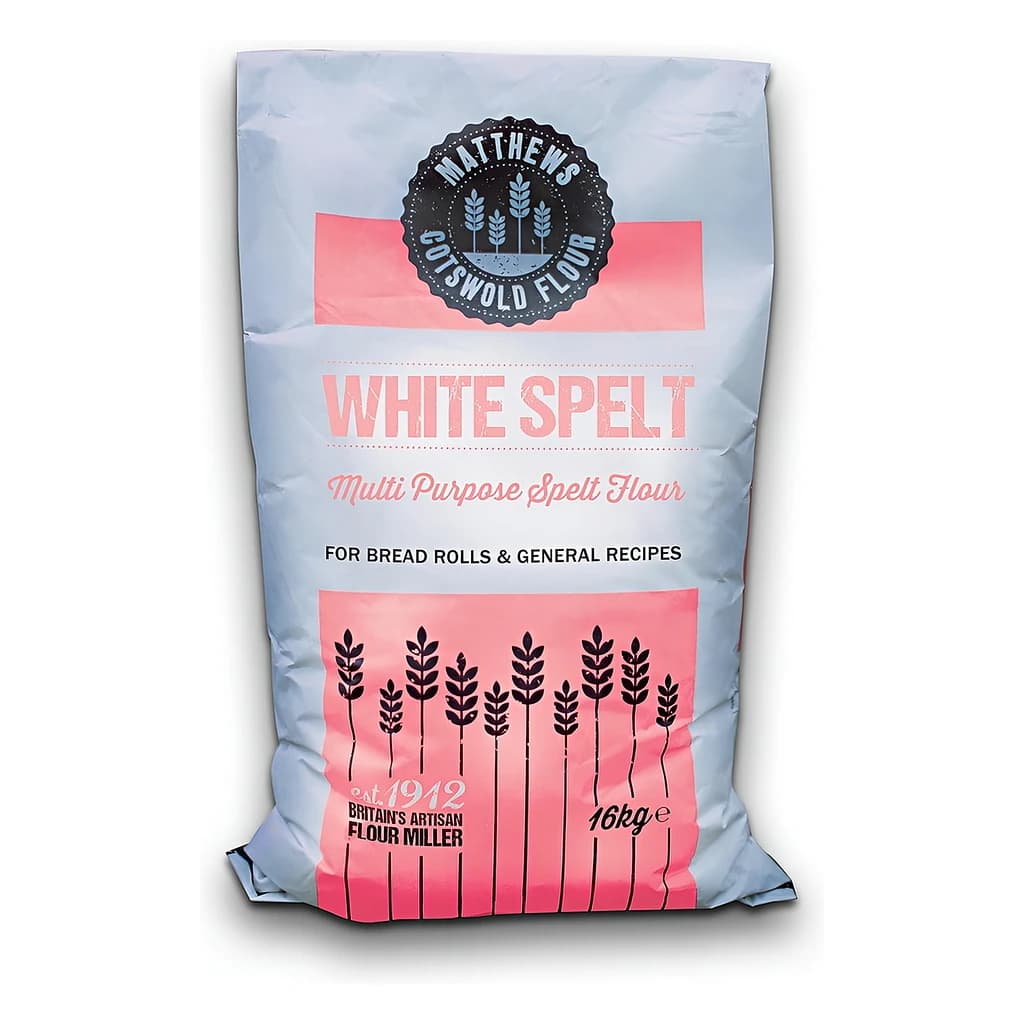
Stoneground White Spelt Flour 16 kg
Golden Jewel Pastry Flour 16 kg
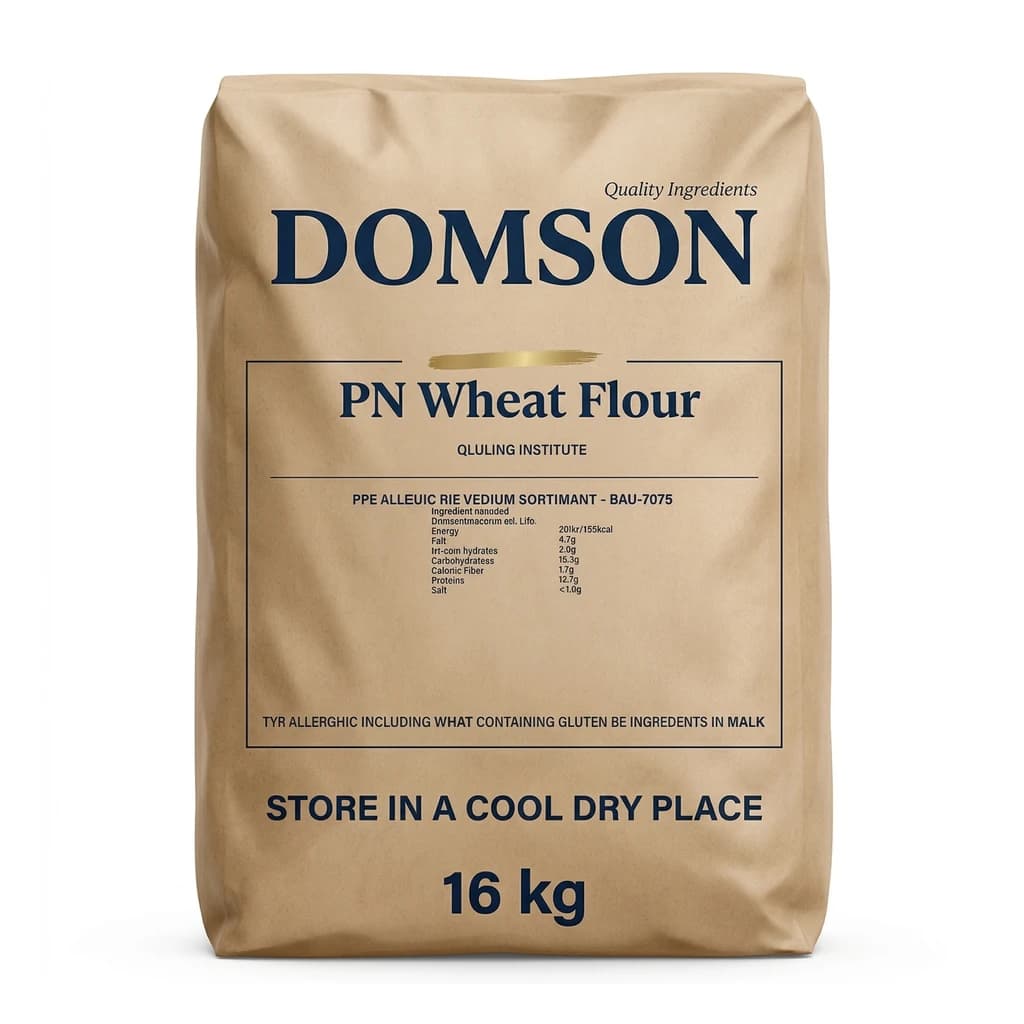
Domson PN Wheat Flour 16 kg
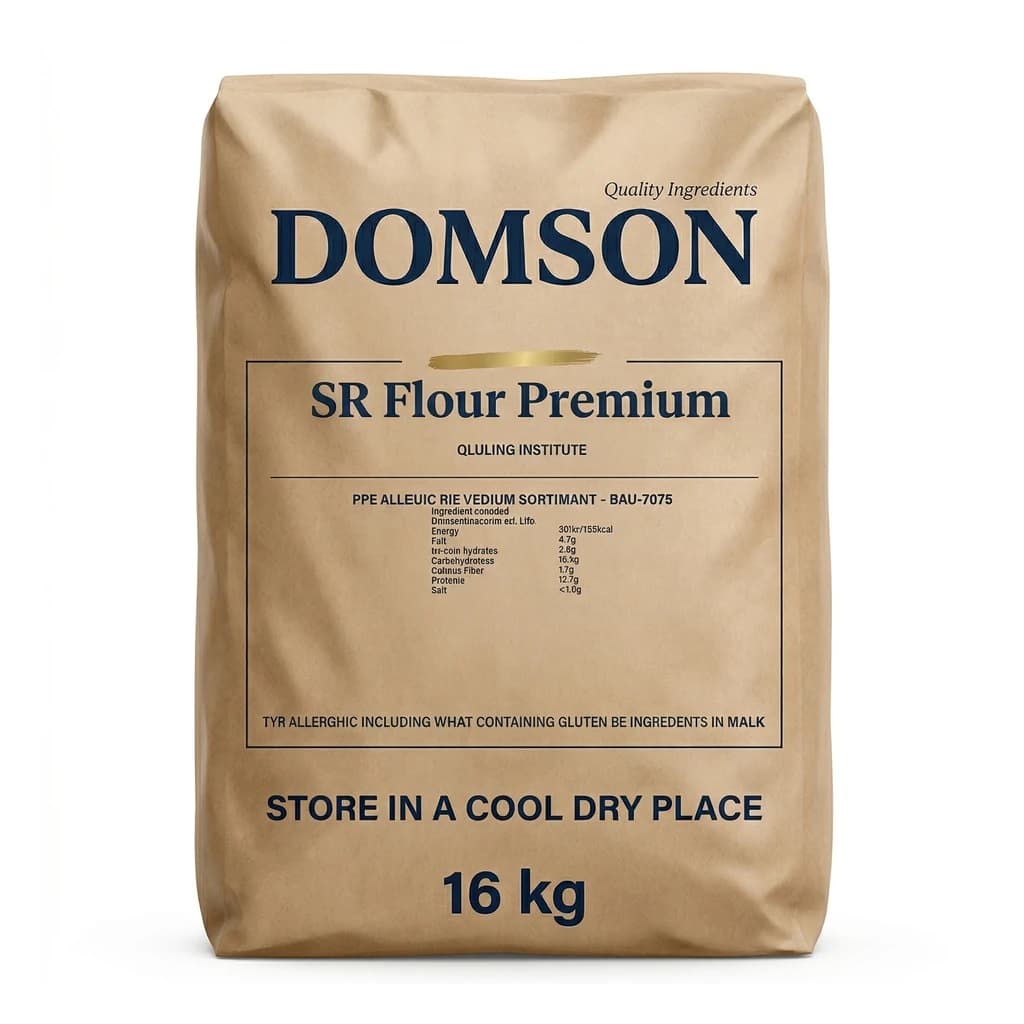
Domson Premium Self-Raising Flour 16 kg
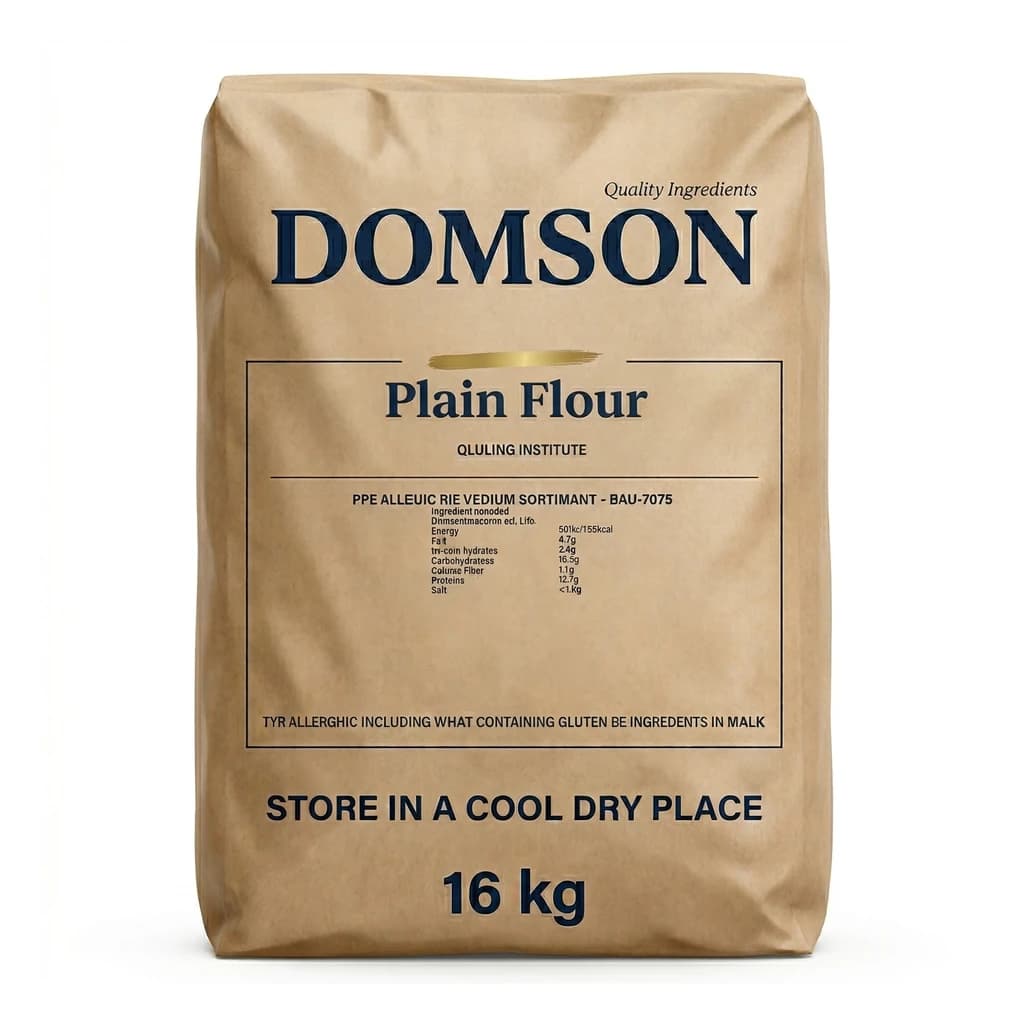
Domson Plain Flour 16 kg
Wheat Flour T400 Macaroni 25 kg
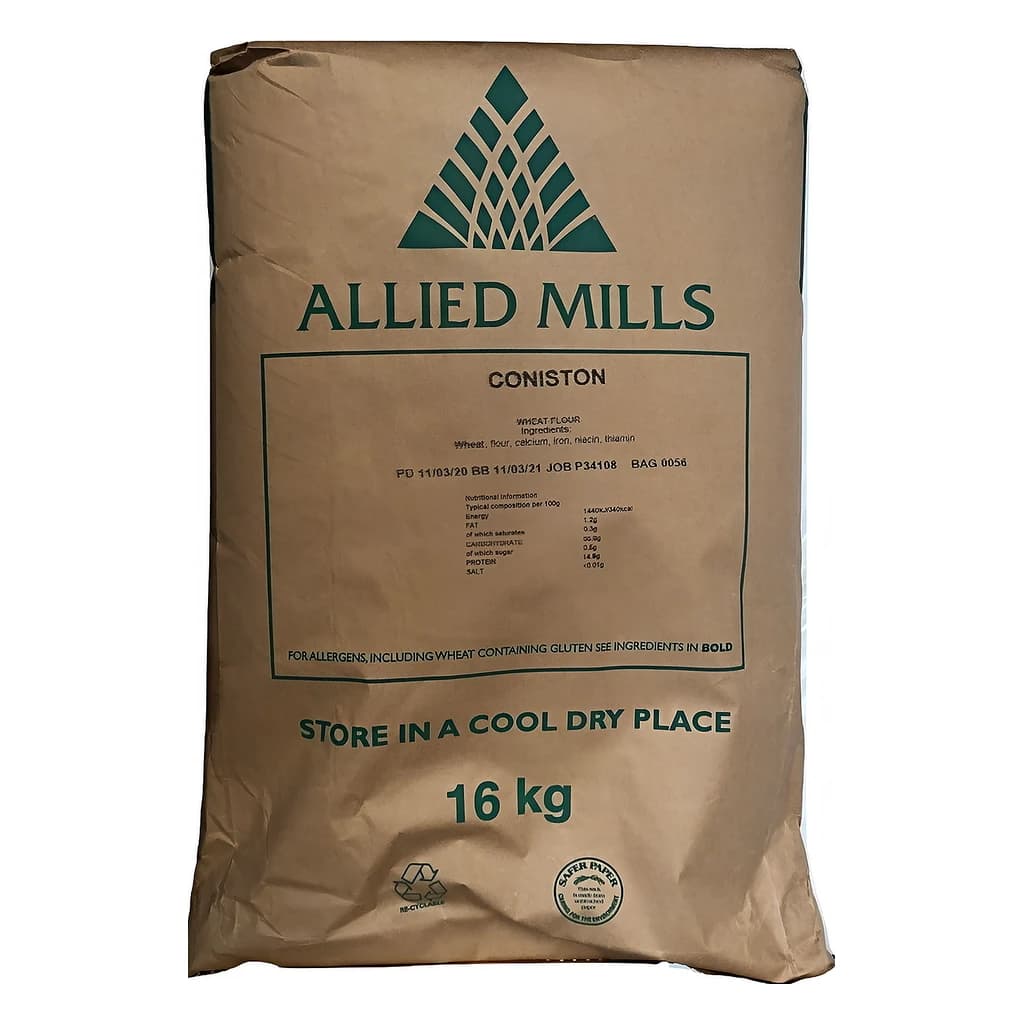
Coniston Strong White Flour 16 kg
Top Flight Cake Flour 25 kg

Wholemeal Spelt Flour 25 kg
Verace Pizza Flour 16 kg
Durum Wheat Semolina 16 kg