
The British Real Bread and sourdough revival: the UK Sourdough Code of Practice, long-ferment technique and artisan positioning
Britain bakes two very different loaves. Roughly eight in ten UK loaves come off Chorleywood plant lines; a small but fast-growing share is craft "Real Bread" made the slow way - and sourdough is its flagship. This dossier is written for the British home market. It settles the question every UK baker now has to answer at the label: what may legally be called sourdough here (nothing is legally defined), what the voluntary ABIM UK Sourdough Code of Practice (January 2023) actually permits across its three tiers, and where the Real Bread Campaign draws the "genuine sourdough" vs "sourfaux" line. It gets the UK rulebook right - the Bread and Flour Regulations 1998 (mandatory calcium carbonate, iron, thiamin and niacin) and the 2024 folic-acid amendment coming into force on 13 December 2026 - and explains why even "additive-free" Real Bread made with standard white flour still carries statutory fortificants and often ascorbic acid. It then covers the craft long-ferment process end to end (levain, autolyse, bulk, overnight cold retard, steam bake), flour choice for wheat, wholemeal, rye and spelt sourdough, and how to tell a genuine sourdough culture from an acidulant "sourfaux" flavouring on your ingredient shelf. Every requirement is wired to the Domson catalogue a UK baker actually orders and cross-linked to the Pillar A craft science behind it.
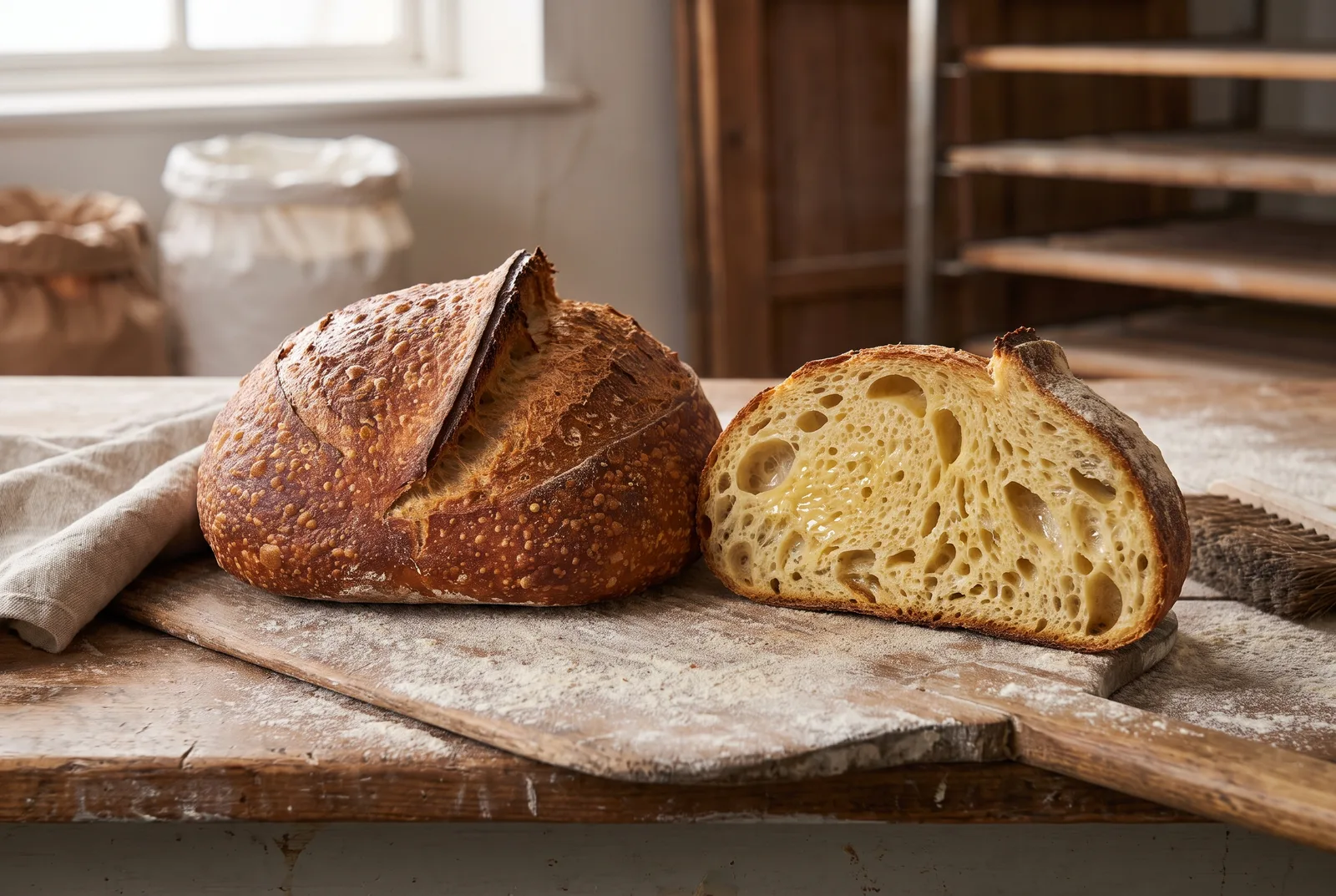
Two Britains of bread, and where sourdough sits
Walk into any British supermarket and you are looking at two completely different traditions on the same
shelves. Most of it - roughly eight in ten UK loaves - is made by the Chorleywood Bread Process
(CBP): a fast, additive-assisted, high-energy method that turns flour into sliced, wrapped bread in
under four hours. The other tradition is craft bulk-fermentation - time, not machinery, builds the
loaf - and it accounts for only around 3% of the market, but it is growing, and it trades under a
banner: Real Bread. (The CBP vs craft divergence is the subject of its sibling dossier
B7-chorleywood-vs-craft; this one is about the craft end, and its flagship product: sourdough.)
Sourdough is where craft baking meets a premium price and a strong story. It is also where British labelling is at its messiest, because - and this is the single most important fact for a UK baker to internalise - there is no legal definition of "bread", "sourdough" or "artisan" in UK law. A plant loaf leavened with baker's yeast and a fistful of additives can legally wear the word "sourdough" on its bag. That vacuum is what this dossier is really about: how to make genuine sourdough, how to buy for it, and how to label it honestly in a market where the word alone guarantees nothing.
For the science of why sourdough works - the wild yeast and lactic acid bacteria (LAB) balance, the
acidification curve, the flavour chemistry - read the Pillar A articles A2-sourdough-cultures-science
and A5-sourdough-technology. This article assumes that grounding and concentrates on the British
picture: regulation, technique, flour and catalogue.
The labelling battleground: the UK Sourdough Code of Practice vs "Real Bread"
The Real Bread Campaign and "sourfaux"
The Real Bread Campaign was launched on 26 November 2008 by the charity Sustain with baker and author Andrew Whitley (Bread Matters). Its definition of Real Bread is deliberately blunt: bread made without chemical raising agents, so-called processing aids or any other additives. The only thing it permits is fortificants that must be added to flour by law (so white and brown Real Bread are possible, not just wholemeal). Real Bread, it points out, can be made from as little as flour, water and salt - and it estimates that around 95% or more of what is sold as "bread" in the UK falls short of even that low bar.
On top of that sits the Campaign's genuine-sourdough definition, which is stricter still. To be genuine sourdough, bread must be:
- leavened only using a live sourdough culture - no added commercial (baker's) yeast, no baking powder or any other raising agent;
- made without additives; and
- made without other souring or flavouring agents - no vinegar, no yoghurt, no dried sourdough powder to fake the tang.
In 2015, Campaign co-ordinator Chris Young coined the word "sourfaux" for any product marketed as sourdough but made with additives and/or an alternative raising agent instead of (or as well as) a live culture. In a 2019 investigation the Campaign named four of Britain's largest industrial bread makers - Warburtons, Hovis, Allinson's and Roberts - selling products that used "sourdough" wording but were made with baker's yeast and/or additives, with ingredient lists that included vinegar, ascorbic acid, soya flour, fermented wheat flour, the emulsifier E472e and the preservative E282 (calcium propionate). None of these, in the Campaign's view, is sourdough.
The ABIM Code of Practice (January 2023): three tiers
In response to exactly this confusion, the Association of Bakery Ingredient Manufacturers (ABIM) published the UK Baking Industry Code of Practice for the Labelling of Sourdough Bread and Rolls on 31 January 2023. It is voluntary and self-regulatory, and it was supported by a wide slice of the industry: the Federation of Bakers, the Craft Bakers Association, Scottish Bakers, the Pizza, Pasta & Italian Food Association and the UK Association of Producers of Yeast among others. It creates three labelling tiers (see the figure below):
- "Sourdough" - the product uses live/active sourdough as the principal leavening agent and may contain a maximum of 0.2% compressed baker's yeast (or the equivalent in cream, liquid, dried or frozen yeast) calculated on the total flour weight, added in the final dough. It must not contain inactive/deactivated/devitalised sourdough, nor additives or flavourings in the final dough beyond mandatory flour fortificants.
- "(product) with sourdough" - commercial baker's yeast is the principal leaven; permitted additives are allowed, and devitalised sourdough may be used.
- "sourdough flavour (product)" - may contain added yeast, additives and raw materials added specifically to increase shelf life or to impart sourdough-type acidity, flavour or aroma.
The Code is a genuine step forward for consumer clarity, and the "with sourdough" / "sourdough flavour" tiers are honest ways to describe a schedule-friendly hybrid or a flavoured loaf. But the Real Bread Campaign rejected it as a "sourfaux code" and a "cheats' charter", precisely because even the top "Sourdough" tier permits 0.2% added yeast - which, for the Campaign, disqualifies a loaf from being genuine sourdough. More than 1,000 sourdough bakers and buyers signed a letter urging the code be withdrawn. The Campaign continues to push for an "Honest Crust Act" that would give legal definitions to marketing terms including sourdough, wholegrain, fresh/freshly-baked, artisan, craft and heritage.
What this means for you. Until the law changes, labelling is a commercial and ethical choice, not a legal one. The practical, defensible line for a UK craft bakery:
- If you leaven only with your own live levain and add nothing else, you can call it sourdough and stand behind it against anyone's definition, including the Campaign's.
- If you add any baker's yeast, or use a dried/liquid preparation that itself contains yeast, be honest: it is a loaf "made with sourdough", not "sourdough". (Our faster hybrid formula below sits here on purpose.)
- If your "sour" comes from an acidulant powder rather than fermentation, the most you can honestly claim is "sourdough flavour" - and many customers who understand the difference will not thank you for it.
The UK rulebook: the Bread and Flour Regulations 1998 (and the 2024 amendment)
Here is the nuance that trips up bakers who think "Real Bread = zero additives, full stop." Under the Bread and Flour Regulations 1998, all non-wholemeal wheat flour milled in the UK must be fortified. So a "flour, water, salt" loaf made with ordinary strong white flour still contains statutory fortificants that were added at the mill - by law, before you ever open the sack. The current minima, per 100 g of flour, are:
- iron ≥ 1.65 mg
- thiamin (B1) ≥ 0.24 mg
- niacin (nicotinic acid) ≥ 1.60 mg
- calcium carbonate (chalk) between 235 and 390 mg
These figures show up verbatim on real datasheets: the first-party Domson White Strong Flour (ADM 4380) sheet declares its ingredient list as Wheat Flour (Wheat Flour, Calcium Carbonate, Niacin, Iron, Thiamin) and quotes typical values of calcium 180 mg, iron 2.5 mg, niacin 2.45 mg and thiamin 0.26 mg per 100 g. (See the figure below for the full table.)
The 2024 amendment. The Bread and Flour (Amendment) (England) Regulations 2024 (SI 2024/1162) add folic acid at 250 micrograms (0.25 mg) per 100 g to non-wholemeal wheat flour, to cut neural-tube defects in early pregnancy. There is a 24-month transition: compliance is required by 13 December 2026. From that date the other minima also rise - iron to ≥ 2.10 mg, niacin to ≥ 2.40 mg, calcium carbonate to 300-455 mg (thiamin unchanged). If you buy white or brown flour, your fortification will change under you in December 2026; the folic acid, iron and niacin figures on your spec sheets will move.
The exemptions matter to sourdough bakers. Fortification does not apply to:
- wholemeal flour (it naturally retains the nutrients), and
- flour from small mills - a mill with a maximum annual production capacity of 500 tonnes - and
- non-wheat flours: spelt, rye, durum and the rest.
This is why so many artisan sourdough bakers gravitate to stoneground, organic and small-mill flours: not only for flavour and provenance, but because those flours can legitimately reach you without added fortificants or a flour-treatment agent. Our first-party Matthews Stoneground Dark Rye datasheet says it plainly in its Additives line - "Statutory flour additives as specified in the Bread and Flour Regulations 1998 and amendments - No Additives needed." That single line is the wholemeal exemption in action.
Ascorbic acid is the catch. The Real Bread Campaign classes ascorbic acid (E300), added
enzymes (e.g. alpha-amylase), xanthan gum, fast-acting yeast and preservatives such as
propionic acid (E280/E282) as additives/processing aids that Real Bread must not contain (see
A3-preservatives-shelf-life and A3-what-is-a-bread-improver for what these do). The trap: many
commercial UK bread flours carry ascorbic acid E300 and an enzyme by default - the Domson Strong White
sheet lists both a flour-treatment agent (E300) and a carbohydrase enzyme processing aid. Even the
Doves Farm Organic Strong White Bread Flour ("BioBake") sheet - organic, Soil Association certified -
lists organic wheat flour, ascorbic acid and the statutory nutrients. So if you are marketing a
genuinely additive-free Real Bread, you cannot just assume your flour qualifies because it is
"strong" or even "organic": read the ingredient line and, if you need E300- and enzyme-free flour,
specify a stoneground or small-mill flour that omits them. This is the level of scrutiny the home
market rewards.
Building and keeping a starter
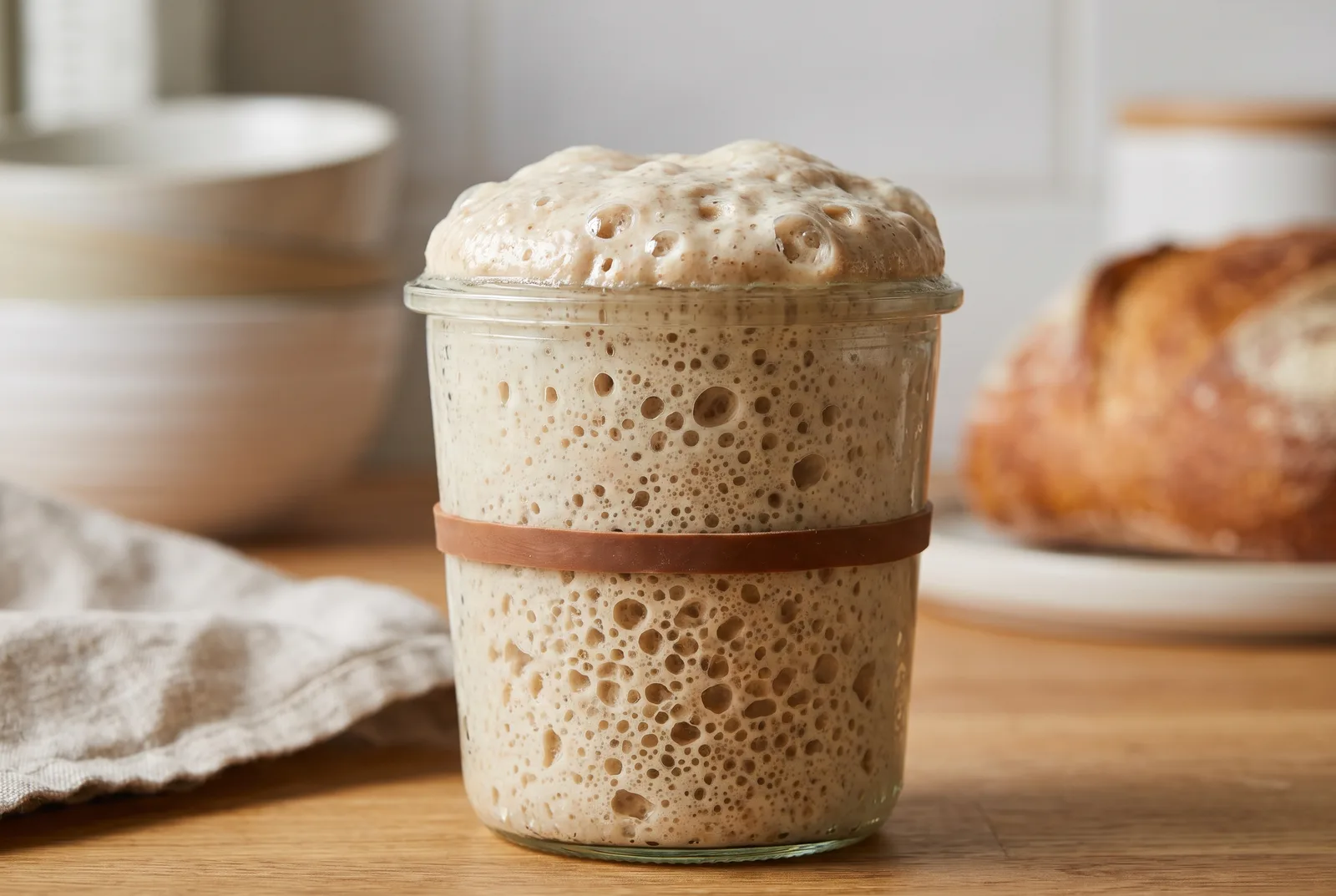
Genuine sourdough begins and ends with a living culture (see the figure below). The microbiology - a
roughly 1:100 balance of wild yeast to lactic acid bacteria, and how temperature, hydration and feed
ratio steer sourness and rise - is covered in depth in A2-sourdough-cultures-science. British bakers do
not do anything mystically different here; what matters in practice is:
- A wheat levain built on strong white flour with a little wholemeal or rye for activity, refreshed to peak before use (see the wheat levain build card below). Use it at peak for a rounded, mildly tangy loaf; use it past peak, or run it cool, for a more acetic, sharper crumb.
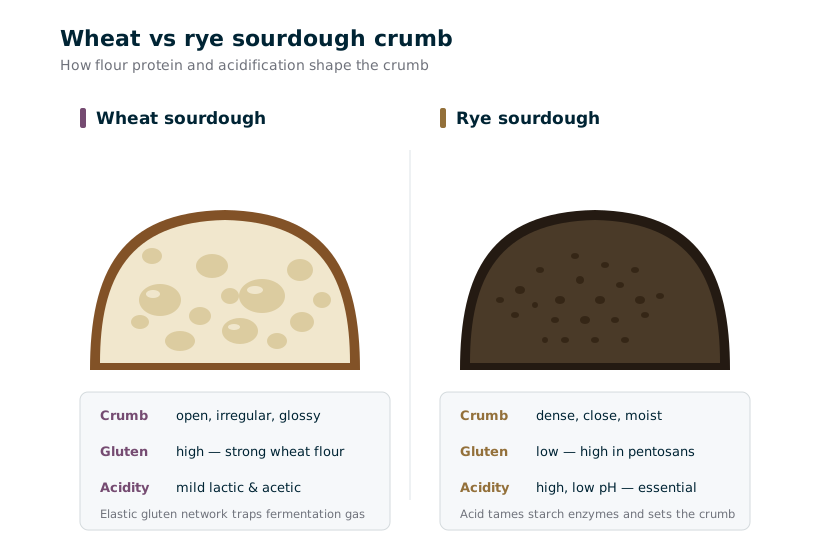
- A rye starter (rye sour) is more acid-tolerant and is the engine of every good rye loaf. Rye's near
absence of functional gluten and its high enzyme and pentosan activity mean acidification does the
structural work - which is why rye is traditionally always sourdough-leavened, never simply
yeast-raised (
A2-rye-sourdough-multi-stage,A5-sourdough-technology). This is common ground across Europe: the Polish zakwas (B1-zakwas-sourdough), the Romanian maia (B4-maia-and-sourdough-tradition) and the Lithuanian raugas (B5-raugas-sourdough-starter) are the same idea in different kitchens.
If you would rather not maintain a mother culture, or you need day-to-day consistency at volume, you can buy in - which brings us to the ingredient shelf and a second sourfaux trap.
Buying sourdough in a tub: genuine culture vs acidulant flavouring
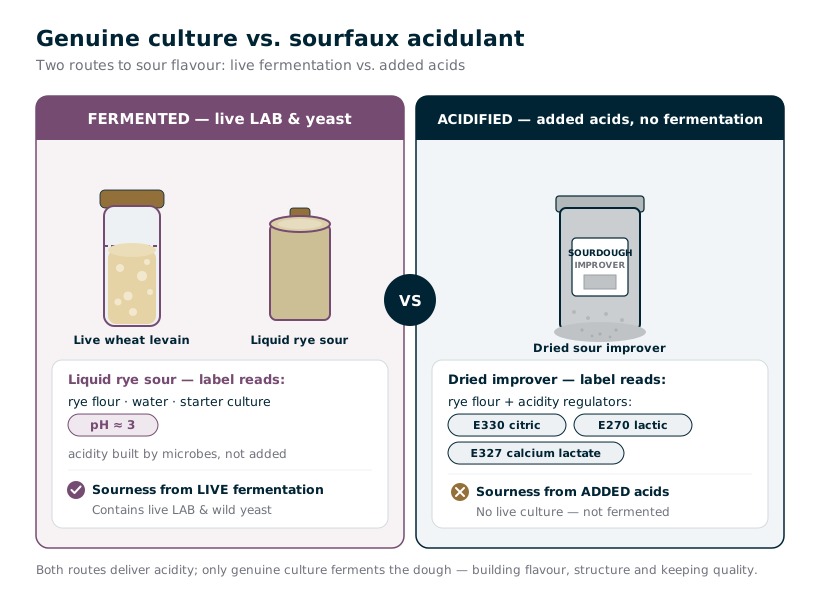
Domson stocks a whole shelf of "sourdough" products, and they are not the same thing (see the figure
below and the ready-to-use sourdough comparison table below). Cross-reference
A2-ready-use-sourdough-industrial for the full industrial picture; the British buying decision comes
down to four formats:
- Live pure starter cultures - a defined culture you use to build your own levain: Bocker Reinzucht-Sauerteig, Lesaffre Saf-Levain LV1 and Livendo LV-2. Build a clean levain from these and you can bake genuine "Sourdough".
- Genuine liquid fermented concentrates - actually fermented, ready to dose. The first-party IREKS Natural Liquid Rye Sour sheet is a model of honesty: its ingredients are just rye flour, water and starter culture, it runs at pH 2.8-3.4 with a degree of acidity of 190-210, and you dose it at 1-7% on flour. Zeelandia Bioferm Dark Liquid Sourdough and Amore Wheat Sourdough are the same category.
- Dried active sourdough - genuine fermented sourdough dried for shelf life, often blended with yeast and enzymes for a consistent result. Puratos O-tentic Durum is a good example: its datasheet lists dried durum wheat sourdough, yeast, ascorbic acid (E300) and enzymes, used at 4% on flour with added water and salt. It is real sourdough - but because it contains added yeast and E300, a loaf made with it belongs in the "with sourdough" tier, not "Sourdough".
- Acidulant "sourfaux" flavourings - here is the important one to recognise. The product listed in the catalogue as Zeelandia "Sourdough Dry" is, on its own datasheet, a wheat-rye bread improver (article name Superkwas): about 79% rye flour plus about 20% acidity regulators - E330 (citric acid), E270 (lactic acid) and E327 (calcium lactate). It delivers a sour taste by chemical acidification, not fermentation - there is no live culture in it at all. It is a perfectly legitimate ingredient for a fast, tangy loaf, but under the ABIM Code it supports "sourdough flavour" at best, and under the Real Bread definition it is textbook sourfaux.
The lesson for a British buyer: read the ingredient line on the sourdough tub the same way you read the flour sack. "Rye flour, water, starter culture" is fermentation; "acidity regulators E330/E270/E327" is chemistry. Both have their place - just know which you are buying and label the finished loaf honestly.
The craft long-ferment process, step by step
Genuine sourdough is a slow process, and the schedule is the recipe. A typical British craft wheat
sourdough runs over roughly 24-36 hours (see the figure below); the numbers below are typical craft
starting points, with the underlying science in A5-bulk-fermentation, A5-retarded-cold-fermentation
and A5-baking-oven-science.
- Refresh the levain to peak (4-12 h before mixing).
- Autolyse - mix flour and most of the water and rest 30 minutes to a few hours. This hydrates
the flour and lets enzymes and gentle gluten development get a head start before the salt and levain
go in (
A5-dough-mixing-methods). - Mix in the levain and salt to moderate development - you are not chasing a full mechanical dough as in Chorleywood; time will finish the job.
- Bulk fermentation - the heart of the loaf. 3-5 hours at around 24-26 C dough temperature, with 3-4 sets of stretch-and-folds in the first couple of hours to build strength without a mixer. This is where flavour, extensibility and the open crumb are made. Judge it by feel and rise, not the clock.
- Pre-shape, rest, and final shape into a floured banneton, building surface tension.
- Overnight cold retard - 8-48 hours (commonly 12-18 h) at 4-6 C. Retarding separates production from baking, deepens flavour and gives that blistered crust; it is the single most useful commercial control a small bakery has.
- Score and bake with steam - a decisive slash at a shallow angle, then 230-250 C with steam
(covered pot, or deck with steam injection) so the crust stays supple long enough for maximum oven
spring and a raised "ear" before it sets (see the figure below;
A5-baking-oven-science). Cool fully before cutting - and for rye, ideally rest a day, or the crumb reads as gummy.
For the formulas in baker's percentage - a British white country loaf, a wholemeal/spelt loaf, a mixed
rye, the levain build and a faster "with sourdough" hybrid - see the formula cards below, and
A8-bakers-percentage-fundamentals, A8-lean-bread-formulas, A8-preferment-formulas and
A8-rye-and-wholegrain-formulas for the maths behind them.
Flour choice for British sourdough
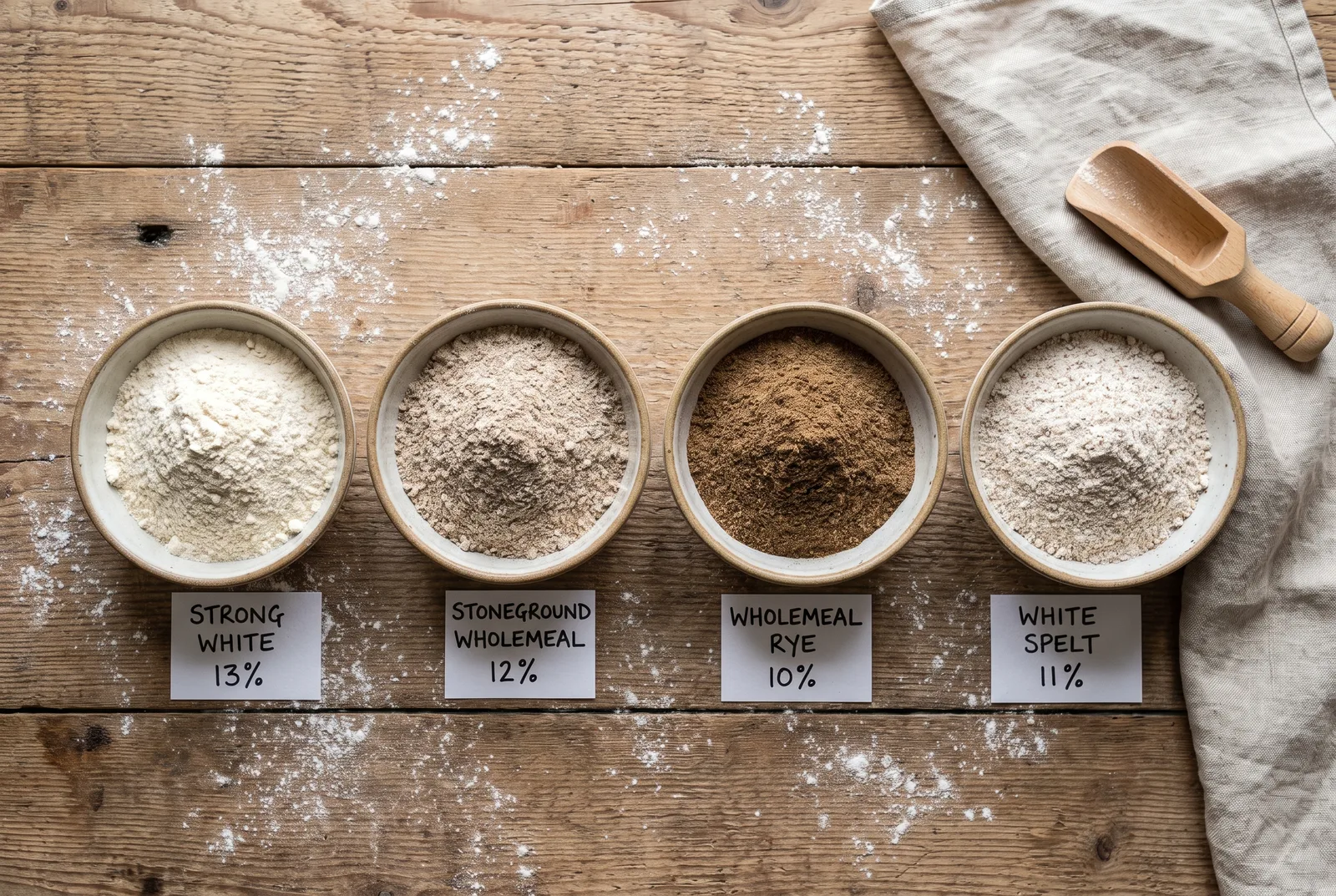
Flour is where the home market gives you real depth of choice (see the figure below; full detail in
B7-flour-landscape and A1-protein-gluten-and-strength). The sourdough flour selection table
below maps each type to hydration, role and specific Domson products. In brief:
- Strong white bread flour (~12-13% protein) is the backbone of most wheat sourdough: Domson White Strong (protein target 12.0%, water absorption 59.5%), Domson Bread Flour Type 750, Doves Organic Strong White (12.6% protein) and Matthews Windrush Strong White. For very high hydration or wholegrain-heavy loaves, reach for a very strong / Canadian flour such as Centurion Canadian Very Strong, or a T65 for a pain au levain character.
- Wholemeal and high-extraction flours add flavour, fibre and ferment faster, but the bran physically
cuts gluten, so you raise hydration and rest the dough longer (
A1-wholemeal-and-high-extraction): Doves Organic Strong Wholemeal, Carr's Bakers Wholemeal, Chiltern Wholemeal. If your wholemeal is under-strength, a few percent of vital wheat gluten restores structure (A3-vital-wheat-gluten). - Rye must be acidified (see above): Doves Organic Wholemeal Rye (a low-protein, high-fibre single-ingredient rye), Matthews Stoneground Rye (Hagberg falling number target ~250) and higher-extraction Wholemeal Rye Type 2000.
- Spelt brings an ancient-grain flavour and an extensible, fast-fermenting dough that over-proofs
easily - watch it closely (
A1-alternative-grain-flours): Matthews Stoneground White Spelt, Doves White Spelt and Wholemeal Spelt. As a non-wheat flour, spelt is also outside the fortification requirement. - Diastatic malt flour (a small addition, ~0.2-1% on flour) supplies amylase that both feeds a
sluggish culture and builds crust colour - EDME Malt Flour is the catalogue workhorse
(
A3-malt-and-malt-extracts,B7-malted-grain-baking).
Hydration is the other lever (see the figure below): the same strong white flour gives a tight-ish crumb at ~68%, a classic open crumb at ~75%, and a wildly open but hard-to-handle crumb at ~82%. Push hydration up with flour strength and your own skill, not ahead of them.
Positioning: honesty as the product
Sourdough sits at the premium end of the British bread market for a reason - it takes skill, time and good flour, and customers increasingly know it (see the figures below). In a market with no legal definition, the most valuable thing a craft bakery owns is trust, and the fastest way to lose it is a sourfaux label a knowledgeable customer sees through. The commercially smart position is also the honest one:
- Call genuine, live-only loaves sourdough and be ready to explain why yours is the real thing.
- Sell your faster hybrid proudly as "made with sourdough" - it is a good loaf and an honest claim.
- Reserve acidulant-flavoured products for "sourdough flavour" wording, or use those ingredients where sour is a seasoning rather than the story.
Root your sourdough in the wider British Real Bread repertoire - bloomers, cobs, tin loaves, batch and
cottage loaves (B7-regional-breads-map, B7-chorleywood-vs-craft) - and you have a range that tells a
single, consistent, defensible story: real ingredients, real time, real bread.
Troubleshooting
The fault table below gives the full diagnostic grid - flat/dense loaves, gummy crumb (the classic rye and under-bake fault), harsh acetic sourness, missing oven spring and ear, slack unworkable dough, pale crust and tunnelling. The recurring British-market fixes: use a levain at peak, keep the dough at 24-26 C, choose a strong enough flour for your hydration, retard to build flavour and control, and steam hard at the start of the bake. Almost every sourdough failure traces back to one of those five.
Cross-references
- Pillar A science:
A2-sourdough-cultures-science,A2-preferments-poolish-biga-sponge,A2-rye-sourdough-multi-stage,A2-ready-use-sourdough-industrial,A2-yeast-types-comparison,A5-sourdough-technology,A5-bulk-fermentation,A5-retarded-cold-fermentation,A5-baking-oven-science,A5-proofing-science,A5-dough-mixing-methods,A1-protein-gluten-and-strength,A1-wholemeal-and-high-extraction,A1-alternative-grain-flours,A3-malt-and-malt-extracts,A3-preservatives-shelf-life,A3-vital-wheat-gluten,A8-bakers-percentage-fundamentals,A8-lean-bread-formulas,A8-rye-and-wholegrain-formulas,A8-preferment-formulas. - British siblings:
B7-flour-landscape,B7-chorleywood-vs-craft,B7-malted-grain-baking,B7-regional-breads-map. - Shared sourdough heritage:
B1-zakwas-sourdough(Polish rye),B4-maia-and-sourdough-tradition(Romanian),B5-raugas-sourdough-starter(Lithuanian).
Figures
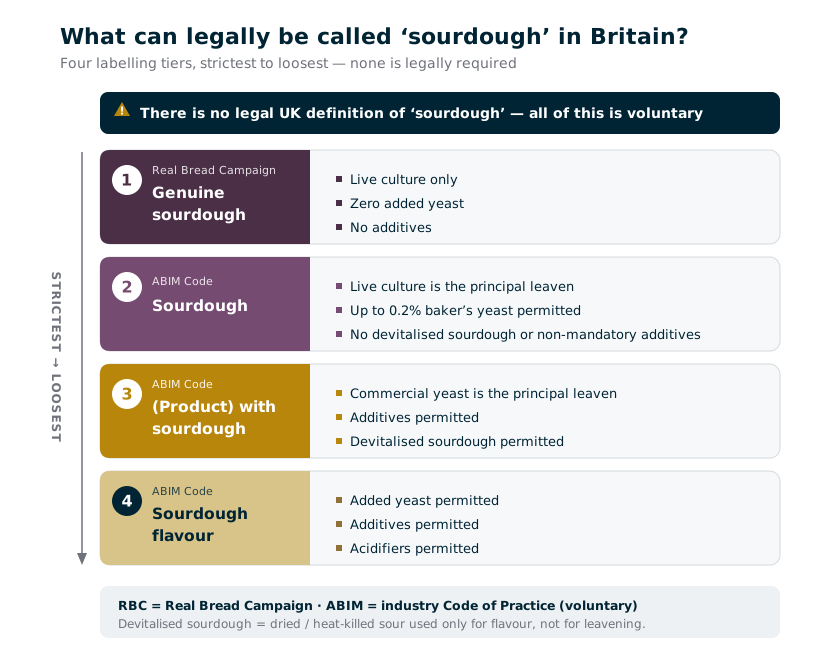 A four-rung ladder comparing genuine sourdough with the three ABIM Code labelling tiers, from strictest (live culture only) to loosest (sourdough flavour with yeast and additives)
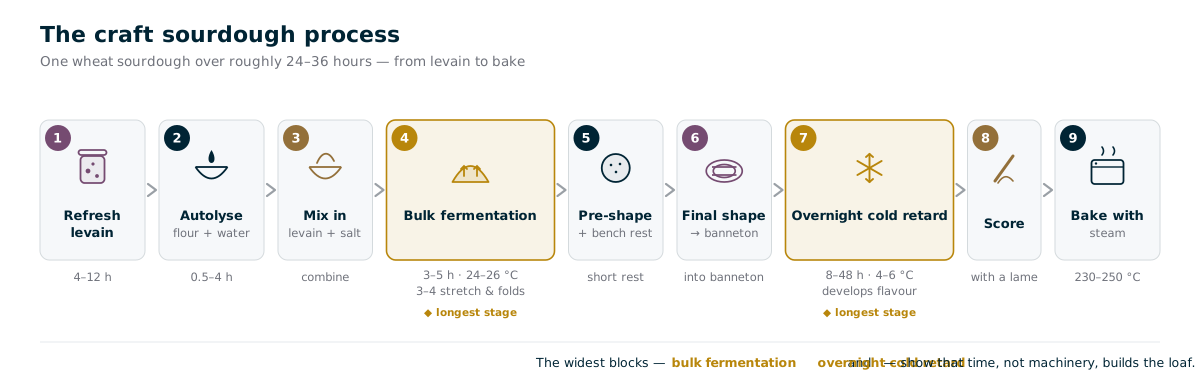 A step-by-step flowchart of the craft sourdough process from refreshing the levain through autolyse, bulk fermentation, shaping, overnight cold retard and steam baking
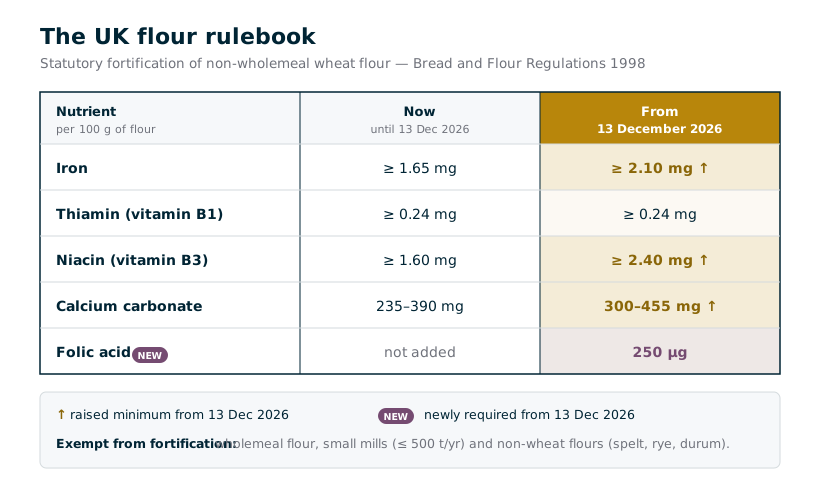 A two-column table of UK statutory flour fortification minima now versus from December 2026, including the new folic acid addition, with wholemeal and small-mill exemptions
 Comparison of genuine live/fermented sourdough (levain jar and liquid rye sour) against an acidulant-based dried sour improver powder listing E330, E270 and E327
 A glass jar of active wheat sourdough starter at peak, doubled in volume with a domed bubbly surface
 Side-by-side cut crumb of an open wheat sourdough loaf and a dense dark rye sourdough loaf
 Four bowls of sourdough flours - strong white, wholemeal, rye and spelt - arranged from light to dark with type cards
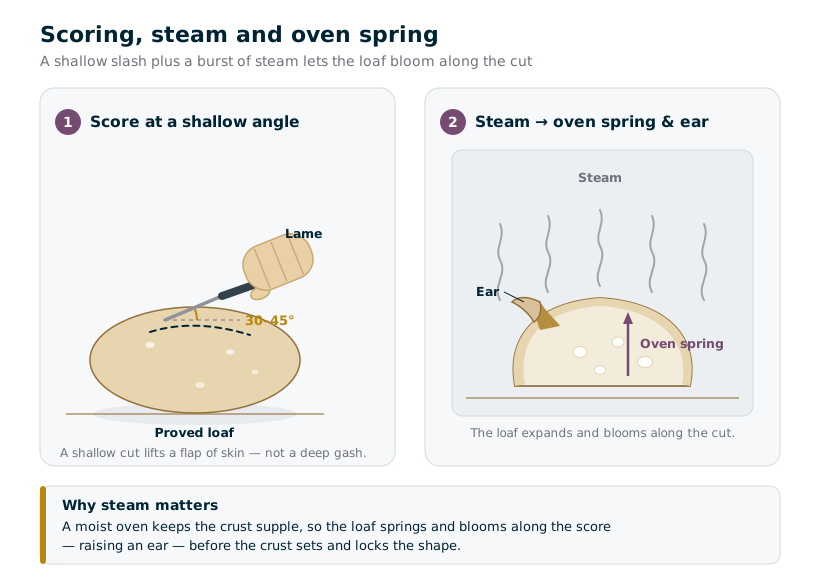 Illustration of scoring a sourdough with a lame and the resulting oven spring and ear under steam
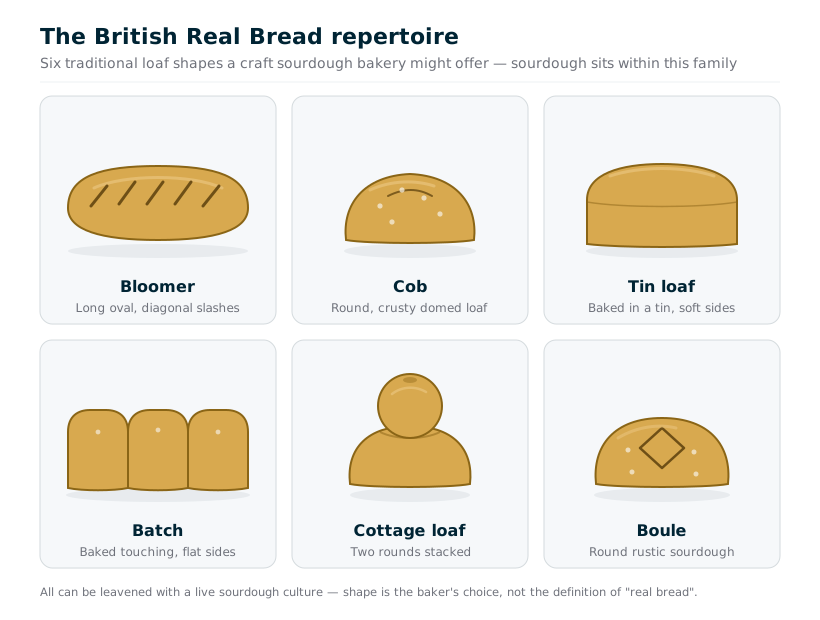 A labelled montage of British loaf shapes - bloomer, cob, tin, batch, cottage loaf and boule
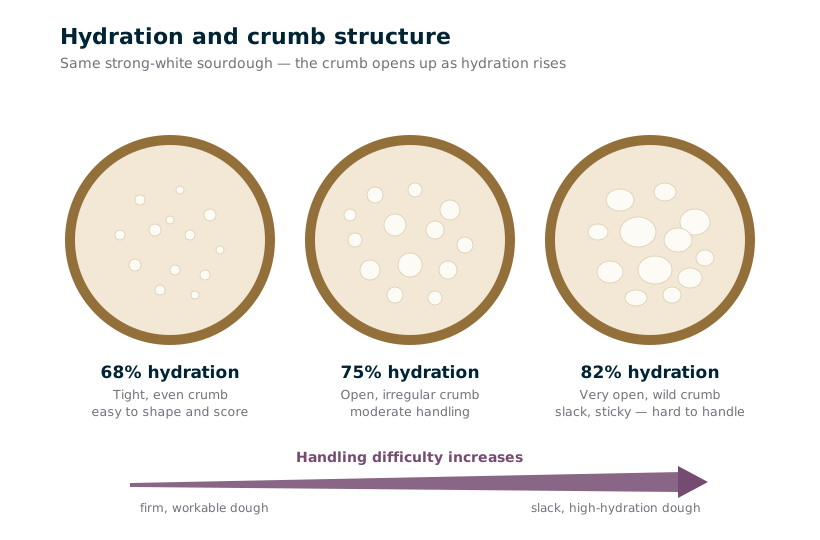 Three sourdough crumb cross-sections at 68, 75 and 82 percent hydration showing increasingly open crumb
Wheat levain build (stiff-ish, for a country loaf)
| Ingredient | Baker's % | Weight |
|---|---|---|
| Strong white bread flour | 80 | 80 |
| Wholemeal or rye flour (for activity) | 20 | 20 |
| Water (25-28 C) | 100 | 100 |
| Ripe mother starter | 20 | 20 |
- Mix, cover, ripen 4-12 h at ~24-26 C until doubled, domed and just past peak (float test). Use at peak for balanced flavour; later for more sour. Cross-link A2-sourdough-cultures-science, A2-preferments-poolish-biga-sponge.
Yield: ~240 g levain
British white sourdough country loaf (pain de campagne style)
| Ingredient | Baker's % | Weight |
|---|---|---|
| Strong white bread flour | 90 | 900 |
| Stoneground wholemeal flour | 10 | 100 |
| Water (total) | 76 | 760 |
| Ripe wheat levain (20% pre-fermented flour) | 20 | 200 |
| Fine sea salt | 2 | 20 |
- Autolyse flour + ~90% of water 0.5-2 h. Add levain and salt (+ remaining water), mix to moderate development. Bulk ferment 3-5 h at 24-26 C with 3-4 stretch-and-folds in the first 2 h. Pre-shape, rest 20-30 min, shape into a banneton. Cold retard 12-18 h at 4-6 C. Bake from cold, scored, with steam: 250 C for 20 min covered/steamed, then 230 C ~20-25 min. Cross-link A5-bulk-fermentation, A5-retarded-cold-fermentation, A8-lean-bread-formulas.
Yield: 2 x ~900 g loaves
Wholemeal / spelt sourdough (higher-extraction)
| Ingredient | Baker's % | Weight |
|---|---|---|
| Strong wholemeal (or half wholemeal, half spelt) | 70 | 700 |
| Strong white bread flour | 30 | 300 |
| Water (total) | 82 | 820 |
| Ripe wheat levain | 20 | 200 |
| Fine sea salt | 2.2 | 22 |
| Vital wheat gluten (optional, weak flour only) | 2 | 20 |
- Wholegrain drinks more water and ferments faster: raise hydration, shorten bulk (2.5-4 h) and watch spelt closely - it is extensible and over-proofs quickly. Longer autolyse (2-4 h) softens bran. Optional VWG only if the flour is under-strength. Cross-link A1-wholemeal-and-high-extraction, A1-alternative-grain-flours, A3-vital-wheat-gluten.
Yield: 2 x ~900 g loaves
Mixed rye sourdough (~70% rye)
| Ingredient | Baker's % | Weight |
|---|---|---|
| Wholemeal / high-extraction rye flour | 70 | 700 |
| Strong white bread flour | 30 | 300 |
| Water (total, warm) | 85 | 850 |
| Ripe rye sourdough (rye sour) | 40 | 400 |
| Fine sea salt | 2 | 20 |
- Rye has little functional gluten, so acidification does the structural work: build a lively rye sour (or dose a genuine liquid rye sour). Mix to a paste - do not expect a wheat-style window. Short bulk, pan-proof, bake in tins with steam; cool fully (ideally rest a day) before cutting to avoid gummy crumb. Cross-link A2-rye-sourdough-multi-stage, A5-sourdough-technology, A8-rye-and-wholegrain-formulas, B1-zakwas-sourdough.
Yield: 2 x ~900 g pan loaves
Faster 'with sourdough' hybrid loaf (schedule-friendly)
| Ingredient | Baker's % | Weight |
|---|---|---|
| Strong white bread flour | 100 | 1000 |
| Water | 68 | 680 |
| Ripe wheat levain OR genuine liquid sour | 15 | 150 |
| Fresh baker's yeast | 0.6 | 6 |
| Fine sea salt | 2 | 20 |
- For consistent daily production: the levain gives flavour, a little yeast gives a predictable rise. NOTE the labelling line - at 0.6% yeast this exceeds the ABIM 0.2% cap, so it must be sold as 'made with sourdough', not 'sourdough'. Puratos O-tentic (4% on flour, contains yeast + E300) sits in the same category. Cross-link A2-ready-use-sourdough-industrial, A2-yeast-types-comparison.
Yield: 3 x ~800 g loaves
| Position | Leavening | Max added baker's yeast | Additives / acidifiers | Devitalised (dead) sourdough | Real-Bread compliant? |
|---|---|---|---|---|---|
| Real Bread Campaign 'genuine sourdough' | Live sourdough culture only | None (0%) | None (bar mandatory flour fortificants) | Not allowed | Yes |
| ABIM Code: 'Sourdough' | Live/active sourdough is the principal leaven | 0.2% compressed yeast (or equivalent) on total flour, in the final dough | None in the final dough beyond mandatory fortificants | Not allowed | No (any added yeast disqualifies it for the Campaign) |
| ABIM Code: '(product) with sourdough' | Commercial baker's yeast is the principal leaven | No cap (yeast is the main leaven) | Permitted additives allowed | Allowed | No |
| ABIM Code: 'sourdough flavour (product)' | Baker's yeast / any leaven | Permitted | Permitted, including acids/agents added to impart sour taste | Allowed / typical | No |
There is no legal UK definition of sourdough. The ABIM Code of Practice (Jan 2023) is voluntary; the Real Bread Campaign's is a campaigning definition.
| Fortificant | Now (until 13 Dec 2026) | From 13 Dec 2026 | Why |
|---|---|---|---|
| Iron | >= 1.65 mg | >= 2.10 mg | Replace iron lost with the bran in white/brown flour |
| Thiamin (vitamin B1) | >= 0.24 mg | >= 0.24 mg (no change) | Replace B1 lost in milling |
| Niacin (nicotinic acid) | >= 1.60 mg | >= 2.40 mg | Replace niacin lost in milling |
| Calcium carbonate (chalk) | 235-390 mg | 300-455 mg | Public-health calcium since WWII |
| Folic acid | not required | 0.250 mg (250 ug) - NEW | Reduce neural-tube defects in early pregnancy |
Applies to non-wholemeal wheat flour, per 100 g. Wholemeal, small mills (<=500 t/yr) and non-wheat flours (spelt, rye, durum) are exempt.
| Flour | Typical protein (per 100 g) | Starting hydration | Role in sourdough | Domson catalogue examples |
|---|---|---|---|---|
| Strong white bread flour | ~12-13% | 70-78% | Backbone of most wheat sourdough; open crumb, good oven spring | Domson White Strong (ADM), Domson Type 750, Doves Organic Strong White, Windrush Strong White |
| Very strong / Canadian | ~13.5-14% | 72-80% | Extra strength for high-hydration or wholegrain-heavy loaves | Centurion Canadian Very Strong |
| Stoneground wholemeal | ~11-13% | 78-88% | Flavour, fibre, faster ferment; bran cuts gluten so needs more water/rest | Doves Organic Strong Wholemeal, Carr's Bakers Wholemeal, Chiltern Wholemeal |
| Rye (wholemeal/high-extraction) | ~6-9% | 80-100%+ | Must be acidified (sourdough) to control gummy crumb; dense, dark, keeps well | Doves Organic Wholemeal Rye, Matthews Stoneground Rye, Wholemeal Rye Type 2000 |
| Spelt | ~11-13% | 68-75% | Ancient-grain flavour; extensible, ferments fast, easy to over-proof; exempt from fortification | Matthews Stoneground White Spelt, Doves White Spelt, Doves Wholemeal Spelt |
| Diastatic malt flour (addition) | n/a | 0.2-1% on flour | Amylase for crust colour and to feed a sluggish culture | EDME Malt Flour |
Protein figures are typical spec-sheet values; hydration is a craft starting point for that flour on its own and rises with wholegrain content.
| Format | What it is | Live culture? | Added yeast / additives? | Typical ABIM tier | Domson examples |
|---|---|---|---|---|---|
| Live pure starter culture | Dried/refrigerated defined LAB + yeast culture to build your own levain | Yes (you culture it) | None once you build a clean levain | Can support 'Sourdough' / Real Bread | Bocker Reinzucht-Sauerteig, Lesaffre Saf-Levain LV1, Livendo LV-2 |
| Liquid fermented concentrate | Genuinely fermented sour, ready to dose | Yes (fermented) | Usually none (flour + water + culture) | 'Sourdough' or 'with sourdough' depending on how you leaven | IREKS Natural Liquid Rye Sour, Zeelandia Bioferm Dark Liquid Sourdough, Zeelandia Amore Wheat |
| Dried active sourdough | Dried fermented sourdough, often + yeast + enzymes for consistency | Yes, but often blended with yeast | O-tentic contains added yeast + ascorbic acid E300 + enzymes | 'with sourdough' (added yeast) | Puratos O-tentic Durum |
| Acidulant sour flavouring ('sourfaux') | Flour carrier + acidity regulators; sours the dough chemically | No | Acids E330/E270/E327; no fermentation | 'sourdough flavour' at best | Zeelandia 'Sourdough Dry' (Superkwas) |
Maps each format to the ABIM tier it typically supports.
| Fault | Likely cause | Remedy |
|---|---|---|
| Flat, dense loaf, little rise | Weak/under-ripe levain; cold dough; under-mixed weak flour | Refresh levain to peak; hold dough 24-26 C; use strong flour ~12%+; check float test |
| Gummy, sticky crumb (esp. rye) | Cut too soon; under-baked; insufficient acidification in rye | Cool fully (rye: rest a day); bake longer/lower; build a livelier rye sour |
| Harshly sour / vinegary | Over-ripe or cold-run starter; retard too long; too little flour fed | Use levain at peak; shorten retard; feed more often at warmer temp |
| No oven spring, no 'ear' | Over-proofed; blunt scoring; no steam; oven not hot enough | Bake a touch under-proofed; score deep at an angle; add steam; preheat to 250 C |
| Slack, unworkable dough | Hydration too high for that flour; over-fermented; weak flour | Lower hydration; add stronger flour or VWG; shorten bulk; more folds |
| Pale, dull crust | Low residual sugar (over-fermented); no steam then dry heat; no malt | Shorten bulk; steam early then dry finish; add ~0.5% diastatic malt |
| Big tunnel / blowout under crust | Under-proofed or poorly shaped; sealed skin | Prove a little longer; shape with more surface tension; score to direct expansion |
| Tight, close crumb in a wheat loaf | Under-fermented bulk; too little water; over-degassed at shaping | Extend bulk; raise hydration; shape gently to keep gas |
- Protein Nx5.7 pct:
- 12.0 (11.8-12.4)
- Water absorption pct:
- 59.5 (58.0-60.5)
- Moisture pct:
- 14.2
- Ingredients:
- Wheat Flour (Wheat Flour, Calcium Carbonate, Niacin, Iron, Thiamin), flour treatment agent E300 (ascorbic acid), carbohydrase enzyme (processing aid)
- Fortification per 100g:
- calcium 180 mg, iron 2.5 mg, niacin 2.45 mg, thiamin 0.26 mg (typical)
- Suitability:
- vegan; not coeliac
- Note:
- Even a plain strong white flour carries E300 + an enzyme - NOT additive-free.
- Protein per 100g:
- 12.6 g
- Fibre per 100g:
- 4.6 g
- Ingredients:
- organic wheat flour, ascorbic acid, statutory nutrients (calcium carbonate, iron, thiamine, niacin)
- Certification:
- Soil Association organic (GB-ORG-05)
- Note:
- Organic + commercial pack still carries ascorbic acid + fortificants.
- Protein per 100g:
- 7.8 g (first-party trade datasheet; single-source - Doves' published retail nutrition lists ~6.3 g, so treat as approximate)
- Fibre per 100g:
- 13.4 g (~14 g on public retail nutrition)
- Ingredients:
- rye flour (single ingredient)
- Note:
- No added fortificants (wholemeal / non-wheat). Protein figure not independently corroborated - see verification notes.
- Protein pct:
- 8.0 target (5.0-11.0)
- Moisture pct:
- 13.0 target
- Hagberg falling number:
- 250 target (min 150)
- Fibre per 100g:
- 11.7 g
- Additives:
- 'No Additives needed' - wholemeal is exempt under the Bread and Flour Regulations 1998
- Allergens:
- gluten (rye); soya contamination risk in supply chain
- Type:
- genuine concentrated liquid rye sourdough
- Ingredients:
- Sourdough (rye flour, water, starter culture)
- pH:
- 2.8-3.4
- Degree of acidity:
- 190-210
- Dosage:
- 1-7% on flour
- Storage:
- 15-20 C, 6-month shelf life
- Allergens:
- gluten (rye)
- Type:
- dried active durum-wheat sourdough component
- Ingredients:
- dried durum WHEAT sourdough, yeast, antioxidant ascorbic acid (E300), enzymes
- Usage:
- 4% on flour with added water and salt
- Total acidity:
- 45-65 ml/10 g
- Protein per 100g:
- 21.2 g
- Suitability:
- vegan; not coeliac
- Note:
- Genuine sourdough but blended with baker's yeast + E300 - a 'with sourdough' ingredient.
- Type:
- wheat-rye bread improver (acidulant sour flavouring)
- Ingredients:
- ~79% rye flour + ~20% acidity regulators E330 (citric), E270 (lactic), E327 (calcium lactate)
- Mechanism:
- chemical acidification, NOT fermentation - no live culture
- Allergens:
- gluten (rye); may contain barley, oat, spelt, egg, soya, milk, sesame
- Note:
- A 'sourfaux' flavouring; would at best support a 'sourdough flavour' label.