Sourdough technology: starter maintenance, LAB–yeast synergy, acidification curves and rye vs. wheat sourdoughs
A practical deep-dive for professional bakers into the science and craft of sourdough: how lactic acid bacteria and wild yeast work together, how to build and maintain a healthy starter, how to read and control acidification curves, why rye sourdough behaves fundamentally differently from wheat sourdough, how multi-stage (Detmold) rye processes work, and how to choose between traditional starters and industrial sourdough concentrates. Includes first-party acidity data extracted from five sourdough products in the Domson catalogue (Puratos, Zeelandia, Uldo), a full fault table, and application recipes.
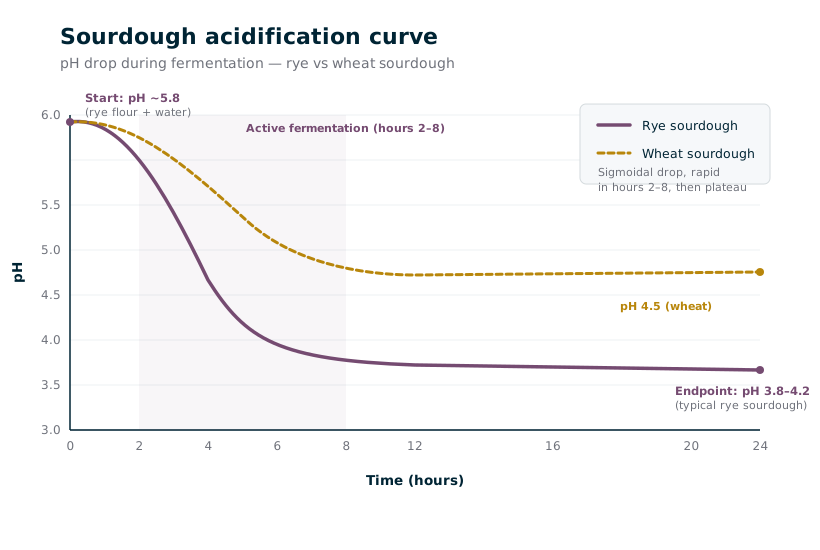 Graph showing sourdough pH drop over time from approximately 5.8 to 4.0 during a 12-hour fermentation
1. What is sourdough and why does it matter?
Sourdough is the oldest leavening technology in bread-making — a fermented culture of flour and water in which lactic acid bacteria (LAB) and wild yeast live in stable, mutually beneficial symbiosis.
The two groups do different jobs. Wild yeasts produce CO2 (which leavens the bread) and ethanol. LAB produce lactic acid and acetic acid (which give sourdough its flavour, preserve the bread naturally, and — critically in rye bread — control the structure of the dough).
Sourdough is not simply "bread with a sour taste." For rye bread, sourdough acidification is a technical necessity: without adequate acid, rye bread becomes a gummy, inedible mass. For wheat bread, sourdough is optional but delivers measurable benefits: deeper flavour, better keeping quality, improved crumb texture, and nutritional improvements (reduced phytates, better mineral bioavailability).
For professional bakers working with the Domson catalogue, sourdough technology sits at the intersection of three choices:
- Traditional starter — a live culture maintained in-house (maximum flavour control, requires discipline and skill)
- Industrial sourdough concentrates — ready-to-dose liquid, paste or dry sourdoughs that replace the fermentation step (consistency, convenience, speed)
- Hybrid approaches — industrial concentrates combined with a short active fermentation step
This dossier covers all three.
2. The microbiology: LAB, wild yeast, and their synergy
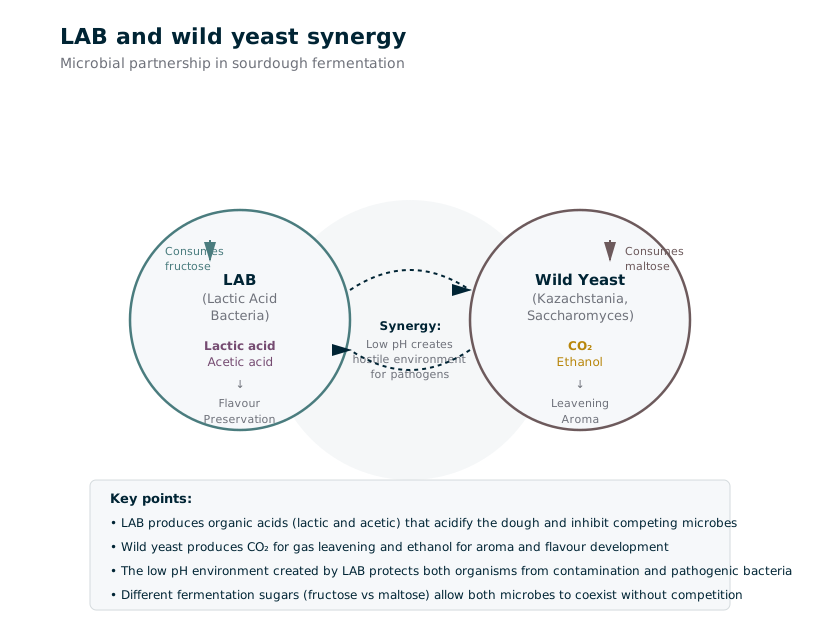 Circular diagram showing the symbiotic relationship between lactic acid bacteria and wild yeast in sourdough
2.1 Cell populations
In a mature, healthy sourdough starter, lactic acid bacteria outnumber wild yeast cells by approximately 100:1. This ratio is not accidental — it reflects the different metabolic roles. LAB are small, fast-dividing, and acid-tolerant; wild yeasts are larger and slower but produce the CO2 essential for leavening.
Key LAB species found in sourdoughs include:
- Lactiplantibacillus plantarum (formerly Lactobacillus plantarum) — homofermentative, produces primarily lactic acid
- Fructilactobacillus sanfranciscensis (formerly Lactobacillus sanfranciscensis) — the characteristic San Francisco sourdough organism; heterofermentative, produces both lactic acid, acetic acid, and CO2
- Limosilactobacillus fermentum (formerly L. fermentum) — heterofermentative
Key wild yeast species:
- Kazachstania humilis (formerly Candida humilis) — the most common wild sourdough yeast; acid-tolerant; cannot ferment maltose alone (leaves it for LAB to process)
- Saccharomyces cerevisiae — the same species as baker's yeast, but wild strains differ in behaviour and acid tolerance
2.2 What makes them symbiotic
The relationship is not accidental — it is actively mutually beneficial.
Substrate partitioning: Heterofermentative LAB preferentially consume fructose (leaving glucose and maltose available for yeast). Wild yeasts prefer glucose and maltose. This substrate division reduces competition and lets both thrive simultaneously.
Acid tolerance: Wild sourdough yeasts are selected by the acid environment that LAB create. Baker's yeast (Saccharomyces cerevisiae) from compressed yeast blocks is much less acid-tolerant; wild strains survive down to pH 3.5–4.0 where conventional yeast would stall.
Pathogen suppression: The acids produced by LAB (lactic acid, acetic acid) and the low pH suppress gram-negative bacteria, moulds, Bacillus subtilis (rope), and other spoilage organisms that would otherwise colonise the fermenting dough. This makes sourdough a self-preserving system and extends the shelf life of the finished bread.
2.3 Homofermentative vs. heterofermentative LAB
This distinction is important for bakers because it controls which acids are produced:
Homofermentative LAB (e.g. L. plantarum): ferment sugars almost exclusively to lactic acid. Result: mild, creamy sourness; no CO2 from the LAB themselves.
Heterofermentative LAB (e.g. F. sanfranciscensis): ferment sugars to lactic acid + acetic acid + CO2. Result: sharper, more complex flavour; minor additional leavening contribution. The lactic:acetic ratio in the finished bread is heavily influenced by the fermentation conditions (see Section 4.2).
Practical implication: A starter built primarily on heterofermentative LAB and allowed to ferment cool and stiff will produce a sharper, more vinegary bread than the same starter fermented warm and wet.
3. Starter maintenance: building and keeping a healthy culture
3.1 Establishing a starter from scratch
A sourdough starter begins with nothing more than flour and water. The succession of microbial activity over the first 5–7 days follows a predictable pattern:
Days 1–2: Gram-negative bacteria (including some initially undesirable species) begin fermenting. The mixture may smell slightly unpleasant. No useful rise.
Days 3–4: The pH begins to drop as LAB start to dominate. Gram-negative bacteria are suppressed by the increasing acid. The culture begins to produce visible bubbles.
Days 5–7: LAB and acid-tolerant wild yeasts have established dominance. The starter rises predictably, smells pleasantly sour and yeasty, and is ready for use once it can reliably double within 8–12 hours of feeding.
Using whole rye flour as a component in the initial build (5–10% of total flour) accelerates the process. Rye bran carries higher natural populations of LAB than white wheat flour.
3.2 The refresh cycle
A mature starter requires regular feeding to keep the LAB and yeast populations healthy. The critical parameters are the refresh ratio (old starter: fresh flour: water), the temperature, and the frequency.
Typical refresh approach (100% hydration wheat starter):
| Parameter | Value | Notes |
|---|---|---|
| Ratio (starter: flour: water) | 1: 5: 5 (by weight) | More flour = dilutes acid, yeast grows more vigorously |
| Water temperature | 22–25°C | Too warm kills yeast; too cold slows LAB |
| Fermentation temperature | 24–26°C | Optimal balance of LAB activity and wild yeast |
| Time to peak activity | 6–10 hours | Varies by starter age and ambient temperature |
| Refrigerator storage (between feeds) | Up to 48–72 hours | Return to room temp 2–3 hours before use |
Signs of a healthy starter: Doubles within 8–12 hours of refresh at 25°C (vigorous starters may peak in as few as 4–6 hours; a healthy starter will reliably double within 12 hours); domed surface with bubbles breaking through; pleasant sour-yeasty aroma (acetic + lactic + alcohol notes); pH of ripe starter typically 3.8–4.5.
Warning signs: Grey liquid on top ("hooch") = over-acidified, starved starter. Stringy texture = proteolysis from over-acidification. Pink or orange streaks = contamination (discard and restart).
3.3 Hydration and starter type
The hydration of the starter (the water:flour ratio) affects both its flavour profile and handling:
- 100% hydration (liquid starter, equal parts flour and water): Fast-acting, more lactic acid, milder flavour. Easy to blend into dough.
- 50–60% hydration (stiff starter, levain dur): Slower fermentation, more acetic acid, sharper flavour. Longer peak window. Better for warm kitchens where a liquid starter would over-ferment overnight.
- Rye starters: Typically maintained at higher hydration (TA 180–200) to allow the pentosan network to hydrate properly.
4. Acidification curves — understanding and controlling pH
4.1 The acidification curve
When a sourdough culture is added to dough (or when a starter is refreshed), the pH follows a characteristic curve: starting around pH 5.8–6.0 (flour + water before fermentation), dropping steeply during the active fermentation phase, then levelling off as the available substrate is consumed and LAB activity slows.
A typical acidification curve looks like:
- Hour 0: pH ~5.8–6.0
- Hours 2–4: Rapid pH drop (LAB now actively producing acids)
- Hours 6–10: pH 4.2–4.8 (most of the acid is produced in this window)
- Hours 12–16: pH 3.8–4.2 (plateau — ripe sourdough)
- Hours 20+: pH may drop further to 3.5 or below (over-ripe/over-acidified)
Wheat sourdough typically plateaus at a higher pH (~4.5–5.0) than rye sourdough (~3.8–4.4) because the wheat gluten network limits gas and acid accumulation differently.
Why the endpoint matters: For rye bread, the target pH must reach approximately 3.8–4.4 to ensure that alpha-amylase is sufficiently inhibited during baking — if it is not, starch is enzymatically broken down inside the hot oven, producing a gummy, sticky crumb. The exact target pH range should be confirmed against the specific rye flour's enzyme activity (falling number) and the baker's own process conditions.
4.2 Controlling the lactic/acetic balance
The ratio of lactic to acetic acid is the primary tool a baker has to control sourdough flavour. Two key levers shift this ratio:
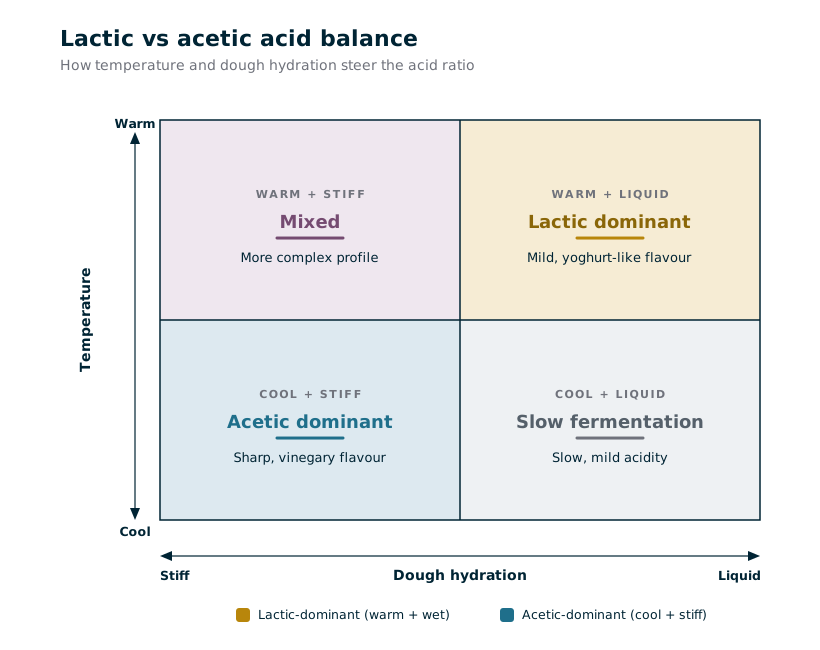 2x2 matrix diagram showing how temperature and dough hydration control the lactic-to-acetic acid ratio in sourdough
Temperature:
- Warm (>30°C) fermentation favours lactic acid — milder, creamy, yoghurt-like sourness
- Cool (<25°C) fermentation favours acetic acid — sharper, vinegary, more complex
Dough hydration:
- High hydration (liquid starter/dough) — favours lactic acid production
- Low hydration (stiff dough) — favours acetic acid production
This is why a traditional San Francisco sourdough (firm starter, cool overnight fermentation) tastes so much sharper than a mild French wheat levain (high-hydration, 4-hour room-temperature fermentation).
Practical tool for rye bakers: To reduce harshness in 100% rye bread without losing the structural benefits of full acidification, use warm temperatures (28–30°C) for the final stage — this biases production toward lactic acid while still achieving the required low pH.
See the comparison table below for a full parameter summary.
4.3 Measuring sourdough acidity
Professional bakeries use two complementary measures:
| Measure | What it captures | Typical values for ripe sourdough |
|---|---|---|
| pH meter | Active (free) hydrogen ion concentration | Ripe wheat: 4.5–5.0; ripe rye: 3.8–4.4 |
| SH° (Soxhlet-Henkel degrees) | Titratable (total) acidity — all acid including buffered | Rye sourdough: 20–30 SH°; industrial liquid concentrates: 250–260 SH° |
| ml NaOH 0.1N / 10g | Alternative titratable acidity unit used by some suppliers | Puratos O-tentic Durum: 45–65 ml/10g |
Important note on product acidity values: The SH° figures stated on industrial sourdough product specs (e.g. Bioferm Ciemny at 250–260 SH° ) are the acidity of the product as supplied, not the resulting dough pH after incorporation at 2.5–4% dosage. The actual dough pH after adding a liquid sourdough concentrate will be much higher (less acidic) than the product's own pH.
5. Multi-stage rye sourdough processes
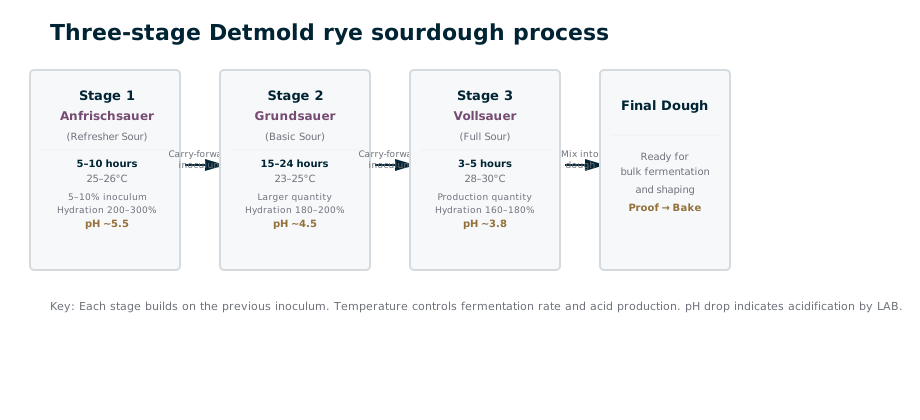 Flowchart of the three-stage Detmold rye sourdough process showing time and temperature for each stage
Rye sourdough is produced using a structured, staged fermentation process — most commonly the Detmold methods developed in Germany, which are the industry standard reference for commercial rye bread production.
The number of stages is a trade-off between flavour complexity, acid development, and practical production time. See the comparison table below for a full comparison.
5.1 One-stage process
The simplest approach: the full production sour (Vollsauer) is made in a single fermentation step from a small amount of stored sour (the "keep-back" or Anstellgut).
Typical parameters: 10–20 hours at 25–28°C, TA (dough yield) 160–200.
Advantages: Simple; suitable for small bakeries; requires less equipment.
Disadvantages: Less flavour complexity; less consistent than multi-stage; sensitive to temperature fluctuations; the full acidification relies on a single population rather than a succession.
5.2 Two-stage process (Detmold)
Two fermentation stages provide better acid balance and consistency.
Stage 1 (Grundsauer / Basic Sour): Intermediate step built from the keep-back. Ferments for 15–24 hours at 23–25°C, developing the LAB population and beginning acid accumulation.
Stage 2 (Vollsauer / Full Sour): The production-scale sour. Ferments for 3–6 hours at 28–30°C. Higher temperature biases production toward lactic acid; the shorter time means the population from Stage 1 is already active, so acidification is fast.
The two-stage method is the most widely used commercial rye sourdough process in Central and Eastern European bakeries because it balances production efficiency with flavour quality.
5.3 Three-stage process (Detmold — maximum flavour)
The full three-stage process adds an Anfrischsauer (Refresher Sour) at the start — a small, high-hydration, moderately warm fermentation that builds the LAB population at relatively low stress. This three-stage succession mimics the natural microbial ecology of a well-maintained starter.
Stage 1 (Anfrischsauer — Refresher Sour): Small amount (~5–10% of total flour used), very high hydration (TA 250–300%), 5–10 hours at 25–26°C. pH drops from ~5.8 to ~5.0.
Stage 2 (Grundsauer — Basic Sour): Larger quantity, lower hydration (TA 180–200%), 15–24 hours at 23–25°C. pH drops to approximately 4.0–4.5.
Stage 3 (Vollsauer — Full Sour): Production quantity, lower hydration (TA 160–180%), 3–5 hours at 28–30°C. Final pH reaches approximately 3.8–4.2.
Why three stages produces the best flavour: Each stage creates different conditions that favour different LAB species and different metabolite ratios. The succession produces a more complex acid profile and aroma spectrum than any single-stage process can achieve.
Practical constraint: Three-stage production requires 24–36 hours of total process time and careful temperature management of three separate vessels. In industrial settings, this is managed by automated souring systems (thermostat-controlled tubs with timers and augers). Smaller bakeries typically manage with insulated containers and accurate thermometers.
6. Wheat sourdoughs — process and flavour
Wheat sourdough is structurally different from rye sourdough because gluten, not pentosans, provides the dough network. This means the acidification requirements are less strict — but they still matter for flavour and shelf life.
6.1 Types of wheat preferment
Wheat sourdough sits alongside other preferment types on a spectrum of fermentation time and acid development:
| Preferment type | Inoculum (yeast) | Time | Acid production | Flavour contribution |
|---|---|---|---|---|
| Poolish (Polish sponge) | Commercial yeast (0.1–0.3%) | 8–16 h | Very low | Mild, sweet, wheaty |
| Biga (Italian stiff sponge) | Commercial yeast (0.1–1%) | 12–18 h | Low | Mild, slightly complex |
| Wheat levain / sourdough | Wild yeast + LAB | 6–18 h | Moderate–high | Sour, complex, aromatic |
| Overnight retarded wheat sour | Wild yeast + LAB | 12–18 h at 5°C | Moderate | Complex, restrained sour |
Wheat sourdough (levain) is now widely used in artisan bakeries and is increasingly adopted in industrial settings — especially as consumer demand for "authentic" and "long-fermentation" breads grows.
6.2 Wheat sourdough targets and management
- Inoculation level: typically 15–30% of flour weight as ripe levain
- Final dough temperature: 24–26°C for standard; 22°C for overnight retard
- Final proof time: 1–4 hours at room temperature; 8–16 hours at 5–8°C (retarded)
- Target dough pH before baking: approximately 4.5–5.0
- Scoring: wheat sourdough must be scored before baking to control oven spring direction
The Puratos O-tentic range is designed specifically to simplify wheat sourdough production at commercial scale: added at 4% on flour weight with water and salt, it brings active sourdough microorganisms (from dried durum wheat sourdough) alongside yeast, ascorbic acid, and enzymes in a single dry concentrate. See Section 8.2 for detailed product data.
7. Rye vs. wheat sourdough — the fundamental difference
The single most important difference between rye and wheat sourdough is this: for rye bread, the sourdough is not optional.
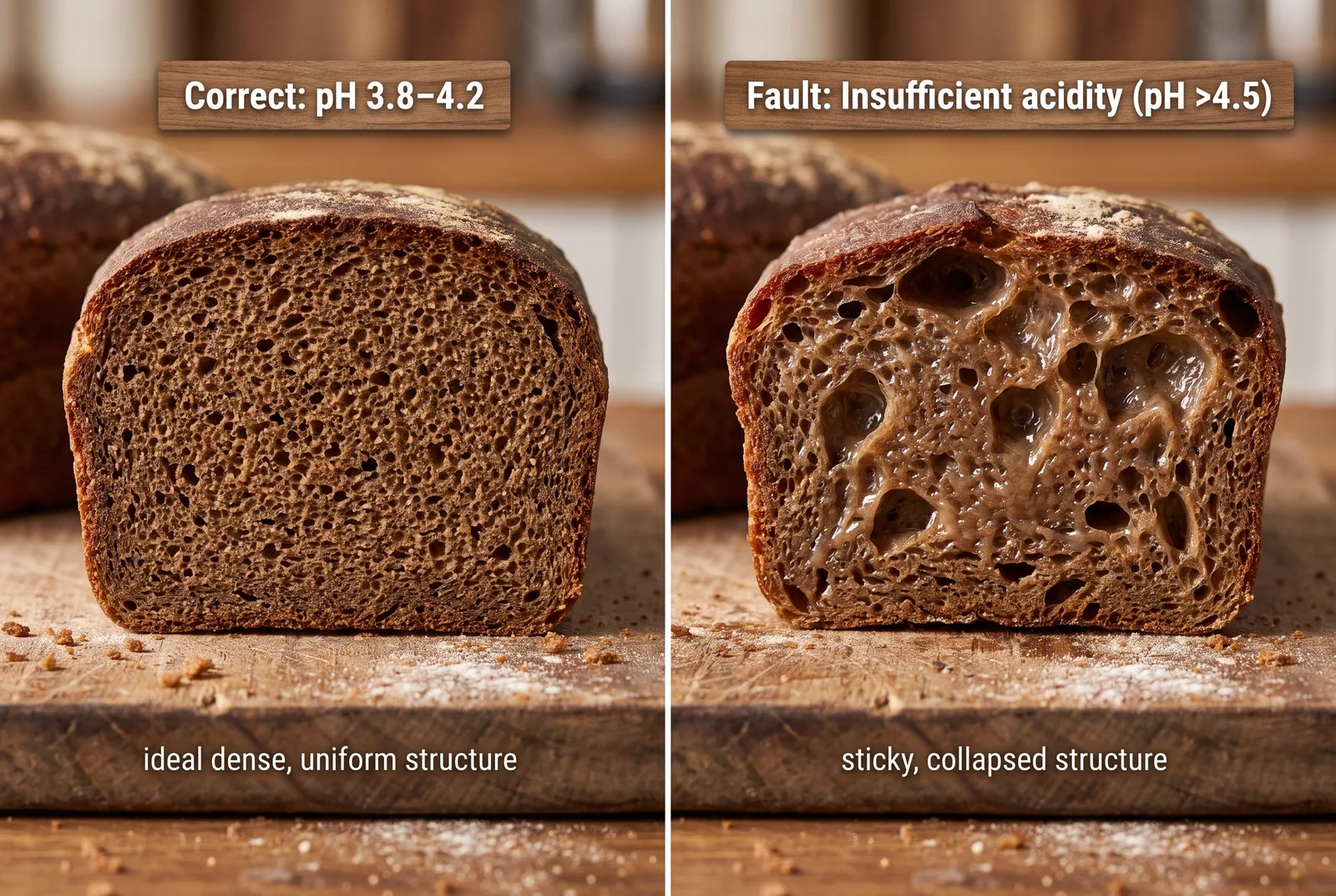
Side-by-side cross-section of properly acidified rye bread (good crumb) versus under-acidified rye bread (gummy defect)
7.1 Why rye needs acid
Rye flour contains:
- No functional gluten — rye proteins (secalin) do not form the cohesive viscoelastic network that wheat gliadin and glutenin create. The structural matrix of rye dough is provided instead by arabinoxylans (pentosans), which form a gel when hydrated.
- High alpha-amylase activity — rye has naturally high amylase levels that are only inhibited at low pH. At the mildly acidic pH of unfermented rye dough (~5.5–6.0), alpha-amylase remains active throughout the baking process and progressively breaks down gelatinising starch — producing a wet, sticky, gummy crumb that cannot be sliced.
Acid is the technical fix for both problems:
- It crosslinks the arabinoxylans into a stable gel that holds the crumb structure in the oven.
- It inhibits alpha-amylase activity, protecting the starch network during baking.
When rye dough reaches pH 3.8–4.4, amylase activity is reduced to a safe level.
7.2 Comparative summary
See the comparison table below for the full parameter comparison.
The key practical implications are:
- For rye bread: sourdough is non-negotiable; the target acidity must be reached and verified; over-acidification (pH below 3.5) is also a fault because it degrades the pentosan gel and destroys gluten in mixed wheat-rye doughs.
- For wheat bread: sourdough improves flavour and keeping quality but is not structurally essential; the process is more forgiving of small deviations in pH.
8. Industrial sourdough products — what is in the Domson catalogue
Professional bakeries increasingly use industrial sourdough products — pre-fermented, acidified ingredients that replace or supplement a traditional starter. These fall into three categories:
8.1 Dry sourdough powders
Zeelandia Superkwas is a dry powder classified as a "wheat-rye bread improver."
-
Composition: 79% rye flour, 20% acidity regulators (E330 citric acid, E270 lactic acid, E327 calcium lactate), plus traces of ascorbic acid (E300), wheat flour, enzyme, and wheat starch
-
How it works: The acidity regulators provide immediate pH drop when mixed with water; the rye flour carries characteristic rye flavour compounds. This is a devitalized sourdough (no live microorganisms) — the acid is chemical, not fermented.
-
Dosage: approximately 1.3% on flour weight (from application recipe: 1.3 kg per 100 kg flour)
-
Process: Mixed with all other ingredients; dough temp 26–28°C; first proof ~20 min; final proof ~45 min; bake 230–250°C with steam
-
Application: 70% wheat type 850 + 30% rye type 720 formula; suitable for mixed wheat-rye bread that needs sourdough flavour and acidity without a traditional fermentation step
Allergens: Contains wheat and rye (confirmed). Possible cross-contamination with barley, oat, spelt, egg, soya, milk, sesame.
Sourdough labelling note: Superkwas is a devitalized sourdough — the acidification is chemical (E330 citric acid, E270 lactic acid, E327 calcium lactate), not from live fermentation. Bread produced only with Superkwas as the sourdough component may NOT qualify for "sourdough bread" labelling in markets where this claim is restricted to products containing live-fermented sourdough (e.g. UK Trading Standards guidance, Real Bread Campaign criteria, or some EU national rules). Verify labelling compliance with a regulatory specialist before making sourdough claims on finished product.
8.2 Active sourdough concentrates (dry)
Puratos O-tentic Durum is categorised as an "active bakery component based on sourdough." Unlike devitalized powders, O-tentic contains active yeast and enzymes alongside the dried sourdough — meaning fermentation continues in the dough.
-
Composition: Dried durum wheat sourdough, yeast, ascorbic acid (E300), enzymes
-
Total acidity (product as supplied): 45–65 ml/10g
-
Organic acids content: 5.0 g per 100 g
-
Dosage: 4% on flour weight with addition of water and salt only (no additional yeast required)
-
Profile: Mediterranean/durum wheat taste — designed for authentic breads such as pita-style, focaccia, and durum rolls
-
Protein: 21.2 g per 100 g (high — reflects the durum wheat sourdough base)
-
Storage: 16–20°C, max 65% RH, 12 months; after opening max 1 week at 0–7°C
-
Dietary status: Kosher-certified; Halal-certified; vegan; GFSI-certified; NOT suitable for coeliacs
-
Allergen: Wheat gluten (as ingredient); mustard (possible cross-contamination)
8.3 Paste concentrates
Uldo Dark Sauer (W/43) is a dark-brown paste concentrated rye sourdough for dark rye and wholegrain breads.
- Composition: Rye bran, water, rye flour, citric acid, lactic acid, acetic acid, barley malt
- pH range (product): 2.5–4.5
- Total acidity: 140–150 SH° — approximately 5–6 times more acidic than a typical ripe rye sour at 20–30 SH°; this is an extremely concentrated acid paste
- Dosage: 2–8% on flour weight, depending on desired acidity and rye content
- Shelf life: 9 months; store max 30°C, max 75% humidity
- Allergen: Gluten; traces possible: milk, sesame, soya, lupin, eggs
8.4 Liquid sourdoughs
Zeelandia Bioferm Ciemny is a dark-coloured liquid sourdough for mixed, rye, and wholegrain breads.
-
Composition: Liquid whey, rye flour, acidity regulators (E270 lactic acid, E260 acetic acid), wholemeal rye flour, rye bran, barley malt flour, roasted barley, roasted rye, salt, pre-gelatinised wheat flour, natural bread sourdough
-
pH (product): 2.4–2.8 — among the most acidic of any liquid sourdough product
-
Total acidity: 250–260 SH°
-
Dosage: 2.5% (50/50 rye/wheat blend) → 3.2% (70% rye) → 3.5% (80% rye) → 4% (100% rye) on flour weight
-
Application: Pre-soak rye wholemeal + Bioferm in ~70% of dough water for 2–3 hours before mixing; dough temp 29–31°C; final proof ~50 min; bake 250°C falling to 200°C (60 min total)
-
Shelf life: 12 months; 0–25°C, do not freeze
Critical allergen note: Bioferm Ciemny contains liquid whey as the FIRST listed ingredient — it is therefore a significant source of MILK protein. Bread produced with this product contains milk allergen and must be labelled accordingly. This is not a cross-contamination risk — whey is a declared, intentional ingredient. Verify the current spec before every batch order.
8.5 Soaked grain inclusions
Puratos Sapore Softgrain Rye is a unique product — it is rye grain soaked and cooked in natural sourdough rather than a sourdough concentrate itself.
- Composition: Fermented sprouted rye grain, pasteurised rye sourdough, salt, potassium sorbate (E202 — preservative)
- Grain content: 56g of grains and seeds per 100g product
- pH (product): 3.20–3.70
- Total acidity: 7.0–12.0 ml/10g (NaOH 0.1N)
- Dosage: 10–50% relative to dough weight (note: unusual metric — all other sourdough products in this section use % on flour weight)
- How to use: Add at the beginning or end of mixing; cannot be frozen; refrigerate after opening at 0–4°C for maximum 2 weeks
- Nutritional note: High fibre (6.6 g/100g); moderate energy (143 kcal/100g)
- Allergen: Cereals containing gluten (rye — as ingredient and on same production line)
- Quality: BRC Global Standard Grade AA
E202 (potassium sorbate) carry-over — regulatory note: Sapore Softgrain Rye contains E202 (potassium sorbate) as a preservative. At 10–50% dosage on dough weight, E202 will be present in the finished bread above a technologically insignificant level. In the EU, sorbates are NOT authorised in standard bread (Category 07.1.1 under EU Regulation 1333/2008 Annex II). For fine bakery wares (Category 07.2) sorbates are permitted at a maximum of 2000 mg/kg in the finished product. Before using Sapore Softgrain Rye in standard bread formulations at significant levels: (1) identify the correct EU food category for the finished product; (2) calculate the actual E202 carry-over concentration; (3) obtain Puratos' regulatory compliance documentation for your market.
Sapore Softgrain Rye is primarily a texture and flavour inclusion — the soaked, fermented grains add chewiness, visual texture, and sourdough character to bread doughs without replacing a traditional sourdough fermentation step.
See the comparison table below for a full side-by-side comparison of all five products.
9. Fault diagnosis and remedy
See the fault-finding table below for the complete list. The most critical faults in sourdough production and their sourdough-specific causes:
| Fault | Sourdough cause | First remedy |
|---|---|---|
| Gummy, uncuttable rye crumb | Insufficient acidity — pH too high; amylase not inhibited | Increase sourdough dose or use more acidic concentrate; verify sour pH before mixing |
| Bread too sour/harsh | Over-fermentation; too much acetic acid | Reduce time or raise temperature (more lactic = milder); reduce sourdough dose |
| No sour flavour | Starter inactive; concentrate under-dosed | Test starter activity; check expiry of industrial product |
| Starter not rising | Over-acidified; yeast killed; contamination | Refresh more frequently; discard and rebuild if contaminated |
| Dense wheat sourdough | Under-active starter; over-proofed | Verify starter doubles in 8h; adjust final proof |
| Crust blisters | Skin dried on shaped dough | Cover during proof; use adequate steam |
| Mould within 3–5 days (packaged) | Insufficient final dough acidity; warm packaging | Achieve target pH; cool before packaging; consider E282 in packaged products |
Note on mould inhibition and E282 (calcium propionate): E282 is NOT permitted in standard bread (EU Regulation 1333/2008 Annex II, Category 07.1.1 — bread made only with wheat flour, water, yeast/leavening, and salt). It IS permitted in pre-packed sliced bread (Category 07.1.2) and fine bakery wares (Category 07.2) at a maximum of 3000 mg/kg in the finished product. Before adding E282 to any sourdough bread formulation: (1) confirm the correct EU food category for your finished product; (2) verify compliance with the applicable national implementation; (3) do not use E282 if the product is standard bread (07.1.1). E282 works synergistically with sourdough acidity and is most effective at pH below 5.5 — which sourdough already achieves.
10. Choosing a sourdough approach for your production
| Scenario | Recommended approach |
|---|---|
| Artisan wheat loaf, maximum flavour, small volume | Live wheat levain (traditional starter, 3-stage if time permits) |
| Consistent mixed rye bread (commercial) | Liquid sourdough concentrate (Bioferm Ciemny) at appropriate dosage |
| Fast turnover wheat-rye bread needing sour notes | Dry sourdough powder (Superkwas) — adds flavour + acidity without active fermentation |
| Premium Mediterranean/durum bread with overnight capability | Puratos O-tentic Durum at 4% — active, replaces starter AND separate yeast addition |
| Dark intense rye bread, highly acidified | Paste concentrate (Uldo Dark Sauer) at 5–8%; verify final dough pH |
| Adding texture and sourdough character to any bread | Puratos Sapore Softgrain Rye at 10–50% on dough weight — does not replace starter |
Coverage notes and gaps
Solid coverage in this dossier:
- Sourdough microbiology — LAB:yeast ratio, species, synergy (academic PMC source + IREKS Compendium)
- Acidification principles — pH curve, lactic/acetic balance parameters
- Multi-stage Detmold rye processes (IREKS Compendium — the industry standard reference)
- Industrial sourdough product data from five first-party spec sheets
- Fault table from an IREKS Compendium fault source
Thin or uncertain areas:
- Exact target pH range for rye doughs (3.8–4.4 is indicative from IREKS; confirm against specific flour enzyme activity for each production run)
- Starter refresh ratios are common professional practice; no single authoritative source states specific ratios; marked confidence:medium
- Böcker product range (Bio Le Chef, Flüssigsauer 200, Reinzucht starter) — no readable spec sheets available in the catalogue (PDF mismatch for Le Chef); product details from brand sources only
- Long-term effects of sourdough on bread nutrition (phytate reduction, GI) — mentioned but not developed; these claims require medical nutrition review
- EU/UK regulatory status of specific sourdough label claims ("made with sourdough", "genuine sourdough") — not addressed here; a Zeelandia sourdough labelling compliance source notes this is a topic; requires regulatory review
Dark Wholemeal Rye Bread with Zeelandia Bioferm Ciemny (liquid sourdough)
Application recipe from Zeelandia Bioferm Ciemny spec sheet. Liquid sourdough replaces a traditional 2-stage sour.
| Ingredient | Baker's % | Weight |
|---|---|---|
| Rye flour type 2000 (wholemeal) | 80 | 80 kg |
| Wheat flour type 850 | 20 | 20 kg |
| Zeelandia Bioferm Ciemny (liquid dark sourdough) | 3.5 | 3.5 kg |
| Optimax (bread improver) | 1 | 1 kg |
| Salt | 2.2 | 2.2 kg |
| Yeast | 3.5 | 3.5 kg |
| Water | 80 | 80 litres |
- Soak wholemeal rye flour and Bioferm Ciemny in approximately 70% of the water for 2–3 hours. Add remaining ingredients and mix 8 min slow speed + 1 min fast speed. Dough temperature 29–31°C. Rest 15–20 min. Scale to 0.7 kg pieces, place in tins, level surface. Final fermentation approx. 50 min. Bake at 250°C falling to 200°C (deck oven) or 280°C falling to 190°C (rack oven) for approx. 60 min.
Yield: 0.7 kg raw pieces; final bread weight approximately 600–620 g after baking
Bioferm Ciemny contains milk (whey) — label bread accordingly. Allergen: gluten (wheat + rye), milk.
Mixed Wheat-Rye Bread with Zeelandia Superkwas (dry sourdough)
Application recipe from Zeelandia Superkwas spec sheet. Dry sourdough powder used as quick acidifier.
| Ingredient | Baker's % | Weight |
|---|---|---|
| Wheat flour type 850 | 70 | 70 kg |
| Rye flour type 720 | 30 | 30 kg |
| Salt | 1.8 | 1.8 kg |
| Zeelandia Superkwas (dry sourdough) | 1.3 | 1.3 kg |
| Yeast | 3.5 | 3.5 kg |
| Water | 68 | 68 litres |
- Mix all ingredients 6 min slow + 4 min fast speed. Dough temperature 26–28°C. First proof approx. 20 min. Shape into loaves. Final proof approx. 45 min. Bake at 230–250°C with steam. Baking time depends on loaf weight.
Yield: Typical bread loaves from 0.4–1.0 kg raw weight
Dry sourdough powder (Superkwas) provides instant acidity without a traditional sour fermentation step. Allergens: wheat, rye; possible cross-contamination with barley, oat, spelt, egg, soya, milk, sesame.
Wheat sourdough starter — standard refresh cycle
Standard approach to maintaining an active liquid wheat sourdough starter. Parameters are typical professional practice, not from a single spec sheet.
| Ingredient | Baker's % | Weight |
|---|---|---|
| Mature starter (keep-back from previous feed) | 10 | 50 g |
| Strong white wheat flour (12%+ protein) | 50 | 250 g |
| Rye flour (optional, 5–10% — accelerates LAB activity) | 10 | 50 g |
| Water (room temperature, 22–25°C) | 50 | 250 g |
- Combine all ingredients; mix until no dry flour remains. Cover loosely. Ferment at 24–26°C for 8–12 hours (or until doubled and domed). Use at peak or refrigerate at this point for up to 48–72 h. Repeat cycle every 24 h at room temperature or every 48–72 h from refrigerator.
Yield: This formula gives a 100% hydration (equal flour:water) starter. Discard or use the remainder before each refresh to prevent acid build-up.
Exact ratios are common professional practice, not stated numerically in cited sources. Flag: a wide range of refresh ratios (1:2:2 to 1:10:10) are used in industry; this is one standard approach. Single-source for exact parameters.
First-party spec sheet data for sourdough products in the Domson catalogue. Acidity values are product-as-supplied, not resulting dough pH.
| Product | Format | pH (product) | Total Acidity | Dosage on Flour | Allergens (key) | Shelf Life |
|---|---|---|---|---|---|---|
| Zeelandia Superkwas | Dry powder | n/a (dry) | n/a (dry) | ~1.3% | Wheat, Rye; CC: Barley, Oat, Spelt, Egg, Soya, Milk, Sesame | 180 days |
| Uldo Dark Sauer (W/43) | Paste | 2.5–4.5 | 140–150 SH° | 2–8% | Gluten; traces: Milk, Sesame, Soya, Lupin, Egg | 9 months |
| Puratos Sapore Softgrain Rye | Wet grain/paste | 3.20–3.70 | 7.0–12.0 ml/10g | 10–50% on dough wt | Rye (gluten) | 12 months |
| Puratos O-tentic Durum | Dry concentrate (active) | n/a (dry) | 45–65 ml/10g | 4% | Wheat (gluten); CC: Mustard | 12 months |
| Zeelandia Bioferm Ciemny | Liquid | 2.4–2.8 | 250–260 SH° | 2.5% (50% rye) to 4% (100% rye) | Wheat + Rye (gluten), Milk (whey) | 12 months |
CC = possible cross-contamination. Dosage for Sapore Softgrain Rye is on dough weight (unusual — all others are on flour weight). Food safety: allergen data from spec sheets must be verified before customer-facing use. Bioferm Ciemny contains milk (whey) as a declared ingredient — not dairy-free. Source: Supplier spec sheet.
IREKS Compendium approach to rye sourdough staging. Temperature and hydration ranges are typical; exact parameters vary by recipe and bakery.
| Method | Stages | Total Time | Typical Temperature | Typical Hydration (TA) | Flavour Complexity | Consistency | Practical Use |
|---|---|---|---|---|---|---|---|
| 1-stage (single sour) | Vollsauer only | 10–20 h | 25–28°C | TA 160–200 | Low–moderate | Variable | Small bakeries; simple rye breads |
| 2-stage (Detmold 2-stage) | Grundsauer + Vollsauer | 15–30 h | 24–27°C stage 1; 28–30°C stage 2 | Stage 1: TA 200–250; Stage 2: TA 160–180 | Moderate | Good | Standard industrial rye; good balance of acid and time |
| 3-stage (Detmold 3-stage) | Anfrischsauer + Grundsauer + Vollsauer | 24–36 h | 25–26°C / 23–25°C / 28–30°C | Stage 1: 250–300%; Stage 2: 180–200%; Stage 3: 160–180% | High | Excellent | Premium artisan rye; maximum flavour development |
TA (Teigausbeute) = dough yield = (dough weight / flour weight) x 100. TA 160 means 60 g water per 100 g flour. Lower TA = stiffer dough. Temperature and hydration are indicative from IREKS Compendium; individual bakery conditions vary.
Functional comparison of the two microbial groups in sourdough fermentation.
| Attribute | Lactic Acid Bacteria (LAB) | Wild Yeast (Kazachstania, Saccharomyces spp.) |
|---|---|---|
| Cell ratio | ~100x more numerous | ~1x (minority) |
| Primary products | Lactic acid, acetic acid, CO2 (heterofermentative only) | CO2, ethanol, minor aromatic esters |
| Leavening contribution | Minor (CO2 from heterofermentative only) | Primary — CO2 from maltose and glucose fermentation |
| Flavour contribution | Primary — organic acids, aroma compounds | Secondary — ethanol, esters, aldehydes |
| Preservation function | Primary — low pH inhibits pathogens | Minor |
| Substrate preference | Fructose (heterofermentative); sugars broadly | Maltose, glucose (not fructose — leaves fructose for LAB) |
| Acid tolerance | Survive to pH 3.5 | Survive to pH 3.5–4.0 |
| Key species | Lactiplantibacillus plantarum, Fructilactobacillus sanfranciscensis, Limosilactobacillus fermentum | Kazachstania humilis (formerly Candida humilis), Saccharomyces cerevisiae |
Species names use current NCBI taxonomy (2021 reclassification of Lactobacillus genus). Common older names appear in most practical baking literature.
The ratio of lactic acid to acetic acid determines sourdough flavour character. Both temperature and dough hydration are tools to shift this ratio.
| Condition | Temperature | Dough Hydration | Dominant Acid | Flavour Profile | Typical Application |
|---|---|---|---|---|---|
| Warm and wet | >30°C | High (TA 180+) | Lactic acid | Mild, yoghurt-like, creamy | Light sourdough wheat breads; mild-tasting rye |
| Cool and stiff | <25°C | Low (TA 155–165) | Acetic acid | Sharp, vinegary, complex | Traditional dark rye; pumpernickel; long-fermented artisan |
| Intermediate | 26–28°C | Medium (TA 170–180) | Mixed (LA:AA ~2:1) | Balanced sour, complex | Most commercial rye-wheat blends |
| Very warm (over-heated) | >35°C | Any | Risk: off-flavours, butyric acid | Unpleasant, off-flavours | Fault condition — avoid |
Ratio guidance from IREKS Compendium. The exact LA:AA ratio also depends on substrate (rye vs wheat), starter inoculum level, and fermentation time. 'Very warm' fault condition is a general fermentation principle, not directly stated with numeric thresholds in reviewed sources.
Structural and functional comparison.
| Parameter | Rye Sourdough | Wheat Sourdough |
|---|---|---|
| Why sourdough is used | ESSENTIAL — neutralises amylase; only acid-stabilised pentosans provide structure | Optional but beneficial — improves flavour, shelf life, and nutrition |
| Structure provider | Pentosans (arabinoxylans) — acid-stabilised into a gel | Gluten network (gliadin + glutenin) |
| Key risk without acid | Amylase activity degrades starch → gummy, sticky, uncuttable crumb | Less critical; over-proofing is the main risk |
| Target dough pH | ~3.8–4.4 (tightly controlled) | ~4.5–5.0 (more flexible range) |
| Sourdough proportion of flour | Typically 20–40% of total flour as sour (calculated weight) | Typically 10–30% preferment |
| Leavening mechanism | Acid-tolerant yeast (in sour or added separately) | Gluten-trapped CO2 from yeast |
| Flavour contribution of sourdough | Critical — defines rye bread character | Important — adds depth, reduces staling |
| Shelf life benefit | High — acid prevents mould and rope | Moderate — acid slows retrogradation and mould |
Practical troubleshooting for sourdough bread faults.
| Fault | Likely Cause(s) | Remedy |
|---|---|---|
| Gummy, sticky, uncuttable rye crumb | Insufficient acidity — dough pH too high (>4.5 for rye); alpha-amylase not neutralised; starch degraded during baking | Increase sourdough proportion or acidity of the sour; check sour pH before use; extend souring time; use a more acidic sourdough concentrate; reduce dough temperature during resting. |
| Bread too sour / harsh flavour | Over-fermentation; excessive acetic acid (low temperature + stiff dough + long time); too much sourdough concentrate | Reduce fermentation time or temperature; increase dough hydration; use warmer proving (favours lactic acid, milder flavour); reduce sourdough dosage. |
| Insufficient sour flavour / flat taste | Starter not active; too little sourdough; dough temperature too high (acid production rate exceeds acid retention); industrial sourdough powder under-dosed | Test starter activity (double in 4–8 h at 26°C); increase sourdough dosage; lower dough temperature; check expiry of dry/liquid sourdough product. |
| Starter does not rise (inactive) | Over-acidified (too much acid accumulated — old starter); yeast killed by too-warm water; contamination; refrigerator too cold | Discard and restart; use unchlorinated water at 22–25°C; refresh more frequently; bring to room temperature before use. |
| Dense, low-volume sourdough loaf (wheat) | Under-active starter (insufficient wild yeast CO2); gluten overdeveloped or weak flour; final proof too short or too long | Verify starter activity; check flour protein (minimum 11% for sourdough wheat bread); adjust final proof time to finger-dent test; do not refrigerate at peak without degassing. |
| Crust blisters or tears | Skin formed on shaped dough before final proof (dough dried); over-proofed then scored too late; steam insufficient in oven | Cover shaped loaves during final proof; score immediately before loading; ensure adequate steam in first 10–15 min of bake. |
| Flat, spreading loaf (no oven spring) | Over-proofed sourdough; gluten breakdown by protease activity in over-acidified dough; flour protein too low | Reduce final proof time; do not let dough over-acidify (pH <3.5 destroys gluten); use higher-protein flour; score less aggressively for over-proofed dough. |
| Mould on rye sourdough bread within 3–5 days | Insufficient dough acidity (pH too high after baking); packaging while too warm (steam condensation); contamination during cooling | Ensure target dough acidity is reached; cool loaves to <35°C before wrapping; consider calcium propionate E282 in pre-packaged versions (check regulatory limits). |
- Value:
- ~1.3
- Unit:
- % on flour weight (calculated from application recipe)
- Value:
- 2.5–4.5
- Unit:
- pH
- Value:
- 140–150
- Unit:
- SH°
- Value:
- 2–8
- Unit:
- % on flour weight
- Value:
- 3.20–3.70
- Unit:
- pH
- Value:
- 7.0–12.0
- Unit:
- ml NaOH 0.1N / 10g
- Value:
- 10–50
- Unit:
- % on dough weight
- Value:
- 4
- Unit:
- % on flour weight
- Value:
- 45–65
- Unit:
- ml acid-base titration / 10g
- Value:
- 5.0
- Unit:
- g/100g
- Value:
- 2.4–2.8
- Unit:
- pH
- Value:
- 250–260
- Unit:
- SH°
- Value:
- 2.5–4.0
- Unit:
- % on flour weight (depends on rye content)
- Value:
- ~100:1
- Unit:
- cell ratio LAB:wild yeast
- Confidence:
- high
Buy the ingredients
Catalogue products and brands referenced in this article.
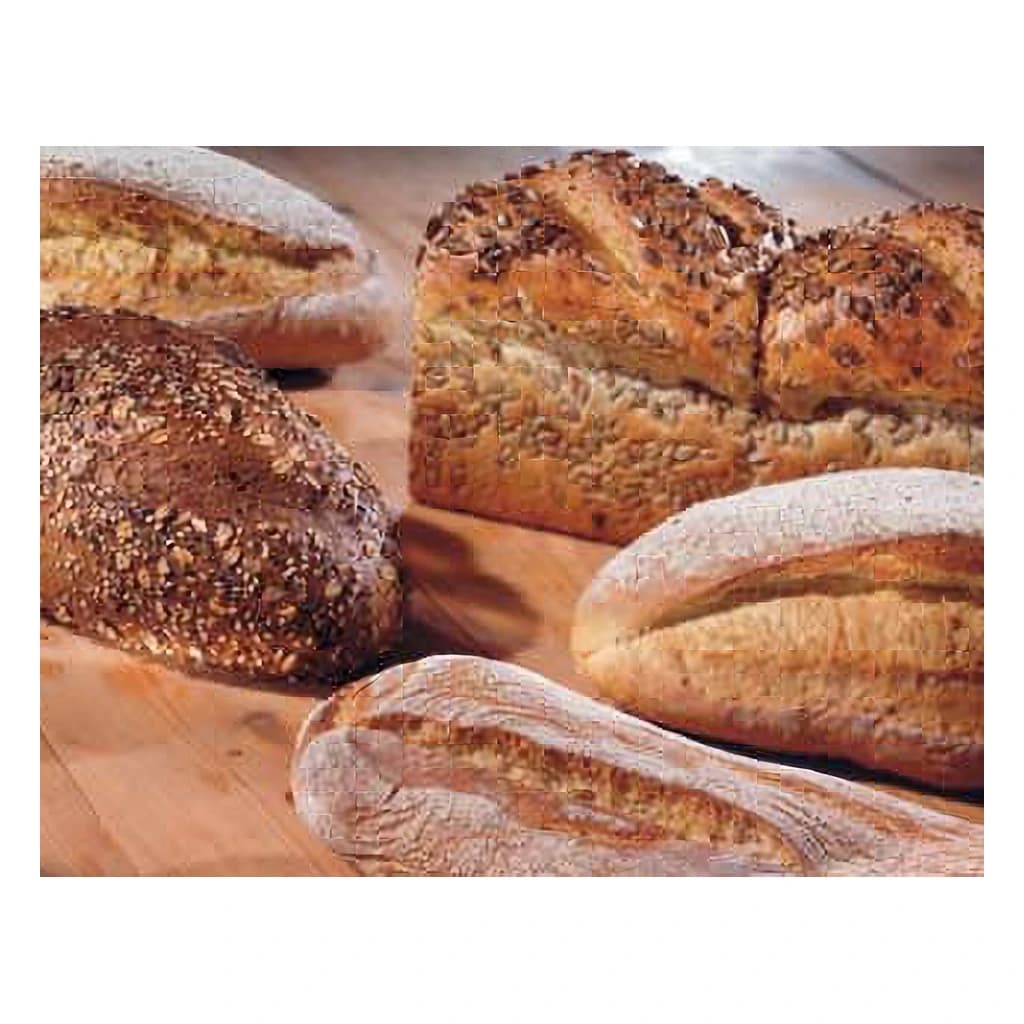
Superkwas Dry Sourdough 25 kg
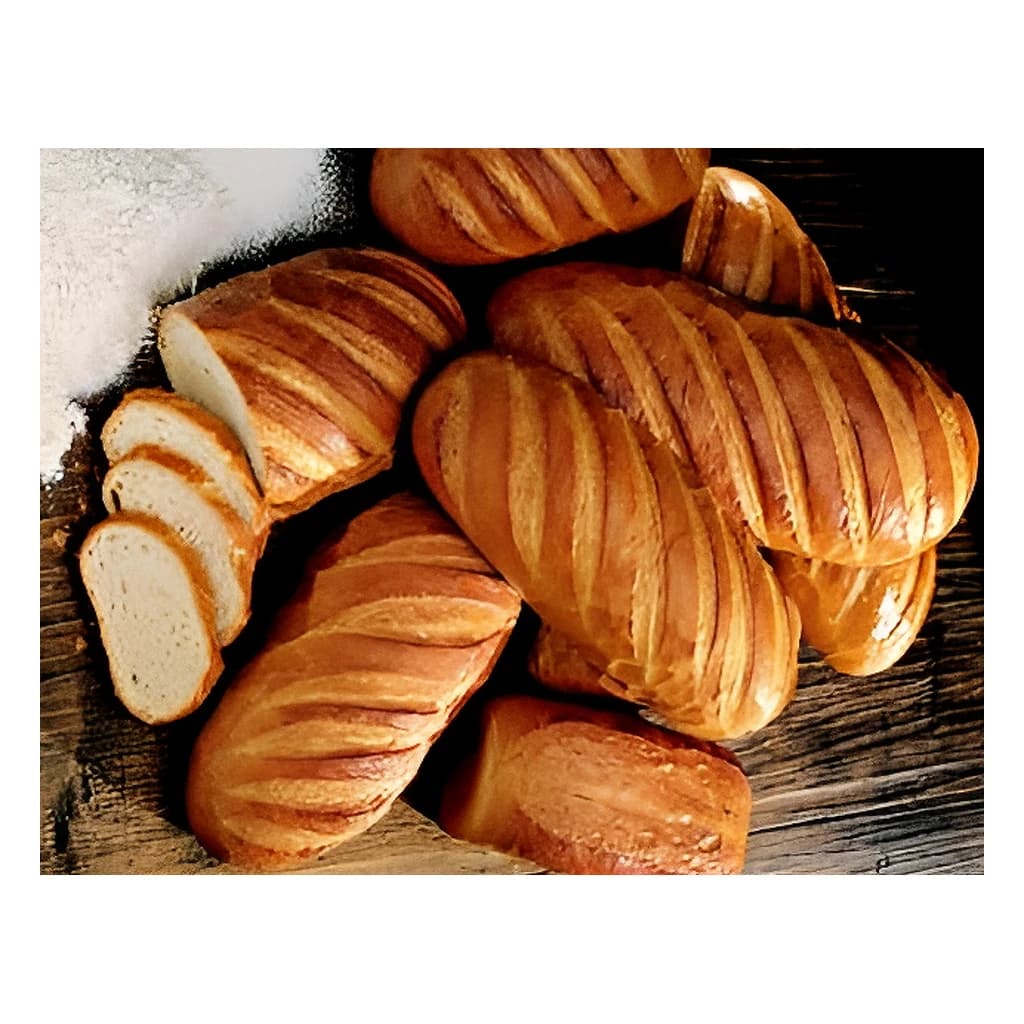
Sauer Dark Rye Sourdough Concentrate 25 kg

Puratos Sapore Softgrain Rye 12.5 kg
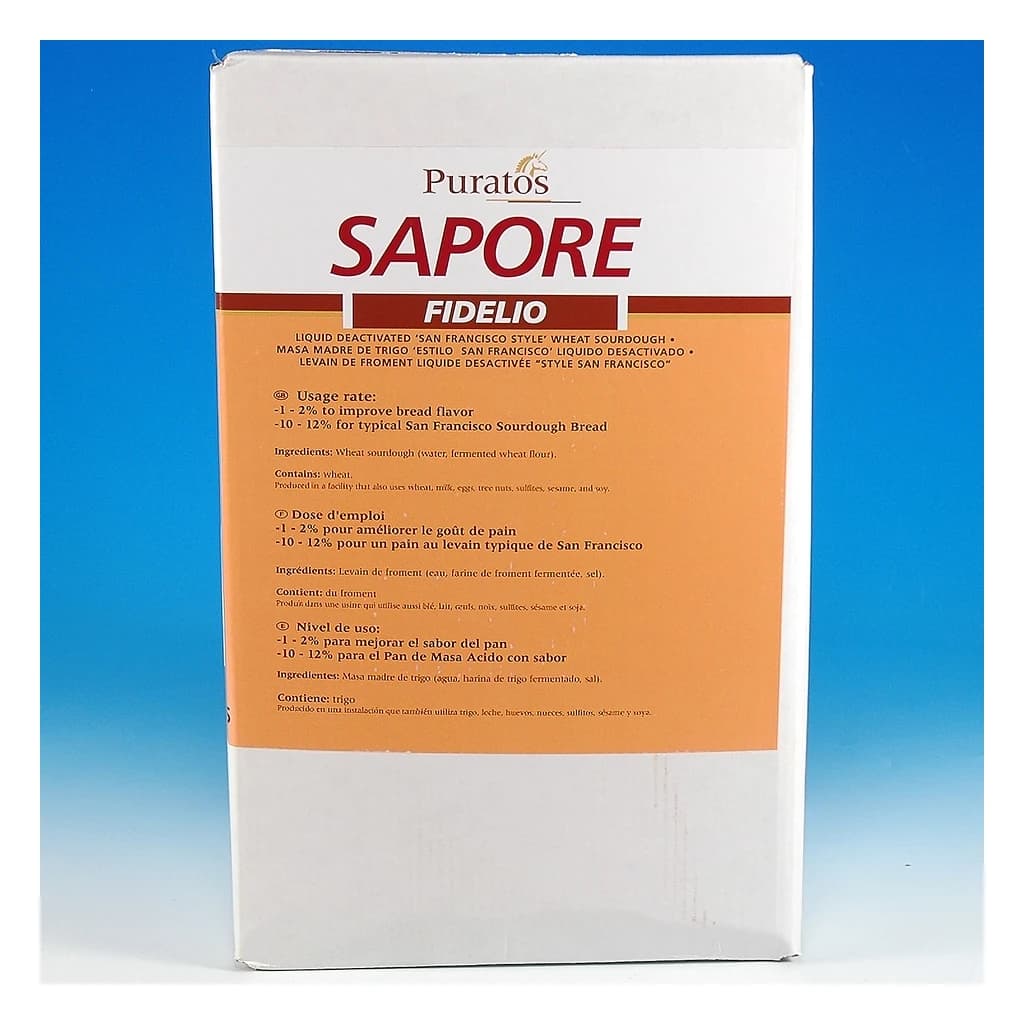
Puratos Sapore Fidelio Sourdough 10 kg
Zeelandia Hearty Rye Bread Mix 25 kg
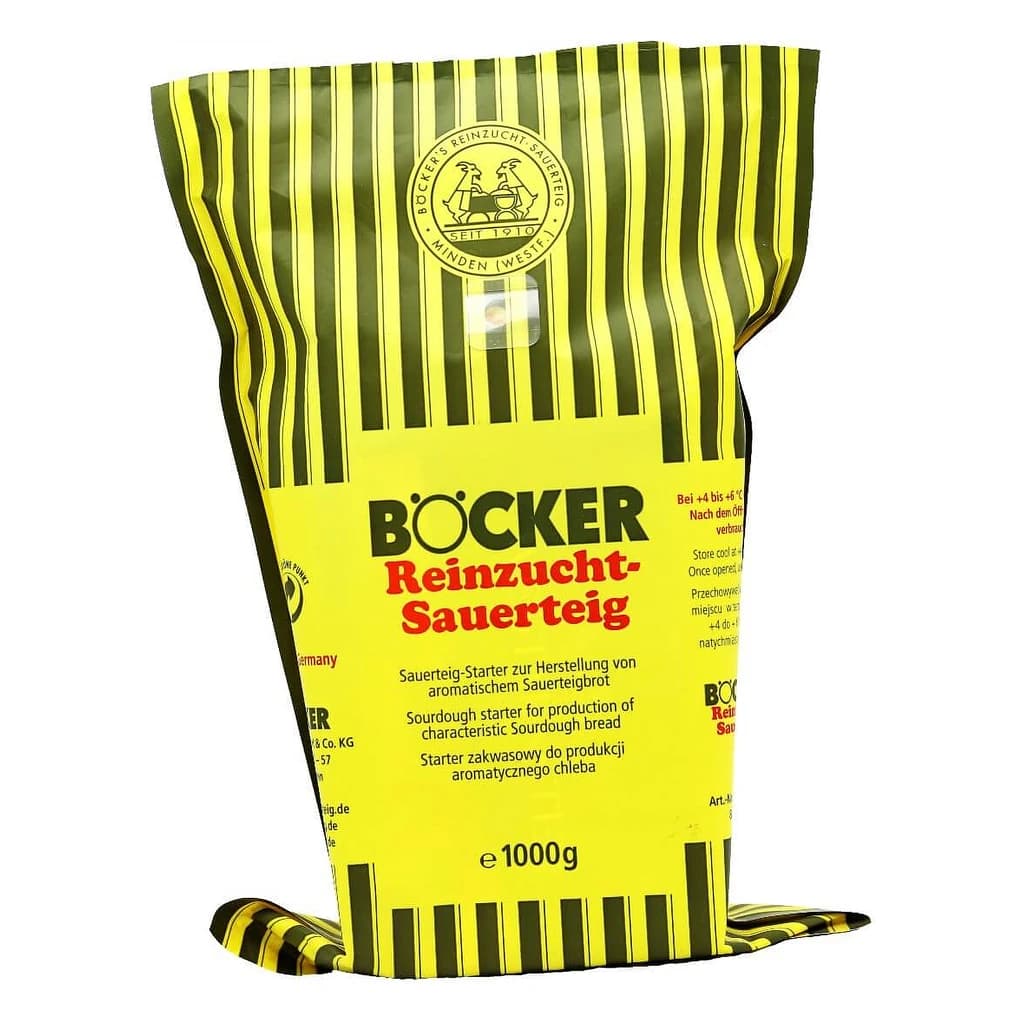
Böcker Reinzucht-Sauerteig Pure Sourdough Starter 1 kg

Böcker Bio Le Chef Organic Liquid Sourdough 2 kg

Böcker Flüssigsauer 200 Liquid Sourdough 15 kg
Bas Turbo 500 Sourdough Concentrate 12 kg

Lesaffre Rye Sourdough AS ECOL 11 kg
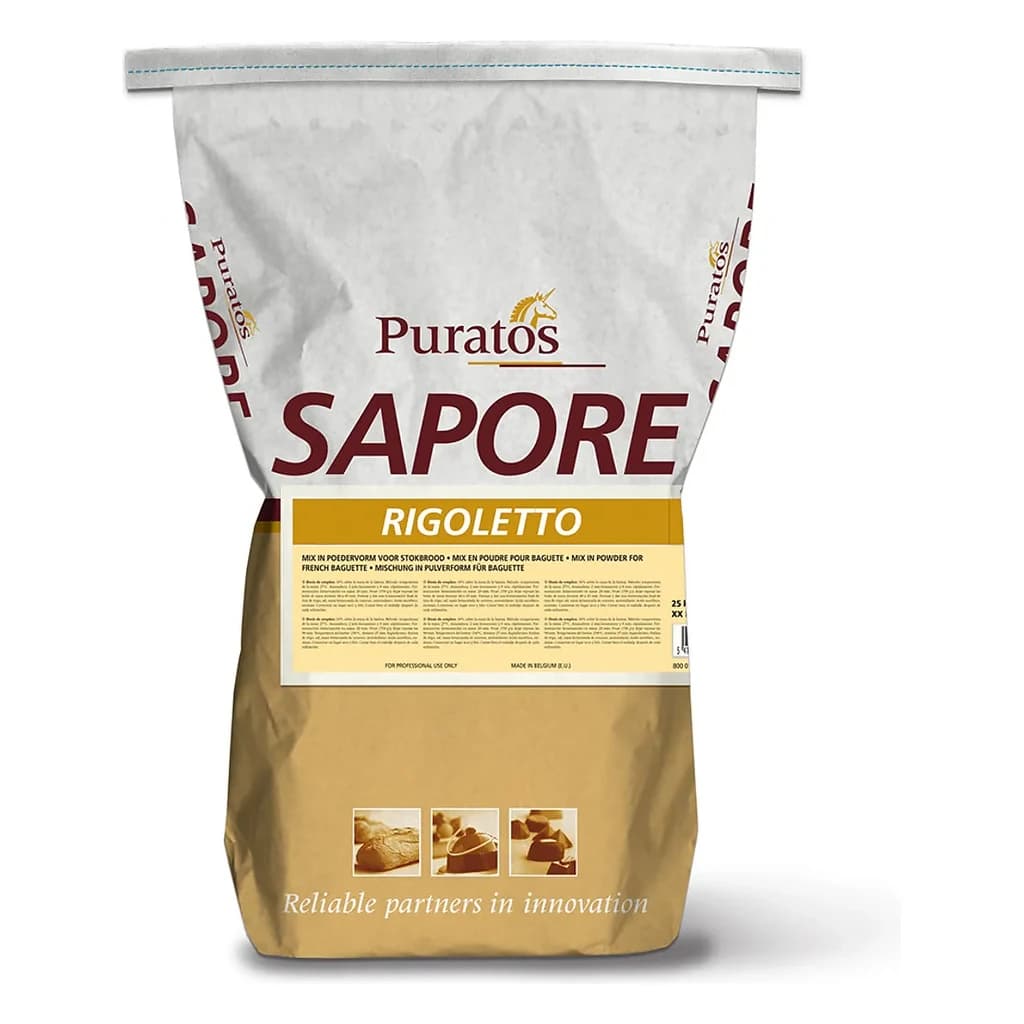
Puratos Sapore Rigoletto Sourdough Powder 25 kg

Puratos O-tentic Durum Sourdough Concentrate 10 × 1 kg
Zeelandia Bioferm Dark Liquid Sourdough 19 kg