
Malt and malt extracts in baking: diastatic vs. non-diastatic, enzymatic activity and crust colour
A practical guide for professional bakers covering the full range of malt products used in baking: diastatic malt flours, non-diastatic roasted malts, liquid malt extracts, malted grain flakes, and malted blend flours. Built on twelve first-party spec sheets from the Domson catalogue (EDME, Forbake, ULDO, IREKS, Bakels, Carr's Maldon Mill) and cross-checked against BAKERpedia, IREKS Baking Technology Compendium, and AHDB Hagberg falling number guidance. Includes comparison tables for all twelve products, EBC colour guide, dosage recommendations, fault diagnosis, allergen summary, and formula cards.
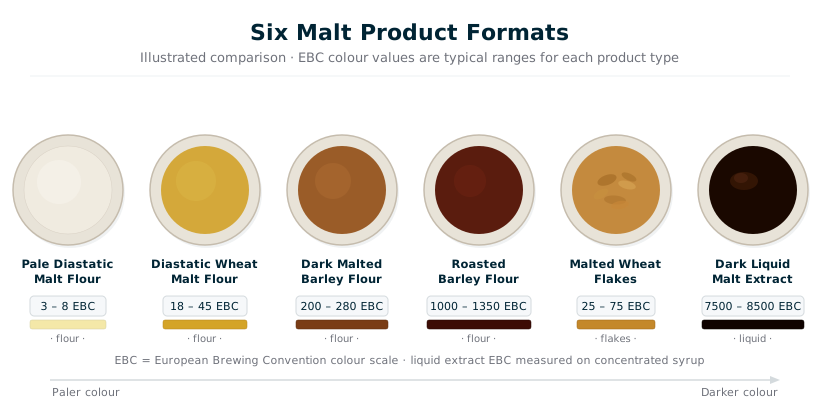 Six malt product formats side by side: pale diastatic malt flour, diastatic wheat malt flour, dark malted barley flour, roasted barley flour, malted wheat flakes, and dark liquid malt extract
What this article covers
This dossier explains what malt is, how it is made, and how to choose between the twelve malt-based products stocked by Domson. It is built on first-party spec sheets for each product and cross-checked against industry sources wherever possible.
The core distinction this article addresses is diastatic vs. non-diastatic malt — the single most important decision point when selecting a malt ingredient for a baking application. Diastatic malts contain active amylase enzymes that break down starch into fermentable sugars; non-diastatic malts have had their enzymes destroyed by heat and function purely as colour and flavour agents.
For the biochemistry of enzymes in baking more broadly, see the companion article A3-enzymes-in-baking. For bread improver formulation and how malt fits into a compound improver, see A3-bread-improvers-overview. For crust colour development chemistry, see A5-crust-colour-maillard-caramelisation.
1. What malt is
Malt is grain — almost always barley or wheat — that has been deliberately germinated (sprouted) under controlled conditions and then dried (kilned). The purpose of germination is to activate enzymes inside the grain, primarily alpha-amylase and beta-amylase, which begin breaking down the grain's starch and protein reserves to feed the growing seedling. The kilning step stops germination and fixes the enzyme activity level, flavour, and colour in the finished product.
In baking, malt serves three overlapping functions depending on the product chosen:
- Enzymatic function (diastatic malt only): Alpha- and beta-amylase enzymes in diastatic malt break down damaged starch in flour into maltose and other fermentable sugars. This feeds yeast more effectively, improves fermentation, and increases the pool of reducing sugars available for Maillard browning.
- Colour function: Malt contributes colour to bread crust via the sugars it supplies to the Maillard reaction and caramelisation. Dark malts and liquid extracts provide very large amounts of pre-formed reducing sugars and colour compounds.
- Flavour function: Malt provides characteristic sweet, toasted, and — in fermented rye malts — sourdough-adjacent flavour notes that define the taste profile of malted bread, dark rye bread, and malt-flavoured morning goods.
2. The malting process
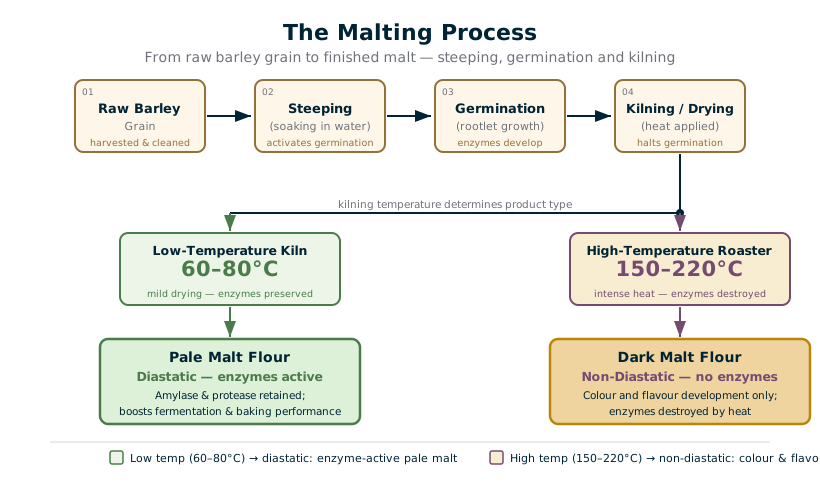 Malting process diagram showing steeping, germination, and kilning stages, with a branch distinguishing pale diastatic malt from dark non-diastatic roasted malt
Understanding the malting process is essential to understanding why some malts are diastatic and others are not.
Step 1: Steeping
Cleaned barley or wheat grain is soaked in water for 24–48 hours (depending on grain and target moisture). The grain's moisture content rises from approximately 12% (dry) to 42–46% (ready to germinate).
Step 2: Germination (malting floor)
The steeped grain is spread on a germination floor or placed in a rotating drum and kept at approximately 13–17°C for 4–6 days. As the seedling begins to grow, the grain produces enzymes:
- Alpha-amylase (endoamylase): Attacks starch chains at internal bonds, producing shorter dextrin fragments. Activity is expressed as Dextrinising Units (DU) or as part of the overall Diastatic Power (DP).
- Beta-amylase (exoamylase): Works from the chain ends, releasing maltose — the primary fermentable sugar for baker's yeast.
- Proteases: Begin breaking down storage proteins, making nitrogen more available and beginning gluten modification.
At peak germination, the grain has its highest enzyme content. The moment to stop germination is controlled by the maltster to target a specific enzyme activity level.
Step 3: Kilning — the fork between diastatic and non-diastatic
The germinated grain (green malt) is dried in a kiln. This is the point where diastatic and non-diastatic malts diverge:
Pale kilning (diastatic malt): At low kiln temperatures — typically 50–80°C — the grain is gently dried over 24–36 hours. Moisture falls to 4–6%. At these temperatures, the amylase enzymes survive in an active form. The finished malt is pale in colour (3–45 °EBC range, depending on degree of kilning) and carries the enzymatic activity that makes it "diastatic."
High-temperature roasting (non-diastatic malt): When kilning temperatures exceed approximately 100–150°C and above (with some roasters reaching 150–220°C+), amylase enzymes are irreversibly denatured. No enzyme activity survives. The Maillard reaction and caramelisation react the grain's sugars and amino acids intensively, developing dark colour compounds and a roasted, complex flavour profile. The finished malt is dark amber to almost-black.
Fermented rye malt (non-diastatic, special case): The Lithuanian Dark Rye Malt in the Domson catalogue is produced by a traditional Baltic method: rye grain is steeped, germinated, then fermented (acidified by lactic acid bacteria) before gradual roasting. This is the process used for Brottrunk-style rye malts and gives the product its characteristic fermented, slightly sour note alongside deep colour. The Forbake spec confirms diastatic power = 0 (measured per EBC Analytica 4.12), meaning all enzyme activity is destroyed by the combined fermentation and roasting process.
3. Diastatic vs. non-diastatic: the decision that matters
The most important decision when selecting a malt product is whether you need enzymatic activity (diastatic) or only colour and flavour (non-diastatic). These are not interchangeable:
| Need | Choose |
|---|---|
| Boost yeast fermentation on flour with low natural enzyme activity | Diastatic malt flour (HDA 5600 or Dextramalt) |
| Deepen crust colour and add malt flavour without affecting fermentation | Non-diastatic dark malt flour, Maltone, or dark liquid extract |
| Improve oven spring and crust development in white bread | Low-dose HDA 5600 (highly diastatic, pale, barely affects flour colour) |
| Add texture, visual malt speckling, and some enzyme activity | Malted wheat flakes (EDME 6600) |
| Colour and flavour a dark rye bread authentically | Lithuanian Dark Rye Malt (non-diastatic) + dark rye malt extract |
| A ready-mixed malted flour for malted brown bread production | Maltster Malted Brown Flour (Carr's) |
The over-dosage trap
Diastatic malt is an enzyme supplement. Too little has little effect; too much causes serious dough faults. Over-dosage of diastatic malt produces excessive starch degradation, generating large amounts of liquid dextrin that cannot contribute to crumb structure. The result is a sticky, gummy crumb that feels underbaked even after full baking time.
Non-diastatic malt does not carry this risk to crumb structure, though excessive dosages of any malt product will produce over-coloured crusts and off-flavours.
4. Diastatic power and EBC colour
Diastatic power
Diastatic power (DP) is the measure of total amylolytic enzyme activity in a malt product. In the UK and Europe, it is commonly expressed in degrees Lintner (°L) or degrees IOB (°IOB — Institute of Brewing). The Domson catalogue EDME spec sheets use °IOB.
From the first-party spec sheets of diastatic products in the catalogue:
| Product | Diastatic power | Measurement |
|---|---|---|
| EDME HDA White Bread Malt Flour 5600 | 165–220 °IOB (target 180 °IOB) | °IOB |
| EDME Dextramalt 5900 | 45–85 °IOB (target 65 °IOB) | °IOB |
| EDME Malted Wheat Flakes 6600 | Hagberg Falling Number 100–999 (target 120) | HFN (see below) |
| Lithuanian Dark Rye Malt (Forbake 2210) | 0 | EBC Analytica 4.12 |
Note on Hagberg Falling Number (HFN): For the Malted Wheat Flakes, diastatic activity is expressed as Hagberg Falling Number rather than °IOB. HFN is an indirect measure of alpha-amylase activity: a sample is heated in water and the time for a plunger to fall through the starch paste is measured in seconds. A lower HFN means more alpha-amylase activity (the enzyme thins the paste faster). A normal bread flour might have HFN 250–300; the malted wheat flakes at HFN 100–999 (target 120) are at the high-enzyme end of the scale, confirming active enzyme presence.
EBC colour
EBC (European Brewery Convention) colour is the standard measurement of malt colour. For dry malt products, EBC is measured on a standardised diluted wort prepared from the malt sample. The colour is read in units (°EBC) using a spectrophotometer; low numbers = pale, high numbers = dark.
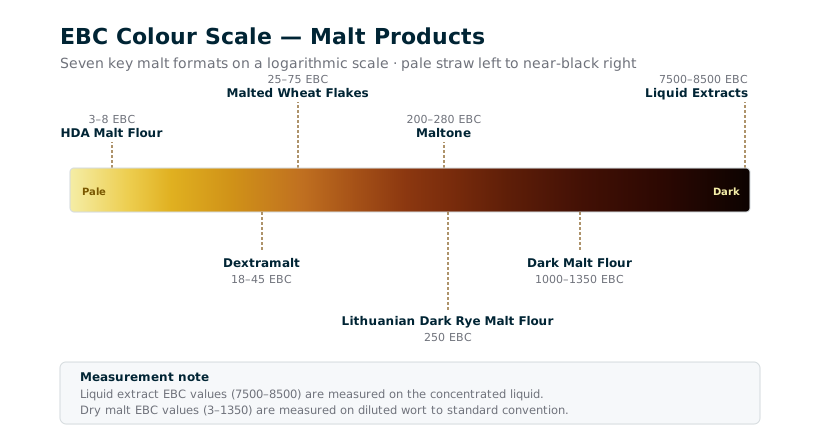 Horizontal EBC colour scale for malt products, from pale ivory (3 EBC) through amber, dark brown to almost-black liquid extract (7500+ EBC), with product labels at key colour positions
Important: liquid extract EBC values are not comparable to dry malt EBC values. The liquid extracts in the Domson catalogue (ULDO T/31, Bakels Dark Rye Malt Extract 8000) have stated EBC values of 7500–8500. These values are measured on the concentrated liquid extract itself, not on a diluted wort. They cannot be placed on the same numerical scale as dry malt powder EBC values — the measurement conventions are different. When using liquid extracts for colour, judge the result by the finished bread crust, not by trying to compare the 7500 EBC figure to a dry malt's 250 EBC.
EBC colour by product group (dry products, measured on wort):
- 3–8 °EBC: Very pale. EDME HDA White Bread Malt Flour 5600. Highest enzyme activity.
- 15–30 °EBC: Light. EDME SDM Medium Extract (spray-dried powder). Non-diastatic (spray-drying inactivates enzymes).
- 18–45 °EBC: Light-medium. EDME Dextramalt 5900. Diastatic.
- 25–75 °EBC: Medium amber. EDME Malted Wheat Flakes 6600. Some diastatic activity.
- 200–280 °EBC: Dark. EDME Maltone Dark Malt Powder 5905. Non-diastatic.
- 250 ± 40 EBCU: Dark rye. Lithuanian Dark Rye Malt. Non-diastatic (DP = 0).
- 1000–1350 °EBC: Very dark. EDME Dark Malt Flour 5700. Roasted barley, non-diastatic.
5. Maillard reaction and crust colour
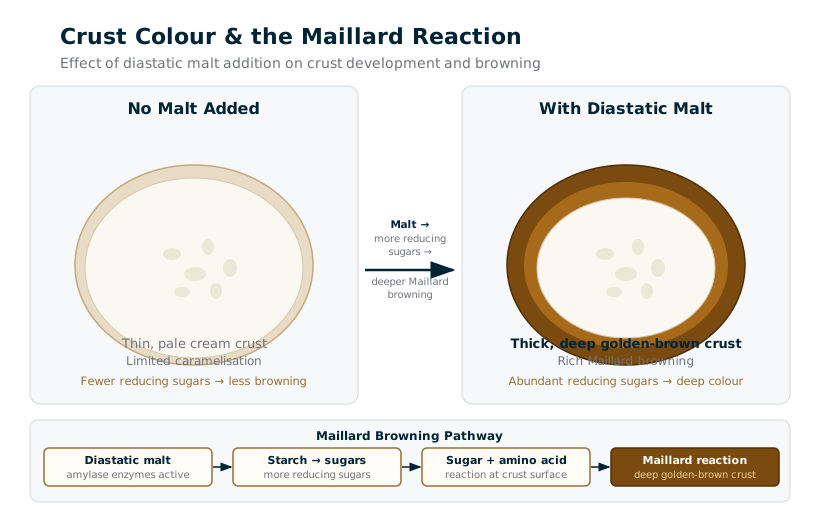 Two bread loaves cut in half showing the difference in crust colour between bread made without malt (pale crust) and bread with diastatic malt added (deep golden-brown crust), illustrating the Maillard reaction effect
The Maillard reaction is the main chemical process responsible for golden-to-brown crust colour (and for a large proportion of crust flavour) in bread. It is a non-enzymatic browning reaction between reducing sugars and amino acids at elevated temperatures.
The reaction proceeds at the bread surface as the oven temperature rises. It begins significantly above approximately 120°C and proceeds most rapidly at 150–160°C under normal bread-baking conditions.
How malt amplifies Maillard browning:
Diastatic malt adds alpha- and beta-amylase enzymes to the dough. During mixing and fermentation, these enzymes attack damaged starch in the flour, releasing maltose and other reducing sugars. By the time the dough enters the oven, it contains more reducing sugars than an unmalt-supplemented dough. These additional reducing sugars enter the Maillard reaction at the oven surface and produce deeper, richer crust colour and more complex flavour.
Non-diastatic malt and liquid extracts provide pre-formed reducing sugars directly — no enzyme activity is needed. The colour contribution is more direct and more predictable than from diastatic malt, but the profile is different: diastatic malt generates crust colour in concert with the specific flour composition and fermentation conditions, while dark liquid extracts have a more fixed colour contribution per gram added.
Note on enzyme inactivation during baking: Alpha-amylase and beta-amylase are denatured during baking as the internal dough temperature rises above approximately 70–75°C. Most enzyme activity ceases before crust temperatures reach the Maillard range. The enzyme's work — generating reducing sugars — is done during fermentation and the early oven stage; the Maillard reaction itself is a heat-driven chemical process, not an enzymatic one.
6. Products in the Domson catalogue
6.1 Diastatic malt flours
EDME HDA White Bread Malt Flour 25 kg
The most enzymatically active malt product in the Domson catalogue.
- Form: Flour (roller-milled, malted barley)
- Origin: UK (EDME Limited, Mistley, Essex)
- Diastatic power: 165–220 °IOB (target 180 °IOB)
- DU (Dextrinising Units): 60–90 dry (target 70)
- EBC colour: 3–8 °EBC (target 4.75) — very pale
- Allergen: Cereal gluten from barley
- Certifications: Kosher (BRC supplier), Halal, BRC, FSSC 22000
- Application: White bread, rolls, soft bread. Used as a diastatic enzyme supplement. At DP 165–220 °IOB, this is a high-activity product — dosage must be controlled precisely.
⚠️ Dosage caution: Over-dosage produces sticky, gummy crumb and excessively dark crust. BAKERpedia guidance for diastatic malt in white pan bread is 0.5–1.5% on flour (single source, no independent cross-check for HDA 5600 specifically). Request application guidelines from EDME Ltd before first use.
EDME Dextramalt 25 kg
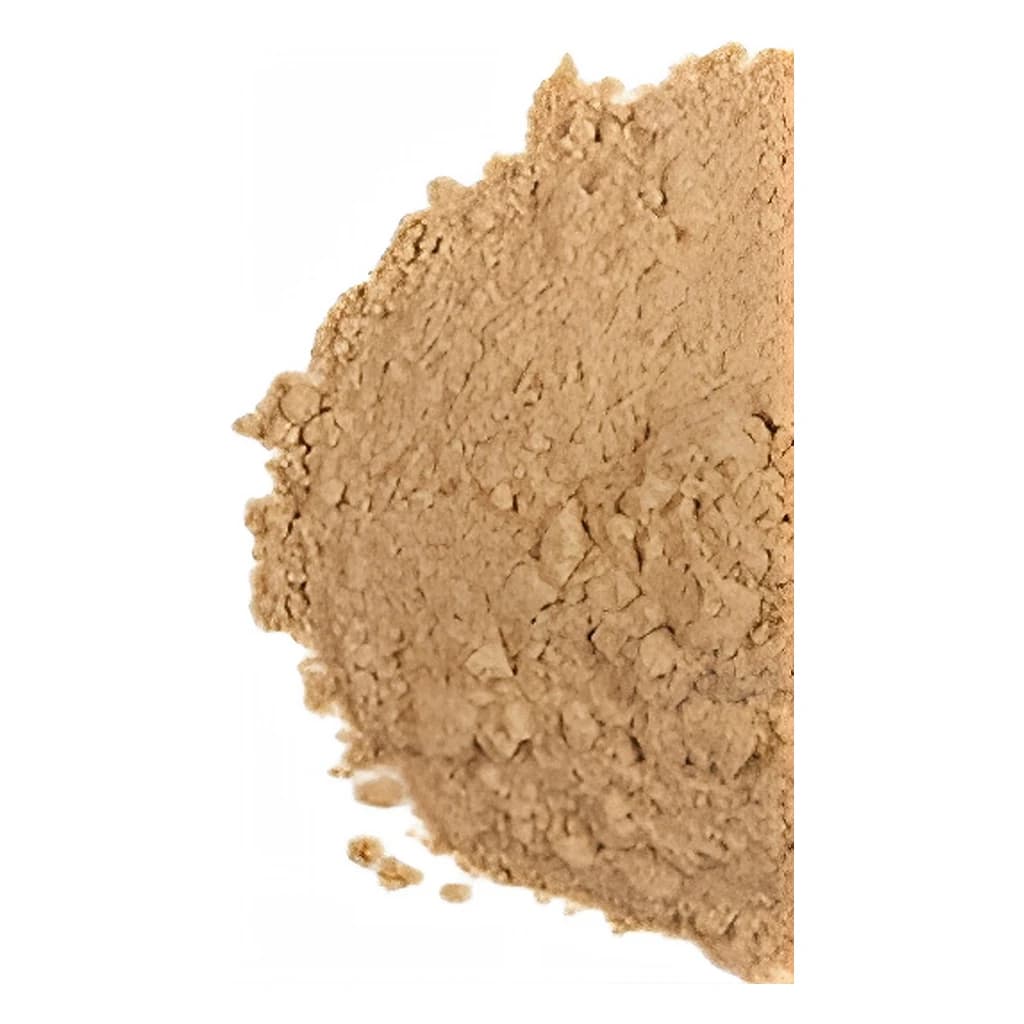
A diastatic malted wheat flour with moderate enzyme activity, delivering malt flavour and colour alongside enzymatic function.
- Form: Flour (roller-milled malted wheat)
- Origin: UK (EDME Limited)
- Grain: Wheat (malted)
- Diastatic power: 45–85 °IOB (target 65 °IOB)
- EBC colour: 18–45 °EBC (target 30) — light-medium, golden
- Allergen: Cereal gluten from wheat
- Certifications: Kosher (BRC supplier), Halal
- Application: Malted wheat bread, granary-style bread, rolls, brown bread. Dextramalt can be used at higher percentages (up to 10–15% partial flour replacement) for products where strong malt character is desired, with lower risk than HDA 5600 due to the lower DP.
Note for allergen management: Dextramalt is wheat-based (not barley). Formulations requiring barley-free products may substitute Dextramalt for HDA 5600. Formulations requiring wheat-free products cannot use Dextramalt.
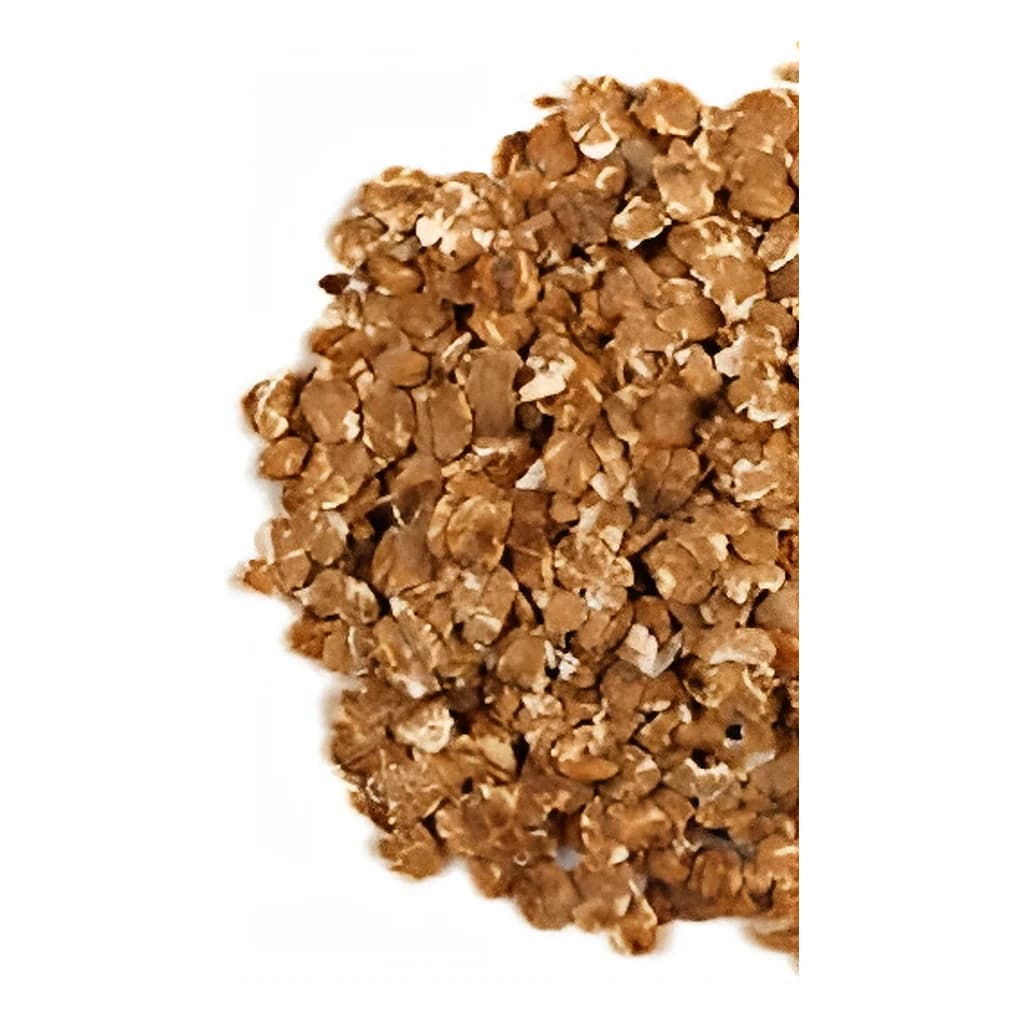
EDME Malted Wheat Flakes 25 kg
Steamed and flaked malted wheat, used primarily as a visible grain inclusion with the secondary benefit of contributing some enzymatic activity to the dough.
- Form: Flakes (steamed, flaked whole malted wheat)
- Origin: UK (EDME Limited)
- Grain: Wheat (malted)
- Hagberg Falling Number: 100–999 (target 120) — confirms active enzyme presence
- Flake thickness: 1.0–1.75 mm
- EBC colour: 25–75 °EBC (target 50) — light amber
- Allergen: Cereal gluten from wheat
- Certifications: Kosher (BRC supplier), Halal
- Application: Grain bread toppings, inclusion in seeded or granary-style loaves. The flakes provide visual texture and malt character. The low Hagberg (HFN 100–999, target 120) confirms enzyme activity, but because flakes are not milled into the dough matrix, their enzymatic contribution to the dough is substantially lower than that of an equivalent weight of diastatic malt flour. Do not use malted wheat flakes as a substitute for diastatic malt flour where enzymatic boosting is the primary goal.
6.2 Non-diastatic malt flours and powders
EDME SDM Medium Extract 25 kg
A spray-dried malt extract powder derived from barley malt. The spray-drying process uses high temperatures that inactivate amylase enzymes — this product functions as a sugar and flavour source, not as an enzyme supplement.
- Form: Powder (spray-dried extract)
- Grain: Barley malt
- EBC colour: 15–30 °EBC (target 22.5) — light to light-medium
- Refractometer solids: 95–98%
- pH: 5.0–5.8
- Sugar content: 81 g sugars per 100 g (from 90 g total carbohydrate per 100 g)
- Allergen: Cereal gluten from barley
- Certifications: Kosher (BRC supplier), Halal, FSSC 22000
- Application: Light malt extract for morning goods, white bread, biscuits, malt loaf. Provides sweetness and a light malt character. Use as a dry powder — easier to measure accurately than liquid extracts.
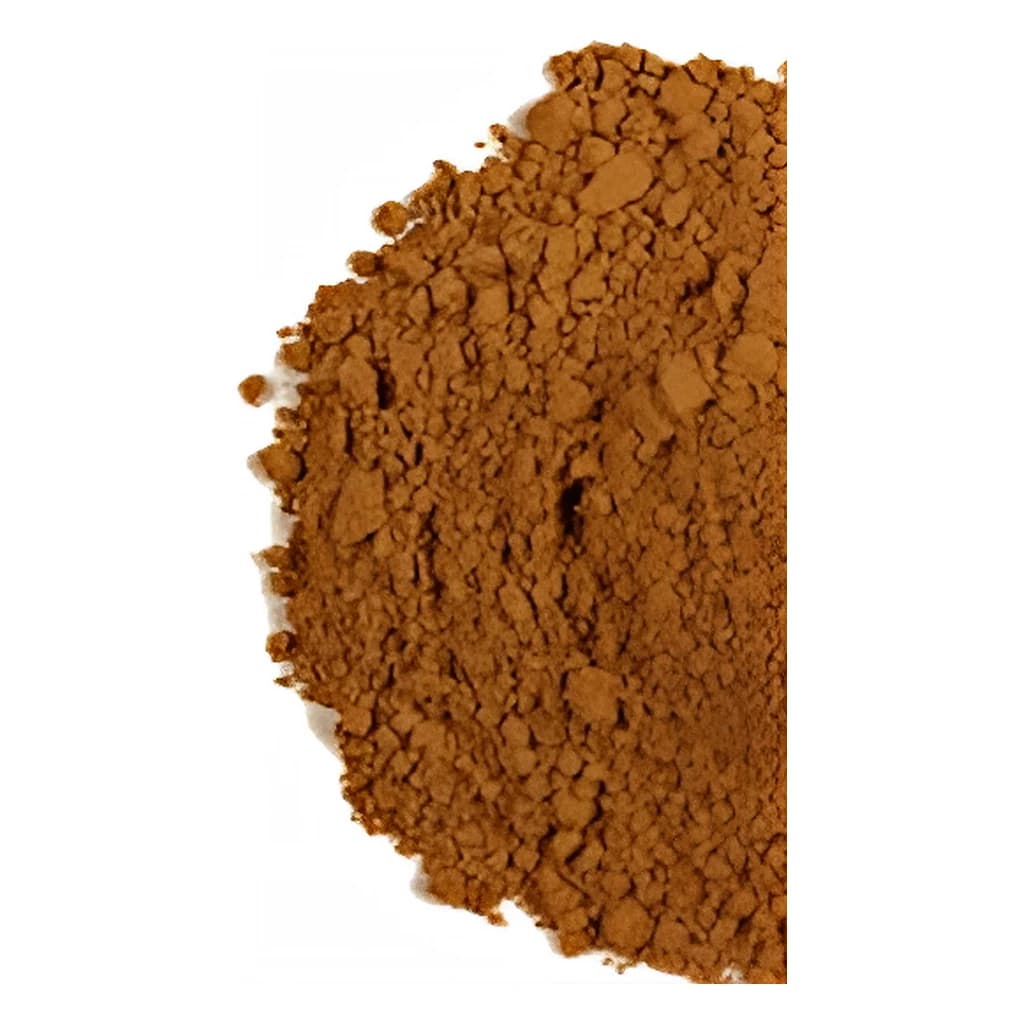
EDME Maltone Dark Malt Powder 25 kg
A dark malted barley flour (roller-milled). At 200–280 °EBC, this is a dark product where enzyme activity has been substantially or fully destroyed by the degree of kilning.
- Form: Flour (roller-milled malted barley)
- EBC colour: 200–280 °EBC (target 230) — dark amber/brown
- Diastatic: Non-diastatic at this colour level
- Allergen: Cereal gluten from barley
- Certifications: Kosher, Halal
- Application: Colouring and flavouring for dark bread, mixed grain bread, pumpernickel-style products. Provides genuine malt character at a darker colour level than Dextramalt, without the enzyme handling complexity.
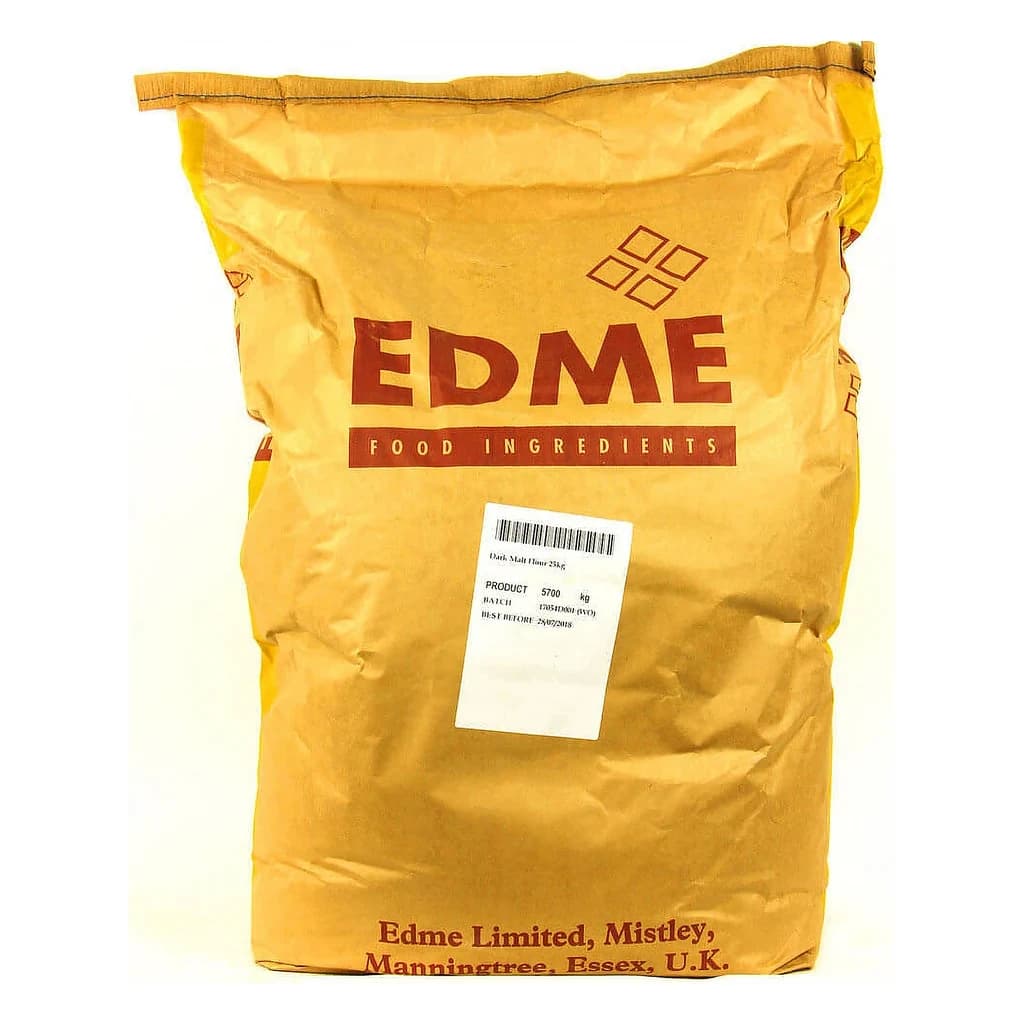
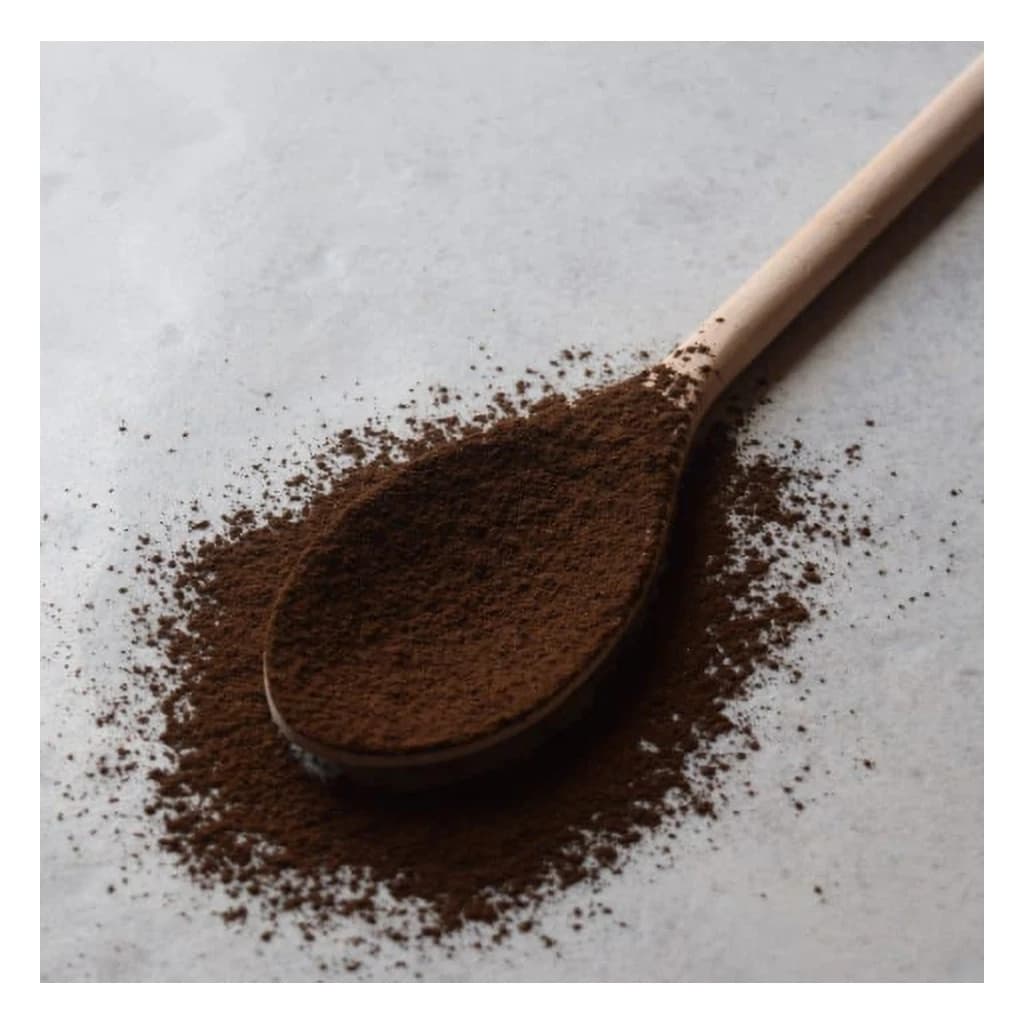
EDME Dark Malt Flour 25 kg
A very dark roasted barley flour. At 1000–1350 °EBC, this is the darkest dry malt product in the Domson catalogue. No enzyme activity.
- Form: Flour (roller-milled roasted barley)
- EBC colour: 1000–1350 °EBC (target 1175) — very dark red-brown
- Diastatic: No — roasting at high temperature destroys all enzyme activity
- Allergen: Cereal gluten from barley
- Certifications: Kosher, Halal
- Application: Colouring dark breads and mixed grain breads. At this EBC level, small additions (1–3% flour) create significant colour depth. Too much produces an intensely bitter, almost burnt flavour.
6.3 EDME Malt Cob Concentrate No.6 20 kg
A proprietary blend product combining malted wheat, wheat, wheat bran, and roasted barley. Proportions are not disclosed on the spec sheet.
- Form: Blended concentrate (flakes and flour mix)
- Grain: Malted wheat + wheat + wheat bran + roasted barley
- Diastatic: Mixed — the malted wheat component carries some enzyme activity; the roasted barley component is non-diastatic
- Allergen: Wheat and barley (both gluten sources present)
- Application: Ready-formulated malt bread concentrate. Use as a partial flour replacement at the ratio specified by EDME Ltd. Suitable for bakers who want a consistent dark malt bread product without individually weighing and combining multiple malt ingredients.
Note: Because exact component proportions are not disclosed, the EBC colour, diastatic power, and dosage for this product are not specifiable from the reviewed spec sheet. Contact EDME Ltd for full application guidance.
6.4 Dark rye malt flour
Lithuanian Dark Rye Malt 25 kg
A traditional Baltic fermented and roasted rye malt flour produced by Forbake / Lietuviskas Salyklas in Lithuania.
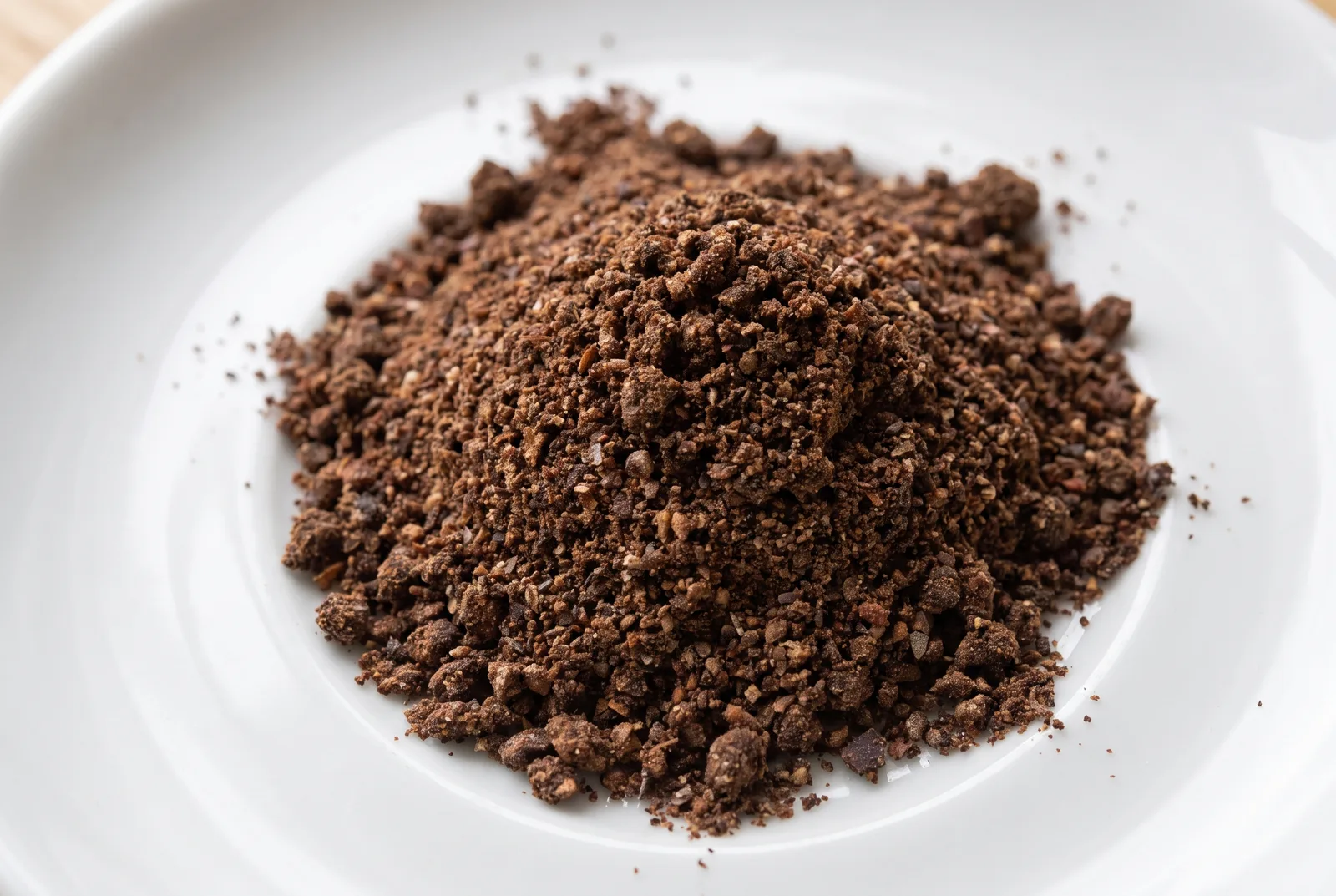 Close-up of Lithuanian dark rye malt flour showing irregular brown granules, illustrating the malt flour's coarser particle texture compared to fine white flour
- Form: Flour (irregular grind, <400 µm particle size)
- Origin: Lithuania (Lietuviskas Salyklas UAB)
- Grain: Rye (malted, fermented, gradually roasted)
- EBC colour: 250 ± 40 EBCU
- Diastatic power: 0 (EBC Analytica 4.12 method) — non-diastatic
- pH (10% solution): 4.5 ± 0.5
- Dosage: 2–6% of flour weight
- Allergen: Rye (contains gluten from rye — the only allergen declared)
- Shelf life: 12 months (cool, dark, dry conditions)
- Application: Dark rye bread (Borodinsky, Riga, Baltic black bread), mixed grain breads, rye sourdough. This product gives the authentic fermented dark rye malt character that distinguishes Eastern European dark rye bread from simply darkened wheat bread. The fermentation step (before roasting) develops acidity and characteristic flavour compounds not present in un-fermented roasted malts.
⚠️ Spec date note: The Forbake spec sheet reviewed is dated 2015-03-15. Request a current spec before any customer-facing publication. Nutritional values and allergen declarations in particular require up-to-date documentation.
6.5 Liquid malt extracts
Liquid malt extracts are produced by mashing malt in hot water (saccharification) and then concentrating the resulting wort under vacuum until a thick, viscous syrup is obtained. The high temperatures involved in production destroy amylase enzyme activity. All three liquid malt extracts in the Domson catalogue are therefore non-diastatic; they function as colourant, flavourant, and fermentable sugar sources.
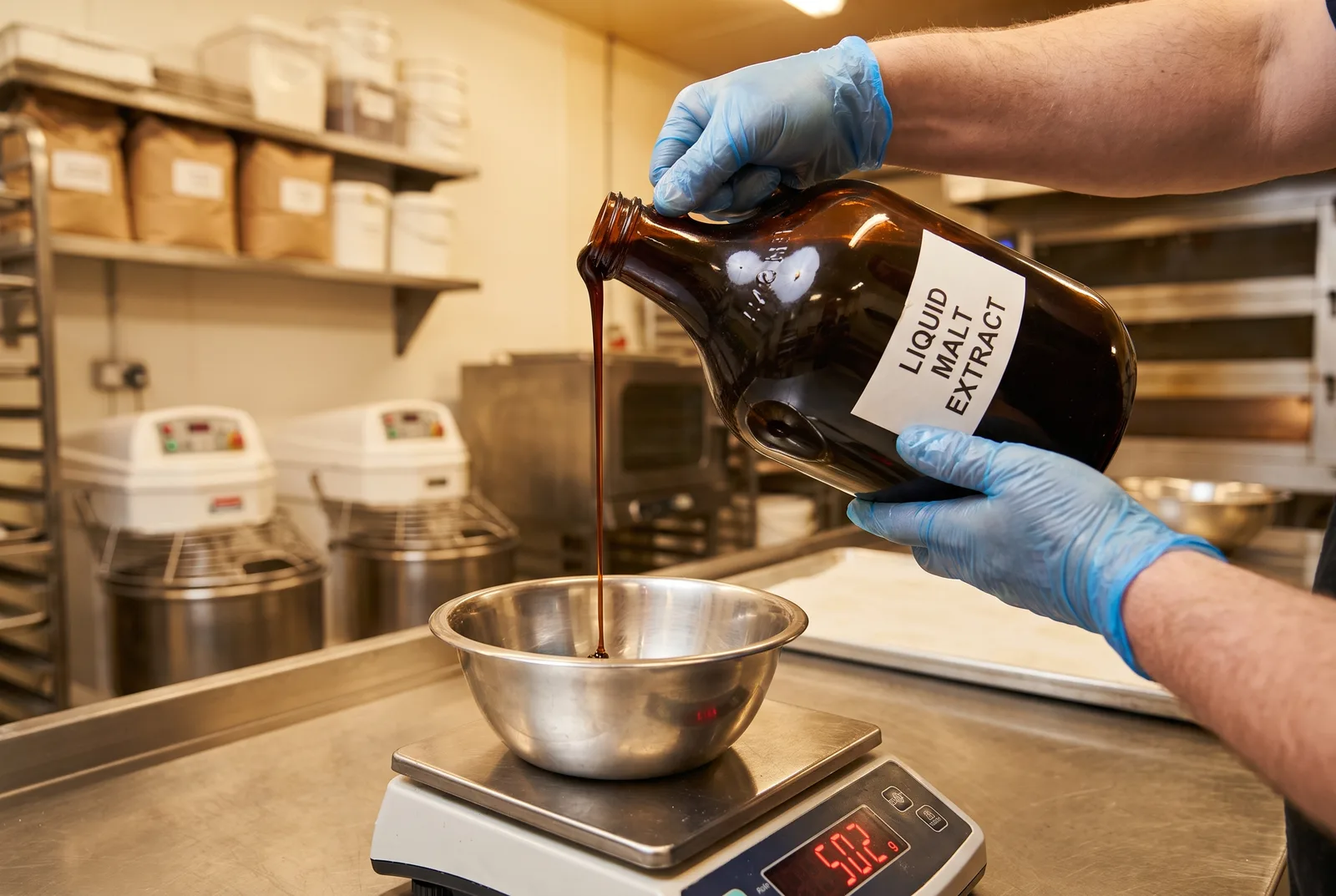
Baker weighing dark liquid malt extract from a commercial canister onto a digital scale, showing the thick viscous consistency of the dark brown syrup
Handling note: All liquid malt extracts are viscous and hygroscopic. At low temperatures they thicken significantly, making accurate dispensing difficult. Always dispense by weight on a tared digital scale. Never measure by volume (spoon or cup). Pre-dissolve in a portion of the dough water before adding to the dough. See the fault table below for handling-related fault diagnosis.
Rye Malt Extract T/31 ULDO Dark 14 kg
- Brand: ULDO Polska
- Ingredients: Barley malt, barley grain, water
- EBC colour: 7500–8500 (measured on concentrated liquid)
- Total extract: 74–76%
- pH: 3.8–4.5
- Specific weight: 1.3–1.4 kg/l
- Dosage: 0.5–5% of flour weight
- Energy: 278 kcal/100g
- Allergen: Barley (contains gluten from barley)
- Shelf life: 18 months (max 30°C, max 75% RH, sealed)
- Application: Colouring, aromatising, and flavouring dark rye, mixed, and wholemeal bread. Very dark extract — even low dosages (1–2%) produce significant colour contribution.
⚠️ Spec date note: The ULDO T/31 spec sheet reviewed is dated 2014. This is more than ten years old. Request a current spec before any customer-facing publication.
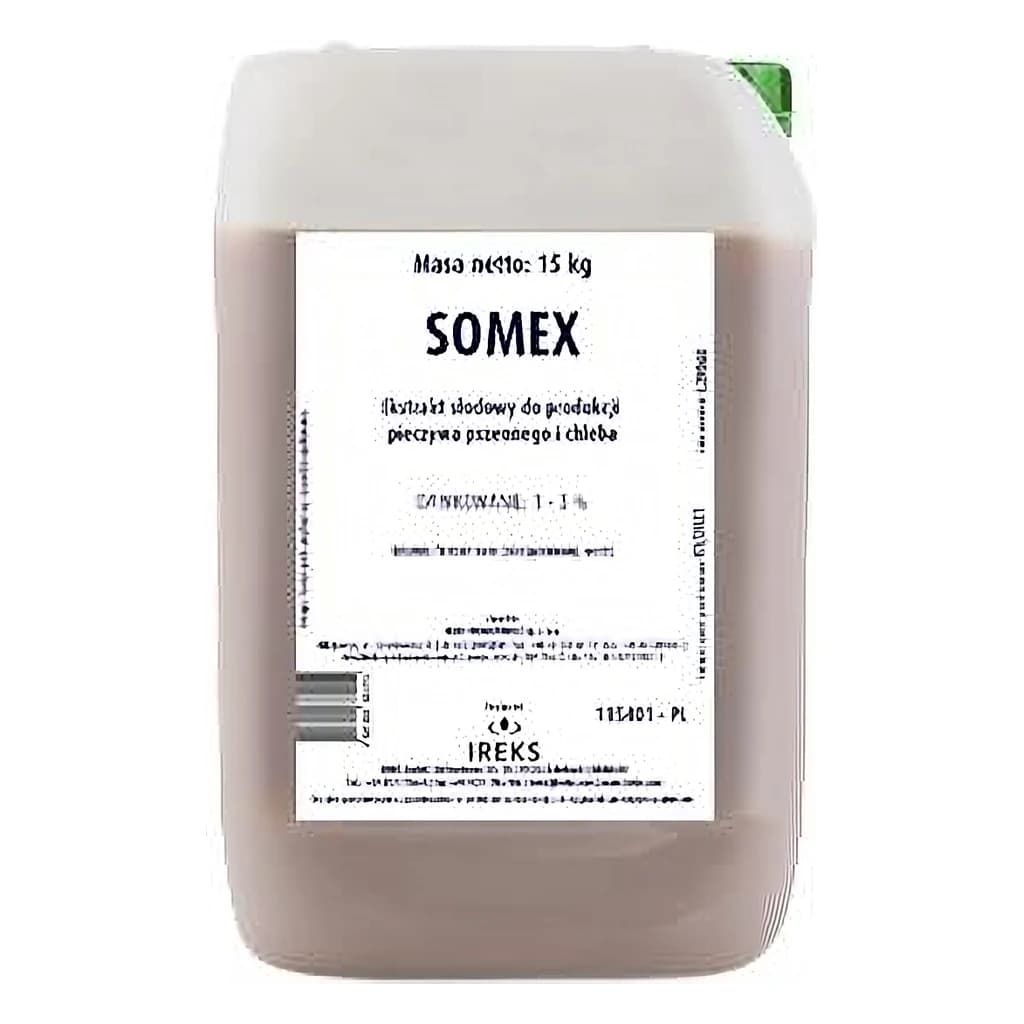
IREKS SOMEX Liquid Malt Extract 15 kg
- Brand: IREKS GmbH (Germany)
- Ingredients: Barley malt, water
- EBC colour: Not stated on spec sheet
- Solids (refractometer): 77.0–79.0%
- pH: 4.7–5.8 (10 g/200 ml solution)
- Specific weight: 1.25–1.52 kg/l
- Dosage: 1–3% of flour weight
- Energy: 290 kcal/100g
- Allergen: Barley (contains gluten from barley)
- Shelf life: Minimum 9 months (dry, cool)
- Application: Described on the spec as suitable for "wheat morning goods and coarse grain bread." This positions SOMEX as a lighter-register liquid extract compared to the dark rye extracts (ULDO T/31, Bakels 8000). Use for a subtle malt sweetness and light browning contribution to wheat rolls, baguettes, and similar products.
Bakels Dark Rye Malt Extract 8000 — 14 kg
- Brand: Bakels (Finland — Bakels Polska)
- Ingredients: Barley malt, water, rye malt
- EBC colour: 7500–8500 (measured on concentrated liquid)
- Solids: 74–76%
- pH: 3–5
- Specific weight: 1.3–1.4 g/ml
- Dosage: 10–70 g per kg flour (= 1–7%); typical usage 20–30 g/kg (2–3%)
- Energy: 261 kcal/100g
- Allergen: Barley AND Rye (both gluten-containing cereals present) ⚠️ food safety flag
- Shelf life: 18 months (sealed, max 25°C); after opening, store below 15°C
- Application: Described on spec as a natural alternative to caramel for colouring and flavouring dark rye bread, mixed bread, and wholegrain bread. Contains both barley and rye — note the dual allergen declaration.
Post-opening storage note: Bakels explicitly specifies below 15°C after opening. Do not store opened containers at ambient temperature.
6.6 Blended malted flour
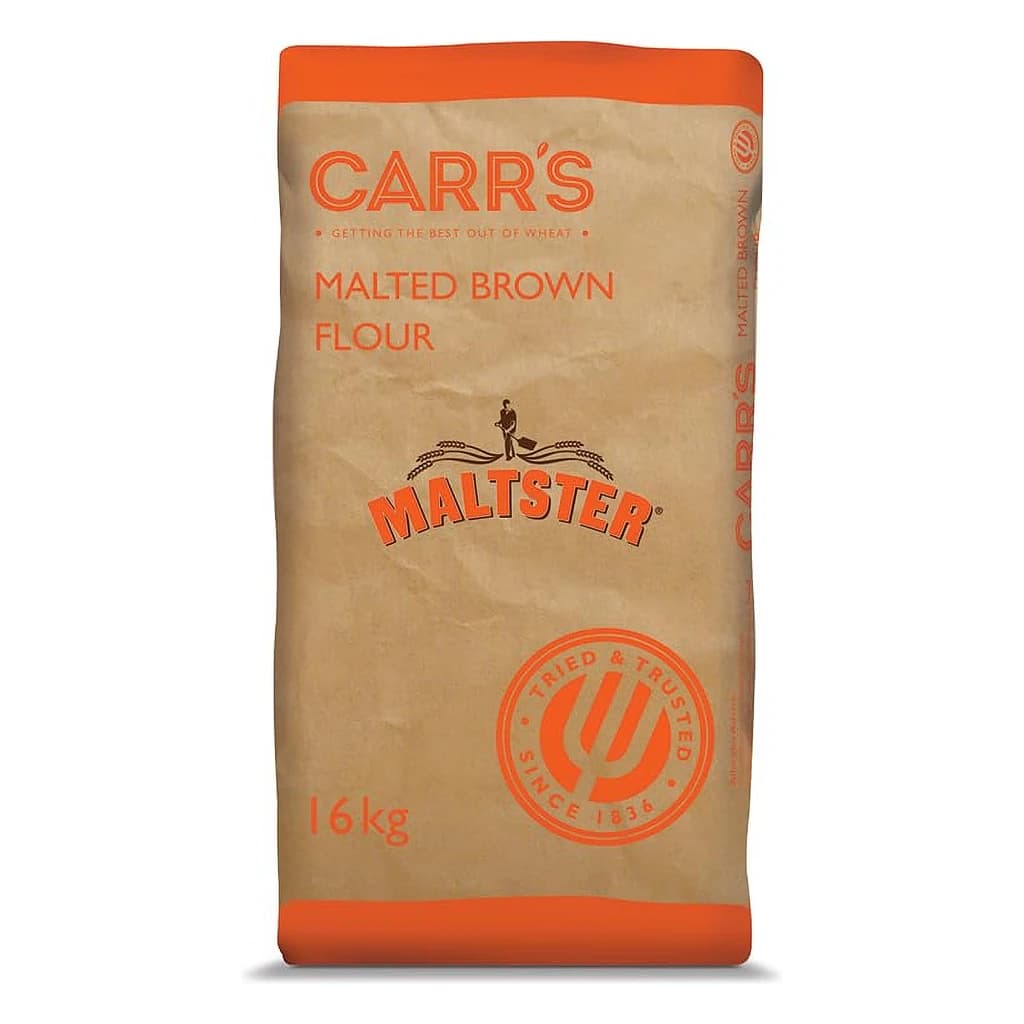
Maltster Malted Brown Flour 16 kg
A ready-to-use malted brown flour blend produced by Carr's Maldon Mill (UK). This is not a pure malt ingredient — it is a pre-mixed flour designed for direct use as the main flour in malted brown bread, replacing the baker's own blending of malt ingredients with plain flour.
- Brand: Carr's Maldon Mill (Maldon, Essex)
- Composition (stated on spec): Wheat flour 78.6%, malted wheat flakes 15.3%, malted barley flour 2.8%, wheat gluten 2.5%
- Protein: 12.6–13.2% ⚠️ The per-100g nutrition panel on the same spec declares 13.6 g protein, which lies outside this specification range. Clarification from Carr's Maldon Mill is required before publishing either figure.
- Diastatic: Partial — contains malted wheat flakes and malted barley flour, both of which carry some enzyme activity
- Allergen (intentional): Wheat (present; contains wheat gluten) ⚠️ food safety flag
- Allergen — CRITICAL INCONSISTENCY: The Carr's spec allergen section classifies barley as a supply chain contamination risk. However, the same spec's recipe breakdown lists Malted Barley Flour at 2.78% as a named intentional ingredient. Under UK Food Information Regulations 2014 / EU Regulation 1169/2011, barley is a cereal containing gluten and must be prominently declared when intentionally present — this cannot be reduced to a 'may contain' cross-contact statement. This inconsistency may be an allergen labelling error within the spec itself. Expert allergen specialist review is required before this product is listed or marketed. Soy is also listed as a supply chain contamination risk and must be assessed for 'may contain' labelling separately. ⚠️ food safety flag
- Shelf life: 6 months from packing (ambient conditions)
- UK flour fortification: Fortified per UK regulations (calcium, iron, niacin, thiamine)
- Certifications: NOT Kosher, NOT Halal
- Application: Straight drop-in replacement for brown bread flour in malted brown loaves. The pre-mixed format ensures consistency without the need to separately weigh and blend malt flours, flakes, and gluten. Use in standard brown bread formulas.
⚠️ CRITICAL allergen note: The Carr's spec allergen section describes barley as a supply chain contamination risk; however, Malted Barley Flour is listed as an intentional ingredient at 2.78% in the recipe breakdown on the same spec. Barley as an intentional ingredient must be declared prominently under UK Food Information Regulations 2014 / EU Regulation 1169/2011 — it cannot be treated as a 'may contain' cross-contact disclosure. This inconsistency may be a labelling error in the Carr's spec and must be resolved by an allergen specialist before any customer-facing use or labelling. Soy cross-contact (supply chain) is a separate 'may contain' risk that also requires formal allergen risk assessment.
⚠️ Kosher/Halal: This product is confirmed NOT Kosher and NOT Halal certified on the spec sheet reviewed. Do not sell to customers requiring Kosher or Halal compliance.
7. Choosing the right malt product: application guide
Dark rye bread (Borodinsky, Baltic black bread, dark mixed bread)
Use Lithuanian Dark Rye Malt (2–6% on flour) as the primary malt flour — it provides the authentic fermented, gradually roasted rye malt character. Combine with Bakels Dark Rye Malt Extract 8000 (2–3%) or ULDO T/31 (1–3%) for additional crust colour and malt intensity. Neither product is diastatic; the dough's fermentation is handled by rye sourdough.
Malted wheat bread (granary-style, Hovis-style, British malted brown)
For a straightforward malted brown loaf, use Maltster Malted Brown Flour (Carr's) as a direct flour replacement. For custom formulas, blend strong white flour with EDME Dextramalt (10–15%) for malt flavour and moderate enzyme activity, and EDME Malted Wheat Flakes (3–5%) for visual texture and bite.
White bread enzyme supplementation
When flour has low natural enzyme activity (high Hagberg, poor fermentation, pale crust), add EDME HDA White Bread Malt Flour 5600 at a low dosage (typically 0.5–1.5% on flour for white pan bread — single source: BAKERpedia; no independent cross-check for HDA 5600 specifically; verify with EDME before first use). This is the highest-DP product in the catalogue; precision weighing is essential.
Wheat morning goods (rolls, baguettes)
IREKS SOMEX at 1–2% on flour provides a light malt sweetness and a subtle browning contribution appropriate for white wheat morning goods where malt is a background note, not the defining flavour.
Dark bread colouring without fermentation effects
EDME Dark Malt Flour 5700 (1–3% on flour) or EDME Maltone 5905 (2–5%) add dark colour without any enzymatic risk. Both are roller-milled non-diastatic barley malts. Use EDME Maltone for a dark amber colour (200–280 EBC); use EDME Dark Malt Flour 5700 for a very dark red-brown (1000–1350 EBC).
8. Allergen summary
All twelve malt products in the Domson catalogue contain gluten from cereal sources. This is the fundamental limitation of malt in baking: malt is cereal-derived and cannot be used in gluten-free formulations.
The gluten source varies by product:
| Gluten grain | Products |
|---|---|
| Wheat (intentional) | EDME Dextramalt, EDME Malted Wheat Flakes, EDME Malt Cob Concentrate No.6, Maltster Malted Brown Flour |
| Barley (intentional) | Lithuanian Dark Rye Malt — No. Rye only. ULDO T/31, IREKS SOMEX, EDME SDM Medium Extract, EDME Dark Malt Flour, EDME Maltone, EDME Malt Cob Concentrate No.6, EDME HDA White Bread Malt Flour |
| Rye (intentional) | Lithuanian Dark Rye Malt, Bakels Dark Rye Malt Extract 8000 |
| Both barley and rye | Bakels Dark Rye Malt Extract 8000 |
| Both wheat and barley | EDME Malt Cob Concentrate No.6, Maltster Malted Brown Flour (barley — ⚠️ see critical allergen note in Section 6.6) |
⚠️ CRITICAL — Maltster Malted Brown Flour: the Carr's spec allergen section classifies barley as a supply chain contamination risk, but Malted Barley Flour is listed as an intentional recipe ingredient at 2.78% in the same spec's recipe breakdown. An intentional barley ingredient requires prominent labelling under UK FIR / EU 1169/2011 — not merely a 'may contain' notice. This inconsistency may be a labelling error in the Carr's spec. Expert allergen review is required before any customer-facing use or labelling. Soy cross-contact (supply chain) also requires formal 'may contain' risk assessment.
See the table below for the full product-by-product allergen matrix.
9. Coverage notes and known gaps
Products with missing dosage information: The spec sheets for EDME HDA 5600, Dextramalt, SDM Medium Extract, Maltone, Dark Malt Flour, Malted Wheat Flakes, and Malt Cob Concentrate do not state a dosage range. Application guidance should be requested from EDME Limited (Mistley, Essex) before any dosage-related content is published.
Old spec sheets: Lithuanian Dark Rye Malt spec is dated 2015; ULDO T/31 spec is dated 2014.
EBC comparison caveat: The statement that liquid extract EBC values (7500–8500) are not directly comparable to dry malt EBC values is based on the known differences in EBC measurement methodology (concentrated liquid vs. wort dilution). No single source is cited for this methodological distinction in the spec sheets reviewed. It is stated as qualitative guidance.
Diastatic power for liquid extracts: None of the three liquid malt extracts (ULDO, IREKS SOMEX, Bakels) provides diastatic power data on the reviewed spec sheets. Their non-diastatic status is inferred from product description (colourant/flavourant function) and from the general principle that hot-water mashing plus vacuum concentration inactivates amylase enzymes. No analytical confirmation from the spec sheets is available.
EDME Malt Cob Concentrate No.6 — composition not fully disclosed: Proportions of the four components (malted wheat, wheat, wheat bran, roasted barley) are not given on the reviewed spec. EBC colour, diastatic power, and dosage cannot be stated without contacting EDME.
Languages: This article is currently available in English only. Polish, Turkish, Arabic, Romanian, Lithuanian, and Bulgarian translations are pending. Lithuanian translation may be of particular value given the Lithuanian Dark Rye Malt product (Forbake).
Regulatory note on malt ingredients: Malt flour and malt extract are commonly used bread improver components regulated under EC Regulation 1333/2008 (EU) and the UK Bread and Flour Regulations 1998 / UK Food Additives Regulations. In most applications they are used as food ingredients rather than additives and do not require E-number declaration. No regulatory flag has been raised by any supplier spec sheet reviewed for this article. However, this has not been independently verified.
Figures
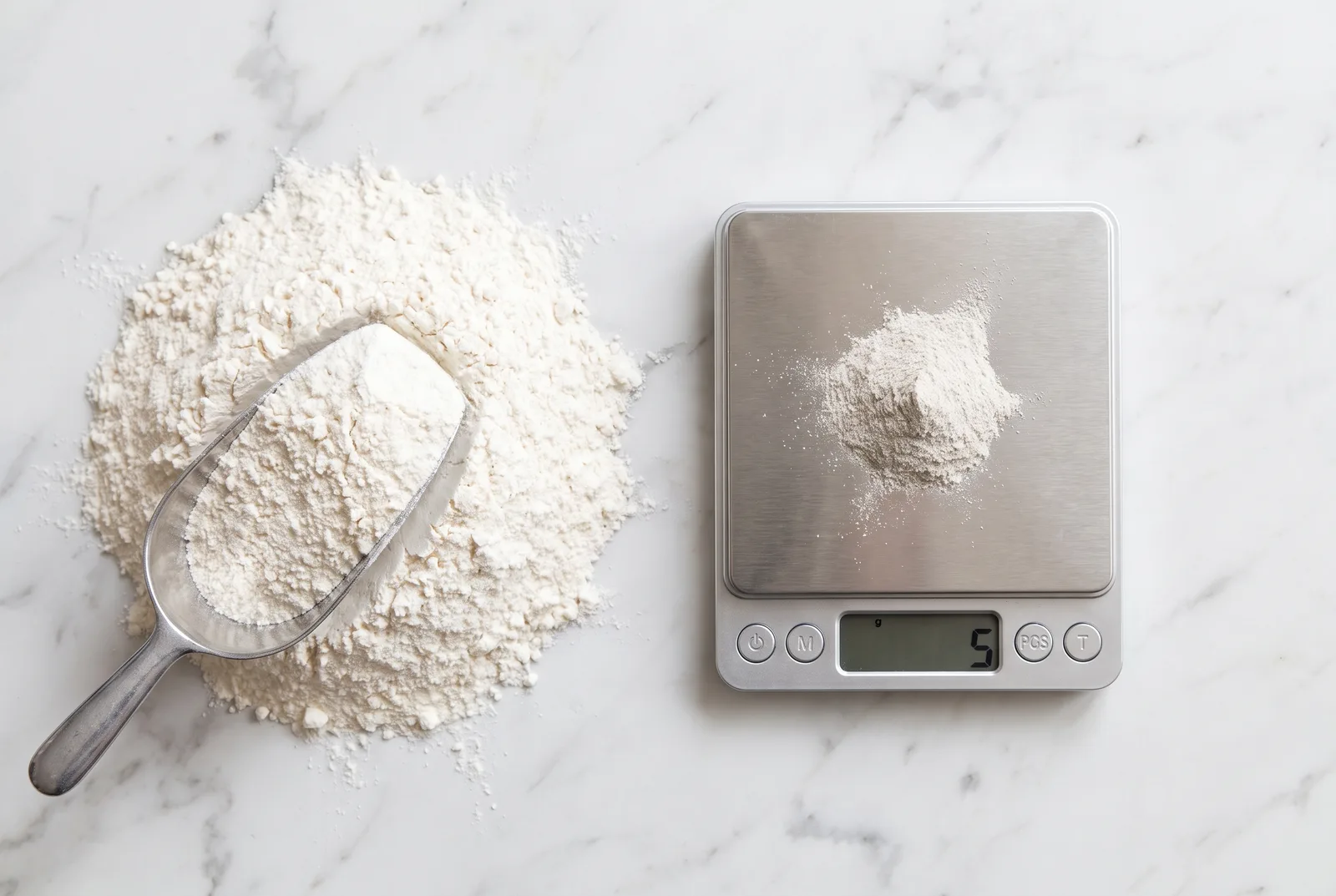 Close-up of pale diastatic malt flour being weighed alongside white bread flour on a precision scale, showing the small proportion used relative to the main flour
Dark rye bread with Lithuanian Dark Rye Malt and Bakels Dark Rye Malt Extract
Reference baker's percentage formula for a continental dark rye bread using both malt flour (for flavour and body) and liquid malt extract (for colour and sweetness). Both products are non-diastatic. Rye sourdough provides leavening and acidity.
| Ingredient | Baker's % | Weight |
|---|---|---|
| Dark rye flour (T720 or T2000) — Base flour | 100% | |
| Water — Higher than wheat bread due to rye absorption | 75–80% | |
| Rye sourdough (active) — For leavening and acidity | 25–30% | |
| Salt | 1.8–2.0% | |
| Lithuanian Dark Rye Malt 25 kg — Non-diastatic; provides colour, fermented rye flavour, and body. Do not increase beyond 6%. | 2–4% | |
| Bakels Dark Rye Malt Extract 8000 — Non-diastatic liquid extract; provides deep crust colour and malt-maltose flavour. Weigh precisely — high EBC means small additions have large colour impact. | 2–3% |
Yield: 1 standard 1 kg loaf
Rye flour requires higher hydration than wheat flour. The malt extract contributes colour and fermentable sugars for the crust. Adjust liquid malt extract within the stated range (2–3% usual) for colour intensity. Rye sourdough must be active and well-acidified to give proper crumb structure.
Malted wheat bread using EDME Dextramalt (diastatic)
Reference formula for a malted wheat bread in the granary/Hovis style, using diastatic Dextramalt flour to enhance fermentation and crust colour. Malted wheat flakes provide texture and visual character.
| Ingredient | Baker's % | Weight |
|---|---|---|
| Strong white bread flour (T550 or UK bread flour) — Base structure | 85% | |
| EDME Dextramalt 25 kg — Diastatic malted wheat flour; contributes malt flavour, golden colour, and enzymatic boost to fermentation | 10% | |
| EDME Malted Wheat Flakes 25 kg — Non-contributing to gluten; adds malty texture and visual speckling | 5% | |
| Water — Adjust for batch hydration; malted wheat flakes absorb water slightly | 60–65% | |
| Instant dry yeast | 1.0–1.5% | |
| Salt | 1.8% |
Yield: Reference percentages; scale to production batch
Dextramalt is diastatic (DP 45–85 °IOB) — it generates additional fermentable sugars during fermentation, which boosts yeast activity and deepens crust colour. Do not over-dose — monitor crumb firmness. The malted wheat flakes are a texture/visual inclusion and do not significantly alter dough water absorption at this dosage.
White bread with EDME HDA Malt Flour — precision diastatic dosing
Reference formula demonstrating the careful use of the highly diastatic HDA 5600 flour in standard white bread. At DP 165–220 °IOB, this is the most enzyme-active product in the Domson catalogue and must be used at low dosage with precision weighing.
| Ingredient | Baker's % | Weight |
|---|---|---|
| Strong white bread flour — Base | 99.5% | |
| EDME HDA White Bread Malt Flour 5600 — ⚠️ CAUTION: highly diastatic (DP 165–220 °IOB). Weigh precisely. Do not exceed 1% without baking trials. | 0.5% | |
| Water | 62–65% | |
| Instant dry yeast — Consider slightly reducing yeast if fermentation accelerates noticeably with malt addition | 1.0–1.2% | |
| Salt | 1.8–2.0% |
Yield: Reference percentages
HDA Malt Flour at DP 165–220 °IOB is significantly more active than Dextramalt (45–85 °IOB). Over-dosage causes sticky, gummy crumb and excessive browning. Start at 0.5% and test before increasing. Best weighed on a precision scale to ±1g for a 50 kg flour batch. Result: deeper crust colour, faster fermentation, improved oven spring.
All malt and malted grain products with key specification data extracted from first-party spec sheets. EBC values for dry malt products are measured on diluted wort per EBC standard; EBC values for liquid extracts are measured on the concentrated liquid and are not directly comparable to dry product EBC values.
| Product name | Catalogue product ID | Brand | Form | Grain | EBC colour | Diastatic? | Diastatic power | Typical dosage | Allergen (gluten grain) | Shelf life | Kosher/Halal |
|---|---|---|---|---|---|---|---|---|---|---|---|
| Lithuanian Dark Rye Malt 25 kg | Forbake / Lietuviskas Salyklas | Flour (irregular grind, <400 µm) | Rye (malted, fermented, gradually roasted) | 250 ± 40 EBCU (dark) | No — DP = 0 | 0 (EBC Analytica 4.12) | 2–6% flour weight | Rye | 12 months (dark, cool, dry) | GMO-free; no certification stated on spec | |
| Rye Malt Extract (T/31 ULDO Dark) 14 kg | ULDO Polska | Liquid extract (thick, dark brown) | Barley malt, barley grain | 7500–8500 EBC (measured on concentrate) | Not stated — functions as colourant/flavourant | Not measured/stated on spec | 0.5–5% | Barley | 18 months (max 30°C, 75% RH) | GMO-free; no certification on spec (2014 spec) | |
| IREKS SOMEX Liquid Malt Extract 15 kg | IREKS GmbH | Liquid extract (brown, viscous) | Barley malt | Not stated | Not stated — light extract for wheat morning goods | Not stated | 1–3% | Barley | Min 9 months (dry, cool) | Not stated; HACCP + ISO 9001 | |
| EDME SDM Medium Extract 25 kg | EDME Limited | Powder (spray-dried extract) | Barley malt | 15–30 °EBC (target 22.5) — light-medium | No — spray-drying destroys enzyme activity | Not stated; enzymes inactivated by spray-drying | Not stated on spec; see application guidance | Barley | Not stated on spec pages reviewed | Kosher (BRC supplier), Halal, FSSC 22000 | |
| EDME Dextramalt 25 kg | EDME Limited | Flour (roller-milled malted wheat) | Wheat (malted) | 18–45 °EBC (target 30) — light-medium | YES | 45–85 °IOB (target 65 °IOB) — moderate | Not stated on spec; see application guidance | Wheat | Not stated on spec pages reviewed | Kosher (BRC supplier), Halal | |
| EDME Dark Malt Flour 25 kg | EDME Limited | Flour (roasted barley, roller-milled) | Barley (roasted) | 1000–1350 °EBC (target 1175) — very dark | No — roasting destroys all enzyme activity | 0 (inactivated by roasting) | Not stated on spec; see application guidance | Barley | Not stated on spec pages reviewed | Kosher, Halal | |
| EDME Maltone Dark Malt Powder 25 kg | EDME Limited | Flour (roller-milled malted barley) | Barley (malted) | 200–280 °EBC (target 230) — dark | No — at this colour level, enzyme activity substantially or fully destroyed | Not measured/stated on spec | Not stated on spec; see application guidance | Barley | Not stated on spec pages reviewed | Kosher, Halal | |
| EDME Malted Wheat Flakes 25 kg | EDME Limited | Flakes (steamed, flaked malted wheat) | Wheat (malted) | 25–75 °EBC (target 50) | Partial — Hagberg 100–999 confirms enzyme activity | Hagberg FN 100–999 (target 120) — significant alpha-amylase activity | Topping/inclusion use; see application guidance | Wheat | Not stated on spec pages reviewed | Kosher, Halal | |
| EDME Malt Cob Concentrate No.6 20 kg | EDME Limited | Blend (flakes + flours mix) | Wheat (malted + unmalted) + Wheat Bran + Roasted Barley | Not stated on spec | Mixed — contains both malted wheat (some DP) and roasted barley (non-diastatic) | Not stated on spec | Not stated on spec; see application guidance | Wheat and Barley | Not stated on spec pages reviewed | Not stated on spec | |
| EDME HDA White Bread Malt Flour 25 kg | EDME Limited | Flour (roller-milled malted barley) | Barley (malted, pale kiln) | 3–8 °EBC (target 4.75) — very pale | YES — highest diastatic activity in catalogue | 165–220 °IOB (target 180 °IOB) + DU 60–90 dry (target 70) | See application guidance; caution — high DP requires careful dosing | Barley | Not stated on spec pages reviewed | Kosher, Halal; BRC, FSSC 22000 | |
| Bakels Dark Rye Malt Extract 8000 — 14 kg | Bakels | Liquid extract (viscous, dark brown) | Barley malt + Rye malt | 7500–8500 EBC (measured on concentrate) | Not stated — described as caramel alternative / colourant | Not measured/stated on spec | 10–70g/kg flour (1–7%); usually 20–30g/kg (2–3%) | Barley and Rye | 18 months (sealed, max 25°C); after opening: below 15°C | GMO-free; no Kosher/Halal noted on spec | |
| Maltster Malted Brown Flour 16 kg | Carr's Maldon Mill | Flour (malted brown flour blend) | Wheat (main) + Malted Wheat Flakes + Malted Barley Flour + Wheat Gluten | Not stated | Partial — contains malted wheat flakes and malted barley flour | Not stated on spec | Straight replacement for brown bread flour | Wheat (YES); Barley contamination risk (supply chain); Soy contamination risk | 6 months from packing (ambient) | NOT Kosher, NOT Halal certified |
Practical comparison of the two fundamental malt categories relevant to professional bakers.
| Property | Diastatic malt | Non-diastatic malt |
|---|---|---|
| Definition | Malt with active alpha- and beta-amylase enzymes preserved by mild kiln temperatures | Malt with enzyme activity destroyed by high kiln/roasting temperatures |
| EBC colour (typical dry product) | Low: 3–8 EBC (pale) to 45 EBC (medium). EDME HDA: 3–8; Dextramalt: 18–45 | Medium to very high: 200–280 EBC (Maltone), 250 EBC (Lithuanian Rye), 1000–1350 EBC (Dark Malt Flour) |
| Primary function | Enzyme supplement: breaks starch into fermentable sugars → feeds yeast, boosts oven spring, deepens crust colour via Maillard reaction | Flavour, colour, and sugar contribution only — no enzymatic starch conversion |
| Effect on fermentation | Boosts yeast activity by generating additional maltose from damaged starch | Minor — provides some pre-formed sugars but does not increase total fermentable sugar pool via enzyme action |
| Effect on crust colour | Deepens crust colour by increasing reducing sugars for Maillard browning; effect is enzymatically driven during dough fermentation and early baking | Deepens crust colour via pre-formed reducing sugars and caramel compounds already present; colour effect is more direct/predictable |
| Dosage risk | High — over-dosage generates too much starch breakdown, causing sticky, gummy crumb and uncontrolled fermentation. Must be weighed precisely. | Lower — excess flavour and colour are the main risks; crumb structure risk is minimal at moderate dosages |
| Typical Domson catalogue examples | EDME HDA 5600 (DP 165–220 °IOB); EDME Dextramalt (DP 45–85 °IOB); EDME Malted Wheat Flakes (HFN 100–999) | Lithuanian Dark Rye Malt (DP 0); EDME Dark Malt Flour (1000–1350 EBC); EDME Maltone (200–280 EBC); Bakels / ULDO liquid extracts (7500–8500 EBC on concentrate) |
EBC (European Brewery Convention) is the standard colour measurement for malt. For dry products, EBC is measured on a standardised diluted wort. For concentrated liquid extracts, EBC is measured on the liquid directly — these values are not directly comparable to dry malt EBC values on the same numerical scale.
| EBC range | Description | Domson catalogue examples | Typical use |
|---|---|---|---|
| 3–8 °EBC | Very pale, almost white. Highest diastatic activity. Resembles pale lager malt. | EDME HDA White Bread Malt Flour 5600 | Diastatic supplement for white bread, rolls, morning goods. Must be dosed precisely. |
| 18–45 °EBC | Light golden flour. Moderate diastatic activity. Sweet malt flavour. | EDME Dextramalt 5900 | Malted bread, brown bread, Hovis-style loaves, rolls with malt character. |
| 25–75 °EBC | Light to medium amber. In flake form, earthy/malty. Some diastatic activity (Hagberg 100–999). | EDME Malted Wheat Flakes 6600 | Topping and inclusion for malted grain breads, granary-style loaves, seeded bread. |
| 200–280 °EBC | Dark amber/brown flour. At this level, enzyme activity is largely or fully destroyed. Strong roasted malt flavour. | EDME Maltone 5905 | Colouring and flavouring for dark bread, mixed grain bread, pumpernickel-style. |
| 250 ± 40 EBCU | Dark brown rye malt flour (non-diastatic; DP = 0). Fermented and gradually roasted rye. | Forbake Lithuanian Dark Rye Malt 2210 | Dark rye bread, mixed bread, rye sourdough — colour and flavour. |
| 1000–1350 °EBC | Very dark red-brown flour. Roasted barley. No diastatic activity. Intense colour contribution. | EDME Dark Malt Flour 5700 | Deepening colour of dark breads, stout-style grain breads, colouring mixes. |
| 7500–8500 EBC (liquid, concentrated) | Very dark brown liquid extract. Concentrated colourant. Values measured on concentrate — not comparable to dry product EBC. | Bakels Dark Rye Malt Extract 8000; ULDO T/31 Dark Malt Extract | Precision colouring and flavouring of dark rye, mixed and wholemeal bread. Small dosages have large colour impact. |
Side-by-side of the three liquid/paste malt extracts in the Domson catalogue.
| Parameter | ULDO T/31 Dark Malt Extract | IREKS SOMEX | Bakels Dark Rye Malt Extract 8000 |
|---|---|---|---|
| Grain / Ingredients | Barley malt, barley grain, water | Barley malt, water | Barley malt, water, rye malt |
| EBC colour | 7500–8500 | Not stated | 7500–8500 |
| Total solids / refract. solids | 74–76% extract | 77.0–79.0% solids | 74–76% solids |
| pH | 3.8–4.5 | 4.7–5.8 | 3–5 |
| Specific weight / density | 1.3–1.4 kg/l | 1.25–1.52 kg/l | 1.3–1.4 g/ml |
| Typical dosage | 0.5–5% | 1–3% | 1–7% (usually 2–3%) |
| Shelf life | 18 months (max 30°C, 75% RH) | Min 9 months | 18 months sealed (max 25°C); after opening: <15°C |
| Allergen (gluten grain) | Barley | Barley | Barley and Rye |
| Energy (per 100g) | 278 kcal | 290 kcal | 261 kcal |
| Primary application | Colouring, aromatising, flavouring — dark rye, mixed, wholemeal bread | Wheat morning goods, coarse grain bread | Dark rye, mixed bread, wholegrain — natural caramel alternative |
| Origin | Spec 2014 (old); ULDO Polska | Germany (IREKS GmbH) | Finland (Bakels Polska) |
Allergen declarations as stated on first-party spec sheets. Verify with current spec sheets before use in customer-facing communications — formulations can change.
| Product | Contains wheat | Contains rye | Contains barley | Other allergens | Notes |
|---|---|---|---|---|---|
| Lithuanian Dark Rye Malt (Forbake) | No | YES | No | None declared | Single allergen: rye (gluten) |
| ULDO T/31 Dark Malt Extract | No | No | YES | None | Based on a 2014 supplier spec sheet; may not reflect current formulation |
| IREKS SOMEX | No | No | YES | None declared | Gluten from barley only |
| EDME SDM Medium Extract (powder) | No | No | YES | None | Cereal Gluten from Barley Grains |
| EDME Dextramalt | YES | No | No | None | Cereal Gluten from Wheat grains |
| EDME Dark Malt Flour 5700 | No | No | YES | None | Cereal gluten from barley grains |
| EDME Maltone 5905 | No | No | YES | None | Cereal Gluten from Barley grains |
| EDME Malted Wheat Flakes 6600 | YES | No | No | None | Cereal Gluten from Wheat grains |
| EDME Malt Cob Concentrate No.6 | YES | No | YES | None stated | Both wheat and barley gluten present |
| EDME HDA White Bread Malt Flour 5600 | No | No | YES | None | Cereal Gluten from Barley grains |
| Bakels Dark Rye Malt Extract 8000 | No | YES | YES | None | Both barley and rye gluten present |
| Maltster Malted Brown Flour (Carr's) | YES (intentional) | No | ⚠️ CRITICAL — Intentional ingredient (Malted Barley Flour 2.78% in recipe) despite spec allergen section classifying as supply chain contamination risk only — possible allergen labelling error in spec | Soy: supply chain contamination risk | ⚠️ CRITICAL: Malted Barley Flour is an intentional named ingredient at 2.78% — barley must be declared prominently under UK FIR / EU 1169/2011, not merely as 'may contain'. Spec allergen section may contain a labelling error. Expert allergen review mandatory before customer-facing use. |
- Description:
- Range of diastatic power (DP) across diastatic malt products in the Domson catalogue
- Unit:
- °IOB
- Values · EDME HDA White Bread Malt Flour 5600 · Min:
- 165
- Values · EDME HDA White Bread Malt Flour 5600 · Target:
- 180
- Values · EDME HDA White Bread Malt Flour 5600 · Max:
- 220
- Values · EDME Dextramalt 5900 · Min:
- 45
- Values · EDME Dextramalt 5900 · Target:
- 65
- Values · EDME Dextramalt 5900 · Max:
- 85
- Values · EDME Malted Wheat Flakes 6600 (Hagberg proxy) · Min:
- 100
- Values · EDME Malted Wheat Flakes 6600 (Hagberg proxy) · Target:
- 120
- Values · EDME Malted Wheat Flakes 6600 (Hagberg proxy) · Max:
- 999
- Values · EDME Malted Wheat Flakes 6600 (Hagberg proxy) · Note:
- Expressed as Hagberg Falling Number (F.N.), not °IOB — lower HFN = more enzyme activity
- Values · Lithuanian Dark Rye Malt 2210 · Min:
- 0
- Values · Lithuanian Dark Rye Malt 2210 · Target:
- 0
- Values · Lithuanian Dark Rye Malt 2210 · Max:
- 0
- Values · Lithuanian Dark Rye Malt 2210 · Note:
- Non-diastatic; DP measured per EBC Analytica 4.12
- Description:
- EBC colour values for dry malt products (comparable within dry product category)
- Unit:
- °EBC
- Values · EDME HDA White Bread Malt Flour 5600 · Min:
- 3
- Values · EDME HDA White Bread Malt Flour 5600 · Target:
- 4.75
- Values · EDME HDA White Bread Malt Flour 5600 · Max:
- 8
- Values · EDME Dextramalt 5900 · Min:
- 18
- Values · EDME Dextramalt 5900 · Target:
- 30
- Values · EDME Dextramalt 5900 · Max:
- 45
- Values · EDME SDM Medium Extract (spray dried powder) · Min:
- 15
- Values · EDME SDM Medium Extract (spray dried powder) · Target:
- 22.5
- Values · EDME SDM Medium Extract (spray dried powder) · Max:
- 30
- Values · EDME Malted Wheat Flakes 6600 · Min:
- 25
- Values · EDME Malted Wheat Flakes 6600 · Target:
- 50
- Values · EDME Malted Wheat Flakes 6600 · Max:
- 75
- Values · Lithuanian Dark Rye Malt 2210 · Min:
- 210
- Values · Lithuanian Dark Rye Malt 2210 · Target:
- 250
- Values · Lithuanian Dark Rye Malt 2210 · Max:
- 290
- Values · EDME Maltone 5905 · Min:
- 200
- Values · EDME Maltone 5905 · Target:
- 230
- Values · EDME Maltone 5905 · Max:
- 280
- Values · EDME Dark Malt Flour 5700 · Min:
- 1000
- Values · EDME Dark Malt Flour 5700 · Target:
- 1175
- Values · EDME Dark Malt Flour 5700 · Max:
- 1350
- Note:
- Liquid extract EBC values (ULDO: 7500–8500; Bakels: 7500–8500) are measured on the concentrated liquid and are not directly comparable to dry product EBC values on the same scale.
- Description:
- Dosage ranges from manufacturer spec sheets
- Unit:
- % baker's flour weight
- Values · Lithuanian Dark Rye Malt 2210:
- 2–6%
- Values · ULDO T/31 Dark Malt Extract:
- 0.5–5%
- Values · IREKS SOMEX:
- 1–3%
- Values · Bakels Dark Rye Malt Extract 8000:
- 1–7% (usually 2–3%)
- Values · EDME HDA 5600 (manufacturer recommendation not on spec — BAKERpedia white pan bread range):
- ~0.5–1.5% (single source: BAKERpedia, white pan bread only; use with precision; high DP; verify with EDME Ltd)
- Note:
- Dosage for EDME HDA, Dextramalt, SDM Medium Extract, Maltone, Dark Malt Flour, Malted Wheat Flakes, and Malt Cob Concentrate is not stated on the spec sheets reviewed. Application guidance from EDME Ltd should be requested. The BAKERpedia 0.5–1.5% guidance for diastatic malt applies to white pan bread only and is a single secondary source with no independent cross-check for HDA 5600 specifically.
Buy the ingredients
Catalogue products and brands referenced in this article.
Lithuanian Dark Rye Malt 25 kg
Uldo Dark Barley Malt Extract 14 kg
IREKS Somex Liquid Malt Extract 15 kg
Edme Dextramalt Dried Malt Extract 25 kg
Dark Malt Flour 25 kg
Maltone Dark Malt Powder 25 kg
Malted Wheat Flakes 25 kg

EDME Maltcob Concentrate No.6 20 kg
Malt Flour 25 kg
Maltster Malted Brown Flour 16 kg
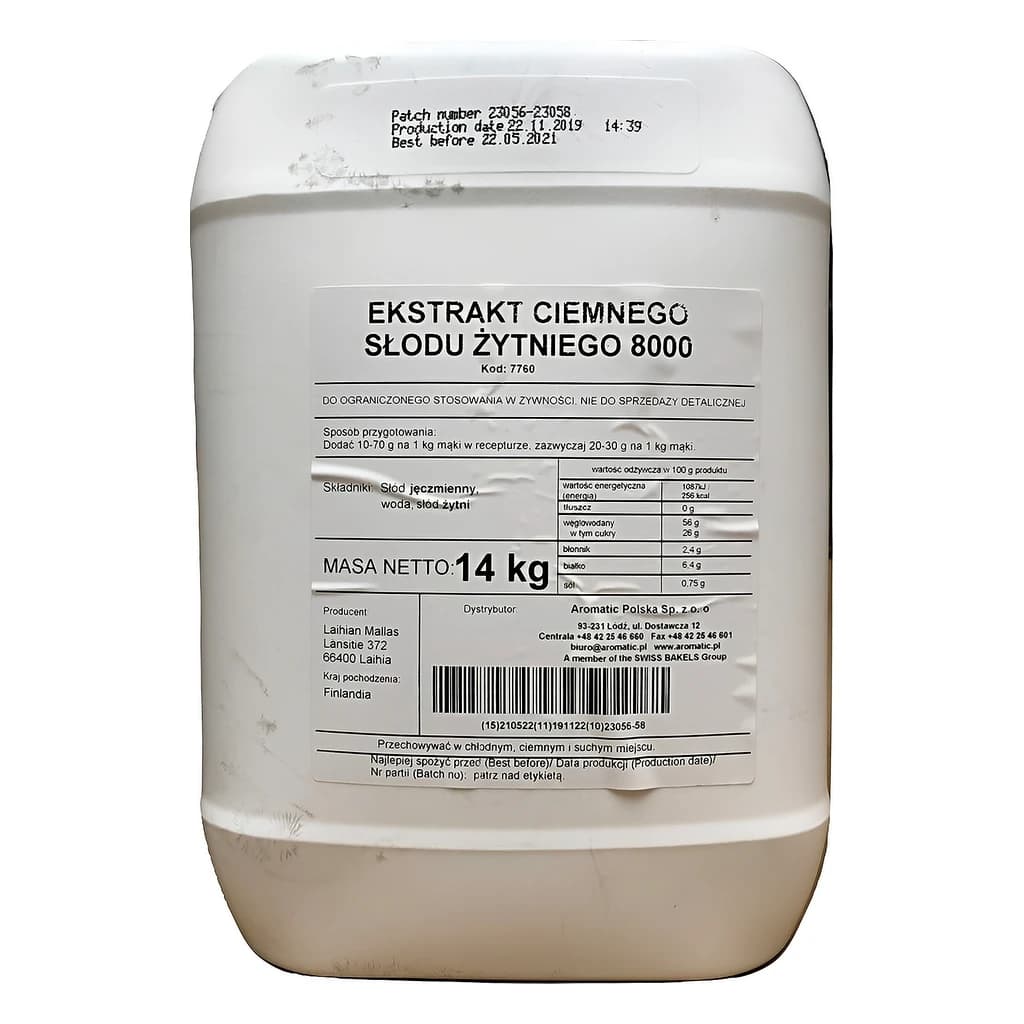
Bakels Dark Rye Malt Extract 8000 14 kg