
Clean-label and enzyme-only improvers: replacing DATEM, SSL and L-cysteine without losing performance
A practical guide for professional bakers on reformulating away from DATEM (E472e), SSL (E481) and L-cysteine (E920) using enzyme-only bread improvers and clean-label structural ingredients. Covers the enzyme replacement toolkit (lipase, xylanase, glucose oxidase, maltogenic amylase, protease, transglutaminase), vital wheat gluten as a structural anchor, and the EU/UK regulatory distinction between food additives and processing aids that makes enzyme-only labelling work. Grounded in first-party spec sheets from ten Domson catalogue products (Zeelandia, Puratos, IREKS, Beneo, Cereform) with side-by-side comparison tables, three formula cards, and a practical fault-diagnosis table for bakeries switching from conventional to enzyme-only systems.
Why bakers want to remove E-number emulsifiers
Consumer panels across Europe consistently show that shoppers prefer shorter ingredient lists with recognisable ingredients. In the UK, the "free from artificial additives" positioning is a frequent purchase driver in premium and artisan bread segments. In Poland, Turkey and Arab markets — key audiences for this platform — the trend toward clean-label bakery products is accelerating, driven by foodservice buyers, private-label briefs and health-conscious retail consumers.
For the professional baker, the challenge is clear: DATEM (E472e), SSL (E481) and L-cysteine (E920) exist in improvers because they do specific, difficult jobs. Removing them without understanding what replaces them causes bake failures. This article explains the replacement strategy in practical terms.
Full mechanism descriptions of each conventional emulsifier and additive are in the companion articles Emulsifiers in bread: DATEM, SSL, CSL, lecithin, mono- and diglycerides — functions, dosages and E-numbers and Oxidants and reductants in dough: ascorbic acid (E300), L-cysteine (E920), glucose oxidase and potassium bromate alternatives. This article focuses on the replacement map and the products available from the Domson catalogue.
What the conventional additives do — a brief recap
DATEM (E472e) strengthens gluten networks. Its tartaric acid groups bond ionically to glutenin proteins, reinforcing the protein web, retaining more CO₂ during fermentation and giving the dough tolerance against flour variability. Typical effective dosage in dough: 0.1–0.5% of flour weight. In the Domson catalogue, DATEM is the primary active in Puratos S500 SG (up to 2% product dosage), Puratos S500 Sense SG (10–20% DATEM in product), and Puratos Tigris SG 2% (10–20% DATEM in product).
SSL (E481) does two distinct jobs: it strengthens gluten (like DATEM) and it forms inclusion complexes with amylose starch chains, slowing retrogradation and keeping the crumb soft for longer. Typical dosage: 0.1–0.5% of flour weight. EU maximum: 3 g/kg in finished bread (EU Regulation EC 1333/2008, Category 07.1).
Regulatory compliance flag: At the upper end of this dosage range (0.5% SSL on flour), the estimated SSL level in finished bread is approximately 3.4–3.5 g/kg (assuming typical 65% hydration and 14% baking loss), which approaches or may exceed the EU maximum of 3 g/kg for E481 in bread (Category 07.1). Before specifying SSL dosages at or near 0.5% on flour in any customer-facing formulation guidance, verify the delivered SSL level in the specific finished bread formula and check against the current consolidated Annex II of EU Regulation 1333/2008.
In the catalogue, SSL is the primary active in IREKS Crumb Softener (1.5% dosage), IREKS Toast & Buns / Super Toast (2% dosage), and appears alongside DATEM and MDG in IREKS Soft Roll 7 (7% dosage) and IREKS Voltex (1–2% dosage).
L-cysteine (E920) is a dough reductant. It cleaves disulphide bonds in glutenin, reducing dough elasticity and enabling sheeting, automated forming and shorter mixing times — particularly valuable for crackers, pizza bases and very strong (high-protein) flour formulations. Dosage: approximately 10–75 ppm in dough.
The enzyme toolkit: what each enzyme replaces
<!-- image: img-enzyme-replacement-map -->Enzymes are proteins produced by microorganisms (bacteria, fungi). In EU and UK law, enzymes used in bread are classified as processing aids under Regulation (EC) No 1332/2008 when they have no significant technological effect in the finished baked product — meaning the finished bread does not need to declare them in the consumer ingredient list. This is the legal mechanism that makes enzyme-only "clean-label" bread possible.
Lipase and phospholipase — replacing DATEM
<!-- image: img-enzyme-mechanism-lipase -->Phospholipase A1 and A2 enzymes act on naturally occurring phospholipids in wheat flour, producing lyso-phosphatidylcholine (lyso-PC). Lyso-PC is an amphiphilic molecule structurally analogous to DATEM: it stabilises gas cells at the gluten-water-gas interface, reinforces the gluten network, and improves dough tolerance and loaf volume.
Natural wheat flour contains approximately 0.5–1% total lipid, of which roughly 25% is polar phospholipids. Phospholipase generates lyso-PC in situ during mixing, avoiding the need to add a pre-formed emulsifier. The enzyme is then inactivated during baking, leaving lyso-PC residues that contribute emulsifying activity without triggering an additive declaration requirement.
Performance relative to DATEM: independent research from Lesaffre and industry experience from AB Enzymes indicate that lipase-generated lyso-PC can replicate most of DATEM's dough-strengthening and volume-increasing effects in standard white and wholemeal bread. For very strong flours or high-speed mixing lines, supplementation with vital wheat gluten (VWG) at 1–2% on flour is typically recommended.
Xylanase — machinability and water management
Xylanase degrades arabinoxylans (AX), the major hemicellulose fraction of wheat flour. AX binds significant amounts of water; xylanase hydrolysis releases this bound water into the gluten network, improving dough extensibility, reducing stickiness and enabling better water distribution.
Key practical effects: less dough adherence to moulder, divider and sheeter; more consistent dough piece weight; improved crumb structure uniformity. Xylanase does not replicate SSL's anti-staling function — it acts during mixing and fermentation, not in the baked product.
Glucose oxidase (GOX) — oxidative gluten strengthening
Glucose oxidase converts glucose to gluconolactone, generating hydrogen peroxide (H₂O₂) as a by-product. H₂O₂ oxidises glutenin thiol (SH) groups, forming additional disulphide (S-S) crosslinks in the gluten network — the same structural outcome as ascorbic acid (E300) but via a different route.
GOX strengthens the gluten network without any additive declaration. Used in combination with lipase, it can substitute for the main volume-enhancing functions of DATEM. Typical dosage: 2–30 ppm enzyme protein. This is a single-source range — use as indicative only; verify with the enzyme supplier before formulation sign-off.
Maltogenic amylase — anti-staling without SSL or MDG
<!-- image: img-maltogenic-amylase-antistaling -->Thermostable maltogenic amylase (produced from Bacillus stearothermophilus or related organisms) hydrolyses amylose and amylopectin side chains during baking and post-baking cooling, producing shorter oligosaccharides that are less able to recrystallise. This delays starch retrogradation — the primary cause of bread crumb hardening — keeping the crumb soft for longer.
SSL and MDG (E471) achieve a similar delay by a different mechanism: they form helical inclusion complexes with amylose chains, physically preventing recrystallisation. Maltogenic amylase shortens the chains before they can crystallise; the net effect on crumb softness is comparable, though the precise shelf-life outcome varies by formula and flour.
One academic source (IntechOpen) reports maltogenic amylase-treated breads maintaining softness for 5–7 days versus 2–3 days for untreated control. This figure is single-source and should be treated as indicative. Actual results depend on the flour system, fermentation conditions and packaging.
Protease — replacing L-cysteine for dough relaxation
Fungal proteases (optimum pH approximately 4–5) partially hydrolyse gluten proteins, reducing dough elasticity and increasing extensibility. This replicates L-cysteine's disulphide-bond cleavage effect via a different — and slower — mechanism.
Critical caution (food safety relevance): Protease over-dose leads to irreversible gluten destruction: sticky, inextensible dough that cannot be recovered. L-cysteine's action is more rapid and dose-predictable. When switching from L-cysteine to protease, begin at the lowest possible dosage and conduct a minimum of five bake trials before fixing a formula. Reduce improver dosage in trials rather than the product's formula rate if the product is a pre-blended improver.
Alternative: inactivated (killed) baker's yeast contains glutathione (GSH) — a tripeptide that cleaves disulphide bonds via thiol-disulphide exchange, comparable to L-cysteine but gentler in action. It is declared simply as "yeast" on an ingredient list. Typical dosage: approximately 0.1–0.5% on flour weight (single-source BAKERpedia, confidence: low).
Transglutaminase — gluten crosslinking without emulsifiers
Transglutaminase (TGase) forms covalent isopeptide bonds between glutamine and lysine residues in gluten proteins, crosslinking the network directly. This does not replicate DATEM's ionic mechanism but produces similar macroscopic outcomes: improved loaf volume, dough tolerance and machinability. TGase does not appear as a declared ingredient in the Domson catalogue's current bread improver range but is available from specialist enzyme suppliers and is a processing aid under EU/UK law.
Vital wheat gluten: the structural anchor for clean-label formulas
<!-- image: img-vwg-gluten-network -->When emulsifiers are removed from a bread formula, the gluten network must be strong enough on its own to retain fermentation gas and support loaf volume. Vital wheat gluten (VWG) achieves this by directly increasing the protein content of the dough.
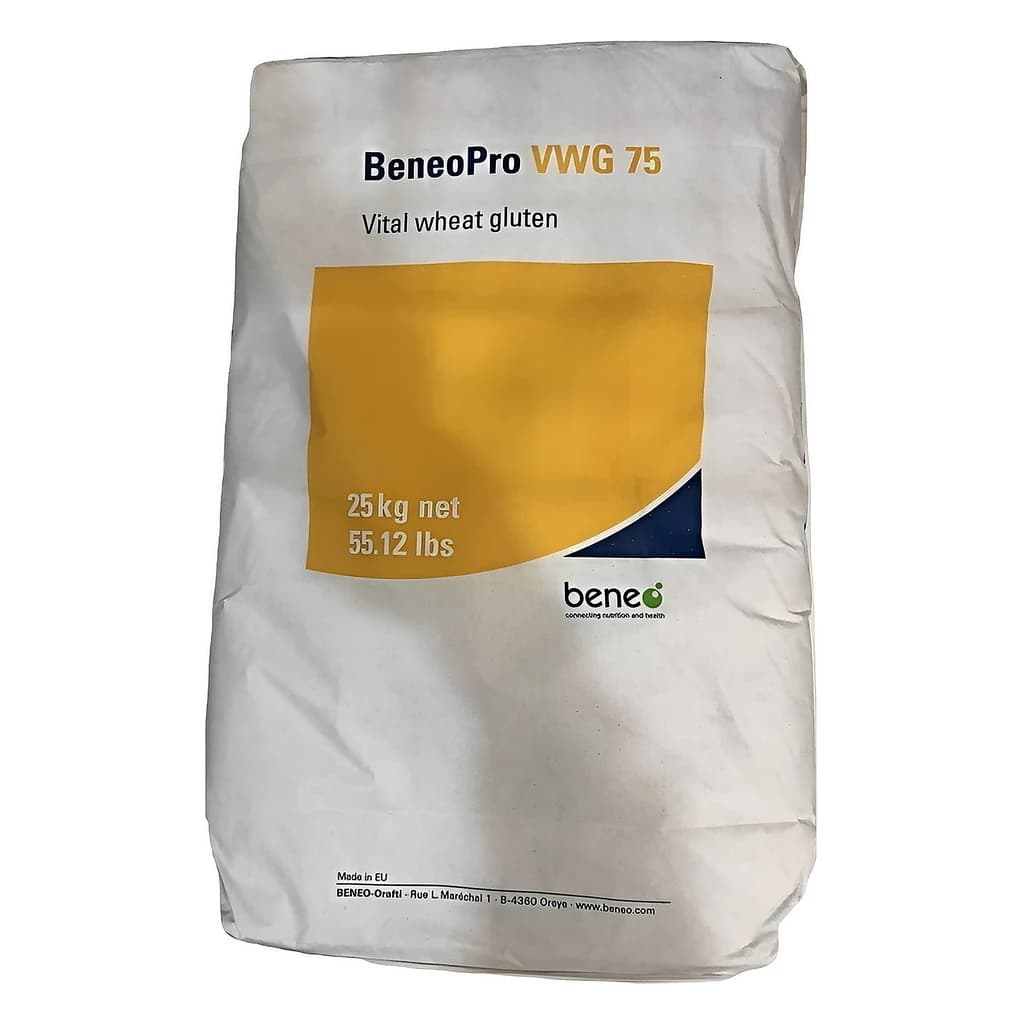
Beneo BeneoPro VWG 75 is the VWG product in the Domson catalogue. Key specifications from the first-party spec sheet:
| Parameter | Specification |
|---|---|
| Protein (N×5.7) | Minimum 75% dry matter |
| Protein (N×6.25 equivalent) | Minimum 82% dry matter |
| Moisture | Maximum 8% |
| Fat | Maximum 2% |
| Ash | Maximum 1% |
| Water binding capacity | Approximately 140–170 g/100 g (AACC 56-30) |
| Shelf life | 36 months (<60% RH, <20°C) |
| Certifications | Kosher, Halal, vegetarian, vegan |
| Allergens | Contains wheat gluten only; no other declared allergens |
How to use VWG in clean-label reformulation:
- Add 1–2% VWG on flour weight when switching a white or wholemeal bread from a DATEM-containing improver to an enzyme-only system.
- Add 2–4% VWG for high-fibre (wholemeal, multigrain) breads where bran dilutes native gluten.
- VWG absorbs approximately 140–170% of its weight in water — increase dough water absorption by approximately 1.2–1.5 kg water per kg VWG added.
- Mix VWG into dry flour before water addition to ensure full hydration.
- Dosage range from BAKERpedia: 1–12% of flour weight (1–4% for most yeast-raised doughs; up to 12% for high-fibre applications). First-party manufacturer context suggests 1–5% for standard applications.
VWG on the bread label: VWG is a natural food ingredient, not an additive. It appears in the ingredient list as "wheat gluten" — a recognisable, non-intimidating term that supports clean-label positioning.
Enzyme-active soya flour: natural oxidant and bleacher
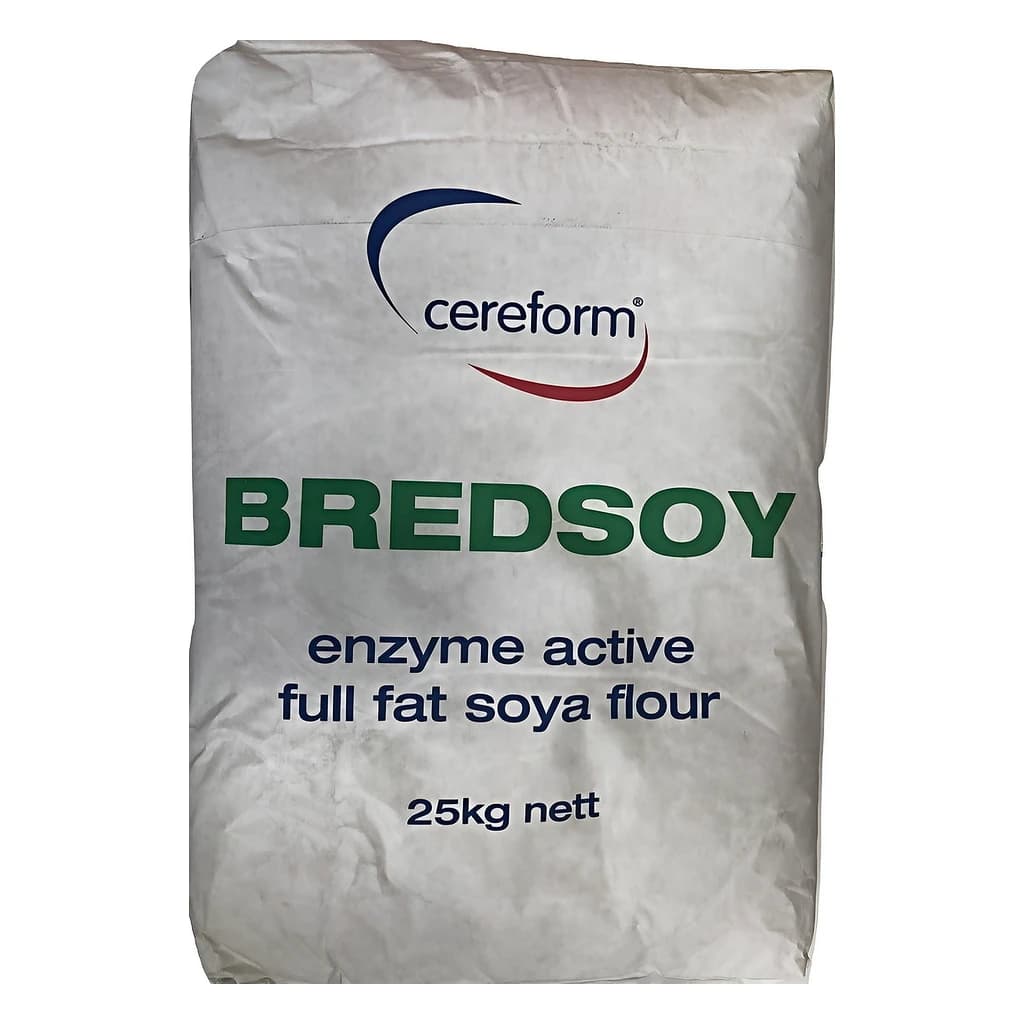
Cereform Breadsoy (enzyme-active full-fat soya flour from AB Mauri) is the enzyme-active soya flour in the Domson catalogue.
Breadsoy retains active lipoxygenase enzyme, which oxidises unsaturated fatty acids in the flour, generating lipid peroxides that:
- Bleach carotenoid pigments in wheat flour — producing a whiter crumb without chemical bleaching agents.
- Mildly strengthen gluten via oxidation of SH groups.
Key specifications:
- 100% enzyme-active full-fat soya flour (Non-GM IP Canadian and UK beans)
- Protein: 35.2 g/100g; Fat: 17.4 g/100g; Fibre (AOAC): 15.3 g/100g
- Moisture: 6–11%; shelf life: 270 days (storage 10–25°C)
Important allergen note: Cereform Breadsoy is 100% soya flour. Soya is a major allergen under EU Regulation 1169/2011 and must be declared in the finished bread ingredient list as "soya flour" or equivalent. This is not a processing aid — it is an ingredient. A bread produced with Breadsoy cannot claim to be "free from" soya. If allergen-free clean-label bread is required, do not use soya flour — rely on the enzyme system alone (lipase, xylanase, GOX from non-soya sources).
Clean-label catalogue products: Zeelandia's enzyme-only range
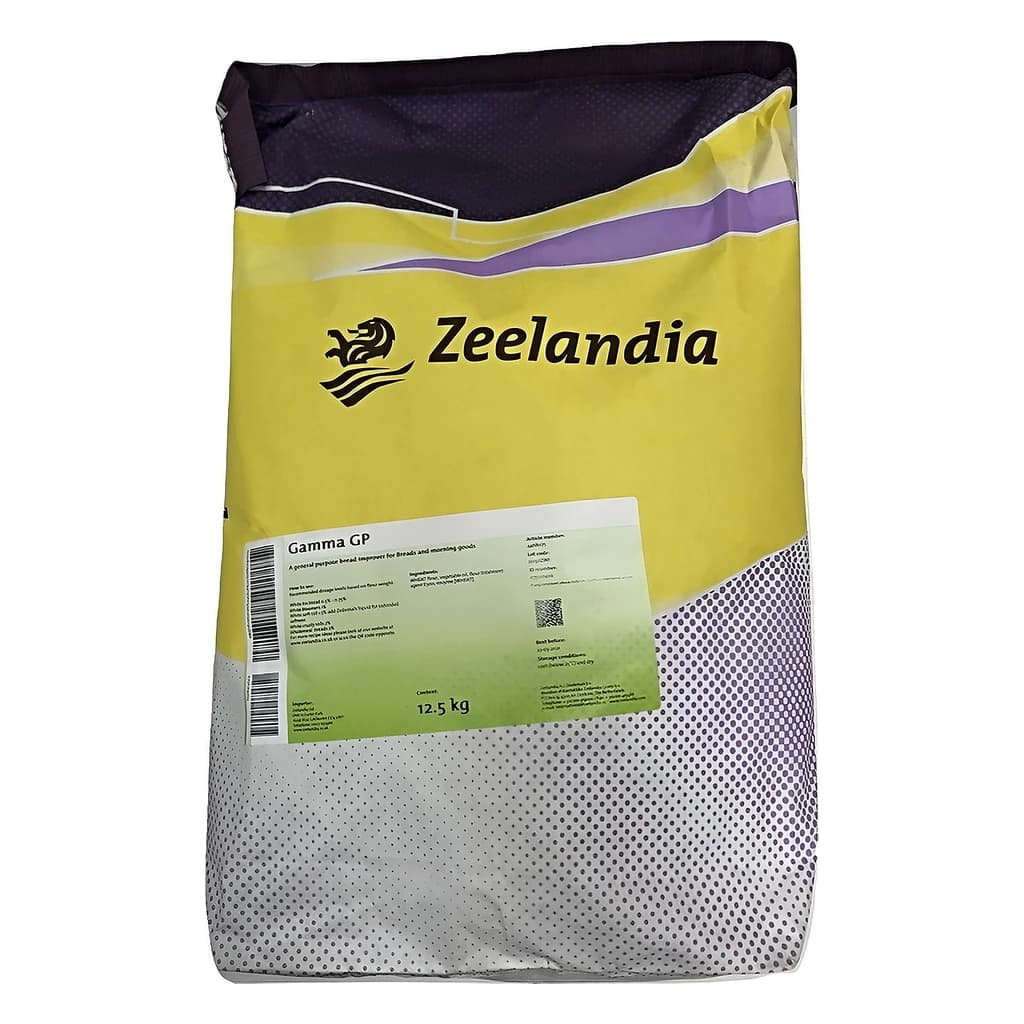
Zeelandia Gamma GP — general-purpose enzyme-only bread improver
<!-- image: img-gamma-gp-product -->Gamma GP is the benchmark enzyme-only bread improver for white and wholemeal bread production. Its complete ingredient declaration (from spec sheet): WHEAT flour, vegetable oil (rapeseed), flour treatment agent E300, enzyme [WHEAT]. No emulsifiers. No soya. No milk.
Dosage by application (first-party spec sheet):
| Application | Dosage (% on flour) |
|---|---|
| White tin bread | 0.5–0.75% |
| Bloomers | 1% |
| Soft rolls (add Zedomals liquid for extended softness) | 1.5% |
| Crusty rolls | 2% |
| Wholemeal breads | 2% |
Shelf life: 12 months from manufacture.
Allergen status: Contains WHEAT (as carrier flour and enzyme). Cross-contamination risk on the production line: Rye, Barley, Oats, Spelt, Egg, Soya, Milk, Sesame, Lupin. If the bakery's finished product must be declared free from any of these allergens, confirm directly with Zeelandia.
What the bread label reads: A white tin loaf using only Gamma GP as the improver (with flour, water, yeast, salt, rapeseed oil) can declare: Wheat flour (with calcium carbonate, iron, niacin, thiamin), water, yeast, salt, rapeseed oil, ascorbic acid (E300), enzyme. The E300 is declared because it is a food additive (flour treatment agent), not a processing aid. Declaring it as "ascorbic acid" rather than "E300" removes the E-number. The enzyme does not need to appear on the finished bread label under EU/UK processing aid rules.
Performance note: Gamma GP's spec sheet recommends adding Zedomals (a Zeelandia liquid softener) alongside Gamma GP for soft roll production. This indicates that the enzyme system alone does not fully replicate the crumb-softening effect of SSL or MDG in soft, enriched applications. For standard tin bread and crusty rolls, no supplement is needed.
Zeelandia Optimax Free — enzyme-only rye and mixed bread improver (with VWG)
Optimax Free is designed for breads where rye flour is a major component. Its composition (from spec sheet): WHEAT gluten (50%), RYE flour (39%), potato starch (10%), flour treatment agent E300 (<1%) from maize, WHEAT flour (<1%), enzyme (<1%) from Netherlands.
No emulsifiers. The 50% wheat gluten content makes this product function differently from Gamma GP: at a 1.67% dosage, approximately 0.84% of the flour weight is contributed as pure vital wheat gluten. This structural protein addition compensates for rye flour's absence of gluten-forming proteins. The enzyme (Netherlands origin) handles arabinoxylan management and fermentation.
Application recipe (from spec sheet):
- 1.0 kg wheat flour type 850 + 5.0 kg rye flour type 720 = 6.0 kg total flour
- 0.1 kg Optimax Free = 1.67% on total flour
- 6.4 kg rye sourdough + 0.23 kg salt + 0.25 kg yeast + 5.6 kg water
Process: Mix 8 min slow + 2 min fast. Dough temperature approximately 28°C. First proof 15 min. Divide, pan. Final proof 50 min. Bake 250→230°C with steam for first 5 min. Baking time 45 min.
Shelf life: 180 days (6 months). Shorter than Gamma GP due to the rye flour and high-protein gluten content.
Allergen status: Contains wheat gluten and rye (both as ingredients). Cross-contamination possible: barley, oat, spelt, egg, soya, milk, sesame.
Zeelandia Rye Stabil Free (Rye Stabil Improver) — high-gluten enzyme system for rye-wheat bread
Rye Stabil Free is the highest-gluten enzyme improver in this range, optimised for mixed rye-wheat and predominantly rye breads. Composition (from spec sheet): WHEAT gluten (78%), pregelatinised WHEAT flour (20%), WHEAT flour (1%), flour treatment agent E300 (1%), enzymes (<1%) from Finland and Japan.
The 78% gluten content means this product is functionally a concentrated gluten carrier with enzyme support. At the stated recipe dosage of 2.78% on total flour, approximately 2.2% of the flour weight is contributed as pure vital wheat gluten. The pregelatinised flour (20% of product) acts as a binding and consistency agent, improving dough handling.
Nutritional values per 100g product (from spec sheet): Protein 60.8g, fat 5.0g, carbohydrate 23.0g, fibre 1.8g, energy 386 kcal. The high protein value is consistent with the 78% gluten composition.
Application recipe (from spec sheet):
- 3.0 kg wheat flour type 850 + 4.2 kg rye flour type 720 = 7.2 kg total flour
- 0.2 kg Rye Stabil Free = 2.78% on total flour
- 4.6 kg rye sourdough + 0.22 kg salt + 0.2 kg yeast + 5.8 kg water
Process: Mix 7 min slow + 3 min fast. Dough temperature 27–29°C. First proof 15–20 min. Divide into 0.8 kg pieces, shape, place on boards or in baskets. Final proof approximately 45 min. Bake 250→230°C with steam, approximately 40 min.
Shelf life: 270 days (9 months).
Product identity note: The Domson catalogue lists this product as "Rye Stabil Improver 25 kg"; the spec sheet reads "Rye Stabil Free". Verify with Zeelandia that the currently stocked product is the enzyme-only "Free" formulation before positioning it as E-number-emulsifier-free to customers.
Conventional comparators: what you are reformulating away from
The following products from the catalogue contain declared emulsifier E-numbers and are listed here for comparison and to help bakers identify what needs to be replaced when switching. Full details are in Emulsifiers in bread: DATEM, SSL, CSL, lecithin, mono- and diglycerides — functions, dosages and E-numbers.
Puratos S500 SG (up to 2% on flour): Contains E472e (DATEM) and E516 (calcium sulphate). Primary DATEM-based improver. Ascorbic acid 0.9–1.1% in product.
Puratos S500 Sense SG (typically 0.5–1% on flour): Contains E472e (DATEM) at 10–20% of product, fermented rye flour. Ascorbic acid 0.67% ±10% in product.
Puratos Tigris SG 2% (2% on flour): Contains E472e (DATEM) at 10–20% of product, dextrose. Ascorbic acid 1% ±10% in product.
IREKS Voltex (1–2% on flour): Contains E472e (DATEM) and E481 (SSL). Soya flour as carrier — bread must declare both emulsifiers and soya allergen.
IREKS Crumb Softener (Softy) (1.5% on flour): Contains E481 (SSL) as primary active. Wheat flour carrier, no soya.
Allergen flag: The IREKS Softy spec sheet lists cross-contamination risk for lupin and mustard in addition to egg, soya, milk, and sesame. Both lupin and mustard are major allergens under EU Regulation 1169/2011 (Annex II) and UK food law. Lupin in particular is frequently under-declared in bakery. Any bread produced with this improver may require "may contain lupin" and "may contain mustard" declarations if allergen risk is not mitigated through segregation. Verify with IREKS and conduct a formal allergen risk assessment before any customer-facing allergen communication.
IREKS Toast & Buns / Super Toast (2% on flour): Contains E481 (SSL). Soya flour carrier — bread must declare SSL and soya allergen.
IREKS Soft Roll 7 (7% on flour): Contains E481 (SSL) + E471 (MDG) + E472e (DATEM), plus soya flour and whey powder (milk). Richest emulsifier profile in the catalogue — a complex improver that contributes sugar, salt and fat as well as emulsifiers. Bread must declare three emulsifiers plus soya and milk allergens.
Salt content and HFSS flag: The IREKS Soft Roll 7 spec sheet declares a salt content of 22.4 g/100g in the product. At the stated 7% dosage, this improver alone contributes approximately 1.6 g salt per 100g flour — exceeding the UK Food Standards Agency voluntary salt-reduction target for bread (≤1.0 g/100g finished bread from 2024) before any baker's salt addition. Formulas using Soft Roll 7 will substantially exceed FSA voluntary salt targets and may be affected by HFSS marketing regulations. Communicate salt contribution clearly when recommending this product to customers, and ensure finished product nutritional analysis is conducted before launch.
EU and UK regulatory rules: what "clean label" means legally
The additive–processing aid distinction
| Category | Legal definition | Declared on bread label? | E-number? |
|---|---|---|---|
| Food additive | Intentionally added substance with technological function that remains active in the finished food | YES (EU Reg. 1169/2011) | Usually yes |
| Processing aid | Substance used in processing; no significant technological effect in the finished food; present only as unavoidable residue | NO | No |
Under EU Regulation (EC) No 1332/2008 (the food enzymes regulation), enzymes used in bread that have no significant technological effect in the finished baked product are processing aids — they do not need to be declared on the consumer ingredient list. The UK retained this classification post-Brexit (UK Retained Regulation 2008/1332).
DATEM (E472e), SSL (E481), CSL (E482) and L-cysteine (E920) are food additives listed in EU Regulation (EC) No 1333/2008, Annex II. They must be declared in finished bread ingredient lists.
Ascorbic acid (E300): the residual E-number
Ascorbic acid is a food additive (flour treatment agent), not a processing aid. It remains in a small amount in baked bread and must be declared. All clean-label improvers in the Domson catalogue — including Gamma GP, Optimax Free and Rye Stabil Free — contain E300. It appears in the bread ingredient list either as "E300" or as "ascorbic acid". Declaring it by name ("ascorbic acid") removes the E-number from the label without changing the substance; this is standard practice for clean-label bread positioning.
Labelling a bread made with Gamma GP
A white tin loaf using Zeelandia Gamma GP (0.75% dosage) as the sole improver, with standard ingredients, can legitimately carry:
INGREDIENTS: Wheat flour (with calcium carbonate, iron, niacin, thiamin), water, yeast, salt, rapeseed oil, ascorbic acid, enzyme.
No E-number emulsifiers. The enzyme is not declared (processing aid exemption). Ascorbic acid is declared by name rather than E-number. This satisfies both EU Regulation 1169/2011 and UK food labelling requirements.
What "E-number-free" means and does not mean
"E-number-free" is a marketing claim, not a legal food category. It means the ingredient list contains no E-codes. Declaring ascorbic acid by name rather than E300 achieves this without removing the substance. However, if the bakery wishes to completely remove ascorbic acid (making the formula enzyme-only with zero E-numbers), a reformulation discussion with Zeelandia is required — some applications without any ascorbic acid may show reduced volume.
Side-by-side product comparison
See the comparison table below for the full table of all products. Summary:
| Clean-label enzyme-only | Conventional (DATEM) | Conventional (SSL) | |
|---|---|---|---|
| Representative product | Zeelandia Gamma GP | Puratos S500 Sense SG | IREKS Crumb Softener |
| Dosage | 0.5–2% | 0.5–1% | 1.5% |
| Declared emulsifiers | None | E472e (DATEM) | E481 (SSL) |
| Clean label | YES | NO | NO |
| Soya allergen | No (production line risk) | No | No |
| Shelf life | 12 months | 9 months | 12 months |
| Anti-staling | Depends on enzyme blend | Moderate (from enzymes) | Good (SSL amylose complex) |
Enzyme replacement map
See the comparison table below for the full table. Summary:
| Conventional additive removed | Best enzyme replacement | Performance gap |
|---|---|---|
| DATEM (E472e) | Lipase + xylanase + GOX | Minor in standard doughs |
| SSL (E481) strengthening role | Lipase + GOX | Minor to moderate |
| SSL (E481) anti-staling role | Maltogenic amylase | Minor (supplement with liquid softener if needed) |
| MDG (E471) crumb softening | Maltogenic amylase + lipase | Moderate for very soft products |
| L-cysteine (E920) | Protease or inactivated yeast | Moderate — trial carefully |
Reformulation protocol: switching from conventional to enzyme-only
Step 1: identify what your current improver delivers
Review the declared ingredient list of your current improver:
- Does it contain E472e (DATEM) as primary active? → Volume and dough strengthening is the primary function. Replace with a lipase-containing enzyme improver or with Gamma GP + VWG supplementation.
- Does it contain E481 (SSL) as primary active? → Anti-staling and crumb softness are key. Replace with maltogenic amylase-containing enzyme improver, supplemented with liquid softener for extended-life products.
- Does it contain E920 (L-cysteine)? → Dough relaxation is needed. Switch to inactivated yeast or protease-containing enzyme system.
- Does it contain soya flour (as allergen)? → The current product already contributes soya to the bread label. Switching to Gamma GP removes this allergen declaration.
Step 2: calculate the effective active level you are replacing
Using Puratos Tigris SG 2% as an example: DATEM content in product = 10–20% (c30). At 2% product dosage, effective DATEM in dough = 0.2–0.4% of flour weight. This is within the typical dosage range. Your enzyme replacement (lipase + xylanase combination) must deliver comparable gluten network reinforcement at that level.
Step 3: trial the enzyme-only improver at the midpoint of its recommended range
Start at the midpoint of the spec-sheet dosage range (e.g. 1.25% for Gamma GP where the range for your application is 1–1.5%). Run three identical bake tests. Assess:
- Loaf volume (compare to conventional benchmark — target ±5%)
- Crust colour and sheen
- Crumb structure and cell uniformity
- Day 1 crumb softness and resilience
- Day 3 and Day 5 crumb hardness (staling rate)
Step 4: adjust dosage or add supplementary ingredients
If volume is insufficient: increase enzyme improver by 0.25% increments; add VWG at 1% on flour. If staling is faster: add maltogenic amylase preparation; check water activity of baked product. If dough is difficult to handle (sticky, slack): reduce dosage by 0.25%; lower dough temperature to 26°C.
Step 5: validate allergen declarations and label
Before launch, have the new ingredient list reviewed by your technical team or an external food labelling consultant. Confirm processing aid status of enzymes with the enzyme supplier (EU Reg. 1332/2008 compliance). Confirm E300 is declared correctly (either as E300 or as ascorbic acid).
Troubleshooting clean-label switches
See the fault table below for the complete picture. Key entries:
| Fault | Most likely cause | Remedy |
|---|---|---|
| Reduced volume vs conventional | Loss of DATEM gluten-strengthening; enzyme system insufficient | Increase dosage; add VWG at 1–2% |
| Faster staling | Insufficient maltogenic amylase | Add amylase preparation; add liquid softener |
| Slack/sticky dough | Xylanase over-dose; high dough temperature | Reduce dosage; lower dough temperature |
| Snap-back on moulder | Loss of L-cysteine relaxation | Extend intermediate proof; add inactivated yeast 0.1–0.2% |
| Pale crust | Loss of MDG browning or insufficient dextrins | Add malt extract 0.2–0.5% |
| Unexpected soya on label | Previous improver contained soya flour | Confirm new enzyme-only improver is produced on soya-free or soya-separated line |
Formula cards
Formula 1: Clean-label white sandwich loaf (Gamma GP)
See the formula card below.
Baker's summary: 100% bread flour (min 12% protein), 62–65% water, 2% salt, 2% yeast, 1% rapeseed oil, 1% Zeelandia Gamma GP. Mix → bulk rest 10–15 min → divide → intermediate proof → mould → final proof 50–60 min at 38°C → bake 220°C, 25–30 min. Label: "Wheat flour, water, yeast, salt, rapeseed oil, ascorbic acid, enzyme."
Formula 2: Clean-label rye-wheat bread (Rye Stabil Free)
See the formula card below.
Baker's summary (from first-party spec sheet): 41.7% wheat flour 850 + 58.3% rye flour 720 (total 7.2 kg per batch), 4.6 kg rye sourdough, 0.22 kg salt, 0.2 kg yeast, 0.2 kg Rye Stabil Free (2.78%), 5.8 kg water. Mix 7+3 min → proof 15–20 min → divide 0.8 kg → final proof 45 min → bake 250→230°C with steam, 40 min.
Formula 3: Clean-label wholemeal loaf with VWG supplementation
See the formula card below.
Baker's summary: 100% wholemeal wheat flour, 68–72% water, 2% salt, 2% yeast, 2% rapeseed oil, 2% Beneo BeneoPro VWG 75, 2% Zeelandia Gamma GP. Mix → bulk fermentation 30 min → divide → final proof 50–70 min → bake 215°C, 30–35 min. Label: "Wholemeal wheat flour, water, wheat gluten, yeast, rapeseed oil, salt, ascorbic acid, enzyme."
What enzyme-only systems will not fully replicate
Honesty is important: there are applications where removing emulsifiers does require compromise.
Very soft, enriched rolls (brioche-style, milk bread): The crumb softness achieved by SSL + MDG at 7% dosage (as in IREKS Soft Roll 7) is difficult to fully replicate with enzymes alone. The SSL+MDG starch-lipid complex provides immediate (Day 1) and sustained (Day 5+) softness that maltogenic amylase replicates only partially. These applications typically require a supplementary liquid softener or an emulsifier outside the label claim.
High-speed industrial lines with very strong flours: DATEM provides a robust, reproducible dough tolerance that enzymes — which are more sensitive to flour variability and process parameters — cannot always match. A VWG buffer (1–2% on flour) helps but is not always sufficient.
Extended frozen or retarded doughs: Some emulsifiers improve freeze-thaw stability of the gluten network. Enzyme-only systems behave differently under freezing; dedicated frozen bread enzyme systems are available from suppliers but are beyond the scope of the current Domson catalogue range.
These limitations should be disclosed to the baker during any clean-label reformulation consultation.
Coverage notes
Solid: Zeelandia clean-label improver specs (Gamma GP, Optimax Free, Rye Stabil Free) — first-party, complete, high confidence. Beneo VWG 75 spec — first-party, complete, high confidence. Conventional comparator specs (Puratos, IREKS) — first-party, complete, high confidence. Regulatory framework (EU Reg. 1332/2008, 1333/2008; UK Bread and Flour Regs 1998) — primary legal sources.
Thin (single-source, confidence: low): GOX dosage range (c5); L-cysteine dosage (c4); inactivated yeast dosage (c27); maltogenic amylase shelf-life data (c20); DATEM and SSL pure-ingredient dosage ranges (c1, c2). Each flagged with confidence level.
Missing / needs follow-up: First-party spec sheets for Zeelandia Gamma GP and Optimax Free do not specify which enzyme class is present (xylanase? lipase? amylase?) — described generically as "enzyme". Request enzyme class disclosure from Zeelandia for more precise replacement mapping. No independent head-to-head volume comparison data between Gamma GP and S500 SG was available — a controlled bake trial would be the definitive verification.
Figures
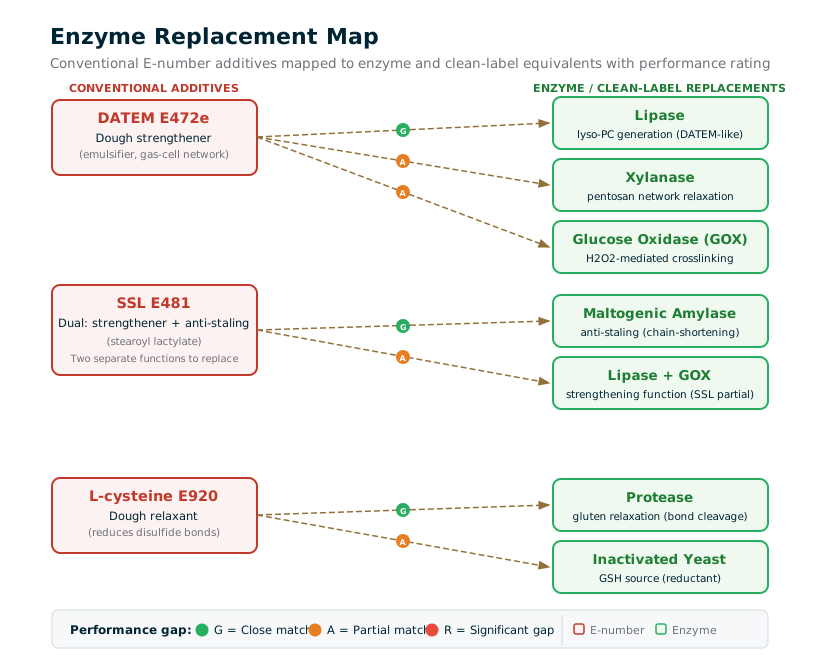 Diagram: enzyme replacement map for conventional bread improver additives — DATEM replaced by lipase and xylanase, SSL by maltogenic amylase, L-cysteine by protease and inactivated yeast
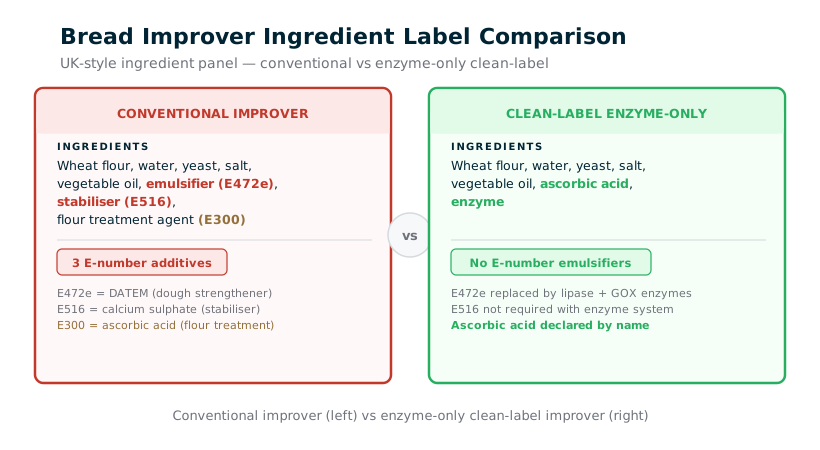 Side-by-side bread ingredient labels: left shows conventional improver with DATEM (E472e) and SSL (E481); right shows clean-label enzyme-only version with no E-number emulsifiers
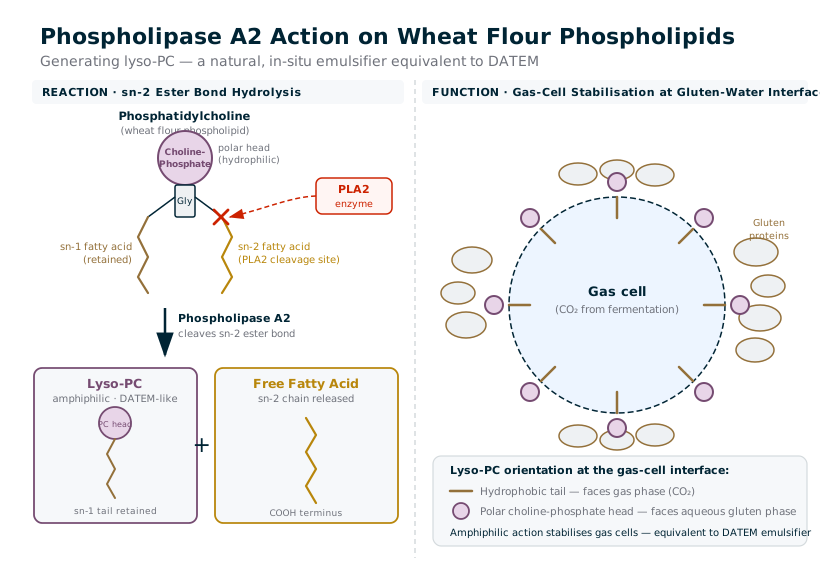 Diagram showing phospholipase A2 hydrolysing phosphatidylcholine at the sn-2 position to produce lyso-phosphatidylcholine, with the lyso-PC molecule shown stabilising a gas cell at the gluten-water interface
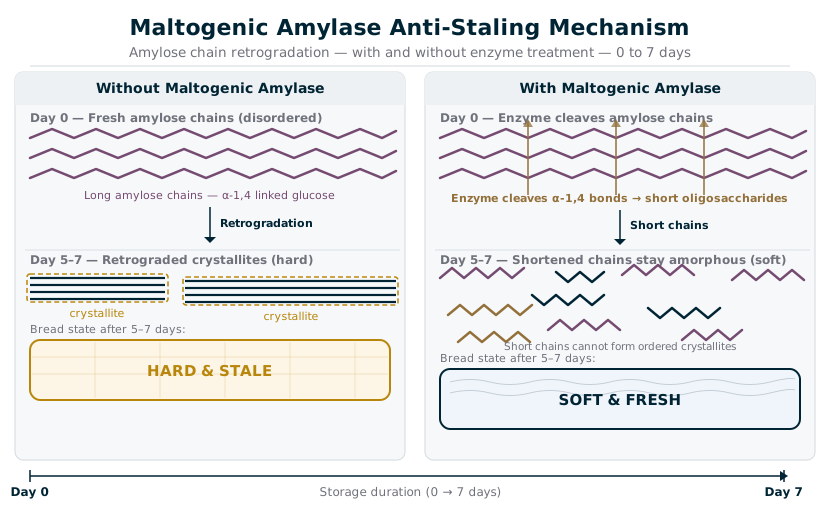 Two diagrams: left shows normal amylose chains recrystallising into hard retrograded starch over 5 days (staling); right shows maltogenic amylase-shortened amylose chains remaining disordered and soft
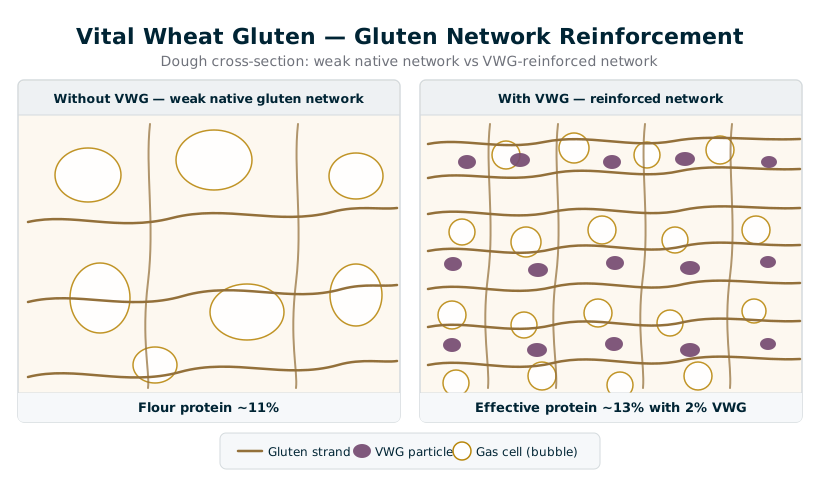 Schematic diagram comparing bread dough gluten network without VWG (sparse, weak network) versus with VWG added (dense, reinforced network with VWG particles hydrating and integrating)
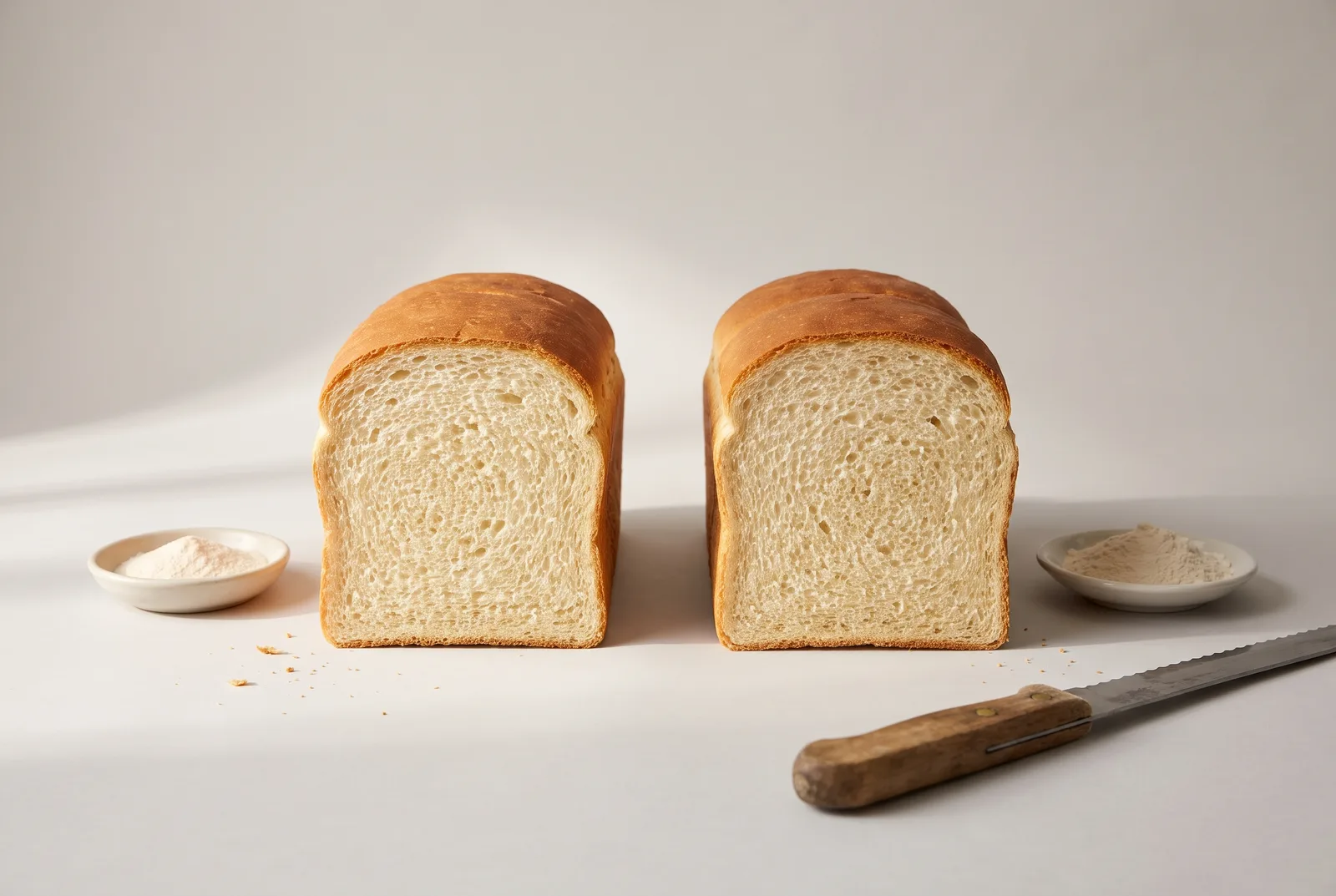
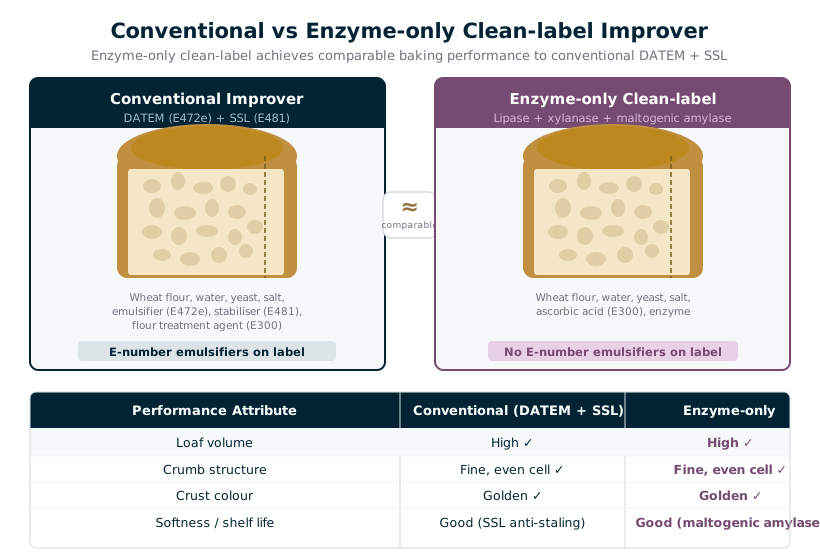 Two sliced white loaves side by side: left uses conventional DATEM+SSL improver, right uses enzyme-only clean-label improver — comparable crumb structure, volume and crust colour
Clean-label white sandwich loaf using Zeelandia Gamma GP
Straight-dough white sandwich bread with no emulsifier E-numbers. Uses enzyme-only improver at 1% on flour. Recipe derived from manufacturer guidance and professional baking practice.
| Ingredient | Baker's % | Weight |
|---|---|---|
| White bread flour (min 12% protein) — Weight per 100kg flour: 100 kg | 100% | |
| Water — Weight per 100kg flour: 62–65 kg | 62–65% | |
| Salt — Weight per 100kg flour: 2 kg | 2% | |
| Fresh yeast — Weight per 100kg flour: 2 kg | 2% | |
| Rapeseed oil (or vegetable fat) — Weight per 100kg flour: 1 kg | 1% | |
| Zeelandia Gamma GP — Weight per 100kg flour: 1 kg | 1% |
- Straight dough, Chorleywood-compatible (single-stage mixing)
Yield: Tin loaves (approximately 800g baked)
E300 (ascorbic acid) is present in Gamma GP at low level. It is a food additive (flour treatment agent), not a processing aid — it must be declared on the bread label. The enzyme is a processing aid and does not need to appear. Water absorption may need adjustment by ±2% depending on flour brand. For improved crumb softness longevity (Day 3+), consider adding Zedomals liquid softener per Zeelandia guidance.
Clean-label rye-wheat bread using Zeelandia Rye Stabil Free
Rye-wheat mixed bread with no emulsifier E-numbers. Uses high-gluten enzyme improver. Recipe directly from Zeelandia Rye Stabil Free spec sheet (Polish version) — quantities are first-party data.
| Ingredient | Baker's % | Weight |
|---|---|---|
| Wheat flour type 850 — Weight per batch: 3.0 kg | 41.7% of total flour | |
| Rye flour type 720 — Weight per batch: 4.2 kg | 58.3% of total flour | |
| Rye sourdough (ready-made) — Weight per batch: 4.6 kg | 63.9% on total flour | |
| Salt — Weight per batch: 0.22 kg | 3.1% on total flour | |
| Fresh yeast — Weight per batch: 0.2 kg | 2.8% on total flour | |
| Zeelandia Rye Stabil Free — Weight per batch: 0.2 kg | 2.78% on total flour | |
| Water — Weight per batch: 5.8 kg | ~80.6% on total flour |
- Direct dough with rye sourdough acidification
Yield: Rye-wheat loaves (0.58 kg dough pieces baked in tins)
Recipe is from spec sheet (first-party source). The Rye Stabil Free product contributes approximately 2.2% vital wheat gluten to the dough (78% gluten content × 2.78% dosage). The product is labelled as 'Rye Stabil Free' on the Polish spec; the Domson catalogue title is 'Rye Stabil Improver 25 kg' — verify with Zeelandia that these are the same clean-label formulation before ordering. Enzyme origin: Finland/Japan.
Clean-label wholemeal loaf with VWG supplementation
Wholemeal bread using enzyme-only improver plus vital wheat gluten to compensate for the bran-diluted gluten network. No emulsifier E-numbers. Formula derived from professional practice; dosages derived from spec sheets and BAKERpedia.
| Ingredient | Baker's % | Weight |
|---|---|---|
| Wholemeal wheat flour (100% extraction) — Weight per 100kg flour: 100 kg | 100% | |
| Water — Weight per 100kg flour: 68–72 kg | 68–72% | |
| Salt — Weight per 100kg flour: 2 kg | 2% | |
| Fresh yeast — Weight per 100kg flour: 2 kg | 2% | |
| Rapeseed oil — Weight per 100kg flour: 2 kg | 2% | |
| Beneo BeneoPro VWG 75 — Weight per 100kg flour: 2 kg | 2% | |
| Zeelandia Gamma GP — Weight per 100kg flour: 2 kg | 2% |
- Straight dough
Yield: Standard 800g tin loaves
VWG water absorption: approximately 140–170 g/100g (Beneo spec); this explains the higher water absorption in the formula. Add VWG to flour before water addition to allow adequate hydration. The effective gluten content of the dough increases from approximately 10% (wholemeal baseline) to approximately 11.9% with 2% VWG — comparable to a strong white bread flour.
Direct comparison of Domson catalogue bread improvers by additive profile, dosage and shelf life. All dosage and shelf-life figures from first-party spec sheets.
| Product | Brand | Key emulsifiers declared | Key enzymes / actives | Dosage (% on flour) | Shelf life | Clean label? |
|---|---|---|---|---|---|---|
| Zeelandia Gamma GP | Zeelandia | None | Enzyme [WHEAT], E300 (ascorbic acid) | 0.5–2% (by application) | 12 months | YES — no E-number emulsifiers |
| Zeelandia Optimax Free (rye/mix) | Zeelandia | None | Enzyme (Netherlands), E300; carrier: wheat gluten 50%, rye flour 39% | ~1.67% (from recipe) | 180 days | YES — no E-number emulsifiers |
| Zeelandia Rye Stabil Free (rye-wheat) | Zeelandia | None | Enzymes (Finland/Japan), E300; carrier: wheat gluten 78%, pregelatinised wheat flour 20% | ~2.78% (from recipe) | 270 days | YES — no E-number emulsifiers |
| Puratos S500 SG (Kosher) | Puratos | E472e (DATEM), E516 (calcium sulphate) | Enzymes (undeclared processing aids); E300 (0.9–1.1%) | Up to 2% | Not stated in spec | NO — E472e must be declared on bread |
| Puratos S500 Sense SG | Puratos | E472e (DATEM) 10–20% in product | Enzymes <1% (undeclared aids); E300 (0.67% ±10%); fermented rye flour | Typically 0.5–1% | 9 months | NO — E472e must be declared on bread |
| Puratos Tigris SG 2% | Puratos | E472e (DATEM) 10–20% in product | Enzymes <1% (undeclared aids); E300 (1% ±10%) | 2% | 9 months | NO — E472e must be declared on bread |
| IREKS Voltex | IREKS | E472e (DATEM) + E481 (SSL) | Enzymes; E300; soya flour (lipoxygenase carrier) | 1–2% | 12 months | NO — E472e + E481 + soya declared |
| IREKS Crumb Softener (Softy) | IREKS | E481 (SSL) — primary active | Enzymes; E300; E170i (calcium carbonate) | 1.5% | 12 months | NO — E481 declared |
| IREKS Toast & Buns (Super Toast) | IREKS | E481 (SSL) — primary active | Enzymes; E300; soya flour; E170 | 2% | 12 months | NO — E481 + soya declared |
| IREKS Soft Roll 7 | IREKS | E481 (SSL) + E471 (MDG) + E472e (DATEM) | Enzymes; E300; soya flour; whey powder (milk) | 7% (rich formula with sugar, salt, fat) | 9 months | NO — three emulsifiers + soya + milk declared |
All data from first-party spec sheets. 'Clean label' = no emulsifier E-numbers required on the finished bread ingredient list (E300/ascorbic acid may still appear as it is a flour treatment agent additive, not a processing aid). Cross-contamination allergen risks exist for all products — see individual spec sheets.
For each conventional additive removed, the enzyme(s) that can replicate its primary function, the mechanism, and a single-source confidence rating on performance equivalence.
| Conventional additive removed | Primary function lost | Enzyme/clean-label replacement | Replacement mechanism | Performance gap | Confidence on equivalence |
|---|---|---|---|---|---|
| DATEM (E472e) | Gluten network strengthening, gas retention, volume, dough tolerance | Phospholipase / lipase (generating lyso-PC); Xylanase; Glucose oxidase (GOX); Transglutaminase | Lipase generates lyso-phosphatidylcholine — an emulsifier structurally similar to DATEM. Xylanase releases bound water to improve dough consistency. GOX and TGase add covalent crosslinks. | Minor in standard doughs. May need VWG addition (1–2%) for strongest flours or high-speed mixing. | Medium — supported by Lesaffre and IntechOpen; no multi-source RCT data |
| SSL (E481) — dough strengthening function | Gluten reinforcement via ionic interaction with glutenin | Lipase + GOX combination | Lyso-PC from lipase stabilises gluten-starch interface; GOX-generated H2O2 oxidises SH groups forming extra S-S crosslinks | Minor to moderate depending on flour protein level | Low-medium — single-brand sources (Lesaffre, AB Enzymes) |
| SSL (E481) — anti-staling function | Amylose-lipid complex formation retarding starch retrogradation | Thermostable maltogenic amylase | Enzymatic shortening of amylose and amylopectin side chains, reducing their ability to recrystallise | Minor — comparable shelf-life extension reported; some formulas may need supplementary liquid softener | Low-medium — IntechOpen reports 5–7 days vs 2–3 days untreated; single source |
| MDG (E471) — crumb softening | Starch-lipid complex formation (Maillard interaction); crumb softness on Day 1 | Maltogenic amylase + lipase combination | Amylase delays retrogradation; lipase lyso-PC provides interface stabilisation | Moderate for very soft bread (brioche, milk bread). Supplementary liquid softener may be needed for products requiring long softness. | Low-medium |
| L-cysteine (E920) | Dough relaxation — reduces elasticity, enables sheeting, shortens mixing time | Fungal protease; inactivated yeast (glutathione/GSH source) | Protease hydrolyses gluten peptide bonds reducing elasticity. GSH from inactivated yeast cleaves disulphide bonds similarly to L-cysteine but more slowly. | Moderate — protease is irreversible and slower; over-dose risks gluten destruction. Inactivated yeast is gentler but less predictable on high-speed lines. | Low — primarily single-source |
Performance gap ratings are indicative based on available literature. Actual results depend on flour protein level, mixing intensity, fermentation conditions and product type. A trial programme of 3–5 bake tests is recommended before finalising any reformulation.
Application-specific dosage table for Zeelandia's flagship enzyme-only improver, from first-party spec sheet.
| Application | Dosage (% on flour) | Notes |
|---|---|---|
| White tin bread (sliced sandwich) | 0.5–0.75% | Lower end for strong flours; upper end for weaker flours or high-speed mixing |
| Bloomers | 1% | |
| Soft rolls | 1.5% | Spec recommends adding Zedomals liquid for extended crumb softness — enzyme-only improver does not fully replace SSL anti-staling in this application |
| Crusty rolls | 2% | |
| Wholemeal breads | 2% | Higher dosage compensates for bran diluting the gluten network |
All figures from Zeelandia Gamma GP spec sheet (first-party). Product: 12.5 kg bag, minimum shelf life 12 months.
| Fault observed | Most likely cause | Diagnostic check | Remedy |
|---|---|---|---|
| Reduced loaf volume compared to DATEM-based improver | Loss of DATEM's gluten-network strengthening; insufficient enzyme DATEM-equivalent effect | Compare dough extensibility pre-proof; check flour protein content (target min 12% for enzyme-only white bread) | Increase enzyme-only improver dosage by 0.25–0.5%; add Beneo BeneoPro VWG 75 at 1–2% on flour; extend bulk fermentation by 10–15 min |
| Faster staling — crumb hardens by Day 2–3 | Loss of SSL or MDG anti-staling function; maltogenic amylase level insufficient or absent in enzyme system | Check product spec for presence of thermostable amylase; compare Day 1 vs Day 3 crumb hardness | Add a separate maltogenic amylase preparation (consult supplier for dosage); add liquid softener (e.g. Zedomals per Zeelandia recommendation); reduce baking temperature slightly to preserve more moisture |
| Dough too slack or excessively sticky | Xylanase over-hydrating arabinoxylan fraction; protease breaking down gluten | Reduce improver dosage by 25% in test batch; check dough temperature (high temperature accelerates enzyme activity) | Reduce improver dosage; lower dough temperature to 26°C; check flour protein content and water absorption |
| Tearing and snap-back during moulding or sheeting | Loss of dough relaxation function (previously provided by L-cysteine in conventional improver, if it contained one) | Confirm whether previous improver declared L-cysteine (E920) or inactive yeast in formulation | Extend intermediate proof by 10–15 min; add inactivated yeast at 0.1–0.2% on flour; increase bulk fermentation time |
| Pale crust colour | Loss of Maillard browning contribution from dextrins/sugars that MDG generates via starch interaction; enzyme system may be insufficient | Check if previous formula contained non-diastatic malt or dextrose as crust-browning agent | Add malt extract at 0.2–0.5% on flour; add dextrose at 0.5%; check oven temperature calibration |
| Open or irregular crumb structure | Over-fermentation; enzyme over-dose breaking down arabinoxylan structure too aggressively | Reduce final proof time by 10 min in test batch; check improver dosage | Reduce final proof time; reduce improver dosage; check dough temperature |
| Unexpected soya allergen declaration on bread label | Previous formula used IREKS Voltex / Toast & Buns / Soft Roll 7 (all contain soya flour); enzyme-only improver does not contain soya | Review all improver ingredient declarations; check cross-contamination risk statements on enzyme-only product spec | Confirm with new improver supplier that their product is produced without soya cross-contamination. Zeelandia Gamma GP spec notes soya as cross-contamination possibility on shared production line — check with Zeelandia if allergen-free status is required. |
| Label still shows E-number after switching | E300 (ascorbic acid) is a food additive, not a processing aid — it must be declared even in enzyme-only improvers | Identify whether the E-number is E300 or an emulsifier E-number | Declare as 'ascorbic acid' by name rather than 'E300' for clean-label positioning (same substance, no E-code on label). Emulsifier E-numbers (E472e, E481) cannot be concealed — only a genuine enzyme-only improver eliminates them. |
- Product:
- Beneo BeneoPro VWG 75
- Protein n57 min pct dm:
- 75
- Protein n625 equivalent min pct dm:
- 82
- Moisture max pct:
- 8
- Fat max pct:
- 2
- Ash max pct:
- 1
- Water binding g per 100g:
- 140–170
- Shelf life months:
- 36
- Certifications:
- Kosher, Halal, Vegetarian, Vegan
- Storage:
- <60% RH, <20°C
- Product:
- Zeelandia Gamma GP
- Emulsifiers:
- None
- Dosage white tin pct:
- 0.5–0.75
- Dosage bloomers pct:
- 1
- Dosage soft rolls pct:
- 1.5
- Dosage crusty rolls pct:
- 2
- Dosage wholemeal pct:
- 2
- Shelf life months:
- 12
- Appearance:
- cream powder
- Storage:
- <25°C, dry
- Product:
- Zeelandia Optimax Free
- Emulsifiers:
- None
- Wheat gluten pct in product:
- 50
- Rye flour pct in product:
- 39
- Potato starch pct in product:
- 10
- Calculated dosage on total flour pct:
- 1.67
- Shelf life days:
- 180
- Water content max pct:
- 16.5
- Product:
- Zeelandia Rye Stabil Free / Rye Stabil Improver
- Emulsifiers:
- None
- Wheat gluten pct in product:
- 78
- Pregelatinised wheat flour pct in product:
- 20
- Calculated dosage on total flour pct:
- 2.78
- Protein per 100g product g:
- 60.8
- Shelf life days:
- 270
- Water content max pct:
- 16.5
- Product:
- Puratos S500 SG
- Primary emulsifier:
- E472e (DATEM) — from RSPO Segregated palm oil
- Ascorbic acid pct:
- 0.9–1.1
- Dosage max pct on flour:
- 2
- Product:
- Puratos S500 Sense SG
- Primary emulsifier:
- E472e (DATEM) 10–20% — from RSPO Mass Balance palm oil
- Ascorbic acid pct:
- 0.67 ± 10%
- Shelf life months:
- 9
- Product:
- Puratos Tigris SG 2%
- Primary emulsifier:
- E472e (DATEM) 10–20% — from RSPO Segregated palm oil
- Ascorbic acid pct:
- 1 ± 10%
- Dosage pct on flour:
- 2
- Shelf life months:
- 9
Buy the ingredients
Catalogue products and brands referenced in this article.
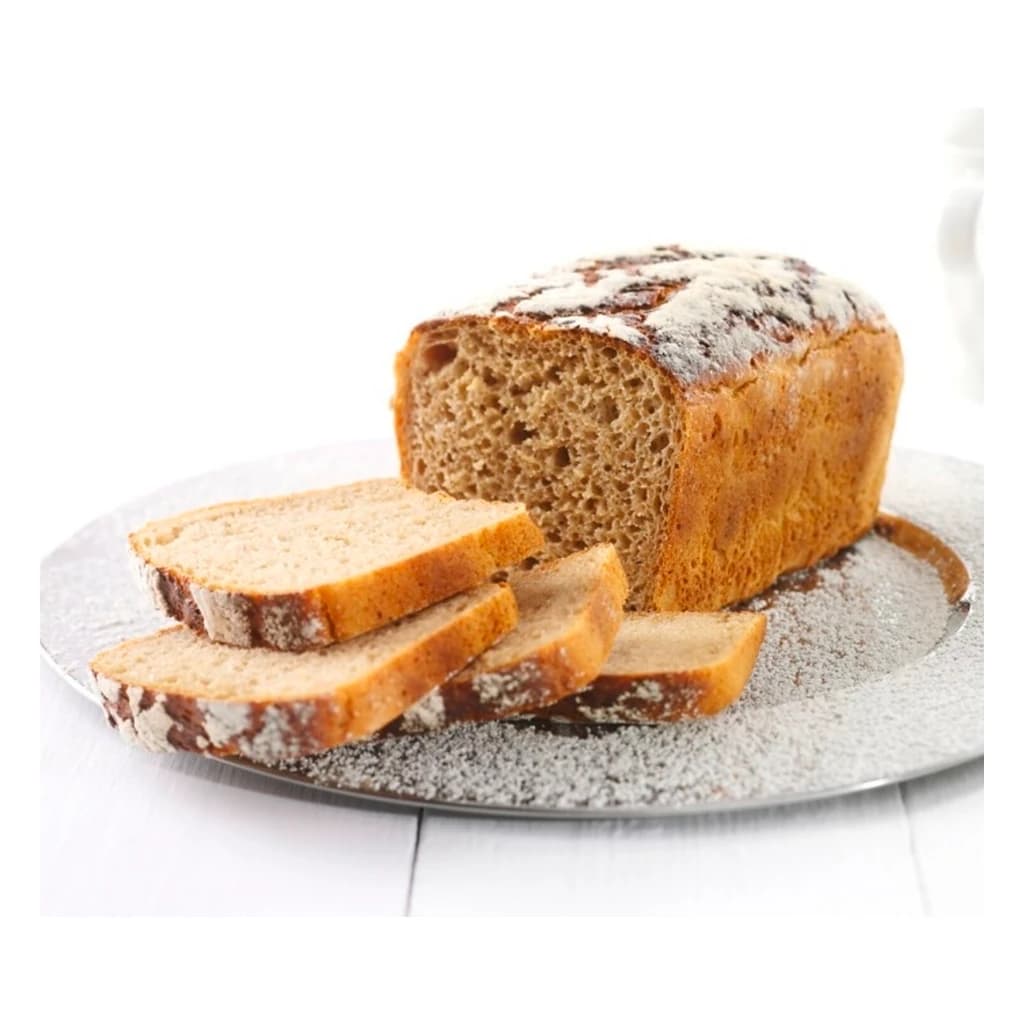
Optimax Free Bread Improver 20 kg
Beneo BeneoPro VWG 75 Vital Wheat Gluten 25 kg
Rye Stabil Improver 25 kg
Zeelandia Gamma GP Bread Improver 12.5 kg
IREKS Soft Roll 7 Bread Improver 25 kg
IREKS Voltex Multipurpose Bread Improver 25 kg
Puratos Tigris SG 2% Bread Improver 16 kg
IREKS Crumb Softener 25 kg
Puratos S500 Sense SG Bread Improver 12.5 kg
Cereform Breadsoy Enzyme-Active Full-Fat Soya Flour 25 kg

Puratos S500 SG Bread Improver 12.5 kg (Kosher)
IREKS Toast & Buns Bread Improver 25 kg