
Vital wheat gluten: fortifying weak flours and high-fibre doughs from 2% to 12%
A practical reference for professional bakers covering vital wheat gluten (VWG) — what it is, how it works, how to dose it from 2% to 12%, and how to troubleshoot the most common errors. Built on first-party spec sheets from the Domson catalogue (BeneoPro VWG 75, Zeelandia Rye Stabil Free, Zeelandia Optimax Free, six bread improvers, four malt products, two emulsifier pastes) cross-checked against BAKERpedia, the IREKS Compendium of Baking Technology, and EU/UK food additive regulations. Includes comparison tables for bread improvers and malt products, three formula cards, and fault-diagnosis tables.
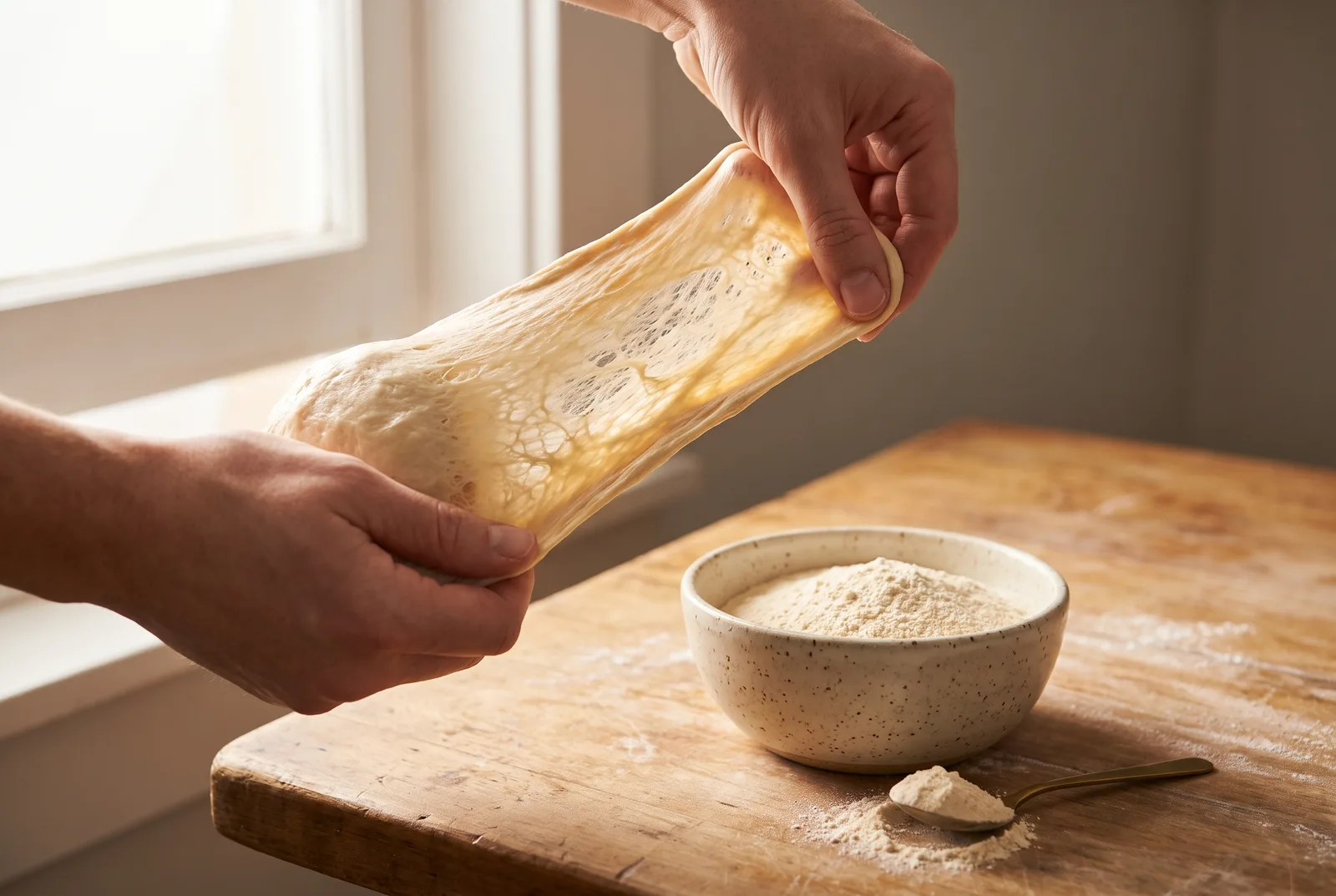
Vital Wheat Gluten: Fortifying Weak Flours and High-Fibre Doughs
What is Vital Wheat Gluten?
Vital wheat gluten (VWG) is a dry, cream-coloured powder produced by washing the starch from wheat flour with water, then gently drying the remaining protein mass at low temperature to preserve the protein's ability to hydrate and form a gluten network. The word "vital" specifically means the proteins remain functionally active — they can still develop a viscoelastic network when rehydrated.
The two protein fractions that matter for baking are:
- Gliadin — the extensible, stretchy fraction that gives dough its flow and gas-holding capacity
- Glutenin — the elastic fraction that gives dough its resistance and recovery
When VWG powder hydrates, these fractions re-associate to form a gluten network structurally identical to that in a normal wheat dough.
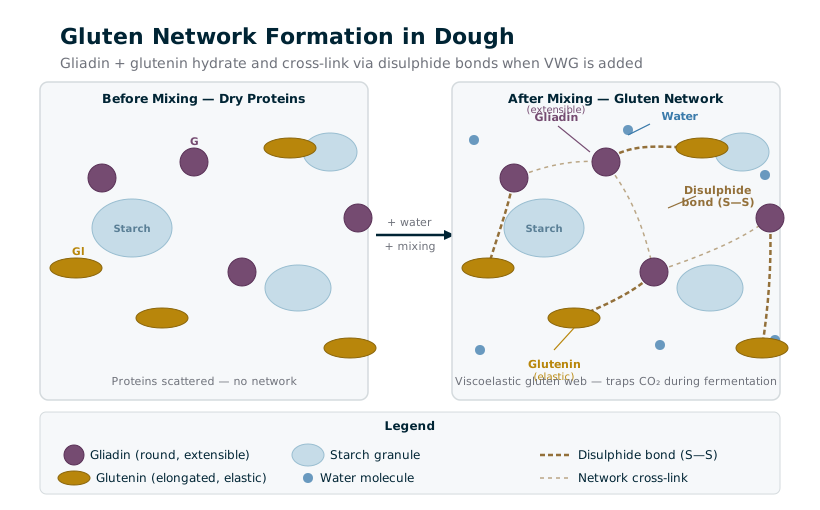 Diagram of gluten protein network formation in bread dough when vital wheat gluten is added
Specification at a glance (BeneoPro VWG 75)
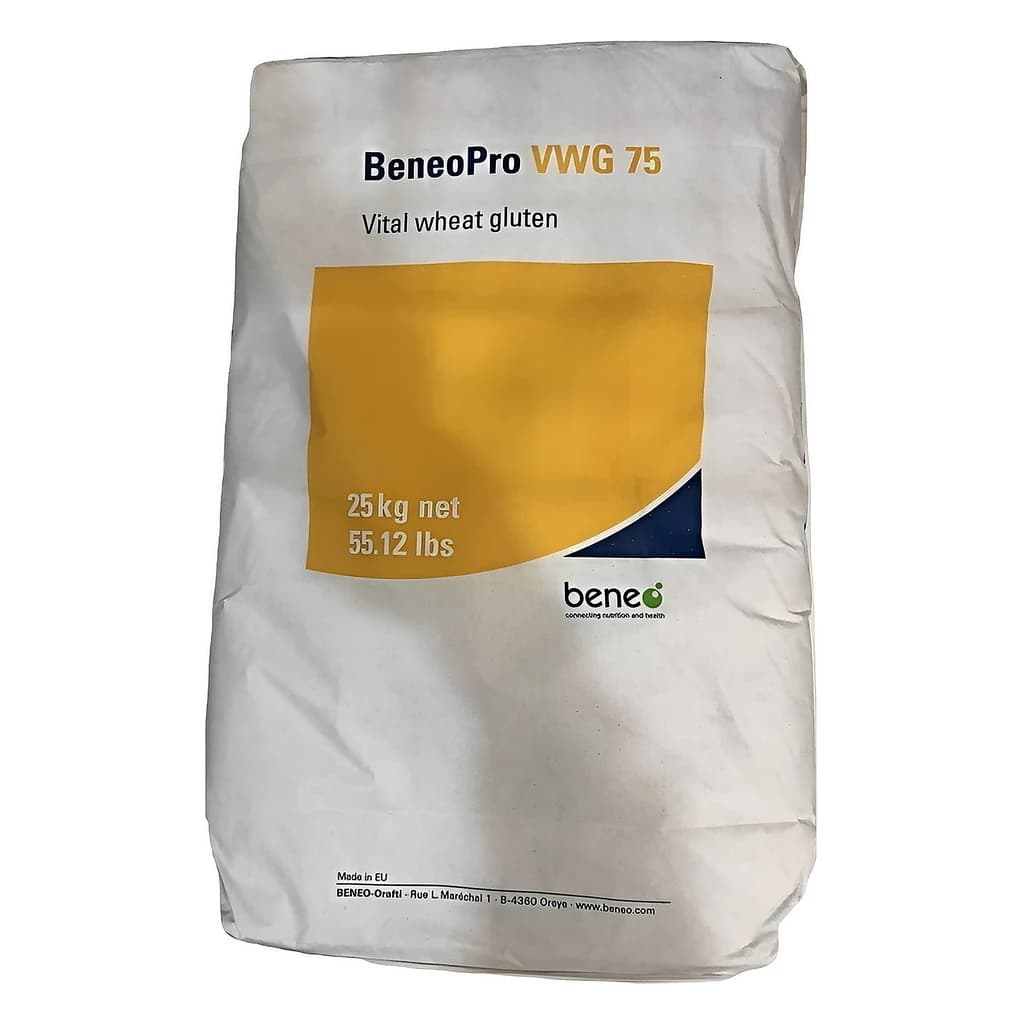
The Domson catalogue carries Beneo BeneoPro VWG 75 from the Südzucker Group (produced in Belgium, Austria and Germany). Its spec sheet (Doc. F3-40, version 007) states the following warranted parameters:
| Parameter | Value |
|---|---|
| Protein (N×5.7, dry matter) | minimum 75 g/100g |
| Protein (N×6.25, typical) | 79.5 g/100g |
| Moisture | maximum 8 g/100g |
| Fat (crude) | maximum 2 g/100g |
| Ash (crude) | maximum 1 g/100g |
| Water binding capacity* | approx. 140–170 g water per 100g VWG (AACC 56-30) |
| Energy | 1728 kJ / 409 kcal per 100g† |
| Shelf life | 36 months at <20°C, <60% RH |
*Indicative value; not subject to complaint per the spec sheet. †Energy cross-check against declared macronutrients (using EU Reg 1169/2011 Atwater factors) yields approximately 1587 kJ (~379 kcal) — approximately 9% below the stated figure. The discrepancy may reflect actual moisture being lower than the 8 g/100g maximum. Do not use this value for finished-product nutrition labelling without independent verification from BENEO.
BAKERpedia gives the general industry range as 70–80% protein, which is consistent with this product.
Note on conversion factors: Protein calculated with N×5.7 is the Codex method specifically for wheat gluten. N×6.25 (the general food-protein factor) gives a higher value from the same nitrogen measurement. Both are legitimate; always check which factor a supplier uses before comparing products.
Allergen and regulatory status
VWG contains only the wheat gluten allergen. Under EU Regulation 1169/2011 it must be labelled as "Wheat gluten". BeneoPro VWG 75 is Kosher and Halal certified (certificates on request), suitable for vegetarians and vegans, and not derived from GMO wheat under Regulation (EC) 1829/2003.
Food safety flag: VWG is a major allergen in the EU and UK. Any product containing or made with VWG must carry a "wheat" allergen declaration on the finished food label. If processing on shared equipment also handles other allergens, cross-contamination controls and labelling must be verified by a food technologist.
Why add VWG to bread?
Bread bakers add VWG for three main reasons:
1. Compensating for weak flour
Flour protein quality and quantity vary by harvest, origin, and price point. When the available flour is too low in gluten strength for the product — for example a ciabatta or baguette specification that needs strong extensibility and good oven spring — adding 1–4% VWG on flour weight lifts the effective protein level and improves dough tolerance.
2. High-fibre and wholemeal bread
Dietary fibre (wheat bran, oat fibre, wholemeal flour) physically dilutes the gluten network and cuts into its continuity, resulting in a dense, heavy crumb. Each percentage point of added bran reduces the "effective" gluten concentration. VWG compensates by adding pure protein back. Dosages of 2–6% are typical for high-fibre or wholemeal breads, rising to 8–12% for products containing very high fibre additions.
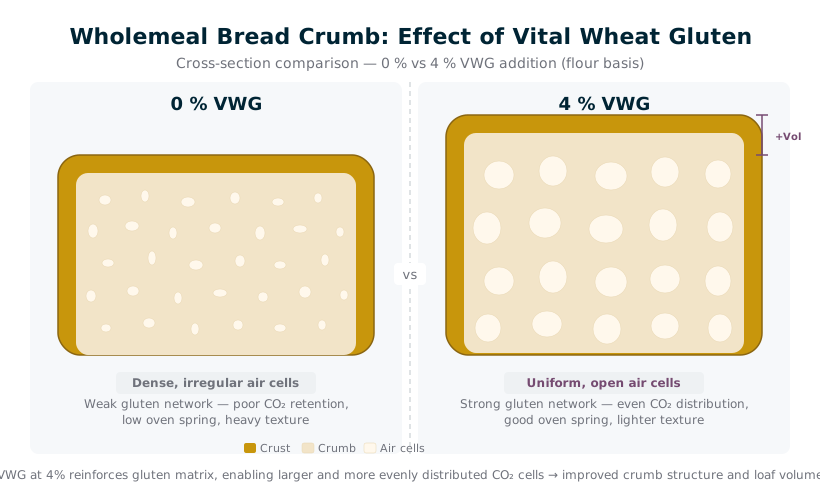 Side-by-side cross-section of wholemeal bread crumb: left without vital wheat gluten (dense, heavy), right with 4% VWG (lighter, more open structure)
3. High-speed and industrial production
High-speed dividers and moulders exert significant mechanical stress on dough. A strong gluten network is more resilient to this stress without tearing or gas loss. VWG at 2–4% on flour increases mixing tolerance and reduces the risk of mechanical damage.
The key technical constraint: water absorption
Every gram of VWG absorbs approximately 1.4–1.7 g of water to fully hydrate (water binding capacity 140–170 g per 100g, BeneoPro spec). BAKERpedia reports a rule of thumb that each 1% VWG addition on flour increases dough water absorption by approximately 1.5%.
Caution: The 1.5% water-per-1%-VWG figure is a single-source reference (BAKERpedia). Actual absorption depends on the flour's own protein content, water temperature, and mixing time. Always confirm empirically in your bakery conditions. Failing to adjust water results in a stiff, slow-fermenting dough and dense loaf.
VWG-based bread improvers in the Domson range
Several products in the Domson catalogue are VWG-dominant improvers designed specifically for rye-wheat or mixed grain bread where VWG is the structural backbone.
Zeelandia Rye Stabil Free
This product is 78% wheat gluten by formulation weight, with 20% gelatinised wheat flour (for water management), 1% wheat flour, 1% ascorbic acid (E300), and trace enzymes. The gelatinised flour pre-absorbs some water on contact, reducing the hydration shock to the rye portion of the dough.
Application recipe (from the spec sheet): 3.0 kg wheat flour type 850 + 4.2 kg rye flour type 720 + 4.6 kg rye sourdough + 0.22 kg salt + 0.2 kg yeast + 0.2 kg Rye Stabil Free + 5.8 kg water. Dosage 0.2 kg on 7.2 kg combined flour = approximately 2.8% on flour.
Protein content of the finished improver is 60.8 g/100g, reflecting its high VWG content.
Zeelandia Optimax Free
50% wheat gluten + 39% rye flour + 10% potato starch + trace E300 and enzymes. This is a lower-VWG product aimed at maintaining machinability in rye-dominant doughs. The rye flour and potato starch help buffer the high water demand of the gluten fraction.
Application recipe (from spec sheet): 1.0 kg wheat flour type 850 + 5.0 kg rye type 720 + 6.4 kg rye sourdough + 0.1 kg Optimax Free + 0.23 kg salt + 0.25 kg yeast + 5.6 kg water. Dosage is 0.1 kg on 6 kg flour equivalent = approximately 1.7% on wheat flour alone.
Standard bread improvers: what's inside?
Most commercial bread improvers are blends of multiple functional ingredients. The Domson catalogue carries a wide range. The table below compares six products from first-party spec sheets.
Key functional ingredients and their roles
Ascorbic acid (E300) — the oxidant
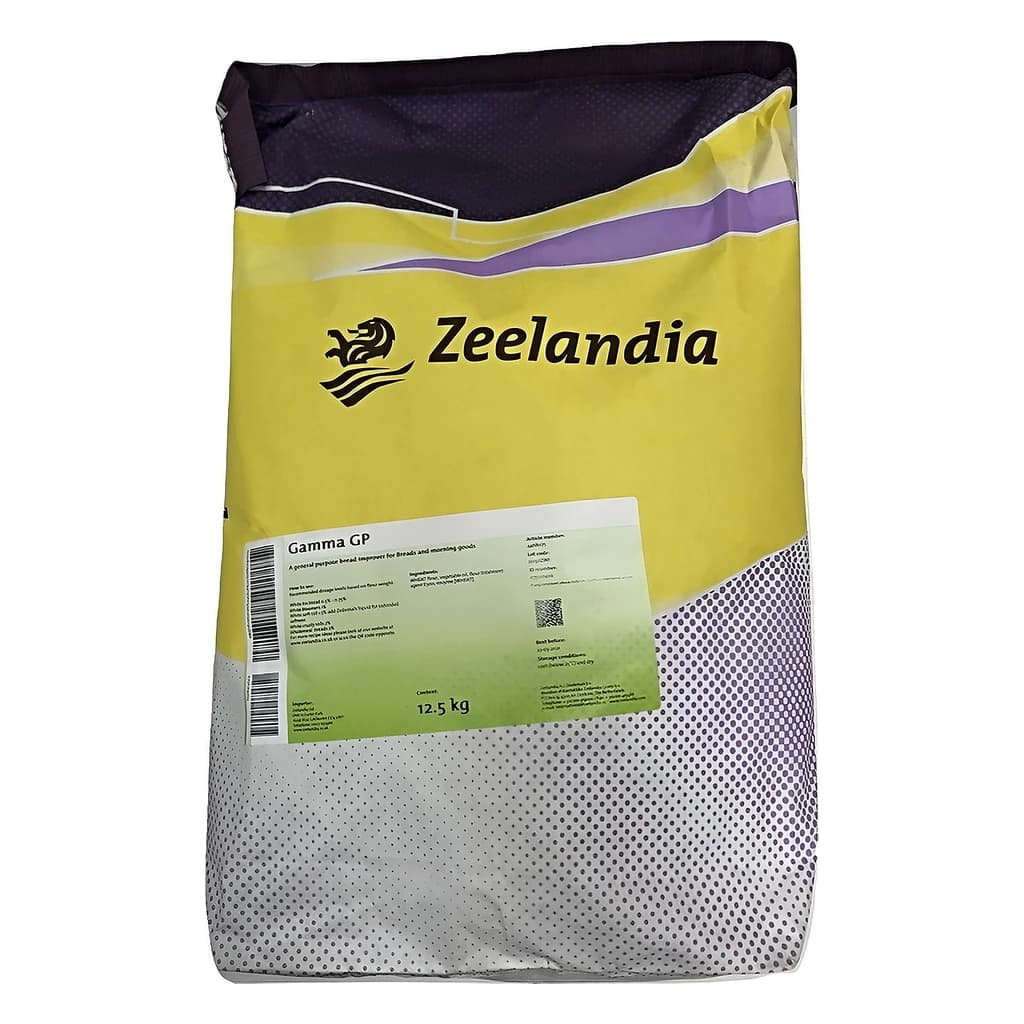
Ascorbic acid is present at trace levels in nearly every bread improver in the range, including Zeelandia Gamma GP, IREKS Voltex, Puratos Tigris SG and S500 Sense. In dough it is rapidly oxidised to dehydroascorbic acid, which strengthens disulphide bonds between gluten proteins, increasing dough strength and loaf volume.
Typical working dosage in finished bread (via improver) is 20–200 ppm on flour weight. The US FDA sets 200 ppm as the maximum permitted level. The EU regulatory position under Regulation (EC) 1333/2008 is that ascorbic acid is permitted at quantum satis (no specific maximum stated) for bread and fine bakery goods; the UK position mirrors this under retained EU law.
Food safety / regulatory flag: Published dosage ranges are for reference only. A regulatory conflict exists between sources: some secondary references (including certain readings of BAKERpedia) state a 200 ppm EU/UK limit, which would mirror the US FDA ceiling; this has not been independently verified against the current EU Annex II text for category 07.1/07.2 (bread and fine bakery wares). Always confirm the applicable limit and final ppm in the finished product with a qualified food technologist and refer to current EU/UK legislation. Regulations are subject to amendment.
Emulsifiers: dough strengtheners vs crumb softeners
Emulsifiers fall into two functional groups based on their interaction with gluten and starch.
Dough strengtheners (high HLB character, interact with gluten proteins):
- DATEM (E472e) — mono- and di-acetyltartaric acid esters of MDG. Reinforces the gluten network, reduces proof time, increases loaf volume. Found in IREKS Voltex, IREKS Soft Roll 7, Puratos Tigris SG, Puratos S500 Sense.
- SSL (E481) — sodium stearoyl lactylate. Strengthens gluten, improves crumb texture, increases volume. Found in IREKS Soft Roll 7, IREKS Voltex, IREKS Softy.
Crumb softeners / anti-staling agents (interact with starch):
- MDG (E471) — mono- and diglycerides of fatty acids. Forms a complex with amylose starch chains, slowing starch retrogradation (the primary mechanism of bread staling). Found in IREKS Soft Roll 7 at high dosage (7% improver on flour).
- CSL (E482) — calcium stearoyl lactylate. Multifunctional emulsifier that appears in the literature both as a dough strengthener (gluten-protein interaction) and as a crumb softener (starch-amylose complexation), depending on application and formulation. Different reference sources classify it differently; confirm the intended function with your supplier.
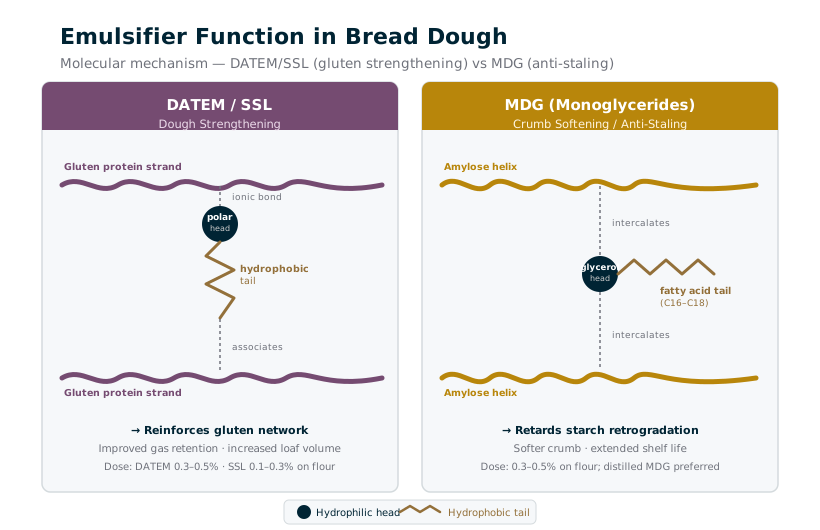 Schematic diagram of emulsifier molecules at gluten-water interface showing dough-strengthening effect of DATEM and SSL versus crumb-softening effect of monoglycerides
All emulsifiers listed above are permitted at quantum satis in bread under EU Regulation 1333/2008.
Allergen note: DATEM and SSL are typically derived from palm or rapeseed fatty acids — not allergens in their own right. MDG sourced from palm is also non-allergenic. However, lecithin (E322, not present in the above products as a declared ingredient) when sourced from soya must be declared as a soya allergen. Zeelandia Quick 96 emulsifier paste contains MDG and PGE from palm and is produced on a line also processing soya and milk — cross-contamination must be declared.
Enzymes — the undeclared processing aids
Enzymes appear in nearly all spec sheets reviewed ("enzymes" or listed as undeclared processing aids). In finished bread they are inactive (denatured by heat). Regulatory status: enzymes used solely as processing aids do not require E-number declaration on the label under EU/UK rules, which explains why many improvers list them without E-numbers.
The main enzyme classes in bread improvers:
| Enzyme | Main substrate | Baking effect |
|---|---|---|
| Alpha-amylase | Starch | Fermentation feed, crust browning, softer crumb (use with caution) |
| Maltogenic amylase | Amylopectin | Anti-staling; delays retrogradation without gumminess |
| Beta-amylase | Starch | Produces maltose for yeast fermentation |
| Xylanase / Hemicellulase | Arabinoxylan | Improves machinability and volume in wholemeal/high-fibre doughs |
| Lipase | Triglycerides | Produces in-situ polar lipids with emulsifier-like function (clean label) |
| Glucose oxidase (GOx) | Glucose | Gluten strengthening via H₂O₂ production |
| Protease | Gluten proteins | Dough relaxation (for biscuits, pizza, crackers) |
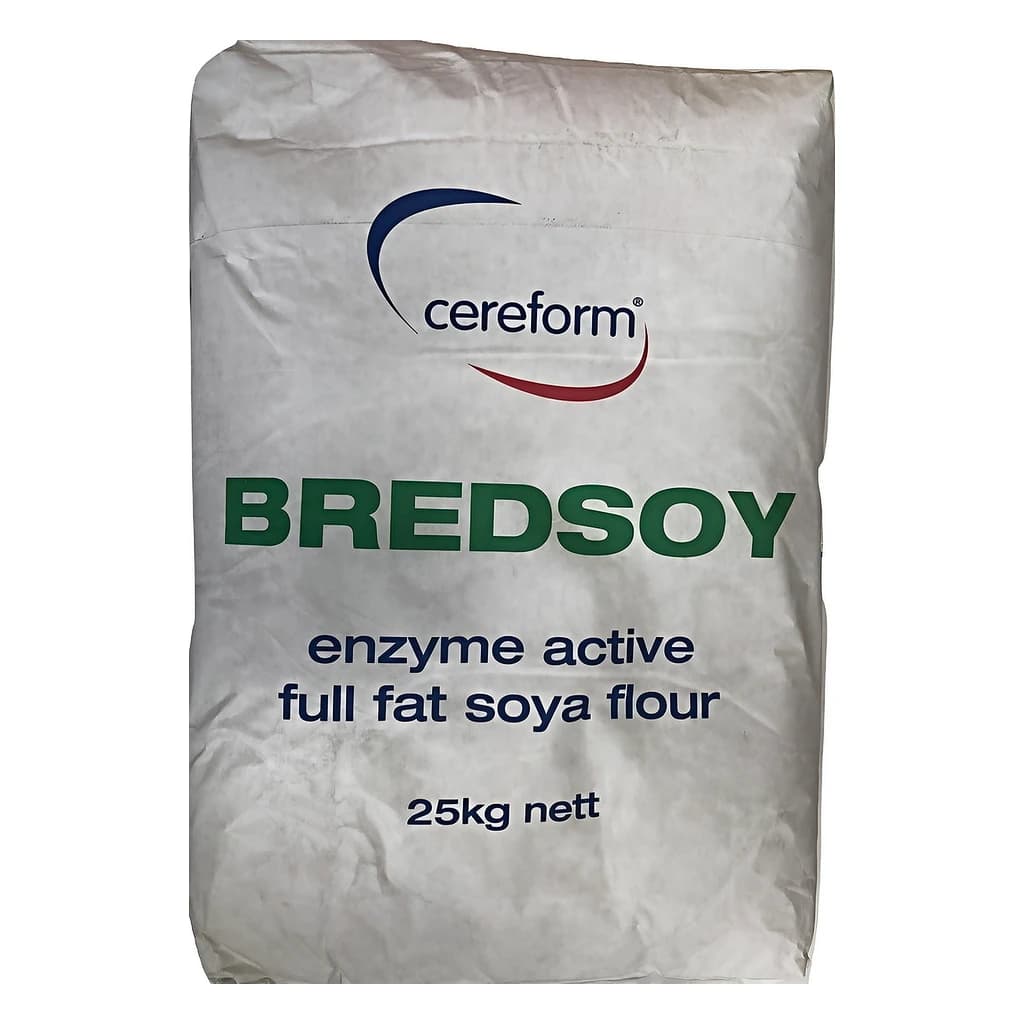
Enzyme-active soya flour (Cereform Breadsoy — 100% full-fat soya, 35.2g protein/100g) contributes lipoxygenase enzyme, which bleaches carotenoid pigments in wheat flour, producing a whiter crumb. Soya flour is a declared allergen (soya) and appears in IREKS Voltex and IREKS Soft Roll 7 formulations.
Soya Lecithin Powder (E322) in the Domson catalogue provides the same crumb-whitening and gas-bubble-stabilisation function and is also a declared soya allergen.
Malt and malt extracts
Malt products form an important sub-group of baking additives, contributing three distinct effects:
- Enzyme supply (diastatic malts only): Alpha- and beta-amylase convert damaged starch to fermentable sugars, feeding yeast and improving fermentation in flours with a low Falling Number.
- Colour: Roasted malts add brown colour from Maillard reactions during kilning. The darker the EBC value, the more colour (and the more bitter the flavour).
- Aroma and flavour: Malt contributes characteristic sweet-malty, sometimes slightly sour flavour notes.
The critical distinction is diastatic vs non-diastatic:
- Diastatic = enzyme-active. Use carefully; overdose leads to gummy, sticky crumb.
- Non-diastatic = no active enzymes. Can be used more freely for colour and flavour.
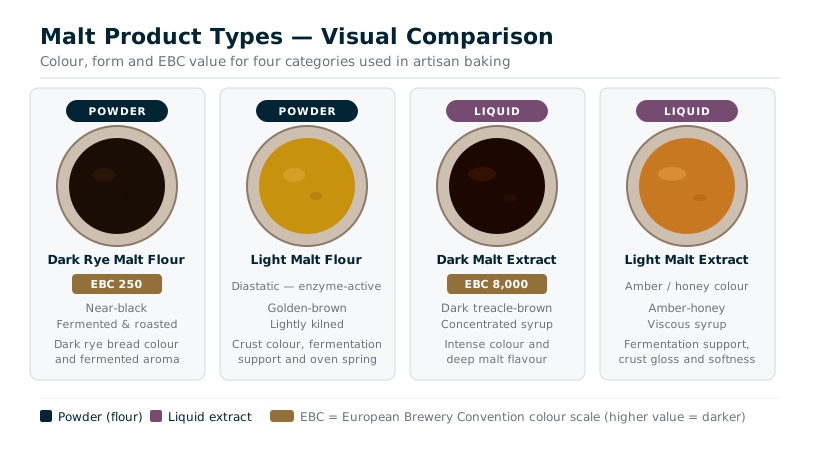 Four glass ramekins showing different malt products: dark rye malt flour, light malt flour, dark liquid malt extract, and light liquid malt extract
Lithuanian Dark Rye Malt (Forbake) — non-diastatic
This fermented and roasted rye malt has a diastatic power of 0 — it contains no active amylase. Its colour is 250±40 EBC (dark brown) and it contributes the characteristic aroma of traditional Lithuanian and Baltic dark rye bread. Dosage is 2–6% on flour weight per the spec sheet.
Key analytical data from the Forbake spec: moisture 7.0±1.0%, protein 10.5±2.0%, ash <2.1%, pH 4.5±0.5. The slightly acidic pH contributes subtly to the flavour profile without replacing sourdough. Allergen: gluten (rye).
ULDO Dark Malt Extract (Rye Malt Extract, liquid)
A dark barley malt liquid extract with EBC colour 7500–8500 — substantially darker than the Lithuanian rye malt powder. Total extract content 74–76%, specific gravity 1.3–1.4 kg/l, pH 3.8–4.5. Dosage 0.5–5% on flour. The liquid format is easier to pre-dissolve in water or metered automatically in larger bakeries.
Comparison: For intense dark colour with minimal dosage, the liquid extract (EBC 7500–8500) is far more efficient than the malt powder (EBC 250±40). For authentic rye aroma and texture, the dark rye malt flour is preferable.
Edme Dextramalt (malted wheat flour) and Edme SDM Medium Extract (malted barley powder)
Both are enzyme-active (diastatic) malts. Edme Dextramalt is a roller-milled malted wheat wholeflour (UK origin; allergen: wheat gluten); Edme SDM Medium is a spray-dried malted barley extract powder manufactured in the Netherlands (allergen: barley gluten; Kosher, Halal, organic certified). Dosage for diastatic malt flour is typically 0.5–2% on flour — overdose causes amylase excess and gummy crumb.
Caution: Over-dosing any diastatic malt produces excessive amylase activity that degrades starch during baking. The result is a gummy, wet crumb that does not recover. Check the Hagberg Falling Number of the base flour before adding any diastatic malt — if Falling Number is already low (below 250), reduce or omit diastatic malt entirely.
A side-by-side summary of these products appears in the comparison table below.
Emulsifier pastes for confectionery
Two emulsifier pastes in the Domson range serve a different function — aeration in cake and sponge batters rather than bread dough strengthening.
Zeelandia Quick 96
An emulsifier paste for aerated cake and sponge batters, containing E471 MDG, E475 PGE, E570 (from palm) in a water-sugar matrix. Dosage: 20–45g per 1000g egg (approximately 2–4.5% calculated on egg+water weight); legal maximum 1.8% calculated on the whole recipe. The paste is pre-emulsified and stabilised, making it easy to incorporate at the start of creaming.
Puratos Pronto
An emulsifier paste (E471 MDG + E475 PGE) for sponge, roulade, and Bundt cake applications. Dosage 0.5–3% on batter weight. Declared allergen: none (free from gluten, soya, dairy, eggs). This makes it useful where allergen labelling complexity from the improver is a concern.
Preservatives for shelf-life extension (packaged bread)
Calcium propionate (E282)
The primary mould inhibitor for pre-packed bread. Active below pH 5.5 by disrupting fungal metabolism. Compatible with yeast fermentation at recommended levels.
Under EU Regulation 1333/2008 Annex II Part E (applicable in the UK as retained EU law post-Brexit), the maximum permitted level in pre-packed bread only is 3000 mg/kg (approximately 0.3% on flour weight).
Food safety / regulatory flag: The 3000 mg/kg limit applies to pre-packed bread only. It does not apply to in-store bakery bread sold unwrapped. Note: the primary regulatory source is EU Regulation 1333/2008 Annex II (retained in UK law post-Brexit). The UK Bread and Flour Regulations 1998 (SI 1998/141) should also be checked; source review found that Schedule 3 of those regulations was amended in 1999 and the current version may not contain an independent propionate limit. Always verify against current UK retained law and consult a qualified food technologist before production use.
Potassium sorbate (E202) and sorbic acid (E200)
Broader-spectrum mould inhibitors effective up to approximately pH 6.5, making them useful for products with higher pH than propionate-optimal. These are not specifically covered in the first-party spec sheets reviewed for this article.
L-cysteine (E920) — a reducing agent, not a preservative
L-cysteine is a reducing agent that cleaves disulphide bonds in gluten, reducing mixing time and producing a more extensible, relaxed dough. It is used in biscuits, crackers, and pizza bases rather than bread. Dosage: typically 10–75 ppm (single reference source, BAKERpedia — verify with your L-cysteine supplier).
Food safety / allergen / dietary flag: The vegan, Halal and Kosher status of L-cysteine depends entirely on whether it is sourced from duck or chicken feathers (animal-derived, not Halal-certified unless slaughtered to Halal standard) or from microbial fermentation (acceptable to most vegan and Halal standards). Always verify the source with your supplier before use and declare accordingly.
How to choose the right product
Decision framework
| Baking goal | Recommended approach |
|---|---|
| Strengthen weak white flour | Add VWG 2–4% on flour; use a standard general-purpose improver (Zeelandia Gamma GP 0.5–1%) |
| High-fibre / wholemeal loaf | VWG 4–8% on flour; xylanase-containing improver; avoid excess alpha-amylase |
| Rye-wheat mixed bread (>50% rye) | Zeelandia Rye Stabil Free or Optimax Free (VWG-dominant improvers) at 2–3% on flour |
| Soft rolls / sandwich bread | IREKS Soft Roll 7 at 7%; provides MDG anti-staling, SSL strength, DATEM volume |
| General-purpose clean label | Zeelandia Gamma GP (enzyme + ascorbic acid only; no E-numbers beyond E300) |
| Industrial high-volume bread | IREKS Voltex 1–2% or Puratos Tigris SG 2%; good tolerance and volume |
| Dark rye bread colour/aroma | Lithuanian Dark Rye Malt 2–6% on flour (non-diastatic); or dark malt extract 0.5–3% |
| Improved crumb softness and shelf life | Puratos S500 Sense or IREKS Softy; MDG + maltogenic amylase; also consider anti-staling step |
| Clean-label emulsifier replacement | Lipase enzyme (processing aid, no E-number label) |
Adjusting water when adding VWG
Use this calculation as a starting point (single reference, BAKERpedia — confirm in practice):
Additional water (g) = VWG addition (% on flour) × 1.5 × flour weight (g) / 100
Example: 4% VWG on 1000g flour = 4 × 1.5 × 1000/100 = 60g additional water needed.
Reminder: this formula is based on one reference source (BAKERpedia). Actual absorption depends on flour protein, temperature, and VWG brand. Always trial before production.
Troubleshooting
Three fault-diagnosis tables are provided below:
- fault-vwg-bread — faults specific to VWG-enriched bread
- fault-malt-bread — faults when using diastatic and non-diastatic malts
- fault-improver-general — general improver selection and dosage errors
The most important rules:
- Adjust water for VWG — under-hydrated VWG dough will be stiff and dense.
- Do not overdose diastatic malt — gummy crumb is very difficult to correct after baking.
- Check allergens before switching improvers — formulations vary widely (IREKS Soft Roll 7 contains soya and milk; IREKS Softy and Zeelandia Gamma GP do not).
- VWG does not prevent staling — pair with an anti-staling emulsifier (MDG) or maltogenic amylase if shelf life beyond 24–48 hours is needed.
Formula cards
Three practical recipe cards are provided below:
- formula-vwg-wholemeal-loaf — Wholemeal tin loaf at 4% VWG fortification
- formula-rye-wheat-mix-with-optimax — Rye-wheat mixed bread (Zeelandia Optimax Free application recipe)
- formula-dark-rye-malt-loaf — Traditional dark rye bread using Lithuanian Dark Rye Malt at 3%
Coverage assessment
Solid (two or more independent sources):
- VWG protein specification and allergen status
- Emulsifier classifications (dough strengthener vs crumb softener)
- Ascorbic acid function and dosage range
- Calcium propionate regulatory limit (UK/EU)
- Malt diastatic vs non-diastatic distinction
Single-source (confidence: low — flag for follow-up):
- Water absorption increase per % VWG (~1.5% per 1%): BAKERpedia only; no first-party confirmation in spec sheets
- L-cysteine dosage range (10–75 ppm): BAKERpedia only
- Diastatic malt flour dosage (0.5–2%): BAKERpedia only; spec sheets do not state dosage on Edme products
Not covered (gaps for follow-up research):
- Commercial calcium propionate-containing bread improvers in the Domson range (no spec sheet for a labelled preservative product found in this run)
- Sorbate-containing products: not confirmed in catalogue spec sheets
- Potassium bromate: confirmed banned in UK (reg-uk-bread-flour-1998) but not the main subject here
- L-cysteine specific source (feather vs fermentation) for Domson-stocked products: not confirmed in any spec sheet reviewed
- Enzyme-only / E-number-free clean label improvers beyond Zeelandia Gamma GP: further research needed
Figures
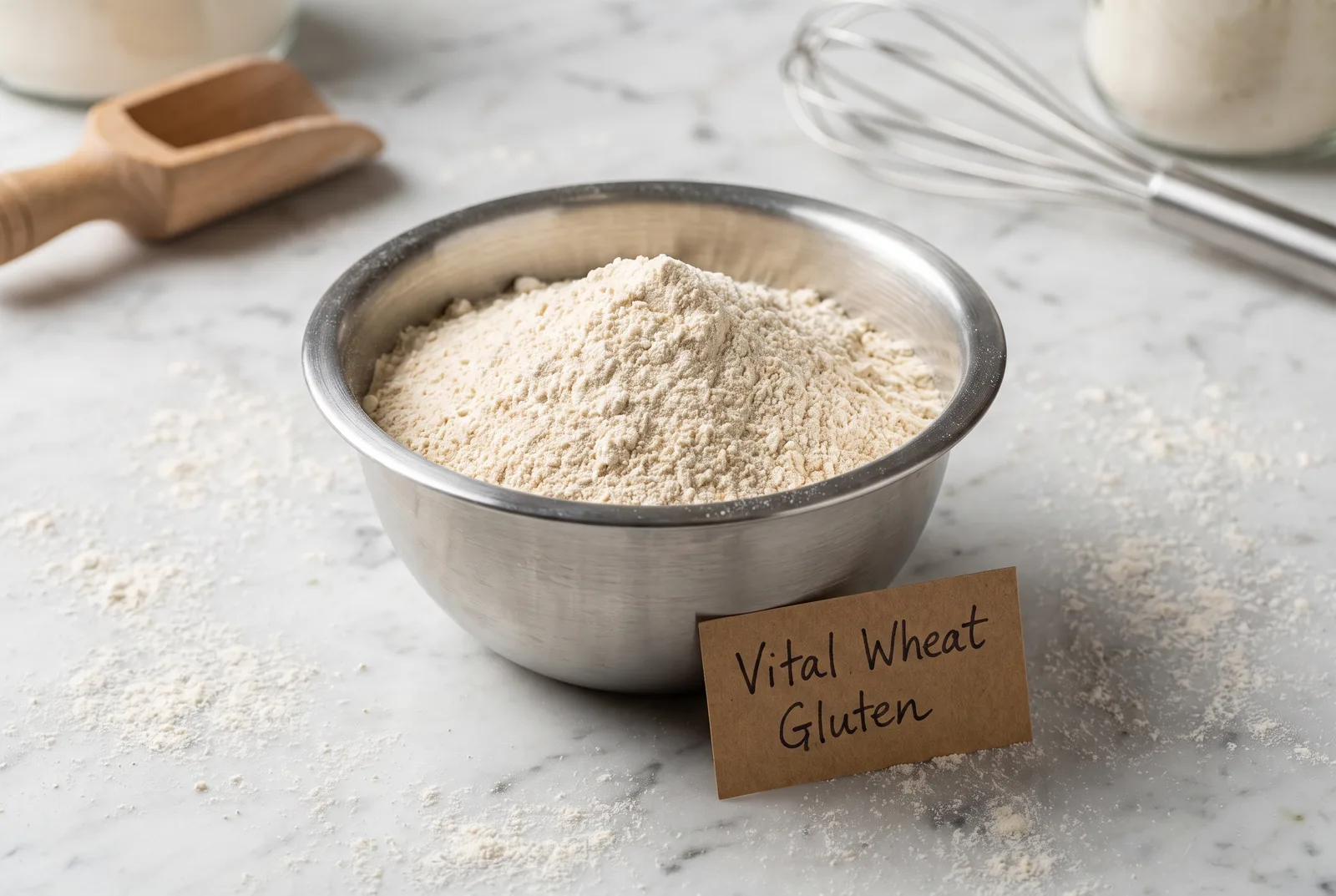 Cream-coloured vital wheat gluten powder in a stainless steel bowl on a bakery worktop
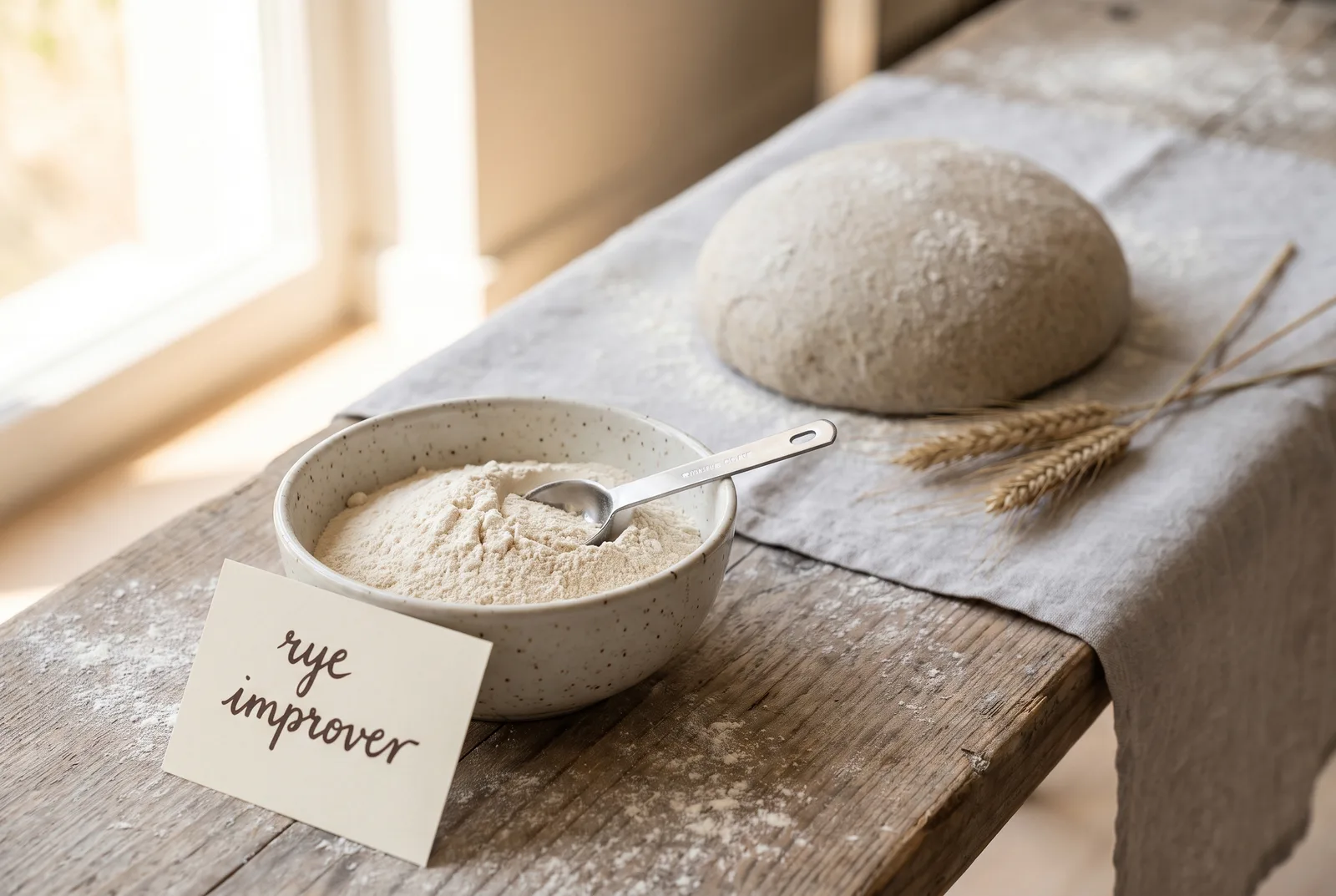 A stoneware bowl of pale cream rye improver powder beside a rounded grey-tan rye-wheat dough piece and ears of rye on a floured bench
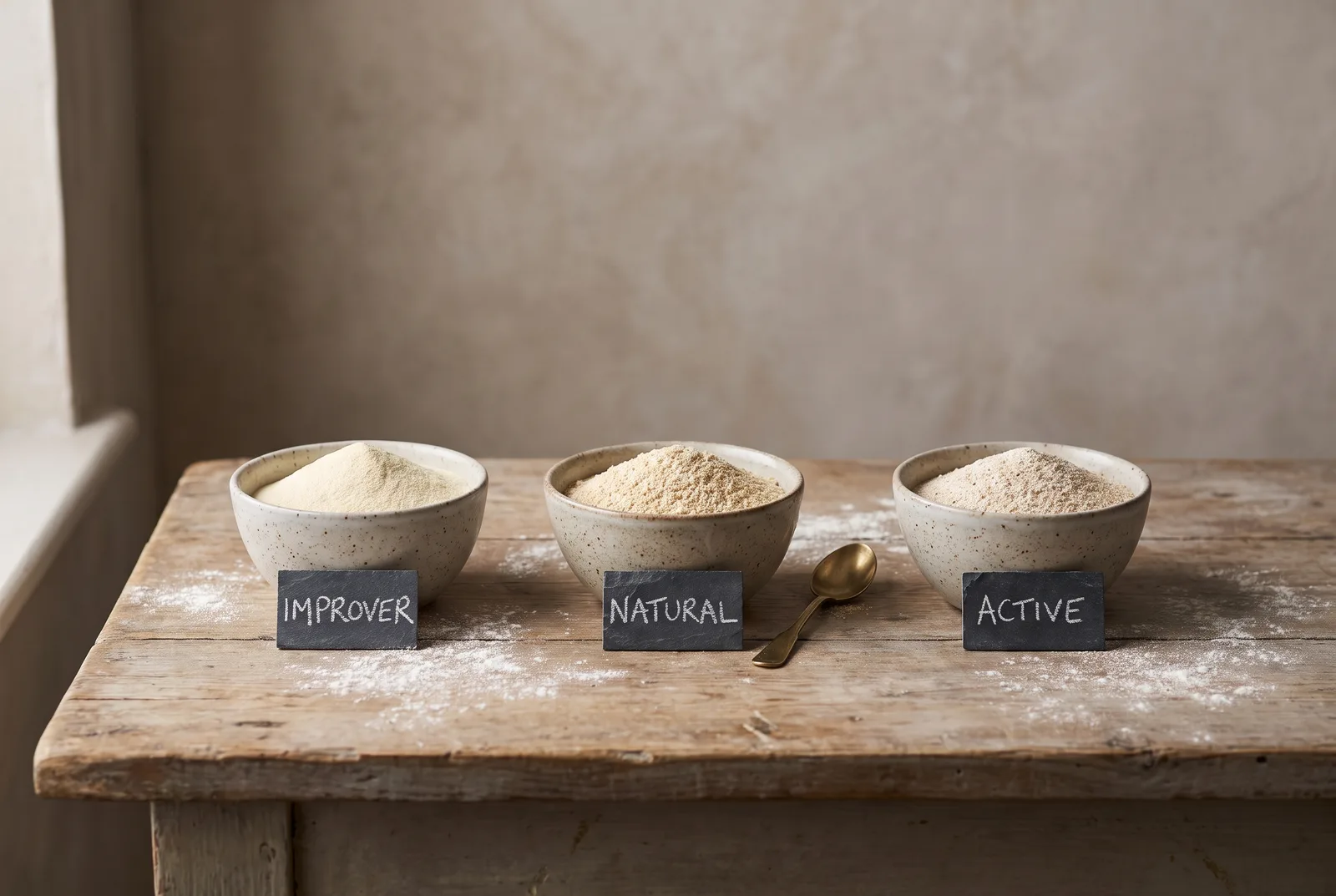 Three stoneware bowls of subtly different cream and beige bread improver powders lined up on a floured wooden bench, each with a small handwritten slate label
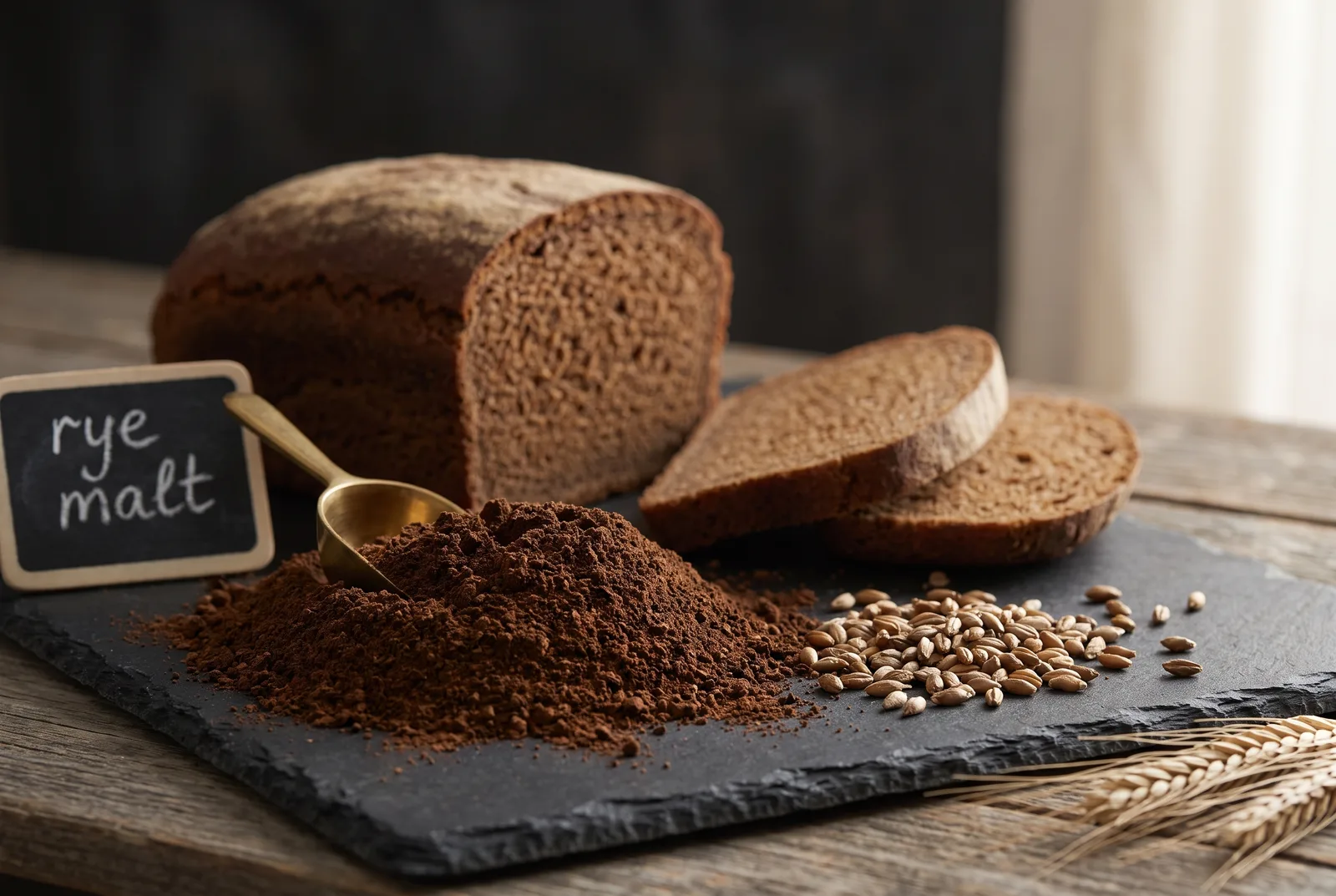 A pile of deep chocolate-brown ground rye malt with whole malted rye grains on dark slate, in front of a sliced dark rye loaf showing its dense brown crumb
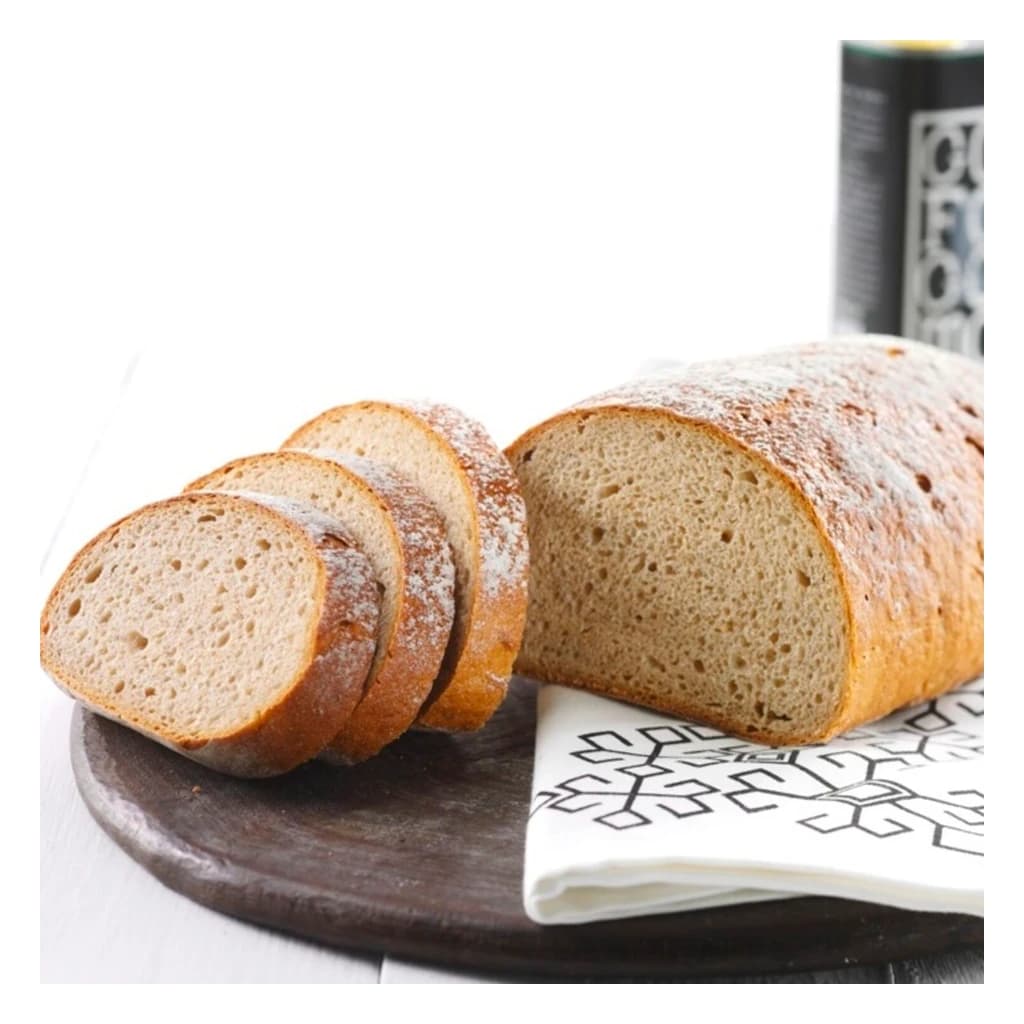
Wholemeal tin loaf with VWG fortification
Formula adapted from BAKERpedia guidance and the Zeelandia Rye Stabil Free application recipe. Dosage 4% VWG on wholemeal flour weight. Adjust water absorption empirically: each 1% VWG adds approximately 1.5% water (single reference source, c4, confidence: low — verify in practice). Scale to your batch size.
| Ingredient | Baker's % | Weight |
|---|---|---|
| Wholemeal wheat flour | 100 | 500 |
| Vital wheat gluten (BeneoPro VWG 75) | 4 | 20 |
| Water (adjusted for VWG absorption) — Increase water by approx. 6g per 1% VWG addition (indicative, single source: BAKERpedia) | 74 | 370 |
| Salt | 2 | 10 |
| Instant dry yeast | 1 | 5 |
| Bread improver (e.g. Zeelandia Gamma GP) | 1 | 5 |
- Mix all dry ingredients including VWG before adding water — VWG hydrates slowly
- Allow 5–10 minutes autolyse after initial mixing to aid hydration
- Bulk ferment 60 minutes at 27°C; knock back; shape into tin
- Final proof 45–50 minutes at 35°C / 85% RH
- Bake 220°C (fan 200°C) 35–40 minutes; internal temperature ≥97°C
Yield: One 900g tin loaf (baked weight approx. 750–800g)
Rye-wheat mixed bread using Optimax Free (Zeelandia)
Application recipe directly from the Zeelandia Optimax Free spec sheet. This recipe illustrates how a 50%-VWG improver is used in practice in rye-wheat production. Optimax Free is dosed at 0.1 kg into a 12.6 kg dough (≈0.8% on total dough, or approximately 1.7% on wheat flour alone).
| Ingredient | Baker's % | Weight |
|---|---|---|
| Wheat flour type 850 | reference | 1000 |
| Rye flour type 720 | 500 on wheat basis | 5000 |
| Rye sourdough | 640 on wheat basis | 6400 |
| Salt | 23 on wheat basis | 230 |
| Instant dry yeast | 25 on wheat basis | 250 |
| Optimax Free (50% wheat gluten improver) | 10 on wheat basis | 100 |
| Water | 560 on wheat basis (approx) | 5600 |
- Mix 8 min low speed + 2 min high speed; dough temperature 28°C
- First proof: 15 minutes; divide 580 g pieces directly into forms
- Final proof: approx 50 minutes
- Bake at 250°C reducing to 230°C; steam first 5 minutes; baking time 45 minutes
Yield: Batch producing approximately 15–16 loaves (from 12.6 kg dough)
Dark rye malt bread using Lithuanian Dark Rye Malt
Formula for a traditional dark rye bread using Forbake Lithuanian Dark Rye Malt at the lower end of its recommended dosage range (2–6%, per the supplier's specification). The malt contributes colour (250±40 EBC) and rye aroma but no enzyme activity (diastatic power = 0). Sourdough or added amylase must supply any necessary enzyme activity.
| Ingredient | Baker's % | Weight |
|---|---|---|
| Rye flour type 720 | 100 | 400 |
| Lithuanian Dark Rye Malt (Forbake) — 3% — mid-range of 2–6% recommended dosage, per the supplier's specification | 3 | 12 |
| Active rye sourdough | 30 | 120 |
| Water (warm, 40°C) | 75 | 300 |
| Salt | 2.2 | 9 |
| Instant dry yeast | 1 | 4 |
- Mix malt into flour before adding liquids — aids even dispersion
- Dough is sticky; use wet hands or oiled scraper — do not knead like wheat dough
- Bulk ferment 30–40 minutes at 28°C (rye dough is more active)
- Shape and place in oiled loaf tin; final proof 30–40 minutes until dough crowns above tin
- Bake 240°C reducing to 200°C; steam first 10 minutes; total 60 minutes
Yield: One large rye loaf (approximately 900g baked weight)
Key physical, chemical and nutritional parameters for BeneoPro VWG 75 Food as stated in the product specification Doc. F3-40 version 007 (2021-10-01). Parameters marked * are indicative and not subject to complaint per the spec sheet. All values are per 100g unless stated. Cross-reference BAKERpedia for the 70–80% protein range which is consistent with this data.
| Parameter | Limit / Typical Value | Unit | Test Method |
|---|---|---|---|
| Protein (N×5.7, d.m.) | min 75 | g/100g | ISO 1871 |
| Protein (N×6.25, typical) | 79.5 | g/100g | ISO 1871 |
| Moisture | max 8 | g/100g | ISO 6496 |
| Fat (crude) | max 2 (typical 6.4 by hydrolysis) | g/100g | ISO 11085 |
| Ash (crude) | max 1 | g/100g | ISO 2171 |
| Carbohydrate | 7.9 | g/100g | calculated |
| Dietary fibre | 0.7 | g/100g | calculated |
| Salt (sodium) | 0.04 (sodium 0.016) | g/100g | calculated |
| Energy | 1728 / 409 | kJ / kcal per 100g | calculated |
| Water binding capacity * | approx 140–170 | g water per 100g VWG | AACC 56-30 |
| Particle size ≥0.2 mm | max 2 | g/100g | DIN 66165, method F |
| Lead | max 0.2 | mg/kg | ICP-MS |
| Cadmium | max 0.15 | mg/kg | ICP-MS |
| Shelf life (sealed, recommended storage) | 36 months (<20°C, <60% RH) | months | — |
Key parameters from first-party spec sheets for six bread improvers sold through Domson. Dosage values are as stated on spec sheets. Protein and fat figures are per 100g of finished improver product. Allergen symbols: W=Wheat, R=Rye, S=Soya, M=Milk, E=Egg; (+) = contained; (?) = possible cross-contamination. All shelf-life values at ambient storage (typically <25°C).
| Parameter | Zeelandia Gamma GP | IREKS Voltex | Puratos Tigris SG 2% | IREKS Soft Roll 7 | IREKS Softy (Crumb Softener) | Puratos S500 Sense |
|---|---|---|---|---|---|---|
| Dosage (% on flour) | 0.5–2% | 1–2% | 2% | 7% | 1.5% | not stated on spec |
| Product type / description | General purpose bread improver | Multi-purpose bread improver | Bread improver for yeast-raised goods | Improver for soft rolls | Improver for soft baked goods | All-purpose improver with natural sourdough |
| Key emulsifiers declared | None (E-number free) | E472e DATEM, E481 SSL | E472e DATEM | E481 SSL, E471 MDG, E472e DATEM | E481 SSL | E472e DATEM |
| E300 ascorbic acid | Yes | Yes | Yes (<5%) | Yes | Yes | Yes (<1%) |
| Enzymes | Yes | Yes | Yes (<1%, processing aid) | Yes | Yes | Yes (<1%, processing aid) |
| Other notable ingredients | Wheat flour, rapeseed oil | Soya flour, E170i CaCO3 | Wheat flour, dextrose, rapeseed oil | Soya flour, whey powder (milk), dextrose, rapeseed oil | Wheat flour, E170i CaCO3 | Fermented rye flour 50–60%, E516 CaSO4 |
| Protein (g/100g improver) | 8.7 | 12.2–18.2 | 5.2 | 4.3–6.5 | 6.8–10.2 | not stated |
| Fat (g/100g improver) | 4.1 | 24.0–29.0 | 9.7 | 9.0–12.0 | 15.5–20.0 | not stated |
| Allergens — CONTAINS | Wheat | Wheat, Soya | Wheat (gluten) | Wheat, Soya, Milk | Wheat | Wheat (gluten) |
| Allergens — possible cross-contamination | Rye, Barley, Oats, Spelt, Egg, Soya, Milk, Sesame | Rye, Barley, Spelt, Oat, Milk | Milk, Egg, Soya | Rye, Barley, Spelt, Oat, Eggs | Eggs, Soya, Milk | Milk, Egg, Soya |
| Vegan / Vegetarian | Yes / Yes | Yes / Yes | Yes / Yes (confirmed on spec) | No (whey) / Yes | Yes / Yes | Yes / Yes (confirmed on spec) |
| Halal / Kosher | Likely / Likely (not stated) | Not stated | Yes / Yes (not certified) | Not stated | Not stated | Yes / Yes (Kosher certified) |
| Shelf life | 12 months | 12 months | 9 months | 9 months | 12 months | 9 months |
| Clean label (E-number free) | Yes (enzyme + E300 + oil) | No | No (DATEM + E300) | No (SSL + MDG + DATEM) | No (SSL + E300) | No (DATEM + E300) |
Comparison of malt and malt extract products sold by Domson. Diastatic power indicates whether active amylase enzymes are present. Non-diastatic malts contribute colour and flavour only. Dosages are from spec sheets where available; BAKERpedia cross-reference for general ranges. Colour values in EBC. Allergen: all malt products contain gluten (barley or rye).
| Parameter | Lithuanian Dark Rye Malt (Forbake) | Dark Malt Extract / Rye Malt Extract (ULDO) | Dextramalt — Malted Wheat Flour (Edme) | SDM Medium Extract — Malted Barley Powder (Edme) |
|---|---|---|---|---|
| Grain source | Rye | Barley | Wheat | Barley |
| Physical form | Powder (flour) | Liquid extract | Free-flowing flour | Spray-dried powder |
| Diastatic (enzyme active) | No (diastatic power = 0) | Likely low / non-diastatic (dark roast) | Yes (malted wheat wholegrains) | Yes (light extract from sound malt) |
| Colour (EBC) | 250 ± 40 | 7500–8500 | Light (not stated on spec) | Light-medium (not stated on spec) |
| Dosage (% on flour weight) | 2–6% | 0.5–5% | 0.5–2% typical (BAKERpedia) | 0.5–2% typical (BAKERpedia) |
| Primary function in bread | Dark colour, rye aroma, slight acidity | Dark colour, malty flavour, sweetness | Yeast feed, crust browning, subtle malt flavour | Yeast feed, crust browning, malt flavour (powder form) |
| pH | 4.5 ± 0.5 | 3.8–4.5 | Not stated | Not stated |
| Moisture / extract content | 7.0 ± 1.0% moisture | 74–76% total extract; 1.3–1.4 kg/l SG | Not stated on spec | Spray-dried (low moisture) |
| Shelf life | 12 months | 18 months | Not stated | Not stated |
| Allergen (EU 1169/2011) | Gluten (rye) | Gluten (barley) | Gluten (wheat) | Gluten (barley) |
| Typical applications | Dark rye bread, Lithuanian/Baltic rye, pumpernickel | Rye bread, wholemeal bread, malted loaves, malt vinegar | Malted bread, wholemeal, seeded loaves, tin bread | Malted bread, wholemeal, easy-disperse powder format |
Summary of major emulsifiers used in bread improvers. E-number status under EU Regulation 1333/2008 and UK Bread and Flour Regulations 1998. 'Quantum satis' (QS) = no specific maximum, use at minimum needed for technological effect. HLB = hydrophilic-lipophilic balance (higher = more water-loving = better dough strengthening). Allergen flags are for the most common commercial sources; always verify finished product spec sheets.
| E number | Name | Primary function in bread | HLB character | EU/UK status in bread | Allergen / dietary note | Found in (Domson products) |
|---|---|---|---|---|---|---|
| E322 | Lecithin | Crumb whitening via lipoxygenase; gas bubble stabilisation | Intermediate | QS, EU 1333/2008 | Soya or sunflower source; soya lecithin = soya allergen | Soya Lecithin Powder (E322) |
| E471 | Mono- and diglycerides of fatty acids (MDG) | Anti-staling crumb softener; amylose complex formation | Low (lipophilic) | QS, EU 1333/2008 | Usually palm or sunflower derived; check for soya | IREKS Soft Roll 7, Zeelandia Quick 96 |
| E472e | DATEM (Diacetyl tartaric acid esters of MDG) | Dough strengthener; gluten network reinforcement; volume increase | High (hydrophilic) | QS, EU 1333/2008 | Derived from MDG (palm/sunflower) + tartaric acid; vegan | IREKS Voltex, IREKS Soft Roll 7, Puratos Tigris SG, Puratos S500 Sense |
| E481 | Sodium stearoyl lactylate (SSL) | Dough strengthener; improved loaf volume and crumb texture | High | QS, EU 1333/2008 | Stearic acid usually from palm/rapeseed; lactic acid from fermentation; vegan | IREKS Soft Roll 7, IREKS Voltex, IREKS Softy |
| E482 | Calcium stearoyl lactylate (CSL) | Multifunctional: acts as both dough strengthener (gluten-protein interaction) and crumb softener (starch complexation) depending on formulation and application; classification varies between reference sources | Intermediate | QS, EU 1333/2008 | Same origin as SSL; vegan | Not confirmed in current spec-checked products |
| E475 | Polyglycerol esters of fatty acids (PGE) | Aeration agent; emulsifier paste for cake batters | Variable | QS, EU 1333/2008 | Fatty acid sourced from palm | Zeelandia Quick 96, Puratos Pronto |
Practical troubleshooting for breads where vital wheat gluten has been added. Sources: BAKERpedia, IREKS Compendium, first-party spec sheet guidance.
| Fault | Probable cause | Remedy |
|---|---|---|
| Dense, low-volume loaf despite VWG addition | VWG not fully hydrated before proofing; insufficient water added to compensate for VWG's high water binding capacity (140–170 g/100g) | Increase water by approx. 1.5% per 1% VWG (c4, single source — verify in practice). Allow autolyse of 5–10 min after initial mix. Check dough temperature is ≥25°C. |
| Tough, rubbery crumb texture | VWG overdose or over-mixing after VWG addition — excessive disulphide cross-links | Reduce VWG to recommended dosage (2–6% for high-fibre; up to 12% only for specific industrial high-speed applications). Do not over-mix after dough is developed. |
| Bread stales quickly despite VWG | VWG does not have anti-staling function; no anti-staling emulsifier or enzyme present | Add an anti-staling emulsifier (MDG E471) or maltogenic amylase. VWG improves structure but does not slow starch retrogradation. |
| Off-white / grey tinge to crumb | Normal effect of VWG addition; cream-coloured VWG powder alters crumb colour slightly | Accept as characteristic of VWG-fortified bread. Add enzyme-active soya flour (such as Cereform Breadsoy) or lecithin (E322) for crumb whitening via lipoxygenase activity. |
| VWG clumping in dry pre-mix | Moisture above 8% in VWG (storage in humid conditions) or moisture migration from other ingredients | Store VWG sealed at <60% RH and <20°C. Use within shelf life (36 months BeneoPro). Sieve before blending if clumped. |
Troubleshooting for malt applications in bread. Primary risk with diastatic malt is overdose causing excessive amylase activity. Non-diastatic malt (such as Lithuanian Dark Rye Malt, diastatic power = 0) does not carry this risk. Sources: BAKERpedia, Forbake spec sheet.
| Fault | Probable cause | Remedy |
|---|---|---|
| Gummy, wet crumb in malt loaf | Excess diastatic malt — amylase over-activity degrades too much starch; starch cannot gel properly on baking | Reduce diastatic malt to ≤2% on flour. Check Falling Number of base flour — if already low (high amylase), reduce or omit malt. Switch to non-diastatic malt for colour/flavour without enzyme risk. |
| Bread too pale despite malt addition | Non-diastatic malt dosage too low, or malt product colour insufficient for target | Increase non-diastatic malt to 3–6% on flour. For extra-dark colour use dark malt extract (EBC 7500–8500). Combine non-diastatic dark malt with a trace of diastatic malt for colour and sugar supply. |
| Fermentation too fast with malt | Diastatic malt producing sugars faster than expected, increasing yeast activity; effect is temperature-amplified | Reduce diastatic malt. Keep dough temperature controlled (target 27°C). Shorten fermentation time or reduce yeast. Monitor proof carefully. |
| Bitter aftertaste in malt bread | Excessive dark malt — highly roasted malts contribute bitter phenolic compounds at high dosage | Reduce dark malt flour to ≤3% on flour. Blend dark and light malts to moderate bitterness while maintaining colour. |
General troubleshooting for improver selection and dosage errors. Sources: IREKS Compendium, Zeelandia Gamma GP spec sheet, IREKS Voltex spec sheet.
| Fault | Probable cause | Remedy |
|---|---|---|
| Dough tears on sheeting or machining | Insufficient dough relaxation; too much gluten strength for the process | Add a reducing agent (L-cysteine E920 at 10–75 ppm, BAKERpedia — single reference; verify dosage with supplier) or protease enzyme. Relax dough adequately between stages. Consider a relaxing improver rather than a strengthening one. |
| Bread stales within 24 hours | No anti-staling agent; starch retrogradation proceeding unchecked | Switch to or add an anti-staling improver containing MDG (E471) and/or maltogenic amylase. Puratos S500 Sense or IREKS Soft Roll 7 address this. |
| Mould growth within 3–4 days (packaged bread) | No preservative system; packaging too early before sufficient cooling | Add calcium propionate E282 at up to 3000 mg/kg in prepacked bread (c13, reg-uk-bread-flour-1998) or potassium sorbate E202 (IREKS Compendium). Ensure bread is fully cooled before sealing. Maintain good factory hygiene. |
| Allergen label becoming complex from improver | Multi-allergen improver (e.g. IREKS Soft Roll 7 contains wheat, soya, milk) complicates finished product label | Use a minimal-allergen improver (Zeelandia Gamma GP: wheat only; IREKS Softy: wheat only). Consider enzyme-only / E-number-free options if clean label is a priority (Lesaffre Baking Center). |
- Value:
- 75
- Unit:
- g/100g d.m. (N×5.7)
- Confidence:
- high
- Value:
- 79.5
- Unit:
- g/100g (N×6.25)
- Confidence:
- high
- Value:
- 140–170
- Unit:
- g water per 100g VWG
- Confidence:
- high
- Note:
- indicative per spec, not subject to complaint
- Value:
- 2–12
- Unit:
- % on flour weight
- Confidence:
- high
- Note:
- upper end (12%) from BAKERpedia only; typical practical range 2–6%
- Value:
- 36
- Unit:
- months at <20°C, <60% RH
- Confidence:
- high
- Value:
- 20–200
- Unit:
- ppm on flour weight
- Confidence:
- high
- Food safety flag:
- true
- Note:
- EU/UK: quantum satis; US FDA maximum 200 ppm
- Value:
- 3000
- Unit:
- mg/kg in prepacked bread
- Confidence:
- high
- Food safety flag:
- true
- Value:
- 10–75
- Unit:
- ppm
- Confidence:
- low
- Food safety flag:
- true
- Note:
- single source; vegan/Halal status depends on production route
- Value:
- 250 ± 40
- Unit:
- EBC
- Confidence:
- high
- Value:
- 2–6
- Unit:
- % on flour weight
- Confidence:
- high
- Value:
- 7500–8500
- Unit:
- EBC
- Confidence:
- high
Buy the ingredients
Catalogue products and brands referenced in this article.
Optimax Free Bread Improver 20 kg
Lithuanian Dark Rye Malt 25 kg
Uldo Dark Barley Malt Extract 14 kg
Beneo BeneoPro VWG 75 Vital Wheat Gluten 25 kg
Rye Stabil Improver 25 kg
Puratos Pronto Dough Conditioner 10 kg
Zeelandia Gamma GP Bread Improver 12.5 kg
Edme Dextramalt Dried Malt Extract 25 kg
IREKS Soft Roll 7 Bread Improver 25 kg
IREKS Voltex Multipurpose Bread Improver 25 kg
Puratos Tigris SG 2% Bread Improver 16 kg
IREKS Crumb Softener 25 kg
Puratos S500 Sense SG Bread Improver 12.5 kg
Cereform Breadsoy Enzyme-Active Full-Fat Soya Flour 25 kg
Soya Lecithin Powder (E322)