Britain's regional bread map: Cornish saffron buns, Yorkshire parkin, Welsh bara brith, Scottish bannock and the oatcake belt
A working baker's tour of Britain's regional bakes — the home market — organised around the one fact that explains most of them: the grain divide. Oats and barley grew in the cool, wet north and west (Scotland, Wales, the North, the West Country) and wheat in the drier south and east, so the north and west baked flat on the girdle (bannocks, oatcakes) while the south baked wheaten buns and loaves. It covers the five headliners in production detail: the CORNISH SAFFRON BUN (a rich yeasted, saffron-gold, currant-studded bun tied to Methodist "tea treats" and Cornish revels — with the honest note that the romantic tin-for-saffron trade story is legend, while documented English saffron was grown at Saffron Walden); YORKSHIRE PARKIN (the sticky medium-oatmeal-and-black-treacle Bonfire Night gingerbread that must be matured 3-7 days, and the Lancashire golden-syrup version); WELSH BARA BRITH ("speckled bread", its fruit soaked overnight in tea, yeast-raised in North Wales or self-raising elsewhere); the SCOTTISH BANNOCK (barley/beremeal or oatmeal, girdle-baked, soda-leavened — plus the enriched Selkirk bannock); and the OATCAKE BELT, where a "Staffordshire oatcake" (a soft yeasted pancake) and a "Scottish oatcake" (a crisp biscuit) share only a name. Every regional ingredient — currants, sultanas, candied peel, black treacle, golden syrup, ground ginger, UK mixed spice, demerara, barley and oat flour — is mapped to the Domson catalogue with first-party datasheet numbers, and two gaps (saffron and true medium/pinhead oatmeal) are flagged. Regulatory (Bread and Flour Regulations 1998) and all allergen points are flagged.
Why Britain's bakes follow a map: the grain divide
Most of Britain's regional baking makes sense the moment you look at where the grain grew. In the cool, wet, upland north and west — Scotland, Wales, the northern English hills and the West Country — wheat was a struggle, but oats and barley thrived. In the drier, warmer south and east, wheat gave reliable harvests. So the north and west built a baking culture on oatmeal and barley, cooked flat on a hot surface, while the south and east built one on wheaten buns and loaves raised with yeast . That single divide explains why you find parkin and oatcakes and bannocks in the north, and Chelsea buns and Bath buns in the south. For the grains themselves — oats, barley, bere and spelt and how they behave — see Rye, spelt, emmer and heritage wheats: baking behaviour and blending rules; for the wheat side of the story and the UK flour system, the sibling dossier British flour in depth: protein grades, the Bread and Flour Regulations, and choosing the right flour for every application.
The second half of the explanation is the oven — or the lack of one. Before domestic ovens were common, much northern and western baking was done on a flat iron girdle (Scots for griddle) or a stone bakestone set over the fire. That is why so many regional specialities are flat, griddle-baked forms: bannocks, oatcakes, Welsh cakes, crumpets, pikelets and Northumbrian singin' hinnies. The griddle-baking science — a hot surface, conduction not radiant heat, no steam — sits alongside oven baking in The baking stage: oven spring, steam injection, starch gelatinisation, Maillard reaction and crust formation, and the griddle tea-table bakes get their own treatment in Scones, crumpets and English muffins: the chemistry of baking-powder rise, griddle baking and the cream-tea format. The tour below runs the five headliners in and; the ingredients to make them all are mapped to the Domson catalogue at the end.
Cornwall: the saffron bun
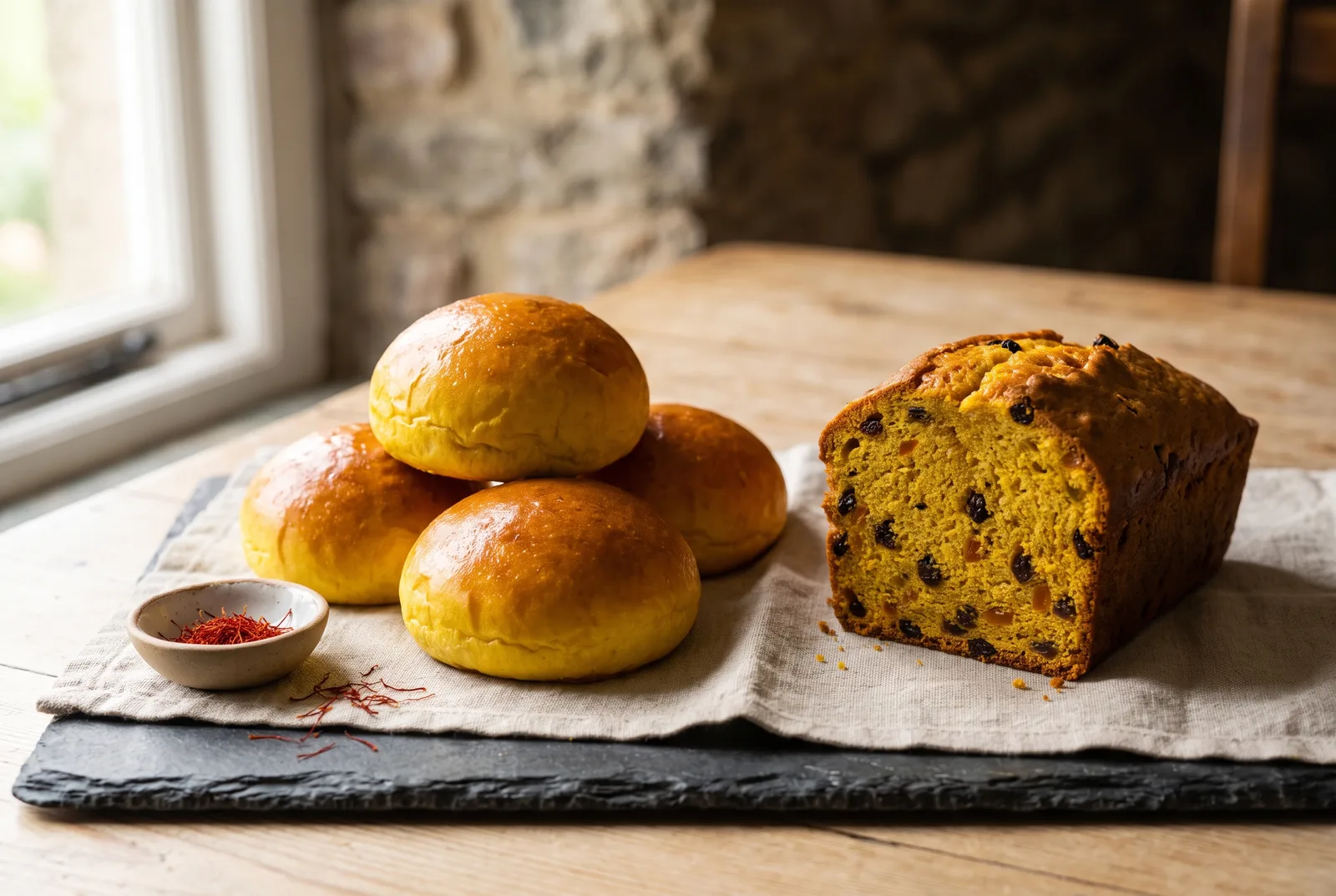
The South West is wheat country, and its most distinctive bake is the Cornish saffron bun (also sold as saffron cake in a loaf, and as a "tea treat" or "revel" bun): a rich, yeast-leavened, spiced sweet dough turned a deep gold by saffron and studded with currants and mixed peel — much like a teacake, but with that unmistakable saffron colour and perfume. The buns are woven into Cornish community life: they were the treat handed out at Methodist chapel tea treats and at parish revels (feasts), eaten on Sundays and outings.
Be honest about the history. A romantic tradition says saffron reached Cornwall because ancient traders swapped it for Cornish tin. It is a lovely story and it is legend — the firmly documented English saffron industry was not in Cornwall at all but at Saffron Walden in Essex, where the saffron crocus was cultivated commercially from the late-medieval period. The crop so defined the town that Walden was renamed "Saffron Walden" over the sixteenth century (a 1514 charter of Henry VIII survives illustrated with saffron crocuses; saffron growing is traditionally traced to the reign of Edward III) . Present the tin-trade tale to customers as folklore, not fact.
Production notes. Saffron is expensive, so it is steeped in the warm milk — ideally for hours or overnight — to draw out both colour and flavour before it ever meets the flour. The dough is a proper enriched, yeasted dough: with the butter, sugar and heavy fruit load slowing the yeast, give it time and warmth, use a strong white flour (British flour in depth: protein grades, the Bread and Flour Regulations, and choosing the right flour for every application, Choosing the right wheat flour: bread, pastry, cake, pizza, pasta and laminated doughs) and consider an osmotolerant yeast (Osmotolerant Yeast for Enriched Doughs: Brioche, Panettone, Doughnuts & High-Sugar Formulas). One honest caveat for British bakers pricing this bake: saffron is not in the Domson catalogue — source it separately. When saffron was scarce in the two World Wars, bakers stretched or replaced it with yellow food colouring, a shortcut still seen today. Flag if you go synthetic: the common "Southampton Six" yellow/orange colours — tartrazine (E102), sunset yellow FCF (E110) and quinoline yellow (E104) — legally require the advisory "may have an adverse effect on activity and attention in children" on the finished product in Great Britain, so a genuine saffron or a natural alternative (e.g. turmeric/annatto) avoids that labelling obligation. The currants (G44677), candied peel (G22145) and UK mixed spice (G45412) are all catalogue lines. The full formula is below; the enriched-dough family it belongs to is Hot cross buns, Chelsea buns, lardy cake and Yorkshire teacakes: a production guide to British enriched yeasted bakes and Enriched dough formulas: brioche, challah, cinnamon rolls and sweet buns by baker's percentage.
Yorkshire (and Lancashire): parkin
Cross into the oat-growing North and the signature bake changes completely. Parkin is a dark, dense, sticky gingerbread made with oatmeal and black treacle. It is old: the first dated reference is from the 1728 West Riding of Yorkshire Quarter Sessions, when one Anne Whittaker was accused of stealing oatmeal to make it, and its recognisable ancestor is tharf cake, an unleavened griddle cake described by the Lancashire poet Tim Bobbin in 1740 — a neat illustration of the north's oatmeal-and-griddle roots.
Two things define parkin. First, medium oatmeal — a coarse, steel-cut/pinhead-style ground oat, not rolled oats or flakes — which gives the cake its characteristic nubbly bite. Second, the syrup: Yorkshire parkin leans on black treacle (with soft brown or demerara sugar) for a dark, bittersweet, malty depth, while Lancashire parkin uses golden syrup for a paler, sweeter cake; many bakers blend the two. The two syrups are genuinely different products, and the catalogue datasheets show it: Black Treacle (G45098) is cane molasses plus invert syrup — sucrose 25-30%, near-black, iron-rich, 280 kcal/100 g — while Golden Syrup (G45099) is a clear invert sugar syrup, sucrose 30-33%, milder, 343 kcal/100 g. Both are gluten-free. The warmth comes from Ground Ginger (G44879) — 100% ginger, volatile oil ≥1.5% — and often a little Mixed Spice (G45412).
The most important step is not the bake — it is the wait. Parkin is baked firm, then wrapped and matured in a sealed tin for at least 3-7 days, during which the treacle (a humectant) draws moisture through the crumb and the cake turns soft, sticky and moist. That maturation, not the oven, makes parkin Bread staling and shelf life: starch retrogradation, moisture migration, anti-staling enzymes and clean-label approaches. It is the traditional food of Bonfire Night (5 November) eaten with treacle toffee; by 1862 the pairing was so established that 5 November was called "Parkin Night" in Leeds. One catalogue caveat: a true medium/pinhead oatmeal is not stocked, so pulse Oat Flakes (G23549) to a coarse meal or blend in Oat Flour (G22040). For volume work, the Whitworth Complete Ginger Cake Mix (G44676) is a fast ginger-cake base to build a parkin-style bake on — but note it contains WHEAT, EGG, SOYA and MILK and is not a like-for-like oatmeal parkin. The treacle-toffee side of Bonfire Night belongs to British sugar confectionery: fudge, tablet, toffee, treacle and golden syrup - temperature stages and crystallisation control, and the syrup/sugar chemistry to Sugar work for confectioners: cooking stages, pulled, blown and spun sugar, and isomalt.
Wales: bara brith
Wales gives us bara brith — literally "speckled bread" in Welsh — a fruited tea loaf densely speckled with dried fruit and warm with mixed spice. Its defining technique is simple and worth insisting on: the dried fruit (sultanas G44764, currants G44677, raisins) is soaked overnight in cold strong tea, which plumps the fruit, keeps the finished loaf moist for days, and lends a gentle tannic backnote.
There are two bara briths, and both are "correct". The traditional loaf is a yeast-raised enriched dough — you will still find these in North Wales bakeries — while the version most home and craft bakers make today is a no-yeast loaf raised with self-raising flour / baking powder, closer to a fruit tea-cake. The yeast route belongs with Enriched dough formulas: brioche, challah, cinnamon rolls and sweet buns by baker's percentage and Fresh, Active Dry & Instant Yeast: Formats, Performance & When to Use Each; the chemical-leavened route with Chemical Leaveners: Baking Soda, Baking Powder, Ammonium Bicarbonate & Choosing the Right Acid. Either way the fruit and peel are the point: candied peel (G22145) and a generous hand with UK mixed spice (G45412) — a real British blend of coriander, cassia, ginger, cardamom, cloves, fennel and nutmeg. Bara brith sits in the same teatime family as the enriched bakes of Hot cross buns, Chelsea buns, lardy cake and Yorkshire teacakes: a production guide to British enriched yeasted bakes and the fruit cakes of British fruit cake: from Dundee to Christmas and wedding cakes — fruit maceration, baking curves, marzipan application and royal icing.
Scotland: bannocks, beremeal and the Selkirk
Scotland is the heartland of the bannock — and of Britain's oldest baking grains. A bannock is a flat, round quick bread, historically a heavy, unleavened cake of barley or oatmeal patted into a round and cooked on a girdle or on a hot "bannock stane" (sandstone) set on the fire . The word itself is ancient — from Latin panicium / panis, recorded as "bannuc" in glosses to Aldhelm (died 709). As commercial baking soda spread through the nineteenth century — bicarbonate of soda became a widely marketed kitchen leavener from the 1840s — the soda bannock appeared: bicarbonate leavened with the acid of buttermilk or soured milk, giving a lighter round Chemical Leaveners: Baking Soda, Baking Powder, Ammonium Bicarbonate & Choosing the Right Acid.
The most authentic Scottish bannock grain is beremeal, ground from bere — a six-row barley (Hordeum vulgare) that is one of Britain's oldest cultivated grains, still grown in Orkney, where Barony Mill is essentially the only mill producing beremeal commercially (bere-crushing bowls were found at Neolithic Skara Brae). Beremeal is not in the catalogue, but the nearest analogue is Doves Organic Barley Flour (G45157) — 100% stone-ground barley, off-white with brown specks, and (importantly) it contains gluten, naturally present in barley . Blend it with wheat flour for a bannock that handles well.
The glorious exception is the Selkirk bannock — which is not a flat girdle cake at all but a rich, buttery, sultana-laden enriched YEAST loaf, closer to a fruitcake, from Selkirk in the Scottish Borders. It was first made by baker Robbie Douglas, who opened his shop in Selkirk in 1859 . Build it as a proper enriched dough loaded with Turkish sultanas (G44764) and a strong flour — see Enriched dough formulas: brioche, challah, cinnamon rolls and sweet buns by baker's percentage and Hot cross buns, Chelsea buns, lardy cake and Yorkshire teacakes: a production guide to British enriched yeasted bakes.
The oatcake belt: one word, three different bakes
Follow the oats south from Scotland through the northern counties down to Staffordshire and you cross the "oatcake belt" — but beware, because the word oatcake means three completely different things :
- Staffordshire (Potteries) oatcake — the one most likely to surprise you. It is a soft, flexible, savoury pancake, made from a yeast-leavened oatmeal-and-flour BATTER cooked on a griddle or "bakestone" (locally a "backstone" or "baxton"). It is neither a bread dough nor a biscuit; it dates to the 19th century and is the everyday breakfast of Stoke-on-Trent, folded hot around cheese, bacon or egg. The batter is traditionally fermented — historically in a wooden vessel seasoned with resident wild yeasts — which links it to the fermentation science of How Yeast Ferments: Carbon Dioxide, Ethanol, Flavour and the Key Variables That Control It and the wild-yeast tradition of The British Real Bread and sourdough revival: the UK Sourdough Code of Practice, long-ferment technique and artisan positioning.
- Scottish oatcake — a crisp, dry BISCUIT of oatmeal and fat, rolled and cut into farls (quarters), baked or toasted on a girdle, eaten like a cracker with cheese. It belongs with the British biscuit family in Shortbread and the British biscuit family: formulation, fat selection and commercial production from shortbread through digestives to ginger snaps — a world away from the Staffordshire pancake despite the shared name.
- Derbyshire oatcake — a middle case: a soft pancake like the Staffordshire, but larger, thicker and paler, made with a little milk in the batter.
For all three, the oat comes from Oat Flour (G22040) or Oat Flakes (G23549) pulsed to a meal . The Staffordshire and Derbyshire batters also need a plain wheat flour (British flour in depth: protein grades, the Bread and Flour Regulations, and choosing the right flour for every application). The batter formula is below.
The wider map: regional buns and rolls
Beyond the five headliners, Britain's regions each have their own bun or roll — worth knowing for a British B2B customer building a regional range:
- Aberdeen buttery (a "rowie") — a flaky, salty, butter-laden roll, croissant-like but denser, from the North East of Scotland.
- Kentish huffkin — a flat, soft, oval bap with a dimple in the middle (once for a Kentish cherry), enriched with lard to keep it soft. Lard is a catalogue line (G24762); its role as a softening/shortening fat is in Butter, margarine, shortening & oil: which fat for which job?.
- Newcastle stottie — a large, flat, chewy round baked on the oven floor (a "bottom cake"); the name comes from a Tyneside word meaning to bounce.
- Chelsea bun and Bath bun — the rich, sugar-glazed, fruited buns of the 18th-century south; along with the Bath Sally Lunn, they belong to the wheaten south and to Hot cross buns, Chelsea buns, lardy cake and Yorkshire teacakes: a production guide to British enriched yeasted bakes.
- Lancashire barm cake — a soft, floury bread roll, its name a memory of the days when ale barm (yeast) raised the dough.
These are the wheaten, oven-baked counterpoints to the northern oat-and-griddle bakes — the two ends of the grain divide meeting on the same national map.
Craft, not Chorleywood
One framing point for the home market. These regional bakes are, almost by definition, craft products: long-fermented enriched doughs, girdle skills, matured cakes, wild-yeast batters. They are the living counter-tradition to the industrial Chorleywood Bread Process that makes most UK sliced bread — the contrast drawn out in Chorleywood Bread Process vs craft bulk-fermentation: how Britain's two bread traditions diverged and what each demands from flour and improvers, and championed commercially by the Craft Bakers Association and the Real Bread movement. Selling a Cornish saffron bun or a Selkirk bannock is selling craft and place; price and position them accordingly.
Buying the ingredients from the Domson catalogue
Everything on this map, except saffron and a true pinhead oatmeal, can be built from Domson stock :
- Dark, sticky sweetness → Black Treacle (G45098) for Yorkshire parkin and gingerbread; Golden Syrup (G45099) for the Lancashire version and flapjack; Demerara (G44477) and Molasses Sugar (G45469) for crunch and depth.
- Warm spice → Ground Ginger (G44879) and the genuine Mixed Spice UK Blend (G45412) — vegan, UK-made.
- Dried fruit and peel → Currants (G44677) for saffron buns and bara brith; Turkish Sultanas (G44764) for bara brith and the Selkirk bannock; Candied Orange Peel (G22145) / Mixed Peel (G44774) for both.
- The northern grains → Organic Barley Flour (G45157) as the nearest beremeal analogue for bannocks; Oat Flakes (G23549) / Oat Flour (G22040) for parkin and oatcakes.
- Traditional fat → Lard (G24762) for parkin, huffkins and pastry Butter, margarine, shortening & oil: which fat for which job?.
- At volume → the Whitworth Complete Ginger Cake Mix (G44676) as a fast ginger/parkin-style base (contains WHEAT/EGG/SOYA/MILK).
- Flour → strong white for saffron buns and the Selkirk bannock; self-raising for bara brith and parkin; plain for the oatcake batters — all in British flour in depth: protein grades, the Bread and Flour Regulations, and choosing the right flour for every application.
- Not stocked — flag → saffron (source separately) and a true medium/pinhead oatmeal (pulse oat flakes).
To turn any of the formula cards into scalable production quantities, work in baker's percentage — see Baker's percentage: the universal language of professional formulas. The formulas here (Cornish saffron buns, Yorkshire parkin, bara brith, barley soda bannock, Staffordshire oatcakes) are representative working formulas, not protected recipes: dial them in on trial bakes.
Food safety and allergens
Read this before any customer-facing claim. Every wheat-, barley- and oat-based bake on this map contains GLUTEN and is unsuitable for coeliacs — and note that oats and barley carry their own gluten, so a "barley bannock" or an "oatcake" is not gluten-free. The dried-fruit lines need care: Currants (G44677) and Turkish Sultanas (G44764) are stated coeliac-suitable, but both carry an SO2 / sulphite cross-contamination risk from lines shared with sulphured fruit, and Candied Orange Peel (G22145) "may contain sulphites" — always read the current datasheet. The Whitworth Complete Ginger Cake Mix (G44676) additionally contains EGG, SOYA and MILK. Ground Ginger (G44879) carries naturally occurring sulphites up to ~30 ppm. Colour additives (saffron substitutes): if you replace saffron with a synthetic yellow, the common "Southampton Six" colours — tartrazine (E102), sunset yellow FCF (E110) and quinoline yellow (E104) — legally require the advisory "may have an adverse effect on activity and attention in children" on the finished product in Great Britain. And the wheat flour in every one of these bakes is fortified under the Bread and Flour Regulations 1998 with calcium, iron, thiamin and niacin — visible right on the Whitworth mix declaration ("WHEAT Flour with added Calcium, iron, Niacin, Thiamin") — which belongs in your ingredient declaration; the full regulatory picture, including the 2024 folic-acid amendment, is in British flour in depth: protein grades, the Bread and Flour Regulations, and choosing the right flour for every application . Full-ingredient allergen labelling under Natasha's Law (PPDS) applies to any of these bakes sold prepacked for direct sale. Treat all allergen, sulphite, colour-additive, fortification and legal-status statements here as requiring independent verification before customer-facing use.
Figures
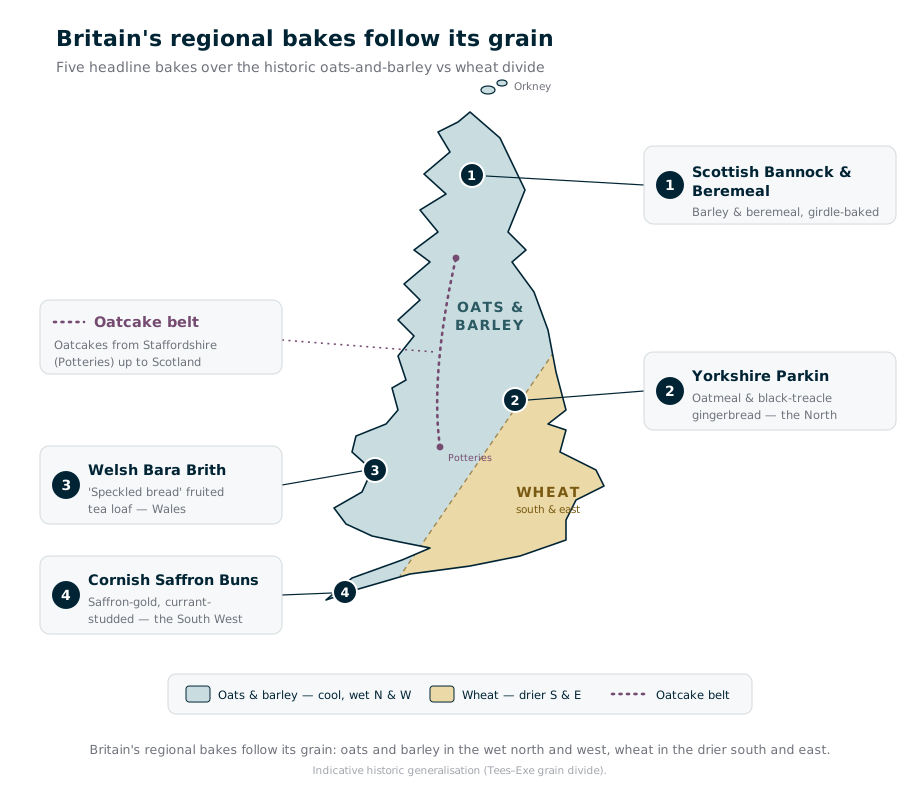 Illustrated map of Great Britain: Cornish saffron buns in the South West, Yorkshire parkin in the North, Welsh bara brith in Wales, Scottish bannock and beremeal in Scotland, and a shaded 'oatcake belt' from Staffordshire to the Scottish/Northern uplands — set over a divide of oats and barley in the cooler, wetter north and west and wheat in the drier south and east.
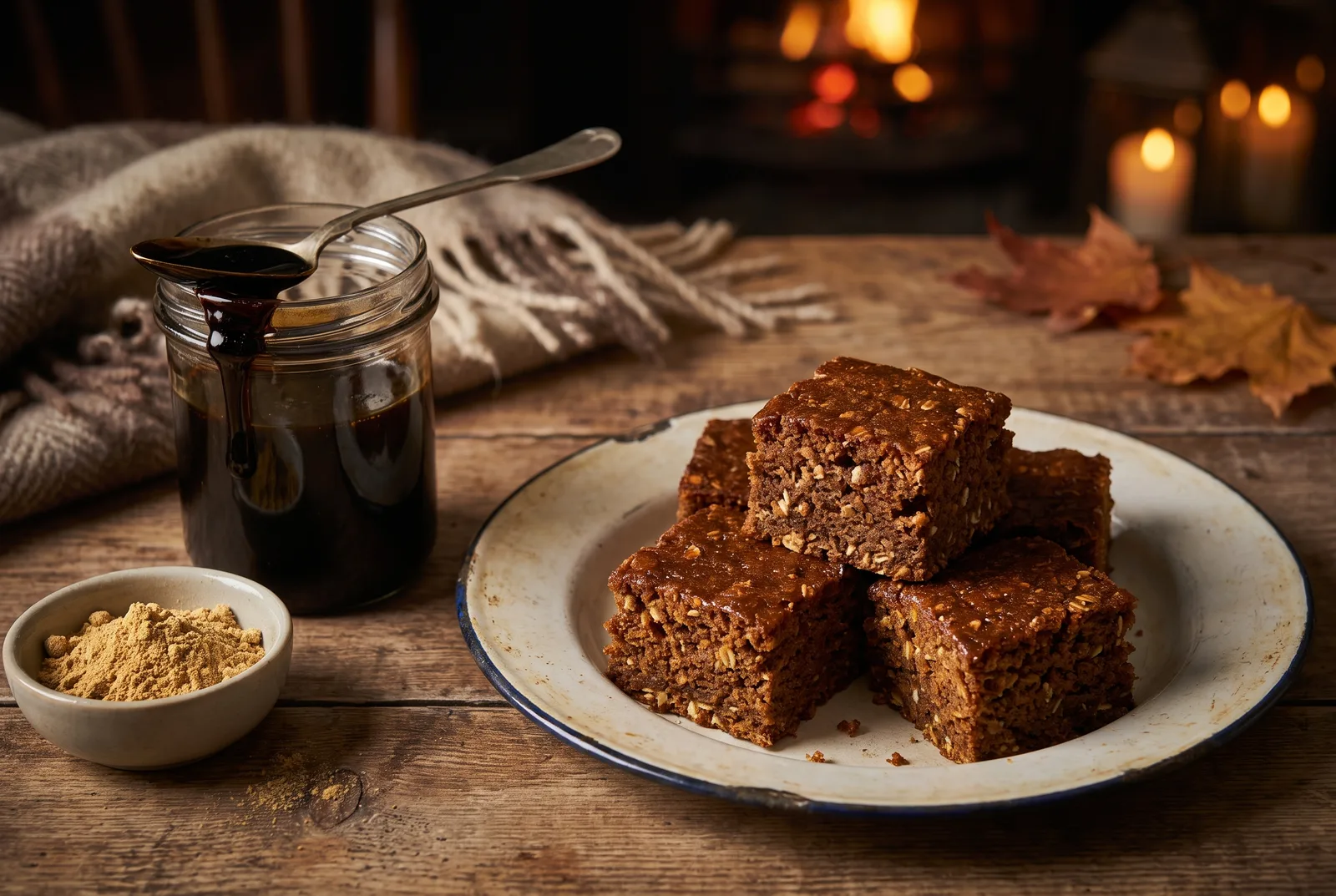 Dark, dense Yorkshire parkin cut into squares on a wire rack, the sticky treacle-brown crumb visibly flecked with medium oatmeal, beside a jar of black treacle.
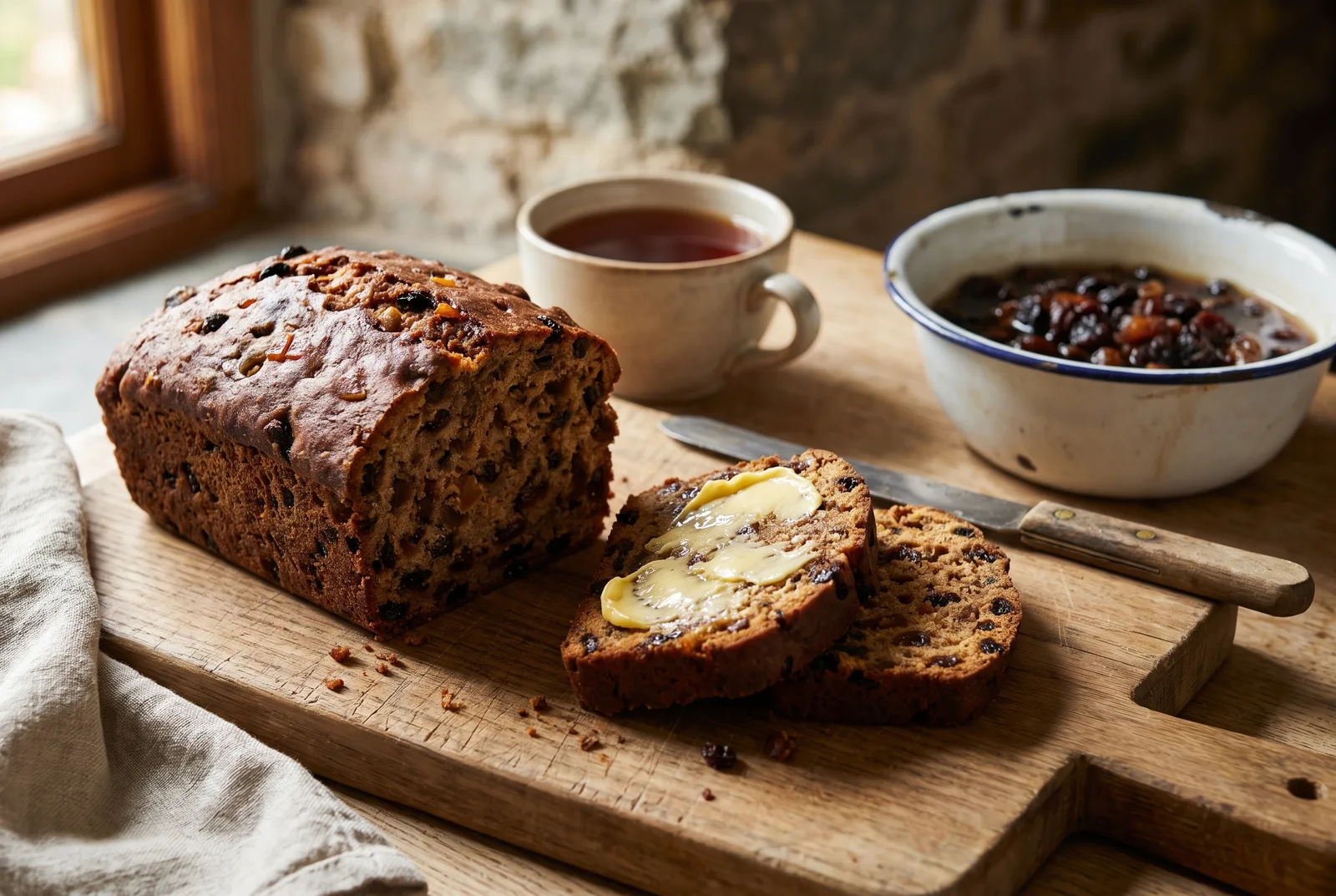 A sliced Welsh bara brith tea loaf on a wooden board, its crumb densely speckled with tea-soaked currants, sultanas and raisins, two slices spread with salted butter.
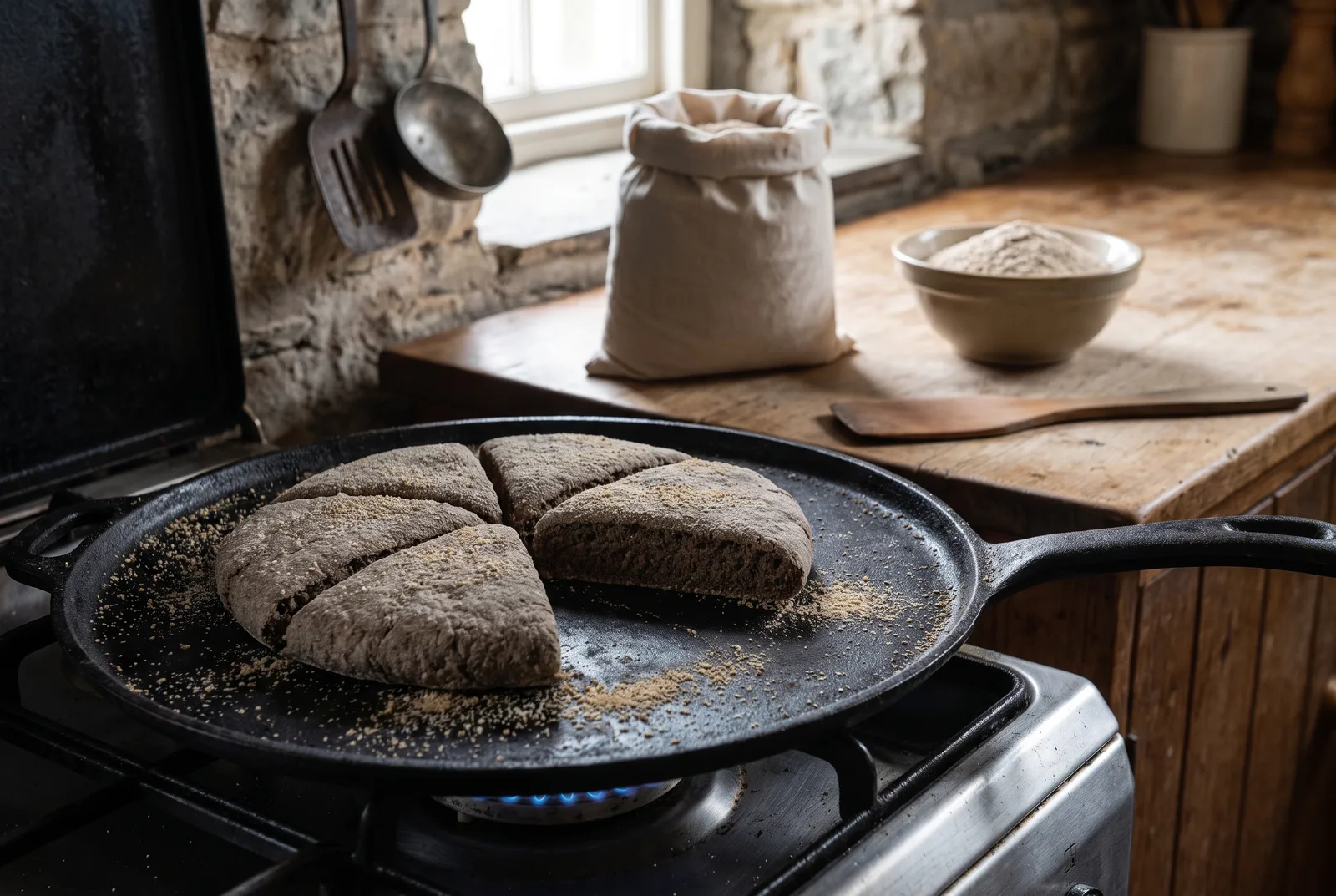 A dark, round beremeal bannock cooking on a flat cast-iron girdle over a flame, one cut into triangular farls to show a dense greyish-brown barley crumb.
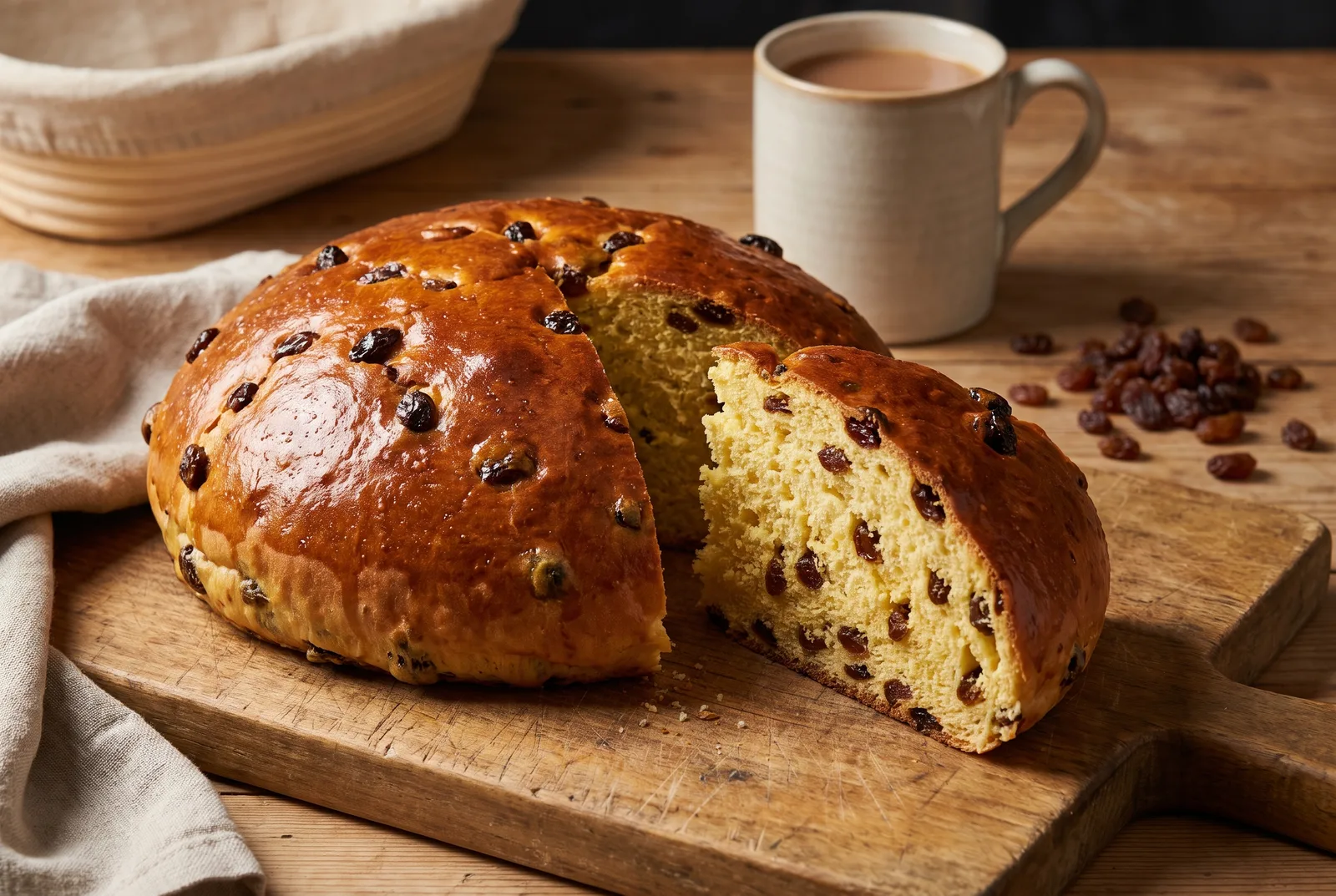 A golden, domed Selkirk bannock enriched loaf, glossy on top, one slice cut to reveal a soft buttery crumb packed with sultanas and raisins.
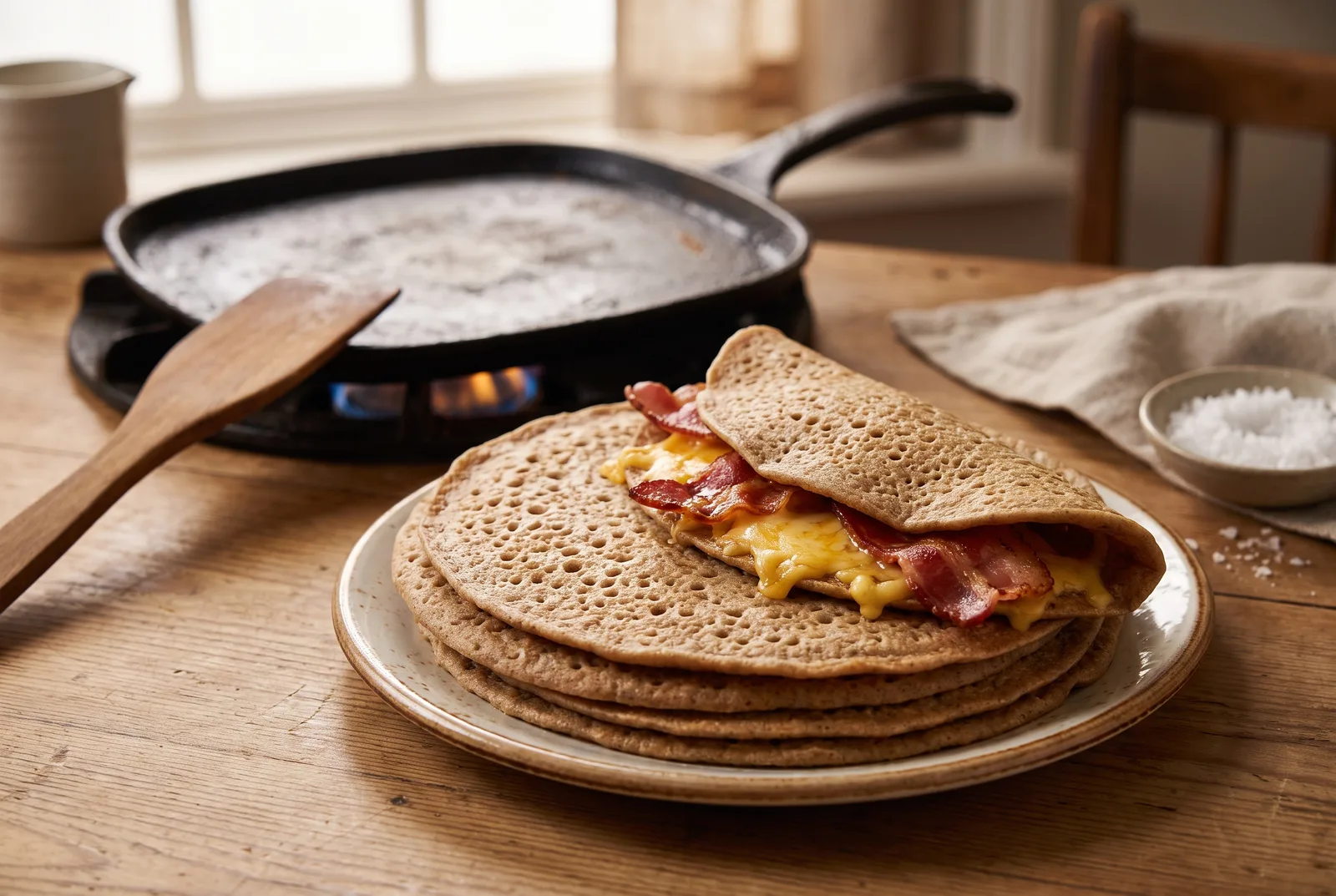 Two soft, flat, speckled Staffordshire oatcakes on a plate, one folded around melting cheese and bacon, showing the tender, lightly holey yeasted-oatmeal pancake texture.
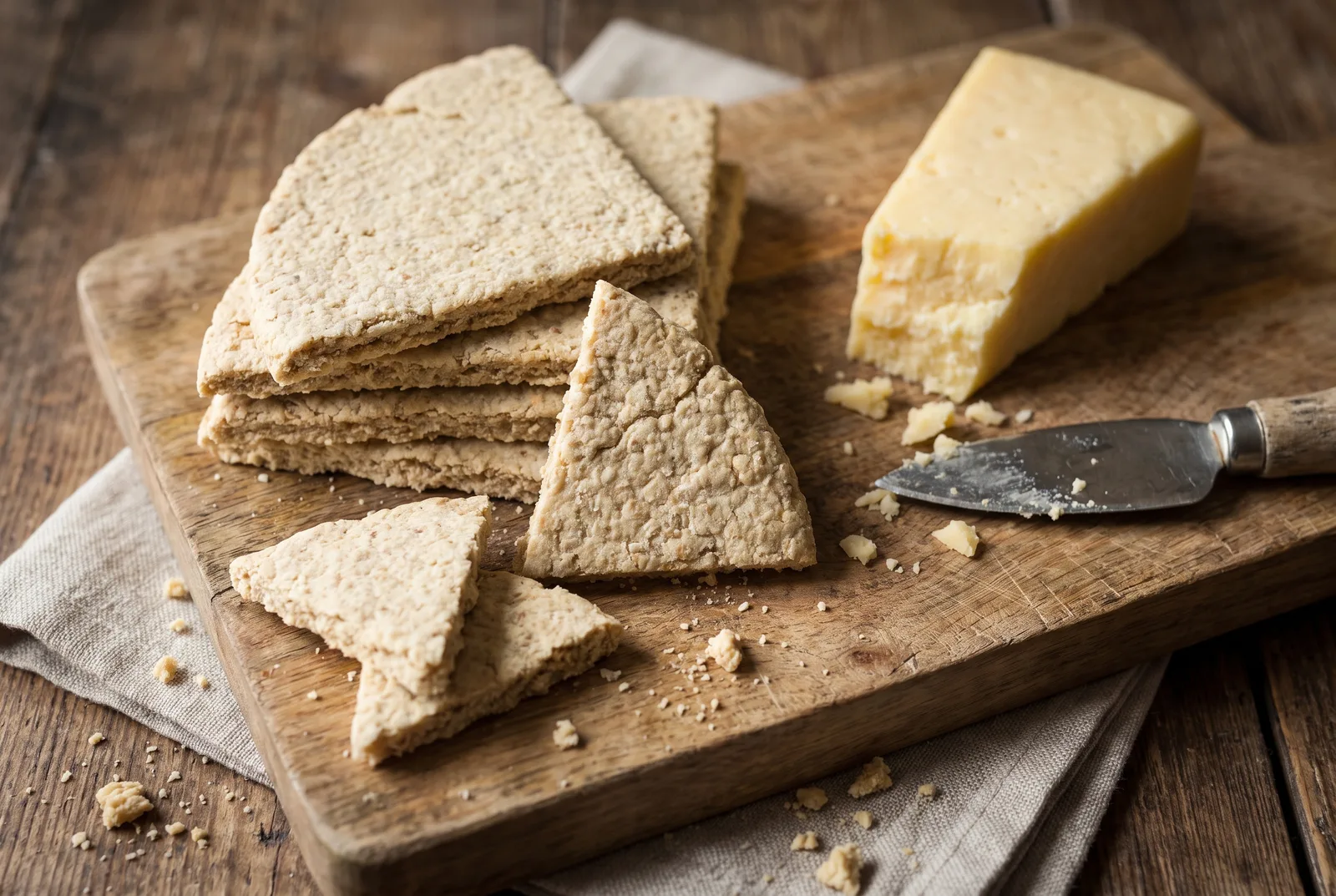 A stack of crisp, dry, pale Scottish oatcake biscuits, some cut into triangular farls, served with a wedge of hard cheese — a completely different bake from the soft Staffordshire oatcake.
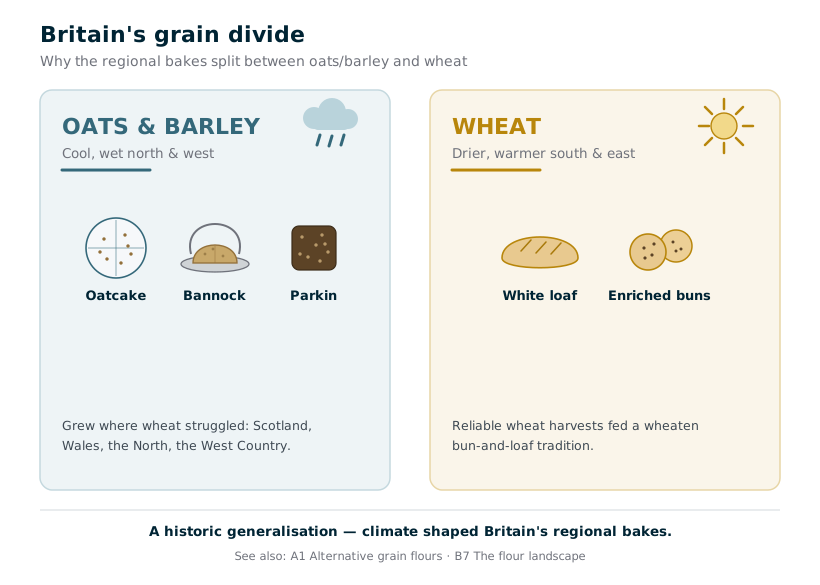 Schematic split diagram: left panel 'OATS & BARLEY — cool, wet north and west (Scotland, Wales, the North, the West Country)' with icons for oatcakes, bannocks and parkin; right panel 'WHEAT — drier, warmer south and east' with icons for buns and white loaves.
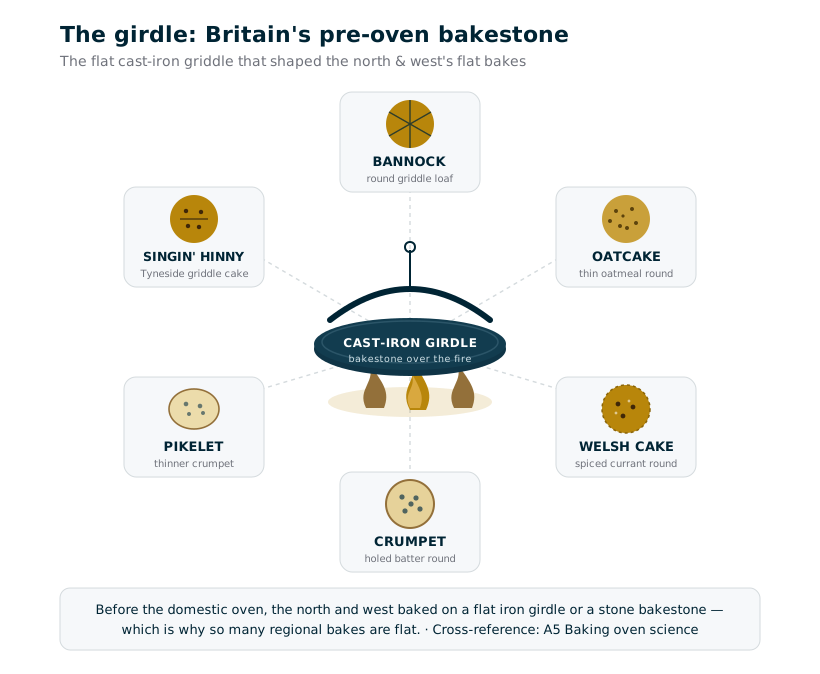 Diagram of a flat cast-iron girdle (griddle) hanging over a fire, surrounded by the flat griddle-baked British bakes it produced: bannock, oatcake, Welsh cake, crumpet, pikelet and Northumbrian singin' hinny.
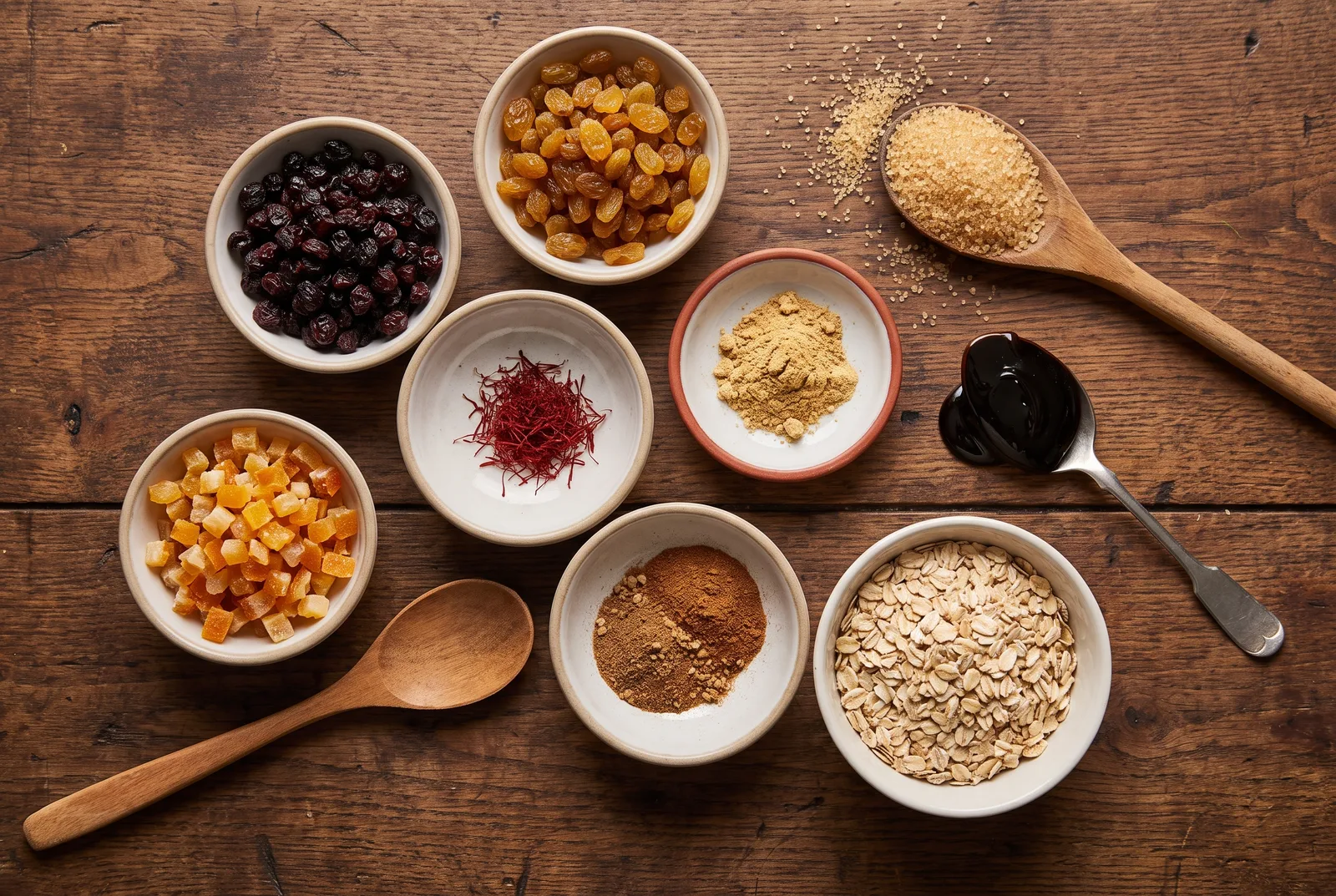 Overhead flat-lay of small bowls: currants, sultanas, candied mixed peel, saffron threads, ground ginger and mixed spice, with medium oatmeal and black treacle — the shared pantry of Cornish saffron buns, bara brith, parkin and Selkirk bannock.
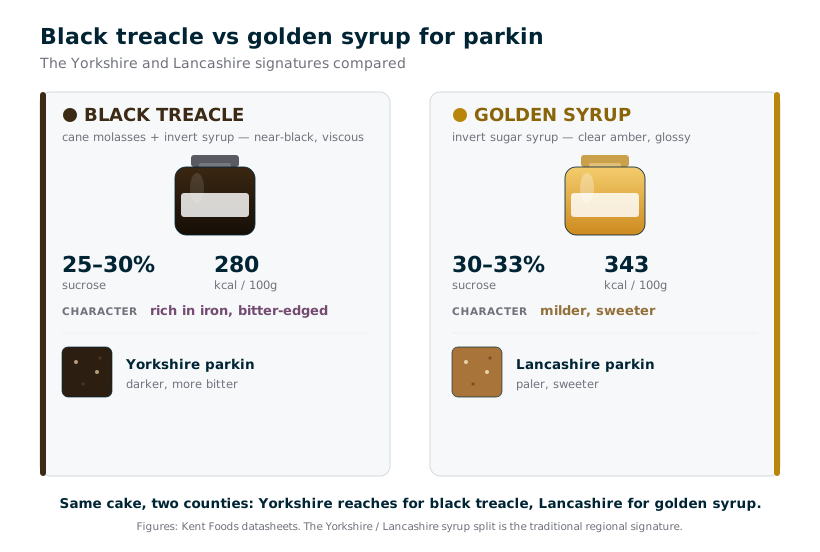 Side-by-side comparison of two syrups: black treacle (near-black, bitter-edged cane molasses, sucrose 25-30%, Yorkshire parkin) and golden syrup (clear amber invert syrup, sucrose 30-33%, Lancashire parkin), each with the parkin it makes.
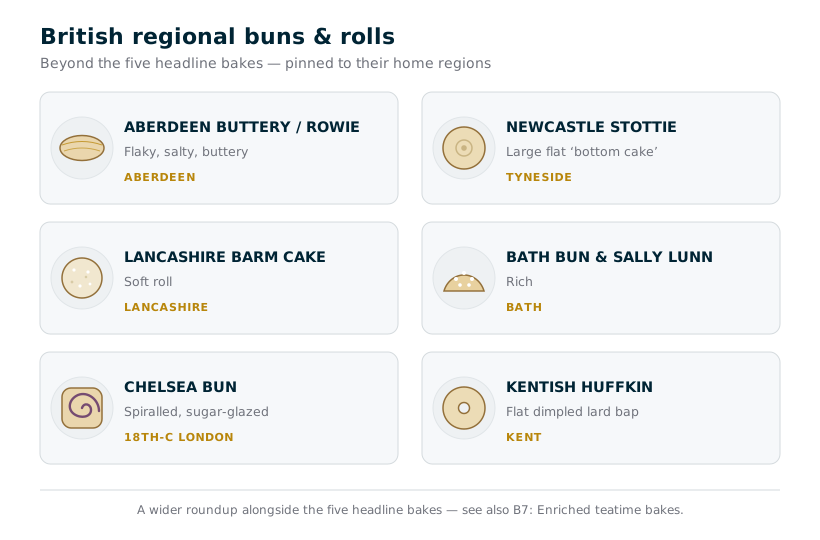 Panel of labelled regional British buns and rolls: Aberdeen buttery/rowie, Kentish huffkin, Newcastle stottie, London Chelsea bun, Bath bun and Sally Lunn, and Lancashire barm cake, each pinned to its region.
Cornish saffron buns (representative, baker's %)
| Ingredient | Baker's % | Weight |
|---|---|---|
| Strong white flour: 100% | ||
| Saffron (steeped in the warm milk): ~0.1-0.2% (a generous pinch per 500 g flour) — NOT stocked, source separately | ||
| Full-fat milk (warm, saffron-infused): 55-60% | ||
| Butter: 15-20% | ||
| Caster sugar: 12-16% | ||
| Fresh yeast: 3-4% (or instant 1.2-1.5%; osmotolerant for the sugar/fat) | ||
| Egg: ~10% (optional, for richness) | ||
| Currants (G44677): 35-50% | ||
| Mixed/candied peel (G22145): 8-12% | ||
| Mixed spice (G45412): 0.5-1% (optional; some purists keep it saffron-only) | ||
| Salt: 1.5-1.8% |
- Steep the saffron: warm the milk, crumble in the saffron threads and leave to infuse (ideally several hours or overnight) until deep gold — this both colours and flavours the dough (c3).
- Rub or beat the butter and sugar into the flour and salt, then mix in the saffron milk, yeast and egg to a soft, enriched dough; develop the gluten (a strong flour and enough mixing carry the fat/sugar and dried fruit).
- Bulk ferment until doubled; the high butter and sugar slow the yeast, so allow time and warmth.
- Knock back and work in the currants and peel gently so they distribute without tearing the dough; scale into buns (or a loaf tin for saffron cake).
- Final proof until light and puffy; bake in a moderately hot oven until golden and the fruit is glossy. A milk-and-sugar wash gives the traditional shine.
- Note: in the World Wars, scarce saffron was eked out or replaced with yellow food colouring — a substitution still seen today (c4). If you use a SYNTHETIC yellow, the 'Southampton Six' colours (tartrazine E102, sunset yellow FCF E110, quinoline yellow E104) legally require the 'may have an adverse effect on activity and attention in children' advisory on the finished product in GB — flag it, or use genuine saffron / a natural colour (c4).
A representative rich yeasted saffron bun in baker's percentage (flour = 100%). Character and ingredients from multiple trade sources (c3). Saffron is NOT in the catalogue — source separately; currants (G44677), mixed peel (G22145) and mixed spice (G45412) are. Use a strong white flour (see B7-flour-landscape) and osmotolerant yeast for the high sugar/fat (see A2-osmotolerant-yeast-enriched-doughs). Not an authenticated recipe.
Yorkshire parkin (representative, grain = 100%)
| Ingredient | Baker's % | Weight |
|---|---|---|
| Total grain = 100%, split roughly: medium oatmeal 50-60% + self-raising (or plain) flour 40-50% | ||
| Black treacle (G45098): 55-75% (Yorkshire) — Lancashire uses golden syrup (G45099) instead/as well | ||
| Golden syrup (G45099): 20-35% (often blended with the treacle) | ||
| Butter or lard: 45-60% | ||
| Soft dark brown or demerara sugar (G44477): 35-45% | ||
| Ground ginger (G44879): 3-5% | ||
| Mixed spice (G45412): 1-2% (optional) | ||
| Bicarbonate of soda: ~1% (omit/reduce if using self-raising flour) | ||
| Egg: ~20% | ||
| Milk: 15-30% (to a soft dropping/pouring batter) | ||
| Salt: ~1% |
- Gently melt the butter/lard, black treacle, golden syrup and sugar together — do NOT boil; a low melt keeps the treacle's flavour and gives the sticky set (c9).
- Stir the dry grain, ginger, mixed spice, bicarbonate and salt together, then combine with the warm treacle mix, beaten egg and enough milk to a soft, pourable batter.
- Pour into a lined tin and bake low and slow (a moderate-to-low oven) until set but still slightly sticky in the middle — parkin is meant to bake firm.
- Cool, then wrap and store in a sealed tin for AT LEAST 3-7 days: the treacle draws moisture and the cake softens to its intended sticky, moist crumb (c9). It is the maturation, not the bake, that makes parkin.
- Serve in squares on Bonfire Night (5 November) with treacle toffee (c8). For volume production, the Whitworth Complete Ginger Cake Mix (G44676) is a fast ginger-cake base to build a parkin-style bake on (contains WHEAT/EGG/SOYA/MILK).
A representative parkin expressed against total grain (medium oatmeal + flour = 100%), because parkin is a cake-batter, not a bread (c5-c9). Yorkshire uses black treacle (G45098); Lancashire swaps to golden syrup (G45099) (c7). A true medium oatmeal is not stocked — pulse Oat Flakes (G23549) to a coarse meal, or blend Oat Flour (G22040) with a little flake. MUST be matured 3-7 days before cutting (c9).
Welsh bara brith — tea-soaked, baking-powder version (representative, flour = 100%)
| Ingredient | Baker's % | Weight |
|---|---|---|
| Self-raising flour: 100% (or plain + ~4% baking powder) | ||
| Mixed dried fruit — sultanas (G44764), currants (G44677), raisins: 90-110% | ||
| Cold strong tea (for soaking the fruit): 55-70% | ||
| Soft brown sugar: 40-55% | ||
| Egg: 18-22% | ||
| Mixed/candied peel (G22145): 8-12% (optional) | ||
| Mixed spice (G45412): 1-2% | ||
| Marmalade or a little butter: 5-10% (optional, for moisture/shine) |
- The night before, soak the dried fruit (and peel) in the cold strong tea with the sugar; cover and leave overnight so the fruit plumps and the tea tannins flavour the loaf (c13).
- Next day, beat in the egg, then fold in the self-raising flour and mixed spice to a thick, fruit-heavy batter — do not overwork.
- Scrape into a lined loaf tin and bake in a moderate oven, low and slow, until a skewer comes out clean (a long, gentle bake stops the sugar-and-fruit loaf catching).
- Cool, then wrap; bara brith keeps and improves for a few days. Serve sliced and buttered with tea.
- For the traditional North Wales yeast version (c12): build as an enriched dough — strong flour, ~2% instant yeast, ~12% butter, ~20% sugar, the soaked fruit and spice — bulk ferment, shape, proof and bake.
The modern, most common no-yeast bara brith (self-raising flour) in baker's percentage (c11-c13). The defining step is soaking the fruit overnight in cold tea (c13). For the traditional yeast version still sold in North Wales (c12), use strong flour + ~2% instant yeast + butter and proof as an enriched dough (see A8-enriched-dough-formulas). Not a protected recipe.
Scottish barley / beremeal soda bannock (representative, grain = 100%)
| Ingredient | Baker's % | Weight |
|---|---|---|
| Total grain = 100%: beremeal/barley flour (G45157) 40-60% + plain wheat flour 40-60% (the wheat gives handling strength) | ||
| Buttermilk or soured milk: 60-75% (the acid that activates the soda) | ||
| Bicarbonate of soda: 1.5-2% | ||
| Cream of tartar: 2-3% (omit if buttermilk supplies enough acid) | ||
| Salt: 1.5% | ||
| Butter or lard: 0-8% (optional, for a softer bannock) |
- Mix the grains, bicarbonate, cream of tartar and salt; rub in any fat.
- Quickly stir in the buttermilk to a soft, just-holding dough — work fast and minimally so the soda stays active and the crumb stays tender.
- Pat into a round about 2 cm thick and, traditionally, cut a cross to make four farls (quarters).
- Bake on a hot, lightly floured flat girdle/griddle (or heavy pan) over moderate heat, turning once, until set and cooked through — or bake on a stone/oven; a beremeal bannock is dense, dark and earthy (c18).
- Eat fresh and warm — girdle bannocks stale fast. For the rich Selkirk bannock instead (c17), build an enriched wheat yeast dough loaded with sultanas (G44764): see A8-enriched-dough-formulas and B7-enriched-teatime-bakes.
A girdle-baked soda bannock in baker's percentage (c14, c16, c18). Authentic beremeal comes from Orkney's Barony Mill; the nearest catalogue analogue is Doves Organic Barley Flour (G45157, CONTAINS gluten). Traditional bannocks were unleavened; the soda-and-buttermilk method spread through the nineteenth century as commercial bicarbonate became available (widely marketed from the 1840s) (c16). See A2-chemical-leaveners-baking-powder.
Staffordshire (Potteries) oatcakes — yeasted batter (representative, grain = 100%)
| Ingredient | Baker's % | Weight |
|---|---|---|
| Total grain = 100%: fine oatmeal (G22040/G23549 pulsed) 50% + plain flour 50% | ||
| Warm water + milk (roughly half and half): 170-200% (a thin, pourable batter) | ||
| Fresh yeast: 2-3% (or instant ~1%) | ||
| Salt: 1-1.5% | ||
| Sugar: ~1% (optional, to feed the yeast) |
- Whisk the oatmeal, flour, salt and yeast with the warm water/milk to a thin, smooth, pourable batter — thinner than a pancake batter.
- Cover and leave to ferment warm for 1-2 hours (or a longer cool ferment) until bubbly and slightly tangy; historically the batter was kept and topped up in the same wooden vessel, seasoning it with resident wild yeasts (c19).
- Ladle onto a hot, lightly greased flat griddle/bakestone and spread to a large thin round; cook until the top sets with holes (like a crumpet), then flip briefly.
- Stack and keep soft. Serve hot, filled and folded with cheese, bacon or egg — the Potteries breakfast (c19).
- Do NOT confuse with the crisp Scottish oatcake biscuit (c20), which is a rolled, fat-enriched oatmeal cracker cut into farls — see B7-shortbread-biscuits.
A representative Staffordshire oatcake BATTER in baker's percentage (c19). This is a thin, yeasted, savoury pancake batter cooked on a griddle — not a dough and not the crisp Scottish biscuit (c20). Use fine oatmeal (pulse Oat Flakes G23549, or Oat Flour G22040) with plain flour. The overnight/ambient batter ferment is a wild-yeast-friendly step (see A2-yeast-fermentation-science, B7-sourdough-real-bread).
| Region | Dominant grain | Typical cooking surface | Signature bakes |
|---|---|---|---|
| Scotland (incl. Orkney) | Barley / bere, oats | Girdle / bannock stane | Beremeal & oatmeal bannocks, Scottish oatcakes, Selkirk bannock (wheaten, enriched) |
| Wales | Oats historically; wheat for tea breads | Girdle (planc) and oven | Welsh cakes (griddle), bara brith (oven) |
| Northern England (Yorks/Lancs) | Oats | Oven (parkin); griddle (oatcakes, pikelets) | Parkin, oatcakes, teacakes, stottie (Tyneside) |
| The Potteries (Staffordshire) | Oats | Griddle / bakestone ('backstone') | Staffordshire oatcakes (soft yeasted pancakes) |
| South West (Cornwall/Devon) | Wheat | Oven | Cornish saffron buns & saffron cake, splits |
| South & East England | Wheat | Oven | Chelsea buns, Bath buns, Sally Lunn, huffkins, white loaves |
The organising idea of the whole map (c21, c35): the cool, wet north and west grew oats and barley and baked flat on the girdle/bakestone; the drier south and east grew wheat and baked leavened buns and loaves. An indicative historical generalisation, not a hard line. See A1-alternative-grain-flours and B7-flour-landscape.
| Bake | Home region | What it is | Leavening | Defining ingredients | Catalogue picks |
|---|---|---|---|---|---|
| Cornish saffron buns / saffron cake | Cornwall (South West) | Rich, golden, spiced sweet bun/loaf coloured with saffron | Yeast | Saffron (NOT stocked), currants, mixed peel, strong flour, butter | Currants (G44677), Candied Orange Peel (G22145), Mixed Spice (G45412), strong white flour (B7-flour-landscape) |
| Yorkshire parkin | Yorkshire / the North | Dark, sticky oatmeal-and-treacle gingerbread; matured before eating | Bicarbonate / self-raising | Medium oatmeal, black treacle, ginger, brown/demerara sugar | Black Treacle (G45098), Golden Syrup (G45099), Ground Ginger (G44879), Oat Flakes (G23549), Demerara (G44477), or Ginger Cake Mix (G44676) |
| Welsh bara brith | Wales | 'Speckled' fruited tea loaf; fruit soaked overnight in tea | Yeast (traditional) or baking powder / self-raising (modern) | Tea-soaked currants/sultanas/raisins, mixed peel, mixed spice | Sultanas (G44764), Currants (G44677), Candied Orange Peel (G22145), Mixed Spice (G45412) |
| Scottish bannock | Scotland (incl. Orkney) | Flat round quick bread of barley/beremeal or oatmeal, girdle-baked; Selkirk bannock is a rich fruited yeast loaf | Historically unleavened; now soda / baking powder; Selkirk = yeast | Beremeal/barley, oatmeal, buttermilk; Selkirk: wheat flour + sultanas | Organic Barley Flour (G45157), Oat Flour (G22040); Selkirk: Sultanas (G44764) + strong flour |
| Staffordshire (Potteries) oatcake | Staffordshire (the oatcake belt) | Soft, savoury, yeast-leavened oatmeal-and-flour batter pancake | Yeast (batter ferment) | Fine oatmeal, flour, yeast, warm water/milk | Oat Flour (G22040), Oat Flakes (G23549), plain flour (B7-flour-landscape) |
Character, leavening and the dried fruit / grain that define each bake, with the nearest Domson catalogue picks. Regional facts from the topic sources (c3-c20); catalogue picks are UK-relevant stock lines. Full methods in the formula cards below.
| Type | Region | Form | Made from | How eaten |
|---|---|---|---|---|
| Staffordshire (Potteries) oatcake | Stoke-on-Trent / North Staffordshire | Soft, flexible savoury pancake | Yeasted oatmeal + flour BATTER, griddle-cooked | Filled/folded with cheese, bacon, egg — a hot savoury |
| Scottish oatcake | Scotland | Crisp, dry BISCUIT | Oatmeal + fat, rolled, cut into farls, baked/toasted | With cheese, butter, soup — a cracker |
| Derbyshire oatcake | Derbyshire | Soft pancake, larger, thicker, paler than Staffordshire | Oatmeal + flour + yeast + a little milk | Filled like the Staffordshire, but bigger and thicker |
The word 'oatcake' covers a soft pancake, a crisp biscuit and a thick milk-enriched pancake depending on where you are (c19, c20). The Staffordshire and Scottish types especially must not be confused. See B7-scones-crumpets-muffins (griddle bakes) and B7-shortbread-biscuits (the Scottish biscuit).
| Property | Black Treacle (G45098) | Golden Syrup (G45099) |
|---|---|---|
| What it is | Cane molasses + invert sugar syrup | Invert sugar syrup (inverted refiner's syrup) |
| Colour / flavour | Near-black; bitter-edged, intensely malty-molasses | Clear amber; mild, buttery-caramel, sweet |
| Sucrose | 25-30% | 30.2-33.2% |
| Invert sugar | 29-34% | 47.0-51.2% |
| Moisture | 20.0-21.0% | 16.0-16.5% |
| Energy / 100 g | 280 kcal | 343 kcal |
| Notable | Rich in iron (30-500 mg/kg) & potassium (3 g/100g) | Processing aids: sulphuric acid E513 & sodium carbonate E500 (1% max each) |
| Parkin use | Yorkshire parkin (dark, bittersweet) | Lancashire parkin (paler, sweeter); often blended with treacle |
Same cake, two counties: Yorkshire parkin leans on black treacle, Lancashire on golden syrup (c7). Numbers read this session from the Kent Foods datasheets (c22, c23). Both are gluten-free. See A6-sugar-work-techniques.
| Ingredient (SKU) | What it is | Moisture | Sugars / 100 g | Energy / 100 g | Allergen note |
|---|---|---|---|---|---|
| Currants (G44677) | Greek Provincial (Corinthian) currants, Vitis vinifera + 0.5% sunflower oil | 13-18% (t 15%) | 67.8 g | 267 kcal | Gluten-free; SO2 sultanas cleaned on same line (allergen control) |
| Turkish Sultanas (G44764) | Potash-dipped, sun-dried Vitis vinifera + 0.5% sunflower oil | 12-16% | 69.4 g | 275 kcal | Coeliac-suitable (not tested <20 ppm); SO2 handled in segregated area |
| Candied Orange Peel (G22145) | Orange peel saturated in sugar + glucose syrup, citric acid, potassium sorbate | n/a (moist) | 52 g | 261 kcal | May contain sulphites (SO2 <=10 mg/kg); vegan |
The dried fruit that speckles saffron buns, bara brith, teacakes and the Selkirk bannock. All figures read this session from the on-disk product-spec PDFs (c26, c27, c28). ALLERGEN NOTE: currants and sultanas are stated coeliac-suitable but carry an SO2/sulphite cross-contamination risk from lines shared with sulphured fruit — read the current datasheet.
| Job | Catalogue line (SKU) | Datasheet headline | Used in |
|---|---|---|---|
| Dark treacle base | Black Treacle (G45098) | Cane molasses + invert syrup; 280 kcal/100g; iron-rich; gluten-free | Yorkshire parkin, gingerbread, treacle tart |
| Golden syrup base | Golden Syrup (G45099) | Invert sugar syrup; 343 kcal/100g; gluten-free | Lancashire parkin, flapjack, treacle bakes |
| Warming spice — ginger | Ground Ginger (G44879) | 100% ginger, volatile oil >=1.5%; 370 kcal/100g; vegan | Parkin, ginger cake, spiced buns |
| Warming spice — mixed | Mixed Spice UK Blend (G45412) | UK blend: coriander, cassia, ginger, cardamom, cloves, fennel, nutmeg; vegan | Bara brith, saffron buns, hot cross buns, parkin |
| Small dark fruit | Currants (G44677) | Corinthian currants; 67.8 g sugars/100g; gluten-free | Saffron buns, bara brith, teacakes, Eccles cakes |
| Golden dried fruit | Turkish Sultanas (G44764) | Potash-dipped sun-dried; 69.4 g sugars/100g | Bara brith, Selkirk bannock, teacakes |
| Candied peel | Candied Orange Peel (G22145) | Peel in sugar/glucose syrup; 52 g sugars/100g; vegan | Bara brith, saffron buns, teacakes |
| Crunch / dark sugar | Demerara Sugar (G44477) | White (UK beet) sugar + 1.3% cane molasses; 397 kcal/100g | Parkin, toppings, ginger bakes |
| Barley grain (bere analogue) | Organic Barley Flour (G45157) | 100% organic barley, stone-ground; CONTAINS gluten; 360 kcal/100g | Barley / beremeal-style bannocks |
| Oat grain | Oat Flakes (G23549) / Oat Flour (G22040) | De-husked hydrothermal oats; oat flour 13 g protein, 10.3 g fibre/100g | Parkin (pulse flakes), Staffordshire & Scottish oatcakes |
| Ginger-cake shortcut | Ginger Cake Mix Complete (G44676) | Complete UK mix; contains WHEAT/EGG/SOYA/MILK; 402 kcal/100g | Fast ginger / parkin-style cake at volume |
| Not stocked — flag | Saffron; true medium/pinhead oatmeal | n/a — source separately or pulse oat flakes | Cornish saffron buns; authentic parkin/oatcakes |
Which UK-relevant stock line does each job, with the first-party datasheet headline and the bakes it serves (c22-c32). One important gap is flagged: saffron and a true medium/pinhead oatmeal are NOT stocked. Strong, plain and self-raising flours are covered in the sibling dossier B7-flour-landscape.
| Bake | Fault | Likely cause | Fix |
|---|---|---|---|
| Cornish saffron buns | Pale, no saffron colour or flavour | Saffron not steeped long enough, or under-dosed | Steep saffron in warm milk for hours/overnight; use a generous pinch (c3, c4) |
| Cornish saffron buns | Dense, heavy, under-risen | Rich dough under-proofed; yeast slowed by fat/sugar | Allow longer, warmer proof; use osmotolerant yeast and a strong flour (A2-osmotolerant-yeast-enriched-doughs) |
| Yorkshire parkin | Dry, crumbly, not sticky | Eaten too fresh, or too little treacle/syrup | Mature 3-7 days in a sealed tin; keep treacle+syrup high (c7, c9) |
| Yorkshire parkin | Greasy or leaden, sunk middle | Fat/treacle mix boiled, or over-baked hot | Melt gently (don't boil); bake low and slow (c9) |
| Bara brith | Sticky, undercooked centre; fruit sunk | Baked too hot/fast; batter too wet; fruit not drained | Bake low and slow; drain soaked fruit; toss fruit in a little of the flour (c13) |
| Barley/beremeal bannock | Flat, heavy, soapy taste | Soda not activated / over-dosed; batter over-worked | Balance soda with buttermilk acid; mix fast and minimally; bake on a hot girdle (c16) |
| Staffordshire oatcake | No holes, rubbery, flat flavour | Batter too thick or under-fermented | Thin the batter; ferment warm until bubbly and tangy before griddling (c19) |
| Any oat/barley bake | Assumed gluten-free — coeliac reaction | Oats and barley carry gluten; shared-line cross-contamination | Never treat oat/barley bakes as gluten-free; read the datasheet; use a dedicated product for coeliacs (c30, c34) |
Common defects in these regional bakes and their likely cause. General diagnostic guidance; see A5-bread-faults-causes-remedies for the full bread-fault map and A2-yeast-fermentation-science / A2-chemical-leaveners-baking-powder for leavening issues.