
Baker's percentage: the universal language of professional formulas
Baker's percentage is the notation every professional formula in this library is written in: flour is always 100%, and every other ingredient is expressed as a percentage of the flour weight. This dossier teaches the whole language from one lean dough, then shows how the same idea reads an enriched brioche (where eggs and butter hide most of the water), a cake (a "modified" baker's percentage governed by balance rules), a ganache (where chocolate, not flour, is the 100% base) and a complete mix. It includes five worked formula cards in baker's percentage with arithmetic-checked totals, hydration and yields, a hydration ladder, a yeast-conversion table, a fault table, and the catalogue products a baker buys to execute each one. Numbers are cross-checked against Callebaut, trade references and pastry educators, and anchored to eight first-party supplier spec sheets (Domson/GoodMills flour, Lallemand yeast, Polmlek butter, Zeelandia improver & couverture, Barbara Luijckx couverture).
Baker's percentage: the universal language of professional formulas
If you learn one thing before reading any other formula in this library, learn this. Baker's percentage is the notation professionals use to write, scale, compare and trouble-shoot every recipe — bread, cake, pastry and confectionery alike. Master it and a formula stops being a fixed recipe and becomes a model you can resize and adjust at will.
The one rule
In baker's percentage, the flour is always 100%, and every other ingredient is written as a percentage of the flour weight: divide the ingredient weight by the flour weight and multiply by 100. Because everything is measured against flour rather than against the whole batch, the percentages add up to more than 100% — that grand total is called the total formula percent . This is the opposite of "true" or conventional percent, where all the ingredients sum to exactly 100% (see the comparison table and the figure below).
Take the simplest professional dough:
| Ingredient | Baker's % | At 1 kg flour |
|---|---|---|
| Flour | 100% | 1000 g |
| Water | 65% | 650 g |
| Salt | 2% | 20 g |
| Instant yeast | 1% | 10 g |
| Total | 168% | 1680 g |
That is the full formula card below. King Arthur writes the same lean loaf as 100 / 66 / 2 / 1.2, and BAKERpedia as 100 / 62 / 2 — all the same bread, tuned to the flour.
Two small print rules matter from day one:
- Multiple flours still total 100% between them. A loaf that is 80% white and 20% wholemeal is written as two flour rows summing to 100% — never two separate 100% bases.
- Salt is a percentage of FLOUR, not of the dough. 2% salt means 2% of the flour weight (the classic working window is 1.8–2.2%). Figuring it on total dough weight is a common and bland-tasting mistake (see the fault table).
Hydration: the number that decides the crumb
Hydration = water weight ÷ flour weight × 100. It is the single most important lever in bread. The same flour gives a tight, fine crumb at 60% and a wild, open crumb at 85% — and it does not stop at 100%: very wet batters run up to ~190%. The figure below and the hydration table walk the whole range, from stiff bagel dough (~55%) through baguette (~65–72%) to ciabatta (72–85%) and pourable cake batter.
Use a flour strong enough to hold the water you pour in. Domson Bread Flour Type 750 carries ≥10% protein (~11.6 g/100 g) and ≥26% wet gluten; the fortified Type 550 runs 11.5–12.5% protein and 28–32% wet gluten — both ample for the formulas here.
Yeast: the same percentage, three different products
Yeast is dosed as a percentage of flour, so swapping yeast types means rescaling that percentage, not the recipe. Instant dried yeast sits at ~0.6–1.5% (≈1%) for lean dough; Fermipan Red is exactly this — an instant dried yeast for lean dough with 0–10% sugar, carrying 1% emulsifier (E491) and free of egg, soya and dairy. (Food-safety / allergen flag: E491 sorbitan monostearate may be derived from animal tallow — professionals making vegetarian, vegan or halal claims on finished products must verify the source with Lallemand directly.) Fresh yeast is about 70% water, so you use roughly three times the instant weight for the same lift (≈3×). The yeast-conversion table makes the switch routine.
Scaling: resize any formula in two steps
The total formula percent is also your scaling tool. To hit a target dough weight, divide that weight by the total formula percent (as a decimal) to get the flour weight; then multiply each percentage by that flour weight (see the figure below). King Arthur's own worked example takes a 168.25%-total French bread and 150 lb of dough → 150 ÷ 1.6825 ≈ 0.9 → 90 lb flour. For our lean loaf: 5 kg of dough ÷ 1.68 ≈ 2976 g flour, and every other ingredient follows. (The dedicated scaling-and-yield dossier covers batch costing and the ingredients that do not scale linearly.)
Enriched dough: where the water hides
Enriched doughs look dry on paper but feel supple, because eggs are ~75% water, milk ~87% and butter ~16% (EU 82%-fat butter standard; US butter ≈18%). The honest number is effective hydration — count the water inside those ingredients, not just the water you pour from a jug. Using King Arthur's professional brioche (flour 100, egg 50, butter 50, sugar 12, salt 2.5, yeast 7, water 9; total 230.5%):
egg 500 g × 0.75 + butter 500 g × 0.16 + added water 90 g = 545 g of water against 1000 g flour ≈ 55% effective hydration.
So a brioche with only 9% added water is really a ~55%-hydration dough — which is why it handles and proofs the way it does (see the figure below). Butter choice matters here: Polmlek Unsalted Butter 82% is min 82% fat and ~16% water, and is a milk allergen. Brioche butter typically runs 50–60% of flour (working range ~30–70%; a common three-tier classification puts 'basic' brioche at ≈20%, 'classic' at ≈50% and 'rich' at ≈88% of flour). The 7% yeast is a fresh-yeast dose — sugar and fat slow fermentation, so a high dose is needed. If substituting osmotolerant instant yeast, use ≈2% (not 7% — applying the same percentage as instant would cause severe over-fermentation). (Confirm yeast type and the equivalent rate before production use.)
Cakes: a "modified" baker's percentage with balance rules
Cakes keep flour at 100% but obey balance rules between structure (flour, egg) and tenderness (sugar, fat, liquid) (see the figure below). The textbook balanced cake is the pound cake / quatre-quarts — equal weights of flour, butter, sugar and egg, i.e. 100% each, total 400% . Notice it satisfies the low-ratio rules automatically: sugar ÷ flour = 1 and fat ÷ egg = 1. (Note: Baking-Sense's professional pound-cake recipe runs sugar 125%, liquid 94%, eggs 106% — a modernised adaptation of the classical quatre-quarts; the formula card below uses the classical equal-weight definition.) Push sugar above flour and you enter high-ratio territory, which needs extra liquid and emulsification to stay stable — Baking-Sense's vanilla layer runs sugar 133% / liquid 133% / eggs 73% versus Baking-Sense's adapted pound cake at sugar 125% / liquid 94% / eggs 106%.
Beyond flour: choosing the 100% base
The real power of baker's percentage is that it generalises. When there is no flour, you simply make the dominant ingredient the 100% base (see the "beyond flour" table). For a ganache, chocolate is the base and cream is the percentage: a dark ganache is classically 1:1 (cream = 100% of chocolate); milk chocolate ~1.5:1 and white ~2–2.5:1 are Callebaut's professional guidance (ratios vary across sources — some textbooks quote 2:1 for milk and 3:1 for white; treat these as starting points) (see the figure below). The formula card below builds it with real couverture — Zeelandia Arabesque Dark 58% (temper: melt 47°C, cool two-thirds to 27°C, work at 30°C) or Barima Dark 72% (min 72% cocoa solids, min 43% fat) — plus glucose and a butter finish. Callebaut's framed confectionery ganache shows the same notation at production scale: 49.9% dark / 26.9% cream / 8.8% glucose / 8.8% invert / 3.8% clarified butter / 1.5% cocoa butter / 0.2% salt.
Food-safety flag: ganache is a perishable emulsion whose keeping quality is governed by water activity, lowered by invert sugar, glucose/sorbitol and a higher chocolate ratio. The full water-activity and shelf-life treatment lives in the chocolate & confectionery formulas dossier — here it is only the teaching example for a non-flour base.
The same logic reads a complete (premixed) product, where the mix itself is 100%: a Zeelandia chocolate-cake-mix sheet directs 1000 g mix: 200 g egg: 130 g oil: 200 g water, baked 180°C for 30–35 min.
Preferments: a second percentage to track
Preferments add one more baker's-percentage idea: pre-fermented flour percentage = flour in the preferment ÷ total formula flour. A poolish is a 100%-hydration preferment (equal flour and water) with a small yeast dose — typically 0.25% of the preferment flour for a standard 12–16 h cool ferment (extended, very-cool ferments can use as little as 0.1%) — fermented 8–16 h. The card below builds a baguette dough where 300 g of the 1000 g total flour (i.e. 30% pre-fermented flour) ripens overnight, then folds into a 68%-hydration final dough. A typical professional starting range is 20–40%; the dedicated preferment dossier covers poolish, biga, pâte fermentée and levain in full.
The five formula cards
All five are written in baker's percentage with arithmetic-verified totals, hydration and yields (see below):
- Lean white bread — the canonical four-ingredient lean loaf (total 168%, 65% hydration).
- Enriched brioche — effective hydration with eggs and butter (total 230.5%, ~55% effective).
- Pound cake — modified baker's percentage and balance rules (1:1:1:1, total 400%).
- Dark ganache — chocolate as the 100% base (1:1 dark, total 220%).
- Poolish preferment — the pre-fermented flour metric (30% poolish, 68% overall).
Buying the ingredients
Every formula maps to catalogue products (see the products at the end of this article): Domson Bread Flour Type 750 and Type 550 as the flour base; Fermipan Red (instant) or Benevia (fresh) yeast; Polish Fine Iodized Salt and Granulated Sugar; Polmlek Unsalted Butter 82%; Milk Łaciate 3.2% and Double Cream Bieruńska 33%; Glucose Syrup; and Zeelandia Arabesque Dark 58% or Barima Dark 72% couverture. The Zeelandia Optimax Free improver appears as an example of a small-percentage functional addition (~1.7% on flour).
General food-safety note: raw flour is not ready-to-eat — all the wheat and rye flours here declare gluten and must be heat-treated before consumption; the enriched and cake formulas contain egg and milk/butter allergens, and the couvertures carry soya and may contain milk.
Figures
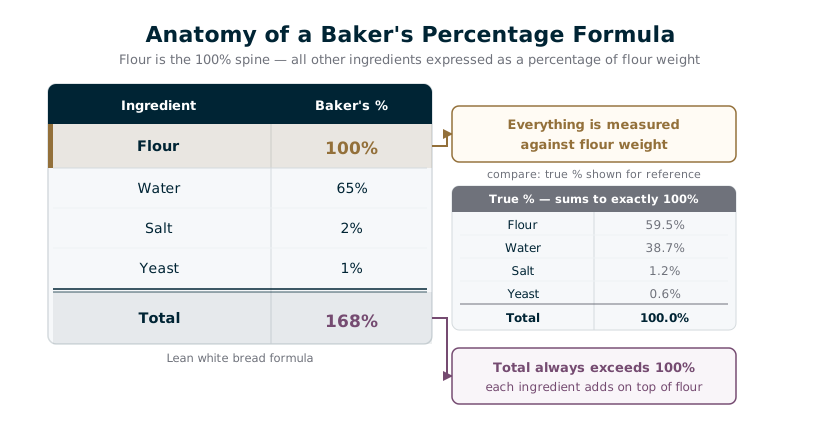 Diagram labelling the parts of a baker's percentage formula table with flour at 100 percent and a total over 100 percent
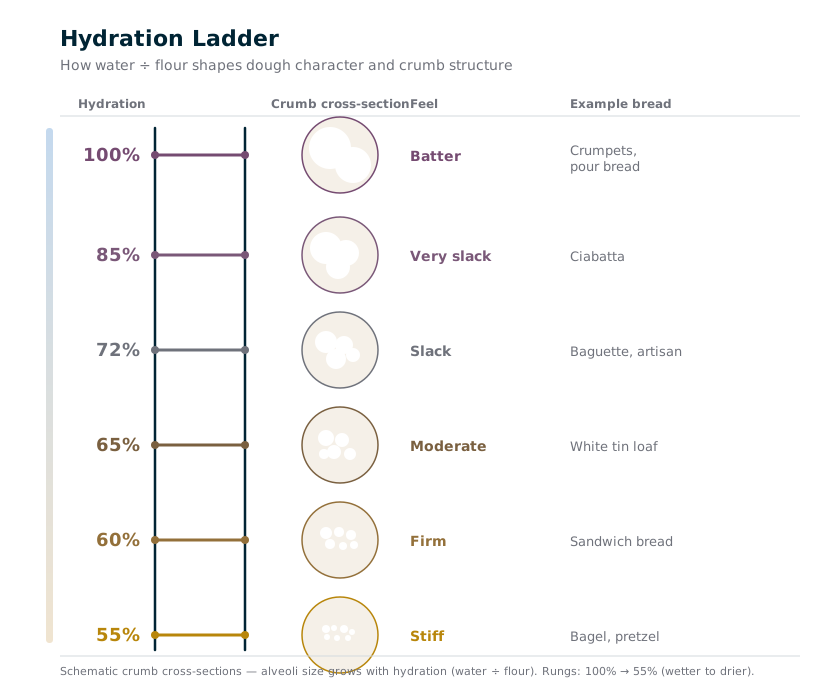 Vertical ladder diagram relating dough hydration percentage to crumb openness from tight to very open
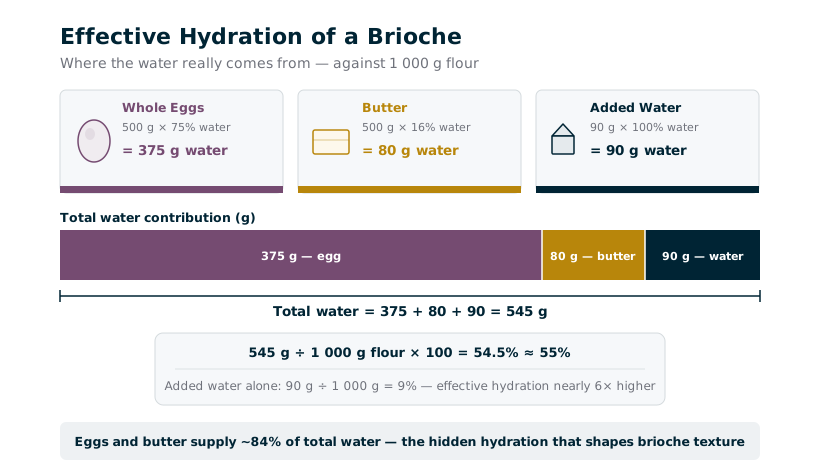 Stacked bar showing hidden water contributed by whole eggs, butter and added water totalling about 55 percent effective hydration in brioche
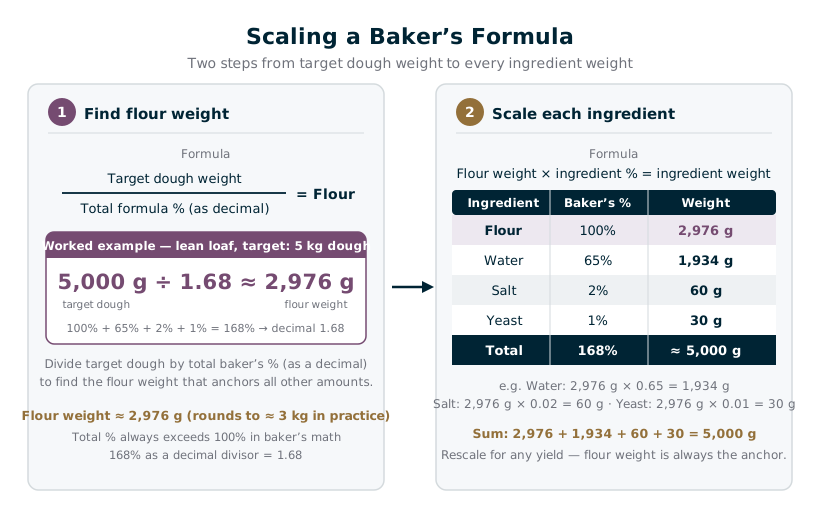 Flow diagram showing scaling a baker's formula by dividing target dough weight by the total formula percent to get flour weight
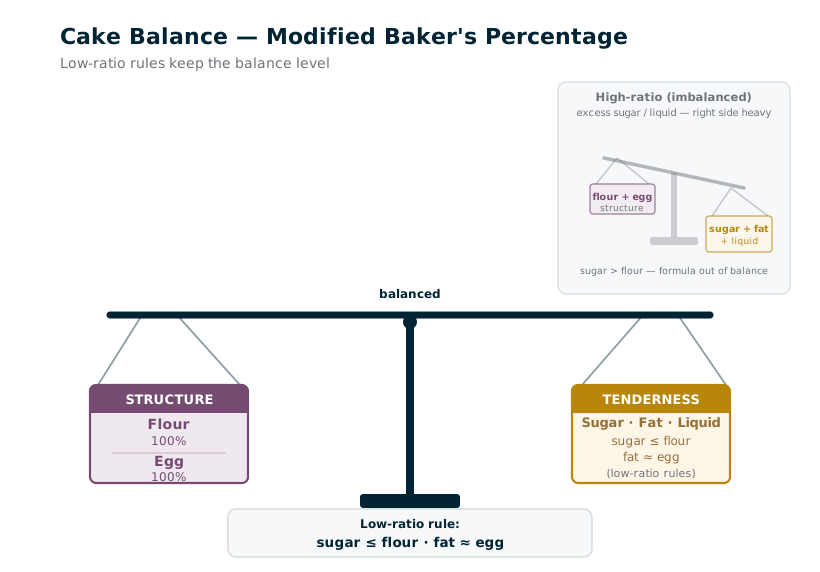 Balance scale diagram contrasting cake structure builders flour and egg against tenderisers sugar fat and liquid
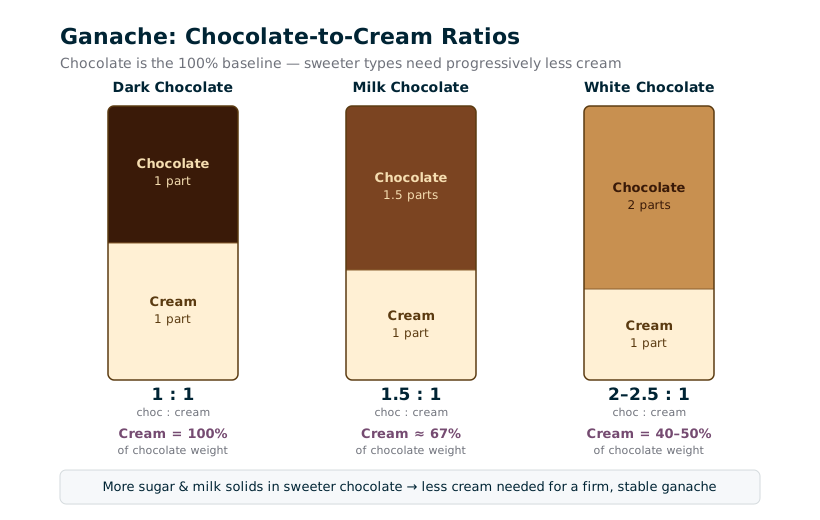 Chart of chocolate to cream ratios for dark, milk and white chocolate ganache
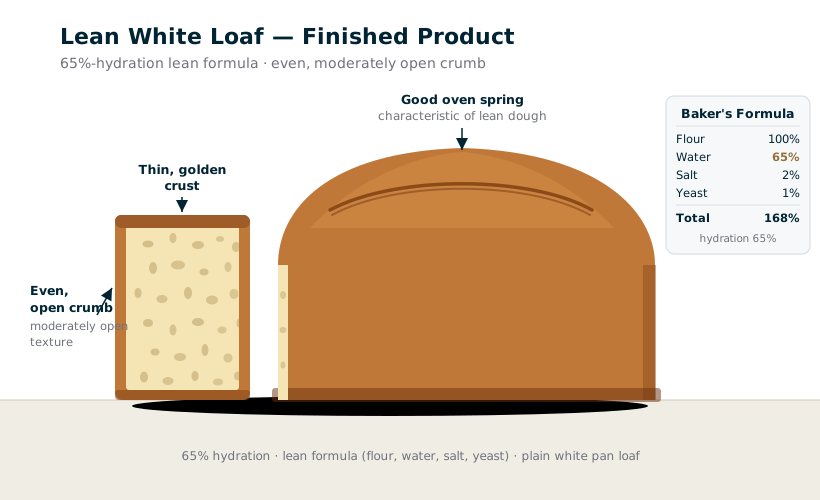 A baked white loaf with one slice cut showing an even open crumb
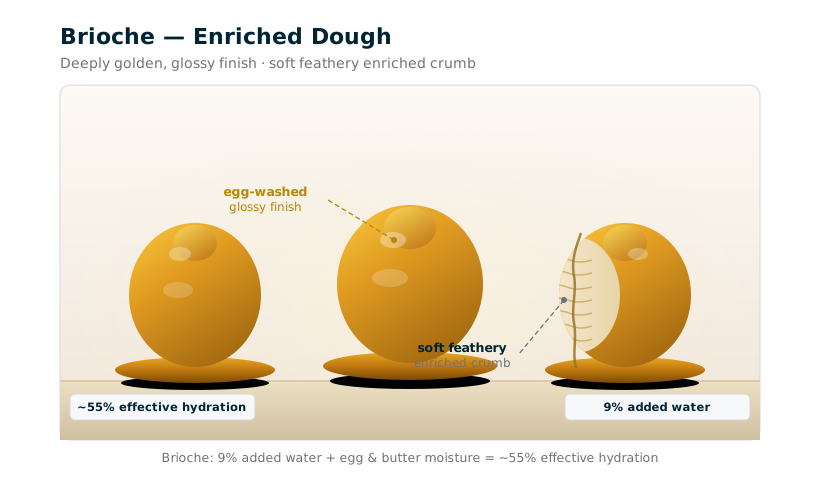 Shiny golden brioche buns with a soft enriched crumb
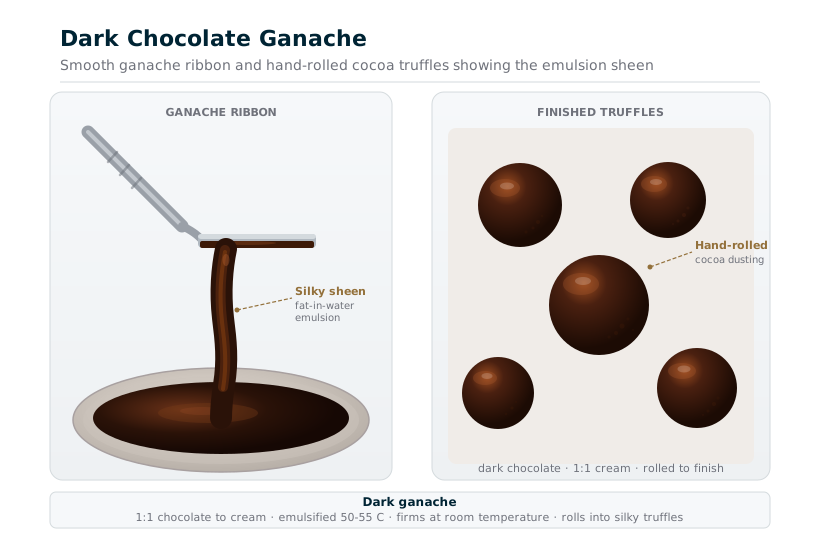 Glossy dark chocolate ganache and finished truffles
Lean white bread / pan loaf — the canonical baker's-percentage formula
The four-ingredient lean dough every baker learns first. It shows the whole language in one table: flour as 100%, water as hydration, salt and yeast as small percentages, and a total formula percent of 168%. Use a strong bread flour (≥10% protein) so the gluten holds the gas.
| Ingredient | Baker's % | Weight |
|---|---|---|
| Strong bread flour (Type 750) — Example: 1000 g | 100% | |
| Water (≈24–26°C) — Example: 650 g | 65% | |
| Salt — Example: 20 g | 2% | |
| Instant dried yeast — Example: 10 g | 1% | |
| Total | 168% |
- Combine flour, salt, yeast and water; mix to a smooth, moderately developed dough (aim for a final dough temperature of ~24–26°C).
- Bulk ferment, covered, ~60–90 min at ~26°C until roughly doubled.
- Divide and pre-shape; rest 10–15 min, then final-shape into tins or as rolls.
- Final proof ~45–60 min at ~27–30°C until springy.
- Bake loaves at ~230°C with steam for the first minutes, ~25–30 min (rolls ~220°C, ~12–15 min); bake until the core reaches ~96–98°C.
Worked example
At 1000 g flour: 650 g water + 20 g salt + 10 g yeast = 1680 g dough. To hit a target dough weight instead, divide the target by 1.68 to get the flour weight (e.g. 5 kg dough ÷ 1.68 ≈ 2976 g flour).
Yield: ≈1.68 kg dough per 1 kg flour → two ~800 g loaves or ≈21 × 80 g rolls (before bake loss)
Salt 1.8–2.2% is the working window; below ~1.5% the dough slackens and ferments too fast. For fresh yeast, multiply the 1% by ~3 → ~3%. King Arthur's reference uses 66% water / 1.2% yeast and BAKERpedia 62% water — all the same lean loaf, tuned to the flour.
Enriched (brioche) dough — reading 'effective hydration' when fat and eggs carry the water
An enriched dough looks 'dry' on paper — just 9% added water — yet it is supple, because eggs are ~75% water, butter ~16% and milk ~87%. Counting that hidden water gives an effective hydration near 55%. Percentages follow King Arthur's professional brioche.
| Ingredient | Baker's % | Weight |
|---|---|---|
| Strong flour — Example: 1000 g | 100% | |
| Whole egg (~75% water) — Example: 500 g | 50% | |
| Butter, 82% fat (~16% water) — Example: 500 g | 50% | |
| Sugar — Example: 120 g | 12% | |
| Salt — Example: 25 g | 2.5% | |
| Yeast (fresh, or osmotolerant instant) — Example: 70 g | 7% | |
| Water or milk — Example: 90 g | 9% | |
| Total | 230.5% |
- Mix flour, egg, milk/water, sugar, salt and yeast to FULL gluten development (the dough must be strong before fat goes in).
- Add the pliable butter in chunks; mix until the dough sheets out fully and is glossy.
- Bench rest ~1 h, fold, then retard overnight at ~4°C (cold dough is essential to shape high-butter dough).
- Divide, shape, egg-wash; final proof until very light (cool prove protects the butter).
- Bake ~180°C; small pieces ~14 min, loaves longer, until deep golden.
Worked example
Effective hydration = (egg 500 g × 0.75) + (butter 500 g × 0.16) + (added water 90 g) = 375 + 80 + 90 = 545 g of water against 1000 g flour ≈ 55%. Total dough = 2305 g; at 100 g per bun that is ~23 pieces.
Yield: ≈2.3 kg dough per 1 kg flour → ≈23 × 100 g buns or four ~575 g loaves
Butter typically runs 50–60% of flour (working range ~30–70%; a common three-tier classification puts 'basic' brioche at ≈20%, 'classic' at ≈50% and 'rich' at ≈88% of flour). IMPORTANT — YEAST DOSE: the 7% is a FRESH-YEAST dose; sugar and fat slow fermentation so a high dose is used. If substituting osmotolerant instant yeast, use ≈2% of flour (not 7%); applying 7% instant yeast would cause severe over-fermentation. Butter and milk are dairy allergens.
Pound cake (quatre-quarts) — modified baker's percentage and the balance rules
Cakes use a 'modified' baker's percentage: flour is still 100%, but the formula must obey balance rules between structure (flour, egg) and tenderness (sugar, fat). The pound cake is the textbook balanced low-ratio cake — equal weights of all four, so sugar = flour and fat = egg.
| Ingredient | Baker's % | Weight |
|---|---|---|
| Flour — Example: 500 g | 100% | |
| Butter (softened) — Example: 500 g | 100% | |
| Sugar — Example: 500 g | 100% | |
| Whole egg — Example: 500 g | 100% | |
| Baking powder (optional, modern) — Example: 0–10 g | 0–2% | |
| Total | 400% (402% with baking powder) |
- Cream softened butter with sugar until pale and aerated (this is the leavening in the classic version).
- Add egg gradually, beating to keep the emulsion (add a spoon of the flour if it threatens to curdle).
- Fold in the flour (and optional baking powder) just to combine.
- Scale into lined tins ~2/3 full; bake ~160–170°C until a skewer comes out clean (~45–60 min for loaf tins).
Worked example
At 500 g flour: 500 g butter + 500 g sugar + 500 g egg = 2000 g batter. Balance check: sugar ÷ flour = 1.0 (≤ 1, lean side) and fat ÷ egg = 1.0 — both within the low-ratio rules, so the batter is stable without extra emulsifier.
Yield: ≈2.0 kg batter per 500 g flour → two ~900 g loaf cakes
To move toward a softer high-ratio layer cake, raise sugar above flour (≈125–160%) and add liquid and emulsification — Baking-Sense's vanilla layer runs sugar 133% / liquid 133% / eggs 73% versus the pound cake's 125 / 94 / 106. Eggs and dairy butter are allergens.
Dark chocolate ganache — baker's percentage with chocolate as the 100% base
Confectionery formulas need no flour, so the dominant ingredient becomes the base. A 1:1 dark ganache is simply cream at 100% of the chocolate. Use real couverture (e.g. 58% or 72% dry cocoa solids) for a clean set. Soften to a piping/whipped texture; for a firm moulded shell drop the cream to 50% (2:1).
| Ingredient | Baker's % | Weight |
|---|---|---|
| Dark couverture (58–72%) — Example: 500 g | 100% | |
| Whipping cream (35% fat) — Example: 500 g | 100% | |
| Glucose syrup (optional, for gloss & shelf life) — Example: 50 g | 10% | |
| Butter (optional, finish, added < 35–40°C) — Example: 50 g | 10% | |
| Total | 220% |
- Chop or weigh out couverture/callets into a bowl.
- Heat cream (with glucose) to just below the boil (~90°C); pour over the chocolate and let stand ~1 min.
- Emulsify from the centre outward to a smooth, glossy emulsion (stick blender for a tight emulsion).
- When below ~35–40°C, beat in soft butter; use warm to pipe, or set and whip.
- If moulding shells: pre-crystallise (temper) the couverture separately — Arabesque Noir 58 melts at 47°C, is cooled two-thirds to 27°C, then worked at 30°C.
Worked example
At 500 g couverture: 500 g cream (1:1) + 50 g glucose + 50 g butter = 1100 g. For a firm moulded filling use cream at 50% (250 g, a 2:1 ratio); for milk chocolate use ~67% cream (1.5:1) and for white ~40–50% cream (2–2.5:1).
Yield: ≈1.1 kg ganache
FOOD-SAFETY / SHELF-LIFE: ganache is a perishable emulsion; keeping quality depends on water activity, lowered by invert sugar, glucose/sorbitol and a higher chocolate ratio. Callebaut's framed confectionery ganache is 49.9% dark 66% / 26.9% cream / 8.8% glucose / 8.8% invert / 3.8% clarified butter / 1.5% cocoa butter / 0.2% salt. Couvertures carry soya and may contain milk. Full water-activity guidance lives in the chocolate & confectionery formulas dossier.
Poolish preferment — the 'pre-fermented flour percentage' metric
A poolish shows a second baker's-percentage idea: pre-fermented flour percentage = flour held in the preferment ÷ total formula flour. The poolish itself is 100% hydration (equal flour and water) with a small yeast dose — 0.25% of the poolish flour for a standard 12–16 h cool ferment (some extended very-cool ferments use as little as 0.1%). Here 30% of the flour is pre-fermented overnight, then folded into a 68%-hydration final dough.
| Ingredient | Baker's % | Weight |
|---|---|---|
| POOLISH — flour — Example: 300 g | 100% of poolish flour (= 30% of total flour) | |
| POOLISH — water — Example: 300 g | 100% | |
| POOLISH — instant yeast — Example: 0.75 g | 0.25% | |
| FINAL DOUGH — remaining flour — Example: 700 g | 70% of total flour | |
| FINAL DOUGH — water — Example: 380 g | to reach 68% overall | |
| FINAL DOUGH — salt — Example: 20 g | 2% of total flour | |
| FINAL DOUGH — instant yeast — Example: 6 g | ≈0.6% of total flour | |
| Total | Overall ≈170.7% (flour 100 + water 68 + salt 2 + yeast 0.68) |
- Mix the poolish (flour + water + yeast) to a loose batter; cover and ferment 12–16 h at ~18–20°C until bubbly and just domed.
- Add the ripe poolish to the final-dough flour, water and yeast; mix, then add salt and develop the gluten.
- Bulk ferment, divide, shape, proof and bake as for a lean bread (≈230°C with steam).
- The poolish adds extension, flavour and crust colour — standard lever for baguettes and pain courant.
Worked example
Pre-fermented flour = 300 g ÷ 1000 g total flour = 30%. Overall water = 300 g (in poolish) + 380 g (final) = 680 g ÷ 1000 g flour = 68% hydration. Total dough ≈ 300 + 300 + 0.75 + 700 + 380 + 20 + 6 = 1706.75 g ≈ 1707 g.
Yield: ≈1.7 kg final dough (1 kg total flour)
A typical professional pre-fermented flour range is 20–40%. A biga is the same idea but stiffer; pâte fermentée is a piece of finished dough (it carries salt). Full preferment formulas are covered in the dedicated preferment dossier.
A simple lean dough written both ways. Baker's percent references everything to flour (=100%) and sums to over 100%; true percent references everything to the total batch and sums to exactly 100%. Professional formulas use baker's percent because you can change any single ingredient without recalculating the rest.
| Ingredient | Weight | Baker's % (flour = 100%) | True % (batch = 100%) |
|---|---|---|---|
| Flour | 1000 g | 100% | 59.5% |
| Water | 650 g | 65% | 38.7% |
| Salt | 20 g | 2% | 1.2% |
| Instant yeast | 10 g | 1% | 0.6% |
| TOTAL | 1680 g | 168% | 100% |
Hydration = water weight ÷ flour weight × 100. The same flour gives a completely different product as hydration climbs. Ranges are typical professional starting points, not hard limits.
| Hydration (water/flour) | Dough feel | Typical product | Crumb |
|---|---|---|---|
| 55–60% | Firm, stiff | Bagels, pretzels, some pan breads | Tight, even, fine |
| 60–65% | Workable, slightly tacky | Sandwich loaf, soft rolls, enriched bases | Close, regular |
| 65–72% | Soft, supple | Country loaf, baguette, batards | Moderately open |
| 72–85% | Slack, sticky | Ciabatta, rustic sourdough, focaccia | Open, irregular, glossy |
| 85–100%+ | Pourable to batter | Pan de cristal, very wet sourdough | Very open / wild |
| 100–190% | Batter | Cake batters, crêpe/waffle batters | Aerated sponge / set custard-like |
Baker's percentage is not only for bread. The principle generalises: pick the dominant structural or defining ingredient as the 100% base, then reference everything else to it. This is why the same mental model reads a brioche, a cake, a ganache and a complete mix.
| Formula family | 100% base | Why this base | Key reference ratios |
|---|---|---|---|
| Lean & enriched bread | Total flour | Flour builds the gluten structure | Hydration, salt 2%, yeast ~1% |
| Cakes (modified baker's %) | Total flour (+ starch) | Flour/egg are the structure; sugar/fat tenderise | Sugar vs flour, fat vs egg balance |
| Ganache / chocolate confectionery | Chocolate (or cream) | No flour; chocolate defines set | Dark 1:1, milk 1.5:1, white 2–2.5:1 |
| Complete (premixed) products | The mix itself | Mix already balances flour/sugar/leavening | Mix: egg: fat: water on the datasheet |
With chocolate as the 100% base, cream percentage falls as the chocolate gets sweeter and milkier. Milk and white chocolates carry more sugar and milk solids, so they need less cream for the same firmness. Ratios written chocolate: cream.
| Chocolate type | Chocolate: cream | Cream as % of chocolate | Typical use |
|---|---|---|---|
| Dark (≈55–72%) | 1: 1 | 100% | Soft truffle, whipped ganache, glaze |
| Dark (firm / moulded shell) | 2: 1 | 50% | Filled moulded chocolates, sliceable filling |
| Milk (≈30–40%) | 1.5: 1 (3: 2) | ≈67% | Milk-chocolate truffles & fillings |
| White (≈28–35%) | 2: 1 to 2.5: 1 | 40–50% | White-chocolate ganache, flavoured fillings |
Yeast is dosed as a percentage of flour. Switching yeast type means rescaling that percentage. Fresh yeast is ~70% water, so it is used at roughly three times the weight of instant.
| Yeast type | Relative weight | Typical % of flour (lean dough) | Notes |
|---|---|---|---|
| Instant (dried) | 1 (reference) | 0.6–1.5% (≈1%) | Add to dry flour; no pre-hydration |
| Active dried | ≈1.25 | 0.8–1.9% | Rehydrate in warm water first |
| Fresh (compressed) | ≈3 | 2–4.5% | ≈70% water; crumble into dough |
| Symptom | Likely cause | Corrective action |
|---|---|---|
| Scaled batch comes out the wrong size | Divided target weight by 100% instead of the total formula percent | Divide target dough weight by the total formula percent (e.g. ÷1.68), not by 100% |
| Hydration looks right but dough is far too wet/dry | Liquid sugars, eggs, butter or milk not counted as water | Use effective hydration: egg ~75%, milk ~87%, butter ~16% water |
| Multiple flours, percentages don't add up | Each flour given its own 100% base | All flours together = 100%; split that 100% between them |
| Switched to fresh yeast, dough barely rises | Used the instant percentage for fresh yeast | Multiply the instant % by ~3 for fresh yeast (≈70% water) |
| Cake batter curdles / sinks | Sugar or fat pushed past the balance rules without extra liquid/emulsifier | Keep sugar ≤ flour and fat ≈ egg for low-ratio; add liquid + emulsification for high-ratio |
| Ganache splits or is too soft/hard | Wrong cream:chocolate ratio for the chocolate type, or poor emulsion | Dark 1:1, milk 1.5:1, white 2–2.5:1; emulsify from the centre; butter only < 40°C |
| Salt added by total-batch percent tastes flat | Salt figured on dough weight instead of flour weight | Salt is 1.8–2.2% OF FLOUR, not of total dough |