Preservatives in packaged bread: calcium propionate, potassium sorbate, sodium diacetate — modes of action and legal limits
A practical deep-dive for professional bakers into the three chemical preservatives permitted for use in pre-packed bread and bakery products in the EU and UK: calcium propionate (E282), potassium sorbate (E202), and sodium diacetate (E262). Covers modes of action, pH dependency, yeast compatibility, EU legal limits by bread category (Regulation (EC) No 1333/2008), and how to select and dose the right preservative for the right product. Grounded in first-party spec sheets from two Domson catalogue products — Macco Calcium Propionate E282 20 kg (Hortimex/Macco Organiques, spec dated May 2022) and Zeelandia Mould Inhibitor 25 kg (spec dated April 2024) — cross-checked against BAKERpedia, IREKS Compendium of Baking Technology, and EFSA re-evaluation opinions. Includes comparison table, EU legal limits table, full fault-diagnosis table, and allergen and labelling guidance.
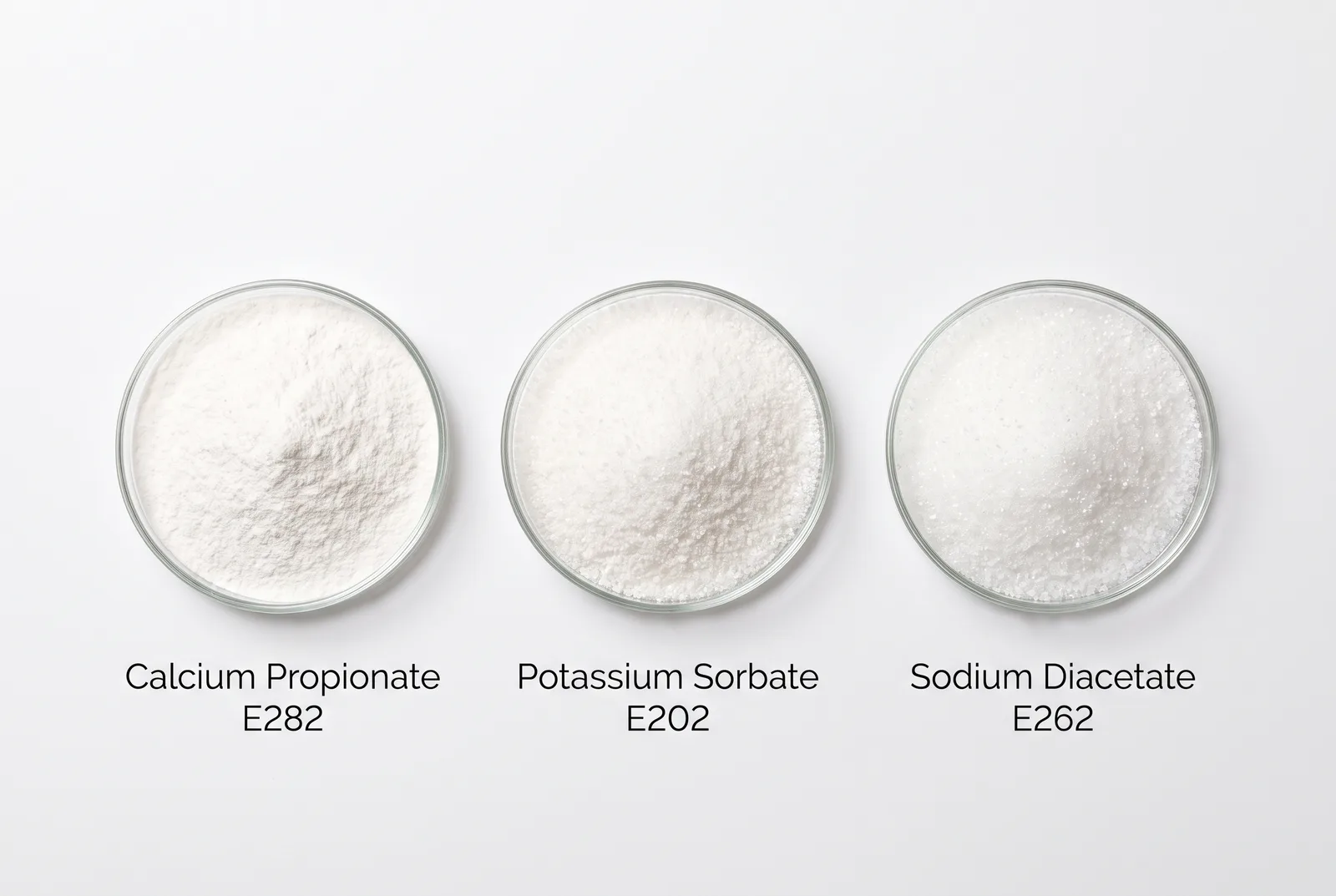
Three white powder samples of calcium propionate, potassium sorbate and sodium diacetate arranged side by side on a white background
What this article covers
Chemical preservatives are among the most practically significant — and the most scrutinised — ingredients in modern commercial baking. This dossier explains the three acids permitted as preservatives in pre-packed bread and bakery products in the EU and UK: calcium propionate (E282), potassium sorbate (E202), and sodium diacetate (E262). It explains what each one does at the molecular level, why pH matters so much, which leavening systems they are and are not compatible with, and what the law allows.
The starting point is first-party data: full specification sheets for two Domson catalogue products (Macco Calcium Propionate E282 20 kg and Zeelandia Mould Inhibitor 25 kg — both pure E282). These are cross-checked against BAKERpedia, the IREKS Compendium of Baking Technology, and EFSA re-evaluation opinions. Where sources disagree or a figure is single-source, this is stated explicitly.
For enzymes that extend shelf life by delaying staling (the textural degradation of bread, a separate mechanism), see A3-enzymes-in-bread. For the full improver landscape, see A3-what-is-a-bread-improver.
1. Why packaged bread goes mouldy: the spoilage problem
Freshly baked bread emerging from the oven is, for a brief window, essentially sterile — the baking process (typically 200–240°C surface, 95–98°C crumb) kills vegetative cells of most spoilage organisms. The problem begins the moment bread begins to cool.
Post-bake contamination is the key route: airborne mould spores settle on the bread surface and on sliced cut faces during cooling, slicing, and packaging. Once bread is sealed in plastic packaging, any spores that landed on the surface have a warm, humid, nutrient-rich environment in which to germinate and grow.
The most common spoilage moulds in packaged bread include Penicillium spp. (the blue-green moulds most consumers recognise), Aspergillus spp., and Rhizopus stolonifer (black bread mould). Some Aspergillus and Penicillium strains can produce mycotoxins under certain conditions — which is why mould inhibition is a food safety issue, not simply a shelf-life-extension exercise. ⚠️
Rope spoilage — caused by Bacillus subtilis and B. licheniformis, whose heat-resistant spores survive baking — is a second spoilage route in dense crumb breads. It manifests as a sticky, discoloured crumb with a characteristic sweet, fruity smell. Rope spores come primarily from flour and other ingredients. Calcium propionate is active against rope as well as mould.
The fundamental challenge: the water activity (aw) of packaged bread is too high for easy preservation. Most bread has aw 0.94–0.97 — a range where almost all major bakery moulds are capable of growth given sufficient time. Reducing aw to below 0.7 (sufficient to inhibit most moulds without a preservative) is incompatible with the texture of most breads.
Where preservatives are legally permitted: under EU Regulation (EC) No 1333/2008, preservatives in bread are only permitted in pre-packed products. Freshly baked bread sold unpackaged direct to the consumer does not fall within the permitted categories.
2. Three preservative systems: overview
The food technology literature and EU regulation recognise three organic acid systems as preservatives for baked goods. In practice, the free acids are not used directly — they are applied as stable, water-soluble salts:
| Acid | Salt form used in baking | E-number |
|---|---|---|
| Propionic acid | Calcium propionate | E282 |
| Sorbic acid | Potassium sorbate | E202 |
| Acetic acid | Sodium diacetate (sodium hydrogen diacetate) | E262 |
All three work by the same fundamental mechanism: in their undissociated (free acid) form, they are lipid-soluble and can penetrate the microbial cell membrane. Once inside the cell, they dissociate and release protons, disrupting the cell's pH homeostasis and interfering with metabolic processes.
The critical implication: activity is pH-dependent. The lower the dough or product pH, the higher the proportion of preservative that exists in the effective undissociated form. Above a certain pH, the acid is almost entirely dissociated and therefore inactive as an antimicrobial agent.
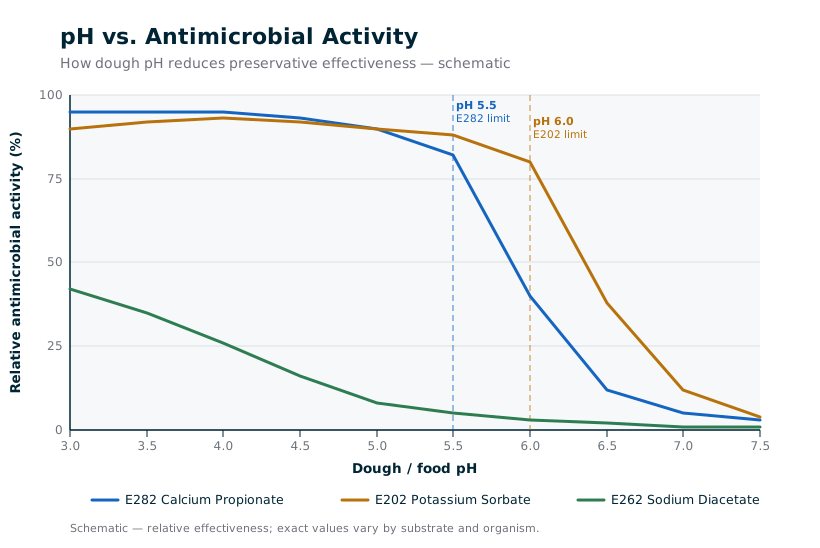 Line graph comparing pH versus antimicrobial activity for calcium propionate (E282), potassium sorbate (E202) and sodium diacetate (E262)
3. Calcium propionate — E282
Calcium propionate is the dominant preservative for yeast-raised packaged bread. Its defining advantage is yeast compatibility: at normal bakery dosages, it has little effect on Saccharomyces cerevisiae and does not interfere with fermentation.
3.1 Chemistry and physical properties
Calcium propionate is the calcium salt of propionic acid.
- Formula: Ca(C₃H₅O₂)₂
- Molecular weight: 186.22 g/mol
- CAS number: 4075-81-4; EEC number: E-282
- Appearance: White powder with a faint odour of propionic acid
- Solubility: 1 g dissolves in approximately 3 mL water
- pH of 10% solution: 7.5–9.0 (the neat salt is mildly alkaline — the antimicrobial species is the propionic acid released from the salt at the low pH of the dough)
Propionic acid is a normal metabolite found naturally in many foods and in the human gut; it does not accumulate in the body.
3.2 Mode of action
Calcium propionate inhibits mould and ropy bacteria by blocking cellular metabolism. At the low pH values found in bread (typically pH 5.0–6.5), a fraction of the calcium propionate dissociates to release undissociated propionic acid. This undissociated form is lipophilic: it crosses the microbial cell membrane, disrupts the proton gradient, and interferes with enzyme function — blocking the cell's ability to maintain internal pH and carry out metabolic activity.
The key target organisms are:
- Moulds: Penicillium spp., Aspergillus spp. (primary surface spoilage)
- Rope bacteria: Bacillus subtilis, B. licheniformis (crumb spoilage, heat-resistant spores)
- Gram-negative bacteria: generally not the primary target in bread
3.3 pH dependency
Calcium propionate is most active at pH below 5.5. Above this threshold, an increasing proportion of the propionic acid is in the dissociated (ionised) form, which cannot penetrate cell membranes. At bread pH of 5.5–6.5, some activity remains, but the preservative is less efficient. This is why:
- Acidifying the dough (e.g., adding sourdough, acetic acid, or citric acid) can potentiate the effect of propionate.
- Calcium propionate is most effective in breads with a naturally lower pH — rye breads, sourdough-enhanced products — and relatively less effective in neutral-pH white breads.
The Zeelandia spec confirms this in practical terms: the product is described as preventing mould within 7 days after baking when used at the recommended dosage in a normal bakery recipe.
3.4 Yeast compatibility
This is calcium propionate's most commercially important property for the bread baker. At the legal dosages permitted in pre-packed bread (1000–3000 mg/kg finished product), calcium propionate has little effect on baker's yeast (Saccharomyces cerevisiae) and does not impair fermentation performance.
By contrast, sodium propionate (E281) delays fermentation and is not suitable for yeast-raised breads. Calcium propionate is the standard choice whenever yeast-raised bread requires mould inhibition.
3.5 EU legal limits by bread category
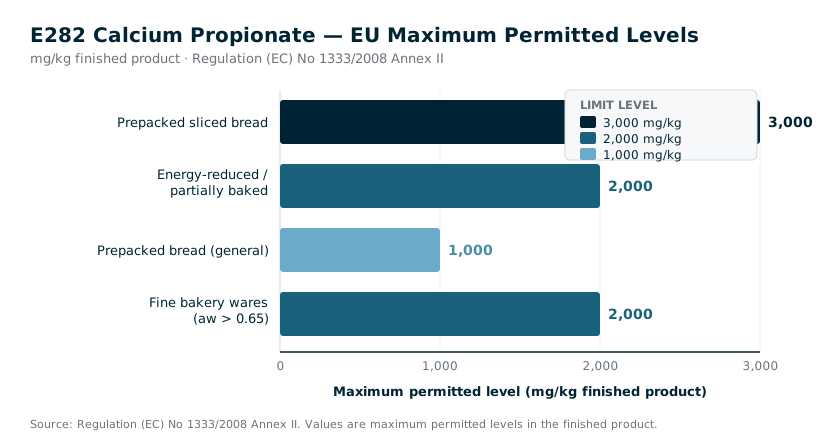 Horizontal bar chart of EU maximum permitted levels of calcium propionate E282 in four bread categories
Under Regulation (EC) No 1333/2008 Annex II, the maximum permitted levels for calcium propionate E282 vary by bread category. The following figures are confirmed from two independent sources (Zeelandia spec sheet and BAKERpedia):
| Bread / Bakery Product Category | Max Permitted Level (mg/kg finished product) |
|---|---|
| Pre-packed sliced bread and rye bread | 3000 |
| Energy-reduced bread; partially baked pre-packed bread; pre-packed rolls and pitta | 2000 |
| Pre-packed bread (general — not sliced, not energy-reduced) | 1000 |
| Pre-packed fine bakery wares (incl. flour confectionery) with water activity > 0.65 | 2000 ⚠️ |
Critical operational note: All limits are in mg per kg of the finished product (the bread as sold to the consumer), not per kg of flour. The dosage percentage added to flour (typically 0.1–0.3% flour weight ) must be calculated such that the resulting concentration in the finished loaf does not exceed the applicable category limit.
⚠️ The fine bakery wares limit (2000 mg/kg, aw > 0.65) is sourced from the Zeelandia spec sheet only — verify this category mapping against the current consolidated EC 1333/2008 text before applying it to a fine bakery wares product.
⚠️ UK post-Brexit: Regulation (EC) 1333/2008 was retained in UK law at the point of departure. UK maximum levels for bread preservatives are currently the same as EU limits, but operators should confirm against the current UK version of the Food Additives, Flavourings, Enzymes and Extraction Solvents Regulations 2013 (SI 2013/2210) and any subsequent amendments.
3.6 Domson catalogue products — E282
Three E282 products are available in the Domson catalogue:
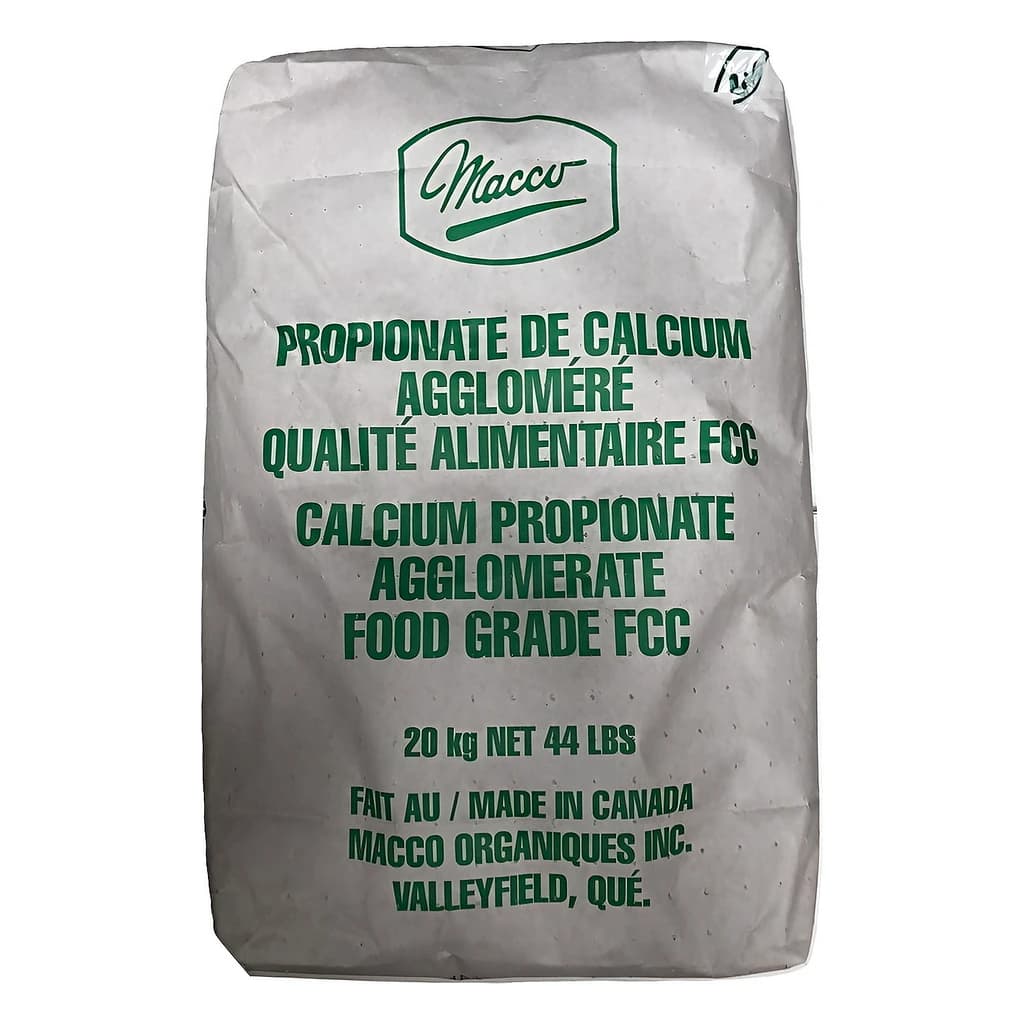
Macco Calcium Propionate E282 20 kg
Manufactured by Macco Organiques Inc. (Canada), distributed in Europe via Hortimex. This is a pure, food-grade calcium propionate agglomerate conforming to FCC (Food Chemicals Codex), EEC (E282 specification), and Polish standards.
Key specification data (from first-party spec, dated May 2022):
| Parameter | Value | Source |
|---|---|---|
| Molecular formula | Ca(C₃H₅O₂)₂ | Macco spec sheet |
| Molecular weight | 186.22 g/mol | Macco spec sheet |
| CAS / EEC | 4075-81-4 / E-282 | Macco spec sheet |
| Assay (anhydrous basis) | 99.0–100.5% | Macco spec sheet |
| Water content | Max 4% | Macco spec sheet |
| pH (10% solution) | 7.5–9.0 | Macco spec sheet |
| Tapped density | 0.45–0.53 g/mL | Macco spec sheet |
| Heavy metals — Lead | ≤2 mg/kg | Macco spec sheet |
| Heavy metals — Arsenic | ≤3 ppm | Macco spec sheet |
| Heavy metals — Mercury | ≤1 ppm | Macco spec sheet |
| Shelf life | Up to 3 years | Macco spec sheet |
| Storage | Cool and dry, tight containers | Macco spec sheet |
| Packaging | 20 kg multiwall paper bags | Macco spec sheet |
Zeelandia Mould Inhibitor (Środek Antyplesniowy) 25 kg
Zeelandia's ready-to-use calcium propionate preparation for bakeries, designed as a turn-key mould inhibitor. Spec dated April 2024 — the most current of the two E282 specs in this catalogue.
Key specification data:
| Parameter | Value | Source |
|---|---|---|
| Descriptive name | Calcium propionate (E282) | Zeelandia spec sheet |
| Ingredients | Preservative (E282) | Zeelandia spec sheet |
| Appearance | White powder, soft sour odour/taste | Zeelandia spec sheet |
| Water content | < 16.5% | Zeelandia spec sheet |
| Shelf life | 720 days from manufacture | Zeelandia spec sheet |
| Storage | Below 25°C, ≤75% RH | Zeelandia spec sheet |
| Packaging | 25 kg, two-layer paper bag + PE | Zeelandia spec sheet |
Note on water content difference: The Macco spec lists water max 4%; Zeelandia lists water <16.5%. Both are calcium propionate E282, but produced by different manufacturers using different particle engineering methods. The Zeelandia product is a commercial preparation that may include processing aids that raise the apparent moisture. Do not compare these two specs directly as quality indicators — each product should be assessed against its own manufacturer specification.
⚠️ Regulatory purity note (c25): Commission Regulation (EU) No 231/2012, which sets purity criteria for approved food additives, specifies a maximum water content of 5% for E282 (calcium propionate). The Zeelandia Mould Inhibitor spec value of <16.5% water significantly exceeds this threshold. This discrepancy is most likely explained by the product being a proprietary carrier-blended or agglomerated preparation — in which case the overall moisture of the blend is not directly comparable to the purity criterion for pure crystalline E282. Bakers and food technologists must confirm with Zeelandia technical support that product article P03662 fully meets E282 purity compliance under Regulation (EU) No 231/2012 before relying on it for food additive compliance assessments.
Allergen status for Zeelandia Mould Inhibitor: ⚠️ No allergens are used as ingredients. Cross-contamination risk exists for: wheat, rye, barley, oat, eggs, soybeans, milk, and sesame. Bakers supplying customers with allergen sensitivities must obtain a current allergen declaration directly from Zeelandia and must assess their own bakery cross-contamination controls.
How to use (Zeelandia guidance): Add the mould inhibitor directly to the flour. Prepare the dough according to the standard bakery recipe. This ensures even distribution throughout the dough and consequently uniform distribution in the finished loaf.
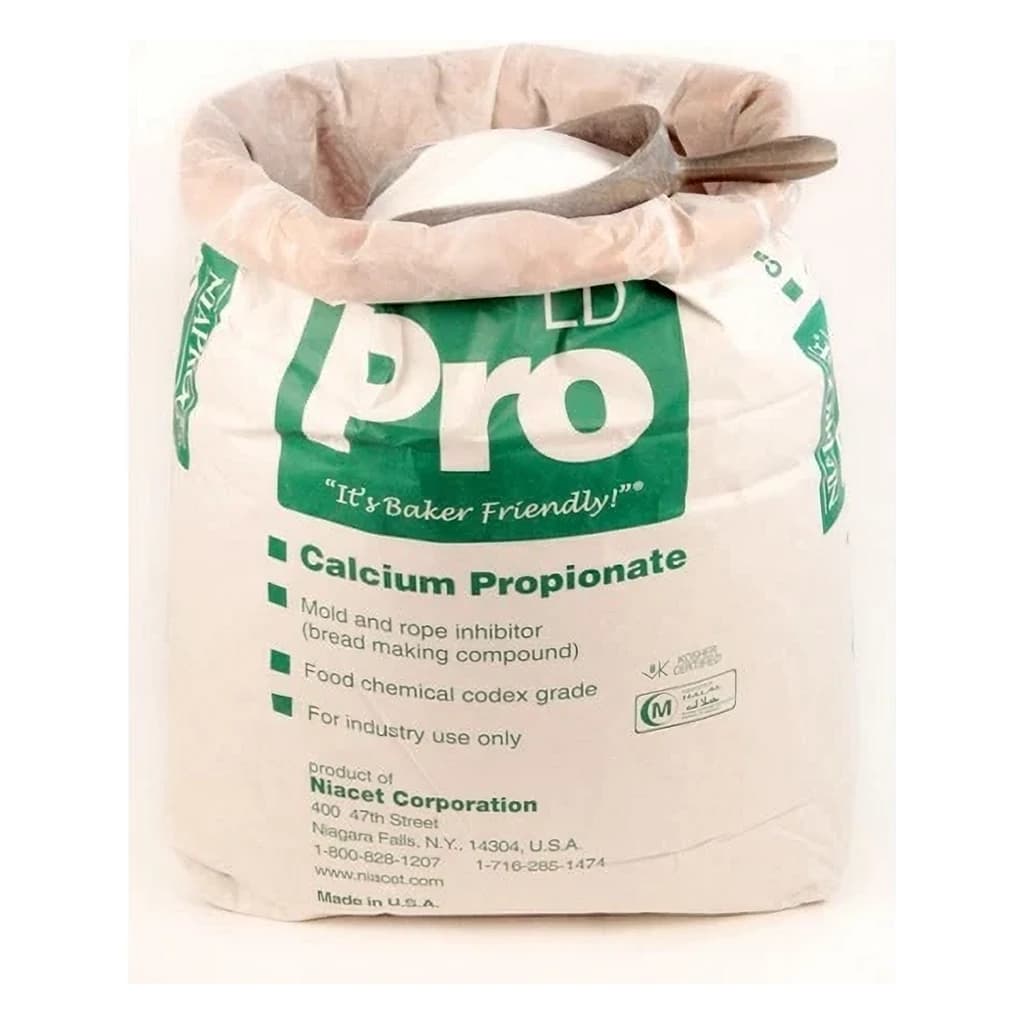
Kilo Ltd Calcium Propionate FG Granular 25 kg
A food-grade granular calcium propionate available through Kilo Ltd. No spec sheet is attached to this product in the Domson catalogue at the time of research (2026-06-26). Technical parameters and allergen declaration must be obtained directly from Kilo Ltd before formulating with this product. [no spec — verify before use]
4. Potassium sorbate — E202
4.1 Chemistry
Potassium sorbate is the potassium salt of sorbic acid (a naturally occurring polyunsaturated fatty acid found in rowan berries). It is a white granular powder, highly water-soluble, with minimal odour. It is the most widely used preservative in chilled and ambient food categories globally, and is effective against a broader spectrum of organisms than calcium propionate.
4.2 Mode of action
Potassium sorbate inhibits microbial growth by:
- Altering cell membrane morphology and integrity
- Disrupting transport functions across the cell membrane
- Interfering with metabolic activity including enzyme systems
Like propionate, it acts primarily in its undissociated (sorbic acid) form.
4.3 pH dependency
Potassium sorbate is effective at pH up to approximately 6.0; activity drops rapidly above pH 6.0.
This gives it a slightly wider active pH range than calcium propionate (active to ~5.5 vs ~6.0). However, typical bread pH is 5.5–6.5, meaning potassium sorbate sits at the edge of its effective range for standard yeast-raised bread.
4.4 EU safety evaluation
EFSA re-evaluated sorbic acid (E200) and potassium sorbate (E202) in 2015 (EFSA Journal 2015;13(6):4144, DOI 10.2903/j.efsa.2015.4144) and concluded they are safe at authorised uses.
⚠️ 2019 ADI revision (c22): A 2019 EFSA follow-up opinion (EFSA Journal 2019;17(6):5625, DOI 10.2903/j.efsa.2019.5625) revised the group ADI for sorbic acid and its salts downward from 25 mg/kg bw/day (set by SCF in 1996) to 11 mg/kg bw/day, based on reproductive and developmental toxicity data in animal studies. The current authorised uses of E202 have not been prohibited, but this ADI revision is a material update that operators and food technologists should note. Always verify EFSA's current opinion and any implementing regulatory changes before making food safety claims about potassium sorbate to customers.
4.5 Target organisms
Potassium sorbate is active against a broad spectrum of moulds, yeasts, and some bacteria. BAKERpedia notes it is more effective than calcium propionate against mould growth in bakery products — however this comparative claim should be treated as indicative (single source, effectiveness depends heavily on pH, aw, and dosage).
4.6 Yeast incompatibility — critical limitation for bread baking
Potassium sorbate inhibits baker's yeast (Saccharomyces cerevisiae). This makes it unsuitable for yeast-raised bread doughs — adding it to a yeast-risen formula will suppress fermentation and result in poor volume and tight crumb.
Potassium sorbate is appropriate for:
- Chemically leavened bakery products (cakes, muffins, soda bread, scones)
- Products where yeast fermentation is not required
Typical dosage in chemically leavened baked goods: 0.03–0.4% of batter weight — a wide range that reflects the variability of pH and aw across different formulations. Single-source figure; confirm with supplier.
4.7 Domson catalogue product — E202
Kilo Ltd Potassium Sorbate Granular 25 kg:
No spec sheet is available in the Domson catalogue at the time of research. Technical parameters (particle size, purity, heavy metals, allergens) must be obtained directly from Kilo Ltd before formulating.
5. Sodium diacetate — E262
Sodium diacetate (also called sodium hydrogen diacetate) is the sodium salt of acetic acid — a crystalline solid that releases acetic acid in solution. It has a mild vinegary odour, more perceptible than propionate at comparable dosages.
5.1 Mode of action
Acetic acid acts by the same undissociated-acid mechanism as propionate and sorbate. However, the pKa of acetic acid is 4.76 — below that of sorbic acid (4.76 — similar) and propionic acid (4.87 — similar). At bread pH of 5.5–6.5, only a small fraction of the acetic acid is undissociated, which explains why sodium diacetate alone provides only a modest, short extension of shelf life compared with propionate or sorbate.
5.2 Synergy with potassium sorbate
Sodium diacetate is most practically useful as part of a combination system with potassium sorbate. The acetic acid component lowers the local pH, increasing the proportion of undissociated sorbic acid — amplifying the antimicrobial effect of the sorbate. IREKS Compendium notes: "acetates are often combined with sorbic acid, as the effect of the sorbic acid is heightened with low pH values."
5.3 Fermentation impact
Sodium diacetate inhibits fermentation at bakery-relevant concentrations. Formulas using sodium diacetate require higher yeast additions to compensate. This makes it impractical as a standalone preservative in yeast-raised products, but in combination systems (e.g., with potassium sorbate) in chemically leavened goods, the interaction is less problematic.
5.4 Sensory impact
The acetic (vinegary) note of sodium diacetate is more perceptible to consumers than the faint propionic note of calcium propionate. Above a certain dosage, "a clearly perceivable inherent smell and taste can be noticed." This limits its practical ceiling dosage in neutral-flavour white breads, though it is appropriate in products where an acidic/vinegary note is flavour-consistent (e.g., some rye breads).
5.5 Domson catalogue
There is no dedicated sodium diacetate product in the Domson catalogue at the time of research. The closest product is Spirit Vinegar 10% 1 L — an acetic acid solution used primarily as a flavour ingredient rather than a measured preservative system. Bakers requiring sodium diacetate as a food additive should source a food-grade E262 product and verify it against the applicable EU limits under EC 1333/2008 Annex II.
6. Comparison summary
See the full machine-readable table below. Key differences in summary:
| E282 Calcium Propionate | E202 Potassium Sorbate | E262 Sodium Diacetate | |
|---|---|---|---|
| Best application | Yeast-raised packaged bread | Chemically leavened bakery | Blended with K-sorbate |
| Yeast compatible? | Yes | No | Marginal (higher yeast needed) |
| Active pH range | Up to ~5.5 | Up to ~6.0 | Up to ~5.0 (low alone) |
| Sensory impact | Faint propionic note | Minimal | Vinegary above threshold |
| Domson products (spec) | 2 spec-backed products | No spec product | No product |
7. EU legal limits — regulatory framework
Preservatives in bakery products are regulated under Annex II of Regulation (EC) No 1333/2008, which sets out maximum permitted levels for each additive in each food category.
Key principles:
- Limits are category-specific — the same additive may have different limits in different bread types.
- All limits are expressed as mg/kg of finished food (the product as sold), not mg/kg of flour or dough.
- Preservatives in bread are permitted only in pre-packed products. Fresh bakery goods sold unpackaged are not covered.
- Regulation (EC) 1333/2008 applies across all EU member states. The UK retained equivalent rules post-Brexit.
For calcium propionate (E282) specifically, the limits confirmed in this research are shown in section 3.5 above. For potassium sorbate (E202) and sodium diacetate (E262), the specific bread category limits were not independently confirmed during this research — operators must consult the current consolidated Annex II directly.
Labelling: When a preservative is used, it must be declared in the ingredient list by its function and E-number, e.g., "preservative (E282)" or "preservative: calcium propionate". Declaration rules follow Regulation (EU) No 1169/2011 (food information to consumers).
8. How to use: correct addition method
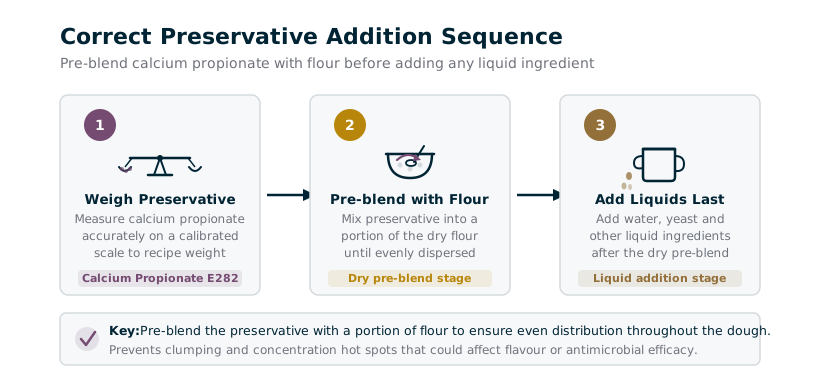 Baker weighing and blending calcium propionate preservative into flour before mixing
For calcium propionate E282 (Zeelandia Mould Inhibitor guidance):
- Weigh the required quantity of mould inhibitor accurately (small errors at sub-0.3% of flour weight have a significant effect).
- Pre-blend with a portion of flour before adding to the main mixing bowl. This prevents the preservative from sitting in a concentrated mass, ensuring even distribution throughout the dough.
- Add to the mixing process along with the other dry ingredients.
- Do not reduce yeast dosage significantly — calcium propionate does not meaningfully inhibit baker's yeast at legal dosages.
- Do not add in a concentrated lump to wet dough — this risks visible white streaks and uneven distribution (see fault table).
Hygiene protocols: Preservatives extend the mould-free period but do not sterilise. They work best in combination with:
- Good bakery hygiene (low airborne spore counts)
- Adequate cooling before slicing and packaging
- Airtight packaging
- Correct storage temperatures
9. Clean label alternatives
The IREKS Compendium notes that the use of chemical preservatives "is met with rejection in many countries on the part of the consumer." The market trend is towards clean-label strategies. Options include:
- Sourdough: Organic acids produced by lactic acid bacteria (primarily lactic and acetic) lower dough pH naturally, inhibiting mould and rope. A significant sourdough contribution (target dough pH below 5.5) can reduce or eliminate the need for chemical preservatives. However, sourdough flavour may not be appropriate for all product types. See A2-sourdough-cultures-science.
- Modified atmosphere packaging (MAP): Displacing oxygen in the packaging headspace with nitrogen (N₂) or carbon dioxide (CO₂) inhibits aerobic moulds and extends mould-free shelf life. Effective but requires capital investment in packaging equipment.
- Ethanol spraying: Applying food-grade ethanol spray to the cut surface or packaging interior before sealing inhibits mould. Common in some markets.
- Fermented flour preparations: Products such as Bakels Protect (fermented wheat flour concentrate) are marketed as clean-label mould inhibitors at approximately 2% on flour weight. Note this claim is single-source (Bakels brand article); performance relative to E282 is not independently quantified. ⚠️ Allergen flag (c24): Fermented wheat flour preparations contain wheat — a major allergen. Breads formulated with these products must include a wheat allergen declaration and cannot be marketed as wheat-free. Confirm full allergen status with the preparation supplier before use.
- Enzyme-based anti-staling (not the same as mould inhibition): Maltogenic amylase extends freshness/texture — but does not inhibit mould. See A3-enzymes-in-bread.
10. Allergen and labelling summary
⚠️ This section must be reviewed by a qualified food technologist before use in customer-facing communications. Formulations change; always verify against current spec sheets.
| Product | E-number | Allergens as ingredient | Cross-contamination risk | Spec date |
|---|---|---|---|---|
| Macco Calcium Propionate E282 20 kg | E282 | None stated on spec | Not declared on spec (Macco spec does not include allergen cross-contamination table) | May 2022 |
| Zeelandia Mould Inhibitor 25 kg | E282 | None | Wheat, rye, barley, oat, eggs, soy, milk, sesame (possible) | April 2024 |
| Kilo Ltd Calcium Propionate FG Granular 25 kg | E282 | No spec — verify | No spec — verify | — |
| Kilo Ltd Potassium Sorbate Granular 25 kg | E202 | No spec — verify | No spec — verify | — |
Important: The Macco spec sheet (May 2022) does not include a detailed allergen cross-contamination table. Bakers supplying allergen-sensitive customers must obtain a current allergen declaration from Hortimex/Macco before relying on this product for allergen-critical applications. ⚠️
11. Fault table
See the full machine-readable fault table below. Summary of key faults:
- Mould appearing before expected shelf life: typically insufficient dosage, post-bake contamination, or packaging failure — not a preservative chemistry failure.
- Sluggish fermentation / flat bread: potassium sorbate or sodium diacetate being used in a yeast-raised dough (wrong preservative choice — use E282).
- Off-flavour (soapy, sour, vinegary): excessive preservative dosage; sodium diacetate giving perceivable vinegary note.
- White streaks in crumb: concentrated preservative powder not pre-blended into flour before mixing.
- Rope spoilage despite preservative use: high rope contamination load in flour or ingredients; increase E282 to maximum legal limit for category; lower dough pH.
Coverage notes and gaps
Solid:
- Calcium propionate (E282) chemistry and mode of action — two independent sources plus first-party specs.
- EU legal limits for E282 in the major bread categories — confirmed from Zeelandia spec (April 2024) and BAKERpedia; consistent with known EC 1333/2008 provisions.
- First-party data for two E282 products (Macco and Zeelandia) — good spec quality.
Medium confidence:
- pH thresholds (E282 below 5.5; E202 below 6.0) — sound food-science basis but cited from single/limited sources; exact cut-offs vary by substrate and organism.
- Yeast inhibition by E202 — well-established principle, BAKERpedia as primary source.
- EFSA safety opinions — confirmed by reference but EFSA texts not directly accessed in this session.
Thin / single-source — verify before customer-facing use:
- Practical dosage ranges for E282 (0.1–0.3% flour weight) and E202 (0.03–0.4% batter weight) — BAKERpedia only.
- Fine bakery wares E282 limit (2000 mg/kg, aw > 0.65) — Zeelandia spec only.
- E202 and E262 exact bread category limits under EC 1333/2008 — not independently confirmed.
- Clean label alternative dosages (Bakels Protect 2%) — single brand source.
Needs follow-up:
- Obtain spec sheets for Kilo Ltd Calcium Propionate FG Granular 25 kg and Kilo Ltd Potassium Sorbate Granular 25 kg — both lack data sheets in the current catalogue.
- Obtain current allergen declaration from Macco/Hortimex for the calcium propionate product.
- Directly access and cite EC 1333/2008 Annex II consolidated text for E202 and E262 bread category limits.
- Quantitative comparison of E282 vs clean-label alternatives (fermented wheat flour, sourdough, MAP) — no peer-reviewed data accessed.
- Rope spoilage section would benefit from a dedicated source on Bacillus contamination in flour.
Figures
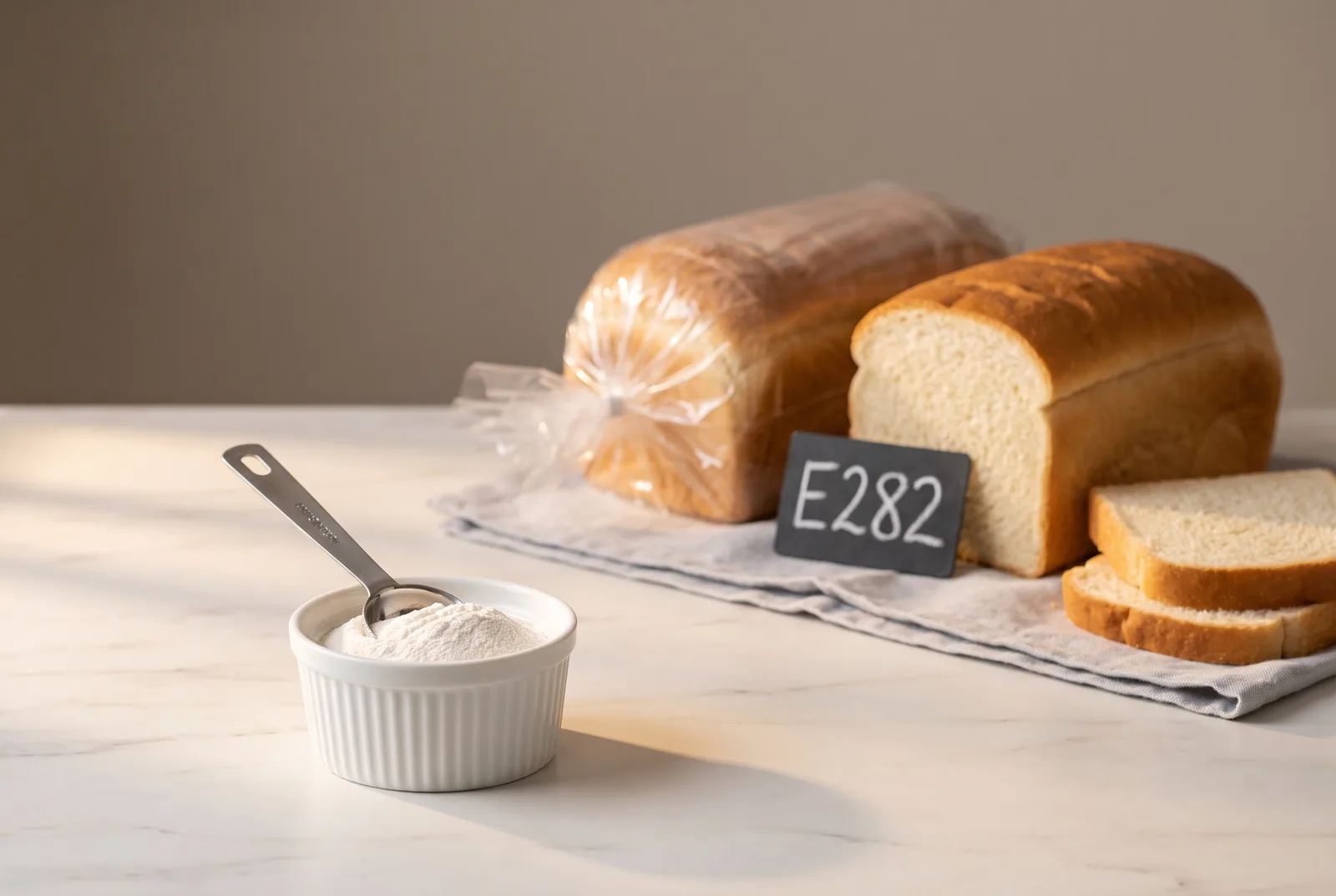 A ramekin of fine white calcium propionate powder with a precision dosing spoon on a marble bench, beside a sliced sandwich loaf wrapped in plain film and an unwrapped fresh loaf
Prepacked sliced white bread with calcium propionate (E282) — reference formula
Illustrative formula showing where calcium propionate sits in the full ingredient list. Dosage based on practical range from BAKERpedia. Baker's % calculated on flour weight. NOTE: this is a reference guide, not a tested recipe. Baking trials are always required. Calcium propionate dosage in mg/kg of finished bread must be calculated once formula is fixed — ensure it does not exceed the applicable legal limit.
| Ingredient | Baker's % | Weight |
|---|---|---|
| Wheat bread flour (strong, 12%+ protein) | 100 | |
| Water — Adjust to absorption | 62 | |
| Baker's yeast (instant dry) — May need slight increase to compensate for any mild fermentation inhibition | 1 | |
| Salt | 1.8 | |
| Sugar | 2 | |
| Fat / shortening | 2 | |
| Bread improver — Follow improver manufacturer's spec | 0.5 | |
| Calcium propionate E282 — 0.1–0.3% of flour weight. Verify finished product mg/kg against EC 1333/2008 limit for your category. | 0.1–0.3% |
Summary of calcium propionate (E282), potassium sorbate (E202), and sodium diacetate (E262) as they apply to packaged bread. Numeric ranges that are single-source are marked (SS).
| Parameter | Calcium Propionate E282 | Potassium Sorbate E202 | Sodium Diacetate E262 | Notes |
|---|---|---|---|---|
| Parent acid | Propionic acid | Sorbic acid | Acetic acid | |
| Chemical formula | Ca(C₃H₅O₂)₂ | CH₃(CH=CH)₂COOK | CH₃COONa · CH₃COOH | |
| Molecular weight (g/mol) | 186.22 | 150.22 | 142.11 (anhydrous) | |
| Physical form | White powder or granules | White granules or powder | White crystalline powder with mild acetic odour | |
| Optimal pH range for activity | Below 5.5 (drops above 5.5) | Up to ~6.0 (drops rapidly above 6.0) | Below ~5.5 (effect modest alone; synergistic with sorbate at low pH) | E282 pH figure dual-sourced. E202 pH limit single-source (SS). E262 pH from IREKS. |
| Primary target organisms | Moulds; rope bacteria (Bacillus spp.) | Moulds and yeasts (broad spectrum) | Moulds and rope bacteria; modest effect alone | |
| Yeast compatibility | YES — little effect on Saccharomyces cerevisiae at legal doses | NO — inhibits baker's yeast; not suitable for yeast-raised bread | MARGINAL — inhibits fermentation; higher yeast additions needed | |
| Typical practical dosage | 0.1–0.3% flour weight (higher not uncommon) [SS] | 0.03–0.4% batter weight for chemically leavened goods [SS] | Not established from a single reliable cited source | Both E282 and E202 practical dosages are single-source (BAKERpedia). Confirm with supplier and regulatory guidance for your specific product category. |
| EU legal limits (bread categories) | 1000–3000 mg/kg depending on bread type (Annex II, EC 1333/2008) | Permitted in specific bread categories under EC 1333/2008; limits differ by category | Permitted in specific bread categories under EC 1333/2008; limits differ by category | Only E282 limits have been confirmed from two independent sources (spec sheet + BAKERpedia). E202 and E262 exact bread-category limits not confirmed from two independent sources in this research — verify against current EC 1333/2008 Annex II before use. |
| Permitted in fresh unpackaged bread? | NO — pre-packed products only | NO — pre-packed products only | NO — pre-packed products only | |
| US regulatory status | GRAS affirmed (21 C.F.R. § 184.1221) | GRAS (21 CFR 182.3089, 182.3225, 182.3640, 182.3795) | GRAS | |
| EU safety evaluation | EFSA 2014: no safety concerns at authorised uses (EFSA Journal 2014;12(10):3779, DOI 10.2903/j.efsa.2014.3779) | EFSA 2015: considered safe at authorised uses (EFSA Journal 2015;13(6):4144, DOI 10.2903/j.efsa.2015.4144). ⚠️ 2019 follow-up (DOI 10.2903/j.efsa.2019.5625) revised the group ADI downward to 11 mg/kg bw/day based on reproductive/developmental toxicity data — verify current regulatory status before food safety claims. | Covered by general EFSA acetic acid/acetates evaluation | |
| Sensory impact at high dose | Faint propionic acid note at elevated levels | Possible off-notes; affects flavour above threshold | Vinegary/sour note; more perceptible than propionate | |
| Domson catalogue product(s) | Macco Calcium Propionate E282 20 kg; Zeelandia Mould Inhibitor 25 kg; Calcium Propionate FG Granular 25 kg | Potassium Sorbate Granular 25 kg | No dedicated sodium diacetate product — Spirit Vinegar 10% 1 L is the closest (acetic acid source, different application) |
Maximum permitted levels per Regulation (EC) No 1333/2008 Annex II. Figures confirmed from two independent sources: the Zeelandia Mould Inhibitor spec sheet and BAKERpedia. Limits are expressed as mg/kg of finished product (not flour weight). Fine bakery wares category confirmed from Zeelandia spec only (single-source — SS).
| Bread / Bakery Category | Maximum Permitted Level (mg/kg finished product) | Source confidence |
|---|---|---|
| Pre-packed sliced bread and rye bread | 3000 | HIGH — two independent sources |
| Energy-reduced bread; partially baked pre-packed bread; pre-packed rolls and pitta | 2000 | HIGH — two independent sources |
| Pre-packed bread (general — not sliced, not energy-reduced) | 1000 | HIGH — two independent sources |
| Pre-packed fine bakery wares (including flour confectionery) with water activity (aw) > 0.65 | 2000 | MEDIUM — single source (Zeelandia spec sheet) [SS] |
Fault diagnosis for problems directly caused by preservatives or their misapplication.
| Fault | Likely cause | Investigation steps | Remedy |
|---|---|---|---|
| Mould appearing before expected shelf-life end | Insufficient preservative level; post-bake contamination; packaging failure | Check actual mg/kg level vs. legal limit; inspect packaging seal integrity; check bakery hygiene (airborne spore count); verify preservative is being added and mixed correctly | Increase calcium propionate to upper end of legal limit for your category; improve packaging and sealing; introduce hygiene audit; consider modified atmosphere packaging |
| Sluggish fermentation / under-risen dough | Potassium sorbate (E202) or sodium diacetate (E262) added to a yeast-raised dough | Check formulation — E202 and to a lesser extent E262 inhibit Saccharomyces cerevisiae at bakery dosages | Switch to calcium propionate E282 for yeast-raised products; potassium sorbate is only appropriate for chemically leavened goods |
| Off-flavour: soapy, sour or bitter note in bread | Preservative dosage too high; sodium diacetate giving vinegary notes | Compare with control loaf without preservative; reduce dosage and re-test | Reduce to minimum effective dose; ensure even mixing into flour; for vinegary note, consider switching from sodium diacetate to calcium propionate |
| Preservative visibly unmixed / white streaks in crumb | Calcium propionate added in a lump rather than dispersed in flour | Check mixing procedure | Pre-blend preservative with a portion of flour before adding to mixer; do not add directly as a concentrated powder to wet dough |
| Rope spoilage (sticky, discoloured crumb with sweet, fruity smell) despite preservative use | Rope bacteria (Bacillus subtilis/licheniformis) survive baking as heat-resistant spores; calcium propionate does inhibit rope but may be insufficient at high contamination loads | Perform rope test (keep slice at 35°C for 48h); check flour and ingredient contamination levels | Increase calcium propionate to maximum permitted level; lower dough pH by using sourdough element or added vinegar/diacetate; improve flour hygiene; contact miller about rope contamination in flour |
- Sku:
- G23547
- Brand:
- Hortimex (Macco Organiques Inc.)
- Spec date:
- 2022-05-31
- Molecular formula:
- Ca(C₃H₅O₂)₂
- Molecular weight g mol:
- 186.22
- Cas:
- 4075-81-4
- E number:
- E-282
- Description:
- White powder with faint propionic acid odour; 1 g dissolves in ~3 mL water
- Ph 10pct solution:
- 7.5–9.0
- Assay anhydrous pct:
- 99.0–100.5
- Water max pct:
- 4
- Tapped density g mL:
- 0.45–0.53
- Heavy metals · Lead mg kg max:
- 2
- Heavy metals · Arsenic ppm max:
- 3
- Heavy metals · Iron ppm max:
- 50
- Heavy metals · Mercury ppm max:
- 1
- Packaging:
- 20 kg multiwall paper bags
- Storage:
- Cool and dry, tight containers
- Shelf life:
- Up to 3 years
- Conformance:
- FCC, EEC, Polish specifications
- Sku:
- G22117
- Brand:
- Zeelandia
- Spec date:
- 2024-04-15
- Article ref:
- P03662
- Descriptive name:
- Calcium propionate (E282)
- Ingredients:
- Preservative (E282)
- Appearance:
- White powder, soft sour odour/taste
- Water content max pct:
- 16.5
- Heavy metals · Arsenic mg kg max:
- 0.5
- Heavy metals · Lead mg kg max:
- 0.2
- Heavy metals · Mercury mg kg max:
- 0.03
- Heavy metals · Cadmium mg kg max:
- 0.1
- Allergens cross contamination risk:
- wheat, rye, barley, oat, eggs, soybeans, milk, sesame
- Shelf life days:
- 720
- Storage:
- Below 25°C, humidity up to 75%
- Packaging:
- 25 kg — two layers paper bag + one layer PE
- How to use:
- Add preservative directly to flour; prepare dough per normal bakery recipe
- Effect:
- Prevents mould growth within 7 days after baking
- Eu legal limits mg kg final product · Prepacked sliced bread rye bread:
- 3000
- Eu legal limits mg kg final product · Energy reduced bread partially baked rolls pitta:
- 2000
- Eu legal limits mg kg final product · Prepacked bread general:
- 1000
- Eu legal limits mg kg final product · Fine bakery wares aw above 0 65:
- 2000
- Note on legal limits:
- Limits cited on spec sheet refer to Regulation No. 1169/2011 (which is actually the food labelling regulation); the preservative additive limits are established in Regulation (EC) No 1333/2008 Annex II. The numerical limits match EC 1333/2008 and are confirmed by BAKERpedia. Always verify against the current consolidated EC 1333/2008 text.
Buy the ingredients
Catalogue products and brands referenced in this article.