
Rye, spelt, emmer and heritage wheats: baking behaviour and blending rules
Rye, spelt, emmer, einkorn and barley behave nothing like modern common wheat in the bakery. Rye has no gluten — only a pentosan gel that demands sourdough acidification. Spelt gluten shatters under overmixing. Emmer and einkorn need a strong-wheat scaffold to hold their gas. This article explains the science behind each grain's behaviour, gives spec-sheet data from the Domson catalogue for every relevant product, and provides practical blending ratios, fermentation targets and fault-diagnosis tables you can use immediately in production.
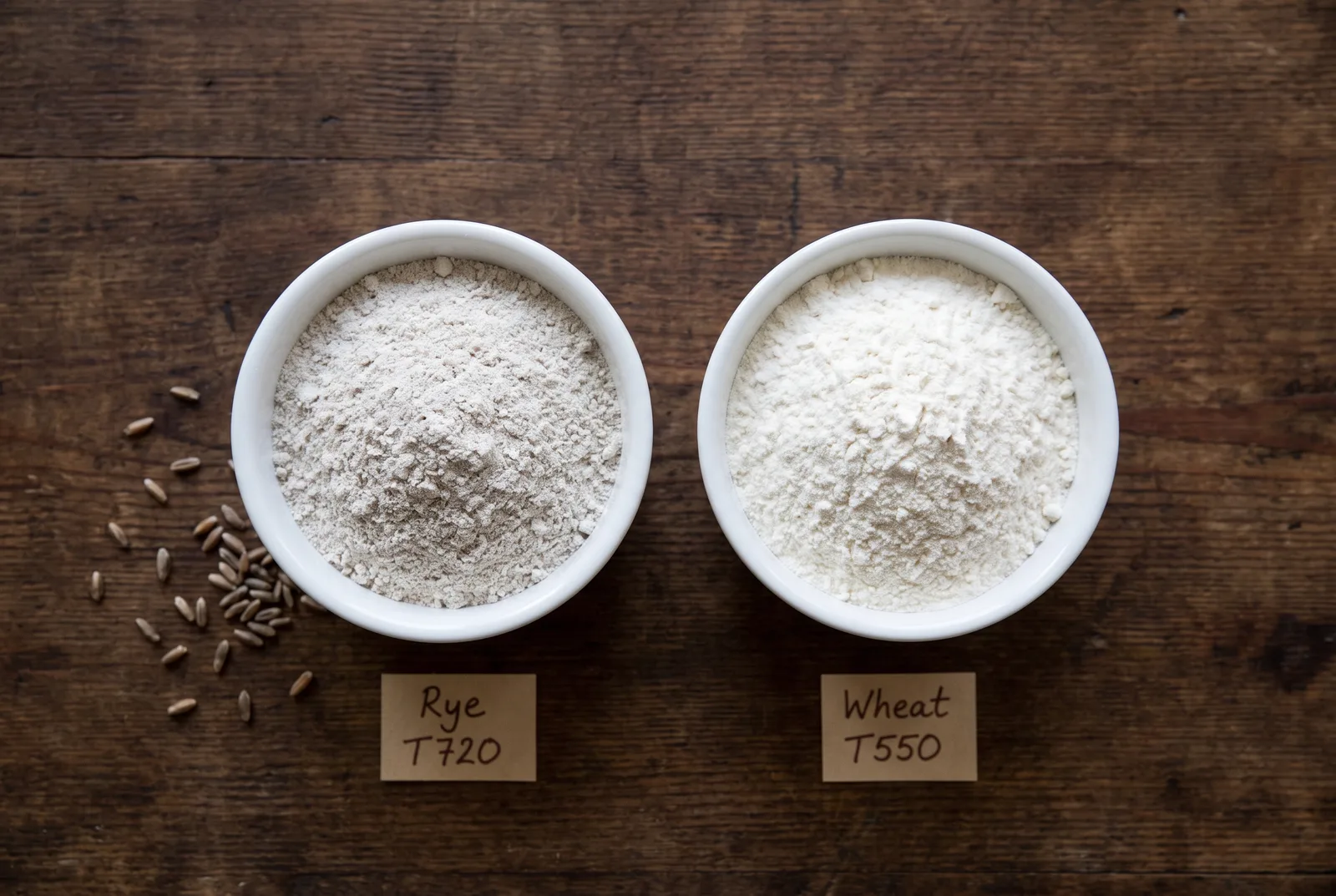
Why alternative grains behave so differently
When a baker picks up a 25 kg sack of rye flour and a sack of wheat flour, the grains they contain look similar. But the moment water touches the flour, everything changes. Alternative and heritage grains — rye, spelt, emmer, einkorn, barley — each have a fundamentally different protein chemistry, starch architecture and micronutrient profile from modern common wheat. Understanding those differences is not optional knowledge for a professional baker who wants consistent results. It is the prerequisite.
This article covers the four most practically relevant alternative grain types available in the Domson catalogue, using data extracted directly from supplier spec sheets. It also covers emmer and einkorn — which have no Domson catalogue spec sheets as of 2026-06-25 — with appropriately cautious trade-reference data.
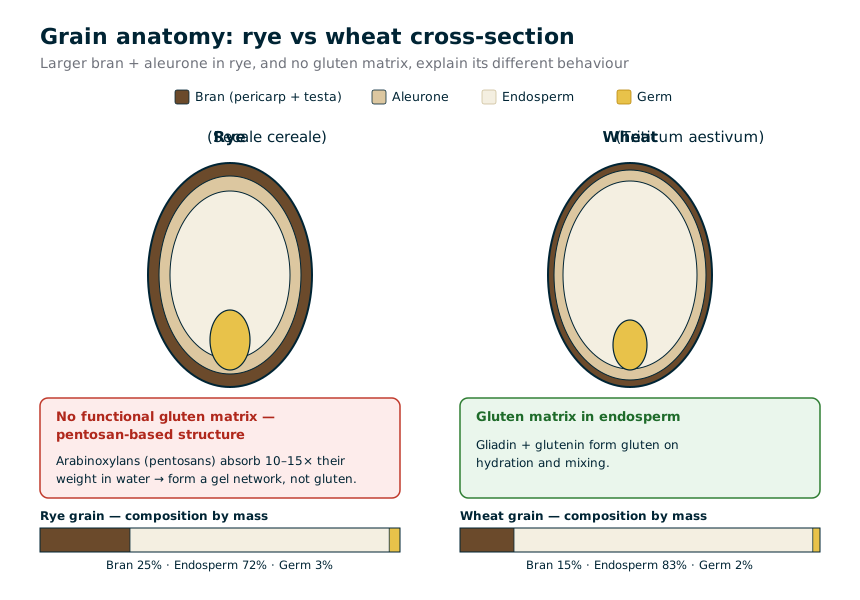 Comparison diagram of rye grain and wheat grain cross-sections. Both are shown as oval cross-sections with labelled layers: bran, aleurone, endosperm and germ. The rye grain shows a larger relative bran+aleurone proportion and a label 'No functional gluten matrix — pentosan-based structure'. The wheat grain shows a label 'Gluten matrix in endosperm'.
Part 1: Rye flour
1.1 Why rye is not a low-protein wheat
The most common misconception about rye flour is that it behaves like weak wheat flour. It does not. Rye contains similar amounts of protein to medium-protein wheat (the GoodMills Polska Rye T720 spec sheet records 6.5 g protein per 100 g, and Rye T2000 records 8.4 g per 100 g). But rye protein does not form a coherent gluten network when hydrated and mixed.
Instead, rye dough structure is governed by pentosans — specifically arabinoxylans — a group of complex carbohydrates found in high concentration in the bran and aleurone layers of the rye grain. Arabinoxylans have very high water-holding capacity — trade references typically cite approximately 10–15 times their own weight in water, though published scientific literature reports a wider range depending on the arabinoxylan fraction — forming a viscous gel that replaces gluten as the structural matrix in rye dough.
This has a direct consequence that every baker who handles rye must understand: you cannot knead rye dough into gluten development. There is no gluten to develop. Rye dough is mixed to full hydration and then left; it holds its shape by gel viscosity rather than protein network elasticity.
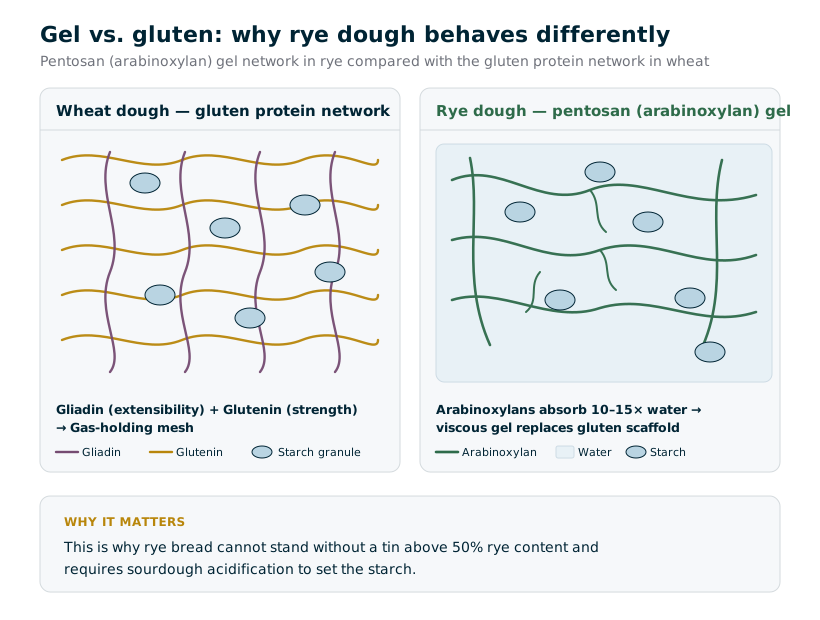 Two schematic diagrams. Left: 'Wheat dough structure — gluten network' showing interlinked protein strands forming a mesh with starch granules trapped inside. Right: 'Rye dough structure — pentosan gel' showing a looser, more fluid gel matrix of water-swollen arabinoxylan chains surrounding starch granules, with no protein mesh.
1.2 Rye flour grades and what the spec sheets say
The Polish (and broadly European) T-type classification encodes ash content directly in the type number. For rye, the Domson catalogue includes the following spec-sheet-confirmed grades:
The full Polish rye flour classification is in the comparison table below.
Rye T720 — the workhorse
The GoodMills Polska spec sheets for Rye Flour Type 720 (both the 20 kg and 25 kg variants) confirm:
- Ash content: < 0.78% dry matter (PN-EN ISO 2171)
- Moisture: < 15.0% (PN-EN ISO 712)
- Falling number: > 90 s (PN-EN ISO 3093)
- Colour: white-grey
- Protein (nutritional info): 6.5 g / 100 g
- Dietary fibre: 7.4 g / 100 g
- Ergot alkaloids: max 500 µg/kg
The Forbakery/Domson Poland spec for the same product additionally confirms acidity: max 6.0 degrees.
Important — ergot alkaloids (food safety): Both GoodMills rye spec sheets set an ergot alkaloid maximum of 500 µg/kg. EU Regulation 2023/915 sets 500 µg/kg as the current maximum for ground rye products. However, EU Regulation 2024/1808 schedules a reduction to 250 µg/kg for ground rye products from 1 July 2028. The GoodMills spec sheets (dated 2022) pre-date this amendment. Confirm the currently applicable regulatory limit — and the planned 2028 threshold — with your food safety advisor before placing any rye flour in product formulation.
Rye T2000 — wholemeal rye
The GoodMills Polska Rye Flour Type 2000 spec (Product Description No. 12 ZN-18/VK/10, Version 11) confirms:
- Ash content: < 2.0% dry matter (PN-EN ISO 2171)
- Moisture: < 15.0% (PN-EN ISO 712)
- Falling number: > 90 s (PN-EN ISO 3093)
- Colour: white-grey with part of bran
- Protein (nutritional info): 8.4 g / 100 g
- Dietary fibre: 14.4 g / 100 g
The T2000's fibre content — 14.4 g per 100 g — is nearly double the T720 (7.4 g) and approximately five to six times the fibre of white wheat T550 (approximately 2–3 g per 100 g from trade references). This is the primary nutritional argument for rye bread in customer marketing.
1.3 The falling number trap: rye vs. wheat
The Hagberg Falling Number (HFN) measures alpha-amylase enzyme activity. For wheat flour, the standard commercial minimum is 220 s. Both rye flour spec sheets set a minimum of > 90 s.
Do not compare these two numbers directly. Rye starch gelatinises at a lower temperature than wheat starch — published literature places rye starch onset as low as approximately 50–57°C with completion around 65–70°C, versus wheat starch onset approximately 58–65°C; exact values vary by method and extraction. Rye alpha-amylases are also more heat-stable than wheat alpha-amylases. The rye falling number test therefore measures enzyme activity in a fundamentally different physical context from the wheat test. A rye HFN of 90 s is the commercial minimum to exclude severely sprouted grain — it does not indicate poor flour quality in the way that a wheat HFN of 90 s would.
Note (medium confidence): For sourdough rye applications, an HFN above 120 s is preferable; some EU grain segregation thresholds use 110–140 s for rye. The GoodMills commercial floor of > 90 s is the minimum acceptable level. If rye falling number is critical to your production (particularly for 100% rye bread), request the typical value from your supplier in addition to the specification minimum.
1.4 The essential role of sourdough in rye baking
Rye dough contains abundant alpha-amylase, which remains active during the early stages of baking. Without acidification, the enzyme continues breaking down starch granules as the loaf heats, producing a wet, gummy crumb that sets improperly — an industry fault known colloquially as "starch attack."
The solution is sourdough: rye sourdough fermentation lowers the dough pH to 4.0–4.5. At this pH level, alpha-amylase is denatured more rapidly as oven temperature rises, and the starch sets properly. This is not optional for 100% rye bread — it is the mechanism that makes rye bread possible.
Lactic vs. acetic acid balance: During rye sourdough fermentation, lactic acid bacteria produce both lactic acid (mild, sweet, dairy notes) and acetic acid (sharp, tangy notes). The balance is controlled by temperature and dough hydration:
- Higher temperatures (above 28°C) favour lactic acid — rounder, milder flavour
- Lower temperatures (below 24°C) favour acetic acid — sharper, more complex tang
Three-stage sourdough (traditional Polish/German method):
The three-stage rye sourdough builds acid incrementally, giving maximum flavour complexity and the most robust acidification:
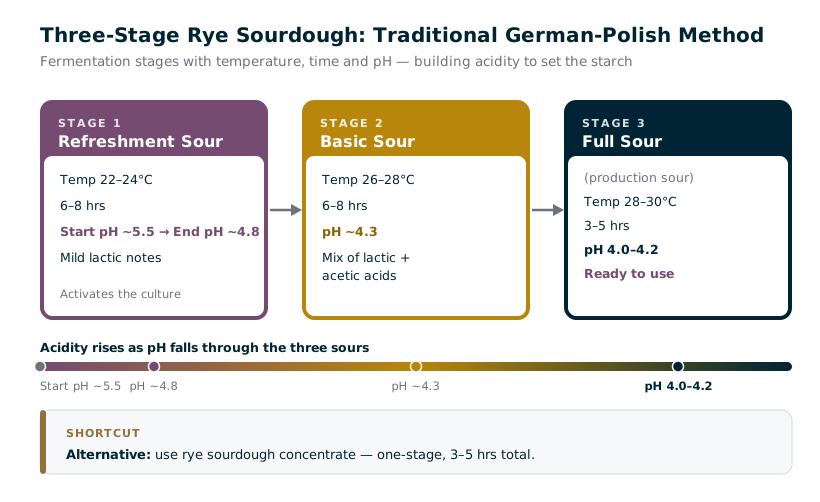 Flow chart of three-stage rye sourdough fermentation. Stage 1 (Refreshment Sour): 22–24°C, 6–8 hours. Stage 2 (Basic Sour): 26–28°C, 6–8 hours. Stage 3 (Full Sour): 28–30°C, 3–5 hours. Each stage shows the resulting pH drop and relative acidity.
The full stage-by-stage comparison of one-stage vs. three-stage methods is in the table below.
For bakeries using a ready-made rye sourdough concentrate (such as the Sauer Dark Rye Sourdough Concentrate or IREKS Natural Liquid Rye Sour in the Domson catalogue), a one-stage approach takes 3–6 hours total and is appropriate for mixed rye-wheat bread.
1.5 Rye blending rules
Rye flour weakens gluten when blended with wheat. The practical limits are well-established across industry sources:
The full blending guide is in the table below.
Key thresholds to remember:
- Up to 30% rye: free-standing hearth loaf remains possible; yeast alone may be sufficient; no sourdough mandated but recommended for flavour
- 31–50% rye: tin strongly recommended; sourdough required for crust support and starch control
- Above 50% rye: tin is essential; no gluten scaffold exists at these ratios for a free-standing loaf
- 100% rye: tin, sourdough, and careful pH control are all mandatory
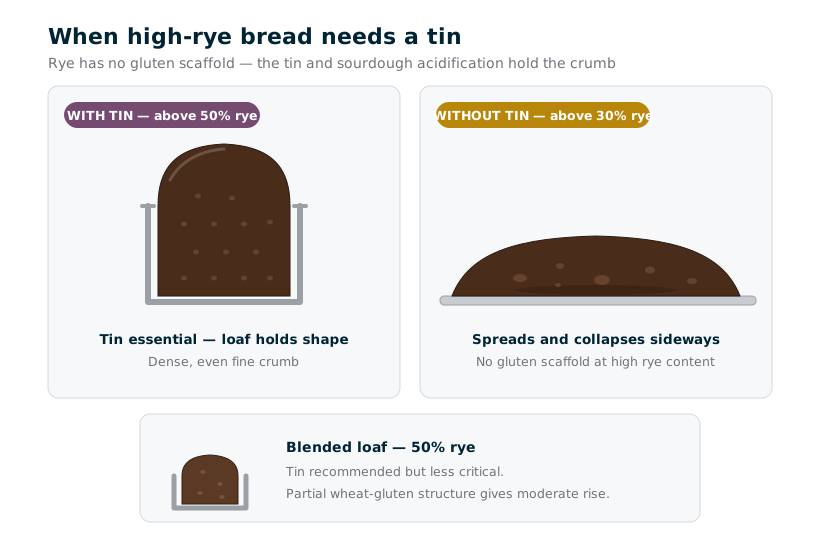 Side-by-side comparison: left — a tall dark rye sourdough loaf baked in a rectangular Pullman tin, showing dense even crumb with small bubbles; right — a free-standing rye loaf that has spread sideways showing a flat, dense result, labelled 'without tin — not recommended above 30% rye'.
A practical 50/50 rye-wheat starting formula using Domson catalogue flours is in the formula card below.
1.6 Rye dough handling in production
Rye doughs are not handled like wheat doughs. The practical rules:
- Mix to full hydration only — do not extend mixing to develop gluten (there is none)
- Dough will be sticky and loose. Do not compensate by adding flour.
- Dough yield (DY = 100 × total water and flour / flour weight) for rye bread typically runs 170–185; higher DY = softer, moister crumb
- Floor time is short: 15–30 minutes, not the 1–2 hours of wheat sourdough
- Single proof in the tin: approximately 50–60 minutes at 30–32°C
- Baking starts hot (230–250°C with steam) to set the crust, then reduces to 190–200°C for the long centre bake
Shelf life advantage: Rye sourdough bread stays fresh significantly longer than wheat yeast bread — typically 5–7 days — because the acidic environment inhibits mould growth.
Part 2: Spelt flour
2.1 What spelt is — and what it is not
Spelt (Triticum spelta) is not a type of common wheat. It is a distinct hexaploid species that was a staple of European agriculture for over 7,000 years before modern common wheat (Triticum aestivum) displaced it. It is sometimes described as an "ancient grain" or "heirloom wheat" — claims that are accurate from a historical standpoint.
Allergen declaration (food safety — flag for review): Spelt is listed under EU Regulation 1169/2011 Annex II as a named wheat sub-species. All products containing spelt must declare the allergen as GLUTEN (SPELT WHEAT) — not just "wheat." This is distinct from a generic wheat allergen declaration. It is NOT suitable for coeliacs.
Spelt does contain gluten — which means it behaves broadly like wheat in baking — but the gluten has a different molecular character. It is more water-soluble and much more fragile under mechanical stress than modern wheat gluten. This single fact determines almost every practical difference in handling.
2.2 Spec sheet data: light spelt and wholemeal spelt
The Domson catalogue carries two spec-sheet-confirmed spelt flours:
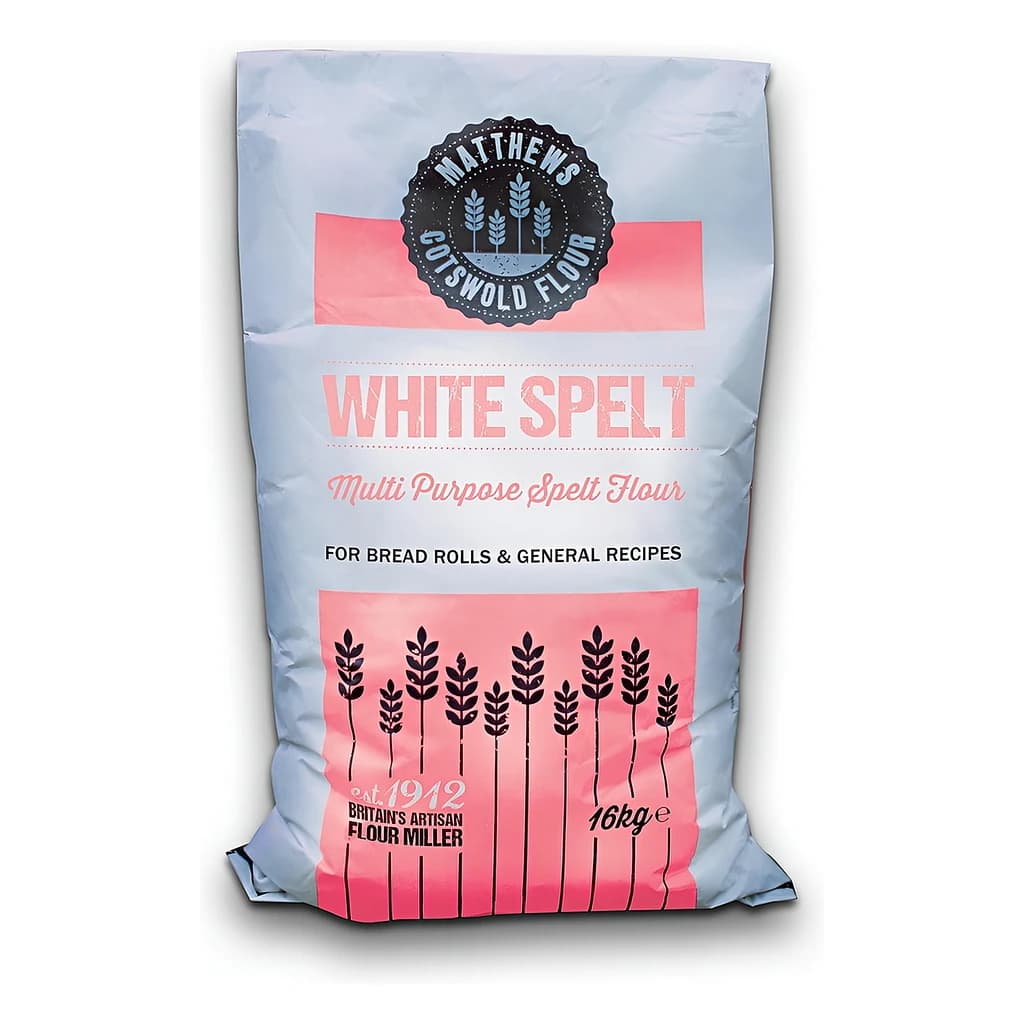
Stoneground White Spelt Flour (Matthews Cotswold Flour, 16 kg)
Spec sheet confirms:
- Protein: 9.0–13.0% (target 11.0%) — a very wide range reflecting seasonal variability in spelt grain
- Moisture: 13.5–15.0% (target 14.5%)
- Falling number: minimum 220 s — the same floor as standard wheat flour
- Water absorption (W/A%): 53.0–65.0% (no target specified)
- Dietary fibre: 4.5 g / 100 g
- Shelf life: 9 months (16 kg bag); 12 months (1.5 kg)
- Allergen: Contains cereals containing gluten (spelt wheat). Potential soya contamination risk from supply chain (note on spec sheet).
- Not suitable for coeliacs
Wholemeal Spelt Flour (Doves Farm Foods, 25 kg)
Spec sheet confirms:
- Protein: 11.8–17.0% (typical 13.3 g/100g) — stoneground, includes bran and germ
- Moisture: 11.5–14.5%
- Dietary fibre: 8.5 g / 100 g
- Production: stoneground — flavour and texture differ from roller-milled spelt
- Allergen: Contains gluten (naturally present in spelt). No soya, nuts or milk used on plant.
- Not suitable for coeliacs
A full comparison of these two spelt flours against Windrush Strong White wheat flour is in the table below.
2.3 The critical difference: water absorption variability
The most practically important number on the Matthews Light Spelt spec sheet is the water absorption range: 53.0–65.0% — a span of 12 percentage points. Compare this to the Windrush Strong White wheat flour water absorption: 55.0–61.0% — a span of only 6 percentage points.
This wide range means that a spelt loaf formula that works perfectly with one delivery of flour may produce dough that is either too dry or too slack with the next delivery. The practical rule: bench-test each new delivery of spelt flour with a small trial dough before scaling to full production.
2.4 Handling spelt dough: the overmix trap
Spelt gluten breaks down much more rapidly under mechanical stress than wheat gluten. The practical consequences:
- Reduce mix time significantly compared to your wheat equivalent formula — practitioner references vary between 20–50% reduction; some sources advise approximately half the wheat mixing time. Verify against your own mixer, dough temperature and recipe. Treat all time figures as starting points, not absolutes (single-source practitioner reference, confidence:low)
- Use slow speed predominantly; avoid extended high-speed spiral mixing
- An autolyse rest (mixing flour and water, resting 30 minutes before adding starter and salt) allows gluten to hydrate without mechanical stress and reduces the mixing time needed
- Stop mixing as soon as the dough comes together and passes a windowpane test — do not continue for "insurance"
What over-mixed spelt dough looks like: The dough suddenly becomes very slack and shiny, stops holding its shape, and sticks aggressively to the bowl. This is irreversible — the gluten has broken down. Unlike wheat dough, you cannot recover it by reducing water.
A practical spelt sourdough formula using Domson catalogue flours is in the formula card below.
2.5 Spelt blending rules
Blending spelt with strong common wheat flour compensates for the weaker gluten network:
- Up to 50% spelt in a tin loaf: manageable with careful handling; W/A% variability is the main risk
- 50–100% spelt in a tin loaf: requires careful hydration adjustment; recommend starting 5–10% lower water than your wheat formula
- 100% spelt hearth loaf: possible with gentle handling and sourdough, but not recommended for new users — the loaf will spread more than wheat
- Spelt in flatbreads, scones, cookies: up to 100% without structural concern; the weak gluten is actually an asset for tender crumb
Part 3: Graham wheat flour (T1850)
3.1 What Graham flour is
Graham flour is a coarsely ground whole-grain wheat flour that includes the bran, germ and endosperm of the wheat kernel, typically milled so that the bran is ground separately and then re-added in coarser particles. It is distinct from standard wholemeal flour in its coarser bran particle size, which gives a more textured crumb and a more pronounced wheaty flavour.
In the Polish classification system it falls under Type 1850 — an ash content corresponding to nearly full extraction.
3.2 What the spec sheet says
The GoodMills Polska Wheat Flour Type 1850 spec (Product Description No. 14, ZN-19/VK/10, Version 12) confirms:
- Ash content: < 2.0% dry matter (PN-EN ISO 2171)
- Moisture: < 15.0% (PN-EN ISO 712)
- Falling number: > 180 s (PN-EN ISO 3093)
- Protein (nutritional info): 12.3 g / 100 g
- Dietary fibre: 12.3 g / 100 g
- Colour: white and grey with part of bran
- Allergen: cereals containing gluten (wheat)
- Ergot alkaloid limit: 150 µg/kg (notably lower than rye at 500 µg/kg)
Note: The Graham T1850 falling number minimum (180 s) is lower than the standard wheat flour minimum (220 s). This is a single-source spec-sheet figure — confirm with GoodMills Polska if HFN is critical to your process. For Graham bread applications, the lower HFN may reflect that some bran fractions carry higher natural enzyme activity. Consider supplementing with diastatic malt (0.1–0.2% on flour weight) if producing long-fermentation Graham bread.
3.3 Baking with Graham flour
Graham flour is used at 100% flour weight in authentic Graham bread (Chleb Grahamowy) — it is a complete flour, not a partial replacement. Key practical points:
- Pre-soak the bran fraction: coarse bran particles cut gluten strands if added dry. Soaking the flour in a proportion of recipe water for 30 minutes before mixing helps bran hydrate and reduces this effect
- Extend mixing time slightly: bran increases mix time vs. T550; monitor dough feel rather than clock
- Expect a tighter crumb: even at 100% T1850, the bread will be denser than T550 but less dense than 100% rye. Loaf volume will be lower
- High fibre, good flavour: with 12.3 g fibre per 100 g, Graham bread is a strong-performing product in consumer fibre-awareness markets
Part 4: Barley flour
4.1 Barley's unique properties
Barley (Hordeum vulgare) has the highest beta-glucan content of any common cereal. Beta-glucan is a soluble dietary fibre with clinically recognised cholesterol-lowering properties; the EU health claim (Regulation 432/2012) requires 3 g of oat or barley beta-glucan per day to substantiate the claim on packaging.
Barley flour also has very weak gluten — significantly weaker than even spelt — which means it contributes texture (gummy, dense, moist crumb) more than structure. It cannot be used alone in any bread application.
Allergen (flag for review): Barley contains gluten. Barley and products thereof must be declared as GLUTEN (BARLEY) under EU Regulation 1169/2011 Annex II.
4.2 Spec sheet data — Organic Stoneground Barley Flour (Doves Farm Foods)
The Doves Farm Organic Barley Flour spec sheet (Issue 3, 18.06.11) confirms:
- Protein: 7.9 g / 100 g (nutritional, McCance & Widdowson source) — note: USDA FoodData Central shows higher protein (~10.5 g/100 g) for barley flour; discrepancy likely reflects product-type differences (stoneground wholemeal vs standard milled barley). Single-source spec-sheet figure; flag for review.
- Dietary fibre: 6.5 g / 100 g — note: USDA shows higher fibre (~10 g/100 g) for barley flour in general; same product-type caveat applies. Single-source spec-sheet figure; flag for review.
- Carbohydrate: 83.6 g / 100 g
- Fat: 1.7 g / 100 g
- Shelf life: 9 months from date of manufacture
- Production: stoneground
- Organic certification: GB-Org-05
- No falling number or ash content specified (not standard for barley flour)
- Allergen: contains gluten (naturally present in barley). No soya, nuts or milk used on plant.
4.3 Barley blending rules
Barley flour is used as a partial replacement in bread (for fibre and beta-glucan) or as the primary flour in flatbreads and shortbread-style products.
The blending limits are in the table below. Key rule: maximum 15–20% barley in a yeasted bread before volume loss becomes unacceptable. Above this level, vital wheat gluten addition (1–2% on total flour weight) can compensate for the lost structure.
Part 5: Emmer and einkorn — heritage wheats
Coverage note: Neither emmer nor einkorn has a Domson catalogue spec sheet as of 2026-06-25. The data in this section is from single-source trade references (IREKS Compendium, BAKERpedia). Confidence is low for all numeric claims. This section is flagged for follow-up research when these flours are added to the catalogue.
5.1 Emmer (Triticum dicoccum)
Emmer is a tetraploid hulled wheat, also called farro medio (Italian) or płaskurka (Polish). It was a dominant cereal across the ancient Mediterranean and Middle East, and is experiencing renewed interest in artisan baking.
Baking characteristics:
- Protein typically 15–18% (single-source estimate) — high, but the gluten is very extensible and weak
- Absorbs water slowly — allow extended autolyse or pre-ferment
- Flavour: rich, nutty, slightly sweet — more complex than modern wheat
- Maximum blend ratio: approximately 30–40% emmer in a yeasted bread without significant volume loss; above this a strong wheat scaffold is essential
- Works well in dense artisan loaves, focaccia-style breads and flatbreads
5.2 Einkorn (Triticum monococcum)
Einkorn is the most ancient cultivated wheat — a diploid hulled species. It is called płaskurka (common for both emmer and einkorn in Polish, occasionally distinguished as samopsza), or little einkorn.
Baking characteristics:
- Protein approximately 14–18% (single-source estimate) — high nitrogen, but again gluten is very extensible with low gas-holding capacity
- Highest carotenoid content of any wheat species — gives a distinctive golden-yellow crumb that functions as a natural colour without added pigment
- Maximum blend ratio: approximately 20–30% einkorn without structure collapse
- Works well in crackers, flatbreads, pasta, and as a blend addition to give golden colour
Practical limitation: Both emmer and einkorn are significantly more expensive than modern wheat and rye. They are positioned as premium "ancient grain" or "heritage wheat" products. Their baking limitations (fragile gluten, poor gas retention) mean they are blending flours in professional bread production, not standalone base flours.
Part 6: Nutritional comparison
The chart below compares the dietary fibre content of the key alternative grain flours from the Domson catalogue spec sheets:
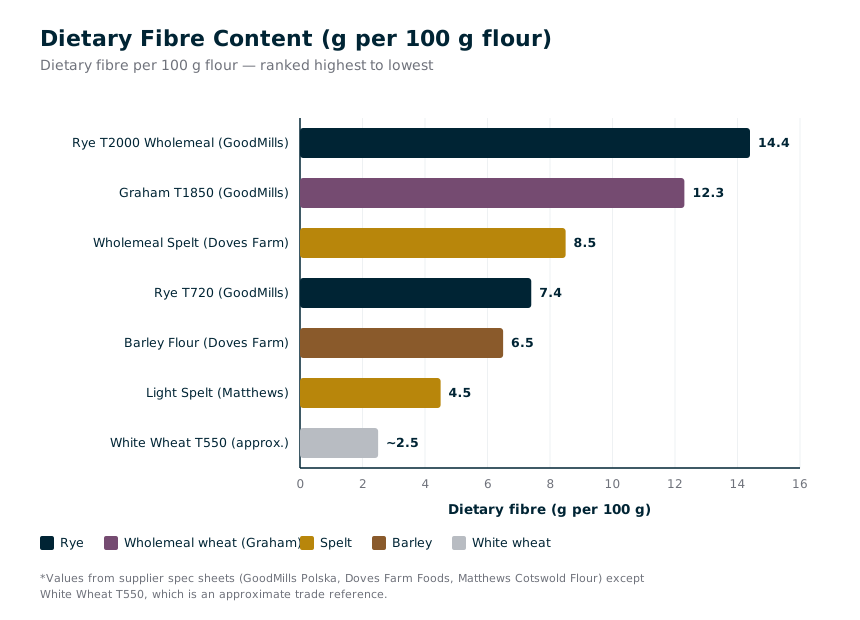 Horizontal bar chart showing dietary fibre per 100g for six alternative grain flours, ranked from lowest to highest: White Wheat T550 approx. 2–3 g, Light Spelt 4.5 g, Barley 6.5 g, Rye T720 7.4 g, Wholemeal Spelt 8.5 g, Graham Wheat T1850 12.3 g, Rye T2000 Wholemeal 14.4 g.
Key nutritional points confirmed from spec sheets:
- Rye T2000 wholemeal: 14.4 g fibre / 100 g — the highest of any flour in the Domson catalogue with a spec sheet
- Graham T1850: 12.3 g fibre / 100 g
- Wholemeal spelt: 8.5 g fibre / 100 g
- Rye T720: 7.4 g fibre / 100 g
- Barley flour: 6.5 g fibre / 100 g
- Light spelt: 4.5 g fibre / 100 g
Part 7: Quick-reference comparison table
The full parameter-by-parameter comparison across all alternative grain flours covered in this article is in the table below.
Part 8: Faults and corrections
The complete fault-diagnosis table covering gummy rye crumb, flat spelt loaves, barley stickiness, and over-sour rye bread is below.
Part 9: Allergen summary for production labelling
Allergen note: All allergen statements below are based on spec-sheet data and EU Regulation 1169/2011. Confirm with your food safety advisor and review against current UK post-Brexit retained law before use in production documents.
| Flour | Must declare | Notes |
|---|---|---|
| Rye T720, Rye T2000 | GLUTEN (RYE) | Both GoodMills spec sheets confirm rye as sole grain ingredient |
| Light Spelt (Matthews) | GLUTEN (SPELT WHEAT) | Must name spelt specifically — not just "wheat" |
| Wholemeal Spelt (Doves Farm) | GLUTEN (SPELT WHEAT) | No soya/nut/milk used on plant |
| Graham T1850 (GoodMills) | GLUTEN (WHEAT) | Standard wheat allergen |
| Barley Flour (Doves Farm) | GLUTEN (BARLEY) | No soya/nut/milk used on plant |
| Emmer flour | GLUTEN (WHEAT — EMMER) | Best practice to name variety; consult food safety advisor |
| Einkorn flour | GLUTEN (WHEAT — EINKORN) | Best practice to name variety; consult food safety advisor |
Coverage notes and gaps
Solid: All rye flour data (T720 and T2000) is from two independently confirmed GoodMills Polska spec sheets plus a third Forbakery/Domson spec. Light spelt and wholemeal spelt are from two independent supplier spec sheets (Matthews and Doves Farm). Graham T1850 is from one GoodMills spec sheet. Barley is from one Doves Farm spec sheet. Rye fermentation and blending guidance is confirmed across three or more industry sources (IREKS Compendium, BAKERpedia, Puratos).
Thin — needs confirmation: Graham T1850 falling number > 180 s is a single-source spec-sheet figure. Spelt gluten fragility is qualitatively confirmed but no alveograph data is available. Barley beta-glucan health claim is single-source (IREKS Compendium via trade reference).
Gap — follow-up required: Emmer and einkorn have no Domson catalogue spec sheets; all data is single-source trade reference (confidence:low). Rye grades T997, T1150 and T1400 are in the catalogue with spec sheets but not read in this session — add to the next research update. Ergot alkaloid regulatory limits for rye should be confirmed against EU Regulation 2023/915 (phased implementation from 2024).
Language gap: Polish, Turkish, Arabic, Romanian, Lithuanian and Bulgarian translations are pending. The rye bread content is particularly relevant for Polish (Chleb Żytni culture), Lithuanian (Ruginė Duona tradition) and Bulgarian baker audiences.
Classic Rye-Wheat Mixed Bread (50/50) — baker's % formula
A practical starting formula for a 50% rye / 50% wheat mixed bread using Domson catalogue flours. Requires a rye sourdough starter or concentrated rye sour.
| Ingredient | Baker's % | Weight |
|---|---|---|
| Rye Flour T720 (GoodMills) | 50 | 500 |
| Wheat Flour T750 or T850 (Domson Bread / GoodMills) | 50 | 500 |
| Rye sourdough (as pre-fermented rye flour equiv.) — 20% of total flour as mature rye sour — adjust water accordingly | 20 | 200 |
| Water (adjust for dough yield DY 170–175) | 70 | 700 |
| Salt | 2 | 20 |
| Instant yeast (optional boost) | 0.5 | 5 |
- Mix all ingredients 7 min slow / 3 min fast. Dough temperature 26–28°C.
- Floor time: 15–20 min. Dough will be sticky — do not add flour.
- Divide and shape into tins. Single proof: 50–60 min at 30–32°C.
- Bake: 240°C with steam for 10 min; reduce to 200°C for further 40–50 min.
- De-tin and cool on wire. Allow 24 hours rest before slicing (crumb sets as it cools).
Yield: Dough yield (DY) = (water g + flour g) / flour g × 100. Target DY 170–175 for mixed rye-wheat bread.
Spelt Sourdough Loaf — baker's % formula
Starting formula for an open-crumb spelt loaf using Stoneground White Spelt Flour. Gentler mixing than wheat equivalent.
| Ingredient | Baker's % | Weight |
|---|---|---|
| Stoneground White Spelt Flour (Matthews) | 80 | 800 |
| Wheat Flour T550 or Strong White (for structure support) | 20 | 200 |
| Sourdough starter (active) | 20 | 200 |
| Water (start at 60%; adjust per delivery W/A) | 60 | 600 |
| Salt | 2 | 20 |
- Autolyse: mix flour and water only, 30 min rest before adding starter and salt.
- Mix at slow speed only — max 6 min. Spelt gluten breaks down quickly under mechanical stress.
- Bulk ferment: 3–4 hours at 24–26°C with 3 sets of stretch-and-folds at 30 min intervals.
- Shape gently; final proof in banneton 8–12 h at 4°C or 1–2 h at 28°C.
- Score and bake: 240°C with lid/Dutch oven for 20 min; remove lid, 200°C for 20 min.
- Note: reduce water by 10–15 g if flour feels soft at mixing (W/A at lower end of 53% range).
Parameters extracted from Domson supplier spec sheets where available; supplemented by trade references where noted. All moisture limits are dry-matter basis unless stated. 'n/s' = not specified in reviewed spec sheets.
| Flour type | Botanical species | Protein % (typical) | Fibre g/100g (typical) | Falling number min (s) | Ash % max (d.m.) | Moisture % max | Gluten network type | Spec-sheet source |
|---|---|---|---|---|---|---|---|---|
| Rye T720 | Secale cereale | 6.5* | 7.4* | > 90 (rye scale) | < 0.78 | < 15.0 | Pentosan-based (no conventional gluten) | GoodMills Polska spec sheet |
| Rye T2000 (Wholemeal) | Secale cereale | 8.4* | 14.4* | > 90 (rye scale) | < 2.0 | < 15.0 | Pentosan-based (no conventional gluten) | GoodMills Polska spec sheet |
| Light Spelt Flour | Triticum spelta | 9–13 (target 11) | 4.5* | ≥ 220 | n/s | 13.5–15.0 | Weak/fragile gluten (short stability) | Matthews Cotswold Flour spec sheet |
| Wholemeal Spelt Flour | Triticum spelta | 11.8–17.0 (typical 13.3) | 8.5* | n/s | n/s | 11.5–14.5 | Weak/fragile gluten (short stability) | Doves Farm spec sheet |
| Graham Wheat T1850 | Triticum aestivum | 12.3* | 12.3* | > 180 | < 2.0 | < 15.0 | Wheat gluten (reduced by bran) | GoodMills Polska spec sheet |
| Organic Barley Flour | Hordeum vulgare | 7.9* | 6.5* | n/s | n/s | n/s | Very weak gluten + beta-glucan | Doves Farm spec sheet |
| Emmer flour | Triticum dicoccum | ~15–18 (trade ref) | higher than wheat (trade ref) | n/s | n/s | n/s | Weak/extensible (no Domson spec) | IREKS Compendium (single-source) |
| Einkorn flour | Triticum monococcum | ~14–18 (trade ref) | higher than wheat (trade ref) | n/s | n/s | n/s | Very weak/extensible (no Domson spec) | IREKS Compendium (single-source) |
* Protein and fibre values marked with asterisk are from the nutritional information section of the spec sheet, not quality specification minimums. Emmer and einkorn have no Domson catalogue spec sheets; values are single-source trade estimates — treat as approximate and flag confidence:low. Rye falling number uses a structurally different scale from wheat: do NOT compare the '>90 s' rye floor to the '≥220 s' wheat floor.
Polish (and broadly European) rye flour T-type system directly encodes ash content in mg per 100 g dry flour, identical convention to wheat flour. Data from GoodMills Polska spec sheets and industry references.
| Type (PL) | Ash % max (d.m.) | Colour | Typical application | Spec-sheet confirmed |
|---|---|---|---|---|
| Rye T720 | < 0.78 | White-grey | Mixed-grain bread, light rye rolls, blending base for rye-wheat bread | Yes — GoodMills Polska spec sheet |
| Rye T997 | < 1.00 (trade ref) | Grey | Medium rye bread, standard Eastern European dark bread | (has_spec=true; spec not read in this session) |
| Rye T1150 | < 1.20 (trade ref) | Dark grey | Dark rye bread, artisan Polish rye | (has_spec=true; spec not read in this session) |
| Rye T1400 | < 1.40 (trade ref) | Very dark grey | 100% rye bread, pumpernickel-style loaves | (has_spec=true; spec not read in this session) |
| Rye T2000 (Wholemeal) | < 2.0 | Grey-brown with bran | Pumpernickel, wholegrain rye, dense loaves | Yes — GoodMills Polska spec sheet |
Rye T997, T1150 and T1400 grades are stocked in the Domson catalogue but their spec sheets were not read in this research session. Ash thresholds for those grades are from industry convention (cross-verified with GoodMills Polska product range descriptions and the IREKS compendium). Confirm with the spec sheets in the catalogue for authoritative limits.
Practical blending guidance derived from industry references (IREKS Compendium, BAKERpedia, Puratos). All percentages are % of total flour weight (baker's % basis).
| Rye % in blend | Resulting bread type | Sourdough required? | Tin required? | Expected behaviour | Source |
|---|---|---|---|---|---|
| 5–15% | Wheat bread with rye flavour (Mischbrot light) | No (yeast alone sufficient) | No — hearth or tin | Slight darkening of crumb; mild earthy note; minimal effect on loaf volume | IREKS Compendium |
| 16–30% | Light mixed rye-wheat bread | Recommended | No — hearth or tin | Noticeable rye flavour; crumb becomes denser; gluten network still functional; volume slightly reduced | IREKS Compendium |
| 31–50% | Mixed bread (Mischbrot) | Required | Tin strongly recommended | Rye pentosans dominate structure; loaf needs support; sourdough pH control critical; fermentation extended | IREKS Compendium; BAKERpedia |
| 51–79% | Rye-dominant bread (Roggenmischbrot) | Required | Tin essential | Gluten network insufficient for free-standing loaf; dense crumb; baking temperature higher (220–240°C) | IREKS Compendium |
| 80–100% | Rye bread (Roggenbrot) / Pumpernickel | Required (often 2- or 3-stage sour) | Tin essential | No wheat gluten; structure entirely from pentosan gel; must reach pH 4.0–4.5; very long bake (220°C → 180°C) | IREKS Compendium; BAKERpedia; GoodMills spec sheet |
These are practitioner convention ranges confirmed across multiple industry sources. The exact threshold at which a tin becomes required depends on the rye flour grade and the dough yield — darker rye grades (T1400/T2000) need tins at lower rye percentages than T720.
Based on spec-sheet data (Matthews Light Spelt, Doves Farm Wholemeal Spelt vs. Windrush Strong White) and BAKERpedia reference.
| Parameter | Common wheat (Windrush Strong White) | Light spelt (Matthews) | Wholemeal spelt (Doves Farm) | Practical implication |
|---|---|---|---|---|
| Protein % | 12.0–12.5 (target 12.2) | 9.0–13.0 (target 11.0) | 11.8–17.0 (typical 13.3) | Spelt protein range wider; individual delivery may vary more than wheat |
| Water absorption % | 55.0–61.0 (target 58) | 53.0–65.0 (no target) | n/s (stoneground, variable) | Spelt W/A range is 12 percentage-point wide vs. wheat 6pp; bench-test each delivery |
| Falling number (s) | 250–400 (target 350) | ≥ 220 (no target) | n/s | Spelt minimum matches standard wheat floor; less certainty on enzyme activity |
| Gluten network stability | High (good mechanical tolerance) | Low–medium (overmix risk) | Low–medium (bran interference) | Reduce mixing time and speed for spelt; do not use aggressive spiral mix |
| Dietary fibre (g/100g) | 3.1 (calculated from spec) | 4.5 | 8.5 | Wholemeal spelt is a meaningful fibre upgrade; light spelt modest improvement over white wheat |
| Flavour profile | Neutral, cereal | Nutty, mild sweet, slightly earthy | More complex: nutty, earthy, slightly bitter from bran | Spelt's flavour is a selling point; use label claim 'ancient grain' |
| Shelf life | 9 months (16 kg bag) | 9 months / 12 months (1.5 kg) | 9 months | Comparable to wheat; store in cool dry conditions away from light |
All spec-sheet data verified from first-party sources. The claim that spelt gluten is 'weaker' is qualitative and supported by wider W/A range and lower HFN minimum; it does not mean spelt protein quantity is lower (wholemeal spelt protein at 13.3 g/100g exceeds strong white wheat typical range). Confidence: medium for gluten fragility claims (two independent sources agree on the direction; no alveograph W/P/L data available from these spec sheets).
Practical maximum inclusion rates before structure or volume is significantly compromised. These are practitioner convention ranges from industry references; actual limits depend on variety, growing season and processing.
| Alternative flour | Max in bread without significant volume loss | Max in pastry / flatbread | Key constraint | Recommended substitute product (Domson catalogue) |
|---|---|---|---|---|
| Rye T720 | 30% (hearth); 100% in tin with sourdough | 50% in flatbreads | Pentosans dilute gluten; sourdough required above 30% | |
| Light spelt flour | 50% blend in tin loaf; 100% with care in tin | 100% in flatbread and scones | Gluten fragility; overmix collapse | |
| Wholemeal spelt flour | 30–40% blend (bran cuts gluten strand length) | 60% in dense flatbread | Bran particles cut gluten; hydration variable | |
| Graham T1850 wheat | 100% (high-bran wheat flour, not a different species) | 100% | Lower falling number (>180 s min); longer mix for bran hydration | |
| Barley flour | 15–20% max in bread blend | 30% in flatbread or biscuit | Very weak gluten; beta-glucan stickiness | |
| Emmer flour (trade ref) | 30–40% blend with strong wheat | 50% flatbread or pizza | Low gluten extensibility; slow hydration | No Domson spec-sheet; single-source ref |
| Einkorn flour (trade ref) | 20–30% blend with strong wheat | 50% cracker or flatbread | Very low gas retention; yellow crumb from carotenoids | No Domson spec-sheet; single-source ref |
Emmer and einkorn data are single-source trade references (confidence:low); no spec sheet available in the Domson catalogue as of 2026-06-25. Barley beta-glucan causes stickiness in doughs at high inclusion; water absorption increases. All blend limits assume standard production conditions and no bread improver.
Based on IREKS Compendium of Baking Technology and supported by The Rye Baker (Stanley Ginsberg). Baker's % based on rye flour weight in the sour.
| Stage | One-stage (express) method | Three-stage (traditional) method | Notes |
|---|---|---|---|
| Purpose | Convenience for high-throughput bakeries using liquid sour concentrate | Maximum flavour complexity; authentic Polish/German/Lithuanian tradition | Choice depends on volume, available time and quality goal |
| Fermentation temperature | 28–32°C for 3–5 hours | Stage 1 (refreshment sour): 22–24°C / Stage 2 (basic sour): 26–28°C / Stage 3 (full sour): 28–30°C | Lower temp stages favour acetic acid; higher temp stages favour lactic acid |
| Duration | 3–5 hours total | 12–24 hours total across all three stages | Three-stage is typical for wholegrain rye; one-stage suits T720 mixed bread |
| Resulting pH | 4.0–4.5 | 3.8–4.2 (more acidic, more robust) | Lower pH = longer shelf life and more intense flavour; too low (<3.5) gives off-notes |
| Baker's % of rye in sour | 20–40% of rye flour as sour (concentrate top-up) | 25–50% of rye flour as sour pre-fermented | Higher sour % = more complex flavour but longer production cycle |
| Suitable rye flour grades | T720 (light rye) or T997 | T720 through T2000 (wholemeal); T2000 gives maximum flavour | Darker grades benefit most from multi-stage fermentation |
pH targets are industry standards widely cited by IREKS, Puratos and BAKERpedia. Confidence: medium (two or more independent sources agree on direction; precise numerical ranges vary slightly between sources).
| Flour type | Fault observed | Most likely cause | Corrective action |
|---|---|---|---|
| Rye (any grade) | Gummy, wet, sticky crumb that collapses on cutting | Insufficient acidification — alpha-amylase active during bake; starch gel not set properly | Increase sourdough pre-ferment; ensure pH reaches 4.0–4.5 before oven; check falling number |
| Rye (any grade) | Extremely sour / vinegary flavour; dense crumb | Over-fermented sourdough; excessive acetic acid from long cool fermentation | Shorten fermentation time or raise temperature to favour lactic acid; reduce sour % in formula |
| Rye T2000 / high-bran | Loaf collapses out of the tin during baking | Dough yield too low (too stiff); inadequate proofing | Increase DY to 175–185; extend proof to fully risen; verify tin size is matched to dough weight |
| Spelt flour | Dough collapses after mixing / sticky and slack | Over-mixed: spelt gluten breaks down past development peak | Reduce mix time by 20–30% vs. wheat recipe; avoid spiral at high speed; use slow speed only |
| Spelt flour | Dense loaf with poor volume; pale crust | Insufficient gluten strength to retain gas; water too high for this delivery's W/A | Reduce water 5–10%; add 5–10% strong wheat flour to blend; check HFN — if below 220 s add diastatic malt |
| Spelt flour | Inconsistent results batch to batch | W/A range 53–65% means flour varies significantly between deliveries | Bench-test each new delivery: mix a small trial dough and adjust water before full production |
| Graham T1850 | Crumb tight and chewy; unpleasant bran grittiness | Bran particles not hydrated; insufficient mixing time for bran to absorb water | Pre-soak bran with warm water 30 min before adding to dough; increase bulk ferment time |
| Barley flour (high %) | Sticky, dense crumb; dough difficult to handle | Beta-glucan absorbing excess water; very weak gluten insufficient for structure | Reduce barley % to ≤20%; add vital wheat gluten (1–2% on flour weight) to compensate structure |
| Rye-wheat blend >30% rye | Flat loaf baked on hearth; sides spread outward | Dough lacks gluten support for free-standing loaf; rye pentosans too dominant | Switch to tin baking; add bread improver with DATEM or ascorbic acid; or reduce rye % |
- Ash max pct dm:
- 0.78
- Fn min s:
- 90
- Moisture max pct:
- 15
- Ash max pct dm:
- 2
- Fn min s:
- 90
- Moisture max pct:
- 15
- Protein pct min:
- 9
- Protein pct max:
- 13
- Protein pct target:
- 11
- Fn min s:
- 220
- Wa pct min:
- 53
- Wa pct max:
- 65
- Protein pct min:
- 11.8
- Protein pct max:
- 17
- Protein pct typical:
- 13.3
- Ash max pct dm:
- 2
- Fn min s:
- 180
- Moisture max pct:
- 15
- Protein per100g:
- 12.3
- Fibre per100g:
- 12.3
- Ash content:
- ISO 2171 / PN-EN ISO 2171 (incineration at 550°C, dry matter basis)
- Falling number:
- ISO 3093 / PN-EN ISO 3093 (Hagberg-Perten method — NOTE: rye and wheat FN values are not directly comparable)
- Moisture:
- ISO 712 / PN-EN ISO 712 (oven drying)
- Protein:
- Kjeldahl Nx5.7 (wheat, rye) / Nx6.25 (oats, barley) — method ISO 20483
- Rye flour:
- Contains GLUTEN (RYE). Declare on all downstream products per EU Reg 1169/2011 Annex II.
- Spelt flour:
- Contains GLUTEN (SPELT WHEAT). Spelt is a named sub-species of wheat — must be declared specifically. Not suitable for coeliacs.
- Barley flour:
- Contains GLUTEN (BARLEY). Declare on all downstream products.
- Graham wheat flour:
- Contains GLUTEN (WHEAT). Declare on all downstream products.
Buy the ingredients
Catalogue products and brands referenced in this article.

Rye Flour Type 720 20 kg

Rye Flour Type 720 25 kg
Zeelandia Spelt Bread Mix 25 kg
Wholemeal Rye Flour Type 2000 40 kg
Graham Wheat Flour Type 1850 40 kg
Stoneground White Spelt Flour 16 kg
Ireks Spelt & Honey Bread Mix 25 kg

Wholemeal Spelt Flour 25 kg

Organic Stoneground Barley Flour 25 kg
Non-Organic White Spelt Flour 25 kg