Chemical Leaveners: Baking Soda, Baking Powder, Ammonium Bicarbonate & Choosing the Right Acid
A practical field guide for professional bakers on chemical leavening: how baking soda (NaHCO3 / E500ii), baking powder, and ammonium bicarbonate (E503ii) work chemically, when to use each, how to dose them correctly, and how to troubleshoot common faults. Built on first-party spec sheets for three catalogue products — Bowika Baking Powder (G22077), Bowika Bicarbonate of Soda (G23024), and CSM Pell Premium Baking Powder (G45684) — plus BAKERpedia, Kansas State University Extension, EU food additive regulations, and EFSA's 2019 phosphate re-evaluation. Includes allergen and food-safety flags relevant for EU and UK production.
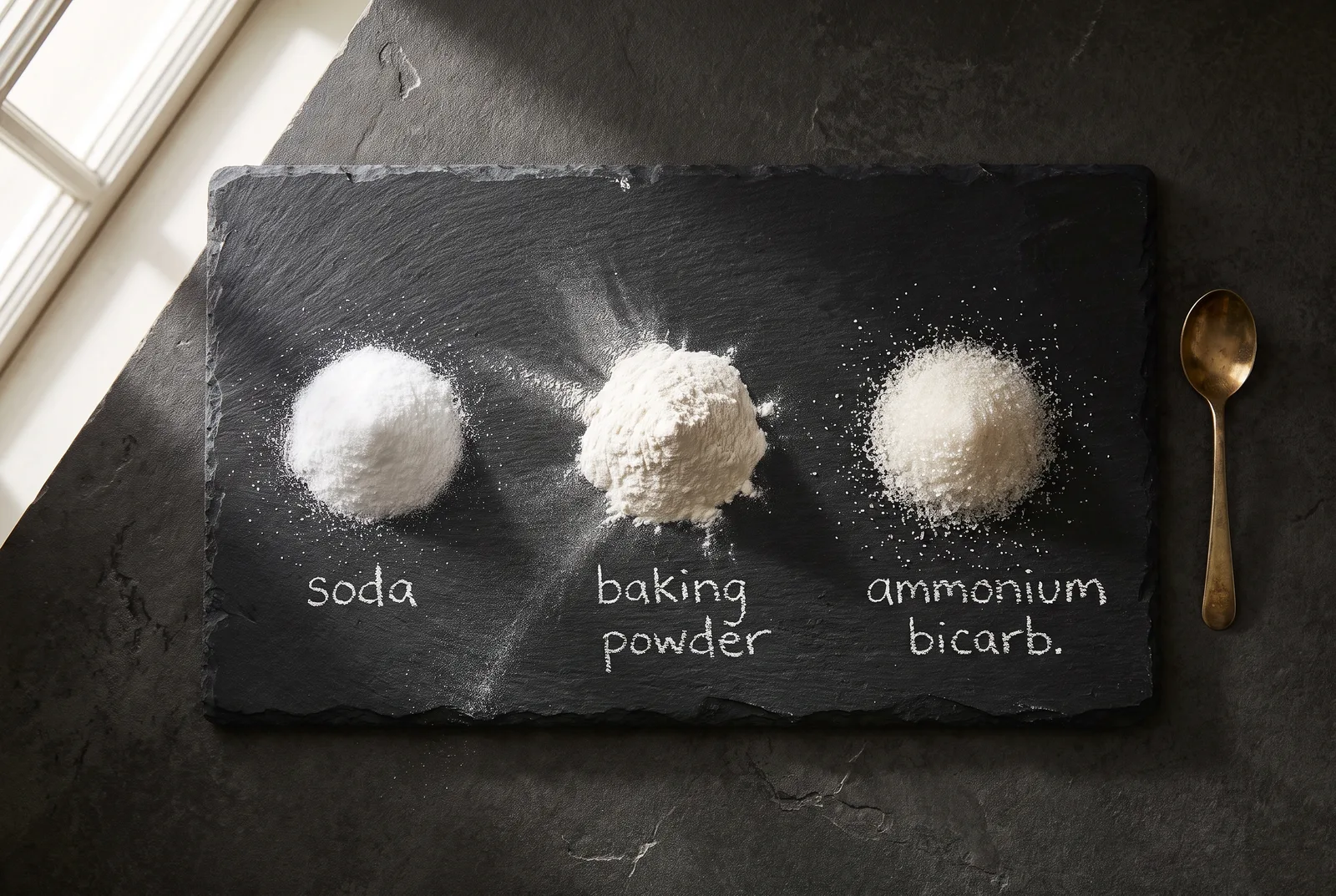
Chemical Leaveners: Baking Soda, Baking Powder, Ammonium Bicarbonate & Choosing the Right Acid
Chemical leavening is the fastest and most controllable way to introduce lift into baked goods without fermentation. Three ingredients dominate: baking soda (sodium bicarbonate / E500ii), baking powder (a pre-balanced mixture), and ammonium bicarbonate (baker's ammonia / E503ii). Understanding how each works, and when to use which, is a core competency for any professional baker.
1. How Chemical Leavening Works
All three agents release carbon dioxide (CO2) gas when they react or decompose. CO2 expands existing air bubbles that were incorporated during mixing or creaming, stretching the batter's structure until the heat of the oven sets it permanently.
The key difference between the three agents lies in how and when they release gas:
| Agent | Gas source | Trigger | Residue |
|---|---|---|---|
| Baking soda (NaHCO3) | CO2 from acid-base reaction | Acid + moisture | Salt + water |
| Baking powder | CO2 from built-in acid-base system | Moisture (Stage 1) + heat (Stage 2) | Salt + water |
| Ammonium bicarbonate | CO2 + NH3 from thermal decomposition | Heat (onset ~36°C; complete above ~60°C) | None (fully volatile) |
2. Baking Soda (Sodium Bicarbonate / E500ii)
What it is
Sodium bicarbonate is a white crystalline powder, purity minimum 99.3% NaHCO3 per the Bowika Bicarbonate of Soda specification (G23024, Annex 3.27, Version 8, 10.07.2025). It is sold in the Domson catalogue as Bicarbonate of Soda 5 kg (SKU G23024), produced in Turkey.
The reaction
Baking soda is a base. On its own in the oven, it undergoes partial thermal decomposition:
2 NaHCO3 → Na2CO3 + CO2 + H2O
The sodium carbonate (Na2CO3) residue left behind is strongly alkaline and produces a bitter, soapy or metallic aftertaste. This is why baking soda almost always requires an acid partner in the recipe.
When an acid is present, the reaction is complete and flavour-neutral:
NaHCO3 + acid → CO2 + H2O + neutral salt
Acid partners
Any recipe acid will activate baking soda. Common partners include buttermilk, yogurt, sour cream, natural (non-alkalized) cocoa powder, lemon juice, vinegar, cream of tartar (E336), treacle, molasses, and honey. See the comparison table below for reaction speeds and applications.
Important note on cocoa: only natural (Dutching-free) cocoa is acidic enough to activate baking soda. Dutch-processed (alkalized) cocoa has a neutral-to-alkaline pH and will not reliably activate the soda. If using Dutch cocoa, switch to baking powder or add cream of tartar as an explicit acid.
Dosage
Baking soda is considerably more concentrated than baking powder — often quoted as approximately 3–4× stronger by weight. This multiplier is a practical rule of thumb rather than a precise analytical figure (single-source, confidence: low ); actual ratio depends on the specific baking powder formulation.
- Typical inclusion: 0.3–1.0% of flour weight when paired with a recipe acid.
- Do not exceed ~1% without verifying that sufficient acid is present in the recipe — excess soda leaves the alkaline residue noted above.
Storage and shelf life
The Bowika specification states a shelf life of 24 months from production stored at max 30°C / max 75% RH. Baking soda has a significantly longer shelf life than baking powder because there is no pre-mixed acid to begin reacting prematurely.
Allergen and safety profile
Per the Bowika spec: no allergens present in the ingredients. Cross-contamination risk from gluten is present during production and storage at the Bowika facility; nuts, celery, mustard, and sesame cross-contamination risk exists during storage. Verify the batch certificate for each delivery. The regulatory salt figure per EU Regulation 1169/2011 is 68.42 g per 100 g (= sodium 27.37 g × 2.5) — food safety flag: this high sodium figure is mandated by the calculation method; actual sodium contribution to a finished product is small given the low inclusion rates used in recipes.
3. Baking Powder
What it is
Baking powder is a pre-balanced mixture of baking soda + one or more acid salts + a starch filler. The starch (typically wheat starch or maize starch) serves as an anti-caking agent and absorbs moisture to prevent premature reaction during storage.
The Domson catalogue carries two baking powder products with full spec sheets:
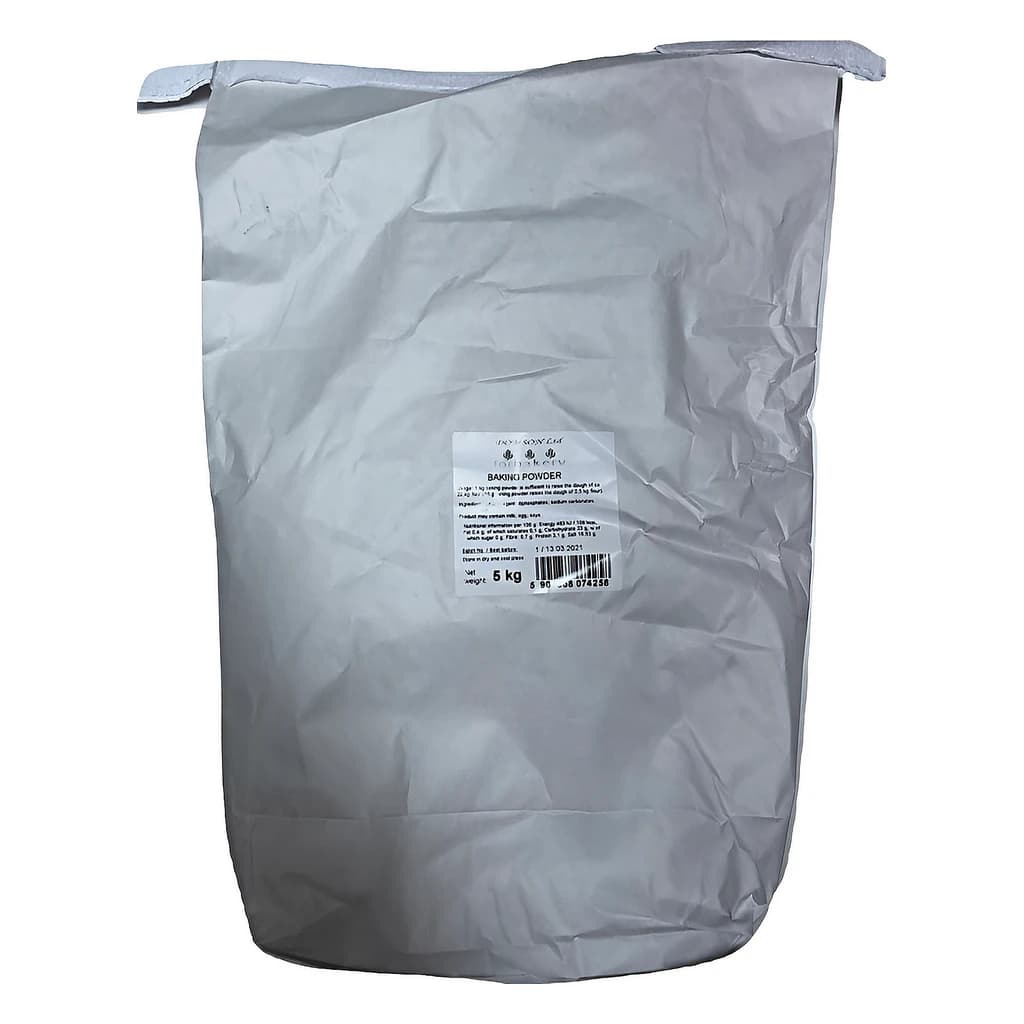
- Baking Powder 5 kg (SKU G22077) — Bowika (Poland). Ingredients: E500ii (sodium hydrogen carbonate) + E450i (disodium diphosphate) + wheat flour.
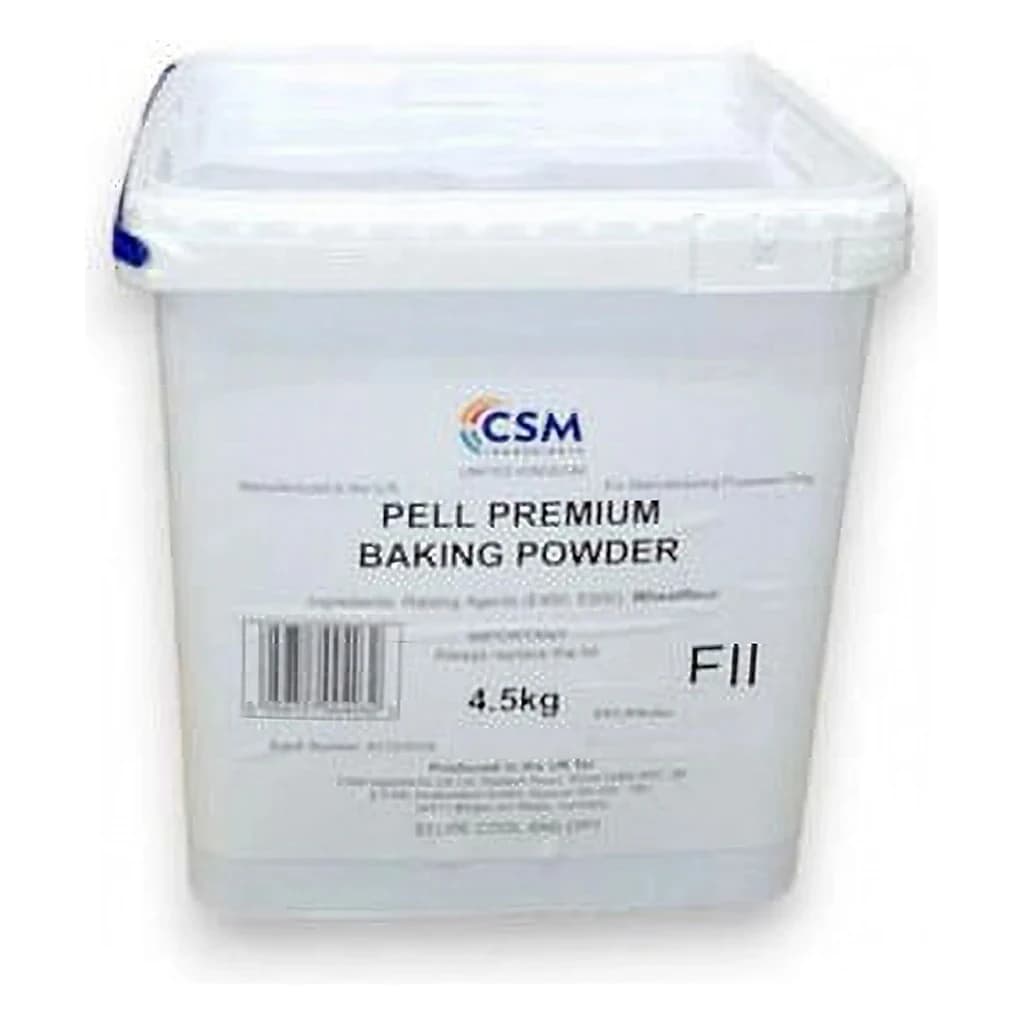
- CSM Pell Premium Baking Powder 4.5 kg (SKU G45684) — CSM Ingredients (UK). Ingredients: diphosphates (E450i), sodium carbonates (E500ii), WHEAT FLOUR (fortified with calcium carbonate, iron, niacin, thiamine).
Both are double-acting baking powders using diphosphate (SAPP / E450i) as the slow heat-activated acid. The starch carrier in the CSM product is fortified wheat flour, contributing minor amounts of calcium and B vitamins.
The double-acting mechanism
Double-acting baking powder releases CO2 in two separate stages:
Stage 1 — Cold / mixing temperature: The fast-acting acid (MCP or cream of tartar) reacts with baking soda in the presence of moisture as soon as the wet and dry ingredients are combined. This provides initial aeration — typically around 30% of the total CO2. The batter must be baked promptly after mixing to preserve this gas.
Stage 2 — Oven heat above ~60°C: The slow acid (SAPP / disodium diphosphate, E450i — the acid in both Bowika and CSM products) activates when the oven heat is applied, releasing the majority of the CO2. This gives the characteristic "oven spring" that sets the final crumb structure.
This two-stage release provides better volume, more uniform cell structure, and greater tolerance to slight variations in mixing time compared to single-acting systems.
CO2 yield
The CSM Pell Premium specification reports a CO2 content of 17.5–18.5% by weight. The Bowika specification reports phosphate (as P2O5) of 18.02–18.45% m/m — a quality-control measure on the acid component rather than a direct CO2 figure. The CSM CO2 figure is from a first-party spec sheet (single-source); it is broadly consistent with trade understanding of commercial baking powder performance, but the Campden BRI figure cited elsewhere in earlier research could not be independently confirmed from a publicly accessible source.
Dosage
Bowika spec: Suggested dosage is 1 kg baking powder per 32 kg flour = 3.125% flour weight. This sits within the standard trade-reference range of 2–4% for cakes and sponges. King Arthur Professional reference gives 1–2% as a starting point for lighter applications. For heavier batters (fruit cakes, dense muffin mixes) 3–4% may be appropriate.
Formula (see the formula card below):
baking_powder_g = flour_weight_kg × 31.25 Example: 10 kg flour → 312.5 g baking powder (3.125%)
Phosphate and EU regulatory status
Both products contain E450i (disodium diphosphate / SAPP) as the leavening acid. In 2019, EFSA re-evaluated phosphate additives and set an Acceptable Daily Intake (ADI) of 40 mg phosphate/kg body weight/day (as phosphorus). This is relevant in high-volume production where baking powder is used across multiple product lines. The Bowika phosphate specification (18.02–18.45% P2O5) provides the quality control anchor.
Note on SALP: Sodium aluminium phosphate (SALP / E541), the slow acid used in many US baking powders, is not permitted as a leavening acid in commercial baking powder in the EU or UK. While E541 exists in the EU food additive list, its permitted uses are extremely narrow (limited to scones and sponge cakes with jelly or jam filling at max 0.4 g/kg) and it is not approved for use in standard baking powder formulations. Do not source US-formulated baking powders for EU/UK production without verifying that SALP is absent. Both Bowika and CSM products use SAPP (E450i) instead, which is EU-compliant.
Shelf life
- Bowika Baking Powder: 9 months from production; stored max 25°C / 75% RH (short-term storage above 25°C to max 40°C is permitted for up to 3 months).
- CSM Pell Premium: 365 days from production; stored below 25°C, cool and dry.
The shorter shelf life of baking powder compared to baking soda reflects the risk of slow acid-base reaction within the bag if moisture is absorbed during storage.
Allergen and safety profile
Both catalogue baking powders contain wheat flour — GLUTEN allergen is present in the ingredients. Neither product is suitable for coeliac or wheat-free formulations.
The CSM Pell Premium spec additionally lists wheat allergen on the production line and in the factory. The Bowika spec lists gluten cross-contamination in production and storage, plus possible cross-contamination with nuts, peanuts, celery, mustard, and sesame seeds during storage (from other products handled in the same facility).
The CSM spec also reports aluminium maximum 200 mg/kg — a contaminant carried over from the diphosphate raw material, reported here as a raw-material quality specification (not an EU regulatory limit). Food safety flag: No specific EU maximum contaminant limit exists for aluminium in baking powder (as of mid-2026). EFSA's tolerable weekly intake for aluminium is 1 mg/kg body weight/week; at normal baking powder inclusion rates the aluminium contribution is a small fraction of this, but cumulative dietary aluminium should be considered in high-volume production.
4. Ammonium Bicarbonate (Baker's Ammonia / E503ii)
What it is
Ammonium bicarbonate (NH4HCO3) is a white granular powder, historically called hartshorn or baker's ammonia. The Domson catalogue carries Ammonium Bicarbonate 5 kg (SKU G23047), but no spec sheet is currently available in the product-spec module — baker should request the supplier's technical data sheet for dosage and allergen specifics.
How it works
Ammonium bicarbonate is thermally unstable. Decomposition begins at approximately 36–40°C and is effectively complete above 60°C:
NH4HCO3 → NH3 (gas) + CO2 (gas) + H2O (vapour)
Important: partial decomposition begins well below baking temperatures (onset ~36°C). Store in sealed, cool conditions; do not leave product open in warm bakery environments or CO2 and NH3 will be lost before use.
The reaction leaves no residue whatsoever — all decomposition products are volatile gases. This is the key advantage over baking soda and baking powder: no salt residue, no starch filler, no off-flavour. The CO2 and ammonia bubbles together provide exceptional lift and a characteristic crispness in thin baked goods.
The critical constraint: moisture
The NH3 gas produced must be able to escape from the product during baking. In thin, dry goods (crackers, biscuits, wafers, speculaas, Dutch/German spiced cookies, thin gingerbread), NH3 volatilises freely and leaves no trace of ammonia flavour in the finished product.
In moist or thick products (cakes, muffins, breads, anything with significant residual moisture), NH3 is retained in the crumb and produces a sharp ammonia off-odour that does not bake out. Do not use ammonium bicarbonate in moist products.
Applications in this platform's customer base
Ammonium bicarbonate is particularly relevant for:
- Polish piernik (gingerbread) — thin varieties traditionally use hartshorn for crispness
- Speculaas / Dutch/Belgian spiced biscuits — characteristic crisp snap
- German Lebkuchen (lower-moisture varieties)
- Crackers and wafer sheets
- Industrial biscuit production where maximum lift and crispness are required
Dosage
No spec sheet is available in this catalogue. Trade references cite 0.5–2% flour weight for biscuit and cracker production. Verify with the supplier's technical data sheet for SKU G23047 before formulating.
Regulatory status
Ammonium bicarbonate is approved as food additive E503ii in the EU under Regulation (EC) No 1333/2008, permitted quantum satis in bakery products. No specific maximum limit; usage is governed by good manufacturing practice and the technical need.
5. Choosing the Right Leavener
| Decision point | Guidance |
|---|---|
| Recipe contains a natural acid (buttermilk, yogurt, natural cocoa, vinegar, lemon, treacle) | Use baking soda as the primary leavener. Acid and soda react immediately — mix and bake without delay. |
| Recipe has no acid, or uses Dutch/alkalized cocoa | Use baking powder (self-contained acid-base system). No recipe adjustment needed. |
| Product is thin and dry (cracker, biscuit, wafer, thin gingerbread) | Consider ammonium bicarbonate for superior lift, crispness, and zero residual flavour. Confirm final product moisture is low enough for NH3 to escape. |
| Consistency and repeatability over multiple batches | Prefer baking powder — it is a pre-balanced, quality-controlled mixture that eliminates the variable of recipe acid strength. |
| Coeliac / gluten-free formulation | Use pure baking soda alone (with a recipe acid). Do NOT use the wheat-flour-based baking powders in this catalogue (G22077, G45684) — both contain gluten. Source a certified gluten-free baking powder instead. |
| Halal / Kosher certified requirement | CSM Pell Premium (G45684) carries both Halal (certified) and Kosher (certified) declarations. Verify current certification status with CSM before including in certified product lines. |
| Vegan formulation | All three leaveners are vegan-suitable. CSM Pell Premium is declared vegan-suitable on its spec sheet. |
6. Dosage Quick Reference
| Leavener | Typical baker's % (flour weight) | Source |
|---|---|---|
| Baking soda (with recipe acid) | 0.3–1.0% | |
| Baking powder (Bowika spec) | 3.125% (1 kg per 32 kg flour); trade range 2–4% | |
| Baking powder (King Arthur guidance, lighter products) | 1–2% | |
| Ammonium bicarbonate (biscuit/cracker) | 0.5–2% | — no catalogue spec sheet; verify with supplier |
Substitution: To replace 1 tsp baking powder with baking soda: use approx ¼ tsp baking soda and add an acid to the recipe (e.g. ½ tsp cream of tartar or 1 tbsp buttermilk). Conversely, replacing 1 tsp baking soda requires 3–4 tsp baking powder while removing the recipe acid — though this significantly increases phosphate and sodium load.
7. Faults and Troubleshooting
See the fault table below for the full cause-and-remedy guide. The most common faults are:
Flat, dense crumb — leavener expired or moisture-damaged, or underdosed. Test baking powder potency: dissolve 1 tsp in hot water; vigorous bubbling confirms it is still active.
Coarse cells and sunken centre — overdosed leavener, or batter held too long after mixing (CO2 escaped before oven). Bake promptly after mixing; reduce dosage to spec range.
Soapy/metallic aftertaste — excess baking soda relative to acid, leaving residual Na2CO3. Reduce soda, increase recipe acid, or switch to baking powder.
Yellow tinge in vanilla or lemon cakes — alkalinity from excess baking soda causes browning shift. Reduce soda, balance acid.
Ammonia off-odour — ammonium bicarbonate used in too-moist a product. Switch to baking powder, or extend bake time / reduce product thickness.
Inconsistent batch-to-batch rise — natural acid in recipe is variable (dairy source, cocoa brand). Switch to baking powder for repeatability.
8. Storage and Handling Summary
| Product | Shelf life | Temperature | Humidity | Key risk |
|---|---|---|---|---|
| Bicarbonate of Soda 5 kg (G23024) | 24 months | max 30°C | max 75% | Moisture absorption; gluten cross-contamination during production/storage |
| Baking Powder 5 kg (G22077) | 9 months | max 25°C (40°C/3 months) | max 75% | Premature acid-base reaction if moisture ingress; gluten allergen present |
| CSM Pell Premium 4.5 kg (G45684) | 12 months (365 days) | below 25°C | cool/dry | Premature reaction; gluten allergen; aluminium max 200 mg/kg |
| Ammonium Bicarbonate 5 kg (G23047) | No spec sheet — verify with supplier | Cool and dry recommended | Low humidity | Premature decomposition if warm/humid; NH3 odour in moist products |
Coverage and Confidence Notes
Solid: All numeric specs for the three spec-sheeted products (G22077, G23024, G45684) are from first-party supplier documents. Dosage, shelf life, allergen status, and phosphate content are directly from spec sheets. EFSA ADI for phosphates confirmed from the EFSA 2019 opinion (DOI 10.2903/j.efsa.2019.5674). SAPP (E450i) regulatory status confirmed as EU-compliant.
Corrected from earlier draft:
- SALP regulatory status: corrected from "not approved as a food additive in the EU" to "not permitted as a general-purpose leavening acid in baking powder in the EU/UK" (E541 has a valid EU number but is approved only in very narrow product categories at 0.4 g/kg max).
- Ammonium bicarbonate decomposition onset: clarified from "above ~60°C" to "onset ~36°C; complete above ~60°C".
- Aluminium figure in CSM spec (200 mg/kg): clarified as raw-material quality specification, not an EU regulatory limit.
- EFSA source DOI corrected: was 5669 (plant viruses — wrong paper); now 5674 (phosphate re-evaluation — correct).
- CO2 yield cross-check: Campden BRI corroboration removed as the cited URL is a services page without accessible CO2 data; the 17.5–18.5% figure remains as single-source (CSM spec sheet).
Thin / single-source: The 3–4× strength multiplier (baking soda vs baking powder) is widely cited but single-source in this research — treat as indicative. Ammonium bicarbonate dosage figures (0.5–2%) are from trade references only; no first-party spec sheet for G23047.
Follow-up needed: Request supplier technical data sheet for Ammonium Bicarbonate G23047. Verify CSM and Bowika certifications (Kosher/Halal) are current before including in certified product documentation. Obtain CSM packaging image directly from CSM Ingredients.
Figures
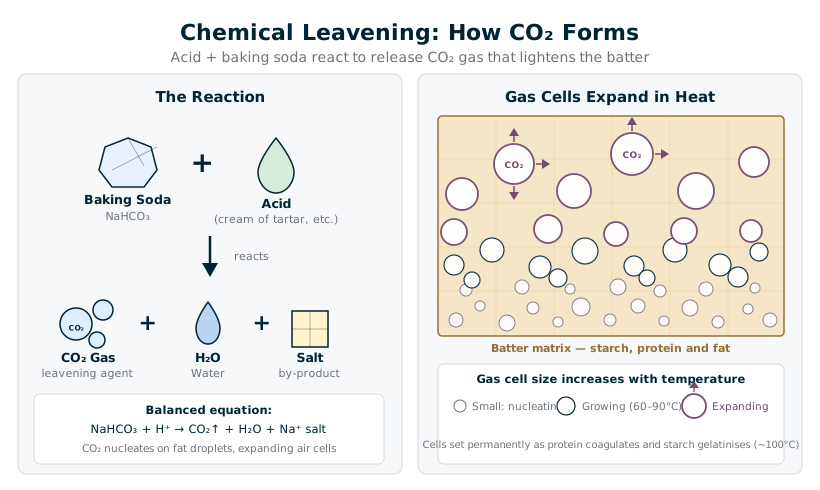 Diagram of the baking soda acid reaction producing carbon dioxide bubbles that expand a cake batter
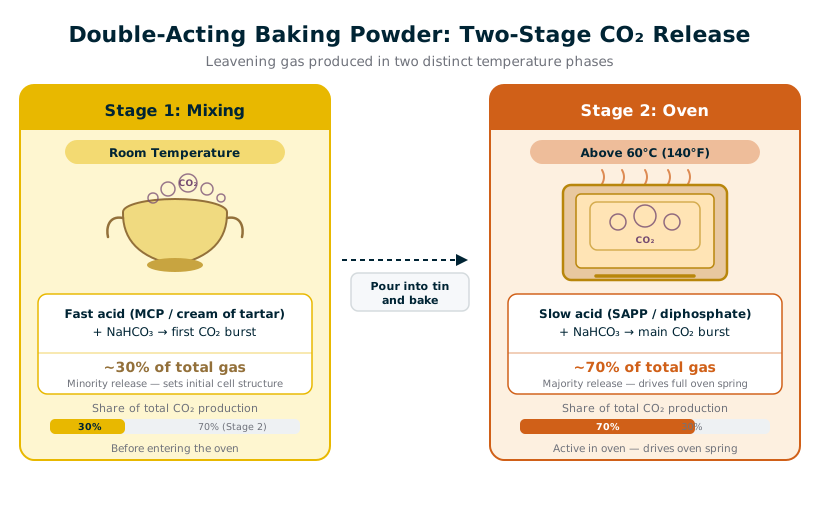 Two-stage CO2 release timeline for double-acting baking powder: cold stage at mixing, hot stage in oven
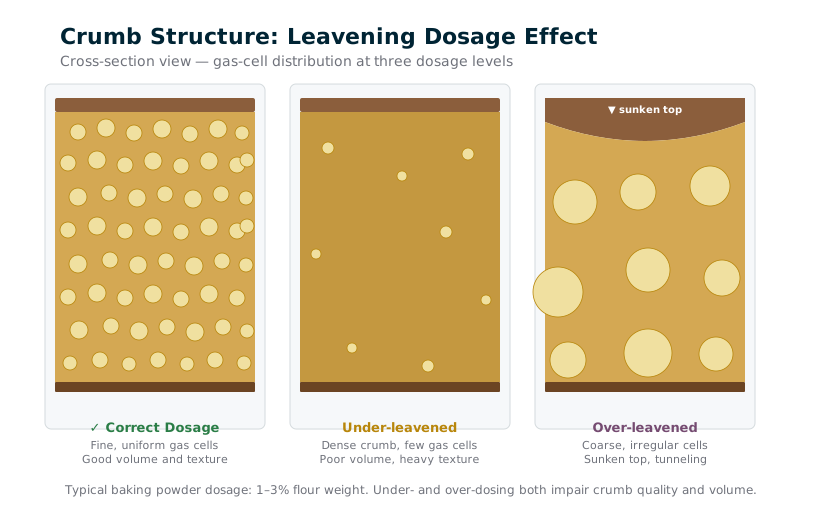 Three cake crumb cross-sections illustrating correct leavening, under-leavening and over-leavening
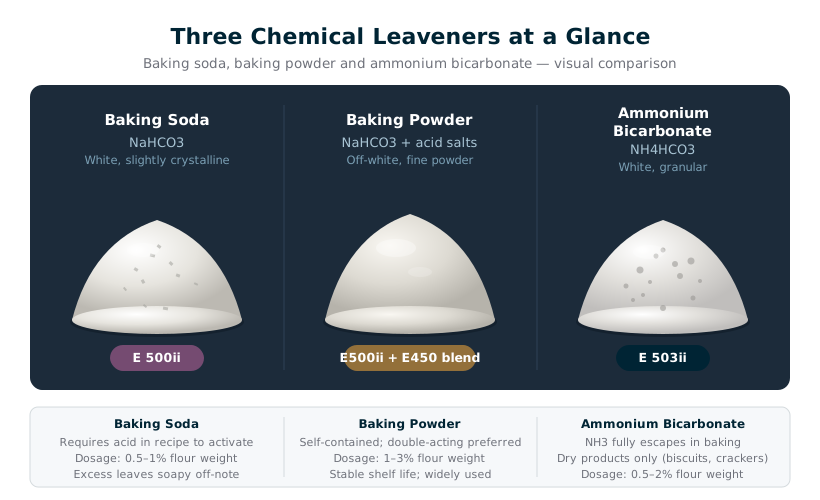 Three mounds of chemical leaveners side by side: baking soda, baking powder and ammonium bicarbonate, labelled
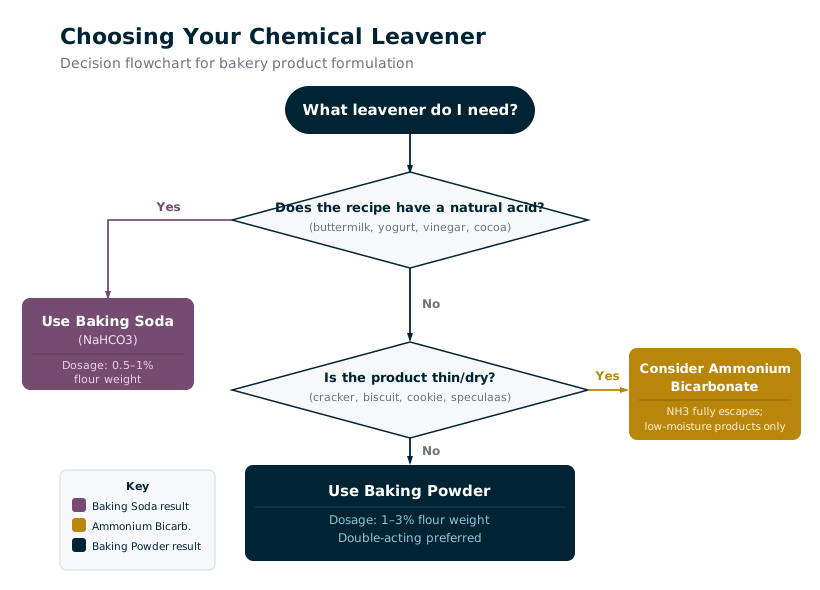 Decision flowchart for selecting the correct chemical leavener for a bakery product
Baking Soda — Dosage formula
Rule-of-thumb dosage for sodium bicarbonate used with a natural acid in the recipe.
bicarb_g = flour_weight_kg × bicarb_percent × 10
Worked example
| Scenario | Buttermilk scones — 5 kg flour, 0.5% bicarb |
| Calculation | 5 × 0.5% × 1000 = 25 g baking soda |
| Notes | Pair with acid ingredient; verify pH of final batter is neutral (no excess alkalinity) |
Baking Powder — Dosage formula (Bowika spec)
Supplier-stated dosage from the Bowika Baking Powder specification sheet (G22077), with trade-body context.
baking_powder_g = flour_weight_kg × 31.25
Worked example
| Scenario | Sponge cake — 10 kg flour |
| Calculation | 10 kg × 31.25 = 312.5 g baking powder |
| Baker percent | 3.125% |
Substitution — Baking Powder for Baking Soda (and vice versa)
Conversion ratios when one leavener must substitute for the other. Based on relative CO2 yield. Note: substitution changes flavour profile and may require recipe acid adjustment.
| 1 tsp baking powder | ~1/4 tsp baking soda + add acid to recipe (e.g. 1/2 tsp cream of tartar or 1 tbsp buttermilk per 1/4 tsp soda) — 1:0.25 (baking powder to soda, by weight) |
| 1 tsp baking soda | 3–4 tsp baking powder (remove or reduce recipe acid) — 1:3 to 1:4 (soda to baking powder, by weight) — High baking powder dosage needed to substitute soda significantly increases sodium and phosphate load — check regulatory compliance and flavour |
Ammonium Bicarbonate — Usage and decomposition
Ammonium bicarbonate decomposes entirely above approximately 60°C. No starch filler or acid is needed. Key constraint: only suitable for thin, dry, low-moisture baked goods.
NH4HCO3 → NH3 (gas) + CO2 (gas) + H2O (vapour) — onset ~36°C; effectively complete above ~60°C
| Typical dosage | 0.5–2% flour weight in biscuit/cracker production (no spec sheet in catalogue; verify with supplier) |
| Residue | None — fully volatile decomposition. Advantageous for clean crumb and extra crispness. |
| Moisture constraint | Use only where final product moisture is low enough for NH3 to escape during baking (crackers, biscuits, wafers, thin gingerbread). In moist products, NH3 is retained → sharp ammonia off-odour and off-taste. |
Core technical properties of the three main chemical leaveners. Numeric values are from first-party spec sheets (Bowika, CSM) and cross-checked against BAKERpedia and Kansas State University Extension. Where sources disagree on exact dosage ranges, both are shown with the source named.
| Property | Baking Soda (NaHCO3 / E500ii) | Baking Powder (double-acting) | Ammonium Bicarbonate (E503ii) |
|---|---|---|---|
| Common name / E-number | Sodium bicarbonate; E500ii | Mixture (no single E-number; contains E500ii + acid salt E450i or E336) | Baker's ammonia / hartshorn; E503ii |
| Purity / composition | Min 99.3% NaHCO3 (spec sheet); sodium min 27% | Approx 28% baking soda + ~55% acid salt + ~17% starch filler (BAKERpedia); actual CO2 yield 17.5–18.5% (CSM spec); phosphate as P2O5 18.02–18.45% (Bowika spec) | NH4HCO3; no spec sheet in this catalogue — EU E503ii approved |
| How CO2 is generated | Acid + NaHCO3 → CO2 + H2O + salt. Requires an external acid in recipe. Without acid: NaHCO3 → Na2CO3 + CO2 + H2O (alkaline off-note results). | Stage 1 (cold/mixing): fast acid (MCP or cream of tartar) + NaHCO3 → CO2. Stage 2 (oven heat above 60°C): slow acid (SAPP/diphosphate) + NaHCO3 → CO2. Both stages required for full lift. | NH4HCO3 → NH3 + CO2 + H2O. Onset of decomposition ~36°C; effectively complete above ~60°C. Completely self-contained; no acid needed. Store sealed in cool conditions to prevent premature gas loss. Both ammonia and CO2 are volatile and dissipate entirely from thin dry goods. |
| Relative leavening power | Approx 3–4× stronger by weight than baking powder (King Arthur / BAKERpedia; single-source multiplier — treat as indicative) | Baseline (1×); self-balanced mixture | Comparable to baking soda in thin-product applications; volume advantage from dual gas (CO2 + NH3) |
| Typical dosage (baker's % of flour weight) | 0.3–1.0% flour weight when paired with recipe acid; or 0.5–1% in mixed acid recipes | Supplier spec: 1 kg per 32 kg flour = 3.125% flour weight (Bowika); trade guidance: 1–3% flour weight; retail equivalent ~1–2 tsp per cup flour (~4–8%). Both sources indicate a practical range of 2–4% in industrial use. | Typically 0.5–2% flour weight in crackers, biscuits, cookies — no on-catalogue spec sheet; use manufacturer data sheet |
| Acid partners / formulation notes | Buttermilk, yogurt, natural cocoa, vinegar, lemon juice, cream of tartar, treacle/brown sugar (molasses), honey | Acids built in — no external acid needed. EU products: typically SAPP (E450i) + MCP or cream of tartar. SALP (sodium aluminium phosphate / E541) is not permitted as a general-purpose leavening acid in EU/UK baking powder — only narrowly approved for specific product types at very low levels. Verify absence in any imported baking powder. | No external acid required. Do not combine with baking soda or baking powder (additive ammonia gas release). |
| Flavour impact | Neutral when properly balanced with acid. Excess → soapy, metallic, bitter aftertaste from residual Na2CO3. | Slight mineral/chalky note at high dosages. Modern double-acting systems are flavour-clean at recommended levels. | Zero residual flavour in thin/dry products (NH3 fully escapes). Avoid in moist thick products — residual NH3 produces sharp ammonia off-note. |
| Product suitability | Quick breads, soda bread, muffins, pancakes, waffles, scones, chocolate cake (with natural cocoa), gingerbread, honey cake, flat bread | Cakes, sponges, scones, muffins, cake mixes, batters, dumpling dough, pastry, self-raising flour blends | Crackers, biscuits, speculaas, Dutch/German spiced cookies, wafers, thin-style gingerbread (piernik), flatbreads. NOT suitable for thick cakes, muffins, bread. |
| Shelf life (pure ingredient) | 24 months from production (Bowika spec); store max 30°C, max 75% RH | 9 months (Bowika spec) / 12 months (CSM spec) from production; store max 25°C, max 75% RH. Shelf life shorter than pure bicarb because moisture-activated reactions begin slowly during storage. | Typically 12–24 months sealed; store cool and dry — no on-catalogue spec; handle carefully (volatile at room temperature if exposed) |
| Allergen status | No allergens in ingredients (Bowika spec). Cross-contamination risk (gluten, nuts, celery, mustard, sesame) during storage — check batch declaration. | Contains WHEAT FLOUR — GLUTEN allergen declared in ingredients (both Bowika and CSM specs). Not suitable for coeliac diet. Cross-contamination risks (nuts, peanuts) during storage. | No allergen data (no spec sheet in catalogue). Typically allergen-free in pure form — verify with supplier batch certificate. |
| EU/UK regulatory status | E500ii — permitted quantum satis in most food categories (Reg. EC 1333/2008) | Constituent acids individually regulated: E450i (diphosphate) subject to ADI 40 mg phosphate/kg body weight (EFSA 2019 re-evaluation). SALP (E541) not permitted as a general-purpose leavening acid in EU/UK baking powder — only allowed in very narrow product categories (scones with jelly/jam filling) at 0.4 g/kg max. | E503ii — permitted quantum satis in bakery (Reg. EC 1333/2008) |
Natural and synthetic acids that react with sodium bicarbonate. Reaction speed classification is from BAKERpedia and confirmed by Kansas State University sources. Practical baking application column draws on industry references.
| Acid source | Type | Reaction speed | Typical baking application | Notes |
|---|---|---|---|---|
| Cream of tartar (potassium bitartrate / E336) | Synthetic salt | Fast (cold) | Scones, shortbread, some sponge cakes | Clean flavour; used in gluten-free and clean-label baking powders; EU-approved |
| Monocalcium phosphate / MCP (E341i) | Synthetic salt | Fast (cold): approx 30% of CO2 released at room temperature | Cake mixes, self-raising flour, baking powder blends | Primary fast acid in most commercial baking powders; EU-approved |
| Sodium acid pyrophosphate / SAPP (E450i) | Synthetic salt | Delayed / slow (heat-activated above ~45–60°C) | Cake mixes, doughnuts, baking powder double-acting systems | Dominant slow acid in EU and UK baking powder; subject to EFSA ADI phosphate limit; contributes to bitterness at overdosage |
| Sodium aluminium phosphate / SALP (E541) | Synthetic salt | Slow (heat-activated) | Double-acting baking powder in USA | NOT permitted as a leavening acid in commercial baking powder in the EU or UK. E541 has an EU food additive number but its permitted uses are extremely narrow (scones and sponge cakes with jelly/jam filling only, max 0.4 g/kg). European baking powders for general use must use SAPP (E450i) instead. Do not use US-sourced baking powder in EU/UK finished goods without verifying SALP absence. |
| Buttermilk | Natural dairy | Fast (cold, lactic acid reacts immediately with baking soda) | Soda bread, pancakes, scones, muffins | Traditional acid partner; contributes flavour and tenderness |
| Yogurt / sour cream | Natural dairy | Fast | Muffins, quick breads, layer cakes | pH-dependent; full-fat yogurt typically pH 3.8–4.4 |
| Natural (non-alkalized) cocoa powder | Natural plant | Moderate | Chocolate cake, brownies | pH ~5.0–6.0; Dutch-processed (alkalized) cocoa is NOT acidic and will not activate baking soda |
| Brown sugar / treacle / molasses | Natural plant | Slow | Gingerbread, honey cake, dark cookies | Weak acid contribution only; usually combined with another acid |
| Vinegar / lemon juice | Natural plant | Very fast (strong acid — acetic/citric) | Vegan egg-replacement activation, red velvet (historical) | Vigorous reaction — mix quickly and bake immediately; not suitable for delayed bake |
Practical troubleshooting guide for professional bakers. Causes and remedies are drawn from BAKERpedia, Kansas State University, and Canadian Baker references.
| Fault observed | Most likely cause | Leavener involved | Remedy |
|---|---|---|---|
| Flat/dense crumb — insufficient rise | Under-dosing; expired leavener (CO2 capacity degraded); insufficient mixing to distribute leavener; incorrect storage (moisture absorbed leavener prematurely) | Baking powder or baking soda | Check expiry/shelf life (baking powder 9–12 months, bicarb 24 months). Test potency: 1 tsp in hot water — vigorous bubbling = active. Increase dosage within spec range. Ensure product stored dry (max 75% RH). Check mixing technique. |
| Coarse, open crumb with large holes; sunken centre | Over-dosing baking powder or baking soda; batter overmixed after leavener added (CO2 escapes before baking) | Baking powder; baking soda | Reduce leavener to recommended dosage. Fold batter minimally after dry ingredients are added. Bake immediately after mixing. |
| Bitter, metallic or soapy aftertaste | Excess baking soda relative to acid — residual sodium carbonate (Na2CO3). Also excess SAPP (phosphate) from over-dosed baking powder. | Baking soda (excess) or baking powder (high SAPP formulation at overdose) | Reduce baking soda and/or increase recipe acid. Cross-check acid level. If using baking powder, reduce to spec dosage. Consider switching acid type. |
| Yellow or greenish tinge in light-coloured cakes (vanilla, lemon) | Excess baking soda → alkaline environment; alkalinity reacts with anthocyanin pigments in flour (minor) and causes Maillard browning shift | Baking soda | Reduce baking soda to minimum required; balance with acid. Switch to baking powder for neutral-flavour products. |
| Ammonia off-odour in biscuits or cookies | Ammonium bicarbonate used in a product that retains too much moisture — NH3 cannot fully escape | Ammonium bicarbonate | Switch to baking powder for moist products. If ammonium bicarbonate is needed for texture/crispness, extend bake time or reduce product thickness to allow complete NH3 volatilisation. Bake internal temperature must reach >60°C throughout. |
| Caking / clumping of baking powder during storage | Moisture ingress above 75% RH — starch filler absorbs moisture and acid-base reaction begins in the bag | Baking powder | Store strictly sealed and dry. Bowika spec: max 25°C / 75% RH (max 40°C for 3 months). CSM spec: cool and dry below 25°C. Discard clumped product that has lost CO2 capacity. |
| Inconsistent rise between batches | Variable mixing temperature affecting double-acting baking powder Stage 1 release; inconsistent acid level in recipe (e.g. variability in buttermilk pH or cocoa type) | Baking powder + baking soda with natural acid | Standardise mixing temperature. Use consistent supplier for dairy/acid ingredients. Switch to baking powder alone (self-contained system) for batch repeatability. |
- Product:
- Bicarbonate of Soda 5 kg (G23024)
- Supplier:
- Bowika Sp. z o.o. Sp. k.
- Sku:
- G23024
- Purity min percent:
- 99.3
- Sodium min percent:
- 27
- Sodium carbonate max percent:
- 0.5
- pH 1pct solution max:
- 8.5
- Loss on drying max percent:
- 0.25
- Country of origin:
- Turkey
- EU number:
- E500ii
- Shelf life months:
- 24
- Storage max temp C:
- 30
- Storage max RH percent:
- 75
- Allergens in ingredients:
- None
- Cross contamination gluten during production:
- YES
- Heavy metals mg per kg · Hg max:
- 0.1
- Heavy metals mg per kg · Fe max:
- 6
- Heavy metals mg per kg · Pb max:
- 2
- Heavy metals mg per kg · Cu max:
- 1
- Heavy metals mg per kg · As max:
- 1
- Heavy metals mg per kg · Cd max:
- 0.5
- Micro · Salmonella:
- absent in 25 g
- Micro · Enterobacteria max cfu g:
- 100
- Micro · Yeasts moulds max cfu g:
- 1000
- Nutrition per 100g · Energy kJ:
- 0
- Nutrition per 100g · Energy kcal:
- 0
- Nutrition per 100g · Fat g:
- 0
- Nutrition per 100g · Carbohydrate g:
- 0
- Nutrition per 100g · Protein g:
- 0
- Nutrition per 100g · Salt g regulatory:
- 68.42
- Nutrition per 100g · Note:
- Salt calculated as Na × 2.5; sodium content 27.37 g per 100 g NaHCO3
- Product:
- Baking Powder 5 kg (G22077)
- Supplier:
- Bowika Sp. z o.o. Sp. k.
- Sku:
- G22077
- Ingredients:
- E500ii (sodium hydrogen carbonate), E450i (disodium diphosphate), wheat flour
- Phosphate as P2O5 percent range:
- 18.02–18.45
- Colour:
- white to light yellow
- Shelf life months:
- 9
- Storage max temp C:
- 25
- Storage extended 3months max C:
- 40
- Storage max RH percent:
- 75
- Suggested dosage ratio:
- 1 kg per 32 kg flour (3.125% flour weight)
- Allergens in ingredients:
- GLUTEN (wheat flour)
- Micro · Salmonella:
- absent in 25 g
- Micro · E coli:
- absent in 1 g
- Nutrition per 100g · Energy kJ:
- 538
- Nutrition per 100g · Energy kcal:
- 127
- Nutrition per 100g · Fat g:
- 0
- Nutrition per 100g · Carbohydrate g:
- 26
- Nutrition per 100g · Sugars g:
- 0.7
- Nutrition per 100g · Fibre g:
- 0.7
- Nutrition per 100g · Protein g:
- 4.8
- Nutrition per 100g · Salt g regulatory:
- 41.1
- Nutrition per 100g · Note:
- Calculated values from supplier recipe/literature — not analytically measured averages
- Product:
- CSM Pell Premium Baking Powder 4.5 kg (G45684)
- Supplier:
- CSM Ingredients
- Sku:
- G45684
- Country of origin:
- United Kingdom
- Ingredients:
- diphosphates (E450i), sodium carbonates (E500ii), WHEAT FLOUR, calcium carbonate, iron, niacin, thiamine
- CO2 content interval percent:
- 17.5–18.5
- Colour:
- Off White
- Structure:
- Fine, free-flowing powder
- EU numbers:
- E450i, E500ii
- Shelf life days:
- 365
- Storage max temp C:
- 25
- Transport temp range C:
- 15–20
- Certifications:
- Kosher (certified), Halal (certified), Vegan-suitable
- Not suitable for:
- coeliac diet
- Allergens in product:
- Wheat (gluten)
- Allergens on production line:
- Wheat (gluten)
- Allergens in factory:
- Wheat (gluten)
- Contaminant limits · Aluminium max mg per kg:
- 200
- Contaminant limits · Fluoride max mg per kg:
- 10
- Micro · Total viable count max per g:
- 100
- Micro · E coli max per g:
- 10
- Micro · Moulds max per g:
- 100
- Micro · Yeasts max per g:
- 100
- Micro · Salmonella:
- not detectable in 25 g
- Nutrition per 100g · Energy kJ:
- 289
- Nutrition per 100g · Energy kcal:
- 69
- Nutrition per 100g · Fat g:
- 0.3
- Nutrition per 100g · Carbohydrate g:
- 15.6
- Nutrition per 100g · Of which starch g:
- 15.4
- Nutrition per 100g · Protein g:
- 1.7
- Nutrition per 100g · Salt g regulatory:
- 48.7
- Nutrition per 100g · Sodium mg:
- 19200
- Nutrition per 100g · Mineral substance ash mg:
- 65000
Buy the ingredients
Catalogue products and brands referenced in this article.