
From grain to bag: how wheat is milled and what extraction rate means
Every flour bag begins as a living grain of wheat. This article explains the anatomy of that grain — endosperm, bran and germ — and follows the journey through tempering, break rolls, sifting and reduction rolls to finished flour. You will understand what extraction rate actually measures, why the T-type number on a flour bag encodes its ash content, and how to choose the right type number for each product in your bakery. Spec-sheet data from thirteen Domson catalogue flours is used throughout as a concrete reference.
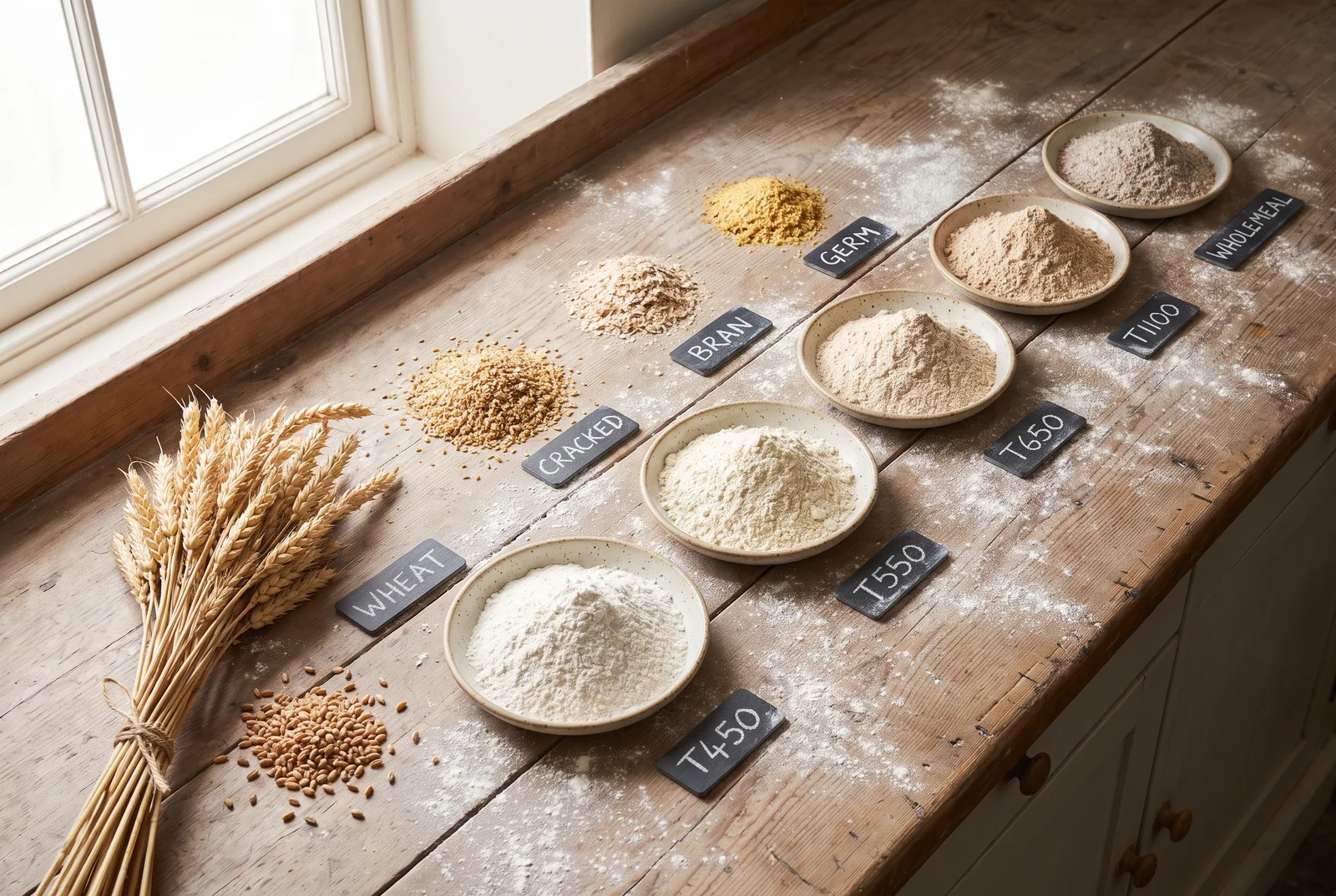
Introduction: flour starts as a living grain
Before a flour bag lands in your storeroom, the contents went through one of the most precise industrial separation processes in food manufacturing. Modern roller milling can split a single grain of wheat into more than twenty distinct streams, each with different protein content, ash content, and colour — then blend them back to exact specification.
Understanding that journey — from grain anatomy to extraction rate to T-type number — will change how you read a spec sheet, how you order flour, and how you troubleshoot inconsistencies in production. This article builds the foundation. The companion article Reading the flour spec sheet covers the tests used to verify quality.
1. Anatomy of the wheat grain
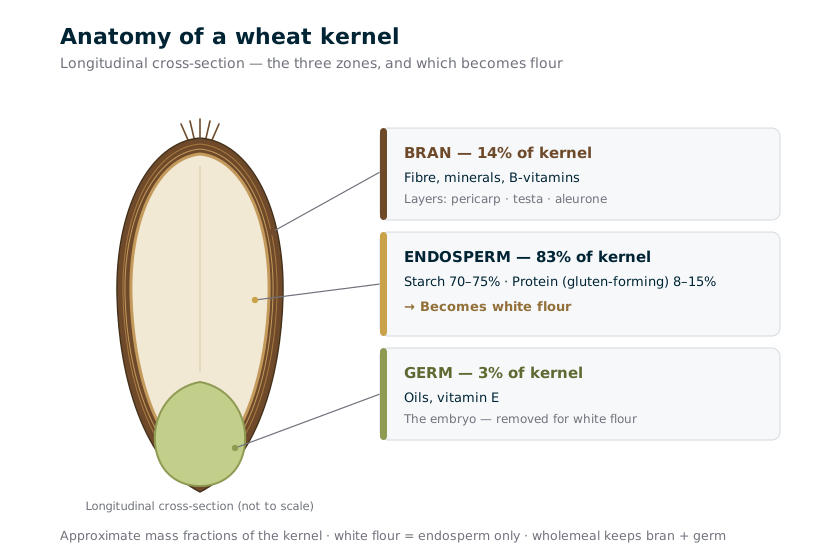 Annotated cross-section of a wheat kernel. The outer bran layers are shown in brown, the large pale interior endosperm in cream, and the small germ at the base highlighted in yellow. Labels indicate approximate mass percentages: endosperm 83%, bran 14%, germ 3%.
A wheat kernel is not uniform. It is three anatomically and chemically distinct zones, each of which has a different role in baking.
1.1 Endosperm — the flour zone
The starchy endosperm makes up approximately 83% of the kernel by weight. It contains:
- Starch: approximately 70–75% of its dry weight — the carbohydrate substrate that ferments under yeast and gelatinises in the oven to set bread structure.
- Protein: approximately 8–15% — specifically the storage proteins gliadin and glutenin, which combine with water and mechanical work to form the gluten network.
- Minor amounts of fat, moisture, and enzymes.
The inner endosperm (furthest from the bran) is the palest, starchiest, and lowest in protein. The outer endosperm, closest to the bran, is richer in protein. This is why high-extraction flours tend to have both more ash and more protein than low-extraction patent flours — they include more of the outer endosperm layers.
1.2 Bran — the fibre zone
The bran layers — pericarp, testa, and aleurone cell layer — make up approximately 14% of the kernel. The bran is rich in:
- Dietary fibre (arabinoxylan, cellulose, beta-glucan in the aleurone)
- Minerals (phosphates, potassium, magnesium — these are the ash measured in the T-type system)
- B-vitamins (thiamin, riboflavin, niacin — concentrated in the aleurone layer)
- Phytic acid — reduces mineral bioavailability, though sourdough fermentation partially degrades it
The aleurone is a single-cell-thick layer at the boundary between bran and endosperm. It is biochemically active and contains much of the grain's B-vitamin reserves. Because of its position, it may partially blend into the flour during stone milling, giving stoneground flour a different nutritional character than roller-milled flour of the same T-type.
Bran's effect on gluten: Even small quantities of bran particles in flour physically cut the gluten network during mixing. This is why high-extraction flours tend to produce denser, more open crumbs than white flour — the bran interrupts gluten strand formation. In practice, you can compensate by mixing slightly longer, increasing hydration, or adding a small quantity of vital wheat gluten.
1.3 Germ — the fat zone
The embryo (germ) makes up approximately 3% of the kernel. It contains:
- Unsaturated fats (~10% of germ weight) — provides flavour but causes rancidity in storage
- Vitamin E (tocopherol) — a natural antioxidant
- B-vitamins and various enzymes, including lipases
Modern roller mills deliberately flatten and sieve out the germ to prevent rancidity — this is why white flour lasts 5 months while stone-ground wholemeal is typically sold with a 3–6 month shelf life. The Doves Farm BIOBAKE Organic Strong Wholemeal uses a roller mill (stated on spec sheet) and achieves a 6-month shelf life by limiting oil-bearing germ fragments.
2. The milling process
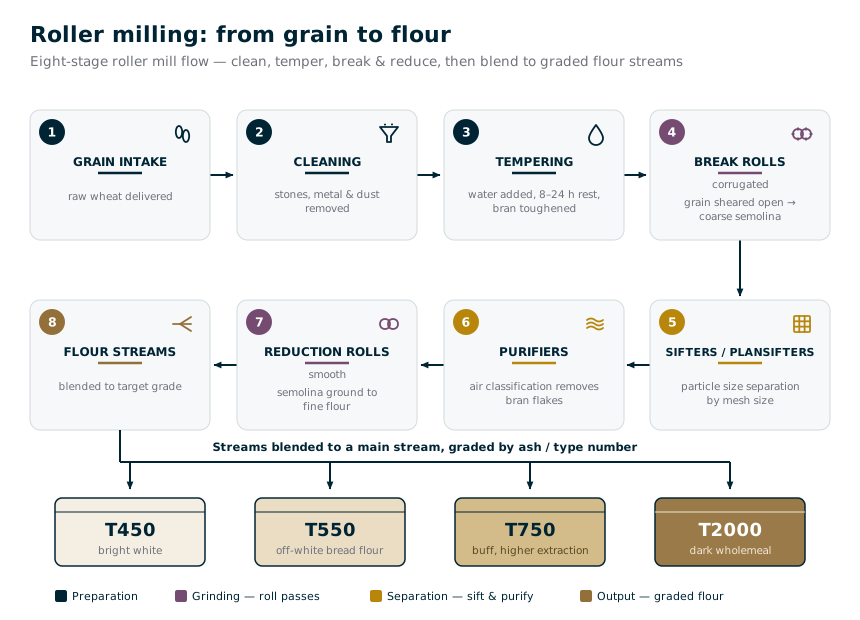 Flow diagram of roller mill wheat milling. Steps from left to right: grain intake, cleaning (stoning, aspiration, scouring), tempering (water addition + rest), first break rolls, sifting/purification, successive break and reduction rolls, multiple flour streams collected into a main stream.
2.1 Cleaning
Incoming wheat is cleaned mechanically before any milling begins. Stoning removes rocks and dense impurities; aspiration removes dust and light chaff; magnetic separators remove metal. This is why the spec sheets for all reviewed products specify inorganic impurity content as zero (niedopuszczalna/none).
2.2 Tempering (conditioning)
Cleaned wheat is wetted with water and rested for 8–24 hours before milling. Tempering serves two purposes:
- Toughens the bran — hydrated bran becomes leathery and flexible, allowing the break rolls to shear it open without grinding it into powder that would contaminate the flour.
- Softens the endosperm — moist starch grinds more easily to a fine powder with lower energy input.
The moisture added in tempering is one reason why flour specification sheets set a maximum moisture of 15% rather than specifying the exact post-tempering level — the miller controls this to achieve clean separation, not to a fixed number.
2.3 Break rolls — opening the grain
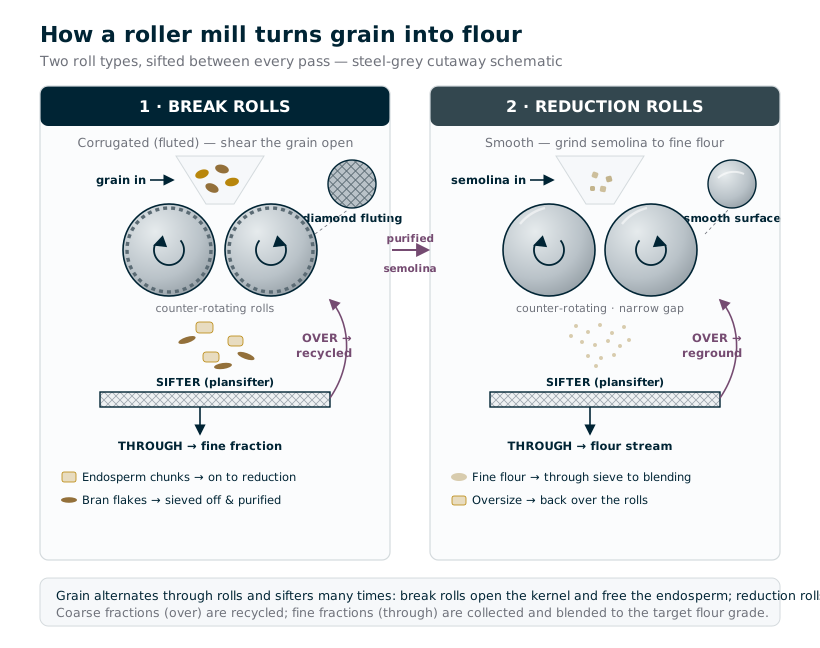 Technical cutaway diagram of a roller mill showing two pairs of steel rolls. Left pair: corrugated (fluted) break rolls with grain entering at the top and coarse particles exiting at the bottom. Right pair: smooth reduction rolls converting semolina particles to fine flour. Arrows show the particle flow path. Sieve is shown below each roll pair.
The tempered wheat first passes between pairs of corrugated (fluted) break rolls running at different speeds. The speed differential creates a shearing action that tears the grain open lengthwise along the crease, releasing endosperm as coarse semolina while leaving the bran as large flakes.
Typically 4–5 break roll passes progressively extract endosperm from the bran and germ. After each pass, the material passes through a plansifter (vibrating sieve stacks) that separates particles by size.
2.4 Purification and reduction
The coarse semolina particles (endosperm chunks) separated by the plansifter are fed to purifiers — air classifiers that blow light bran-contaminated particles off the surface of semolina streams. This produces clean semolina for the next stage.
The purified semolina then passes through smooth reduction rolls that progressively grind it to fine flour. Each reduction pass grinds the particles finer; sifting follows each pass. The result is a series of flour streams with slightly different characteristics — earlier (purer) streams have lower ash and higher starch; later streams progressively include more from the outer endosperm and any residual bran.
2.5 Flour streams and blending
A commercial roller mill may produce 20 or more distinct flour streams. These are analysed for ash content, protein, and colour, then blended to hit a target specification — typically an ash range corresponding to a specific T-type. The miller does not simply take all streams and mix them; the blend recipe is adjusted seasonally as the wheat supply changes.
What this means for bakers: Two bags of T550 from the same mill but different harvest years may require slightly different hydration. The spec sheet sets the minimum/maximum guardrails; the mill targets a typical value within that window. This is why GoodMills specifies ash as a range (0.51–0.58%) rather than a single number — the range reflects blending precision across seasons, not poor quality control.
3. Extraction rate — the single most important milling concept
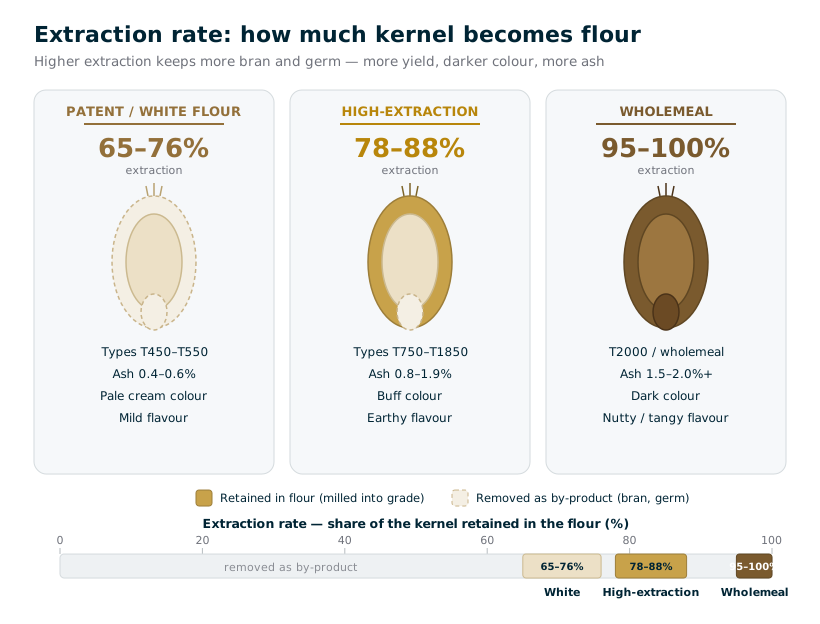 Diagram comparing extraction rates. Left panel: a wheat kernel cross-section with only the endosperm shaded (72–78% of grain), labelled 'WHITE FLOUR: 72–78% extraction — ash ~0.4–0.6%'. Right panel: entire kernel shaded, labelled 'WHOLEMEAL: ~100% extraction — ash ~1.5–2.0%'. A middle panel shows partial extraction for T750/T850.
Extraction rate is defined as the mass of flour produced per 100 kg of cleaned wheat grain input, expressed as a percentage.
Extraction rate (%) = (kg of flour produced / kg of clean wheat) × 100
3.1 What different extraction rates produce
Standard white flour is produced at approximately 72–78% extraction. At this level, most of the bran and germ have been removed, and the flour is composed almost entirely of endosperm material.
A small fraction of the grain — bran, germ, and the coarser endosperm particles that resist fine grinding — goes to by-products: bran for animal feed or fibre supplements, and germ for oil pressing.
Wholemeal or whole-grain flour at approximately 95–100% extraction retains everything — endosperm, bran, and germ are all ground together and remain in the flour. Nothing is sieved away.
In between lies a continuous spectrum. A T750 flour at approximately 78–82% extraction retains slightly more of the outer endosperm and some fine bran particles compared to T550, giving it more colour, more fibre, and more mineral content.
3.2 The flour fraction taxonomy
Three traditional terms describe different extraction levels within the milling process:
| Term | What it means | Approx. extraction | Ash approx. |
|---|---|---|---|
| Patent flour | Purest fraction — centre of endosperm only; first, cleanest streams | 40–60% | 0.3–0.45% |
| Straight flour | All flour streams combined (standard commercial white flour) | 72–78% | 0.4–0.65% |
| Clear flour | Dark residual streams after patent flour removed; high in protein and ash | Residual fraction | 0.7–1.5%+ |
In the Polish and European T-type system, white bread flour (T550) corresponds approximately to straight flour; T450 is closer to a strong patent grade. Clear flour is rarely sold directly but is used in rye bread and some speciality dark breads where the darker colour and stronger flavour are desired.
4. The T-type system — ash encodes extraction rate
The insight that makes the T-type system elegant is that ash content directly reflects how much bran is in the flour — and bran mineral content is consistent enough that a single ash measurement captures the extraction level accurately.
The Polish (and broadly European) convention: the type number equals the ash content in milligrams per 100 grams of dry flour.
- T450 = approximately 450 mg ash / 100 g dry flour = approximately 0.45% ash
- T550 = approximately 550 mg ash / 100 g dry flour = approximately 0.55% ash
- T750 = approximately 750 mg ash / 100 g dry flour = approximately 0.75% ash
- T2000 = approximately 2000 mg ash / 100 g dry flour = approximately 2.0% ash
The spec sheets confirm this directly: GoodMills T550 specifies ash 0.51–0.58% d.m.; the Wągrowiec Mill T450 specifies ash max 0.48% d.m.
4.1 What rising ash content means in the bakery
As extraction rises and ash rises, three things happen simultaneously:
-
Colour darkens — from brilliant white (T450) to buff (T750–T850) to grey-brown (T2000 wholemeal rye).
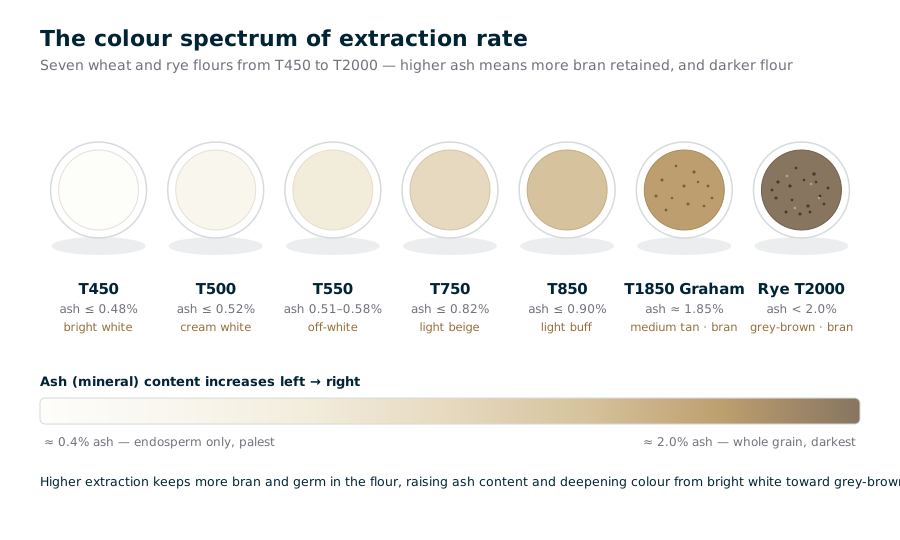 Seven flour samples in white ceramic ramekins arranged in a row from left to right. Left: T450 bright white. T500 cream-white. T550 off-white. T750 light buff. T850 buff with slight brown specks. T1850 Graham tan with bran. T2000 Wholemeal Rye dark grey-brown with visible bran particles.
 -
Fibre increases — the bran fraction carries most of the grain's dietary fibre. The nutritional data from the Domson catalogue spec sheets confirms this: T450 has approximately 2.5g fibre/100g; T2000 wholemeal rye has 14.4g fibre/100g. (Values from nutritional information panels on spec sheets — typical values, not specification limits.)
-
Flavour intensifies — bran contributes earthy, nutty, and slightly bitter notes. This is desirable in rustic bread and sourdough but inappropriate in fine pastry or sponge cake.
4.2 International classification crosswalk
The T-type numbering convention is shared across Poland, France, and broadly across continental Europe — but boundary values differ between national systems. The table below is a comparative guide, not a precise equivalence:
| Polish T-type | French T-type | German Weizenmehl | Italian Tipo | Approx. use |
|---|---|---|---|---|
| T450 | T45 | W405 | Tipo 00 | Pastry, pasta |
| T500–T550 | T55–T65 | W550 | Tipo 0–1 | White bread, rolls |
| T750 | T80 | W812 | Tipo 1 | Rustic bread |
| T850–T1050 | T110 | W1050 | Tipo 2 | Brown bread |
| T1850 (Graham) | — | W1600 | Integrale | Wholegrain loaves |
| T2000 (Wholemeal rye) | — | — | — | Wholemeal rye |
Note (medium-reliability crosswalk): This table is drawn from trade literature. The French T-type and Polish T-type share the same convention; German and Italian systems use different exact boundaries. Use this table as a starting guide when substituting imported flour for a local grade — always verify the ash content on the incoming spec sheet rather than trusting the type number alone, since naming conventions between suppliers can vary.
5. Spec sheet data for Domson catalogue flours
The following parameters were read directly from supplier specification documents for thirteen products in the Domson catalogue. The complete side-by-side comparison is in the table below.
5.1 Wheat flours — Polish classification
Wheat Flour Type 450 (Wągrowiec Mill): ash max 0.48% d.m.; wet gluten min 23%; protein min 8.0%; Hagberg Falling Number min 220 s; moisture max 15%; shelf life 5 months; country of origin Poland. Allergen: GLUTEN.
Domson White Flour Type 500 (Wągrowiec Mill): ash max 0.52% d.m.; wet gluten min 23%; protein min 8.0%; FN min 220 s; moisture max 15%. Allergen: GLUTEN.
Domson Wheat Flour T550 — GoodMills Fortified (GoodMills Polska): ash 0.51– 0.58% d.m. (a range reflecting seasonal grain variation); wet gluten 28–32%; protein 11.5–12.5%; FN min 220 s; gluten index 75–99; moisture max 15%; storage at relative humidity max 75%. Fortification (voluntary, matching UK BFR 1998 levels): calcium carbonate 235–390 mg/100g, iron ≥ 1.65 mg/100g, thiamin ≥ 0.24 mg/100g, nicotinic acid ≥ 1.60 mg/100g.
FOOD SAFETY NOTE: The GoodMills T550 fortification matches UK Bread and Flour Regulations 1998 minimums. This fortification is VOLUNTARY in the Polish and EU context — it is NOT mandated by Polish or EU law for T550 flour. Do not assume other T550 products are fortified to the same levels. Allergen: GLUTEN.
Komplexmłyn Wheat Flour T550 (Wągrowiec Mill): ash max 0.58% d.m.; wet gluten min 25%; FN min 220 s. An alternative T550 option at a lower specified protein minimum — appropriate for standard production where cost per kg is a priority over the consistently high protein of the GoodMills fortified grade. Allergen: GLUTEN.
Domson Bread Flour Type 750 (Wągrowiec Mill): ash max 0.82% d.m.; wet gluten min 26%; protein min 10% (typical 11.6g/100g per nutritional panel); FN min 220 s; fibre 2.9g/100g. The higher ash brings deeper flavour suitable for rustic and artisan breads. Allergen: GLUTEN.
Wheat Flour Type 850 (Wągrowiec Mill): ash max 0.90% d.m.; wet gluten min 26%; FN min 220 s. A brown bread flour where the closer-to-bran extraction contributes colour and fibre without the weight of full wholemeal. Allergen: GLUTEN.
Graham Wheat Flour Type 1850 (GoodMills Polska): ash max 2.0% d.m.; FN min 180 s; moisture max 15%; protein 12.3g/100g (nutritional panel); fibre 12.3g/100g. The lower FN minimum (180 s vs 220 s for white wheat flour) reflects the practical reality that grain milled at such high extraction typically includes bran-associated amylase activity.
FOOD SAFETY NOTE: Graham T1850 spec sheet specifies GoodMills internal mycotoxin limits: aflatoxins B1 ≤ 2 µg/kg; total aflatoxins ≤ 4 µg/kg; ochratoxins ≤ 3 µg/kg; zearalenone ≤ 75 µg/kg; deoxynivalenol (DON) ≤ 750 µg/kg; ergot alkaloids ≤ 150 µg/kg. DON, ZON, aflatoxin, and ochratoxin limits match EU legal maxima (EC Reg 1881/2006 and amendments). The ergot alkaloid limit of 150 µg/kg is a GoodMills internal supplier limit — it is more conservative than the EU legal maximum of 500 µg/kg for cereal flour (EU Reg 2023/915); the EU legal maximum is NOT 150 µg/kg. Allergen: GLUTEN.
5.2 Rye flours
Rye Flour Type 720 (GoodMills Polska): ash max 0.78% d.m.; FN min 90 s (see note); moisture max 15%; colour white-grey; protein 6.5g/100g, fibre 7.4g/100g. This is the standard light rye flour for mixed-grain bread and rye rolls. Allergen: GLUTEN.
Wholemeal Rye Flour Type 2000 (GoodMills Polska): ash max 2.0% d.m.; FN min 90 s; moisture max 15%; colour white-grey with bran; protein 8.4g/100g, fibre 14.4g/100g — nearly twice the fibre of rye T720. Used for dense sourdough rye breads and pumpernickel. Allergen: GLUTEN.
Note on rye Falling Number: The GoodMills commercial specification floor of > 90 s is a minimum to exclude severely sprouted grain. Rye starch gelatinises at a lower temperature than wheat starch, and rye amylases are more heat-stable, so rye FN values are structurally lower than wheat FN values and cannot be compared on the same scale. For sourdough rye applications, a FN above 120 s is generally preferable to minimise sticky, collapsing crumb. Confirm with your GoodMills representative if rye FN is critical to your process.
5.3 UK wheat flours
Windrush Strong White Bread Flour (Matthews Cotswold Flour, 16 kg): protein 12.0–12.5% (target 12.2%); FN 250–400 s (target 350 s); water absorption 55–61% (target 58%); moisture 13.5–15%; fortified per UK Bread and Flour Regulations 1998 (Creta Plus chalk 0.31%, vital wheat gluten added < 1.5%). Origin: Germany or UK wheat. Allergen: GLUTEN (cereals containing gluten); potential soya contamination risk in supply chain (noted on spec sheet).
The Windrush Strong White falls squarely in the optimal breadmaking window for Falling Number (250–400 s, target 350 s) — a much tighter and higher target than the minimum-only Polish specifications. This reflects UK milling practice where premium bread flour is specified more tightly for consistent automated production.
5.4 Spelt flours
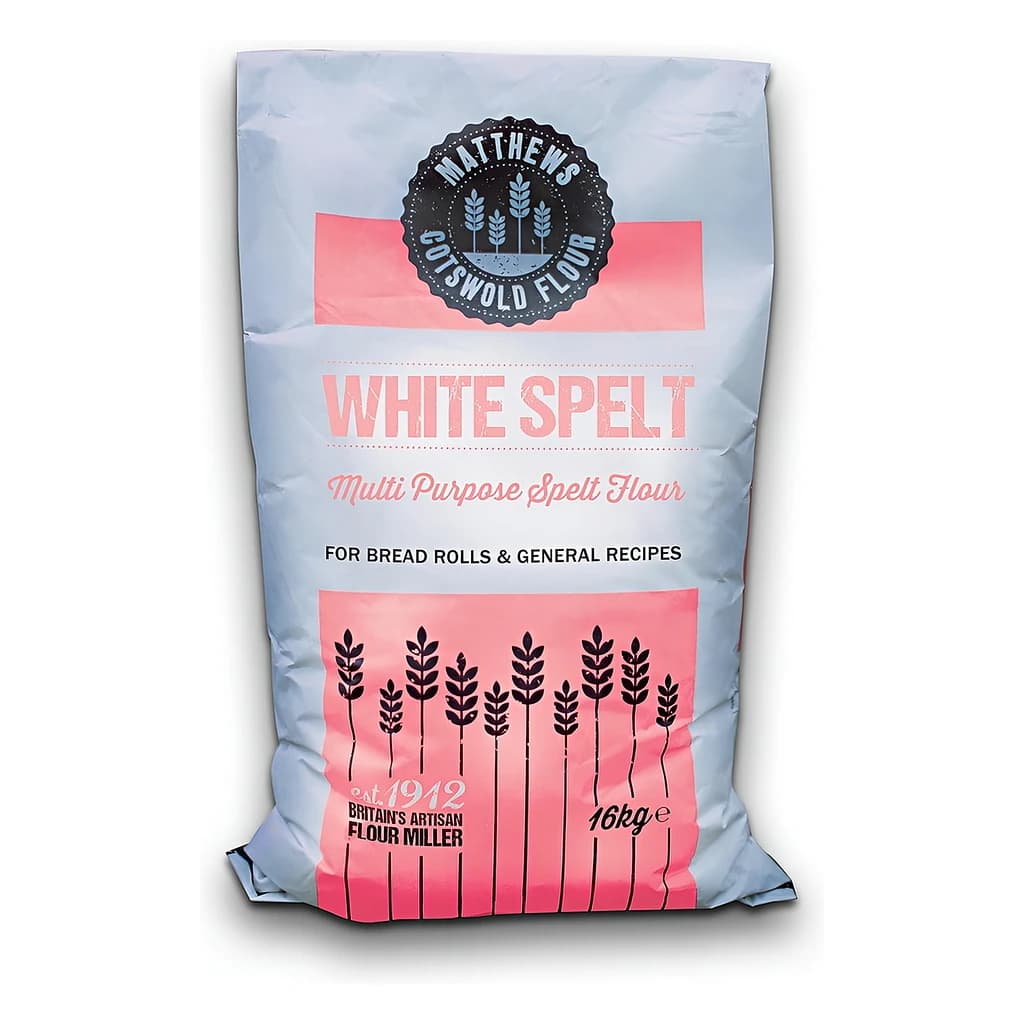
Stoneground White Spelt Flour (Matthews Cotswold Flour, 16 kg): protein 9.0–13.0% (target 11.0%); FN min 220 s; water absorption 53–65% (wide range — reflects spelt's variable and fragile gluten hydration); no additives; UK origin only. Allergen: GLUTEN (SPELT WHEAT).
FOOD SAFETY NOTE — ALLERGEN LABELLING: Both Matthews and Doves Farm spec sheets declare spelt as 'GLUTEN (SPELT WHEAT)', and all practical guidance is to declare spelt by name in ingredients lists with the allergen emphasis. However, the precise legal basis under EU Regulation 1169/2011 Annex II is nuanced: Annex II lists spelt parenthetically within the wheat category ('wheat (such as spelt...)') rather than as a separately enumerated entry. The practical labelling obligation — declare as 'SPELT WHEAT' or 'SPELT (WHEAT)' and emphasise the allergen — is the correct advice and is consistent with FSA guidance, but the article's reference to spelt being 'named separately' in Annex II should be verified by a food law specialist.
Wholemeal Spelt Flour (Doves Farm Foods, 25 kg): protein min 11.8% (range 11.8–17.0%); moisture 11.5–14.5%; stoneground; E.coli < 10/g; Salmonella absent. Allergen: GLUTEN (SPELT WHEAT).
5.5 Oat flour
Oat Flour (Agrol, 25 kg): moisture max 11% (tighter than wheat — oat lipids are at risk of rancidity at higher moisture); protein 13g/100g; fibre 10.3g/100g; fat 7.9g/100g (high compared to wheat flour — from oat lipids); colour grey-white; produced by hydrothermally treating and flaking oats then roll-grinding.
FOOD SAFETY NOTE — ALLERGEN: The Agrol Oat Flour spec sheet explicitly declares a gluten cross-contamination risk from the agricultural and processing environment. Oats are classified as a gluten-containing cereal under EU Regulation 1169/2011 and equivalent UK law. Do not use this flour in gluten-free products and declare GLUTEN on all downstream products containing this ingredient.
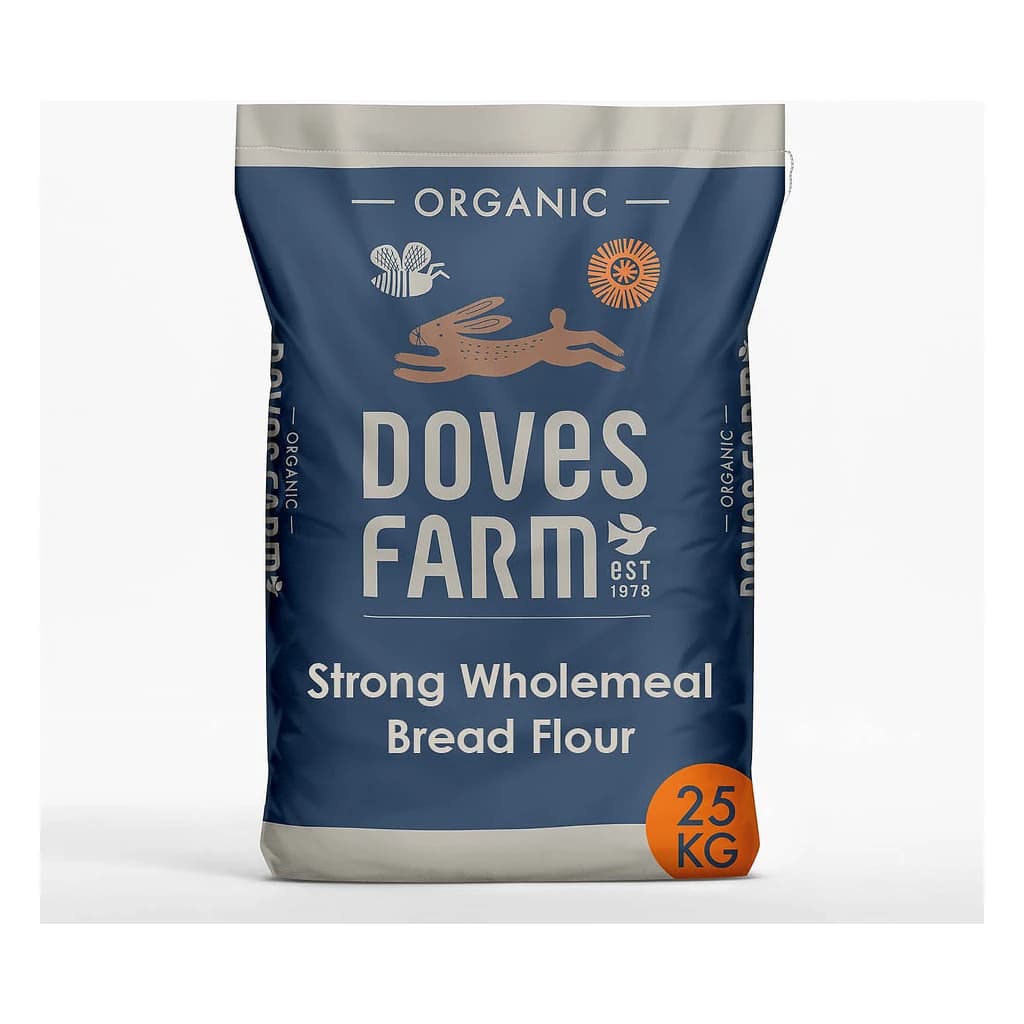
Organic Strong Wholemeal Bread Flour (Doves Farm Foods, 25 kg): protein 12.6g/100g; fibre 11.2g/100g; fat 2.5g/100g; energy 311 kcal/100g; roller milled; Soil Association and Kosher certified. Allergen: GLUTEN.
6. Roller milling versus stone milling
Both production methods appear in the Domson catalogue. Their practical differences for bakers are summarised in.
The essential distinction: roller milling achieves clean, controlled separation of bran and endosperm, giving very consistent colour and ash. Stone milling grinds everything together in a single pass, retaining germ oils and aleurone material, giving more complex flavour at the cost of shorter shelf life and more variable absorption.
The Matthews Stoneground White Spelt Flour and the Doves Farm Wholemeal Spelt Flour are stoneground (stated on their spec sheets). All GoodMills and Wągrowiec Mill flours are roller-milled; the Doves Farm BIOBAKE Organic Wholemeal is also roller-milled (stated on spec sheet).
7. Choosing the right flour type: a practical guide
7.1 Match the T-type to the product
| Product type | Recommended T-type | Key reason |
|---|---|---|
| Fine pastry, shortcrust, delicate sponge | T400–T450 | Neutral flavour; white colour; low fibre interference with fat/sugar structure |
| Layer cakes, all-purpose baking, soft rolls | T500 | Versatile; slight cream colour acceptable |
| White sandwich bread, pizza, rolls | T550 | Standard European white bread flour; GoodMills high-protein grade for sourdough |
| Rustic, artisan, sourdough breads | T750–T850 | More mineral flavour; extra protein in outer endosperm; better fermentation |
| Graham bread, wholegrain loaves | T1850 | Significant bran content — declare fibre on label; adjust hydration up 5–10% |
| 100% wholemeal bread, pumpernickel | T2000 (rye) | Full grain; dense; requires sourdough or long fermentation to manage texture |
| Mixed-grain and rye bread | Rye T720 + T550 blend | Light rye character without structural compromise; classic 60/40 or 80/20 blend |
7.2 Adjust hydration for T-type
Higher extraction flours absorb more water because bran particles absorb water at approximately 3–4 times the rate of pure endosperm starch. As a practical rule, every step up in T-type (e.g. T550 → T750) requires an increase of approximately 3–5% additional water in your recipe to maintain the same dough consistency. The GoodMills Graham T1850 nutritional spec (12.3g fibre, 2.0g fat, 12.3g protein per 100g) suggests substantially higher absorption than T550 — expect to add 8–12% more water compared to a T550 recipe baseline.
(Single-source absorption estimate from practitioner convention; verify with your specific flour and dough consistency target before committing to production.)
7.3 Fermentation considerations
Higher-extraction flours generally ferment more vigorously because:
- More minerals (from bran) support yeast activity and sourdough bacteria.
- More enzymes remain active (bran-associated lipases and amylases).
- Higher fibre can accelerate organic acid production in sourdough.
For sourdough production using T750 or T850, reduce bulk fermentation time by 10–20% compared to T550 baseline, or reduce dough temperature by 1–2°C to slow fermentation. Monitor the dough rather than relying on fixed timers.
8. What the spec sheet does not tell you
The spec sheets reviewed across thirteen products contain excellent primary data on ash, moisture, protein, wet gluten, and falling number. However, no Polish flour spec sheet in this set reports:
- Alveograph W and P/L values — dough strength and extensibility (standard in French and Italian milling; request from GoodMills or Wągrowiec Mill for automated line setup)
- Zeleny sedimentation index — gluten quality beyond protein quantity (useful for sourdough and high-hydration work; request from supplier)
- Farinograph DDT and stability — mixing time and dough tolerance (useful for setting mixer parameters; request from supplier)
- Starch damage % — relevant for high-absorption applications and rye specialities
These parameters are covered in the companion article Reading the flour spec sheet: ash content, Hagberg falling number, Zeleny, farinograph and alveograph. If any of them are critical to your process, request the supplementary technical data sheet from your supplier contact — most commercial mills have this data internally even if it is not printed on the standard spec sheet.
Coverage notes and gaps
Solid: Grain anatomy and roller milling process confirmed from two independent academic open-text sources plus UK Flour Millers trade body. Extraction rate and T-type ash relationship confirmed from three independent sources. Spec-sheet parameters (ash, moisture, FN, wet gluten, protein, allergens) extracted from thirteen supplier PDFs and cited at claim level.
Single-source figures (confidence: medium): Grain anatomy percentages (endosperm 83%, bran 14%, germ 3%) appear consistently in both academic sources but vary slightly by wheat variety. The 3–5% hydration adjustment per T-type step is practitioner convention; no independent numerical confirmation was available in sources read. Rye FN minimum 90 s (GoodMills spec floor) — academic literature suggests optimal baking FN is higher; present the floor as a minimum not a target.
Gap: No spec sheet in this set reports Zeleny, alveograph, or farinograph data — these are standard in French and Italian milling but not in the Polish market. Schedule the companion article A1-key-quality-parameters (already drafted) as the mandatory read for anyone needing those parameters.
Follow-up recommended: The GoodMills T550 fortification crosswalk to UK BFR 1998 was verified by comparing spec-sheet values to the UK Flour Millers publication. Consider confirming directly with GoodMills customer service whether this is a permanent standard or a batch-by-batch option, as the spec sheet notes seasonal variation.
Baker's percentage reference — flour as the base
In baker's percentage, flour always equals 100% regardless of recipe size. All other ingredients are expressed relative to total flour weight. When using blended flours (e.g. 80% T550 + 20% T750), the total flour weight remains the base.
Worked example
| Flour total | 1000g (100%) |
| Water | 680g (68%) |
| Salt | 20g (2%) |
| Yeast | 10g (1%) |
| Note | If using a blend: 800g T550 + 200g T750 = 1000g flour (100%). Each flour brings different absorption and flavour — adjust water by +5–10g if substituting T750 for T550. |
Extraction rate calculation
Extraction rate = (mass of flour produced / mass of clean wheat input) × 100. Used by millers to calculate yield and set pricing.
Worked example
| Formula | Extraction rate (%) = (kg flour out / kg clean wheat in) × 100 |
| Example calculation | 1000 kg clean wheat → 745 kg white flour → extraction rate = 74.5%. Remaining 255 kg = bran, germ, shorts, mill dust. |
| Note | A higher extraction rate means more flour per tonne of grain — lower cost per kg flour — but a darker, more flavourful product. There is no 'correct' extraction rate; it is determined by the T-type target. |
Ash content measured on dry-matter basis (% d.m.) by incineration at 550°C (ISO 2171 / PN-EN ISO 2171). The T-type number directly encodes ash in mg per 100 g dry flour: T550 = ~550 mg/100g = ~0.55% ash. Extraction rate figures are approximate industry estimates; spec-sheet confirmed values noted. French T-type equivalents are approximate crosswalks only.
| Type (Polish) | Approx. French equiv. | Approx. German equiv. | Approx. Italian equiv. | Ash % (d.m.) max | Approx. extraction rate | Typical colour | Primary baking use | Spec-sheet confirmed |
|---|---|---|---|---|---|---|---|---|
| T400–T450 | T45 | W405 | Tipo 00 | 0.48–0.50 | ~65–70% | Bright white | Fine pastry, pasta, shortcrust, semolina products | Yes — T450: max 0.48% |
| T500 | T55 | W405–W550 | Tipo 0 | 0.50–0.52 | ~70–73% | Cream-white | General pastry, layer cakes, sponges, light rolls | Yes — T500: max 0.52% |
| T550 | T55–T65 | W550 | Tipo 0–1 | 0.51–0.58 | ~72–76% | Off-white, slight cream | White sandwich bread, rolls, pizza, croissant dough | Yes — GoodMills: 0.51–0.58%; Komplexmłyn: max 0.58% |
| T750 | T80 | W812 | Tipo 1 | ~0.82 | ~78–82% | Light buff with trace bran | Rustic bread, semi-wholemeal loaves, hearth bread | Yes — max 0.82% |
| T850 | T110 | W1050 | Tipo 2 | ~0.90 | ~82–86% | Buff, visible bran flecks | Brown bread, high-fibre loaves | Yes — max 0.90% |
| T1850 (Graham) | — | W1600 | Integrale | ~1.85–2.0 | ~88–92% | Tan-brown with bran | Graham bread, high-bran loaves, wholegrain products | Yes — GoodMills Graham T1850: ash < 2.0%, FN > 180 s |
| T2000 (Wholemeal Rye) | — | — | — | < 2.0 | ~95–100% | Grey-brown with bran particles | Pumpernickel, dense rye loaves, sourdough rye | Yes — GoodMills Rye T2000: ash < 2.0%, FN > 90 s |
| Rye T720 | — | — | — | < 0.78 | ~70–76% | White-grey | Light rye bread, mixed-grain bread, rye rolls | Yes — GoodMills: ash < 0.78%, FN > 90 s |
Higher T-number = more bran fraction retained = darker colour, stronger flavour, more fibre. Rye T-types use the same ash-based numbering but rye starch and enzyme behaviour differs from wheat — do not compare rye and wheat falling number values directly. French T-types and Polish T-types share the same convention; German and Italian systems differ in exact boundary values but use the same direction (higher number = higher ash).
All parameters extracted directly from current supplier specification documents. Moisture limit is max 15% by PN-EN ISO 712 for all wheat and rye flours unless otherwise noted. Protein values marked * are from nutritional information panels (per 100g), not specification minima. — = not specified in the reviewed spec sheet.
| Product | Supplier / Mill | Ash % max (d.m.) | Wet gluten % min | Protein % (min or typical) | Falling number (s) | Gluten index | Water absorption % | Fibre g/100g* | Allergen |
|---|---|---|---|---|---|---|---|---|---|
| Wheat Flour T450 25 kg | Wągrowiec Mill | 0.48 | ≥ 23.0 | ≥ 8.0 | ≥ 220 | — | — | 2.5* | GLUTEN |
| Domson White Flour T500 25 kg | Wągrowiec Mill | 0.52 | ≥ 23.0 | ≥ 8.0 | ≥ 220 | — | — | 2.5* | GLUTEN |
| Domson Wheat Flour T550 (GoodMills Fortified) 25 kg | GoodMills Polska | 0.51–0.58 | 28–32 | 11.5–12.5 | ≥ 220 | 75–99 | — | — | GLUTEN |
| Komplexmłyn Wheat Flour T550 25 kg | Wągrowiec Mill | 0.58 | ≥ 25.0 | ≥ 8.0 | ≥ 220 | — | — | — | GLUTEN |
| Domson Bread Flour T750 25 kg | Wągrowiec Mill | 0.82 | ≥ 26.0 | ≥ 10.0 (typical 11.6*) | ≥ 220 | — | — | 2.9* | GLUTEN |
| Wheat Flour T850 25 kg | Wągrowiec Mill | 0.90 | ≥ 26.0 | — | ≥ 220 | — | — | — | GLUTEN |
| Graham Wheat Flour T1850 40 kg | GoodMills Polska | < 2.0 | — | 12.3* | > 180 | — | — | 12.3* | GLUTEN |
| Rye Flour T720 (20 kg / 25 kg) | GoodMills Polska | < 0.78 | — | 6.5* | > 90 | — | — | 7.4* | GLUTEN |
| Wholemeal Rye Flour T2000 40 kg | GoodMills Polska | < 2.0 | — | 8.4* | > 90 | — | — | 14.4* | GLUTEN |
| Oat Flour 25 kg | Agrol | — | — | 13.0* | — | — | — | 10.3* | GLUTEN (cross-contamination risk — see note) |
| Windrush Strong White Bread Flour 16 kg | Matthews Cotswold Flour | — | — | 12.0–12.5 (target 12.2) | 250–400 (target 350) | — | 55–61 (target 58) | — | GLUTEN |
| Stoneground White Spelt Flour 16 kg | Matthews Cotswold Flour | — | — | 9.0–13.0 (target 11.0) | ≥ 220 | — | 53–65 | 4.5* | GLUTEN (SPELT WHEAT) |
| Wholemeal Spelt Flour 25 kg | Doves Farm Foods | — | — | 11.8–17.0 (min 11.8) | — | — | — | 8.5* | GLUTEN (SPELT WHEAT) |
| Organic Strong Wholemeal Bread Flour 25 kg | Doves Farm Foods | — | — | 12.6* | — | — | — | 11.2* | GLUTEN |
FOOD SAFETY NOTE (ALLERGEN): All wheat, rye, spelt, and oat flours in this table contain GLUTEN or present a GLUTEN cross-contamination risk. Spelt must be declared separately as 'SPELT (WHEAT)' under EU Regulation 1169/2011 Annex II and equivalent UK food law. Oat flour (Agrol) spec sheet declares a gluten cross-contamination risk from processing environment — do not treat as gluten-free. GoodMills T550 fortification (Ca, Fe, B1, niacin) matches UK Bread and Flour Regulations 1998 levels; this fortification is VOLUNTARY in Poland/EU and is NOT a legal requirement for all T550 products. Request a Certificate of Analysis per delivery if protein or falling number is critical to your process.
Extraction rate = kg of flour produced per 100 kg of cleaned wheat grain. Values are approximate industry consensus; actual yield depends on wheat variety, moisture and mill settings.
| Extraction rate (approx.) | Polish T-type | Flour fraction produced | Ash % (approx.) | Colour | Fibre (g/100g, approx.) | Baker's use |
|---|---|---|---|---|---|---|
| 65–70% | T400–T450 | Patent flour — purest endosperm centre only | 0.40–0.50 | Brilliant white | 1–2 | Fine pastry, pasta, delicate sponge |
| 70–73% | T500 | Endosperm with trace aleurone | 0.50–0.53 | Cream-white | 2–2.5 | All-purpose, cake, soft rolls |
| 72–76% | T550 | Standard white flour — straight grade | 0.50–0.58 | Off-white | 2–3 | White bread, rolls, standard production |
| 78–82% | T750 | Higher-extraction white flour | 0.75–0.85 | Light buff | 3–4 | Rustic bread, semi-wholemeal loaves |
| 82–86% | T850 | High-extraction flour with bran flecks | 0.85–0.95 | Light buff-brown | 4–5 | Brown bread, nutritional loaves |
| 88–92% | T1850 (Graham) | Near-wholemeal — includes most bran | 1.6–2.0 | Tan with bran | 10–14 | Graham bread, wholegrain loaves |
| 95–100% | T2000 / Wholemeal | Whole grain — nothing removed | 1.5–2.0+ | Dark grey-brown (rye) or brown (wheat) | 12–15+ | 100% wholemeal or rye bread |
Straight flour (all streams combined) typically 72–78% extraction for wheat. Patent flour is a high-value fraction extracted from the purest inner endosperm. Clear flour is the dark residual stream remaining after patent flour is removed; it has higher ash and is used in rye bread and some dark speciality breads. In commercial milling, different flour streams are blended to hit a precise ash target — there is no single 'correct' extraction rate for a given type number, only a target ash window.
Based on academic sources. Percentages are approximate averages for common bread wheat; individual varieties differ.
| Zone | Approx. % of kernel weight | Main components | What happens in milling | Baker relevance |
|---|---|---|---|---|
| Bran (pericarp + testa + aleurone) | ~14% | Dietary fibre (arabinoxylan, cellulose), mineral salts (phosphates, K, Mg), B-vitamins (B1, B2, niacin), phytic acid | Progressively separated by break rolls and sifting; some unavoidably grinds into flour (contributes ash) | Raises ash content and T-type; adds fibre, colour and flavour; weakens gluten network if excess bran particles cut gluten strands |
| Endosperm (starchy endosperm) | ~83% | Starch (~70–75% of kernel dry weight), protein (gluten-forming gliadin and glutenin, 8–15%), some fat, water | Primary target of milling — reduced to fine flour by reduction rolls; higher-quality fractions come from the inner endosperm | Provides starch for fermentation substrate and structure; provides gluten proteins for dough network and gas retention |
| Germ (embryo) | ~3% | Unsaturated fat (~10% of germ), vitamin E (tocopherol), B-vitamins, enzymes | Deliberately flattened and sieved out in roller milling to prevent rancidity from germ lipases; retained in wholemeal and stoneground flours | Fat in germ causes rancidity and reduces shelf life; germ enzymes can degrade starch and weaken gluten over time; its removal is why white flour lasts longer than wholemeal |
The aleurone cell layer (part of bran) contains most of the grain's B-vitamin content and is the biochemically active boundary between bran and endosperm. In stone milling, the aleurone may partially blend with the flour fraction, giving stoneground flour a different nutritional profile than equivalent roller-milled flour of the same T-type. Phytic acid in bran can reduce bioavailability of minerals — sourdough fermentation partially degrades phytate and increases mineral absorption.
Both methods are commercially available; the catalogue includes both roller-milled and stoneground products. Properties are general characteristics; individual mills vary significantly.
| Property | Roller milling | Stone milling |
|---|---|---|
| Primary mechanism | Multiple corrugated break rolls then smooth reduction rolls; bran/germ separated at each stage by sifting | Single pair of large revolving millstones; all grain components ground together in one pass |
| White flour extraction | Precise T-type control by selective blending of multiple streams; very clean separation | More variable; achieving a light colour requires additional sifting (bolting) |
| Wholemeal flour | Streams recombined after separate milling; some nutritional loss during separation | Everything ground together — aleurone, germ, and endosperm blended; closer to natural grain composition |
| Germ in flour | Removed (extends shelf life, prevents rancidity) | Often retained (shorter shelf life; more flavour and nutrition; higher fat content) |
| Flavour | Clean, neutral — allows other flavours to dominate | More complex, nutty, wheaty — the ground stone may impart trace mineral character |
| Particle size uniformity | Very uniform — consistent water absorption in production | More variable particle distribution — can affect water absorption and dough feel |
| Shelf life | Longer for white flour (germ removed) | Shorter for wholemeal/stoneground (germ fat oxidises); typically 3–6 months vs 5 months+ for roller-milled white |
| Domson examples | GoodMills T550 Fortified, Wągrowiec Mill T450/T500/T750/T850, GoodMills Rye T720/T2000, GoodMills Graham T1850 | Matthews Stoneground White Spelt Flour, Doves Farm Wholemeal Spelt Flour (stone ground per spec) |
The Matthews Stoneground White Spelt Flour is clearly labelled 'stoneground' in its product description; the Doves Farm Wholemeal Spelt Flour spec sheet states 'stone ground'. All Polish-sourced flours in this catalogue (GoodMills, Wągrowiec Mill, Agrol) use roller milling. The Doves Farm Organic Wholemeal Bread Flour spec explicitly states 'produced on the roller mill'.
Values are from supplier spec sheets — see source references. These are typical values or nutritional information panel figures, not specification limits. Rye and oat flours are included for comparison. FOOD SAFETY: All values are for raw flour; flour must be heat-treated before consumption.
| Product | Energy (kcal/100g) | Protein (g/100g) | Carbohydrate (g/100g) | Fat (g/100g) | Fibre (g/100g) |
|---|---|---|---|---|---|
| Wheat T450 | 356 | 9.2 | 74.9 | 1.2 | 2.5 |
| Wheat T500 (Domson White) | 343 | 9.2 | 76.7 | 1.3 | 2.5 |
| Wheat T750 (Domson Bread) | 343 | 11.6 | 71.3 | 1.8 | 2.9 |
| Graham Wheat T1850 | 326 | 12.3 | 58.4 | 2.0 | 12.3 |
| Rye T720 | 334 | 6.5 | 70.8 | 1.1 | 7.4 |
| Wholemeal Rye T2000 | 320 | 8.4 | 60.9 | 1.5 | 14.4 |
| Oat Flour | 370 | 13.0 | 56.0 | 7.9 | 10.3 |
| Organic Wholemeal Bread Flour (Doves Farm) | 311 | 12.6 | 62.6 | 2.5 | 11.2 |
| Wholemeal Spelt Flour (Doves Farm) | 330 | 13.3 | 63.6 | 2.5 | 8.5 |
ALLERGEN NOTE (FOOD SAFETY): All wheat and rye products contain GLUTEN. Spelt contains GLUTEN (must be declared as SPELT WHEAT separately). Oat flour (Agrol) carries a GLUTEN cross-contamination risk. Higher-extraction flours (T1850, T2000, wholemeal) have significantly more dietary fibre, reflecting the greater bran content. Oat flour has the highest fat and protein content due to the different oat grain composition — it is not a wheat-type flour and has no gluten-forming protein. Higher fibre flours absorb more water — adjust hydration accordingly in formulation.
Practical troubleshooting guide for production bakers. Faults may relate to the grain lot, the milling process, or storage and handling after delivery.
| Fault observed | Most likely cause | Prevention / remedy |
|---|---|---|
| Dough much stickier than usual from the same flour type | Flour moisture higher than normal (>14.5%) — seasonal variation; poor storage | Check incoming moisture; reduce recipe water by 1–2%; store flour at < 20°C in dry conditions |
| Flat bread, gummy crumb, very sticky dough after fermentation | High alpha-amylase activity — grain may have pre-harvest sprouted (low Hagberg Falling Number) | Check HFN on delivery; reject lots below 200 s; blend with high-HFN flour; reduce fermentation time |
| Pale, dry crust; dense crumb; poor Maillard browning | Very low alpha-amylase (HFN > 400 s, enzyme-deficient grain, dry season) | Add diastatic malt flour (0.1–0.3% on flour weight) or fungal alpha-amylase |
| White flour tastes flat or off; peculiar odour | Rancid germ lipids — stoneground or wholemeal flour stored too long or above 20°C | Use roller-milled flour for longer shelf life; store wholemeal/stoneground in cool conditions; check shelf date |
| Dough tears during sheeting or machining | Over-tenacious gluten (very high gluten index or high W alveograph value); or flour too cold | Allow dough to rest longer between steps; warm flour to 15–20°C before use; request alveograph data if systematic |
| Dough slackens quickly after mixing and spreads on bench | Weak, extensible gluten — wrong flour grade (too low protein or gluten index), over-fermentation, or weak grain variety | Switch to higher-protein flour (T550 GoodMills or Windrush Strong White); check gluten index; reduce fermentation time |
| Dark specks or grey streaks in white bread crumb | Excess bran contamination — flour extraction rate higher than specified; or incorrectly labelled stock | Verify ash content on delivery (request Certificate of Analysis); check storage has not cross-contaminated with wholemeal |
| Unusually strong or bitter flavour in supposedly white flour | High-extraction flour delivered as lower extraction; or contamination with rye or dark malt flour | Request ash content test; review storage and delivery protocols to avoid cross-contamination |
- Ash content:
- ISO 2171 / PN-EN ISO 2171 (incineration at 550°C, dry-matter basis)
- Moisture:
- ISO 712 / PN-EN ISO 712 (oven drying, 130°C)
- Falling number:
- ISO 3093 / PN-EN ISO 3093 (Hagberg-Perten viscometer method)
- Wet gluten:
- ISO 21415 / PN-EN ISO 21415 (mechanical dough washing, e.g. Glutomatic device)
- Gluten index:
- ISO 7495 (centrifuge sieve method; output 0–100 scale)
- Protein:
- ISO 20483 / Kjeldahl × nitrogen conversion factor 5.7 (wheat) or 6.25 (oat)
- Moisture max wheat rye:
- 15.0% (all reviewed spec sheets)
- Moisture max oat:
- 11.0% (Agrol spec; tighter due to lipid rancidity risk)
- Falling number min wheat:
- 220 s (all Wągrowiec Mill and GoodMills wheat spec sheets)
- Falling number target uk strong:
- 350 s (target), 250–400 s (range) — Matthews Windrush Strong White
- Falling number min rye:
- 90 s (GoodMills Rye T720 and T2000; lower threshold is normal for rye)
- Ash t450 max:
- 0.48% d.m.
- Ash t500 max:
- 0.52% d.m.
- Ash t550 range:
- 0.51–0.58% d.m. (GoodMills); max 0.58% (Komplexmłyn)
- Ash t750 max:
- 0.82% d.m.
- Ash t850 max:
- 0.90% d.m.
- Ash rye720 max:
- 0.78% d.m.
- Ash rye2000 max:
- 2.0% d.m.
- Ash graham1850 max:
- 2.0% d.m.
- Extraction rate white flour:
- ~72–78% (straight flour)
- Extraction rate wholemeal:
- ~95–100%
- Notice:
- FOOD SAFETY
- Wheat flours:
- GLUTEN — declared allergen under EU Reg 1169/2011 Annex II; must appear on label in bold or otherwise highlighted
- Spelt flours:
- GLUTEN (SPELT WHEAT) — spelt is named separately in Annex II; must be declared as 'spelt' not merely 'wheat'
- Rye flours:
- GLUTEN — declared allergen
- Oat flour agrol:
- GLUTEN cross-contamination risk declared on spec sheet — do not treat as gluten-free; processed in facility handling other gluten-containing grains
Buy the ingredients
Catalogue products and brands referenced in this article.
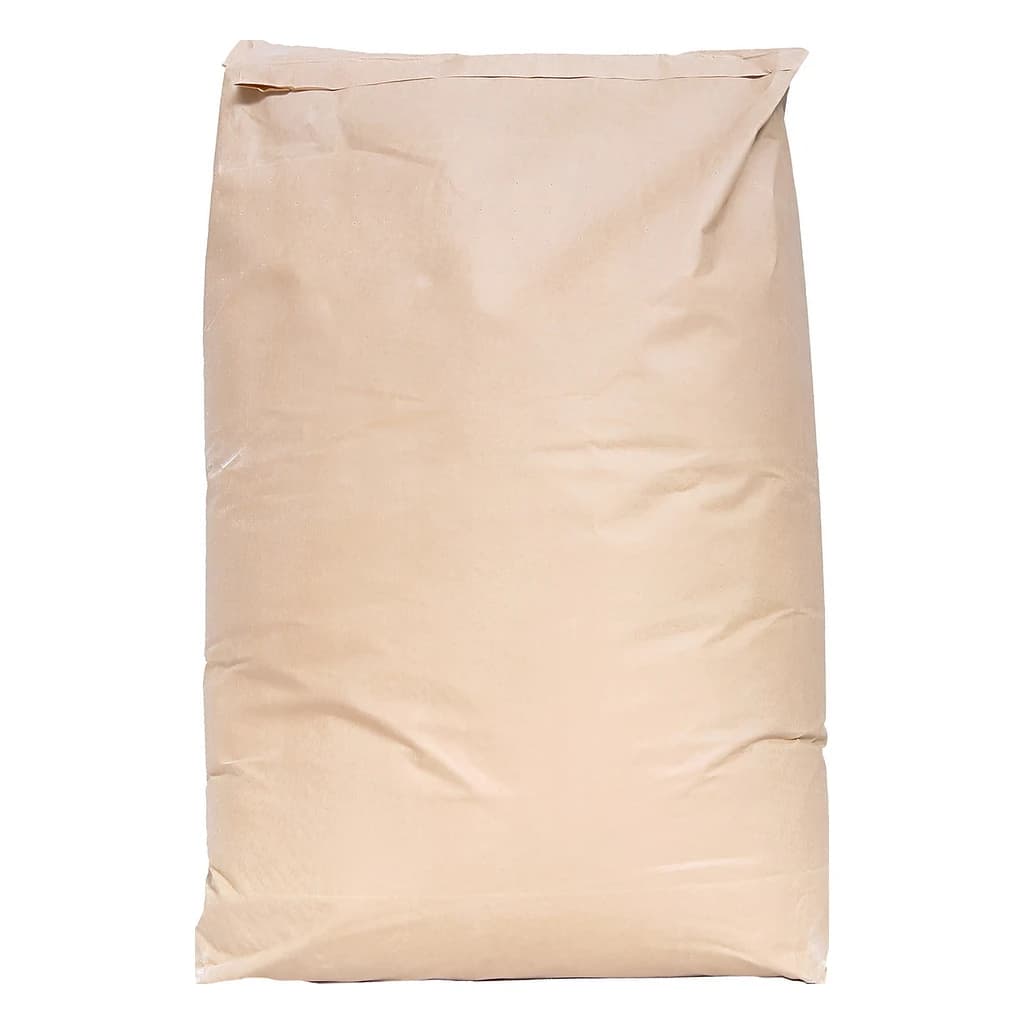
Wheat Flour Type 450 25 kg
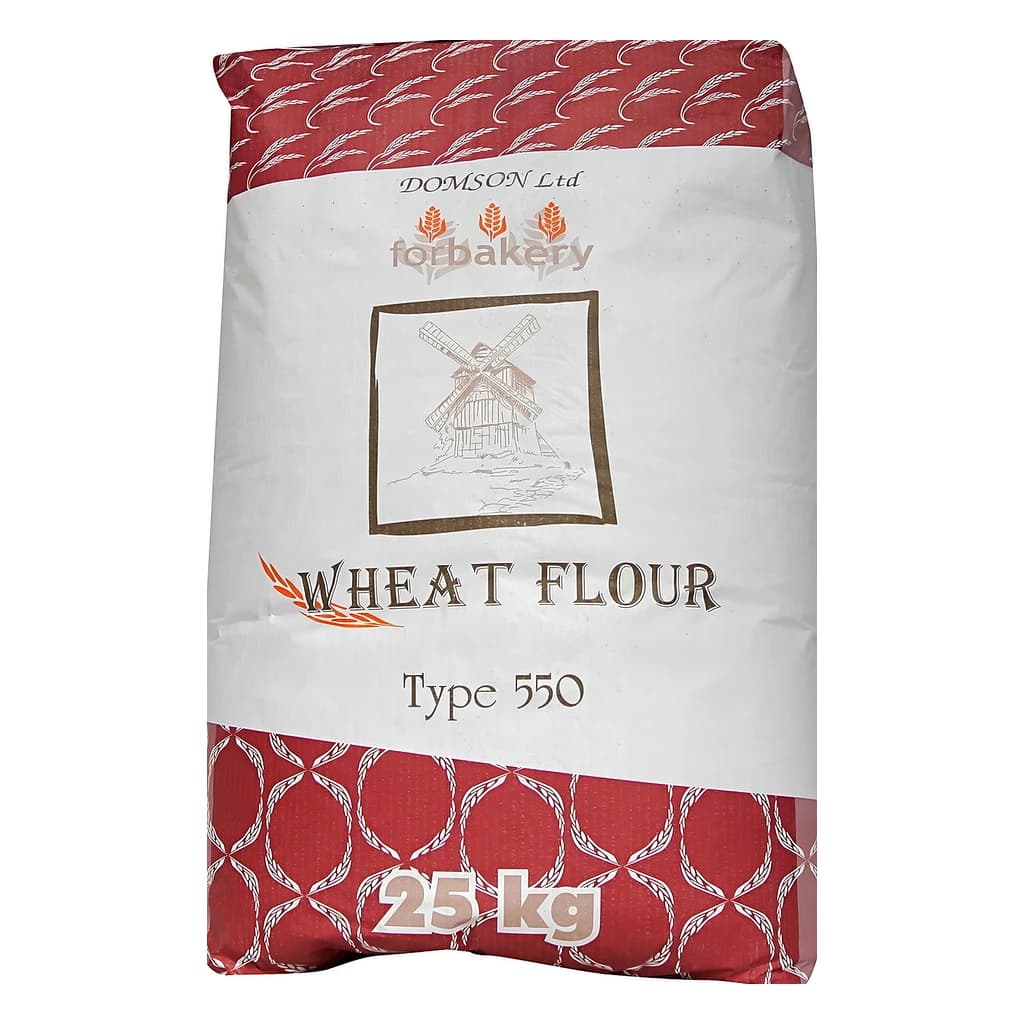
Wheat Flour Type G 550 25 kg

Rye Flour Type 720 20 kg
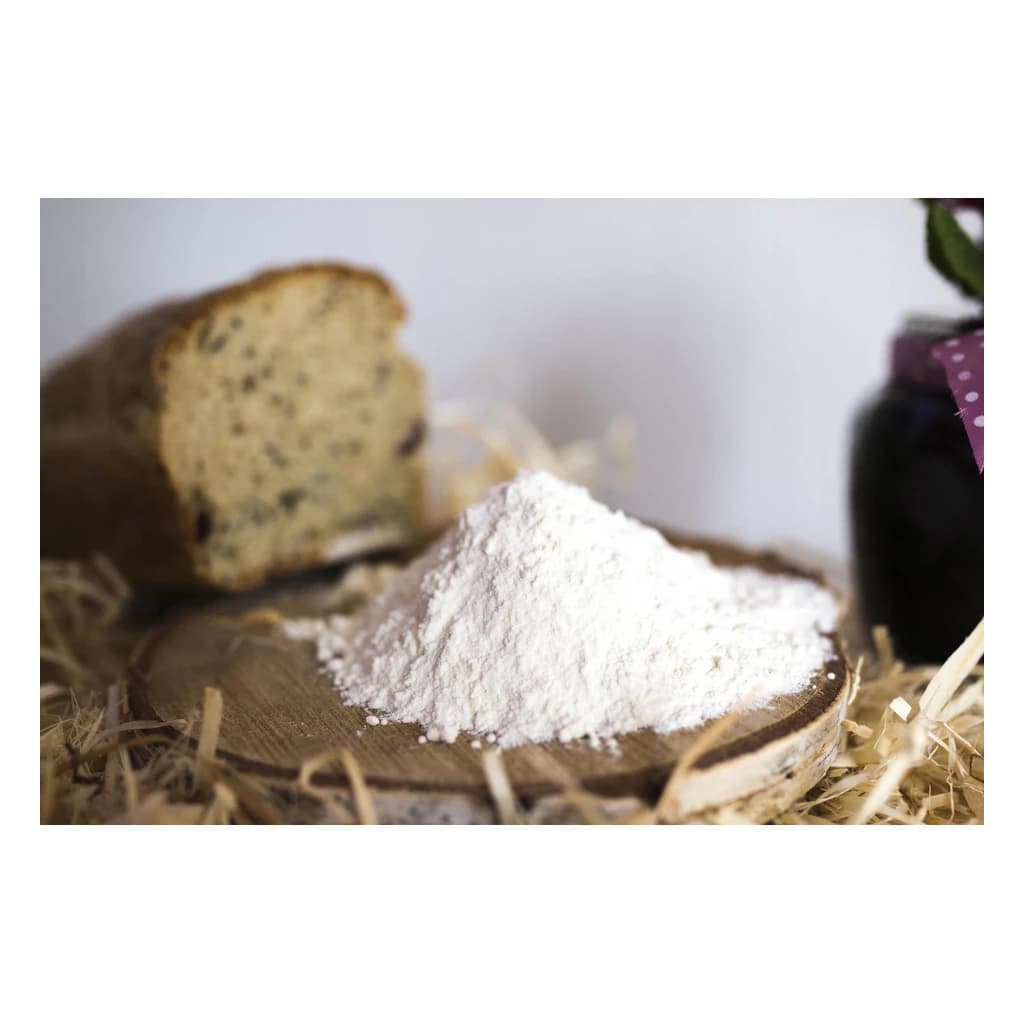
Wheat Flour Type 850 25 kg
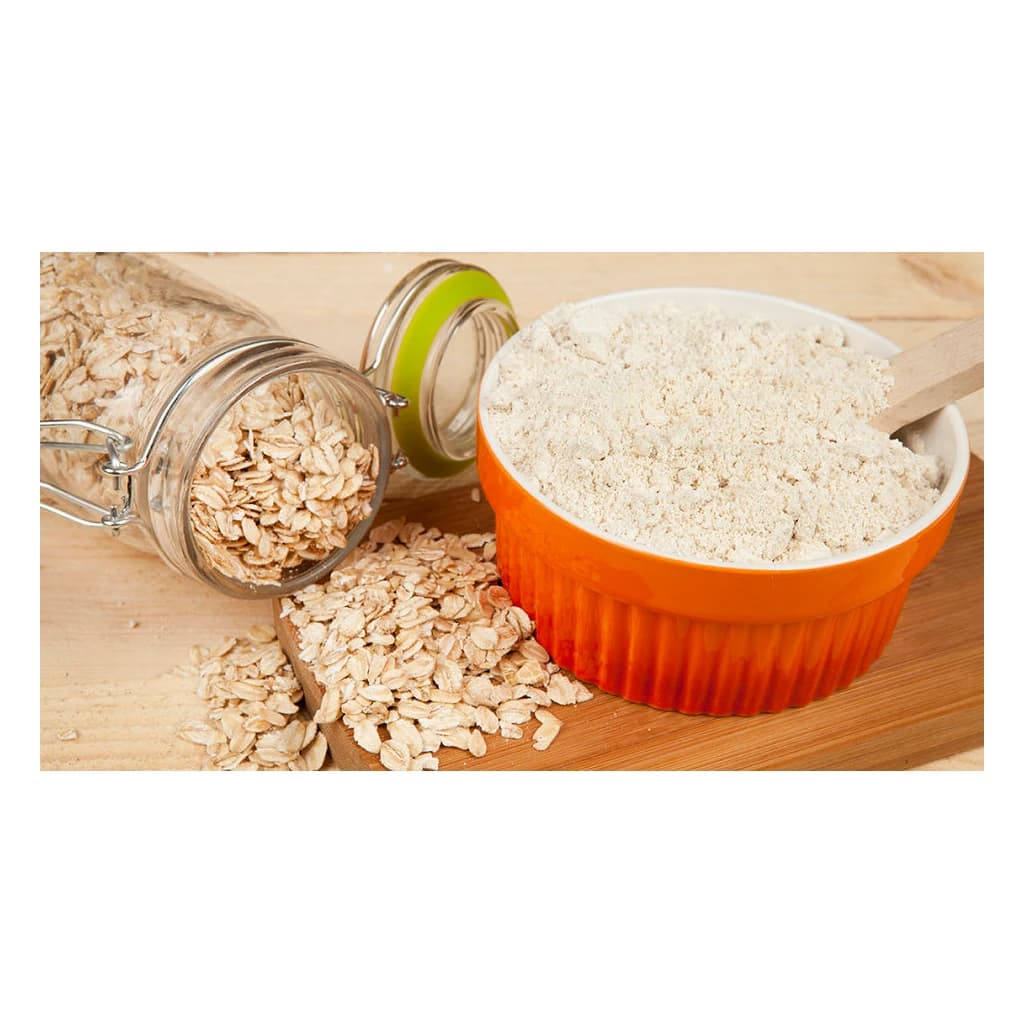
Oat Flour 25 kg
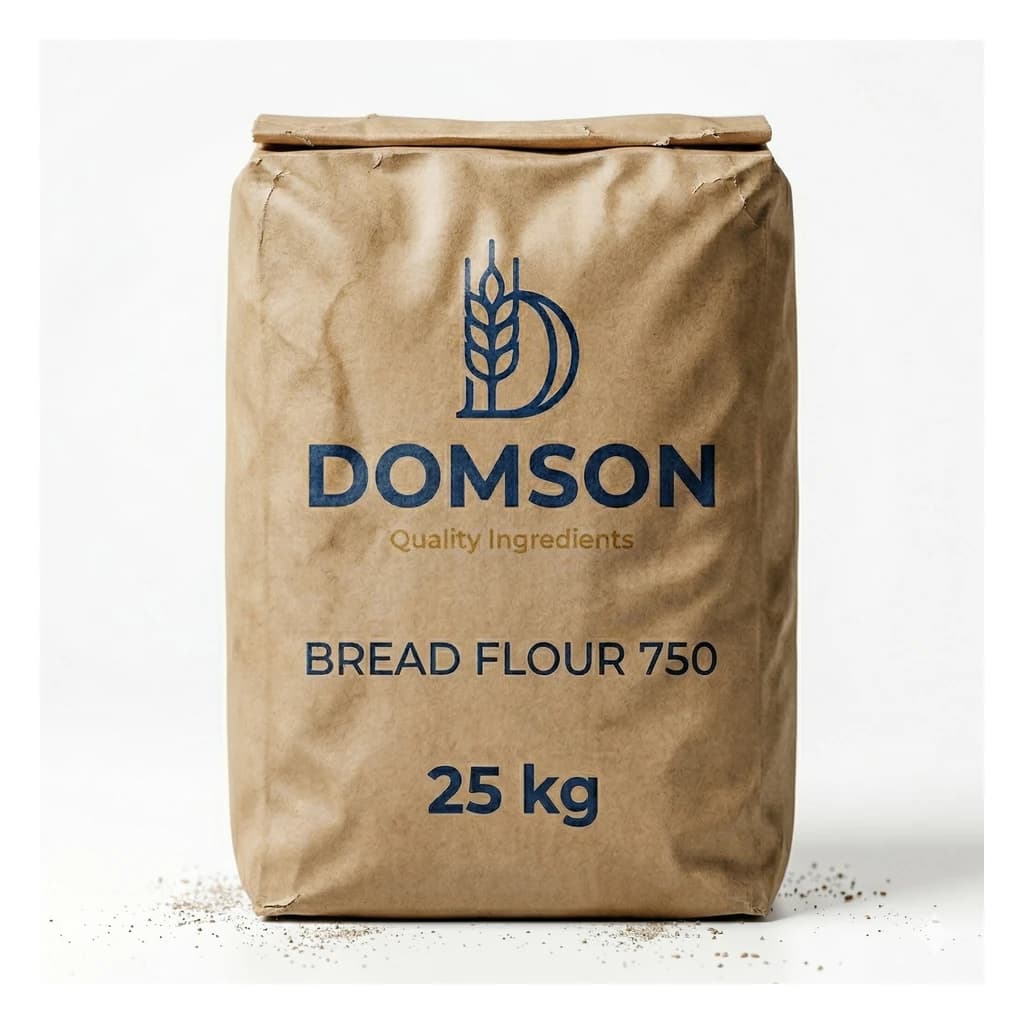
Domson Bread Flour Type 750 25 kg
Komplexmłyn Wheat Flour Type 550 25 kg
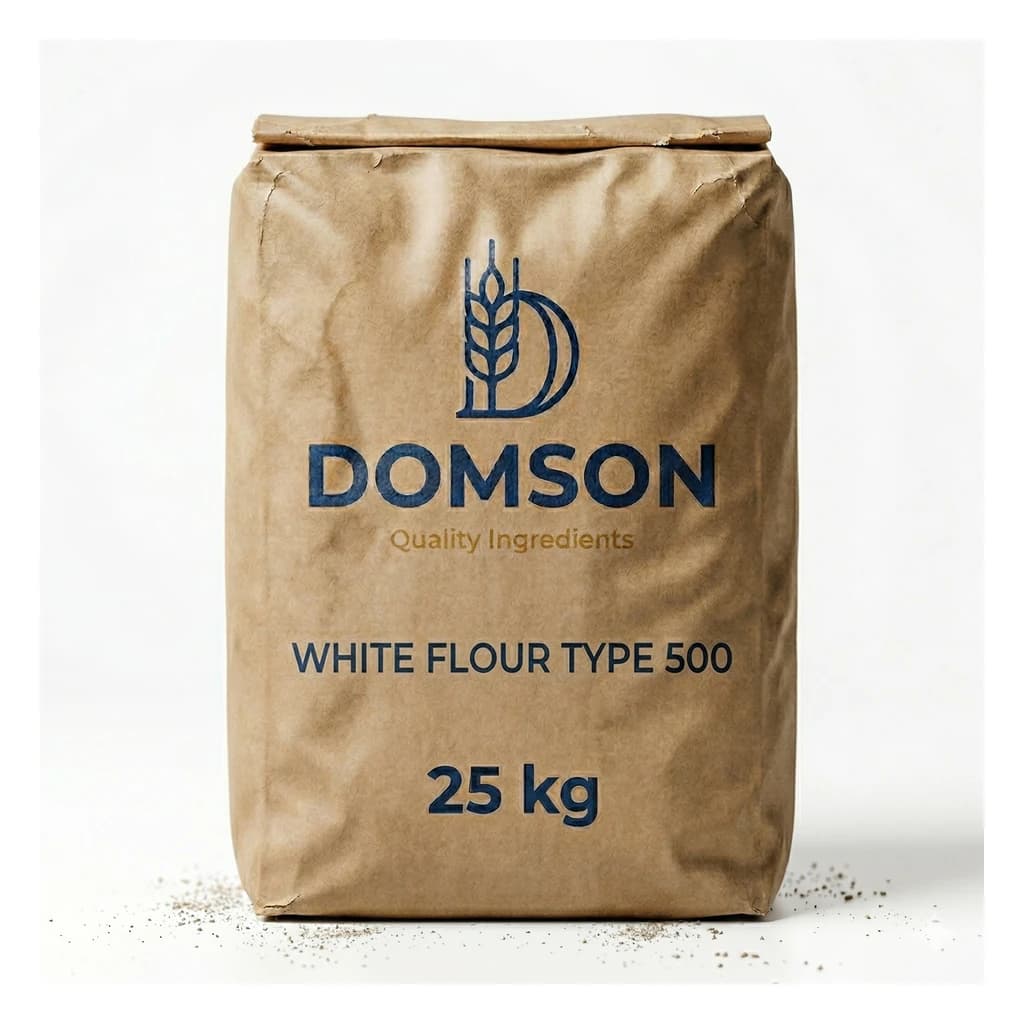
Domson White Flour Type 500 25 kg

Rye Flour Type 720 25 kg
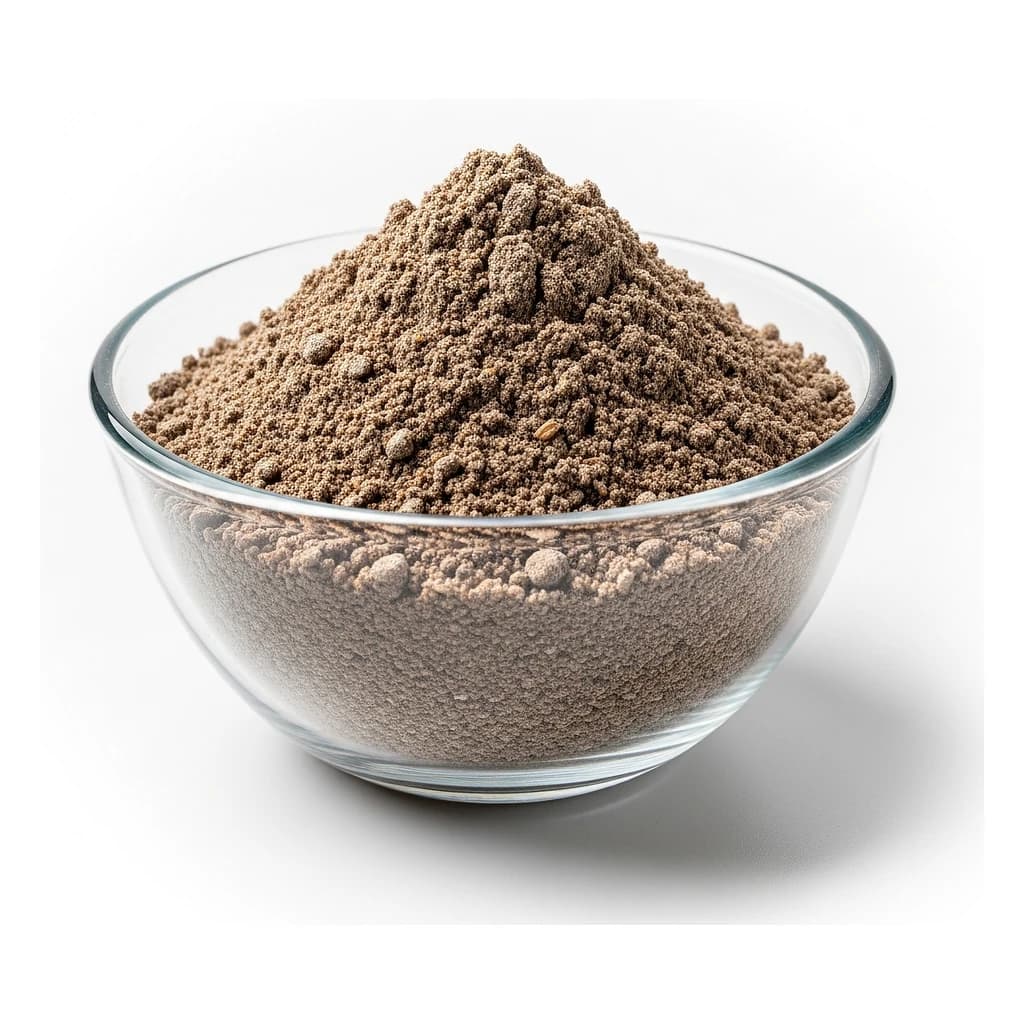
Wholemeal Rye Flour Type 2000 40 kg
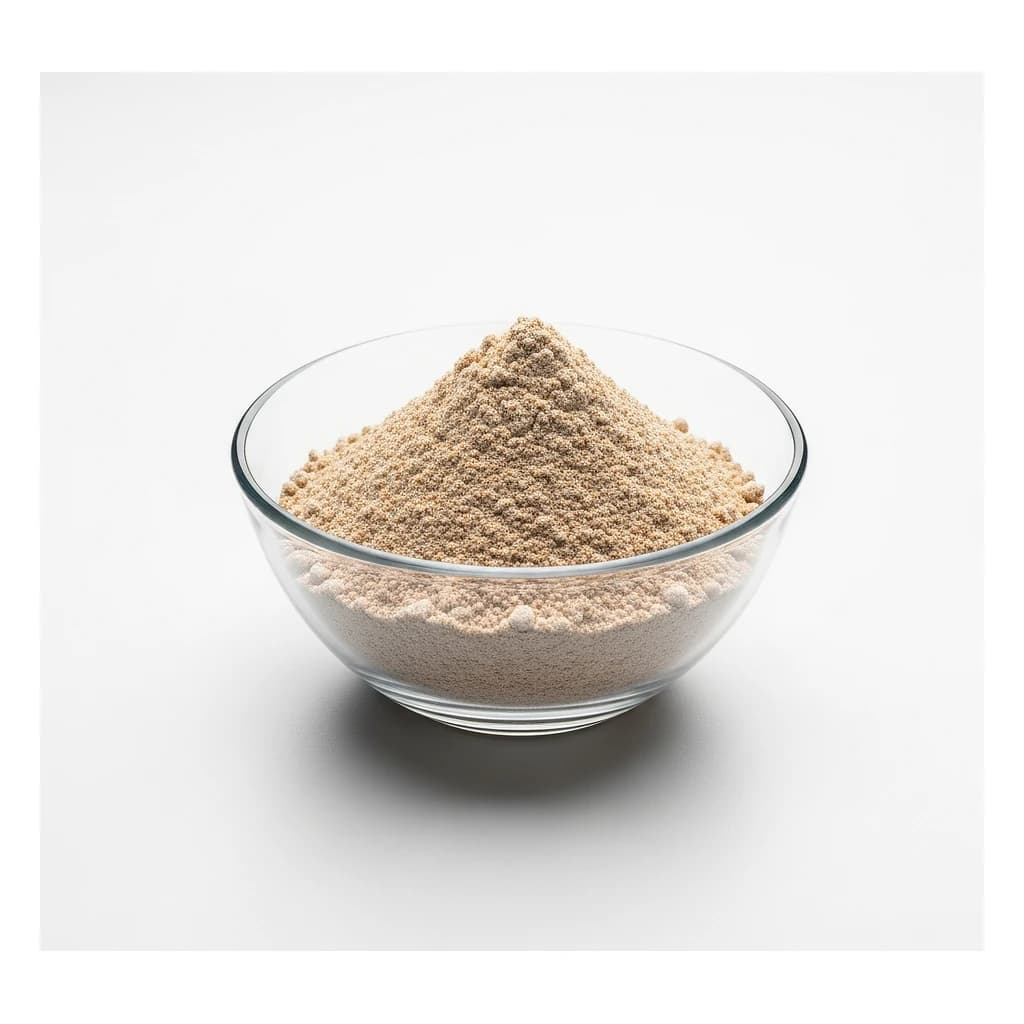
Graham Wheat Flour Type 1850 40 kg
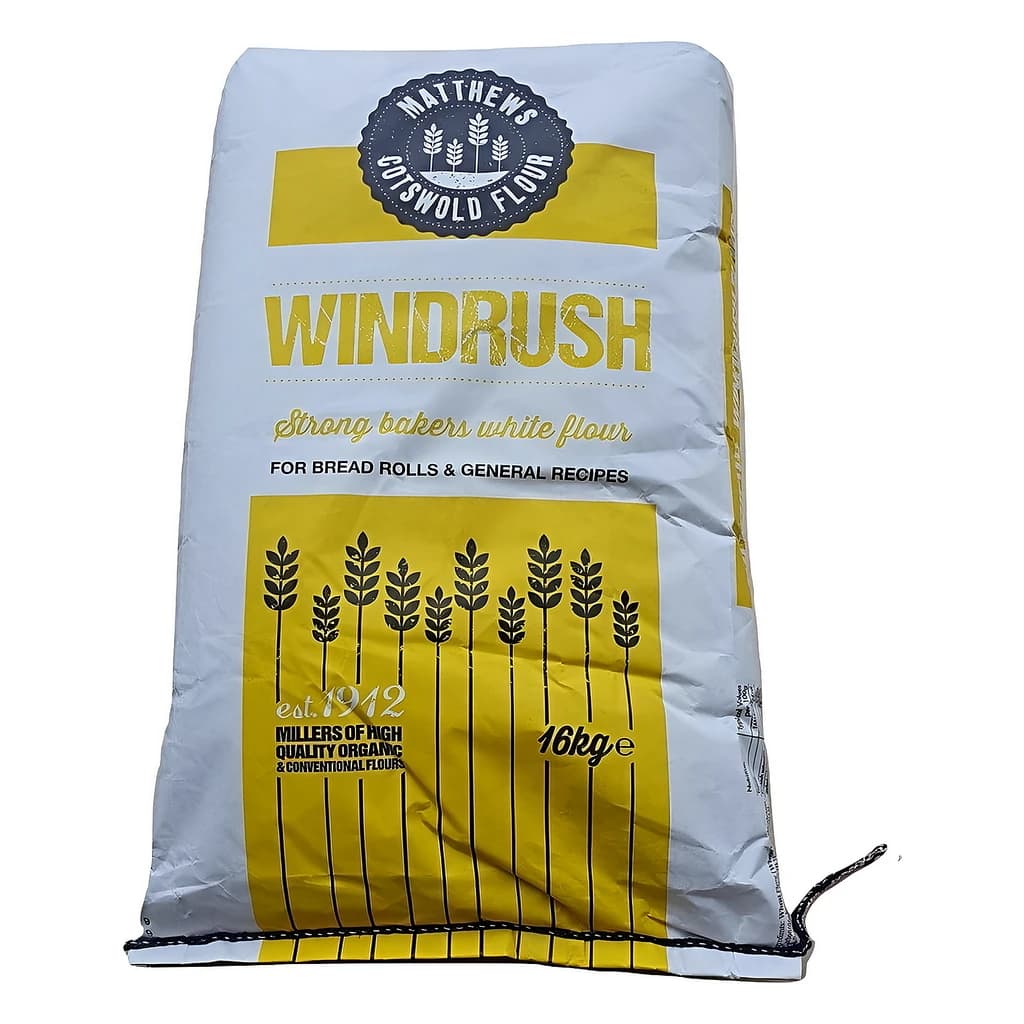
Windrush Strong White Bread Flour 16 kg
Stoneground White Spelt Flour 16 kg
Organic White Spelt Flour 25 kg
Organic Strong Wholemeal Bread Flour 25 kg