
Shortbread and the British biscuit family: formulation, fat selection and commercial production from shortbread through digestives to ginger snaps
Britain is one of the world's great biscuit nations, and its whole repertoire radiates from a single archetype: the all-butter shortbread. This dossier - written for a UK B2B baker and mined from the platform's own supplier spec sheets - starts from the two dough families every biscuit belongs to (short vs developed), then works through the load-bearing decisions: which fat (butter at a ~32-35C melt vs a 44C high-ratio shortening), which sugar and syrup (caster, icing, demerara, golden syrup, black treacle), which flour (soft/weak, ~8.5% protein) and which leavening (bicarbonate, baking powder, vol). It gives baker's-percentage formulas for shortbread, Viennese whirls, digestives, ginger nuts and oat biscuits; explains the ginger-nut crackle and commercial forming (rotary mould, sheet-and-dock, wire-cut, deposit); and gets the UK home-market regulation right - the Bread and Flour Regulations 1998 mandatory fortification (calcium, iron, thiamin, niacin) and the 2024 amendment (SI 2024/1162) that adds folic acid and, from 13 December 2026, also raises the iron, calcium and niacin levels. Every technique is wired to the Domson catalogue a British biscuit maker actually orders. Cross-linked to the Pillar A craft (A4 fats, A1 flour, A2 leaveners, A5 bake and shelf life, A8 formulas) and to its sibling B7 British articles.
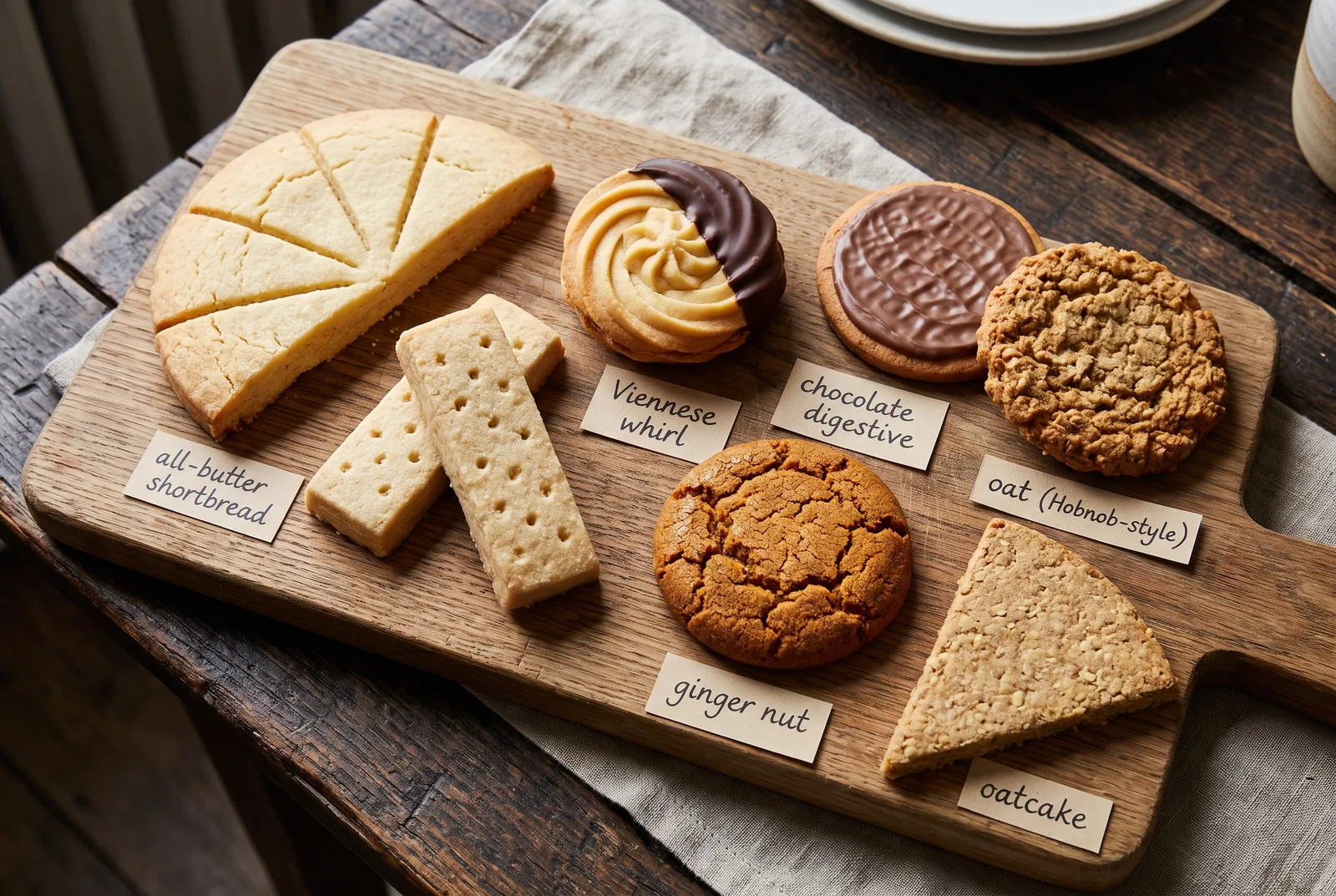
Shortbread and the British biscuit family
If you learn one British biscuit properly, learn shortbread. Almost the entire national biscuit repertoire - the tea-time tin, the supermarket aisle, the cafe counter - fans out from the same simple idea: butter, sugar and flour worked so that gluten barely forms. Get shortbread right and you understand the whole "short-dough" family; understand where the digestive and rich tea diverge from it and you understand the rest. Biscuits are one of Britain's defining bakery categories and a fixture of everyday British life.
This dossier is written for a working UK baker or buyer. It moves from the two dough families, through the four decisions that actually make or break a biscuit (fat, sugar/syrup, flour, leavening), into baker's-percentage formulas and commercial forming, and finishes on the one thing every British biscuit maker should get right on the home market: the flour you buy is fortified by law. Every ingredient is tied to a product Domson stocks (see the sourcing table and figure below).
1. The short-dough archetype
"Short" is the whole point. A short dough is one in which fat physically coats the flour so the gluten-forming proteins cannot link up; the result is tender, crumbly, "melts or snaps short" rather than chewy. Shortbread pushes this to the limit - a very high fat load and essentially no added water - which is why it is the shortest of all doughs and the natural teaching piece. This is the same principle behind British shortcrust pastry (see sibling B7-pastry-traditions), and the science of it sits in A4-fat-science-functionality and A1-protein-gluten-and-strength.
Everything else in the tin is a variation on how far you let gluten develop, how much sugar and syrup you add, and how you leaven it. See the figure below for the two-family model.
2. The two dough families
British biscuits split cleanly into two families:
- Short (soft) dough - high fat, low water, minimal gluten. Tender and crumbly. Shortbread, Viennese, ginger nuts, melting moments, most "cookies". Formed by rotary moulding, wire-cutting or piping.
- Hard (developed) dough - less fat, more water, mixing work that develops gluten. Firmer, often layered. The "semi-sweet" biscuits: digestive, rich tea, Marie, plus water biscuits and cracker bases. Formed by sheeting, relaxing, cutting and docking.
The family decides the flour, the fat load, the mixing and the machine. It is the first question to ask of any new biscuit brief. Full breakdown in the dough-families comparison table below.
3. Shortbread: the 3:2:1 archetype
Classic Scottish shortbread is built on a 3:2:1 ratio by weight of flour: butter: sugar - three parts flour, two parts butter, one part sugar. That single ratio, plus "keep it cold, work it little, bake it pale," is 90% of shortbread. See the figure below and the formula card below.
The flour swap. Replacing part of the flour changes the bite: rice flour or semolina gives the characteristic sandy, gritty crunch of good Scottish shortbread, while cornflour makes it more tender and melting. A little rice flour also further dilutes the gluten. Use a soft/weak flour as the base (see section 5).
Method. Because you want almost no aeration and no gluten, shortbread is usually blended or lightly creamed (not beaten to a fluff), pressed or rolled to ~8 mm, docked all over, chilled, and baked low and slow at around 150-160C so it dries out and sets pale/blond, not brown. Dust with caster while warm; roll cut edges in demerara for extra crunch.
The three shapes and the legend. The three traditional forms are the large round scored into segments ("petticoat tails"), individual rounds, and thick slabs cut into "fingers" (see the figure below). Shortbread evolved from medieval "biscuit bread" - leftover bread dough dried in a low oven to a rusk - and as butter progressively replaced the yeast the rusk became today's rich all-butter biscuit. Its refinement is popularly credited to Mary, Queen of Scots in the mid-16th century, said to have favoured caraway-flavoured petticoat tails - but the sources are clear that this is tradition, not documented fact. "Petticoat tails" itself is thought to come from the French petites gatelles ("little cakes") or from tailored petticoat panels. Walkers of Speyside is the archetypal modern all-butter brand.
4. Fat selection: the load-bearing decision
In a short dough, fat is the single biggest lever - it sets flavour, spread, snap and mouthfeel. The practical shorthand is slip melting point: a fat that melts near body temperature eats clean and releases flavour in the mouth; a higher-melting, plastic fat resists spread and can carry more sugar and liquid. See the figure and table below, and the craft background in A4-fat-types-and-selection and A4-margarine-shortening-manufacturing.
- Butter (82% fat, 16% water). The authentic shortbread fat. It melts at about 32-35C, near mouth temperature, which is why all-butter shortbread eats so cleanly; its ~16% water builds a little structure and it browns beautifully. The platform's Polmlek 82% butter is made from pasteurised, unacidified (sweet) cream, at min 82% fat / 16% water / 55 g saturated fat per 100 g, and must be kept at 0-10C; it carries the milk allergen. Butter grades are covered in A4-butter-grades-and-specialist-types.
- High-ratio vegetable shortening. A plastic, aerated fat engineered for spread control and to carry a high ratio of sugar and liquid. The Cardowan high-ratio shortening is 100% fat, 38.1 g saturates/100g, slip melting point 44.0C, ~12% air, with an added distilled monoglyceride emulsifier (E471); it is palm/rapeseed based and RSPO-certified, vegan and free of all 14 legal allergens. Because it melts far higher than butter (44C vs ~33C), it holds shape in the oven and is the workhorse for spread-critical or dairy-free biscuits.
- Blends, cake margarine and lard. Many bakeries blend butter with shortening for a butter flavour at a controlled cost and spread; cake margarine (~80% fat) is the economy creaming fat for Viennese and spread biscuits; lard is the traditional fat in some regional and savoury bakes (not vegetarian). All are in the range.
A common professional move: butter for flavour where it shows (shortbread, Viennese), high-ratio shortening where spread and uniformity matter more than a dairy note (ginger nuts, high-volume cookies).
5. Sugars, syrups and the jobs they do
In biscuits, sugar is not just sweetness. Crystal size drives spread and crunch, and invert syrups act as humectants that keep biscuits chewy and drive browning. British ginger and oat biscuits lean hard on golden syrup and treacle - this is a genuinely British signature. See the sugars-and-syrups table below and, for the confectionery side, sibling B7-confectionery-sugar-work.
- Caster sugar - the default. Fine, near-pure sucrose (Kent Foods spec: ~100 g sugars/100g, reducing sugars <0.04%, ICUMSA colour ~32, from UK sugar beet) that creams well and dissolves for even spread.
- Icing sugar - milled sucrose with a tricalcium-phosphate anticaking agent (E341(iii)), >80% of particles below 75 micron. Gives a very fine, low-spread, melt-in-the-mouth crumb - the sugar for Viennese and melting moments.
- Demerara - large crystals (~700 micron) part-browned with ~1.3% cane molasses. Adds crunch and a caramel note; ideal to roll biscuit edges or top oat biscuits.
- Golden syrup - the British invert-sugar syrup. The Kent Foods spec gives sucrose ~31%, invert sugars ~49%, 16% moisture, ~83 Brix, pH 4-6, colour 1500 ICUMSA. As an invert humectant it keeps ginger biscuits and flapjacks chewy, its reducing sugars accelerate Maillard browning, and it adds a mellow caramel note - it is the classic ginger-nut and flapjack binder.
- Black treacle - cane molasses plus invert syrup: darker, more bitter and mineral-rich (sucrose 25-30%, ~7% mineral matter, iron 30-500 mg/kg, pH 4.7-6.3). It darkens the crumb and adds the molasses depth of dark ginger biscuits and Yorkshire parkin (see sibling B7-regional-breads-map). Golden syrup and black treacle are both British sugar-refining products.
6. Flour and gluten control
Biscuits want the opposite of bread flour. A biscuit/pastry flour is a soft, weak, low-protein flour: the platform's Whitworth "Golden Jewel" pastry flour targets ~8.5% protein (range 7.5-9.5%) and is deliberately a wheat-plus-maize blend to weaken it further. Use a strong bread flour by mistake and even careful mixing will build enough gluten to make shortbread tough (see the fault table, and A1-wheat-flour-types-by-application). Plain and pastry flours in the range - Golden Jewel, Domson Plain, Allied Mills Plain White, Carr's Starlight - are the right base; rice flour and cornflour are the short-dough tweaks from section 3.
For the developed family (digestives, rich tea) you still use a soft flour, but you add water and mixing work to develop some gluten and give the biscuit its firmer, more layered bite. Wholemeal and brown flours (Domson Brown, Grampian Wholemeal, Carr's Maltster Malted Brown) give the digestive its character; malted grain flours are covered in sibling B7-malted-grain-baking.
7. Leavening in biscuits
Most British biscuits are chemically leavened (or barely leavened at all). The craft detail is in A2-chemical-leaveners-baking-powder; the biscuit-specific points:
- Bicarbonate of soda (sodium bicarbonate E500(ii), min 99.3%, 1% solution pH <=8.5 ) is the classic biscuit leavener. It needs acid to release all its gas; in ginger nuts the acid comes from the golden syrup and treacle. Bicarbonate also raises pH, which speeds browning and spread - useful in digestives (the biscuit is even named for it; see section 8) and ginger nuts.
- Baking powder (bicarbonate + acid salts) is used where you want lift without an acidic ingredient present, in cakier biscuits.
- Ammonium bicarbonate (E503, "vol"/hartshorn) is the traditional choice for thin, crisp biscuits: it decomposes completely on baking to gases (CO2, ammonia, water) and leaves no residual salt or alkaline taste - but only works in low-moisture bakes where the ammonia can escape. All three are stocked (Emix bicarbonate, Domson baking powder, PGD ammonium bicarbonate).
The ginger-nut crackle deserves its own note (see the figure below). The reaction of bicarbonate with the acidic golden syrup/treacle generates gas that makes the biscuit spread and dome, then the surface - especially if rolled in granulated or demerara sugar - sets and cracks into the characteristic crackled top as the centre falls. Too little bicarbonate (or stale bicarbonate), too little syrup, or no sugar coat, and you lose the crackle.
8. The wider British biscuit family
From the shortbread archetype the whole repertoire fans out (see the comparison table and figure below):
- Shortbread - the short-dough benchmark (section 3).
- Viennese whirls / fingers and melting moments - a very soft, piped short dough using icing sugar and cornflour for a fine crumb, sandwiched with buttercream and raspberry jam and half-dipped in chocolate. The Viennese formula card below gives the build; for volume, the just-add-fat Macphie Viennese Mix (fortified wheat flour 70-100%, sugar 10-30%, rapeseed oil <10%; contains gluten, made on a line handling egg/soya/milk) removes the weighing.
- Ginger nuts / ginger snaps - the crackle biscuit (section 7). Ground ginger does the heavy lifting - the platform's ground ginger is 100% Zingiber officinale with volatile oil >=1.5%. (For a spiced-honey cousin from another tradition, see B1-piernik-gingerbread.)
- The digestive - a semi-sweet, wholemeal, developed-dough biscuit. McVitie's first manufactured it in 1892 to a recipe by (later Sir) Alexander Grant; the name comes from the Victorian - now discredited - belief that its sodium-bicarbonate content aided digestion. Enrobe one side in chocolate for the chocolate digestive (couverture and compound coatings are in the range; see A6-chocolate-selection-couverture).
- Rich tea / Marie - lean, plain, developed-dough biscuits, sheeted and docked.
- Oat biscuits (Hobnob-style), flapjacks and oatcakes - rolled oats bound with golden syrup. Oats come in grades (regular, thick-cut/"mountain", quick-cook) at 11-12% moisture; use jumbo/regular flakes for texture. The oatcake is the savoury griddle/oven cousin of Scotland and the North.
The British biscuit as an industry was a Victorian creation, built on mechanisation by firms such as Huntley & Palmers of Reading (decorative tins from 1842), Peek Frean of Bermondsey (Henry Mayhew recorded ~1.5 million "Pic Nic" biscuits a week in 1865), Carr's of Carlisle and, in Edinburgh, McVitie's.
9. Commercial production
The forming method follows the dough family (see the figure and table below):
- Rotary moulding - short dough pressed into the engraved cavities of a cylinder and scraped level; smooth, detailed tops. Shortbread, ginger nuts.
- Sheeting + cutting + docking - hard dough gauge-rolled into a sheet, relaxed so it does not shrink, stamped, and docked with pin holes to stop blistering. Digestive, rich tea, cracker bases.
- Wire-cutting - soft dough with inclusions extruded through a die and sliced by a wire. Oat and chocolate-chip biscuits.
- Depositing / rout press - very soft, pipeable dough piped into rosettes, fingers and shells. Viennese.
Scaling craft recipes to these lines is covered in A5-scaling-artisan-to-industrial; the heat reactions (spread, set, Maillard browning) sit in A5-baking-oven-science.
Shelf life and faults. Biscuits are a low-moisture, low-water-activity product baked to a low final moisture, which gives their long ambient shelf life; they spoil chiefly by picking up moisture (going soft) or by fat rancidity, not by mould (contrast bread staling in A5-shelf-life-and-staling). A characteristic biscuit defect is "checking" - cracking hours or days after baking, caused by uneven internal moisture setting up stresses as the biscuit equilibrates; slow, even cooling and even bake-out reduce it. The full fault list is in the fault table below.
10. UK regulation: the flour you buy is already fortified
This is the home-market point most biscuit bakers overlook. The Bread and Flour Regulations 1998 require UK white and brown (non-wholemeal) wheat flour to be fortified with four nutrients - calcium, iron, thiamin (B1) and niacin (B3) - before it reaches you. It applies to the flour, not the finished biscuit, so it holds even though biscuits are not "bread." You can see it on real spec sheets: the Whitworth Golden Jewel pastry flour states outright that its calcium carbonate and "Vitamix" additions are made "to comply with the Bread and Flour Regulations 1998". See the figure and table below, and sibling B7-flour-landscape for the full flour picture.
The current statutory addition levels (per 100 g flour), in force until 12 December 2026, are:
- Calcium carbonate (chalk): 235-390 mg
- Iron: not less than 1.65 mg
- Thiamin (B1): not less than 0.24 mg
- Niacin (B3): not less than 1.60 mg
Exemptions: wholemeal flour (bran and germ are natural sources of iron, thiamin and niacin), self-raising flour with a calcium content of not less than 0.2%, and flour for communion wafers, matzos, gluten, starch or export. Organic non-wholemeal flour is NOT exempt.
The 2024 amendment - folic acid AND raised levels (from 13 December 2026). The Bread and Flour (Amendment) (England) Regulations 2024 (SI 2024/1162) do two things to non-wholemeal wheat flour, both with a compliance deadline of 13 December 2026. First, they add folic acid to the mandatory list at 250 micrograms per 100 g, to help reduce neural-tube defects. Second - the part most summaries miss - the same instrument raises three of the four existing fortificant levels from that date: iron to not less than 2.10 mg, calcium carbonate to 300-455 mg, and niacin to not less than 2.40 mg per 100 g (thiamin is unchanged at 0.24 mg). Mills producing under 500 tonnes/year, and flour from "other" wheats (spelt, einkorn, emmer, durum, which fall outside the "common wheat" definition), are outside scope. Folic acid must be declared on labels of flour and products made with it, and in practice most UK non-wholemeal flour will already be carrying it before the deadline.
These UK statutory levels are cross-checked against UK Flour Millers, the Federation of Bakers, the Real Bread Campaign, gov.uk and SI 2024/1162. The pre-2026 figures are correct for the current regime and the 13 December 2026 changes are set out above.
A note on the other big UK bread topics. The Chorleywood Bread Process and the voluntary UK Sourdough Code of Practice / "sourfaux" debate are bread-making issues, not biscuit ones - they are covered in siblings B7-chorleywood-vs-craft and B7-sourdough-real-bread and are out of scope here except to note that the same fortified flour underlies all of them.
Allergens and labelling. Standard British biscuits carry the cereals-containing-gluten (wheat) allergen and usually milk (butter) and often egg; oat biscuits add oats (a cereal containing gluten), nut biscuits add nuts, and any product built on the Macphie Viennese base also flags soya (its line also handles egg, soya and milk). Every regulated allergen present must be declared under UK food-information law (assimilated Regulation (EU) 1169/2011). Butter carries milk/lactose; high-ratio shortening is free of all 14 legal allergens and vegan. Two further points a UK biscuit baker should check against their own recipe and specs - flagged here for the operator's food-safety/technical review:
- Sulphites. The platform's ground-ginger spec records naturally occurring sulphites at up to 30 ppm. Because sulphur dioxide/sulphites must be declared once present above 10 mg/kg (10 ppm, as SO2) under Reg 1169/2011 Annex II, a heavily gingered biscuit can cross that threshold - it warrants a sulphite risk assessment and may need a sulphites declaration.
- PPDS / "Natasha's Law". Biscuits prepacked for direct sale on your own premises (bagged at the counter, wrapped for a cafe display) must carry a full ingredient list with the 14 allergens emphasised, under the Prepacked for Direct Sale rules in force since 1 October 2021 - the most important recent UK allergen-labelling duty for a bakery packing its own biscuits.
11. Sourcing from the Domson range
Britain is Domson's home market, so the biscuit larder is deep. The full map is in the sourcing table below; the headlines:
- Fats: Unsalted Butter 82% (Polmlek g22581, g22344), High Ratio Vegetable Shortening (Cardowan g44887), Vegetable Shortening (g45065), Cake Margarine (g45064), Lard (g24762), Palmax palm shortening (g44568).
- Flours: Golden Jewel Pastry (g43079), Domson Plain (g43247), Plain White (g45392), Starlight Pastry (g45776); wholemeal/brown for digestives (g43197, g45396, g45546); rice flour (g44134) and corn flour (g22567) for shortbread.
- Sugars & syrups: Caster (g44027), Icing CP (g44052), Demerara (g44477), Soft Dark Brown (g44034), Molasses Sugar (g45469), Nibbed Sugar (g44779), Golden Syrup (g45099), Black Treacle (g45098, g43243).
- Leavening & spice: Bicarbonate of Soda (g23024), Baking Powder (g22077), Ammonium Bicarbonate (g23047); Ground Ginger (g44879), Mixed Spice UK Blend (g45412), Cinnamon (g22066).
- Oats & chocolate: Oat Flakes (g23549), Oat Flour (g22040), Oats Stabilised (g44392); couverture/compound coatings for chocolate digestives.
- Just-add-fat bases (volume): Macphie Viennese Mix (g44898), Soft & Chewy Cookie Mix (g44916), Chocolate Cookie Mix (g44891), Credin Rodeo Cookie Mix (g25489), Shortcrust Pastry Mix (g25542), Macphie Flapjack Mix (g44746), Zeelandia Qki Oat Cookie Mix (g25539).
The five formula cards below (shortbread, Viennese, digestive, ginger nut, oat biscuit) each name the specific products to buy, in baker's percentage - see A8-bakers-percentage-fundamentals and A8-cake-and-pastry-formulas for the formula method.
Quick reference
- Shortbread = 3:2:1 flour:butter:sugar, cold, minimal mixing, baked pale at 150-160C.
- Two families: short/soft (fat coats flour, crumbly) vs hard/developed (gluten develops, firmer).
- Fat is the biggest lever: butter (~33C melt, flavour) vs high-ratio shortening (44C, spread control).
- Golden syrup + treacle + bicarbonate = the ginger-nut crackle.
- Your UK flour is fortified by law - calcium, iron, thiamin, niacin (current levels to 12 Dec 2026); from 13 Dec 2026 SI 2024/1162 raises iron/calcium/niacin and adds folic acid at 250 ug/100g.
Figures
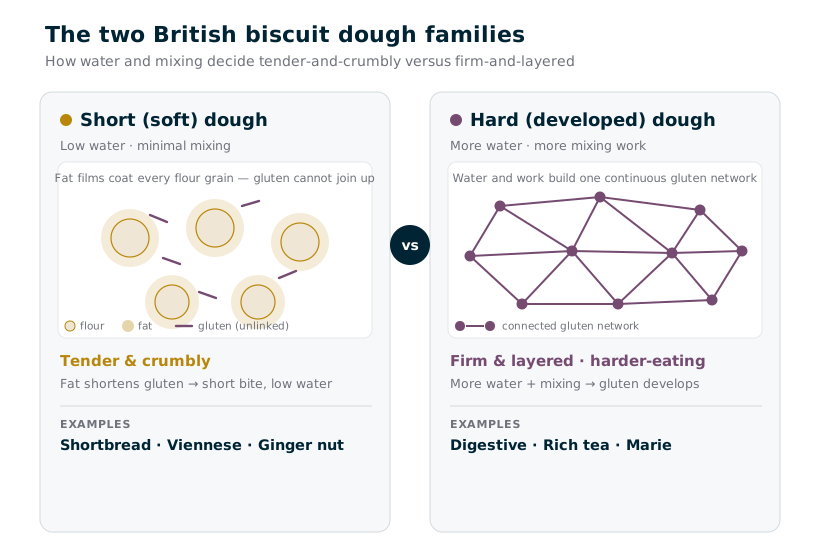 Diagram contrasting short soft dough (fat coats flour, no gluten network) with hard developed dough (connected gluten network) and the biscuits each produces
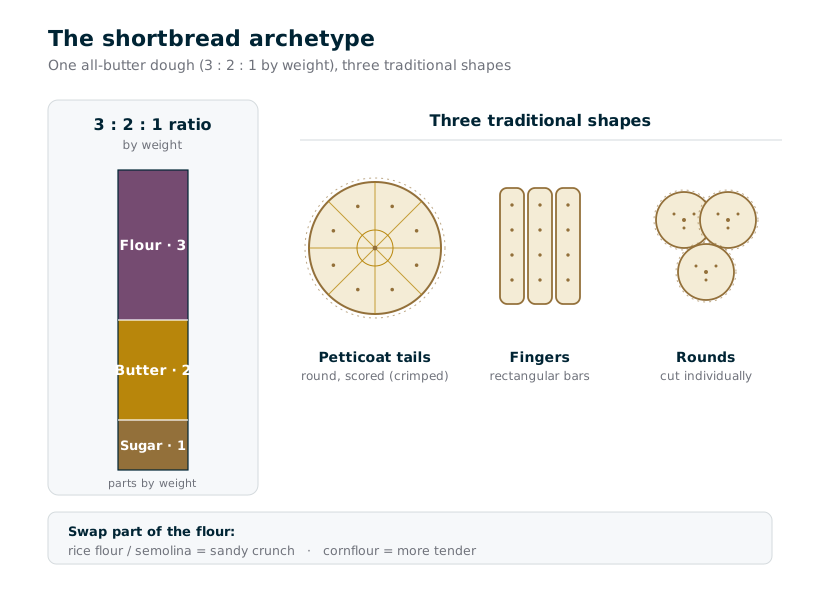 Diagram of the 3:2:1 shortbread ratio next to petticoat tails round, shortbread fingers and individual rounds, with rice-flour and cornflour notes
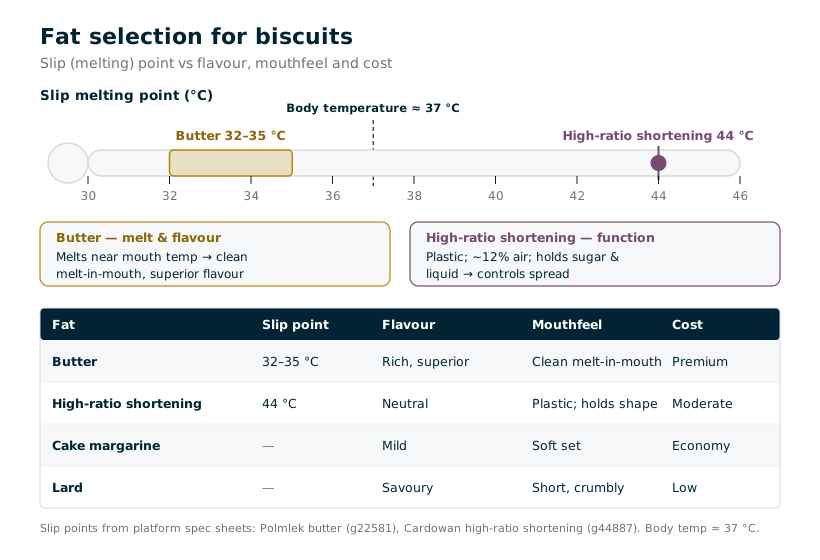 Temperature scale comparing butter (~32-35C) and high-ratio shortening (44C slip point) with notes on melt, plasticity and use in biscuits
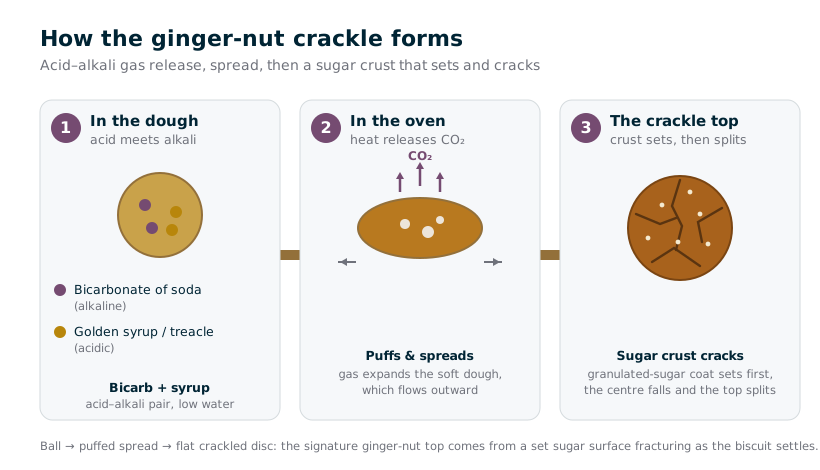 Three-step diagram: bicarbonate plus golden syrup releases CO2, biscuit spreads, and a sugar-coated top cracks into the ginger-nut crackle
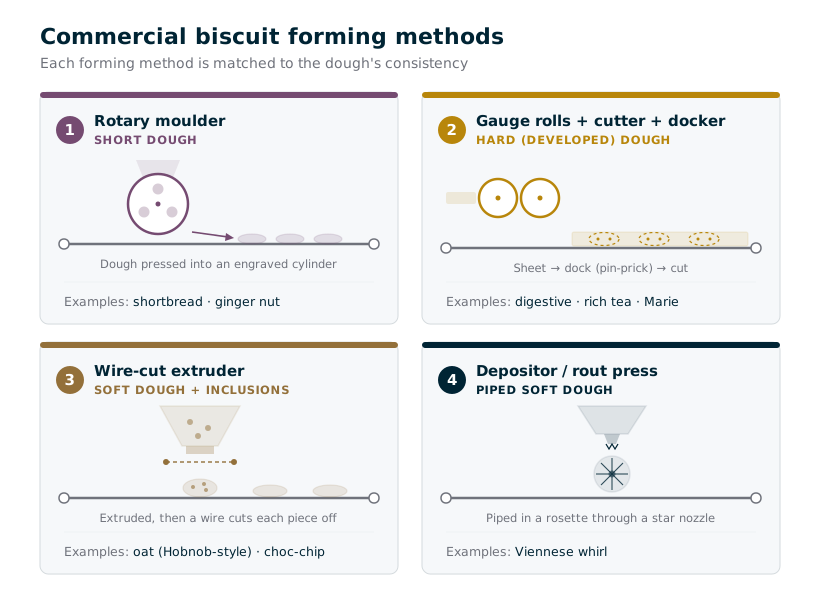 Diagram of four biscuit forming methods - rotary moulding, sheet-and-cut with docking, wire-cut and piped/rout-press - each matched to a dough type
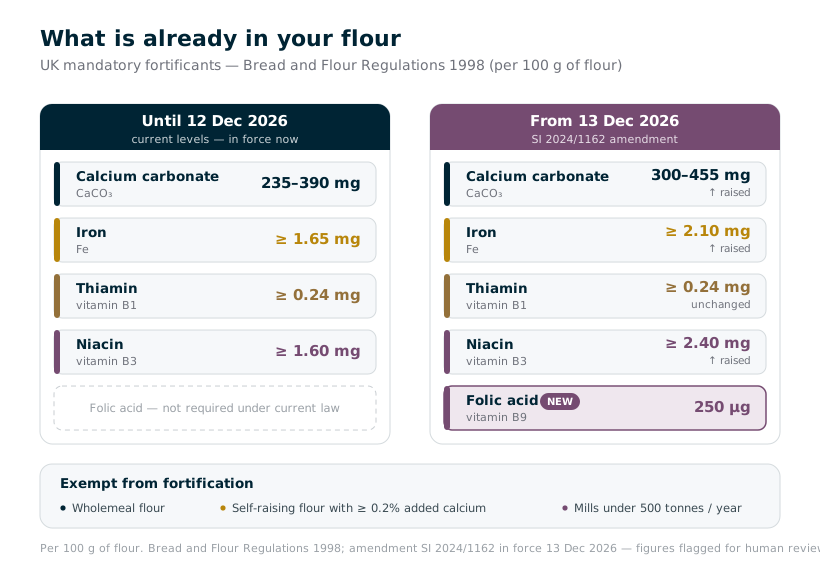 Panel of UK mandatory flour fortificants - calcium, iron, thiamin, niacin - showing current levels to Dec 2026 and the raised levels plus folic acid 250 micrograms/100g from 13 Dec 2026, with exemptions
Classic all-butter shortbread (3:2:1)
| Ingredient | Baker's % | Weight |
|---|---|---|
| Soft/weak wheat flour — Golden Jewel Pastry Flour g43079 or Domson Plain Flour g43247 | 80 | |
| Rice flour (optional, part of the flour) — Peacock Rice Flour g44134 - swap for cornflour for a softer bite | 20 | |
| Unsalted butter 82% — Polmlek g22581 - the 2 in 3:2:1 | 66.7 | |
| Caster sugar — Kent Foods g44027 - the 1 in 3:2:1 | 33.3 | |
| Salt — Balances the butter | 1 | |
| Demerara/caster to coat edges (optional) — Roll cut edges in demerara g44477 for crunch | 0 |
- Blend or lightly cream cold butter with sugar and salt (minimal aeration), work in the flours just to a paste, press/roll to ~8 mm, mark segments or cut fingers, dock all over, chill, then bake at 150-160 degC for ~35-45 min until pale and dry (not browned). Dust with caster while warm.
Yield: One 20-22 cm round of petticoat tails, or ~16 fingers
The archetype. Baker's percentage on total flour = 100%. The 3:2:1 flour:butter:sugar ratio by weight is the tradition; swapping 15-25% of the flour for rice flour gives the sandy Scottish crunch, or use cornflour for a more melting bite. Keep it cold, work it as little as possible, and bake it pale.
Viennese whirls / fingers (piped short dough)
| Ingredient | Baker's % | Weight |
|---|---|---|
| Soft/weak wheat flour — Golden Jewel g43079 | 85 | |
| Cornflour (part of the flour system) — Corn Flour g22567 - fine, tender crumb | 15 | |
| Unsalted butter (or half cake margarine) — Polmlek butter g22581 / Cardowan cake margarine g45064 | 90 | |
| Icing sugar — Icing Sugar CP g44052 - fine crumb, low spread | 35 | |
| Vanilla — To taste | 1 | |
| Milk (to soften to pipeable) — Adjust so it just holds a rosette | 5 |
- Cream butter and icing sugar until light, beat in vanilla, fold in sifted flour + cornflour to a soft pipeable paste (loosen with a little milk). Pipe rosettes/fingers, bake ~170-180 degC for ~12-15 min until just set and pale. Cool, sandwich with buttercream + jam, half-dip in tempered/compound chocolate.
Yield: ~20 sandwiched whirls
A very soft, pipeable short dough - icing sugar and cornflour keep it fine and melting. Pipe rosettes or fingers, bake pale, sandwich with buttercream and raspberry jam, and half-dip in chocolate. For volume, the just-add-fat Macphie Viennese Mix (g44898) removes the weighing.
Digestive-style biscuit (semi-sweet, wholemeal)
| Ingredient | Baker's % | Weight |
|---|---|---|
| Wholemeal/brown flour — Domson Brown Flour g43197 / Grampian Wholemeal g45396 | 70 | |
| Soft white flour — Domson Plain Flour g43247 - lightens the crumb | 30 | |
| Fine oatmeal / oat flour — Oat Flour g22040 - the digestive bite | 15 | |
| Butter or shortening — Butter g22581 or Cardowan HR shortening g44887 | 28 | |
| Demerara + caster sugar — Demerara g44477 for colour/crunch | 22 | |
| Bicarbonate of soda — Emix g23024 - lift + alkaline browning | 1.5 | |
| Salt | 1.2 | |
| Milk (to bind) — Bring to a firm, sheetable dough | 12 |
- Rub fat into the dry mix, dissolve bicarbonate in the milk, bring to a firm dough. Sheet to ~4 mm, relax, cut rounds, dock, bake ~180-200 degC for ~12-15 min to golden. Cool; for chocolate digestives, flood one side with tempered or compound chocolate and comb.
Yield: ~30 biscuits
A developed, semi-sweet biscuit built on wholemeal flour with a little oat flour for the characteristic bite; mildly sweet, leavened with bicarbonate. The name recalls the Victorian belief that the bicarbonate aided digestion. Sheet, dock and bake to golden; enrobe in chocolate for chocolate digestives.
Ginger nuts / ginger snaps
| Ingredient | Baker's % | Weight |
|---|---|---|
| Soft/weak wheat flour — Golden Jewel g43079 | 100 | |
| Caster + soft brown sugar — Caster g44027 + Soft Dark Brown g44034 | 40 | |
| Butter or shortening — Cardowan HR shortening g44887 for even spread | 30 | |
| Golden syrup — Kent Foods g45099 - invert humectant + browning | 25 | |
| Black treacle — Kent Foods g45098 - colour + molasses note | 8 | |
| Bicarbonate of soda — Emix g23024 - drives spread + crackle | 2 | |
| Ground ginger — Sleaford g44879, volatile oil >=1.5% | 4 | |
| Mixed spice + cinnamon — Mixed Spice g45412 / Cinnamon g22066 | 2 | |
| Salt | 0.8 |
- Warm fat + syrup + treacle until fluid, stir into dry mix (flour, sugars, spices, bicarbonate, salt) to a firm paste. Scale into balls, roll in granulated/demerara sugar, space widely, bake ~180 degC for ~12-15 min - they spread, dome, then crack and set. Crisp on cooling.
Yield: ~30 biscuits
The crackle biscuit: bicarbonate reacts with the acidic golden syrup and treacle to spread the dough and set the cracked top; a sugar roll before baking sharpens the cracks. Golden syrup keeps them chewy-then-crisp; treacle darkens and deepens. Ground ginger does the heavy lifting.
Oat biscuit (Hobnob-style) & flapjack note
| Ingredient | Baker's % | Weight |
|---|---|---|
| Rolled oat flakes — Agrol Oat Flakes g23549 | 90 | |
| Soft/weak wheat flour — Golden Jewel g43079 (or part wholemeal) | 100 | |
| Demerara + caster sugar — Demerara g44477 for crunch | 55 | |
| Butter or shortening — Butter g22581 / Cardowan g44887 | 55 | |
| Golden syrup — Kent Foods g45099 - binds + chew | 15 | |
| Bicarbonate of soda — Emix g23024 | 1.5 | |
| Salt | 0.8 |
- Melt butter + syrup, combine with oats, flour, sugar, bicarbonate and salt to a stiff mix. Scale, flatten, bake ~170-180 degC for ~12-15 min to golden; they firm on cooling. (Flapjack: skip the flour, bind more oats with butter+syrup+demerara and set in a tray, no bicarbonate.)
Yield: ~24 biscuits
Rolled oats bound with golden syrup make the quintessential British oat biscuit; the same larder makes flapjacks (unbaked-set oat slice) and pairs with the savoury oatcake tradition. Oats come in grades - use jumbo/regular flakes for texture. For volume use Macphie Flapjack Mix (g44746) or Zeelandia Qki Oat Cookie Mix (g25539).
Almost every British biscuit sits in one of two families, set by how much gluten is allowed to form. Shortbread is the extreme 'short' end; the digestive/rich tea group is the developed end. Knowing which family a product belongs to tells you the flour, the fat load, the mixing and the machine.
| Short (soft) dough | Hard (developed) dough | |
|---|---|---|
| Gluten | Fat coats flour, gluten barely forms | More water + mixing work, gluten develops |
| Fat load | High (shortbread up to ~2/3 the flour weight) | Lower |
| Water/liquid | Very low (shortbread: essentially none) | Higher |
| Texture | Tender, crumbly, melts / snaps short | Firmer, layered, harder bite |
| Examples | Shortbread, Viennese, ginger nut, melting moments | Digestive, rich tea, Marie, water biscuit |
| Typical forming | Rotary mould, wire-cut, pipe/deposit | Sheet, relax, cut, dock |
Fat is the single biggest lever in a short dough - it sets flavour, spread, snap and mouthfeel. Slip melting point is the practical shorthand: a fat that melts near body temperature (butter) eats clean; a higher-melting plastic shortening controls spread and carries more sugar. Figures are from the platform's own spec sheets.
| Fat | Slip / melt behaviour | What it does in a biscuit | Domson product |
|---|---|---|---|
| Butter (82% fat, 16% water) | Melts ~32-35 degC, near mouth temp | Best flavour and clean melt; the water builds a little structure; browns well; the authentic choice for all-butter shortbread | Unsalted Butter 82% (Polmlek g22581; also g22344) |
| High-ratio vegetable shortening | Slip point 44 degC; plastic; ~12% aerated; +E471 emulsifier | Controls spread, carries a high ratio of sugar and liquid, gives a uniform short crumb; vegan and allergen-free; no dairy flavour | High Ratio Vegetable Shortening (Cardowan g44887) |
| Plain vegetable shortening | Firm plastic block, ~100% fat | Economical short-eating fat; often blended with butter for cost/flavour balance | Vegetable Shortening (Cardowan g45065) |
| Cake / all-purpose margarine (80%) | Plastic, ~80% fat + water | Economy creaming fat for spread biscuits and Viennese; softer flavour | Unsalted Cake Margarine (Cardowan g45064) |
| Lard | Soft, low-melting animal fat | Traditional in some regional bakes; savoury/short; not vegetarian | Lard 25 kg (Polmlek g24762); Lard (PGD) |
| Sustainable palm shortening | Firm, high-melting | Bake-stable, spread-controlling; RSPO | Palmax SG Sustainable Palm Oil (KTC g44568) |
In biscuits sugar is not just sweetness: crystal size drives spread and crunch, and invert syrups act as humectants that keep biscuits chewy and drive browning. British ginger and oat biscuits lean hard on golden syrup and treacle. All figures from platform spec sheets.
| Sugar / syrup | Key spec | Effect in the biscuit | Domson product |
|---|---|---|---|
| Caster sugar | Fine sucrose, ~100 g sugars/100g, reducing sugars <0.04% | The default: creams well, dissolves for even spread, moderate browning | Caster Sugar 25 kg (Kent Foods g44027) |
| Icing sugar | Milled sucrose + E341(iii) anticaking; >80% <75 micron | Very fine crumb, low spread; melt-in-mouth Viennese and melting moments | Icing Sugar CP 25 kg (Kent Foods g44052) |
| Demerara | Large crystals ~700 micron, ~1.3% cane molasses | Crunch and a caramel note; ideal to roll/coat biscuit edges | Demerara Sugar 25 kg (Kluman g44477) |
| Soft dark brown / molasses sugar | Fine, high-molasses brown sugar | Moisture, colour and toffee/liquorice depth in ginger and treacle biscuits | Soft Dark Brown Sugar g44034; Molasses Sugar g45469 (Kent Foods) |
| Golden syrup | Invert syrup: sucrose ~31%, invert ~49%, 16% moisture, pH 4-6 | Humectant -> chewy; reducing sugars -> browning; mellow caramel; the classic ginger-nut/flapjack binder | Golden Syrup JC (Kent Foods g45099) |
| Black treacle | Cane molasses: invert ~31%, ~7% minerals, iron 30-500 mg/kg, bitter | Dark colour, mineral/bitter molasses note; parkin and dark ginger biscuits | Black Treacle JC (Kent Foods g45098); Black Treacle 25 kg (Kluman g43243) |
| Nibbed sugar | Coarse heat-stable sugar grains | Decorative crunchy topping that survives the bake | Nibbed Sugar 25 kg (Kent Foods g44779) |
From the shortbread archetype the whole British repertoire fans out. This maps each classic to its dough family, its defining ingredient and the Domson lines a UK baker would order to make it.
| Biscuit | Dough family | Defining feature | Key Domson ingredients |
|---|---|---|---|
| Shortbread (petticoat tails / fingers / rounds) | Short (soft) | All butter, 3:2:1, pale bake; rice flour optional | 82% butter, caster/icing sugar, soft flour, rice flour |
| Viennese whirls / fingers, melting moments | Short (piped) | Very soft piped dough, icing sugar + cornflour, jam + buttercream, chocolate dip | Butter/cake margarine, icing sugar, cornflour; or Macphie Viennese Mix (g44898) |
| Ginger nut / ginger snap | Short | Golden syrup + treacle + bicarbonate -> spread & crackle; ground ginger | Golden syrup, treacle, bicarbonate, ground ginger, mixed spice |
| Digestive (plain & chocolate) | Hard (developed), semi-sweet | Wholemeal, mildly sweet; bicarbonate; often chocolate-enrobed | Wholemeal/brown flour, oat flour, demerara, bicarbonate, couverture/compound |
| Rich tea / Marie | Hard (developed), semi-sweet | Lean, plain, sheeted and docked | Soft/plain flour, caster sugar, small fat, milk |
| Oat biscuit (Hobnob-style), flapjack, oatcake | Short / bound-oat | Rolled oats + golden syrup; oatcakes are savoury griddle/oven bakes | Oat flakes, oat flour, golden syrup, demerara, butter/shortening |
| Shortcake / Empire / jammie-style | Short | Short base, jam and/or icing layer | Soft flour, butter, caster sugar, fruit fillings/jams |
Getting the machine right is a function of the dough family. Short doughs cannot be sheeted cleanly; hard doughs must be relaxed and docked.
| Method | Dough | How it works | Typical products |
|---|---|---|---|
| Rotary moulding | Short (soft) | Dough pressed into cavities of an engraved cylinder, scraped level; smooth, detailed tops | Shortbread, ginger nuts, Marie/rich tea (some) |
| Sheeting + cutting + docking | Hard (developed) | Gauge rolls form a sheet, dough relaxes, cutters stamp, pins dock to stop blistering | Digestive, rich tea, water biscuit, cream-cracker base |
| Wire-cutting | Soft with inclusions | Dough extruded through a die and sliced by a wire | Oat / chocolate-chip / chunky biscuits |
| Depositing / rout press | Very soft (pipeable) | Dough piped or extruded into rosettes, fingers, shells | Viennese whirls and fingers, melting moments |
| Hand roll + dock (craft) | Short & hard | Roll to even thickness, cut/scallop, dock, chill before bake | Craft shortbread, cut-out biscuits |
This is the UK home-market point most biscuit bakers overlook: the flour is fortified by law before it reaches you. It applies to the flour, not the finished biscuit, so it holds even though biscuits are not 'bread'. The levels in the middle column are the CURRENT regime, in force until 12 December 2026; SI 2024/1162 (the 2024 amendment) then adds folic acid AND raises iron, calcium and niacin from 13 December 2026 - see the final column.
| Nutrient | Current level per 100 g flour (until 12 Dec 2026) | From 13 Dec 2026 / notes |
|---|---|---|
| Calcium carbonate (chalk) | 235-390 mg | Rises to 300-455 mg; added to white and brown non-wholemeal wheat flour |
| Iron | not less than 1.65 mg | Rises to not less than 2.10 mg; naturally met in wholemeal (exempt) |
| Thiamin (vitamin B1) | not less than 0.24 mg | Unchanged at 0.24 mg; naturally met in wholemeal (exempt) |
| Niacin (vitamin B3) | not less than 1.60 mg | Rises to not less than 2.40 mg; naturally met in wholemeal (exempt) |
| Folic acid (NEW - 2024 amendment) | not currently mandatory | Added at 250 micrograms from 13 Dec 2026; Bread and Flour (Amendment) (England) Regulations 2024 / SI 2024/1162 |
| Exemptions | - | Wholemeal; self-raising with >=0.2% calcium; communion wafers/matzos/gluten/starch; export; mills <500 t/yr and 'other' wheats (spelt/emmer/einkorn/durum). Organic non-wholemeal is NOT exempt. |
Britain is Domson's home market, so the biscuit larder is deep. This maps each need to a stocked product, plus commercial 'just-add-fat' bases for volume production.
| Need | In the range? | Product |
|---|---|---|
| All-butter fat (shortbread) | Yes | Unsalted Butter 82% (Polmlek g22581; g22344) |
| High-ratio shortening (spread control) | Yes | High Ratio Vegetable Shortening (Cardowan g44887) |
| Soft / weak biscuit flour | Yes | Golden Jewel Pastry Flour g43079; Domson Plain Flour g43247; Plain White Flour g45392; Starlight Pastry Flour g45776 |
| Rice flour / cornflour (shortbread crunch/tenderness) | Yes | Peacock Rice Flour g44134; Rice Flour (Eurostar); Corn Flour (Agrol g22567) |
| Wholemeal / brown flour (digestive) | Yes | Domson Brown Flour g43197; Grampian Wholemeal g45396; Maltster Malted Brown g45546 |
| Caster / icing / demerara sugar | Yes | Caster Sugar g44027; Icing Sugar CP g44052; Demerara Sugar g44477 |
| Golden syrup & black treacle (ginger, flapjack) | Yes | Golden Syrup JC g45099; Black Treacle JC g45098; Black Treacle 25 kg g43243 |
| Bicarbonate / baking powder / vol | Yes | Bicarbonate of Soda g23024; Baking Powder g22077; Ammonium Bicarbonate g23047 |
| Ground ginger / mixed spice / cinnamon | Yes | Ground Ginger g44879; Mixed Spice UK Blend g45412; Cinnamon Ground g22066 |
| Oats (oat biscuits, flapjack, oatcake) | Yes | Oat Flakes g23549; Oat Flour g22040; Oats Stabilised g44392 |
| Chocolate for enrobing (choc digestive) | Yes | Couverture & compound coatings (e.g. Callebaut 811, Barima 72%, Zeelandia Satina Pro) |
| Commercial just-add-fat biscuit bases | Yes | Macphie Viennese Mix g44898; Soft & Chewy Cookie Mix g44916; Credin Rodeo Cookie Mix g25489; Shortcrust Pastry Mix g25542; Macphie Flapjack Mix g44746 |
| Fault | Likely cause | Remedy |
|---|---|---|
| Shortbread tough / hard, not short | Over-worked dough, too much water, or flour too strong -> gluten developed | Use soft/weak flour, mix minimally, keep cold, add rice flour; avoid any added liquid |
| Shortbread browned, not pale | Oven too hot / bake too long | Drop to 150-160 degC and bake longer to dry pale |
| Biscuits spread too much / thin | Too much sugar or liquid syrup, fat too soft, weak spread control | Chill dough, part-swap butter for high-ratio shortening, reduce syrup |
| Biscuits do not spread / stay domed | Too little sugar/fat, dough too tight, oven too hot | Increase sugar/fat slightly, relax dough, check oven |
| Ginger nuts with no crackle | Bicarbonate low/old, syrup too little, no sugar coat, oven too cool | Fresh bicarbonate, adequate golden syrup, roll in sugar, bake hot enough to spread then set |
| Digestive/hard biscuit blistered | Not docked / trapped steam | Dock (pin-prick) before baking |
| Biscuits soft / soggy after a day | Moisture pickup - low-aw product rehydrating | Cool fully, pack airtight; store dry - biscuits spoil by softening, not mould |
| Biscuits crack days later ('checking') | Uneven internal moisture setting up stresses on equilibration | Bake to even moisture, cool slowly/evenly, avoid thick-thin sections |
| Alkaline / soapy aftertaste | Too much bicarbonate for the acid present | Balance bicarbonate to the syrup/treacle acidity, or use baking powder |
| Rancid / stale flavour in fatty biscuits | Fat oxidation over time / warm light storage | Rotate stock, store cool and dark; check fat peroxide/FFA |
- Fat:
- min 82%
- Water:
- 16%
- Saturated fat:
- 55 g/100g
- Cream:
- pasteurised, unacidified (sweet cream)
- Storage:
- 0-10 degC <=60 days; frozen 12 months
- Allergen:
- milk (lactose)
- Fat:
- 100%
- Saturates:
- 38.1 g/100g
- Slip melting point:
- 44.0 degC
- Air content:
- ~12%
- Emulsifier:
- distilled monoglyceride E471
- Oils:
- palm + rapeseed (RSPO)
- Diet:
- vegan/vegetarian/kosher/halal
- Allergens:
- free of all 14 legal allergens
- Sugars:
- ~100 g/100g
- Reducing sugars:
- max 0.04%
- Colour:
- ICUMSA ~32
- Particle size:
- max 10% >425 micron; max 22% <212 micron
- Origin:
- UK sugar beet
- Anticaking:
- tricalcium phosphate E341(iii) 0.5-1.5%
- Particle size:
- >80% <75 micron; mean 19-26 micron
- Sugars:
- 99.2 g/100g
- Crystal size:
- mean aperture ~700 micron
- Cane molasses:
- ~1.3%
- Colour:
- ICUMSA ~4000
- Origin:
- UK sugar beet + USA cane molasses
- Sucrose:
- 30.2-33.2%
- Invert sugars:
- 47.0-51.2%
- Moisture:
- 16.0-16.5%
- Brix:
- 82.5-83
- pH:
- 4.0-6.0
- Colour:
- 1500 ICUMSA
- Viscosity:
- 18,500 cps @ 30 degC
- Sucrose:
- 25-30%
- Invert:
- 29-34%
- Mineral matter:
- ~7%
- Moisture:
- 20-21%
- pH:
- 4.7-6.3
- Calcium:
- 0.8 g/100g
- Potassium:
- 3.0 g/100g
- Iron:
- 30-500 mg/kg
- Identity:
- sodium bicarbonate E500(ii)
- Purity:
- min 99.3%
- pH 1pct:
- max 8.5
- Shelf life:
- 24 months
- Type:
- blended pastry flour (wheat + maize)
- Protein:
- ~8.5% (7.5-9.5%)
- Moisture:
- 13-15%
- Fortification:
- calcium carbonate + Vitamix (niacin, iron, thiamin) to comply with Bread and Flour Regulations 1998
- Content:
- 100% ginger (Zingiber officinale)
- Volatile oil:
- min 1.5%
- Moisture:
- max 12%
- Origin:
- India
- Sulphites:
- naturally occurring <=30 ppm
- Grades:
- regular / mountain (thick-cut) / quick-cook
- Moisture:
- 11-12% max
- Process:
- rolled de-husked oats + hydrothermal treatment
- Type:
- just-add-fat powder base for piped Viennese biscuits
- Composition:
- fortified wheat flour 70-100%, sugar 10-30%, rapeseed oil <10%
- Diet:
- vegan/vegetarian
- Allergens:
- contains gluten/wheat; line also handles egg, soya, milk