
Pască, colaci and ritual breads: the Orthodox liturgical calendar's baking demands
For a Romanian bakery the church calendar IS the production calendar. This dossier gives a UK operator the authentic picture, from native Romanian ethnographic and Orthodox sources, of the ritual breads that punctuate the Orthodox year and wires each one to the Domson catalogue. It covers pască (the round, cross-topped sweet-cheese bread that is the food-icon of the Resurrection), prescură (the leavened Eucharistic bread stamped IS-HS-NI-KA and the source of the Agneț and the Anafură), colivă (the boiled- wheat memorial dish that carries the John 12:24 grain-of-wheat symbolism), the colac in its many life-cycle roles (the bride's colac de mireasă, the 4-6 kg Colac Mare / Stolnic, funeral capete, Christmas colindeți), and the commemoration schedule (3/9/40 days, months, years and the Saturdays of the dead) that drives repeat orders. It gives working formulas in baker's % where sensible (pască enriched dough, the sweet cow's-cheese filling, colivă, a lean prescură dough), regional style differences (Moldova/Bucovina, Transylvania, Muntenia, and the Lenten pască de post), a fault table, and a flour-choice map from the Romanian 000/650 system to the catalogue Type numbers. It cross-links the Pillar A craft (A2 osmotolerant yeast and yeast fundamentals, A8 enriched-dough formulas and baker's %, A5 proofing/oven/staling, A1 flour choice, A4 butter) and the sister B4 dossiers (cozonac, maia, mucenici, flour classification, de-post baking) plus cross-tradition parallels (Polish and Bulgarian Easter breads).
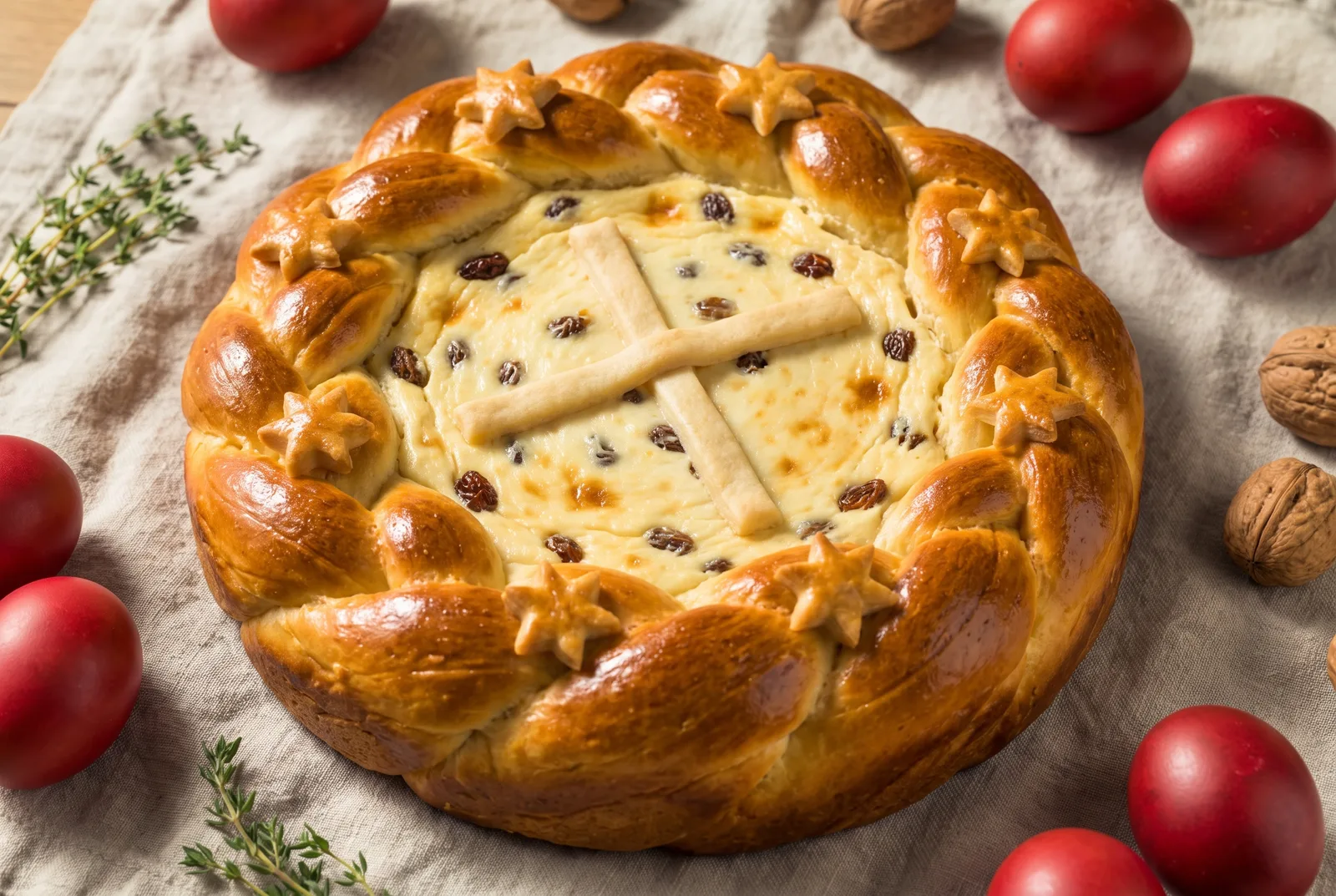
Pască, colaci and ritual breads: the Orthodox liturgical calendar's baking demands
For a Romanian bakery, the Orthodox church calendar is the production calendar. The year turns on a family of ritual breads, each with a fixed form, a fixed meaning and a fixed moment: pască at Easter, colivă and colaci for the dead, the colac de mireasă at weddings, round colaci at Christmas caroling, and — running quietly through every single Sunday — prescură, the bread of the Eucharist. Get these right, in the right week, and a UK Romanian community will treat your counter as home. This dossier takes the authentic detail from native Romanian ethnographic and Orthodox sources and wires every step to the ingredients you actually order. See the hero spread and the calendar wheel below.
Bread is sacred. In Romanian tradition „pâinea este fața lui Hristos" — bread is the face of Christ. Crumbs are burned or left for the birds, never trodden underfoot or thrown away, and a ritual bread marks every beginning: the start of field work, a new house, a baptism, a wedding, and even a funeral — understood as the beginning of another life (c1). This is the frame for everything below.
Names and diacritics. Romanian names are kept with their diacritics (ă, â, î, ș, ț) and glossed in English on first use. The same bread often carries several regional names; getting them right is what signals authenticity.
1. The ritual-bread year at a glance
Five breads do most of the work (see the calendar wheel and the table below):
- pască — the round, cross-topped sweet-cheese Easter bread; the food-icon of the Resurrection.
- prescură (pl. prescuri) — the small, round, leavened Eucharistic bread stamped IS-HS-NI-KA.
- colivă — the boiled-wheat memorial dish for the dead.
- colac (pl. colaci) — the all-purpose ritual/gift bread: weddings, births, Christmas, and the commemoration of the dead.
- cozonac — the festive enriched sweet loaf that shares pască's dough (its own dossier: B4-cozonac-enriched-dough).
They cluster around two poles of the year: Easter (pască, cozonac) and the cult of the dead (colivă, colac, prescură), with weddings and Christmas adding their own colaci. The rest of this dossier takes them in that order.
2. Pască: the food-icon of the Resurrection
Pască is the most important bake of the Romanian Easter — „coptura cea mai importantă" — made from carefully chosen clean wheat, sifted fine (c2). Its name comes from Hebrew Pesach (Passover) via Latin/Greek Pascha; Christian tradition re-reads the Passover lamb, bread and wine with new, salvific meaning centred on Christ, and pască is called „dulcele Învierii" — the sweet of the Resurrection — and, after the red egg, the food-icon of the Resurrection (c8).
The form carries the theology (see the construction diagram below). The most common pască is round, because the swaddling cloths in which the infant Christ was wrapped were believed to be round; a rectangular, four-cornered form („în 4 cornuri") stands for the square/rectangular tomb; the braided edge is broken by little dough stars (steluțe), and the central dough braid is a cross — the Cross of the Crucifixion (c3). This symbolism is documented by the ethnographer S. F. Marian and in Antonescu's dictionary.
When it is made and blessed. Pască is baked on Joia Mare (Holy Thursday), Vinerea Seacă (Good Friday) or — most commonly — Sâmbăta Paștelui (Holy Saturday) (c2). It goes to church in the Easter basket (coșul de Paști) — with red eggs, cozonac, cheese, lamb, salt and wine — to be blessed during the Resurrection service (the priest reads the "Prayer for the blessing of cheese and eggs on Holy Pascha"), and the blessed foods are the first eaten after the fast, after the anafură (c7). See the reference image below. Old beliefs cluster around it: if the Easter dough rises and bakes well the year will be bountiful, while dough that fails to rise is read as an omen of a death in the house (Muntenia, Suceava) (c5); and a piece of the pască is kept until St George's day (23 April) — „Paștele vitelor", the cattle's Easter — then fed to the livestock so they stay healthy and the cows give more milk (Suceava) (c6). In some Moldovan villages pască is also baked for St George, the Ascension (Ispas) and Pentecost (Rusalii) (c4).
3. Making pască — dough, filling and the cross
The pască dough is the cozonac dough: a rich, egg-yolk-and-butter, high-sugar enriched dough (c32). Everything the Pillar A craft says about sweet doughs applies here — use an osmotolerant yeast against the sugar (A2-osmotolerant-yeast-enriched-doughs), develop the gluten before adding the butter (A2-yeast-fermentation-science, A8-enriched-dough-formulas), and control the final proof and oven so the enriched crumb sets without drying (A5-proofing-science, A5-baking-oven-science). The full cozonac treatment is in B4-cozonac-enriched-dough; the sourdough alternative (maia) in B4-maia-and-sourdough-tradition.
A working baker's-% dough and the cheese filling are in the formula cards below. In short: flour 100%, milk ~21%, fresh yeast ~4.3%, egg yolks ~20%, sugar ~23%, melted 82% butter ~17%, salt ~1%, plus lemon zest and vanilla (c11) — a genuinely rich dough, so lean on the baker's-% method in A8-bakers-percentage-fundamentals when you scale (A8-scaling-and- yield-conversion).
The filling is what makes it pască: well-drained brânză de vaci (sweet cow's-milk curd cheese) — 350 g per ~350 g dough — with sugar (~150 g), 2 eggs, ~80 ml sour cream (smântână), raisins (~50 g, soaked in rum), vanilla and lemon zest; a little semolina (griș) sets a wetter cheese (c12). The curd-cheese handling is the same discipline as Polish twaróg cheesecake — see B1-sernik-polish-cheesecake.
Assembly (see the construction diagram below): roll a round base, ring it with a twisted/braided border dotted with
steluțe, pour in the filling, lay the dough cross over the centre, egg-wash and bake at ~180 °C
for ~50 minutes total, foiling the edge if it colours too fast (c13). Fault-finding — dense dough, a
weeping or sinking filling, a cross that loses definition, sinking raisins — is in the
pasca-ritual-bread-faults table.
Regional and fasting styles
Customers ask for different pască (see the figure below and pasca-regional-styles):
- Moldovan / Bucovinian — the classic: rich cozonac dough, a generous fatty cheese-and-rum-raisin filling, often with sour cream; the braided ring and cross. Bucovina sometimes makes it plain (no braids) but very creamy (c10).
- Transylvanian / ardeleană — cheese often set with griș, sometimes tin-baked; the ornament vocabulary overlaps the Colac Mare / Stolnic tradition (§6).
- Muntenia / southern — glossy egg-washed; modern shops also sell a breadless baked-cheese pască and chocolate/fruit variants.
- Pască de post (Lenten) — egg-free and dairy-free for those keeping the fast to the last moment: oil for fat, and fruit/nut/poppy fillings instead of cheese. This is the domain of B4-cozonac-de-post-vegan-baking.
4. Prescură: the bread of the Eucharist
Prescură (pl. prescuri) is a small, round, leavened wheat bread used to prepare Holy Communion — per Antonescu (citing Șăineanu), „pâinișoară sfințită, de obicei în formă de cruce, din care se pregătește cuminecătura și se taie anafura" — a small consecrated bread, usually cross-shaped, from which the Communion is prepared and the anafură is cut; by extension, a kind of colac distributed at funerals and parastases (c16). Its centre is stamped with a pecete (seal) using a carved wooden tool, the pistornic, imprinting a cross in a square with the letters IS · HS · NI · KA — „Iisus Hristos Biruitorul", Jesus Christ Conquers (c14). See the figures below for a reference photo of real prescuri and the stamp.
A doctrinally important point for a baker: the Orthodox prescură is leavened (aluat dospit) — a plain wheat-and-water bread with no fat, sugar or egg — which is precisely why the Orthodox tradition sits apart from the unleavened azyme of the Latin/Roman-Catholic rite. The leaven links it to B4-maia-and-sourdough-tradition. An indicative lean dough is given in the formula card below purely to show the contrast with the enriched pască — prescură is normally baked by parish prescurărese, not on a commercial line.
At the Proscomidia (the preparation of the Gifts before the Liturgy) five prescuri are used
(prescura-proscomidie): from the 1st the priest cuts the Agneț (the Lamb — a cube bearing the
IS-HS-NI-KA seal, representing Christ); from the 2nd, a triangle for the Mother of God; from the
3rd, nine triangles for the ranks of saints; from the 4th, particles for the living
(the hierarch, clergy, names); from the 5th, the miride for the departed commemorated; and the
remaining bread is cut into Anafură (antidoron), the blessed bread shared with everyone at the end
of the service (c15).
5. Breads for the dead: colivă, colac and the commemoration calendar
The cult of the dead is the other great driver of ritual baking, and it repeats on a fixed schedule — so it is steady, recurring business, not a once-a-year peak.
Colivă — boiled wheat (grâu), or pearled barley (arpacaș) as a stand-in — is the indispensable memorial dish, brought alongside a colac and prescuri (c17). Its symbolism is explicit and scriptural: the boiled wheat is the body of the deceased and the pledge of resurrection — „după cum bobul de grâu, ca să încolțească și să aducă roadă, trebuie să fie îngropat întâi în pământ" (as the grain of wheat must first be buried to sprout and bear fruit), a direct reference to John 12:24 and 1 Corinthians 15:36; the sweet aromatics stand for the virtues and the sweetness of eternal life, and the wine poured over colivă and the grave signifies the myrrh used to anoint Christ's body (c18). The method: boil the wheat soft, rest it covered overnight, then mix with sugar, ground walnuts („cu multă nucă" — a defining Romanian trait), lemon zest and vanilla; mound and level it, dust with ground biscuits and icing sugar, and mark a cross of cocoa or coloured sweets. See the figure below.
The commemoration schedule (commemoration-schedule; see the figure below) is what a supplier should plan
around: 3, 9 and 40 days after death, then 3, 6 and 9 months, 1 year, and yearly to 7 years;
plus the Saturdays of the dead (sâmbetele morților / Moșii) in the calendar (c19). At each, colivă, a
colac mare (large colac) and a candle are taken to church (the calendar Moși connect to
B4-mucenici-and-calendar-pastries). In parts of the south, funeral colaci are called generically
„capete" (heads), each named after a figure from Christian history, an echo of ancient sacrifice-
offerings (Antonescu, citing Mircea Eliade) (c20). There is even pomana de viu — alms given while still
living — in Oltenia and western Muntenia, where a person hosts a meal and gives colaci in their own
lifetime so the gift is "received" in the world beyond (c19).
6. The colac across the life-cycle: weddings, births, Christmas
The word colac is Old Church Slavonic in origin — from kolo, wheel/circle — which is exactly why the bread is round (cognates: Bulgarian kolač, Serbo-Croatian kolač, Russian kalač) (c21). It is the most versatile ritual bread, and its meaning shifts with the occasion (see the figure below).
- Weddings. The centrepiece is the colac de mireasă (bride's colac), also stolnic (Hunedoara, Gorj), colac de nuntă (Gorj, Dolj, Olt), colac înstruțat de nuntă (Bistrița), colac românesc (Cluj), jimblă/păpușă (Bacău) or ploconul miresii (Ilfov). It is broken over the bride's head before the wedding — by the godmother (nașa) in Oltenia, Muntenia and Moldova, by the bride herself in Transylvania. Its braid (împletitura), sometimes finished with dough birds, flowers or fresh basil (busuioc), reads as a fertility symbol, and an X sign often marks it (c22).
- The Colac Mare / Stolnic. Each household makes a large festive bread of 4-6 kg, made „ca soarele și ca luna" — like the sun and the moon — in Bucovina, called Stolnic in Transylvania and Oltenia; it is decorated with dough bars, little flowers and dough birds (Maramureș), its food value subordinate to its artistic and symbolic value (c23).
- Births. At the colăciune (the party at the godparents'), the parents bring colaci; small round colăcei are given to the midwife (moașă) and godmother — the still-current phrase „se dau colacii" marks the moment of giving gifts (c1, c22).
- Christmas. Ritual colaci are made round, like the sun and moon; in Bucovina/Moldova a "tied" figure-of-eight loaf is kept until spring, blessed and eaten in the field before the first furrow (or set between the oxen's horns) to ensure the soil's fertility; and carolers (colindători) are rewarded with apples, nuts, colaci or money (c24). This is the Romanian corner of the wider festive-baking picture — compare Poland's Easter and Christmas calendar in B1-seasonal-festive-baking and the parallel Easter breads of the Balkans, B6-kozunak-enriched-bread and B6-ritual-breads-pitka-pogacha.
7. Flour and ingredients: the reality for a UK Romanian baker
A Romanian baker thinks in the 000 / 550 / 650 / 1250 flour system. The practical crosswalk to the
catalogue (see flour-choice-ritual) is: enriched pască/cozonac/colac de mireasă → white Type 550 (or
500); prescură and lean colaci → a cleaner, slightly stronger Type 550/750; filling set / colivă
grain → semolina (griș) and pearled/whole wheat. The Romanian flour numbering itself (and its national
norm) is treated in B4-flour-classification-romanian, with the universal decode in
A1-flour-classification-systems; for choosing strength for an enriched dough see
A1-wheat-flour-types-by-application and A1-protein-gluten-and-strength.
From the first-party datasheets on file:
- White flour Type 550 (fortified): ash 0.51-0.58%, wet gluten 28-32% (protein 11.5-12.5%), gluten index 75-99, falling number ≥220 s, moisture max 15%, 5-month shelf; allergen gluten (traces soy/lupine/mustard); some batches carry ascorbic acid (E300)/enzymes (c25). A medium-strong white flour — enough gluten to carry the eggs, butter and sugar and hold the plait and the cross. Note the Romanian 000/550/650 → catalogue Type mapping is an approximate ash-based crosswalk, not a legal equivalence, and confirm E300/enzyme presence per delivered batch for correct additive/allergen declaration (c25).
- Fresh yeast (Benevia): S. cerevisiae, dry matter >29%, activity 125 ± 10 ml CO₂, store 1-10 °C, 35-day shelf; no Big-14 allergens present (sulphites only in the production molasses) (c26). Keep long-life dried yeast on hand for the Easter peak.
- Unsalted butter 82%: fat min 82%, water 16%, 744 kcal/100 g, contains milk; 0-10 °C for max 60 days or frozen (c27) — the enrichment fat; grade and type theory in A4-butter-grades-and-specialist-types and A4-fat-types-and-selection.
- White sugar:≥99.7% sucrose, GMO-free (c28). Raisins/sultanas: raisins 99.5% + a little vegetable oil, moisture 13-16%, aflatoxin B1 max 2 ppb (at the EU direct-consumption limit), 12-month shelf, no allergenic ingredients used — but check the pack, as some sultana lines are sulphited (SO₂ is declarable at ≥10 mg/kg) (c29). Ochratoxin A — verify per batch: the datasheet quotes OTA max 10 ppb, which is the superseded Reg 1881/2006 figure; the current EU maximum for dried vine fruit is 8 ppb (Reg (EU) 2023/915, and lower still — ~2 ppb — for ready-to-eat), so a 10 ppb spec is not automatically "within limits" today — confirm the delivered batch against the level in force (c29).
Data caveat. The two catalogue "curd cheese" products carry misfiled spec PDFs (the attached files are actually a rapeseed dough-divider oil and a plain-flour sheet), so no first-party datasheet is cited for the brânză-de-vaci filling — treat it generically (a drained, low/medium-fat fresh curd, twaróg/quark-style) and fix the catalogue mapping.
8. Buy the ingredients: the Domson catalogue for a Romanian ritual-bread line
All available in our catalogue; see the products at the end of this article. In short:
- Enriched dough (pască, cozonac, colac de mireasă): Domson / Komplexmłyn Wheat Flour Type 550, White Flour Type 500; Fresh Yeast Benevia (Lesaffre) and Dried Yeast Fermipan Red for the peak; Unsalted Butter 82%; Whole Egg / Egg Yolk Liquid (or Liquid Egg Eifix); Granulated / Caster Sugar; optional Ireks Global Yeast Doughnut Concentrate or Ireks Mella Brioche Mix to stabilise a high-sugar dough at scale.
- Cheese filling (brânză de vaci): Cheesecake Curd Cheese (Polmlek / Kaliski) as the curd base, or the ready Figand Profesja Plus / Vanilla Curd Cheese Filling for volume; Mascarpone for a creamier set; Wheat Semolina (Manna / Krupczatka) to firm a wet filling; Turkish Raisins / Sultanas (soaked in rum); lemon and vanilla.
- Prescură / lean colac: Bread Flour Type 750 or Type 550, fresh yeast, fine salt — nothing else.
- Colivă: whole/pearled wheat (the ritual grain), Walnuts (generously) or Walnut Filling, Granulated Sugar (or honey), Icing Sugar and cocoa to finish, ground biscuits, coloured sweets for the cross.
- Finishing: Icing Sugar CP (dusting), Candied Orange Rind for aromatic enriched doughs, egg for the wash.
9. Allergen & food-safety summary
A pască/ritual-bread counter brings several of the Big-14 allergens together at once: cereals containing gluten (all doughs), egg (dough, egg wash, cheese filling), milk (butter, sour cream, curd cheese) and tree nuts (walnuts in colivă and some fillings). Add the flour's precautionary soy/lupine/ mustard traces and possible sulphites on some sultana lines, and drive a formal per-product allergen matrix under UK/EU FIC (Reg 1169/2011); filled items sold prepacked need full ingredient lists with the 14 allergens emphasised (PPDS / "Natasha's Law") (c30).
Before you rely on any of this for production, note the following:
- Food safety. The pască is baked (~180 °C / ~50 min), so a heat step does exist — the risk is not a "missing kill step" but a thick egg-and-dairy filling that must reach a safe centre temperature, and then post-bake recontamination and ambient holding of a perishable dairy product: cool baked pascas rapidly and cold-hold, and keep the raw filling and any sour cream chilled throughout. Boiled-wheat colivă must be cooled promptly and refrigerated (cooked cereal held warm/ambient is a Bacillus cereus / heat-stable-toxin risk, exactly like cooked rice) and not left overnight at room temperature in a commercial setting. Rum-soaked raisins add alcohol that is mostly — but not entirely — baked off, so do not represent the product as alcohol-free. Follow your HACCP plan (c31).
- Respect.Prescură, colivă and pomană colaci are religious offerings — supply them in line with local parish practice, and do not represent or handle the consecrated Gifts.
- Provenance of the historical claims. Regional attributions and the "≥1,600-year" bread-and-cheese pască claim are devotional/ethnographic, cited to their Romanian sources, and should be presented as such rather than as settled historical fact (c9).
Figures
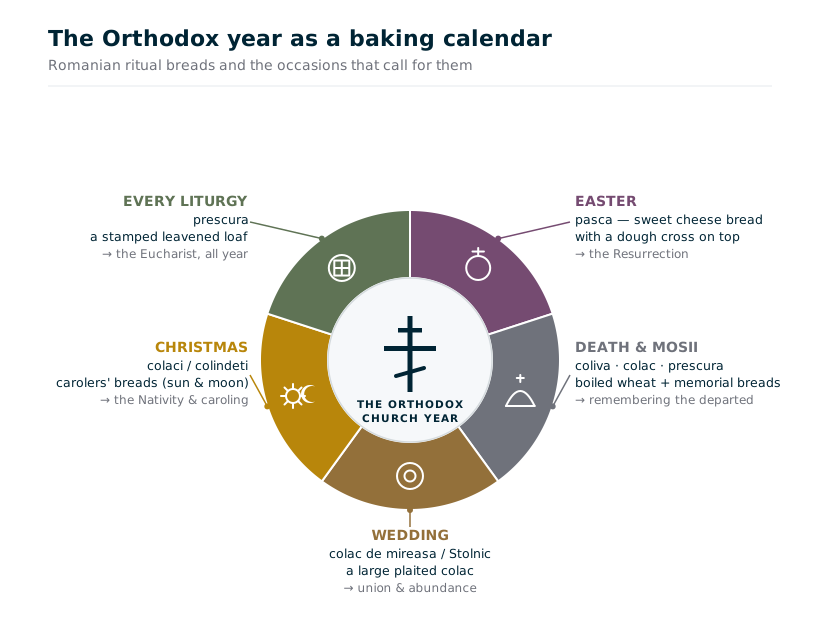 Circular calendar diagram linking pasca, coliva, colac, prescura and Christmas colaci to their occasions in the Orthodox year
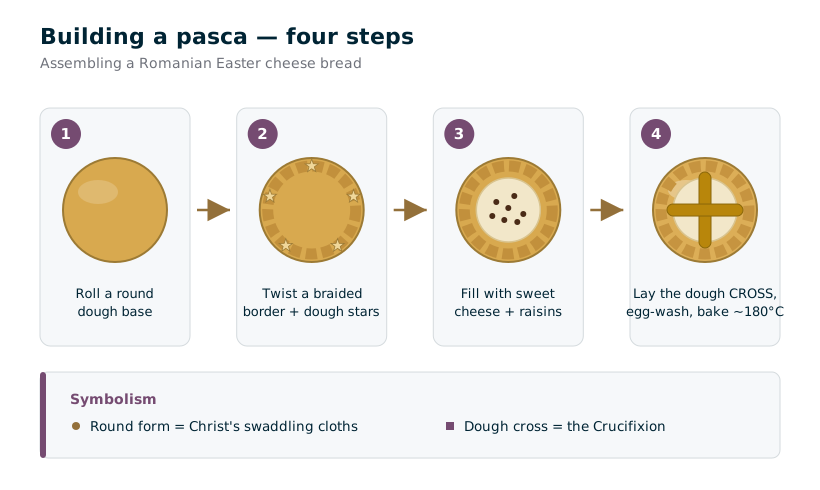 Four-step diagram: dough base, braided border, cheese filling, dough cross - assembling a Romanian pasca
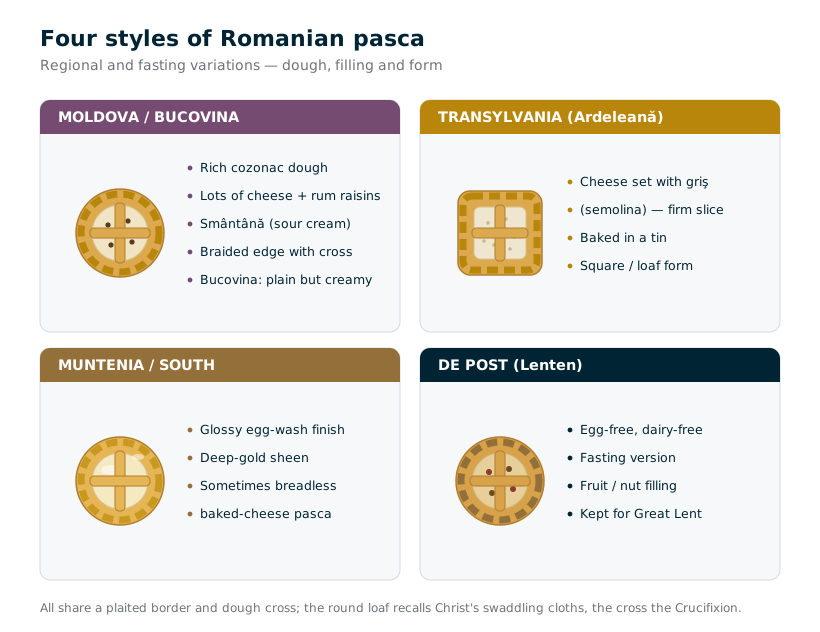 Four-way comparison of Moldovan, Transylvanian, Muntenian and Lenten (de post) pasca styles
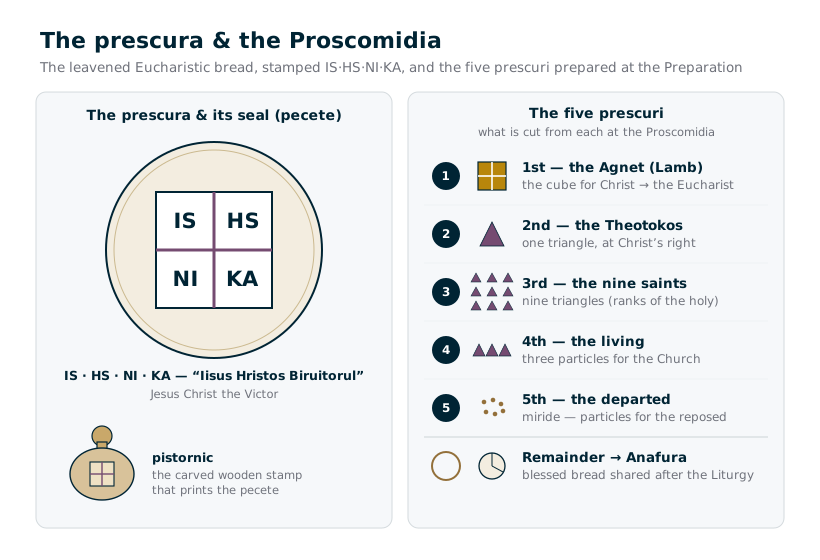 Diagram of a prescura with the IS-HS-NI-KA seal and a chart of the five prescuri used at the Proscomidia
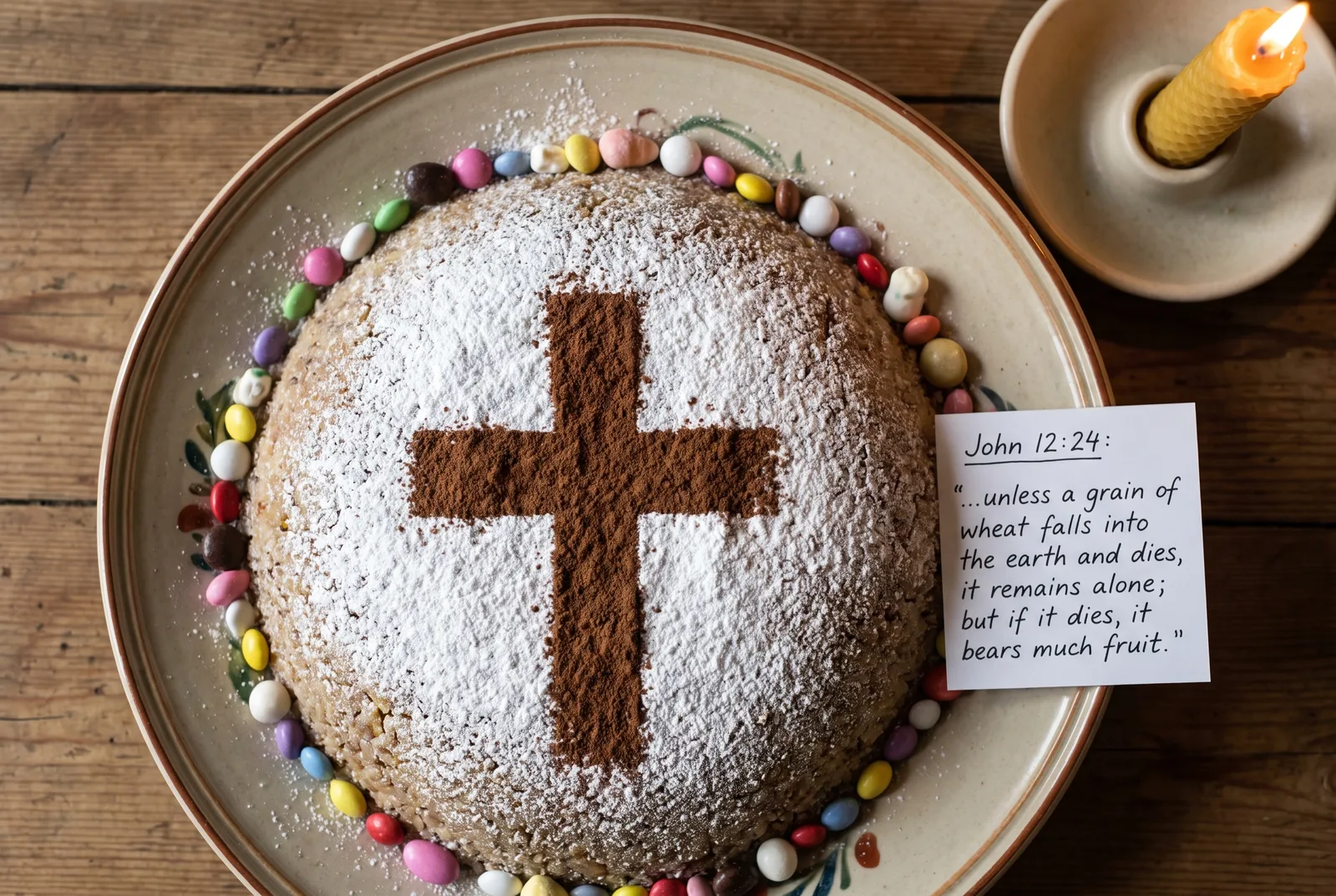 Plate of Romanian coliva - boiled wheat with walnuts, dusted and marked with a cocoa cross
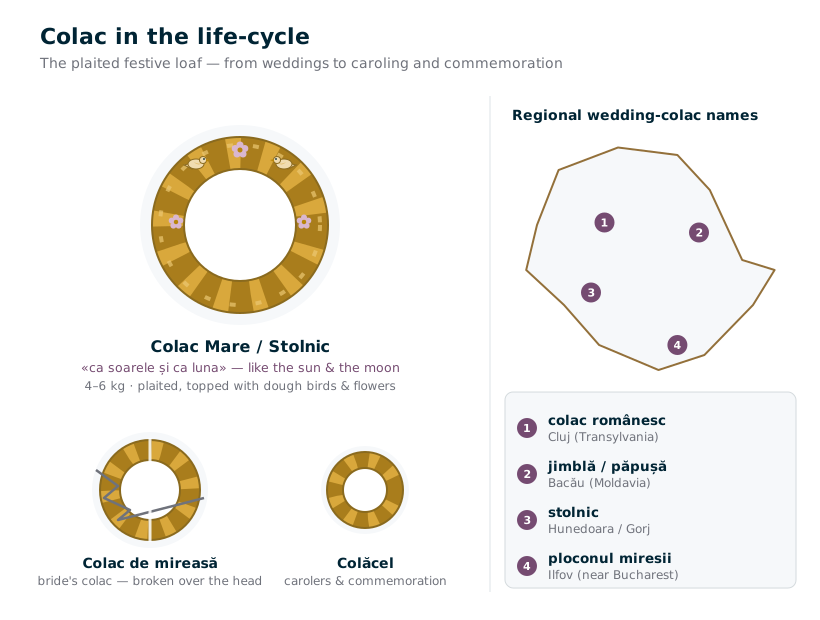 Illustration of Romanian colaci: a large plaited Colac Mare/Stolnic, a bride's colac, and small colacei, with regional name labels
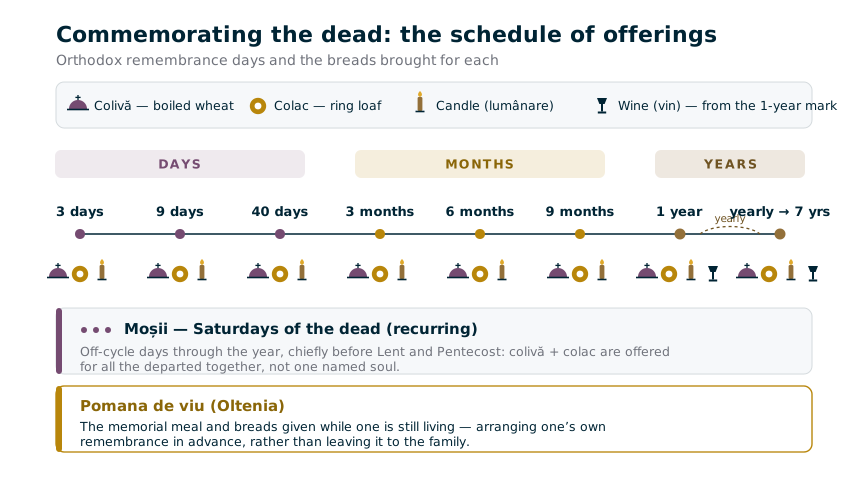 Timeline of Orthodox death commemorations (40 days, months, years, Mosii) with coliva and colac offerings
Pasca enriched (cozonac-type) dough - working formula
| Ingredient | Baker's % | Weight |
|---|---|---|
| White wheat flour (Type 550 / 500) — medium-strong white flour; Romanian 000/550 | 100 | |
| Milk (warm) — adjust 1-2 tbsp to a soft, supple dough | 21 | |
| Fresh yeast — or ~1.5% instant dried; bloom fresh yeast with a little sugar | 4.3 | |
| Egg yolks — ~4 yolks per 350 g flour; yolks give colour and richness | 20 | |
| Sugar — high sugar - an osmotolerant yeast helps at scale | 23 | |
| Butter (82%, melted) — added after the gluten is developed | 17 | |
| Salt | 1 | |
| Lemon zest + vanilla — flavour; some add rum or orange zest | 0 |
Yield: One ~22-23 cm pasca (about 10 portions); scale linearly
Pasca sweet cow's-cheese filling (umplutura de branza dulce)
| Ingredient | Baker's % | Weight |
|---|---|---|
| Branza de vaci (well-drained sweet cow's-milk curd cheese) — twaróg/quark-style fresh curd; press through a sieve | 350 | |
| Sugar — to taste | 150 | |
| Whole eggs — ~2 large eggs; sets the filling | 100 | |
| Sour cream (smantana) — for creaminess; optional | 80 | |
| Raisins — soaked in ~4 tbsp rum (drain before use) | 50 | |
| Semolina / gris (optional) — to set a wetter cheese | 30 | |
| Vanilla + lemon zest — flavour | 0 |
Yield: Fills one ~22-23 cm pasca
Coliva (boiled-wheat memorial dish)
| Ingredient | Baker's % | Weight |
|---|---|---|
| Wheat (grau) - or pearled barley (arpacas) — the ritual grain; rinse well; Ratio: 1 part grain | ||
| Water — boil the grain soft, then rest covered overnight; Ratio: ~3-4 parts | ||
| Sugar (or honey) — sweetens; symbolises the sweetness of eternal life; Ratio: to taste | ||
| Ground walnuts — 'cu multa nuca' - a defining Romanian trait; Ratio: generous | ||
| Lemon zest + vanilla — aromatics; Ratio: to taste | ||
| Ground biscuits + icing sugar (finish) — dusting; then a cross of cocoa or sweets; Ratio: surface |
Yield: One large commemorative dish
Prescura (Eucharistic bread) - lean leavened dough (indicative)
| Ingredient | Baker's % | Weight |
|---|---|---|
| White wheat flour (Type 550 / 750) — clean, slightly strong white flour | 100 | |
| Water (warm) — to a firm, workable dough that holds the seal | 55 | |
| Yeast (fresh) — traditionally leavened - not azyme | 1.5 | |
| Salt | 1.5 |
Yield: Several small round prescuri
| Bread | Romanian name(s) | Occasion | Form / decoration | Leaven | Core meaning |
|---|---|---|---|---|---|
| Easter cheese bread | pasca | Easter (Invierea Domnului); also St George, Ascension, Pentecost in Moldova | Round (swaddling cloths) or rectangular 'in 4 cornuri' (the tomb); braided edge with stelute; central dough cross | Yeast (enriched cozonac dough) | Food-icon of the Resurrection; blessed at church, first food after the fast |
| Eucharistic bread | prescura (pl. prescuri) | Divine Liturgy, year-round; funerals/parastase | Small round loaf; central pecete stamped with the pistornic: IS-HS-NI-KA | Yeast (leavened wheat dough) | Body of Christ; source of the Agnet and the Anafura |
| Boiled-wheat offering | coliva | Funerals and all commemorations of the dead; Saturdays of the dead | Levelled dome; ground biscuits + icing sugar; cross of cocoa/sweets | None (boiled grain) | Body of the deceased + resurrection (John 12:24) |
| Memorial / gift bread | colac (pl. colaci); colac mare / Stolnic | Death commemorations, weddings, births, Christmas caroling | Round; plaited (impletitura); dough birds/flowers/basil; X sign; big 4-6 kg 'like the sun and moon' | Yeast | Continuity; a bridge to the world beyond; fertility and social gift |
| Bride's bread | colac de mireasa / stolnic / ploconul miresii | Wedding | Large plaited ring, richly ornamented | Yeast | Fertility and the bride's new duty; broken over the bride's head |
| Christmas bread | colac de Craciun / colindeti | Christmas Eve caroling; New Year | Round 'like the sun and moon'; figure-of-eight tied loaf kept for spring ploughing | Yeast | Abundance, fertility of the soil; reward for carolers |
| Style | Dough | Filling | Shape / finish | Notes |
|---|---|---|---|---|
| Moldovan / Bucovinian | Rich risen cozonac dough (egg yolks, butter, sugar) | Generous fatty branza de vaci with raisins in rum, lemon zest, often sour cream | Round ring + central dough cross; braided edge with stelute | The 'classic' pasca; more cheese and raisins; Bucovina sometimes plain (no braids) but very creamy |
| Transylvanian / Ardeleana | Enriched dough, sometimes lighter | Sweet cheese, often with semolina/gris to set; raisins | Round; plaited edge; may be baked in a tin | Local ornament vocabulary overlaps the Colac Mare / Stolnic tradition |
| Muntenia / southern | Enriched dough | Sweet cheese; sometimes a plain (breadless) baked cheese 'pasca' | Round with cross; egg-washed glossy | Modern shops also sell chocolate or fruit variants |
| Pasca de post (Lenten) | Egg-free, dairy-free enriched dough (oil for fat) | No cheese - fruit, nut, poppy or apple fillings; or plain marked bread | Round with cross | For those keeping the fast to the last moment; see B4-cozonac-de-post-vegan-baking |
| Prescura | What is cut | Commemorates |
|---|---|---|
| 1st | The Agnet (Lamb) - a cube bearing the IS-HS-NI-KA seal | Christ (placed on the diskos, later consecrated) |
| 2nd | One triangle | The Mother of God (Theotokos) |
| 3rd | Nine small triangles | The ranks of saints |
| 4th | Three particles | The living: the hierarch, clergy and other names |
| 5th | Miride (particles) | The departed being commemorated |
| Remainder | Cut into Anafura (antidoron) | Blessed bread shared with the faithful at the end of the Liturgy |
| When | Offering brought to church | Note |
|---|---|---|
| 3rd, 9th and 40th day | Coliva + colac (colac mare) + candle; prescura for the priest | The 40th day is the major early parastas |
| 3, 6 and 9 months | Coliva + colac + candle | Continues the cycle through the first year |
| 1 year, then yearly to 7 years | Coliva + colac + wine | Wine = the myrrh of Christ's anointing |
| Saturdays of the dead (Mosii / sambetele mortilor) | Coliva + colaci shared for all the family's departed | Calendar days of general commemoration; ties to B4-mucenici-and-calendar-pastries |
| Pomana de viu (Oltenia, W. Muntenia, Chioar) | A meal + colaci given while still living | So the gift is 'received' in the other world |
| Use | Romanian type (approx.) | Catalogue equivalent | Why |
|---|---|---|---|
| Pasca / cozonac / colac de mireasa (enriched) | faina 000 / 550 | Wheat Flour Type 550 (fortified); White Flour Type 500 | Medium-strong white flour: enough gluten to carry eggs, butter and sugar and hold the plait and cross |
| Prescura, lean colac, plain ritual bread | faina 650 | Bread Flour Type 750; Type 550 | A clean, slightly stronger white bread flour for a firm crumb that takes the pecete/braid cleanly |
| Filling set / coliva alt grain | gris (semolina) | Wheat Semolina (Manna / Krupczatka T450) | Semolina sets a wetter cheese filling; pearled/whole wheat is the coliva grain |
| Fault | Likely cause | Fix |
|---|---|---|
| Pasca dough dense, poor rise | Sugar/fat added too early or too cold; weak flour; over-salted near yeast; slow ferment | Develop gluten before butter; use medium-strong Type 550 and an osmotolerant yeast; warm proof; keep salt off the yeast |
| Cheese filling weeps / sinks / cracks | Filling too wet; not enough egg/semolina to set; oven too hot; underbaked centre | Drain the curd well; add egg and a little gris; moderate the oven; bake until the centre is set, foil the edge if browning |
| Dough cross or braided border loses definition | Border proved too long; dough too soft; egg wash too heavy | Shape from slightly firmer reserved dough; prove just under full; egg-wash thinly for a clean gloss |
| Pale, no gloss on the edge | No/late egg wash; oven too cool | Egg-wash the border (yolk + water) before and after adding the cross; ensure the oven is at ~180 C |
| Raisins sink / burst | Not drained after the rum soak; too much soaking liquid in the filling | Drain and lightly flour the raisins; fold in last |
| Coliva sticky/gummy or, conversely, hard | Grain overcooked to paste, or undercooked/underrested | Boil the wheat just soft, rest covered overnight; loosen with a little of its cooking liquid if stiff |
| Prescura seal (pecete) unreadable after baking | Dough too slack or over-proved; stamp too shallow; oven too hot | Use a firm lean dough, stamp deep, prove briefly, bake moderate so the imprint holds |
| Pasca stales fast / dries | Lean-ish dough, under-enriched, over-baked | Keep the butter/yolk enrichment up; do not over-bake; wrap once cool - see A5-shelf-life-and-staling |