
Calendar of Polish festive baking: Fat Thursday pączki, Easter mazurek & babka, Christmas makowiec
A working baker's calendar of the Polish festive year — what the trade expects on the bench for Tłusty Czwartek (Fat Thursday), Wielkanoc (Easter) and Boże Narodzenie (Christmas), and how to produce it authentically. It walks the three peak seasons in order: the deep-fried pączki and faworki of Fat Thursday; the Easter triad of yeast babka, shortcrust mazurek and baked sernik; and the Christmas makowiec, piernik and keks. Each product is tied to its cultural meaning (why rose-petal jam, why poppy seed, why six joined circles), to the craft concepts in Pillar A (osmotolerant yeast, frying fats, shortcrust, fillings), and to the specific Domson supplier brands a Polish baker actually orders. Built on twelve first-party supplier spec sheets (Zeelandia Berliner mix, kajmak, honey-cake mix and white-poppy-walnut filling; Lesaffre Benevia yeast; AKO and Floramex poppy; Martin Braun plum filling; Vortumnus rose marmalade and candied peel; Chelmer ground almonds; ACOR cinnamon) cross-checked against Polish-language cultural, trade and academic sources (gov.pl traditional-products register, Mistrz Branży, the Toruń Gingerbread Museum, NCK, and the mamz.pl vocational almanachs).
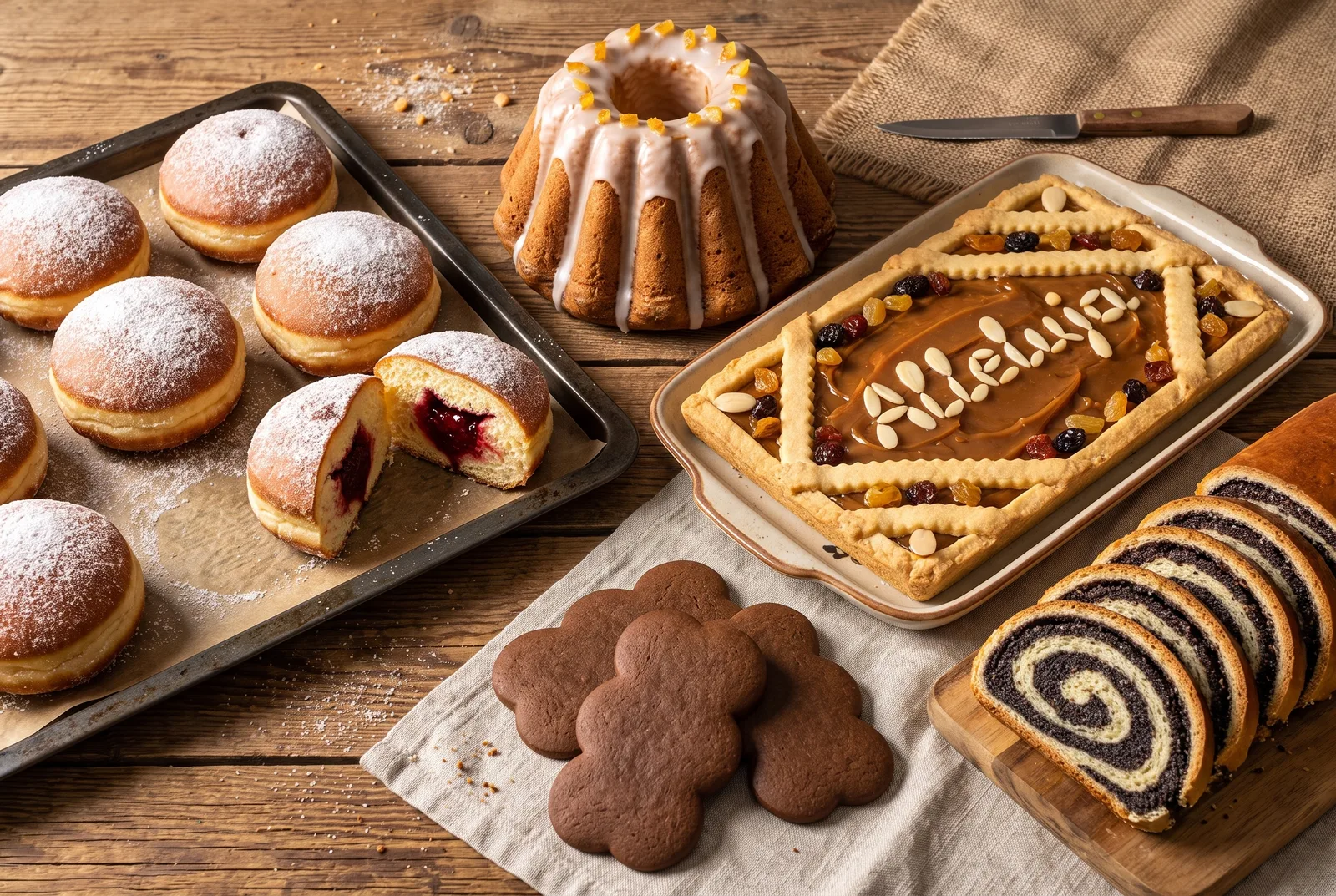
Calendar of Polish festive baking: Fat Thursday pączki, Easter mazurek & babka, Christmas makowiec
In a Polish bakery the year is not measured only in seasons — it is measured in bakes. There are three peaks when a piekarnia and cukiernia sell more in a few days than in an ordinary month, and on each the customer arrives with a precise, centuries-old expectation of shape, filling and finish. Get the cultural detail right and you own the season; get it wrong and the customer simply walks to the bakery that didn't. This dossier is the calendar a Polish baker carries in their head, written down: what to make for Tłusty Czwartek (Fat Thursday), Wielkanoc (Easter) and Boże Narodzenie (Christmas), why it matters, and which Domson supplier brands put it on the bench. See the figure below for the year at a glance.
Each product here has a deeper dedicated dossier — pączki in B1-paczki-and-deep-fried-pastry, poppy fillings in B1-makowiec-and-poppy-seed-fills, the Easter shortcrust in B1-mazurek-and-short-pastry, cheesecake in B1-sernik-polish-cheesecake and gingerbread in B1-piernik-gingerbread. This article is the map that ties them to the calendar and to the catalogue.
1. The festive year in one table
Three seasons dominate, plus the steady drumbeat of name-days, weddings and All Saints. The full breakdown is in the comparison table below (Polish festive baking calendar), and the timeline diagram is below.
| Season | When | Signature bakes | Defining finish |
|---|---|---|---|
| Tłusty Czwartek (Fat Thursday) | Last Thursday before Lent — 52 days before Easter; 12 Feb 2026 | pączki, faworki (chrust), oponki | Sugar dust, icing, the pale frying ring |
| Wielkanoc (Easter) | Holy Week → Easter Sunday | babka wielkanocna, mazurek, sernik, chałka | White/pink icing; "Alleluja" décor; lattice |
| Boże Narodzenie (Christmas) | Advent → Wigilia (24 Dec) | makowiec, piernik, keks, sernik | Poppy spiral; spiced glaze; candied fruit |
Two cross-cutting rules a Polish baker takes for granted: festive enriched doughs are high-sugar, high-fat and therefore need the osmotolerant-yeast and enriched-dough handling covered in A2-osmotolerant-yeast-enriched-doughs and A8-enriched-dough-formulas; and every festive line is allergen- dense (wheat everywhere, plus egg, milk, tree nuts), so the allergen discipline in §6 is not optional (c32).
2. Tłusty Czwartek — the deep-fried week
The day. Fat Thursday is the last Thursday before Lent, falling 52 days before Easter — in 2026 it lands on 12 February (c1). It is the single biggest doughnut day in Europe: a well-known Polish folk custom holds that eating at least one pączek on Fat Thursday brings good fortune for the year (c2). For a bakery this is a volume event — plan dough, fat and filling capacity around it.
What the customer expects. A pączek (plural pączki) is a round, filled, deep-fried yeast doughnut — richer and rounder than a Berliner, traditionally rolled in caster sugar or finished with a thin fondant/lukier and a candied-orange fleck. The benchmark of a well-made pączek is the pale ring around its equator — the jasna obwódka or kołnierzyk — which forms only when the doughnut floats correctly and is turned at the right temperature (c7). See the figure below.
The two technical tricks (both in B1-paczki-and-deep-fried-pastry):
- A splash of spirit. A small amount of spirytus, rum or vodka in the dough measurably reduces fat uptake — the alcohol (ethanol boiling at 78°C) flashes off ahead of water, shortening the steam-replacement window during which oil is absorbed into the dough, and speeds surface browning (c5). This is established craft practice; the precise mechanism from trade sources is not peer-reviewed food science but the fat-reduction effect is widely observed.
- Temperature control. Fry at about 175°C (170–180°C); oil that is too cool lets the dough drink fat and stay pale (c6). The Zeelandia Berliner Complete mix datasheet specifies frying at 180°C for 6–8 minutes, turning twice (c8) — see the frying diagram below. Fat choice and smoke point are covered in A4-frying-fats-and-oils.
Filling — get the tradition right. The classic pączek filling is rose-petal jam (konfitura z płatków róży / powidła różane) — its perfume is the signature of a "proper" Polish pączek (c4). Plum jam (powidła śliwkowe), advocaat (adwokat), and budyń/pastry cream are regional and modern variants. Pipe filling after frying through the side, using a stuffer tip.
A note on history. Sweetened, sugar-dusted pączki only spread in Poland in the 16th century; older pączki were fried in lard (smalec) and could even be savoury, stuffed with bacon (słonina) (c3). Alongside pączki, Fat Thursday also means faworki (chrust, "angel wings") — thin fried-dough ribbons dusted with icing sugar.
Buy it (Domson): the Zeelandia Berliner Complete mix (G22221) is the workhorse base; the Berliner 10% Improver Free (G22786) and Berliner 2500 Premix (G24408), Ireks Global Yeast Doughnut Concentrate (G44208) and Backaldrin Doughnut & Yeast Dough Concentrate (G25695) are alternatives. Leaven with Lesaffre Benevia fresh yeast (G25216) — fresh compressed yeast, dry matter >29%, 35-day chilled shelf life, store at 1–10°C (c10). Fill with GIL Rose Hip Confectionery Jam (G25155) or the rose-flavoured marmalade (G25205), Martin Braun Śliwidło plum filling (G22044) or Helcom plum jam (G25388). Finish with icing sugar (G25350), Vortumnus Sugar Fondant (G22135) and PGD Candied Orange Rind (G22145).
3. Wielkanoc — the Easter bench
Easter is the broadest of the three seasons because the święcone (blessed Easter breakfast) and the święconka basket call for several distinct items at once. Three define the cukiernia window: babka, mazurek and sernik (with chałka from the piekarnia side). The Easter spread is shown below.
3a. Babka wielkanocna — the tall yeast cake
Babka entered Polish baking in the 17th century and is baked in a fluted (karbowana) truncated-cone mould, often with a central chimney, then glazed with white or pink icing (c16). It is a high-enrichment yeast dough — eggs, butter, sugar, frequently raisins and candied peel — leavened from a milk-based starter (rozczyn). The crumb is tender and draught-sensitive: folk custom warns against slamming the oven door (c17), which encodes a real truth — a high-enrichment, high-proof crumb collapses easily. This is enriched-dough craft: see A8-enriched-dough-formulas, A2-osmotolerant-yeast-enriched-doughs and the proof control in A5-proofing-science; the dedicated piece is B1-enriched-yeast-doughs.
Buy it: flour T550 base; Lesaffre Benevia yeast (G25216); PGD Candied Orange Rind (G22145); vanillin sugar (G22469); finish with fondant/lukier (G22135) and icing sugar (G25350).
3b. Mazurek — the Easter shortcrust tart
Name and origin. Mazurek takes its name from Mazur, an inhabitant of Mazowsze (Mazovia) — literally "a Mazovian cake" (c11). It became a regular Polish Easter bake in the 17th century, symbolising the end of Lent, and its roots are sometimes traced to Ottoman/Turkish confectionery (c12; note: this is one popular narrative in Polish food writing — some food historians attribute the style to broader Middle Eastern trade-route influence and no single external origin is universally accepted) — a nice cross-link to B2-turkish traditions.
The build. A crumbly shortcrust (kruche ciasto) base — flat, thin, structurally sound — edged with a piped dough rope or a lattice (kratka), then flooded with a topping and decorated before it sets with nuts and candied/dried fruit, often spelling "Alleluja" (c13). The classic topping is kajmak (Polish dulce de leche): the Zeelandia kajmak datasheet gives pH 5.2–6.2, 69–72% solids, 44.5g sugar and 14.5g fat per 100g, a milk allergen with a 6-month shelf life (c14). Shortcrust and filling craft live in A6-pastry-creams-fillings and A6-marzipan-fondant-sugar-pastes; the deep dive is B1-mazurek-and-short-pastry.
Buy it: Zeelandia Kajmak (G22097), Gostyń (G25305) or Agart Classic Kajmak (G25335); Zeelandia Marzipan 50% (G25514) or Almond Paste (G23448); ground almonds (G44748) — the datasheet shows 612 kcal, 55.8g fat, 21.1g protein per 100g, a tree-nut allergen (c15); whole almonds (G43057); candied orange (G22145); plum/fruit jams (G22044, G25388) for fruit mazurki.
3c. Sernik — the baked cheesecake
Sernik is anchored to Easter (and present year-round) and lives or dies on the twaróg (curd cheese) — its fat content and grind decide the texture; the Kraków style (sernik krakowski) carries a shortcrust lattice top (c31). Full treatment in B1-sernik-polish-cheesecake.
Buy it: OSM Bieruń Cheesecake Curd Cheese Wykwintny (G25302), Polmlek 14% (G23305) or Figand Profesja Plus curd filling (G25255); vanillin sugar (G22469); candied peel (G22145).
4. Boże Narodzenie — the Christmas table
4a. Makowiec — the poppy-seed roll
Why poppy. Makowiec (regionally makownik or strucla z makiem) is a core Christmas Eve (Wigilia) bake; the Wigilia table traditionally carries 12 dishes — one traditional folk explanation associates them with the 12 Apostles; other accounts point to the 12 months or the 12 fruits of the earth (c19). Poppy seed is not decoration — it is symbol: abundance, fertility and prosperity, and (through its sleep-inducing nature) the boundary between life and death; eating poppy at Christmas is meant to bring the family good fortune (c20).
The technique that fails most bakers. Poppy seed must be scalded/cooked and ground before sweetening — this releases flavour and avoids bitterness — and the filling's moisture must be balanced so it does not leak from the yeast casing during baking (c21). The figure below shows the target spiral. The full method is in B1-makowiec-and-poppy-seed-fills.
Buy it (three routes, by labour):
- From raw seed: Floramex White Poppy Seeds (G23506) — ~41.5g fat/100g, water ≤10%, must be thermally processed before use (c23); Agart Blue Poppy Seeds (G22031). Grind and cook in-house.
- From concentrate: AKO Poppy Seed Dry Filling (G24113) — 40% ground poppy, reconstitute 1000g + 100g crumbs + 600g water (c22); fast and consistent.
- Ready filling: Prospona Poppy Seed Paste (G22025), Polmarkus Poppy Seed Cake (G22299), or Zeelandia's cooked white-poppy-and-walnut filling (datasheet SAP G22573) — 20% white poppy, 10% walnuts, ≥60% dry matter, declares wheat and walnut allergens, may contain peanuts (c24).
4b. Piernik — the spiced honey cake
Heritage. Toruń gingerbread (piernik toruński) has been made for at least ~600 years, with the first written record from 1380 (c25). The famous katarzynki — six joined circles — are named after St Catherine of Alexandria (feast 25 November), the traditional opening day of the Toruń Christmas-gingerbread season (c26).
What makes it authentic. Real piernik is built on honey and a warm spice blend — cinnamon, ginger, cloves, cardamom, nutmeg, anise, pepper — and is matured/rested (leżakowanie), historically for weeks to months (an Old-Polish custom even kept dough for years), to develop flavour and a moist crumb (c27). Honey's fructose is what keeps the crumb soft for weeks; this is honey chemistry, not a shortcut. Full treatment in B1-piernik-gingerbread.
Buy it: Ratos Natura Multifloral Honey (G23652) or Artificial Honey (G23512); PGD Ground Cinnamon (G23892) — moisture ≤16%, may carry trace celery/mustard/SO₂ (c29); Rolmex Mixed Spice Euro Blend (G23128) and cinnamon sticks (G25586); Martin Braun Śliwidło plum filling (G22044) for layered piernik przekładany — 50% plum, 35°Bx, pH 3.5, bake-stable, 210-day shelf life (c30); finish with Zeelandia chocolate/sugar gingerbread decorations (G25598, G25596). Convenience caveat: the Zeelandia Honey Cake Mix (Ciasto Miodowe EU, G23673) is a fast miodownik base — 1000g mix + 500g oil + 500g eggs, bake 180°C for 40–50 min — but it contains only 0.2% honey and is a honey-flavour product (c28); for an authentic piernik staropolski use real honey and a long rest.
4c. Keks and sernik
The Christmas table also expects keks (fruit cake, heavy with candied peel and raisins — buy PGD candied orange G22145) and, again, sernik. These round out the season.
5. Formula cards
Five house-typical formulas in baker's percentage, anchored to the cited spec recipes and the mamz.pl vocational almanachs (exact ratios vary by bakery): pączki yeast doughnut, makowiec enriched dough + poppy filling, mazurek shortcrust + kajmak, babka wielkanocna enriched dough, and piernik honey dough. Use them with the universal language of A8-bakers-percentage-fundamentals.
6. Food safety & allergens
These statements must be confirmed against the live supplier spec attached to each SKU (datasheet producer/name sometimes differs from the catalogue title — see verification notes).
- Allergens are dense and unavoidable. Wheat/gluten is in every item; egg and milk in most; tree nuts (almond in mazurek, walnut in poppy fillings) and soya in many fillings; sesame cross-contact is common. The Berliner mix alone declares wheat, egg, soya and milk (c9). Build and display allergen statements per EU Reg 1169/2011 (c32). See the figure below.
- Raw poppy seed must be thermally processed before consumption (c23). EU Commission Regulation (EU) 2023/167 (amending Reg. (EC) No 1881/2006) sets maximum levels for the sum of morphine and codeine in poppy seeds intended for direct consumption; thermal processing is a recognised mitigation measure — confirm processing adequacy against the current MRL before placing product on sale.
- Cassia cinnamon coumarin risk (piernik). The ACOR ground cinnamon in the catalogue (G22066, SAP c29) is cassia (Cinnamomum cassia, origin Indonesia), which contains 1,000–10,000 mg/kg coumarin — far above the <50 mg/kg found in Ceylon cinnamon (C. verum). EU Commission Regulation (EC) No 1334/2008 (Annex III) sets maximum coumarin at 15 mg/kg in fine bakery wares, or 50 mg/kg for traditional/seasonal bakery wares bearing a cinnamon label. Piernik formulas using 2–3% cassia spice may approach or breach these limits. Recommended: use certified low-coumarin Ceylon cinnamon for regular production; if using cassia for a seasonal piernik, obtain lot-specific coumarin analysis from the supplier and label accordingly (c29).
- 'Piernik toruński' is a Protected Geographical Indication (PGI) under EU Regulation 1151/2012. Commercial use of this name on products not meeting the certified PGI specification — including origin in the Toruń region and defined production methods — is prohibited under EU 1151/2012 Art. 13. This dossier references piernik toruński for its heritage value only; do not use the name commercially unless your product meets the PGI specification (c25).
- Frying safety. Control frying-fat quality (replace degraded oil), fry to a safe internal crumb, and apply acrylamide mitigation best practices — temperature control and avoiding over-browning. Note: EU Reg 2017/2158 explicitly names biscuits, wafers and similar fine bakery wares; its precise scope for yeast-raised deep-fried doughnuts (pączki) is not explicit — apply the mitigation principles as good manufacturing practice and seek competent-authority guidance if needed (c33).
- Honey-flavour mixes and labelling. Convenience mixes such as the Zeelandia Ciasto Miodowe EU (G23673) contain only 0.2% honey and are honey-flavour bases. If a finished product is marketed to end consumers as "honey cake" or "ciasto miodowe", EU 1169/2011 Art. 22 may require a Quantitative Ingredient Declaration (QUID) for honey, and Art. 7 prohibits misleading information. Verify supplier labelling compliance before making consumer-facing claims (c28).
- UK allergen law. Bakeries operating in the UK must comply with the Food Information (Amendment) (EU Exit) Regulations 2019 (SI 2019/529) for general allergen labelling, and with Natasha's Law (in force October 2021) for prepacked-for-direct-sale (PPDS) foods — any festive bake made on-site and sold from the same premises must carry full ingredient and allergen labelling (c32).
- Cold chain. Kajmak and curd fillings are perishable: refrigerate after opening, hold finished dairy/egg products chilled, and use fresh yeast within its 35-day chilled life (c34).
7. Coverage report
Solid: the calendar structure and cultural/historical attributions (Fat Thursday date and luck custom; mazurek's Mazovian etymology and 17th-century Easter role; makowiec's Wigilia symbolism; piernik's 1380 record, katarzynki and leżakowanie) are each cited to Polish-language sources and mostly corroborated twice. Twelve first-party spec sheets give authoritative numbers for the headline ingredients.
Thin (finalized): the 1681 Sobieski/Marysieńka strucla anecdote has been removed (claim c35 retracted) — the CDN/Gdańsk University source cited does not contain this story, making it a mis-citation; the anecdote may circulate in popular Polish baking writing but lacks a verifiable primary source. Several single-source cultural/historical attributions (c3, c7, c12, c16, c17, c19, c20, c25, c26, c31) and the spirit-mechanism claim (c5) carry appropriate caveats. Sernik curd-cheese numbers could not be taken from a spec (the OSM Bieruń product_ref's on-disk PDF is a release oil) and rely on trade reporting plus the dedicated sernik dossier. The formula cards are house-typical syntheses, not single-source recipes.
Food-safety and regulatory flags added to §6 in finalization: cassia coumarin limits (EU Reg 1334/2008); PGI status of 'piernik toruński' (EU 1151/2012); UK Natasha's Law (SI 2019/529); EU poppy-seed opium-alkaloid MRLs (EU Reg 2023/167); honey-mix QUID and misleading-labelling risk (EU 1169/2011 Art. 7 and 22).
Follow-up runs: deepen each product in its dedicated B1 dossier; add verified Wikimedia/supplier photography for the finished-product images currently specified as originals; capture a clean twaróg spec for the sernik numbers; obtain lot-specific coumarin data for the cassia cinnamon SKU.
Figures
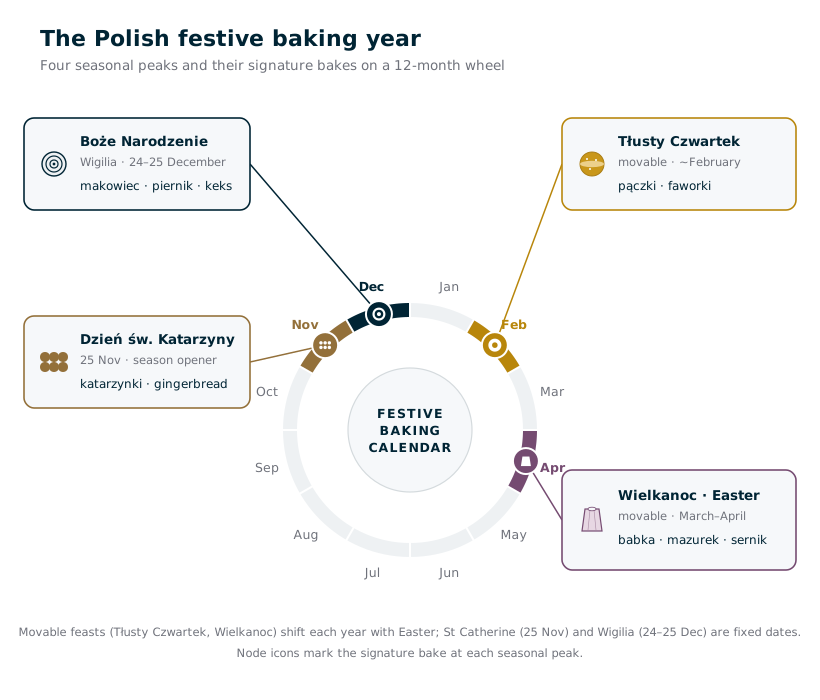 Year-wheel diagram of the Polish festive baking calendar with signature bakes per season
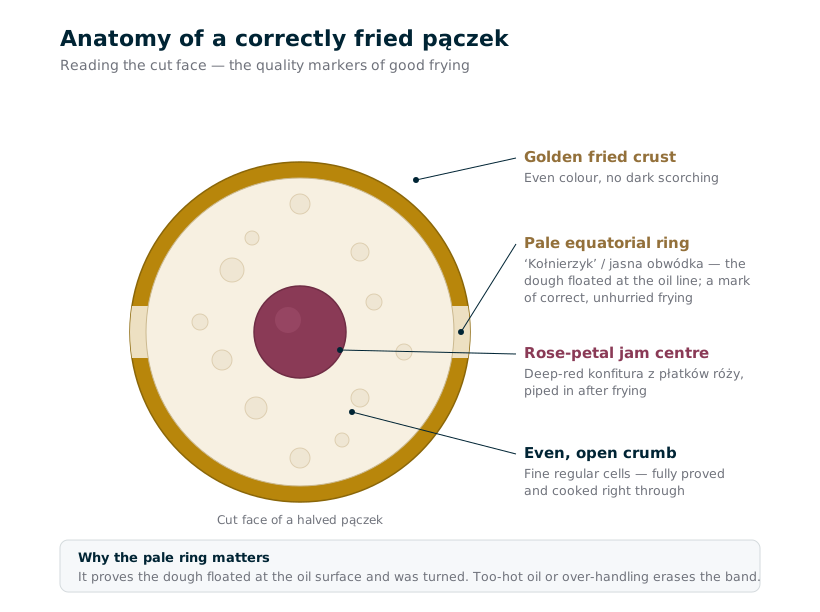 Cut pączek showing the pale frying ring and rose-jam filling
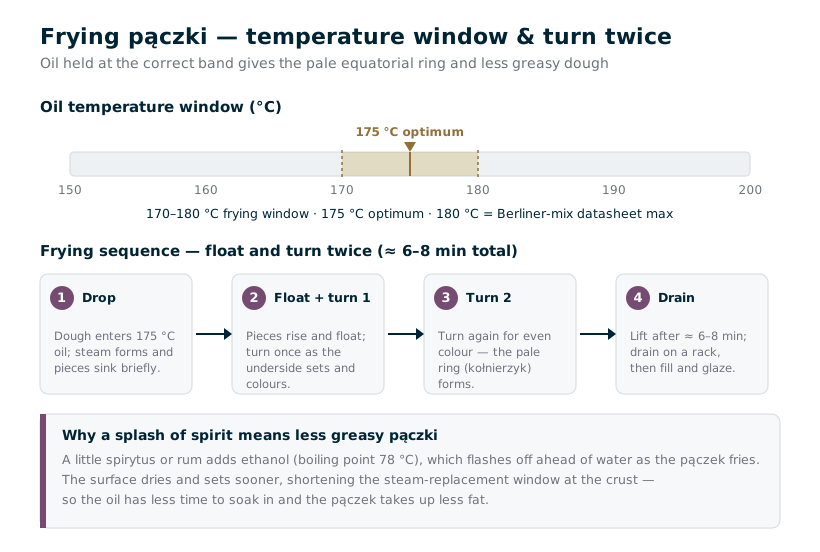 Diagram of pączki frying temperature window and turn-twice technique
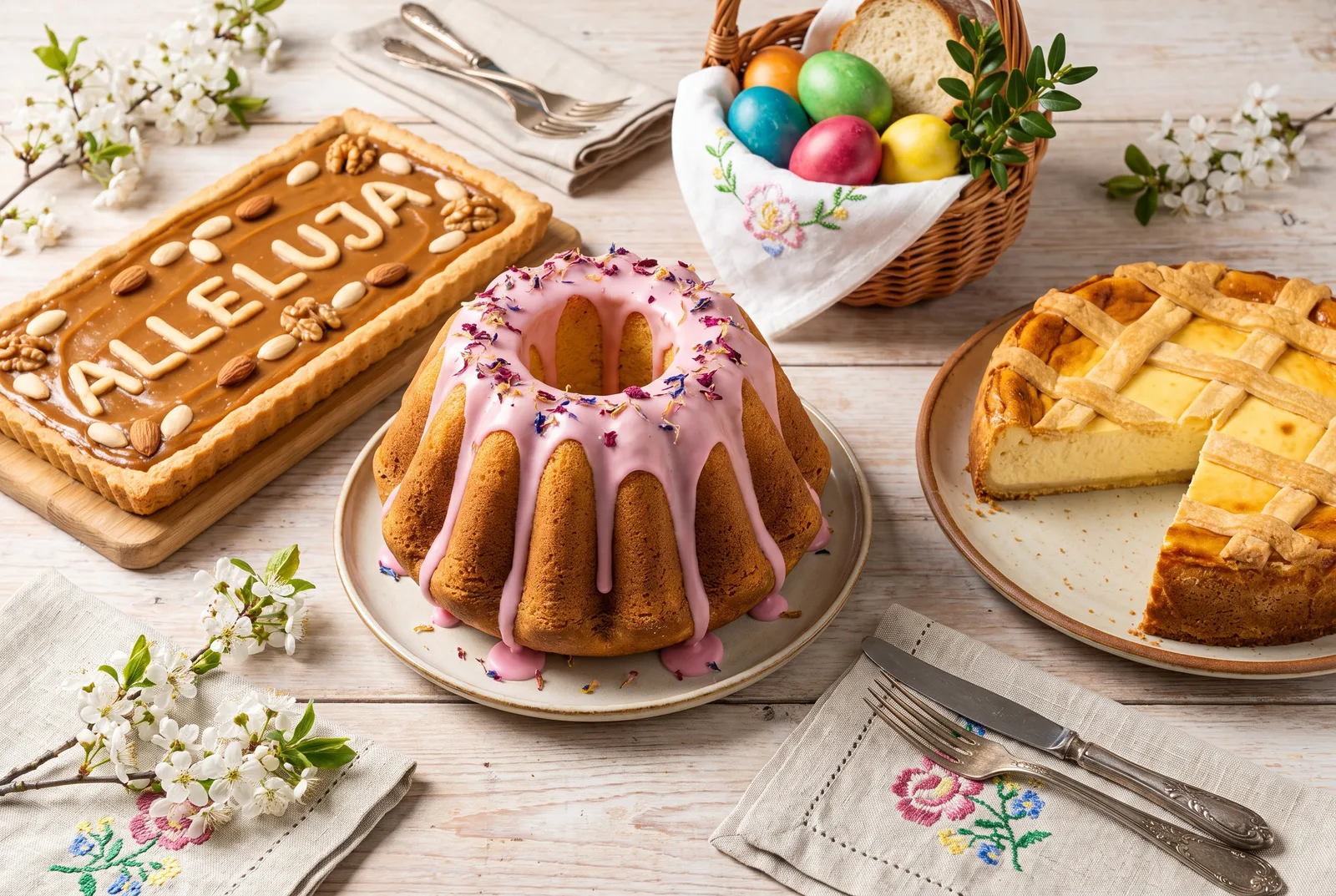 Polish Easter bakes: babka, mazurek and sernik with a blessing basket
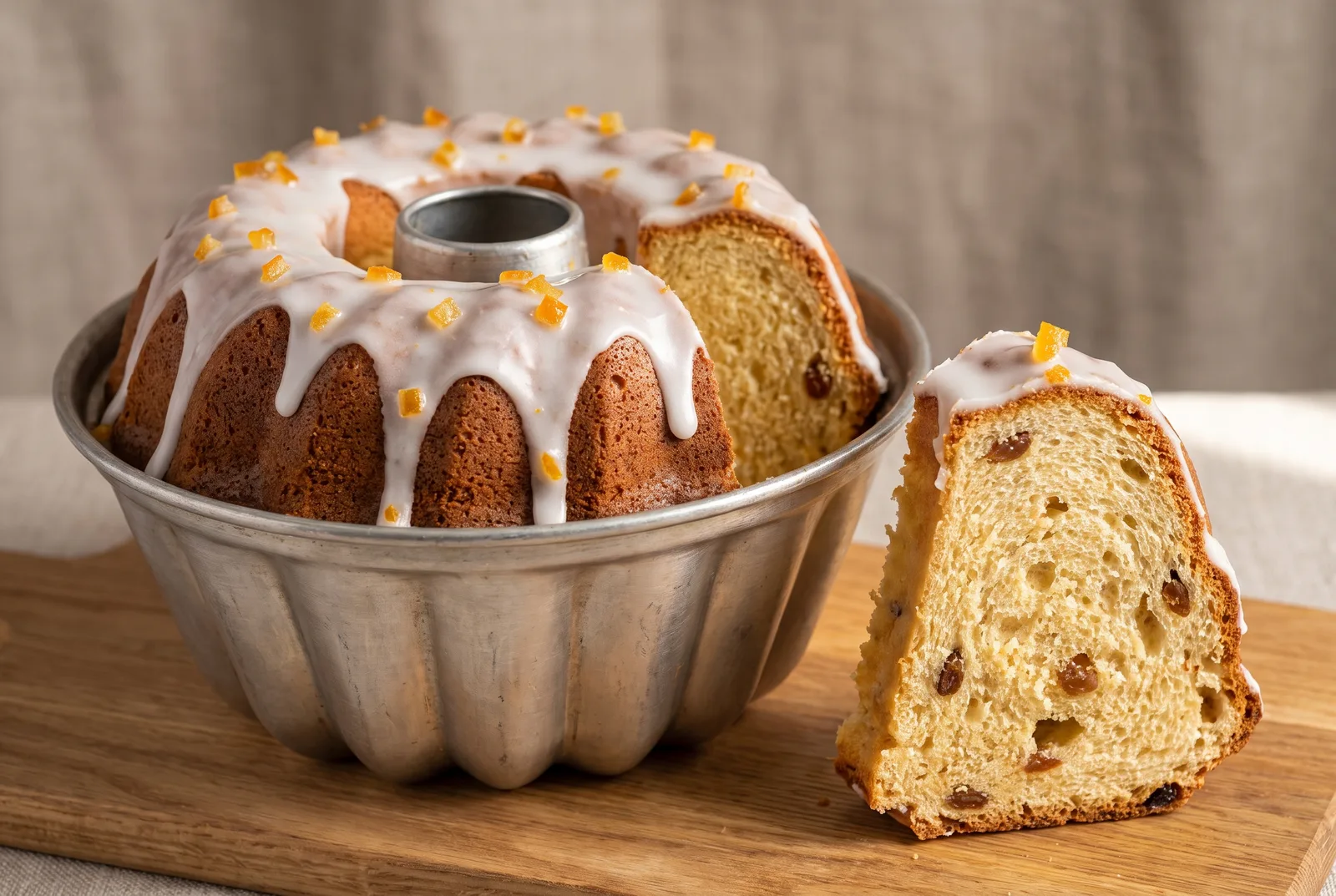 Tall fluted Easter babka glazed white with a tender crumb slice
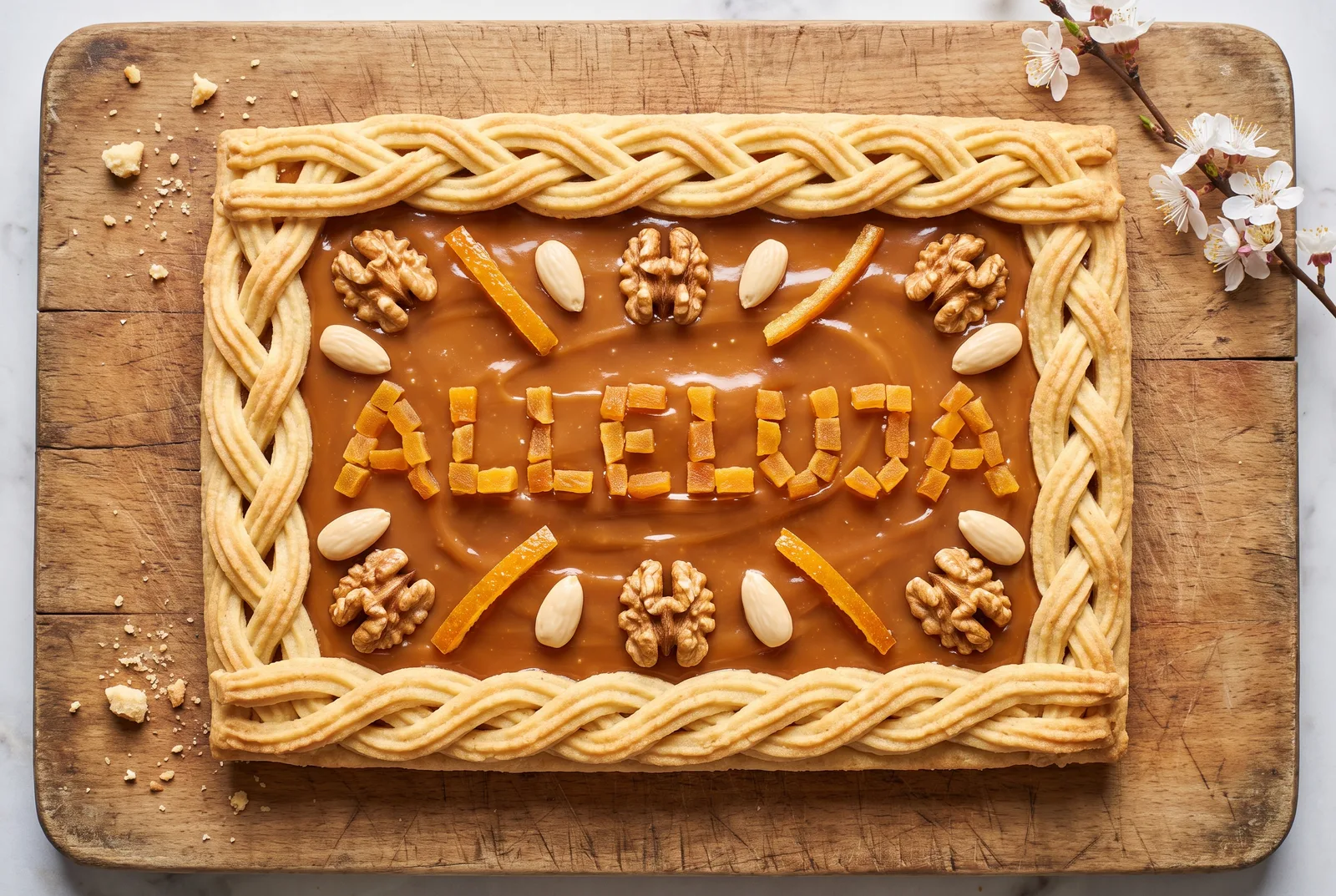 Decorated Easter mazurek with lattice edge, kajmak and nut decoration
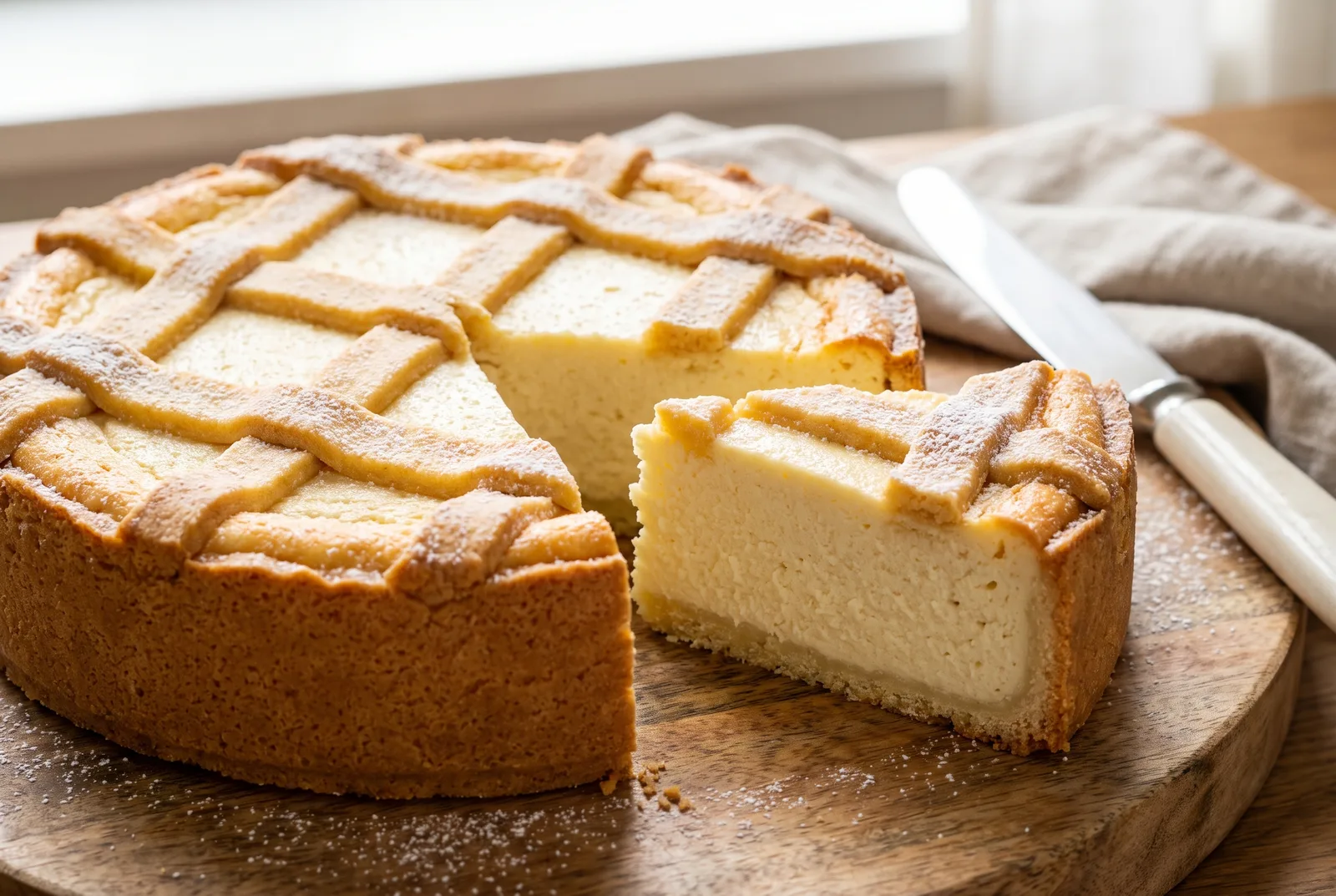 Baked Polish sernik krakowski with a lattice top and smooth curd crumb
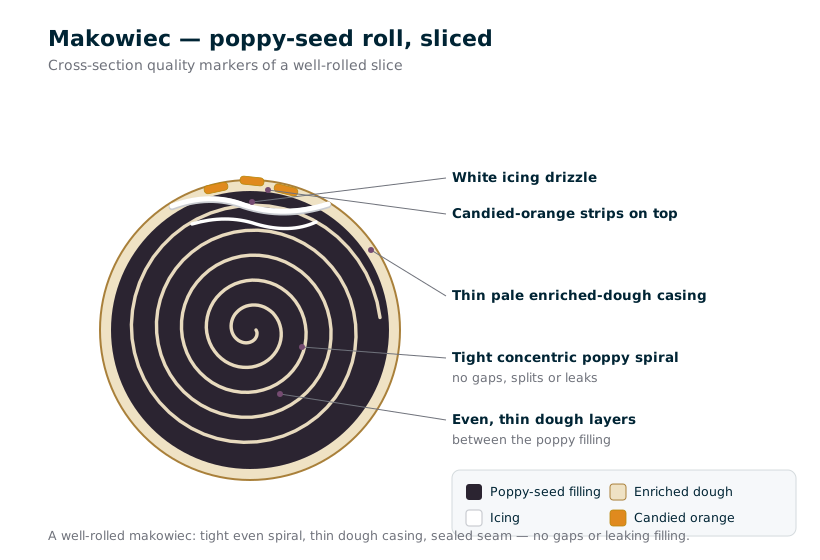 Sliced makowiec showing the tight poppy-seed spiral
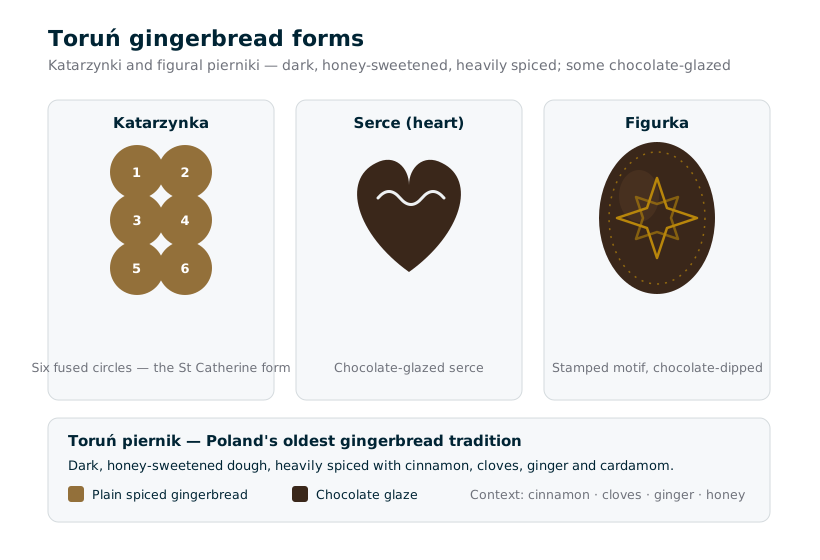 Toruń katarzynki six-circle gingerbread and figural pierniki
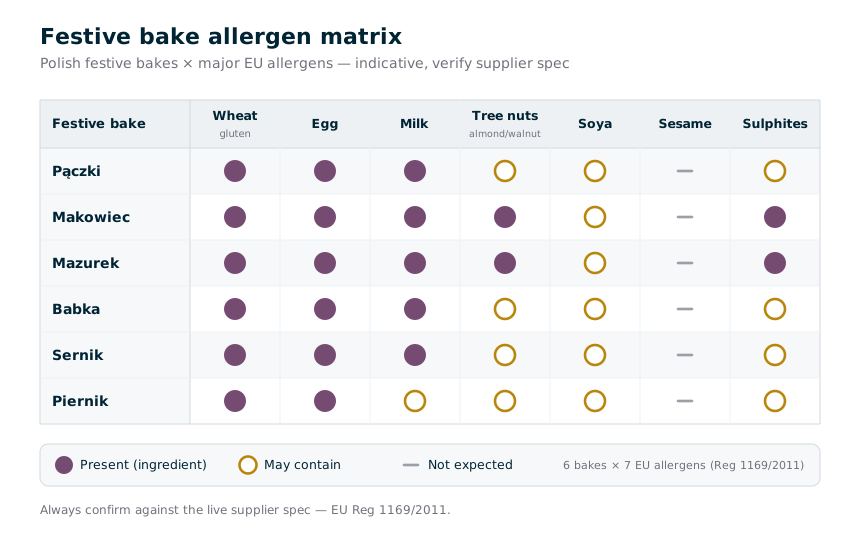 Allergen matrix of Polish festive bakes against major EU allergens
Pączki (Polish filled yeast doughnut) — house-typical baker's %
| Ingredient | Baker's % | Weight |
|---|---|---|
| Wheat flour (T550) | 100 | |
| Fresh yeast | 6 | |
| Sugar | 14 | |
| Butter / margarine | 12 | |
| Egg yolks | 16 | |
| Milk | 42 | |
| Spirit (spirytus/rum) | 3 | |
| Salt | 1 | |
| Vanilla / lemon zest | 1 |
- Develop a soft enriched dough (osmotolerant yeast helps); bulk-proof, divide ~50–60g, round, final-proof. Fry at ~175°C (mix datasheet: 180°C, 6–8 min, turning twice). Pipe rose-petal jam after frying; finish with caster sugar or fondant + candied orange.
Spirit reduces fat uptake (c5). Allergens: wheat, egg, milk. Fry to safe internal crumb; EU Reg 2017/2158 acrylamide mitigation (c33).
Makowiec (poppy-seed roll) — enriched dough + poppy filling
| Ingredient | Baker's % | Weight |
|---|---|---|
| Wheat flour (T550) — dough | 100 | |
| Fresh yeast — dough | 5 | |
| Sugar — dough | 15 | |
| Butter — dough | 12 | |
| Egg yolks — dough | 14 | |
| Milk — dough | 45 | |
| Salt — dough | 1 | |
| Ground cooked poppy — filling base | 100 | |
| Sugar/honey — filling | 60 | |
| Butter — filling | 20 | |
| Egg / semolina binder — filling | 15 | |
| Candied peel + nuts + raisins — filling | 40 |
- Roll enriched dough thin, spread balanced-moisture poppy filling to the edges, roll tight (spiral), proof, egg-wash, bake ~180°C. Filling moisture must be controlled so it does not leak (c21). Shortcut: AKO concentrate (1000g + 100g crumbs + 600g water) or ready paste.
Allergens: wheat, egg, milk, tree nuts (walnut), possible sesame/peanut. Raw poppy must be thermally processed (c23).
Mazurek — shortcrust base + kajmak topping
| Ingredient | Baker's % | Weight |
|---|---|---|
| Wheat flour — base | 100 | |
| Butter — base | 60 | |
| Icing/caster sugar — base | 33 | |
| Egg yolks — base | 20 | |
| Ground almonds (optional) — base | 15 | |
| Kajmak — topping — Applied as a layer over the baked base; pH 5.2–6.2 (c14) | 0 |
- Make a crumbly shortcrust; chill, roll flat and thin, dock, bake blind to pale gold. Edge with a piped dough rope or lattice (kratka). Spread kajmak (or marzipan/jam) and decorate with nuts and candied fruit BEFORE it sets (c13).
Base must be sturdy enough to carry a heavy kajmak/ganache top without buckling. Allergens: wheat, egg, milk; almond (tree nut) if used.
Babka wielkanocna — high-enrichment yeast dough
| Ingredient | Baker's % | Weight |
|---|---|---|
| Wheat flour (T550) | 100 | |
| Fresh yeast | 5 | |
| Sugar | 22 | |
| Butter | 22 | |
| Egg yolks | 35 | |
| Milk | 40 | |
| Raisins + candied peel | 25 | |
| Salt | 1 | |
| Vanilla | 1 |
- Build a milk-based starter (rozczyn); develop the enriched dough; proof in fluted mould; bake gently and do NOT slam the oven door (the crumb is draught-sensitive, c17). Glaze with white or pink icing (lukier).
See A8-enriched-dough-formulas and A2-osmotolerant-yeast-enriched-doughs. Allergens: wheat, egg, milk.
Piernik (Polish honey-spice cake) — honey dough
| Ingredient | Baker's % | Weight |
|---|---|---|
| Rye + wheat flour blend | 100 | |
| Honey | 45 | |
| Sugar | 20 | |
| Egg | 18 | |
| Butter / oil | 15 | |
| Spice blend (cinnamon, ginger, cloves, cardamom, nutmeg, anise, pepper) | 3 | |
| Leavening (soda / ammonium bicarbonate) | 1.5 | |
| Plum jam (przekładaniec layers) | 50 |
- Warm honey + sugar + spices, combine into dough; ideally rest/mature (leżakowanie) weeks before baking; bake ~170–180°C. Honey fructose keeps the crumb moist for weeks (c27). Layer with Śliwidło plum filling for piernik przekładany (c30).
Convenience route: Zeelandia Honey Cake Mix (1000g + 500g oil + 500g egg, 180°C 40–50 min) — but only 0.2% honey, a honey-FLAVOUR base (c28). Allergens: wheat, egg, milk.
| Season (PL) | Season (EN) | When | Signature bakes | Defining finish | Claim |
|---|---|---|---|---|---|
| Tłusty Czwartek | Fat Thursday | Last Thursday before Lent — 52 days before Easter; 12 Feb 2026 | pączki, faworki/chrust, oponki | Caster sugar / fondant; the pale frying ring (kołnierzyk) | c1 |
| Wielkanoc | Easter | Holy Week → Easter Sunday; święconka blessed on Holy Saturday | babka wielkanocna, mazurek, sernik, chałka, keks | White/pink icing; 'Alleluja' décor; shortcrust lattice | c16 |
| Boże Narodzenie / Wigilia | Christmas / Christmas Eve | Advent → Wigilia (24 Dec); 12 dishes (one trad. explanation: 12 Apostles; others: 12 months) | makowiec, piernik, sernik, keks | Poppy spiral; spiced glaze; candied fruit | c19 |
| Dzień św. Katarzyny | St Catherine's day | 25 November (opens Toruń gingerbread season) | katarzynki, pierniki | Sugar/chocolate glaze; six-circle shape | c26 |
| Filling | Polish name | Status | Domson product (SKU) | Note |
|---|---|---|---|---|
| Rose-petal jam | konfitura z płatków róży / powidła różane | Classic / benchmark | GIL Rose Hip Confectionery Jam (G25155); rose-flavoured marmalade (G25205) | The signature 'proper' pączek perfume (c4) |
| Plum jam | powidła śliwkowe | Traditional | Martin Braun Śliwidło (G22044); Helcom Plum Jam (G25388) | Bake-stable plum, 50% fruit, pH 3.5 (c30) |
| Advocaat | adwokat | Regional / modern | — | Egg-liqueur cream; popular in cities |
| Pastry cream / budyń | budyń / krem | Modern | Emix/Helios custard creams (cross-ref A6) | Custard-style; see A6-pastry-creams-fillings |
| Multifruit / marmalade | marmolada | Modern volume | Multifruit Doughnut Marmalade (G25205) | Cheaper high-throughput option |
| Route | Domson product (SKU) | Poppy content | Key spec | Allergens | Claim |
|---|---|---|---|---|---|
| Raw seed (grind + cook in-house) | Floramex White Poppy Seeds (G23506) | 100% seed | ~41.5g fat/100g, water ≤10%, must be thermally processed | (seed; process before use) | c23 |
| Raw seed (blue) | Agart Blue Poppy Seeds (G22031) | 100% seed | Classic dark makowiec colour | (seed) | — |
| Powdered concentrate | AKO Poppy Seed Dry Filling (G24113) | 40% ground poppy | 1000g + 100g crumbs + 600g water; 445 kcal/100g | Wheat; may contain gluten/soya/sesame/egg | c22 |
| Ready paste | Prospona Poppy Seed Paste (G22025); Polmarkus Poppy Seed Cake (G22299) | High | Ready to roll | Check live spec | — |
| Cooked poppy+nut filling | Zeelandia white-poppy-walnut (SAP G22573) | 20% poppy + 10% walnut | ≥60% dry matter, 368 kcal/100g | Wheat, walnut; may contain peanuts | c24 |
| Topping | Polish name | Domson product (SKU) | Note | Claim |
|---|---|---|---|---|
| Caramel / dulce de leche | kajmak | Zeelandia Kajmak (G22097); Gostyń (G25305); Agart (G25335) | pH 5.2–6.2, 69–72% solids, 44.5g sugar/100g, milk allergen | c14 |
| Almond / marzipan | masa migdałowa / marcepan | Zeelandia Marzipan 50% (G25514); Almond Paste (G23448); ground almonds (G44748) | Ground almonds 612 kcal, 55.8g fat/100g, tree-nut | c15 |
| Chocolate / ganache | czekolada | (cross-ref A6-pastry-creams-fillings) | Set firm to support décor | — |
| Fruit jam | marmolada / dżem | Plum Śliwidło (G22044); Helcom (G25388) | For fruit mazurki | c30 |
| Product (datasheet) | SAP/SKU | Energy/100g | Fat/100g | Sugar/100g | Key parameter | Shelf life | Claim |
|---|---|---|---|---|---|---|---|
| Zeelandia Berliner Complete mix | G22221 | 483 kcal | 26.2 g | 21.2 g | Fry 180°C 6–8 min; dough 26–28°C | 180 days | c8, c9 |
| Lesaffre Benevia fresh yeast | G25216 | 111 kcal | 1.8 g | 3.7 g | Dry matter >29%; store 1–10°C | 35 days | c10 |
| Zeelandia Kajmak (dulce de leche) | G22097 | 339 kcal | 14.5 g | 44.5 g | pH 5.2–6.2; 69–72% solids | 6 months | c14 |
| Ground blanched almonds (Chelmer) | G44748 | 612 kcal | 55.8 g | 4.2 g | 21.1g protein; moisture ≤6% | 12 months | c15 |
| AKO poppy-seed filling concentrate | G24113 | 445 kcal | 17.2 g | 51.4 g | 40% ground poppy; +crumbs+water | 6 months | c22 |
| Floramex raw white poppy seed | G23506 | 525 kcal | 41.5 g | 3 g | Water ≤10%; thermally process | per producer | c23 |
| Zeelandia white-poppy-walnut filling | G22573 | 368 kcal | 17.8 g | 37.2 g | 20% poppy + 10% walnut; ≥60% DM | 9 months | c24 |
| Zeelandia Honey Cake Mix (Ciasto Miodowe EU) | G23673 | 373 kcal | 1.0 g | 47.7 g | 0.2% honey; 1000+500 oil+500 egg; 180°C 40–50 min | 180 days | c28 |
| ACOR ground cinnamon (cassia) | G22066 | — | — | — | Moisture ≤16%; trace celery/mustard/SO₂ | per producer | c29 |
| Martin Braun Śliwidło plum filling | G22044 | 132 kcal | 0.11 g | 27.0 g | 50% plum; 35°Bx; pH 3.5; bake-stable | 210 days | c30 |
| Vortumnus candied orange peel 4×4 | G22145 | 261 kcal | 1.2 g | 52 g | 110g peel/100g; ≥60% extract; may contain sulphites | 12 months | c18 |
| Vortumnus rose-flavoured marmalade | G25205 | 224 kcal | 1.1 g | 47 g | ≥50% extract; apple-puree base | 8 months | c4 |
| Product | Fault | Likely cause | Fix |
|---|---|---|---|
| Pączki | Greasy, no pale ring | Oil too cool; no spirit in dough; over-handled | Hold ~175°C; add spirytus/rum; don't crowd the fryer (c5, c6, c7) |
| Pączki | Raw centre, dark outside | Oil too hot / pieces too large | Lower to 170–175°C; size pieces evenly; turn twice (c8) |
| Makowiec | Filling leaks / splits casing | Filling too wet; rolled loose; under-proofed | Balance filling moisture; roll tight; full proof (c21) |
| Makowiec | Bitter filling | Poppy not scalded/ground; old seed | Scald + grind fresh poppy before sweetening (c21) |
| Mazurek | Base buckles under topping | Base too thin/soft; not baked enough | Sturdy short pastry; bake to pale gold before topping (c13) |
| Mazurek | Décor slides off | Topping set before decorating | Decorate while kajmak/ganache is still tacky (c13) |
| Babka | Collapsed / dense crumb | Oven door slammed; under/over-proof; too rich | Gentle bake, no draught; control proof; balance enrichment (c17) |
| Sernik | Cracked / weeping top | Over-baked; wrong twaróg fat/grind; too much egg | Lower temp, sieve curd, adjust egg (see B1-sernik) (c31) |
| Piernik | Hard, dry crumb | No honey / no rest; over-baked | Use real honey; rest the dough (leżakowanie) (c27) |