
Osmotolerant Yeast for Enriched Doughs: Brioche, Panettone, Doughnuts & High-Sugar Formulas
A practical deep-dive for professional bakers into why standard baker's yeast fails in high-sugar, high-fat doughs — and how osmotolerant yeast strains overcome that problem. Covers the biochemical mechanism (HOG pathway, glycerol and trehalose accumulation), format comparison (fresh compressed vs standard IDY vs osmotolerant IDY), dosage tables, sugar-threshold decision rules, formula cards for brioche and Berliner doughnuts, and a fault-troubleshooting guide. Built on first-party spec sheets for six products in the Domson catalogue across Lesaffre Polska, Lallemand/Fermipan, IREKS and AB Mauri, supplemented by BAKERpedia trade references and peer-reviewed fermentation science.
The core problem: why rich doughs kill standard yeast
A standard baker's yeast cell is a water-management machine. It produces carbon dioxide by fermenting sugars, and it does this reliably as long as the water inside the cell is roughly in equilibrium with the water outside it. When you add large quantities of sugar to a dough, that equilibrium breaks. Sugar is strongly hydrophilic — it competes with yeast for the free water in the dough. Above approximately 5% sugar on flour weight, this osmotic pull begins to measurably dehydrate yeast cells, shrinking them and slowing the enzymatic reactions that drive fermentation.
The result is a dough that ferments sluggishly, proofs unevenly, and may fail to achieve adequate volume at all. This is not a dosage problem or a temperature problem. It is a fundamental biological incompatibility between high-sugar environments and standard Saccharomyces cerevisiae strains.
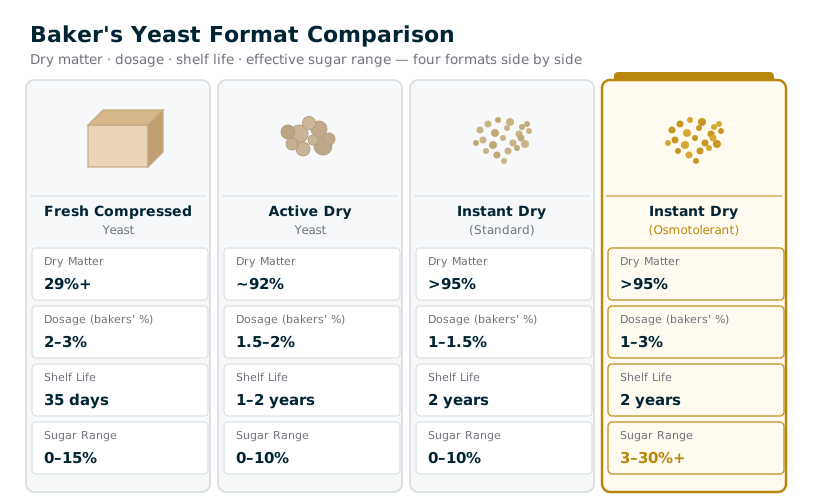 Infographic comparing four baker's yeast formats with key parameters: fresh compressed, active dry, instant dry (lean), instant dry (osmotolerant)
This article explains how osmotolerant yeast strains solve this problem, which products in the Domson catalogue are affected, and how to make practical decisions about yeast selection for every enriched-dough application from soft rolls to panettone.
1. The sugar-threshold decision rule
The sugar threshold for switching to osmotolerant yeast is a practitioner convention confirmed by multiple trade sources, not a regulatory requirement. The data consistently points to the same decision rule:
| Sugar level (% on flour) | Recommended yeast |
|---|---|
| 0–5% | Standard fresh compressed or standard IDY |
| 5–10% | Standard yeast workable; osmotolerant adds consistency — consider at the higher end |
| 10–12% | Switch to osmotolerant IDY or increase fresh yeast dosage significantly |
| 12–30%+ | Osmotolerant IDY required; or lievito madre for traditional panettone |
The threshold of ~5% where impairment begins is confirmed by BAKERpedia. The ~10–12% switch-point is a practitioner convention — neither BAKERpedia nor Lesaffre cite this exact figure, but Lesaffre positions SAF-Instant Gold for doughs with 3–30% sugar, which implies osmotolerant yeast adds value at the lower end of that range.
The table below shows typical sugar levels across enriched product types.
2. The science: how osmotolerant yeast copes
The HOG pathway
When a standard yeast cell detects high external osmotic pressure — from dissolved sugar, dissolved salt, or both — it activates a signalling cascade called the HOG (High Osmolarity Glycerol) pathway. The key enzyme is the MAPK kinase Hog1, which translocates into the nucleus and triggers gene expression to produce two protective compounds:
- Glycerol: a three-carbon polyol that accumulates inside the cell, raising internal osmotic pressure to counterbalance the external sugar load. Glycerol synthesis is driven by the GPD1 and GPD2 genes encoding glycerol-3-phosphate dehydrogenases.
- Trehalose: a disaccharide that protects proteins and membranes from osmotic dehydration damage.
In standard baker's yeast strains, this response is slower and less efficient. The cell loses water faster than it can produce glycerol, glycolysis (the sugar-fermentation pathway) slows, and CO2 production falls.
In osmotolerant strains, selection and breeding have produced yeast with faster HOG pathway activation, higher GPD1 expression, and more efficient glycerol retention. The cells adapt to high-sugar environments within minutes rather than hours, maintaining fermentation at a fraction of the cost to the baker.
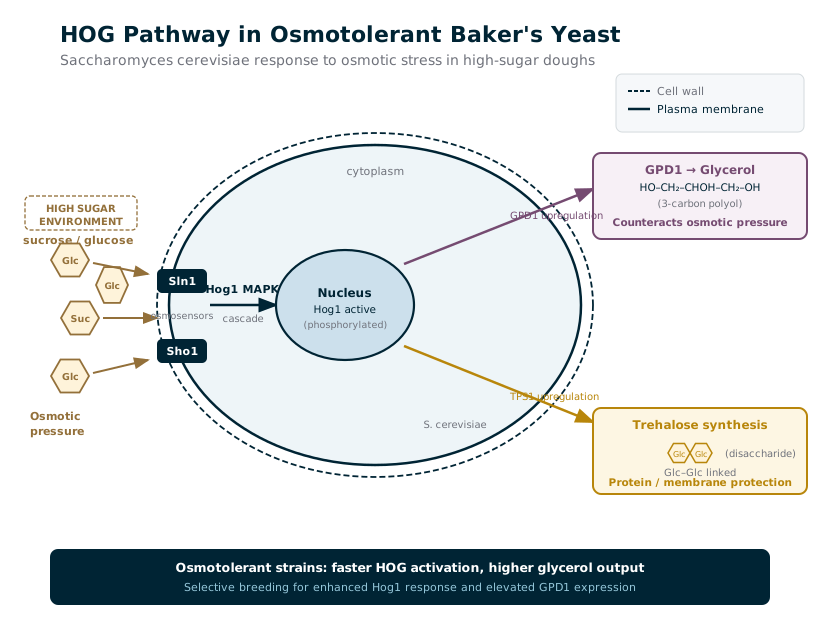 Cell biology diagram of the HOG pathway in baker's yeast showing osmotic stress leading to glycerol and trehalose production
What this means in the bakery
The practical effect is measurable: osmotolerant instant dry yeast produces approximately 10–20% more gassing activity than non-osmotolerant yeast in the same high-sugar dough, all else being equal — according to BAKERpedia trade reference data. No single published peer-reviewed controlled experiment was located for this specific figure; treat it as a directional estimate from industry sources. This translates directly to:
- More reliable proof times (less variability batch to batch)
- Adequate volume in formulas where standard yeast would produce flat or dense product
- The ability to reduce yeast dosage slightly versus a compensatory overload of standard yeast
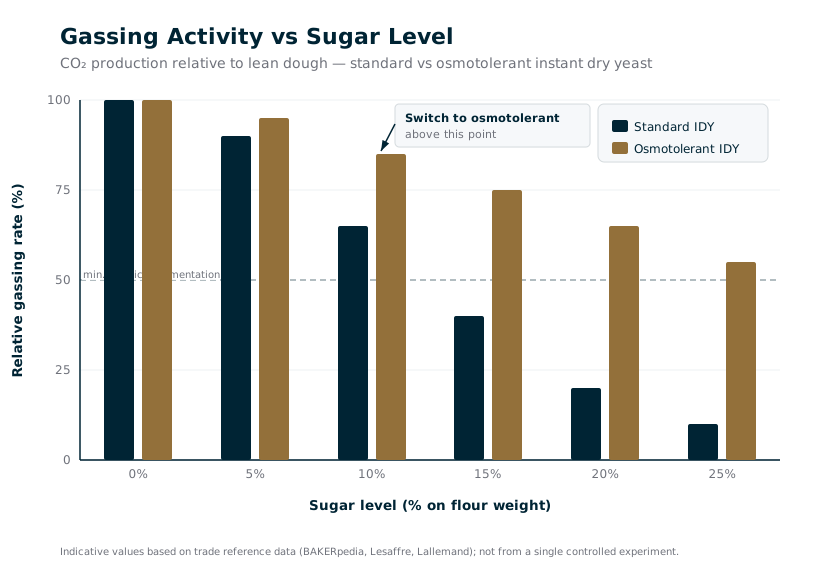 Bar chart comparing CO2 gassing rate of standard vs osmotolerant instant dry yeast across six sugar concentration levels from 0 to 25 percent
3. Baker's yeast formats in the Domson catalogue
The Domson catalogue contains six yeast products with specification data available. None of the current in-catalogue yeast products are osmotolerant IDY — this is noted in the table below. Osmotolerant IDY (SAF-Instant Gold, Instaferm Gold, Fermipan Brown) can be sourced separately.
The full format comparison is below. Key points per product:
Fresh compressed yeast — Benevia (Lesaffre Polska)
Product: Fresh Yeast Benevia 10 kg
Benevia is Lesaffre Polska's standard commercial fresh compressed yeast, manufactured in Poland from a pure Saccharomyces cerevisiae strain multiplied on molasses.
- Dry matter: >29%
- Fermentative activity: 125 ± 10 ml CO2 in a maximum of 100 minutes (risograph method)
- Shelf life: 35 days from production
- Storage: 1–10°C, optimum 4°C; in original, closed, ventilated packaging
- Pack format: Carton 10 kg (4 × 5 × 500 g blocks)
- Allergens: None of the 14 EU Regulation 1169/2011 Annex II allergens declared as ingredients.
Food safety note — sulphites (flagged for review): The Benevia spec sheet explicitly states that sulphur dioxide and sulphites are present in the molasses used during yeast production. The spec does not declare SO2 as an allergen in the finished product, but downstream bakers should assess whether residual SO2 could cross the 10 mg/kg threshold that triggers mandatory Annex II declaration. Confirm with your legal adviser if producing for sulphite-sensitive consumers.
Application: Standard fresh yeast for all lean and moderately enriched doughs (up to ~10% sugar on flour). Not an osmotolerant strain — for doughs above 10% sugar, use an osmotolerant IDY or increase dosage with careful monitoring.
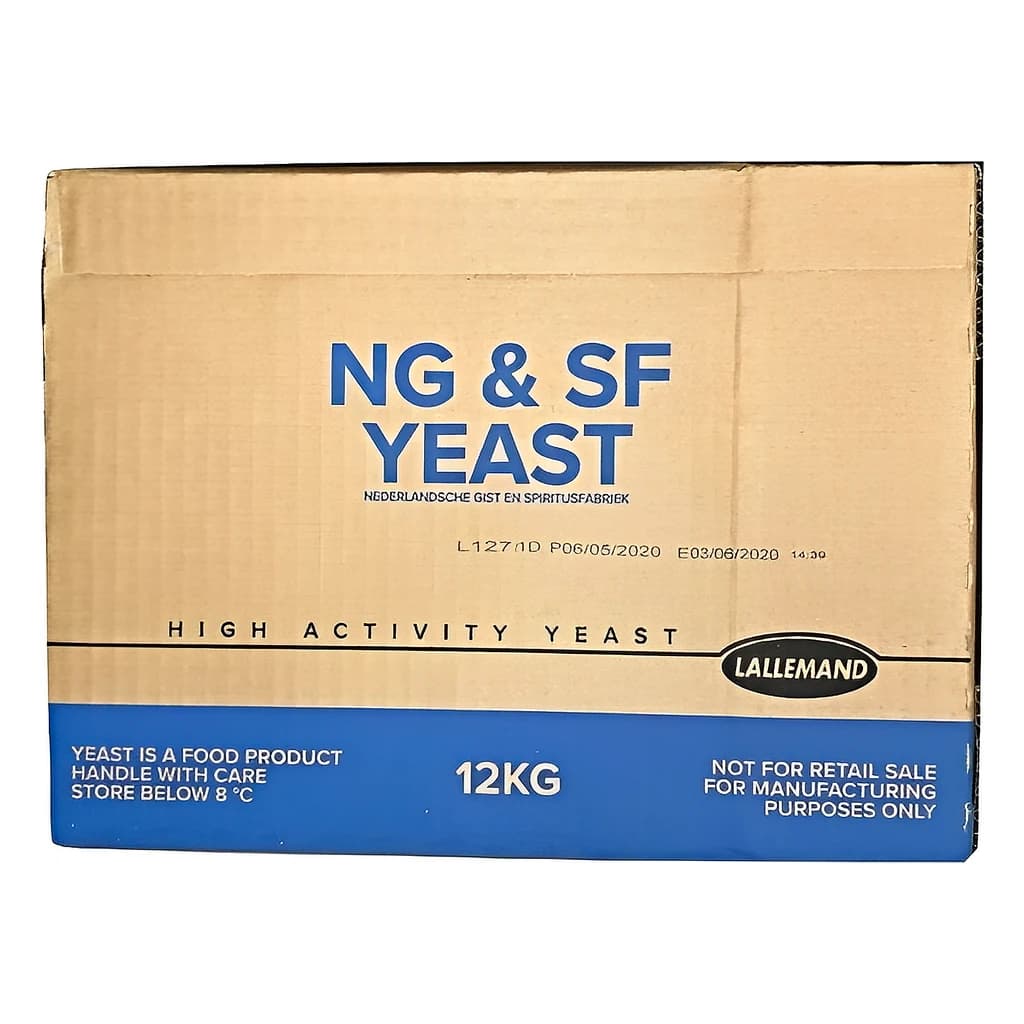
Fresh compressed yeast — NG & SF High Activity (Lallemand)
Product: Fresh Yeast NG & SF Fast Active 12 kg
NG & SF is Lallemand Gb's high-activity fresh yeast optimised for fast, no-time or Chorleywood-process baking applications. The faster cell activity comes from the strain selection and the production process (higher dehydration in the vacuum filter).
- Dry matter: 28–35%
- Moisture: approximately 69 g/100g
- Shelf life: 28 days from production
- Storage: ≤8°C, do not freeze
- Certifications: Kosher, Halal, Vegetarian, Vegan
- Allergens: None declared
Application: High-activity no-time dough; all yeast-leavened applications. The higher activity makes it useful in Chorleywood-process bakeries where mix time is short and fermentation time minimal. Not osmotolerant — limitations in high-sugar dough are the same as Benevia.
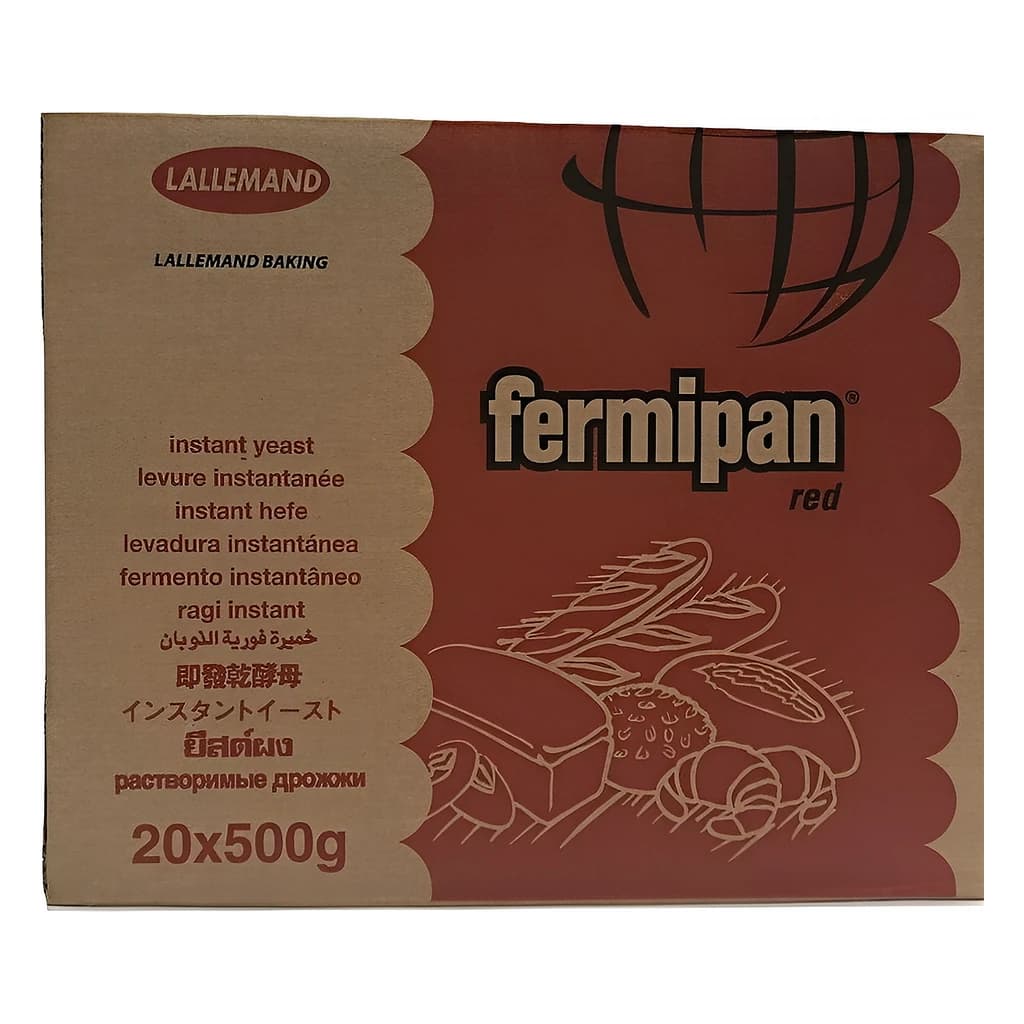
Standard instant dry yeast — Fermipan Red (Lallemand)
Product: Dried Yeast Fermipan Red 10 kg
Fermipan Red is the Lallemand lean-dough instant dry yeast benchmark. The product is explicitly specified for doughs with sugar content 0–10%.
- Dry matter: >95% (2021 TDS); 93–98% (2012 spec)
- Emulsifier: E491 sorbitan monostearate 1% — enables direct addition to flour without rehydration
- Shelf life: 2 years ambient unopened; refrigerate after opening
- Dosage: 1–1.5% on flour weight
- Sugar range: 0–10% on flour (lean dough formulation)
- Certifications: Kosher, Halal
- Allergens: None of the 14 EU Annex II allergens
Dosage conversion from fresh yeast: Use 40–45% of the fresh yeast weight. If a recipe calls for 30g fresh yeast per kg flour (3%), use approximately 12–14g Fermipan Red (1.2–1.4%).
Important: Fermipan Red is a lean-dough yeast. Do not use it as a direct substitute in brioche, panettone or doughnut formulas with >10% sugar without adjusting your process and proofing expectations. The result will be sluggish fermentation and potential under-proof.
Standard instant dry yeast — DCL Levure Premium (Lallemand / DCL Yeast)
Product: Dried Yeast DCL Levure Premium 10 kg
DCL Levure Premium shares the same technical platform as Fermipan Red — both are Lallemand-produced instant dry yeasts from the EMEA facility in Felixstowe.
- Dry matter: >95%
- Dosage: 1–1.5% on flour weight
- Shelf life: 2 years ambient unopened
- Certifications: Kosher, Halal
Application: Interchangeable with Fermipan Red for lean to moderately enriched dough applications. Same osmotic limitations above 10% sugar.
Osmotolerant IDY — not currently in catalogue
At the time of research (2026-06-25), no osmotolerant instant dry yeast (SAF-Instant Gold, Instaferm 02 Gold, Fermipan Brown or equivalent) appears as a stocked line in the Domson catalogue. Bakers requiring osmotolerant IDY for brioche, panettone or doughnut production should contact their Domson account manager to enquire about sourcing. The key technical specification to request: sugar range ≥10–30% on flour; dry matter >95%; dosage 1–3%.
The head-to-head comparison is below.
4. Enriched dough applications — what bakers actually need to know
Yeast-raised doughnuts (Berliner)
Berliner doughnuts are one of the most osmotically challenging enriched dough applications. The formula combines 10–14% sugar, 8–12% eggs, and 6–10% fat in a dough that must proof reliably under warm, humid conditions before frying. The cumulative osmotic load from sugar, eggs and dissolved solids makes osmotolerant yeast strongly recommended.
Key process parameters:
- Proofing: 32–43°C (90–110°F), 40–70% relative humidity, 30–40 minutes until the dough piece doubles and springs back slowly when poked (BAKERpedia trade reference; some practitioners use 60–80% RH for tighter crust — conduct trials for your specific operation)
- Frying: 190–196°C (375–385°F) oil temperature — a calibrated thermometer is essential
Food safety note — frying temperature (flagged for review): Oil temperature must be maintained throughout the frying batch with a calibrated probe thermometer. Under-temperature frying produces under-cooked dough (food safety risk). Over-temperature above 200°C increases acrylamide formation. Conduct a full HACCP assessment for your frying operation.
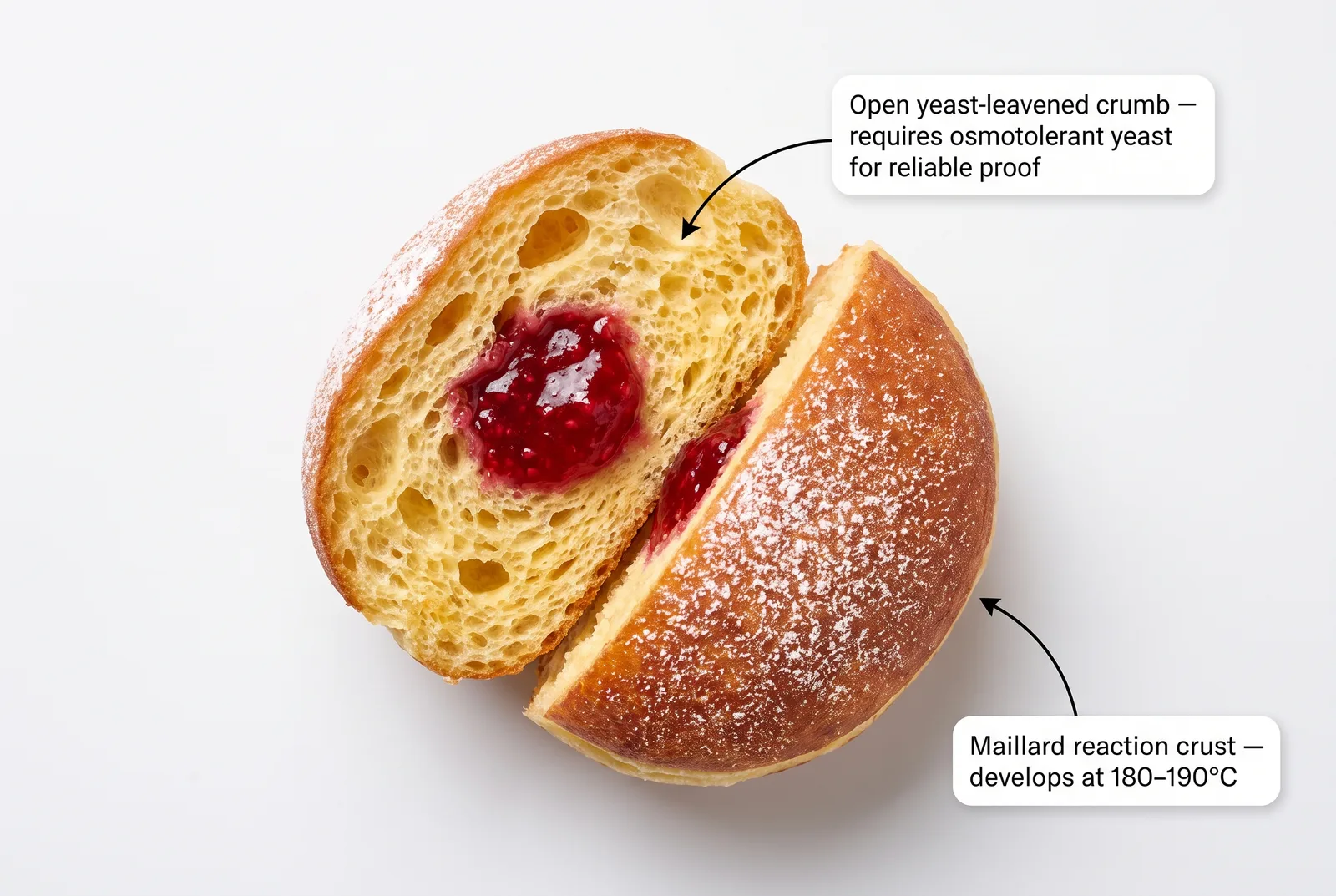
Cross-section of a Berliner doughnut showing open porous crumb typical of yeast-leavened fermentation, jam filling in centre, golden fried crust
Catalogue options for doughnut production:
The Domson catalogue offers two routes to Berliner production:
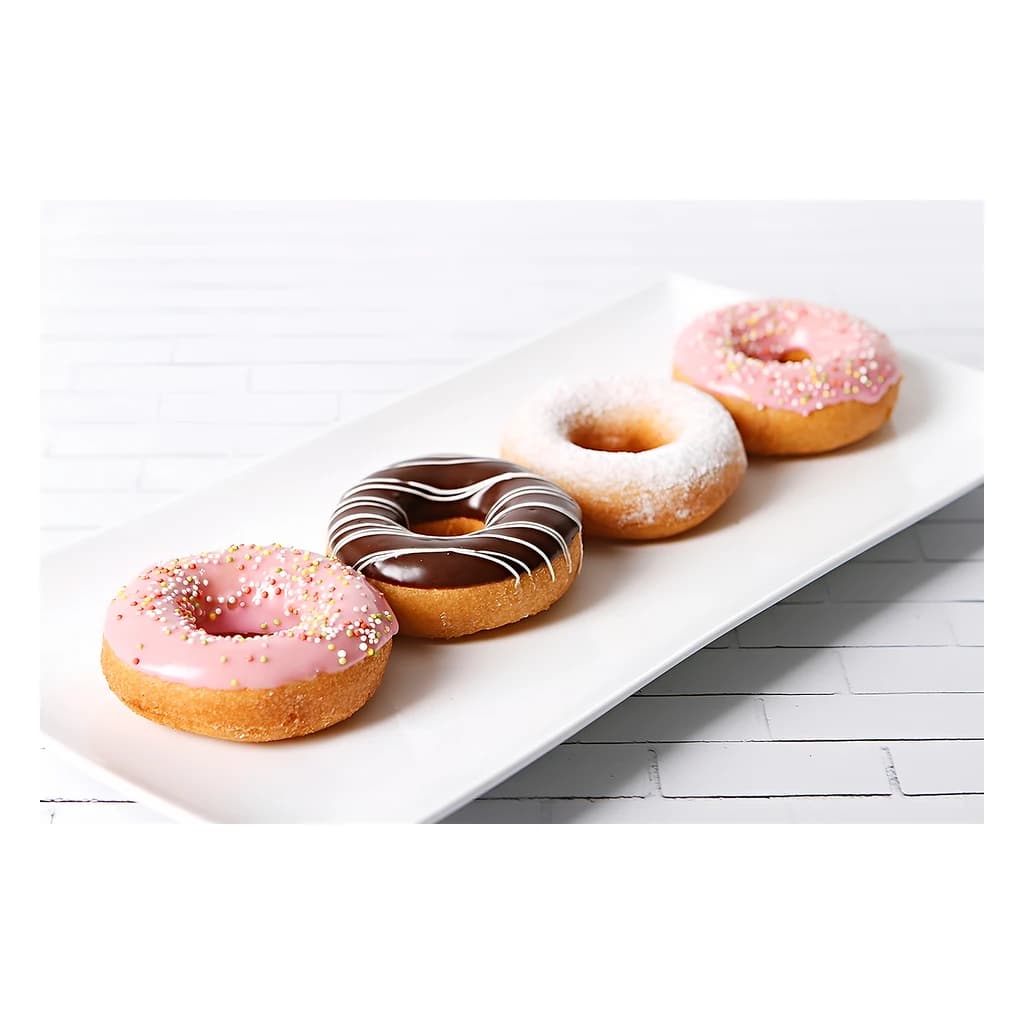
- From concentrate — Ireks Global Yeast Doughnut Concentrate 25 kg: used at 50% on flour weight (12.5 kg concentrate per 25 kg flour). The concentrate contains wheat flour, dextrose, emulsifiers E471/E481, soya oil, raising agents E450/E500, soya flour, skim milk powder, whey powder, thickeners E412/E466, flavourings, and enzyme/flour treatment agents E300/E920. You add water, and yeast separately.
Allergen warning (flagged for review): Contains wheat (gluten), soybeans and milk (including lactose) as declared ingredients. Traces of rye, barley and oats cannot be excluded. Eggs are also possible trace allergen. All three declared allergens must be emphasised in the ingredient list of your finished product.
- Complete doughnut premixes — Zeelandia Berliner 2500, Zeelandia Berliner Complete, MLM Berliner Mix, Ireks Vegan Doughnut Mix, Puratos Krapfenkonzentrat Extra, Backaldrin Doughnut & Yeast Dough Concentrate (check current stock): these are more complete formulations that typically require only water and sometimes yeast. Spec sheets for these products were not available for this research session — request allergen declarations before use.
The from-scratch baker's percentage baseline formula is below.
Brioche
Classic French brioche is defined by its butter content: typically 50–60% butter on flour weight, with 10–20% sugar (these are practitioner ranges; richer styles reach 70–80% butter). At sugar levels above 12%, osmotolerant yeast is strongly recommended.
The primary challenge in brioche production is not just sugar — it is the combination of fat, sugar and eggs creating an extreme osmotic and physical environment:
- Butter physically interferes with gluten development if added too early
- High sugar level inhibits standard yeast
- Eggs contribute additional fat, protein and dissolved solids that further raise osmotic load
The butter-addition rule is non-negotiable: Add butter only after the gluten is fully developed (confirmed by windowpane test). Adding butter early produces a greasy, non-cohesive dough that cannot hold gas.
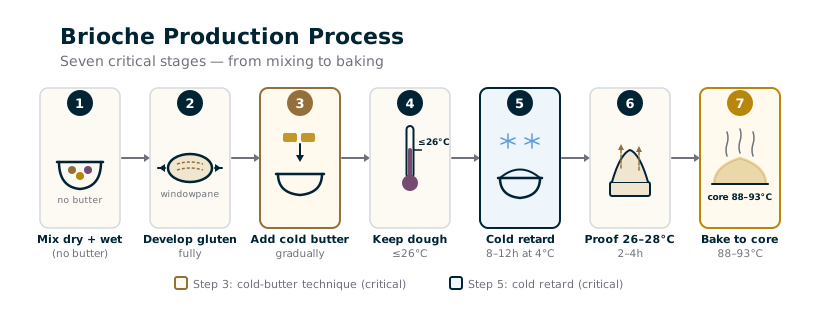 Seven-step illustrated process diagram for professional brioche dough production showing mixing, gluten development, butter addition, cold retard, proofing and baking stages
The cold retard (overnight at 4°C after the initial bulk fermentation) serves two purposes:
- Slows fermentation to develop complex flavour through slow yeast metabolism
- Firms the butter back to a workable consistency, making shaping much easier
The full baker's percentage reference formula is below.
Panettone
Panettone is the most extreme enriched dough application in professional baking. A traditional Italian panettone contains 20–30% sugar and 25–35% fat (butter plus egg yolks) on flour weight. Commercial operations typically use osmotolerant IDY in a two-build process. Artisan panettone is almost universally made with lievito madre — a stiff Italian sourdough starter maintained at 40–45% hydration, which provides a naturally osmotolerant yeast community alongside lactic acid bacteria.
This article does not cover lievito madre propagation in detail (see the companion article A2-sourdough-cultures). For commercial operations using IDY, the key rule is:
- Use osmotolerant IDY at 1.5–2.5% on flour weight
- Use a two-build (primo impasto / secondo impasto) structure to gradually acclimatise the gluten network to the full fat and sugar load
- Cool panettone inverted on skewers for a minimum of 6 hours after baking — the structure is too fragile to support its own weight while hot
Danish and croissant dough (laminated enriched)
Laminated enriched doughs (croissant, danish, pain au chocolat) contain 8–14% sugar and 15–30% fat in the dough itself, plus the roll-in fat. Osmotic stress from sugar is significant, but the slow cold fermentation typical of laminated doughs (8–16 hours at 4°C) partially compensates: at low temperatures, even standard yeast activity is sufficient because the extended time allows adequate CO2 production. However, osmotolerant IDY is preferred for consistency, especially in operations with shorter cold-retard windows or warmer proofing rooms.
5. Dried sourdough as a flavour additive in enriched doughs
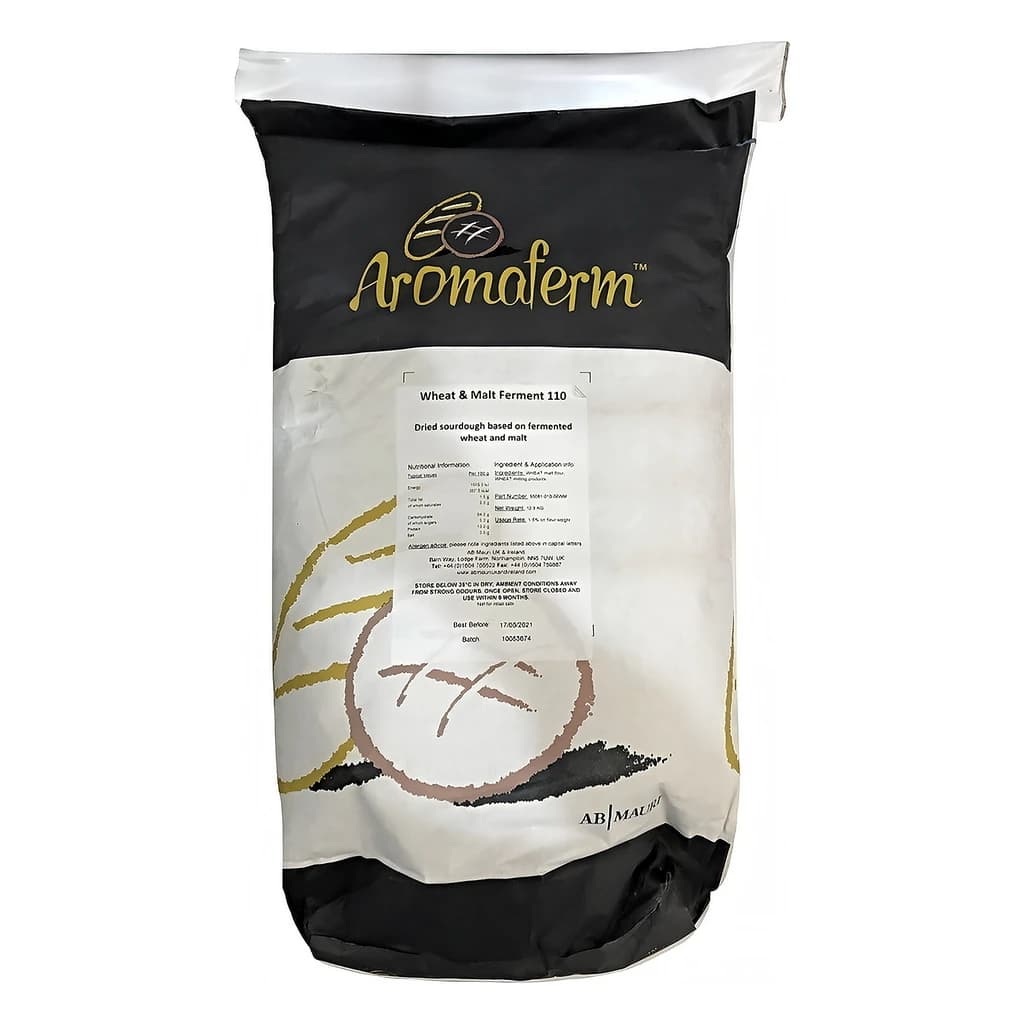
Aromaferm Wheat & Malt Ferment 110 (Mauri Technology / AB Mauri) is not a leavening product. It is a dried, devitalised wheat sourdough with a pH of approximately 3.3 and a titratable acidity of 110 ± 10%. Used at 1–5% on flour weight, it contributes acidic, malty, aromatic notes to enriched doughs without contributing any meaningful CO2.
This is useful when a baker wants to add sourdough character to a brioche or enriched pan bread without running a live sourdough culture alongside active baker's yeast. The dried sourdough is mixed in with the dry ingredients.
Allergen note (flagged for review): Aromaferm Wheat & Malt Ferment 110 contains wheat (gluten) as a declared ingredient. It must be declared in the ingredient list of any finished product.
Dosage guidance from the spec: 1–5% on flour weight. The spec explicitly states that as a natural fermentation product it is subject to natural fluctuations — run bake trials at 1%, 2.5% and 5% to find your target flavour intensity before committing to a production dosage.
6. Practical decision guide: choosing yeast for enriched doughs
Use this decision logic before selecting a yeast for any enriched formula:
Step 1 — Calculate your sugar level in baker's percentage (weight of sugar ÷ weight of flour × 100).
Step 2 — Apply the threshold:
- 0–5%: standard fresh compressed (Benevia) or standard IDY (Fermipan Red / DCL Levure Premium)
- 5–10%: standard yeast with careful proofing; osmotolerant IDY for consistency
- 10%+: osmotolerant IDY required; contact Domson for sourcing
Step 3 — Choose your format:
- Immediate-use artisan: fresh compressed (Benevia or Traditional)
- Ambient-storage / bulk: instant dry yeast (Fermipan Red for lean; osmotolerant IDY for enriched)
- Doughnut production from concentrate: Ireks Global Yeast Doughnut Concentrate (requires separate yeast addition)
Step 4 — Calculate dosage:
- Fresh compressed (standard): 2–3% on flour
- Fresh compressed (high-activity NG&SF): 2–3% on flour (process-dependent)
- Standard IDY: 1–1.5% on flour
- Osmotolerant IDY: 1–3% on flour
- Conversion from fresh to IDY: multiply fresh weight by 0.40–0.45
Step 5 — Check allergens. Standard yeasts (Benevia, Fermipan Red, NG&SF, DCL Levure Premium) contain no EU Annex II allergens as ingredients. The Ireks Doughnut Concentrate contains wheat, soya and milk — all must be declared.
The head-to-head comparison, format specs and troubleshooting fault table are below.
7. Common faults and how to fix them
The full fault table is below. The four most critical for enriched doughs:
-
Dough fails to rise in high-sugar formula — almost always a yeast type error (standard IDY used where osmotolerant is needed). Switch yeast first before adjusting anything else.
-
Doughnut collapses in frying — over-proofed; dough has exhausted its gas retention capacity. Monitor proof by poke test; do not rely on time alone.
-
Dense brioche crumb despite visible proof — butter added before gluten was fully developed; or dough temperature exceeded 26°C during mixing, causing butter to liquify and emulsion to break. Cool equipment; chill dough if needed.
-
Yeasty/alcoholic off-flavour — dosage too high for the fermentation schedule. The ratio of yeast dose to time is the key variable. Use cold retard to slow fermentation and build flavour without excess alcohol.
8. Allergen summary — all products in this article
Food safety notice (flagged for review): All allergen declarations below are drawn from first-party supplier specification sheets. Downstream food businesses must perform their own allergen risk assessment and apply appropriate labelling under EU Regulation 1169/2011 (or UK Food Information Regulations 2014 for UK-market products). "May contain" precautionary labelling for unintentional cross-contamination is advisory best practice; consult your legal adviser.
| Product | Contains (intentional) | Cross-contamination / trace risk |
|---|---|---|
| Benevia fresh yeast (Lesaffre) | No Annex II allergens | SO2 from molasses — assess threshold |
| NG & SF fast active fresh yeast (Lallemand) | No Annex II allergens | None declared |
| Fermipan Red IDY (Lallemand) | No Annex II allergens | None declared |
| DCL Levure Premium IDY (Lallemand) | No Annex II allergens | None declared |
| Ireks Global Yeast Doughnut Concentrate | Wheat (gluten), Soybeans, Milk (incl. lactose) | Rye, barley, oats, eggs (trace) |
| Aromaferm Wheat & Malt Ferment 110 (AB Mauri) | Wheat (gluten) | On same line and same site |
Coverage notes and gaps
Solid: Spec-sheet data for all six in-catalogue products confirmed from on-disk PDFs (Benevia, NG&SF, Fermipan Red, DCL Levure Premium, Ireks Doughnut Concentrate, Aromaferm). Osmotolerant yeast mechanism confirmed from two independent peer-reviewed sources. Dosage and threshold data corroborated by three first-party brand sources.
Gap — osmotolerant IDY spec sheets: No osmotolerant IDY (SAF-Instant Gold, Instaferm Gold, Fermipan Brown) is currently stocked in the catalogue; no on-disk spec sheet was available for review. All osmotolerant IDY data is from brand websites and BAKERpedia. When/if Domson stocks an osmotolerant IDY, re-run this article against the first-party spec sheet.
Gap — Pakmaya dried yeast: Pakmaya 20 × 500g (10 kg) has no spec sheet. It is listed in the catalogue but its osmotolerance status, dry matter and dosage are unconfirmed. Request spec sheet from supplier before use in enriched doughs.
Gap — panettone lievito madre: The lievito madre culture and its propagation (refreshes, tri-refreshes, acidity management) are complex enough to warrant a separate article (A2-sourdough-cultures or A2-italian-panettone-guide). This article covers only the osmotolerant IDY route for commercial panettone.
Gap — fresh yeast osmotolerant strains: Some manufacturers produce osmotolerant fresh compressed yeast. These are not confirmed as stocked in the Domson catalogue. If a customer requests osmotolerant fresh yeast, liaise with Lesaffre Polska or Lallemand UK directly.
Capped: Web research was limited to priority sources (brand pages, BAKERpedia, PMC/PubMed). Patent literature on osmotolerant yeast strain development was found but not read in full (e.g. USPTO 9138006). Academic sources on proline accumulation as a secondary stress-tolerance mechanism were identified but not fully read. A follow-up deep-dive into strain genetics would strengthen the science section.
Yeast-raised Berliner doughnuts — professional baseline formula
Industry-baseline baker's percentage formula for yeast-raised filled doughnuts (Berliner). Adapted from BAKERpedia Yeast Donuts and cross-referenced with Ireks Global Yeast Doughnut Concentrate concentrate ratio of 50%. This formula shows from-scratch ratios; when using the Ireks concentrate at 50%, the concentrate replaces a portion of flour, sugar, fat, and leavening as specified on the concentrate label.
| Ingredient | Baker's % | Weight |
|---|---|---|
| Strong wheat flour (T550 / bread flour) — Protein 11–12.5% recommended | 100% | |
| Water — Adjust for flour absorption and egg addition | 48–55% | |
| Sugar — Within osmotolerant yeast range; use osmotolerant IDY | 10–14% | |
| Whole eggs — Adds richness and colour | 8–12% | |
| Margarine or butter — Adds tenderness and frying quality | 6–10% | |
| Skim milk powder — Improves browning and texture | 2–4% | |
| Salt | 1.5–2% | |
| Osmotolerant instant dry yeast — Standard IDY can be used if proofing time is extended; osmotolerant preferred | 1.5–2.5% | |
| Bread improver (optional) — Emulsifiers / enzymes improve crumb texture and shelf life | 0.5–1% |
- Mix all dry ingredients including IDY; add liquids
- Mix to full gluten development (medium mixing, ~8–10 min in spiral)
- Dough temperature target: 26–28°C
- Bulk fermentation: 15–30 min at room temperature
- Scale and mould into balls; rest 10 min
- Sheet or hand-roll to ~10–12 mm thickness; cut rounds
- Proof: 35–40°C, 60–75% RH, 30–45 min until doubled
- Fry in palm oil or high-stability frying oil at 180–190°C, ~60–90 sec per side
- Drain; cool; fill and dust with icing sugar
Allergens: WHEAT (gluten) — from flour,EGGS — from whole eggs,MILK — from skim milk powder and butter,SULPHITES — may be present in yeast at trace level from molasses (Benevia spec note)
Exact ratios are producer-dependent. Ireks Global Yeast Doughnut Concentrate is used at 50% addition rate on flour weight; its built-in emulsifiers (E471, E481), raising agents (E450, E500), soya flour and milk powder alter the from-scratch formula substantially. When using the concentrate, follow Ireks usage instructions rather than this baseline.
Classic brioche — professional baker's percentage reference
Baker's percentage reference for classic French-style brioche. Sugar and fat levels place this firmly in the osmotolerant yeast zone. Sourced from King Arthur Baking professional formula and BAKERpedia osmotolerant yeast reference.
| Ingredient | Baker's % | Weight |
|---|---|---|
| Strong white flour (T550 / bread flour) — Protein 11–12% preferred for good structure under high fat load | 100% | |
| Unsalted butter (softened) — Added gradually after gluten development | 50–60% | |
| Whole eggs — Provides liquid, fat, emulsification | 45–55% | |
| Sugar — Within osmotolerant yeast range | 12–20% | |
| Salt | 1.5–2% | |
| Milk (or water) — Adjust for total hydration | 10–20% | |
| Osmotolerant instant dry yeast — Essential at this sugar level | 1.5–2.5% |
- Mix flour, eggs, sugar, salt, milk and yeast to a smooth dough — no butter yet
- Develop gluten fully (windowpane test) before butter addition
- Add cold butter in small pieces over 15–20 min — do not rush
- Dough temperature must not exceed 26°C during butter addition (chill if needed)
- Bulk ferment 1–2 h at 22–24°C until 50% volume increase
- Punch down; refrigerate overnight (cold retard 8–12 h at 4°C develops flavour)
- Shape from cold; proof at 26–28°C, 70% RH, 2–4 h
- Egg-wash; bake 180°C conventional (or 160°C fan) until internal temp 88–93°C
Allergens: WHEAT (gluten) — from flour,EGGS — from whole eggs,MILK — from butter and milk
Butter percentage of 50–60% on flour is the classic range; richer brioche (parisienne) goes to 70–80%. This is categorically a high-fat, high-sugar dough. Osmotolerant yeast is not optional at 20%+ sugar. Single-source verification for these baker's percentages: confirmed directionally by King Arthur Baking professional reference, but exact ratios vary widely by style.
Key technical parameters for the main yeast formats available in the Domson catalogue and wider market. Dry-matter and shelf-life values are extracted from first-party spec sheets where available; other values are from trade references (BAKERpedia, Lallemand, Lesaffre).
| Format | Dry matter (%) | Shelf life (unopened) | Storage | Typical dosage (% on flour) | Relative activity vs fresh | Applications |
|---|---|---|---|---|---|---|
| Fresh compressed (standard) | >29 (Benevia spec) | 35 days from production | 1–10°C, optimum 4°C | 2–3% | 1× (baseline) | All lean and enriched doughs, artisan production |
| Fresh compressed (high activity / no-time) | 28–35 (NG&SF spec) | 28 days from production | ≤8°C, do not freeze | 2–3% (process-dependent) | Higher than standard fresh | Chorleywood / no-time dough; fast-process bakeries |
| Instant dry yeast — lean dough (Red / standard) | >95 (Fermipan Red TDS) | 2 years ambient unopened | Cool, dry; refrigerate after opening | 1–1.5% | ~1× (use at ~40–50% of fresh weight) | Bread, pizza, rolls — sugar 0–10% |
| Instant dry yeast — osmotolerant (Gold / Brown) | >95 (industry standard) | 2 years ambient unopened | Cool, dry; refrigerate after opening | 1–3% | 10–20% higher than non-osmotolerant in high-sugar doughs | Brioche, panettone, doughnuts, danish — sugar 3–30%+ |
Dosage ranges are baker's-percentage conventions (% on flour weight). Conversion from fresh to instant dry: multiply by 0.40–0.45. Conversion from fresh to active dry: multiply by 0.50. Osmotolerant IDY is available as SAF-Instant Gold (Lesaffre), Instaferm 02/Gold (Lallemand), Fermipan Brown (Lallemand Gb). None of these osmotolerant SKUs are currently stocked in the Domson catalogue (confirmed at research date 2026-06-25); the closest in-range products are Fermipan Red (lean IDY) and Benevia (standard fresh). Single-source flag: the dosage range for osmotolerant IDY is corroborated by BAKERpedia, Lesaffre and Lallemand — confidence high.
Practical comparison for a baker choosing yeast for a high-sugar formula. All performance comparisons sourced from BAKERpedia and first-party brand guidance; no single controlled experiment cross-compared all parameters — treat relative values as directional.
| Parameter | Standard instant dry (e.g. Fermipan Red) | Osmotolerant instant dry (e.g. SAF Gold / Instaferm Gold) |
|---|---|---|
| Sugar threshold for full activity | Up to ~10% on flour | 3–30%+ on flour (confirmed by multiple brand sources) |
| Relative gassing power in 20% sugar dough | Significantly reduced; fermentation sluggish | 10–20% greater activity than standard at same dosage |
| Recommended dosage (baker's %) | 1–1.5% | 1–3% |
| Typical applications | Lean bread, rolls, pizza, doughs with 0–10% sugar | Brioche, panettone, sweet rolls, doughnuts, danish |
| Mechanism: osmotic stress response | HOG pathway activated but adaptation limited; cell water loss inhibits glycolysis | Rapid HOG pathway upregulation; GPD1-driven glycerol accumulation; trehalose protection |
| Emulsifier included | E491 (Fermipan Red spec: 1%); facilitates rehydration without pre-activation | E491 typically included in IDY formats; check spec sheet |
| Allergens | None (Fermipan Red: no EU Annex II allergens) | None expected; verify specific product spec sheet |
Typical baker's-percentage sugar ranges for key enriched products. Values are industry convention from multiple trade references. Product-specific recipes will vary.
| Product type | Typical sugar % (on flour) | Typical fat % (on flour) | Yeast choice | Notes |
|---|---|---|---|---|
| Lean white bread | 0–2% | 0–2% | Standard IDY or fresh | No osmotolerance needed |
| Soft rolls / burger buns | 5–8% | 3–6% | Standard IDY or fresh; osmotolerant optional above 5% | Borderline range — osmotolerant adds consistency |
| Yeast-raised doughnuts (Berliner) | 8–14% | 4–8% + frying absorption | Osmotolerant IDY strongly recommended | High osmotic load from sugar+eggs+fat; proofing at 35–43°C |
| Brioche (classic French) | 10–20% | 40–60% butter | Osmotolerant IDY | High butter + sugar creates extreme osmotic environment |
| Danish / croissant dough | 8–14% | 15–30% dough + roll-in | Osmotolerant IDY or fresh (adjust for cold retard) | Slow cold-ferment can partly compensate for standard yeast |
| Panettone (industrial/commercial) | 20–30% | 25–35% (butter + eggs) | Osmotolerant IDY or dedicated lievito madre culture | Highest sugar load; typically two-build process; professional panettone uses natural lievito madre |
Sugar percentages are baker's-percentage (weight of sugar / weight of flour × 100). Sources: BAKERpedia Yeast Donuts, BAKERpedia Osmotolerant Yeast, Lesaffre SAF-Instant Gold product page, King Arthur Baking brioche formula. Single-source flag for panettone sugar range: confirmed by multiple practitioner sources but not from a single manufacturer spec.
Practical troubleshooting guide for professional bakers working with high-sugar, high-fat doughs. Based on BAKERpedia yeast and osmotolerant yeast references, Lallemand and Lesaffre technical guidance.
| Symptom | Likely cause | Correction |
|---|---|---|
| Dough does not rise or rises very slowly | Standard (non-osmotolerant) yeast used in high-sugar formula (>10% sugar); osmotic stress dehydrates yeast cells and inhibits glycolysis | Switch to osmotolerant instant dry yeast (SAF Gold / Instaferm Gold / Fermipan Brown equivalent); verify dosage is 1.5–2.5% on flour |
| Inconsistent proofing time between batches of doughnuts | Variable sugar content or water temperature affecting osmotic load; standard yeast more sensitive to this variation | Use osmotolerant IDY for better consistency across sugar batches; standardise dough temperature 26–28°C; verify sugar weight on scales |
| Over-proofed doughnuts that collapse in frying | Proofing time too long or temperature too high; gluten structure weakened by fat before full proof reached | Monitor proof by poke test (slight spring-back); keep proof temp 35–40°C; do not exceed 75% RH |
| Dense, tight crumb in brioche despite correct proof volume | Butter added too quickly before adequate gluten development; or dough temperature overheated (>28°C) causing butter to split | Add butter gradually in small pieces only after windowpane test passes; chill dough if temperature exceeds 26°C during mixing |
| Yeasty / off-flavour in finished sweet dough | Yeast dosage too high for the fermentation time; or fermentation temperature too warm accelerating alcohol production faster than gas is retained | Reduce yeast dosage; use cold retard (overnight at 4°C) to develop flavour slowly; keep bulk ferment below 26°C |
| Doughnuts absorb excessive fat during frying | Under-proofed dough (dense structure absorbs more oil) or frying oil too cool (oil penetrates before crust sets) | Ensure full proof before frying; maintain frying oil at 180–190°C throughout; monitor with thermometer |
| Panettone structure collapses after baking | Gluten structure insufficient for the weight of inclusions; or over-fermentation weakened gluten; or cooling upright instead of inverted | Use strong flour (protein ≥12%); cool panettone inverted on skewers for minimum 6 h; do not cut before fully cooled |
- Product:
- Benevia fresh compressed yeast
- Supplier:
- Lesaffre Polska SA
- Format:
- Fresh compressed cube
- Dry matter:
- >29%
- Fermentative activity:
- 125 ± 10 ml CO2 in max 100 min (risograph, Lesaffre method)
- Shelf life:
- 35 days from production
- Storage:
- 1–10°C, optimum 4°C
- Pack size catalogue:
- 10 kg (4 × 5 × 500g)
- Allergens:
- None declared under EU Annex II; sulphite note: SO2 present in molasses used in production (not as added ingredient)
- Certifications:
- Not stated on spec
- Osmotolerant:
- false
- Product:
- NG & SF High Activity Yeast (fresh compressed)
- Supplier:
- Lallemand Gb / Lallemand Baking EMEA
- Format:
- Fresh compressed block
- Dry matter:
- 28–35%
- Moisture:
- 69 g/100g
- Shelf life:
- 28 days from production
- Storage:
- ≤8°C, do not freeze
- Pack size catalogue:
- 12 kg (12 × 1 kg blocks)
- Allergens:
- None declared
- Certifications:
- Kosher, Halal, Vegetarian, Vegan
- Application:
- Chorleywood no-time dough process; all yeast-leavened applications
- Osmotolerant:
- false
- Product:
- Fermipan Red Instant Dry Yeast
- Supplier:
- Lallemand Gb / Lallemand Baking EMEA
- Format:
- Instant dry yeast (IDY) — vacuum packed
- Dry matter:
- 93–98% (older spec); >95% (2021 TDS)
- Emulsifier:
- E491 sorbitan monostearate 1%
- Shelf life:
- 2 years ambient unopened
- Storage:
- Cool, dry; refrigerate after opening
- Dosage:
- 1–1.5% on flour weight
- Sugar range:
- 0–10% on flour (lean to moderately enriched)
- Pack size catalogue:
- 10 kg (20 × 500g)
- Allergens:
- None declared under EU Annex II
- Certifications:
- Kosher, Halal
- Osmotolerant:
- false
- Note:
- Fermipan Red is for lean doughs. For enriched doughs above ~10% sugar, an osmotolerant IDY (e.g. Fermipan Brown, SAF Gold) is preferred. Osmotolerant variants are not currently stocked in the Domson catalogue at research date.
- Product:
- Dried Yeast DCL Levure Premium
- Supplier:
- Lallemand Baking EMEA / DCL Yeast
- Format:
- Instant dry yeast — vacuum packed
- Dry matter:
- >95%
- Dosage:
- 1–1.5% on flour weight
- Shelf life:
- 2 years ambient unopened
- Pack size catalogue:
- 10 kg
- Allergens:
- None declared
- Certifications:
- Kosher, Halal
- Osmotolerant:
- false
- Applications:
- Bread, rolls, pizza — lean to moderately enriched doughs
- Product:
- Ireks Global Yeast Doughnut Concentrate
- Supplier:
- IREKS GmbH, Germany
- Format:
- Dry concentrate (powder)
- Usage rate:
- 50% on flour weight
- Shelf life:
- 9 months
- Storage:
- Dry, cool place (unopened)
- pH range:
- 5.9–7.3 (at 10g/200ml solution)
- Water content:
- 9.1–12.3%
- Protein:
- 5.8–8.6%
- Starch:
- 41.7–56.4%
- Fat:
- 9.4–11.4%
- Allergens declared:
- wheat (gluten), soybeans, milk (including lactose)
- Allergens trace:
- rye, barley, oats, eggs
- Emulsifiers:
- E471, E481
- Raising agents:
- E450 (diphosphates), E500 (sodium carbonates)
- Certifications:
- ISO 9001:2015; HACCP
- Osmotolerant yeast included:
- false
- Note:
- This is a dough concentrate; yeast must be added separately. At 50% usage rate, a 25 kg bag covers 50 kg of flour. Contains soya, milk and wheat allergens — must be declared on finished product.
- Product:
- Aromaferm Wheat & Malt Ferment 110
- Supplier:
- Mauri Technology (AB Mauri), Netherlands
- Format:
- Dried wheat sourdough powder
- Composition:
- Wheat malt 90–100%, wheat milling products 5–10%
- Dosage:
- 1–5% on flour weight
- Moisture:
- <5%
- pH:
- approx 3.3
- Total titratable acidity:
- 110 ± 10%
- Appearance:
- Beige free-flowing powder
- Flavour:
- Acidic, aromatic, malty
- Shelf life:
- 12 months at 0–25°C unopened
- Pack size:
- 12.5 kg bags
- Allergens declared:
- wheat (gluten) — as ingredient and on site
- Certifications:
- Kosher, Halal
- Note:
- This product is a devitalised dried sourdough flavouring agent, not a live leavening yeast. It provides sourdough flavour and mild acidification to enriched doughs without contributing meaningful leavening. Use alongside active baker's yeast.
Buy the ingredients
Catalogue products and brands referenced in this article.
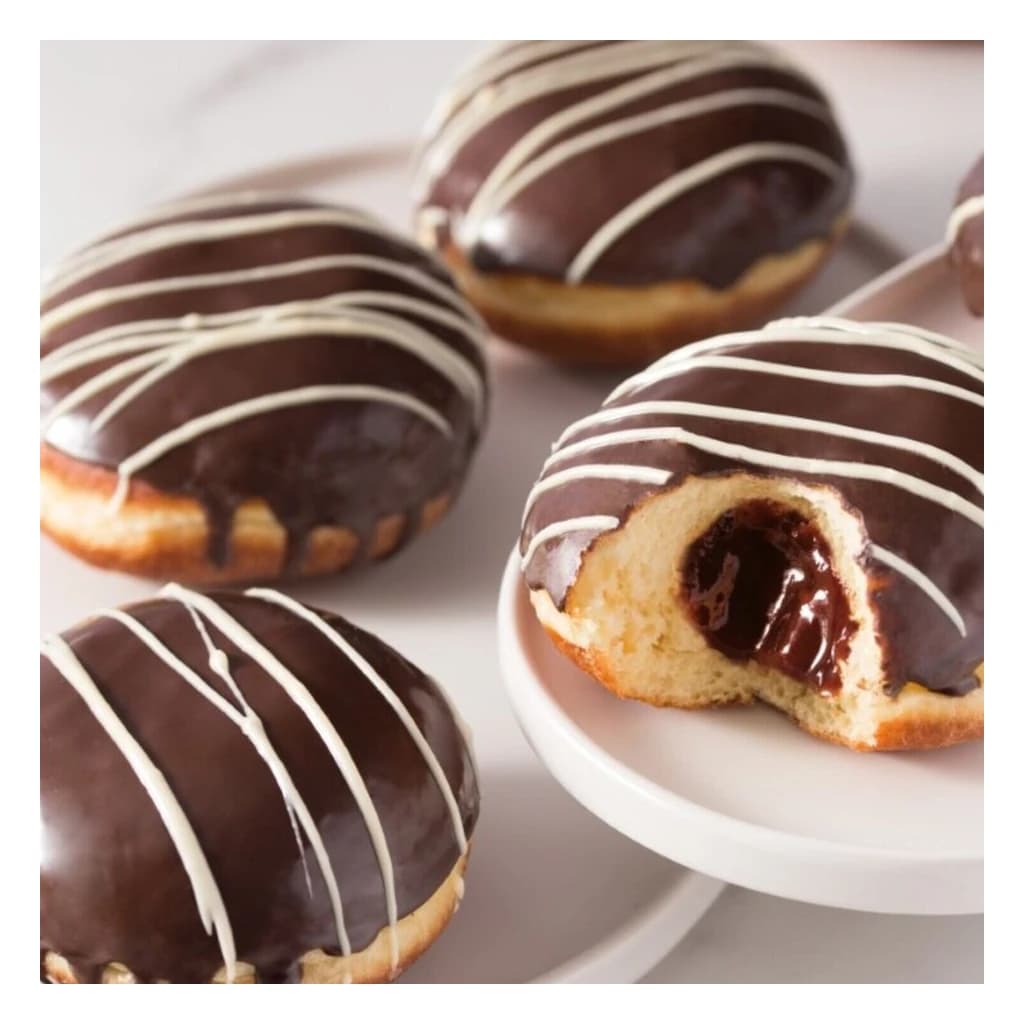
Zeelandia Berliner Complete Doughnut Mix 20 kg
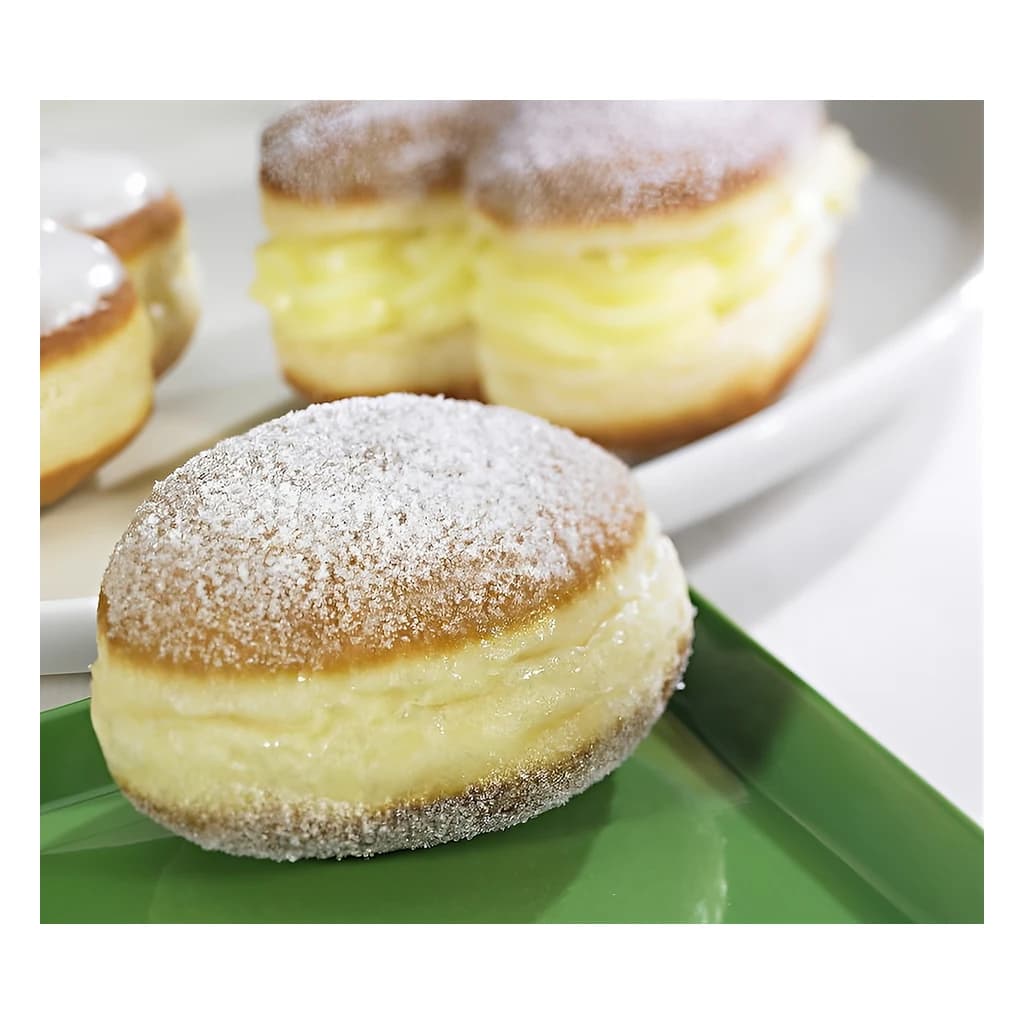
Zeelandia Berliner 2500 Doughnut Premix 25 kg

Fresh Yeast Benevia 10 kg
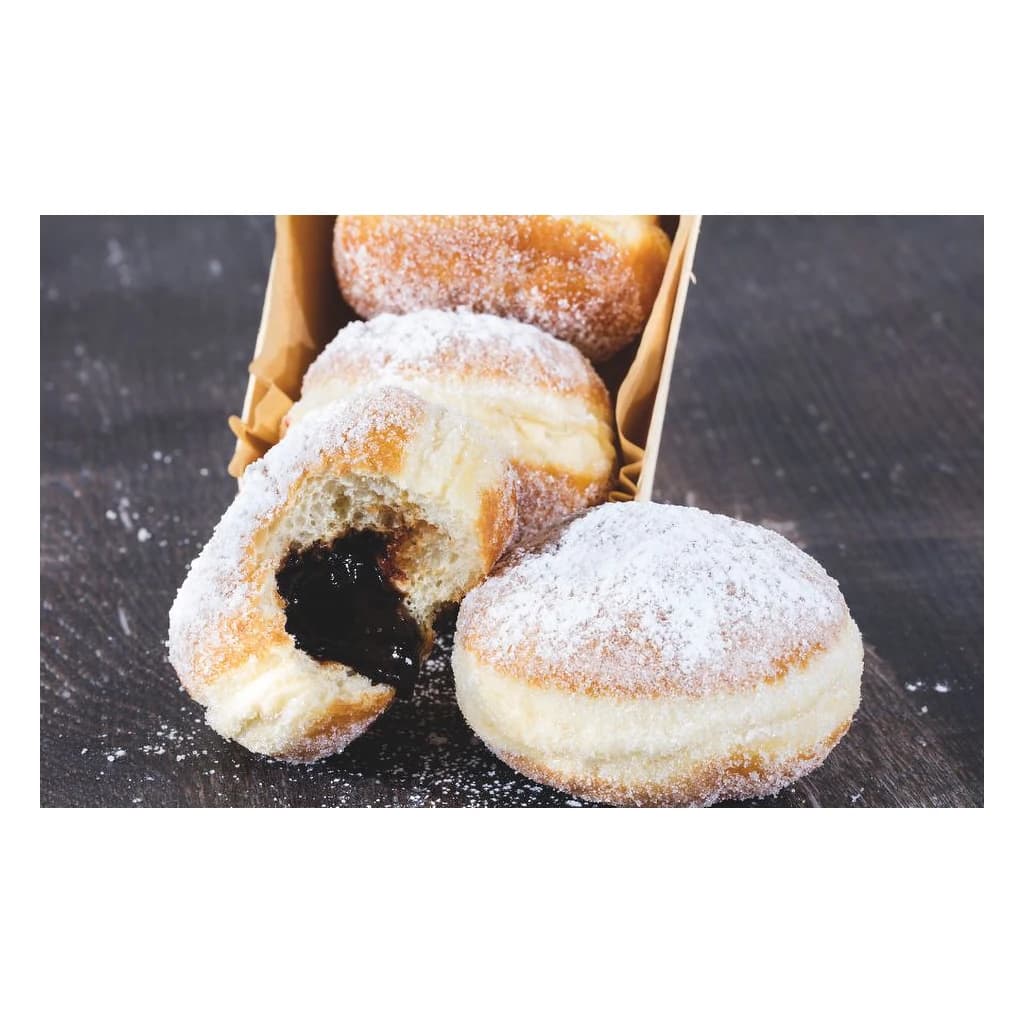
Malmon Berliner 20 Doughnut Concentrate 25 kg
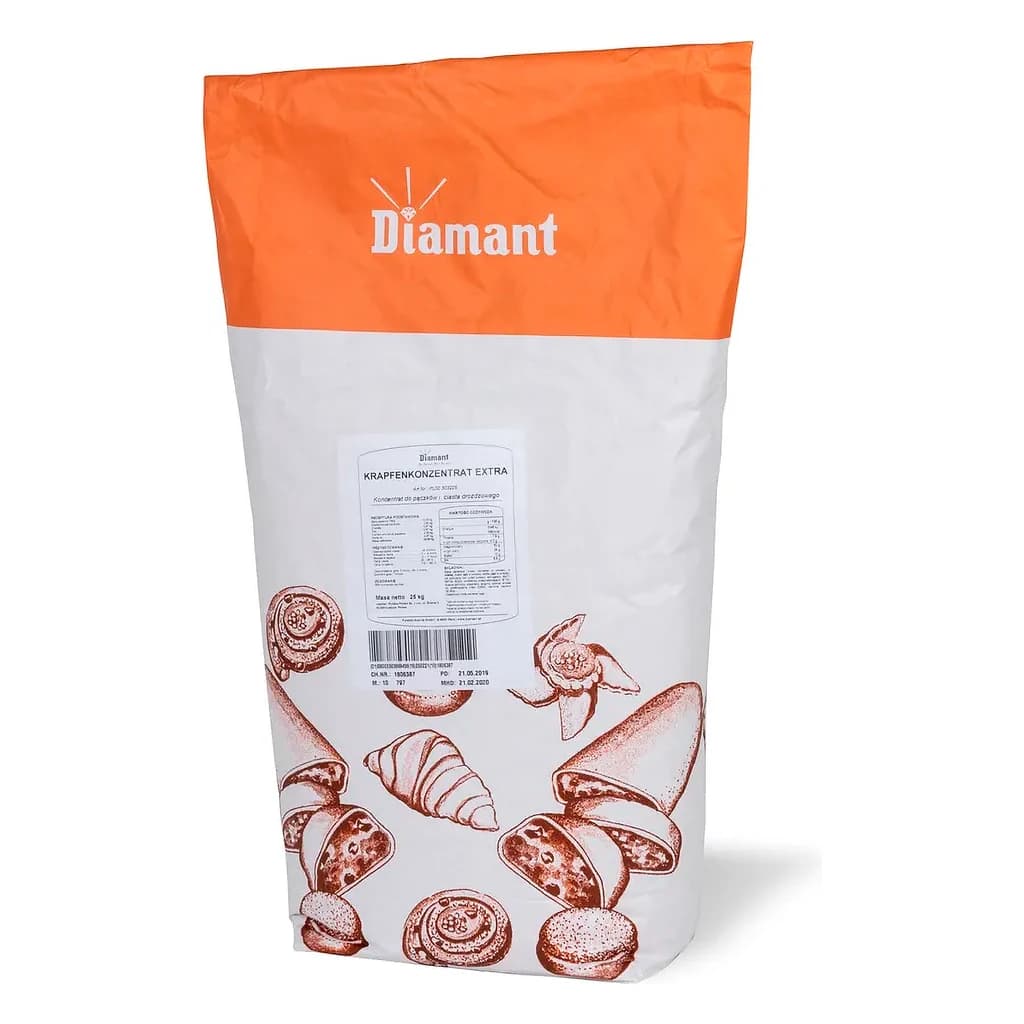
Puratos Krapfenkonzentrat Extra Doughnut Mix 25 kg
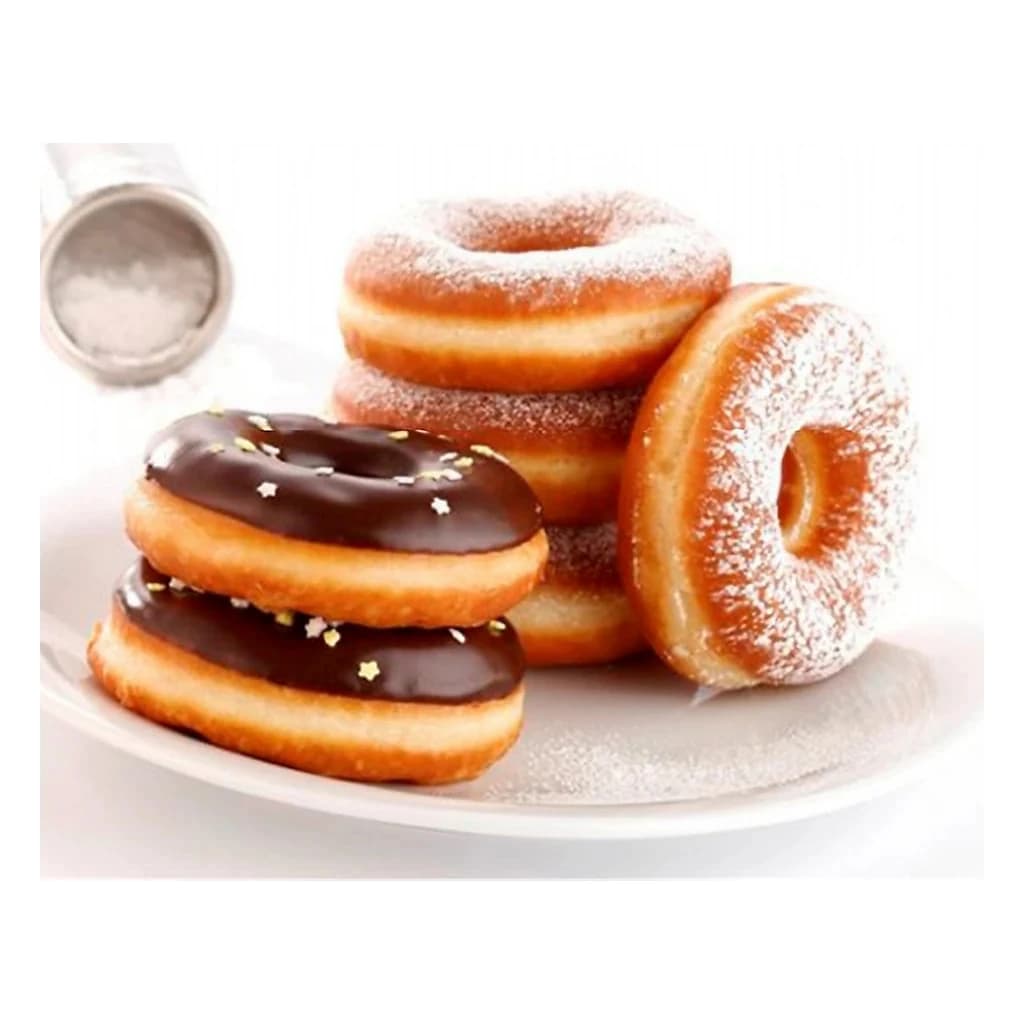
Ireks Vegan Doughnut Mix 25 kg
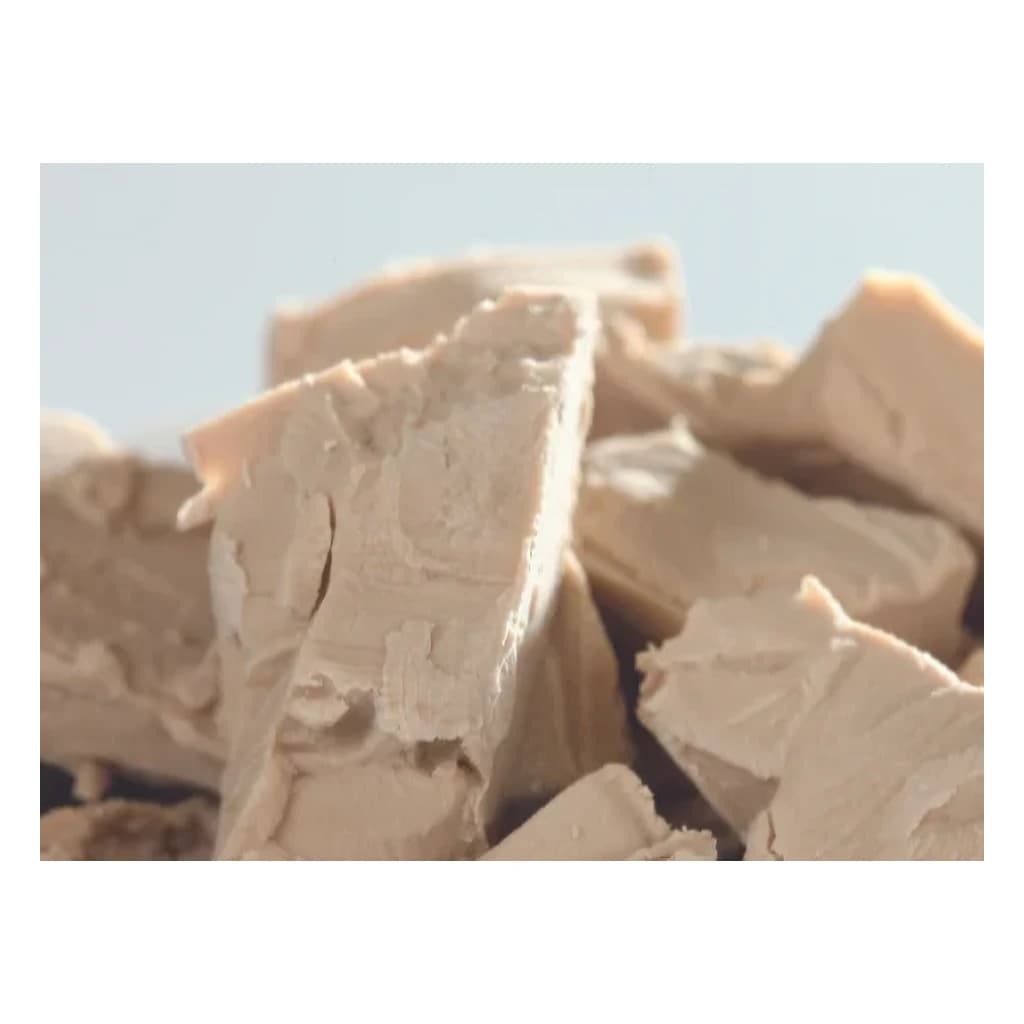
Fresh Yeast Traditional 12 kg
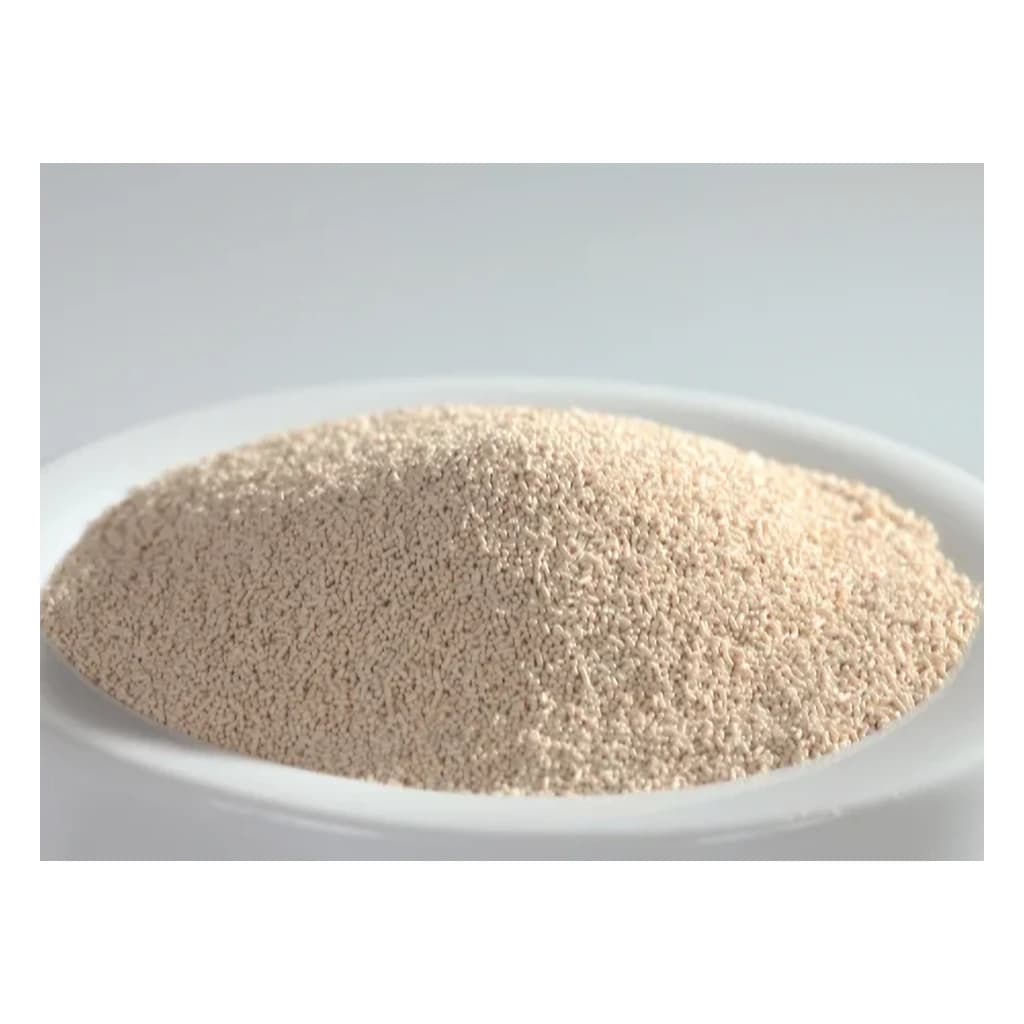
Dried Yeast Pakmaya 20 × 500 g (10 kg)
Aromaferm Wheat & Malt Ferment 110 12.5 kg
Ireks Global Yeast Doughnut Concentrate 25 kg
Fresh Yeast NG & SF Fast Active 12 kg
Dried Yeast Fermipan Red 10 kg

Dried Yeast DCL Levure Premium 10 kg

Backaldrin Doughnut & Yeast Dough Concentrate 25 kg