Butter grades, fat content and specialist types: unsalted, cultured, high-fat & tourage butter
A practical guide for professional bakers covering the EU/UK legal definition of butter, the difference between 82% standard, 84%+ high-fat, cultured and tourage grades, how fat content and crystal structure govern baking performance, how to select and handle butter for laminated pastry, enriched doughs and flavour-critical applications, with data extracted from the Polmlek Unsalted Butter 82% spec sheet and comparative data from Kruszwica and Cardowan supplier specifications in the Domson catalogue.
1. What the law means by "butter"
Across the EU and — under retained law — the UK, the word butter is legally protected. Only a fat derived from cream that meets all three of the following compositional requirements may carry that name on a professional ingredient label or customer-facing menu:
- Milkfat: 80–90%. The fat must be of dairy origin. Products below 80% milkfat cannot be called butter; products at or above 90% milkfat are a separate category (concentrated butter, eventually anhydrous milk fat / AMF at ≥99.8%).
- Water: maximum 16%. The aqueous phase must be no more than 16% of product weight.
- Milk non-fat dry solids (NFDS): maximum 2%. This covers proteins (casein, whey), lactose and minerals from the cream.
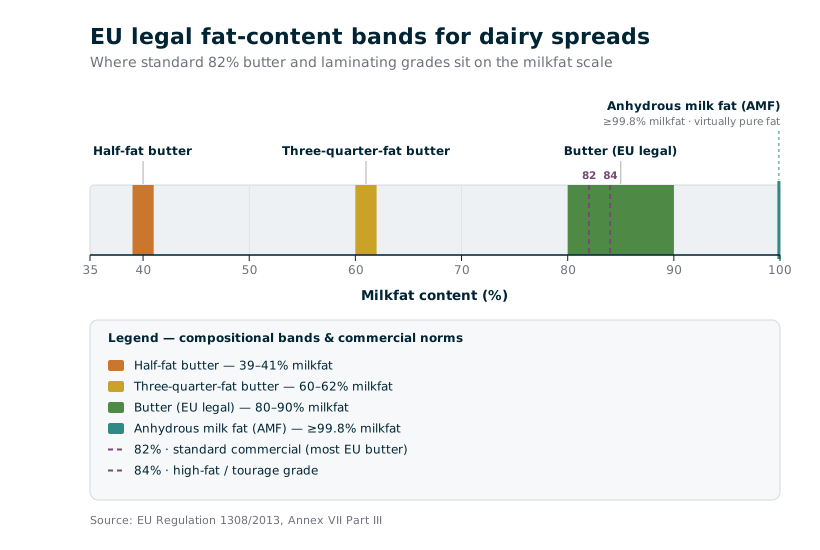 Horizontal bar diagram showing EU fat content bands for dairy spreadable fats from half-fat butter at 39% to anhydrous milk fat at 99.8%, with standard commercial butter at 82% highlighted
The regulation also defines two reduced-fat grades that are rarely relevant to professional bakery: three-quarter-fat butter (60–62% milkfat) and half-fat butter (39–41% milkfat). Neither may be used interchangeably with full butter in professional baking formulas.
Practical consequence: When a supplier calls its laminating fat "pastry butter" in marketing copy but the product is based on vegetable oils, this is a label violation under EU/UK law. Always check the ingredient declaration — real butter declares only cream (and optionally salt for salted grades). Any product listing vegetable oils is a margarine, regardless of the commercial name.
2. The 82% standard: what it means in practice
Commercial European butter virtually always carries a fat content of 82% minimum — two percentage points above the legal floor — to give producers a QA margin and allow consistent nutritional labelling. This is the grade you will find in professional 10 kg and 25 kg blocks.
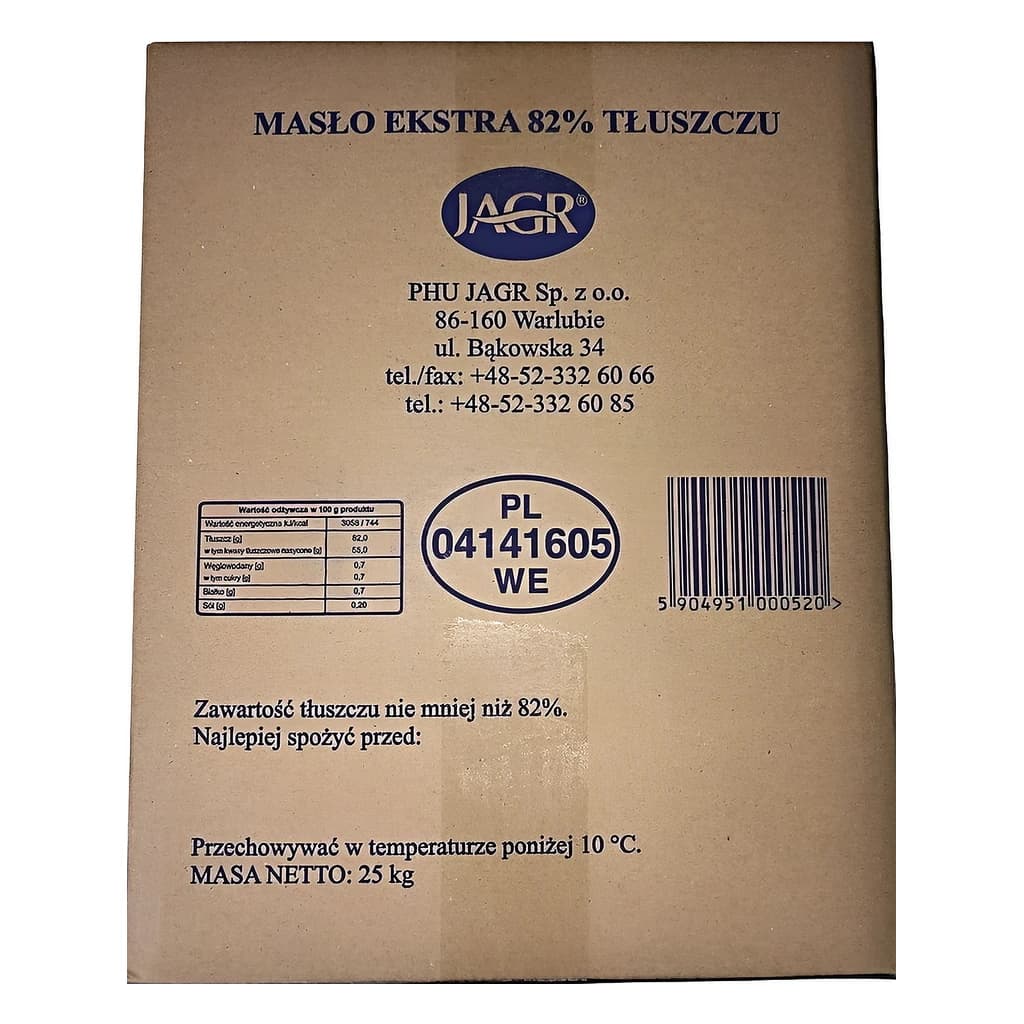
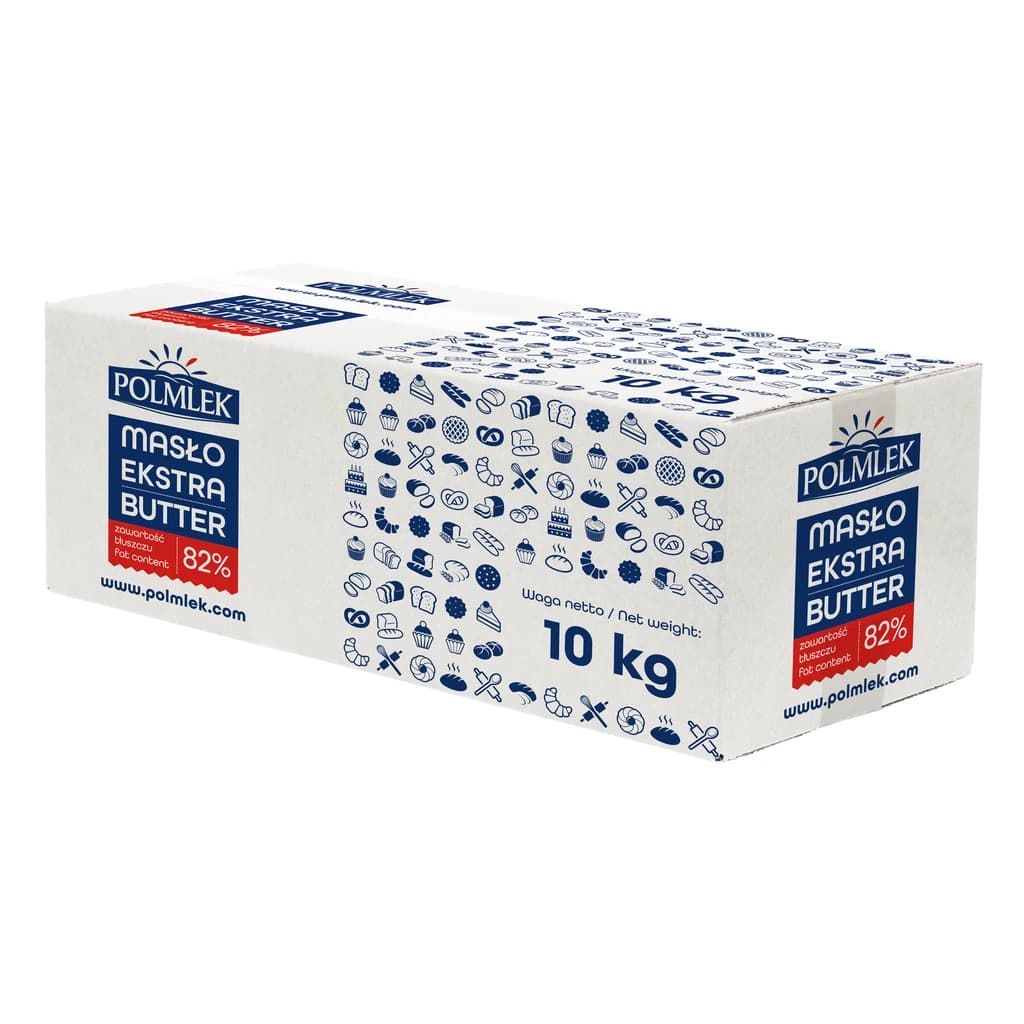
The Domson catalogue carries Polmlek Unsalted Butter 82% Fat in both 10 kg and 25 kg block formats. The Polmlek spec sheet (SW-01, dated 18/10/2023) confirms:
- Fat content: minimum 82% (tested externally twice per year)
- Water: 16% (tested internally every batch)
- Single ingredient: pasteurised cream — no additives, no preservatives
- Nutritional profile per 100 g: fat 82.0 g, saturated fatty acids 55.0 g, protein 0.7 g, carbohydrates 0.7 g, energy 3058 kJ / 744 kcal
The 55 g of saturated fat per 100 g reflects the composition of bovine milk fat: roughly 65% of butterfat is saturated, predominantly palmitic (C16:0), stearic (C18:0), myristic (C14:0) and short-chain acids (butyric C4:0, caproic C6:0, caprylic C8:0). These short-chain fatty acids are responsible for much of the characteristic "buttery" flavour and aroma during baking and cooking.
The non-fat fraction (0.7 g protein + 0.7 g carbohydrate per 100 g) consists primarily of casein proteins and lactose — both important for Maillard browning in pastry and biscuit. When butter is used in a dough that bakes to a golden crust, the milk proteins and sugars react with each other and with any reducing sugars in the dough to produce hundreds of flavour and colour compounds. This is why butter-rich recipes (croissant, brioche, shortbread) have markedly deeper, more complex crust colour than oil-based or margarine-based equivalents.
3. Unsalted vs. salted butter: why professional bakers specify unsalted
The Polmlek spec declares only 0.20 g salt per 100 g — trace sodium inherent from the cream itself, not added salt. This places the product firmly in the unsalted category. There are three compelling reasons why professional bakeries should always specify unsalted butter:
1. Precision salt control. Enriched doughs with 20–30% butter on flour incorporate a meaningful mass of butter. If that butter contained 1.5% added salt (a common level in salted retail packs), a croissant dough at 25% butter with 2% salt on flour would receive an additional ~0.4% salt on flour from the butter alone — enough to noticeably affect taste, fermentation rate and gluten strength.
2. Freshness transparency. Salt is a mild preservative. Salted butter can mask the early development of off-flavours caused by oxidation or microbial activity. Unsalted butter shows its freshness (or lack of it) clearly. A professional kitchen using unsalted butter relies on proper cold-chain management, which is the correct approach.
3. Allergen and dietary compliance. Salt may be produced via processes that introduce sulphite compounds in some operations; this is not a declared allergen in butter itself, but the simpler formulation of unsalted butter (cream only) is a cleaner declaration.
Allergen: All forms of real butter — unsalted or salted — contain milk, including lactose and must be declared as a milk allergen under EU Regulation (EU) No 1169/2011 and UK equivalent. The Polmlek spec explicitly states "for every consumer, except for people allergic to cow's milk protein or lactose."
4. Cultured butter: flavour, fermentation and professional applications
Standard 82% butter — like the Polmlek product — is described in its spec as made from "pasteurized unacidified cream". This distinguishes it as a sweet-cream butter.
Cultured butter (also called beurre de culture, Kulturbutter, or ripened butter) is made from cream that is deliberately inoculated with a selected lactic acid bacteria (LAB) starter — typically Lactococcus lactis subsp. cremoris, often combined with Leuconostoc mesenteroides — and allowed to ferment at a controlled temperature before churning.
The fermentation produces:
- Diacetyl (butanedione, C₄H₆O₂): the principal flavour compound responsible for the intense "buttery", slightly nutty aroma that distinguishes cultured from sweet-cream butter.
- Lactic acid: lowers pH of the cream, contributing a clean, mild acidity in the finished butter.
- Acetic acid and other volatile organic acids: add complexity and length of flavour.
For professional bakers, cultured butter is the correct choice when the butter's flavour is the product's primary selling point:
- High-butter brioche: the diacetyl in cultured butter survives baking to give a richer, more pronounced dairy character.
- Croissant in premium segments: French and Belgian artisan standards often specify cultured (ripened) butter as the standard.
- Butter cream, ganache: cultured butter adds flavour depth in uncooked or lightly heated applications.
Practical note: Cultured butter is not currently stocked in the Domson catalogue as a labelled product. Buyers seeking cultured butter should request it specifically, noting the French designation beurre de culture (standardised by CNIEL, the French interprofessional dairy organisation) or the German Sauerrahmbutter on their purchase order.
5. High-fat butter (84–86%): less water, better lamination
Above the 82% standard sits a commercial (not legal) category: high-fat or dry butter, typically at 84–86% milkfat. No EU legal grade distinguishes this from standard butter (both fall within the ≥80–90% definition), but it is routinely specified by pastry teams for laminated work.
Why higher fat content matters in lamination:
When a standard 82% butter (16% water) is enclosed in a laminated dough and baked, the water in the butter converts to steam at ~100°C. This steam is the primary mechanism that physically separates the thin fat-and-dough layers, creating lift and flakiness. However, if there is too much water, or if the water is not evenly distributed throughout the fat phase, the steam generation is uneven — some layers over-expand and collapse, while others remain dense.
High-fat butter (84–86%, water ~12–14%) produces less steam per gram of fat incorporated, reducing the risk of over-steaming and layer collapse. Additionally, the lower water content means a slightly wider and more stable plasticity window — the temperature range over which the butter is pliable enough to sheet without cracking but firm enough not to seep into the dough.
Confidence note: The specific plasticity temperature range and SFC curve values for high-fat butter are from a single reference source rated medium reliability. The Domson catalogue currently has no spec sheet attached to any high-fat butter or the Tourage Croissant Butter product. Claims marked (LOW confidence) below reflect this.
6. Tourage (roll-in) butter: specifically designed for folding
Beurre de tourage — tourage butter, or roll-in butter — is butter selected and formatted specifically for enclosing inside laminated pastry doughs. "Tourage" refers to the rolling and folding technique (from tourner, French: to turn) used to create hundreds of alternating fat and dough layers.
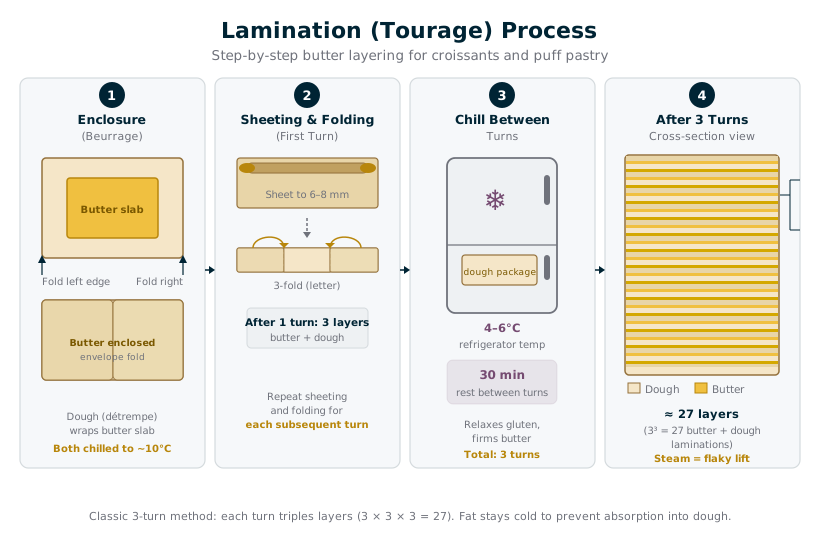 Four-panel diagram of the croissant lamination (tourage) process: butter enclosure, sheeting, folding, and final cross-section of layered dough
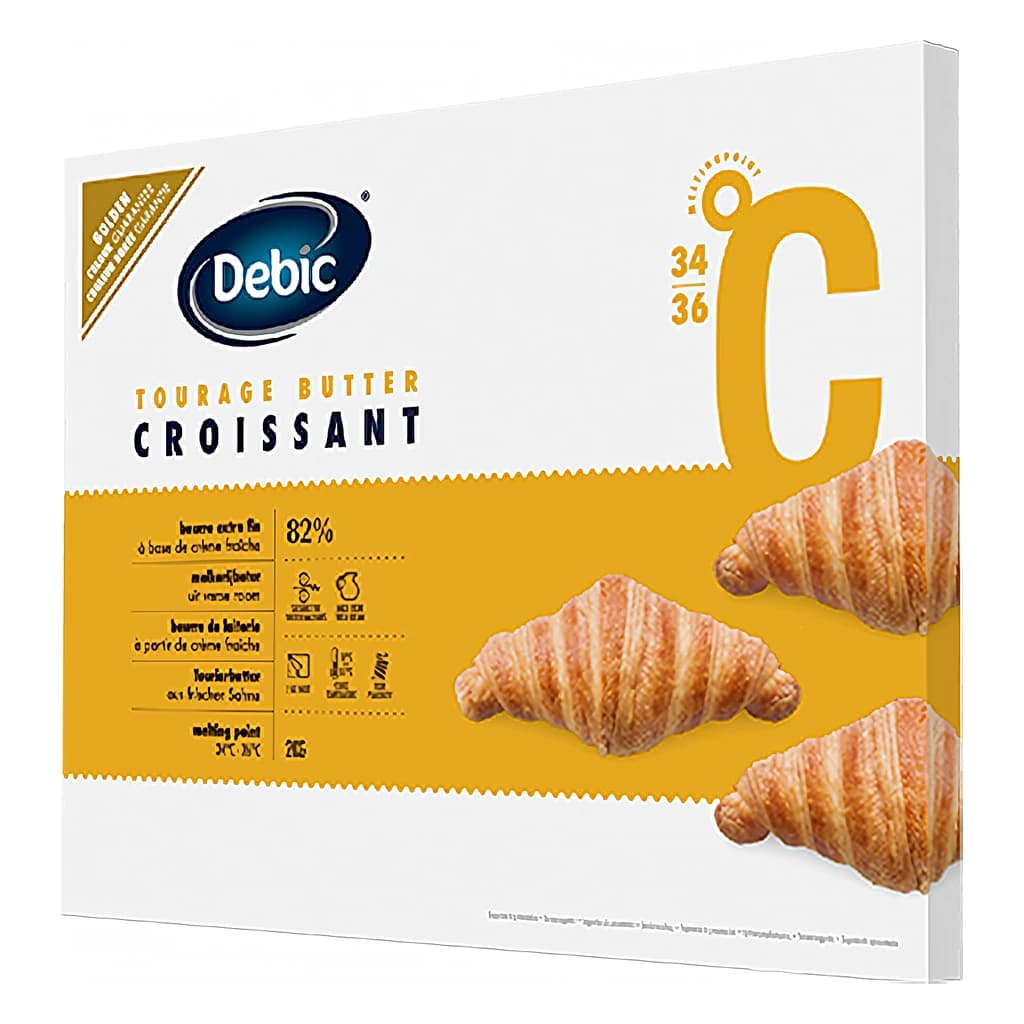
The Domson catalogue lists Tourage Croissant Butter 10 kg (5 × 2 kg slabs). This product is packaged in purpose-sized rectangular slabs designed to fit inside a standard rolled dough piece without trimming. No spec sheet is currently attached to this product — specific fat %, water %, SFC or plasticity data cannot be extracted from first-party sources.
What differentiates a tourage-grade butter from a standard butter block:
| Feature | Standard unsalted butter (e.g. Polmlek 10 kg block) | Tourage butter (e.g. 5 × 2 kg slabs) |
|---|---|---|
| Format | Block or cube; irregular or large slab | Rectangular slab precisely sized for dough enclosure |
| Fat % | Min. 82% (spec confirmed) | Typically 84%; exact % unknown (no spec) |
| Water % | 16% (spec confirmed) | ~14% (estimated; no spec) |
| Primary use | General baking, enriched doughs | Exclusively lamination |
| Temperature at delivery | 0–10°C chilled | 0–10°C chilled; should be tempered to 13–14°C before use |
7. Crystal structure and plasticity: why butter behaves as it does
All fats can solidify in different crystal polymorphs — arrangements of triglyceride molecules in the crystal lattice. The three relevant forms in bakery fats are:
- Alpha (α): unstable, very fine crystals, forms first on rapid cooling. Quickly converts to more stable forms.
- Beta-prime (β'): small, needle-like crystals packed closely; gives a smooth, creamy texture and excellent plasticity. This is the preferred form for lamination, creaming and any application requiring a spreadable, malleable fat.
- Beta (β): the most thermodynamically stable form; large, coarse crystals that give a grainy, brittle texture and very narrow plasticity window.
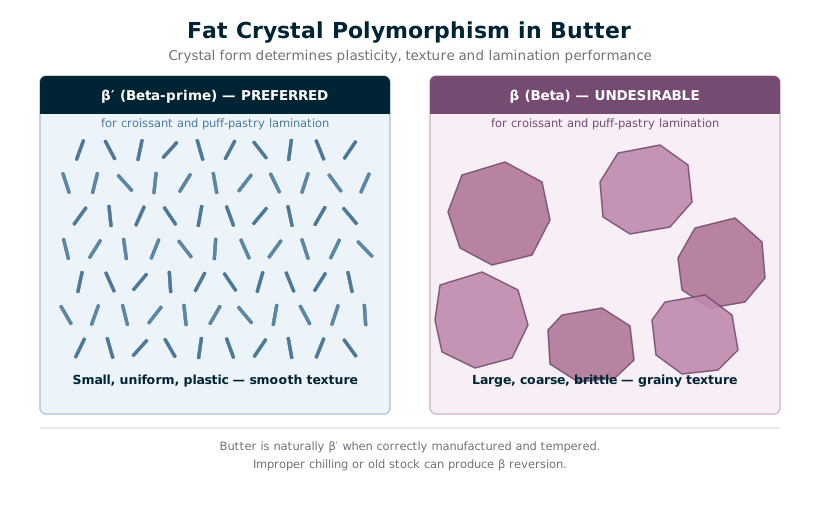 Side-by-side comparison of beta-prime and beta fat crystal structures: small plastic needle crystals vs. large coarse brittle crystals
Butter is naturally in β' form when correctly manufactured and properly tempered. The churning process and subsequent cooling rates during manufacturing are designed to maintain β' crystals. However, butter that has been stored at very low temperatures for extended periods, or temperature-cycled (repeatedly warmed and rechilled), can undergo β reversion — gradual conversion to the coarser β form. This explains why old or temperature-abused butter feels grainy or sandy rather than smooth and plastic.
The plasticity window — the temperature range within which butter is workable — is approximately 13–16°C for standard 82% butter and somewhat wider for high-fat 84%+ grades. At this temperature the fat is firm enough that it does not smear through the dough under sheeting pressure, yet plastic enough to deform without cracking. Below ~10°C, butter becomes brittle and shatters. Above ~18°C it begins to soften and will seep into the dough.
Confidence note: The 13–16°C plasticity range is from a single reference source and is LOW confidence. No SFC data from spec sheets is available for the butter products in this catalogue. Compare with the Kruszwica Maestra laminating margarine (spec SPBL11/04), whose SFC at 20°C is confirmed at 33–37% and working temperature is specified at 18–20°C — these values are spec-sheet confirmed and HIGH confidence.
8. SFC and melting: butter vs. laminating margarine
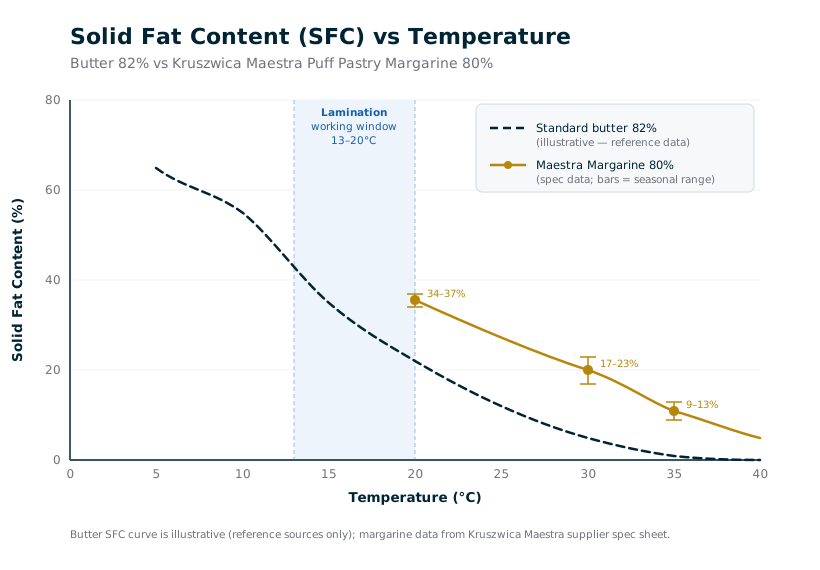 Graph comparing SFC (solid fat content) curves of standard butter versus puff pastry margarine across temperatures 0–40°C, with the lamination working temperature range highlighted
One practical reason why commercial bakeries often prefer laminating margarines over real butter for high-volume puff pastry and Danish is the higher and more consistent SFC at working temperatures:
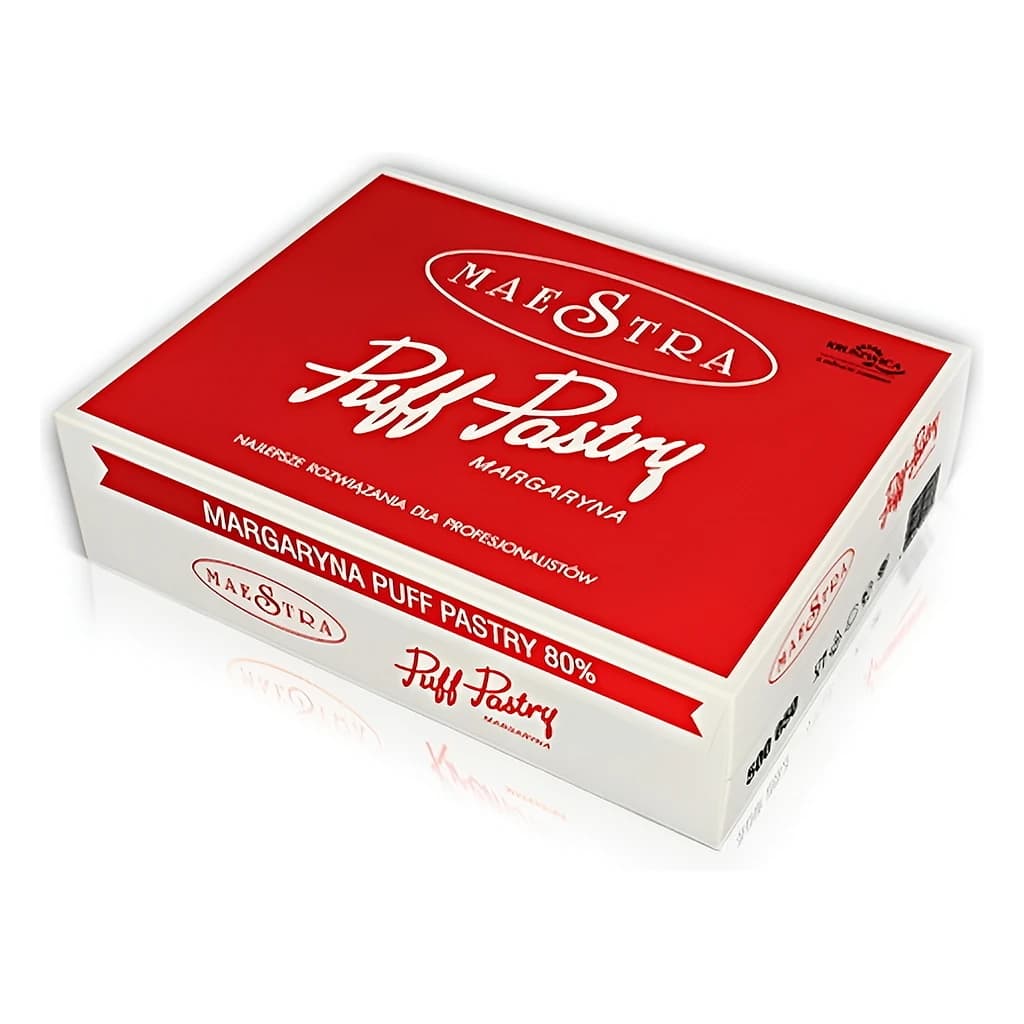
The Kruszwica Maestra Puff Pastry Margarine 80% spec provides confirmed SFC data: at 30°C the margarine still retains 17–23% solid fat — meaning it holds structure well into temperatures where butter would be largely fluid. This wider working window reduces the need for refrigerated work rooms and reduces spoilage when rooms warm during summer.
The Cardowan Crown NHAV Pastry Margarine (82% fat) has a confirmed slip melting point of 47.0°C — significantly higher than butter's melting range, which begins to soften around 28°C and reaches full fluidity only at approximately 36–38°C. This higher melting point means the margarine remains structured at room temperature and oven temperatures that would have already melted butter into the dough. The practical consequence: margarine-laminated pastry is more tolerant of warm proof boxes and equipment, at the cost of the full dairy flavour and the Maillard contribution of milk solids.
Regulatory note: the Kruszwica Maestra specification (SPBL11/04) referenced throughout this article is dated 20 May 2009. Its ingredient declaration lists partially hydrogenated and interesterified vegetable fats. EU Regulation (EU) 2019/649, in force from 1 April 2021, restricts industrially produced trans-fatty acids (iTFA) to a maximum of 2 g per 100 g of fat in food placed on the EU or UK market. A product formulation containing partially hydrogenated fats may be non-compliant with or may have since been reformulated to meet this limit. The SFC values, nutritional data and working-temperature recommendations from the 2009 spec may describe a superseded formulation. Request an updated post-April 2021 specification from Kruszwica confirming either iTFA ≤ 2 g/100 g fat or removal of partially hydrogenated fats before presenting this data as current.
Allergen comparison:
- Butter (Polmlek 82%): contains milk and lactose — mandatory declaration.
- Kruszwica Maestra Margarine: "may contain trace amounts of milk" — cross-contamination risk disclosure, not an intentional ingredient.
- Cardowan Crown NHAV Pastry Margarine: no milk allergen in product, production line or factory.
For halal-certified, dairy-free or severely milk-allergic product lines, the Cardowan Crown NHAV Pastry Margarine is the technically verified allergen-free alternative to butter lamination.
See the table below for the full side-by-side comparison of all confirmed parameters.
9. Temperature management for lamination: the practical guide
Regardless of whether you use butter or a tourage-grade margarine, temperature control at every stage determines the quality of lamination.
For real butter (82% or 84%+ tourage):
- Remove from cold store and allow to temper — either at room temperature (~15 min for a 2 kg slab) or by briefly working in a sheeter between sheets of baking parchment — until a poke test shows the slab dents but does not crack. Target: 13–14°C throughout.
- Keep the work room at or below 16–18°C throughout lamination.
- After each fold (tour), rest the dough in the refrigerator for 20–30 minutes before the next turn. This re-firms the butter and relaxes gluten.
- If butter begins smearing during a turn, stop immediately and chill for 30 minutes. Do not try to continue — compromised layers cannot be recovered.
- After shaping, proof at 26–28°C with 75% RH — the shaped croissant structure is already set and the butter can soften slightly for oven spring without compromising layer integrity.
For laminating margarine (e.g. Kruszwica Maestra):
Use at 18–20°C per spec. The higher SFC of margarine means it tolerates warmer working conditions than butter. Work rooms up to 20–22°C are typically acceptable.
10. Butter in enriched doughs: mixing sequence and dosage
In yeast-leavened enriched doughs, butter plays a different role: it shortens the gluten network (coating gluten strands in fat and making them slip past each other rather than cross-link), traps air during creaming or intensive mixing, and retains moisture in the baked crumb to slow staling.
The key practical rule: always add butter at the final stage of mixing, after the gluten network has developed. Adding butter at the beginning coats flour particles and prevents the proteins from absorbing water and forming gluten bonds, resulting in a dense, under-developed dough.
At dosages above ~20% butter on flour (standard brioche), fat and high sugar loads together reduce yeast activity in enriched doughs. Practical compensations (adjust to your formula and yeast strain):
- As a starting guideline, increase yeast quantity by around 10–20% above your standard rate; exact adjustment depends on fermentation temperature, total sugar load and dough hydration
- Use an osmotolerant yeast strain (designed for high-sugar, high-fat conditions)
- Extend bulk fermentation time
- Add butter cold and in stages over 10–20 minutes rather than all at once
See the table below for reference baker's percentage ranges across major enriched-dough applications, and the formula cards below for example formula structures.
11. Catalogue products mapped to this topic
Direct butter products
| Product | SKU | Has spec | Key data |
|---|---|---|---|
| Unsalted Butter 82% 10 kg | g22581 | Yes (SW-01) | Fat ≥82%, water 16%, cream only, allergen: milk/lactose |
| Unsalted Butter 82% 25 kg | g22344 | No | Same product, bulk format — same spec applies |
| Tourage Croissant Butter 10 kg (5 × 2 kg) | g25126 | No | Purpose-sized lamination slabs — no spec data available |
Laminating margarine (comparison / alternative products)
| Product | SKU | Fat % | SMP °C | Allergen | Key note |
|---|---|---|---|---|---|
| Puff Pastry Margarine 80% 10 kg (Kruszwica Maestra) | g22663 | 80% ±0.5% | — | Trace milk possible | SFC data confirmed; use at 18–20°C |
| Puff Pastry Margarine 12.5 kg (Cardowan Crown NHAV) | g45067 | 82% | 47°C | None detected | Allergen-free, RSPO; salt 2.5 g/100 g — adjust recipe |
| High Ratio Vegetable Shortening 12.5 kg | g44887 | 100% | 44°C | None | For cakes, not lamination; contains E471 |
| Vegetable Shortening 12.5 kg | g45065 | 100% | 45°C | None | Plain shortening; no emulsifier |
12. Buying guide summary
Choose standard unsalted butter (82%) when:
- You need genuine dairy flavour and Maillard colour contribution from milk solids
- Your dough or recipe is ≤25% butter on flour
- You have temperature-controlled lamination facilities or are working in small batches
Choose tourage / high-fat butter (84%+) when:
- You are laminating croissant or Danish at commercial volume
- Reducing layer irregularity from excess steam is a priority
- You want a slightly wider working temperature window
Choose cultured butter when:
- The butter flavour is the primary selling point of the finished product (premium brioche, artisan croissant)
- Your customers distinguish genuine fermented dairy character from sweet-cream products
Choose laminating margarine (Kruszwica Maestra or similar) when:
- You need reliable lamination at room temperatures above 18°C
- Your operation is certified halal and requires dairy-free alternatives (check each product spec)
- Consistency across seasonal temperature variation is critical
Choose allergen-free pastry margarine (Cardowan Crown NHAV) when:
- The product line is dairy-free or must meet a confirmed milk-allergen-free standard
- Note: Crown NHAV Pastry Margarine contains 2.5 g salt/100 g — reduce recipe salt accordingly
Coverage notes (for editorial review)
Solid coverage:
- EU/UK legal definition of butter (two regulatory sources, high confidence)
- Polmlek Unsalted Butter 82% spec data (fat, water, salt, SFA, energy, allergen, microbiological, storage) — directly from spec sheet, high confidence
- Kruszwica Maestra Puff Pastry Margarine SFC curve and working temperature — directly from spec sheet, high confidence
- Cardowan Crown NHAV Pastry Margarine slip melting point and allergen-free status — spec confirmed
- Cultured butter LAB chemistry and diacetyl flavour — LibreTexts textbook, single source but high-reliability publisher, MEDIUM confidence
- Crystal polymorphism (β' vs β) — BAKERpedia, single source, MEDIUM confidence
Thin / needs follow-up:
- SFC data for any real butter product in the catalogue — none available. The Tourage Croissant Butter has no spec sheet attached. A future research session should request and attach the supplier datasheet for this product to convert plasticity claims from LOW to HIGH confidence.
- High-fat butter (84–86%) specific parameters — no spec sheet available, single reference source only.
- Cultured butter specifics (diacetyl levels, LAB strain names by manufacturer) — would benefit from a second independent academic or regulatory source.
- Comparison with Puratos Argenta Pastry Laminating Fat — no spec sheet available; a future run should include it.
- Polish and UK national butter traditions (relevant to Pillar B articles) — not covered here but cross-referenced in the related_articles list.
Classic French croissant — butter usage guide (baker's %)
| Ingredient | Baker's % | Weight |
|---|---|---|
| Strong white flour | 100% | |
| Water | 45–55% | |
| Fresh yeast | 3–5% (increase at higher butter %) | |
| Salt | 1.8–2.0% | |
| Sugar | 8–12% | |
| Unsalted butter (in dough) | 10–15% | |
| Milk (partially or fully replacing water) | 0–20% | |
| Tourage / roll-in butter (unsalted 82%+ or high-fat 84%) | 20–40% (separate; not mixed into dough; commercial norm 20–30%; artisan formulas up to 40%) |
These are reference percentages from the IREKS Compendium; actual production formulas will vary by bakery. All percentages relative to flour weight.
Standard brioche — butter levels (baker's %)
| Ingredient | Baker's % | Weight |
|---|---|---|
| Strong white flour (or blend) | 100% | |
| Whole eggs | 40–80% (key enrichment alongside butter) | |
| Unsalted butter (softened, added in stages) | 40–80% | |
| Sugar | 8–15% | |
| Salt | 1.5–2.0% | |
| Fresh yeast (osmotolerant recommended at >50% butter) | 3–6% | |
| Milk (optional) | 0–10% |
Brioche butter content varies enormously by style: lean brioche (Nanterre-style) to very rich (Parisienne). The ranges below cover common commercial bakery versions.
Legal fat-content thresholds from EU Regulation 1308/2013 (regulatory, high confidence). SFC and plasticity-range figures for standard 82% butter are from reference literature (BAKERpedia, Pastry Arts Magazine — single source, confidence LOW) because no SFC data for butter is present in any spec sheet in this catalogue. The Polmlek SW-01 spec confirms fat ≥82% and water 16% for the standard-grade entry. The 84%+ high-fat and tourage rows are supported by reference sources only — the Tourage Croissant Butter product has no attached spec sheet. Food safety: all real butter contains milk, including lactose, which must be declared as an allergen.
| Type | Fat % (typical) | Water % (max) | Cream treatment | Salt added? | Plasticity range °C (ref. only) | Primary baking use | Catalogue product |
|---|---|---|---|---|---|---|---|
| Standard unsalted butter (82%) | ≥82% (EU legal min 80%) | ≤16% | Pasteurised sweet cream (unacidified) | No (<0.1% inherent NaCl from cream; 0.20 g/100 g in Polmlek spec) | ~13–16°C (LOW confidence — reference only) | Enriched yeast doughs, short pastry, cakes, sauces | Polmlek Unsalted Butter 82% 10 kg |
| Cultured (ripened) butter | ≥82% (same legal grade) | ≤16% | Pasteurised cream + LAB culture (Lactococcus lactis / Leuconostoc spp.) → fermented before churning | Unsalted or lightly salted variants exist | ~13–16°C (same as sweet-cream 82% butter — LOW confidence) | Brioche, croissant, viennoiserie where rich dairy flavour is a selling point; butter creams | Not currently in catalogue (note for buyer: specify 'beurre de culture' or 'Kulturbutter') |
| High-fat (dry) butter (84–86%) | 84–86% (no distinct EU legal grade; still falls under EU ≥80% definition) | ~13–14% (reduced by extra churning/working) | Pasteurised sweet cream; additional moisture removal | Typically unsalted | ~12–18°C (slightly wider than 82%; LOW confidence — reference only) | Laminated pastry where lower moisture reduces steam disruption of layers; premium croissant | Not currently in catalogue as labelled high-fat SKU |
| Tourage (roll-in) butter | Typically 84%; some products 82% | ~14–16% | Pasteurised sweet cream; purpose-shaped into slab/sheet blocks | Unsalted | ~13–16°C (LOW confidence — no spec sheet for this product) | Specifically for folding into laminated pastry dough (croissant, Danish, puff pastry) | Tourage Croissant Butter 10 kg — 5 × 2 kg slabs — NO SPEC SHEET ATTACHED |
Values for Polmlek butter from spec sheet SW-01 (high confidence for fat/water/nutrition; melting range LOW confidence — reference only; full fluidity ~36–38°C, not 33–35°C as previously cited — corrected per verification). Values for Kruszwica Maestra from spec SPBL11/04 dated 2009 (SFC data confirmed in that spec BUT spec lists partially hydrogenated fats; EU Reg 2019/649 iTFA limit applies from April 2021 — obtain updated spec before publishing SFC values as current). Values for Cardowan Crown NHAV Pastry from spec code 10100 (high confidence). Food safety: butter contains milk/lactose (a declarable allergen); the margarines below carry no declared milk allergen per their specs, but cross-contamination notes vary — check each spec sheet before use.
| Parameter | Polmlek Unsalted Butter 82% | Kruszwica Maestra Puff Pastry Margarine 80% | Cardowan Crown NHAV Pastry Margarine 82% |
|---|---|---|---|
| Fat % | ≥82% (spec: min 82%) | 80% ±0.5% | 82.0% |
| Water % (approx.) | 16% (spec stated) | ~18% (calculated) | ~16% (calculated) |
| Saturated fat g/100 g | 55.0 g (spec stated) | Not stated in spec | 41.2 g (spec stated) |
| Salt g/100 g | 0.20 g (trace; inherent from cream) | 0.5% ±0.05% (≈0.5 g/100 g, added) | 2.5 g (added; high — check recipe impact) |
| Energy per 100 g | 3058 kJ / 744 kcal | 2960 kJ / 720 kcal | 3033 kJ / 738 kcal |
| SFC at 20°C | ~20–25% (LOW confidence — reference only; not in spec) | 35–37% (summer) / 33–35% (winter) (per the 2009 spec — may not reflect the post-2021 reformulated product; see the regulatory note above) | Not stated in spec |
| SFC at 30°C | ~5–10% (LOW confidence — reference only) | 18–23% (summer) / 17–22% (winter) (per the 2009 spec — see the regulatory note above) | Not stated in spec |
| Slip/softening point °C | Softening begins ~28°C; largely fluid ~34–36°C; fully liquid ~36–38°C (LOW confidence — reference only; not in spec) | Not stated in spec (SFC curve given instead) | 47.0°C (SPEC CONFIRMED) |
| Recommended working temperature | 13–16°C for lamination (LOW confidence — reference only) | 18–20°C (SPEC CONFIRMED) | Not stated in spec |
| Crystal form | Predominantly β' (natural; reference sources) | β' by design (interesterification; reference) | β' (design intent; reference) |
| Milk allergen | YES — milk, including lactose (SPEC CONFIRMED) | Trace possible ('may contain trace amounts of milk' per spec) | NO milk allergen in product, line or factory (SPEC CONFIRMED) |
| Vegan/dairy-free | No | Not confirmed vegan (may contain trace milk) | Yes (no dairy ingredients or allergens) |
| RSPO status | N/A (dairy fat) | Not stated in spec | RSPO Segregated & Mass Balance (BMT-RSPO-000023) |
| Shelf life | 60 days chilled (0–10°C); 12 months frozen (−18 to −22°C) | 150 days (storage ≤10°C) | 5 months |
| Flavour contribution | Rich dairy butter flavour; contributes to Maillard browning via milk proteins and lactose | Neutral-to-mild; diacetyl-flavoured (artificial butter note) | Neutral; no dairy flavour |
Baker's percentage ranges from the IREKS Compendium and the LibreTexts open textbook. These are indicative ranges — actual recipe optimisation may fall outside them. Single-source confidence MEDIUM. No spec-sheet data available for dosage — butter is an ingredient, not a compound improver with stated dosage.
| Application | Butter in dough (% on flour) | Roll-in / tourage butter (% on flour) | Notes |
|---|---|---|---|
| Standard enriched white tin loaf | 2–5% | N/A | Small amounts of butter or fat improve crumb softness and shelf life; more than 5% requires adjusted yeast quantity |
| Soft rolls / brioche-style rolls | 10–25% | N/A | Add butter at final mixing stage after gluten is developed |
| Classic brioche | 40–80% | N/A | The highest butter content in any standard bread dough; high-fat content strongly inhibits yeast — use osmotolerant or enriched formulas; butter incorporated cold and in stages |
| Croissant | 10–20% | 20–40% | Total butter ~35–55% on flour (dough + roll-in combined). Commercial operations typically 20–30% roll-in; artisan/premium formulas commonly 30–40%. Use unsalted or tourage-grade 84%+ butter for roll-in for cleaner lamination |
| Danish pastry | 10–20% | 20–25% | Similar to croissant; often slightly sweeter dough; egg adds richness |
| Rough puff / blitz puff | N/A | 50–75% (of flour; butter layered in chunks) | Butter chunks must be cold and firm; quick method produces fewer layers than classical puff but faster |
| Classical puff pastry (feuilletage) | N/A | 50–100% (equal weight to flour in many formulas) | Butter and dough weights often equal (1:1 or dough slightly heavier); 6 bi-fold turns create up to 729 layers |
Fault causes and remedies based on reference literature. No spec-sheet data available for fault analysis. MEDIUM confidence — standard professional baking knowledge.
| Fault observed | Probable cause | Corrective action |
|---|---|---|
| Butter cracks and shatters during first sheeting pass | Butter too cold (<10°C); fat crystals are brittle | Temper butter at room temperature until it reaches 13–14°C — firm but plastic. Ideally beat to consistency in a sheeter between sheets of parchment before enclosing in dough. |
| Butter smears through dough layers; no visible lamination after sheeting | Butter too warm (>17–18°C); fat begins seeping into dough | Return to refrigerator. Chill dough and butter for 20–30 min between every 1–2 folds. Keep work room <18°C. |
| Layers blow out unevenly or collapse in oven; dense interior | Excess water in butter (standard 82%) generating uncontrolled steam; or uneven fat distribution during folding | Switch to high-fat (84%+) or dedicated tourage butter. Ensure even fat distribution at enclosure stage. Do not rush folding turns. |
| Croissant has good layering but tastes bland or artificial | Laminating margarine used instead of butter, or low-quality butter with insufficient diacetyl content | Use real butter (82%+ unsalted, or cultured butter for enhanced flavour). Cultured butter can increase diacetyl flavour markedly. |
| Over-salty croissant or pastry despite recipe having no added salt | Salted or semi-salted butter used for roll-in by mistake; or Cardowan Crown NHAV Pastry Margarine (2.5 g salt/100 g) not accounted for in recipe | Always specify unsalted butter. When using a margarine with added salt (e.g. Cardowan Crown NHAV at 2.5 g salt/100 g), reduce recipe salt proportionally. |
| Yeast dough with high butter content is dense; poor oven spring | Butter added too early in mixing, coating flour particles and inhibiting gluten development; or yeast quantity not adjusted for fat content | Add butter at final mixing stage after gluten window is established. Increase yeast by 10–20% for doughs >25% butter. Use osmotolerant yeast for brioche. |
| Butter pastry goes rancid quickly in storage | Butter not stored correctly; oxidation or microbial spoilage | Store at 0–10°C; use within 60 days (chilled) or freeze at −18 to −22°C for up to 12 months. After thawing, use within 7 days. Never refreeze. |
- Confidence:
- high
- Fat pct min:
- 82
- Water pct:
- 16
- Salt g per 100g:
- 0.2
- Sfa g per 100g:
- 55
- Protein g per 100g:
- 0.7
- Carbs g per 100g:
- 0.7
- Energy kj per 100g:
- 3058
- Energy kcal per 100g:
- 744
- Ingredient declaration:
- Pasteurized cream
- Preservatives:
- None
- Cream type:
- Unacidified (sweet cream) — NOT cultured
- Allergen contains:
- milk, lactose
- Storage chilled temp:
- 0–10°C
- Storage chilled days max:
- 60
- Storage frozen temp:
- -18 to -22°C
- Storage frozen months max:
- 12
- After thaw note:
- Store 0–10°C, consume within 7 days. Do not refreeze.
- Available formats:
- 200g cube, 250g cube, 300g whetstone, 10kg block, 25kg block, 10g portions
- Spec doc number:
- SW-01 Printing 27
- Spec date:
- 2023-10-18
- Confidence:
- high
- Fat pct:
- 80% ±0.5%
- Salt pct:
- 0.5% ±0.05%
- Ffa pct max:
- 0.75
- Peroxide value max:
- 4
- Erucic acid pct max:
- 2
- Sfc data · At 20C summer:
- 35–37%
- Sfc data · At 20C winter:
- 33–35%
- Sfc data · At 30C summer:
- 18–23%
- Sfc data · At 30C winter:
- 17–22%
- Sfc data · At 35C summer:
- 10–13%
- Sfc data · At 35C winter:
- 9–12%
- Sfc data · Seasons:
- Summer season: 15 Apr–31 Aug; Winter season: 1 Sep–14 Apr
- Energy kj per 100g:
- 2960
- Energy kcal per 100g:
- 720
- Working temp C:
- 18–20
- Shelf life days:
- 150
- Storage temp:
- 4–10°C
- Confidence:
- high
- Fat g per 100g:
- 82
- Saturates g per 100g:
- 41.2
- Mono unsaturates g per 100g:
- 29.8
- Polyunsaturates g per 100g:
- 8.7
- Salt g per 100g:
- 2.5
- Energy kj per 100g:
- 3033
- Energy kcal per 100g:
- 738
- Slip melting point C:
- 47
- Ffa pct:
- 0.1
- Peroxide value:
- 1
- Milk allergen:
- false
- Rspo certified:
- true
- Rspo model:
- Segregated & Mass Balance
- Shelf life months:
- 5
Buy the ingredients
Catalogue products and brands referenced in this article.