
Mucenici, scovergi and calendar pastries: ritual baking for Saints' days and seasonal festivals
A working baker's guide to the ritual bakes of the Romanian Orthodox calendar, built around the 9 March feast of the Sfinții 40 de Mucenici (the Forty Martyrs of Sebaste). It explains why that one date splits the country in two: in Moldova bakers make mucenici moldovenești — figure-eight buns of risen (yeast) dough, baked, brushed with honey syrup and rolled in ground walnut, close cousins of the rum baba; in Muntenia and Oltenia they make mucenici muntenești — tiny figure-eight twists of a plain flour-and-water pasta dough, simmered in a sweet walnut broth (a dessert soup). Because 9 March almost always falls inside the Great Lent (it does in 2026), the traditional forms are de post (egg- and dairy-free), which is a production fact, not a footnote. The dossier ties each product to the martyr's story and figure-eight symbolism, to the craft concepts in Pillar A (osmotolerant vs lean-dough yeast, enriched-dough handling, proofing, frying fats, nut toppings), and to the exact Domson supplier brands a Romanian baker or cofetărie in the UK would order. It also covers scovergi (Lenten fried dough) and situates all of it in the wider ritual-baking calendar. Anchored on eight first-party supplier spec sheets (GoodMills Type 400 macaroni flour and Type 550 flour, Polski Cukier granulated sugar, Ratos Natura multifloral honey, Lesaffre Benevia fresh yeast, Lallemand Fermipan Red instant yeast, ground cinnamon, Olympic sunflower oil) cross-checked against Romanian-language cultural, liturgical and culinary sources (Radu Anton Roman, the Antonescu dictionary of Romanian symbols, Doxologia, Basilica/AGERPRES and the Romanian recipe canon).
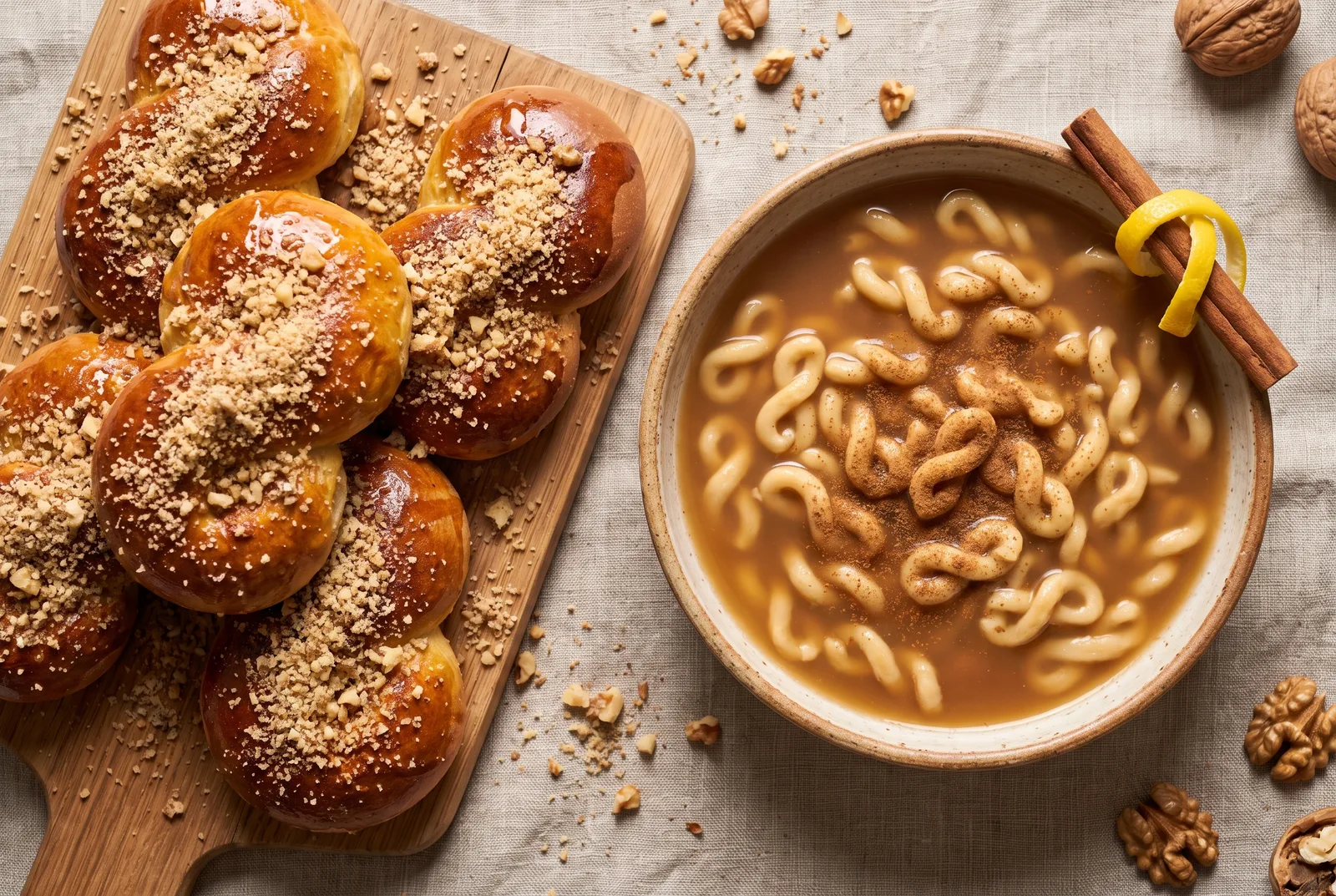
Mucenici, scovergi and calendar pastries: ritual baking for Saints' days and seasonal festivals
In a Romanian bakery the liturgical calendar is a production calendar. The Orthodox year sets predictable, immovable spikes — Easter pască, Christmas colaci, the wheat colivă of the memorial days — and among them sits one feast that is unusually revealing for a baker, because it splits the country cleanly in two. On 9 March, the feast of the Sfinții 40 de Mucenici (the Forty Holy Martyrs of Sebaste), a Moldavian bakery and a Wallachian one make something that shares a name, a shape and a saint, yet is produced by two completely different systems: one is a baked, yeast-raised, honey-glazed enriched bun; the other is a boiled, unleavened flour-and-water twist served in a sweet walnut soup (c1, c6). Understand why, and you understand a great deal about how Romanian ritual baking maps onto flour choice, leavening and fat. See the figure below for the two side by side.
This article is the calendar piece for the B4-romanian section. The festive enriched dough it draws on is treated in depth in B4-cozonac-enriched-dough; the Easter and memorial ritual breads (pască, colaci, colivă) in B4-pasca-and-ritual-breads; the fasting versions in B4-cozonac-de-post-vegan-baking; and the flour system in B4-flour-classification-romanian. Here we tie the calendar to the craft and to the catalogue.
1. The saint, the date and the figure-eight
The feast. The 40 Martyrs of Sebaste were, by tradition, Christian soldiers of the 12th "Fulminata" Legion from Armenia. Under Emperor Licinius (reigned 308–324) and the governor Agricola they refused to renounce their faith and were left overnight to freeze in the lake at Sebaste (in present-day Turkey); the Orthodox Church commemorates them every year on 9 March (c1, c2). The date is fixed — it does not move with Easter — and because Orthodox Pascha usually falls between early April and early May, 9 March almost always lands inside the Great Lent (Postul Mare): in 2026 Orthodox Easter is 12 April and Clean Monday (the start of Postul Mare) is 23 February, so the feast sits well inside Lent (c3). (The one caveat: in rare very-late-Easter years — e.g. 2021, Orthodox Pascha 2 May — 9 March instead falls in the pre-Lenten cheesefare week, when egg and dairy are still allowed, so check the year's calendar.) That timing drives the whole production brief: the traditional mucenici are de post — made without egg or dairy — and the rich, egg-and-butter "de dulce" versions are a modern feast-day liberty (see §2).
Why a figure-eight. Every mucenic, in every region, is shaped like the numeral 8 (or a joined double-loop). Romanian folk and church tradition gives several overlapping explanations, and a baker should know them because customers ask: the eight recalls the days of torture the martyrs endured; it is read as the crown/wreath each martyr received; and it is read as a stylised human silhouette, a little body, standing for the forty (c4). In Muntenia there is a further, very concrete reading — the mucenici are boiled, and the sweet broth stands for the "waters of Sebaste" in which the soldiers died (c7). The shaping diagram is below.
The names change with the map. The same bake is called, by region, mucenici, măcinici, sfinți, sfințișori ("little saints"), bradoși/brăduleți, or moși de paresimi (c5). As a rule of thumb: in Moldova the baked, puffy version is often called sfințișori; in Muntenia/Oltenia the boiled version keeps the name mucenici (c5, c6).
The day around the bake. 9 March also marks a popular agrarian new year at the cusp of spring: it is when the "days of the old women" (zilele babelor) give way to the "days of the old men," and custom calls for driving out the cold — ritual fires, beating the ground with wooden mallets to "release its heat," and a symbolic first ploughing. Most famously, the men are said to drink 40 (or 44) glasses of wine for the forty martyrs (c8). For the baker this is context, not a recipe; but it explains the volume: mucenici are a genuine seasonal event, worth planning dough, walnut and honey capacity around. The year-at-a-glance is below.
2. Two mucenici, two production systems
The contrast is the teaching point. It is summarised in the comparison table below (Moldavian vs Muntenian mucenici) and mapped geographically in the figure below.
| Mucenici moldovenești (Moldova) | Mucenici muntenești (Muntenia / Oltenia) | |
|---|---|---|
| Cooking | Baked in the oven | Boiled/simmered in liquid |
| Dough | Risen — yeast-leavened enriched dough | Unleavened — plain flour + water (a pasta dough) |
| Size | Larger individual buns | Small twists, eaten by the dozen |
| Finish | Brushed with honey/sugar syrup, rolled in ground walnut | Served in a sweet walnut broth with cinnamon and citrus |
| Closest analogue | A honey-soaked baba/savarin bun | A sweet dessert soup / stewed pasta |
| Common name | often sfințișori | mucenici (c5, c6) |
Two rules cut across both. First, since the feast is inside Lent, the de post base is the authentic default — yeast, flour, water, salt, a little oil, honey and walnut — with no egg or milk (c3, c10, c11); the "de dulce" enriched Moldavian bun (milk, egg yolks, butter) is the modern non-fasting version. The Lenten functional-substitution logic sits in B4-cozonac-de-post-vegan-baking. Second, the two forms need different flours and different (or no) yeast, which is exactly where the catalogue comes in (§3–5).
3. Mucenici moldovenești — the baked figure-eight
What it is. A soft, faintly sweet, yeast-raised dough, shaped into figure-eights of about 55–60 cm ropes twisted from both ends, proofed, baked to gold, then — while still warm — brushed with a honey (or honey-and-sugar) syrup and showered with ground walnut (c10). The result is pillowy and aromatic, closer to a small baba/savarin than to a biscuit — hence the taxonomy note that these behave "like rum babas."
The flour. This is an enriched, structure-carrying dough: use a strong white wheat flour so the crumb holds the syrup without collapsing. In the Romanian system that is the whiter, higher-gluten end (Type 000/480–550; see B4-flour-classification-romanian). On the Domson shelf, the closest working equivalent is a strong bread flour: the datasheet held against the Domson White Strong Wheat Flour SKU (G44001) is in fact a GoodMills Type 550 spec — moisture max 15%, wet gluten 28–32%, falling number min 220 s, ash 0.51–0.58% (d.m.), gluten index 75–99 (c15) — a sound enriched-dough profile; the UK Windrush Strong White Bread Flour (G43025) is the pixel-for-pixel British stand-in. (See the verification note on the title/datasheet mismatch.)
The yeast — read this before you order. A honey/sugar-glazed Moldavian bun is only lightly sugared in the dough, so ordinary fresh yeast performs well: Lesaffre Benevia fresh compressed yeast (G25216) — living Saccharomyces cerevisiae, dry matter >29%, store 1–10 °C (optimum 4 °C), 35-day chilled shelf life (c18). But if you push the recipe toward a genuinely rich "de dulce" dough (higher sugar, egg yolks, butter), you enter osmotic-stress territory and should either raise the fresh-yeast dose or switch to an osmotolerant strain — see A2-osmotolerant-yeast-enriched-doughs and A2-yeast-types-comparison. Note the trap: the Fermipan Red instant dried yeast on this SKU (G45032, datasheet issued by Lallemand GB) is explicitly a lean-dough yeast for limited sugar (0–10 %) (c19) — perfect for scovergi, wrong as the sole leaven for a sugar-heavy de dulce mucenic. (Brand-attribution caveat: Fermipan is historically a Lesaffre/DSM trademark even though the datasheet on file is issued by Lallemand GB — confirm the manufacturer on the live SKU before relying on the name.) The decision is drawn in the figure below.
The syrup and the walnut. Radu Anton Roman's recorded Moldavian base is deliberately plain — 1 kg flour, ~2 tsp yeast, 500 ml water (≈50 % hydration), 1 tsp salt, with a syrup of ~6 tbsp honey (or sugar) + ~1 cup water + vanilla, and ~4 tbsp ground walnut over the top, baked about 30 minutes to gold (c10). Use a real honey for the glaze: Ratos Natura Multifloral Honey (G23652) — water ≤20 %, reducing sugars ≥60 %, HMF ≤4 mg/100 g, ~330 kcal/100 g, no declared allergens, 36-month shelf life (c17); the invert-sugar profile keeps the surface moist and glossy. Sweeten and build the syrup with granulated sugar (G22065, min 99.7 % sucrose, 400 kcal/100 g, c16) and finish with vanillin sugar (G22469) and citrus zest. The build and cross-section are shown below. Proof control matters here — an over-proofed bun drinks syrup and slumps; see A5-proofing-science. Walnut handling (chop size, freshness, allergen) is in A7-seeds-nuts-toppings. The formula card is below.
4. Mucenici muntenești — the figure-eight in walnut soup
What it is. In Muntenia and Oltenia the mucenic is not a bun — it is a tiny pasta-like twist. A plain unleavened dough of flour and water (Radu Anton Roman: 1 kg flour, 125 ml oil ≈12.5 %, 500 ml water ≈50 %, 1 tsp salt, no yeast) is rolled thin, cut, shaped into little figure-eights, dried briefly, then simmered in a sweet, aromatic walnut broth and served warm as a dessert soup (c11). It is the boiling that carries the symbolism — the sweet liquid stands for the "waters of Sebaste" (c7).
The flour is the surprise. Because the dough is essentially fresh pasta, the right flour is a low-ash, clean-tasting macaroni/pasta grade, not a bread flour. The catalogue carries exactly this: GoodMills Wheat Flour Type 400 (Macaroni grade) (G44069) — ash ≤0.50 % (d.m.), wet gluten ≥18 %, Gluten Index 55–100, moisture ≤15.3 %, sold as a semi-finished baking/confectionery flour (c14). The moderate gluten and very white colour give twists that hold their shape in the simmer without turning grey or gluey. A very white Type 450/480–500 (e.g. G22013 / G22179) is the everyday substitute. This is a rare case where the pasta aisle, not the bread aisle, is correct — see B4-flour-classification-romanian.
The broth. A representative Muntenian broth (from Bucate Aromate) is ~2 L water, 200 g sugar, ~250 g ground walnuts, a cinnamon stick, 20 g lemon zest + 20 g orange zest, vanilla, a little rum and salt, with the shaped mucenici simmered 5–10 minutes (some households boil the twists longer in water first, then add the flavoured syrup) (c12). Cinnamon and citrus are the signature; on the shelf, ground cinnamon (G23892) and vanillin sugar (G22469) do the aromatic work — with the important provisos in §7 about the cassia cinnamon. The finished bowl is shown below; the formula card is below.
Shortcut for volume. Most Muntenian households (and many cafés) buy the dried twists (mucenici uscați) by the bag and only make the broth; a bakery can equally sell the dried figure-eights plus a walnut-broth concentrate as a paired seasonal SKU. A ready walnut filling such as Semix Walnut Filling (G25556) can stand in for hand-ground walnut where labour is tight.
5. Scovergi — Lenten fried dough (turte în ulei)
Mucenici are not the only Lenten bake on the March bench. Scovergi (singular scovergă; in Oltenia also turte în tigaie, "pan-turtes") are fried dough — rustic, puffy fritters of a simple bread dough, fried in oil and eaten sweet or savoury (c9). The name comes from the Old-Slavonic skovrada, "frying pan," which tells you the whole method: dough fried straight in fat (c9). Like mucenici, the traditional scovergi are de post — flour, water, yeast, salt, a little oil, no dairy — which is why they belong to the Lenten repertoire; the de dulce version enriches with milk and a little butter.
Method and fat. A leavened scovergă dough (from Laura Adamache) runs flour 500 g, milk 300 ml (≈60 %), fresh yeast 20 g (≈4 %), sugar 20 g, butter 25 g, proofed in two stages, rolled out with a thin centre (the source thins the middle; some cooks pierce a small hole) so the centre fries through, then fried at ~170 °C, 2–3 minutes a side, and rolled in fine sugar while hot (c13). For the fasting version, swap milk for water and drop the butter. Frying-fat choice is a real quality-and-safety lever: Olympic Sunflower Oil (G44536) — 900 kcal/100 g, 100 g fat (11 g saturated / 28 g mono / 60 g polyunsaturated), 0 g trans, free-fatty-acid ≤0.1 %, peroxide ≤1.0 meq/kg, from a nut-free site, suitable for vegans (c21) — is a clean neutral frying oil, but its high 60 % polyunsaturate content means it oxidises faster at frying heat than a high-oleic or blended fat, so manage oil turnover and temperature (see A4-frying-fats-and-oils). Olympic Rapeseed Oil (G44625) or a dedicated palm frying oil (G25499) are more heat-stable alternatives. Scovergi are served rolled in sugar, spread with jam or honey, or — savoury — with salty cheese or soured cream (c9). The frying schematic is below.
6. The wider ritual-baking calendar
Mucenici and scovergi sit inside a fuller year of calendar bakes that a Romanian baker plans around (the wheel is below):
- Great Lent (late Feb → Easter): the de-post window — mucenici (9 March), scovergi/turte, and Lenten cozonac de post; drives demand for egg- and dairy-free formulas (see B4-cozonac-de-post-vegan-baking) (c3).
- Easter (Paști): pască (cheese-filled ring) and cozonac — the year's biggest enriched-dough event — treated in B4-pasca-and-ritual-breads and B4-cozonac-enriched-dough.
- Memorial days (Moși / pomeni) and funerals: colaci (ritual ring breads) given as alms and colivă (boiled sweetened wheat) — the ritual-bread mechanics live in B4-pasca-and-ritual-breads; note colivă shares the boiled-wheat logic that also underlies Muntenian mucenici (c6).
- Christmas (Crăciun): colaci and cozonac again, plus regional festive breads from B4-bread-landscape.
The common thread — figure-eight mucenici, ring-shaped colaci, boiled colivă and mucenici — is that shape and cooking method carry religious meaning, and the baker who can explain it (the eight, the ring, the "waters of Sebaste") sells the season with authority.
7. Food safety & allergens
These statements must be confirmed against the live supplier spec attached to each SKU (a datasheet's producer/name sometimes differs from the catalogue title — see the verification notes; the G44001 flour PDF is a Type 550 spec, the G23892 cinnamon PDF is an ACOR cassia certificate).
- Allergens. Every bake here contains wheat/gluten (declared on the T400, T550, sugar-line and yeast specs). The walnut topping and walnut broth are a tree-nut allergen. The enriched "de dulce" Moldavian mucenic adds egg and milk. The T400 and T550 flours also carry a trace soy/lupin/mustard cross-contamination declaration (c14, c15, c22). Two further, easily-missed allergens sit in the aromatics and leaven: the cassia cinnamon carries a "may contain" declaration for celery, mustard and sulphur dioxide (SO₂) (c20), and the fresh yeast is grown on molasses that contains sulphites — since sulphites (SO₂) are a declarable allergen above 10 mg/kg in the finished product, verify carry-over before relying on a "no added allergens" line (c18). Build and display allergen statements per EU/retained Reg 1169/2011; UK bakeries selling prepacked-for-direct-sale must also meet Natasha's Law (SI 2019/529) (c22). The allergen matrix is below.
- Cassia cinnamon coumarin (Muntenian broth, scovergi). The catalogue ground cinnamon (datasheet ACOR, origin Indonesia, SAP G22066/G23892; moisture ≤16 %, may contain trace celery/mustard/SO₂, c20) is a cassia-type cinnamon — Indonesian cassia is typically Cinnamomum burmannii (Korintje/Padang cassia) rather than the Chinese Cinnamomum cassia, but both cassia species are high in coumarin (unlike low-coumarin Ceylon, C. verum). EU Commission Regulation (EC) No 1334/2008 (Annex III) sets maximum coumarin at 15 mg/kg in fine bakery wares, or 50 mg/kg for traditional/seasonal bakery wares bearing a cinnamon reference — but a boiled sweet "dessert soup" like the Muntenian broth may instead fall under the desserts category, whose limit is a much stricter 5 mg/kg, so confirm the correct legal category before setting your limit. A cinnamon-heavy walnut broth or sugared scovergă can approach these limits — prefer certified low-coumarin Ceylon cinnamon for regular production, or obtain lot-specific coumarin data for the cassia and label accordingly (c24).
- Frying safety (scovergi). Control frying-fat quality (monitor free fatty acid / peroxide, replace degraded oil), fry to a safe internal crumb, and apply acrylamide-mitigation good practice — temperature control and avoiding over-browning. EU Reg 2017/2158 explicitly names biscuits, wafers and similar fine bakery wares; its precise scope for fried yeast dough is not explicit, so apply the mitigation principles as good manufacturing practice (c23).
- Honey and infants. The Moldavian syrup uses honey. Honey should not be given to infants under 12 months (infant-botulism precaution); flag on any product marketed to young children (c22).
- The wine custom is not a serving instruction. The "40 or 44 glasses of wine" tradition (c8) is folklore; do not reproduce it as a consumption suggestion — apply responsible-drinking messaging if referenced in marketing.
- Cold chain. Fresh yeast (Benevia) is perishable — hold at 1–10 °C and use within its 35-day life (c18); enriched de-dulce mucenici carrying egg/milk must be held chilled.
8. Buy it (Domson catalogue map)
Consolidated in the products at the end of this article; headline picks:
- Moldavian baked mucenici: strong flour — Domson White Strong Wheat Flour (G44001, datasheet = GoodMills Type 550) or UK Windrush Strong White Bread Flour (G43025); leaven with Lesaffre Benevia fresh yeast (G25216) (osmotolerant/higher dose for de dulce); glaze with Ratos Natura Multifloral Honey (G23652) + Granulated Sugar (G22065) + Vanillin Sugar (G22469); top with Walnuts Light Amber Halves (G44028).
- Muntenian boiled mucenici: GoodMills Wheat Flour Type 400 (Macaroni) (G44069) — the correct pasta-grade dough flour — or very-white Type 450/500 (G22013 / G22179); broth from Granulated Sugar (G22065), ground walnut (G44028 or Semix Walnut Filling G25556), Ground Cinnamon (G23892, cassia — see §7) and Vanillin Sugar (G22469).
- Scovergi: any bread/plain flour; lean-dough yeast Fermipan Red (G45032, datasheet issued by Lallemand GB — Fermipan is historically a Lesaffre brand, so verify the manufacturer on the SKU, see §3) or fresh Benevia (G25216); fry in Olympic Sunflower Oil (G44536), Rapeseed Oil (G44625) or Palm Frying Oil (G25499); finish with sugar (G22065) or honey (G23652).
9. Coverage report
Solid: the two-form structure and the historical/liturgical frame (9 March feast of the 40 Martyrs of Sebaste; the fixed date almost always inside Great Lent — and inside it in 2026; the Moldova-baked vs Muntenia-boiled split; the figure-eight symbolism; the regional name variants; the 40/44-glass wine custom) are each cited to Romanian-language sources and mostly corroborated twice (Radu Anton Roman, the Antonescu dictionary, Doxologia, Basilica/AGERPRES, crestinortodox, adevarul). Eight first-party spec sheets give the numbers for the headline ingredients (only the sugar and honey figures are also cross-checked against EU compositional standards; the rest are single supplier documents), including the pasta-grade Type 400 flour that makes the Muntenian point so cleanly.
Thin: the formula cards are house-typical syntheses anchored to Radu Anton Roman's
recorded ratios plus the Romanian recipe canon — exact quantities vary by household and region
(especially the enriched "de dulce" Moldavian version, whose milk/egg/butter loading is a modern
liberty, not a fixed traditional formula). The Muntenian simmer time is given as a range (5–10 min in
one source, ~1 h in Radu Anton Roman's method) and is labelled accordingly. The scovergi "central hole"
was softened to match the cited source (which thins, not necessarily pierces, the centre). The cinnamon
is a cassia-type (Indonesian, likely C. burmannii), not confirmed C. cassia. Brand attribution
needs verification on two yeasts (Fermipan Red — a historically Lesaffre trademark on a Lallemand-GB
datasheet; Pakmaya — a Pak Gıda/Turkish brand). Two catalogue SKUs carry a mismatched datasheet
(G44001 → Type 550 spec; G23892 → ACOR cassia certificate) and every number from them cites the actual
document. Spec numbers are first-party and single-source (only sugar and honey are corroborated against
EU compositional standards), so specs_cross_checked is set false.
Food-safety and regulatory flags: wheat/tree-nut/egg/milk allergen density plus the easily-missed celery/mustard/SO₂ on the cassia cinnamon and sulphite carry-over from the yeast molasses (EU/retained 1169/2011, UK Natasha's Law SI 2019/529); cassia-cinnamon coumarin limits (EU Reg 1334/2008 — 15/50 mg/kg bakery ware, or the stricter 5 mg/kg desserts limit if the boiled "soup" is classed as a dessert); frying-fat quality and acrylamide-mitigation good practice for scovergi (EU Reg 2017/2158 scope for fried yeast dough not explicit); honey-for-infants precaution; the wine custom is folklore, not a serving instruction.
Follow-up runs: capture a genuine strong-flour spec for the enriched dough (rather than the mismatched T550 PDF); source a Ceylon-cinnamon SKU or lot coumarin data; add verified Wikimedia/supplier photography for the finished-product images currently specified as originals; deepen the enriched-dough craft in B4-cozonac-enriched-dough.
Figures
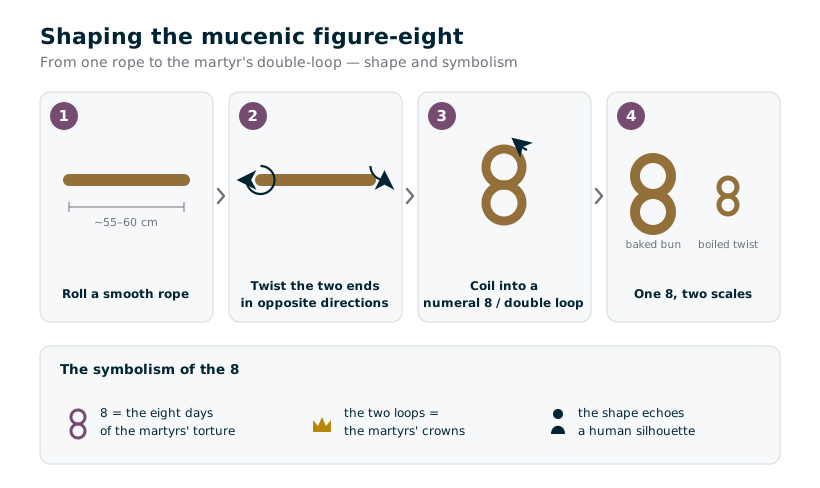 Diagram showing how a dough rope is twisted into the mucenic figure-eight shape
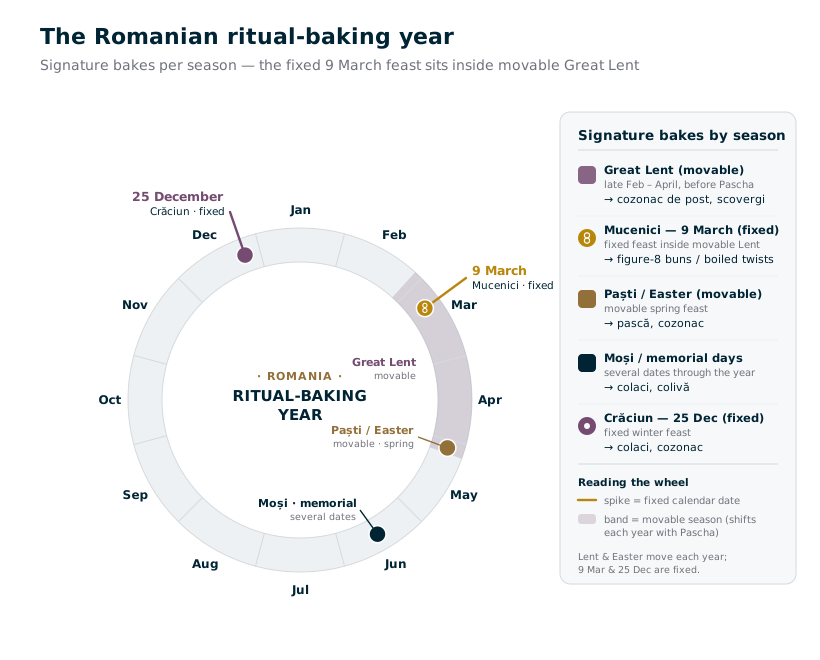 Year-wheel diagram of the Romanian Orthodox ritual-baking calendar with signature bakes per season
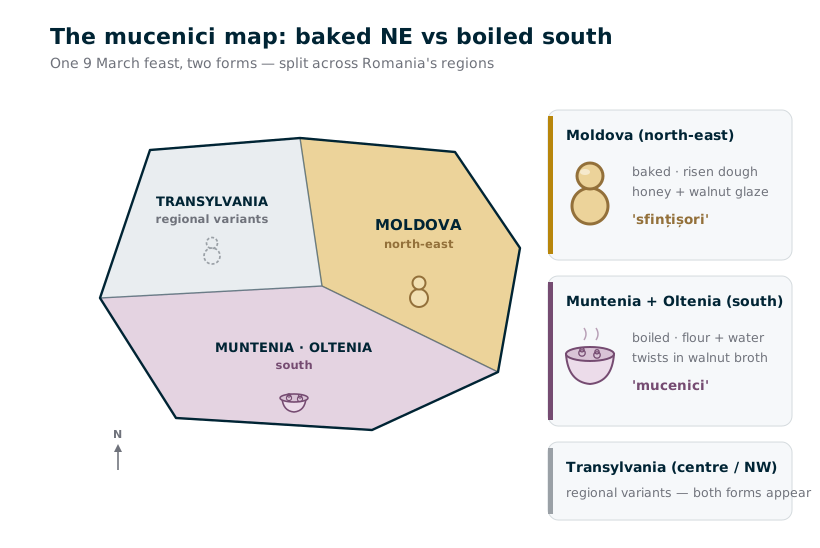 Map of Romania showing the baked-north-east versus boiled-south split of the mucenici tradition
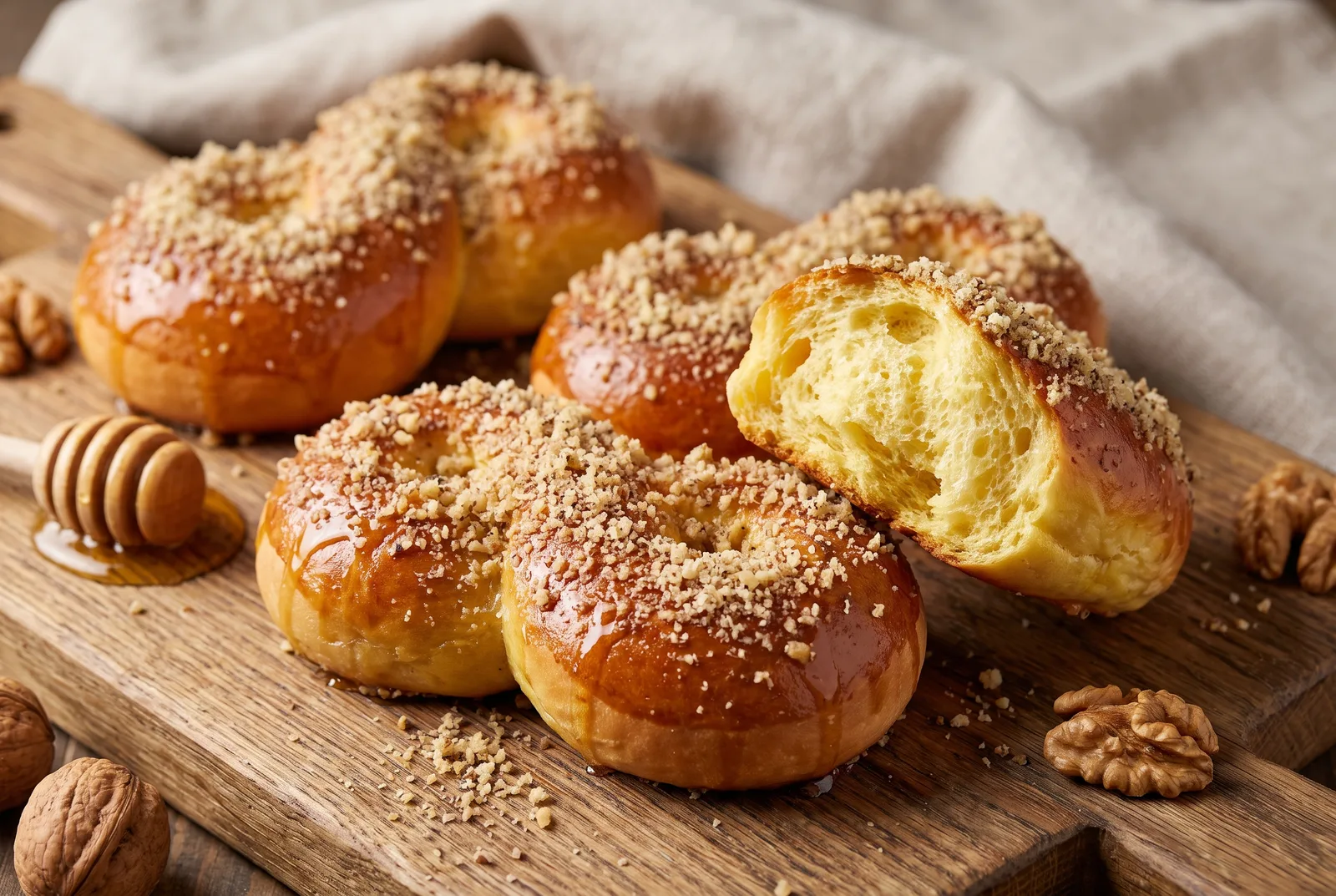 Close-up of baked Moldavian mucenici glazed with honey and coated in ground walnut, one torn open
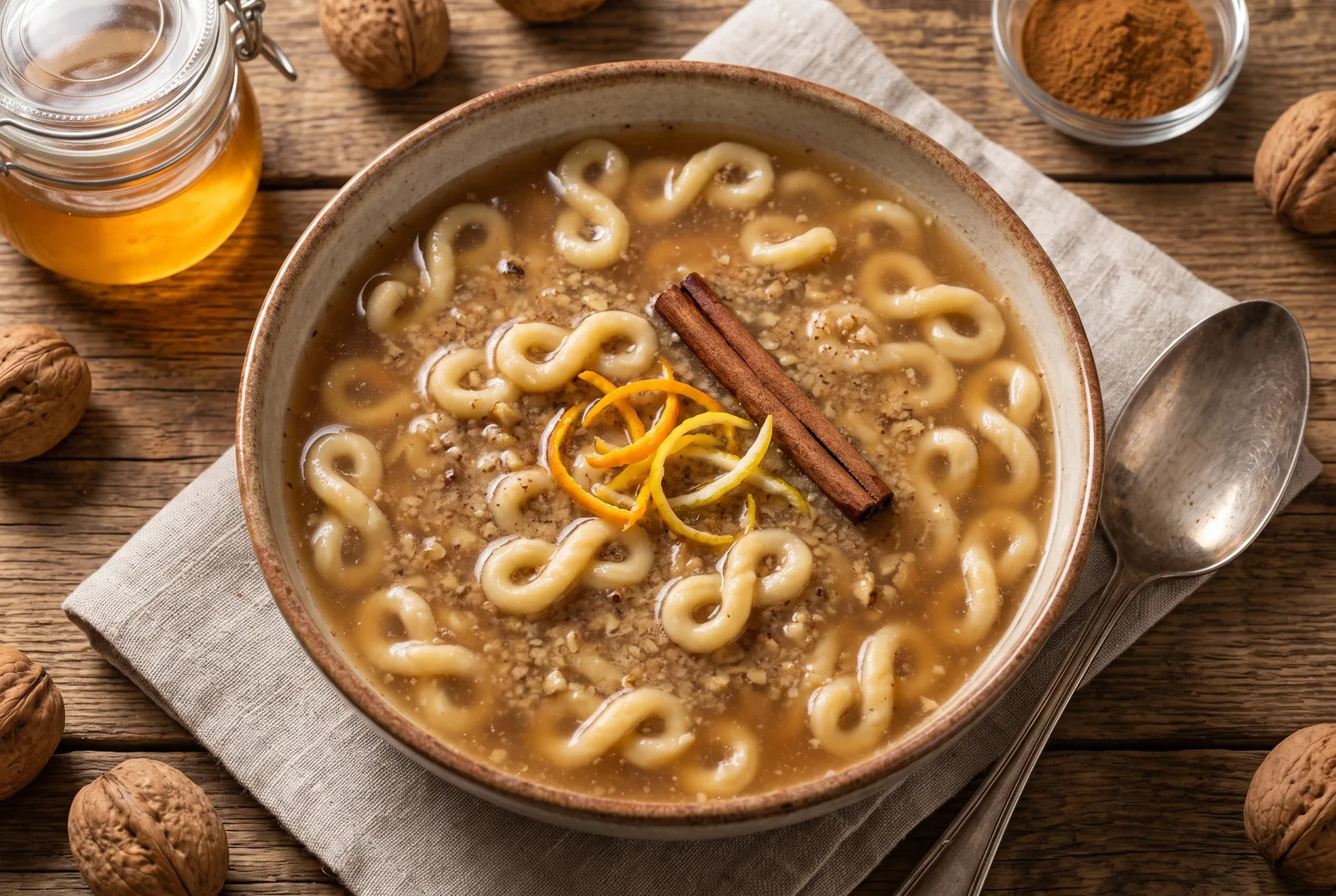 Bowl of small Muntenian mucenici twists in a sweet cinnamon-walnut broth
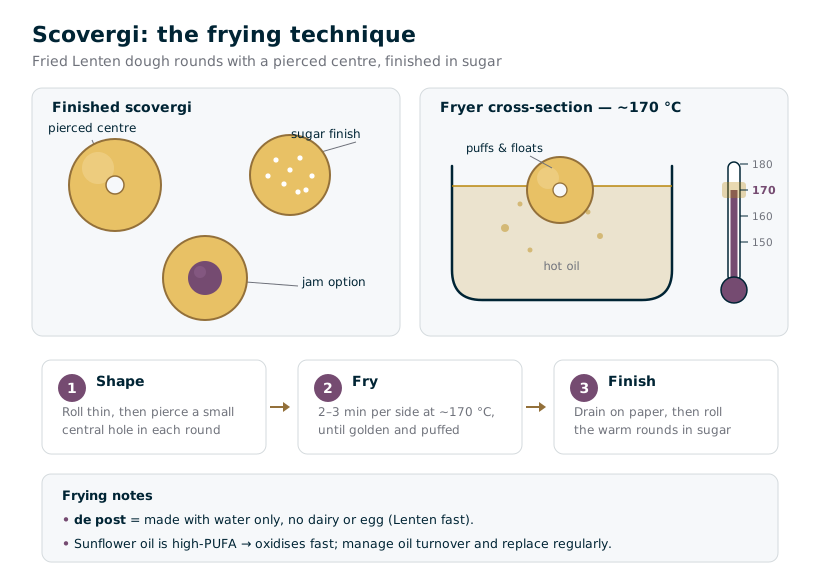 Scovergi frying at 170°C with a pierced centre hole, then rolled in sugar
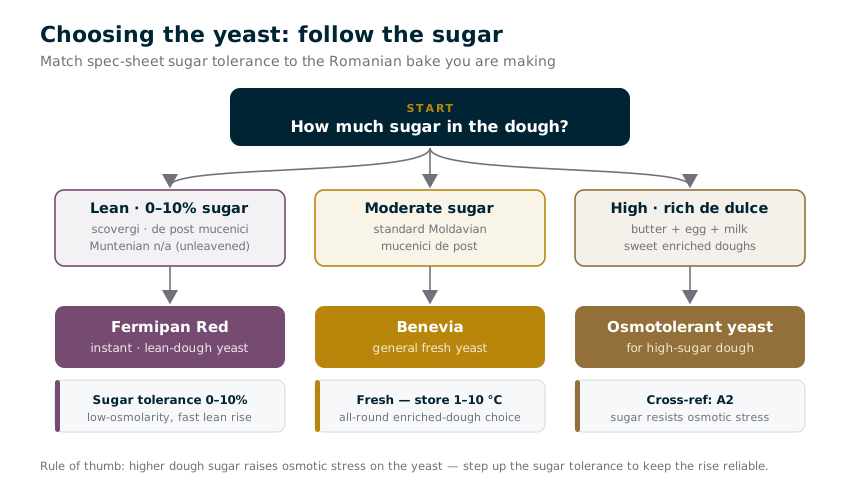 Decision diagram routing dough sugar level to the correct yeast type for Romanian bakes
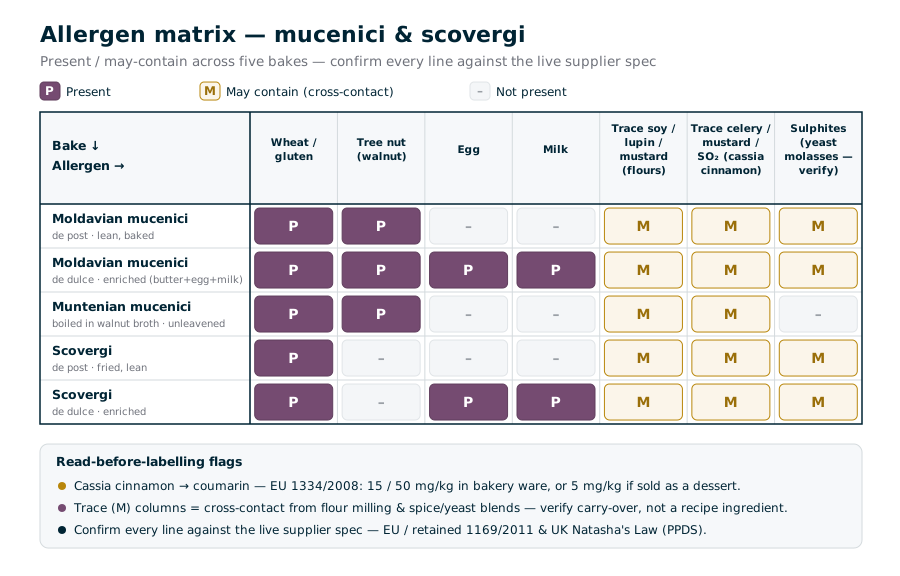 Allergen matrix of mucenici and scovergi against wheat, tree nut, egg, milk, soy/lupin/mustard and celery/sulphites, with a cassia-coumarin note
Mucenici moldovenești (baked figure-eight), de post base — house-typical baker's %
| Ingredient | Baker's % | Weight |
|---|---|---|
| Strong white wheat flour (Type 000/550) | 100 | |
| Fresh yeast | 3 | |
| Water (≈50% hydration) | 50 | |
| Sugar (in dough) | 8 | |
| Oil (in dough) | 6 | |
| Salt | 1.5 | |
| Lemon/orange zest + vanilla | 1 | |
| Honey syrup — honey (finish) — brushed on warm, with a little water | 20 | |
| Ground walnut (finish) — tree-nut allergen (c22) | 12 |
- Develop a soft yeast dough; bulk-proof ~60–75 min; roll ~55–60 cm ropes and twist into figure-eights; final-proof; bake ~180°C ~30 min to gold. Brush warm buns with honey (+ a little water) syrup; shower with ground walnut. Do not over-proof or the bun drinks syrup and slumps (see A5-proofing-science).
De post (Lenten) default. De dulce variant: add milk ~30%, egg yolks ~15%, butter ~15% and use an osmotolerant yeast (A2). Allergens: wheat, tree-nut (walnut); de dulce adds egg + milk (c22).
Mucenici muntenești (boiled figure-eight in walnut broth) — house-typical
| Ingredient | Baker's % | Weight |
|---|---|---|
| Pasta/macaroni-grade flour (Type 400/450) — dough | 100 | |
| Water — dough (≈50%) | 50 | |
| Oil — dough (≈12.5%) | 12.5 | |
| Salt — dough | 1.5 | |
| Water — broth (base) — ≈2 L per batch | 100 | |
| Sugar — broth — ≈200 g / 2 L | 10 | |
| Ground walnut — broth — ≈250 g / 2 L; tree-nut allergen (c22) | 12.5 | |
| Cinnamon + lemon zest + orange zest + vanilla + rum — broth — cassia coumarin flag (c24) | 2 |
- Make a firm unleavened flour-water dough (a little oil for suppleness); roll thin, cut, shape tiny figure-eights, dry briefly. Simmer the twists in the sweet walnut broth 5–10 min (or boil in water first, then add flavoured syrup — ~1 h method in Radu Anton Roman). Serve warm as a dessert soup. The broth = the 'waters of Sebaste' (c7).
Unleavened. Right flour is a low-ash pasta grade (Type 400 Macaroni, G44069), not a bread flour (c14). Allergens: wheat, tree-nut (walnut). Cassia cinnamon coumarin (c24).
Scovergi (Lenten fried dough / turte în ulei) — house-typical
| Ingredient | Baker's % | Weight |
|---|---|---|
| Bread/plain wheat flour | 100 | |
| Milk (de dulce) or water (de post) — ≈60% | 60 | |
| Fresh yeast | 4 | |
| Sugar | 4 | |
| Butter (de dulce only) | 5 | |
| Salt | 1 | |
| Frying oil (sunflower/rapeseed/palm) — deep pool; ~170°C | 0 |
- Develop a soft dough; two-stage proof (~30 min, then ~90 min after knock-back); divide, roll rounds with a thinned centre (the cited source thins the middle; some cooks pierce a small hole) so it fries through; fry ~170°C, 2–3 min per side to gold; roll in fine sugar while hot. Serve with sugar, jam/honey or (savoury) salty cheese/soured cream (c13, c9).
Lean de post dough → Fermipan Red (0–10% sugar) is ideal (c19). Manage frying-oil quality; acrylamide-mitigation GMP (c23). Allergens: wheat; de dulce adds milk.
| Attribute | Mucenici moldovenești (Moldova) | Mucenici muntenești (Muntenia / Oltenia) | Claim |
|---|---|---|---|
| Cooking method | Baked in the oven | Boiled/simmered in liquid | c6 |
| Dough | Risen — yeast-leavened enriched dough | Unleavened — plain flour + water (pasta dough) | c6, c10, c11 |
| Leavening | Fresh yeast (osmotolerant if de dulce) | None | c10, c11, c18 |
| Right flour | Strong white bread flour (Type 000/480–550) | Low-ash pasta/macaroni grade (Type 400/450) | c14, c15 |
| Fat/enrichment | De post: none; de dulce: butter + egg yolks + milk | A little oil (~12.5%); no egg/milk | c10, c11 |
| Size & serving | Larger individual buns | Small twists eaten by the dozen, in broth | c6 |
| Finish | Brushed with honey/sugar syrup, rolled in ground walnut | Served IN a sweet walnut broth (cinnamon + citrus) | c10, c12 |
| Closest analogue | Honey-soaked baba / savarin bun | Sweet dessert soup / stewed pasta | c6 |
| Common regional name | often sfințișori | mucenici | c5 |
| Symbolism of the broth | n/a (baked) | sweet liquid = the 'waters of Sebaste' | c7 |
| Product (SKU) | Type | Sugar tolerance / use | Key spec | Best for | Claim |
|---|---|---|---|---|---|
| Lesaffre Benevia (G25216) | Fresh compressed yeast | General; raise dose for high sugar | Dry matter >29%; store 1–10°C; 35-day life | Moldavian mucenici (de post & moderate de dulce), scovergi | c18 |
| Fermipan Red (G45032; datasheet Lallemand GB — verify brand) | Instant dried yeast | LEAN dough, limited sugar 0–10% | 1% emulsifier E491; 363 kcal/100g; 2-yr ambient life | Scovergi (lean); NOT sole leaven for sugar-heavy de dulce | c19 |
| Osmotolerant / 'gold' strain (cross-ref A2) | Fresh or instant, high-sugar | High-sugar enriched dough | See A2-osmotolerant-yeast-enriched-doughs | Rich de dulce Moldavian mucenici | c19 |
| Bake | Recommended flour (SKU) | Ash | Gluten | Other spec | Claim |
|---|---|---|---|---|---|
| Muntenian boiled twists (pasta dough) | GoodMills Wheat Flour Type 400 Macaroni (G44069) | ≤0.50% (d.m.) | wet gluten ≥18%; Gluten Index 55–100 | moisture ≤15.3%; cream–light yellow; semi-finished | c14 |
| Moldavian enriched bun | Domson White Strong Wheat Flour (G44001) — datasheet = GoodMills Type 550 | 0.51–0.58% (d.m.) | wet gluten 28–32%; gluten index 75–99 | moisture max 15%; falling number min 220 s; some batches contain ascorbic acid | c15 |
| Very-white substitute (either bake) | Wheat Flour Type 450 (G22013) / Type 500 (G22179) | low | — | very white, clean-tasting | c14 |
| UK strong-flour equivalent (Moldavian) | Windrush Strong White Bread Flour (G43025) | — | strong bread flour | British stand-in for Type 550/000 | c15 |
| Product (datasheet) | SAP/SKU | Energy/100g | Key parameters | Allergens | Shelf life | Claim |
|---|---|---|---|---|---|---|
| GoodMills Wheat Flour Type 400 (Macaroni) | G44069 | — | ash ≤0.50% d.m.; wet gluten ≥18%; GI 55–100; moisture ≤15.3% | gluten; trace soy/lupin/mustard | 5 months | c14 |
| GoodMills Wheat Flour Type 550 (on G44001) | G44001 | — | wet gluten 28–32%; ash 0.51–0.58% d.m.; falling number min 220 s; GI 75–99 | gluten; trace soy/lupin/mustard; may contain ascorbic acid | 5 months | c15 |
| Polski Cukier white granulated sugar | G22065 | 1700 kJ / 400 kcal | sucrose min 99.7%; moisture max 0.06%; sugar beet; GMO-free | none | unlimited if stored dry | c16 |
| Ratos Natura Multifloral Honey | G23652 | 1320 kJ / 330 kcal | water ≤20%; reducing sugars ≥60%; HMF ≤4 mg/100g; diastase ≥8; 70g sugars/100g | none declared | 36 months | c17 |
| Lesaffre Benevia fresh yeast | G25216 | 464 kJ / 111 kcal | dry matter >29%; fermentative activity 125±10 ml CO2; protein 15g; store 1–10°C | none declared (sulphites in molasses used in production) | 35 days | c18 |
| Lallemand Fermipan Red instant dried yeast | G45032 | 1534 kJ / 363 kcal | lean dough, sugar 0–10%; 1% emulsifier E491; dry matter 93–98%; 2-yr ambient | no egg/dairy/soya | up to 2 years unopened | c19 |
| Ground cinnamon (ACOR, cassia; on G23892) | G23892 | — | origin Indonesia (cassia); moisture ≤16% | may contain trace celery/mustard/SO₂ | per producer | c20 |
| Olympic Sunflower Oil | G44536 | 3700 kJ / 900 kcal | fat 100g (11 sat/28 mono/60 polyunsat); trans 0; FFA ≤0.1%; peroxide ≤1.0 meq/kg; nut-free site | none (nut-free site) | 15–24 months by pack | c21 |
| Product | Fault | Likely cause | Fix |
|---|---|---|---|
| Moldavian mucenic | Bun slumps / soggy after glazing | Over-proofed; crumb too weak; syrup too thin/hot on cold bun | Full but not over-proof; use strong flour; brush warm bun with a set syrup (c10, c15) |
| Moldavian mucenic | Dense, under-risen crumb (de dulce) | Lean-dough yeast used in a high-sugar dough; yeast osmotically stressed | Switch to osmotolerant yeast or raise fresh-yeast dose (c19, A2) |
| Moldavian mucenic | Pale, no colour | Oven too cool; no residual sugar for browning | Bake ~180°C; a touch of sugar in the dough aids Maillard (A5) |
| Muntenian mucenic | Twists turn grey/gluey in the broth | Wrong flour (too strong/high-ash); over-boiled | Use low-ash pasta-grade Type 400; simmer only 5–10 min (c12, c14) |
| Muntenian mucenic | Twists dissolve/fall apart | Dough too wet or under-rested; shaped too thin | Firmer dough; rest/dry the shapes before simmering (c11) |
| Muntenian broth | Bitter or dull | Old/rancid walnut; too much cassia | Fresh walnut; balance cinnamon; watch coumarin (c12, c24) |
| Scovergi | Greasy, raw centre | Oil too cool; no central hole; dough too thick | Hold ~170°C; pierce the centre; roll thinner (c13) |
| Scovergi | Dark outside, doughy inside | Oil too hot; pieces too large | Lower to ~170°C; size evenly; turn once (c13) |
| Scovergi | Off/rancid flavour after a service | Degraded frying oil (high FFA/peroxide) | Monitor and replace oil; prefer more stable fat for long runs (c21, c23) |