
Romanian flour types decoded: Type 480, 000, 550, 650, 800, 1250 and whole-grain — ash, protein and choosing for each application
A working baker's guide to the Romanian flour system, where flour is graded by ash content and the Type number (tip) is literally the milligrams of ash per 100 g of dry flour: Type 480 ≈ 0.48% ash (very white), through 550 and 650 (the standard bread/franzelă grades), 800/900 (semi-white), 1250/1350 (dark, neagră) up to 1750 (integrală/graham). It explains the four legal groups (albă / semialbă / neagră / dietetică) and their governing standards, the older colloquial 000/00/0 zero-scale still printed on packs, and the single most useful authenticity point for this trade: why cozonac (festive enriched sweet bread) needs the "000 superioară" grade — a flour that is white AND strong (wet gluten ≥28%), not a soft pastry flour. It gives the crosswalk that lets a UK Romanian baker adapt recipes (Romanian Type = Polish T-code = German number; French T and Italian 00 differ), shows how to read the whole spec (gluten umed, indice glutenic, indice de deformare, W, P/L, falling number) and maps each Romanian Type to a Domson UK-stock flour. Classification is cited to the Romanian standard and a university milling course; supplier numbers come from first-party datasheets.
Romania reads flour by ash, and the Type number is the ash
Romania grades wheat flour the German and Polish way: by ash content (conținut de cenușă / substanțe minerale) — the mineral residue left when a weighed sample is incinerated. The Type number (tip) you see on the bag is simply that ash figure, measured on dry substance and multiplied by 1000. So Type 480 ≈ 0.48% ash, Type 650 ≈ 0.65% ash, Type 1750 ≈ 1.75% ash. A low number means whiter, more refined flour milled mostly from the starchy endosperm; a high number means more of the mineral-rich bran and germ has been kept, i.e. a higher extraction rate (grad de extracție).
This is the same ash-based logic explained for every national system in the Pillar A reference Flour type numbers decoded: Polish T-codes, French T45–T150, German 550, Italian 00; for how milling and extraction actually produce these grades see From grain to bag: how wheat is milled and what extraction rate means, and for what ash, falling number and the alveograph really measure see Reading the flour spec sheet: ash content, Hagberg falling number, Zeleny, farinograph and alveograph. What follows is the Romanian-specific vocabulary a baker serving Romanian customers has to read correctly.
The four groups and their Type numbers
Romanian wheat flour splits into four groups by ash, each fixed by a national standard:
- Făină albă (white) — up to 0.65% ash, comprising Type 480, 000, 550 and 650 (standard SP 3127-95).
- Făină semialbă (semi-white) — 0.66–0.90% ash, sold as Type 800 and 900 (SP 3128-95).
- Făină neagră (dark) — 0.91–1.40% ash, sold as Type 1250 and 1350 (SP 2498-95).
- Făină dietetică / graham — 1.41–2.2% ash; the wholemeal graham Type 1750 (integrală) sits here (SP 957-95). Across the whole range the Type figure runs from 0.48% (Type 480) to 1.75% (Type 1750), reaching 2.20% for dietary flour. The umbrella bakery-flour standard is SR 877-96.
Within the white group the individual grades are defined precisely by the regulation [Ordin 250/531/83/2002]:
- Type 480 — max 0.48% ash: the whitest, finest flour — patiserie and fine cakes.
- Type 000 (superioară) — max 0.48% ash AND wet gluten ≥ 28%: same whiteness as 480 but with a minimum gluten floor written into the standard — the cozonac / fine-pastry grade (see below).
- Type 550 — max 0.55% ash: the versatile all-purpose flour.
- Type 650 — max 0.65% ash: the standard bread flour, the one behind the everyday franzelă (white bread stick).
The white grades also carry tight quality limits: moisture (umiditate) max 14.5% and acidity (aciditate) max 2.2 degrees for 480/000/550, rising to 2.8 for 650 and 3.2–5 for the higher-extraction groups. The full table is below.
The zero-scale (000 / 00 / 0) still printed on the pack
Alongside the Type numbers, Romanian mills and shoppers still use an older Italian-style zero scale as a plain "how white is it" label. On this scale 000 is the finest and whitest, 480 (or 450) is a fine pastry flour, 550 is the everyday all-purpose grade, and 650 is coarser, darker and higher in gluten . You will meet both systems on Romanian packaging, sometimes together (e.g. făină albă 000), so read them as two names for the same refinement idea, not as two different measurements .
One warning about consumer media: many Romanian articles say Type 650 is milled from "grâu dur" (durum). That is an error — Romanian Type 650 is ordinary bread wheat, just a higher-ash white grade with more gluten (roughly 10–12% protein for 550, 12–14% for 650, as an indicative figure, not a legal one). Durum belongs to semolina/pasta, not to Type 650 bread flour — see Protein content, gluten quality and flour strength: what the numbers mean for your dough.
The cozonac secret: "000" means white, not weak
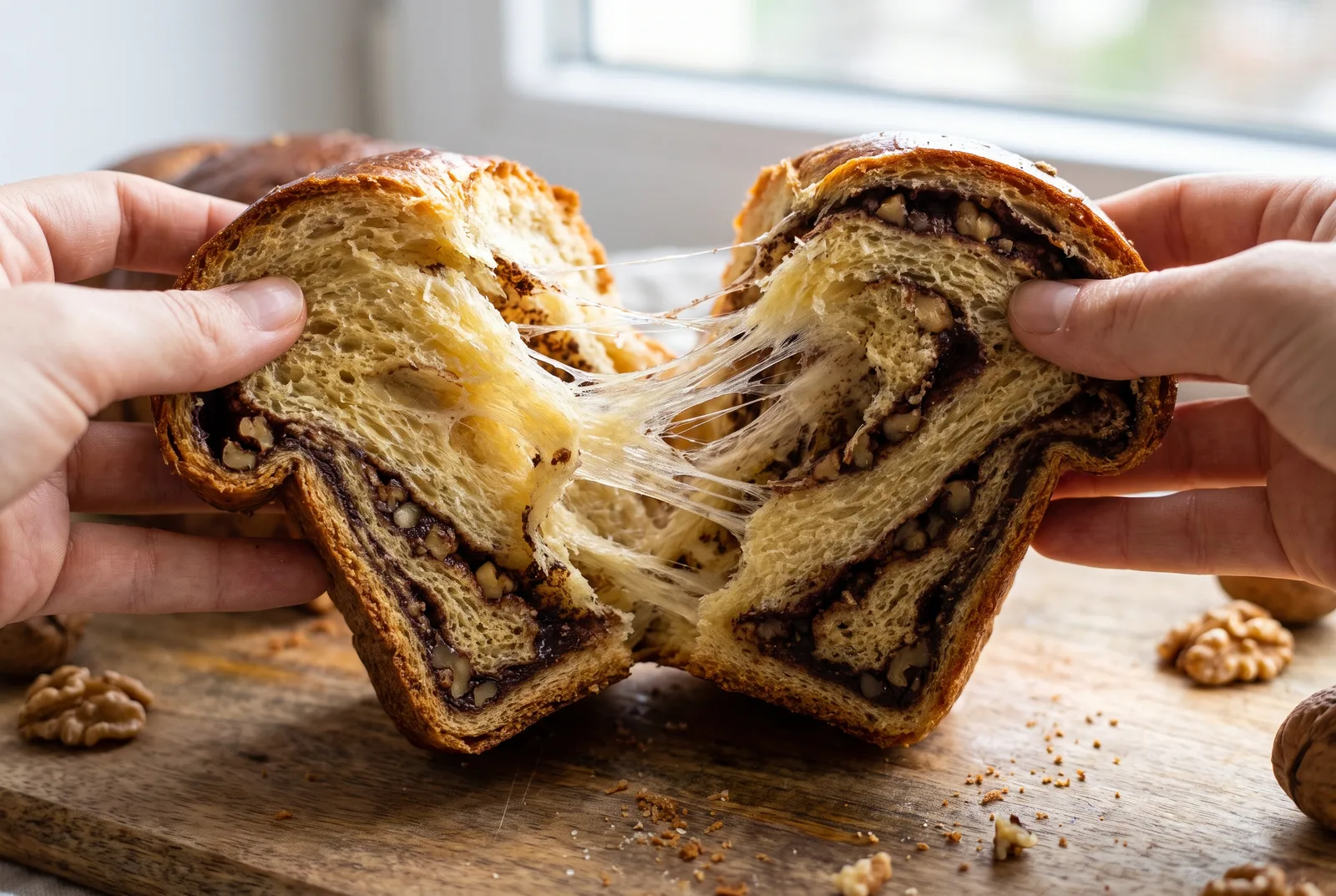
Here is the single most useful thing a UK Romanian baker can know about flour. Cozonac (festive enriched sweet bread) is traditionally called a "000" job — and that is where bakers from other traditions get caught out. They read "000" as "the softest, finest pastry flour" and reach for a weak, low-protein flour. The result is a dense, crumbly loaf that will never do what a good cozonac must: "se desface în fâșii" — peel apart into long, silky strands.
The resolution is in the standard itself. The 000 superioară grade is the only white type that carries a minimum wet-gluten requirement (≥28%). In other words, cozonac flour is defined to be white AND strong. Romanian millers sell exactly this as a purpose-milled product — Boromir's "făină albă superioară pentru cozonaci" and Șapte Spice "Făină Cozonac Lux" are low-ash but high-gluten flours, and professional bakers prize strong Manitoba wheat for the same reason. Aim for a protein of roughly 11–14%, at the top of that band for a cozonac carrying heavy fillings (walnut-cocoa, poppy/mac, rahat, halva).
So for cozonac, do not buy a soft pastry flour. Buy a strong white. The dough-building sequence (developing the gluten before the butter goes in), the regional fillings and the full formula are covered in Cozonac: mastering Romania's festive enriched bread — dough formula, gluten development and regional fillings; the general strong-flour science is in Protein content, gluten quality and flour strength: what the numbers mean for your dough, and if your only white flour is a touch weak you can fortify it with vital wheat gluten (Vital wheat gluten: fortifying weak flours and high-fibre doughs from 2% to 12%).
Reading the whole spec, not just the Type number
The Type number tells you ash and whiteness. It does not tell you strength. For that, read the rest of a Romanian datasheet — and Romanian technologists choose a flour's destination by its gluten indices, not by Type alone:
- Gluten umed (wet gluten) — quantity of gluten. A recent Romanian crop survey put commercial panification flour above 24%, averaging ~26%.
- Indice glutenic (gluten index) — gluten quality / strength.
- Indice de deformare (deformation index) — how far the gluten slackens after 60 minutes at 30 °C; 2–5 mm in 85–90% of 2021 samples (lower = stronger).
- Indice W (Chopin alveograph) — overall baking strength; 180–250 ×10⁻⁴ J for a Type 650, averaging ~190, with most samples above 200.
- Raport P/L (alveograph tenacity vs extensibility) — 1.1–2.9, averaging ~1.85 in 2021, i.e. a strong flour with reduced extensibility.
- Indice de cădere (Hagberg falling number) — enzyme activity; an optimum around 250 s, though the 2021 crop ran high at 350–400 s (very low enzyme, a staling/volume risk to manage with malt — see Malt and malt extracts in baking: diastatic vs. non-diastatic, enzymatic activity and crust colour).
These are the same instruments described generically in Reading the flour spec sheet: ash content, Hagberg falling number, Zeleny, farinograph and alveograph; the Romanian numbers above are a crop-year snapshot, not a permanent standard. The practical targets Romanian mills work to are: bread 26–30% wet gluten, gluten index 20–40, deformation 5–9 mm; pastry and laminated (foietaj) 27–35% wet gluten, gluten index 28–40%, deformation 5–8 mm (see the formula card below).
A last production detail from Romanian practice: flour is matured (maturare) before use — minimum 15 days for dark flour, 20 for semi-white, 30 for white, 35–40 for pasta flour and 20–25 for biscuit flour . Fresh-milled flour bakes poorly; the mill's maturation is part of the spec.
Choosing the Type for the Romanian product
Putting the Type number and the gluten indices together gives the working selection every Romanian bench uses :
- Cozonac, savarine, fine patiserie → Type 000 superioară / 480 — white but strong (see the cozonac section, and Savarină, ecler, negresă and tort diplomat: the classic Romanian café-pastry canon and how to execute it).
- Pâine albă / franzelă, most breads, pizza → Type 550 / 650 — the everyday grades.
- Biscuiți, pesmeți (biscuits, rusks) → extraction flour of 0.550–0.900% ash (white to semi-white) .
- Pâine semialbă → Type 800 / 900.
- Pâine neagră (dark bread), pâine cu maia (sourdough) → Type 1250 / 1350, often blended with rye — the higher ash and the long ferment of a masonry oven suit each other (see Maia: Romania's sourdough culture — starter management, fermentation biology and wood-fired oven protocols and Romania's regional bread map: from Transylvanian pâine bătută to Oltenian pâine la țest).
- Pâine integrală (wholemeal) → graham Type 1750.
Remember the bran-interference rule from Wholemeal and high-extraction flours: nutrition, flavour and the bran interference problem: the higher the Type/ash, the more bran, and bran physically cuts the gluten network and raises water demand — so a neagră or integrală loaf bakes denser than a white one unless you use a stronger base flour, more water or added gluten. This is also why ritual breads that must hold a shaped, braided form (Easter pască, Christmas colaci) are made from white, strong flour rather than dark — see Pască, colaci and ritual breads: the Orthodox liturgical calendar's baking demands.
The crosswalk: adapting foreign recipes (and buying in the UK)
Because Romanian, Polish and German type numbers all mean the same thing — ash × 1000 on dry basis — they map one-to-one. This is the good news for a UK Romanian bakery buying from a Polish-heavy catalogue :
- Romanian Type 550 = Polish T550 = German 550 (all ≈ 0.55% ash).
- Romanian 650 ≈ French T65 ≈ Polish T650.
- French T-numbers use the same ash idea on a slightly different scale, and Italian 00 / 0 / 1 grade primarily fineness / refinement and carry their own ash caps that do not line up one-to-one with the Type number — so treat those as approximate. The full table is Flour type numbers decoded: Polish T-codes, French T45–T150, German 550, Italian 00 and the table below.
That makes the Domson shelf easy to shop for a Romanian repertoire (see the table below) :
- Cozonac / Type 000 superioară → a strong white: Allied Mills Coniston Strong White (first-party datasheet: protein 12.5–14.5%, falling number ≥250 s, water absorption 58–61%, ash ~0.8%) or Carr's Centurion Canadian Very Strong (a Manitoba-type flour). Not a pastry flour.
- All-purpose / Type 550 → Domson Wheat Flour Type 550 — the direct equivalent, datasheet ash 0.51–0.58% dm, wet gluten 28–32% (protein 11.5–12.5%), gluten index 75–99, falling number ≥220 s — or Komplexmłyn Type 550 / Gdańskie Młyny Type 550. For a fine white 480/patiserie use Domson White Flour Type 500 or Domson Diamond Type 500.
- Bread / Type 650 → French Traditional / Belle Or T65 (T65 ≈ Romanian 650), or Domson Bread Flour Type 750 (datasheet ash ≤0.82%, gluten ≥26%, falling number ≥220 s, protein 11.6 g/100 g) which sits at the 650–800 boundary for a fuller-flavoured loaf.
- Semi-white / dark (Type 800–1350, neagră) → ADM Domson Brown, blended toward wholemeal, plus rye (Agrol Cracked Rye) for the mixed and maia loaves (Rye, spelt, emmer and heritage wheats: baking behaviour and blending rules).
- Wholemeal / integrală (Type 1750) → GoodMills Graham Wheat Flour Type 1850 (datasheet ash <2.0%, protein 12.3%, falling number >180 s), Carr's Bakers Wholemeal (protein 13.5–14.2%, fibre 10.1 g/100 g), Allied Mills Grampian or Chiltern Wholemeal.
- Pizza / focaccia → Italian Tipo 00 Pizza Flour where an Italian 00 texture is wanted.
Beyond wheat flour: griș, mălai and rye
A Romanian bakery also stocks two non-flour grades. Griș is wheat semolina — a coarse, grits-like grade used for pasta (Romanian milling specifies grișată flour of 350–530 µm, ash 0.350–0.550%, for paste făinoase) and for milk puddings; in the UK reach for Allied Mills Durum Wheat Semolina or Eurostar Extra Coarse Semolina. Mălai is cornmeal — the base of mămăligă and a classic dusting for bread and țest-baked loaves — graded 090 or 0-75 by extraction; Agrol Corn Flour covers this. And rye (secară) is the classic partner for Romanian pâine neagră and maia loaves — see Rye, spelt, emmer and heritage wheats: baking behaviour and blending rules and Maia: Romania's sourdough culture — starter management, fermentation biology and wood-fired oven protocols.
For market context, Romania remains one of Europe's larger bread markets — per-capita consumption around 82 kg/year (down from ~92 kg a decade ago, still above the EU average of ~78 kg), with on the order of ~10,000 milling and baking units — though these are moving figures; the wider market and supplier landscape is covered in The Romanian professional bakery market: flour standards, premix adoption, key ingredient suppliers and modernisation trends.
Quick selection checklist
- Read the Type number as ash — low = white/refined, high = more bran/extraction.
- 000 does not mean weak — for cozonac buy a strong white (Type 000 superioară, ≥28% wet gluten, ~12–14% protein), never a soft pastry flour.
- Confirm strength on the spec — check wet gluten, gluten index, deformation and W, not just the Type .
- Cross-walk by ash — Romanian Type = Polish T = German number; French T and Italian 00 are approximate .
- Higher ash = denser loaf — compensate for bran interference with a stronger base, more water or added gluten.
- Let flour mature and manage a high falling number (low enzyme) with malt if volume/staling suffers .
Food safety, allergens and caveats
Every wheat flour and semolina (griș) in this article contains gluten (wheat) and is unsuitable for coeliacs; flour is a raw ingredient that must be baked or cooked before eating, and supplier datasheets flag risk of cross-contamination with other allergens — the Graham Type 1850 datasheet explicitly states the product is not intended for direct consumption. The Polish-milled catalogue flours here carry a voluntary manufacturer micronutrient premix (labelled "Fortified" / "Wzbogacana") — this is the miller's own addition and is not the UK statutory scheme; do not conflate the two. Separately, under the UK Bread and Flour Regulations UK-milled white and brown (non-wholemeal) flours must be fortified with calcium, iron, niacin and thiamin, wholemeal is exempt (so any fortification on a wholemeal such as Carr's Bakers Wholemeal is voluntary or comes from blended-in white flour), and mandatory folic acid is being phased in (compliance by December 2026) — confirm the current fortification list on each product's own datasheet before any customer-facing use. Finally, the finished Romanian products built on these flours introduce further named allergens absent from the flour itself — egg and milk (cozonac, pască filling, savarine), tree nuts (walnut in cozonac and many pastries), sesame (halva filling — a top-14 UK/EU allergen), poppy seed (the mac filling) and others — which must be declared under UK/EU food-information law from each product's actual recipe. Numeric specs are first-party but single-source per product and the classification's international crosswalk is approximate; all food-safety, allergen and fortification points above should be confirmed before customer-facing use.
Figures
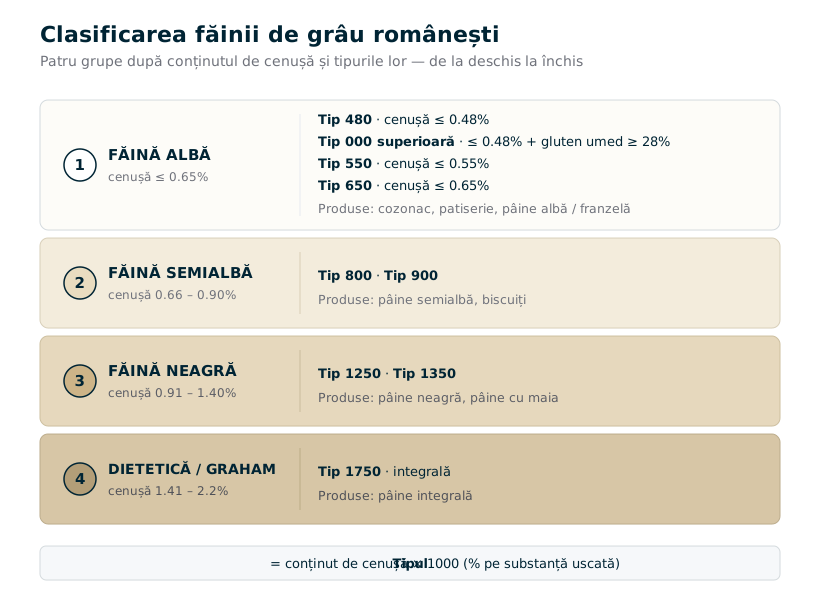 Orientation diagram of Romanian wheat flour split into four groups by ash content — făină albă (Type 480/000/550/650, ≤0.65%), semialbă (800/900, 0.66–0.90%), neagră (1250/1350, 0.91–1.40%) and dietetică/graham (1750, 1.41–2.2%) — each with the products it makes.
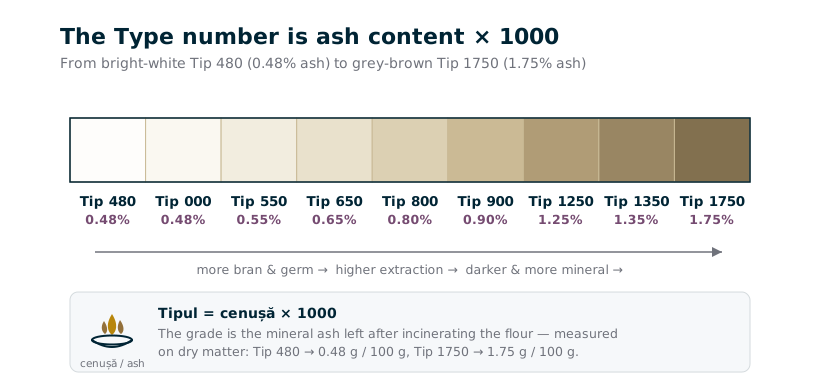 A colour gradient ladder from very white Type 480 (0.48% ash) through 550, 650, 800, 1250, 1350 to grey-brown Type 1750 (1.75% ash), showing how the Type number tracks ash content and whiteness.
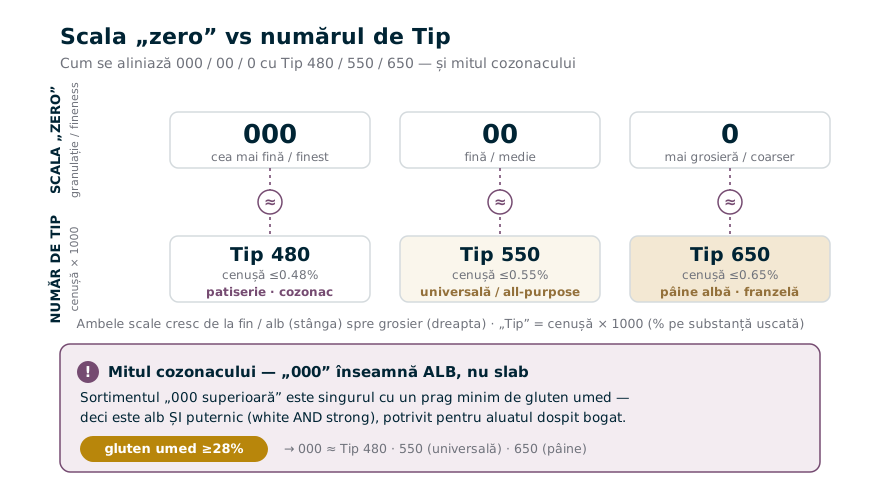 Diagram aligning the Romanian zero scale 000/00/0 with Type numbers 480/550/650 and calling out that the '000 superioară' cozonac flour is both very white and strong (wet gluten ≥28%).
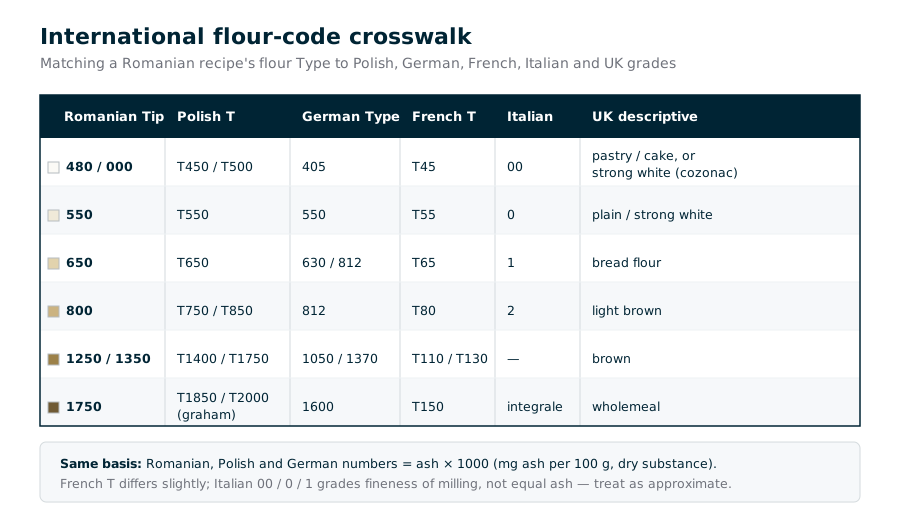 Crosswalk table matching Romanian flour Types (480/550/650/800/1250/1750) to Polish T-codes, German numbers, French T-numbers, Italian 00/0/1 grades and UK descriptive flour names.
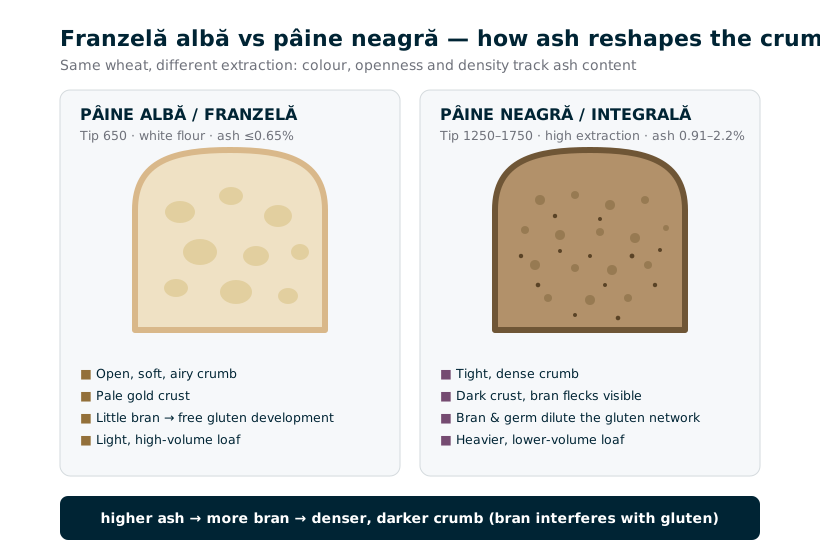 Side-by-side cut loaves — a pale open-crumb franzelă from Type 650 white flour and a darker, denser bran-flecked loaf from neagră/integrală high-extraction flour.
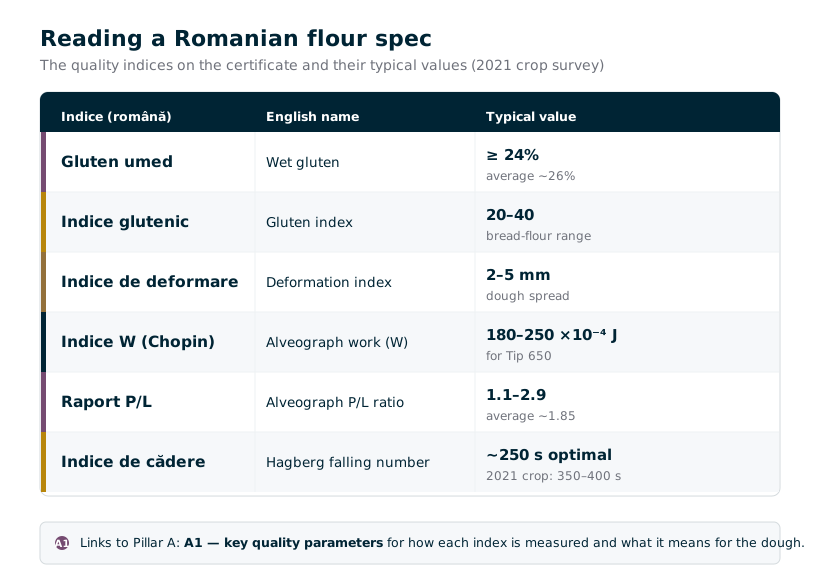 Spec-sheet panel showing the Romanian flour quality indices — gluten umed, indice glutenic, indice de deformare, indice W (alveograf), raport P/L and indice de cădere (falling number) — with typical 2021 survey values.
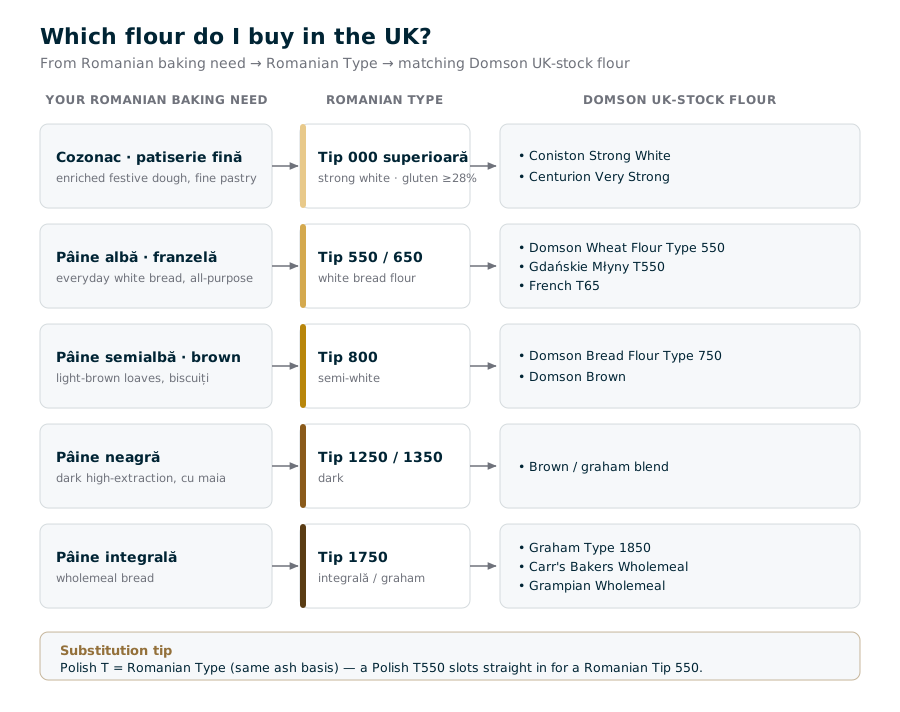 Flowchart mapping a Romanian baking need — cozonac, franzelă/pâine albă, semi-white/brown bread, dark/wholemeal — to the correct Romanian Type and the matching Domson UK catalogue flour.
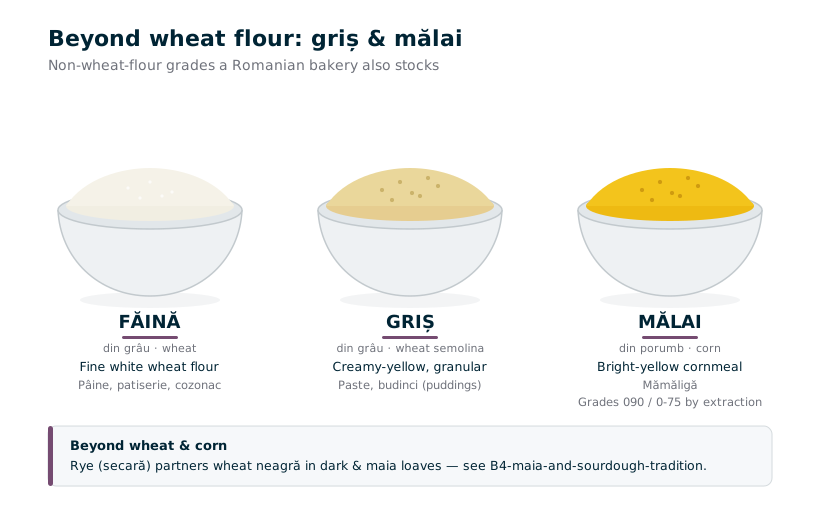 Three bowls — fine white wheat flour, creamy granular griș (wheat semolina) and yellow mălai (cornmeal) — showing the non-wheat-flour grades a Romanian bakery also stocks.
Choosing flour for cozonac — the strong-white rule (selection guide)
| Ingredient | Baker's % | Weight |
|---|---|---|
| Strong white flour — Romanian Tip 000 superioară (white + wet gluten ≥28%) | ||
| UK stand-in: Coniston Strong White (12.5–14.5% protein) or Centurion Very Strong / Manitoba | ||
| NOT a soft pastry flour |
- Pick a white BUT strong flour so the enriched dough (eggs, butter, sugar) still develops a long gluten network; a soft low-ash '480/000 pastry' flour without a gluten floor gives a dense, crumbly cozonac that will not 'se desface în fâșii'. Develop the gluten fully before adding the fat. Fillings (walnut-cocoa, poppy, rahat, halva) and the butter-incorporation sequence are covered in B4-cozonac-enriched-dough.
Cozonac is labelled a '000' (white/fine) job, but the dough must carry heavy fillings and pull into silky strands, so the flour must be STRONG. Given as a selection guide, not a fixed formula. Sources: c3, c16, c17. See B4-cozonac-enriched-dough for the full dough formula.
Match the flour to the product by its quality indices (Romanian practice)
| Pâine / panificație (bread) | wet gluten 26–30%, gluten index 20–40, deformation 5–9 mm |
| Patiserie / foietaj (pastry, laminated) | wet gluten 27–35%, gluten index 28–40%, deformation 5–8 mm |
| Paste făinoase (pasta) | grits-like (grișată) 350–530 µm, ash 0.350–0.550%, wet gluten 30–40% good/very good |
| Biscuiți / pesmeți (biscuits, rusks) | extraction flour of 0.550–0.900% ash (white to semi-white) |
- Read the datasheet's gluten umed, indice glutenic and indice de deformare against the target for your product, then confirm the Type/ash is in range. Allow the flour to mature before use — min 15 days (dark), 20 (semi-white), 30 (white), 35–40 (pasta), 20–25 (biscuits). See Pillar A A1-key-quality-parameters and A8-bakers-percentage-fundamentals.
The 'destinația făinii' guidance from Romanian milling technology — choose by wet gluten, gluten index and deformation, not by Type number alone. Source: c19, c20. Percentages are wet-gluten targets, not baker's %.
| Group (Romanian) | Type(s) | Ash (% dry substance) | Romanian character / use | Standard |
|---|---|---|---|---|
| Făină albă (white) | 480 | ≤ 0.48% | Very white, fine — patiserie, prăjituri | SP 3127-95 |
| Făină albă (white) — superioară | 000 | ≤ 0.48% + wet gluten ≥ 28% | Finest & strong — the cozonac / fine-pastry grade | SP 3127-95 |
| Făină albă (white) | 550 | ≤ 0.55% | All-purpose — cakes, general bread, pizza | SP 3127-95 |
| Făină albă (white) | 650 | ≤ 0.65% | Standard bread flour — pâine albă / franzelă, pizza | SP 3127-95 |
| Făină semialbă (semi-white) | 800, 900 | 0.66–0.90% | Light-brown bread, biscuits | SP 3128-95 |
| Făină neagră (dark) | 1250, 1350 | 0.91–1.40% | Dark bread (pâine neagră), maia/sourdough loaves | SP 2498-95 |
| Făină dietetică / graham | 1750 (integrală) | 1.41–2.2% (1750 ≈ 1.75%) | Wholemeal — pâine integrală, high-fibre | SP 957-95 |
| Făină de panificație (bakery, umbrella) | — | per type above | General bakery wheat flour standard | SR 877-96 |
Ash is on dry substance; the Type number = ash % × 1000. Ash bands and type numbers: primary regulation Ordin 250/531/83/2002 (white group 480/000/550/650) plus a peer-reviewed RO market study and Romanian consumer sources for the semialbă/neagră/dietetică bands. CAVEAT: the standard codes (SP 3127-95 / SP 3128-95 / SP 2498-95 / SP 957-95 / SR 877-96) and the 800–1750 type numbers rest on a single academic source (TU Iași, c12) and were not independently verifiable online — verify the standard numbers before any label/spec use.
| Index (Romanian) | English | Typical / target value | What it tells you |
|---|---|---|---|
| Conținut de cenușă / Tip | Ash / Type number | 0.48% (480) → 1.75% (1750) | Degree of refinement / extraction; the whiteness and mineral load |
| Gluten umed | Wet gluten | >24%, avg ~26%; bread 26–30%; pastry/foietaj 27–35% | Quantity of gluten — dough strength and gas retention |
| Indice glutenic | Gluten index | bread 20–40; pastry/foietaj 28–40% | Gluten strength / quality (resistance during working) |
| Indice de deformare | Gluten deformation index | 2–5 mm (2021); bread 5–9 mm; pastry 5–8 mm | How much the gluten slackens after 60 min at 30°C — lower = stronger |
| Indice W (Chopin) | Alveograph work (baking strength) | 180–250 ×10⁻⁴ J for tip 650 (avg ~190) | Overall flour strength (área under the alveograph curve) |
| Raport P/L | Alveograph P/L ratio | 1.1–2.9, avg ~1.85 | Tenacity vs extensibility; high = strong but stiff, low extensibility |
| Indice de cădere | Hagberg falling number | optimal ~250 s (2021 crop 350–400 s) | Alpha-amylase activity; very high = low enzyme = risk of dense crumb |
| Umiditate | Moisture | max 14.5% (standard) / 15% (supplier) | Storage stability and true flour weight |
Rheology values are 2021 Romanian crop/market data (c18); application targets are the 'destinația făinii' guidance from the milling course (c19). See Pillar A A1-key-quality-parameters for the underlying test methods.
| Romanian Tip | Polish T | German | French T | Italian | UK descriptive |
|---|---|---|---|---|---|
| 480 / 000 | T450 / T500 | 405 | T45 | 00 | Cake/pastry — or strong white for cozonac |
| 550 | T550 | 550 | T55 | 0 | Plain / strong white |
| 650 | T650 | 630 / 812 | T65 | 1 | Bread flour |
| 800 (semialbă) | T750 / T850 | 812 | T80 | 2 | Light-brown flour |
| 1250 / 1350 (neagră) | T1400 / T1750 | 1050 / 1370 | T110 / T130 | — | Brown flour |
| 1750 (integrală/graham) | T1850 / T2000 | 1600 | T150 | integrale | Wholemeal |
Romanian, Polish and German numbers all express ash × 1000 (same basis) so they map one-to-one; French T uses the same ash idea on a slightly different scale; Italian 00/0/1 grade primarily fineness/refinement and carry their own ash caps that do not line up one-to-one with the Type number. Approximate — always confirm on the actual datasheet. Sources: c21 + Pillar A A1-flour-classification-systems.
| Romanian need / Type | Domson catalogue product | Key spec | Why it fits |
|---|---|---|---|
| Cozonac, fine pastry (Tip 000 superioară — white + strong) | Allied Mills Coniston Strong White; Carr's Centurion Canadian Very Strong | Coniston: protein 12.5–14.5%, FN ≥250 s, ash ~0.8% | White but very strong gluten to carry rich fillings and pull into strands |
| All-purpose / general bread (Tip 550) | Domson Wheat Flour Type 550; Komplexmłyn Type 550; Gdańskie Młyny Type 550 | ash 0.51–0.58% dm, wet gluten 28–32%, GI 75–99, FN ≥220 s | Direct T550 = Romanian 550; the everyday bench flour |
| Bread / franzelă (Tip 650) | Domson Bread Flour Type 750; Belle Or / French Traditional T65 | T750: ash ≤0.82%, gluten ≥26%, FN ≥220 s; T65 ≈ 0.65% ash | T65 ≈ Romanian 650; T750 sits at the 650–800 boundary for a fuller-flavoured loaf |
| Semi-white / light brown bread (Tip 800) | Domson Bread Flour Type 750; ADM Domson Brown | T750 ash ≤0.82% | 0.82% ash matches the semi-white band |
| Dark bread — pâine neagră (Tip 1250/1350) | ADM Domson Brown + a graham/wholemeal blend; add rye (Cracked Rye) for mixed loaves | brown/high-extraction | Blend brown + a little wholemeal/rye to reach the 0.9–1.4% ash character |
| Wholemeal — pâine integrală (Tip 1750) | Graham Wheat Flour Type 1850; Carr's Bakers Wholemeal; Allied Mills Grampian Wholemeal; Chiltern Wholemeal | Graham 1850: ash <2.0%, protein 12.3%; Carr's WM protein 13.5–14.2%, fibre 10.1 g | High-extraction/wholemeal for integrală; compensate for bran interference |
| Pizza / Italian-style (Tip 550/650 alt.) | Italian Tipo 00 Pizza Flour (ROMEL) | Italian 00 (fine grade) | For pizza/foccacia where an Italian 00 texture is wanted |
| Griș / mălai (non-wheat-flour grades) | Durum Wheat Semolina; Eurostar Extra Coarse Semolina; Agrol Corn Flour | durum semolina; cornmeal | Griș for pasta/puddings; mălai for mămăligă and dusting |
Practical substitutes a UK Romanian bakery can order. Polish T-codes are the cleanest match because they share the Romanian ash×1000 basis. Specs are first-party datasheet values where cited (c22–c26); each is single-source per product (specs_cross_checked=false). Where a row lists several products the tabulated spec is the first-named product's own datasheet (the T550 figures are the Domson G22006 sheet; Komplexmłyn and Gdańskie Młyny are the same Type 550 grade but carry their own slightly different sheets — confirm each before substituting).
| Parameter | Value |
|---|---|
| Designation | Wheat Flour Type 550 (Fortified) — colour white with yellow tone |
| Ash | 0.51–0.58% (dry matter) |
| Wet gluten | 28–32% (or protein 11.5–12.5%) |
| Gluten index | 75–99 |
| Falling number | not less than 220 s |
| Moisture | max 15% |
| Allergen | Contains gluten (wheat); risk of trace cross-contamination — raw ingredient, must be baked |
Read on disk this session. Fortified wheat flour, micronutrient premix; made from EU wheat. Source: c22.
| Product | Fault | Likely flour cause | Fix |
|---|---|---|---|
| Cozonac | Dense, crumbly; will not peel into strands (nu se desface în fâșii) | Flour too weak — a soft 480/000 pastry flour with no gluten floor | Use Tip 000 superioară / a strong white (≥28% wet gluten, 12–14% protein); develop gluten fully before the fat |
| Cozonac | Tears / collapses under heavy filling | Insufficient gluten strength | Stronger white or Manitoba; add a little vital wheat gluten (see A3-vital-wheat-gluten) |
| Pâine albă / franzelă | Flat, pale, tight crumb | Ash/Type too low or W index too low | Move to Tip 650 (or T65/T650); check W ≥ ~180 |
| Pâine neagră / integrală | Very dense, gummy crumb | High bran cutting the gluten network; low enzyme (very high falling number) | Blend with a stronger base flour, raise hydration, or add gluten; check falling number |
| Foietaj / patiserie | Dough tears on lamination, no lift | Wrong gluten profile — too weak or too tenacious | Use a pastry flour at 27–35% wet gluten, gluten index 28–40%, deformation 5–8 mm |
| Any product from adapted foreign recipe | Over-strong or under-structured dough | Type mis-read across systems (e.g. treating French T45 as Romanian 450) | Use the crosswalk: Romanian Tip = Polish T = German number; French T and Italian 00 differ |
| Bread from new crop | Sticky, slack dough / poor volume | Falling number too low (sprouted grain) or too high (inert, dense) | Check indice de cădere against ~250 s optimal; adjust improver/malt (see A3-malt-and-malt-extracts) |
Diagnostic guide linking a defect to Type/quality choice. Sources: c3, c16, c17, c19, c27.