
Ramadan baking production guide: qatayef (قطايف), luqaimat (لقيمات) and seasonal sweets — scaling, fried vs baked options and the peak-demand workflow
Ramadan is the single biggest trading month for an Arab or Middle-Eastern bakery, and it runs on a small family of fried and griddled sweets. This dossier gives a UK operator the authentic picture from native Arabic sources and wires it to the Domson catalogue. It covers qatayef (قطايف — the one-sided yeasted pancake, cooked on a single side so the top opens into pores that grip the filling) in both its forms: the small, fresh, cream-filled qatayef asafiri (قطايف عصافيري) crowned with pistachio, and the larger regular qatayef sealed around a walnut-sugar-cinnamon or sweet-cheese filling and deep-fried (or baked) then soaked in cool syrup. It covers luqaimat (لقيمات) — the fermented drop-fried dough balls known as awameh (عوامة) or zalabia (زلابية) in the Levant and luqmat al-qadi (لقمة القاضي, "the judge's morsel") in Egypt and Iraq, finished with date syrup (dibs), sugar syrup, honey or icing sugar — and balah al-Sham (بلح الشام), the choux paste piped into warm oil. It gives working batter formulas in baker's %, the fried-vs-baked decision, frying-fat selection (why a stable palm/high-oleic fat beats a high-polyunsaturate sunflower oil for a busy fryer), the qatr/attar syrup grammar and the cool-syrup-on- hot rule, a full fault table, and a peak-demand production workflow. Every step maps to the ingredients a UK Arab bakery orders (plain flour, fine semolina, fresh and dried yeast, baking powder, frying oils, corn flour and cream for ashta, walnuts/pistachios/almonds/coconut, dates and date syrup, sugar, citric acid, glucose, sesame, icing sugar and ghee). It cross-links the Pillar A craft (A2 yeast & leavening, A4 frying fats, A6 choux and pastry creams and sugar work, A7 nuts & toppings, A8 baker's percentage & scaling) and the sister B3/B2 traditions.
Ramadan baking production guide: qatayef, luqaimat and seasonal sweets
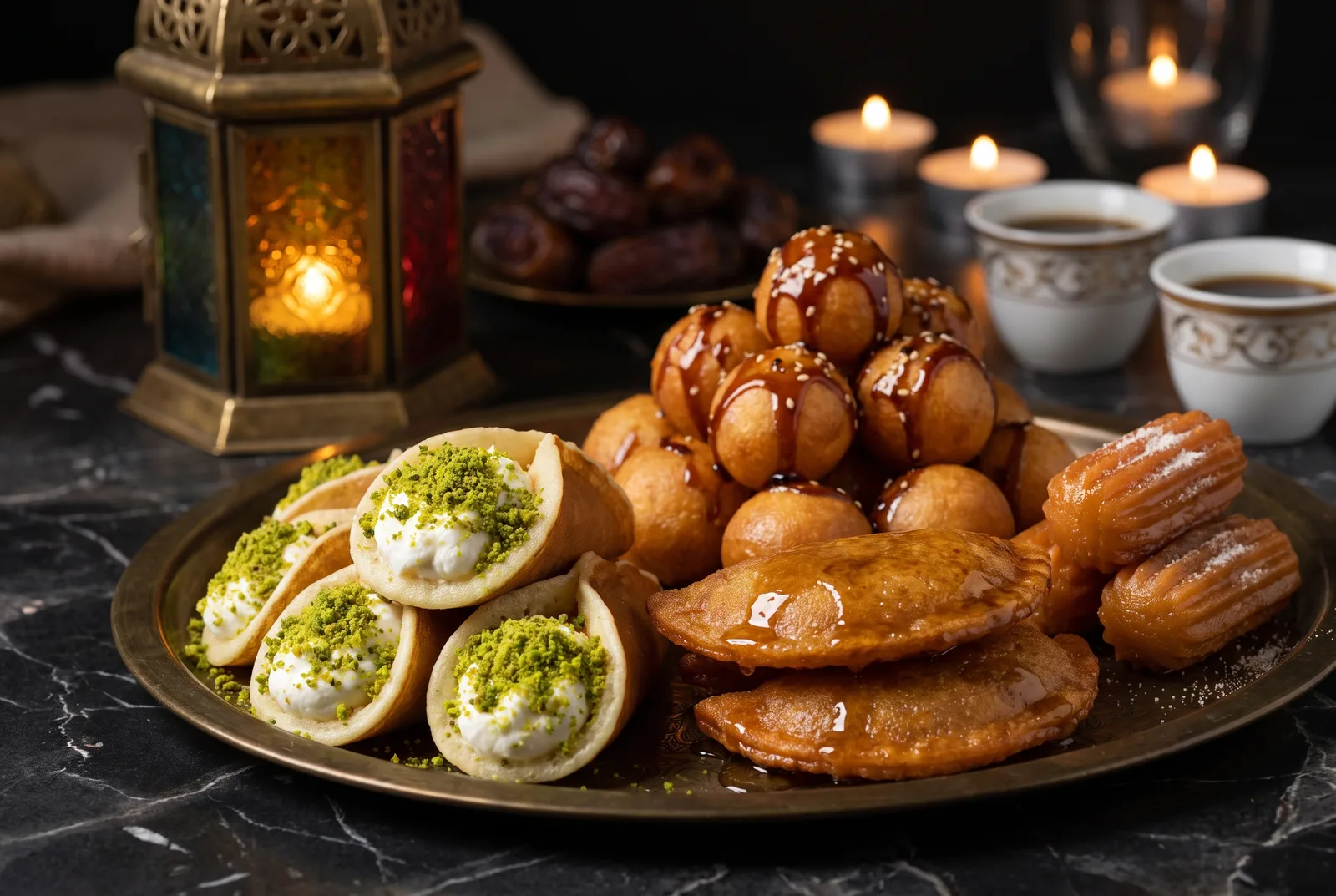
For an Arab or Middle-Eastern bakery, Ramadan is the year's commercial peak — a month when demand for a handful of specific sweets multiplies, concentrated into the hours around iftar (the sunset meal) and suhoor (the pre-dawn meal). Get the classics right, at volume, and you own the neighbourhood's table. This dossier translates the authentic regional practice, from native Arabic sources, into a professional workflow for the three sweets that define the season — qatayef, luqaimat and balah al-Sham — and wires every step to the ingredients you actually order. See the hero spread below.
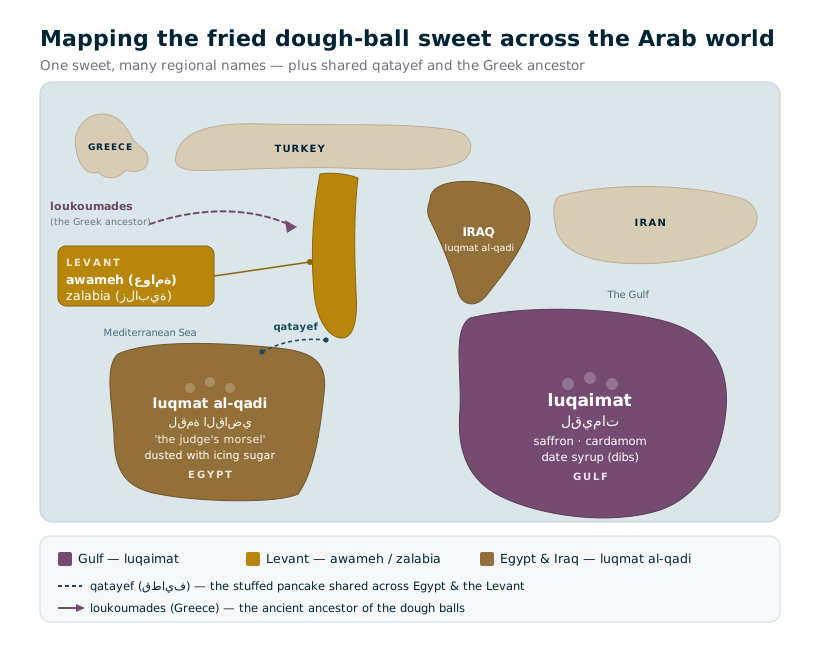
Names and transliteration. Arabic names are given in Latin transliteration with the Arabic script on first use and an English gloss. The same sweet often carries several regional names (see the figure below); getting the register right is what makes a Gulf, Levantine or Egyptian customer feel at home.
1. The names, and why they matter to your customers
The fried dough-ball sweet is the clearest example of regional naming. It is luqaimat (لقيمات, "little bites") in the Gulf; awameh (عوامة, "floaters") or zalabia (زلابية) in the Levant; and luqmat al-qadi (لقمة القاضي, "the judge's morsel") in Egypt and Iraq (c10). The name luqmat al-qadi is traditionally explained by Baghdad's judges (qadis) eating it for a quick, easy bite; the dish is documented to 13th-century Baghdad (associated with al-Baghdadi's Kitab al-Tabikh), and its ancient ancestor is the Greek loukoumades (لوقماديس) — fried dough in honey syrup (c11).
Qatayef (قطايف) is shared across Egypt and the Levant. Its name comes from the Arabic root q-t-f (قطف, "to pick up / pluck / scoop"); a secondary folk explanation links it to qatifa (قطيفة, "velvet") for its soft texture (c1). The earliest documented qatayef recipes appear in Ibn Sayyar al-Warraq's 10th-century Kitab al-Tabikh, including one titled "qatayef made for Harun al-Rashid" — so the dish is firmly Abbasid (750–1258), with some accounts also placing it in Fatimid Egypt (909–1171) (c2). Its tight association with Ramadan — eaten after iftar and at suhoor across Egypt, Syria, Lebanon, Jordan and Palestine — is often traced to the Fatimid court, though that specific origin is single-source and best treated as folklore (c3).
The commercial point: a Palestinian, Syrian or Lebanese customer expects qatayef and awameh; a Gulf customer expects luqaimat with saffron and cardamom and date syrup; an Egyptian customer expects qatayef and luqmat al-qadi dusted with icing sugar (c10, c12, c13). Stock and label accordingly.
2. Qatayef: the one-sided pancake, and the asafiri / regular decision
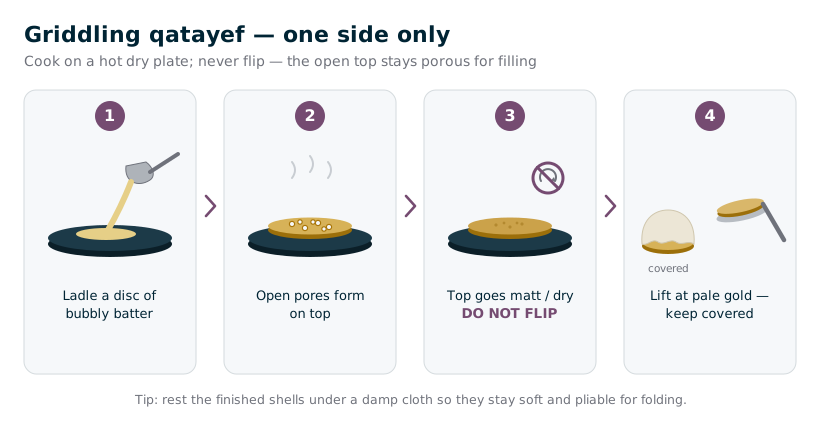
Qatayef is built on a yeasted pancake cooked on ONE side only. Small discs of a lightly fermented batter are poured onto a hot dry plate; the top fills with open pores/bubbles as the base sets, the surface turns matt and dry, and the cake is lifted off without ever being flipped (c4). That dry, porous top is the whole trick: it grips the filling and lets the edges pinch into a clean seal. See the cooking diagram below. Keep the cooked shells covered with a cloth so they stay pliable — a dried-out qatayef cracks when you fold it.
The batter is plain wheat flour (often with a little fine semolina for a more porous, slightly crisper top), warm water to a pourable consistency, a little sugar and salt, and a leavening of yeast and/or baking powder, rested 30–60 minutes until bubbly (c5). A working baker's-% formula is in the formula card below; for the science of the ferment and of chemical leavening see A2-yeast-types-comparison, A2-yeast-fermentation-science and A2-chemical-leaveners-baking-powder, and for flour choice A1-wheat-flour-types-by-application and B3-flour-and-semolina-selection.
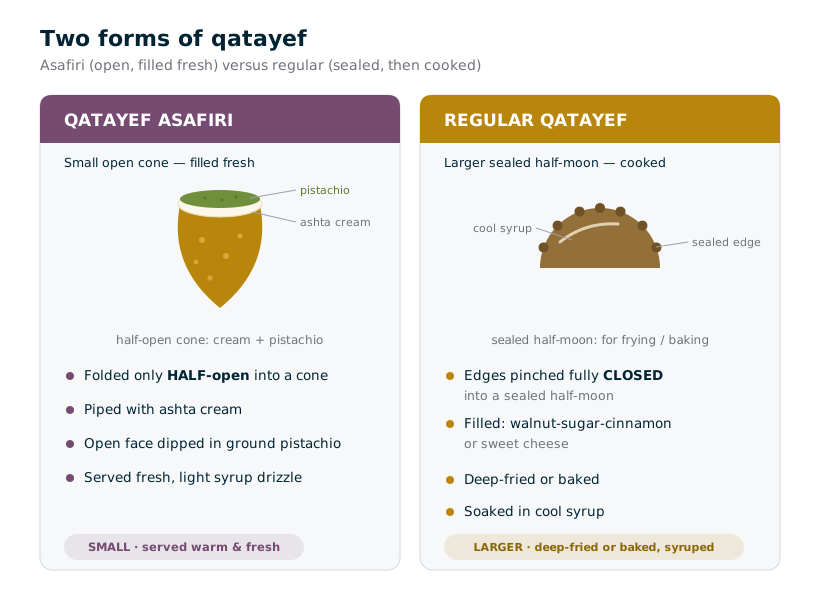
There are two forms, and they are made and sold differently:
- Qatayef asafiri (قطايف عصافيري, "little birds"). Small (~5–7 cm), folded only halfway into an open cone, piped with ashta cream, the exposed cream face pressed into ground pistachio, and served fresh — not fried or baked — with a light drizzle of scented syrup (c6). This is the delicate, high-margin counter piece.
- Regular qatayef. Larger, filled with a walnut–sugar–cinnamon mixture or sweet/desalted cheese, the edges pinched fully closed into a sealed half-moon, then deep-fried or baked and soaked in cool syrup (c6, c7).
The walnut filling is chopped/ground walnuts with sugar and cinnamon, sometimes a few drops of orange-blossom or rose water (c7); the formula is in the formula card below. Nut handling and allergen control are covered in A7-seeds-nuts-toppings. For cheese qatayef, use a sweet or desalted white brined cheese (akkawi/nabulsi) — the same desalting discipline as cheese knafeh (B3-knafeh-kunafa-production) — or a mild melting cheese; do not skip the desalt or the sweet turns savoury (c8).
The ashta / qishta cream for asafiri is a milk + corn flour (native maize starch) custard, enriched with cream and finished with a few drops of rose or orange-blossom water (c9). The formula is in the formula card below; the wider cream family sits in A6-pastry-creams-fillings and the aromatics in B3-aromatic-flavourings-rosewater-orange-blossom-mastic.
3. Luqaimat / awameh: the fermented drop-fried dough ball
Luqaimat is a soft fermented yeast batter — flour and water and yeast, usually with a little starch / corn flour for a crisper shell and sometimes yogurt or milk for a softer crumb. Gulf versions are scented with saffron and cardamom (c12). The batter is fermented until bubbly and elastic, then small balls are dropped into moderate hot oil (hand-squeezed through a fist, or piped) and fried to a crisp deep-gold shell with a soft interior, turning so the centres cook and puff evenly (c12, c28). See the process strip below; the baker's-% formula is in the formula card below.
Finishing is regional (c13):
- Gulf luqaimat — drizzled with date syrup (dibs) and scattered with sesame (and sometimes cinnamon).
- Levantine awameh / zalabia — dipped in sugar syrup or honey.
- Egyptian luqmat al-qadi — often simply dusted with icing sugar.
Date syrup can be bought or made by simmering pitted dates with water and straining; the catalogue chopped and whole dates support both a date filling and a home-made dibs (c22, and §7).
4. Fried vs baked — the production decision
Deep-frying gives the crispest, most authentic qatayef, but the fryer is the bottleneck during the pre-iftar surge, and it carries the highest oil cost. Baking — brush the sealed pieces with clarified butter/ghee or oil and bake hot (~200 °C) to gold, then syrup on exit — is a recognised lower-fat, higher-throughput alternative that avoids a fryer queue and suits wholesale/delivery lines (c27). Treat "lower-fat" here as an operational description, not a formal nutrition claim — a "reduced fat" label would have to be substantiated and declared under food-labelling rules. The full trade-off is in the comparison table and infographic below; the scaling logic sits in A5-scaling-artisan-to-industrial and A8-scaling-and-yield-conversion.
Frying-fat selection (this matters more than most bakeries think)
For a fryer that runs hard for a month, oxidative stability is everything. The catalogue sunflower
oil is ~60% polyunsaturated (28% mono, 11% saturated) — excellent value and fine for short runs or a
single service, but high polyunsaturate = faster oxidation, so it degrades quickly under repeated
frying (c20). A high-saturate frying fat is far more stable: the catalogue RSPO Palmax SG palm fat
is ~45% saturated / 42% mono / 8% poly, melting point 34–42 °C, and — importantly for this market
— is nut-free and, on its datasheet, declared suitable for Halal/Muslim, vegan and kosher diets (c21). See the frying-fat
table (frying-fat-selection) and the stability bars below; the full theory (smoke point, oil
turnover, filtration) is in A4-frying-fats-and-oils and A4-fat-types-and-selection, and the
animal-vs-vegetable ghee question in B3-ghee-and-baking-fats-in-arab-baking.
Halal caveat. The datasheet's "suitable for Halal/Muslim" wording is a dietary-suitability statement, and RSPO certification is an environmental (sustainable-palm) scheme — neither is a Halal certificate. Before you advertise any finished sweet as Halal to Muslim customers, confirm an actual Halal certificate for the specific fat (and for every other input) with your certifier.
Food safety. Deep-frying is a hot-oil hazard: fry at a moderate, controlled temperature (too hot browns the shell while leaving raw centres, especially on luqaimat and balah al-Sham), monitor and change oil on a schedule, and follow your HACCP plan for hot-oil handling and acrylamide control on high-temperature frying.
5. Balah al-Sham: choux paste in warm oil
Balah al-Sham (بلح الشام, "Levantine dates" — named for its date-like shape) is the Arab world's fried choux. A choux paste (water + butter + flour + eggs) is piped through a large star nozzle in short lengths directly into warm — not smoking — oil, so it puffs slowly into a ridged cylinder that is crisp outside and hollow inside, then dipped in cool syrup and often filled with ashta and dipped in pistachio (c14). See the figure below. The oil temperature is the make-or-break: too hot and the skin sets before it can expand, giving a dense, hollow-less result. The choux technique itself — cooking the paste, egg ratio, piping consistency — is covered in A6-choux-eclair-technology; the Turkish cousin tulumba (and lokma, the Turkish luqaimat) sits in B2-syrup-sweets-ottomans.
6. The syrup — qatr / attar, and the cool-on-hot rule
Every fried Ramadan sweet is finished with qatr (قطر) / attar — a scented sugar syrup, the same
family treated in depth in B3-attar-sugar-syrup-science, with sugar-cooking fundamentals in
A6-sugar-work-techniques. The grammar (c15, formula qatr-attar-syrup):
- ~2 parts sugar: 1 part water (some run ~1.5:1 for a lighter finish).
- Add a squeeze of lemon or a pinch of citric acid at the boil; simmer ~10 minutes until it coats a spoon but still pours. The acid inverts part of the sucrose and stops the syrup crystallising (tashkir); a little glucose syrup is extra insurance.
- Off the heat, stir in a few drops of rose and/or orange-blossom water — over-dosing turns it soapy.
- Cool the syrup fully.
The rule: pour COOL syrup over the HOT fried (or baked) sweet, the moment it leaves the oil/oven, then drain. The temperature differential drives syrup into the pastry while the shell stays crisp; hot syrup on hot pastry, or leaving pieces sitting in syrup, makes them soggy. (This is the same discipline as cheese knafeh — see B3-knafeh-kunafa-production — and contrasts with some baklava practice in B3-baklava-and-phyllo-pastries and B2-baklava-production.)
7. The peak-demand workflow — planning the Ramadan month
Ramadan concentrates a month's demand into daily pre-iftar surges. During the season, bakeries and specialist shops griddle very large volumes of plain qatayef shells (one side only) and sell them by weight to customers who fill and finish at home, alongside ready filled/fried qatayef and luqaimat (c16). Plan the line around that (see the timeline below):
- Pre-Ramadan. Stock the ambient staples that don't need daily delivery — flour, dried yeast (long shelf life; keep some fresh yeast on rotation, cold, 35-day life), baking powder, frying oil, sugar, citric acid, glucose, sesame, dates, nuts. Run trial batches to lock batter hydration and fry timings.
- Morning. Batch-griddle qatayef shells and pack/sell by weight; make the day's syrup ahead and keep it cool; cook and chill the ashta cream (cold-hold it).
- Afternoon. Ferment the luqaimat batter; make the choux for balah al-Sham; prep walnut and cheese fillings (desalt brined cheese chilled).
- Pre-iftar surge.Fry to order, syrup cool-on-hot, dip/dust, box. The fryer capacity is your ceiling — this is where baked qatayef and pre-made asafiri relieve pressure.
- Suhoor top-ups later in the night.
Formula scaling for these surges uses the baker's-% method in A8-bakers-percentage-fundamentals and the yield/costing logic in A8-scaling-and-yield-conversion.
Fault-finding for all of the above — unsealed/bursting qatayef, no pores on the pancake, soggy or greasy fried pieces, raw-centred luqaimat, dense balah al-Sham, crystallised syrup, weeping fillings — is laid out in the fault table below.
8. Companion Ramadan & Eid sweets (brief)
Beyond the fried classics, the season's counter also carries knafeh/kunafa (the Ramadan icon — see B3-knafeh-kunafa-production), baklava and phyllo pastries (B3-baklava-and-phyllo-pastries), and the semolina sweets — basbousa/namoura and, for Eid, the date/nut-filled maamoul — treated in B3-semolina-desserts-basbousa-maamoul (semolina grind choice is previewed by the basbousa coarse/fine question). Stocking these together lets one flour/semolina/nut/syrup order cover the whole seasonal range.
9. Buy the ingredients: the Domson catalogue for a Ramadan line
All available in our catalogue; see the products at the end of this article. In short:
- Batter & choux: Domson Wheat Flour Type 550 (all-purpose; ash 0.51–0.58%, wet gluten 28–32%, c17), Type 500 / 450 plain flours, and Wheat Semolina (Krupczatka) T450 for a more porous top; Fresh Yeast Benevia (dry matter >29%, 35-day shelf, c18) and Dried Yeast Fermipan Red for ambient peak stock; Baking Powder (opens the pores — note it contains wheat/gluten, c19); Corn Flour / Maisita Native Maize Starch for luqaimat crispness and ashta.
- Frying: Palmax SG Sustainable Palm Oil (stable; datasheet-declared Halal/vegan/kosher-suitable — confirm an actual Halal certificate before marketing as Halal, c21) or Palm Frying Oil 25 L for the fryer; Sunflower Oil for short runs (c20); Rapeseed Oil as a neutral blend.
- Fillings: Walnuts Light Amber Halves / Walnut Filling Excellent (walnut qatayef); Roasted Diced Pistachios / Pistachio Granules (asafiri & balah al-Sham crowns); Almonds Ground; Coconut Flakes Fine (coconut qatayef); Mozzarella Grated with desalted akkawi (cheese qatayef); Cinnamon Ground; Corn Flour + Double Cream UHT 33% (ashta — a cream + vegetable-fat (palm/coconut) blend with a carrageenan stabiliser, so its milk allergen comes from the dairy portion, not the carrageenan; because it is not pure dairy cream it cannot lawfully be sold as "cream"/"double cream" in the UK/EU — label it a "cream and vegetable-fat blend", c25); Dates Chopped / Whole Pitted for date fillings and home-made dibs (~63% sugars, Halal/vegan-suitable per datasheet, c22).
- Syrup & finish: Granulated / Caster Sugar (≥99.7% sucrose, c23); Citric Acid (E330, c24) and Glucose Syrup against graining; Multifloral Honey for luqaimat; Icing Sugar CP for luqmat al-qadi; Sesame Seeds for the luqaimat coat; Unsalted Butter 82% to clarify to ghee for baked qatayef.
10. Allergen & food-safety summary
A finished Ramadan sweet counter brings together several of the Big-14 allergens at once: cereals containing gluten (batter, semolina, the wheat-containing baking powder, and choux), tree nuts (walnut, pistachio, almond fillings), milk (ashta cream, cheese qatayef, butter/ghee), sesame (the luqaimat coat — the very allergen behind the UK's Natasha's Law) and eggs (balah al-Sham choux) (c26). Add the flour's precautionary soy/lupine/mustard traces and sub-threshold sulphites, and drive a formal per-product allergen matrix under UK/EU FIC (Reg 1169/2011).
Before you rely on any of this for production, note the following:
- Food safety. Ready-to-eat asafiri and the cooked ashta custard are dairy with no final kill step — cool them rapidly and cold-hold them; desalt brined cheese CHILLED (never warm); deep- and warm-oil frying is a hot-oil hazard and boiling ~2:1 syrup is a scald hazard; control fryer/oven temperatures for acrylamide (EU/UK Reg 2017/2158) and follow your HACCP plan.
- Honey. The honey finish for luqaimat must not be used in any product intended for infants under 12 months (infant-botulism risk).
- Labelling. Selling loose qatayef shells by weight requires allergen information to be available, and pre-packed-for-direct-sale (PPDS) filled items need a full ingredient list with the 14 allergens emphasised (Natasha's Law); the "Double Cream UHT 33%" input is a cream + vegetable-fat blend and cannot lawfully be described as "cream"/"double cream" (see §9); and "lower-fat" baked qatayef is not a substantiated nutrition claim.
- Halal. Datasheet "suitable for Halal" statements and RSPO certification are not a Halal certificate — verify certification per input before marketing to Muslim customers (see §4).
Figures
 Map of Arab Ramadan sweet names: Gulf luqaimat, Levantine awameh/zalabia, Egyptian/Iraqi luqmat al-qadi, shared qatayef, Greek loukoumades ancestor
 Four-step diagram: pour batter disc, bubbles form on top, surface goes dry, lift without flipping - one-sided qatayef cooking
 Comparison: asafiri qatayef half-folded open cone with cream and pistachio vs sealed half-moon walnut/cheese qatayef for frying
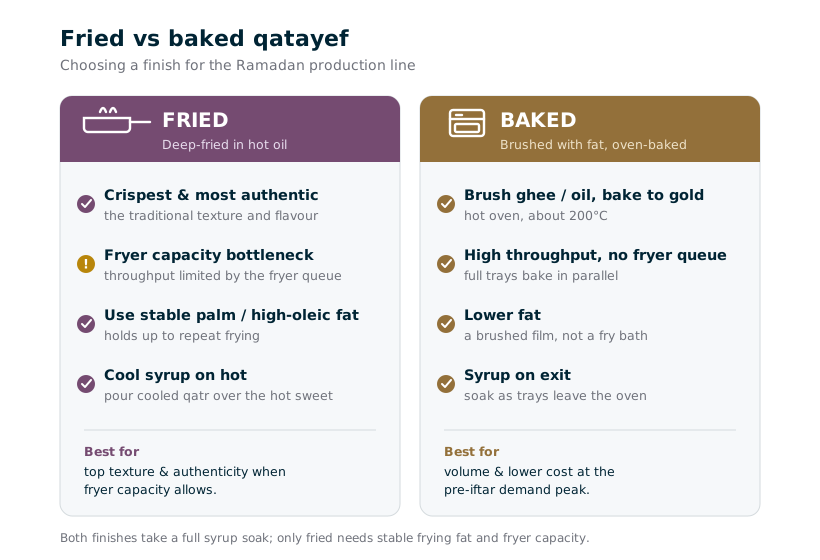 Infographic comparing fried qatayef (crispest, fryer bottleneck) vs baked qatayef (ghee-brushed, high throughput, lower fat)
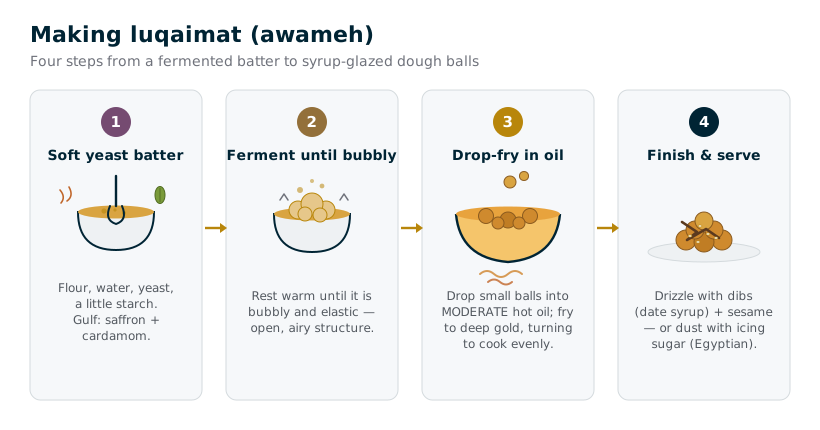 Four-step luqaimat diagram: fermented saffron-cardamom batter, proof, drop-fry balls in oil, finish with date syrup and sesame
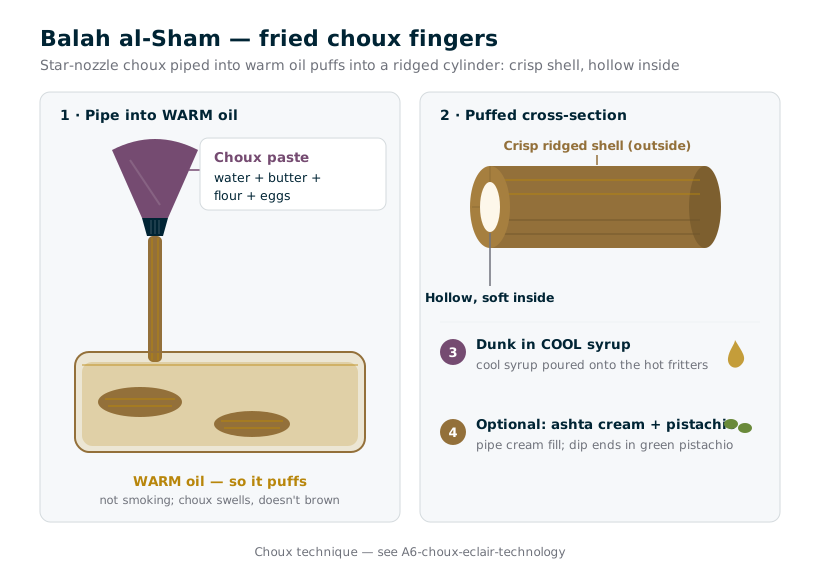 Balah al-Sham diagram: star-nozzle choux piped into warm oil, puffed ridged cylinder, hollow inside, syruped, cream-filled, pistachio
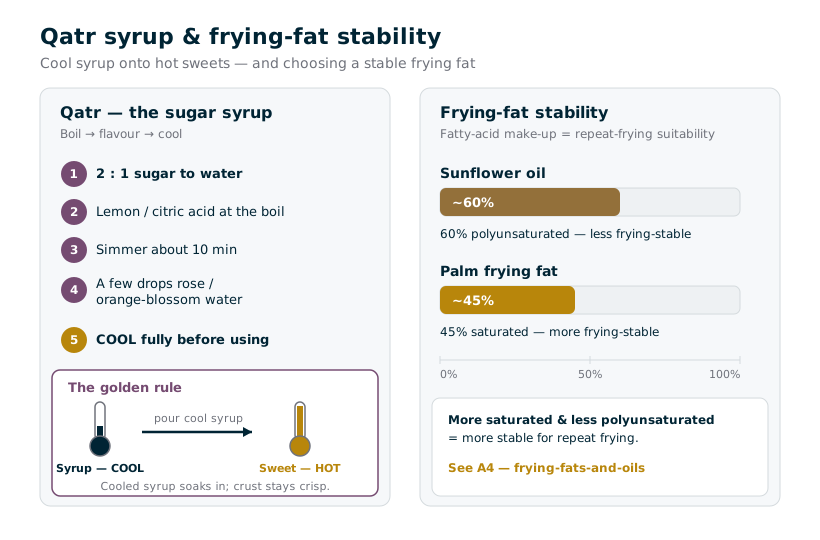 Infographic: qatr syrup 2:1 cooled onto hot sweets, plus frying-fat stability bars comparing sunflower (60% PUFA) vs palm (45% saturated)
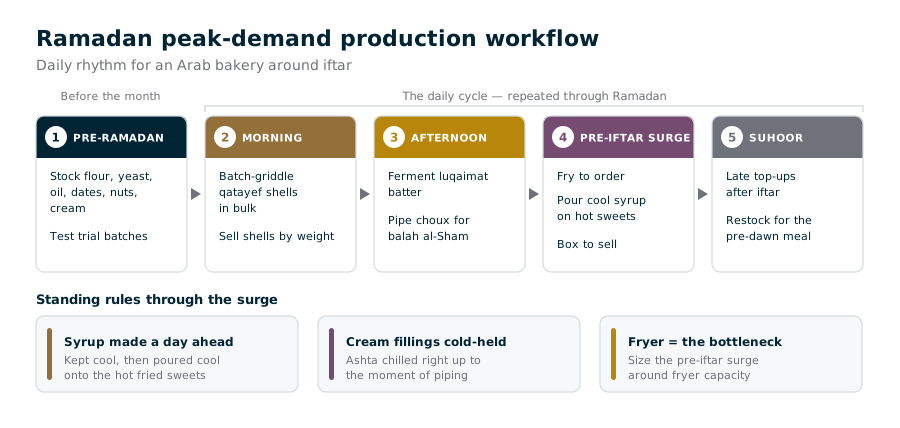 Ramadan bakery workflow timeline: pre-stock, morning qatayef shells by weight, afternoon batters, pre-iftar frying surge, cold-held cream
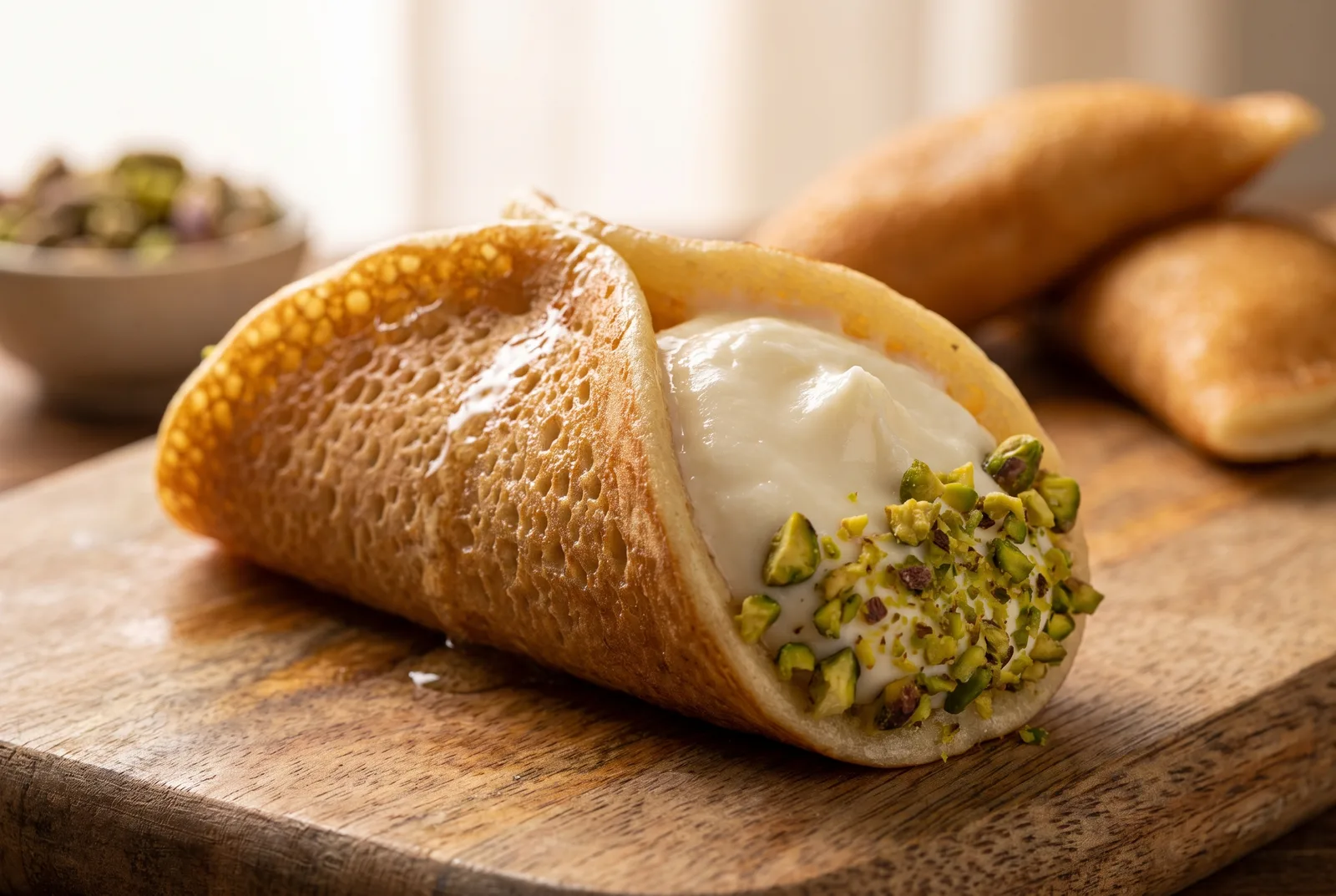 Close-up of a cream-filled qatayef asafiri with a green ground-pistachio crown
Qatayef pancake batter (one-sided) - working formula
| Ingredient | Baker's % | Weight |
|---|---|---|
| Plain wheat flour (Type 500-550) — all-purpose; some add up to ~10-15% fine semolina for a slightly crisper, more porous top | 100 | |
| Fine semolina (optional) — for porosity/crispness; reduce flour accordingly | 12 | |
| Water (warm) — pourable batter; adjust to a smooth ladle-able consistency | 150 | |
| Sugar — feeds the ferment and lightly sweetens | 4 | |
| Fresh yeast — or ~1% instant dried; bloom fresh yeast in a little warm water | 3 | |
| Baking powder — opens the pores; the catalogue baking powder CONTAINS wheat (gluten) | 1.5 | |
| Salt | 1 |
Yield: About 30-40 small asafiri or ~20 regular discs per ~500 g flour; scale linearly
Ashta / qishta cream (for asafiri qatayef and balah al-Sham)
| Ingredient | Baker's % | Weight |
|---|---|---|
| Full-cream milk | 1000 | |
| Corn flour (native maize starch) — thickener | 70 | |
| Double cream UHT 33% (enrichment) — catalogue product is a cream + veg-fat blend, not pure dairy cream | 250 | |
| Sugar | 60 | |
| Rose or orange-blossom water — a few drops; over-dosing turns it soapy | 5 |
Yield: Fills ~30-40 asafiri; scale linearly
Walnut filling for fried qatayef
| Ingredient | Baker's % | Weight |
|---|---|---|
| Walnuts, chopped/coarsely ground | 300 | |
| Sugar | 60 | |
| Ground cinnamon | 4 | |
| Orange-blossom or rose water — optional | 5 |
Yield: Fills ~20 regular qatayef
Luqaimat / awameh batter (drop-fried)
| Ingredient | Baker's % | Weight |
|---|---|---|
| Plain wheat flour (Type 500-550) | 100 | |
| Corn flour / native maize starch — for a crisper shell | 15 | |
| Water (warm) — to a thick, sticky, just-pourable batter | 90 | |
| Plain yogurt or milk (optional) — softer crumb; common in Gulf/Levant versions | 20 | |
| Fresh yeast — or ~1% instant dried | 3 | |
| Sugar | 5 | |
| Salt | 1 | |
| Ground cardamom (Gulf) — with a pinch of saffron steeped in warm water | 0.5 |
Yield: ~60-80 balls per ~500 g flour
Qatr / attar scented sugar syrup (all fried sweets)
| Ingredient | Baker's % | Weight |
|---|---|---|
| Sugar: water — some run ~1.5:1 for a lighter finish; Ratio: 2: 1 by volume | ||
| Lemon juice or citric acid — ~1/2 tsp lemon or a pinch of citric acid per ~400 g sugar, added at the boil | ||
| Glucose syrup (optional) — extra insurance against graining | ||
| Rose and/or orange-blossom water — a few drops off the heat |
Yield: Enough to soak one large batch
| Sweet | Arabic / regional names | Base | Cooking | Filling / finish | Syrup |
|---|---|---|---|---|---|
| Qatayef asafiri | قطايف عصافيري (Levant, Egypt, Gulf) | One-sided yeasted pancake, small ~5-7 cm | Griddled one side only; NOT fried | Ashta cream, open face dipped in ground pistachio; served fresh | Light drizzle of cool scented syrup |
| Qatayef (regular, fried) | قطايف (Egypt & Levant) | One-sided yeasted pancake, larger | Sealed half-moon, deep-fried or baked | Walnut + sugar + cinnamon, or sweet/desalted cheese | Dipped in COOL syrup after frying |
| Luqaimat | لقيمات (Gulf); عوامة awameh / زلابية zalabia (Levant) | Soft fermented yeast batter (+ starch; Gulf: saffron + cardamom) | Drop-fried balls in moderate oil | Sesame; sometimes cinnamon | Date syrup (dibs), sugar syrup or honey |
| Luqmat al-qadi | لقمة القاضي 'the judge's morsel' (Egypt, Iraq) | Same fermented batter | Drop-fried balls | Often plain | Dusted with icing sugar or light syrup |
| Balah al-Sham | بلح الشام 'Levantine dates' (Levant, Egypt) | Choux paste (water+butter+flour+eggs) | Star-nozzle piped into WARM oil; puffs crisp/hollow | Optional ashta fill + pistachio | Dipped in cool syrup |
| Basbousa / namoura | بسبوسة / نمورة (companion; see B3-semolina-desserts-basbousa-maamoul) | Semolina cake batter | Baked in a tray | Almond/coconut; cut into diamonds | Syrup poured on exit |
| Factor | Fried (deep-fry) | Baked |
|---|---|---|
| Texture | Crispest shell, most authentic (Levant/Egypt standard) | Crisp-tender; less shatter, more even |
| Fat | Absorbs frying oil; higher fat/cost | Brushed with ghee/oil only; lower fat |
| Throughput at peak | Fryer is the bottleneck; batch size limited by oil volume/recovery | Oven trays scale better; no fryer queue |
| Fat choice | Use an oxidatively stable fat (palm/high-oleic); manage oil turnover | Ghee/clarified butter for flavour, or oil |
| Syrup rule | Cool syrup onto HOT fried pieces immediately | Cool syrup onto HOT baked pieces on exit |
| Best for | To-order pre-iftar service; signature crunch | High-volume trays, delivery/wholesale, lower-fat lines |
| Fat | Fatty-acid profile | Frying stability | Notes | Catalogue |
|---|---|---|---|---|
| Sunflower oil | ~60% poly / 28% mono / 11% sat | Lower (high polyunsaturate = faster oxidation) | Fine for short runs / single service; monitor and change oil often | Sunflower Oil 15 L (Olympic) |
| RSPO palm frying fat | ~45% sat / 42% mono / 8% poly; m.p. 34-42 C | Higher (more stable for repeated frying) | Nut-free; declared Halal/Muslim, vegan, kosher suitable | Palmax SG 12.5 kg (KTC); Palm Frying Oil 25 L (Master Martini) |
| Rapeseed oil | High mono, moderate poly | Moderate | Neutral flavour; a common blend base | Rapeseed Oil 5 L (Ajax) |
| Ghee / clarified butter | High saturated, no water/solids once clarified | High; browns without burning | For brushing baked qatayef / flavour; not for large fry vats | Clarify from Unsalted Butter 82% |
| Fault | Likely cause | Fix |
|---|---|---|
| Qatayef won't seal / bursts in the fryer | Batter too wet or too dry (no grip on the seal); overfilled; edge not moistened | Adjust batter to a matt-dry top; fill less; moisten and pinch the rim firmly; fry seam-side down first |
| No open pores on the pancake top | Batter under-fermented or too thick; plate not hot enough | Rest batter until bubbly; thin slightly; pre-heat the dry plate properly |
| Qatayef tears / cracks when folding | Pancakes over-cooked/dried; not kept covered | Lift when the top is just dry; keep under a cloth; fold while still pliable |
| Soggy, greasy fried pieces | Oil too cool; hot syrup poured on hot pastry; over-soaked | Fry at moderate heat with good recovery; pour COOL syrup on HOT pieces and drain; do not leave sitting in syrup |
| Luqaimat raw/doughy inside, dark outside | Oil too hot; balls too big | Lower the oil temperature so the centre cooks/puffs; make smaller balls; turn for even colour |
| Luqaimat greasy / not crisp | Under-fermented batter; oil too cool; no starch | Ferment fully; add a little cornflour/starch; fry hot enough to crisp then drain well |
| Balah al-Sham dense / not hollow | Oil too hot (skin sets before it puffs); choux under-cooked on the stove | Fry in WARM oil so it expands slowly; cook the choux paste properly before piping |
| Syrup crystallises / grainy | No acid; boiled too hard/long; sugar not fully dissolved | Add lemon/citric acid at the boil and/or a little glucose; simmer gently ~10 min; dissolve fully |
| Cheese/cream filling weeps or spoils | Wet/under-desalted cheese; cream not cold-held; time/temperature abuse in the surge | Desalt and dry brined cheese (chilled); cold-hold cream fillings; batch small during peak service |