
Flour and semolina for Arab baking: white wheat flour, durum semolina and wholemeal, and which one for which job
A working baker's guide to choosing flour (طحين / دقيق) and semolina (سميد) for Arab and Middle-Eastern production. Arab bakers, like Turkish ones, buy by the finished product rather than a single type number, and the choice runs across three families: white wheat flour (from very strong for jullash/phyllo and hand-pulled markoúk down to soft, low-protein flour for maamoul and kahk), durum semolina (samīd — fine, medium and coarse, the backbone of basbousa/namoura, kunafa naʿama, maamoul and couscous), and wholemeal/brown flour (for khubz asmar and the high-extraction Egyptian baladi loaf). It explains the regional vocabulary (Levantine طحين vs Egyptian/Gulf دقيق; Gulf grades fākher / asmar / burr; farkha), the Egyptian baladi 82–87.5% vs fino/tourist 76% extraction bands, the fine-vs-coarse semolina debate for basbousa, and exactly which Domson UK-stock flours a UK Arab bakery or patisserie should order — including the durum-vs-soft-wheat semolina trap. Regional and numeric attributions are cited to Arabic-language sources; supplier facts come from first-party datasheets.
Arab bakers buy flour "by the job", in three families
Across the Arab world flour is chosen the way a Turkish miller sells it — by the finished product, not by a single type number. The vocabulary changes as you travel: in the Levant and Iraq flour is طحين (ṭaḥīn / "tiheen"), while in Egypt, the Gulf and Modern Standard Arabic it is دقيق (daqīq); semolina everywhere is سميد (samīd / "smid"). Whatever the word, the working choice runs across three families, and this guide keeps to the flour question — the products themselves live in the sibling B3 articles (Arab flatbreads decoded: khubz, markook, taboon and tannour — doughs, ovens and regional differences, Baklava and Arab nut pastries: pistachio, walnut and almond fillings, samneh layering and floral finishing, Knafeh (كنافة): regional varieties, cheese selection, kataifi dough and the full production workflow for professional scale, Semolina-based Arab sweets: basbousa, namoura (نمّورة) and maamoul (معمول) — grind choice, ghee ratios and resting times, Za'atar, manakish and savoury Arab flatbreads: spice blends, olive oil ratios and the breakfast-bakery opportunity):
- White wheat flour — from very strong (for hand-pulled markoúk and the firm base dough of baklava / jullash phyllo) down to soft and low-protein (for maamoul, kaʿk and ghraybeh).
- Durum semolina (samīd) — the creamy-yellow, granular meal that is the backbone of Arab sweets: basbousa/namoura, kunafa naʿama, maamoul, harissa, and North African couscous.
- Wholemeal / brown flour (دقيق أسمر / دقيق بر) — for brown Arabic bread (khubz asmar) and the high-extraction Egyptian baladi loaf.
The universal science behind all of this is in the Pillar A flour set — start with Flour type numbers decoded: Polish T-codes, French T45–T150, German 550, Italian 00, Protein content, gluten quality and flour strength: what the numbers mean for your dough and Reading the flour spec sheet: ash content, Hagberg falling number, Zeleny, farinograph and alveograph, and see From grain to bag: how wheat is milled and what extraction rate means for how milling and extraction work.
The regional vocabulary you have to read
There is no single pan-Arab legal "type number" the way Poland has T-codes; mills and food authorities each publish their own grades. The two systems a UK buyer meets most often are the Egyptian extraction-rate language and the Gulf named-grade language.
Egypt — by extraction (نسبة الاستخلاص). Egyptian flour is talked about as a percentage of the grain that ends up in the bag. The famous baladi loaf (عيش بلدي) is made from a high-extraction brown-ish flour: the 2022 Ministry of Supply (التموين) decree lists several bands — 93.3 / 87.5 / 82 / 80 / 76 / 72% — and the flour then in use for subsidised baladi was reported at 87.5% (historically it has often been quoted at ~82%). The whiter fino / tourist bread (عيش فينو / سياحي) uses about 76%, and the lowest band (72%) is used for pasta and fine white (shami) flour. The headline shift 82→87.5% is independently corroborated (USDA FAS), but the full six-band list comes from the single decree report, so treat the exact bands as indicative. Because this is a live policy figure, treat baladi as "high-extraction (~82–87.5%)" and confirm the current standard before quoting an exact number. This is the extraction/randıman idea explained in From grain to bag: how wheat is milled and what extraction rate means and Wholemeal and high-extraction flours: nutrition, flavour and the bran interference problem.
The Gulf and Saudi — by named grade. Saudi mills such as المطاحن العربية (Arabian Mills), one of the Kingdom's major wheat millers, sell a family of named grades:
- دقيق فاخر (daqīq fākher) — refined patent white flour, for general bread and pastry.
- دقيق أسمر (daqīq asmar) — brown flour, roughly 85%-extraction, with some bran and germ removed.
- دقيق بر (daqīq burr) — wholemeal, carrying the whole grain (endosperm, bran and germ).
- دقيق كيك (daqīq keek) — cake flour, milled from soft wheat; like cake flour anywhere it runs low in protein — typically under ~9%, often nearer ~7% (a general cake-flour norm rather than a Gulf-specific legal figure).
- سميد (samīd) — semolina, sold in coarse and fine grades (below).
Gulf and GCC white-wheat-flour grades are also governed by Saudi (SFDA) and Gulf Standardization Organization (GSO) technical regulations; those set legal ash, moisture and additive limits rather than the "which flour for which sweet" logic that follows.
White wheat flour: match the protein to the job
White flour spans the widest range of Arab work, and the single most useful number is protein / gluten strength — see Protein content, gluten quality and flour strength: what the numbers mean for your dough and Choosing the right wheat flour: bread, pastry, cake, pizza, pasta and laminated doughs. Think of it as a ladder:
Very strong white — for pulled doughs and the baklava base
The most demanding white-flour jobs are the hand-pulled and rolled thin doughs: the Levantine/Gulf markoúk / shrāk stretched paper-thin over a domed saj, and the firm, elastic base dough rolled and sheeted thin as jullash / raqāʾiq phyllo for baklava (shredded kataifi dough is a separate product — see Phyllo and kataifi in Arab pastry: production technique, storage and professional handling for baklava and knafeh). These need a very strong, extensible gluten so the sheet thins without tearing. Reach for the strongest whites in the range — Carr's Centurion Canadian Very Strong or Allied Mills Coniston Strong White. Coniston runs protein 12.5–14.5%, Hagberg falling number ≥250 s, water absorption 58–61%, ash ~0.8% on its datasheet. For phyllo and kataifi production technique see Phyllo and kataifi in Arab pastry: production technique, storage and professional handling for baklava and knafeh.
Strong white — for saj/markoúk bread, sfiha and lahm bi ajin
A step down, strong bakers' flour handles leavened flatbread and topped doughs: khubz on the saj, the open dough beds under sfiha and lahm bi ajin (meat pies), and rings. Carr's Titan Strong Bakers suits this — protein 12.7–13.3% with about 2.5% added vital wheat gluten — as do Allied Mills Pennine and Matthews Windrush. To push a merely-strong flour up to pulled-dough strength, add vital wheat gluten (see Vital wheat gluten: fortifying weak flours and high-fibre doughs from 2% to 12% via Protein content, gluten quality and flour strength: what the numbers mean for your dough).
Medium, extensible white — for manakish, khubz arabi and fino
Everyday khubz ʿarabi / kmaj (pocket pita), manakish and fino-style bread want a medium-protein, extensible flour that opens easily and stays soft. Carr's Verace Pizza Flour — medium protein with high water absorption and a little fungal alpha-amylase and ascorbic acid — behaves like a good manakish/fino base, and the clean Polish patent Domson White Strong (T550) or ADM Domson PN serve as general daqīq fākher for the daily bread bench. Za'atar manakish is covered in Za'atar, manakish and savoury Arab flatbreads: spice blends, olive oil ratios and the breakfast-bakery opportunity.
Soft, low-protein white — for maamoul, kaʿk and ghraybeh
At the weak end sit the short, tender doughs and biscuits: the flour side of maamoul, the buttery kaʿk and melt-in-the-mouth ghraybeh, plus cakes. Here you want low protein so the dough stays short and does not toughen. Whitworth Golden Jewel Pastry Flour is a blended pastry flour at protein 7.5–9.5% (target 8.5%) — and, importantly for this trade, it is halal- and kosher-certified. Carr's Starlight Pastry is an alternative. Note that maamoul is rarely all flour: most recipes are semolina-led (see below), with a proportion of fine flour worked in. The same soft flour is the base for the thin poured batter of qatayef and the fritters of Ramadan — see Ramadan baking production guide: qatayef (قطايف), luqaimat (لقيمات) and seasonal sweets — scaling, fried vs baked options and the peak-demand workflow.
Durum semolina (samīd): the heart of Arab sweets
If one ingredient defines Arab confectionery it is samīd — semolina, the coarse, purified endosperm of durum / hard wheat (القمح الصلب), milled to a granular meal rather than a fine powder, and creamy-yellow in colour. Durum is a hard, high-protein wheat, and its granularity is the point: the grains absorb syrup and melted ghee (samn) slowly and steadily, which is exactly what a syrup-soaked semolina cake needs.
Semolina is graded by particle size, and the grade is chosen by dish. Arabic sources describe three grades :
- Fine — سميد ناعم (samīd nāʿim). Closest to flour, pale. The default for basbousa, layali lubnāniyya (Lebanese-nights semolina pudding), custard and mahalabiya, kunafa naʿama (the fine, smooth kunafa base ), kaʿk, and cakes; also blended with white flour for delicate work.
- Medium — سميد متوسط (samīd mutawassiṭ). The "safe choice", balancing tenderness and body. Used for kibbeh shells, couscous, semolina bread (khubz samīd), harissa/hareseh, and — per the Saudi supplier Baker's Choice — for basbousa.
- Coarse — سميد خشن (samīd khishn). Visible granules; absorbs liquid slowly. Used for couscous, maftoul (Palestinian large couscous), ʿaṣīda, Aleppo maʾmūniyya and qishṭa halabiyya, and the coarser maamoul and semolina breads; also the base for the best dry pasta.
The basbousa question (a real regional debate). Ask three bakers which semolina makes the best basbousa and you may get three answers. One camp insists on fine semolina so the cake drinks the sugar syrup and ghee evenly and sets smooth; another prefers medium (Baker's Choice) or even a fine+coarse blend for a grainier, more traditional bite. Both are authentic — decide by the texture your customers expect, and see Semolina-based Arab sweets: basbousa, namoura (نمّورة) and maamoul (معمول) — grind choice, ghee ratios and resting times for full formulas.
Maamoul — semolina + a little flour + ghee, and time. Classic Levantine maamoul dough is semolina-led, cut with a proportion of fine flour (the finest grade is called farkha — فرخة in the Levant), rubbed with warm ghee (samn) and flavoured with mahlab and mastic, then rested (often overnight) so the semolina hydrates, absorbs the fat and softens before shaping. The rest is not optional: under-rested semolina bakes gritty. An indicative baker's-percentage structure for this dough is in the formula card below; for how to read and scale such a formula see Baker's percentage: the universal language of professional formulas. The ghee side is covered in Ghee and clarified fats in Arab baking: animal ghee (samneh) vs vegetable ghee, smoke point, flavour and when to substitute.
North Africa (a note on the edge of the region). In the Maghreb — Morocco, Algeria, Tunisia — durum semolina (سميدة, smida) is even more central: it is the base of couscous, msemmen and the semolina flatbread kesra, which is typically durum semolina and wheat, sometimes with barley (as in Tunisia). Do not confuse Maghrebi kesra with the similarly named Sudanese kisra (كسرة), which is a different bread — traditionally a thin, fermented sorghum bread, not a durum-semolina flatbread.
Buying semolina in the UK — and the durum trap
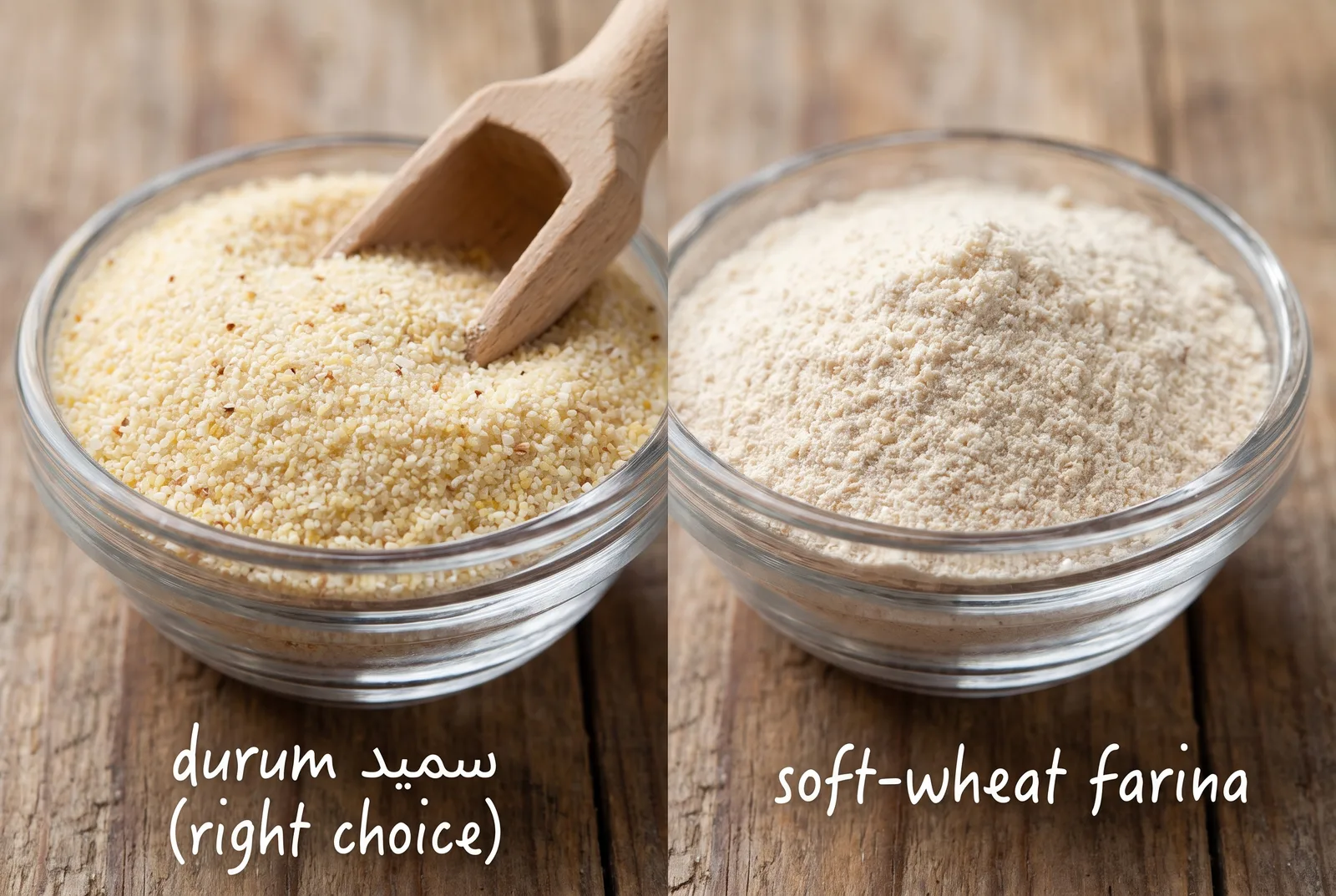
The single biggest purchasing mistake a UK Arab bakery makes is buying a soft-wheat "semolina" when the recipe wants durum. Genuine samīd for Arab sweets is durum (creamy-yellow, granular). In the Domson range:
- Allied Mills Durum Wheat Semolina is the real thing — 100% durum wheat (may contain 3% common wheat), protein ≥11% (dm), ash ≤0.8% (dm), creamy-yellow and granular, with a coarse granulation (about 40–60% retained on 425 µm, 20–30% on 355 µm, 15–25% on 300 µm). This is your basbousa / maamoul / couscous semolina.
- Eurostar Extra Coarse Semolina gives a coarser grind for couscous, maftoul and grainy work.
- Komplexmłyn Wheat Semolina "Manna" and GoodMills "Krupczatka" (T450) are soft / common-wheat
semolina (farina), not durum — fine for Polish
krupnikor milk puddings, but they will not give the colour, bite or syrup uptake of true samīd in an Arab sweet. Check the label reads durum before you commit a batch of basbousa to it.
Wholemeal and brown: khubz asmar and the baladi loaf
Brown and wholemeal flours cover the healthier and high-extraction breads — khubz asmar (brown Arabic bread), wholemeal saj and tannour loaves, and the Egyptian baladi loaf whose whole character comes from its high extraction and retained bran. Reach for:
- Carr's Bakers Wholemeal — a fortified wholemeal at protein 13.5–14.2%, fibre 10.1 g/100 g.
- ADM Domson Brown (a brown daqīq asmar), Allied Mills Grampian Wholemeal, and Doves Farm Organic Strong Wholemeal for organic lines.
- Carr's Lion Atta Medium Chapatti Flour — a medium-brown flour at protein 9–11.2%, fibre 5.7 g/100 g — for the whole-wheat flatbreads (roti/chapati-style) that the Gulf and expatriate trade also bake.
Remember the bran-interference rule from Wholemeal and high-extraction flours: nutrition, flavour and the bran interference problem: the more bran retained, the more it cuts the gluten network, so a wholemeal khubz will be denser than a white one unless you compensate with a stronger base flour or added gluten.
A note on UK fortification and the labels you will read
Every white and brown (roughly ≤85%-extraction) UK flour here — though not the pure durum semolina — is fortified with calcium, iron, niacin (nicotinic acid) and thiamin under the UK Bread and Flour Regulations 1998; you will see these on the ingredient declaration. This is a legal UK addition, not something the miller chose for Arab baking, and it does not change how the flour performs. Two caveats: wholemeal flour is exempt from this mandatory fortification (the bran and germ are retained), so any fortification of a wholemeal here is voluntary or reflects added white flour; and the Regulations are being amended to add mandatory folic acid — confirm the current fortification list before any customer-facing use.
Quick selection checklist
The decision tree in condenses the whole guide into a single "which flour do I buy" selector.
- Name the product first, then the flour — pulled dough / baklava base → very strong white; saj bread, sfiha → strong white; khubz ʿarabi, manakish, fino → medium extensible white; maamoul dough, kaʿk, ghraybeh → soft low-protein white.
- Semolina = durum, and pick the grind — fine for basbousa/kunafa naʿama/mahalabiya; medium for kibbeh/couscous/basbousa; coarse for couscous/maftoul/grainy maamoul.
- Avoid the soft-wheat "semolina" trap — confirm the label says durum for Arab sweets.
- Brown/baladi = high extraction — expect a denser crumb and compensate for bran interference.
- Check certification for a Muslim clientele — halal status differs by product (Golden Jewel is halal- and kosher-certified; Titan is kosher- but not halal-certified; the other strong whites, the wholemeal and the durum semolina carry neither at the specs read — and uncertified is not the same as non-halal).
Food safety, allergens and certification
Every flour and semolina in this article contains gluten (wheat) and is unsuitable for coeliacs; flour and semolina are raw ingredients that must be baked or cooked before eating — Allied Mills explicitly does not recommend its semolina be eaten raw (for example as an un-baked dusting) — and datasheets flag cross-contamination with other gluten-containing cereals (barley, rye, oats), with soya, and, for several products, with maize. Halal certification differs by product: Golden Jewel Pastry Flour is halal- and kosher-certified; Carr's Titan is kosher-certified but not halal-certified; and Coniston, Carr's Bakers Wholemeal, Lion Atta and the Allied Mills Durum Semolina carry neither certification at the specs read. This is a material point for the largely Muslim Arab trade — but note that not certified is not the same as not halal: plain wheat flour and semolina are generally halal by nature, and the distinction here is documented certification, which some customers require. Certification is time-sensitive and site-specific, so confirm current certificates before advising customers. Finally, although the flours and semolina themselves contain none, the finished Arab products built on them introduce further named allergens: sesame (tahini and simsim finishes, some kaʿk), tree nuts (pistachio, walnut, almond in baklava, maamoul and syrup sweets), milk (kunafa/qatayef cheese and cream), egg (qatayef batter, some cake and kaʿk washes) and soya (in some vegetable ghee, shortenings and emulsifiers) — all declarable under UK/EU food-information law (retained Reg 1169/2011 and Natasha's Law). This list is illustrative, not exhaustive, so any customer-facing recipe or product must carry an allergen declaration built from its own actual formulation. These allergen, safety and certification points should be independently verified before any customer-facing use.
Figures
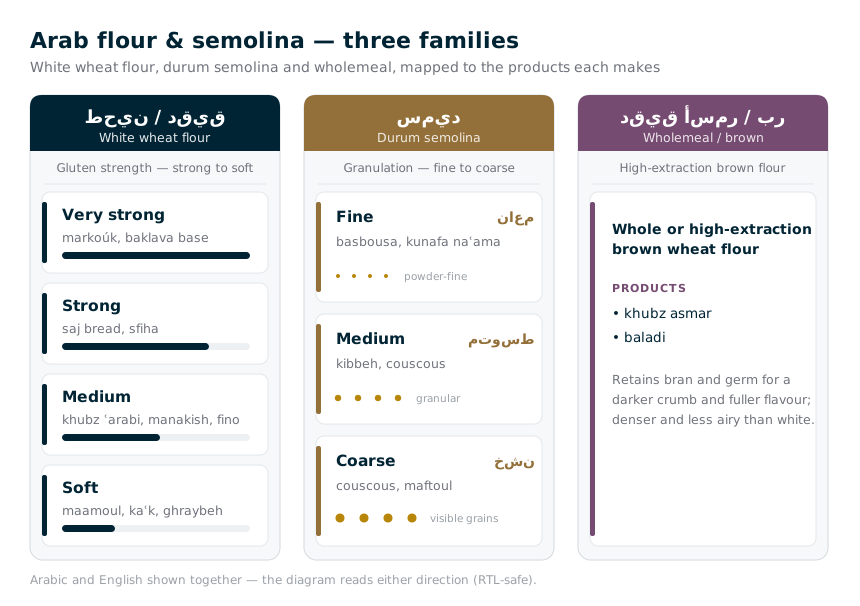 Orientation diagram splitting Arab baking flour into three families — white wheat flour (very strong to soft), durum semolina (fine/medium/coarse) and wholemeal/brown — each with the Arab products it makes.
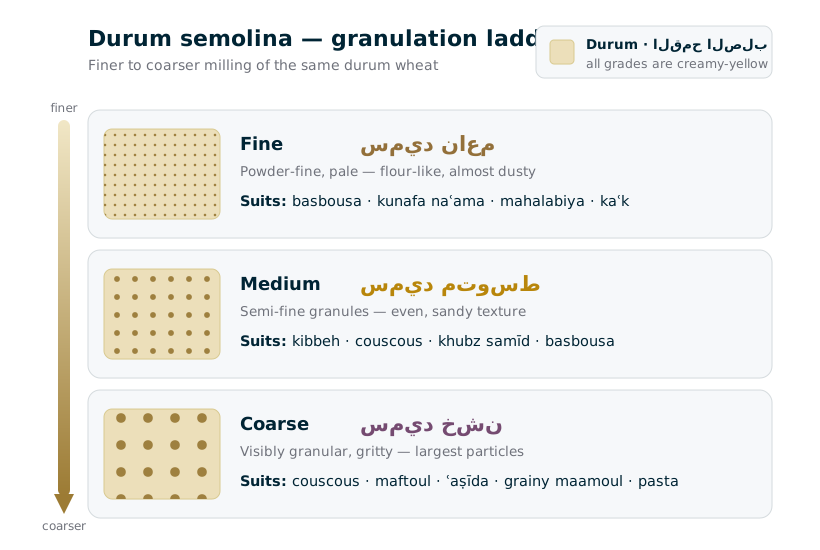 Ladder from fine to coarse durum semolina showing سميد ناعم, سميد متوسط and سميد خشن, each with particle character and the Arab dishes it suits.
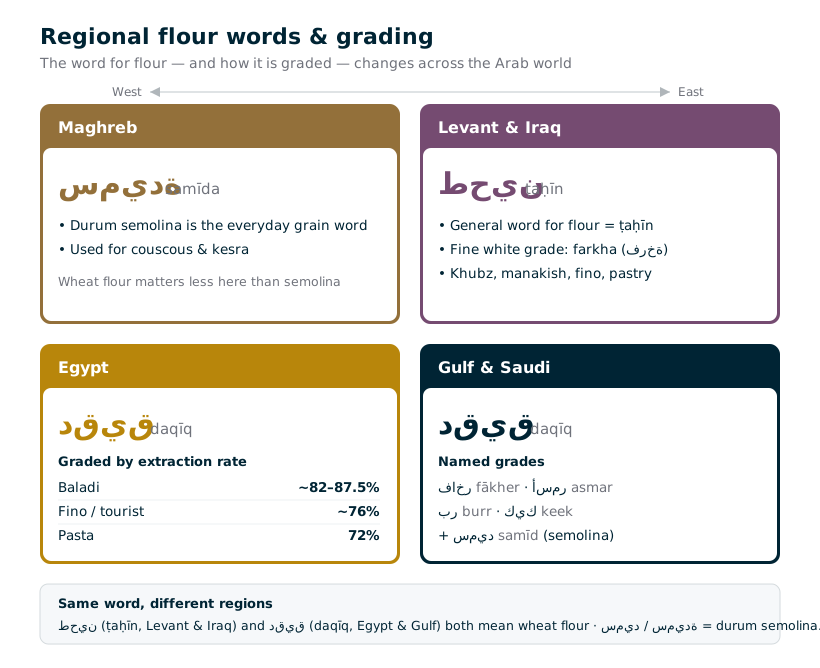 Schematic map contrasting the Levant/Iraq word طحين with the Egyptian/Gulf word دقيق, the Egyptian extraction-rate bands, and the Gulf named grades fākher/asmar/burr/keek.
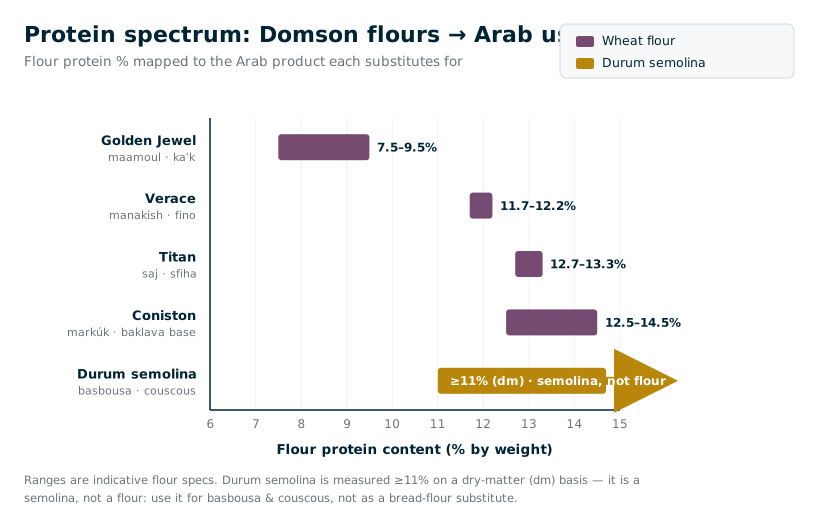 Horizontal bar chart of protein content for Domson UK flours (Golden Jewel pastry, Verace, Titan, Coniston, durum semolina) against the Arab application each substitutes for.
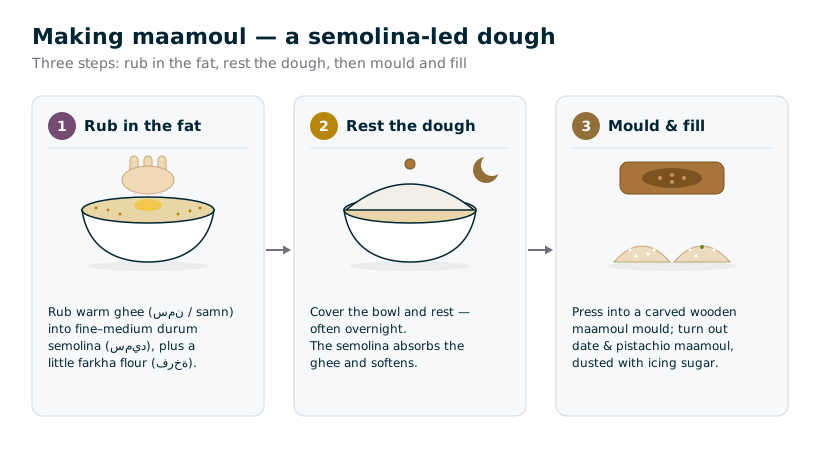 Three-step illustration of maamoul — rubbing ghee into durum semolina, the covered dough resting overnight, and moulded date/pistachio maamoul dusted with icing sugar.
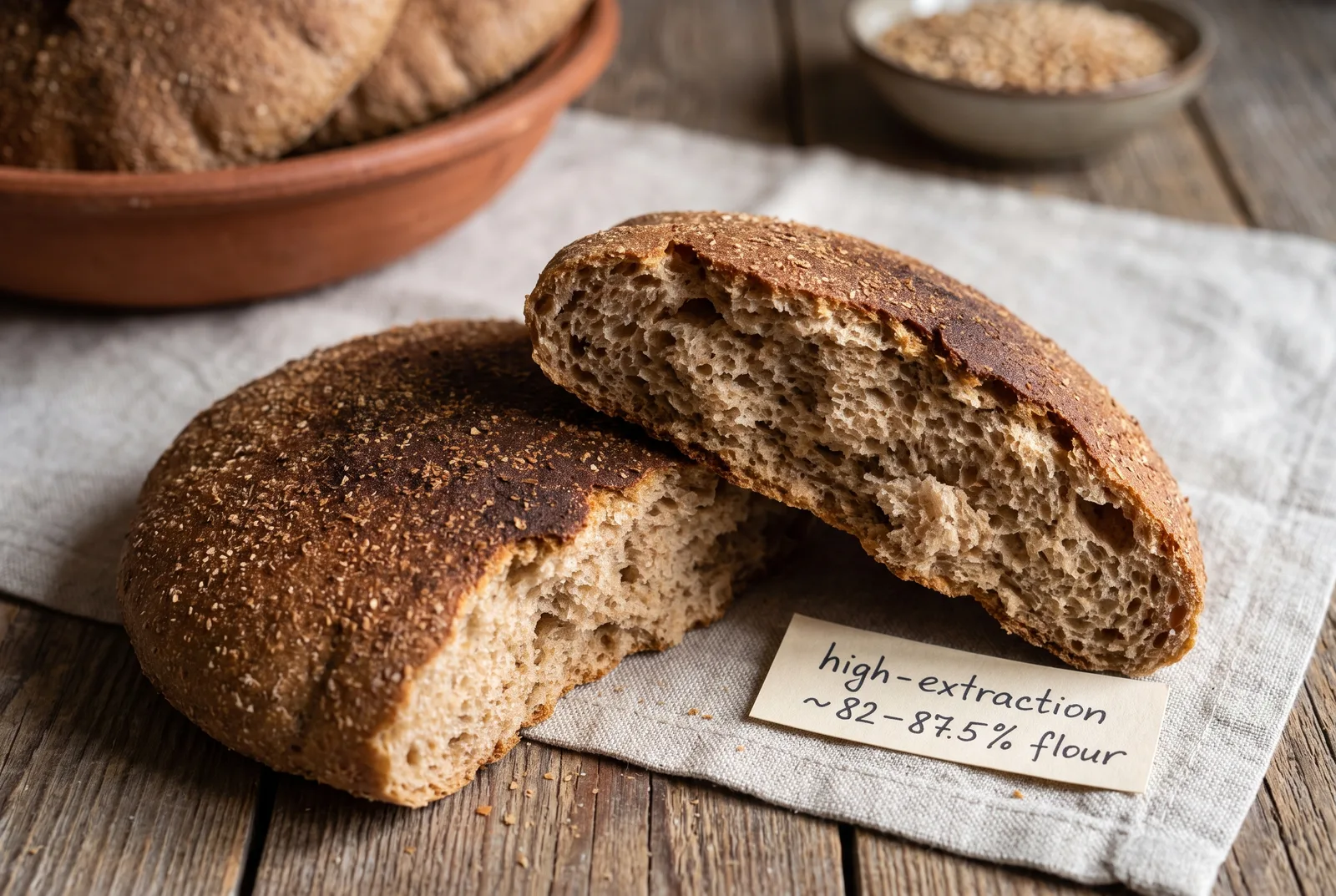 Round flat high-extraction brown Arabic bread (khubz asmar / baladi loaf) with a rustic bran-flecked crust and a soft open crumb.
 Flowchart mapping the Arab product a baker wants to make to the correct flour family, grade and key specification.
Maamoul semolina dough — structure (baker's %, indicative)
| Ingredient | Baker's % | Weight |
|---|---|---|
| Durum semolina (fine/medium, samīd + farkha) | 100 | |
| Fine white flour (optional, part of total) | 0–30 (of the semolina+flour blend) | |
| Ghee / clarified butter (samn) | 30–45 | |
| Milk or water | to a soft, non-sticky dough | |
| Sugar (in dough) | 5–10 | |
| Mahlab + mastic | to taste |
- Rub warm ghee into the semolina (and flour) to coat the grains; add sweetened liquid to a soft dough; REST covered, often overnight, so the semolina absorbs the fat and softens; fill with dates/walnut/pistachio, mould, bake gently to pale (do not brown), dust with icing sugar.
Yield: Under-rested semolina bakes gritty. Fine or medium durum semolina gives the classic short, sandy bite; add fine flour for a smoother, more cohesive dough.
Levantine maamoul is semolina-led with a proportion of fine flour (farkha) and ghee, rested (often overnight) so the semolina hydrates and softens. Cited Arabic recipes give quantities but ranges vary widely by house, so treat these as an indicative structure, not a fixed formula. Sources: c12 / rana-academy, mawdoo3, Baker's Choice.
Basbousa / namoura — semolina choice orientation (qualitative)
| Ingredient | Baker's % | Weight |
|---|---|---|
| Durum semolina (fine OR medium — see note) | ||
| Sugar | ||
| Ghee/oil + yoghurt or milk | ||
| Leavening | ||
| Sugar syrup (attar) to soak after baking |
- Combine semolina with sugar, fat and dairy; rest to hydrate the semolina; bake, then drench the hot cake with cooled sugar syrup (attar) — the hot/cold rule and syrup ratios are covered in the sibling attar/syrup and basbousa articles.
Not given as an exact baker's % because Arabic sources disagree on grind and hydration; provided as a selection guide. Sources: c8, c11 / atyabtabkha, Baker's Choice.
| Family | Arabic name | Grade / strength | Typical Arab products |
|---|---|---|---|
| White wheat flour — very strong | طحين / دقيق قوي جداً | protein ~12.5–14.5% | Hand-pulled markoúk/shrāk, firm baklava base dough, jullash/raqāʾiq phyllo base |
| White wheat flour — strong | دقيق قوي | protein ~12.5–13.5% | Saj/markoúk leavened bread, sfiha, lahm bi ajin, rings |
| White wheat flour — medium / extensible | دقيق فاخر / متوسط | protein ~11.5–12.5% | Khubz ʿarabi (pocket pita/kmaj), manakish, fino/tourist bread |
| White wheat flour — soft / low-protein | دقيق ضعيف / كيك | protein ~7.5–9.5% (cake <9%) | Maamoul dough (with semolina), kaʿk, ghraybeh, cakes |
| Durum semolina — fine | سميد ناعم | durum, finest grind | Basbousa, kunafa naʿama, layali lubnāniyya, mahalabiya, kaʿk; blended with flour |
| Durum semolina — medium | سميد متوسط | durum, mid grind | Kibbeh shells, couscous, khubz samīd, harissa/hareseh, basbousa |
| Durum semolina — coarse | سميد خشن | durum, coarse grind | Couscous, maftoul, ʿaṣīda, Aleppo maʾmūniyya, grainy maamoul, dry pasta |
| Wholemeal / brown | دقيق أسمر / دقيق بر | high extraction (~85–100%) | Khubz asmar, wholemeal saj/tannour bread, Egyptian baladi loaf, whole-wheat flatbread |
Arab bakers select by finished product. Protein guides the white-flour ladder; particle size guides semolina. Sources: c2, c6, c7, c8, c9, c10, c23.
| Region | Word for flour | How it is graded | Key grades / bands |
|---|---|---|---|
| Levant & Iraq | طحين (ṭaḥīn / 'tiheen') | By strength/use; fine grade called فرخة (farkha) | Strong bread flour, soft farkha, samīd |
| Egypt | دقيق (daqīq) | By extraction rate (نسبة الاستخلاص) | Baladi high-extraction ~82–87.5% (decree bands 93.3/87.5/82/80/76/72); fino/tourist ~76%; pasta 72% |
| Gulf / Saudi | دقيق (daqīq) | Named grades | فاخر fākher (patent white), أسمر asmar (brown ~85%), بر burr (wholemeal), كيك keek (cake, gluten <9%), سميد samīd (semolina) |
| Maghreb (edge of region) | دقيق / سميدة (smida) | By product | Durum smida for couscous, msemmen, kesra |
No single pan-Arab type number exists; mills and food authorities publish their own grades. Sources: c1, c3, c4, c5.
| Arab need | Domson catalogue product | Protein / spec | Why it fits |
|---|---|---|---|
| Pulled dough / baklava base (very strong) | Carr's Centurion Canadian Very Strong; Allied Mills Coniston Strong White | Coniston 12.5–14.5%, WA 58–61%, FN ≥250 s | Very strong, extensible gluten for thin pulled sheets and firm phyllo base |
| Saj/markoúk bread, sfiha, lahm bi ajin (strong) | Carr's Titan Strong Bakers; Allied Mills Pennine; Matthews Windrush | Titan 12.7–13.3% (+~2.5% VWG) | Strong dough that holds shape and topped beds |
| Khubz ʿarabi / manakish / fino (medium) | Carr's Verace Pizza Flour; Domson White Strong T550; ADM Domson PN | Verace medium protein, high WA | Medium, extensible; opens easily, stays soft |
| Maamoul dough / kaʿk / ghraybeh / cakes (soft) | Whitworth Golden Jewel Pastry (halal+kosher); Carr's Starlight Pastry | Golden Jewel 7.5–9.5% | Low protein for short, tender doughs and biscuits |
| Semolina for basbousa / maamoul / couscous (durum) | Allied Mills Durum Wheat Semolina; Eurostar Extra Coarse Semolina | Durum ≥11% dm; 425 µm 40–60% retained | True durum samīd — creamy-yellow, granular, slow syrup/ghee uptake |
| AVOID for classic Arab sweets | Komplexmłyn Wheat Semolina 'Manna'; GoodMills 'Krupczatka' T450 | soft/common-wheat farina | Not durum — lacks colour, bite and syrup uptake of samīd |
| Brown / baladi-style bread (wholemeal) | Carr's Bakers Wholemeal; ADM Domson Brown; Grampian Wholemeal; Doves Farm Organic Strong Wholemeal | Carr's Wholemeal 13.5–14.2%, fibre 10.1 g | High-extraction/wholemeal for khubz asmar and baladi character |
| Whole-wheat flatbread (Gulf/expat) | Carr's Lion Atta Medium Chapatti Flour | 9–11.2%, fibre 5.7 g | Medium-brown atta for roti/chapati-style flatbread |
Practical substitutes a UK Arab bakery/patisserie can order. Specs are first-party supplier datasheet values where cited. Sources: c15, c16, c17, c18, c19, c20.
| Parameter | Value |
|---|---|
| Description | Purified middlings milled from durum wheat; creamy-yellow, granular, small brown bran specks |
| Ingredient declaration | 100% durum wheat (may contain 3% common wheat) |
| Protein | min 11.0% (dry matter) |
| Ash @900°C | max 0.8% (dry matter) |
| Moisture | max 14.99% |
| Granulation (sievings) | 425 µm 40–60% retained; 355 µm 20–30%; 300 µm 15–25%; 150 µm max 10%; 106 µm max 1% |
| Nutrition (per 100 g, Eurofins Feb 2023) | 1491 kJ / 352 kcal; protein 15.8 g; carb 63.9 g; fibre 4.5 g; fat 2.7 g |
| Halal / Kosher | NOT halal-certified; NOT kosher-certified |
| Suitable for | vegetarians, vegans, Hindus; NOT coeliacs (gluten) |
AMP SPEC SEMO 01-06, rev 37, published 21-04-2023. First-party datasheet read on disk. Source: c15.
| Product | Fault | Likely flour cause | Fix |
|---|---|---|---|
| Markoúk / pulled dough | Sheet tears when stretched thin | Flour too weak / low protein | Use very strong white (protein ≥12.5%); rest dough; add vital wheat gluten |
| Baklava base / jullash | Base dough springs back or cracks | Flour too weak or under-rested | Strong/very strong white; adequate rest for extensibility |
| Maamoul | Gritty, sandy after baking | Semolina not rested / too coarse for style | Rest the semolina dough (often overnight); use fine/medium durum or add fine flour |
| Maamoul | Dough too tough, biscuits hard | Too much strong flour, not enough semolina/ghee | Semolina-led dough with soft flour and enough ghee |
| Basbousa / namoura | Cake stays wet/greasy or won't drink syrup | Wrong grind or soft-wheat 'semolina' used | Use durum semolina; match fine vs medium grind to desired texture |
| Basbousa | Pale, gummy, no bite; poor colour | Soft-wheat farina instead of durum | Switch to true durum semolina (creamy-yellow) |
| Khubz asmar / baladi | Dense, tight crumb | High bran cutting the gluten network | Blend with a stronger base flour or add gluten; hydrate fully |
| Kunafa naʿama base | Coarse, grainy smooth-kunafa | Semolina too coarse | Use fine semolina (samīd nāʿim) / fine-flour blend |
Diagnostic guide linking a defect to flour choice. Sources: c8, c11, c12, c22, c23, c24.