
Arab baking aromatics: rose water, orange blossom water, mastic and mahlab — sourcing, dosage and application
Four ingredients carry the aromatic signature of Arab confectionery: rose water (ma' al-ward), orange blossom water (ma' al-zahr), mastic (mistika) and mahlab. This dossier, built from Arabic brand and culinary sources, a Saudi FDA comparison, the Chios Mastiha PDO body and Domson spec sheets, tells a UK baker what each one is, where the authentic material comes from (Damask/Taif rose, Tunisian bitter-orange blossom, Chios mastiha resin, mahaleb-cherry kernels), how much to use and — the make-or-break point — WHEN to add it. Floral waters are dilute distillates dosed by the teaspoon and added off the heat; mastic is a strong resin ground with sugar and melted into hot milk for booza and muhallabia; mahlab is a spice ground fresh into maamoul and ka'ak. It maps regional habits (Levant vs Gulf vs Egypt vs Maghreb), flags the food-safety points (mahlab's cyanogenic kernels, mastic's Anacardiaceae link, sesame as a declared allergen), warns about the hydrosol-versus-essence sourcing trap, and wires every technique to the Domson catalogue and to the Pillar A craft concepts behind it (A6-pastry-creams-fillings, A6-glazes-finishes, A6-sugar-work-techniques) and the sister Arab dossiers (B3-attar-sugar-syrup-science, B3-knafeh-kunafa-production, B3-baklava-and-phyllo-pastries, B3-semolina-desserts-basbousa-maamoul, B3-ramadan-seasonal-specialities, B3-tahini-halva-and-sesame-confections, B3-ghee-and-baking-fats-in-arab-baking).
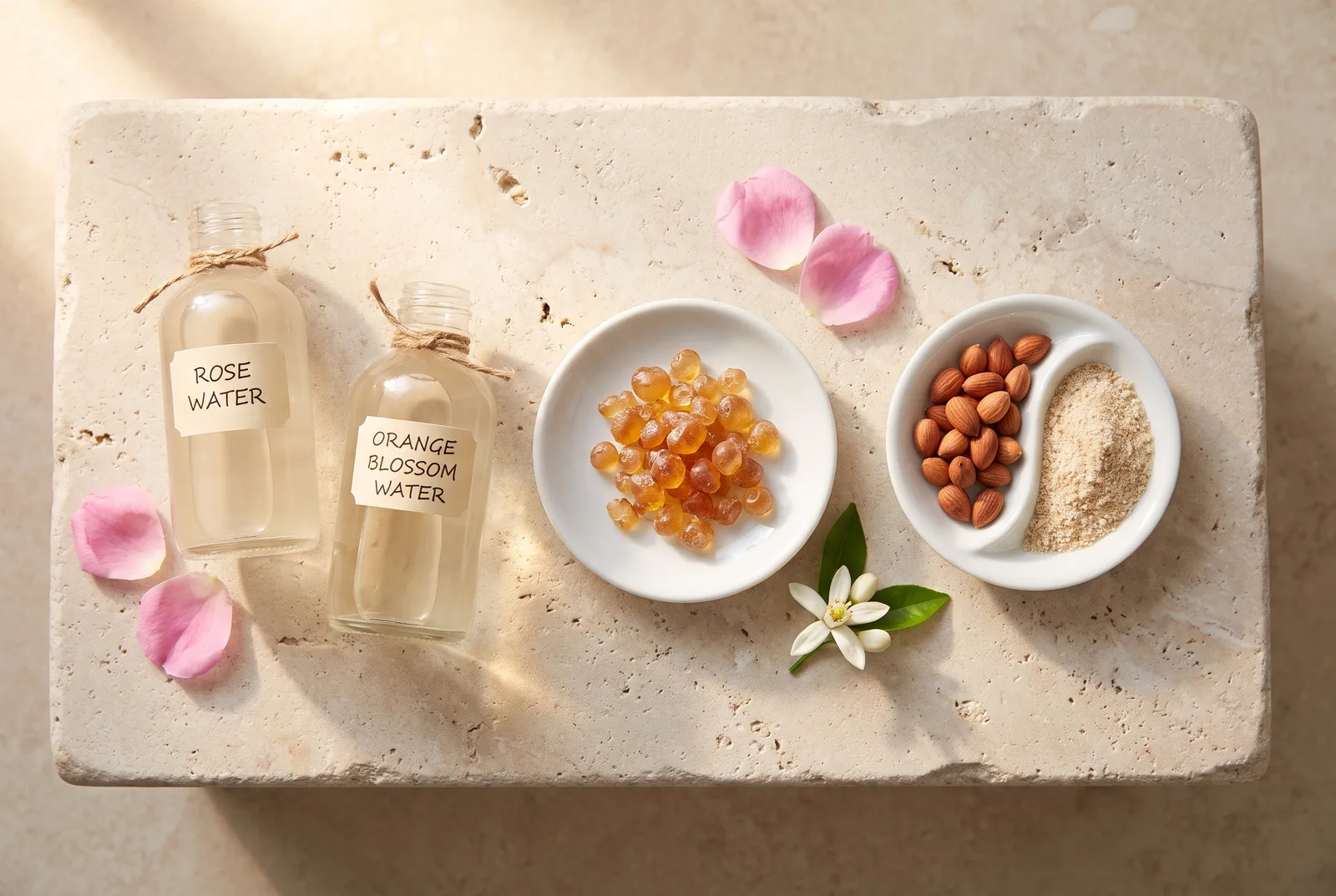
Arab baking aromatics: rose water, orange blossom water, mastic and mahlab
Ask a Damascus, Beirut, Cairo or Nabeul confectioner what makes their sweets smell of "home" and the answer is almost always the same short list: rose water (ماء الورد, ma' al-ward), orange blossom water (ماء الزهر, ma' al-zahr), mastic (مستكة, mistika) and mahlab (محلب, mahleb). None of them is a headline ingredient — you use grams and teaspoons, not kilos — yet they are what separates an authentic maamoul, knafeh or booza from a competent imitation. This dossier is the practical guide for a UK bakery serving Arab and Middle-Eastern customers: what each aromatic actually is, where the real material comes from, how much to use, and — the point most guides skip — when to add it. The figures below show the four side by side, and a summary infographic.
1. The four aromatics at a glance
The comparison table below sets out source, character and typical home for each. In one line: two of them are distilled floral waters (rose and orange blossom), one is a tree resin (mastic) and one is a ground spice (mahlab). That difference in physical nature is exactly why they are dosed and timed differently, so it is worth fixing in your head before you touch a recipe.
2. Rose water (ماء الورد)
Rose water is the steam-distillate of Damask rose petals (Rosa × damascena). The same species underlies every famous name: the Taif rose of the Saudi highlands, the Iranian Mohammadi rose of Qamsar/Kashan, and the Bulgarian rose of the Kazanlak valley. Traditional Taif distillation is famously bloom-hungry: figures on the order of 10,000 blooms are cited to charge a single copper still (some accounts frame this as blooms per bottle of oil rather than per still charge), with the roses grown high — up to around 2,000 m and above — and hand-picked at dawn over a short spring window (roughly April), before the heat drives off the volatiles — pictured below. Bulgaria's Kazanlak "Valley of the Roses" supplies about 70% of the world's rose oil, and Iran's double-distilled golab do-atishe is prized for potency — useful context when a customer insists on "Iranian" or "Taif" rose water.
Rose water is the lighter, sweeter of the two floral waters. Its natural home is the Gulf and Iran (with cardamom and saffron), but it is used everywhere: in attar (syrup), in ashta cream, in muhallabia (milk pudding), in maamoul, and in rose-scented rice puddings.
3. Orange blossom water (ماء الزهر)
Orange blossom water — ma' al-zahr, also mazaher — is distilled from the blossom of the bitter (Seville) orange, Citrus aurantium, not from any rose. Tunisia, and the town of Nabeul in particular, is a leading producer: the bitter-orange trees (bigaradier) bloom in spring and artisanal distillation yields two fractions — the floral water used in cooking and the neroli essential oil used in perfume — pictured below. A Saudi Food & Drug Authority comparison confirms the two waters are byproducts of the same steam-distillation, but from different plants.
The single most important practical fact: orange blossom water is stronger, warmer and more concentrated in aroma than rose water. Treat the two as not interchangeable — if a recipe calls for rose and you reach for orange blossom, use a little less. Orange blossom dominates in Egypt and the Maghreb, and shares the Levant with rose. Its most charming use is Levantine "white coffee" (قهوة بيضاء, qahwa bayda / café blanc) — hot water scented with orange blossom water, caffeine-free, served as a calming after-dinner digestive and said to have been invented in Beirut.
4. How much floral water, and when
This is where most bakers go wrong. Distilled floral waters are dilute hydrosols, so:
- Professional dose: roughly 20–40 g per kg of pastry/preparation.
- Syrup (attar): about 2 tsp rose + 2 tsp orange blossom per 2 cups sugar / 1 cup water; see the formula card below.
- Cream/Chantilly/filling: around 1 tsp at the very end.
- Golden rule: start with a few drops and taste — excess reads as soapy, not fragrant.
Timing matters as much as quantity. Floral aromatics are volatile and boil away, so they go in off the heat: into syrup after it has boiled and cooled slightly, into cream at the finish . The table and diagram below summarise this. In baklava, knafeh and qatayef the perfumed syrup is poured following the hot-syrup-on-cold-pastry (or cold-on-hot) rule that keeps the layers crisp — the technique covered in depth in B3-attar-sugar-syrup-science and, as a universal craft concept, in A6-glazes-finishes and A6-sugar-work-techniques.
Ashta — the floral cream at the heart of Levantine desserts
Ashta (قشطة, also qeshta/kashta) is a Levantine clotted cream flavoured with rose water and orange blossom water; it is the filling and topping for knafeh, qatayef (atayef) and znoud el-sit (pictured below; see B3-knafeh-kunafa-production and B3-ramadan-seasonal-specialities). The aromatic waters go in as the milk clots, so the perfume survives; the formula card below gives both the traditional and a quick cornflour-and-semolina version. As a piece of pastry craft this is a scented set cream — see A6-pastry-creams-fillings.
5. Mastic (مستكة)
Mastic is the dried aromatic resin of Pistacia lentiscus var. Chia, harvested as translucent teardrop "tears" from scratched trunks; Chios mastiha holds EU Protected Designation of Origin (PDO) status (since 1997) and its production is exclusive to southern Chios — pictured below. In Arabic it is mistika or miskeh; in the Gulf and Egypt it flavours milk puddings and ice cream.
Handling is specific: mastic is sticky, so grind the tears in a mortar with a little sugar so they do not clump, then melt the powder into hot milk. It carries a strong pine-resin/cedar aroma and, in dairy, a characteristic chewy, elastic body. Use it sparingly — chef guidance for milk puddings is on the order of 1/4 tsp (a few tears) per litre of milk; one or two tears is enough.
The classic showcase is booza (بوظة) — the Arab stretchy ice cream. At Bakdash in Damascus's Souq al-Hamidiyya (founded around 1885), booza gets its elastic, pull-able body from mastic plus sahlab (salep), is pounded and stretched by hand with a long wooden pestle/mallet rather than churned, and is finished in a thick coat of Aleppo pistachio (pictured below; formula card below). Mastic also appears in muhallabia and in some regional breads and Turkish delight.
Allergen note: mastic comes from Pistacia lentiscus, in the Anacardiaceae family and the same genus as the pistachio (Pistacia vera). People with Anacardiaceae or tree-nut hypersensitivity should exercise caution. A documented oral-consumption food allergy to mastic resin does not appear to be established in the sources reviewed (the reported reactions are contact dermatitis to skin adhesives) — but that is an absence-of-evidence point resting on low-reliability sources, not a cleared safety statement. Note too that mastic resin is not itself a listed EU/UK allergen, whereas pistachio is. Confirm your own allergen policy before labelling.
6. Mahlab (محلب)
Mahlab is the ground kernel of the mahaleb / St Lucie cherry (Prunus mahaleb, family Rosaceae), with an aroma poised between bitter almond and cherry — pictured below. It is a spice, not a liquid, so it is worked into the dry mix or dough. Dose is small — about 1/2 to 1 tsp (2–5 ml) of ground mahlab per 2 cups (~500 ml) of flour.
Buy it whole and grind it fresh. Ground mahlab loses aroma and turns rancid quickly, so pulverise the kernels only when needed (mortar or coffee grinder), store the whole kernels airtight, cool and dark, and refresh tired kernels with a brief dry-pan toast. It is a festive-baking backbone in the Levant and Egypt: in maamoul (in the date filling, alongside rose water and cinnamon), in sweet ka'ak (often with nigella/black seed) and in Eid kahk — pictured below — see B3-semolina-desserts-basbousa-maamoul. Aniseed is a frequent Levantine partner spice in ka'ak.
Safety note: Prunus mahaleb kernels contain cyanogenic/coumarin compounds. Bitter-tasting kernels should be discarded, and mahlab should be used only in the small culinary quantities specified. This is a stone-fruit kernel; treat sourcing and dosage conservatively.
7. Reading the regional map
Aromatic habits are regional, and matching them is what makes a product taste "right" to a specific customer base (see the table and map below):
- Levant (Syria, Lebanon, Palestine, Jordan): rose and orange blossom together; mastic in dairy sweets. Ashta-filled knafeh and qatayef, maamoul, booza, muhallabia.
- Gulf & Iran: rose water leads, with cardamom and saffron. Rose-scented rice puddings, luqaimat syrup.
- Egypt: orange blossom water; mastic in ice cream and puddings; mahlab in kahk.
- Maghreb (Tunisia, Morocco, Algeria): orange blossom water (ma' zahr), sometimes rose and geranium. Makroud, kaab el-ghazal, samsa.
8. Sourcing: distilled water vs concentrated essence (the trap)
A bottle labelled "rose" or "orange blossom" can be one of two very different things, and they are not dosed the same (see the table below):
- A distilled floral water (hydrosol) — mostly water, dosed by the teaspoon. Authentic Middle-Eastern brands such as Al Wadi Al Akhdar (Lebanon) and Habibah (Jordan) supply these.
- A concentrated flavouring essence — aroma compounds in a carrier such as propylene glycol (E1520). The Domson catalogue's Baking Flavourings & Essences (Zeelandia/JAR) range is of this type: an almond flavour on that spec, for example, is dosed at only ~0.1–0.8 g/kg in milk desserts and ~2.0–3.9 g/kg in cookies — an order of magnitude stronger than a hydrosol.
Never swap the two 1:1. Use a distilled water where authenticity matters (attar, ashta, maamoul); reach for an essence only when you understand it must be dosed by the gram. Because the catalogue currently stocks essences rather than distilled floral waters, those product links below are the essence alternative, not a like-for-like substitute for a bottle of ma' al-ward.
9. Buying the rest of the aromatic package from Domson
The floral waters themselves are speciality imports, but the supporting cast an Arab pastry kitchen buys alongside them is in the catalogue (see the products below):
- Semolina for maamoul and basbousa: Durum Wheat Semolina (Allied Mills) — 100% durum, granular, 183-day shelf life — and Extra Coarse Semolina (Eurostar) for a coarser grind. See B3-semolina-desserts-basbousa-maamoul.
- Spices: Ground Cinnamon (PGD) for baklava and maamoul fillings (note the trace-allergen declaration — celery, mustard, sulphur dioxide); Aniseed (Rolmex) for Levantine ka'ak.
- Nuts & finish: Roasted Diced Pistachios (Polmarkus) for booza and baklava.
- Sesame for ka'ak coatings: Sesame Seeds (Global Grains) — a declared sesame allergen, kosher-certified and halal-suitable (not certified); see B3-tahini-halva-and-sesame-confections.
- Syrup & cream: Glucose Syrup (Ratos Natura) for a stable, non-crystallising attar; Double Cream (OSM Bieruń) as a quick ashta base; Whole Pitted Dates (Kluman) for the maamoul filling.
- Ghee for these products is covered in B3-ghee-and-baking-fats-in-arab-baking.
- Flavouring essences (the essence route in §8): Baking Flavourings & Essences (Zeelandia), Orange Baking Flavouring (Flavoria), Liquid Baking Flavourings (IPRA) and Butter Essence (PGD) .
10. Allergen and cold-chain summary
The four aromatics are low-risk in themselves — rose water, orange blossom water and mastic resin are not listed EU/UK allergens — but the products they go into carry allergens that must be declared under UK food-information law (Regulation (EU) No 1169/2011, Annex II, as retained in UK law). This is not legal advice; confirm every on-pack statement and any "may contain" wording against your current supplier specifications before labelling:
- Milk (+ cold chain): ashta and its double-cream base are dairy — a declared allergen — and, as a cooked/held cream, need refrigerated storage and temperature control.
- Tree nuts (pistachio): the Aleppo-pistachio coating on booza and baklava, and the linked Roasted Diced Pistachios, are a declared tree-nut allergen.
- Cereals containing gluten (wheat): the semolina bases (maamoul, basbousa), the kataifi pastry and any essence-carrying cookies are wheat/gluten.
- Sesame: ka'ak coatings use sesame, a declared allergen; the linked seed is labelled accordingly .
- Ingredient-specific flags (above):mastic shares the Pistacia genus / Anacardiaceae family with pistachio; mahlab is a cyanogenic stone-fruit kernel — discard bitter kernels and keep to small culinary doses; ground cinnamon may carry shared-premises trace allergens (celery, mustard, sulphur dioxide).
11. Troubleshooting
The fault table below is the wall chart. The recurring five: soapy taste (too much floral water, or an essence dosed like a hydrosol); faded aroma (added too early — put it in off the heat); bitter/harsh ka'ak (stale or over-dosed mahlab; discard bitter kernels) ; gritty mastic (grind with sugar, melt into hot milk, use one or two tears); and orange blossom overpowering a delicate dish (use less than you would rose).
Cross-links
Pillar A craft concepts: A6-pastry-creams-fillings · A6-glazes-finishes · A6-sugar-work-techniques. Sister Arab dossiers: B3-attar-sugar-syrup-science · B3-knafeh-kunafa-production · B3-baklava-and-phyllo-pastries · B3-semolina-desserts-basbousa-maamoul · B3-ramadan-seasonal-specialities · B3-tahini-halva-and-sesame-confections · B3-ghee-and-baking-fats-in-arab-baking.
Figures
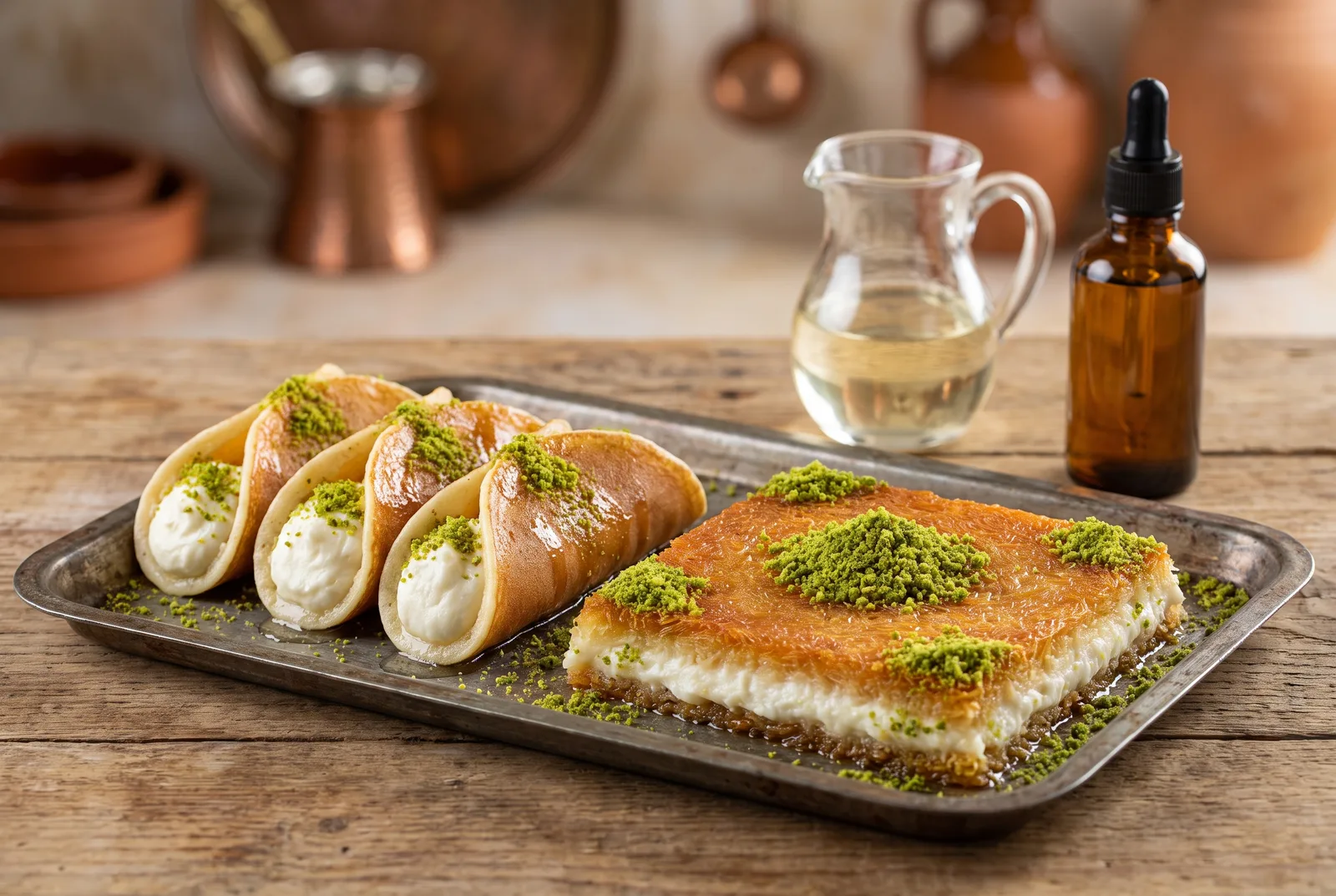 Ashta-filled knafeh and cream qatayef finished with floral syrup and pistachio
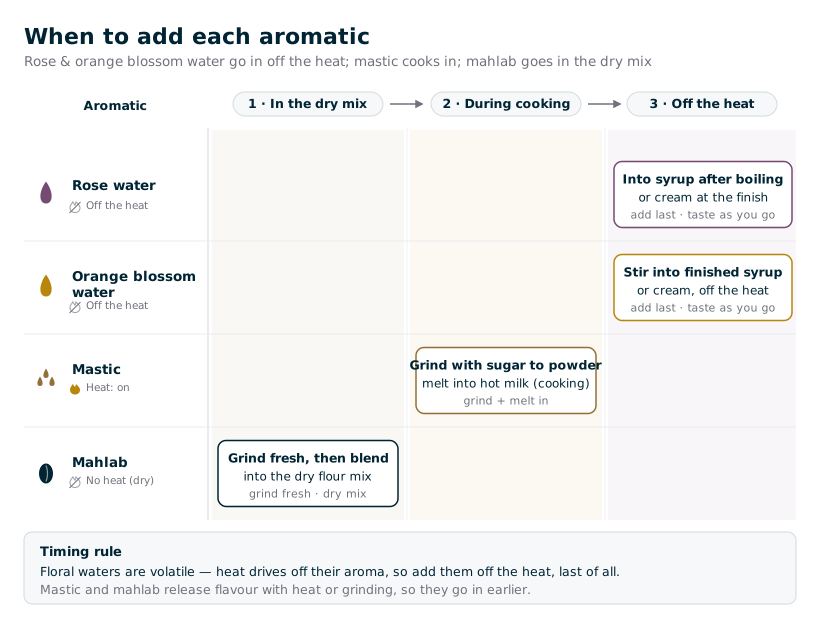 Diagram showing rose and orange blossom water added off the heat, mastic during cooking, mahlab in the dry mix
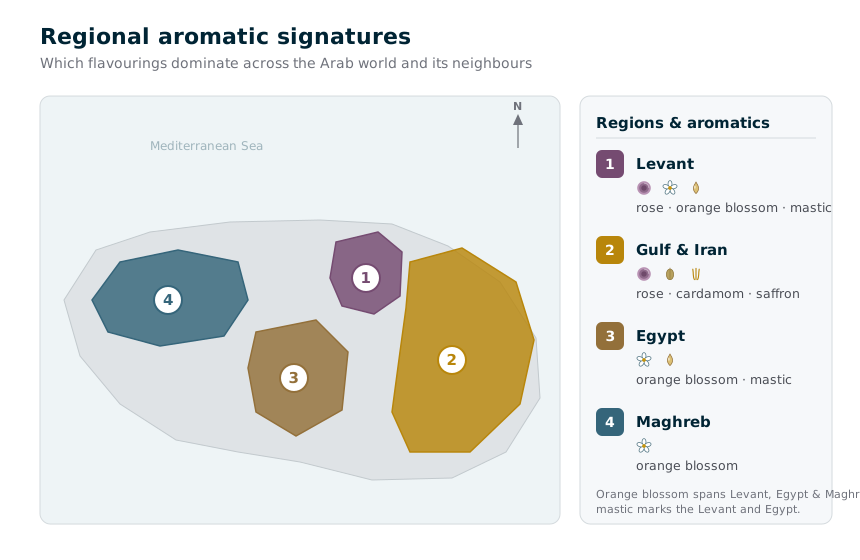 Map of the Arab world showing which aromatics dominate in the Levant, Gulf, Egypt and Maghreb
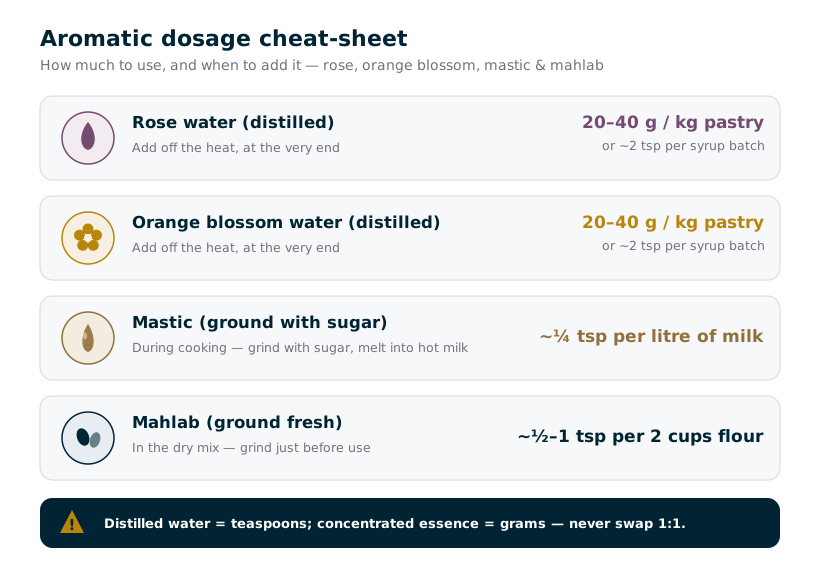 Infographic summarising dosage of rose water, orange blossom water, mastic and mahlab
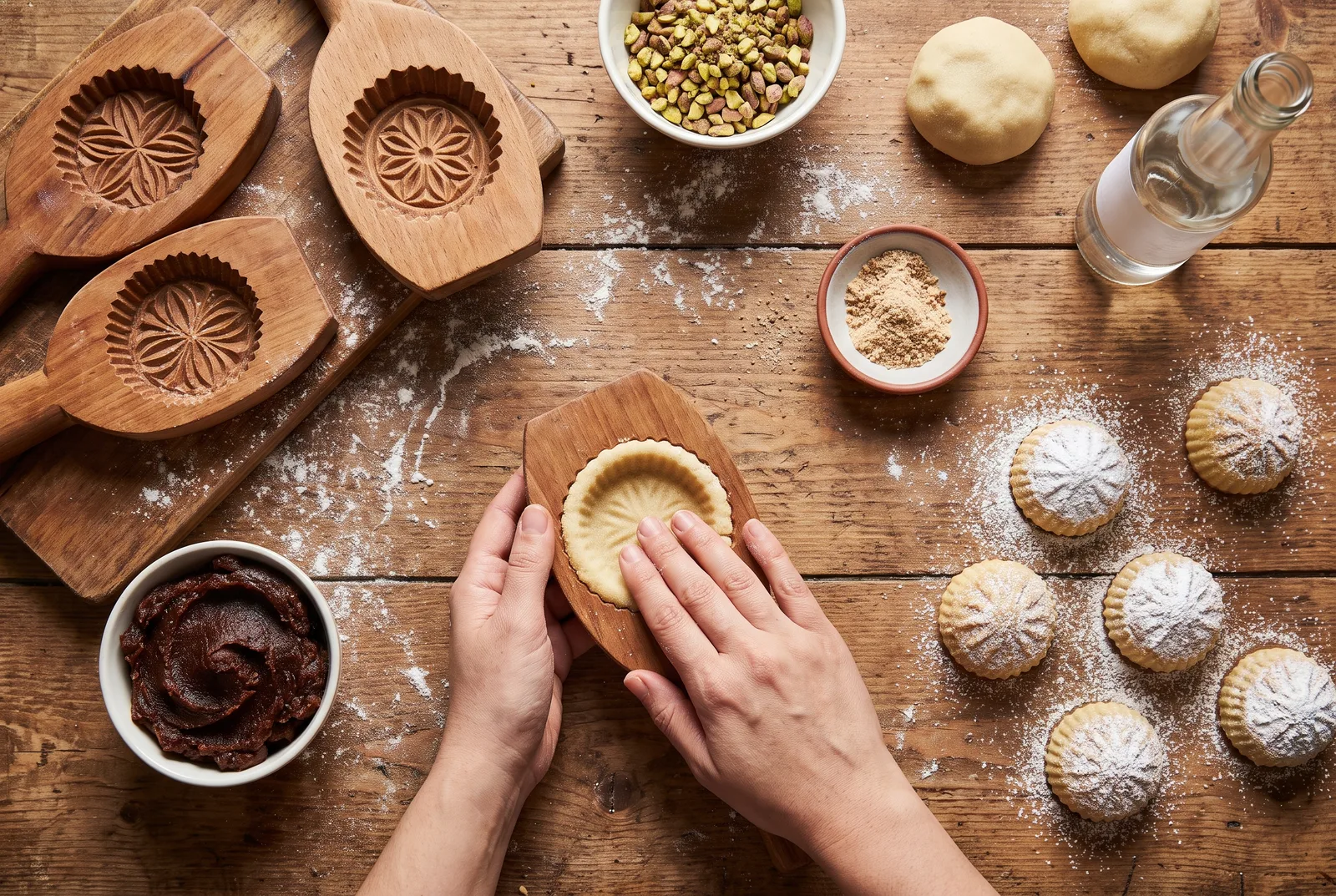 Maamoul dough stamped in carved wooden moulds with date and pistachio fillings
Perfumed attar (sugar syrup) for baklava, knafeh and qatayef
The single technique behind dozens of Arab confections. Floral waters go in last; the hot/cold temperature contrast is what keeps baklava and knafeh crisp rather than soggy. Cross-links to B3-attar-sugar-syrup-science and A6-sugar-work-techniques.
Total: ~150% (sugar: water 2:1 by volume)
Worked example
2 cups (~400 g) sugar + 1 cup (~240 ml) water + 1-2 tsp lemon juice; boil then simmer to a light syrup; OFF the heat stir in ~2 tsp rose water + ~2 tsp orange blossom water. Pour hot syrup over cold-from-the-oven pastry (or cold syrup over hot pastry) so the layers stay crisp.
Yield: Enough to soak one standard tray of baklava or knafeh
Ashta (qeshta) — Levantine clotted cream flavoured with floral waters
The creamy heart of Levantine desserts. The aromatic waters are added as the milk clots so their perfume survives. Cross-links to A6-pastry-creams-fillings.
Total: milk + thickener + ~1-2% floral water
Worked example
Simmer whole milk (optionally with cream); as it begins to clot, stir in ~1 tsp rose water + ~1 tsp orange blossom water per litre and scoop the clotted cream. For a quick version, thicken warm milk/cream with cornflour and semolina, then flavour off the heat.
Yield: Filling/topping for knafeh, qatayef and znoud el-sit
Maamoul aromatic package (semolina/flour shells + scented filling)
Shows the four aromatics working together in one product. Grind the mahlab fresh; add floral waters to the filling and dough, not to a hot pan. Cross-links to B3-semolina-desserts-basbousa-maamoul and B3-ghee-and-baking-fats-in-arab-baking.
Total: aromatics are a small fraction of flour weight
Worked example
Into a semolina-and-flour shell dough work ~1/2-1 tsp ground mahlab per ~500 ml flour and a splash of rose and/or orange blossom water; the date filling is scented with rose water, orange blossom, mahlab and a little cinnamon.
Yield: One batch of stamped maamoul cookies
Booza (Arab stretchy ice cream) — mastic + sahlab for elastic body
The mastic + sahlab pairing (as at Bakdash, Damascus, since c.1885) is what makes booza stretch rather than scoop. Use mastic very sparingly. Cross-links to B3-semolina-desserts-basbousa-maamoul and A6-pastry-creams-fillings.
Total: milk + sugar + sahlab + mastic + pistachio finish
Worked example
Sweeten and thicken milk with sahlab (salep); grind a few mastic tears with a little sugar and stir into the hot mix so it disperses; freeze while pounding and stretching with a long wooden pestle/mallet for the elastic, chewy body; finish with a coat of Aleppo pistachio.
Yield: Damascus-style stretchy ice cream
Botanical source, sensory character and where each one belongs in an Arab bakery. Use this to place an aromatic before deciding dose and timing.
| Aromatic | Arabic name | Source | Character | Typical home in Arab baking |
|---|---|---|---|---|
| Rose water | ماء الورد (ma' al-ward) | Distilled petals of the Damask rose (Rosa × damascena) | Light, sweet, floral | Syrups, ashta cream, maamoul, muhallabia, ma'moul, halawet el-jibn, Gulf/Iranian sweets |
| Orange blossom water | ماء الزهر (ma' al-zahr) | Distilled blossom of the bitter/Seville orange (Citrus aurantium) | Stronger, warmer, more concentrated than rose | Baklava & knafeh syrup, maamoul date filling, qatayef, white coffee, Maghrebi & Egyptian sweets |
| Mastic | مستكة (mistika / miskeh) | Dried resin 'tears' of Pistacia lentiscus var. Chia (Chios PDO) | Pine-resin, cedar; adds chewy body in dairy | Booza (Arab ice cream), muhallabia and milk puddings, some breads and Turkish delight |
| Mahlab | محلب (mahleb) | Ground kernel of the mahaleb cherry (Prunus mahaleb) | Between bitter almond and cherry | Maamoul, sweet ka'ak, Eid kahk, festive enriched doughs |
Which aromatic dominates where. Knowing your customer's region prevents a Levantine recipe tasting wrong to a Gulf or Maghrebi palate.
| Region | Lead aromatics | Signature dishes |
|---|---|---|
| Levant (Syria, Lebanon, Palestine, Jordan) | Rose + orange blossom together; mastic in dairy sweets | Ashta-filled knafeh & qatayef, maamoul, booza dimashqiya, muhallabia |
| Gulf (Saudi Arabia, UAE) & Iran | Rose water (Taif / Iranian), with cardamom & saffron | Rose-scented rice puddings, luqaimat syrup, Gulf date sweets |
| Egypt | Orange blossom water; mastic in ice cream/puddings | Roz bel-laban, mahalabiya, kahk (with mahlab), balah el-sham syrup |
| Maghreb (Tunisia, Morocco, Algeria) | Orange blossom water (ma' zahr), sometimes rose & geranium | Makroud, kaab el-ghazal, samsa, orange-blossom syrups |
Timing is the single biggest error with these ingredients. Volatiles are driven off by prolonged heat, so most go in late.
| Aromatic | Add it... | Why |
|---|---|---|
| Rose water | Off the heat — into syrup after it boils and cools slightly, or into cream/filling at the end | Aroma is volatile and 'boils away'; late addition keeps the perfume |
| Orange blossom water | Off the heat, same as rose; a fraction less because it is stronger | Stronger aroma means it is easy to overdose; taste as you go |
| Mastic | During cooking — ground with sugar then stirred into hot milk so it disperses and sets the texture | It is a resin that must melt/disperse into the fat-and-milk matrix to work |
| Mahlab | In the dry mix / dough, ground fresh just before use | It is a spice that bakes into the crumb; grinding fresh preserves the aroma |
The commonest sourcing trap: a bottle labelled 'rose' can be either a dilute distillate or a strong synthetic essence. They are NOT dosed the same.
| Property | Distilled floral water (hydrosol) | Concentrated flavouring essence |
|---|---|---|
| What it is | Steam-distillate of the flower, mostly water | Aroma compounds in a carrier (e.g. propylene glycol E1520) |
| Typical dose | By the teaspoon / ~20-40 g per kg pastry | By the gram — e.g. ~0.1-0.8 g/kg in milk desserts, ~2-3.9 g/kg in cookies |
| Authenticity | Traditional; brands like Al Wadi, Habibah, Cortas | Convenient/economical but reads as 'flavouring' on the label |
| Risk if swapped 1:1 | Under-flavoured if you use essence dose of hydrosol | Soapy/chemical and overpowering if you use hydrosol dose of essence |
| Fault | Likely cause | Remedy |
|---|---|---|
| Soapy / perfume-like off-taste | Too much rose or orange blossom water; or a concentrated essence dosed like a hydrosol | Cut the dose right back; add a few drops at a time and taste; for essence use grams, not teaspoons |
| Floral aroma faded after baking/boiling | Aromatic added too early and cooked off | Add floral waters off the heat, at the very end of syrup or cream |
| Bitter, harsh note in ka'ak/maamoul | Stale or over-dosed mahlab, or a bitter kernel | Grind mahlab fresh and use sparingly; discard bitter kernels (possible cyanogenic content) |
| Mastic gritty / clumped, not dispersed | Ground alone (sticks) or added cold | Grind mastic with a little sugar, then melt into hot milk; use only one or two tears |
| Orange blossom overpowers a delicate dish | Treated as interchangeable with rose water | Remember orange blossom is stronger — use a little less than you would rose |
| Weak, flat flavour despite adding 'rose' | Product is a dilute or synthetic essence, not a real distillate | Check the label; buy a distilled floral water from a reputable Middle-Eastern brand |