Knafeh (كنافة): regional varieties, cheese selection, kataifi dough and the full production workflow for professional scale
Knafeh (also kunafa/kanafeh, كنافة — a shredded-pastry dessert soaked in scented sugar syrup) is the centrepiece of the Levantine and Egyptian sweet counter and a Ramadan icon across the Arab world. This dossier gives a working UK baker the authentic picture from native Arabic sources: the Nabulsi (Nablus, Palestinian) cheese knafeh in its fine na'ama (ناعمة) and coarse khishnah (خشنة) forms; the Egyptian qishta-and-nut style; and the Lebanese and Gulf cream (ashta) versions — plus the closest cousin, Turkish künefe (cross-linked to B2-syrup-sweets-ottomans). It covers cheese selection and the critical desalting of brined akkawi and nabulsi cheese, the modern mozzarella-akkawi-ricotta stretch blend, the distinctive orange colour of Nablus knafeh (and its food-additive/labelling implications), the clarified-butter/ghee dressing of the kataifi, the qatr (قطر) sugar-syrup grammar and the cool-syrup-on- hot-knafeh rule, and two production routes — the tray-in-a-deck-oven route and the traditional copper-tray-over-flame shop route — scaled for a professional kitchen. Every step is wired to the Domson catalogue an Arab/Middle-Eastern patisserie in the UK actually orders (ready kataifi, mozzarella for the cheese blend, unsalted butter to clarify, sugar, glucose and citric acid for the syrup, corn flour and cream for ashta, food colour, and pistachios/semolina to finish) and cross-linked to the Pillar A craft (A6-pastry-creams-fillings, A6-sugar-work-techniques, A4-butter-grades-and-specialist-types, A7-seeds-nuts-toppings, A7-food-colour-and-metallic-effects) and the sister B3/B2 traditions.
Knafeh (كنافة): regional varieties, cheese selection, kataifi dough and the full production workflow
Knafeh — kunafa, kanafeh, künefe in Turkey (كنافة) — is a shredded-pastry dessert bound with clarified butter, filled with either stretchy cheese or a cream/nut layer, baked or griddled until the base is deep gold, and drenched in scented sugar syrup. On an Arab or Middle-Eastern sweet counter it is the flagship: the dessert people queue for, the Ramadan staple, the wedding and Eid centrepiece. For a UK kitchen serving Levantine, Egyptian and Gulf communities it is also a high-margin, high-theatre product — but only if the cheese, the dough orientation and the syrup timing are controlled precisely. This dossier translates the authentic regional practice, from native Arabic sources, into a professional workflow, and wires each step to the ingredients you actually order.
Names and transliteration. The Arabic is كنافة. You will see it romanised as knafeh, kunafa, kunafah, kanafeh and (Turkish) künefe; the shredded dough itself is kataifi / kadayıf / kunafa dough (in Arabic often just ‘ajīnat al-kunāfa, عجينة الكنافة, or sha‘r, شعر, "hair"). This article keeps the Arabic names with an English gloss on first use.
1. A quick history — and why the regional story matters commercially
Knafeh's origins are genuinely contested, and the honest answer is that they are folkloric. The name's etymology is uncertain — variously traced to a Coptic Egyptian word (kenephiten, "bread/cake") or a Semitic root — and it already appears in the folk tales of One Thousand and One Nights. Two origin stories circulate in the Arabic culinary press, both legends rather than established history: an Umayyad legend that Levantine confectioners created it as a rich pre-dawn (suhoor) dish for the Caliph Mu‘awiya ibn Abi Sufyan — "kunafat Mu‘awiya" — and a Fatimid-Egypt account placing its emergence around the 10th century, from which it spread to the Levant via traders. The earliest documented recipe specifically for a cheese-filled kunafa is reported in a cookbook published in Beirut in 1885 — a single early reference, but corroborated by the food historian Daniel Newman (who names the cookbook, Ustadh al-Tabbakhin), so the exact date is best treated as indicative. The Nabulsi (Nablus, Palestinian) cheese knafeh is the most famous version, and a Nablus knafeh reportedly set a Guinness World Record in 2009 — contemporary reports put it at roughly 75 m long; the quoted weight varies widely between sources, so it is not repeated here as fact.
The commercial takeaway: your customers do not want "knafeh" in the abstract — they want their knafeh. A Palestinian or Syrian customer expects Nabulsi cheese knafeh, orange-topped, cheese-stretching, served hot. An Egyptian customer often expects kunafa bil-ishta wal-mksarat (cream and nuts) baked in a tray. A Lebanese customer may expect the same cheese knafeh but also knafeh bi-jibn in ka‘ak (a sesame-bread sandwich for breakfast — note this serving adds sesame; see §9). Getting the regional register right is the difference between "authentic" and "close". The regional map below shows how these expectations vary by community.
2. The dough: kataifi, and the na'ama / khishnah decision
Knafeh is built on kataifi — a dripped-batter dough, not a stretched sheet. A thin flour-and-water batter is dripped through a perforated vessel onto a hot rotating metal plate, where it sets into fine pale threads that are lifted off without browning. This is a different craft from stretched phyllo/jullash sheets, and the full production and handling of both is covered in B3-phyllo-kataifi-production. Almost every UK operation buys it in ready — frozen or chilled — rather than spinning it in-house.
Handling ready kataifi (the rules that save cost):
- Thaw it wrapped, in the fridge, then bring to room temperature so it separates without shattering.
- Keep it covered with a lightly damp cloth while you work; kataifi dries out and turns to brittle crumbs within minutes of exposure.
- Pull the strands apart and loosen them before buttering so the fat coats every thread and the finished pastry crisps evenly rather than clumping.
The na'ama vs khishnah decision is the single most important stylistic choice, because it defines the whole eating experience:
- Na'ama (ناعمة, "fine/smooth"). The kataifi is ground fine — sometimes blended with a little fine semolina — and pressed into a smooth, dense layer. This is the classic Nabulsi look: a smooth orange top, a tender-crisp base, and a clean molten-cheese pull underneath. For flour and semolina selection for the ground base, see B3-flour-and-semolina-selection.
- Khishnah (خشنة, "coarse"). The kataifi strands are kept whole, giving a stringy, more crunchy, more textured pastry.
- Muhayyara / mhayara is a mix of the two; mabrumeh (مبرومة) is a twisted-cylinder format, usually nut-filled — closer in spirit to the rolled kadayıf treated in B2-syrup-sweets-ottomans.
For a professional counter, decide na'ama for the cheese "signature slice" and keep khishnah or mabrumeh for the nut lines.
3. Cheese selection — the make-or-break variable
Levantine cheese knafeh lives or dies on the cheese. The authentic choices are akkawi (from Akka / Acre) and nabulsi cheese (from Nablus, traditionally cow/goat/sheep milk and sometimes flavoured with mahlab and nigella/black seed) — both white, brined and salty.
3.1 Desalting is non-negotiable
Because akkawi and nabulsi are stored in brine, they must be desalted before use or the dessert tastes savoury. The authentic method:
- Slice the cheese ~1 cm thick.
- Soak in fresh cold water, in the chiller, changing the water roughly every hour for at least ~6 hours (many shops soak overnight for a large brined block) — keep it refrigerated throughout.
- A faster route is a warm-water soak of ~30 minutes, changing the water every 30 minutes; because warm, prolonged immersion of a dairy product sits in the bacterial danger zone, treat this as a last resort, keep it brief and return the cheese to the chiller immediately (see the food-safety flag).
- Drain and pat dry thoroughly — surplus water is what makes a filling weep and a base go soggy.
Food safety. Long ambient or warm soaking of a dairy product is a temperature-abuse risk. In a professional kitchen, desalt under refrigeration (soak in the chiller, or use cold running water for short periods) and keep the drained cheese cold until assembly. Confirm against your HACCP plan.
3.2 The modern professional stretch blend
Fresh akkawi/nabulsi is not always available in the UK, and pure desalted brine cheese can be firm rather than dramatically stretchy. The widely used professional compromise is a three-cheese blend:
- Low-moisture, full-fat mozzarella for the stretch — shredded and dried well so it melts stretchy, not watery;
- Akkawi for authenticity and the characteristic mild salt note;
- Ricotta (or a fresh curd) for creaminess and to soften the pull.
The Domson catalogue supports this directly with grated mozzarella and mozzarella blends (see §8). A common, forgiving ratio is roughly equal parts mozzarella and desalted akkawi with a smaller proportion of ricotta, adjusted to how salty the akkawi remains after soaking. Whatever the blend, serve hot — the cheese firms as it cools and loses its stretch.
4. The orange colour — tradition, and its regulatory reality
The vivid orange-red top of Nabulsi knafeh is not a flavour; it is purely cosmetic. A red-plus- yellow food-colour blend (sold as "kunafa colour", sometimes with a little saffron) is stirred into the melted ghee before the fat is worked through the dough — a Nablus shop tradition associated with the famous houses (e.g. Habiba, Arafat). Egyptian tray kunafa uses the same trick: the colour goes into the melted samn first, then into the kataifi.
Food additive. In a UK/EU bakery, "kunafa colour" is typically an azo dye — Sunset Yellow FCF (E110) and/or Ponceau 4R (E124) — or, for a redder note, carmine (E120), which is not an azo dye but a natural cochineal colour. These are permitted additives but carry maximum-level limits by food category and mandatory labelling (for example Ponceau 4R E124 is capped at 50 mg/kg in fine bakery wares). The azo colours E110 and E124 additionally trigger the "may have an adverse effect on activity and attention in children" advisory; carmine (E120) does not carry that advisory but is a recognised IgE allergen that must be clearly declared. Use only food-grade colours at permitted levels and declare them. The colour handling, formats and EU/UK limits are covered in A7-food-colour-and-metallic-effects.
Note that khishnah and many Syrian versions are left their natural pale-gold colour; the orange is a Nablus/Egyptian signature, not a universal one.
5. The syrup — qatr, and the rule that keeps knafeh crisp
Every knafeh is finished with qatr (قطر — also attar, sheera, or sherbet), a scented sugar syrup. This is the same syrup family treated in depth in B3-attar-sugar-syrup-science, and the sugar-cooking fundamentals sit in A6-sugar-work-techniques.
Formula and method:
- ~2 parts sugar: 1 part water by volume (some shops run leaner, ~1.5:1, for a lighter finish).
- Dissolve the sugar in the water, bring to the boil, then add a squeeze of lemon (about ½ tsp juice, or a pinch of citric acid, per ~2 cups sugar).
- Simmer ~10 minutes until slightly thickened — it should coat a spoon but still pour freely; it thickens further on cooling.
- Off the heat, stir in orange-blossom water (ma‘ zahr) and/or rose water (ma‘ ward) — only a few drops; over-dosing turns the syrup soapy. Aromatics are covered in B3-aromatic-flavourings-rosewater-orange-blossom-mastic.
- Cool the syrup fully before use.
Why the lemon/citric acid: it inverts part of the sucrose and stops the syrup crystallising (tashkir) in the pan and on the finished pastry. A little glucose syrup does the same job and is a common bakery insurance against graining.
The knafeh rule — cool syrup on hot knafeh. The moment the knafeh comes off the heat, ladle the cool/cold syrup over the hot pastry. The temperature differential drives the syrup into the base while the crust stays crisp — pour hot syrup on hot knafeh and it goes soft. This is the single most common failure point, and it is the opposite instinct to some baklava practice (see B3-baklava-and-phyllo-pastries and B2-baklava-production for the contrast).
6. Two production routes, scaled
6.1 The tray / deck-oven route (best for volume and cream styles)
This is how most Egyptian tray kunafa and much batch Nabulsi is produced:
- Clarify the butter → ghee. Melt unsalted butter, skim the foam, and pour off the clear fat, leaving the milk solids and water behind. Clarifying removes the water and milk solids so the strands crisp and brown without burning, and it is why traditional recipes prize animal ghee (samneh baladi). See A4-butter-grades-and-specialist-types and B3-ghee-and-baking-fats-in-arab-baking.
- Dress the dough. Toss loosened kataifi with the warm ghee (plus colour, if used) until every strand is coated.
- Base layer. Press about half the dough firmly into a greased tray (the Nabulsi na'ama base is pressed dense; khishnah is left looser).
- Fill. Spread the desalted cheese blend, leaving a ~1 cm clear margin at the edges so the filling does not weld to the tray. For the Egyptian style, spread qishta (ashta cream — cornflour + flour
- milk + cream cooked to a thick custard) and scatter nuts (hazelnut, almond, raisin, cinnamon).
- Top layer. Cover with the remaining dough and press.
- Bake ~180 °C for ~25–30 minutes — foil-covered for the first half to set the centre, then uncovered to brown the top.
- Syrup on exit, cool-on-hot (§5); invert onto a serving tray if you built it upside-down for a coloured base; finish with ground pistachio.
The qishta/ashta cream is a starch-set milk-and-cream custard and follows the same principles as the pastry creams in A6-pastry-creams-fillings.
6.2 The copper-tray / open-flame route (the shop signature for cheese knafeh)
The authentic knafeh-house method for cheese knafeh cooks it in a round copper tray directly over a gas ring / open flame, browning and caramelising the base, then flips the tray onto a serving plate, douses it with cool syrup and finishes with pistachio — served hot, immediately, with the cheese pulling in strands. This is the same principle as Turkish künefe (cooked on both sides on copper), and is treated alongside it in B2-syrup-sweets-ottomans. For a busy counter this route is done to order in individual or shareable pans so each portion arrives molten.
7. Fault-finding (the five that lose you a slice)
The practical failures — soggy base, no cheese pull, salty knafeh, pale/burnt colour, crystallised syrup — and their fixes are laid out in the fault table below. The recurring root causes are: wet cheese or under-clarified butter (soggy), hot syrup on hot pastry (soggy), under-desalted cheese (salty), wrong mozzarella / cheese cooled before service (no stretch), and no acid/glucose in the syrup (graining).
8. Buy the ingredients: the Domson catalogue for a knafeh line
An Arab/Middle-Eastern patisserie ordering for a knafeh line maps cleanly onto the catalogue — see the products at the end of this article:
- Kataifi dough: Roasted Kataifi Pastry 10 kg — the core structural ingredient (na'ama or khishnah builds). Handle per §2. Allergen note: kataifi carries wheat (gluten) and soy and is kept frozen.
- Cheese (stretch blend): Mozzarella Cheese Grated 2 kg, Mozzarella/Cheddar 80/20 Grated 2 kg, Hanley's Grated Mozzarella & Cheddar Blend 1.8 kg — the low-moisture stretch component; pair with a desalted akkawi/nabulsi and a ricotta/curd where available (§3.2).
- Fat to clarify: Unsalted Butter 82% 10 kg (Polmlek) or Unsalted Butter 82% 25 kg — clarify to ghee (82% fat / 16% water; milk allergen). See B3-ghee-and-baking-fats-in-arab-baking.
- Syrup: Granulated Sugar 25 kg (min 99.7% sucrose) or Caster Sugar 25 kg; Citric Acid 5 kg (E330, 99.5–101%) and/or Glucose Syrup 14 kg to stop graining.
- Ashta / qishta cream (Egyptian & Gulf styles): Corn Flour 25 kg (native maize starch) plus Double Cream UHT 33% 5 L — note this is a cream-plus-vegetable-fat (palm/coconut) blend with carrageenan at ~33% fat, not pure dairy cream; and full-cream milk. Regulatory note: under UK compositional rules the terms "cream" and "double cream" (min 48% milk fat) are reserved for products whose fat is exclusively milk fat, so this 33% blend cannot lawfully be described as "double cream" in UK retail — use a descriptor such as "cream and vegetable-fat blend" and confirm the on-pack naming before use.
- Finishing & fill: Roasted Diced Pistachios 2–4 mm / Pistachio Granules 2/4 mm for the classic green pistachio crown (allergen: tree nuts — see A7-seeds-nuts-toppings); Ground/Flaked Almonds and (Egyptian style) hazelnut/peanut/raisin/cinnamon for nut layers.
- Colour (optional Nabulsi/Egyptian orange): food-grade Food Colour — Powder / Liquid / Gel used at permitted levels and declared (§4, A7-food-colour-and-metallic-effects).
- Semolina (na'ama base / basbousa-style bases): Wheat Semolina (Krupczatka) T450, Durum Wheat Semolina or Extra Coarse Semolina — see B3-flour-and-semolina-selection.
9. Allergen & food-safety summary
Finished cheese knafeh combines several of the Big-14 allergens at once — cereals containing gluten (kataifi and any semolina), milk (cheese, clarified butter, cream) and tree nuts (pistachio garnish); ready kataifi additionally declares soy (soy lecithin) and Egyptian nut versions add further tree nuts (hazelnut/almond) and peanuts. Where the Lebanese knafeh bi-jibn in ka‘ak serving is offered, the sesame-coated bread adds sesame (a named UK/EU allergen) and further gluten (§1). Kataifi and cheese brands vary — confirm the EGG status on the actual supplier specs.
Figures
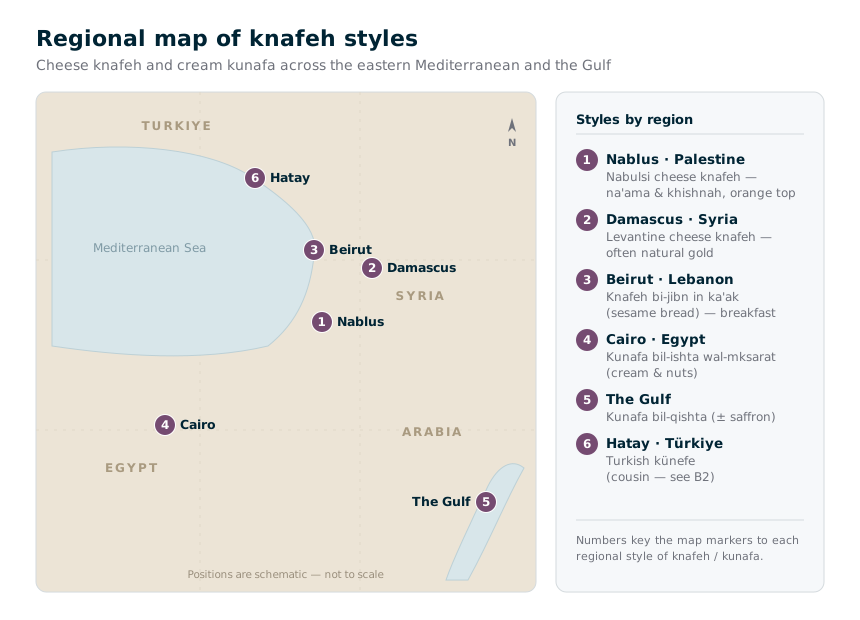 Map of knafeh styles: Nablus, Damascus, Beirut ka'ak, Cairo cream-and-nut, Gulf qishta, and Turkish künefe in Hatay
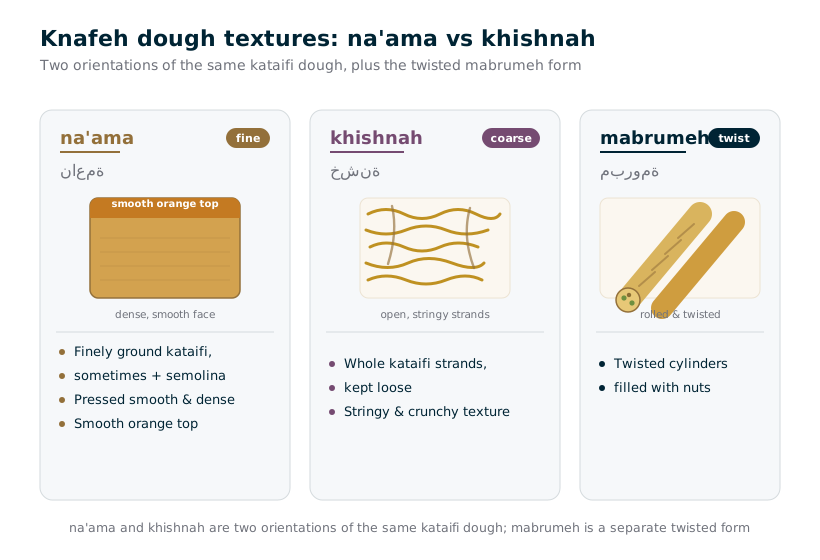 Comparison of knafeh dough: na'ama fine smooth base vs khishnah coarse strands, with a mabrumeh twist inset
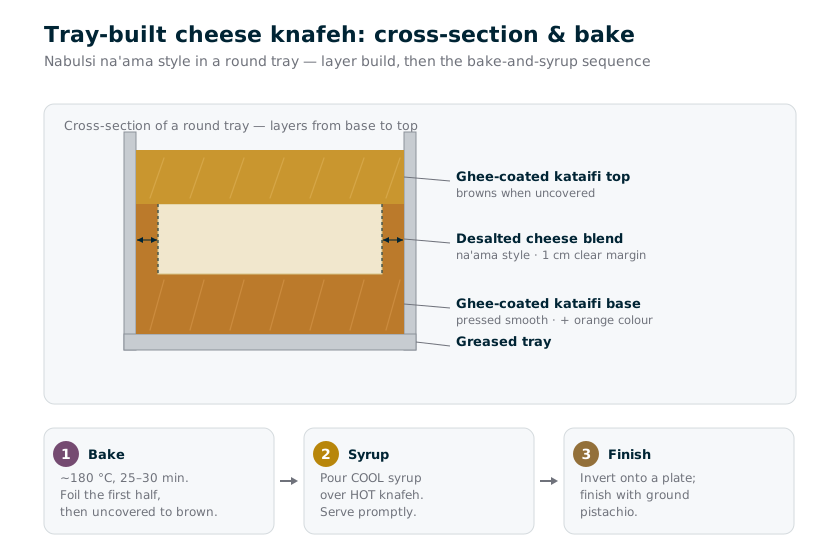 Cross-section diagram of tray cheese knafeh: kataifi base, desalted cheese middle, kataifi top, baked, cool syrup on hot, inverted and pistachio-topped
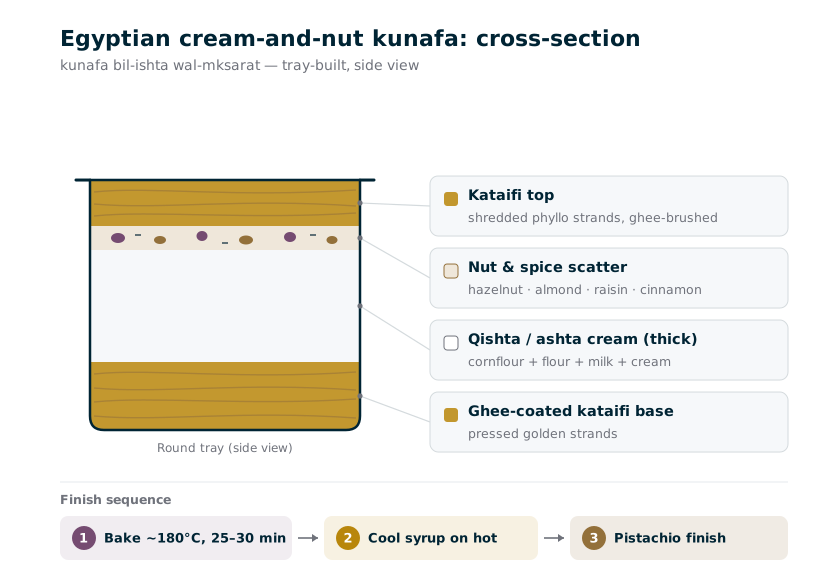 Cross-section diagram of Egyptian cream-and-nut kunafa: kataifi base, qishta cream, mixed nuts, kataifi top
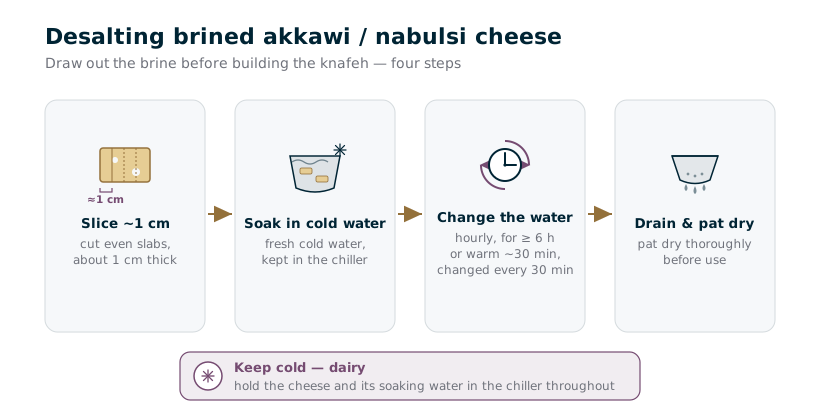 Four-step diagram: slice cheese, soak in cold water chilled, change water hourly for 6+ hours, drain and dry
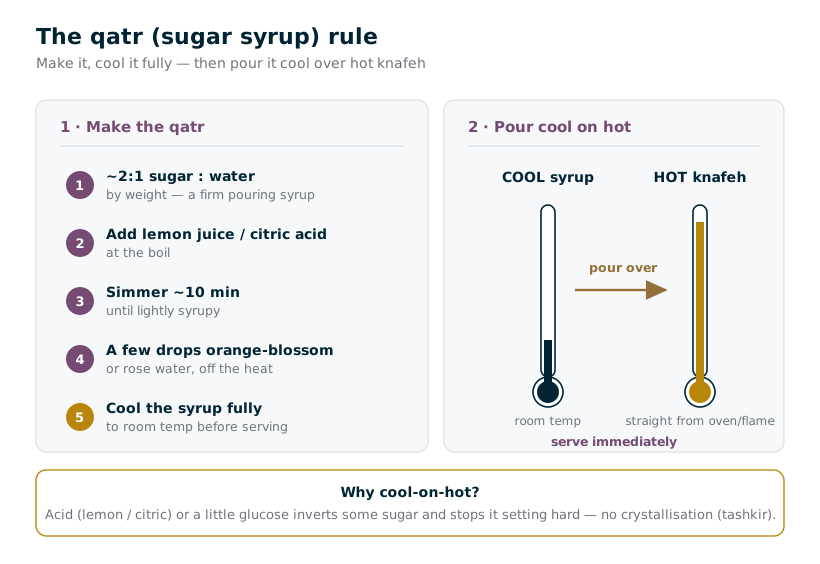 Infographic: qatr syrup 2:1 sugar:water with lemon, cooled, poured cool over hot knafeh; acid/glucose prevents crystallising
 Illustration of copper-tray cheese knafeh cooked over a gas flame, flipped, syruped and pistachio-topped
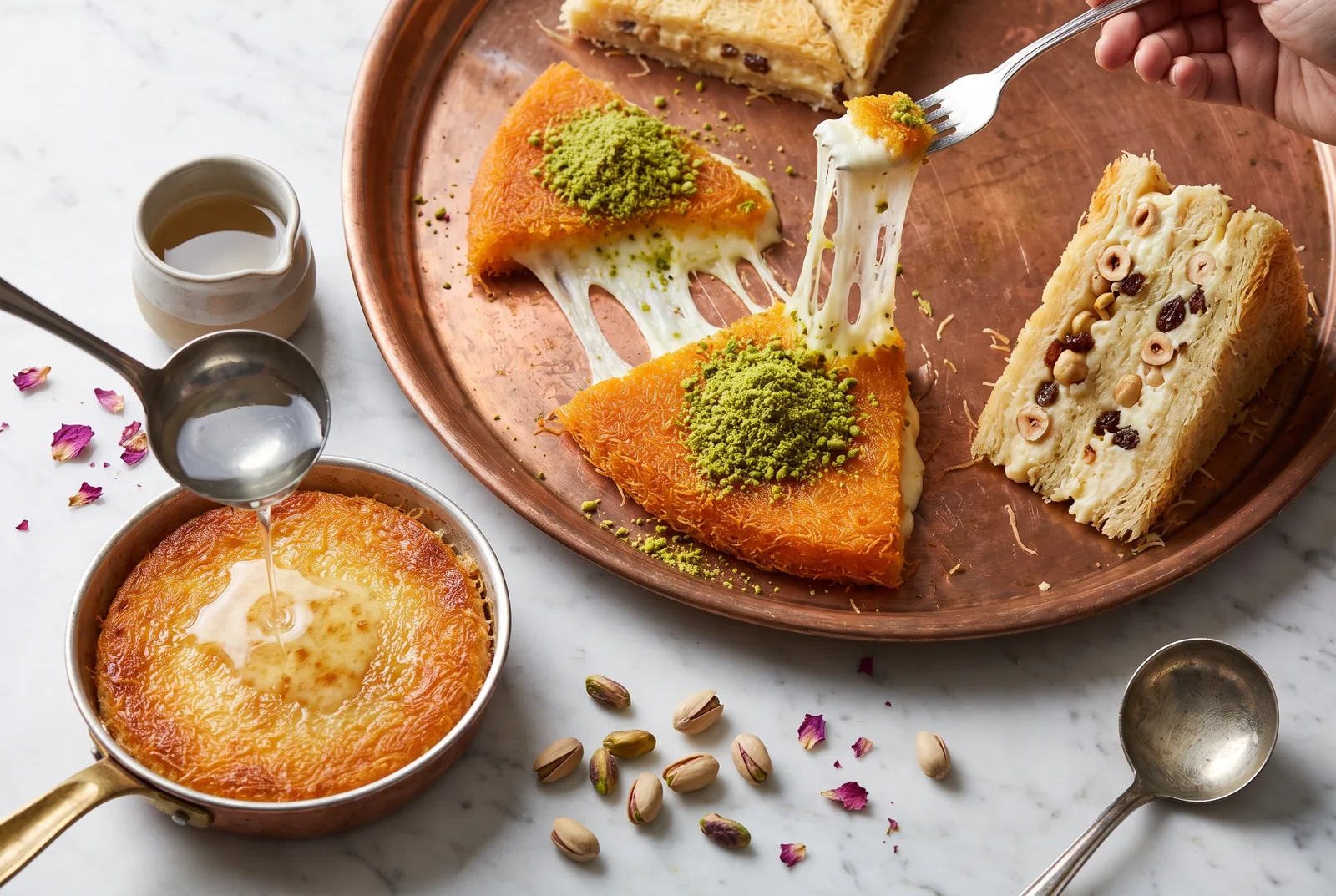
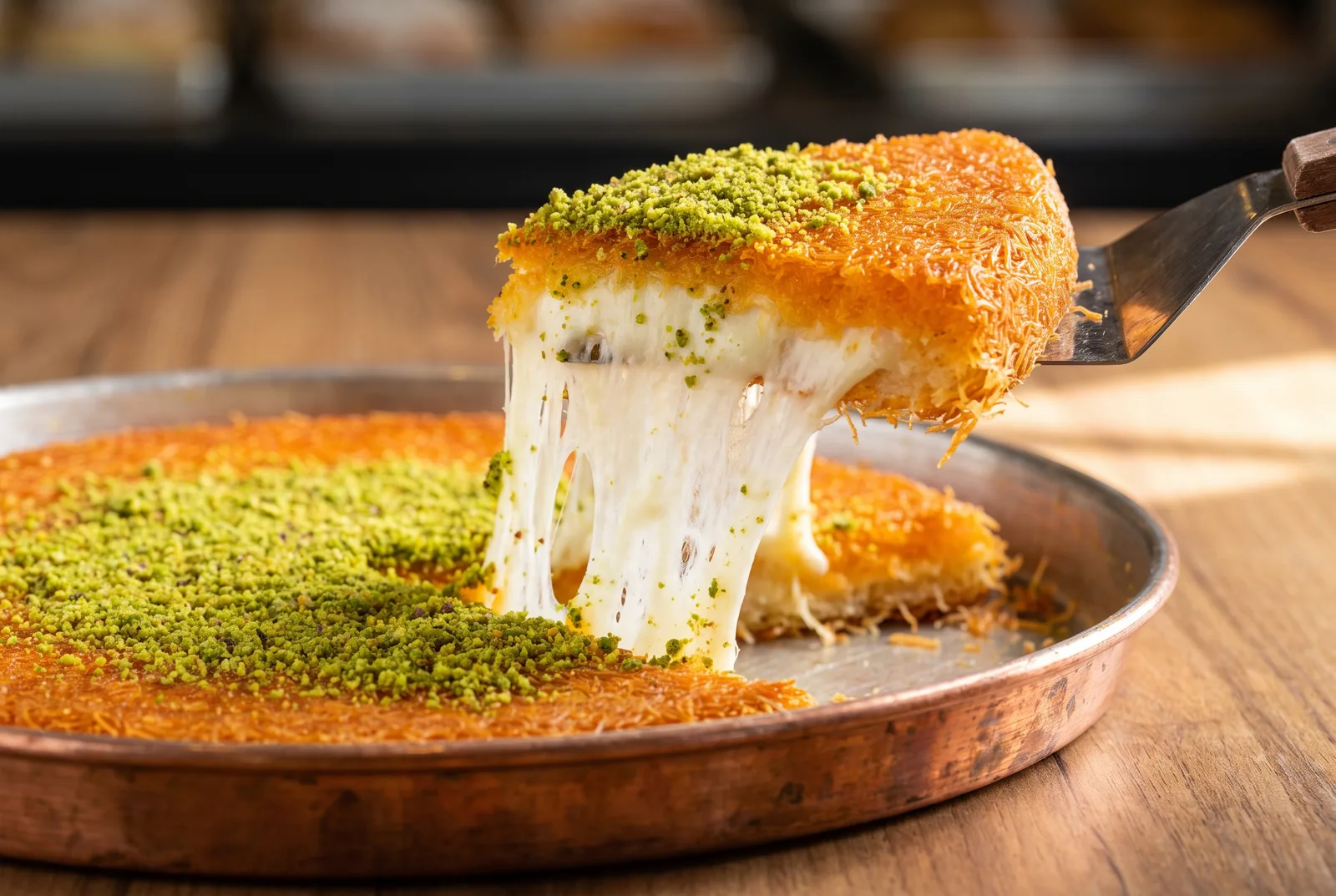 Close-up of Nabulsi cheese knafeh with an orange top, crisp base, molten cheese stretch and green pistachio
Nabulsi-style cheese knafeh (na'ama) — production batch
| Ingredient | Baker's % | Weight |
|---|---|---|
| Kataifi dough (ground fine for na'ama) — ≈ 500 g per tray; loosen, keep under damp cloth | 100 | |
| Clarified butter / ghee (from unsalted 82% butter) — warm; add food colour here if used | 60 | |
| Cheese blend (desalted akkawi + low-moisture mozzarella ± ricotta) — ≈ 600 g; drained and dried | 120 | |
| Ground pistachio (finish) — green crown | 10 | |
| Orange/red food colour — optional Nabulsi tradition; food-grade, permitted level, declared | 0.1 |
Yield: One ~30 cm round tray (8–12 portions); scale linearly
Egyptian kunafa bil-ishta wal-mksarat (cream & nut, tray)
| Ingredient | Baker's % | Weight |
|---|---|---|
| Kataifi dough (coarse) — ≈ 500 g; loosen | 100 | |
| Clarified butter / ghee (+ orange colour optional) — coat every strand | 55 | |
| Qishta / ashta cream (see sub-formula) — cooled, spreadable | 110 | |
| Mixed nuts (hazelnut, almond, raisin) + cinnamon — scatter over cream; allergen: tree nuts/peanuts | 25 | |
| Pistachio (finish) | 8 |
Yield: One ~30 cm round tray; scale linearly
| Style | Region | Dough | Filling | Colour | Cooking route | Signature |
|---|---|---|---|---|---|---|
| Nabulsi na'ama (كنافة نابلسية ناعمة) | Palestine (Nablus) / Levant | Fine, ground kataifi (± semolina), pressed smooth | Desalted akkawi / nabulsi cheese | Orange-red (food colour in ghee) | Copper tray over flame, or deck-oven tray | Molten cheese pull, smooth orange top, pistachio crown |
| Nabulsi/Levantine khishnah (خشنة) | Palestine / Syria / Lebanon | Coarse whole kataifi strands | Desalted cheese | Often natural pale gold | Deck-oven tray | Stringy, crunchier texture |
| Egyptian kunafa bil-ishta wal-mksarat | Egypt | Coarse kataifi, ghee-coated | Qishta (ashta) cream + nuts (hazelnut, peanut, raisin, cinnamon) | Orange (food colour in samn) | Deck-oven tray ~180°C | Creamy, nutty; baked in a round tray |
| Lebanese knafeh bi-jibn | Lebanon | Fine cheese knafeh | Akkawi / ashta | Pale to orange | Griddle / copper tray | Often served hot in ka'ak (sesame semolina bread) as breakfast |
| Gulf kunafa bil-qishta | Arabian Gulf | Fine or coarse kataifi | Qishta cream (± saffron) | Pale gold / saffron | Tray | Cream-forward, saffron/rose accent |
| Turkish künefe | Türkiye (Hatay) | Tel kadayıf | Unsalted fresh 'künefe' cheese | Natural gold | Copper tray, cooked both sides over flame | Cousin dessert; see B2-syrup-sweets-ottomans |
| Cheese | Character | Prep needed | Role in the blend | Catalogue stand-in |
|---|---|---|---|---|
| Akkawi (عكاوي) | White brined, salty, mild, semi-stretchy | Desalt: cold-water soak, change hourly, ≥6 h (or warm ~30 min) | Authenticity + mild salt note | Import fresh where available; not in Domson core range |
| Nabulsi (نابلسية) | White brined, cow/goat/sheep, sometimes mahlab + nigella | Desalt as akkawi | Traditional Nablus filling | Import fresh where available |
| Low-moisture mozzarella | Neutral, very stretchy when hot | Shred and dry well; use full-fat low-moisture | The stretch | Mozzarella Cheese Grated 2 kg; Mozzarella/Cheddar 80/20; Hanley's blend |
| Ricotta / fresh curd | Soft, creamy, non-stringy | Drain if wet | Creaminess, softens the pull | Fresh curd / ricotta (source locally) |
| Product | Sugar:water | Acid/anti-crystalliser | Pouring rule | Goal |
|---|---|---|---|---|
| Cheese knafeh | ~2:1 (some ~1.5:1) | Lemon juice / citric acid (± glucose) | COOL syrup on HOT knafeh, immediately | Soak the base, keep it crisp, serve molten |
| Egyptian tray kunafa | ~2:1 | Lemon / citric acid | Cool syrup on hot tray on exit | Even soak without sogginess |
| Baklava (contrast) | ~2:1 | Lemon / citric acid | Temperature differential (commonly hot syrup on cooled pastry, or cool on hot) | Deep soak of many thin layers — see B3-baklava-and-phyllo-pastries |
| Fault | Likely cause | Fix |
|---|---|---|
| Soggy, greasy base | Wet cheese; under-clarified butter (water left in); OR hot syrup poured on hot knafeh | Desalt and dry cheese; clarify butter fully; pour COOL syrup on HOT knafeh only |
| No cheese pull / rubbery | Wrong/high-moisture mozzarella; cheese served after cooling | Use low-moisture full-fat mozzarella, dry well; serve hot immediately |
| Salty dessert | Cheese not desalted enough | Slice thinner and soak longer, changing water hourly ≥6 h (chilled); taste before use |
| Pale, undercooked base | Too little ghee coating; oven too cool; not browned on the flame long enough | Coat every strand; brown the base fully (copper tray) or uncover to brown in the deck oven |
| Burnt strands / bitter | Un-clarified butter (milk solids scorch); oven too hot | Clarify to ghee; drop to ~180°C; watch the top uncovered |
| Syrup crystallises / grainy | No acid; boiled too hard/too long; sugar not fully dissolved | Add lemon/citric acid at the boil and/or glucose; simmer gently ~10 min; dissolve fully |
| Colour patchy / too dark | Colour added to dough not to the ghee; too much dye | Blend colour into melted ghee first, then coat the dough; use minimal permitted level |
| Dough crumbles when working | Kataifi dried out / not loosened | Keep under a damp cloth; pull strands apart before buttering |