
Arab & Middle-Eastern
12 articles · 68 diagrams · avg 10 min read
Articles in this section
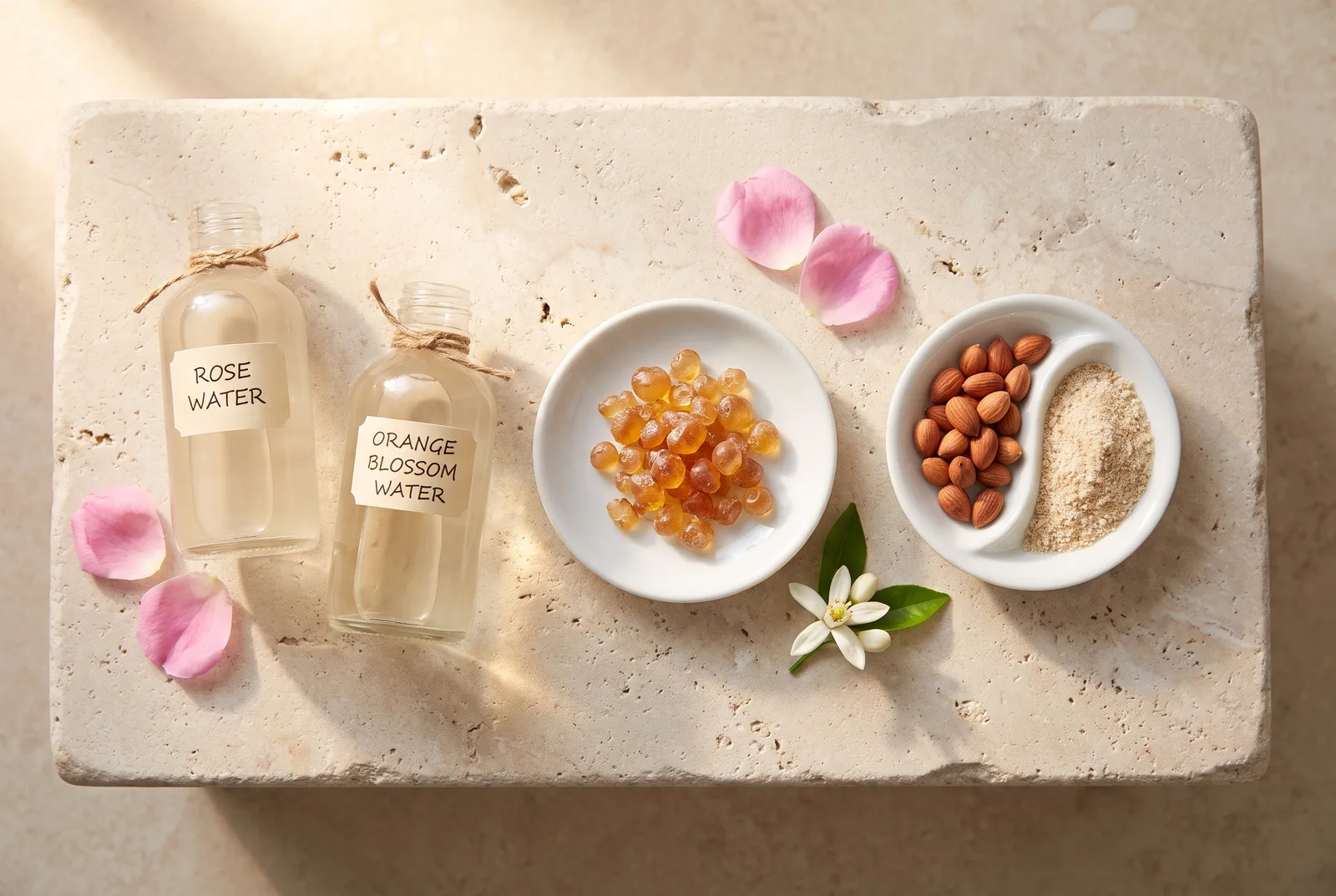
Arab baking aromatics: rose water, orange blossom water, mastic and mahlab — sourcing, dosage and application
Four ingredients carry the aromatic signature of Arab confectionery: rose water (ma' al-ward), orange blossom water (ma' al-zahr), mastic (mistika) and mahlab. This dossier, built from Arabic brand and culinary sources, a Saudi FDA comparison, the Chios Mastiha PDO body and Domson spec sheets, tells a UK baker what each one is, where the authentic material comes from (Damask/Taif rose, Tunisian bitter-orange blossom, Chios mastiha resin, mahaleb-cherry kernels), how much to use and — the make-or-break point — WHEN to add it. Floral waters are dilute distillates dosed by the teaspoon and added off the heat; mastic is a strong resin ground with sugar and melted into hot milk for booza and muhallabia; mahlab is a spice ground fresh into maamoul and ka'ak. It maps regional habits (Levant vs Gulf vs Egypt vs Maghreb), flags the food-safety points (mahlab's cyanogenic kernels, mastic's Anacardiaceae link, sesame as a declared allergen), warns about the hydrosol-versus-essence sourcing trap, and wires every technique to the Domson catalogue and to the Pillar A craft concepts behind it (A6-pastry-creams-fillings, A6-glazes-finishes, A6-sugar-work-techniques) and the sister Arab dossiers (B3-attar-sugar-syrup-science, B3-knafeh-kunafa-production, B3-baklava-and-phyllo-pastries, B3-semolina-desserts-basbousa-maamoul, B3-ramadan-seasonal-specialities, B3-tahini-halva-and-sesame-confections, B3-ghee-and-baking-fats-in-arab-baking).
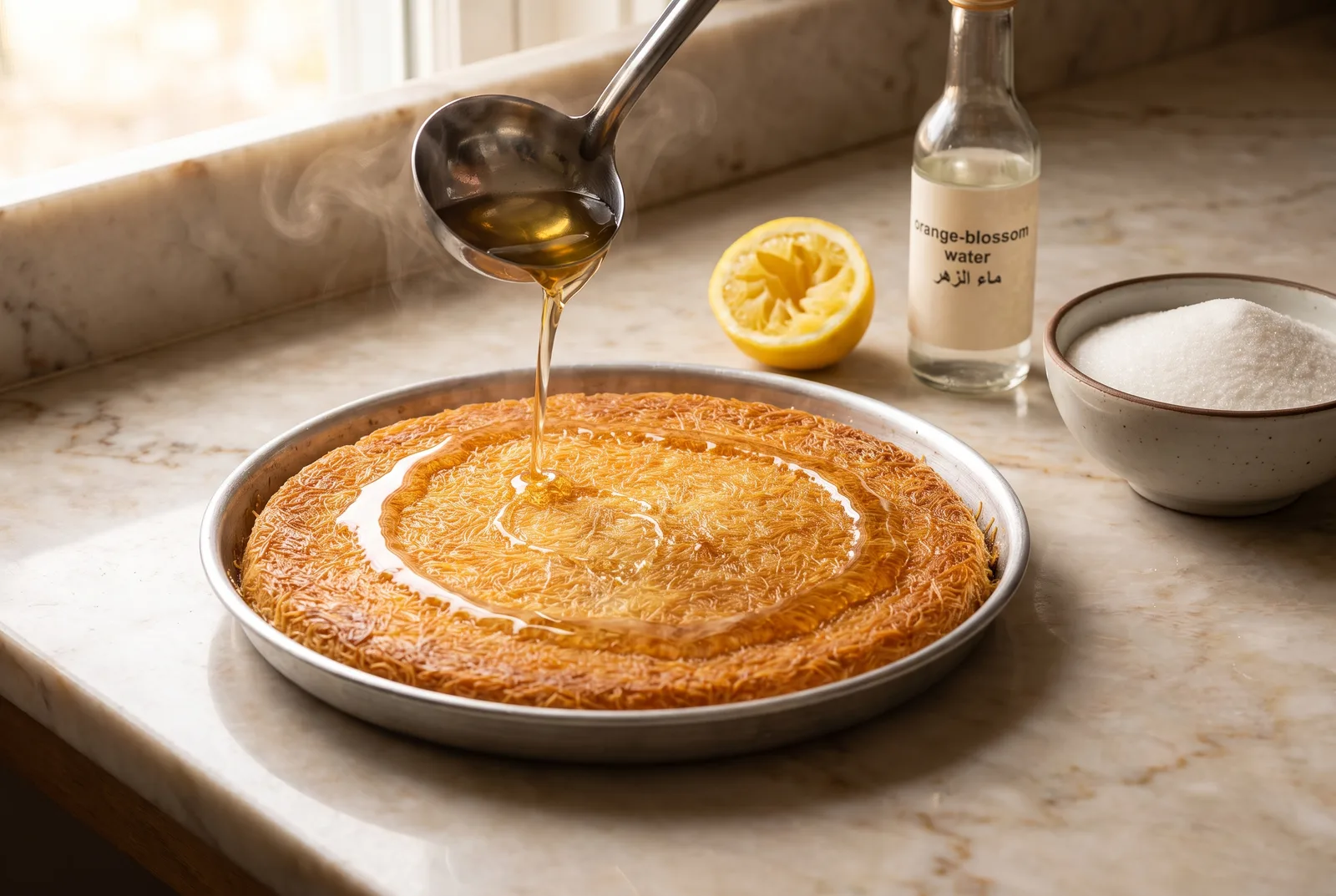
Attar (قطر): the science of Arab sugar syrup — ratios, temperature, floral aromatics and the hot/cold rule
Attar (قطر) — also called sheera (شيرة) in the kitchen and sherbet/shurbaat (شربات) in Egypt — is the single most load-bearing technique in Arab confectionery: a two-ingredient sugar-and-water syrup that finishes dozens of sweets, from knafeh and baklava to basbousa, namoura and qatayef. This dossier, built from Arabic-language kitchen and trade sources synthesised into English, gives a working UK baker the authentic picture: the density ladder (light ~1:1 sugar:water for soaking cakes; a balanced ~1.3:1 household syrup; a heavy ~2:1 for crisp pastries); the short cook (2-5 min light, 10-15 min heavy) to a light-honey coat — deliberately far below any candy stage; the role of lemon or citric acid in inverting sucrose so the syrup stays clear; the "don't stir once it boils" discipline; the two defining floral aromatics (rose water and, especially in the Levant, orange-blossom water / mazaher) added off the heat; and — the make-or-break step — the temperature-contrast rule: COLD thick syrup on HOT knafeh or baklava keeps them crisp, while both hot together turns them soggy. It maps Levantine, Egyptian, Gulf and Maghrebi naming and style, wires every step to the Domson catalogue an Arab patisserie actually buys (sugar, citric acid, glucose syrup, invert/multifloral honey, semolina, kataifi, cinnamon), and cross-links the Pillar A craft science (A6-sugar-work-techniques, A6-glazes-finishes, A8-chocolate-confectionery-formulas) and the sibling Arab and Turkish dossiers.
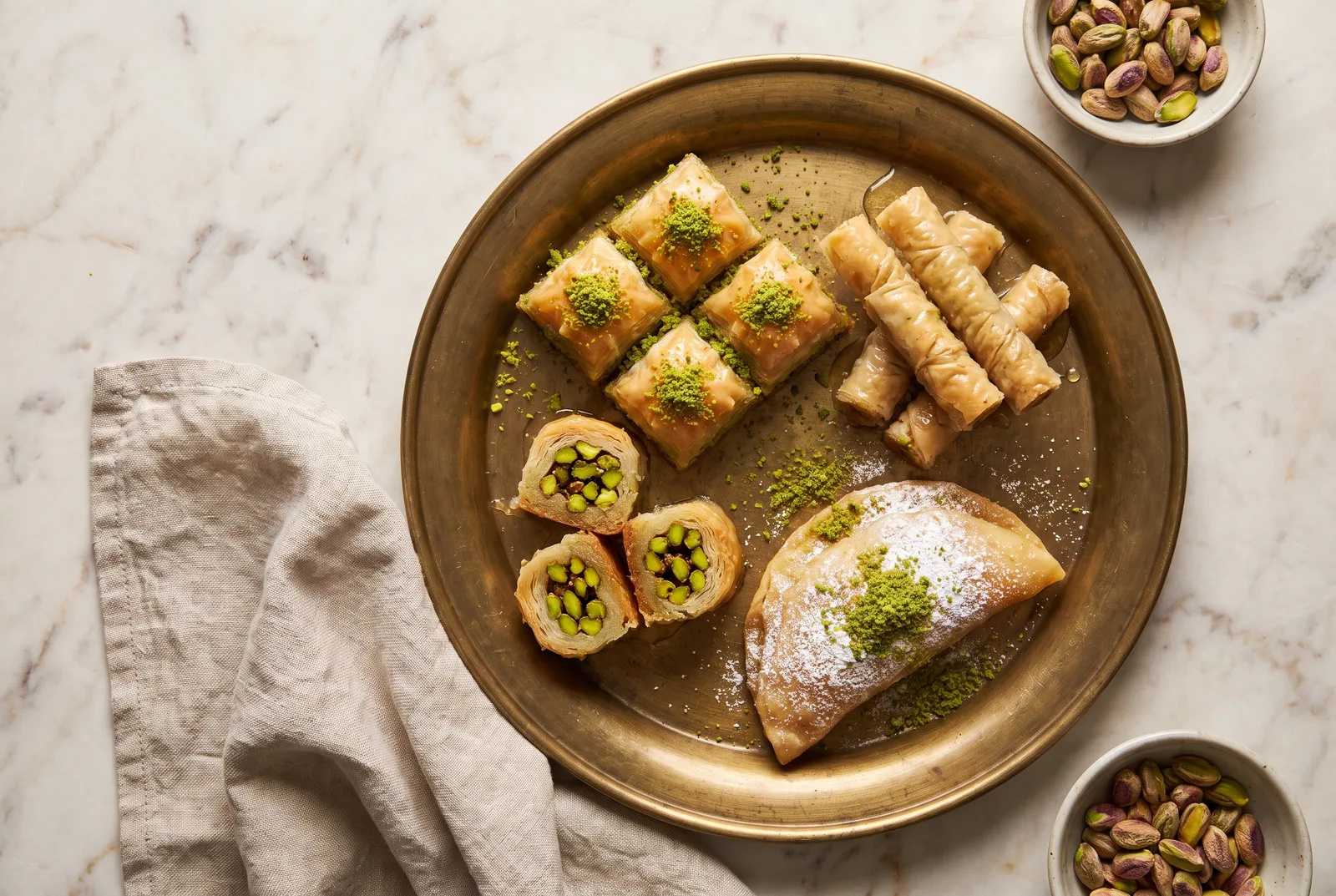
Baklava and Arab nut pastries: pistachio, walnut and almond fillings, samneh layering and floral finishing
For an Arab or Levantine patisserie, baklawa (بقلاوة) is a family, not a single sweet — and it is read differently from the Turkish original. This dossier gives a UK baker the authentic Arab picture, built from Arabic-language recipe, brand and encyclopaedia sources and cross-checked against the platform's supplier specifications: the mixed-nut fillings (Aleppo pistachio / fustuq halabi, walnut / jawz, cashew / kaju and almond / lawz) that set the Levant apart from Gaziantep's single-nut purity; the barely-sweetened filling (about 4:1 nuts:sugar, because the sweetness lives in the syrup); layering with samneh (clarified butter / ghee) rather than whole butter; the cut-forms — flat baklawa, asabe' fingers, borma/mabroumeh, ballorieh and warbat; and the make-or-break finish: attar (قطر) perfumed with rose water and orange-blossom water, poured cooled onto hot pastry. Every technique is wired to the Domson catalogue an Arab kitchen actually orders — almonds, walnuts, pistachio, kataifi, unsalted butter to clarify, sugar, glucose and citric acid — and cross-linked to the Pillar A craft concepts behind it (A7-seeds-nuts-toppings, A6-laminated-dough-fundamentals, A4-butter-grades-and-specialist-types, A6-sugar-work-techniques and A6-pastry-creams-fillings) and to its sister Arab and Turkish articles (B3-phyllo-kataifi-production, B3-attar-sugar-syrup-science, B3-ghee-and-baking-fats-in-arab-baking, B3-aromatic-flavourings-rosewater-orange-blossom-mastic, B3-knafeh-kunafa-production and B2-baklava-production).
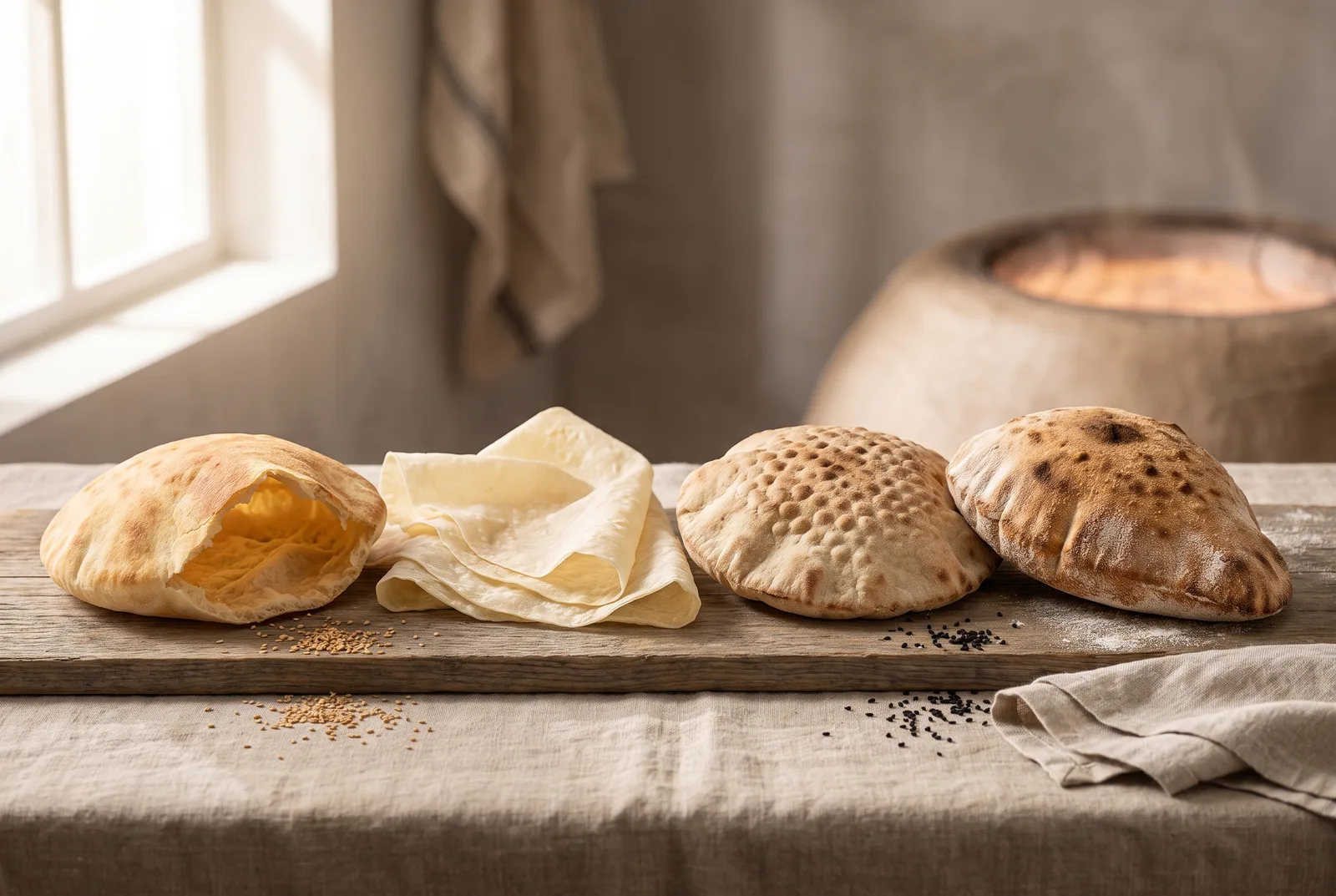
Arab flatbreads decoded: khubz, markook, taboon and tannour — doughs, ovens and regional differences
A working baker's guide to the Arab flatbread family — from the puffed Levantine pocket khubz arabi and the paper-thin markook/shrak of the saj, to Palestinian taboon on hot pebbles, Iraqi khubz al-tannour slapped onto clay walls, Egyptian bran-dusted aish baladi and the lacy Gulf regag. It maps each bread to its dough, its oven and its region, gives baker's-percentage starting formulas, and links the Domson flours, yeasts, salt, oils and seeds a UK Arab bakery would buy.
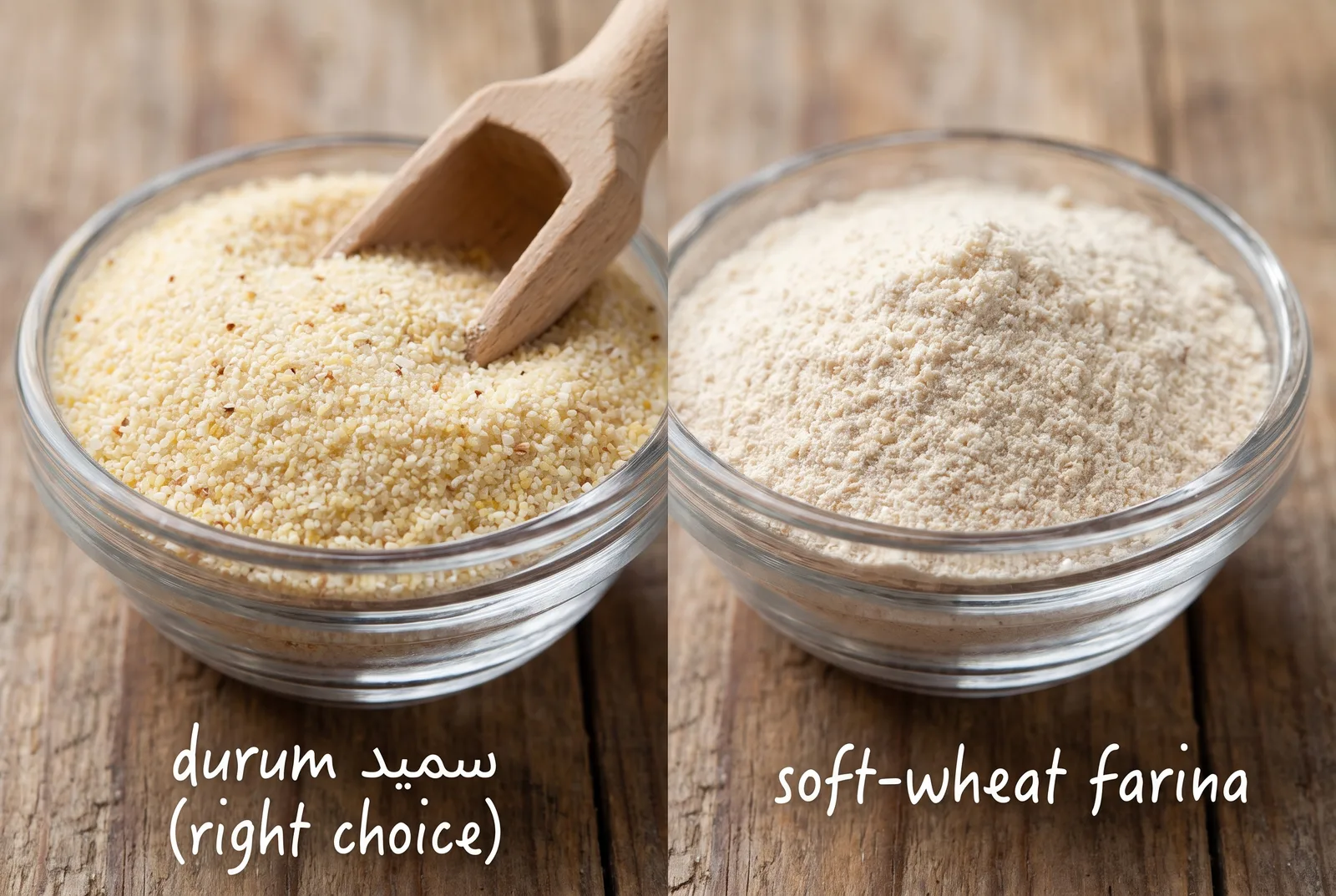
Flour and semolina for Arab baking: white wheat flour, durum semolina and wholemeal, and which one for which job
A working baker's guide to choosing flour (طحين / دقيق) and semolina (سميد) for Arab and Middle-Eastern production. Arab bakers, like Turkish ones, buy by the finished product rather than a single type number, and the choice runs across three families: white wheat flour (from very strong for jullash/phyllo and hand-pulled markoúk down to soft, low-protein flour for maamoul and kahk), durum semolina (samīd — fine, medium and coarse, the backbone of basbousa/namoura, kunafa naʿama, maamoul and couscous), and wholemeal/brown flour (for khubz asmar and the high-extraction Egyptian baladi loaf). It explains the regional vocabulary (Levantine طحين vs Egyptian/Gulf دقيق; Gulf grades fākher / asmar / burr; farkha), the Egyptian baladi 82–87.5% vs fino/tourist 76% extraction bands, the fine-vs-coarse semolina debate for basbousa, and exactly which Domson UK-stock flours a UK Arab bakery or patisserie should order — including the durum-vs-soft-wheat semolina trap. Regional and numeric attributions are cited to Arabic-language sources; supplier facts come from first-party datasheets.
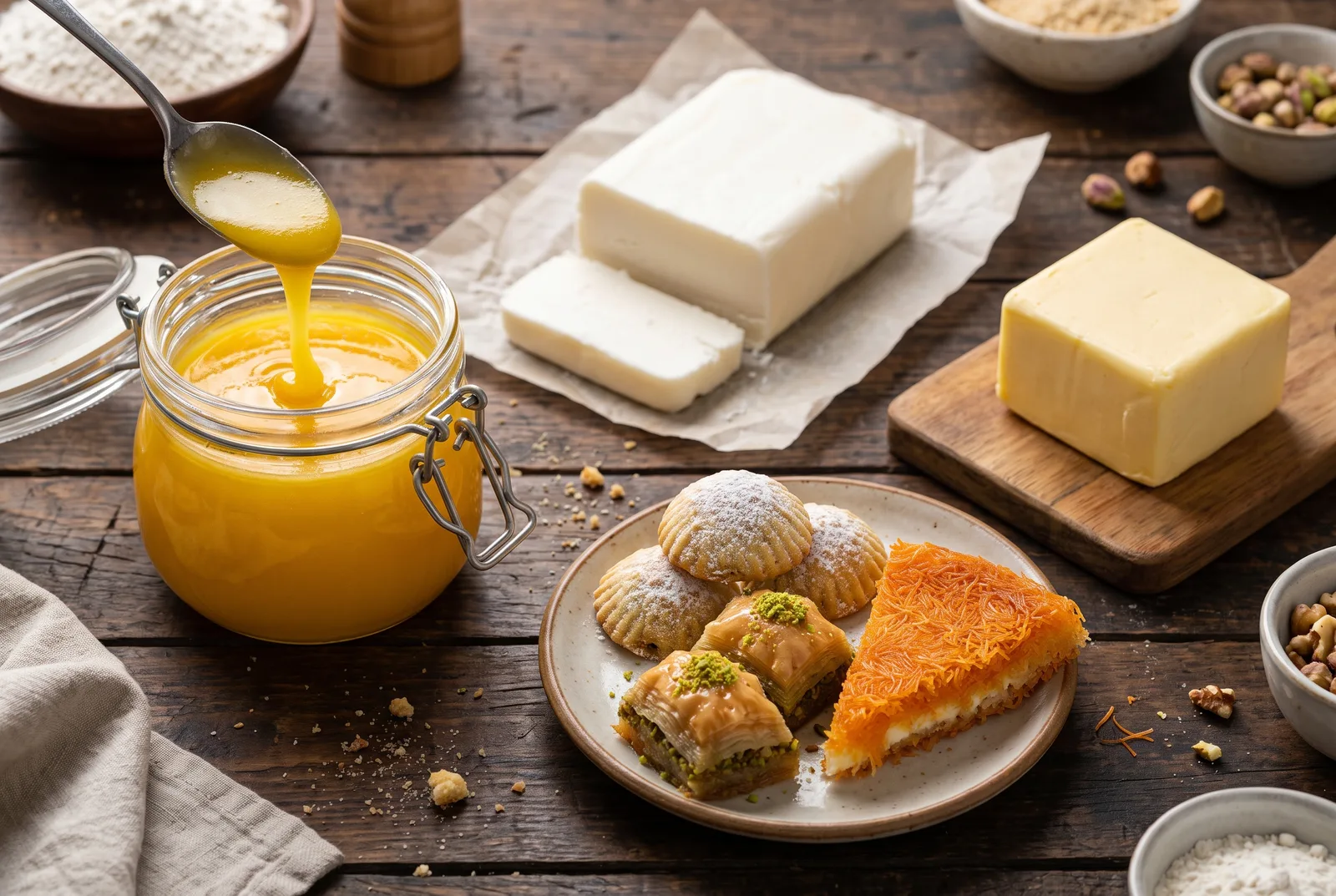
Ghee and clarified fats in Arab baking: animal ghee (samneh) vs vegetable ghee, smoke point, flavour and when to substitute
Quality animal ghee is specified in Arabic pastry for a reason. This dossier gives a UK baker the authentic Arab picture, built from Arabic-language brand and reference sources and cross-checked against the platform's own supplier specifications: what samneh / samn baladi (سمنة / سمن بلدي) is and why clarifying butter to remove its water and milk solids became the region's preservation-first baking fat; the regional map of names and milk sources (Levantine samneh, Egyptian cow/buffalo samn baladi, Gulf/Najran samn, Maghrebi fermented smen); how animal ghee differs from samn nabati (سمن نباتي, vegetable ghee) and from whole butter in smoke point (~250 C vs ~220-230 C vs ~175 C), water content, melting behaviour, flavour and allergen status; and, above all, the practical calls a working baker makes - which fat for maamoul, baklawa, kunafa and basbousa, and exact substitution ratios. Every fat is wired to the Domson catalogue an Arab kitchen actually orders (unsalted butter to clarify, dairy-free vegetable shortening, palm oil, frying oils, semolina and kataifi) and cross-linked to the Pillar A craft concepts behind it (A4-fat-types-and-selection, A4-fat-science-functionality, A4-frying-fats-and-oils, A4-margarine-shortening-manufacturing) and to its sister Arab articles (B3-baklava-and-phyllo-pastries, B3-knafeh-kunafa-production, B3-semolina-desserts-basbousa-maamoul, B3-zaatar-manakish-and-savoury-flatbreads).
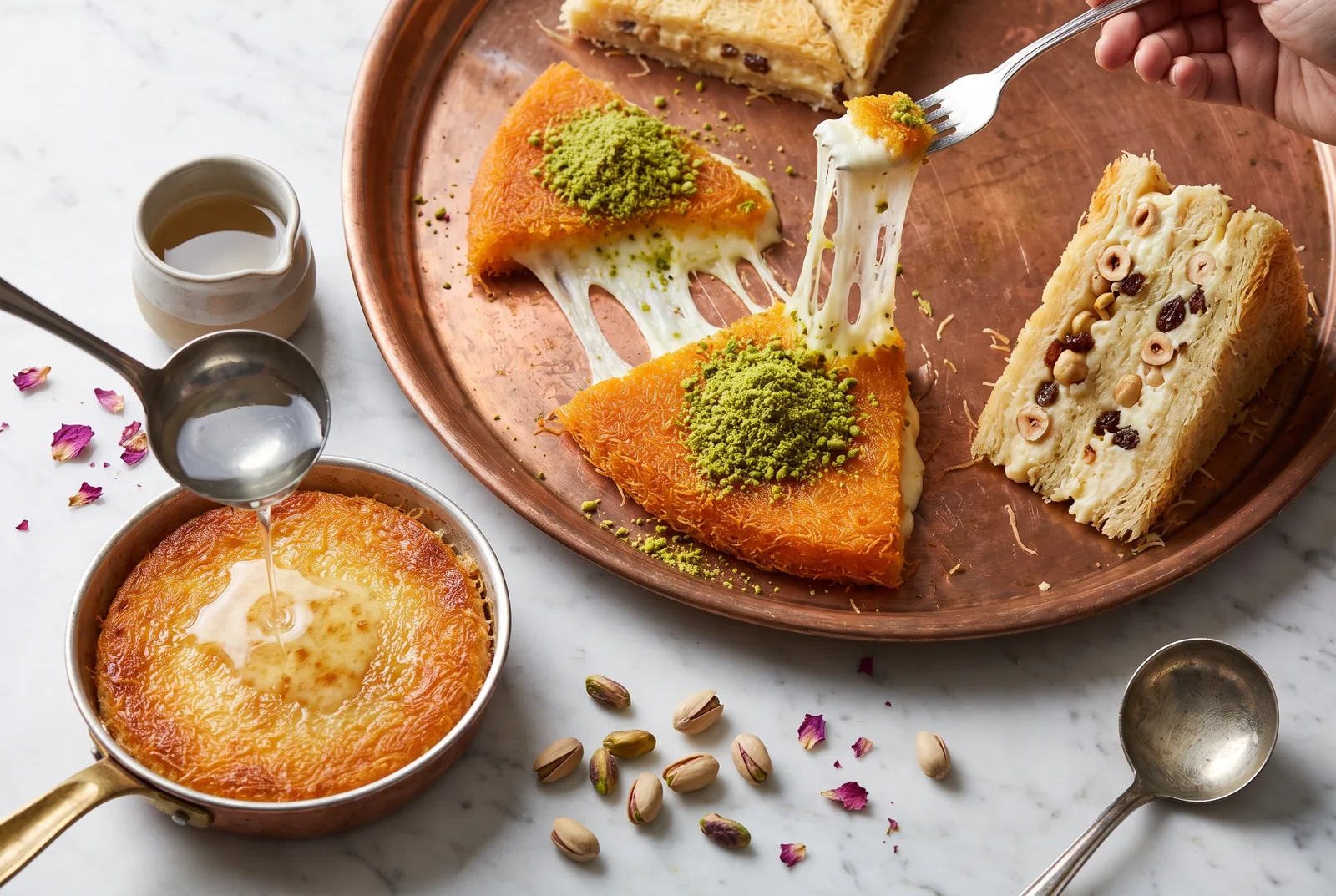
Knafeh (كنافة): regional varieties, cheese selection, kataifi dough and the full production workflow for professional scale
Knafeh (also kunafa/kanafeh, كنافة — a shredded-pastry dessert soaked in scented sugar syrup) is the centrepiece of the Levantine and Egyptian sweet counter and a Ramadan icon across the Arab world. This dossier gives a working UK baker the authentic picture from native Arabic sources: the Nabulsi (Nablus, Palestinian) cheese knafeh in its fine na'ama (ناعمة) and coarse khishnah (خشنة) forms; the Egyptian qishta-and-nut style; and the Lebanese and Gulf cream (ashta) versions — plus the closest cousin, Turkish künefe (cross-linked to B2-syrup-sweets-ottomans). It covers cheese selection and the critical desalting of brined akkawi and nabulsi cheese, the modern mozzarella-akkawi-ricotta stretch blend, the distinctive orange colour of Nablus knafeh (and its food-additive/labelling implications), the clarified-butter/ghee dressing of the kataifi, the qatr (قطر) sugar-syrup grammar and the cool-syrup-on- hot-knafeh rule, and two production routes — the tray-in-a-deck-oven route and the traditional copper-tray-over-flame shop route — scaled for a professional kitchen. Every step is wired to the Domson catalogue an Arab/Middle-Eastern patisserie in the UK actually orders (ready kataifi, mozzarella for the cheese blend, unsalted butter to clarify, sugar, glucose and citric acid for the syrup, corn flour and cream for ashta, food colour, and pistachios/semolina to finish) and cross-linked to the Pillar A craft (A6-pastry-creams-fillings, A6-sugar-work-techniques, A4-butter-grades-and-specialist-types, A7-seeds-nuts-toppings, A7-food-colour-and-metallic-effects) and the sister B3/B2 traditions.
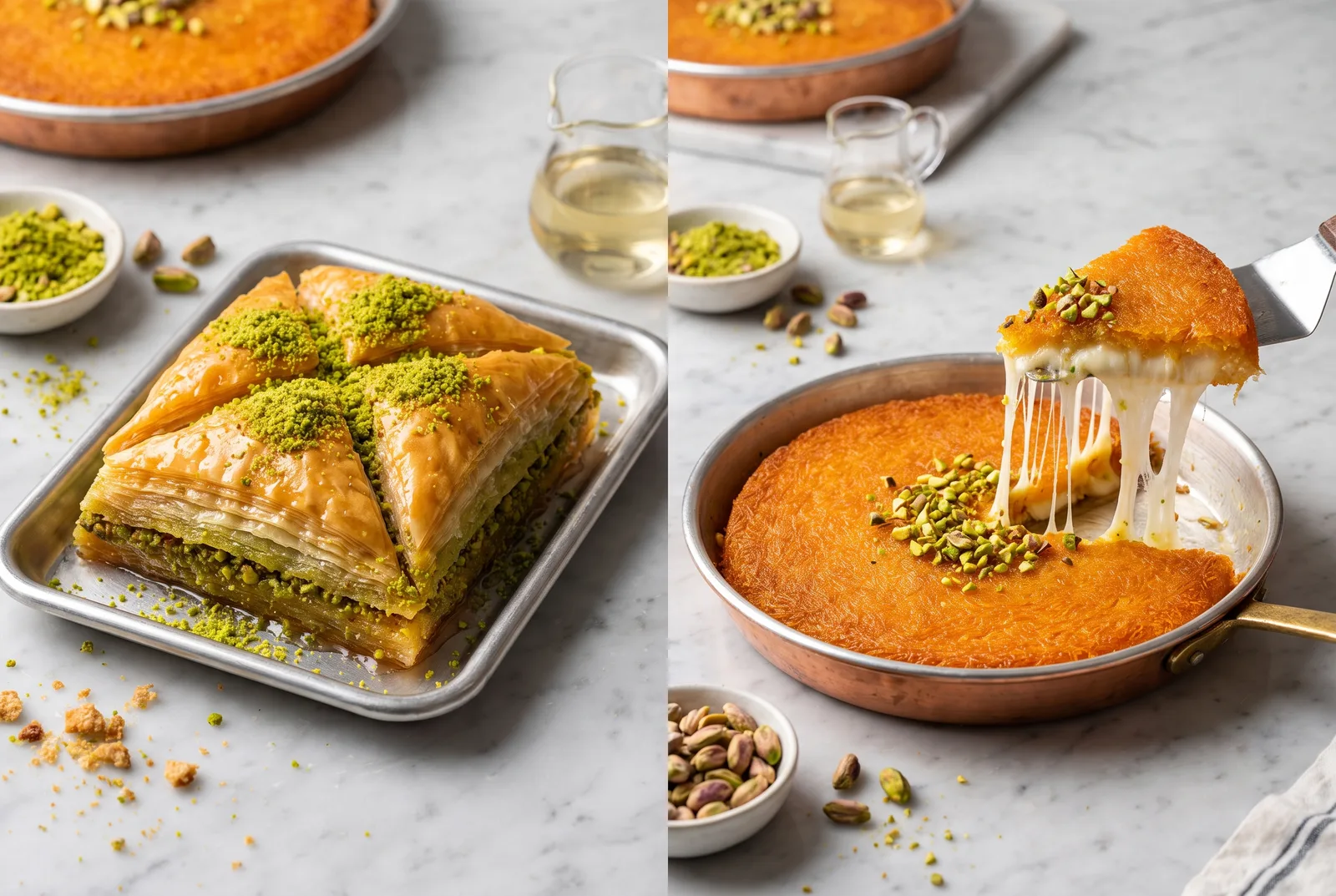
Phyllo and kataifi in Arab pastry: production technique, storage and professional handling for baklava and knafeh
Two doughs carry most of the Arab sweet counter: phyllo — known in Arabic as jullash (جلاش) — a tissue-thin STRETCHED SHEET dough for baklava, and kataifi, the SPUN-BATTER "hair" dough (عجينة الكنافة) for knafeh (كنافة, the shredded-pastry cheese/cream dessert). This dossier gives a working UK baker the authentic picture drawn from Arabic-language recipe and reference sources: how each dough is actually made (phyllo rolled near-transparent and dusted with starch; kataifi dripped as a thin batter onto a rotating hot plate into pale threads that never brown), the knafeh dough textures every Arab baker names — khishneh (خشنة, coarse threads), na'ima (ناعمة, fine crumb), mabroumeh (مبرومة, wound rolls) and muhayyara (محيرة, a blend) — and the regional identities that matter (white Nabulsi/Levantine cheese knafeh with jibneh nabulsiyeh or desalted akkawi, versus the orange-tinted Egyptian na'ima/mabroumeh often filled with qeshta cream). It nails the handling that makes or breaks these expensive pre-made components: thaw frozen phyllo slowly (~8 h in the fridge, then ~1-3 h at room temperature until pliable) and, on most professional guidance, not straight from frozen at room temperature; keep it covered with wrap and a slightly damp cloth and work fast in small portions; brush every sheet with clarified butter (samn); desalt akkawi/nabulsi cheese under refrigeration; loosen and ghee-coat kataifi threads; and syrup on a temperature contrast (syrup and pastry never both hot). Every step is wired to the Domson catalogue an Arab or Levantine patisserie in the UK actually orders — ready kataifi, semolina, unsalted butter to clarify, wheat/maize starch, sugar, glucose and citric acid for the syrup, pistachio/walnut/almond and melting cheese — with an honest note on what the catalogue does not yet stock (ready phyllo sheets, ghee, akkawi). Cross-linked to the Pillar A craft concepts behind it (A6-laminated-dough-fundamentals, A1-protein-gluten-and-strength, A4-butter-grades-and-specialist-types, A6-sugar-work-techniques, A6-pastry-creams-fillings, A7-seeds-nuts-toppings) and to its sibling tradition dossiers (B3-attar-sugar-syrup-science, B3-knafeh-kunafa-production, B3-baklava-and-phyllo-pastries, B3-ghee-and-baking-fats-in-arab-baking, B3-flour-and-semolina-selection, B3-aromatic-flavourings-rosewater-orange-blossom-mastic, B2-borek-phyllo, B2-baklava-production).
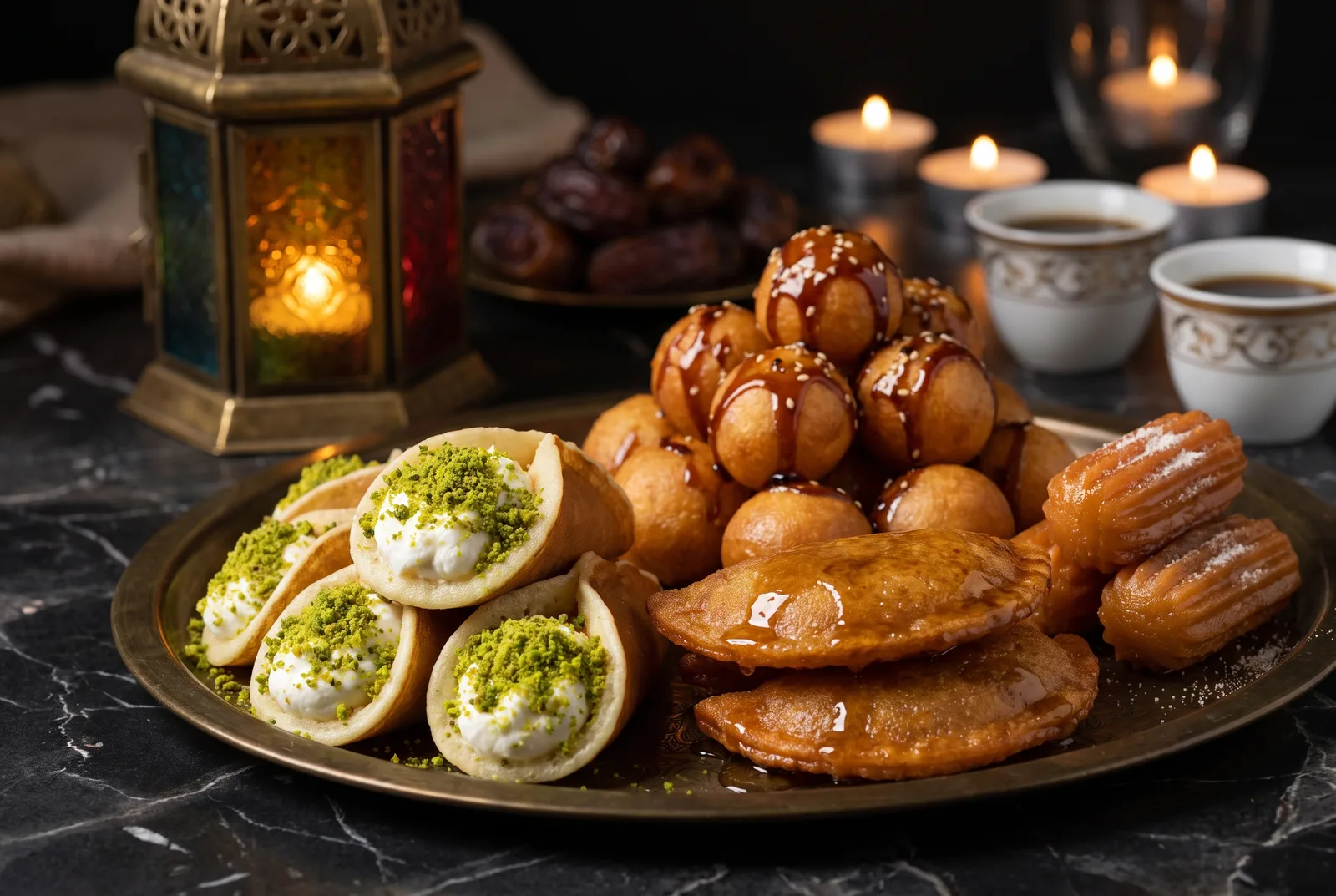
Ramadan baking production guide: qatayef (قطايف), luqaimat (لقيمات) and seasonal sweets — scaling, fried vs baked options and the peak-demand workflow
Ramadan is the single biggest trading month for an Arab or Middle-Eastern bakery, and it runs on a small family of fried and griddled sweets. This dossier gives a UK operator the authentic picture from native Arabic sources and wires it to the Domson catalogue. It covers qatayef (قطايف — the one-sided yeasted pancake, cooked on a single side so the top opens into pores that grip the filling) in both its forms: the small, fresh, cream-filled qatayef asafiri (قطايف عصافيري) crowned with pistachio, and the larger regular qatayef sealed around a walnut-sugar-cinnamon or sweet-cheese filling and deep-fried (or baked) then soaked in cool syrup. It covers luqaimat (لقيمات) — the fermented drop-fried dough balls known as awameh (عوامة) or zalabia (زلابية) in the Levant and luqmat al-qadi (لقمة القاضي, "the judge's morsel") in Egypt and Iraq, finished with date syrup (dibs), sugar syrup, honey or icing sugar — and balah al-Sham (بلح الشام), the choux paste piped into warm oil. It gives working batter formulas in baker's %, the fried-vs-baked decision, frying-fat selection (why a stable palm/high-oleic fat beats a high-polyunsaturate sunflower oil for a busy fryer), the qatr/attar syrup grammar and the cool-syrup-on- hot rule, a full fault table, and a peak-demand production workflow. Every step maps to the ingredients a UK Arab bakery orders (plain flour, fine semolina, fresh and dried yeast, baking powder, frying oils, corn flour and cream for ashta, walnuts/pistachios/almonds/coconut, dates and date syrup, sugar, citric acid, glucose, sesame, icing sugar and ghee). It cross-links the Pillar A craft (A2 yeast & leavening, A4 frying fats, A6 choux and pastry creams and sugar work, A7 nuts & toppings, A8 baker's percentage & scaling) and the sister B3/B2 traditions.
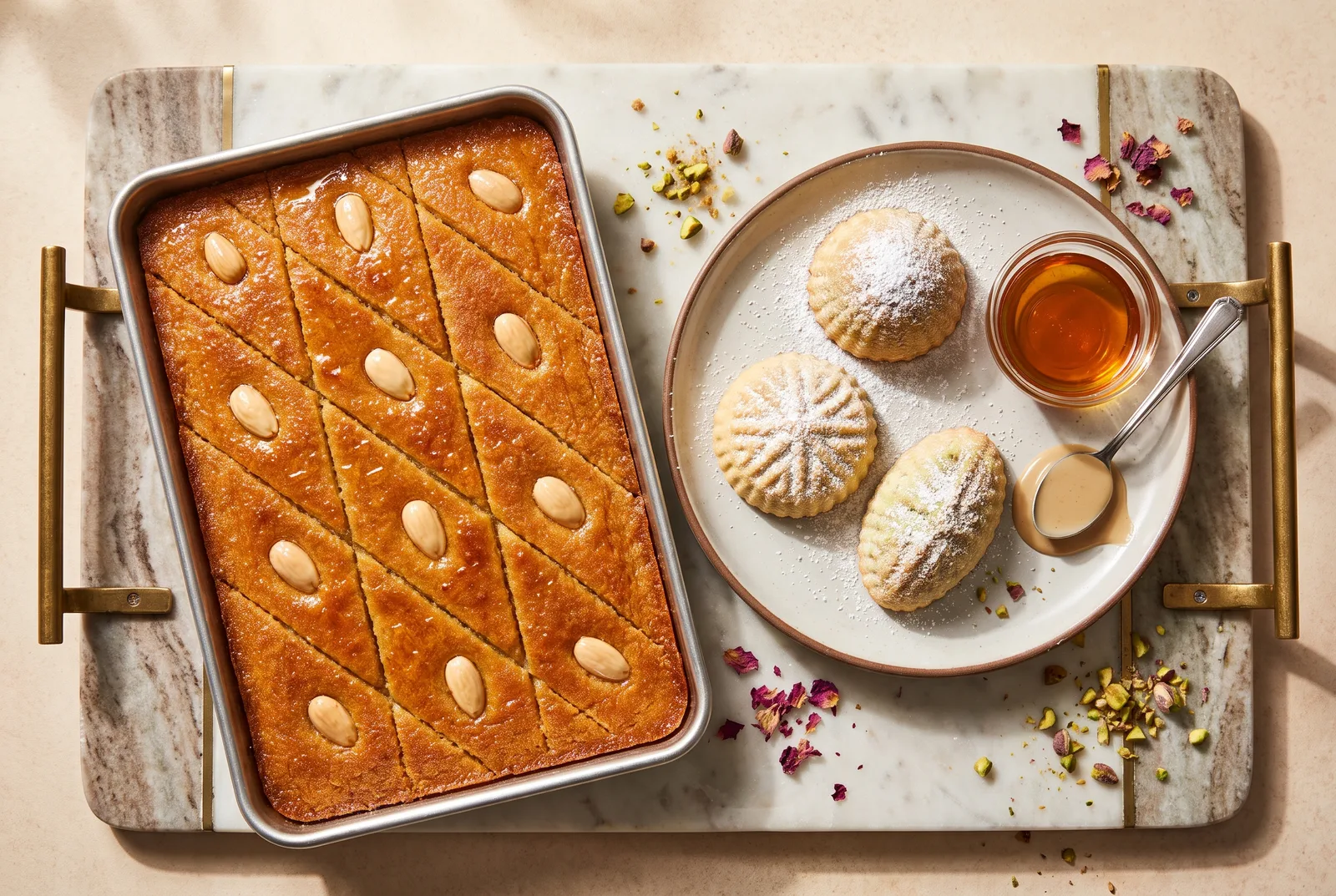
Semolina-based Arab sweets: basbousa, namoura (نمّورة) and maamoul (معمول) — grind choice, ghee ratios and resting times
Semolina (سميد, smeed) is the backbone of the Arab sweet counter, and three products define it: the syrup-soaked semolina cake — basbousa (بسبوسة) in Egypt, namoura/nammoura (نمّورة) in Lebanon, harissa/hareseh (هريسة) in Palestine and Jordan, and revani in Türkiye and the Balkans — and the moulded festival shortbread maamoul (معمول). This dossier gives a UK baker the authentic regional picture from native Arabic sources and settles the three questions that actually decide the result: which SEMOLINA GRIND to use (fine vs coarse vs a blend, and why the answer differs by product and region), the GHEE/ butter RATIOS that make the crumb rich without being greasy, and the RESTING TIMES — the short batter rest that lets basbousa/namoura semolina swell, and the long overnight rest of the ghee-soaked semolina that is the secret to a melt-in-the-mouth maamoul. It covers the tahini-lined pan of Lebanese namoura, the attar (قطر) syrup grammar and the hot-cake/cold-syrup rule, the date (ajwa), walnut and pistachio maamoul fillings and the wooden-mould shapes that signal them, mahlab and mastic aromatics, and the Eid-and-Easter ritual meaning of maamoul across Muslim and Christian Arab communities. Every step is wired to the Domson catalogue an Arab/Middle-Eastern patisserie in the UK actually orders (durum and soft-wheat semolina, unsalted butter to clarify, sugar and citric acid for the syrup, baking powder, yoghurt, desiccated coconut, ground and whole almonds, walnuts, pistachios, dates and sesame) and cross-linked to the Pillar A craft (A1-wheat-flour-types-by-application, A2-chemical-leaveners-baking-powder, A4-butter-grades-and- specialist-types, A4-fat-science-functionality, A6-sugar-work-techniques, A7-seeds-nuts-toppings, A8-cake-and-pastry-formulas) and the sister B3/B2 traditions.
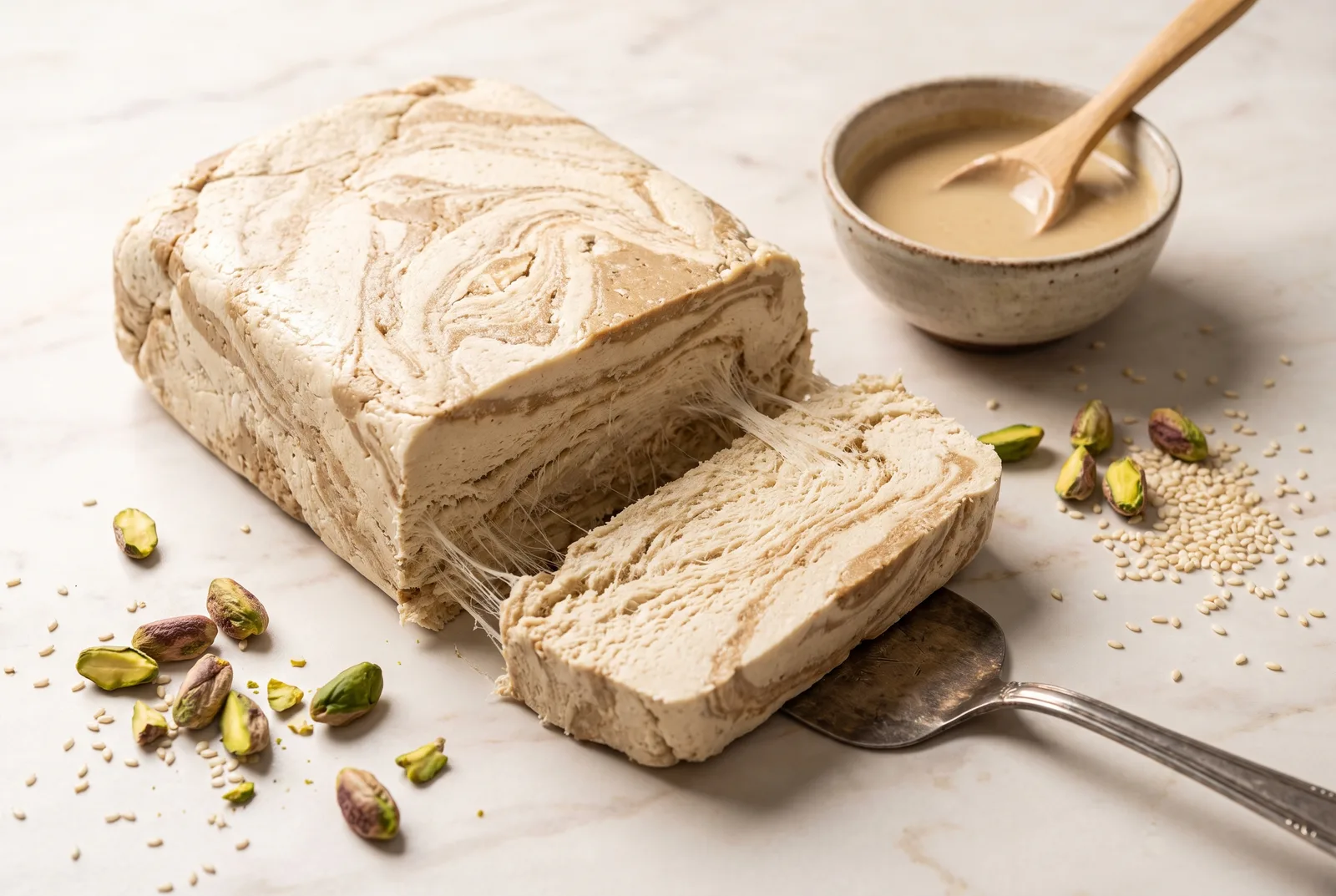
Tahini, halva and sesame in Arab confectionery: production chemistry, quality specs and professional applications
Sesame is the backbone of Arab confectionery, and this dossier follows it from seed to slab. It explains how tahini (طحينة) is really made — sesame wet-hulled by salt-water flotation, roasted around 150°C, then stone-ground into a paste that is ~50-60% oil (so oil separation is normal, not spoilage) — and why the best tahini, from Nablus and East Jerusalem family houses, is prized region-wide. It then unpacks tahini halva (حلاوة طحينية, halawa tahiniyya): the three-part build of tahini, a cooked sugar syrup and — the ingredient that makes it authentic — an extract of soapwort root ('irq/shirsh al-halawa, Saponaria officinalis) whose saponins whiten, aerate and emulsify the mass so the sesame oil never weeps out. It covers the regional names (halawa tahiniyya, tahniyya, halwa shamiyya, al-rahsh, halawet al-sha'r), the crystallisation control (citric acid and glucose), and the wider sesame-sweet family — simsimiyah (sesame brittle) and barazek (sesame-and- pistachio biscuits). Crucially for a UK maker it flags two hard commercial realities: the 2020-2021 EU ethylene-oxide sesame recalls (buy EtO-certified), and that soapwort is not an authorised GB/EU food additive. Every step is wired to the Domson basket — hulled sesame, sugar, glucose, honey, pistachio, almond, cocoa and coating chocolate — and cross-linked to the craft behind it (A7-seeds-nuts-toppings, A6-sugar-work-techniques, A8-chocolate-confectionery-formulas) and to sister traditions (B2-helva-sesame-tahini, B6-halva-confectionery, B3-attar-sugar-syrup-science).
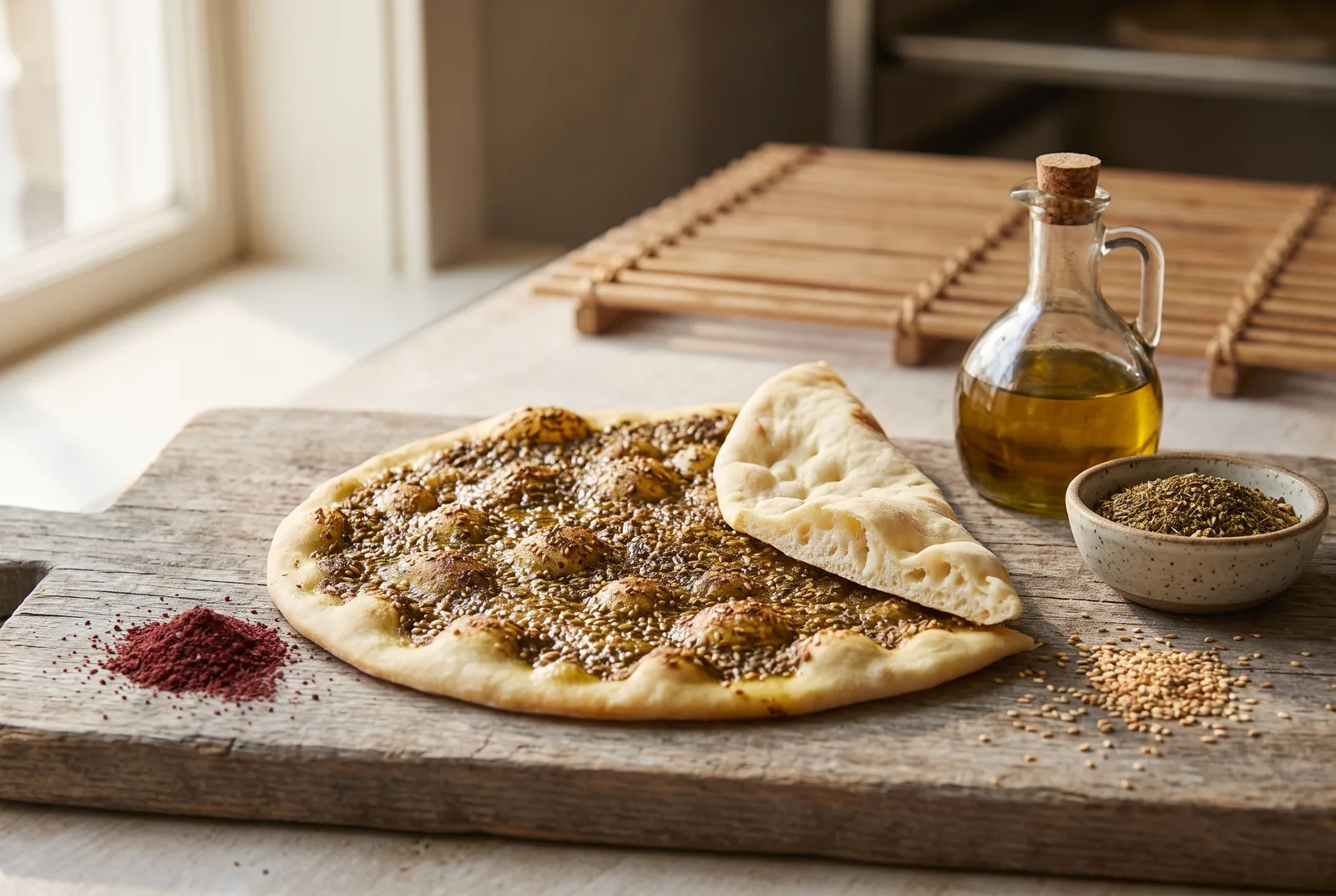
Za'atar, manakish and savoury Arab flatbreads: spice blends, olive oil ratios and the breakfast-bakery opportunity
The practical, authenticity-first guide to the Levantine breakfast bakery for a UK operator. It untangles the single most-confused point — za'atar (زعتر) names both a wild herb (Origanum syriacum, NOT common thyme) and the sesame-sumac spice blend spread on bread — then builds the man'ousheh (منقوشة) from the ground up: a lean yeasted dough, the fingertip 'naqasha' docking that gives the bread its name, the za'atar-to-olive-oil paste ratio (~1:1 to 1.3:1), and a hot, fast bake. It maps the wider savoury family — cheese manoushe with akkawi, lahm bi ajin/sfiha, kishk, and the fatayer (spinach triangles) — and the regional flatbread-and-oven landscape (khubz arabi pocket bread, saj markook, taboon, tannour, Egyptian aish baladi). Regional names, ratios and history are mined from Arabic-language sources (Coroli, Mawdoo3 and other Arabic-language culinary references) and corroborated in English references; flour, yeast, sesame and oil figures are read first from Domson's first-party supplier spec sheets. It flags a real commercial opening — manoushe has commercialised worldwide and London already has specialist mana'eesh bakeries — and wires every technique to the Domson catalogue and to the Pillar A craft articles and sibling B3 dossiers a Middle-Eastern baker leans on.