Frying fats & oils for doughnuts and bakery frying: smoke point, stability and selection
An in-depth guide to selecting and managing frying media for professional bakery doughnut production — covering fat chemistry, smoke points, oxidative stability, oil quality monitoring and RSPO sustainability credentials, with direct references to the catalogue range.

Why the frying fat decision matters more than bakers expect
In a bakery fryer, the fat is not a passive cooking medium — it is an active ingredient. Every doughnut you produce absorbs 15–25% of its own final weight in frying fat during the fry cycle and especially during the cooling phase that follows . That means the flavour, mouthfeel, shelf life and surface appearance of your product are determined as much by what is in the fryer as by what is in the dough.
The wrong fat choice can produce greasy surfaces that deteriorate within hours of frying; fat with a low smoke point can degrade quickly at operating temperature, generating acrolein, acrylamide precursors and off-flavours ; over-used oil that has not been monitored will shorten your fryer's life and pose a food-safety concern under EU frying oil guidance .
This article covers the science and practice of selecting, using and managing frying fats for professional doughnut and deep-fried bakery production. It cross-references the catalogue range available from Domson.
1. The chemistry of frying — what happens in the fryer
Understanding why certain fats perform better than others starts with three chemical characteristics.
1.1 Fatty acid profile and oxidative stability
Fats are composed of triglycerides — three fatty acid chains bonded to a glycerol backbone. The fatty acid chains differ in length and in the number of carbon–carbon double bonds:
- Saturated fatty acids (SFA): no double bonds; chemically stable; resistant to oxidation. Palm oil (saturates ~45%) and coconut oil are the most saturated common bakery fats.
- Monounsaturated fatty acids (MUFA): one double bond; more stable than PUFA; rapeseed oil (~63% MUFA) and high-oleic sunflower oil (~82% MUFA) lead in this category.
- Polyunsaturated fatty acids (PUFA): two or more double bonds; most vulnerable to oxidative attack. The Olympic Foods Sunflower Oil is 60g PUFA per 100g (60%) ; linoleic-type sunflower oils in general literature are typically cited at 65–70% PUFA .
During frying, heat and oxygen attack double bonds — particularly in PUFA-rich oils — generating peroxides, aldehydes and polar compounds that cause rancid flavours, darkened colour and smoke at increasingly low temperatures. This is why regular sunflower oil, although it has a good smoke point when fresh, has a shorter effective fry life than rapeseed or palm-based alternatives.
The Iodine Value (IV) is the traditional measure of unsaturation: higher IV = more double bonds = faster oxidation. The Palmax SG palm shortening has an IV of 45–60 gI2/100g \ — among the lowest of the catalogue range — while standard sunflower oil has IV ~120–140. High-oleic sunflower oil (IV ~78–90) sits between the two .
1.2 Smoke point
The smoke point is the temperature at which a fat begins to visibly smoke during heating, indicating the onset of rapid thermal degradation. For safe, efficient frying, the smoke point must be comfortably above the operating temperature.
<!-- IMAGE: img-a4fry-04 — Bar chart: smoke points of five bakery frying media from rapeseed (~210°C) to high-oleic sunflower (~235°C), with 180°C doughnut frying temperature shown as a reference line -->Typical smoke point ranges for refined bakery frying fats (from AOCS reference data — not stated in product spec sheets; confidence medium):
| Fat | Approximate smoke point |
|---|---|
| Refined rapeseed (canola) oil | 204–230°C |
| Refined sunflower oil | 227–232°C |
| Refined palm oil (RBD) | ~223–232°C |
| High-oleic sunflower oil | 232–235°C |
| Butter (82% fat) | 150–175°C |
Important: smoke points decrease as a fat degrades. An oil that enters the fryer at 230°C may only have a 180–190°C effective smoke point after several hours of frying. This is precisely why Total Polar Compound monitoring (see Section 5) is essential. \
Butter's low smoke point (~150–175°C) means it is not suitable as a primary frying medium for any product requiring temperatures above 160°C. Butter is used in enriched fried doughs (e.g., pączki formulas) as a dough enricher, added before frying, not as the frying fat itself. \
1.3 Free Fatty Acids (FFA) and hydrolytic rancidity
Frying oil also degrades by hydrolysis when moisture from the dough enters the hot fat. Water molecules split ester bonds in triglycerides, releasing free fatty acids (FFA). Elevated FFA:
- lowers the smoke point
- generates characteristic soapy or rancid off-flavours
- promotes foam formation on the fryer surface
- indicates significant oil degradation
Fresh refined oils have very low FFA levels: the Olympic Foods Sunflower Oil spec states a maximum of 0.1% \ and the Palmax SG palm oil a maximum of 0.2% . An FFA above 1% in used frying oil is a trigger for action.
2. Frying fat types — properties and catalogue options
2.1 Refined sunflower oil
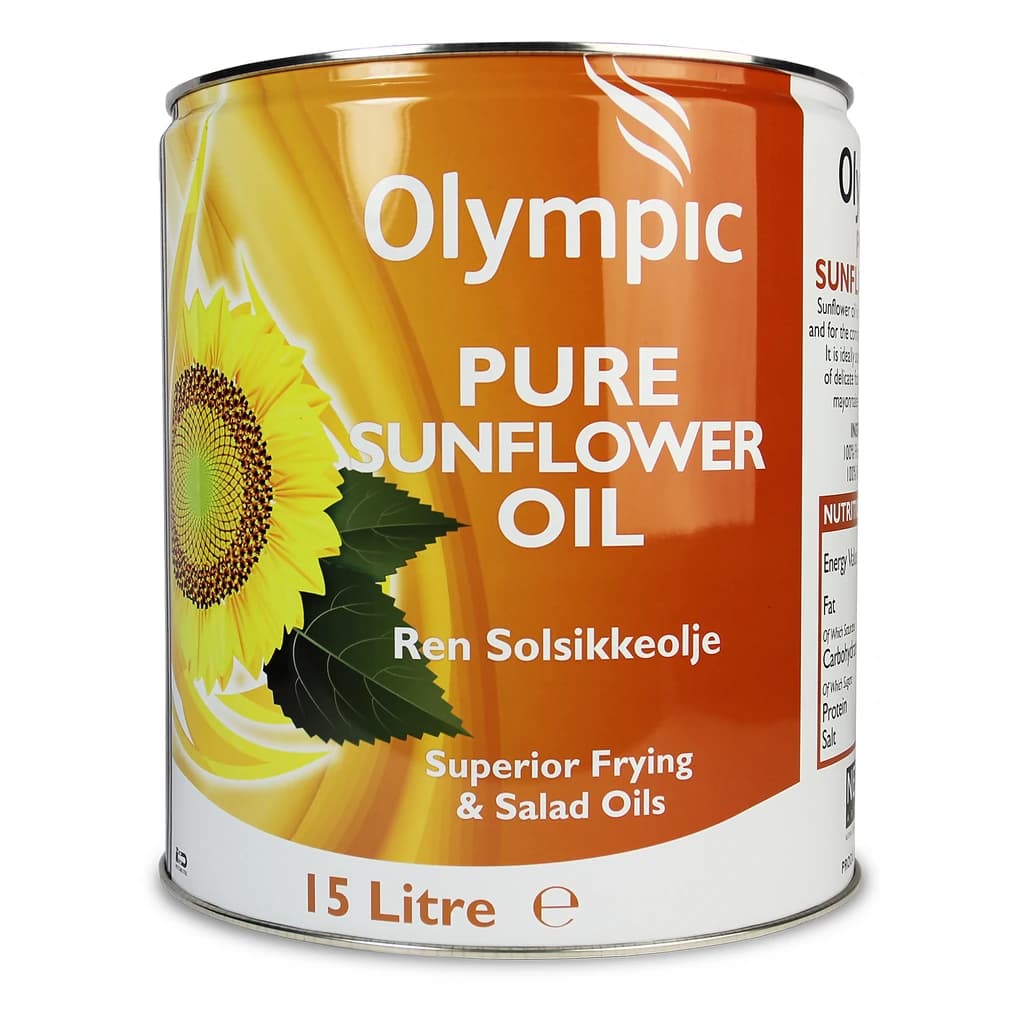
<!-- IMAGE: img-a4fry-08 — 15 L tin drum of Olympic Foods refined sunflower oil -->Olympic Foods Refined Sunflower Oil supplies fat at 100g/100g with a fatty acid profile of 11g saturates, 28g MUFA and 60g PUFA per 100g. FFA maximum 0.1% and Peroxide Value maximum 1.0 meq/kg confirm this is a high-quality, freshly refined product when received. Available in a 15 L drum. BRC AA certified; no declared allergens; no hydrogenated fats .
Suitable for: artisan bakeries producing lower volumes of fried products where fry-life is less critical; products where a neutral liquid oil is preferred. Origin: UK/France/Ukraine (excluding occupied territories).
Frying limitation: The high PUFA content (60%) means the oil oxidises faster than rapeseed or palm-based alternatives during extended frying sessions. Plan for higher oil turnover, and monitor TPC at least every 4–6 hours of active frying.
2.2 Refined rapeseed (canola) oil
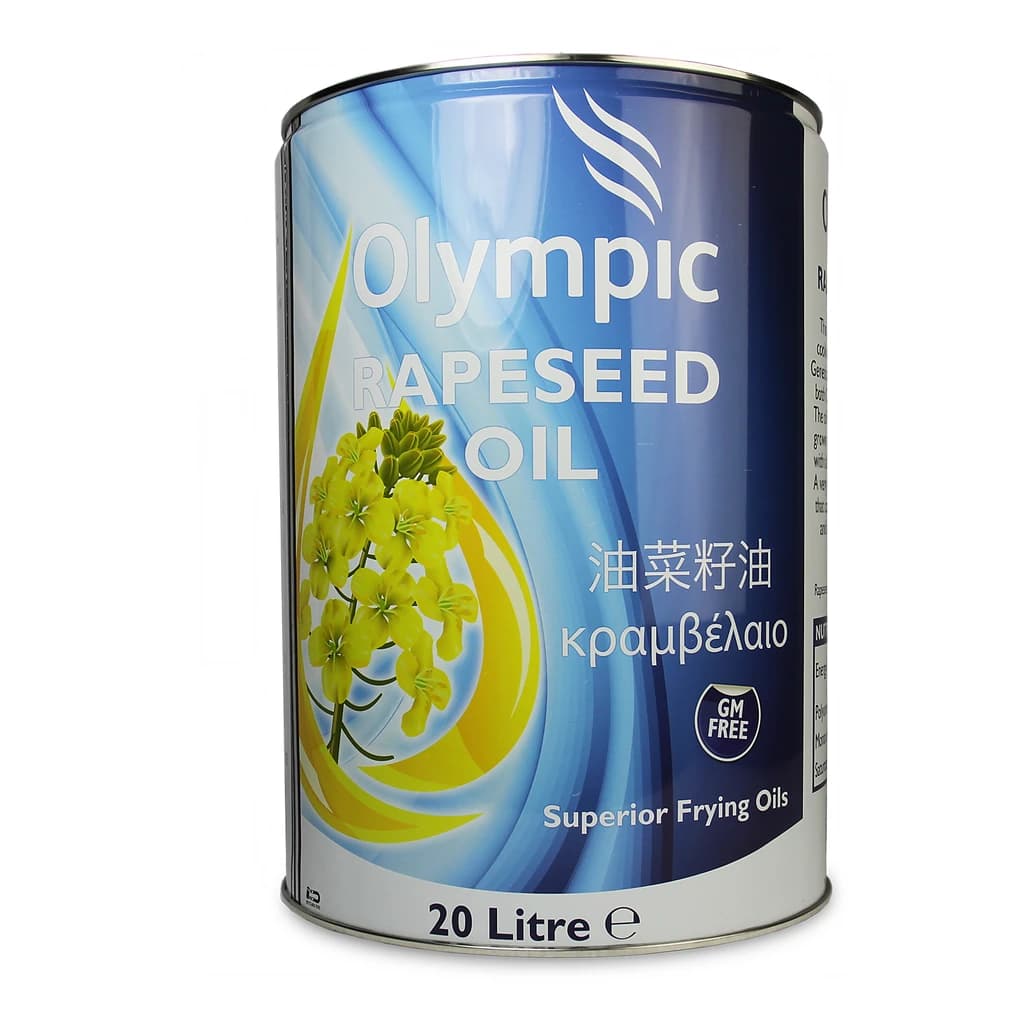
Olympic Foods Refined Rapeseed Oil delivers 100g fat per 100g with 7.5g saturates, 63g MUFA and only 28g PUFA — a substantially more stable fatty acid profile than standard sunflower oil. FFA max 0.1%; Peroxide Value max 1.0 meq/kg; no declared allergens; BRC AA certified. Available in 20 L format. Origin: UK/France .
A notable feature: this oil contains antifoaming agent E900 (dimethylpolysiloxane / PDMS) at 3 ppm. This food-grade additive, declared in the ingredient list, reduces the foam and spattering that can occur when moisture from dough enters the fryer — a significant practical benefit during continuous doughnut production . It has no sensory impact on the fried product.
Suitable for: extended continuous frying sessions; products where neutral flavour and low-saturation nutritional profile are desired; situations where antifoam benefit is valued for safety or clean production.
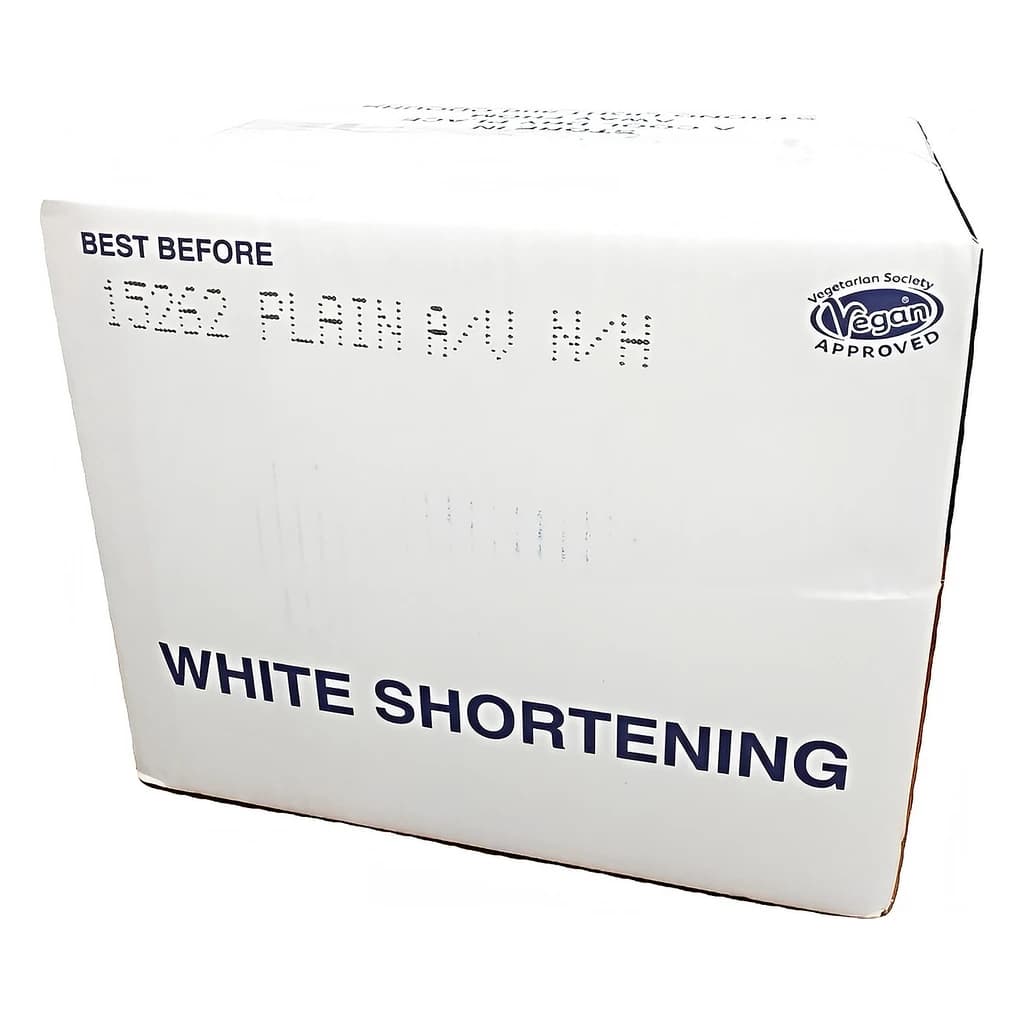
2.3 RSPO palm oil (solid)
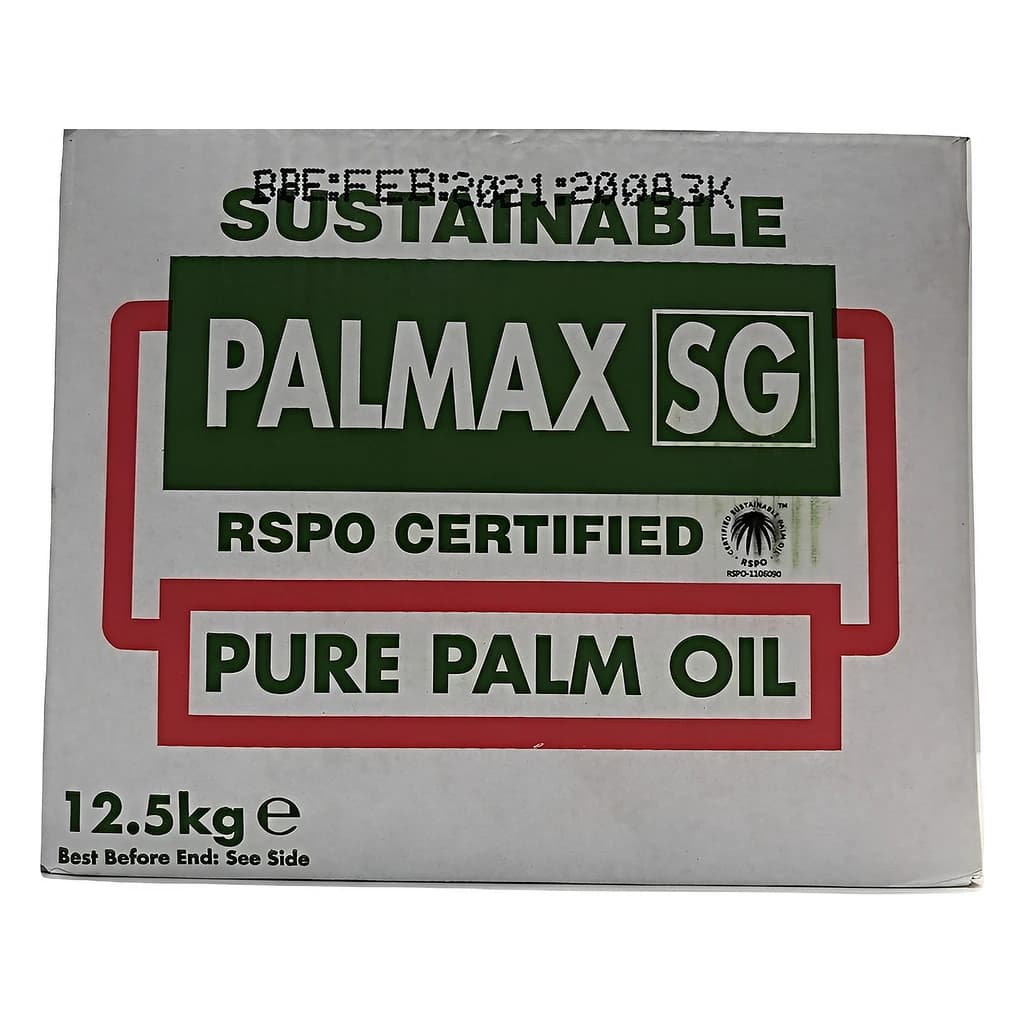
<!-- IMAGE: img-a4fry-02 — KTC Palmax SG 12.5 kg box -->KTC Palmax SG Sustainable Palm Oil is an RSPO-certified Segregated palm oil — the highest-traceability tier of RSPO certification, meaning the certified palm oil is kept physically separate from non-certified material throughout the supply chain. KTC certificate reference: BMT-RSPO-000005. Countries of origin: Malaysia, Indonesia, Papua New Guinea, Colombia .
Fatty acid profile per spec sheet: 45.3g saturates, 41.6g MUFA, 8.3g PUFA per 100g. Melting point 34–42°C (solid at ambient). FFA max 0.2%; Peroxide Value max 2.0 meq/kg; moisture max 0.1%; Iodine Value 45–60 gI2/100g.
Trans fatty acids: 1.0g/100g. This figure is present in the KTC spec sheet and arises from thermal isomerisation during high-temperature deodorisation in the refining process — not from industrial partial hydrogenation of unsaturated fats. At 1.0g/100g the product is within the EU's maximum of 2g trans fat per 100g fat in food for consumers (Regulation (EU) 2019/649), but the animal-origin exemption in that Regulation does NOT apply to vegetable fats including palm oil — the limit applies in full. Label disclosure obligations vary by jurisdiction and should be confirmed with a food law specialist.
Shelf life 11 months from production; ambient storage, clean dry conditions, away from direct sunlight and strong odours. Free from all 14 EU allergens; certified Vegan, Vegetarian, Kosher, Halal .
Suitable for: the benchmark choice for commercial doughnut production where fry life and surface quality are the priority. Solid fat at ambient temperature — melt completely and bring to frying temperature gradually before use.
Sustainability note: RSPO Segregated is the preferred credential for bakeries with a sustainability commitment. However, the broader context of palm oil production (deforestation, biodiversity) means some retailers and consumers require palm-free claims — see Section 6.
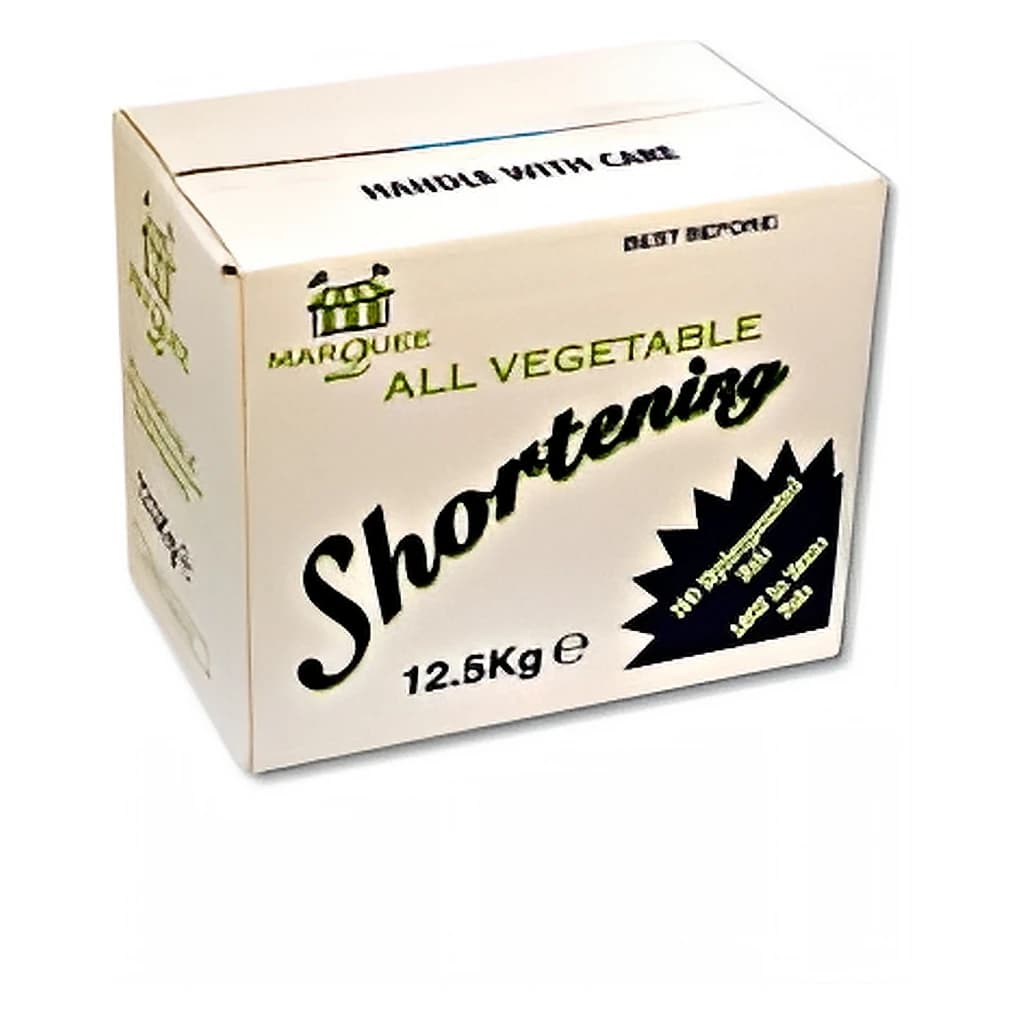
2.4 Vegetable shortenings (palm + rapeseed blends)
<!-- IMAGE: img-a4fry-06 — Cardowan vegetable shortening block packaging -->Cardowan Creameries (Glasgow) supplies two Non-Hydrogenated Aerated Vegetable (NHAV) shortenings in the catalogue range:
Plain Box NHAV Vegetable Shortening (12.5 kg block): Ingredients — Vegetable oil: Palm, Rapeseed. Fat 100g/100g; saturates 38.8g, MUFA 43.5g, PUFA 15.5g; no trans fats. Slip Melting Point 45.0°C; air content 12% (the aeration enables plastic texture and improved creaming behaviour in cake applications). FFA 0.10%; Peroxide Value 1.0. Shelf life 5 months; non-declarable processing aid citric acid E330. RSPO member certificate BMT-RSPO-000023 (Segregated and Mass Balance). No declared allergens; Kosher, Vegan, Vegetarian, Halal certified .
Coronet NHAV HR High Ratio Shortening (12.5 kg block): Similar composition (Palm, Rapeseed) with the addition of distilled monoglyceride (E471) as an emulsifier. Fatty acid profile nearly identical: saturates 38.1g, MUFA 43.5g, PUFA 16.2g. Slip Melting Point 44.0°C; air content 12%. Same shelf life and allergen status as the Plain Box .
The E471 monoglyceride in the High Ratio shortening is primarily a baking functionality additive — it improves aeration in cake batters and cream fillings and extends moisture retention. For pure frying use, the E471 provides no direct advantage over the Plain Box shortening; bakeries with both fried and baked product ranges may choose to use a single shortening across applications.
Suitable for: bakeries producing both fried (doughnuts) and baked (layer cakes, sponges) products that want to rationalise their fat procurement.
2.5 Butter (as a dough enricher, not a frying medium)
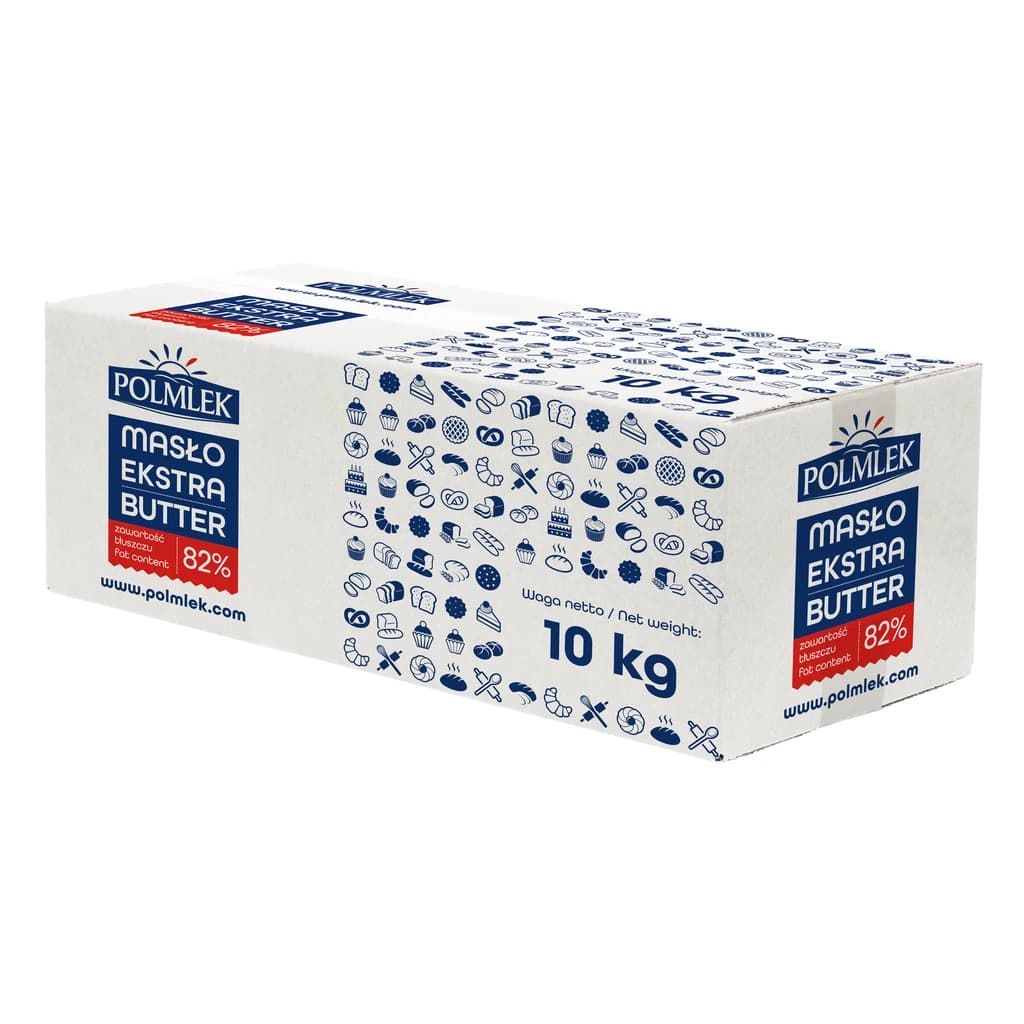
Polmlek Unsalted Butter 82% Fat (10 kg block): Made from pasteurised unacidified cream; fat 82g/100g; saturates 55g/100g; water 16%; protein 0.7g; salt 0.2g. Energy 3058 kJ / 744 kcal per 100g. Shelf life 60 days chilled (0–10°C) or 12 months frozen (-18 to -22°C, consume within 7 days of thawing). Contains milk including lactose — flag for milk allergy and vegan customers .
Butter is not a viable frying fat. Its smoke point (approximately 150–175°C from reference literature — not stated in the spec sheet) is too low for the 175–185°C required for doughnut frying. At frying temperature, butter's milk solids would burn, producing acrid flavour and darkening the oil rapidly. Butter belongs in the pączki dough (up to 10% on flour weight) for flavour and richness, not in the fryer.
3. The doughnut frying process
<!-- IMAGE: img-a4fry-05 — Cross-section diagram: doughnut showing set crust, fat-penetrated crumb layer, steam-dried centre, with fat migration arrows during cooling -->3.1 Temperature — the most critical variable
The standard frying temperature for yeast-raised doughnuts is 175–185°C . This range is a careful balance:
- Below 175°C: the dough surface does not set quickly enough; fat penetrates the full thickness of the crumb before a crust forms; fat uptake rises above 25% and the product is greasy.
- Above 185°C: the exterior crust sets and colours before the centre is fully cooked; the inside remains raw and gummy. Above ~190°C, Maillard browning accelerates and the outer colour becomes unacceptably dark. Acrylamide formation also increases significantly above these temperatures in products containing sugars and asparagine .
For cake doughnuts (chemically leavened), a slightly higher range of 180–190°C is common . Monitor fryer temperature with a calibrated thermostat probe, not just the fryer's own thermostat display.
3.2 Fat uptake — where and when it happens
Fat uptake in fried doughnuts typically falls between 15–25% of final product weight . Contrary to intuition, most of the fat is NOT absorbed during frying — it enters the product during cooling. As the product is removed from the fryer, steam condensing from the crumb creates a partial vacuum that draws fat into the pore structure. This is why:
- Draining well immediately after frying (on a wire rack) reduces final fat content
- The oil quality and viscosity at this point matters — degraded oil with higher FFA and polar compounds is more readily absorbed
- Solid shortenings, which resolidify on the product surface as it cools, can create a dryer, less greasy exterior than liquid oils
3.3 Dwell time and turning
For yeast-raised doughnuts at 175–180°C, typical dwell time is 1.5–2.5 minutes per side, turning once at the halfway point for even colour. The doughnut will float and self-turn at the correct proof level in automated continuous fryers. Under-proofed dough sinks rather than floats and fries unevenly.
3.4 Antifoam agents in production frying
In continuous doughnut production, moisture released from the dough causes foaming in the fryer. Excessive foam is a fire and overflow hazard, and it creates an insulating layer that makes temperature control erratic. The Olympic Foods Rapeseed Oil already contains E900 (PDMS) at 3 ppm \ for this purpose. If using other oils without built-in antifoam, food-grade PDMS can be added at 1–10 ppm, but this requires a separate purchase and careful dosing .
4. Selecting the right fat for your operation
The right choice depends on several factors operating simultaneously:
If surface texture is paramount (dry, non-greasy doughnut): Use a solid palm-based shortening (Palmax SG or Cardowan Plain Box). The fat resolidifies on the crust as the product cools, producing a dryer, crisper finish. \
If fry life and oil economy matter most: Palm shortening or rapeseed oil will outlast sunflower oil. High-oleic sunflower oil (not in the current catalogue range) is the best liquid option for longevity. \
If you need a palm-free option: Refined rapeseed oil is the most viable catalogue alternative. For a palm-free solid replacement, high-oleic sunflower oil or interesterified sunflower-based shortening would be the industry route — currently outside the catalogue range; FLAG for catalogue team to assess demand. \
If the bakery line covers both frying and baking: The Cardowan Coronet HR shortening bridges both; it can fry doughnuts and also be used as a baking shortening for layer cakes. This reduces SKU count in the fat store.
If traditional flavour is required: Pączki formulas often call for butter or lard in the dough. Butter (Polmlek 82%) at 10% of flour weight in the dough enriches the crumb. The frying fat should still be a refined neutral oil or shortening — butter cannot withstand frying temperatures.
Sustainability and labelling: Both the Palmax SG (KTC) and Cardowan NHAV shortenings carry RSPO certification. If labelling or customer requirements specify RSPO Segregated, use Palmax SG or verify which Cardowan stream the batch is from. \
5. Managing frying oil quality
<!-- IMAGE: img-a4fry-07 — Line chart: TPC%, FFA%, PV rising over cumulative frying hours with top-up dilution dips and 25% TPC discard threshold shown -->5.1 Why monitoring matters
Frying oil degrades through two parallel mechanisms:
- Oxidation — attack of double bonds by oxygen and heat; products include peroxides, aldehydes and TPC
- Hydrolysis — water from dough splits triglycerides into glycerol and FFA
The combined result is a rising Total Polar Compounds percentage (TPC%), rising FFA, darkening colour, lower smoke point and increasingly offensive flavour carried into every fried product.
5.2 The TPC discard threshold
Total Polar Compounds (TPC) above 25% indicate oil that must be discarded. This threshold is endorsed by Campden BRI guidance \ and is the limit applied across a broad group of European countries including Belgium, France, Italy, Spain, Austria, Switzerland, Poland and others. Note that Germany applies a stricter national limit of 24% TPC. EU-level harmonisation of TPC limits is not yet complete — bakeries should verify the limit applicable in their jurisdiction before treating 25% as universal.
TPC can be measured inexpensively with a portable meter (e.g. Testo 270 frytest) in under a minute without sending samples to a laboratory. The investment pays back quickly in avoiding both under-used oil (waste) and over-used oil (food safety risk).
5.3 The top-up strategy
Replacing a fraction of the frying oil during a production session — the "fry-through" or top-up method — dilutes degradation products and extends the effective life of the oil charge . Best practice:
- Check TPC before the session — if already >18%, replace the full charge
- Top up by 10–15% of fryer volume at the start of each shift
- Filter out food particles after every production session — carbonised particles accelerate degradation of the remaining oil
- Discard and clean the fryer when TPC exceeds 25%, FFA exceeds 1%, or the oil shows persistent smoking or acrid odour at operating temperature
5.4 Storage of unused frying fat
All frying fats deteriorate faster if exposed to light, oxygen or heat in storage. Bulk containers (the 15 L drum, 20 L drum or 12.5 kg shortening blocks) should be:
- Kept in a cool, dark dry store
- Used in strict date rotation (FIFO)
- Kept away from strong-smelling products (the shortening spec specifically notes this risk )
- Resealed after each use where the packaging allows
The Cardowan shortenings have a 5-month shelf life , shorter than the oils (15–24 months). Plan procurement to avoid holding shortening beyond the use-by period.
6. Sustainability — RSPO certification and palm-free pathways
Palm oil appears in both the Palmax SG solid palm fat and the two Cardowan shortenings. Its use raises legitimate supply-chain questions: palm cultivation is linked to deforestation and habitat loss in South-East Asia, while palm oil's high saturate content provides functional properties difficult to replicate with alternatives.
6.1 RSPO certification
The Roundtable on Sustainable Palm Oil (RSPO) provides an independent certification system with several supply-chain models:
- Segregated (SG): RSPO-certified palm is kept separate from conventional palm from farm to end product. Highest supply-chain assurance. Palmax SG operates on this model .
- Mass Balance (MB): Certified and conventional volumes are mixed in the supply chain but matched by volume at the mill level. Lower cost; acceptable for many retailers. Cardowan's RSPO certificate covers both Segregated and Mass Balance streams .
- Book and Claim / RSPO Credits: Financial mechanism only; no physical traceability.
For customer-facing claims of "sustainably sourced palm oil," Segregated is the strongest credentialing tier.
6.2 Palm-free reformulation
Growing retailer and consumer pressure on palm oil has driven significant reformulation activity. The leading alternatives in bakery frying :
- High-oleic sunflower oil — functionally closest to palm in frying stability; typically >80% MUFA; not in the current catalogue range
- Refined rapeseed oil — already in range; lower saturates than palm; suitable for liquid-oil frying where a solid surface finish is not required
- Interesterified vegetable fat (from sunflower or rapeseed) — creates solid fat without hydrogenation; a technology used by Bakels and other European fat manufacturers; not in the current range
If palm-free demand grows in your customer base, discuss with your Domson account manager — the catalogue can be extended to include high-oleic frying oil.
7. Acrylamide — a regulatory consideration for bakery frying
Acrylamide forms when reducing sugars (glucose, fructose) react with the amino acid asparagine at temperatures above 120°C — a Maillard side-reaction. In fried bakery products including doughnuts, Commission Regulation (EU) 2017/2158 establishes benchmark levels and mandatory mitigation measures, and Commission Recommendation (EU) 2019/1888 addresses ongoing monitoring — food businesses are expected to benchmark against the acrylamide levels set therein .
Practical mitigation steps relevant to doughnut frying:
- Maintain frying temperature in the 175–185°C range; avoid overshooting above 190°C
- Avoid over-fermented or over-sugared doughs where reducing sugar content is higher
- Monitor product colour — over-browned doughnuts are a proxy indicator of higher acrylamide risk
- Reduce reducing sugars in the recipe where feasible (sucrose = lower acrylamide risk than glucose syrup or inverted sugar)
Regulatory note: Specific acrylamide monitoring and reporting obligations vary by volume and market. A food safety professional should verify the applicable obligations for your production.
8. Catalogue summary
| Product | Form | Best application | Shelf life | Allergens |
|---|---|---|---|---|
| Sunflower Oil 15 L | Liquid | Low-volume frying, neutral flavour | 15–24 months | None |
| Rapeseed Oil 20 L | Liquid + E900 antifoam | Continuous frying, MUFA-stable, lower sat | 15–24 months | None |
| KTC Palmax SG 12.5 kg | Solid (RSPO Seg.) | Commercial doughnut frying, driest surface, longest fry life | 11 months | None |
| Cardowan Plain Box NHAV 12.5 kg | Solid shortening (RSPO) | Frying + baking; versatile palm/rapeseed blend | 5 months | None |
| Cardowan Coronet HR Shortening 12.5 kg | Solid + E471 (RSPO) | Frying + cake baking; emulsifier benefit for baked range | 5 months | None |
| Polmlek Butter 82% Fat 10 kg | Solid (chilled/frozen) | Pączki dough enrichment — NOT a frying medium | 60 days (chilled) / 12 months (frozen) | MILK |
Key takeaways
-
Fat chemistry drives frying performance. Lower iodine value (fewer double bonds) = longer fry life. Palm shortening and rapeseed oil significantly outlast standard sunflower oil in the fryer.
-
Smoke point must exceed operating temperature with a margin. Fresh refined oils comfortably exceed the 175–185°C doughnut frying range, but degraded oil can drop below it. Monitor.
-
Total Polar Compounds (TPC) is your primary quality metric. Test before each session; discard at >25% TPC. A handheld TPC meter pays for itself in one avoided batch of defective product.
-
Most fat enters the doughnut during cooling, not frying. Drain and cool on a wire rack immediately after the fryer. Fat quality at that moment determines the final fat content.
-
Antifoam matters in continuous production. The Olympic Foods Rapeseed Oil contains E900 (PDMS) at 3 ppm, removing a significant production hassle.
-
RSPO matters for supply-chain credentials. Both the Palmax SG (Segregated) and Cardowan shortenings (Segregated + Mass Balance) carry RSPO certification. Segregated is the strongest claim.
-
Butter is for the dough, not the fryer. Use it for flavour enrichment in pączki and Polish fried pastry doughs; use a proper frying fat for the cooking stage.
All numeric claims are supported by source IDs listed in _claims.json.
Figures
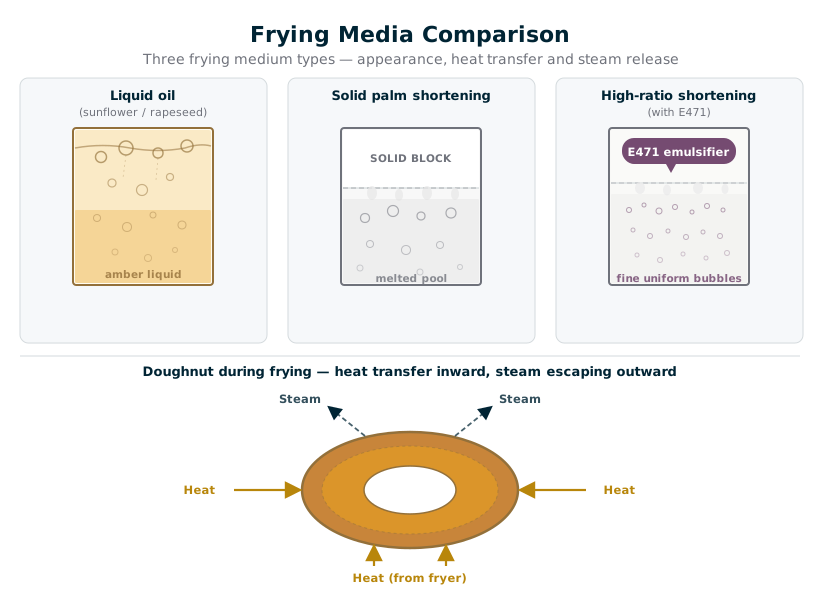 Diagram comparing three types of bakery frying media: liquid sunflower oil, solid palm shortening and high-ratio shortening, showing heat transfer and steam release during doughnut frying
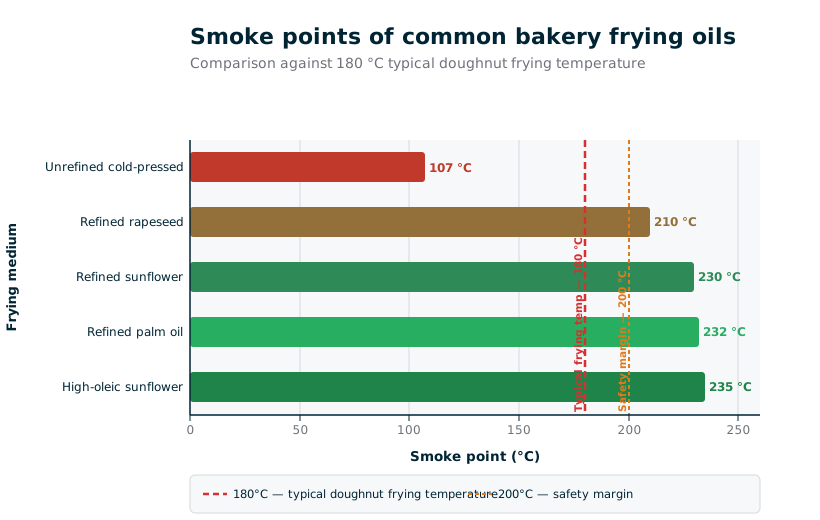 Bar chart comparing smoke points of five bakery frying oils and fats, from rapeseed oil at 210°C to palm oil at 232°C, with typical frying temperature of 180°C shown as a reference line
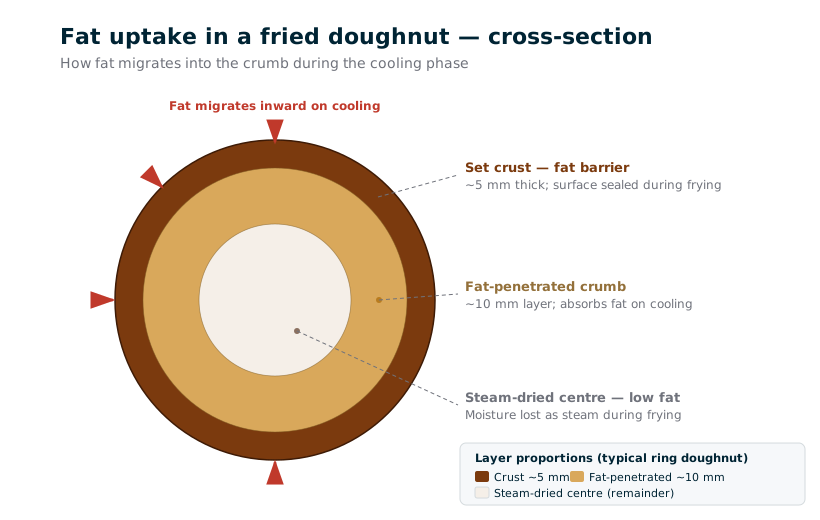 Cross-section of a fried doughnut showing three layers: dark exterior crust, fat-penetrated outer crumb, and dry inner crumb, with arrows showing fat migration during cooling
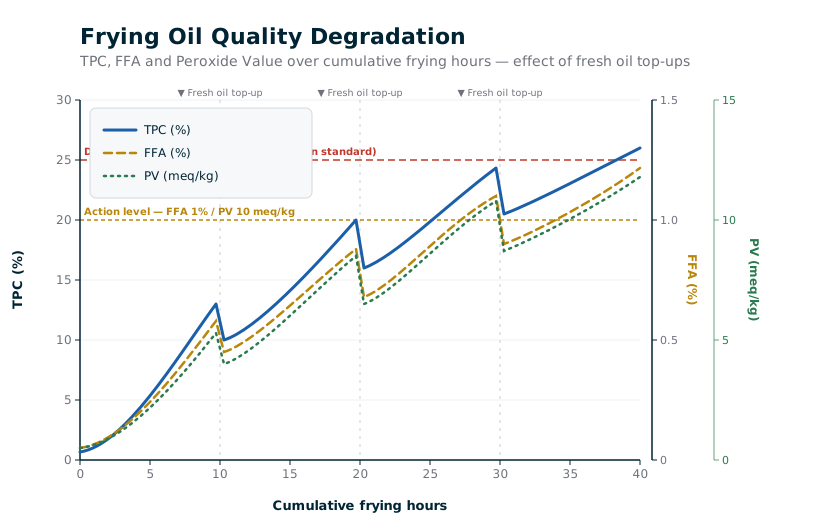 Line graph showing the rise of total polar compounds, free fatty acids and peroxide value in frying oil over cumulative frying hours, with discard thresholds and the dilution effect of fresh oil top-ups
Classic Polish pączki (yeast-raised doughnuts) — indicative baker's formula
Traditional recipe structure adapted to baker's percentages. Specific brand products referenced for cross-selling. This is illustrative; verify with your own test batches before production. Source: adapted from trade recipes (Mistrz Branży, IREKS Kompendium, KruszwicaPro guidance). Confidence: medium (reconstructed from multiple informal sources).
| Ingredient | Baker's % | Weight |
|---|---|---|
| Wheat flour (strong, min. 11.5% protein) — Weight g per 10kg flour: 10000 | 100 | |
| Water (cold, 4–8°C) — Weight g per 10kg flour: 4500 | 45 | |
| Fresh yeast — Reduce by ~40% if using instant dried yeast; Weight g per 10kg flour: 500 | 5 | |
| Sugar (fine) — Weight g per 10kg flour: 1000 | 10 | |
| Salt — Weight g per 10kg flour: 120 | 1.2 | |
| Egg yolks — ~14 yolks per 10 kg flour; Weight g per 10kg flour: 800 | 8 | |
| Butter 82% fat (softened) — Weight g per 10kg flour: 1000 | 10 | |
| Vanilla or rum flavouring — Optional — per tradition; Weight g per 10kg flour: 50 | 0.5 | |
| Spirit (neutral vodka/rum) — Traditional; the alcohol reduces fat uptake by tightening surface; can omit; Weight g per 10kg flour: 200 | 2 |
- Mix flour, yeast, water, sugar and salt first — hold back butter and egg yolks
- Add egg yolks gradually — dough should be smooth and glossy
- Add softened butter at end — mix until incorporated and dough clears the bowl sides
- First proof: 30–45 min at 26–28°C until doubled
- Scale and shape, fill with jam (rose jam traditional), seal well
- Final proof: 30–45 min at 28–30°C under cover
- Fry at 175–180°C in refined rapeseed oil or palm shortening — 2–3 min per side
- Drain on wire rack, glaze or dust with icing sugar when cooled
Fatty acid profiles from first-party spec sheets (labelled with source ID). Smoke points from AOCS/BAKERpedia reference data (not supplier-stated — confidence medium). Iodine values from spec sheets where available, otherwise from AOCS reference literature. Food safety: smoke point figures are not stated in spec sheets and vary with refining degree and free fatty acid content — treat as indicative ranges, not fixed values.
| Fat / oil | Physical form at 20°C | Saturates (g/100g) | MUFA (g/100g) | PUFA (g/100g) | Trans (g/100g) | Approx. smoke point (refined, °C) | Iodine Value (IV) | Key advantage for frying | Key limitation |
|---|---|---|---|---|---|---|---|---|---|
| Refined sunflower oil | Liquid | 11 | 28 | 60 | 0 | 227–232 | ~120–140 | High smoke point; neutral flavour; widely available | High PUFA = susceptible to oxidative rancidity; short frying life; requires antifoam in some formulations |
| Refined rapeseed (canola) oil | Liquid | 7.5 | 63 | 28 | 0 | 204–230 | ~94–120 | Highest MUFA of commodity oils; low saturates; antifoam agent E900 at 3 ppm supports continuous frying | Slightly lower fry-life than high-oleic variants; can develop 'fishy' off-note if overheated |
| High-oleic sunflower oil | Liquid | ~9 | ~82 | ~8 | 0 | 232–235 | ~78–90 | Best oxidative stability of liquid oils; longest fry life; palm-free option; cleaner product surface | Higher cost than standard sunflower; not always available in commodity volumes |
| RSPO palm oil (RBD, solid) | Solid (melts 34–42°C) | 45.3 | 41.6 | 8.3 | 1.0 | ~223–232 | 45–60 | Very long fry life; low PUFA; stable solid form; clean neutral flavour after RBD processing; RSPO certified | High saturated fat; sustainability concerns despite RSPO; solid at ambient — requires melting before use; trans fats 1g/100g |
| Vegetable shortening (palm + rapeseed blend) | Solid block | 38.8 | 43.5 | 15.5 | 0 | 185–220 | ~55–75 (estimated) | Plastic form easy to portion; intermediate saturates; no declared allergens; solid at room temp reduces mess | Lower smoke point than pure palm or sunflower; must be melted evenly before adding to fryer; 5-month shelf life |
| High-ratio shortening (palm + rapeseed + E471) | Solid block | 38.1 | 43.5 | 16.2 | 0 | 185–220 | ~55–75 (estimated) | E471 monoglyceride emulsifier improves aeration in cake batters; suitable for combo bake-and-fry lines | E471 adds no direct frying benefit; primarily a baking shortening; avoid where vegan status requires emulsifier check |
Smoke point ranges are from AOCS and BAKERpedia reference literature and are approximate: actual values depend on refinement degree, FFA content and presence of impurities. Spec sheets for these products do not state smoke points. Palm oil RBD smoke point is disputed — one source cites ~223°C, another ~232°C; the range is shown accordingly. IV for the two shortenings is estimated from fatty acid profiles, not analytically stated. Food safety: trans fat content of 1.0g/100g in Palmax SG is stated in the spec sheet and arises from thermal isomerisation during high-temperature deodorisation in refining (not from industrial hydrogenation); the product is within EU Regulation 2019/649 limits (max 2g/100g) but label disclosure obligations must be confirmed with a food law specialist.
Reference data from BAKERpedia and trade sources. Temperature and dwell time are single-source (BAKERpedia) — confidence medium. Fat uptake ranges from industry literature — confidence medium. Verify against specific product recipes and equipment.
| Doughnut type | Fry temperature (°C) | Dwell time per side (min) | Typical fat uptake (% of fried weight) | Preferred fat | Notes |
|---|---|---|---|---|---|
| Yeast-raised ring doughnut (Berliner-style / pączki) | 175–185 | 1.5–2.5 | 15–25% | Palm shortening, high-oleic sunflower oil | Turn once for even colour. Higher temp risks under-cooked centre; lower temp increases fat uptake. Fry dough must be properly proofed to prevent excessive absorption. |
| Cake doughnut (chemical-leavened batter) | 180–190 | 1–2 | 20–28% | Solid palm shortening or high-oleic oil | Higher fat uptake than yeast-raised due to lower gluten network. Temperature consistency critical — use a thermostat-controlled fryer. |
| Fried croissant / pain perdu / churros | 170–180 | 2–4 | 12–20% | Refined rapeseed oil, high-oleic sunflower | Lower temperature preferred to allow laminated/light dough to expand without burning the exterior. |
| Faworki / angel wings (Polish pastry) | 175–185 | 0.5–1.5 | 8–15% | Refined rapeseed oil or lard (traditional) | High-surface-area product; short fry time. Traditional Polish recipes use lard for flavour; modern production uses rapeseed oil. Very thin dough cooks fast. |
Data from AOCS, BAKERpedia, Campden BRI and spec sheet acceptance criteria. TPC discard limit reflects German Lebensmittelrecht and Campden BRI guidance; EU-level TPC limits are not uniformly harmonised across all member states — verify the limit for the jurisdiction applicable to your bakery.
| Parameter | Unit | Fresh oil (new) | Action level (monitor closely) | Discard threshold | Method | Notes |
|---|---|---|---|---|---|---|
| Total Polar Compounds (TPC) | % | <2% | >18% | >25% | Testo 270 (Testo frytest) or AOCS Cd 22-91 | Most reliable single indicator of frying oil abuse. The 25% limit is applied across multiple European countries (Belgium, France, Italy, Spain, Austria, Switzerland, Poland and others); Germany applies a stricter national limit of 24%. No harmonised EU-wide TPC limit is in force — verify the limit applicable in your jurisdiction. |
| Free Fatty Acid (FFA) | % as oleic acid | <0.1% (sunflower spec: 0.1 max; palm spec: 0.2 max) | >0.5% | >1.0% | EN-ISO 660; AOCS Ca 5a-40 | FFA rises as frying oil hydrolyses. Spec sheet acceptance for fresh sunflower: 0.1% max; palm: 0.2% max — both much lower than action levels, confirming fresh product quality. |
| Peroxide Value (PV) | meq O2/kg | <1.0 (both sunflower and rapeseed spec: 1.0 max) | >5 | >10 | ISO 3960:2007 | PV rises early in oxidation then falls as peroxides break down to aldehydes; PV alone is not sufficient to assess used frying oil — use with TPC. |
| Smoke point observation | °C (visual) | >220°C (refined oils) | Visible blue smoke during normal frying cycle | Persistent smoke at operating temperature | Visual/organoleptic | Smoke point decreases as FFA rises. Persistent smoking at normal frying temperature indicates oil degradation or overheating. |
| Colour and odour (organoleptic) | n/a | Clear/pale; bland or characteristic of oil type | Darkening, oily-bitter or acrid odour | Dark brown, persistent acrid smell, persistent foam | Visual + olfactory | Colour (Lovibond) is monitored in fresh oil (spec: sunflower 1.5/15 max; palm 4.5 Red max). Dark used oil absorbs colour from fried products. Persistent foam on frying surface indicates high FFA. |
| Fault | Likely cause(s) | Remedy | Preventive measure |
|---|---|---|---|
| Excessive fat uptake (greasy doughnuts) | Frying temperature too low — oil penetrates instead of setting surface,Under-proofed dough — dense structure absorbs more fat,Damaged gluten network — fat enters through weak points,High PUFA liquid oil used instead of solid shortening | Raise frying temperature by 5°C increments; check proofer temperature and humidity; use a solid palm or high-oleic shortening | Maintain thermostat-controlled fryer; proof dough to correct volume before frying; use solid shortening for low-fat product |
| Dark exterior, raw centre | Frying temperature too high,Dough pieces too large relative to temperature,Fryer thermostat inaccurate | Reduce frying temperature by 5–10°C; verify thermostat with calibrated probe; reduce piece weight | Calibrate fryer thermostat weekly; standardise dough piece weight |
| Pale, soft, unset crust | Temperature too low,Oil degraded (high TPC, low smoke point),Dough too wet | Raise temperature; replace frying oil; reduce hydration by 1–2% | Test TPC before each production batch; maintain oil quality records |
| Off-flavour / rancid taste in fried product | Oxidised frying oil (high PV or TPC),Oil not filtered after previous batches (food particles carbonise and flavour the oil),Water contamination in fryer | Discard oil; clean fryer; restart with fresh oil | Filter oil after every production session; check FFA and PV of stored oil; never allow water to enter fryer |
| Excessive foaming in fryer | High FFA (degraded oil),Water entering fryer (from wet dough surface or condensation),No antifoam agent in oil | Replace oil if FFA > 1%; allow fryer to stabilise; use rapeseed oil with E900 antifoam built in | Ensure dough surface is dry before frying; use oils with built-in antifoam (e.g. rapeseed with E900 at 3 ppm) |
| Persistent smoking at normal operating temperature | Frying oil degraded — FFA elevated, smoke point reduced,Temperature overshoot (thermostat fault),Food debris burning on heating elements | STOP frying; discard oil; check thermostat; clean fryer; restart | Monitor TPC daily; never heat oil above 200°C; filter and clean fryer regularly |
| Doughnuts break open during frying (filling leaks) | Poorly sealed seam,Dough too extensible at frying temperature,Proof temperature too high before frying | Improve sealing technique; chill dough pieces before frying; reduce proof temperature | Standardise filling process and sealing pressure; monitor proof conditions |
- Fat g per 100g:
- 100
- Saturates g per 100g:
- 11
- Mufa g per 100g:
- 28
- Pufa g per 100g:
- 60
- Trans g per 100g:
- 0
- Ffa max pct:
- 0.1
- Pv max meq per kg:
- 1
- Allergens:
- None
- Hydrogenated:
- false
- Smoke point ref c:
- 227–232 (from reference literature, not stated in spec)
- Shelf life:
- 15–24 months (pack-size dependent)
- Storage:
- Ambient, out of direct sunlight
- Certifications:
- BRC AA, Nut-free factory
- Dietary:
- Vegan, Vegetarian, Kosher (uncertified), Halal (uncertified), Gluten-free
- Fat g per 100g:
- 100
- Saturates g per 100g:
- 7.5
- Mufa g per 100g:
- 63
- Pufa g per 100g:
- 28
- Trans g per 100g:
- 0
- Antifoam agent:
- DMPS E900 at 3 ppm
- Allergens:
- None
- Hydrogenated:
- false
- Smoke point ref c:
- 204–230 (from reference literature, not stated in spec)
- Shelf life:
- 15–24 months
- Storage:
- Cool, dry, avoid direct sunlight
- Fat g per 100g:
- 99.9
- Saturates g per 100g:
- 45.3
- Mufa g per 100g:
- 41.6
- Pufa g per 100g:
- 8.3
- Trans g per 100g:
- 1
- Melting point c:
- 34–42
- Iodine value:
- 45–60 gI2/100g
- Ffa max pct:
- 0.2
- Pv max meq per kg:
- 2
- Moisture max pct:
- 0.1
- Allergens:
- None (free from all 14 EU allergens)
- Rspo certified:
- true
- Rspo model:
- Segregated
- Rspo certificate:
- BMT-RSPO-000005
- Shelf life:
- 11 months from production
- Storage:
- Ambient, off floor, clean dry area, away from odours and direct sunlight
- Certifications:
- RSPO Segregated, Kosher, Halal, Vegan, Vegetarian
- Ingredients:
- Vegetable oil: Palm, Rapeseed
- Fat g per 100g:
- 100
- Saturates g per 100g:
- 38.8
- Mufa g per 100g:
- 43.5
- Pufa g per 100g:
- 15.5
- Slip melting point c:
- 45
- Air content pct:
- 12
- Ffa max pct:
- 0.1
- Pv max:
- 1
- Allergens:
- None
- Rspo certified:
- true
- Rspo model:
- Segregated and Mass Balance
- Rspo certificate:
- BMT-RSPO-000023
- Shelf life:
- 5 months
- Storage:
- Cool, dry, away from direct sunlight and strong odours
- Non declarable processing aid:
- Citric acid E330
- Certifications:
- BRC, RSPO, Kosher, Vegetarian, Vegan, Halal
- Ingredients:
- Vegetable oil: Palm, Rapeseed; Emulsifier: distilled monoglyceride (E471)
- Fat g per 100g:
- 100
- Saturates g per 100g:
- 38.1
- Mufa g per 100g:
- 43.5
- Pufa g per 100g:
- 16.2
- Slip melting point c:
- 44
- Air content pct:
- 12
- Allergens:
- None
- Rspo certified:
- true
- Shelf life:
- 5 months
- Certifications:
- BRC, RSPO, Kosher, Vegetarian, Vegan, Halal
- Fat g per 100g:
- 82
- Saturates g per 100g:
- 55
- Water content pct:
- 16
- Energy kj per 100g:
- 3058
- Energy kcal per 100g:
- 744
- Allergens:
- Contains milk (including lactose)
- Smoke point note:
- Butter smoke point is approximately 150–175°C (unspecified in spec; reference literature only) — butter is NOT suitable as a primary frying medium due to low smoke point and milk solids that burn. Used only for flavour finishing or in small quantities for enriched fried doughs.
- Shelf life chilled:
- Maximum 60 days at 0–10°C
- Shelf life frozen:
- 12 months at -18 to -22°C; consume within 7 days of thawing
Buy the ingredients
Catalogue products and brands referenced in this article.