
Ottoman palace sweets: kadayıf, künefe, muhallebi and aşure — heritage confectionery for modern menus
Beyond baklava, the Ottoman sweet repertoire splits into three great families that a UK Turkish patisserie or muhallebici sells year-round: the shredded-pastry şerbet sweets built on tel kadayıf (künefe, fıstıklı/cevizli kadayıf, ekmek kadayıfı), the milk puddings of the palace (muhallebi, su muhallebisi, sütlaç, keşkül, tavuk göğsü, kazandibi), and aşure — Noah's pudding, the grain-and- dried-fruit sweet of Muharrem. This dossier gives a working baker the authentic picture from the Turkish geographical-indication spec for Antakya Künefesi and native Turkish culinary and academic sources: the palace helvahâne that codified these sweets; how tel kadayıf is dripped onto a rotating hot sac from a weak, low-gluten kadayıflık un (the opposite of baklava flour); the unsalted fresh künefe cheese and its UK stand-ins (dil peyniri, fresh mozzarella); the GI's ~60:40 sugar:water şerbet with a squeeze of lemon, poured hot-on-hot; the starch-and-rice-flour grammar of the milk puddings and the caramelised base of kazandibi; and the wheat-pulse-dried-fruit build of aşure. Every technique is wired to the Domson catalogue a Turkish sweet kitchen actually orders — ready kataifi, unsalted butter to clarify, maize/wheat starch, rice flour, milk and cream, sugar, glucose and citric acid, pistachios and walnuts, Turkish sultanas, currants, dates and cinnamon — and cross-linked to the Pillar A craft (A6-pastry-creams-fillings, A6-sugar-work-techniques, A4-butter-grades-and-specialist-types, A7-seeds-nuts-toppings, A5-baking-oven-science) and to the sister traditions (B2-baklava-production, B2-flour-and-milling, B2-lokum-production, B2-helva-sesame-tahini, B3-knafeh-kunafa-production, B3-attar-sugar-syrup-science).
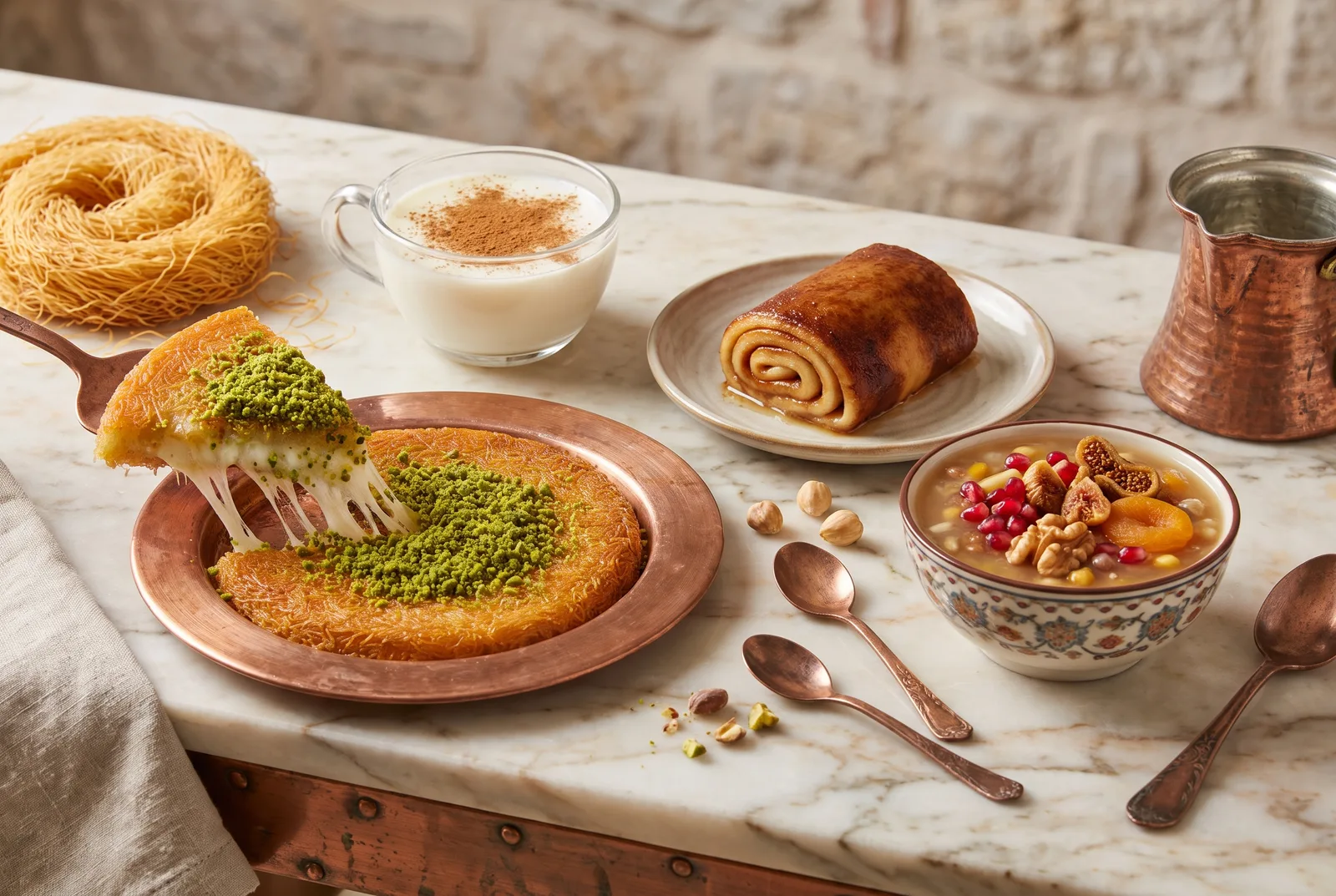
Why these sweets are a menu, not a footnote
Baklava gets the headlines (see B2-baklava-production), but the Ottoman sweet repertoire is much wider, and for a UK Turkish patisserie or muhallebici (milk-pudding shop) the daily takings come from three other families: the shredded-pastry şerbet sweets built on tel kadayıf (above all künefe), the milk puddings of the palace (muhallebi, sütlaç, keşkül, tavuk göğsü, kazandibi), and aşure — the grain-and-dried-fruit sweet of Muharrem. This dossier is the working guide to those three families; the shredded-dough cousins were promised here by the baklava article, and here they are.
These are genuinely heritage products. Ottoman palace confectionery was codified in the helvahâne, a dedicated palace kitchen that also served as the "saray eczanesi" (palace pharmacy), making macun (medicinal pastes). Its confectioner corps was the Helvahâne Ocağı and its staff the Helvaciyân-ı Hâssa; one sixteenth-century figure cited in Turkish palace-history sources puts about 812 people in the helvahâne under the Helvacıbaşı (chief confectioner) — a single-source headcount, treat it as indicative — producing desserts, jams (reçel), hoşaf and şerbet drinks, macun and pickles, with "Râhat-ı halkûm" (lokum) among its best-known confections, covered in B2-lokum-production. The Helvahane is said to be the only room in Topkapı Palace Museum that still keeps its original kitchen character. Muhallebi and sütlaç were eaten in the eighteenth-century Topkapı and Edirne palace kitchens, and kazandibi and tavuk göğsü pass in an unbroken line from that palace kitchen to the modern muhallebici counter. See the figures below (heritage spread; helvahâne and regional map).
1. The shared grammar: şerbet (sugar syrup)
Every sweet in the kadayıf family is finished with şerbet, and the discipline is the same as for baklava: get the density and the pouring temperature right. The Antakya Künefesi GI is unusually precise — its syrup is boiled from about 60% white granulated sugar to 40% water (roughly a 1.5:1 sugar:water ratio, lighter than the ~2:1 professional baklava şerbet) with a few drops of lemon juice per litre added late to invert a little sucrose and stop the syrup crystallising (şekerlenme). Because granulated sugar is ≥99.7% sucrose and caster sugar is essentially 100% sucrose, the syrup is a controlled sucrose solution whose absorption is set by how far you boil it. For the cooking-stage and anti-crystallisation science see A6-sugar-work-techniques; for the wider regional syrup rules (the hot-pastry/cold-syrup differential and floral aromatics) see the Arab B3-attar-sugar-syrup-science and the şerbet section of B2-baklava-production. See the figure below (syrup ratio and temperature).
2. Tel kadayıf — the shredded pastry
Tel kadayıf ("wire kadayıf", the fine shredded pastry) is made in a way that looks nothing like phyllo. A thin, pourable batter of low-protein flour and water (sometimes with a little starch or milk) is strained through a perforated vessel or sieve onto a special heated rotating metal disc — the dönen sac — over the fire; the fine threads set in seconds without browning, are lifted off pale, and are kept dry . The flour choice is the mirror image of baklava: where baklava demands the strongest, highest-gluten baklavalık un, tel kadayıf needs a weak, low-gluten kadayıflık un so the batter flows and forms separate strands with no gluten network — the two opposite ends of the Turkish special-purpose-flour range in B2-flour-and-milling. See the figure below (tel kadayıf on the rotating sac).
Kadayıf is a whole family, not one product. Mehmed Kâmil's landmark 1844 cookbook Melceü't-Tabbâhîn lists roughly a dozen kadayıf types (sources differ on the exact enumeration — around ten to eleven): tel kadayıf, kadife, saray tel kadayıfı, beyaz kadayıf, kaymaklı kadayıf, adi yassı kadayıf, yağsız kadayıf, yufkalı kadayıf, ekmek kadayıfı and fodula kadayıfı, with some lists also adding nuriye. In practice you meet three: tel kadayıf (the shredded strands, used for künefe and for rolled fıstıklı/cevizli kadayıf — rolled around pistachio or walnut, baked and syruped), and the two look-alike-in-name-only sweets yassı kadayıf and ekmek kadayıfı, which are semi-baked bread/pastry discs soaked in syrup — ekmek kadayıfı, an Afyon speciality, traditionally crowned with kaymak. See the figure below (the kadayıf family).
Sourcing note. The catalogue's Roasted Kataifi Pastry is a convenient ready tel kadayıf, but it is pre-roasted — authentic Turkish tel kadayıf for künefe and rolled kadayıf is used pale/unroasted and browned only during cooking, so allow for its head-start colour and reduce your cooking/oven browning accordingly (Arab-style knafeh, by contrast, often does use a pre-toasted kataifi — see B3-phyllo-kataifi-production and B3-knafeh-kunafa-production).
3. Künefe — the cheese-filled şerbet sweet
Künefe is a şerbetli (syrup) dessert of ince tel kadayıf, unsalted fresh künefe cheese (künefelik peyniri), tereyağı (butter) and şekerli şerbet. It is the flagship of Hatay: "Antakya Künefesi" carries a Turkish geographical indication (Tescil No. 101, registered 05.09.2008) whose boundary spans thirteen Hatay districts — Antakya, Samandağ, Yayladağ, Altınözü, Kumlu, Belen, İskenderun, Arsuz, Kırıkhan, Payas, Dörtyol, Hassa and Erzin. Künefe/knafeh is a shared Eastern-Mediterranean sweet: the word traces to Arabic kunāfa/kinafa; a similar sweet is referenced in the eleventh-century Divânü Lügâti't-Türk of Kaşgarlı Mahmud (the exact attestation of the word künefe there is debated, not settled) and it is recorded in Evliya Çelebi's seventeenth-century Seyahatname; the Arab sibling is the subject of B3-knafeh-kunafa-production.
The cheese is the make-or-break ingredient. Authentic künefelik peynir is a fresh, unsalted (tuzsuz), full-fat cow's-milk rennet cheese from the Antakya pastures that melts and stretches when heated and keeps poorly; the GI makes it by warming unadulterated full-fat cow's milk to around 40-65°C (a single-source figure that may describe the milk-warming rather than the ~28-33°C setting step — verify against the primary GI), cooling to lukewarm, adding rennet (peynir mayası) and setting it in vats. There is no direct catalogue equivalent, so the practical UK stand-ins are unsalted dil peyniri (string cheese) or fresh unsalted mozzarella, whose fibrous, melting structure comes closest — grated mozzarella is the everyday substitute, though it is saltier and blander than the real thing, so use a low-moisture/fresh unsalted grade and go easy on any added salt. See the figure below (künefe build).
FOOD-SAFETY FLAG. Because that milk temperature is below pasteurisation (72°C/15 s or 63°C/30 min), authentic künefe cheese is effectively a raw/unpasteurised fresh cheese with a very short (~2-3 day) cold chain — a Listeria/Salmonella/E. coli risk. If you make or buy the authentic cheese, manage the cold chain (typically 4-7°C), cook the künefe until the cheese is molten and hot right through, serve immediately, and warn vulnerable groups (pregnant, elderly, immunocompromised, infants). The UK stand-in mozzarella is pasteurised; verify the status of any authentic cheese before you sell.
The build (GI method). In a shallow copper/tinned künefe tepsisi, press buttered tel kadayıf onto the greased base, crumble the unsalted cheese over it by hand, then press the remaining kadayıf on top. Cook over low heat until the base browns, flip, and lightly brown the other side (the double-sided cook). Then pour hot syrup over the hot künefe and serve immediately, dressed with finely ground pistachio. The hot-on-hot pour is deliberate — künefe is a serve-now sweet, eaten straight from the tray while the cheese is molten. For the enriched Kilis "Cennet Çamuru" (with kaymak and Antep pistachio), see the note on cream below. The butter is melted/clarified sade yağ or tereyağı: clarify a good unsalted 82% butter (spec: 82% fat, ~16% water, ~0.7 g milk-solid protein per 100 g) so the water and milk solids do not soften or scorch the pastry — the same rule as baklava, detailed in A4-butter-grades-and-specialist-types.
4. The muhallebi family — milk puddings of the palace
Turkey's milk puddings are a technology in their own right, and it is the one that maps most directly onto Pillar A: a muhallebi is milk + sugar thickened with a starch (nişasta) and/or rice flour (pirinç unu) — structurally a crème pâtissière without egg (see A6-pastry-creams-fillings), often perfumed with rosewater (gül suyu) or mastic (damla sakızı). The name itself is old: it derives from "İbn/Bin Muhallep" (an Umayyad/Abbasid-era governor), from the Arabic halab/haleb (milk). The family:
- Muhallebi / su muhallebisi — the base pudding; su muhallebisi is a lighter, more water-based, rosewater-scented version.
- Sütlaç — rice pudding (milk + rice + sugar + starch). Fırın sütlaç is baked, traditionally in earthenware, so the top reddens and caramelises — a Maillard/caramel browning that adds aroma and thickens the set (the browning craft is A5-baking-oven-science; the caramel stage is A6-sugar-work-techniques).
- Keşkül (keşkül-ü fukara, "the dervish's bowl") — a palace pudding of milk, ground almonds, sugar, rice flour and potato starch, finished with almond, pistachio or coconut.
- Tavuk göğsü — a starch-and-rice-flour pudding into which very finely pulled boiled chicken breast is beaten to a fibrous paste (a court dish attributed to the reign of Mehmed II / Fatih; a chicken-free rosewater version also exists).
- Kazandibi ("bottom of the cauldron") — the same pudding with its base deliberately caramelised: caramelise sugar and butter in the pan, pour the hot pudding over, cook on low heat ~10-15 minutes, then cool, flip, cut into strips and roll.
Sourcing the set. The thickener is a starch, not a flour: reach for the catalogue's native maize starch (AGRANA Maisita — near-pure starch, moisture ≤14%, protein ≤0.4%, pH 4-6) or native wheat starch (Foodcom) as the mısır/buğday nişastası, and rice flour (pirinç unu) for sütlaç and keşkül. Allergen note: maize starch is gluten-free, but wheat starch is a cereals-containing-gluten (wheat) allergen — choosing the wheat starch turns an otherwise gluten-free maize-starch pudding into a wheat/gluten-declarable product, so declare the allergen against the starch you actually use. Do not confuse either starch with the product labelled "Corn Flour" (Agrol), a coarser steamed-maize meal (6 g protein, 7.5 g fibre per 100 g, sifted <250 µm — single-source datasheet figures) that will not give a smooth pudding. See the figures below (the milk-pudding family; kazandibi caramelisation).
5. Aşure — Noah's pudding
Aşure (Noah's pudding / Nuh'un aşuresi) is the one sweet on this list with no phyllo, no dairy and no fat. It is eaten on the 10th day of Muharrem (Aşure Günü), the first month of the Hijri calendar. The tradition predates Islam (it is linked to the Jewish Yom Kippur); the best-known story holds that Noah made it from the last ingredients left aboard the ark when it came to rest on Cudi Dağı (Mount Judi), and in Islamic culture the day also commemorates Karbala and is observed as a day of mourning. In the Ottoman period aşure spread from the palace to the tekke (dervish lodge), konak and household; it was cooked under the helvacıbaşı, ladled into aşure jugs (aşure testileri) and distributed to the people and the poor — a charitable, community act.
The build. A classic aşure (about 20-25 servings) combines hulled/cracked wheat (dövme / aşurelik buğday, ~4 cups) with chickpeas (nohut, ~1 cup), dried white beans (kuru fasulye, ~1 cup) and rice (~½ cup), sweetened with sugar and studded with dried fruits — dried apricots, dried figs, currants (kuş üzümü) and raisins. The wheat is soaked and boiled the night before, the pulses cooked separately, then everything is combined and finished with a garnish of walnuts, pine nuts, almonds or hazelnuts, pomegranate seeds (nar), sesame and cinnamon . Because it is dairy-, egg- and fat-free, aşure naturally suits fasting and vegan diets — subject only to its nut and sesame garnish, which is a tree-nut/sesame allergen. Note that vegan does not mean gluten-free: the hulled wheat means aşure still contains cereals/gluten (wheat) and must be declared as such . See the figure below (aşure and its ingredients).
Sourcing note. The catalogue carries excellent aşure fruit — Turkish Laser Scanned Sultanas (from Turkey; 275 kcal, 69.4 g sugars/100 g), Currants and Chopped Dates 8-10 mm (282 kcal, 63.35 g sugars/100 g; 18-month shelf life) — plus cinnamon and walnuts for the garnish. But the three grain/pulse bases — aşurelik (hulled) wheat, chickpeas and dried white beans — are not currently in the catalogue, so a Turkish sweet kitchen sources those (and rosewater/mastic for the puddings) separately. Note also that the chopped dates carry a rice-flour dusting (rice, not wheat — it adds no gluten) and the sultanas carry a sulphur-dioxide cross-contamination control. Caveat: many Turkish light/golden sultanas are themselves SO₂-treated — if the finished product's sulphites exceed 10 mg/kg as an ingredient (not merely "handled on site"), declare sulphites as an ingredient allergen, not only a "may contain"; verify against the live label — see allergens below.
6. Allergens and food safety (declare before you sell)
Allergens and food safety. All allergen and food-safety statements here must be verified against each supplier's current label and your own finished recipe.
These sweets are allergen-dense and every one of the 14 UK/EU declarable allergens that applies must be shown: milk (butter — including butter clarified to sade yağ, which still carries the milk allergen — künefe cheese, the muhallebi/sütlaç/keşkül/kazandibi puddings, kaymak/cream); cereals containing gluten (wheat in tel kadayıf, in aşure, and in any pudding made with native wheat starch rather than the gluten-free maize starch); tree nuts (pistachio, walnut, almond, hazelnut); and sesame (aşure garnish). Supplier specs add cross-contamination flags to watch: the Turkish sultanas carry a sulphur-dioxide/sulphite control (SO₂ handled on site in a segregated area — and if the sultanas are themselves SO₂-treated above 10 mg/kg, declare sulphites as an ingredient, not only a "may contain"), and the ground cinnamon "may contain trace amounts of celery, mustard and sulphur dioxide". Further truths matter for menu labelling:
- Künefe cheese (like many Turkish white cheeses) is set with rennet (peynir mayası) that may be animal-derived, and tavuk göğsü and kazandibi contain chicken — so none of these is automatically vegetarian; confirm the rennet type and label accordingly.
- Authentic künefe cheese is made from sub-pasteurisation milk and keeps only ~2-3 days — see the raw-milk cold-chain flag in Section 3.
- The catalogue UHT "double cream" is a filled cream / vegetable-fat blend (milk, cream and palm-coconut fat with stabilisers), a milk allergen and not pure dairy cream — it cannot legally be described as "cream"/"double cream" on a finished product, so name it accurately if you use it as a kaymak stand-in.
Treat the allergen, rennet, sulphite and nutrition panel as a mandatory, human-verified step.
Buy the ingredients for this
See the products at the end of this article for the full mapping. In short, a UK Turkish sweet kitchen orders from Domson: ready kataifi/tel kadayıf (noting the roasted head-start) for künefe and rolled kadayıf; unsalted 82% butter to clarify into sade yağ; fresh/grated mozzarella as the practical künefe-cheese stand-in (authentic is unsalted Hatay künefelik peyniri / dil peyniri); granulated and caster sugar with glucose syrup and citric acid for the şerbet; native maize and wheat starch plus rice flour and UHT milk for the muhallebi family; double cream as a kaymak-substitute topping (a filled cream blend — see the note); pistachios (ground and diced) and walnuts for kadayıf, künefe and aşure toppings; and Turkish sultanas, currants, chopped dates and cinnamon for aşure — with aşurelik wheat, chickpeas, dried white beans, mastic and rosewater sourced separately.
Figures
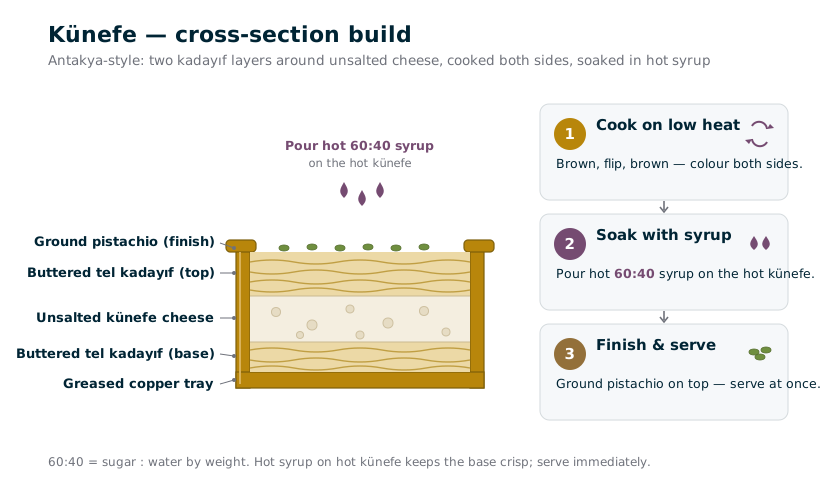 Cross-section diagram of künefe: kadayıf base, unsalted cheese middle, kadayıf top, flipped and cooked both sides, hot syrup poured over, pistachio topping
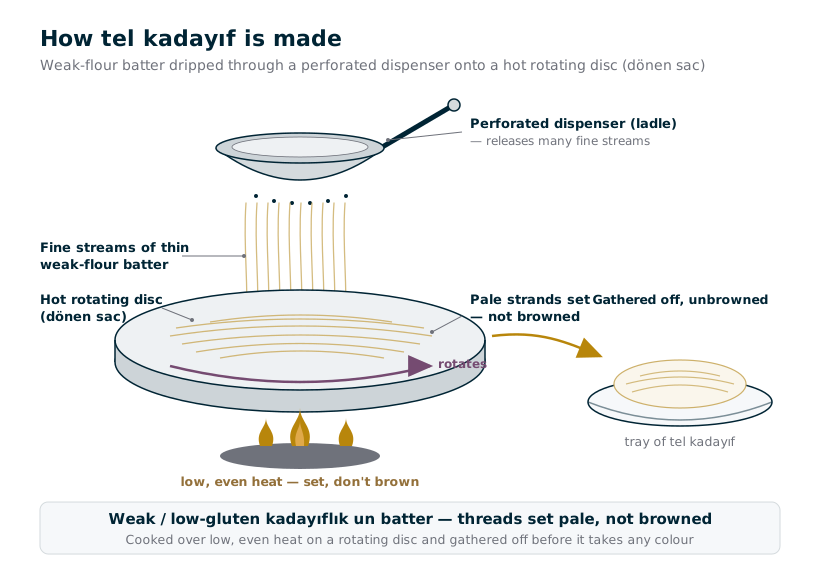 Illustration of tel kadayıf being made — batter dripped through a sieve onto a hot rotating disc, forming pale shredded strands
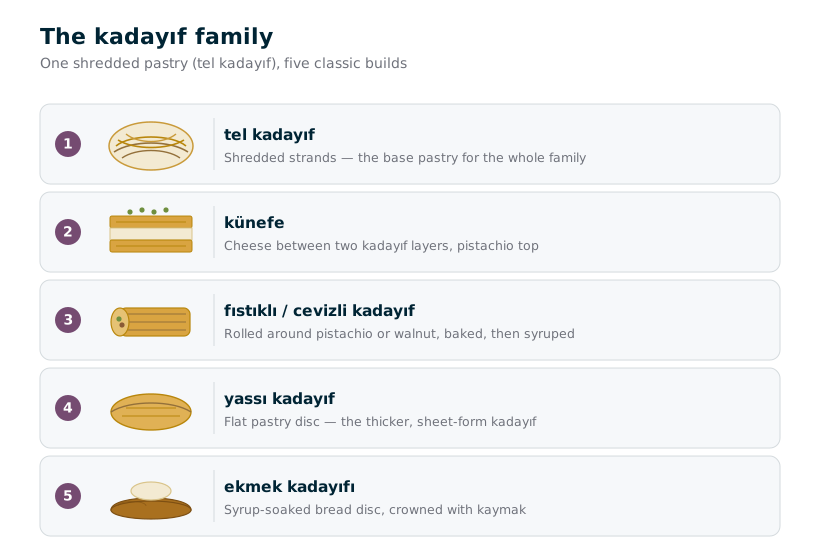 Chart of kadayıf types: tel kadayıf, künefe, rolled pistachio/walnut kadayıf, yassı kadayıf, and ekmek kadayıfı with kaymak
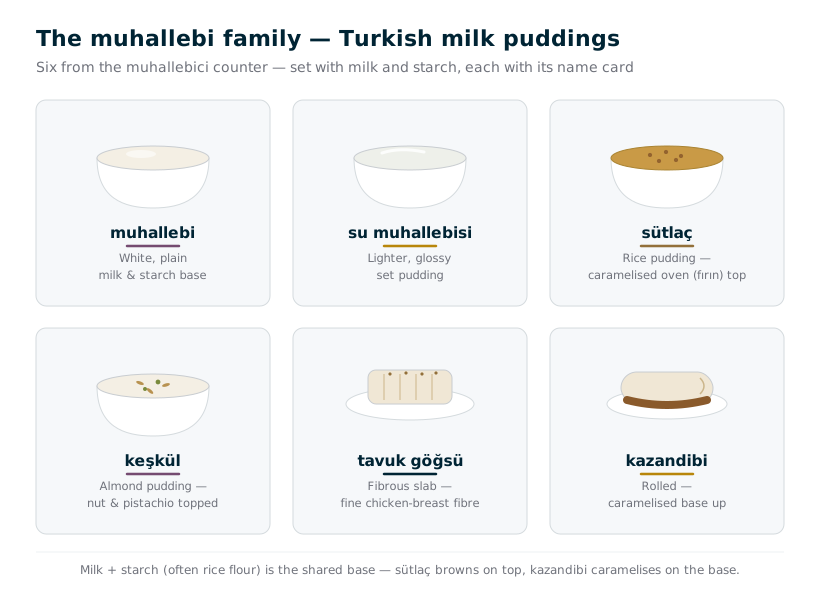 Display of Turkish milk puddings — muhallebi, su muhallebisi, sütlaç, keşkül, tavuk göğsü and kazandibi — each labelled
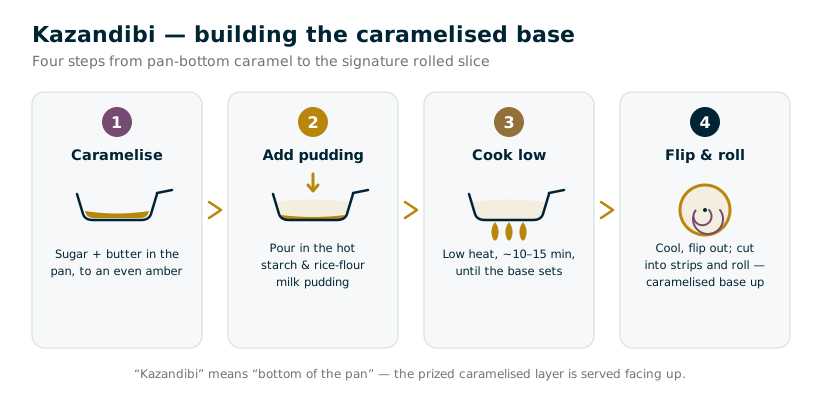 Four-step diagram of kazandibi: caramelise base, add pudding, cook low, cool and roll to show the caramelised bottom
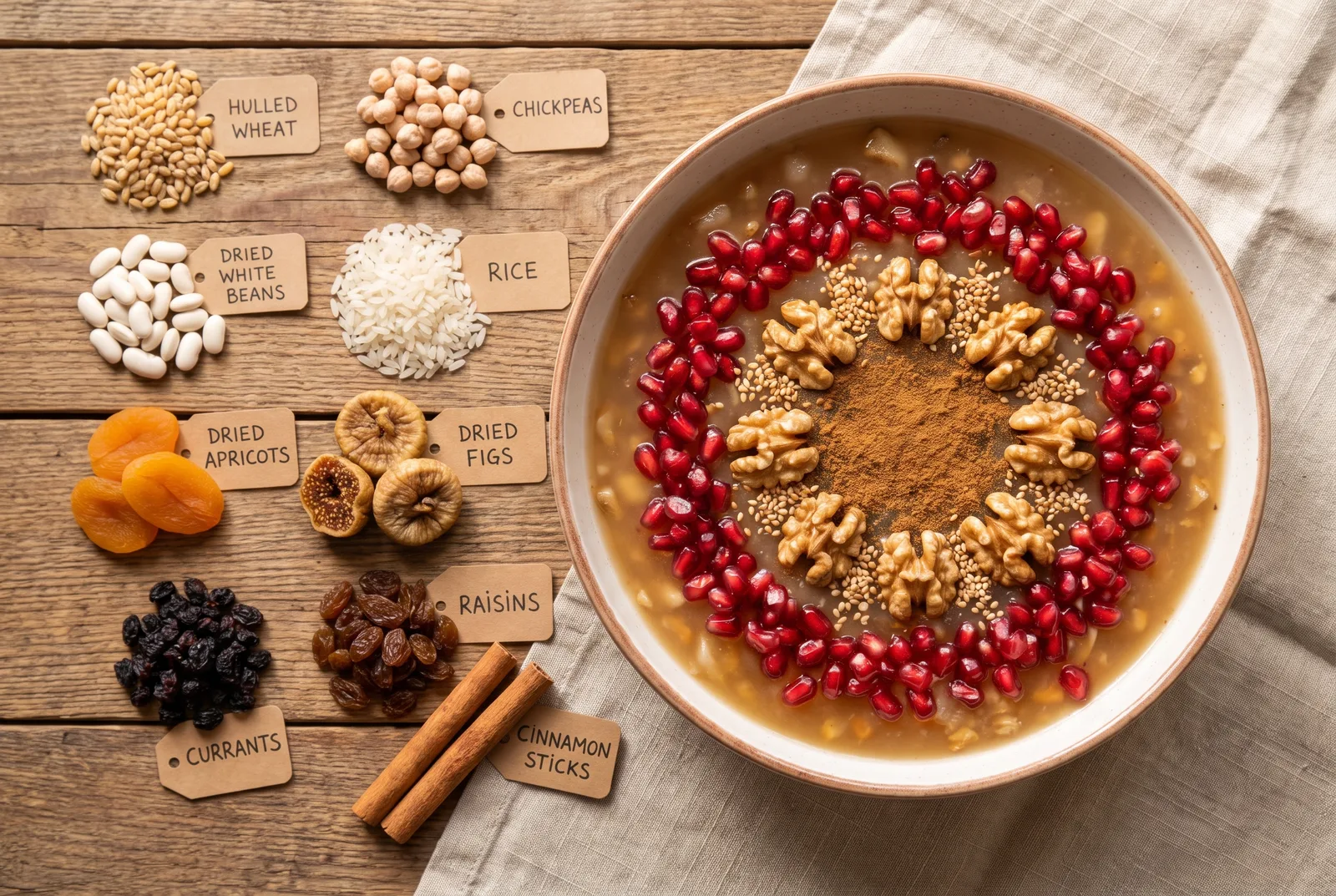 Bowl of garnished aşure next to a flat-lay of its ingredients — wheat, chickpeas, beans, rice, dried fruit and cinnamon
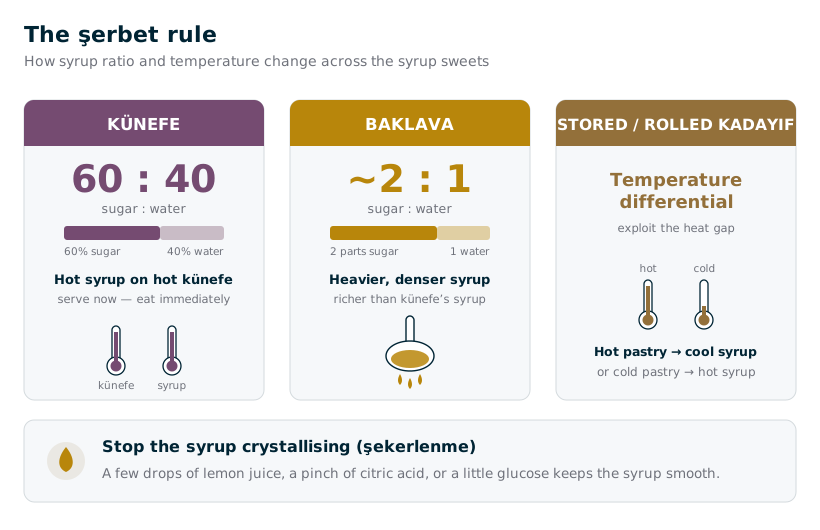 Infographic comparing syrup ratios and pouring: künefe 60:40 hot-on-hot, baklava 2:1, stored kadayıf temperature differential
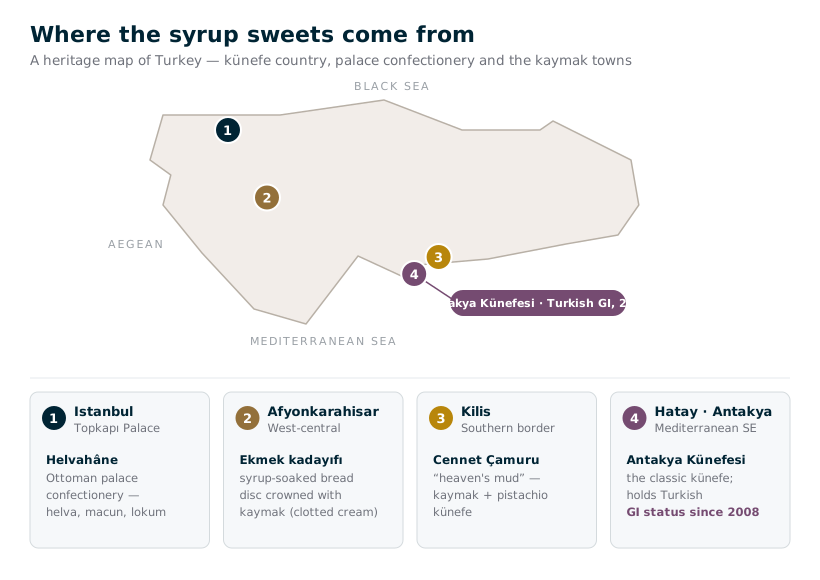 Map of Turkey highlighting Antakya künefe (GI 2008), Kilis Cennet Çamuru, Afyon ekmek kadayıfı, and the Topkapı Helvahâne
Antakya künefe — tray build (GI method)
Künefe is a serve-now sweet — the cheese must be molten at the table, so it is syruped hot-on-hot. Clarify the butter so its water and milk solids do not soften or scorch the pastry (A4-butter-grades-and-specialist-types). Authentic cheese is unsalted Hatay künefelik peyniri; the mozzarella/dil-peyniri route is a practical substitute.
| Ingredient | Baker's % | Weight |
|---|---|---|
| Tel kadayıf (pale; roasted kataifi allows for head-start colour) | base + top layers | |
| Unsalted künefe cheese / dil peyniri / fresh mozzarella | middle layer | |
| Clarified butter (sade yağ) | to coat the kadayıf | |
| 60:40 sugar syrup (hot) | to soak, poured hot-on-hot | |
| Ground pistachio | to finish | |
| Total | n/a (assembly) |
Worked example
Grease a shallow copper/tinned künefe tepsisi. Toss tel kadayıf with melted clarified butter (sade yağ). Press half onto the base; crumble unsalted künefe cheese (or unsalted dil peyniri / fresh mozzarella) evenly over it; press the remaining kadayıf on top. Cook over low heat until the base is golden, flip, and lightly brown the second side. Pour hot 60:40 syrup over the hot künefe and serve at once, topped with finely ground pistachio.
Yield: one künefe tray, cut into portions
Künefe syrup (şerbet) — Antakya GI ratio
A lighter syrup than baklava's ~2:1 because künefe is eaten fresh and warm, not stored. Because sugar is ≥99.7% sucrose, density is a controlled sucrose concentration set by boiling; citric acid or a little glucose syrup can replace lemon for shelf-stable batches (A6-sugar-work-techniques).
| Ingredient | Baker's % | Weight |
|---|---|---|
| Granulated / caster sugar | 100% | |
| Water | ~67% (i.e. 40 parts water to 60 sugar) | |
| Lemon juice (or citric acid) | trace, late in the boil | |
| Total | sugar: water ≈ 60: 40 (≈1.5: 1) |
Worked example
e.g. 600 g sugar: 400 g water (or 1.5 kg: 1 L). Boil to the desired consistency; add a few drops of lemon juice (≈per 1 L syrup) in the last minutes to prevent crystallisation (şekerlenme). Pour hot over hot künefe.
Yield: enough to soak one tray
Muhallebi base — relative to milk
Structurally an egg-free crème pâtissière (A6-pastry-creams-fillings): the starch gelatinises to set the milk. Use a fine STARCH (nişasta), not the coarse 'corn flour' maize meal, for a smooth set; rice flour gives the characteristic sütlaç/keşkül texture. Allergen note: maize starch is gluten-free but native wheat starch is a cereals-containing-gluten (wheat) allergen — declare per the starch you use. Mastic (damla sakızı) and rosewater (gül suyu) are the classic aromatics and are sourced separately from the catalogue.
| Ingredient | Baker's % | Weight |
|---|---|---|
| Milk (UHT whole 3.2%) | 100% | |
| Sugar | ~15-20% | |
| Maize/wheat starch (nişasta) | ~6-8% | |
| Rice flour (pirinç unu) — sütlaç/keşkül | ~4-6% | |
| Rosewater or mastic | to taste | |
| Total | ~120-125% including sugar and starch |
Worked example
Per 1 L milk: ~150-200 g sugar, ~60-80 g starch (maize or wheat nişasta) and/or ~40-60 g rice flour slaked in a little cold milk; scald the milk, whisk in the slaked starch, cook to a nappé that coats the spoon, add rosewater or mastic off the heat, portion and chill. For keşkül add ~80-100 g ground almonds; for sütlaç cook with rice; for kazandibi caramelise the tray base.
Yield: a batch of milk pudding
Aşure (Noah's pudding) — representative batch
Dairy-, egg- and fat-free, so naturally vegan/fasting-friendly — the nut and sesame garnish is the only allergen (A7-seeds-nuts-toppings). The catalogue supplies the dried fruit (Turkish sultanas, currants, chopped dates, golden raisins), walnuts and cinnamon; the hulled wheat, chickpeas and dried white beans are sourced separately.
| Ingredient | Baker's % | Weight |
|---|---|---|
| Hulled/cracked wheat (aşurelik buğday) | ~4 cups | |
| Chickpeas (nohut) | ~1 cup | |
| Dried white beans (kuru fasulye) | ~1 cup | |
| Rice | ~½ cup | |
| Sugar | to taste | |
| Dried fruit (apricot, fig, currants, raisins) | to taste | |
| Garnish: walnut/pine nut/almond, pomegranate, sesame, cinnamon | to finish | |
| Total | n/a (mixed pot) |
Worked example
~4 cups hulled/cracked wheat (soaked and boiled the night before) + 1 cup chickpeas + 1 cup dried white beans + ½ cup rice (pulses cooked separately, then combined); sweeten with sugar to taste; stir in dried apricots, dried figs, currants and raisins; simmer to a loose, glossy pudding. Portion, then garnish with walnuts, pine nuts or almonds/hazelnuts, pomegranate seeds, sesame and ground cinnamon.
Yield: ~20-25 servings
This dossier covers three distinct technologies. Use this to place a product before choosing a method.
| Family | Base | Key members | Finished with | Craft link |
|---|---|---|---|---|
| Shredded-pastry şerbet sweets | Tel kadayıf (shredded pastry from weak flour) | Künefe, fıstıklı/cevizli kadayıf, yassı kadayıf, ekmek kadayıfı | Clarified butter + sugar syrup (± cheese/kaymak) | B2-flour-and-milling; B3-knafeh-kunafa-production |
| Milk puddings | Milk + sugar + starch/rice flour | Muhallebi, su muhallebisi, sütlaç, keşkül, tavuk göğsü, kazandibi | Rosewater/mastic; caramelised base (kazandibi); oven top (fırın sütlaç) | A6-pastry-creams-fillings; A6-sugar-work-techniques |
| Grain-and-fruit sweet | Hulled wheat + pulses + dried fruit | Aşure (Noah's pudding) | Sugar; garnish of nuts, pomegranate, cinnamon, sesame | A7-seeds-nuts-toppings |
The cheese is the make-or-break ingredient. Authentic künefelik peynir has no direct catalogue equivalent; these are practical stand-ins.
| Cheese | Character | Verdict for künefe | Notes |
|---|---|---|---|
| Künefelik peynir (Antakya, authentic) | Fresh, unsalted (tuzsuz), full-fat cow's-milk rennet cheese; melts and stretches; poor keeper | The real thing (GI) | Milk warmed to ~40-65°C (below pasteurisation → raw-milk, ~2-3 day cold chain — human-review food-safety flag) and set with rennet; not in the catalogue |
| Unsalted dil peyniri (string cheese) | Fibrous, low-salt, melts and stretches | Closest practical substitute | Best UK stand-in for texture and melt |
| Fresh / grated mozzarella | Fibrous, melting; saltier and blander | Everyday working substitute | Use a low-moisture / fresh unsalted grade; go easy on added salt |
| Mozzarella-cheddar blend | Melts but salty and coloured by cheddar | Last resort only | Cheddar adds salt and colour away from the unsalted ideal — not recommended |
One base technology — milk thickened with starch and/or rice flour — differentiated by additions and finish.
| Pudding | Thickener / addition | Finish | Notes |
|---|---|---|---|
| Muhallebi | Starch (nişasta) and/or rice flour | Rosewater or mastic | The base pudding; egg-free crème pâtissière analogue |
| Su muhallebisi | Starch, more water / less milk | Rosewater | Lighter, more delicate set |
| Sütlaç | Rice + starch | Fırın sütlaç: baked, caramelised top | Earthenware oven bake reddens the surface |
| Keşkül (keşkül-ü fukara) | Ground almonds + rice flour + potato starch | Almond / pistachio / coconut | Palace 'dervish's bowl'; almond-rich |
| Tavuk göğsü | Starch + rice flour + pulled chicken breast | Cinnamon | Fibrous paste; court dish from Fatih's reign; contains chicken |
| Kazandibi | Same as tavuk göğsü | Caramelised base, flipped and rolled | 'Bottom of the cauldron'; base scorched on purpose |
Density and pouring temperature are the two make-or-break syrup variables. Künefe runs a lighter syrup than baklava, poured hot-on-hot for immediate service.
| Sweet | Sugar: water | Pour | Anti-crystalliser |
|---|---|---|---|
| Künefe (Antakya GI) | ~60: 40 (≈1.5: 1) | Hot syrup over hot künefe, serve immediately | A few drops lemon per litre |
| Baklava (professional Antep) | ~2: 1 | Hot-on-hot (fresh) or temperature differential (stored) | Lemon/citric acid or glucose (see B2-baklava-production) |
| Rolled kadayıf (fıstıklı/cevizli), stored | ~1.5-2: 1 | Cooled syrup on hot pastry, or hot on cold (differential) | Lemon/citric acid; glucose for shelf life |
| Fault | Likely cause | Remedy |
|---|---|---|
| Künefe soggy / not crisp | Syrup too thin, too much syrup, or whole (un-clarified) butter softening the pastry | Boil syrup to the 60:40 consistency; clarify the butter; pour hot-on-hot and serve at once |
| Künefe cheese rubbery / won't stretch | Salted or aged cheese, or overcooked | Use unsalted fresh künefe cheese / dil peyniri / fresh mozzarella; cook just until molten |
| Künefe base burnt, top pale | Heat too high, not flipped | Cook on low heat and flip for the double-sided golden finish |
| Tel kadayıf browned/brittle before use | Pre-roasted kataifi, or cooked too far on the sac | Use pale kadayıf; with roasted kataifi reduce cooking/oven browning |
| Muhallebi lumpy or floury-tasting | Starch not slaked, added to hot milk, or coarse 'corn flour' meal used | Slake fine starch in cold milk, whisk in, cook out; use nişasta not the maize meal |
| Muhallebi too loose / too stiff | Wrong starch ratio | Target ~6-8% starch to milk; add rice flour for a firmer sütlaç/keşkül set |
| Kazandibi base won't caramelise / burns | Pan too cool (no colour) or too hot (bitter) | Caramelise sugar+butter to an even amber, then pour pudding and cook low ~10-15 min |
| Aşure claggy / grains split unevenly | Wheat under-soaked, pulses cooked in the same pot | Soak/boil wheat overnight; cook chickpeas and beans separately, then combine |
| Syrup crystallises (şekerlenme) on storage | No invert acid in a syrup that will be kept | Add lemon/citric acid late in the boil, or a little glucose syrup |