Hot cross buns, Chelsea buns, lardy cake and Yorkshire teacakes: a production guide to British enriched yeasted bakes
Britain's tea-time counter runs on a family of enriched, spiced, fruited yeasted doughs. This dossier gives a UK baker the working picture, wired to the Domson catalogue and cross-checked against first-party supplier specifications: the one shared enriched dough behind all four (strong flour ~12% protein, fat added late, fruit added last); the four builds that make them distinct - hot cross buns (spiced fruited buns with a flour-paste cross and hot glaze), Chelsea buns (spiral pinwheels packed to fuse into a sticky pull-apart tray), lardy cake (a fruited, sugared rough-lamination of bread dough with lard), and Yorkshire teacakes (a lightly enriched fruited breadcake for splitting and toasting); the authentic history (the 1592 Elizabethan spiced-bun decree, the Chelsea Bun House, the Wiltshire lardy-cake harvest tradition); and the home-market regulation that matters most here - the Bread and Flour Regulations 1998 fortification, the 2024 folic-acid amendment, Natasha's Law and finished-product allergen labelling. Every technique is linked to the Pillar A craft concepts behind it (A1-protein-gluten-and-strength, A2-osmotolerant-yeast-enriched-doughs, A4-fat-types-and-selection, A5-dough-mixing-methods, A6-glazes-finishes, A8-enriched-dough-formulas) and to its sibling British articles (B7-flour-landscape, B7-chorleywood-vs-craft, B7-scones-crumpets-muffins, B7-fruit-celebration-cakes, B7-regional-breads-map).
Britain's tea-time counter, decoded
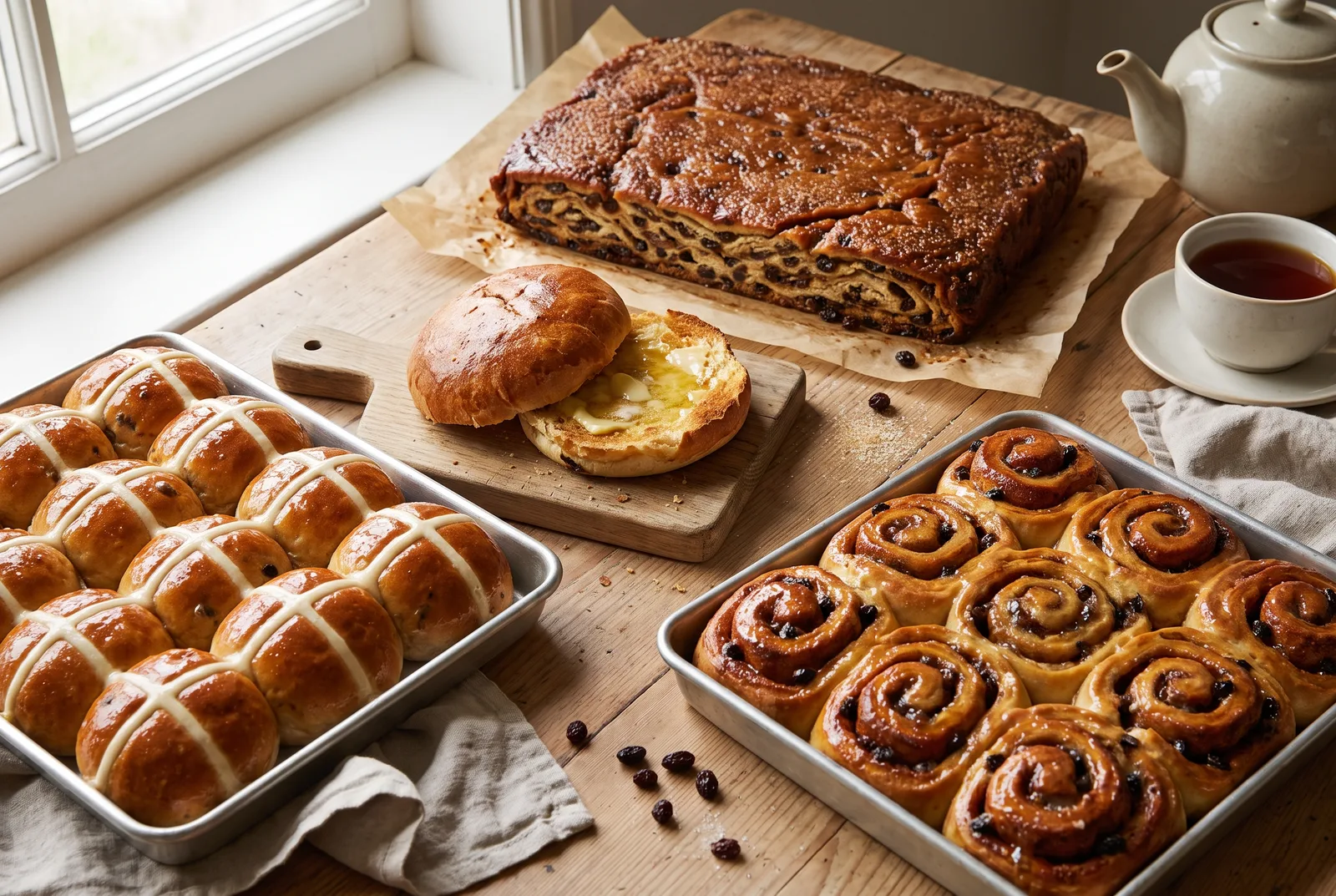
For a British bakery, the enriched yeasted "tea-time" bakes are bread-and-butter trade in every sense. They are the Easter window (hot cross buns), the year-round café spiral (Chelsea buns), the West-Country heritage slab (lardy cake) and the everyday toasting staple (the fruited teacake). See the figure below.
They look like four different products, but they are really four builds of one idea: a soft, enriched, spiced, fruited yeasted dough. Learn the shared dough and its three golden rules - strong flour, fat added late, fruit added last - and the differences come down to shaping and finishing. This dossier is deliberately wired to the Domson catalogue because Britain is Domson's home market: the flour, yeast, dried fruit, spice and glaze a UK baker orders for these bakes are all on the shelf, and several carry first-party specifications we have read directly.
1. The home-market rules you cannot ignore
Because this is the British market, get the regulation right before the recipe. See the figure below.
Fortified flour is the law. Under the Bread and Flour Regulations 1998, all non-wholemeal wheat flour sold in the UK must be fortified to statutory minimum levels per 100 g of flour: calcium carbonate (235-390 mg), iron (min 1.65 mg), thiamin/B1 (min 0.24 mg) and niacin (min 1.60 mg); wholemeal is exempt. This is not an abstraction - the Domson White Strong Flour datasheet (ADM code 4380) declares exactly this "fortification blend (calcium carbonate, niacin, iron, thiamin)" plus flour treatment agent E300 (ascorbic acid), at ~12% protein and 59.5% water absorption. The Real Bread Campaign's critical take on this "so-called fortification" is worth knowing for customer conversations.
Folic acid is the big 2026 change. The Bread and Flour (Amendment) Regulations 2024 (in England, SI 2024/1162, with parallel Scottish and Welsh instruments) add folic acid at 250 micrograms per 100 g to non-wholemeal wheat flour. It becomes legally mandatory from 13 December 2026, though the milling sector began transitioning voluntarily from around September 2025 - so the flour in your buns is likely already carrying folic acid. The same 2024 instrument also raises the calcium, iron and niacin minima from that same date (calcium carbonate to roughly 300-455 mg, iron to 2.10 mg and niacin to 2.40 mg per 100 g; thiamin unchanged), so the 1998 figures above are the pre-2026 levels. Wholemeal and small mills (under 500 tonnes a year) are exempt; the public-health aim is to cut neural-tube-defect pregnancies (spina bifida and similar), which the government estimates at roughly 200 cases prevented a year. You do not need to change your recipe, but you should be ready for the labelling to update.
Natasha's Law and allergen labelling. Since 1 October 2021, any item that is prepacked for direct sale (PPDS) - made and wrapped on your premises before a customer orders it, like buns bagged for a self-service counter - must carry the product name and a full ingredients list with the 14 regulated allergens emphasised. Even loose/over-the-counter buns must have allergen information available. A finished hot cross bun, Chelsea bun, teacake or lardy cake typically declares cereals containing gluten (wheat), egg and milk, and very often sulphites (from dried fruit, peel or glaze) and sometimes soya (from an improver or fat) - declare against your actual recipe under the retained Food Information to Consumers rules (Reg (EU) 1169/2011). These bakes sit squarely in Britain's craft-bakery trade, represented by bodies like the Craft Bakers Association and the Federation of Bakers.
2. The shared enriched dough
All four bakes start from the same place. The full base formula is in the formula card below, and the wider craft theory lives in A8-enriched-dough-formulas and A8-bakers-percentage-fundamentals. See the process flow in the figure below.
Flour - go strong. Use a strong white bread flour of ~12-13% protein (see A1-protein-gluten-and-strength and A1-wheat-flour-types-by-application). Enriched doughs are hard on gluten: the sugar competes for water, and the fat coats the flour and shortens the network. A stronger flour gives you the gluten reserve to hold the gas and carry a heavy fruit load. The Domson White Strong Flour (g45180) is the home-market default; Windrush (g43025, Matthews), Coniston (g44142, Allied Mills) and Topspin (g45539, Carr's Maldon Mill) are all strong white alternatives. Reading a flour spec - protein, water absorption, Hagberg - is covered in A1-key-quality-parameters. (For the deeper UK flour picture and the CBP-versus-craft split, see the sibling dossiers B7-flour-landscape and B7-chorleywood-vs-craft.)
Yeast - dose generously. These are sweet, fruited doughs, so lean on your yeast. Fresh compressed yeast (e.g. Lesaffre Benevia, g25216) is the traditional choice: living Saccharomyces cerevisiae, dry matter >29%, fermentative activity 125 +/- 10 ml CO2, but a short 35-day fridge life. Instant dried (Fermipan Red, g45032) is dosed at roughly one third of the fresh-yeast weight; A2-yeast-types-comparison covers the conversions. The reason to dose up is osmotic: sugar and dried fruit raise the osmotic pressure of the dough and slow the yeast. For the sweetest formulas, an osmotolerant yeast earns its place - the full mechanism is in A2-osmotolerant-yeast-enriched-doughs.
Fat added late, fruit added last. This is the technique that separates a good bun from a tight, cakey one (see A5-dough-mixing-methods). Develop the gluten first with flour, liquid, egg, sugar, salt and spice; add the soft butter gradually only once the dough is smooth, so it does not blanket the flour and block hydration; then mix in the dried fruit and peel LAST on slow speed so the berries stay whole and you do not shred the gluten or bleed colour into the crumb. Bulk-prove warm (~24-28 C) - proofing science is in A5-proofing-science.
3. Hot cross buns
History (some fact, some folklore). The cross stands for the crucifixion, and the buns are tied to Good Friday. A much-repeated folk story credits Brother Thomas Rocliffe, a monk of St Albans, with baking spiced "Alban buns" marked with a cross for the local poor in 1361 - charming, but treat it as tradition rather than documented fact. Better attested: in 1592 the London Clerk of Markets, under Elizabeth I, forbade the sale of spiced buns and breads except at burials, Good Friday and Christmas (penalty: the goods forfeited to the poor), which pushed bun-baking into home kitchens; the earliest printed record of the name is in Poor Robin's Almanac, 1733 ("...with one or two a penny hot cross buns"); the familiar "one a penny, two a penny" street cry was printed later. The Good Friday bun even carried superstitions - hung from the rafters it would supposedly never go mouldy and would protect sailors from shipwreck.
Method. Take the base dough, push the mixed spice to 1.5-2% with a little cinnamon and nutmeg, and load currants (~45%) plus mixed peel (~12%) (see the formula card below). Scale, mould round, and prove batched close so the sides touch. The cross is piped BEFORE baking from a thin plain-flour-and-water paste; keep it thin so it bakes crisp rather than doughy. Bake hot and fast (small buns ~210-220 C) to a safe crumb temperature. Finish with a hot glaze straight from the oven - a boiled sugar syrup or warmed sieved apricot glaze - so the water flashes off to a shine. See the cross-and-glaze diagram and the finished buns in the figures below. Glaze theory is in A6-glazes-finishes and A7-glazes-mirror-and-fruit.
4. Chelsea buns
History. The Chelsea bun is named after the Chelsea Bun House on what is now Pimlico Road, London, run for four generations by the Hand family (Richard Hand was known as "Captain Bun"). It opened in the early 18th century, drew huge Good Friday crowds, was patronised by George II and Queen Caroline and by George III and Queen Charlotte, and finally closed in 1839.
Method. Flavour the base dough with lemon zest and cinnamon or mixed spice, roll it to a rectangle, and smear it with soft butter, soft brown sugar, mixed spice, currants and mixed peel. Roll into a square-sided log, cut into pinwheels, and pack them cut-side-up with small gaps in a lined tray so they fuse into a soft pull-apart batch as they prove and bake. Glaze with hot sugar syrup for the classic sticky top (see the formula card below). See the shaping diagram and the fused tray in the figures below. Do not confuse it with a Bath bun, which is an individual milk-dough bun crusted with crushed sugar on top rather than a fused, glazed spiral.
5. Lardy cake
History. Lardy cake is a West-Country speciality, most strongly tied to Wiltshire and the chalk belt running through Oxfordshire and neighbouring southern counties (Gloucestershire, Berkshire, Dorset, Hampshire). It arose in the mid-19th century as a thrifty treat: when the oven was fired only once a week, surplus bread dough was enriched with local pig lard, precious sugar and dried fruit and baked for harvest and family festivals. Wiltshire Lardy Cake is even listed on the Slow Food Ark of Taste; the old name "flead cake" refers to flead, the soft leaf-fat scraped from a pig's internal membranes.
Method. Lardy cake is essentially a fruited, sugared rough-lamination of bread dough - the fat science (plasticity, shortening, layering) is in A4-fat-types-and-selection and A4-fat-science-functionality, and the folding logic parallels laminated pastry. A representative professional method (Paul Hollywood): a dough of 450 g strong white bread flour, 14 g fast-action yeast and 50 g lard; then over three letter-folds dot in 100 g unsalted butter + 50 g lard with a filling of 100 g raisins, 100 g currants, candied orange peel and 100 g light soft brown sugar. Pan, prove, and bake at 200 C / 180 C fan / gas 6 for 35-40 minutes, then turn out upside-down so the caramelised sugar-and-lard base becomes a glossy top - demerara sugar in the base gives extra crunch. See the lamination diagram and the cut cake in the figures below. Keep the fat cool and firm while laminating and bake hot enough to set the layers, or the lard renders out and the cake turns greasy (see the fault table below). Note that lard is a pork fat, so an authentic lardy cake is not suitable for vegetarian, vegan, halal or kosher customers - flag it accordingly (this is consumer information, not one of the 14 regulated allergens).
6. Yorkshire teacakes
What it is. In Yorkshire and much of the North, a "teacake" is a round, slightly flattened, lightly enriched fruited breadcake carrying a little sugar, spice, dried fruit (usually sultanas and/or currants) and peel - not the chocolate-covered biscuit of the same name. It is the lightest of the four here, closer to a soft fruited bread roll than a cake, and its whole selling point is toasting: it should split cleanly and drink up melting butter. Yorkshire teacakes trace to the early 18th century as expensive "Yorkshire Cakes" (enriched with eggs, butter, milk, sugar and fruit) and were being called "Yorkshire teacakes" by the 1880s. Regional naming is a minefield - in East Lancashire, parts of Yorkshire and Cumbria a "currant teacake" is specifically the fruited version, as opposed to a plain bread roll (the wider naming muddle of British tea-breads is explored in B7-scones-crumpets-muffins and B7-regional-breads-map). Build it as a lighter version of the base dough (see the formula card below); see the figure below.
7. Buy the ingredients: the Domson shortlist
This is the home market, so the cross-linking is rich. Full mappings are in the products at the end of this article; the essentials:
- Strong white flour: Domson White Strong Flour (g45180, spec), Windrush (g43025), Coniston (g44142), Topspin (g45539). See the spec table below.
- Yeast: Fresh Benevia (g25216, spec) or Lallemand fresh (g43237); DCL Craftbake High Activity (g46022) suits sugared doughs; instant Fermipan Red (g45032).
- Dried fruit and peel: Currants (g44677, spec) for buns and lardy cake; Turkish Sultanas (g44764, spec) for teacakes; Raisins (g45048); Mixed Peel (g44774) and Candied Orange Rind (g23527) for the citrus backbone (see the comparison table below). Re-read the live spec for sulphite and mycotoxin data.
- Spice:Mixed Spice UK Blend (g45412, spec) carries the defining British warm-spice note; this particular Sleaford blend lists coriander, cassia cinnamon, ginger, cardamom, cloves, fennel and nutmeg (classic British mixed spice more often leans on cinnamon, coriander, caraway, nutmeg, ginger, cloves and allspice - the exact recipe varies by maker) - backed by ground Cinnamon (g22066, spec) and Nutmeg (g44044, spec). Note that trade cinnamon (typically cassia) can carry trace celery, mustard and sulphur dioxide on its datasheet - relevant to your allergen declaration.
- Fats: Unsalted Butter 82% (g22581, spec) for enrichment; Lard (g24762) for authentic lardy cake (see the comparison table below).
- Sugars: Caster (g44027, spec) in the dough; Demerara (g44477, spec) for the lardy-cake crunch; Granulated (g45060, spec) for glaze syrup.
- Glaze and finish: For a clean-label shine use a real apricot preserve (g22717) or a dedicated bakery apricot glaze (Zeelandia Paletta g25506, Dawn Belnap g25397). Fondant (g22135) for iced crosses; BackGlanz (g25517) as a supplier-declared allergen-free egg-wash substitute (verify against shared-line manufacture before any allergen claim). Avoid the "apricot flavoured jam" (g22711) for a premium line - it is apple-based with residual SO2 and azo colours (E102/E129) that legally carry the "may have an adverse effect on activity and attention in children" warning (see the comparison table below).
- Improver / shelf life: enriched fruited crumb stales fast (A5-shelf-life-and-staling); a clean-label enzyme improver and correct dough temperature help. Optimax Free (g22326) illustrates the "free"/clean-label category, though it is a mix/rye improver rather than a dedicated sweet-bun one - see A3-improver-selection-guide for choosing correctly. A little non-diastatic malt (IREKS Somex, g23193) lifts colour and flavour (B7-malted-grain-baking).
8. Finishing, faults and food safety
The full fault matrix is below. The recurring ones: dense buns (yeast slowed by sugar/fruit or killed by hot milk - warm milk to ~35 C, dose up, prove at 24-28 C); sunken or streaky fruit (added too early or over-mixed - add last, slow speed); doughy crosses (paste too thick); Chelsea buns that fall apart (spirals spaced too far); greasy lardy cake (fat too warm or oven too cool); dull tops (glaze applied cold or too late - glaze hot).
On safety and labelling: bake the egg-and-dairy dough through to a safe crumb (~90-96 C) - the raw-egg wash and enriched dough are only safe once fully baked, and the product is a short-life perishable; declare gluten, egg, milk and any sulphites/soya per your actual recipe; comply with Natasha's Law on PPDS items; and re-check the superseded ochratoxin figure on the vine-fruit datasheets against current limits.
Cross-links
- Pillar A craft concepts: A1-protein-gluten-and-strength, A1-wheat-flour-types-by-application, A1-key-quality-parameters (flour); A2-yeast-types-comparison, A2-osmotolerant-yeast-enriched-doughs (yeast); A4-fat-types-and-selection, A4-fat-science-functionality (butter/lard lamination); A5-dough-mixing-methods, A5-proofing-science, A5-baking-oven-science, A5-shelf-life-and-staling (process); A6-glazes-finishes, A7-glazes-mirror-and-fruit (glazing); A8-enriched-dough-formulas, A8-bakers-percentage-fundamentals (formulas).
- Sibling British dossiers: B7-flour-landscape and B7-chorleywood-vs-craft (the flour and bread background); B7-scones-crumpets-muffins (the rest of the tea-time counter); B7-fruit-celebration-cakes (heavier fruited baking); B7-regional-breads-map (Cornish saffron buns, Welsh bara brith and the wider regional picture); B7-malted-grain-baking (malt for colour and flavour).
Figures
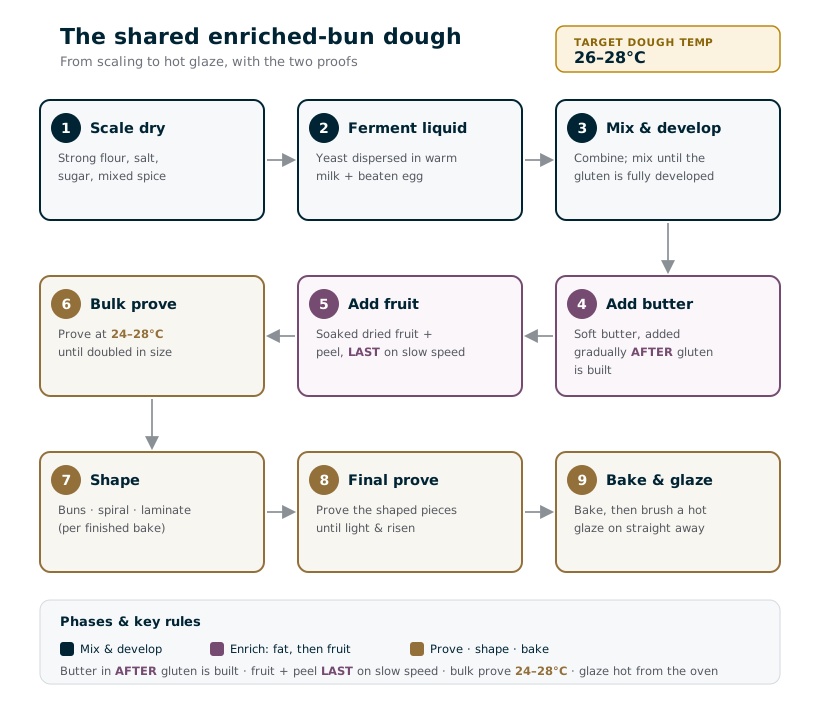 Flow diagram of the enriched bun dough process from mixing to glazing
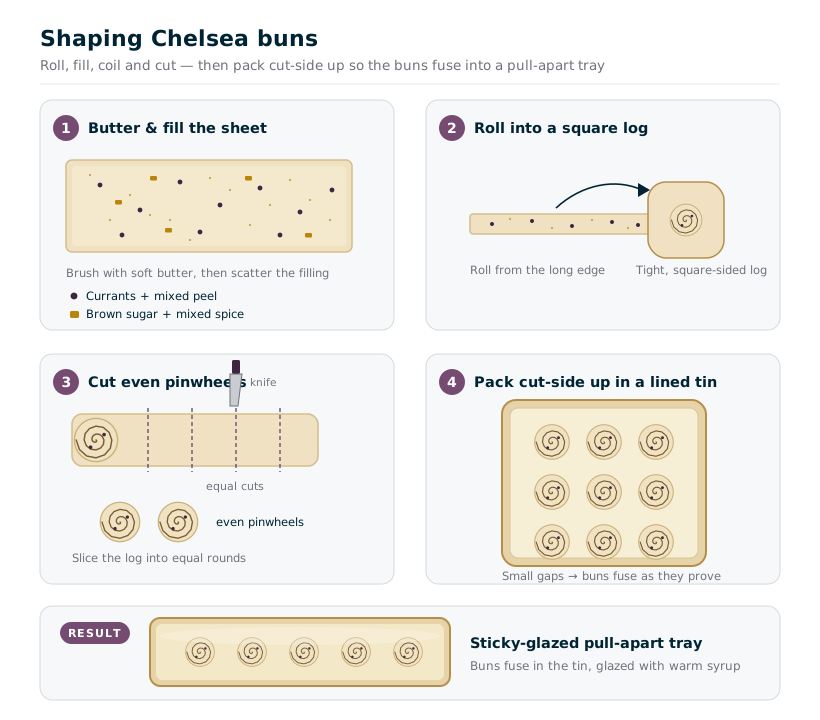 Diagram of rolling, filling, coiling and cutting Chelsea buns into a fused tray
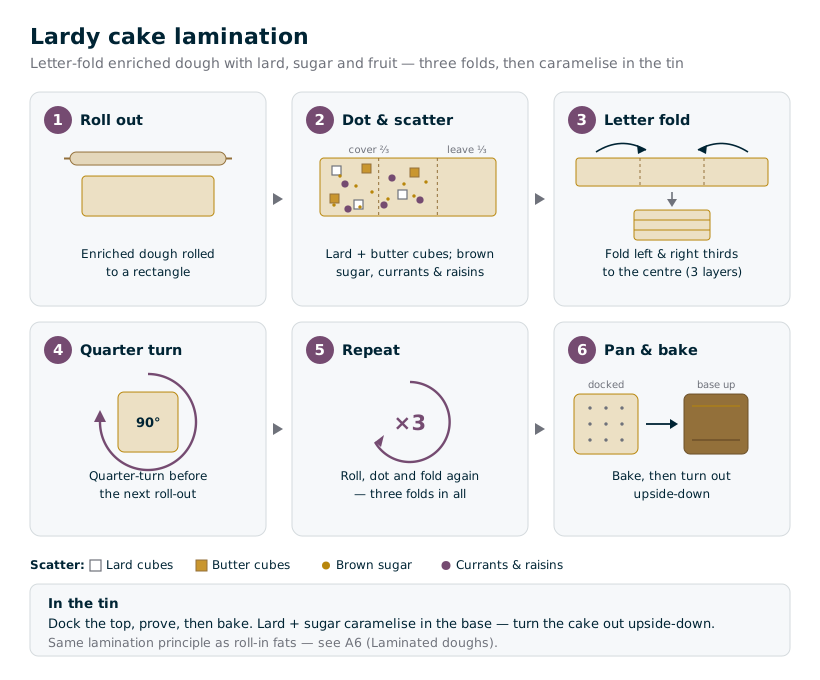 Diagram of the three-fold lardy cake lamination with lard, sugar and fruit
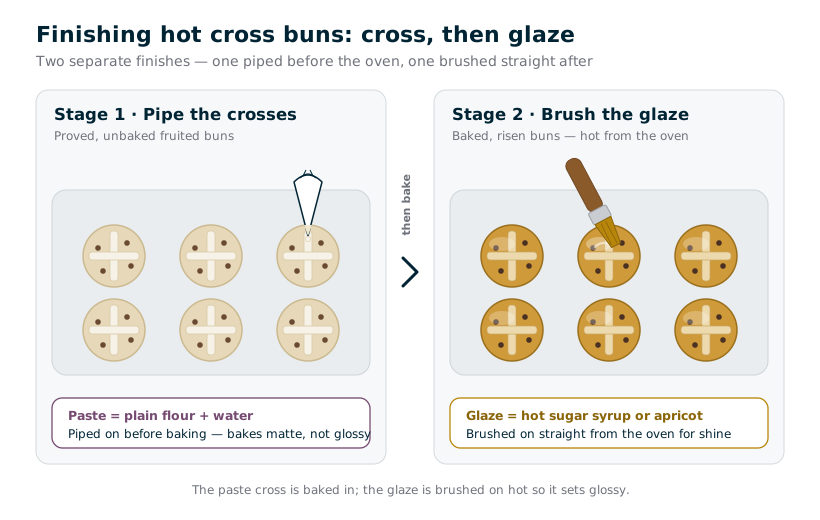 Diagram of piping flour-paste crosses on buns and brushing on a hot glaze
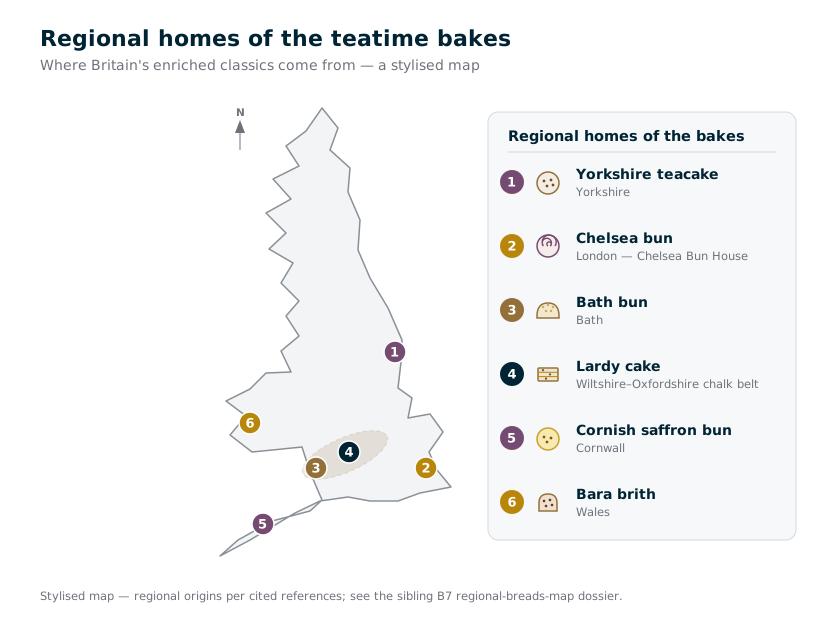 Map of Britain marking the regional origins of Chelsea buns, Bath buns, lardy cake, Yorkshire teacakes, Cornish saffron buns and bara brith
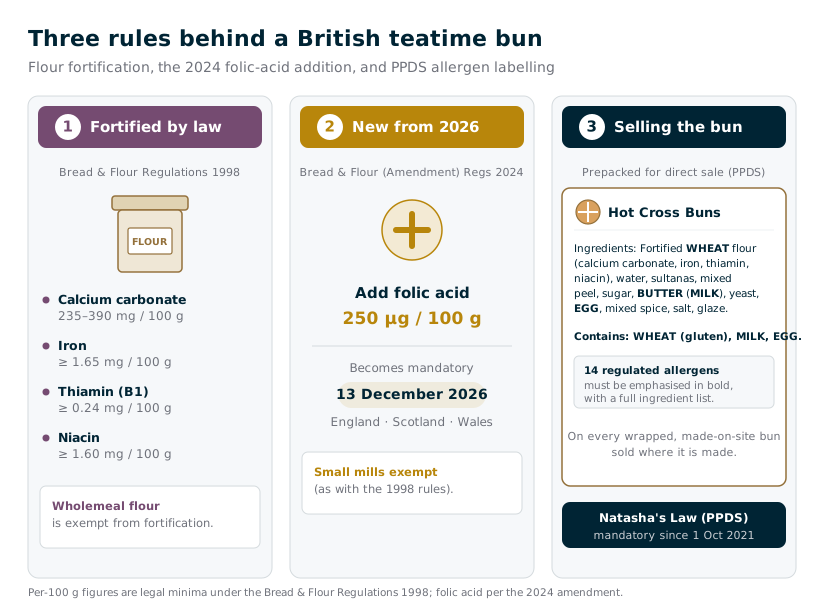 Infographic of UK flour fortification, the 2024 folic-acid rule and Natasha's Law bun labelling
Shared enriched bun dough - base formula (baker's %)
Representative working formula, not a single canonical recipe - real bakery formulas vary. The rules that matter: strong flour to carry the load, fat added after gluten development, and fruit added last.
Total: ~230% with fruit and peel added
Worked example
Strong white bread flour 100 (min ~12% protein), milk 45, egg 10, butter 12, caster sugar 12, fresh yeast 5 (or instant 1.7), salt 1.25, mixed spice 1.5. Inclusions: currants + sultanas 50-60, mixed peel 12. Method: warm the milk to ~35 C and disperse the yeast; combine flour, sugar, spice, salt, egg and milk and develop the gluten fully; add the soft butter gradually only once the dough is smooth; mix in soaked/dried fruit and peel LAST on slow speed so the berries stay whole and the gluten is not torn; bulk-prove at ~24-28 C to double; shape; final prove; bake and glaze hot.
Yield: The common ground for hot cross buns, Chelsea buns and teacakes
Hot cross buns (baker's %)
The cross is piped BEFORE baking from a simple flour-water paste; the shine is a hot glaze applied AFTER. Keep the paste thin so it bakes crisp.
Total: ~245% with fruit, peel, cross paste and glaze
Worked example
Base dough as above with mixed spice 1.5-2 and a touch of ground cinnamon/nutmeg; currants 45 + mixed peel 12 (some bakers add a little chopped apple or orange zest). Cross paste: plain/weak flour + water piped in a thin line over proved buns before baking. Glaze: hot sugar syrup (or warmed sieved apricot preserve) brushed on straight from the oven. Bake buns hot and fast (~210-220 C for small buns) until the crumb reaches a safe ~90-96 C.
Yield: Batched buns for Easter
Chelsea buns (baker's %)
The defining move is packing the cut spirals close so they join into a soft pull-apart batch, then glazing hot. Contrast the Bath bun, an individual sugar-crusted bun.
Total: ~250% with the butter/sugar/fruit smear
Worked example
Base dough flavoured with lemon zest and cinnamon/mixed spice; roll to a rectangle. Smear: soft butter ~15, soft brown sugar ~20, mixed spice, currants ~40 and mixed peel ~10 scattered over. Roll into a square-sided log, cut into pinwheels, pack cut-side-up with small gaps in a lined tray so they fuse on proving. Final prove, bake ~190-200 C, then glaze with hot sugar syrup for the sticky top.
Yield: A fused pull-apart tray of spirals
Lardy cake - representative professional method (weights + baker's %)
Method after Paul Hollywood (Great British Bake Off). Lardy cake is essentially a fruited, sugared rough-lamination of bread dough - the sugar and lard caramelise in the tin base.
Total: Laminated slab, ~9 squares
Worked example
Dough: 450 g strong white bread flour, 1 tsp salt, 14 g fast-action yeast, 50 g lard, 225-250 ml water; knead, prove ~30 min to double. Laminate: roll to ~20x50 cm; over three letter-folds (quarter-turn between) dot in a total of 100 g unsalted butter + 50 g lard and a filling of 100 g raisins, 100 g currants, candied orange peel and 100 g light soft brown sugar (demerara for extra crunch on the base). Pan, prove ~30 min, bake 200 C / 180 C fan / gas 6 for 35-40 min, brush with syrup, and turn out UPSIDE-DOWN so the caramelised sugar-lard base becomes the top.
Yield: 1 tray, cut into ~9 pieces
Yorkshire teacake (baker's %)
The lightest of the four - closer to a soft fruited bread roll than a cake. Its selling point is toasting: it should split cleanly and take butter.
Total: ~200% with modest fruit
Worked example
Strong flour 100, milk 50, butter 8, sugar 8, egg 5, fresh yeast 4, salt 1.5, a little mixed spice 0.5; sultanas and/or currants 30, mixed peel 5. Mix and develop, add fat then fruit; prove; scale and mould round, flatten slightly; final prove; egg/milk wash; bake ~200-210 C. Serve split, toasted and buttered.
Yield: Round, flattish breadcakes for splitting and toasting
All four start from a similar enriched yeasted dough; what separates them is shape, fat handling, fruit/spice load, finish and the occasion they sell for.
| Bake | Format / shape | Dough & fat signature | Fruit & spice | Finish | Occasion |
|---|---|---|---|---|---|
| Hot cross bun | Individual round buns, batched close so sides touch | Enriched with butter, egg, milk; moderate sugar | Currants + mixed peel; mixed spice / cinnamon / nutmeg | Flour-paste cross piped before baking; hot sugar-syrup or apricot glaze | Easter / Good Friday |
| Chelsea bun | Spiral pinwheels cut from a rolled log, packed to fuse into a pull-apart tray | Rich dough; butter smeared into the roll | Currants + peel, brown sugar and cinnamon/mixed spice rolled inside | Sticky sugar-syrup glaze while hot | Year-round tea-room / café |
| Lardy cake | Slab, baked in a tray and cut into squares; turned out upside-down | Enriched bread dough LAMINATED with lard (and often butter) in three folds | Currants + raisins + peel folded in with soft brown/demerara sugar | Caramelised sugar-and-lard base; syrup glaze | Harvest / West-Country festival |
| Yorkshire teacake | Round, slightly flattened breadcake | Lightly enriched (less fat/sugar than the others) | Sultanas and/or currants, a little peel and spice | Milk/egg wash; usually served split, toasted and buttered | Everyday tea-time |
The vine-fruit-and-peel palette. Currants are the classic bun fruit; sultanas suit teacakes; mixed and candied peel add the characteristic citrus note. Match berry size and colour to the product and always re-read the live spec for mycotoxin and sulphite data.
| Ingredient | What it is | Best used in | Catalogue example | Notes |
|---|---|---|---|---|
| Currants | Small dried Corinthian/Provincial grapes (Vitis vinifera) | Hot cross buns, Chelsea buns, lardy cake | Currants 12.5 kg (Chelmer Foods) - g44677 | 267 kcal, 67.8 g sugars/100 g; medium berry count 440-550/100 g |
| Sultanas | Seedless white grapes, potash-dipped and dried | Yorkshire teacakes, fruit loaves | Turkish Laser Scanned Sultanas 12.5 kg (Chelmer Foods) - g44764 | 275 kcal, 69.4 g sugars/100 g; this grade declared sulphite-free (many are SO2-treated) |
| Raisins | Larger dried grapes | Lardy cake, richer buns | Turkish Raisins 12.5 kg - g45048; Iranian Raisins 12.5 kg - g44846 | Paul Hollywood's lardy cake uses raisins + currants together |
| Mixed peel | Chopped candied citrus peel | All four - the citrus backbone | Mixed Peel 10 kg (Kluman) - g44774 | Classic in hot cross buns and Chelsea buns; check sulphite declaration |
| Candied orange rind | Whole/diced candied orange peel | Premium buns, lardy cake | Candied Orange Rind Ambrosia 10 kg - g23527 | For a cleaner, brighter citrus lift than standard mixed peel |
Fat is the biggest character decision after the flour. Butter enriches and softens; lard is non-negotiable for an authentic lardy cake and gives the flaky, savoury-sweet layers.
| Fat | Role | Which bake | Catalogue example | Spec note |
|---|---|---|---|---|
| Butter 82% | Enrichment, flavour, soft crumb | Chelsea buns, hot cross buns, teacakes | Unsalted Butter 82% 10 kg (Polmlek) - g22581 | 82% fat / 16% water, 744 kcal, 55 g saturates/100 g; allergen: milk |
| Lard | Lamination fat for flaky, caramelised layers | Lardy cake (defining fat) | Lard 25 kg (Polmlek) - g24762 | Rendered pork fat; historically 'flead' leaf fat |
| Butter + lard blend | Balance of flavour and flake | Lardy cake (modern method) | Combine g22581 + g24762 | Paul Hollywood folds 100 g butter + 50 g lard into the laminate |
The cross and the glaze are what make these bakes recognisable. Note the clean-label trap on some 'apricot' glazes.
| Finish | How | Use | Catalogue example | Watch-outs |
|---|---|---|---|---|
| Flour-paste cross | Thin plain-flour-and-water paste piped over proved buns before baking | Hot cross buns | Plain/weak flour + water | Keep the paste thin so it sets crisp, not doughy |
| Fondant / iced cross | Piped water-icing or fondant cross after baking | Modern hot cross buns | Sugar Fondant (Soft) 15 kg (Vortumnus) - g22135 | A sweeter, softer alternative to the baked paste cross |
| Hot sugar-syrup glaze | Boiled sugar syrup brushed on straight from the oven | All four | Granulated Sugar 25 kg (Kent Foods) - g45060 | Apply hot so water flashes off to a sticky sheen |
| Real apricot glaze/preserve | Warmed sieved apricot preserve brushed on | Buns, lardy cake | Apricot Preserve 13 kg (Vortumnus) - g22717; Paletta Apricot Glaze 13 kg (Zeelandia) - g25506; Belnap Apricot Fruit Glaze 14 kg (Dawn) - g25397 | Classic professional bun glaze - cleaner label than a 'flavoured jam' |
| 'Apricot flavoured jam' | Ready glaze made from apple puree + flavour + colour | Budget bun glaze | Apricot Jam High Fruit 6 kg (Vortumnus) - g22711 | Apple-based, residual SO2 (sulphites), azo colours E102/E129 carrying the children's-attention warning |
| Fault | Likely cause | Remedy |
|---|---|---|
| Dense, poor rise; slow proof | Yeast slowed by sugar/fruit osmotic pressure, or killed by hot milk or direct contact with salt/sugar; cold room | Warm milk to ~35 C; disperse yeast separately; use a generous yeast dose (or osmotolerant yeast for sweet formulas); prove at 24-28 C |
| Fruit sinks, tears the dough, or streaks grey | Fruit added too early or over-mixed; wet, un-soaked fruit; over-strong mechanical mixing after fruit is in | Add fruit LAST on slow speed; lightly soak/coat fruit; keep the dough on the firmer side |
| Cross spreads or looks doughy (hot cross buns) | Cross paste too thick or too wet; piped after proving collapsed | Pipe a THIN flour-water paste over fully-proved buns just before baking |
| Chelsea buns don't fuse / fall apart | Spirals spaced too far apart; under-proved before baking | Pack pinwheels close with small gaps so they join as they prove and bake |
| Lardy cake greasy or lard leaks out | Fat too soft when laminating; oven too cool so fat renders out instead of setting layers | Keep lard/butter cool and firm; laminate cold; bake hot enough (~200 C) to set the layers and caramelise the sugar |
| Pale, dull top | No glaze, or glaze applied cold; under-baked | Brush a HOT sugar-syrup or apricot glaze straight from the oven; bake to full colour and ~90-96 C crumb |
| Stales / goes dry within a day | Enriched high-fruit crumb retrogrades fast; low dough hydration; poor wrapping | Correct dough temperature and hydration; consider a bun/enzyme improver; wrap well; sell fresh (see A5-shelf-life-and-staling) |