
How fats work: shortening, aeration, plasticity and emulsification in baking
A deep-dive into the science behind baking fats for professional bakers. Covers the four core functions every fat performs (shortening, aeration, plasticity, emulsification), crystal polymorphism and why it matters, Solid Fat Content (SFC) curves with first-party data from seven catalogue products (Polmlek, Kruszwica, Cardowan, CSM, Master Martini), the science of laminated doughs (croissant, Danish, puff pastry), frying fat management, and sustainability (palm oil, RSPO, palm-free). Includes dosage table by application, fault-cause-remedy table, three formula cards, and a fully sourced catalogue comparison.
Why fat is irreplaceable in the bakery
Flour, water and yeast produce bread. But the moment you want pastry that shatters, a cake that springs back, a croissant that peels into ribbons, or a biscuit that snaps — you need fat. Fat does not simply add richness. It performs four distinct physical and chemical roles that no other ingredient can replicate. Understanding these roles lets you choose the right fat for the job, diagnose failures when they happen, and explain to a customer why you use margarine for one product and butter for another.
This article covers the science, the product data and the practical decision-making, with spec-sheet numbers from seven commercial fat products in the Domson catalogue.
The four core functions of fat in baking
1. Shortening — interrupting the gluten network
When fat is mixed or rubbed into flour before water is added, the fat coats the protein particles and starch granules. When water later activates gluten formation, the fat-coated surfaces cannot bond fully into long, continuous gluten strands. The result is a shorter, more fragmented network. That is the physical meaning of "shortening": the fat makes the protein network shorter.
The practical consequence: less gluten = less chewiness = tender, crumbly, melt-in-the-mouth textures. This is the defining mechanism in shortcrust pastry, biscuits and scones. Using 50–60% fat on flour weight in shortcrust leaves almost no continuous gluten network, producing the characteristic "short" crumb that breaks cleanly.
The figure below gives a microscopic comparison of unshortened vs fat-shortened gluten.
2. Aeration — entrapping air for mechanical leavening
When solid fat (at approximately 18–22°C) is beaten with sugar, the sharp edges of sugar crystals cut into the fat crystal surface and trap air bubbles. The fat holds those bubbles in suspension. This is the creaming step.
During baking, the trapped air bubbles expand as they heat (Charles's law), and CO2 from baking powder diffuses into them, amplifying the lift. The more air your fat can trap, the finer and more even the crumb. This is why the temperature of the fat at creaming is critical: too warm (above 25°C) and the fat is semi-liquid and cannot trap air; too cold (below 14°C) and the fat is too rigid to deform around sugar crystals and release bubbles.
3. Plasticity — the solid-yet-pliable window
Plasticity describes a fat's ability to behave as a soft, malleable solid across a useful working-temperature range: not so hard that it cracks under stress, not so soft that it flows. This property depends on the balance of solid crystalline fat and liquid oil at each temperature — the Solid Fat Content (SFC).
Most fats are mixtures of many different triglycerides, each with its own melting point. The result is a melting range rather than a single melting point. In this melting range the fat is "plastic" — like modelling clay. The width and position of this range determines what application the fat is suited for.
- Butter has a relatively narrow working-temperature window: approximately 14–22°C is cited in practical lamination guidance.
- Laminating margarines are engineered for a stable plastic range at 16–22°C — matching the bakery working environment.
- Shortenings, with 100% fat and no water, have wide plastic ranges.
The figure below gives SFC curves comparing catalogue products.
4. Emulsification — holding fat and water together
Batter and dough contain both fat and water. Without an emulsifier, these two phases separate: the batter "breaks" (curdles), the crumb becomes greasy and uneven. Fats naturally carry some emulsifying capacity. Butter contains lecithin from the cream. Some margarines and shortenings are enriched with added emulsifiers — typically mono- and diglycerides (E471) or polyglycerol esters (E475/PGMS).
The Cardowan Coronet NHAV HR shortening contains distilled monoglyceride (E471) for exactly this reason: it is a "high ratio" shortening, designed for high-ratio cake formulas where sugar exceeds flour by weight — a batter that would otherwise split without extra emulsification.
Crystal polymorphism — the hidden architecture
All fats can crystallise in at least three different forms (polymorphs), which differ in how the triglyceride molecules pack together:
- Alpha (α) crystals form on rapid cooling. They are fine and unstable; they quickly convert to beta-prime or beta.
- Beta-prime (β') crystals are fine, smooth and stable at room temperature. They hold air cells well, produce a smooth texture, and are essential for good creaming. Palm oil and most commercial margarines crystallise predominantly in beta-prime form.
- Beta (β) crystals are the most stable thermodynamic form. They are coarser and larger. They give lard and cocoa butter their characteristic waxy, snapping texture. In chocolate they cause bloom (visible white crystals on the surface). In biscuit shortening, beta crystals produce excessive graininess and poor air-holding.
The vast majority of commercial baking margarines and shortenings are engineered to favour beta-prime crystallisation — through the choice of fat base (palm oil is a strong beta-prime former), emulsifiers, and controlled cooling during manufacture.
Solid Fat Content (SFC) — reading the numbers from spec sheets
SFC is the percentage of fat that is crystalline (solid) at a given temperature. It is measured by NMR spectroscopy or the AOCS Cd 16b-93 pulsed NMR method.
The SFC at key temperatures tells you:
- SFC at 10°C: how firm the fat is when cold (out of the fridge)
- SFC at 20°C: how plastic it is at typical room temperature / lamination working conditions
- SFC at 30°C: how quickly it softens as it approaches body temperature
- SFC at 35–37°C: whether it gives a clean melt-in-the-mouth or a lingering waxy feel
Catalogue SFC data (from spec sheets)
The following values are extracted directly from first-party supplier specifications (see the table below):
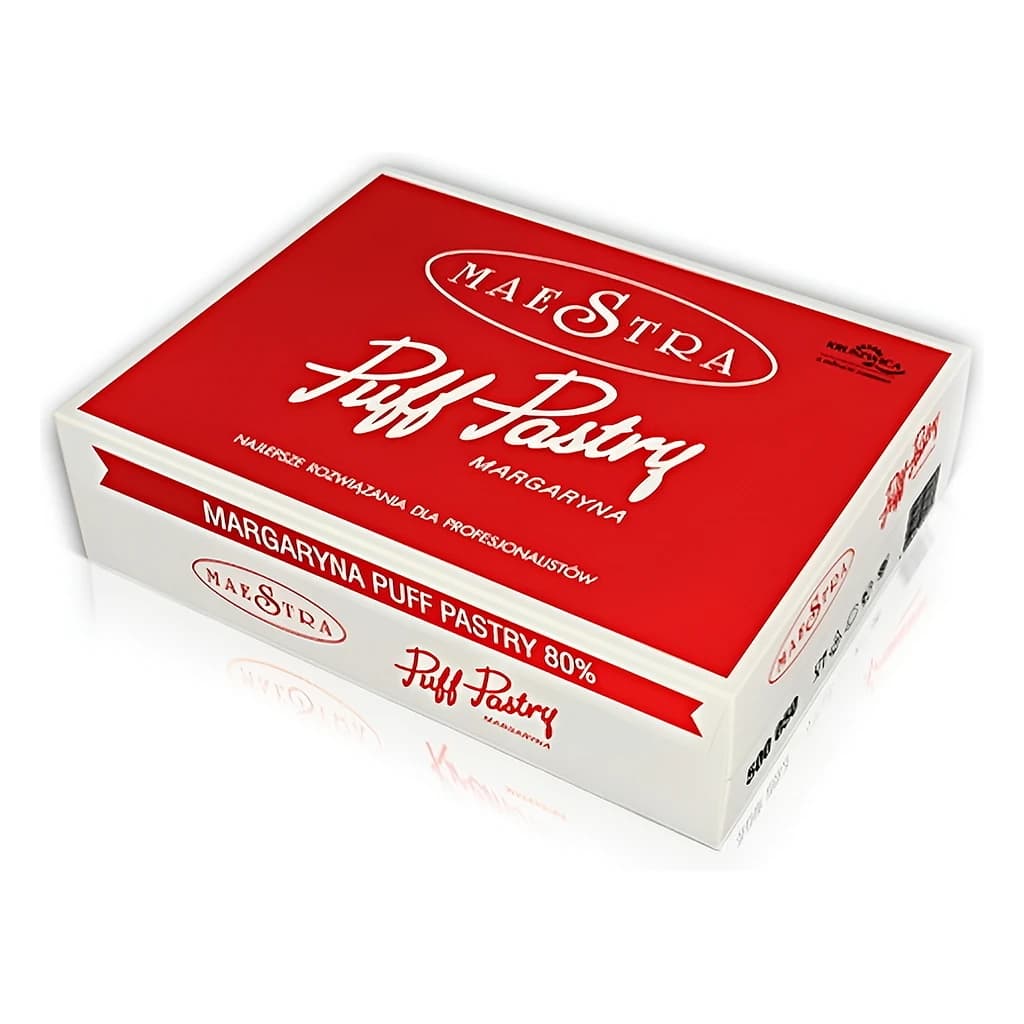
Kruszwica Maestra Puff Pastry Margarine 80% (laminating margarine, summer values):
- 20°C: 35–37% — deliberately high to resist absorption into dough during sheeting
- 30°C: 18–23%
- 35°C: 10–13%
The spec distinguishes summer and winter values, acknowledging that the fat source blend changes slightly to maintain consistent functional performance across ambient temperatures. The recommended working temperature is 18–20°C.
CSM Marvello Cake Margarine 80%:
- 10°C: 34% target
- 20°C: 20% target (interval 18–24%)
- 30°C: 12% target (9.5–13.5%)
- 35°C: 9% target (7–11%)
This lower SFC at 20°C compared to the laminating margarine is intentional: a cake margarine at 20°C should be soft enough to cream well with sugar. The SFC above 30°C drops to single digits, delivering a clean finish in the mouth.
Master Martini Marina 80 Solidarity Recipe:
- 10°C: 41–51% (notably high)
- 20°C: 22–32%
- 30°C: 7–17%
The wide ranges for this product indicate it covers multiple seasonal productions or fat blend variations. The high SFC at 10°C and relatively fast drop above 25°C suits a versatile margarine used for both soft-dough applications (yeast pastry) and shortcrust work.
Butter 82% (Polmlek):
- The Polmlek spec confirms fat content (82% minimum) and saturated fatty acids (55 g per 100 g) but does not report SFC values. SFC estimates from reference literature suggest approximately 18–22% at 20°C — but these are single-source estimates (medium reliability) and should not be presented as spec-verified data. The main limitation of butter for lamination is its narrow plasticity range (~14–22°C) and the tendency to either crack at low temperatures or smear at high temperatures.
Fat types in the Domson catalogue
Butter: 82% fat, the flavour benchmark
Polmlek Unsalted Butter 82% is produced from pasteurized cream and contains no additives or preservatives.
- Fat: 82% minimum
- Water: 16%
- Saturated fatty acids: 55 g per 100 g (67% of fat)
- Energy: 3058 kJ / 744 kcal per 100 g
- Allergen: CONTAINS MILK including lactose
- Storage: 0–10°C (max 60 days); or frozen at -18 to -22°C (max 12 months, consume within 7 days of thawing)
The 16% water content is a functional asset: in puff pastry and croissant, that water flashes to steam during baking and physically separates the dough layers. The milk solids (the remaining ~2%) contribute to Maillard browning, giving butter-based pastry its characteristic deep-gold colour and rich flavour.
The price and allergen implications of butter (MILK) mean many professional bakeries use laminating margarines for volume production, reserving butter for premium retail lines.
Laminating margarines (roll-in fats): engineered for layers
A laminating margarine (also called a roll-in fat, tourage margarine or puff pastry margarine) is engineered to maintain a stable solid-plastic state across the lamination temperature range while melting cleanly at oven temperature.
Kruszwica Maestra Puff Pastry 80%:
- Fat: 80% ±0.5%
- SFC at 20°C: 35–37% (summer) — higher than butter, meaning less risk of smearing at typical bakery temperatures
- Erucic acid (C22:1): max 2.0%, measured by PN-EN ISO 5508 method (this product-specific limit coincides with the current EU contaminant ceiling of 20 g/kg = 2.0% per EU Regulation 2023/915; PN-EN ISO 5508 is the analytical method, not the regulatory text)
- Working temp: 18–20°C
- Ingredients include soya lecithin (E322) — relevant for allergen labelling
- Application: puff pastry, croissants and Danish pastry (ciasta francuskie i półfrancuskie per spec)
The soya lecithin in this product's formulation is declared as an allergen in some markets. Bakers producing for customers with soy allergies should check the full allergen declaration on the current batch spec sheet and consider a lecithin-free alternative.
FLAG — FORMULATION CURRENCY: The Maestra Puff Pastry specification used here dates from 2009 and declares "partially hydrogenated vegetable oils" in its ingredient list. EU Regulation 2019/649 (in force April 2021) limits industrial trans fats to ≤2 g per 100 g fat. Current Kruszwica batches are very likely reformulated without partial hydrogenation; the SFC values and working-temperature recommendations above remain functional parameters relevant to any puff-pastry laminating margarine, but the ingredient list and trans fat content should be confirmed with the current Kruszwica product specification before use.
Cardowan Crown NHAV Pastry Margarine 82%:
- Fat: 82%
- Slip melting point: 47°C
- Saturated FA: 41.2 g per 100 g
- Contains E471 (distilled monoglyceride) but no soya lecithin
- No allergens in product, line or factory
- RSPO certified (Segregated & Mass Balance, cert BMT-RSPO-000023)
The 47°C slip melting point for this pastry margarine means it maintains its solid state well into the oven cycle, holding the layer structure while the dough sets. No allergens in product or factory makes it suitable for allergen-controlled production environments.
Cake and cream margarines
CSM Marvello Cake Margarine 80%:
- Fat: 80%, Saturates: 27 g/100g (lower saturate profile than pastry types)
- Trans fat: 0.9 g per 100 g product (non-animal derived; equivalent to approximately 1.1 g per 100 g fat — within EU Regulation 2019/649 limit of ≤2 g per 100 g fat)
- SFC at 20°C: 20% target (18–24%)
- Moisture: 15–20%
- Kosher and Halal certified (confirm current certification status with CSM before customer-facing publication — certifications require periodic renewal)
- No allergens in product or on production line (wheat present in factory only)
- Storage: 14–18°C
Marvello's lower saturate profile (34% of fat, vs 50%+ for pastry margarines) and its SFC optimised for creaming at 20°C make it well-suited for industrial cake production. Its kosher and halal certifications expand its customer reach considerably.
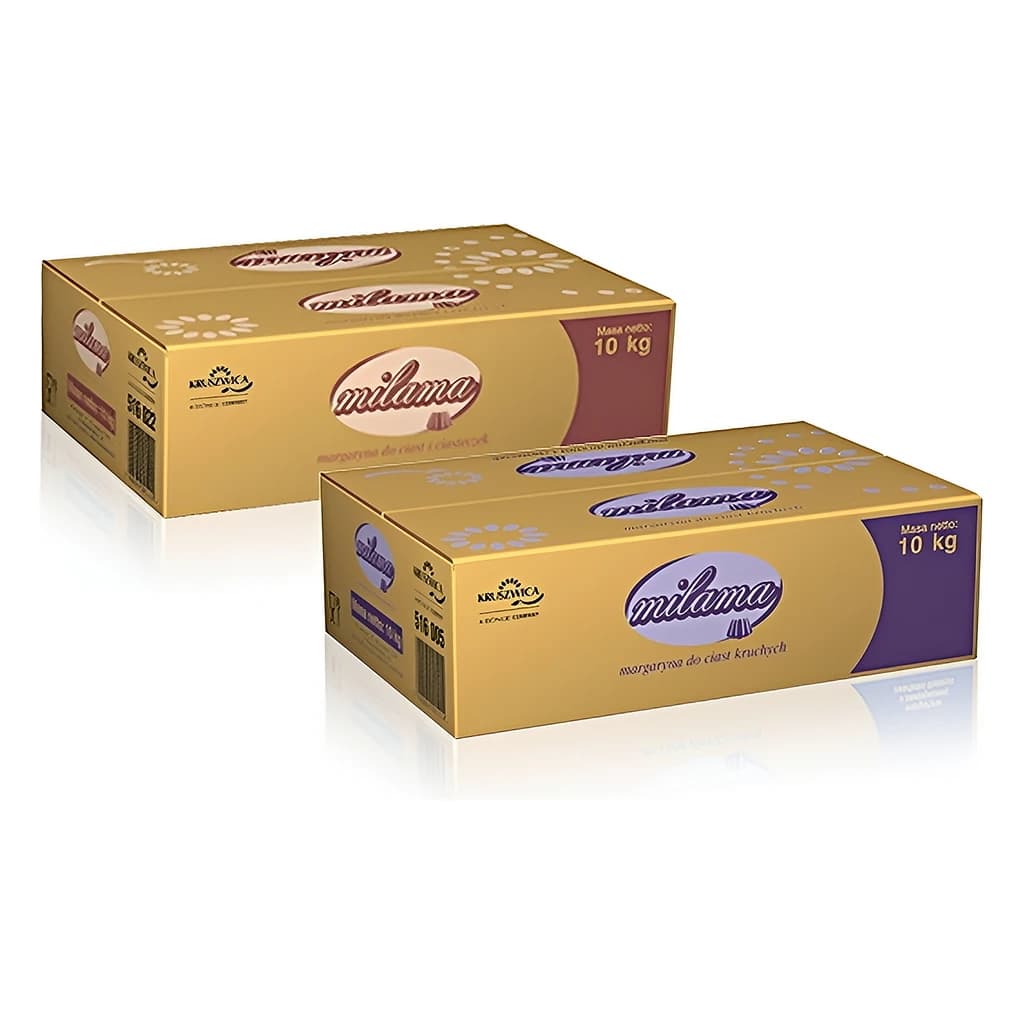
Kruszwica Milama Cake & Cookie Margarine 80%:
- Fat: 80%, SAFA 41%, MUFA 45%, PUFA 13%
- Trans fat: max 2% (typical value) — Food safety: the Milama spec dates from December 2020, before EU Regulation 2019/649 came into force April 2021; the declared "max 2% typical" value sits at the regulatory ceiling of 2 g per 100 g fat.
- SFC at 20°C: 20–25%; SFC at 35°C: max 5% (clean finish)
- Allergens: absent from product and cross-contact (both confirmed absent in spec)
- Application: cakes and cookies
Master Martini Marina 80 Solidarity Recipe:
- Fat: 80%, saturates 39 g/100g
- Trans FA: max 1.0%
- SFC at 20°C: 22–32% — a wider SFC range suggesting broader application latitude
- pH of water phase: 4.60 ± 0.25 (acid water phase reduces microbial risk)
- Application: shortcrust, yeast doughs, puff pastry — a versatile product
- May contain traces of milk (cross-contact, ZK* declaration in spec)
Vegetable shortenings: 100% fat, maximum plasticity
Shortenings contain no water: 100% fat, 0% moisture.
Cardowan Coronet NHAV HR Shortening 12.5 kg — the HR (High Ratio) designation signals that this product contains E471 (distilled monoglyceride):
- Fat: 100%; saturates 38.1 g; MUFA 43.5 g; PUFA 16.2 g
- Energy: 3700 kJ / 900 kcal per 100 g
- Slip melting point: 44°C
- Air content: 12% — pre-incorporated air facilitates high-ratio cake aeration
- FFA: 0.10%; peroxide value: 1.0 meq O2/kg (very fresh, low oxidation)
- No allergens in product, production line or factory
- RSPO certified (NHAV = No Hydrogenation, No Animal ingredients, No Vegan concerns)
Cardowan Plain Box NHAV Shortening 12.5 kg — no E471 emulsifier:
- Fat: 100%; saturates 38.8 g; MUFA 43.5 g; PUFA 15.5 g
- Slip melting point: 45°C; air content: 12%
- No allergens; RSPO certified
The absence of E471 in the Plain Box product means it works best in standard (non-high-ratio) applications: bread enrichment, general pastry work, doughnut frying. For high-ratio cakes (sugar > flour), the Coronet HR with E471 is the correct choice.
The NHAV designation used by Cardowan confirms these products are suitable for halal and vegan customers.
The science of laminated doughs
How layers form
Lamination is the process of alternately folding fat between sheets of dough to create hundreds of discrete layers. The dough provides structure (gluten and starch); the fat provides the barrier that prevents adjacent layers from merging; and the water within the fat (or dough moisture) provides steam that physically pushes the layers apart during baking.
The figure below shows a laminated dough cross-section, illustrating how steam from the fat layers separates the dough into flaky layers during baking.
Puff pastry: up to 729 layers, achieved with six single folds (3^6 = 729); other fold combinations are used in practice (BAKERpedia cites a range of 81–729 layers). No yeast. All lift comes from steam. The butter or laminating margarine accounts for approximately 50% of the total dough weight.
Croissant: 27 layers when three single folds are used (3^3 = 27); other fold configurations are common, with layer counts typically ranging from 24 to over 100 depending on technique. Yeast present. Lift from yeast CO2 combined with steam.
Danish pastry: similar to croissant but further enriched with egg and sugar; fewer lamination folds (lower layer count) for a more open crumb.
The temperature window
This is where most lamination failures occur. The fat must remain as a solid, cohesive sheet throughout sheeting — not crack, not smear.
| Condition | Temperature | Source |
|---|---|---|
| Maestra laminating margarine (optimum) | 18–20°C | Maestra spec sheet |
| Tourage butter (typical recommendation) | 14–17°C | Trade reference (medium reliability) |
| Dough at lamination | ≤18°C | Trade reference |
| Below minimum: fat cracks, tears dough | <14°C for margarine | Maestra spec sheet |
| Above maximum: fat smears into dough | >22°C | Maestra spec sheet |
The Maestra spec is explicit: the recommended fat temperature for production is 18–20°C. If the bakery runs warm, chill the fat for 15 minutes before laminating.
Margarines have a wider plasticity range than butter. This is a deliberate engineering choice: the SFC at 20°C for Maestra (35–37%) is higher than typical butter (~18–22% est.), meaning margarine is more forgiving of small temperature fluctuations. However, margarines will not deliver the flavour of butter, and discerning customers will notice the difference in a premium product.
Dosage by application
See the table below for full dosage ranges. In summary:
| Application | Fat % on flour | Preferred type |
|---|---|---|
| Sandwich bread / tin loaf | 2–5% | Shortening or margarine |
| Soft rolls / burger buns | 5–12% | Cake margarine or shortening |
| Croissant (roll-in only) | 45–55% | Laminating margarine or butter |
| Puff pastry (total fat) | 75–100% | Laminating margarine or butter |
| Shortcrust pastry | 50–60% | Butter, lard or shortening |
| Pound cake / Victoria sponge | 100% | Butter or cake margarine |
| High-ratio cake | 80–130% | High-ratio shortening with E471 |
| Biscuits / cookies | 25–65% | Shortening, margarine or butter |
| Enriched yeast dough (brioche) | 30–60% | Butter or cake margarine |
All dosage values are reference ranges from BAKERpedia, the LibreTexts Canadian Baker open textbook and IREKS Compendium.
Frying fats
Frying fats require different selection criteria than baking fats:
Smoke point is the temperature at which a fat begins to degrade visibly, producing acrolein (toxic, acrid-smelling) and other breakdown products. At the smoke point, the fat begins to impart off-flavours and is unsafe for continued use. Palm frying oil has a naturally high smoke point due to its high saturated fat content; vegetable shortenings follow a similar pattern.
Free Fatty Acid (FFA) content is the primary indicator of frying fat quality. Fresh fat FFA should be ≤0.10% (confirmed in both Cardowan shortening spec sheets ). As fat is used, FFA rises due to hydrolysis from steam and food moisture. Replace or discard frying fat when FFA exceeds 0.5–1.0%, or when the oil darkens significantly.
Peroxide value measures oxidation (rancidity development). Fresh fats should be ≤1.0 meq O2/kg; the Cardowan specs confirm this as their typical value. Above 2–3 meq O2/kg, off-flavours become detectable.
The Domson catalogue includes Palm Frying Oil 25 L. Palm oil's high saturated fat content (~50%) makes it resistant to oxidation at frying temperatures, giving it a long frying life compared to polyunsaturated oils such as sunflower.
Sustainability and palm oil
Palm oil appears as a primary ingredient in most of the margarines and shortenings in this catalogue. It is the world's highest-yielding oil crop (5–10× more oil per hectare than rapeseed or sunflower), but its expansion into tropical regions has been linked to deforestation and biodiversity loss.
The main industry response is the Roundtable on Sustainable Palm Oil (RSPO). Both Cardowan products in this catalogue carry RSPO supply-chain certification (Segregated & Mass Balance, certification BMT-RSPO-000023). Food safety: RSPO certifications are audited annually and can lapse; verify current certification status against the RSPO certificate database (rspo.org) before making sustainability claims in customer-facing material.
RSPO supply chain models:
- Segregated (SG): only RSPO-certified palm oil in the supply chain, kept separate from conventional palm
- Mass Balance (MB): RSPO-certified volumes tracked through the supply chain but physically mixed with conventional
The Maestra Puff Pastry 80% is available in a Mass Balance RSPO certified variant (Maestra Puff Pastry Mass Balance, movex 515 104).
Palm-free reformulation is technically possible using shea, illipe, kokum, high-oleic sunflower or interesterified rapeseed, but achieves different functional properties (often lower SFC at 20°C, different crystal form, narrower plasticity range). The Qualita NP Palm-Free Margarine in the Domson catalogue offers a palm-free option where required.
Allergen summary
| Product | Allergen status |
|---|---|
| Polmlek Butter 82% | CONTAINS MILK (including lactose) |
| Kruszwica Maestra Puff Pastry | Contains SOYA (lecithin E322); no dairy declared |
| Cardowan Coronet NHAV HR Shortening | None in product, line or factory (all 14 EU/UK allergens: No) |
| Cardowan Plain Box NHAV Shortening | None in product, line or factory |
| Cardowan Crown NHAV Pastry Margarine | None in product, line or factory |
| CSM Marvello Cake Margarine | None in product or line; wheat (gluten) present in factory |
| Kruszwica Milama | Allergens absent (product and cross-contact per spec) |
| Master Martini Marina 80 | No allergens IN product; may contain traces of MILK (cross-contact, ZK*) |
Allergen declarations are from supplier spec sheets. Cross-contact risk depends on shared lines and production schedules which can change. Always obtain the current batch spec sheet from the supplier before making allergen claims to customers.
Practical fat selection guide
The flowchart below gives a visual version of this decision guide.
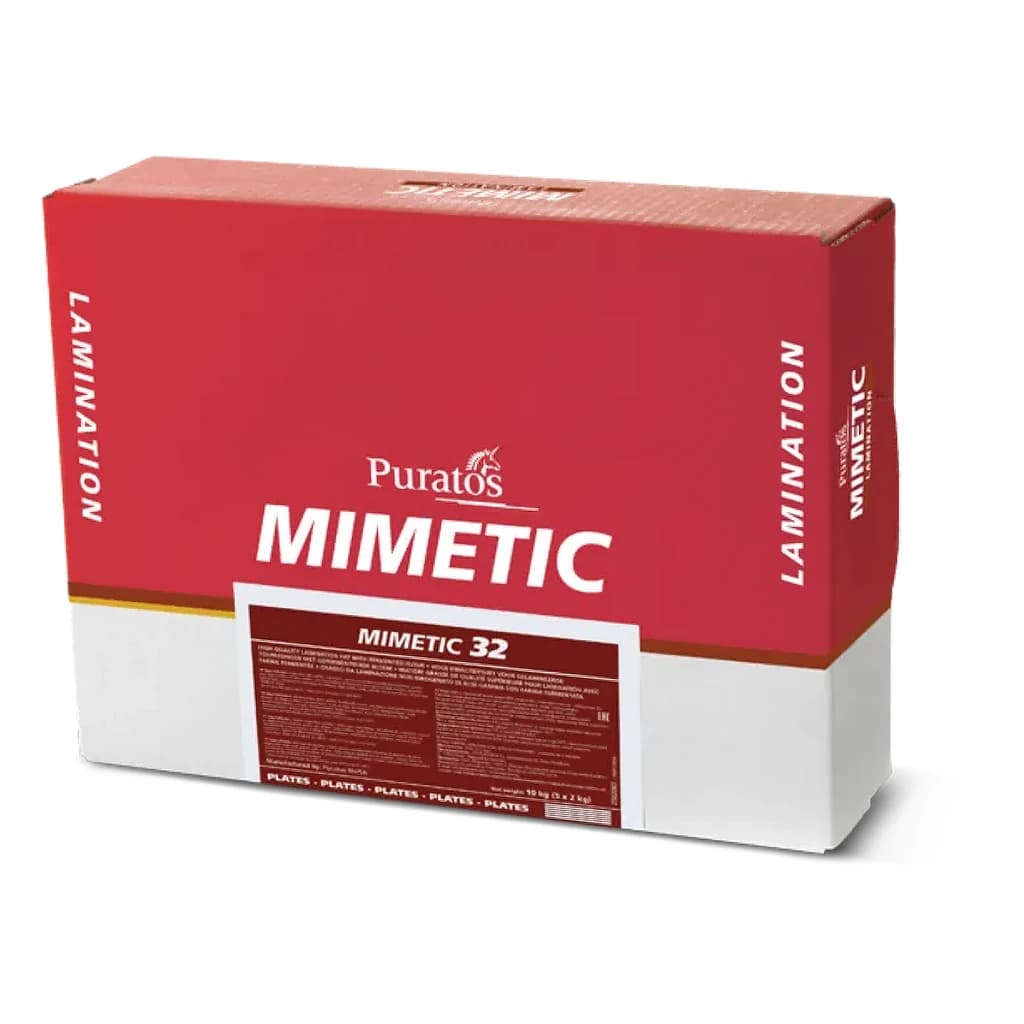
Is your product laminated (croissant, Danish, puff)? Use a laminating margarine with SFC at 20°C of 30–40% (e.g. Maestra Puff Pastry, Crown NHAV Pastry, Mimetic 32, Plus Croissant Margarine, Flex Quatro Danish) or a tourage butter if premium flavour is required. Never use a cake margarine: its low SFC at 20°C means it will smear into the dough.
Is your product a cream-aerated cake or sponge? Use a cake margarine or butter with SFC at 20°C of 18–25% and good beta-prime crystal structure. Temperature at creaming is critical: 18–22°C. Choose a kosher/halal-certified option (e.g. CSM Marvello) where required.
Is your product a biscuit or shortcrust pastry? Shortening, butter or margarine will all work. Lard produces exceptional flakiness in shortcrust. Butter gives superior flavour. Shortening gives the widest plastic range and no dairy allergen.
Is your product fried? Use a dedicated frying oil or palm shortening. Select on smoke point and oxidative stability. Monitor FFA and peroxide value in-use.
Is your product an enriched bread or soft roll? Add 2–10% shortening or cake margarine to the dough. Fat is added after initial gluten development to avoid coating proteins before the network forms.
Do you need to avoid dairy? All Cardowan NHAV shortenings and margarines are dairy-free with no allergens in the factory. CSM Marvello contains no dairy in product or production line. Check full spec sheets for cross-contact risk.
Formula reference
Three reference formulas are provided below:
- formula-croissant: Classic croissant baker's percentage with laminating fat
- formula-shortcrust: All-purpose shortcrust pastry with fat dosage
- formula-pound-cake: Classic pound cake / Victoria sponge creaming method
Fault diagnosis
See the table below for the full ten-fault cause-remedy table. Key principles:
- Tough pastry = too little fat, or fat melted too early (gluten formed freely before fat could coat proteins)
- Flat puff pastry = fat temperature wrong (smeared in or cracked during lamination)
- Dense cake = fat too warm or too cold at creaming (no air entrapment)
- Rancid flavour = fat oxidation (check peroxide value; rotate stock; verify storage conditions)
Coverage notes and research gaps
Solid: SFC data from seven first-party spec sheets (Kruszwica, Cardowan, CSM, Master Martini). Crystal polymorphism mechanism from BAKERpedia, high reliability. Allergen declarations from spec sheets. Layer counts for laminated doughs from BAKERpedia: puff pastry "up to 729 layers" (six-fold; BAKERpedia states range 81–729) and croissant "27 layers" (three single folds; BAKERpedia states range 24–144 layers) are reference values for specific fold configurations. Sustainability (RSPO) from a Bakels insight article and spec sheet provenance declarations; RSPO certification status requires current independent verification.
Single-source / medium confidence (cannot be externally cross-checked — all spec values are private documents with no public URL):
- Butter SFC and plasticity range (working-temperature estimates from Pastry Arts Magazine and BAKERpedia only; Polmlek spec does not report SFC; the cited sources do not explicitly define a plasticity range)
- Butter melting point (~32–35°C) is widely cited in food science literature but the specific reference (Pastry Arts Magazine) may not directly contain this value — use a primary food-science source for any published claim
- Smoke point of palm frying oil — not read from spec (no Palm Frying Oil 25 L spec sheet available in catalogue)
Follow-up needed:
- Read spec sheet for Palm Frying Oil 25 L when available (smoke point, FFA spec, fatty acid profile)
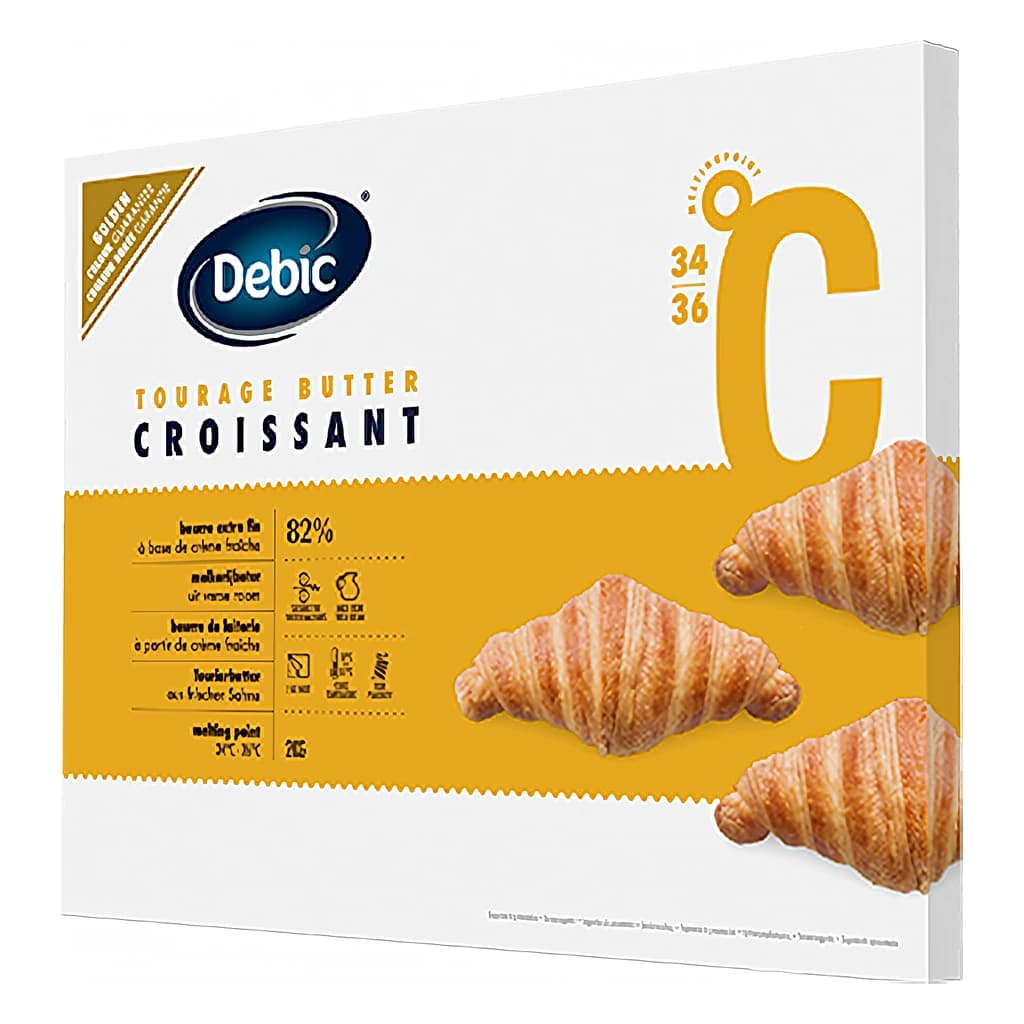
- Obtain current spec for Tourage Croissant Butter 10 kg and Mimetic 32 Lamination Fat to add SFC values
- Confirm soya allergen status on Maestra with current batch documents (some spec sheets indicate traces of milk cross-contact; this article has reported what the 2009 specification stated)
- Full country-by-country regulatory position on trans fat labelling (EU Regulation 2019/649 limits industrial trans fats to ≤2 g per 100 g fat — Marvello at 0.9 g and Milama at <2% are within the limit; Marina at max 1.0% is within limit) — recommend regulatory review before publishing trans fat values
Figures
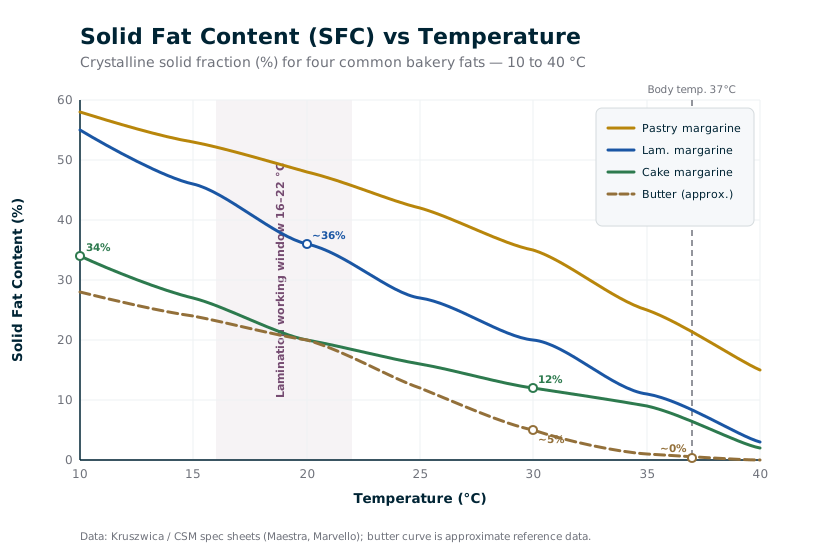 Line graph showing solid fat content (%) versus temperature (°C) for four bakery fat types: butter, laminating margarine, cake margarine and shortening, illustrating how each fat's crystalline fraction changes with temperature
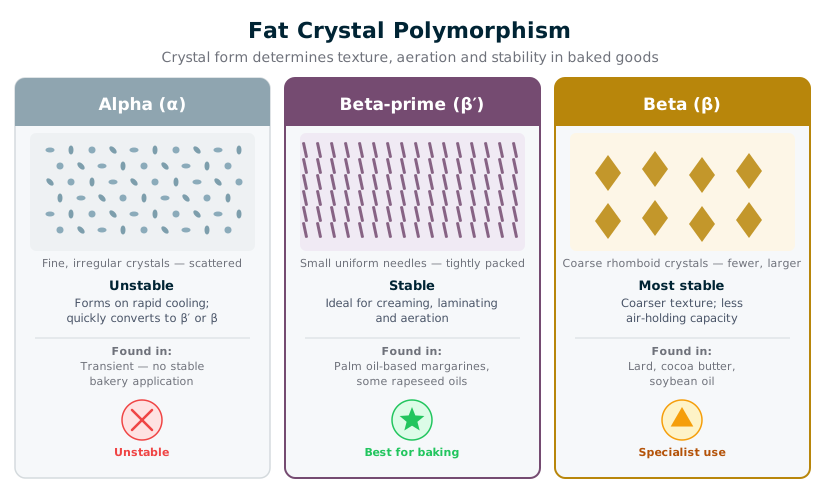 Three-panel schematic diagram illustrating the three polymorphic crystal forms of baking fats — alpha (fine, unstable), beta-prime (fine, stable, ideal for creaming) and beta (coarse, less suitable for creaming)
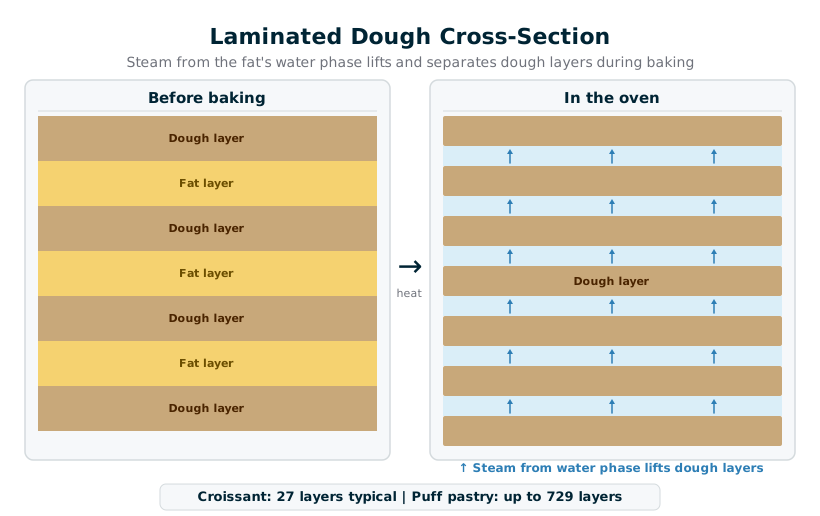 Cross-section diagram of laminated pastry dough showing alternating layers of dough and fat before baking, with arrows indicating steam formation from the fat water phase during baking, resulting in separated flaky layers
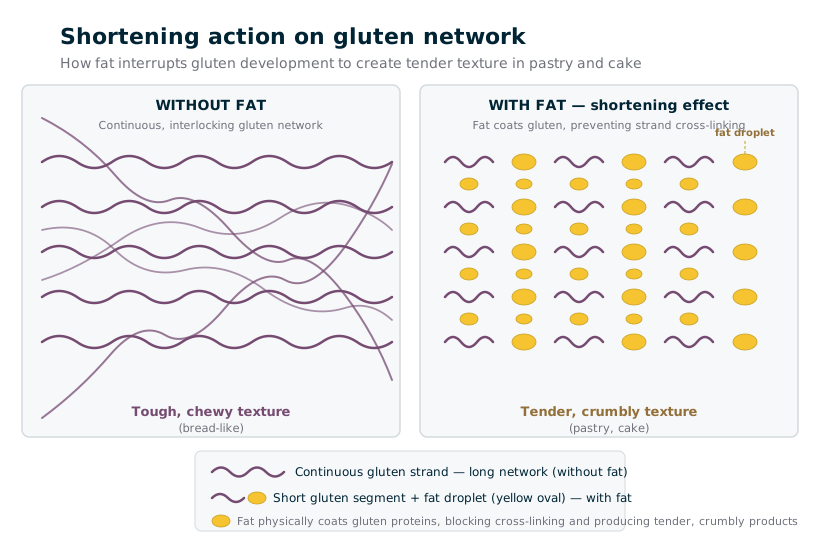 Two-panel diagram comparing gluten network structure without fat (long continuous strands producing tough, chewy texture) versus with fat added (short, interrupted strands producing tender, crumbly texture)
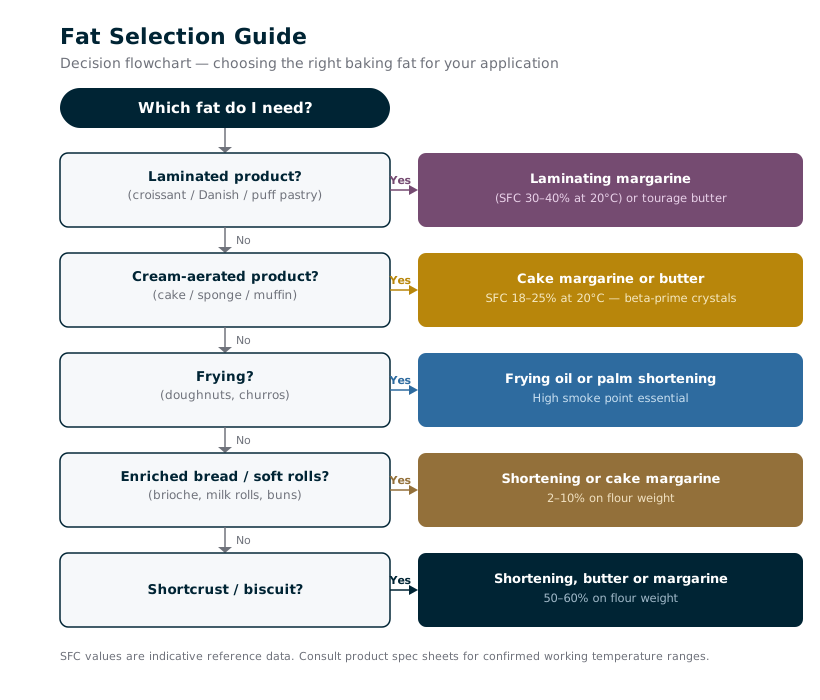 Flowchart decision tree for selecting the correct baking fat type based on application: laminated pastry, creamed cakes, frying, or bread enrichment, with recommended fat type at each endpoint
Classic Croissant — Baker's Percentage Formula
Reference formula for a standard European croissant using laminating margarine. Fat percentage is split between dough fat and roll-in fat. Values are reference ranges from industry literature; not a proprietary recipe.
| Ingredient | Baker's % | Weight |
|---|---|---|
| Strong wheat flour (12–13% protein) | 100% | |
| Fresh compressed yeast | 4–5% | |
| Salt | 2% | |
| Sugar | 8–12% | |
| Whole eggs | 10–15% | |
| Whole milk or water | 45–55% | |
| Butter or cake margarine (dough fat) | 5–8% | |
| Laminating fat (roll-in: Maestra / tourage butter) | 45–55% of dough weight |
- Mix dough to short development; bulk ferment 30 min at room temp then retard overnight (4°C).
- Condition laminating fat to 18–20°C (margarine) or 14–17°C (butter).
- Laminate with 3 × 3-fold (27 layers) or 3 × 4-fold (64 layers).
- Rest 20 min in fridge between each fold.
- Sheet to 5–7 mm, cut triangles, shape, proof at 27°C / 75% RH until jiggling (2–3 h).
- Egg wash; bake 190–200°C for 16–20 min.
This is a guidance formula only. Always validate with your specific flour strength, yeast type and equipment.
All-Purpose Shortcrust Pastry — Baker's Percentage Formula
Classic shortcrust in which fat is rubbed into flour before water is added. Reference formula from industry literature.
| Ingredient | Baker's % | Weight |
|---|---|---|
| Soft/plain wheat flour (9–10% protein) | 100% | |
| Butter or shortening (cold) | 50–60% | |
| Salt | 1% | |
| Cold water | 20–30% | |
| Egg yolk (optional — enriched version) | 8–10% |
- Cut or rub fat into flour until mixture resembles breadcrumbs (fat pieces ~5 mm).
- Dissolve salt in cold water; add all at once; mix until dough just comes together.
- Do not overwork — excess gluten = tough pastry.
- Rest 30 min in fridge to relax gluten and firm fat.
- Sheet to 4–6 mm; blind bake at 180°C / 160°C fan for 15–20 min.
Use cold fat; handle minimally to avoid gluten development.
Classic Pound Cake / Victoria Sponge — Baker's Percentage
Cream-aerated cake using the creaming method. Reference formula from industry literature. Fat must be at correct temperature (18–22°C) to hold maximum air.
| Ingredient | Baker's % | Weight |
|---|---|---|
| Soft/plain wheat flour (9–10% protein) | 100% | |
| Caster sugar | 100% | |
| Butter or cake margarine (e.g. Marvello) | 100% | |
| Whole eggs | 100% | |
| Baking powder | 2–3% | |
| Salt | 0.5% | |
| Milk or water (to adjust consistency) | 0–5% |
- Cream fat and sugar at full speed 5–8 min until pale and fluffy — this is the aeration stage.
- Add eggs one by one with mixer at medium speed; add flour with each addition if mixture curdles.
- Fold in sifted flour + baking powder in two stages; do not overmix.
- Bake 170°C / 150°C fan, 25–35 min depending on tin size.
- For high-ratio cake (sugar > flour): use high-ratio shortening (Coronet NHAV HR) — the E471 emulsifier allows more water in batter without curdling.
Use cake margarine or butter at room temperature (18–22°C) for optimal aeration.
Fat content and key functional properties. Spec-sheet values sourced from first-party datasheets (cited); reference ranges marked [ref].
| Fat type | Fat % (typical) | Water % | Saturated FA % | SFC at 20°C (typical) | Plasticity range (°C) | Crystal form preference | Key flavour note | Allergen headline |
|---|---|---|---|---|---|---|---|---|
| Butter (82% unsalted) | 82% min | 16% | 67% of fat (55 g per 100 g product) | ~18–22% (estimated; not on the spec sheet) | ~14–22°C | Beta-prime / some beta | Rich dairy, diacetyl, mild sour note | CONTAINS MILK (including lactose) |
| Laminating margarine (Maestra Puff Pastry 80%) | 80% ±0.5% | ~18% (by difference) | Not declared per 100g in spec; FFA max 0.75% | 35–37% (summer) / 33–35% (winter) | Recommended working temp 18–20°C | Beta-prime (designed) | Neutral, slight buttery from flavour/annatto | Contains soy lecithin (E322) — may affect soy-allergic; no dairy |
| Pastry margarine (Crown NHAV Pastry 82%) | 82% | ~16% (by difference) | 50% of product (41.2 g per 100 g) | Higher than cake margarine (inferred from slip melting point 47°C; not stated on the spec sheet) | Slip melting point 47°C | Beta-prime | Neutral | None in product, line or factory |
| Cake / cream margarine (CSM Marvello 80%) | 80% | 15–20% | 34% of product (27 g per 100 g) | 20% target (interval 18–24%) | Storage 14–18°C; cream at 18–22°C (inferred) | Beta-prime (palm-based) | Butterlike, slight vanilla/annatto | None in product or line; wheat in factory (may contain trace) |
| Cake / cookie margarine (Kruszwica Milama 80%) | 80% ±0.5% | ~18% (by difference) | ~41% of fat (SAFA 41%) | 20–25% | SFC at 35°C max 5% (clean melt) | Beta-prime | Neutral, mild carotene colour | Allergens absent (product and cross-contact — spec states absent/absent) |
| Versatile margarine (Marina 80 Solidarity Recipe) | 80% min | ~18% (by difference) | 49% of product (39 g per 100 g) | 22–32% | SFC range 10°C: 41–51%, 30°C: 7–17% | Beta-prime | Neutral, mild flavour + E-160ba colour | No allergens IN product; may contain traces of milk (cross-contact, ZK*) |
| High-ratio vegetable shortening (Cardowan Coronet NHAV HR) | 100% | 0% | 38% (38.1 g per 100 g) | Not declared; slip mp 44°C implies moderate SFC (single source) | Broad (no water phase); slip mp 44°C | Beta-prime (palm + rapeseed + E471) | Neutral (no dairy) | None in product, line or factory |
| Vegetable shortening (Cardowan Plain Box NHAV) | 100% | 0% | 39% (38.8 g per 100 g) | Not declared; slip mp 45°C | Broad; slip mp 45°C | Beta-prime | Neutral | None in product, line or factory |
Dosage ranges sourced from BAKERpedia, the Canadian Baker open textbook, and IREKS Compendium. These are general reference ranges, not product-specific dosages. Actual formulations may differ.
| Application | Fat % on flour (baker's %) | Preferred fat type | Key function | Notes |
|---|---|---|---|---|
| Sandwich bread / white tin loaf | 2–5% | Shortening or cake margarine | Crumb softening, shelf-life extension | Fat lubricates gluten; too little = firm crumb; too much = poor volume [ref] |
| Soft rolls / burger buns | 5–12% | Cake margarine or shortening | Softness, extended freshness | Higher fat = softer, more pillowy texture [ref] |
| Croissant (total fat including roll-in) | 40–60% (of which roll-in ~30–45%) | Laminating margarine or tourage butter | Lamination, flavour, lift | Roll-in fat ratio to dough: typically 30–35% of dough weight [ref] |
| Danish pastry | 35–55% | Laminating margarine (e.g. Flex Quatro, Maestra) | Lamination | Less yeast than croissant; enriched with egg and sugar [ref] |
| Puff pastry | 75–100% (fat: flour 1:1 by weight) | Laminating margarine or tourage butter | Steam lift, separation of 729 layers | No yeast; lift entirely from steam — fat water content critical [ref] |
| Shortcrust pastry | 50–60% | Butter, lard or shortening | Shortening (gluten interruption), flavour | Rubbing-in method; fat coats starch before water added [ref] |
| Pound cake / Madeira | ~100% (equal weight) | Butter or cake margarine | Aeration (creaming), moisture, flavour | Equal weight fat, sugar, flour, eggs — classic 1:1:1:1 formula [ref] |
| High-ratio cake | 80–130% | High-ratio shortening (e.g. Coronet NHAV HR with E471) | Aeration, emulsification of high sugar content | Sugar > flour by weight; needs E471 emulsifier to maintain emulsion |
| Biscuits / cookies | 25–65% | Shortening, margarine or butter | Shortening, aeration (creamed), snap | Creamed for crisp/aerated biscuit; melted or rubbed in for chewy [ref] |
| Enriched yeast dough (e.g. brioche, doughnuts) | 30–60% | Butter or cake margarine | Tenderness, richness, shelf-life | Fat added after initial gluten development [ref] |
Critical temperature control for laminated pastry production. Values for Maestra Puff Pastry from its spec sheet. Butter values from Pastry Arts Magazine (medium reliability). Dough room temperature is an industry standard recommendation.
| Condition | Temperature | What happens if violated |
|---|---|---|
| Maestra laminating margarine at lamination | 18–20°C | Below 16°C: fat cracks, tears dough and creates uneven layers; above 22°C: fat softens, smears into dough, layers merge |
| Tourage butter at lamination | 14–17°C | Below 12°C: butter shatters; above 20°C: butter melts into dough — narrow window requires very controlled environment |
| Dough temperature at lamination | ≤18°C | Warm dough accelerates yeast activity and softens fat; results in uneven layering and blown-out shape |
| Proofed croissant in oven (initial) | 180–200°C | Water phase in fat flashes to steam, pushing layers apart; too low = no lift; too high = fat leaks before setting |
| Pastry margarine recommended storage | Max 4–15°C | Above 15°C during storage: early crystal transition reduces plasticity range |
SFC values extracted directly from first-party supplier spec sheets. Spec sheets use NMR (Nuclear Magnetic Resonance) or AOCS Cd 16b-93 method. Values marked [est] are estimates from reference literature, not the spec sheet. Higher SFC = more crystalline/solid at that temperature.
| Product | SFC at 10°C (%) | SFC at 20°C (%) | SFC at 30°C (%) | SFC at 35°C (%) | Method |
|---|---|---|---|---|---|
| Maestra Puff Pastry 80% (Kruszwica) — summer values | Not declared | 35–37% | 18–23% | 10–13% | PN-ISO (implied by spec standard) |
| Maestra Puff Pastry 80% (Kruszwica) — winter values | Not declared | 33–35% | 17–22% | 9–12% | PN-ISO |
| CSM Marvello Cake Margarine 80% (target / interval) | 34% target | 20% target (18–24%) | 12% target (9.5–13.5%) | 9% target (7–11%) | IUPAC 2.150(a); AOCS Cd 16b-93 |
| Kruszwica Milama Cake Margarine 80% | Not declared | 20–25% | Not declared | max 5% | Not specified in spec |
| Master Martini Marina 80 Solidarity Recipe | 41–51% | 22–32% | 7–17% | Not declared | NMR |
| Butter 82% — approximate reference curve | ~28–35% (estimated; not on the spec sheet) | ~18–22% (estimated; reference source only) | ~3–8% [est] | ~0–2% [est] | Reference estimate only — not measured on Polmlek spec |
Practical troubleshooting guide for bakery faults caused by incorrect fat type, temperature or dosage. Based on BAKERpedia, IREKS Compendium and the Canadian Baker open textbook.
| Fault | Most likely fat-related cause | Remedy |
|---|---|---|
| Pastry / biscuit too tough and chewy | Too little fat — insufficient shortening of gluten; or fat melted before mixing completed, causing gluten to develop | Increase fat to correct level; use cold fat; minimal mixing after water added |
| Pastry too crumbly, falls apart | Too much fat, or fat rubbed in too finely (no starch left uncoated to bind) | Reduce fat; leave larger fat pieces during rubbing-in; add a touch more water |
| Laminated product (croissant/puff) has no lift — dense, bread-like | Laminating fat too warm during sheeting — fat absorbed into dough, layers merged; or too many rest-less folds | Chill dough and fat between each fold; verify fat temperature 18–20°C (margarine) or 14–17°C (butter); use correct laminating fat not cake margarine |
| Fat tears and breaks through dough during lamination | Laminating fat too cold (below 14°C) — brittle, cracks, punctures dough | Temper fat to correct working temperature before sheeting; do not use directly from cold store |
| Cake low in volume, dense crumb | Fat too warm (above 25°C) during creaming — liquid fat cannot trap air; or fat too cold (below 15°C) — stiff fat cannot expand | Use fat at 18–22°C for creaming; check fat temperature before mixing |
| Greasy, heavy crumb in cake or brioche | Excess fat; fat added too early before gluten development in enriched dough; or high-ratio formula without emulsifier | Reduce fat to formula level; in enriched doughs add fat after initial gluten development; use high-ratio shortening with E471 if sugar exceeds flour weight |
| Rancid or soapy off-flavour in finished product | Fat oxidation — old fat, high FFA, incorrect storage (heat, light); or peroxide value too high | Check FFA (<0.1% fresh, reject if >0.5%); store fat in cool dark place; rotate stock within shelf life; check peroxide value (<1.0 meq O2/kg fresh) |
| Croissant / Danish — fat leaking excessively onto tray during baking | Proof temperature too high melted fat; or gluten too weak to hold fat in layers | Proof at 27°C max; avoid over-proofing; use flour with adequate protein (12–13%) |
| Biscuit / shortbread spreads flat during baking | Fat too soft (melted before structure sets); too much fat; oven temperature too low | Use colder fat; reduce fat %; increase oven temperature so structure sets before fat fully melts |
| Frying fat — dark colour, off-flavours develop quickly | FFA build-up from hydrolysis; overheating above smoke point; food particles carbonising | Filter frying fat after each session; replace when FFA reaches 0.5–1.0% or colour darkens significantly; control frying temperature (170–180°C for doughnuts) |
- Value:
- 82% minimum
- Unit:
- % by weight
- Confidence:
- high
- Value:
- 55 g
- Unit:
- g per 100 g product
- Confidence:
- high
- Value:
- 16%
- Unit:
- % by weight
- Confidence:
- high
- Value:
- 35–37%
- Unit:
- % solid fat at 20°C (Apr 15 – Aug 31)
- Confidence:
- high
- Value:
- 33–35%
- Unit:
- % solid fat at 20°C (Sep 1 – Apr 14)
- Confidence:
- high
- Value:
- 18–20°C
- Unit:
- °C
- Confidence:
- high
- Value:
- 44°C
- Unit:
- °C (slip melting point)
- Confidence:
- high
- Value:
- 12%
- Unit:
- % air by volume
- Confidence:
- high
- Value:
- 45°C
- Unit:
- °C (slip melting point)
- Confidence:
- high
- Value:
- 47°C
- Unit:
- °C (slip melting point)
- Confidence:
- high
- Value:
- 20% (interval 18–24%)
- Unit:
- % solid fat at 20°C
- Confidence:
- high
- Value:
- 0.9 g per 100 g (non-animal derived)
- Unit:
- g per 100 g
- Confidence:
- high
- Value:
- 41–51%
- Unit:
- % solid fat at 10°C (NMR)
- Confidence:
- high
- Value:
- up to 729 layers (six single folds, 3^6 = 729; BAKERpedia states range 81–729)
- Unit:
- number of layers
- Confidence:
- high
- Value:
- 27 layers (three single folds, 3^3 = 27; one common configuration; BAKERpedia states range 24–144)
- Unit:
- number of layers
- Confidence:
- high
Buy the ingredients
Catalogue products and brands referenced in this article.
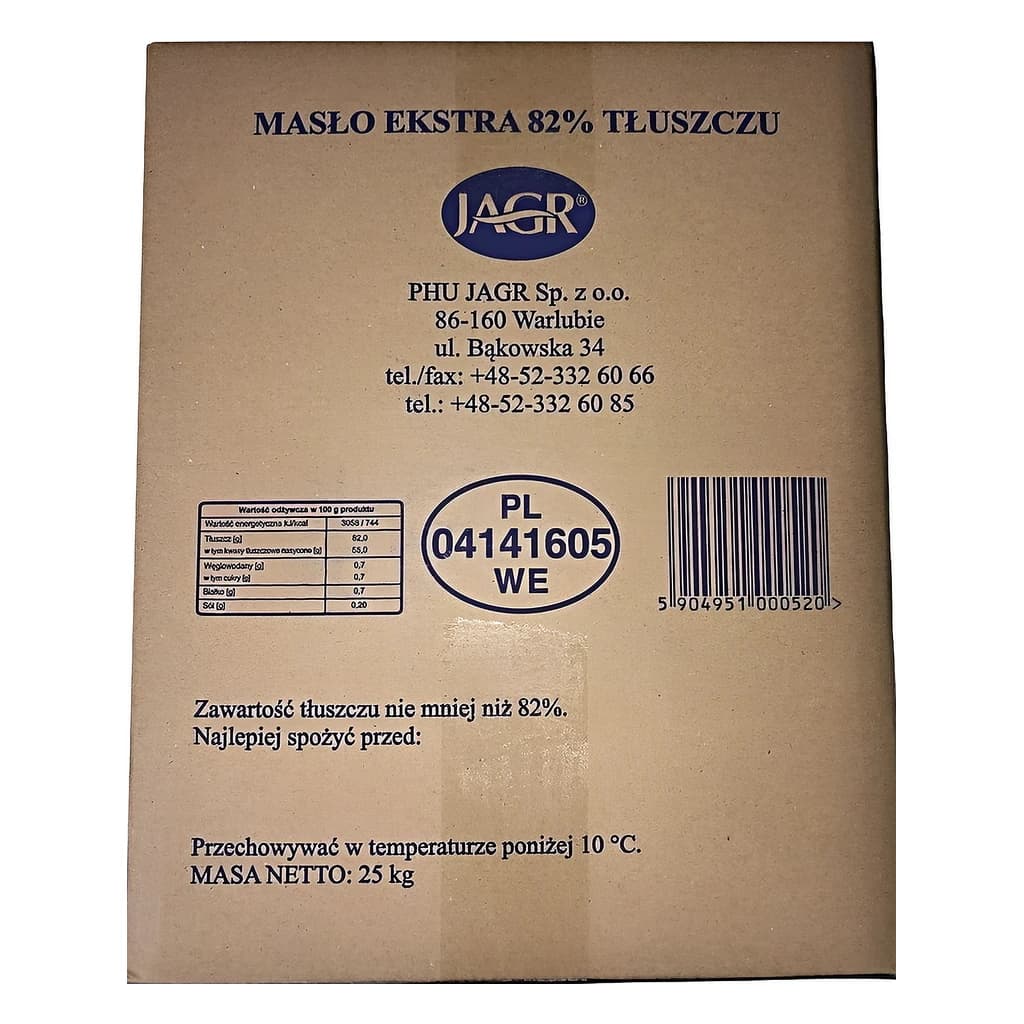
Unsalted Butter 82% 25 kg
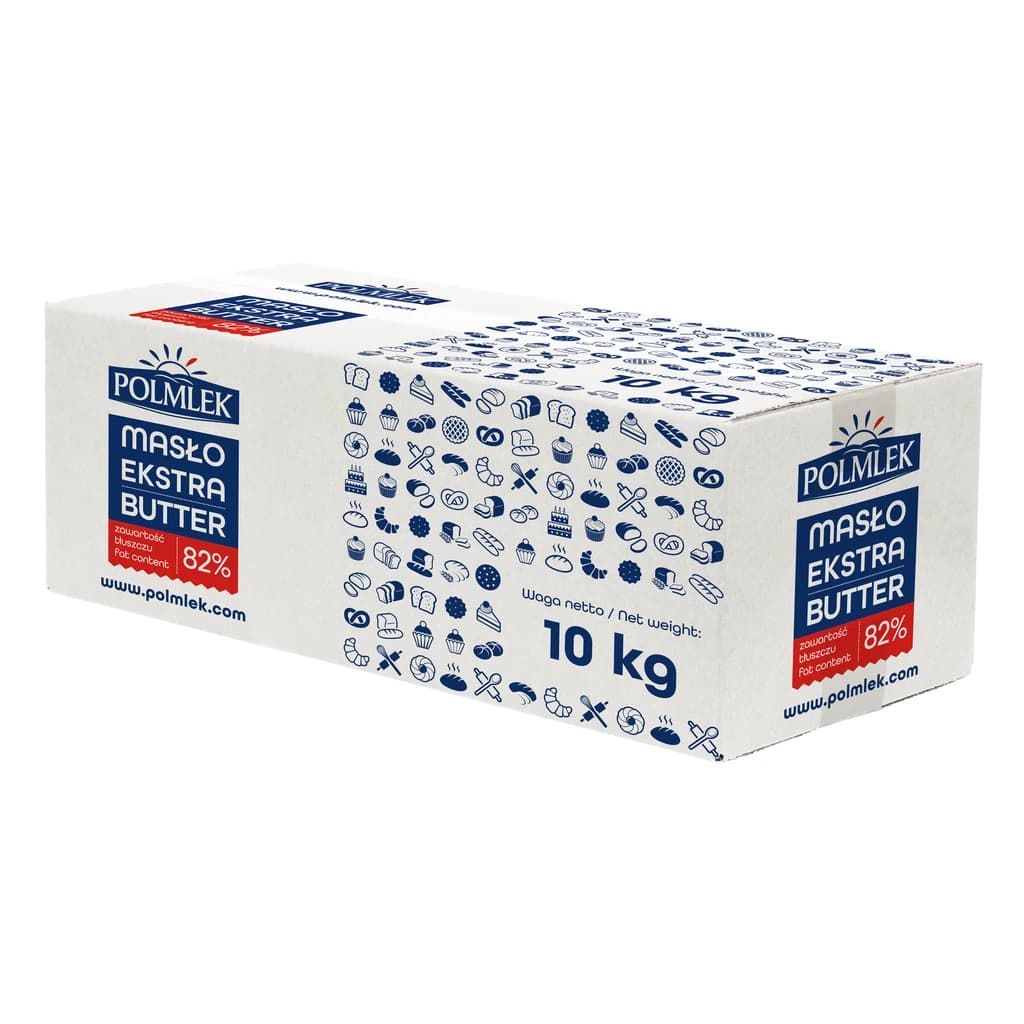
Unsalted Butter 82% 10 kg
Milama Cake & Cookie Margarine 10 kg
Puff Pastry Margarine 80% 10 kg

Puff Favorit Laminating Margarine 10 kg
Mimetic 32 Lamination Fat 10 kg
Tourage Croissant Butter 10 kg (5 × 2 kg)
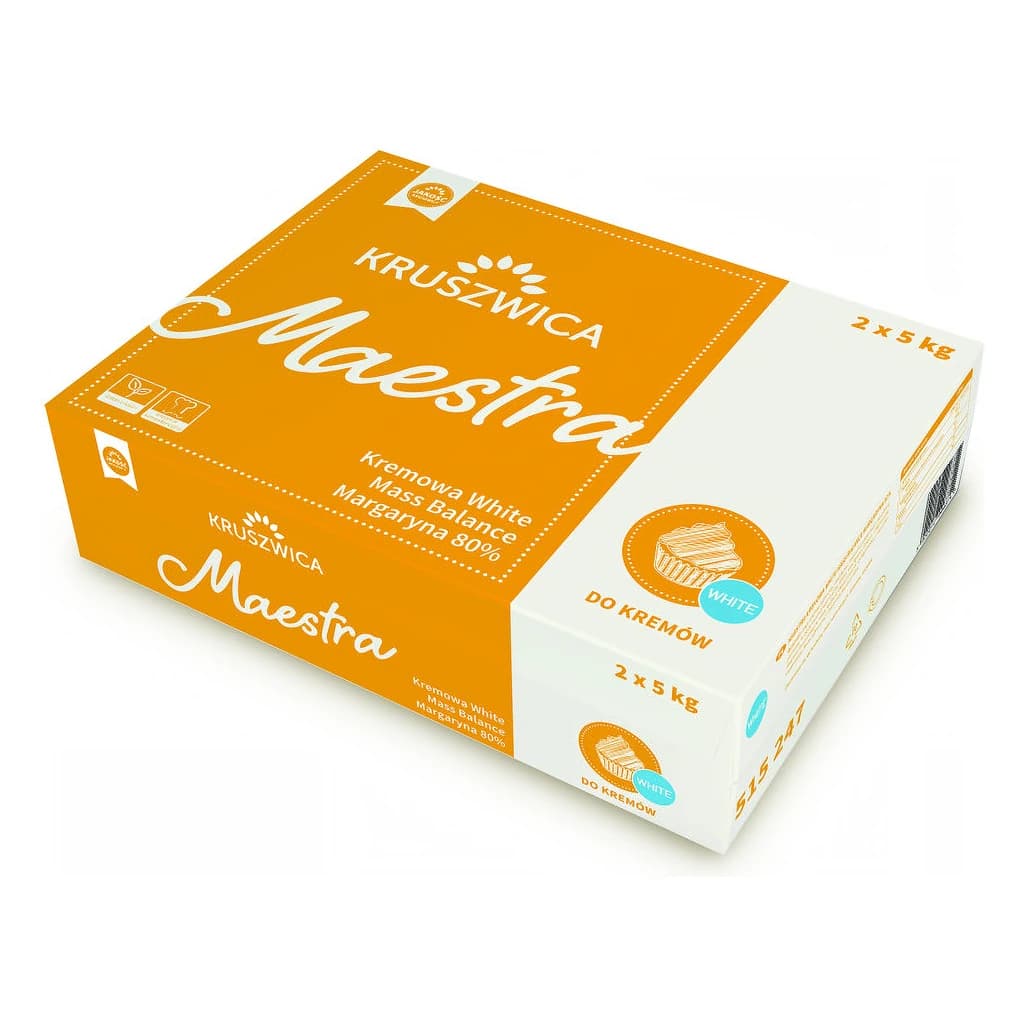
Maestra White Cream Margarine 80% 10 kg
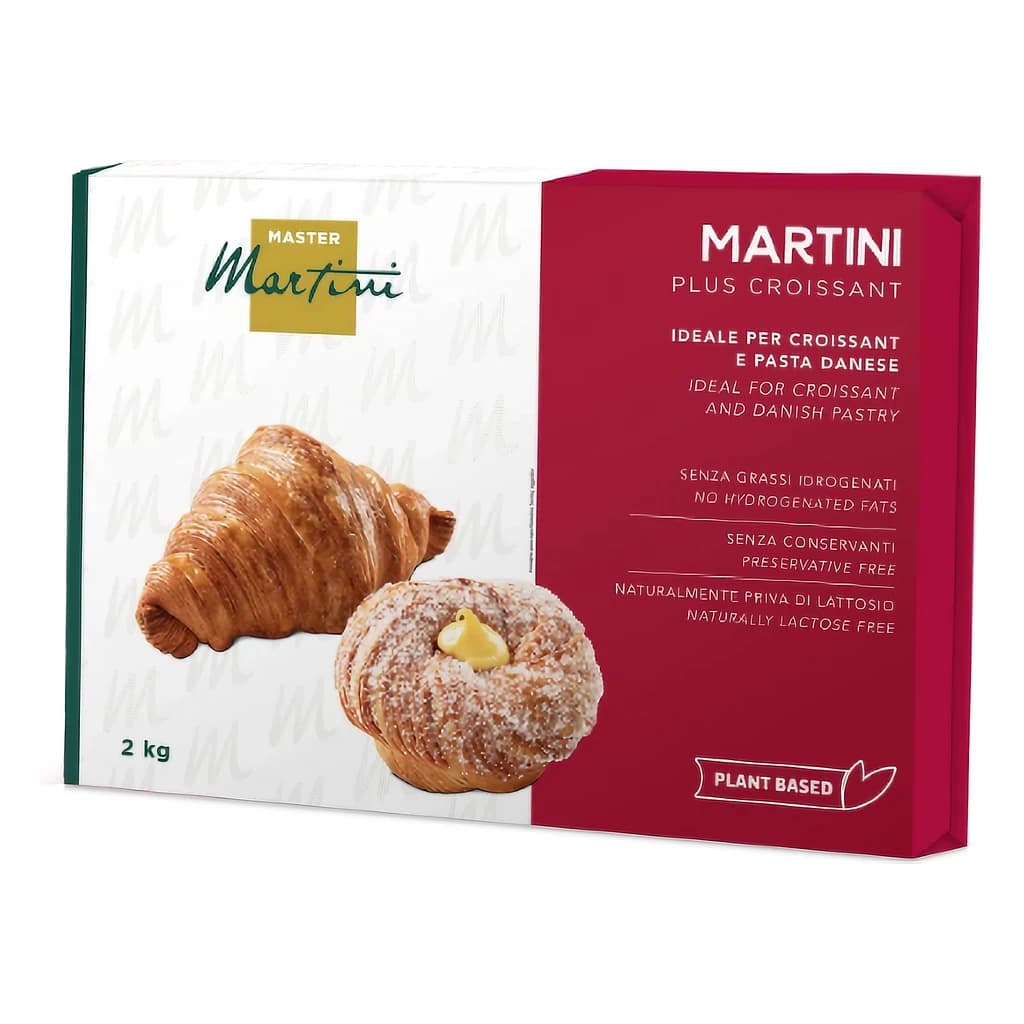
Plus Croissant Margarine 10 kg (5 × 2 kg)
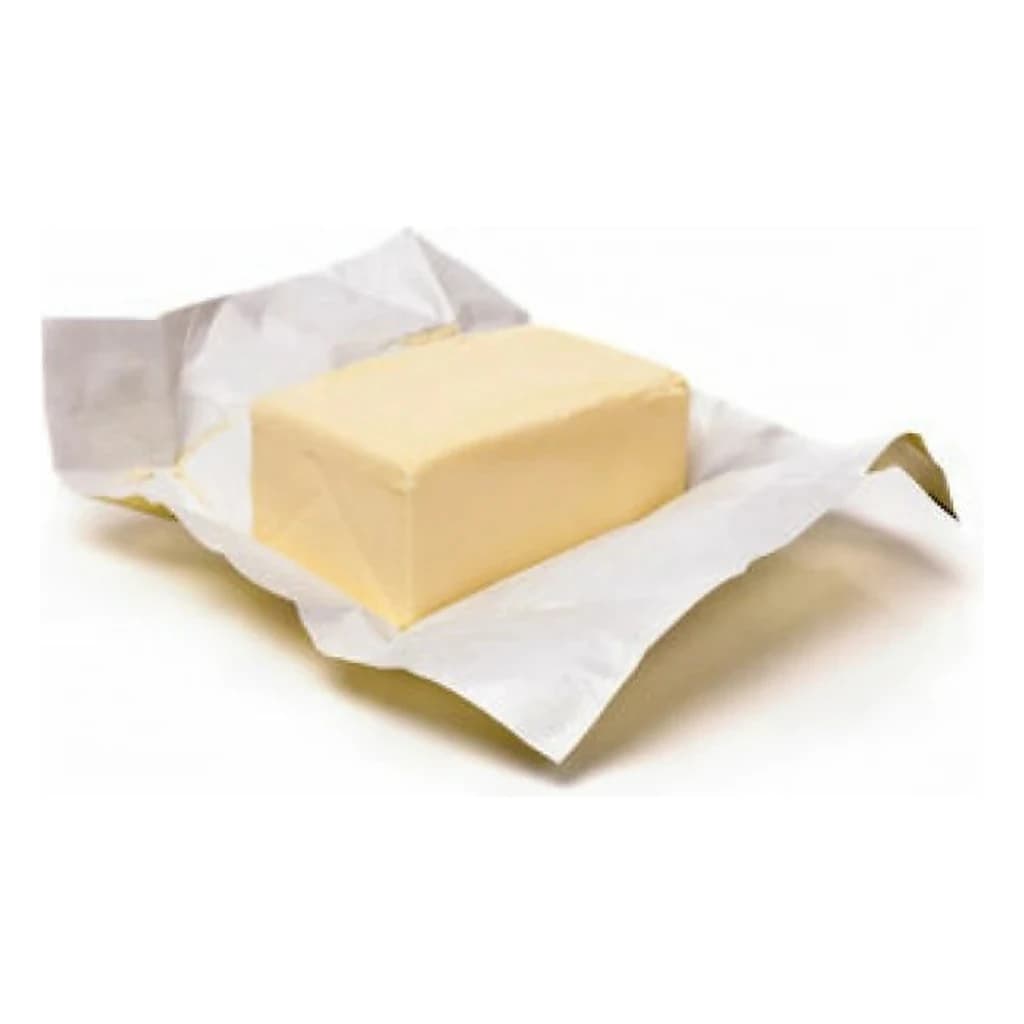
Marina Cake Margarine 80% 10 kg (Solidarity Recipe)
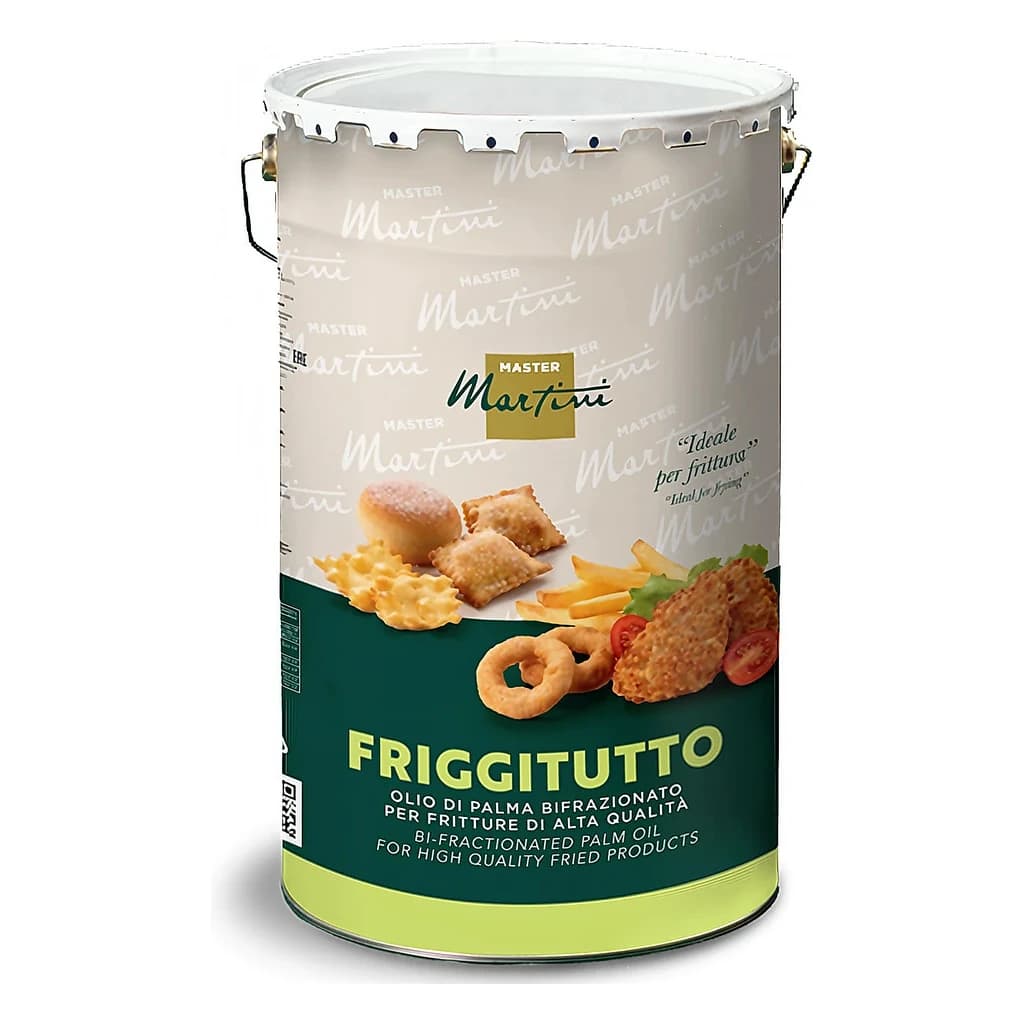
Palm Frying Oil 25 L (22.7 kg)
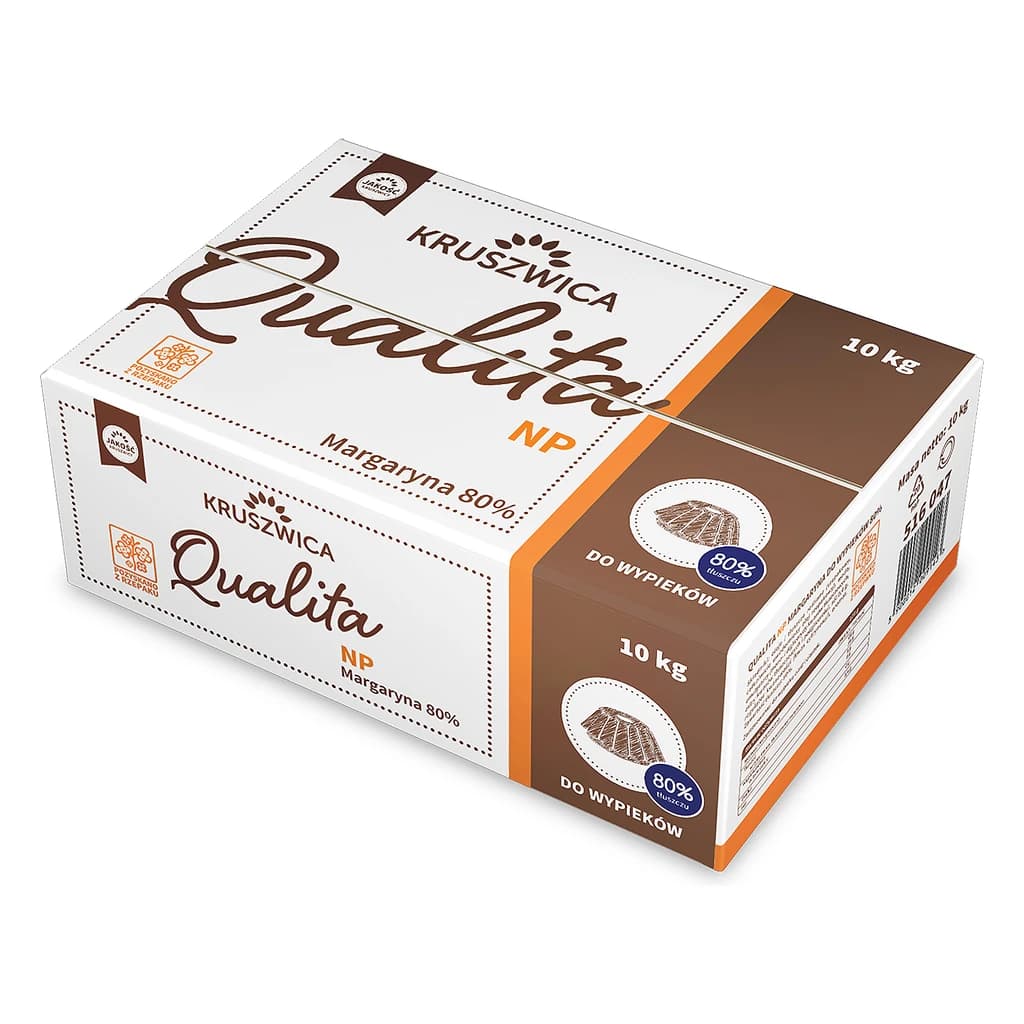
Qualita NP Palm-Free Margarine 80% 10 kg
Flex Quatro Danish Pastry Margarine 12.5 kg
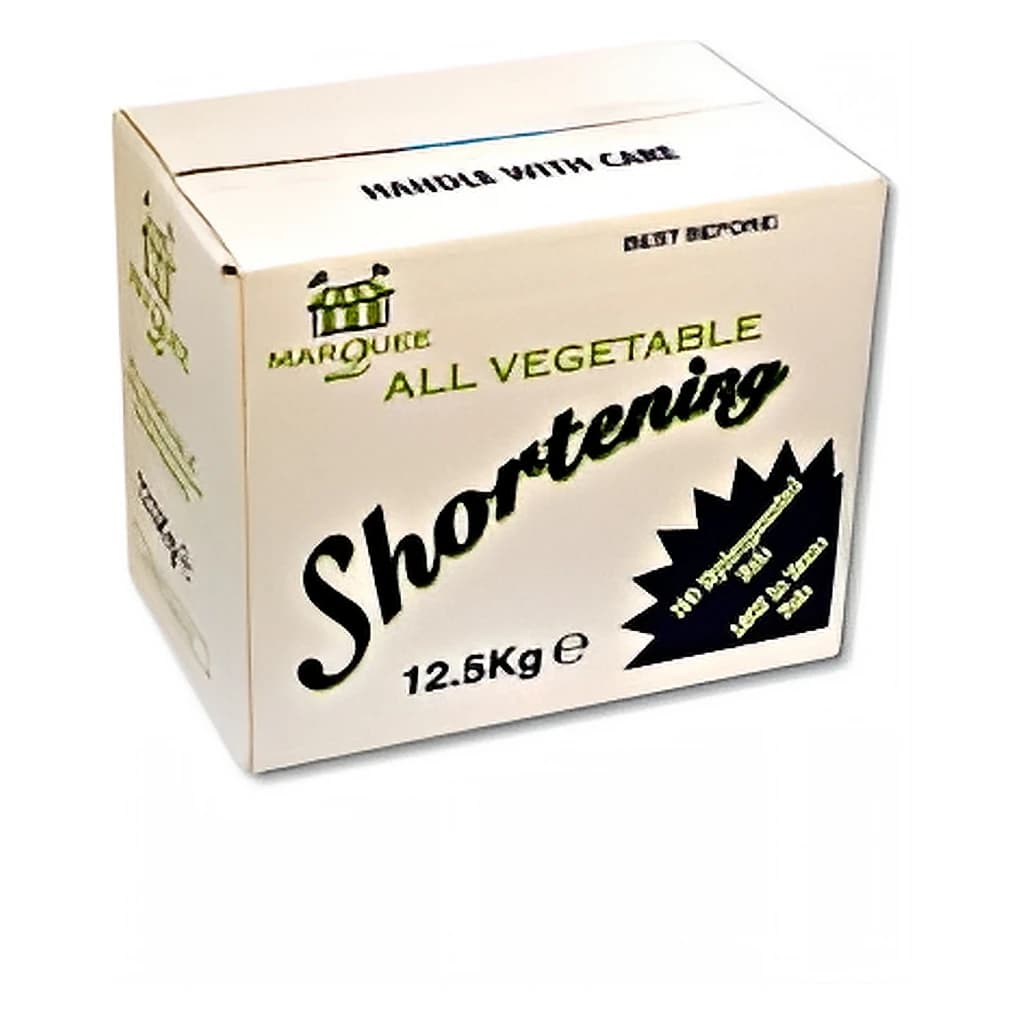
High Ratio Vegetable Shortening 12.5 kg
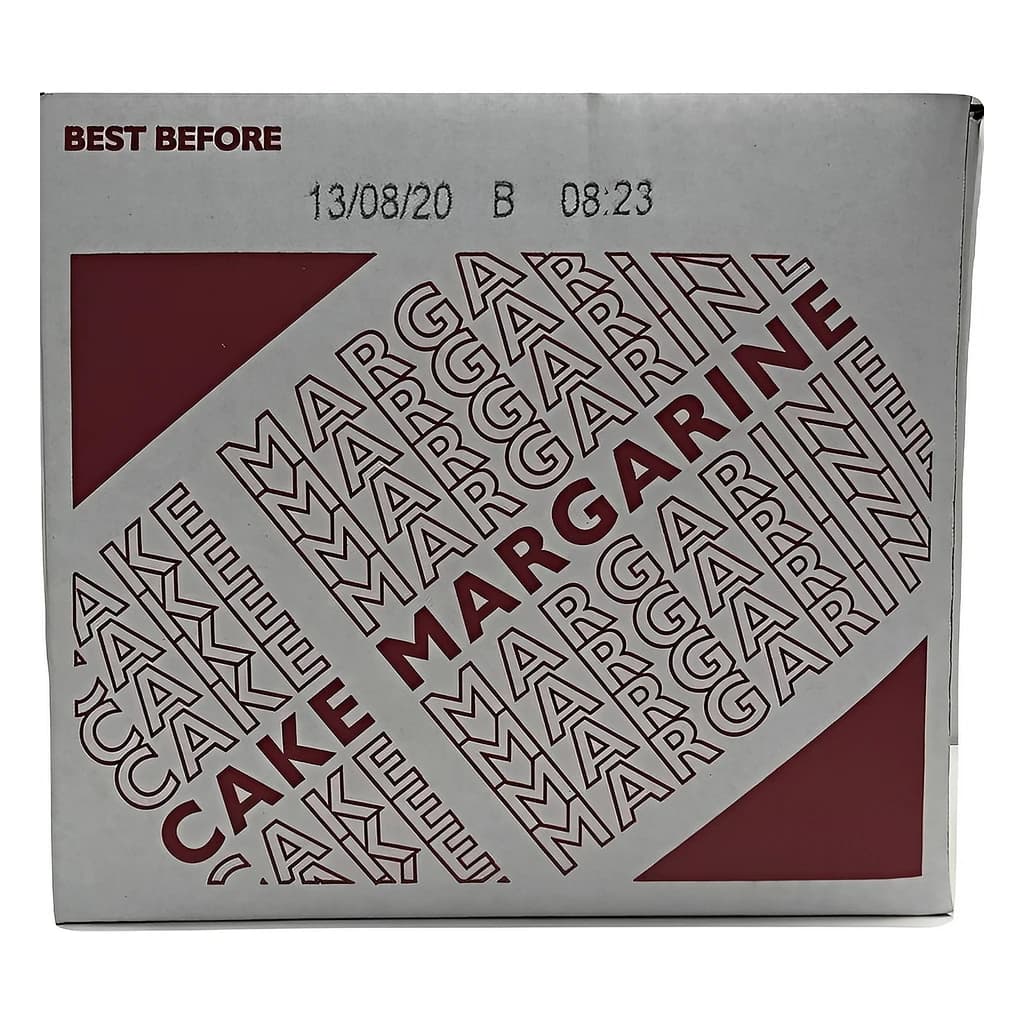
Unsalted Cake Margarine 12.5 kg
Vegetable Shortening 12.5 kg
Puff Pastry Margarine 12.5 kg
Marvello Cake Margarine 12.5 kg