Piernik: Toruń gingerbread tradition, spice blends, honey chemistry and maturation protocols
Piernik is Poland's honey-and-spice gingerbread, and Toruń is its capital. This dossier gives a working baker the authentic picture: the history (first written record around 1380, the baker Mikołaj Czan, the katarzynki linked by folk tradition to St Catherine's feast on 25 November, the carved pearwood moulds and the Kopernik factory's centuries of maturation), the spice blend (przyprawa piernikowa) that defines the flavour, the honey chemistry that gives piernik its deep colour and weeks-long softness, the two dough methods (raw vs scalded) and — above all — lezakowanie, the cold maturation that runs from weeks to a full year. It ties each technique to the Domson catalogue a Polish baker actually orders (Ratos Natura honey, first-party Rolmex/Floramex przyprawa piernikowa, ACOR cinnamon, Sleaford ginger, KST nutmeg, Rolmex aniseed, Bowika/Emix bicarbonate, Martin Braun bake-stable plum filling, Helios compound chocolate glaze) and to the Pillar A craft concepts behind it (see A2-chemical-leaveners-baking-powder, A1-alternative-grain-flours, A5-baking-oven-science, A5-shelf-life-and-staling, A6-chocolate-selection-couverture and A7-icings-and-buttercreams). Built on twelve first-party supplier spec sheets cross-checked against Polish-language cultural, trade and academic sources (the Toruń Gingerbread Museum, the gov.pl traditional-products register, Money.pl on the Kopernik factory, and industrial confectionery-technology references).
Piernik: Toruń gingerbread tradition, spice blends, honey chemistry and maturation protocols
Piernik (gingerbread) is the oldest continuously made sweet baked good in Poland, and Toruń is its undisputed home. For a Polish bakery, piernik is both a year-round line and the centre of the Christmas table (see B1-seasonal-festive-baking for the festive calendar). This dossier is a working guide to making it authentically: the tradition, the spice blend, the honey chemistry, the two dough methods, and the maturation that separates real piernik from a fast honey cake.
1. Where piernik comes from
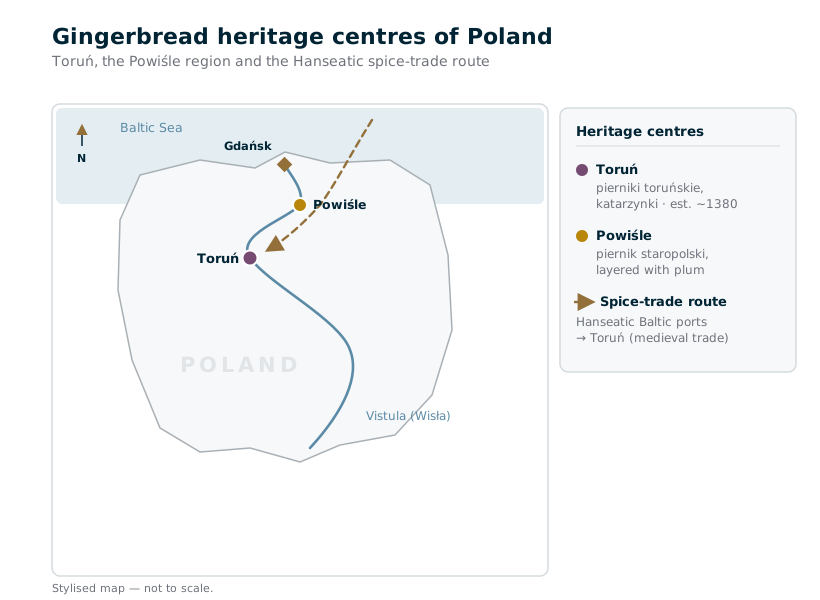
The first written record of Toruń gingerbread dates to around 1380 and concerns a baker named Mikołaj Czan (Nicolaus Czan), who is thought to have baked spiced honey cakes alongside bread . The trade itself — piernikarz (gingerbread baker) — appears in the records a little later; the death of the gingerbread baker Symeon Neisser is noted in 1564. The Living Gingerbread Museum (Żywe Muzeum Piernika) carries on a craft it describes as over 600 years old.
The name tells the story of the spice: piernik comes from the old adjective pierny (peppery, spicy, from pieprz = pepper), and the word itself appears at the turn of the 15th and 16th centuries. Piernik descends from the ancient honey-cake (miodownik) of honey and flour . Toruń became its capital for two reasons: as a Hanseatic trading city it could buy exotic spices, and it sat amid excellent raw materials — fine flour from the ziemia chełmińska (Chełmno Land) and Kujawy (Kuyavia), and honey from well-developed local beekeeping. The oldest preserved Toruń recipe, from 1725, comes from a medical compendium — pierniki were once taken as medicine.
Katarzynki and the carved moulds
The signature Toruń shape is the katarzynka: six small medallions joined into one piece. The name is traditionally linked to St Catherine (Katarzyna) — the Toruń Gingerbread Museum records the origin as "mysterious, preserved only in folk legends"; one folk tradition connects it to St Catherine of Alexandria (Święta Katarzyna Aleksandryjska), whose feast falls on 25 November — confirmed as the day the Christmas-gingerbread season opened, running through to Christmas. Kopernik still releases a limited katarzynki edition on that date each year.
Before piped icing, piernik was shaped in carved wooden moulds (formy piernikowe) — reliefs of rulers such as Zygmunt III, Queen Konstancja and Władysław IV, and of hearts and animals . The dough was pressed into the carving and turned out with the picture in relief.
The Toruń factory now called Kopernik traces to 1763, founded by Jan Weese, and has run for over 250 years.
A note on protected status
Treat the legal status carefully. Reliable sources state that pierniki toruńskie are not registered in the EU schemes (no PDO/PGI/TSG) but are entered on Poland's national List of Traditional Products (Lista Produktów Tradycyjnych); a number of popular articles wrongly call them "ChOG" (Protected Geographical Indication), which appears to be a conflation. The piernik staropolski z Powiśla is also on the national list.
2. The spice blend — przyprawa piernikowa
Piernik's character is its warm-spice blend. A classic Polish przyprawa piernikowa is built on cinnamon (cynamon), ginger (imbir), cloves (goździki), nutmeg (gałka muszkatołowa) and cardamom (kardamon), rounded out with allspice (ziele angielskie), coriander (kolendra), anise (anyż) and pepper (pieprz). Cinnamon is always the dominant note, followed by ginger; exact gram ratios vary between households and recipes and are not standardised — consult a trusted recipe source for a starting point.
Domson carries this as a first-party blend under two genuine gingerbread-spice datasheets (note: both are attached to one catalogue line, a likely title mismatch — see the verification note):
- Rolmex "Przyprawa piernikowa" (G23735): wheat flour, cinnamon, coriander, nutmeg, cloves, cocoa, ginger, cardamom; 205 kcal/100 g (⚠️ anomalously low for a flour-based spice blend; verify with supplier); allergen gluten (wheat), may contain mustard/soy.
- Floramex "Dobra" gingerbread seasoning (G24218): wheat flour, cinnamon, cocoa, pimento (allspice), ginger, coriander, clove; 316 kcal/100 g; allergen gluten (wheat); may also contain celery, mustard and sulphite traces (⚠️ verify the full allergen declaration against the original spec sheet).
In both, the wheat flour is a flowing/carrier base — useful to know for allergen labelling. If you blend your own, the catalogue single spices are: ACOR/PGD ground cinnamon (cassia, Indonesia, moisture max 16%), Sleaford ground ginger (Zingiber officinale, India, volatile oil min 1.5%, vegan/halal/kosher), KST ground nutmeg (Myristica fragrans, volatile oil min 2.5%) and Rolmex aniseed (Pimpinella anisum, essential oil min 1.5 ml/100 g).
Food-safety flag — cassia coumarin: The ACOR cinnamon is cassia (Cinnamomum aromaticum), which naturally contains 2,000–7,000 mg/kg coumarin. EU Regulation 1334/2008 (as amended by Reg. 2017/1400) limits coumarin to 50 mg/kg in traditional/seasonal bakery wares and 15 mg/kg in fine bakery wares. At typical piernik spice rates the finished-product coumarin level must be verified against the applicable EU limit before production sign-off.
Food-safety note — ginger sulphites: The Sleaford ground ginger spec reports naturally occurring sulphites up to 30 mg/kg. EU FIR 1169/2011 Annex II requires sulphite declaration when present above 10 mg/kg in the ingredient. Seek written confirmation from Sleaford on the sulphite declaration status before use in allergen-sensitive formulations.
Quality note — aniseed essential oil: The Rolmex aniseed declares an essential-oil minimum of 1.5 ml/100 g, which is below the EU Pharmacopoeia reference level of 2.0 ml/100 g for food-grade aniseed. This is a quality note, not a food-safety issue.
See the spice-blend comparison table below for the full side-by-side.
3. Honey chemistry — why piernik is brown, soft and keeps
Honey is not just a sweetener in piernik; it is the engine of colour, moisture and shelf life.
- Colour. Honey's free simple sugars — fructose and glucose — undergo the Maillard reaction and caramelisation faster than ordinary sucrose, so a honey-rich dough browns deeper and earlier in the oven. This is the same browning physics covered in A5-baking-oven-science.
- Softness and keeping. Honey is hygroscopic — it pulls in and holds moisture — so honey-rich pierniki stay soft for weeks and tolerate long maturation without drying. This is the staling/anti-staling mechanism in A5-shelf-life-and-staling.
The authentic base is real honey: Ratos Natura natural multifloral honey (Polish origin) is water max 20%, reducing sugars min 60%, HMF max 4 mg/100 g, diastase min 8; the spec declares 330 kcal and 70 g sugars per 100 g (⚠️ these figures appear internally inconsistent — standard multifloral honey is typically ~304 kcal / ~82 g sugars per 100 g; verify with supplier ), and declares no allergens. Industrial bakeries often stretch honey with cheaper invert sweeteners — artificial honey (miód sztuczny), glucose/starch syrup, invert sugar — for the same hygroscopic moisture economics, at the cost of honey's flavour and enzymes.
Beware the shortcut: the Zeelandia Honey Cake Mix (Ciasto Miodowe) is a honey-flavour cake mix with only 0.2% real honey and chemical raising agents, and no spice blend. It is a fast sheet-cake base, not a spiced, matured piernik (see formula 4). ⚠️ Allergen alert: this mix declares milk as a listed allergen — an unexpected ingredient for a honey cake product; bakers must declare milk on finished-product labels and cannot assume the mix is dairy-free.
4. Leavening — alkaline by design
Piernik is chemically leavened, never with yeast, and it favours alkaline leaveners because raising the dough pH both deepens the honey browning and controls spread. The full chemistry of these agents is in A2-chemical-leaveners-baking-powder. Three are used:
- Bicarbonate of soda (sodium bicarbonate, E500) — the all-rounder. Domson's food-grade soda (Bowika E500ii, supplied under the Emix line) is min 99.3% NaHCO3, 1% solution pH max 8.5.
- Baker's ammonia (ammonium bicarbonate, E503) — gives a crisp lift in thin pieces where the ammonia gas can fully bake off. Use it only in thin, low-moisture pieces such as katarzynki; in a thick, moist cake the residual ammonia smell remains, so switch to soda or potash.
- Potash (potaż, potassium carbonate) — the heritage leavener for honey doughs.
Indicative industrial dosing varies by method (single-source; treat as indicative): the scalded-dough formula uses about 0.3 kg soda and 0.8 kg ammonium bicarbonate per 100 kg flour; the raw-dough formula uses about 0.9 kg ammonium bicarbonate and no soda. Do not apply the 0.9 kg figure as a soda dose — it is the ammonium-bicarbonate quantity in the raw-dough context.
5. Two dough methods — raw and scalded
Both are authentic. The choice drives crumb and keeping:
- Raw / cold dough (ciasto surowe): everything mixed cold; target dough moisture 23.5-25.5%, dough temperature <=22 C. Simpler, good for everyday piernik.
- Scalded / brewed dough (ciasto zaparzane): flour is brewed in hot honey-sugar syrup — the single industrial source specifies >=65 C as the brewing minimum, though wheat starch typically gelatinises at 70–90 C; the syrup itself is prepared at 70–75 C (sugar and honey heated together) before the flour is added. The scalded mass reaches ~19-20% moisture, is cooled to 25-27 C and rested ~10-15 days before the final mix; final dough is 20-22% moisture at 29-30 C. These figures are single-source and are treated as indicative. This method gives the finest, longest-keeping crumb and is the route for the deepest pierniki.
For the traditional darker, denser crumb, swing part of the flour to rye — see A1-alternative-grain-flours for how rye behaves.
6. Maturation — lezakowanie
This is the soul of piernik. Lezakowanie is the cold rest of the dough (or of the scald) in a dark, cool place. At Kopernik the dough matures at least several weeks — and sometimes a full year . The annual limited katarzynki are made from dough aged exactly one year and released on 25 November. An old custom had a baker knead a batch of dough at the birth of a daughter and bake her wedding pierniki from it years later. At home, a staropolski dough is typically rested cold for several weeks (commonly cited as 4–6 weeks) before it firms up and rolls cleanly. ⚠️ Food-safety note — raw egg and cold chain: formulas containing whole egg should be stored in a sealed container at <=5 C (refrigerator) for the entire maturation period; a cellar at "cold" ambient temperature does not reliably provide the <=5 C required to control Salmonella risk in a raw-egg dough.
What maturation does: the spices infuse, the flavour rounds out and mellows, and the crumb — held soft by honey's hygroscopicity — softens further. There is no laboratory clock for it; in Toruń the master decides by experience.
7. Baking and finishing
Bake standard pierniki up to ~240 C (about 12 minutes for thin pieces; note this temperature is a single-source industrial tunnel-oven reference — home and craft sources consistently cite 160–180 C for all piernik types; apply professional judgement for your oven), dropping to ~210 C for thin/mint types to avoid surface darkening; thick, layered products take 30-40 minutes .
Finishing is where the regional types diverge (see the piernik-types table below):
- Plain or iced katarzynki — finished bare or with white sugar icing (lukier); royal-icing technique is covered in A7-icings-and-buttercreams.
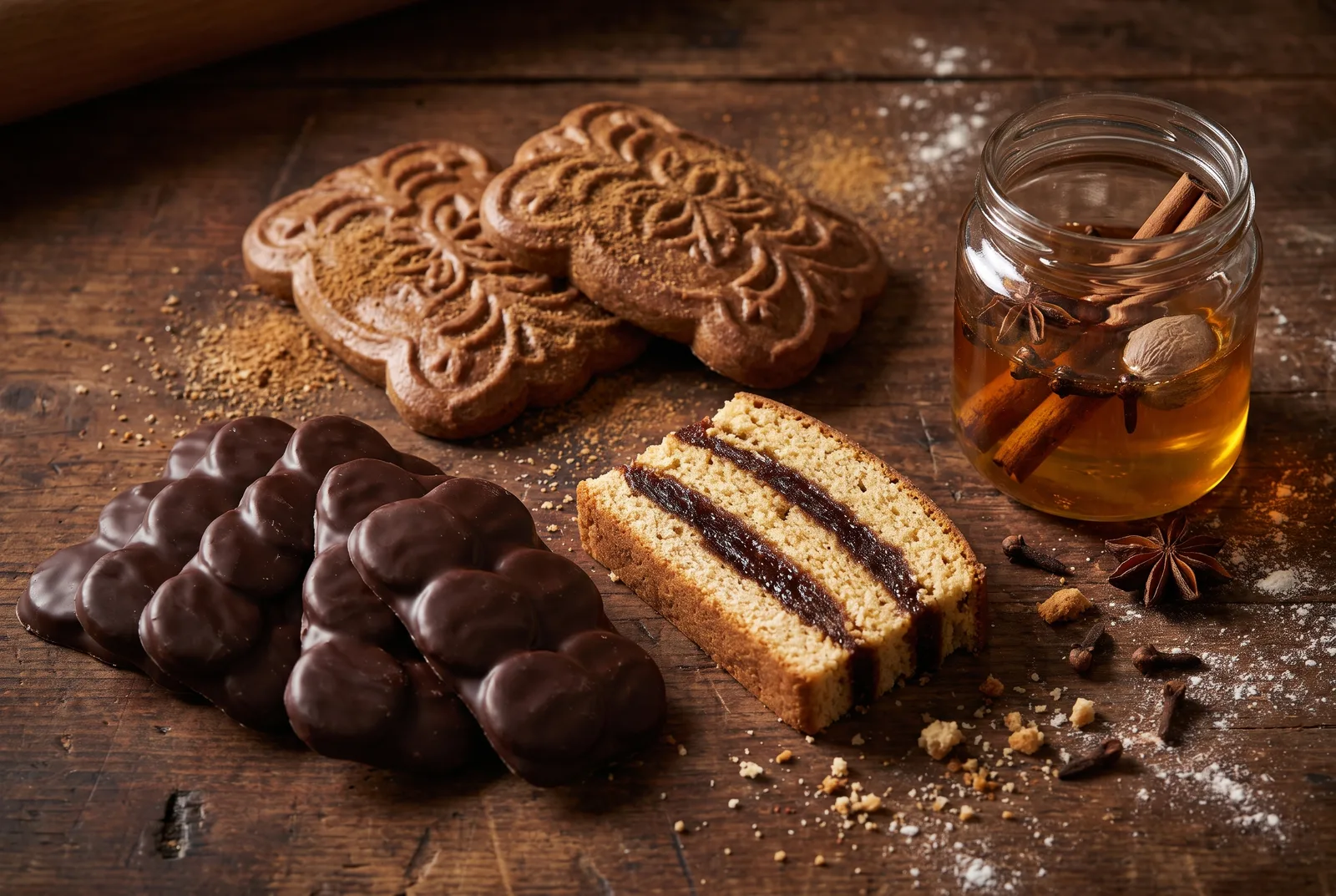
- Piernik przekładany powidłami (layered) — the piernik staropolski z Powiśla format: pale honey-cake sheets stacked and interleaved with dark plum jam (powidła), pressed and matured so the cut block shows alternating light and dark bands; the registered block is about 28 x 12 x 12 cm . Use a bake-stable plum filling so the layers hold and do not weep — Martin Braun Śliwidło (50% plum, pH 3.5, 35 Bx, gelled with gellan/xanthan, preserved with potassium sorbate) is built for exactly this.
- Pierniki w czekoladzie (chocolate-glazed) — dipped or enrobed in dark compound chocolate; Helios Premium dark chocolate glaze (palm-fat compound, 12.5% cocoa, solid strips at 20 C, may contain milk/nuts/peanuts) sets with snap and shelf life. ⚠️ The spec states 36 g saturated fat from 38 g total fat — an unusually high saturation ratio for the declared non-hydrogenated palm fat; verify the fat type with Helios before using these figures in nutritional labelling. Compound vs couverture is explained in A6-chocolate-selection-couverture.
8. Formulas
Four formula cards are below, all arithmetic-checked and tied to the catalogue:
- Staropolski long-matured piernik (honey-rich, baker's %) — the authentic deep-flavour loaf built from the 1927 Old-Polish recipe.
- Toruń-style katarzynki (thin, baker's-ammonia leavened) — the crisp Toruń icon.
- Piernik przekładany powidłami — assembly of honey-cake sheets and bake-stable plum filling.
- Zeelandia Honey Cake Mix shortcut — a fast honey-flavour base, with the caveat that it is not a true spiced, matured piernik.
9. What a Polish baker buys (catalogue)
- Honey: Ratos Natura Multifloral Honey (authentic) or Artificial Honey (invert keeper).
- Spice: first-party Rolmex / Floramex przyprawa piernikowa, or build your own from ACOR cinnamon, Sleaford ginger, KST nutmeg, Rolmex aniseed.
- Leaveners:Bicarbonate of Soda (Emix/Bowika, E500) and Ammonium Bicarbonate (PGD, E503).
- Plum layers:Martin Braun Śliwidło bake-stable plum, or Hortino prune/plum jam.
- Coating & decor:Helios dark compound glaze; Zeelandia marzipan and gingerbread decorations; Polmarkus candied orange peel.
- Shortcuts:Zeelandia Honey Cake Mix, Lesaffre Gingerbread Mix, Whitworth Ginger Cake Mix Complete.
See B1-supplier-brands-for-polish-baking for the full supplier guide, and B1-mazurek-and-short-pastry for the Easter confectionery that shares this shelf.
All numeric specs are drawn from first-party supplier datasheets (single-source) and Polish-language references.
Figures
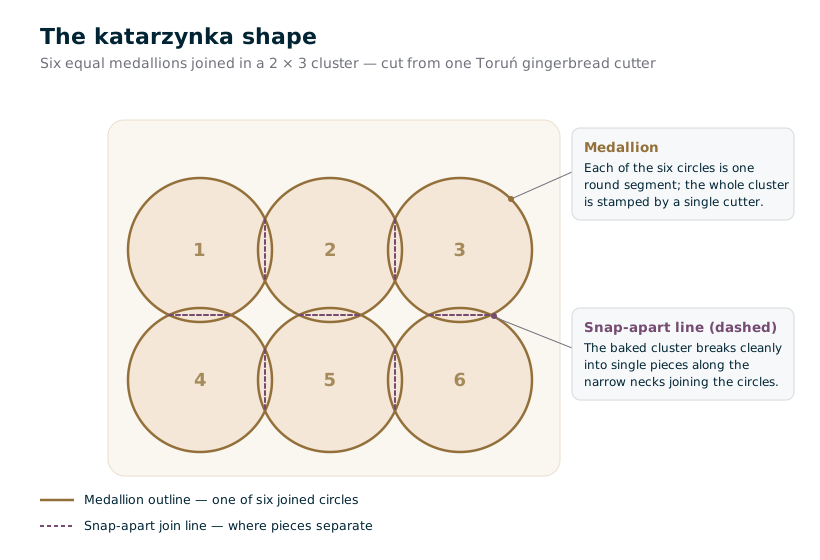 Diagram of the six-medallion katarzynka gingerbread shape
 Map of Poland showing Toruń and Powiśle gingerbread traditions
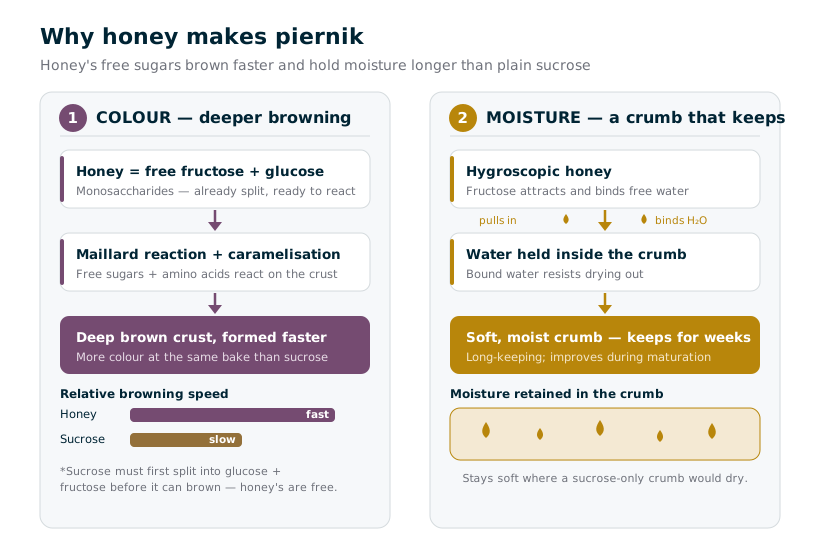 Diagram of honey chemistry in gingerbread: browning and moisture retention
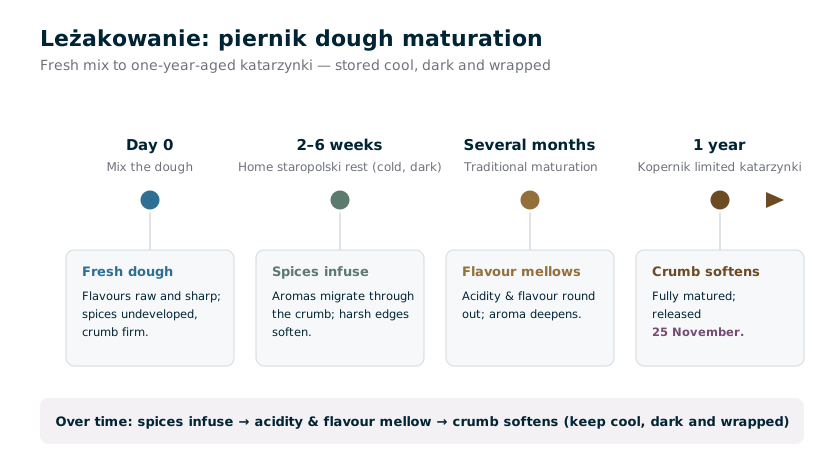 Timeline of piernik dough maturation from weeks to one year
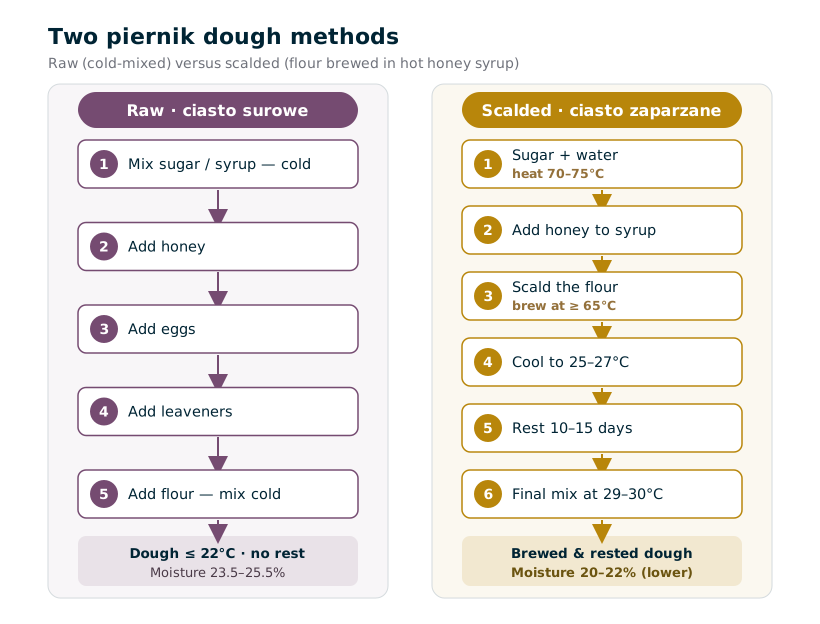 Diagram comparing raw and scalded gingerbread dough methods
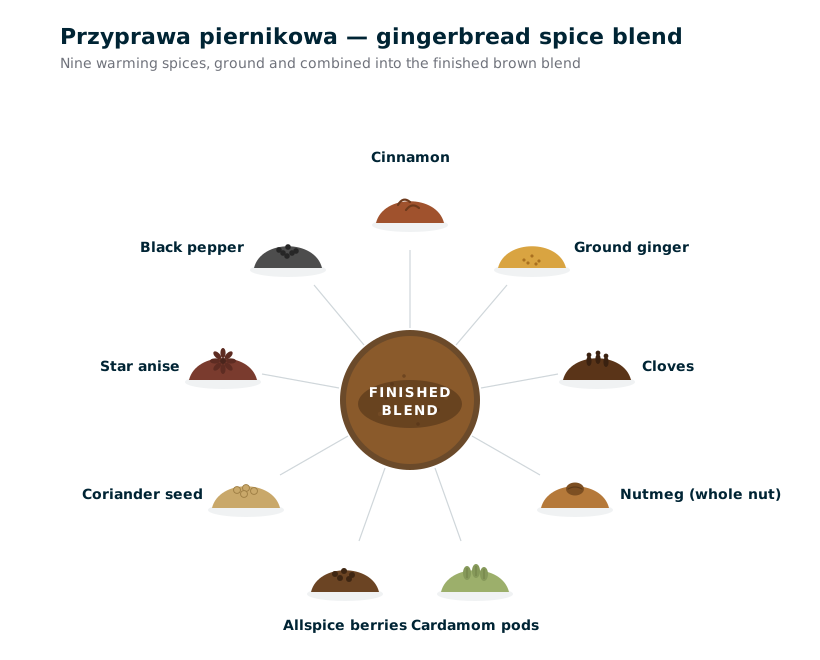 Flat-lay of gingerbread spice-blend components around a bowl of the mixed spice
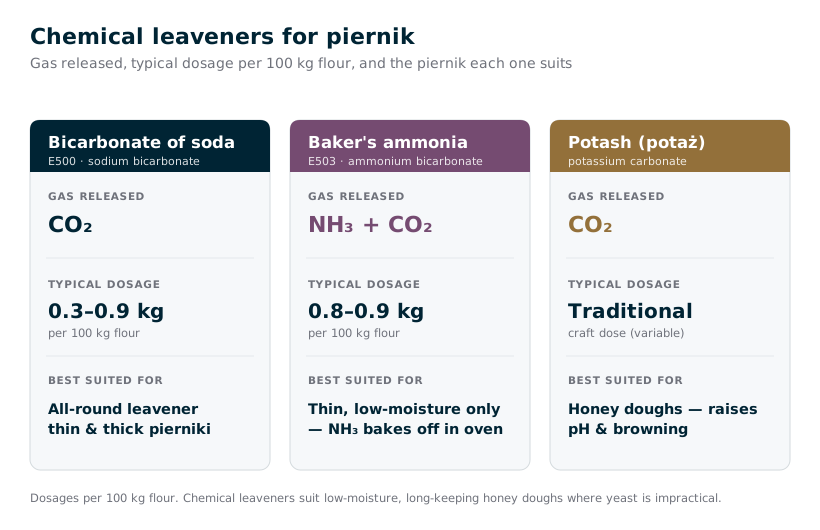 Diagram comparing soda, baker's ammonia and potash as gingerbread leaveners
Staropolski long-matured piernik (honey-rich) — baker's percentage
The authentic deep-flavour piernik: honey-dominant, warm-spiced and matured. Honey supplies colour (its free fructose+glucose brown faster than sucrose ) and keeps the crumb moist for weeks because honey is hygroscopic. The hallmark is lezakowanie (maturation): rest the dough cold for 5-6 weeks at home, or, in the Torun tradition, several weeks to a full year. See A2-chemical-leaveners-baking-powder for the soda/ammonia chemistry, A1-alternative-grain-flours for the rye option, A5-baking-oven-science for the honey-Maillard browning and A5-shelf-life-and-staling for why honey keeps it soft.
| Ingredient | Baker's % | Weight |
|---|---|---|
| Wheat flour (optionally up to 30% rye) | 100% | 520 g |
| Honey, melted and lightly browned (miod zrumieniony) | 98% | 510 g |
| Sugar | 38% | 200 g |
| Whole egg | 42% | 220 g (~4 eggs) |
| Gingerbread spice (przyprawa piernikowa) | 3% | 16 g |
| Bicarbonate of soda (dissolved in a little water) | 1% | 5 g |
| Total | ~282% |
- Melt the honey and warm gently until it darkens slightly (do not burn); cool to warm.
- Whisk eggs and sugar to a pale, fluffy mass; beat in the spice blend so the aromatics disperse.
- Stir the soda into a little water and mix in; stream in the warm honey while beating continuously.
- Fold in the flour to a soft dough; cover and rest cold for 5-6 weeks (longer is traditional) until it firms and rolls cleanly.
- Roll, cut or pan; bake at ~180 C until set and richly brown; cool, then glaze or chocolate-coat as desired.
Worked example
Worked at 520 g wheat flour (use up to ~30% rye for a darker, more traditional crumb), built from the 1927 Old-Polish recipe.
Yield: approx. 1.45 kg dough (one loaf tin or a sheet for cutting)
Honey at this level dominates; reduce to ~60-70% for a lighter everyday piernik. Food-safety/allergen note: contains egg and gluten. Raw-egg cold-chain: rest the dough sealed at <=5 C (refrigerator) for the entire maturation period — a cold cellar at ambient temperature does not reliably control Salmonella risk.
Torun-style katarzynki (thin snap gingerbread) — baker's percentage
The thin Torun classic. Because the piece is thin and low in moisture, baker's ammonia (ammonium bicarbonate, E503) is ideal: it gives a crisp lift and the ammonia bakes off completely, leaving no smell. Bake hot and fast. Finish plain, with white icing (lukier - see A7-icings-and-buttercreams) or dipped in compound chocolate (see A6-chocolate-selection-couverture).
| Ingredient | Baker's % | Weight |
|---|---|---|
| Wheat flour | 100% | 500 g |
| Honey or invert syrup | 45% | 225 g |
| Sugar | 35% | 175 g |
| Whole egg | 8% | 40 g |
| Gingerbread spice (przyprawa piernikowa) | 2.5% | 13 g |
| Baker's ammonia (ammonium bicarbonate, E503) | 0.9% | 4.5 g |
| Bicarbonate of soda | 0.4% | 2 g |
| Total | ~191% |
- Warm honey/syrup with sugar until dissolved; cool slightly and beat in the egg and spice.
- Dissolve the ammonia and soda in a splash of water and mix in; work in the flour to a firm, smooth dough.
- Rest briefly (or longer for flavour); roll ~5-7 mm and cut the joined six-circle katarzynka shape.
- Bake hot, ~210-230 C, for ~10-12 min until set and lightly coloured (lower temperatures avoid darkening).
- Cool fully, then ice or chocolate-glaze.
Worked example
Worked at 500 g flour; rolled ~5-7 mm and cut to the six-circle katarzynka outline (see img-katarzynki-shape).
Yield: approx. 0.95 kg dough (many thin six-medallion pieces)
Baker's ammonia must only be used in thin, low-moisture pieces so the ammonia fully escapes; do not use it in thick cakes. Food-safety/allergen note: contains egg and gluten.
Piernik przekladany powidlami (plum-layered piernik) — assembly
The piernik staropolski z Powisla format: pale honey-cake sheets baked separately, then stacked and interleaved with dark plum jam (powidla) and pressed, so the cut block shows alternating light cake and dark plum bands. A short maturation lets the moisture equalise and the layers soften and bond. Use a bake-stable plum filling so the layers hold and do not weep; see A6-chocolate-selection-couverture if enrobing.
| Ingredient | Baker's % | Weight |
|---|---|---|
| Baked honey-cake sheets (formula-staropolski-matured), ~28 x 12 cm | 4-5 sheets | ~1.0-1.2 kg baked |
| Bake-stable plum filling Sliwidlo (Martin Braun, G22044) | between every layer | ~200-300 g per layer |
| Optional: dark compound chocolate glaze (Helios, G25394) | coat | to enrobe |
| Total | n/a (assembly) |
- Bake thin honey-cake sheets and cool; trim to a uniform 28 x 12 cm.
- Stack: sheet, an even layer of plum filling, sheet, plum, repeating to 4-5 layers; finish with cake on top.
- Press gently under a weighted board; wrap and mature cool for 1-2 weeks so the plum moisture softens the cake and the block firms for clean slicing.
- Optionally enrobe in tempered/compound chocolate; slice to portions.
Worked example
Built from staropolski honey-cake sheets and bake-stable plum filling Sliwidlo (G22044).
Yield: one rectangular block ~28 x 12 x 12 cm
The bake-stable Sliwidlo (50% plum, pH 3.5, 35 Bx, gellan+xanthan, potassium sorbate) holds its shape and resists weeping in the matured stack. Food-safety/allergen note: check sheet and coating allergens (gluten, egg, milk, nuts).
First-party shortcut: Zeelandia Honey Cake Mix application (with caveat)
A fast honey-FLAVOURED cake base, NOT an authentic piernik. The mix carries only 0.2% real honey and uses chemical raising agents (E450 + E500); it has no gingerbread spice blend. Use it as a time-saver and convert it toward piernik by adding przyprawa piernikowa (~1-2% on mix) and finishing with plum or chocolate. For the real thing use formula-staropolski-matured.
| Ingredient | Baker's % | Weight |
|---|---|---|
| Zeelandia Honey Cake Mix (Ciasto Miodowe EU, G23673) | 100% | 1000 g |
| Oil | 50% | 500 g |
| Whole egg | 50% | 500 g |
| Optional: gingerbread spice (przyprawa piernikowa) | 1-2% | 10-20 g |
| Total | 200% |
- Mix all ingredients on low speed ~5 min with a flat beater.
- Pour into a 30 x 40 cm form; bake at 180 C for ~40-50 min.
- Cool; layer with plum filling or coat with compound chocolate to bring it toward piernik character.
Worked example
Manufacturer application recipe scaled to 1 kg mix.
Yield: one 30 x 40 cm sheet (sheet-cake layers / pie base)
Caveat: a honey-flavour cake, not a spiced, honey-rich, matured piernik. Allergens: wheat and milk; may contain rye/barley/oat/egg/soya/sesame.
Piernik is not one product but a family, from thin snap biscuits to honey-rich matured loaves and layered cakes. Use this to place a product before reaching for a formula.
| Type | Form & texture | Leavening / method | Signature finish | Notes |
|---|---|---|---|---|
| Katarzynki | Thin (~5-7 mm), crisp-then-soft, six joined medallions | Baker's ammonia (E503) / soda; rolled & cut | Plain, sugar-iced (lukier) or chocolate-glazed | The Toruń icon; baking season from 25 Nov (St Catherine) |
| Piernik toruński nadziewany (filled) | Soft honey gingerbread, two layers | Soda/ammonia; baked then sandwiched | Jam/plum centre, chocolate coat | Modern Toruń bestseller; descends from the carved-mould tradition |
| Piernik staropolski (long-matured loaf / keks) | Dense, dark, very moist, keeps for weeks | Honey-rich; dough matured weeks-to-a-year | Often glazed; studded with nuts & candied peel | The authentic deep-flavour piernik; honey-dominant |
| Piernik przekładany powidłami (layered) | Stacked pale cake sheets banded with dark plum | Honey cake sheets baked separately, then assembled | Plum (powidła) layers; sometimes chocolate-coated | Piernik staropolski z Powiśla format, ~28x12x12 cm |
| Pierniki w czekoladzie (chocolate-glazed) | Any of the above, dipped/enrobed | As base + compound chocolate coat at ~20 C | Glossy dark compound-chocolate shell | Helios/compound glaze gives snap & shelf life |
The warm-spice signature of piernik. The home blend is pure spice; the two Domson first-party blends are flour-carried (the wheat flour keeps the powder free-flowing) and carry a gluten allergen.
| Blend | Components | Carrier | Allergens | Energy /100 g |
|---|---|---|---|---|
| Classic home blend | Cinnamon, ginger, cloves, nutmeg, cardamom, allspice, coriander, anise, pepper (ratios vary by recipe; cinnamon is always dominant, ginger second; no single set of proportions is standardised) | None (pure spice) | None inherent (check supplier traces) | n/a |
| Rolmex 'Przyprawa piernikowa' (G23735) | Wheat flour, cinnamon, coriander, nutmeg, cloves, cocoa, ginger, cardamom | Wheat flour | Gluten (wheat); may contain mustard, soy | 205 kcal |
| Floramex 'Dobra' gingerbread seasoning (G24218) | Wheat flour, cinnamon, cocoa, pimento (allspice), ginger, coriander, clove | Wheat flour | Gluten (wheat); may contain celery, mustard and sulphite traces (⚠️ verify full allergen list against original spec sheet ) | 316 kcal |
Piernik is chemically, not yeast, leavened. Alkaline leaveners are preferred because raising pH deepens the honey browning and controls spread. Choose by piece thickness. Dosing figures are method-specific (scalded vs raw dough) and single-source — treat as indicative. The ammonia bake-off safety rule (thin pieces only for E503) is multi-sourced and firm.
| Leavener | E-number | Gas released | Typical dose /100 kg flour | Best for |
|---|---|---|---|---|
| Bicarbonate of soda (sodium bicarbonate) | E500 | CO2 | ~0.3 kg (scalded formula); 0 kg (raw formula) | All-round; thick honey doughs and loaves |
| Baker's ammonia (ammonium bicarbonate) | E503 | NH3 + CO2 | ~0.8 kg (scalded formula); ~0.9 kg (raw formula) | Thin, low-moisture pieces only (katarzynki) where ammonia bakes off |
| Potash (potassium carbonate, potaż) | E501 | CO2 | traditional, small | Heritage honey doughs; raises pH for colour |
Honey gives piernik its colour, moisture and flavour. Industrial bakeries often blend in cheaper invert sweeteners for the same moisture economics, sacrificing flavour.
| Sweetener | Role | Key spec | Trade-off |
|---|---|---|---|
| Natural multifloral honey (Ratos Natura, G23652) | Authentic colour, flavour, moisture, browning | Water max 20%, reducing sugars min 60%, HMF max 4 mg/100 g, diastase min 8; 330 kcal | Cost; flavour varies by season |
| Artificial honey / invert syrup (Ratos Natura, G23512) | Cheap hygroscopic moisture-keeper | Invert-sugar syrup | No honey flavour or enzymes |
| Honey-cake mix (Zeelandia Ciasto Miodowe, G23673) | Fast honey-flavoured cake base | Only 0.2% honey + E450/E500; 373 kcal; 1000:500:500 mix:oil:egg, 180 C 40-50 min | Not a spiced, matured piernik; add przyprawa piernikowa |
Both are authentic. Raw is simpler; scalded (flour brewed in hot honey syrup) gives a finer, longer-keeping crumb and is the route for the deepest, most matured pierniki.
| Parameter | Raw / cold (ciasto surowe) | Scalded (ciasto zaparzane) |
|---|---|---|
| Flour treatment | Mixed cold into syrup/egg | Brewed in hot sugar-honey syrup (source: >=65 C minimum; syrup prepared at 70-75 C; note standard wheat starch gelatinises at 70-90 C ) |
| Syrup prep | n/a | Sugar dissolved in water at 70-75 C, then honey added |
| Scalded-mass moisture | n/a | ~19-20%, cooled to 25-27 C |
| Pre-rest of scald | n/a | ~10-15 days before final mix |
| Final dough moisture | 23.5-25.5% | 20-22% |
| Dough temperature | <=22 C | 29-30 C |
| Fault | Likely cause | Corrective action |
|---|---|---|
| Hard, brittle straight from the oven | Insufficient maturation; too little honey/invert; over-baked | Mature the dough longer; raise honey/invert for hygroscopic softening; the crumb also softens on storage |
| Pieces spread / lose shape | Dough too wet/warm; over-leavened | Lower moisture toward the target band (raw 23.5-25.5%, scalded 20-22%); chill dough; cut leavener |
| Ammonia smell in the finished cake | Baker's ammonia used in a thick/moist piece so NH3 cannot escape | Use ammonia only in thin katarzynki; switch thick cakes to soda/potash |
| Pale, under-coloured | Too little honey; oven too cool; pH too low | Increase honey (Maillard); use an alkaline leavener to raise pH; bake hotter (up to ~240 C standard) |
| Dry, crumbly after a few days | Low honey/invert; over-baked; poor wrapping | Raise honey/invert; bake to just-set; wrap airtight; honey's hygroscopicity keeps it moist |
| Surface darkens/scorches | Oven too hot for a thin/sugary piece | Drop to ~210 C for thin/mint types to avoid surface darkening |
| Plum layers weep / cake slides | Non-bake-stable filling; over-filled; not matured | Use a bake-stable plum filling (gellan/xanthan); press and mature so moisture equalises |