
How margarines and shortenings are made: hydrogenation, interesterification and fractionation
A practical deep-dive for professional bakers into how the bakery fats on the shelf are actually made. Covers the three key industrial processes — hydrogenation, interesterification and fractionation — and explains what each one does to the crystal form, solid fat content (SFC) and functional behaviour of the resulting fat. Includes SFC profile data extracted from ten first-party spec sheets across the Domson catalogue (Kruszwica Maestra, Cardowan Crown NHAV Pastry and NHAV HR Shortening, CSM Marvello, AMARG Wyborna, Master Martini Marina, and Polmlek Butter), allergen declarations, storage conditions, a lamination fault-finding guide, and a regulatory checklist covering EU trans fat limits (Regulation 2019/649) and the legal definition of 'margarine' (Regulation 1308/2013).
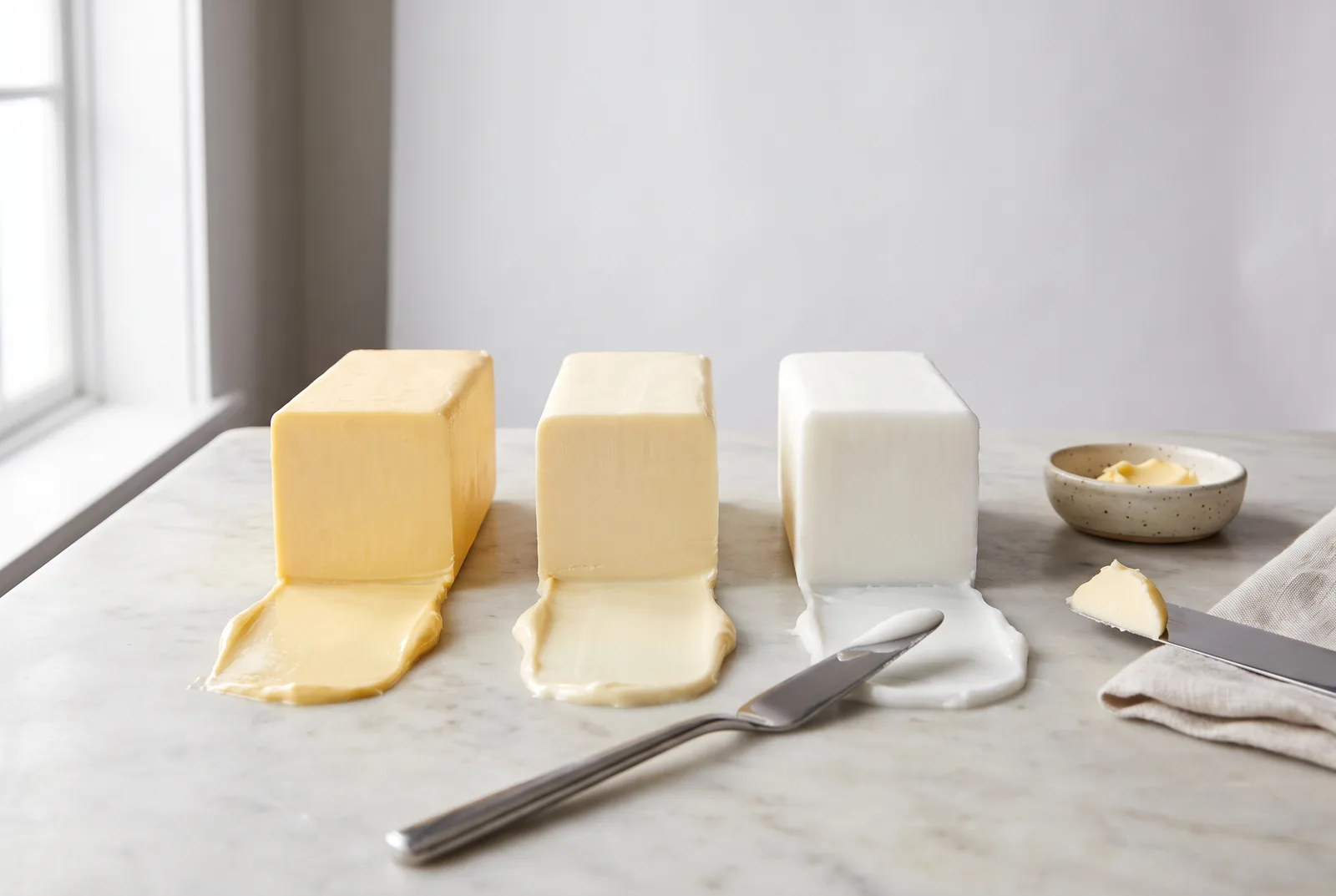
What is the difference between butter, margarine and shortening?
Before examining how these fats are made, it is useful to fix the definitions:
Butter is made from a single ingredient — pasteurised cream from cow's milk. EU and UK standards require a minimum of 82% fat. The remaining 16–18% is water plus small amounts of milk protein, lactose and minerals. Butter contains approximately 55 g of saturated fatty acids per 100 g of product. (This is the Polmlek product-specific spec-sheet value, which is single-source; independent estimates derived from reference dairy fat composition data suggest approximately 51–54 g for an 82% fat European unsalted butter — the exact value varies with milk season, breed and geographic origin.) It is the only product in this family that constitutes a major food allergen: it contains MILK (including lactose), which must be declared on any label or menu under EU Regulation 1169/2011.
Margarine is a water-in-oil (W/O) emulsion, manufactured from vegetable and/or animal fats and oils. Under EU Regulation 1308/2013 Annex VII, the name "margarine" is legally reserved for products with a minimum fat content of 80%, a milk fat content not exceeding 3% of the fat fraction, and derived from solid and/or liquid vegetable and/or animal fats suitable for human consumption. Products below 80% fat must use alternative names such as "fat spread" or "blended spread." All margarines in the Domson catalogue are at the standard 80% fat content — except the Crown NHAV Pastry which is 82%.
Shortening is 100% fat — no water phase, no water-in-oil emulsion. The word "shortening" describes the mechanism: fat coats and lubricates the gluten strands in dough, making it tender and short rather than chewy. Because there is no water, there is no steam leavening and no Maillard browning from the fat itself. Flavour is neutral. The energy value is the highest of the three categories: 3700 kJ / 900 kcal per 100 g for the Cardowan range.
| Term | Fat content | Water | Origin | Main allergen |
|---|---|---|---|---|
| Butter 82% | Min 82% (EU/UK) | ~16% | Dairy exclusively | MILK (including lactose) |
| Margarine | Min 80% (EU, name-reserved) | 14–20% | Vegetable fats (primarily) | Varies by product |
| Shortening | Typically 100% | 0% | Vegetable fats | None in Cardowan range |
The raw material palette: which oils go into these products?
Modern bakery margarines and shortenings are built almost entirely from four vegetable oil sources, chosen for their fatty acid profiles, availability and price:
Palm oil (Elaeis guineensis) is the cornerstone ingredient. It is naturally semi-solid at room temperature because it is rich in C16:0 (palmitic acid) — typically 44–48% of total fatty acids. Importantly, palm oil naturally crystallises in the desirable beta-prime (β') polymorphic form, which gives smooth, plastic texture to the finished fat. It can be fractionated (see Section 3) into a hard stearin fraction (Slip Melting Point approximately 44–56°C) and a liquid olein fraction (SMP approximately 24°C). Every margarine and shortening in the Domson catalogue reviewed here contains palm oil or palm fractions as a primary structural component.
Rapeseed oil (Brassica napus), known as canola in North America, is high in C18:1 (oleic acid, approximately 60–65% of fatty acids) and low in saturates (~7%). It is liquid at room temperature and is blended with palm fractions to soften the SFC profile, reduce total saturated fat, and improve spreadability. It is present in every Domson range fat reviewed.
Soybean oil and sunflower oil are used in some formulations for cost and availability reasons. Neither appears by name in the Domson range specs reviewed, though the Milama and AMARG Wyborna products contain lecithins that may be soy-derived (soy lecithin is confirmed in AMARG Wyborna ).
Palm kernel oil and coconut oil (both high in lauric acid, C12:0) are used in some speciality fats and compound coatings but are not present in the mainstream bakery fats in the Domson range reviewed here.
Process 1: Hydrogenation
<!-- image: img-hydrogenation-partial -->Hydrogenation is the oldest industrial method of hardening liquid oils and remains in use, though its application has narrowed significantly since the 2000s.
The chemistry: In the presence of a finely divided nickel catalyst, hydrogen gas (H₂) is bubbled through liquid oil at elevated temperature and pressure. The reaction adds hydrogen across the carbon–carbon double bonds in unsaturated fatty acid chains:
—CH=CH— + H₂ → —CH₂–CH₂—
Each addition reaction converts one degree of unsaturation to a single bond, raising the melting point and hardening the fat.
Full (complete) hydrogenation drives the reaction to completion: all double bonds become single bonds. The product is fully saturated — hard, waxy and brittle. Importantly, full hydrogenation produces no trans fatty acids. Fully hydrogenated palm stearin or fully hydrogenated vegetable fat is sometimes used as a component in interesterification blends (see next section).
Partial (incomplete) hydrogenation stops the reaction before completion, yielding a product with the desired firmness. The problem: some of the remaining cis double bonds are isomerised by the catalyst to the trans configuration. The most common product is elaidic acid (C18:1 trans-9), the trans isomer of oleic acid. Scientific consensus links high consumption of these industrially produced trans fatty acids (iTFA) to elevated cardiovascular disease risk.
The regulatory response has been decisive:
EU Commission Regulation (EU) 2019/649 (applicable from 2 April 2021): food intended for the final consumer and food supplied to retail must not contain more than 2 g of industrially produced trans fatty acids per 100 g of total fat. UK retained equivalent regulation is in force.
Looking at the Domson catalogue products, where trans fat data is stated in spec sheets:
| Product | Trans FA limit (spec) | Source |
|---|---|---|
| Milama Cake Margarine (Kruszwica) | max 2% of total FA | |
| Maestra Puff Pastry Margarine 80% (Kruszwica) | max 2% of total FA | |
| AMARG Wyborna 80% | max 1% of total FA | |
| Marina 80 Solidarity Recipe (Master Martini) | max 1.0% | |
| Marvello (CSM Ingredients) | 0.9 g per 100 g product | |
| Cardowan NHAV Shortenings (HR and Plain) | Not stated; no partially hydrogenated oil in ingredients |
Note that the Kruszwica products (Milama, Maestra) still list "partly hydrogenated palm oil" as an ingredient, indicating partial hydrogenation is still used in their formulation — but the product-specification limit confirms compliance with the 2 g/100 g regulatory maximum. Modern processors are progressively reformulating away from partial hydrogenation using fractionation and interesterification, which achieve comparable functionality without generating trans fats.
REGULATORY CAUTION — Zero iTFA compliance margin: Both Milama and both Maestra Puff Pastry formulations specify 'max 2% of total fatty acids' for trans fats — a value exactly equal to the EU Reg 2019/649 ceiling of 2 g iTFA per 100 g total fat. There is no compliance buffer. As both products declare partly hydrogenated palm oil in their ingredient lists, industrially produced trans fatty acids are present. Before using these products in formulations where an iTFA claim, certification, or close regulatory scrutiny applies, obtain the current batch certificate of analysis (trans FA analytical result) from Kruszwica and verify the measured value against the regulatory limit.
Process 2: Interesterification
<!-- image: img-interesterification-concept -->Interesterification (IE) rearranges the fatty acids across the glycerol backbone of triglycerides. The total fatty acid composition — the amounts of palmitic, oleic, linoleic acid etc. — remains unchanged. What changes is which fatty acid sits at which position on which glycerol molecule. This rearrangement modifies the physical properties: melting point, SFC profile and crystal form.
Critically, interesterification creates zero trans fatty acids.
Chemical interesterification (CIE)
A sodium methoxide or sodium ethoxide catalyst (typically 0.1–0.5% of the fat mass) is added at approximately 70°C. The catalyst cleaves ester bonds between fatty acids and glycerol, allowing fatty acids to be redistributed randomly across all glycerol positions (sn-1, sn-2 and sn-3). The result is a statistically randomised distribution — very different from the highly ordered triglyceride structure of the original palm oil, where palmitic acid strongly prefers the sn-1 and sn-3 positions.
The randomised product has a different, usually lower SFC and a flatter melting curve than the starting materials.
Enzymatic interesterification (EIE)
Lipase enzymes — typically sn-1,3-specific lipases such as Thermomyces lanuginosus lipase immobilised on a solid support — act selectively at the sn-1 and sn-3 positions only. The sn-2 position (which in natural vegetable oils tends to carry monounsaturated or polyunsaturated fatty acids) remains largely unchanged. This selectivity allows structured triglycerides to be designed with specific melting profiles. EIE operates at milder conditions (~50–70°C) and shorter contact times.
Why it matters for the baker
IE is the dominant method for producing trans-fat-free hard fats today. A common approach: fully hydrogenated palm stearin (a hard, inert solid) is blended with liquid rapeseed or palm olein, then subjected to IE. The product has a SFC profile and crystal form that can be designed to match any margarine or shortening grade — without partial hydrogenation.
Process 3: Fractionation
<!-- image: img-fractionation-dry-process -->Fractionation is a purely physical process. No chemical bonds are broken or formed. The fat is separated into fractions based on their different crystallisation temperatures — an extremely useful property of palm oil, which contains a wide range of triglycerides with melting points from approximately 10°C to over 60°C.
Dry fractionation (most common in European production)
- The fat (e.g., crude palm oil) is fully melted at ~70°C to ensure complete dissolution of all crystalline material.
- The molten fat is pumped into large crystallisation vessels and cooled slowly under precisely controlled temperature ramps, with gentle agitation to promote uniform crystal nucleation. The rate of cooling, the target temperature and the agitation speed are all critical parameters.
- Higher-melting triglycerides (those rich in palmitic and stearic acid) form crystals first, while lower-melting triglycerides remain liquid.
- The crystal slurry is pumped through a vacuum drum filter or a membrane filter press. The solid stearin fraction is retained on the filter; the liquid olein fraction passes through.
No solvents, no chemical modification — dry fractionation is the simplest and most economical method.
Wet (solvent) fractionation
Dissolving the fat in hexane or acetone before cooling allows much sharper separation of fractions, yielding purer products. However, solvent recovery requires additional plant and operating cost, and solvent use is subject to regulation. Wet fractionation is less common in mainstream bakery fat production.
Palm oil fractionation cascade
| Fraction | Approximate SMP | Dominant fatty acids | Primary bakery application |
|---|---|---|---|
| Palm olein (single) | ~24°C | C18:1 oleic | Liquid cooking oils, dressings |
| Palm stearin | ~44–56°C | C16:0 palmitic | Margarines, shortenings, pastry fats |
| Palm mid-fraction (PMF) | ~30–34°C | C16:0 + C18:0 | Cocoa butter equivalent, compound coatings |
| Super olein / super stearin | Varies | C16:0 + C18:0 dominated | Speciality coatings, wafer fats |
Palm stearin is the primary structural component in the Domson range, confirmed by ingredient lists across all reviewed products. Rapeseed oil is blended in to soften the SFC profile and reduce saturated fat content.
Why crystal form matters: polymorphism in bakery fats
<!-- image: img-crystal-polymorphism-alpha-betaprime-beta -->Solid fats do not have a single definite melting point — they are semi-crystalline materials that melt progressively across a temperature range. The fatty acid chains in a solid fat can pack together in different ordered lattice arrangements, a phenomenon called polymorphism. The three main polymorphic forms in edible fats are:
| Polymorph | Stability | Crystal size | Texture | Target for margarines? |
|---|---|---|---|---|
| α (alpha) | Least stable | Very fine, uniform | Soft, waxy | Transient — forms on rapid cooling then transforms |
| β' (beta-prime) | Intermediate | Fine needles (~0.5–1 µm) | Smooth, plastic, creamy | Yes — the target form |
| β (beta) | Most stable (thermodynamically) | Large granules (~10–100 µm) | Grainy, waxy, sandy | No — undesirable in most bakery fats |
Why β' is the target
The fine, needle-like β' crystals create a uniform three-dimensional network that:
- Traps and holds air efficiently during creaming — the fat film around each air bubble is thin and stable, enabling volume development in cakes. High-ratio shortening with E471 (like Coronet NHAV HR ) exploits this particularly effectively.
- Extends uniformly during lamination without tearing — critical for puff pastry and croissant. A fat in β form would have coarse crystal clumps that tear the dough.
- Melts smoothly in the mouth — β' crystals melt over a narrow temperature range, giving a clean melt and avoiding waxy residue.
- Maintains plasticity over a useful temperature range — the fat remains workable across a "plastic range" from roughly 15°C to 25°C for cake margarines, or 16°C to 22°C for puff pastry margarines.
How β' is achieved and maintained
Palm oil naturally tends towards β' crystallisation because of its symmetrical triglyceride composition — PPP (tripalmitin), OPO (oleic-palmitic-oleic) and POP (palmitic-oleic-palmitic) are the dominant triglycerides and they pack in β' form. This is a primary reason palm is the cornerstone fat in modern margarines and shortenings.
Cooling rate in the votator (see next section) determines the initial crystal form: rapid quench favours α; α then transitions to β' during controlled working in the pin mixer. Avoiding prolonged holding at temperatures just below the melt point prevents the unwanted α→β transition.
Fatty acid diversity helps stabilise β'. Blending palm stearin with rapeseed oil introduces a range of different-sized triglycerides that inhibit the orderly packing required for β crystal growth.
Emulsifiers can inhibit β crystal formation: certain polyglycerol esters (E475 — present in Milama, Maestra and Marvello) and sorbitan esters stabilise β' crystals.
From tanks to block: the margarine production line (votator process)
The continuous margarine manufacturing process, developed in the early 20th century and refined progressively since, follows this sequence:
1. Oil phase preparation: Fractions and base oils are weighed and blended in heated tanks to achieve the target fatty acid composition and SFC profile. Emulsifiers, antioxidants (e.g., tocopherol-rich extract as in the Maestra spec ) and fat-soluble vitamins are dissolved into the oil phase. The blend is fully melted at approximately 50–70°C.
2. Water phase preparation: Water is combined with salt, flavouring compounds, colourants (β-carotene/annatto/curcumin as seen across the Domson range specs), acidity regulators (citric acid E330 in most products), and preservatives where used (potassium sorbate E-202 in Marina; potassium sorbate in AMARG Wyborna ). This water phase is pasteurised.
3. Emulsification: Oil and water phases are combined in a high-shear pre-emulsifier to create a stable water-in-oil emulsion. The ratio of oil-phase to water-phase determines the final water content (approximately 14–20% in standard 80% fat margarine). Hydrophilic emulsifiers such as lecithin or polyglycerol esters help stabilise the water droplets inside the fat matrix.
4. A-unit — scraped-surface heat exchanger (SSHE or "votator"): The hot emulsion is pumped through a jacketed stainless-steel cylinder refrigerated with ammonia or CO₂ brine. Scrapers rotate against the cylinder wall, continuously removing crystallised fat to prevent build-up. This rapid chilling under high shear creates a supercooled, partially crystalline mass in the unstable α polymorphic form. The outlet temperature is typically well below the melting point of the fat.
5. B-unit — pin mixer (crystallisation tube): The α-crystalline mass passes through a cylinder lined with rotating pins (the pin rotor). This provides controlled, lower-intensity shear compared with the A-unit, allowing the α→β' crystal transition to complete under controlled conditions, and for the crystal network to develop and interlock. The result is a smooth, plastic margarine with the correct firmness.
6. Resting and tempering: The plastic fat is rested at controlled temperature to allow any remaining crystallisation to complete. This stabilises the texture before packing.
7. Packing: Margarine is extruded or filled at the appropriate temperature — for puff pastry grades, the product must reach 18–20°C before use in dough preparation. Shortenings may be packed at slightly different temperatures.
For shortenings, the process is similar but no water phase exists. The fat blend is chilled, worked and packed. Pre-aeration is often built into the votator step — both Cardowan NHAV shortenings are delivered with 12% air content.
Product families in the Domson catalogue
Butter (reference product)
<!-- image: img-sfc-curve-comparison -->Butter occupies a different manufacturing category entirely — it is made by churning cream, not by the votator process. But it anchors the comparison because every professional baker uses or considers it. Key numbers from the Polmlek specification:
| Parameter | Value |
|---|---|
| Fat content | Min 82% |
| Water content | 16% |
| Saturated fatty acids | 55.0 g per 100 g product |
| Energy | 3058 kJ / 744 kcal per 100 g |
| Salt (unsalted product) | 0.20 g per 100 g |
| Ingredient | Pasteurised cream |
| Allergen | MILK (including lactose) — mandatory declaration |
| Storage | 0–10°C / 60 days; −18 to −22°C / 12 months; use within 7 days of thawing |
Butter's high saturated fat content (55 g/100 g product ≈ 67% of the fat fraction) comes from the natural dairy fatty acid profile dominated by C16:0 (palmitic) and C18:0 (stearic), as well as short-chain fatty acids (butyric C4:0, caproic C6:0) that give butter its characteristic flavour and relatively low melt point of approximately 28–35°C.
Butter's natural trans fatty acids (~3–5% of fat) are ruminant-derived (primarily conjugated linoleic acid CLA and vaccenic acid C18:1 trans-11), biologically distinct from industrially produced trans fats. EU Regulation 2019/649's limit on iTFA does not apply to these natural forms.
Cake margarines (80% fat)
Four products in the Domson catalogue offer cake-grade margarine in 10 kg cartons. Their SFC profiles at 20°C cluster between 18–32% — they are designed to be plastic and workable at typical bakery ambient temperature. This is distinctly softer than laminating-grade fats (33–38% SFC at 20°C).
Key differences:
| Product | Sat fat (g/100 g product) | SFC at 20°C | Trans FA | Key allergen | Notes |
|---|---|---|---|---|---|
| Milama (Kruszwica) | 31 g | 20–25% | max 2% | None | SAFA 41%, MUFA 45%, PUFA 13% of FA |
| AMARG Wyborna 80% | 18 g | 23–27% | max 1% | SOYA (soy lecithin) | Lowest sat fat; contains potassium sorbate |
| Marina 80 Solidarity Recipe | 39 g | 22–32% | max 1% | None (milk x-contam note) | pH 4.60±0.25; contains E-202 (potassium sorbate) |
| Marvello (CSM Ingredients) | 27 g | 18–24% | 0.9 g/100g | None in product/line | Kosher + Halal; vegan; storage 14–18°C (no refrigeration) |
REGULATORY NOTE — AMARG Wyborna fat content tolerance: The specification states a fat content of 80.0% ±2.0%, creating a lower production tolerance bound of 78.0%. Under EU Regulation 1308/2013 Annex VII Part VII, the name 'margarine' is legally reserved for products with a minimum of 80% fat. A product at 78% fat cannot lawfully carry the 'margarine' name. Clarify with AMARG Sp. z o.o. whether the ±2.0% represents analytical measurement uncertainty or an actual production window, and resolve this before any EU regulatory filing or label using the 'margarine' designation.
ALLERGEN FLAG — Marina 80: The allergen table in the spec includes a cross-contamination (ZK) note for milk — "may contain milk traces." This must be evaluated for any production for customers with dairy allergy or intolerance.
Marvello storage exception: Unlike every other margarine in the range, Marvello specifies storage at 14–18°C — it must NOT be refrigerated. Storing below 14°C alters the crystal structure and may affect performance. No special tempering is needed before use.
Puff pastry and laminating margarines
Three product entries in the Domson catalogue cover laminating/roll-in fat applications: Puff Pastry Margarine 80% 10 kg (Maestra, Kruszwica), Maestra White Cream Margarine 80% 10 kg (Kruszwica Mass Balance — note: the on-file spec is the Maestra Puff Pastry Mass Balance formulation, see verification notes), and Puff Pastry Margarine 12.5 kg (Crown NHAV Pastry, Cardowan).
The defining characteristic of a laminating fat is its SFC profile at working temperature. The fat must be:
- Firm enough not to smear and merge with the dough during sheeting (SFC too low → greasy, no layer separation)
- Plastic enough not to crack or shatter through the dough layers (SFC too high → brittle, physical rupture of dough)
Both conditions are met within a narrow SFC window at the working temperature of 18–20°C.
Maestra Puff Pastry (Kruszwica) — key data:
| Parameter | Value | Source |
|---|---|---|
| Fat | 80% ±0.5% | |
| SAFA (% total FA) | 46% | |
| MUFA (% total FA) | 42% | |
| PUFA (% total FA) | 10% | |
| Trans FA (% total FA) | max 2% | |
| SFC at 20°C — summer (Apr–Aug) | 35–38% | |
| SFC at 20°C — winter (Sep–Apr) | 33–36% | |
| SFC at 30°C — summer / winter | 16–20% / 14–17% | |
| SFC at 35°C — summer / winter | 9–12% / 8–10% | |
| Saturated fat per 100 g product | 35 g | |
| Recommended working temperature | 18–20°C | |
| Allergens | None | |
| RSPO | Mass Balance certified |
The seasonal SFC variation is practically important: the summer batch (April–August) has a slightly higher SFC (35–38% vs 33–36% at 20°C) to compensate for warm bakeries. Receiving a summer batch in January, or a winter batch in August, will give different lamination behaviour for the same working temperature. Check the batch documentation on delivery.
Crown NHAV Pastry Margarine (Cardowan) — key data:
| Parameter | Value | Source |
|---|---|---|
| Fat | 82.0 g per 100 g (higher than standard) | |
| Saturated fat per 100 g product | 41.2 g | |
| MUFA per 100 g product | 29.8 g | |
| PUFA per 100 g product | 8.7 g | |
| Slip Melting Point | 47.0°C | |
| Emulsifier | E471 (distilled monoglyceride) | |
| Allergens | None (product, line, factory) | |
| RSPO | Segregated and Mass Balance |
The Crown NHAV Pastry has a higher fat content (82% vs 80%) and a higher slip melting point (47°C) than the Maestra range. A higher SMP margarine is firmer at any given temperature, which is advantageous in warm bakery conditions but requires careful tempering to avoid brittleness at lower temperatures. NMR-based SFC data is not available in the Cardowan spec — the SMP is the primary functional indicator available.
Shortenings (100% fat)
Two products: Coronet NHAV HR (High Ratio — with E471 emulsifier) and Plain Box NHAV (without emulsifier). Both from Cardowan Creameries, both 12.5 kg.
| Parameter | Coronet NHAV HR | Plain Box NHAV | Source |
|---|---|---|---|
| Fat | 100% | 100% | |
| Saturated fat | 38.1 g / 100 g | 38.8 g / 100 g | same |
| MUFA | 43.5 g / 100 g | 43.5 g / 100 g | same |
| PUFA | 16.2 g / 100 g | 15.5 g / 100 g | same |
| Energy | 3700 kJ / 900 kcal | 3700 kJ / 900 kcal | same |
| Slip Melting Point | 44.0°C | 45.0°C | same |
| Air content | 12% | 12% | same |
| Emulsifier | E471 (distilled MDG) | None | same |
| Ingredients | Palm, Rapeseed, E471 | Palm, Rapeseed | same |
| Allergens | None (product/line/factory) | None | same |
| RSPO | Segregated and Mass Balance | Segregated and Mass Balance | same |
| Shelf life | 5 months | 5 months | same |
"NHAV" designation stands for Non-Hydrogenated Aided Vegetable. The ingredient lists (Palm + Rapeseed, no "partly hydrogenated" oil listed) are consistent with production via fractionation and/or interesterification only, with no partial hydrogenation step. This is consistent with the "NHAV" name. Note that the absence of "partly hydrogenated" from an ingredient declaration is an inference of non-hydrogenation, not a positive manufacturing certification. Before making any "non-hydrogenated" or "free from hydrogenated oils" claim on a label or in customer-facing communications, obtain written confirmation from Cardowan Creameries that no partial hydrogenation step is used in manufacturing.
The 12% air content is pre-incorporated during the votator process. Both shortenings arrive already aerated, which means they cream faster and more efficiently than non-aerated fats. For high-ratio cake work, the HR variant with E471 further enhances aeration and provides mild anti-staling through amylose–lipid complex formation.
Choosing between HR and Plain:
- Use Coronet NHAV HR (with E471) for high-ratio cakes, fine crumb products, or where anti-staling matters.
- Use Plain Box NHAV for shortcrust pastry, raised pies, choux, general baking, or where emulsifier-free labelling is needed.
Reading the SFC curve
<!-- image: img-sfc-curve-comparison -->The solid fat content (SFC) profile — measured by pulsed NMR at standardised temperatures per AOCS Cd 16b-93 or ISO equivalent — is the single most diagnostic specification for any bakery fat. It tells you concretely what state the fat will be in at any given processing temperature.
| Temperature | What it represents | Cake margarine range (Domson) | Puff pastry margarine range (Domson) |
|---|---|---|---|
| 10°C | Cold store on delivery; fat firmness | ~34–51% (from Marina, Marvello) | ~50%+ (estimated; no NMR in puff specs) |
| 20°C | Bakery room temperature, creaming/lamination | 18–32% | 33–38% (Maestra summer) |
| 30°C | Warm work environment; mid-palate sensation onset | 7–17% (Marina); 9.5–13.5% (Marvello) | 14–20% (Maestra) |
| 35°C | Near body temperature, full melt approach | max 5% (Milama); 7–11% (Marvello) | 8–12% (Maestra) |
For creaming: a cake margarine at 18–32% SFC at 20°C creates the plastic, air-trapping mass needed for volume. A shortening, arriving pre-aerated with 12% air, supplements this with mechanical aeration already built in.
Emulsifiers inside the fat: what they do and which products contain them
Most bakery margarines and shortenings contain emulsifiers added for two purposes: (1) stabilising the water-in-oil emulsion during manufacture and storage, and (2) influencing crystal form.
| Emulsifier | E-number | Found in (Domson range) | Function within the fat |
|---|---|---|---|
| Distilled monoglycerides | E471 | Coronet NHAV HR, Crown NHAV Pastry | Crystal modifier — promotes β' form; stabilises water-in-oil emulsion |
| Lecithins (soy) | E322 (soy-derived) | AMARG Wyborna (confirmed soy lecithin) | Emulsification; fat dispersion into dough |
| Mono- and diglycerides | E471 | Milama, Maestra, Marina (listed as "mono and diglycerides of fatty acids") | Emulsion stability, plasticity |
| Polyglycerol esters | E475 | Milama, Maestra, Marvello (as primary emulsifier in Marvello) | β' crystal stabilisation; aeration in high-ratio applications |
Storage, temperature windows and handling
All fats absorb odours. Store away from spices, cleaning materials, diesel and strong-smelling products regardless of packaging. Refer to the comparison table below for full details. The three most critical exceptions to general bakery practice:
Marvello (CSM Ingredients): do not refrigerate. Storage at 14–18°C is specified. Refrigerating this product below 14°C will alter the crystal structure in a way that affects performance during creaming. This is contrary to most bakers' instinct to keep fats cold. The 182-day shelf life at ambient temperature is a validated formulation property of this product (low water activity in the W/O emulsion, controlled pH, E475 emulsifier system); however, the available spec sheet does not document the microbiological safety basis. Before using Marvello in supply chains where temperature-control documentation or microbiological audit is required, obtain the microbiological safety validation from CSM Ingredients / AAK International.
Polmlek Butter: consume within 7 days of thawing. If frozen butter (−18 to −22°C, shelf life 12 months) is thawed for bakery use, it must be used within 7 days of thawing regardless of the original best-before date.
Maestra Puff Pastry: temper to 18–20°C before use. The spec explicitly states this working temperature for dough preparation. Below 16°C, the fat at SFC >40% will shatter. Above 22°C, SFC may fall below 30% and smearing will occur.
Regulatory checklist
Food safety flag: all regulatory limits in this table must be verified against the current consolidated regulation text (EUR-Lex, UK legislation.gov.uk) before any product label, formulation sheet or regulatory filing is prepared. Regulations are amended; verify against the current regulations before labelling.
| Requirement | Key Regulation | What to check in practice |
|---|---|---|
| Name "margarine" | EU Reg 1308/2013 Annex VII | Min 80% fat; milk fat ≤3% of fat content; W/O emulsion |
| Industrial trans fatty acids | EU Reg 2019/649 (from 2 April 2021) | Max 2 g iTFA per 100 g total fat — applies to food sold to final consumers |
| Allergen labelling: soy lecithin | EU Reg 1169/2011 Annex II | SOYA must be bold/highlighted on label where soy lecithin is an ingredient |
| Allergen labelling: butter | EU Reg 1169/2011 Annex II | MILK (including lactose) must be declared — applies to any product containing butter |
| Palm oil labelling | EU Reg 1169/2011 Art 20–21 | Palm oil must be listed by name (not hidden as "vegetable oil") |
| 3-MCPD esters in vegetable fats | EU Reg 2020/1322 / EU Reg 2023/915 | Food safety: Kruszwica spec limit for Milama and Maestra is 2188 µg/kg in the finished margarine. When expressed per fat fraction (÷ 0.80 fat content), this equates to ~2735 µg/kg fat — which exceeds the current EU limits under Reg 2020/1322 / 2023/915 for both palm oil (2500 µg/kg) and non-palm vegetable fats (1250 µg/kg). Verify whether the regulatory limit applies to the raw oil input or the finished margarine product; obtain current batch Certificate of Analysis and regulatory confirmation from Kruszwica before any production or regulatory submission. |
| Glycidyl fatty acid esters | EU Reg 2018/290 / EU Reg 2021/1317 / EU Reg 2023/915 | Food safety: Kruszwica spec limit 1000 µg/kg (Milama, Maestra). EU Reg 2021/1317 (effective 1 July 2023) reduced limits to 500 µg/kg (non-palm vegetable oils and fats) and 750 µg/kg (palm oil and fat) under the consolidated EU Reg 2023/915. The Kruszwica spec sheets (2020–2021 issue dates) predate these revised limits. Verify the current applicable limit under EU Reg 2023/915 for the relevant product category and obtain an updated batch CoA from Kruszwica confirming compliance with current limits. |
| Potassium sorbate (E-202) in margarine | EU Reg 1333/2008 (food additives) | Marina 80 Solidarity Recipe contains E-202 (potassium sorbate) as a listed ingredient. E-202 is a permitted preservative in fat emulsions (W/O type) under EU Reg 1333/2008 Annex II. Verify the current maximum use level for the applicable food category before any additive compliance submission or regulatory filing. |
| Erucic acid (C22:1) | EU Reg limits apply | Rapeseed-containing fats must meet erucic acid limits; Maestra spec max 0.5%; older Maestra spec showed max 2.0% — verify current version |
| GMO labelling | EU Reg 1829/2003 + 1830/2003 | All products in Domson range declare non-GMO / no labelling required under these regulations |
| RSPO claim | RSPO standard | Cardowan products carry RSPO Segregated and Mass Balance certification (BMT-RSPO-000023); Kruszwica Maestra Mass Balance (CU-RSPOSCCS-828140). Verify certificates are current before any sustainability claim. |
Fault-finding guide
See the fault table below for full fault analysis across lamination and creamed-cake applications. The most common fat-related faults and their diagnostic indicators:
Fat shatters in lamination: Working temperature too low, or wrong fat grade (puff pastry margarine too cold). Temper Maestra-grade fats to 18–20°C before sheeting.
Fat smears in lamination: Working temperature too high, wrong fat grade (cake margarine used for puff pastry), or summer bakery with no cooling. SFC at 20°C must be ≥33% for puff pastry work. Check the product specification and batch season.
Dense, poorly aerated cake: Fat too cold during creaming; fat not at correct working temperature. Ensure cake margarines are at 16–20°C (check Marvello's exceptional 14–18°C). If switching to shortening for high-ratio work, use Coronet NHAV HR (with E471) rather than Plain Box.
Waxy, sandy mouthfeel in pastry: Beta (β) crystal formation has occurred — fat was worked excessively, or temperature-abused. Source a palm-based fat with confirmed β' habit and avoid over-working.
Rancid off-flavours: Check FFA and peroxide value on delivery against spec limits. FFA above limit or peroxide above limit indicates oxidative degradation. Store fats away from strong odours; rotate stock on FIFO basis.
Coverage notes and what this article does not cover
Solid: SFC profiles at 20/30/35°C from seven product spec sheets (Milama, AMARG Wyborna, Marina 80, Marvello, Maestra both versions, Crown NHAV Pastry). Fatty acid compositions from six products. Allergen declarations from ten products. Trans fat limits from six products. EU regulatory limits (2019/649, 1308/2013) from primary regulatory sources.
Thin (single-source or not in spec): SFC profiles for Cardowan shortenings (only SMP available from spec; no NMR data). Fatty acid composition for AMARG Wyborna and Crown NHAV Pastry (only sat fat from nutrition label, MUFA/PUFA not in spec). Butter SFC profile (not in Polmlek spec; body of article notes typical range as general reference, confidence low). Process contaminant regulatory limits (cited from industry knowledge, not verified in the actual consolidated regulation text in this session).
Not covered here: Palm-free and sustainable fat reformulation (see A4-sustainable-palm-free-fats). Specific viennoiserie lamination techniques (see A4-laminating-fats-viennoiserie). Frying fat selection and smoke points (see A4-frying-fats-and-oils). Specialist butter grades and tourage butter (see A4-butter-grades-and-specialist-types).
Figures
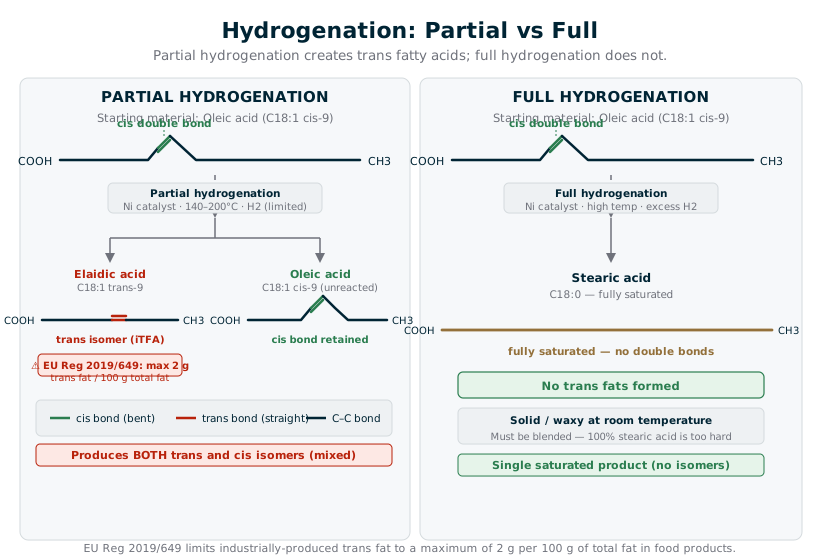 Molecular diagram comparing partial and full hydrogenation of an oleic acid chain, showing formation of trans fatty acids in partial hydrogenation vs fully saturated product in full hydrogenation
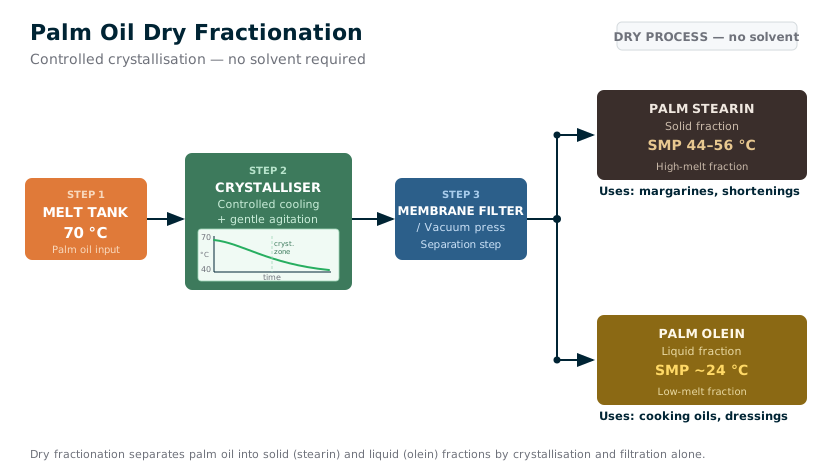 Flow diagram of palm oil dry fractionation process showing melt tank feeding into crystallisation vessel then pressure filtration producing palm stearin and palm olein fractions
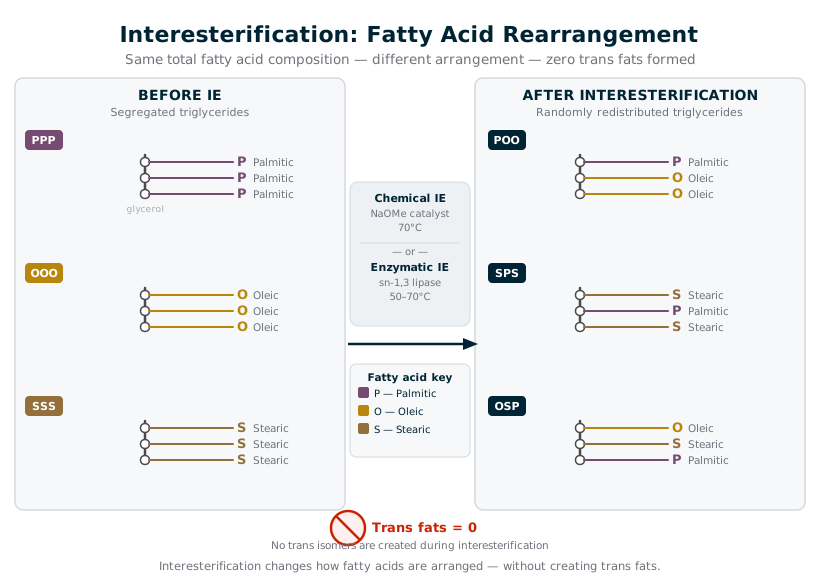 Before-and-after diagram showing fatty acid rearrangement on triglyceride backbones during interesterification, illustrating that no new trans fats are formed
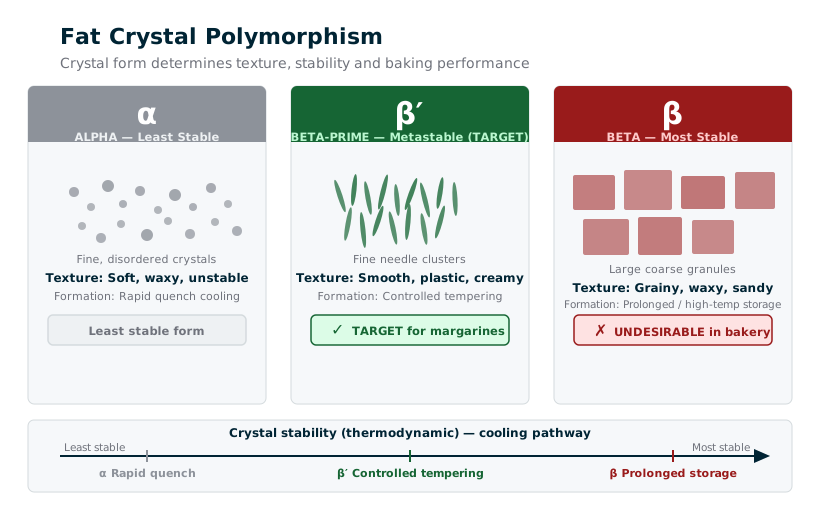 Three-panel illustration comparing alpha, beta-prime, and beta crystal forms in bakery fats, showing crystal size, texture and baking suitability
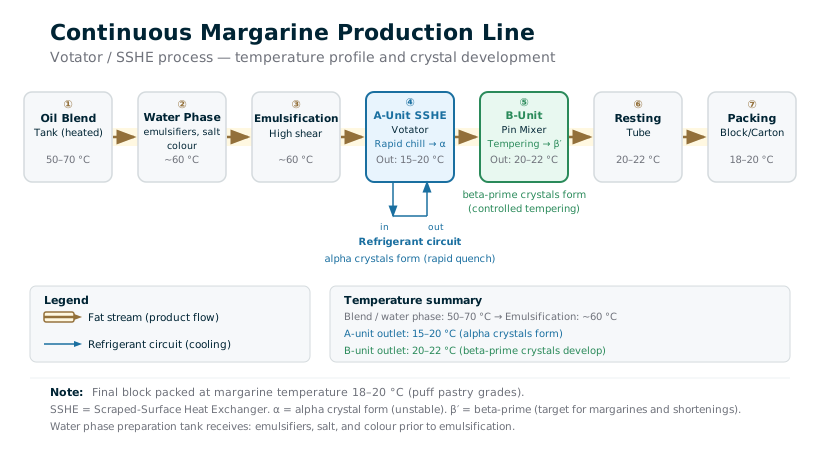 Schematic diagram of continuous margarine manufacturing line from oil blending through votator A-unit and pin mixer B-unit to final packing
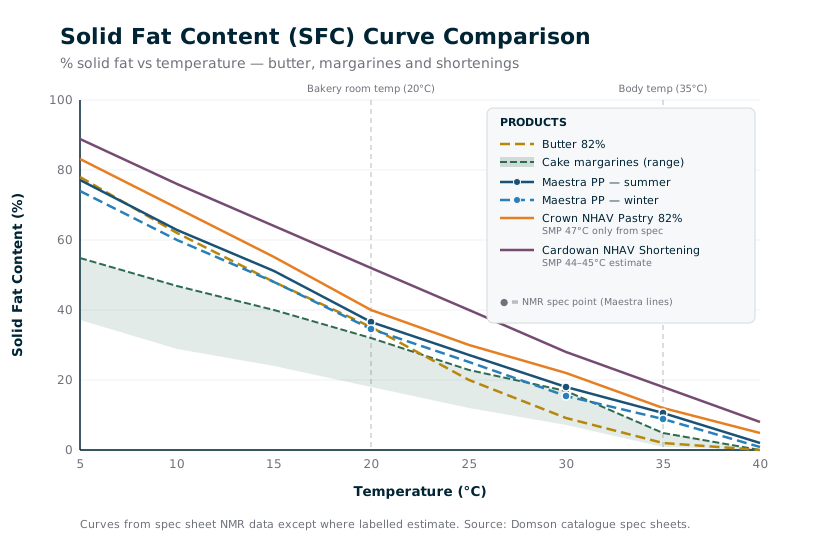 Line chart comparing solid fat content profiles of butter, cake margarines, puff pastry margarines and shortenings from 10°C to 40°C, drawn from Domson catalogue spec sheet data
Puff pastry: roll-in fat percentage (baker's %)
Classic puff pastry (feuilletage) roll-in fat level. Fat weight expressed as a percentage of total flour weight in the dough. Range from Bakels and BAKERpedia reference sources. Exact ratio depends on the method (English, French, Scottish), the desired number of layers, and the specific fat used. Spec-sheet data does not specify dosage — these are industry reference ranges only.
| Ingredient | Baker's % | Weight |
|---|---|---|
| Puff Pastry Margarine 80% (e.g. Maestra) or Butter 82% | 50–100% of flour weight (roll-in fat) |
French-style puff pastry: typically 75–100% (equal parts fat to flour by weight). Reduced-fat puff: 50–66%. With laminating margarine vs butter: margarine at 18–20°C allows cleaner layering due to controlled SFC. Butter requires closer temperature control (ideally 13–16°C) to prevent smearing.
Croissant: roll-in fat percentage (baker's %)
Roll-in fat for a yeast-leavened laminated dough. Industry reference ranges only — no dosage stated in spec sheets.
| Ingredient | Baker's % | Weight |
|---|---|---|
| Puff Pastry Margarine 80% or Butter 82% | 25–33% of total dough weight, or approximately 30–50% of flour weight |
Classic croissant: 25–30 g roll-in fat per 100 g flour weight is a common industry starting point. Layering: typically 27 layers (3 × 3 folds) for croissant. Temperature critical: fat at 18–20°C for margarine; 13–16°C for butter.
Victoria sponge / creamed cake: fat percentage (baker's %)
Standard creamed cake fat level. Figures are industry reference ranges; no dosage stated in catalogue spec sheets.
| Ingredient | Baker's % | Weight |
|---|---|---|
| Cake margarine 80% (e.g. Milama, Marvello, Marina) or Butter 82% | 50–100% of flour weight (equal-weight ratio is traditional Victoria sponge) |
High-ratio cakes: fat above 100% of flour weight — requires high-ratio shortening (e.g. Coronet NHAV HR with E471 emulsifier) for stable batter. Standard creamed method: 100 g fat per 100 g flour per 100 g sugar per 2 eggs (1:1:1:2 ratio). Marvello (14–18°C storage) should be used at ambient bakery temperature — no need to warm before creaming.
Shortcrust pastry: fat percentage (baker's %)
Short paste (rubbing-in method) fat level. Industry reference only.
| Ingredient | Baker's % | Weight |
|---|---|---|
| Vegetable Shortening 100% or Butter 82% | 50% of flour weight (standard: half-fat pastry) |
Half-fat pastry: 1 part fat to 2 parts flour by weight. With shortening (100% fat, no water): produces a more uniform, shorter texture than butter (which contributes 16% water). Shortening's higher SMP (44–45°C from Cardowan specs) means it remains plastic at bakery temperature without tempering — useful for warm conditions.
Legal definitions and composition overview. EU minimum fat content for 'margarine' is 80% under Regulation 1308/2013 Annex VII. Shortening has no single EU legal definition. Butter is from dairy only; EU/UK standard is min 82% fat. Figures in this table: butter from the Polmlek spec sheet; margarine range from across Domson catalogue specs; shortening from Cardowan spec sheets. Flag: regulatory figures must be verified against current consolidated legislation before any labelling use.
| Parameter | Butter (82% fat) | Margarine (standard 80%) | Shortening (100% fat) |
|---|---|---|---|
| EU/UK legal fat minimum | Min 82% (EU/UK standard) | Min 80% (name 'margarine' reserved for ≥80%) | No statutory minimum; typically 100% |
| Water content (typical) | ~16% | 14–20% | 0% (no water phase) |
| Origin | Dairy exclusively (cream only) | Vegetable oils/fats (+ up to 3% milk fat of fat content permitted by EU) | Vegetable oils/fats |
| Saturated fat (per 100 g product, typical range) | 55 g (Polmlek spec) | 18–39 g (see product table below) | 38–39 g (Cardowan range) |
| Energy (per 100 g product, typical) | 3058 kJ / 744 kcal | 2960–3000 kJ / 720–716 kcal | 3700 kJ / 900 kcal |
| Trans fatty acids | ~3–5% (natural ruminant trans fats, CLA — different from industrial iTFA) | Max 1–2% (within EU Reg 2019/649 limit of 2 g/100 g) | Not stated separately in Cardowan specs; no partial hydrogenation in ingredients |
| Allergen risk | MILK (including lactose) — major allergen | Varies by product — SOYA where soy lecithin used (e.g. AMARG Wyborna); milk cross-contamination risk in some (Marina). Others: no declared allergens. | No allergens declared (in product, line or factory) for Cardowan range |
| Key emulsifiers added | None (natural milk fat emulsifiers) | E471 (MDG), E322 (lecithin), E475 (PGFE) depending on product | E471 (HR version); none (plain version) |
| Kosher / Halal availability | Kosher (dairy); not Halal if containing dairy in some interpretations — verify with certifier | Marvello (CSM): Kosher and Halal certified. Others: not confirmed in specs reviewed. | Cardowan not declared in reviewed specs — verify with supplier |
All SFC values from first-party spec sheets measured by pulsed NMR (AOCS Cd 16b-93 or equivalent). Values in % solid. Maestra Puff Pastry has seasonal formulations; both seasons shown. Crown NHAV Pastry: only slip melting point (SMP) confirmed in spec — NMR profile values not available. Cardowan shortenings: only SMP available from spec. For Butter: no NMR profile available from Polmlek spec — SMP range is a general reference for unsalted butter from reference sources only (confidence: low, single general source). Food safety: use spec-sheet values only (high confidence); estimates and general references are marked. N10/N20/N30/N35 = SFC% at 10/20/30/35°C.
| Product | Fat % | N10 (10°C) | N20 (20°C) | N30 (30°C) | N35 (35°C) | SMP or melt range | Season note |
|---|---|---|---|---|---|---|---|
| Unsalted Butter 82% (Polmlek) | 82% | n/a (not in spec) | n/a | n/a | n/a | ~28–35°C typical (general ref, low confidence) | — |
| Milama Cake & Cookie Margarine 80% (Kruszwica) | 80% | n/a (not stated in spec) | 20–25% | n/a (not stated) | max 5% | — | Single formulation year-round |
| AMARG Wyborna 80% (Unsalted Cake Margarine) | 80% | n/a | 23–27% | n/a | n/a | — | — |
| Marina 80 Solidarity Recipe (Master Martini) | 80% | 41–51% | 22–32% | 7–17% | n/a | — | — |
| Marvello Cake Margarine 12.5 kg (CSM Ingredients) | 80% | ~34% (target) | 20% target (18–24% range) | 12% target (9.5–13.5% range) | 9% target (7–11% range) | — | — |
| Maestra Puff Pastry Margarine 80% (Kruszwica) — SUMMER (Apr–Aug) | 80% | n/a | 35–38% | 16–20% | 9–12% | — | Summer batch (Apr–Aug) — higher SFC to resist warm bakeries |
| Maestra Puff Pastry Margarine 80% (Kruszwica) — WINTER (Sep–Apr) | 80% | n/a | 33–36% | 14–17% | 8–10% | — | Winter batch (Sep–Apr) — slightly softer |
| Crown NHAV Pastry Margarine 82% (Cardowan) | 82% | n/a | n/a (NMR not in spec) | n/a | n/a | SMP 47.0°C | SMP only; NMR not available from spec |
| Coronet NHAV HR Shortening 100% (Cardowan) | 100% | n/a | n/a (NMR not in spec) | n/a | n/a | SMP 44.0°C | SMP only; NMR not available from spec |
| Plain Box NHAV Shortening 100% (Cardowan) | 100% | n/a | n/a (NMR not in spec) | n/a | n/a | SMP 45.0°C | SMP only; NMR not available from spec |
Sources: first-party spec sheets. Values reported as % of total fatty acids where stated in spec; otherwise derived from nutrition label (per 100 g product ÷ fat content). Butter: derived from nutrition label (55 g sat ÷ 82 g fat = ~67%). N/A = not stated in spec. Flag: nutrition-label-derived values include the USDA conversion factor 0.956 applied by some producers — minor differences from direct GC analysis may exist. Confidence high for spec-sheet FA composition %; medium for nutrition-label-derived values. Trans fat note: butter contains natural conjugated linoleic acid (CLA) and vaccenic acid (C18:1 trans-11) which are ruminant trans fats, distinct from industrially produced trans fats (iTFA); EU Reg 2019/649 limits apply to iTFA only.
| Product | Fat % | SAFA (% total FA or g/100g product) | MUFA (% total FA or g/100g product) | PUFA (% total FA or g/100g product) | Trans FA | Basis |
|---|---|---|---|---|---|---|
| Polmlek Unsalted Butter 82% | 82% | ~67% of fat (55 g/100 g product) | ~26% of fat (estimated from typical milk fat composition — low confidence, not in Polmlek spec) | ~3% of fat (estimated — low confidence) | ~3–4% natural ruminant (CLA + vaccenic) — distinct from industrial iTFA | Nutrition label; trans estimate from general dairy science |
| Milama Cake & Cookie Margarine 80% (Kruszwica) | 80% | 41% of total FA / 31 g per 100 g product | 45% of total FA | 13% of total FA | max 2% of total FA | Spec fatty acid composition section (% of total FA); nutrition label for g/100g |
| Maestra Puff Pastry Mass Balance 80% (Kruszwica) | 80% | 46% of total FA / 35 g per 100 g product | 42% of total FA | 10% of total FA | max 2% of total FA | Spec fatty acid composition section |
| AMARG Wyborna 80% (Unsalted Cake Margarine) | 80% | 18 g per 100 g product (~23% of fat) | not stated in spec | not stated in spec | max 1% of total FA | Nutrition label for sat fat; FA comp not in spec |
| Marina 80 Solidarity Recipe (Master Martini) | 80% | 39 g per 100 g product (~49% of fat) | 32 g per 100 g product (~40% of fat) | 8 g per 100 g product (~10% of fat) | max 1.0% | Nutrition label |
| Marvello Cake Margarine 12.5 kg (CSM Ingredients) | 80% | 27 g per 100 g product (~34% of fat) | 37 g per 100 g product (~46% of fat) | 12 g per 100 g product (~15% of fat) | 0.9 g per 100 g product (of which 0 g animal, 0.9 g non-animal) | Nutrition label (detailed) |
| Crown NHAV Pastry Margarine 82% (Cardowan) | 82% | 41.2 g per 100 g product (~50% of fat) | 29.8 g per 100 g product (~36% of fat) | 8.7 g per 100 g product (~11% of fat) | not stated in spec | Nutrition label |
| Coronet NHAV HR Shortening 100% (Cardowan) | 100% | 38.1 g per 100 g (= 38.1% of fat) | 43.5 g per 100 g (= 43.5% of fat) | 16.2 g per 100 g (= 16.2% of fat) | not stated in spec | Nutrition label (= FA composition for 100% fat product) |
| Plain Box NHAV Shortening 100% (Cardowan) | 100% | 38.8 g per 100 g (= 38.8% of fat) | 43.5 g per 100 g | 15.5 g per 100 g | not stated in spec | Nutrition label |
All values from first-party spec sheets. 'Working temperature' refers to the recommended temperature at which the fat should be brought before use in dough or batter. Marvello is unusual in specifying a MINIMUM storage temperature (14°C) — it must NOT be refrigerated. Allergen column shows confirmed spec-sheet declarations — food safety flag: always verify against the current version of the supplier spec before use.
| Product | Storage temperature | Shelf life | Delivery max temp | Working temperature | Allergen flag |
|---|---|---|---|---|---|
| Unsalted Butter 82% (Polmlek) | 0–10°C (chilled); −18 to −22°C (frozen) | 60 days (chilled); 12 months (frozen). Consume within 7 days of thawing. | Not stated in spec | 14–18°C (general bakery practice for creaming/mixing) | MILK (including lactose) — mandatory allergen declaration |
| Milama Cake Margarine 80% (Kruszwica) | max 4–15°C | 150 days | max 15°C | 16–20°C (general bakery practice) | No allergens declared (ingredient or cross-contamination) |
| Maestra Puff Pastry 80% (Kruszwica — both versions) | max 4–15°C | 150 days | max 15°C | 18–20°C (specified in spec for dough preparation) | No allergens declared |
| AMARG Wyborna 80% (Unsalted Cake Margarine) | 1–10°C | 6 months | max 15°C | 16–20°C (general bakery practice) | SOYA (soy lecithin as ingredient) — mandatory allergen declaration |
| Marina 80 Solidarity Recipe (Master Martini) | 1–10°C | 6 months | max 15°C | 16–20°C | No listed allergens as ingredient; MAY CONTAIN MILK (cross-contamination) — food safety flag |
| Marvello Cake Margarine 12.5 kg (CSM Ingredients) | 14–18°C (NOT refrigerated — minimum 14°C) | 182 days (target remaining at 50%) | 13–17°C (transport temperature) | 14–18°C (same as storage — ready to use) | No allergens in product or production line; factory may handle wheat/soy/fish/peanuts/nuts/sesame — verify if serving allergen-sensitive customers |
| Cardowan NHAV Shortenings (Coronet NHAV HR & Plain Box) | Cool dry place, away from direct sunlight and strong odours | 5 months | Not stated | Room temperature 18–22°C (general bakery practice for shortening) | No allergens in product, production line or factory (confirmed) |
| Crown NHAV Pastry Margarine 12.5 kg (Cardowan) | Cool dry place, away from direct sunlight and strong odours | 5 months | Not stated | 18–20°C (recommended for pastry) | No allergens in product, production line or factory (confirmed) |
Common faults in laminated doughs relating to fat selection, temperature or technique. Source: general bakery knowledge supported by BAKERpedia, IREKS Compendium and spec-sheet SFC data.
| Symptom | Likely cause (fat-related) | Likely cause (process-related) | Remedy |
|---|---|---|---|
| Fat shatters and breaks into lumps during sheeting | Fat too cold or too hard — SFC too high. Winter batch of puff pastry margarine used in cold (<16°C) conditions. | Fat block not tempered to working temperature before lamination starts. | Temper fat to 18–20°C (per Maestra spec). Check seasonal batch: winter batches have lower SFC but must still reach 18°C before use. |
| Fat smears and merges with dough — no visible layers | Fat too soft — SFC too low. Wrong product selected (cake margarine instead of puff pastry margarine). Bakery too warm. | Sheeting speed too slow; rest periods too short, dough warming during processing. | Use puff pastry/laminating grade fat (SFC@20°C >33%). Chill dough and fat between folds. Check ambient bakery temperature. |
| Uneven lift — some layers well-separated, others stuck | Fat inconsistency from batch to batch or within the block. | Uneven fat sheet thickness, irregular folding technique. | Ensure fat block is at uniform temperature throughout. Use consistent fold pattern. |
| Butter breaks in cold lamination | Butter brittle below 14°C — milk fat SFC rises sharply below 14°C. Margarine is more forgiving in this range. | Cold dough from retarder placed directly on cold fat without tempering. | Bring butter to 13–16°C for lamination. Consider switching to puff pastry margarine for easier temperature management. |
| Finished product waxy or greasy mouthfeel | Fat contains beta (β) crystals rather than beta-prime (β') — poor melt-down in the mouth. Can result from over-working or temperature abuse. | Fat worked excessively, causing crystal transition from β' to β. | Handle fat gently; do not over-work. Store fat correctly. Source a fat with confirmed β' crystal habit (palm-based formulation). |
Common batter/cake faults related to fat selection and temperature.
| Symptom | Likely cause (fat-related) | Remedy |
|---|---|---|
| Poor volume, dense crumb after creaming | Fat too cold — insufficient aeration during creaming. SFC too high at creaming temperature. | Allow cake margarine to reach 16–20°C before creaming. For Marvello: use at 14–18°C (its specified storage/use temperature). Switch to high-ratio shortening (with E471) for very fine-crumb applications. |
| Batter curdles during mixing | Fat too warm or liquid — emulsion breaks. Or fat and liquid temperature mismatch. | Ensure fat is at correct temperature (not melted). Add liquid in small increments. Use a fat with good emulsion stability (one containing E471 or E475). |
| Greasy, oily crumb surface after baking | Fat not properly emulsified into batter — oil separation. Fat content too high, or wrong fat type for the recipe. | Cream fat thoroughly. Use emulsified shortening or cake margarine rather than plain shortening for high-fat recipes. Reduce fat level. |
| Off-flavour: rancid or soapy notes | Fat oxidised or contaminated with strong odours. High peroxide value — degraded fat. | Check FFA and peroxide value on delivery. Store fats away from strong odours. Rotate stock (FIFO). Discard any fat with FFA above spec limit or visible discolouration. |
- Fat pct:
- min 82%
- Sat fat g per 100g product:
- 55
- Trans fa max pct:
- ~3–4% (natural ruminant — not industrial iTFA)
- Key allergen:
- MILK (including lactose)
- Storage temp c:
- 0–10°C chilled; −18 to −22°C frozen
- Shelf life days:
- 60 (chilled); 365 (frozen)
- Application:
- All baking applications, laminated pastry, creaming
- Fat pct:
- 80% ±0.5%
- Sat fat g per 100g product:
- 31
- Sfc n20 pct:
- 20–25%
- Trans fa max pct:
- 2%
- Key allergen:
- None declared
- Storage temp c:
- max 4–15°C
- Shelf life days:
- 150
- Application:
- Cakes, cookies, confectionery
- Fat pct:
- 80% ±0.5%
- Sat fat g per 100g product:
- 35
- Sfc n20 pct:
- 33–38% (seasonal)
- Trans fa max pct:
- 2%
- Key allergen:
- None declared
- Storage temp c:
- max 4–15°C
- Shelf life days:
- 150
- Application:
- Puff pastry, laminated doughs. Working temp: 18–20°C
- Fat pct:
- 80.0% ±2.0%
- Sat fat g per 100g product:
- 18
- Sfc n20 pct:
- 23–27%
- Trans fa max pct:
- 1%
- Key allergen:
- SOYA (soy lecithin as ingredient)
- Storage temp c:
- 1–10°C
- Shelf life days:
- 180
- Application:
- Cakes, cookies, biscuits
- Fat pct:
- 80% ±0.5%
- Sat fat g per 100g product:
- 35
- Sfc n20 pct:
- 33–38% (seasonal, per available spec)
- Trans fa max pct:
- 2%
- Key allergen:
- None declared
- Storage temp c:
- max 4–15°C
- Shelf life days:
- 150
- Application:
- Puff pastry, laminated doughs. Working temp: 18–20°C
- Notes:
- Spec on file (0bc2a6a0) is the Maestra Puff Pastry Mass Balance version — SFC profile reflects puff pastry grade. Verify with Kruszwica if a dedicated cream margarine spec exists.
- Fat pct:
- min 80%
- Sat fat g per 100g product:
- 39
- Sfc n20 pct:
- 22–32%
- Trans fa max pct:
- 1.0%
- Key allergen:
- No listed allergen in product; MAY CONTAIN MILK (cross-contamination flag)
- Storage temp c:
- 1–10°C
- Shelf life days:
- 180
- Application:
- Shortcrust pastry, yeast doughs, wheat products. Contains E-202 preservative.
- Fat pct:
- 100%
- Sat fat g per 100g product:
- 38.1
- Slip melting point c:
- 44
- Trans fa max pct:
- not stated (no partial hydrogenation in ingredient list)
- Key allergen:
- None (product, line, factory)
- Storage temp c:
- Cool dry place
- Shelf life days:
- 150
- Application:
- High-ratio cakes, general baking. Contains E471 for superior aeration. Air content 12%.
- Fat pct:
- 100%
- Sat fat g per 100g product:
- 38.8
- Slip melting point c:
- 45
- Trans fa max pct:
- not stated (no partial hydrogenation in ingredient list)
- Key allergen:
- None (product, line, factory)
- Storage temp c:
- Cool dry place
- Shelf life days:
- 150
- Application:
- General bakery fat, pastry, frying. No emulsifier. Air content 12%.
- Fat pct:
- 82%
- Sat fat g per 100g product:
- 41.2
- Slip melting point c:
- 47
- Trans fa max pct:
- not stated (no partial hydrogenation in ingredient list)
- Key allergen:
- None (product, line, factory)
- Storage temp c:
- Cool dry place
- Shelf life days:
- 150
- Application:
- Puff pastry, laminated doughs. Contains E471. Higher fat (82%) and higher SMP (47°C) than Maestra range.
- Fat pct:
- 80%
- Sat fat g per 100g product:
- 27
- Sfc n20 pct:
- 18–24% (target 20%)
- Trans fa max pct:
- 0.9 g/100g product (low)
- Key allergen:
- None in product/line; factory handles wheat/soy/fish/peanuts/nuts/sesame
- Storage temp c:
- 14–18°C (DO NOT refrigerate)
- Shelf life days:
- 182
- Application:
- Cakes. Kosher + Halal certified. Vegan. Lowest sat fat in range (27g/100g). UK origin.
Buy the ingredients
Catalogue products and brands referenced in this article.
Unsalted Butter 82% 10 kg
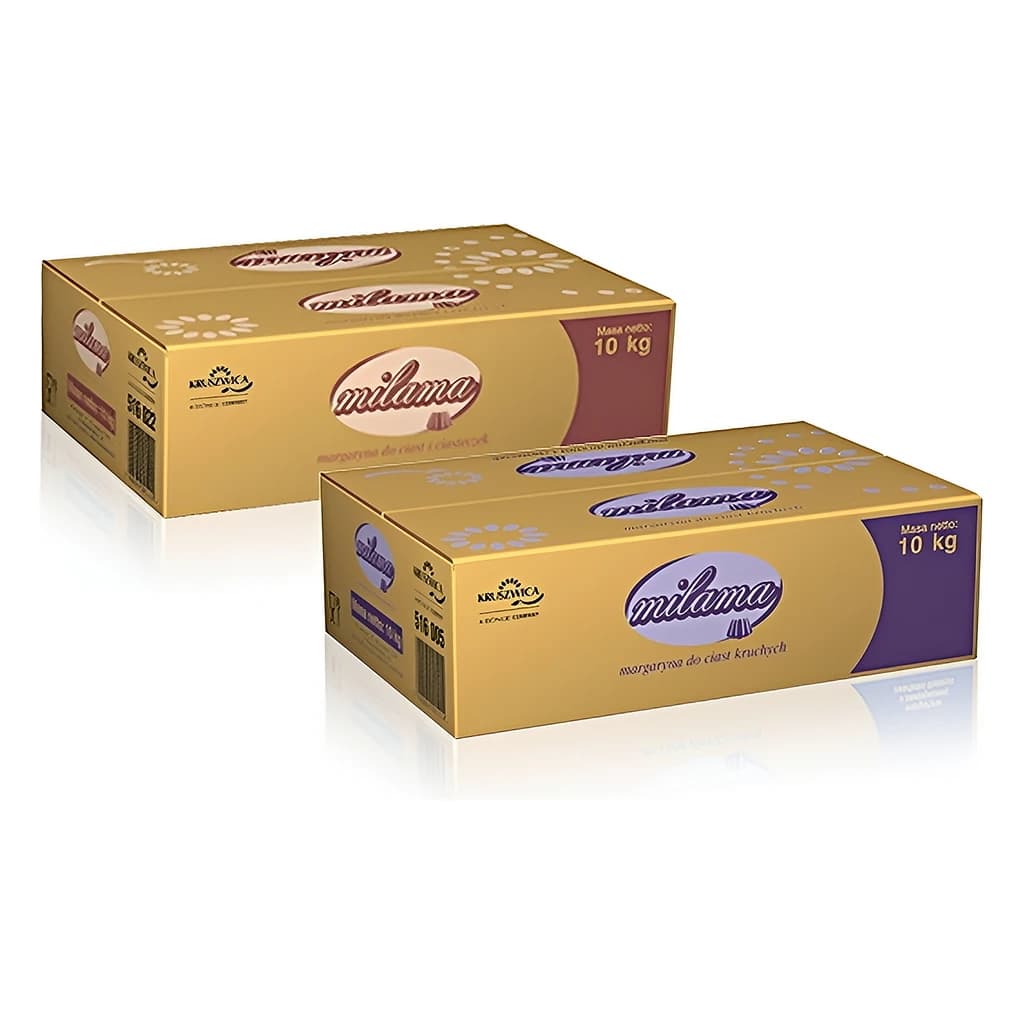
Milama Cake & Cookie Margarine 10 kg
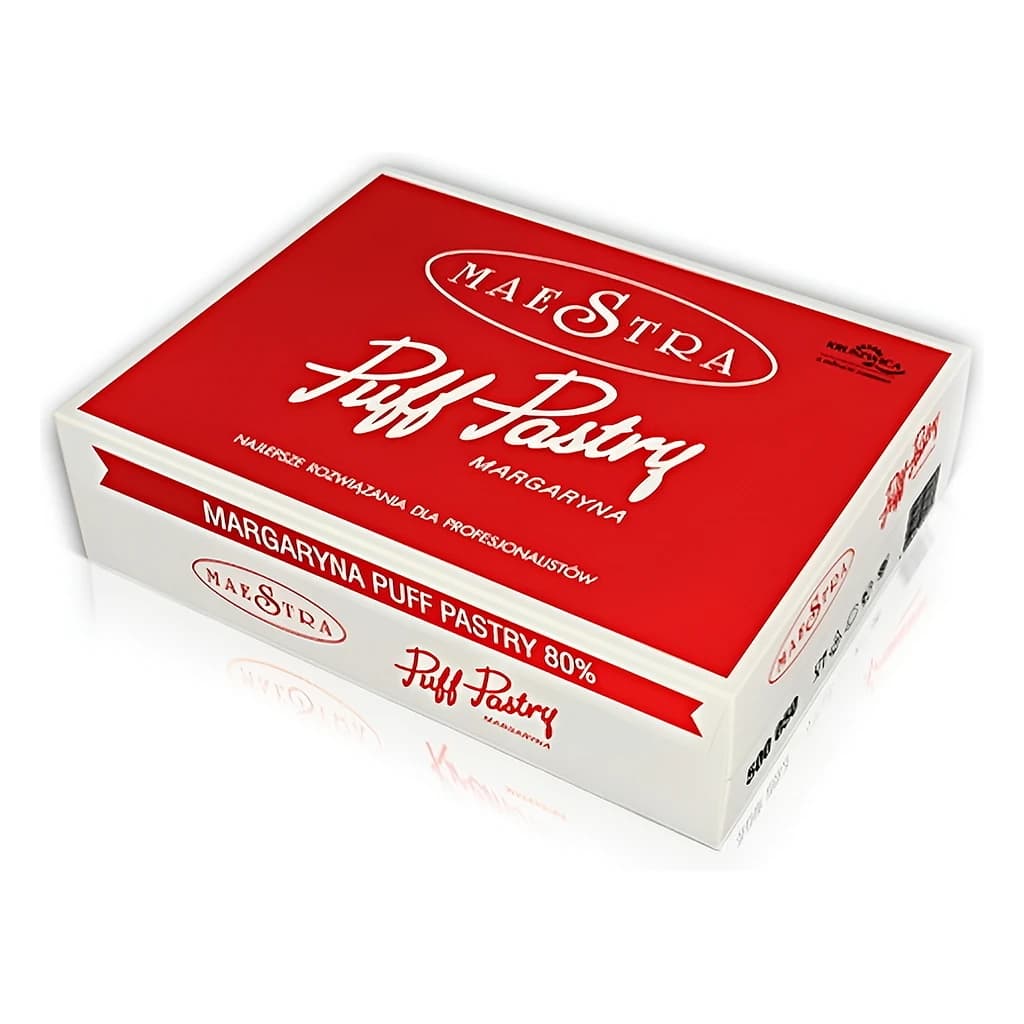
Puff Pastry Margarine 80% 10 kg
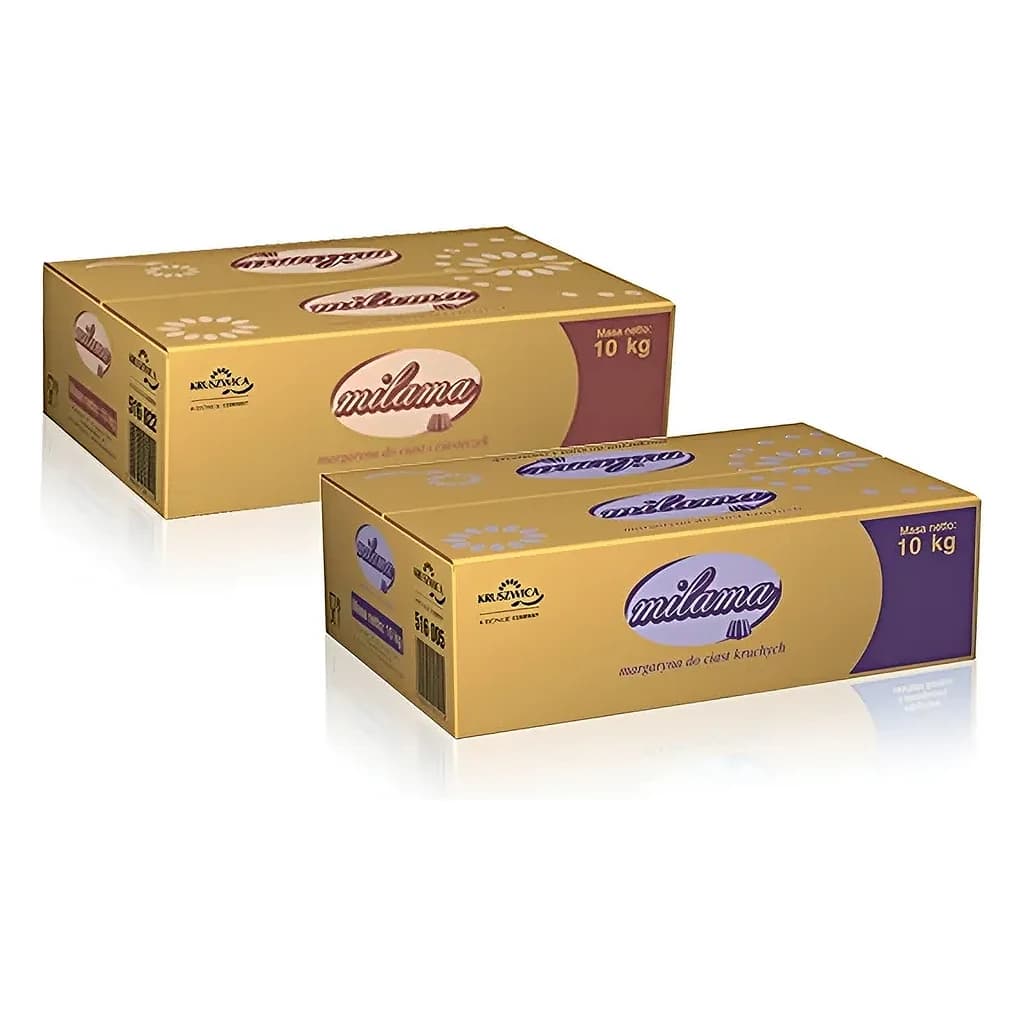
Qualita Plain Cake Margarine 80% 10 kg
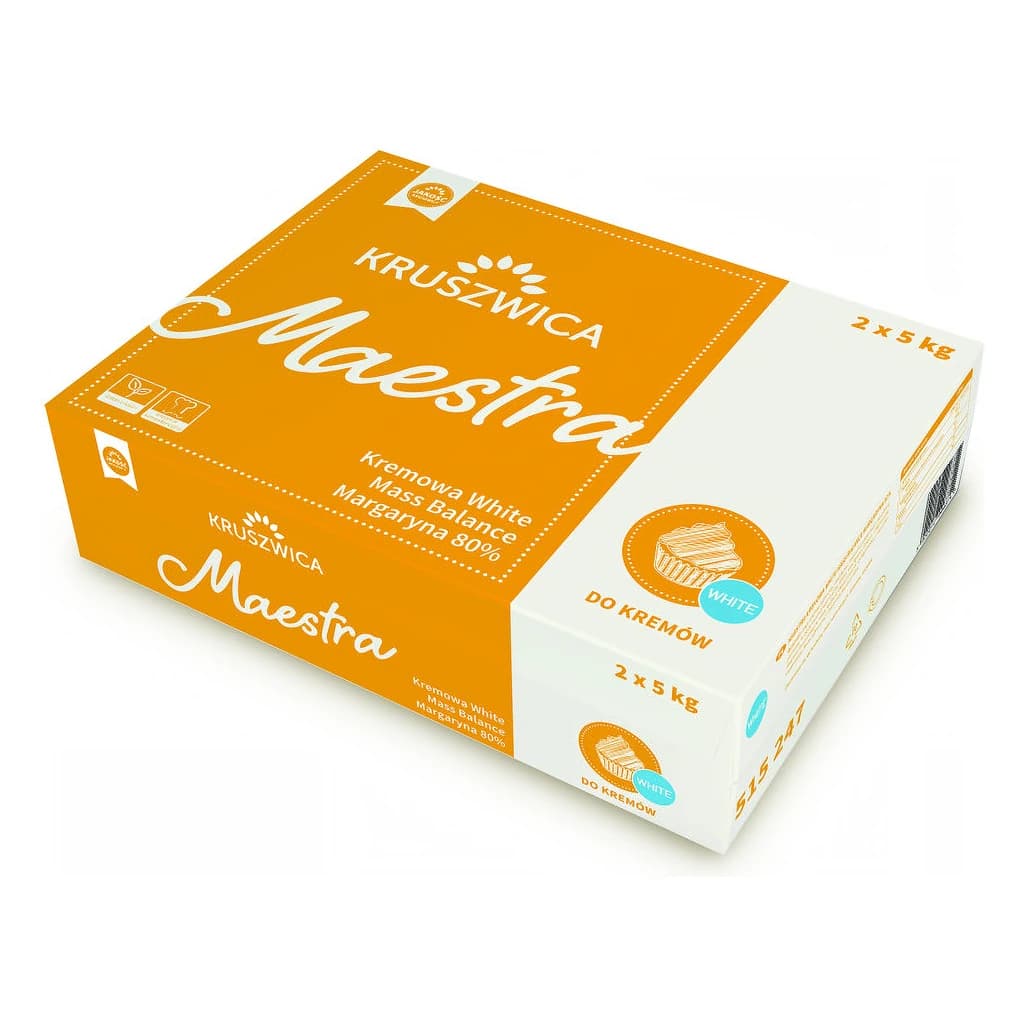
Maestra White Cream Margarine 80% 10 kg
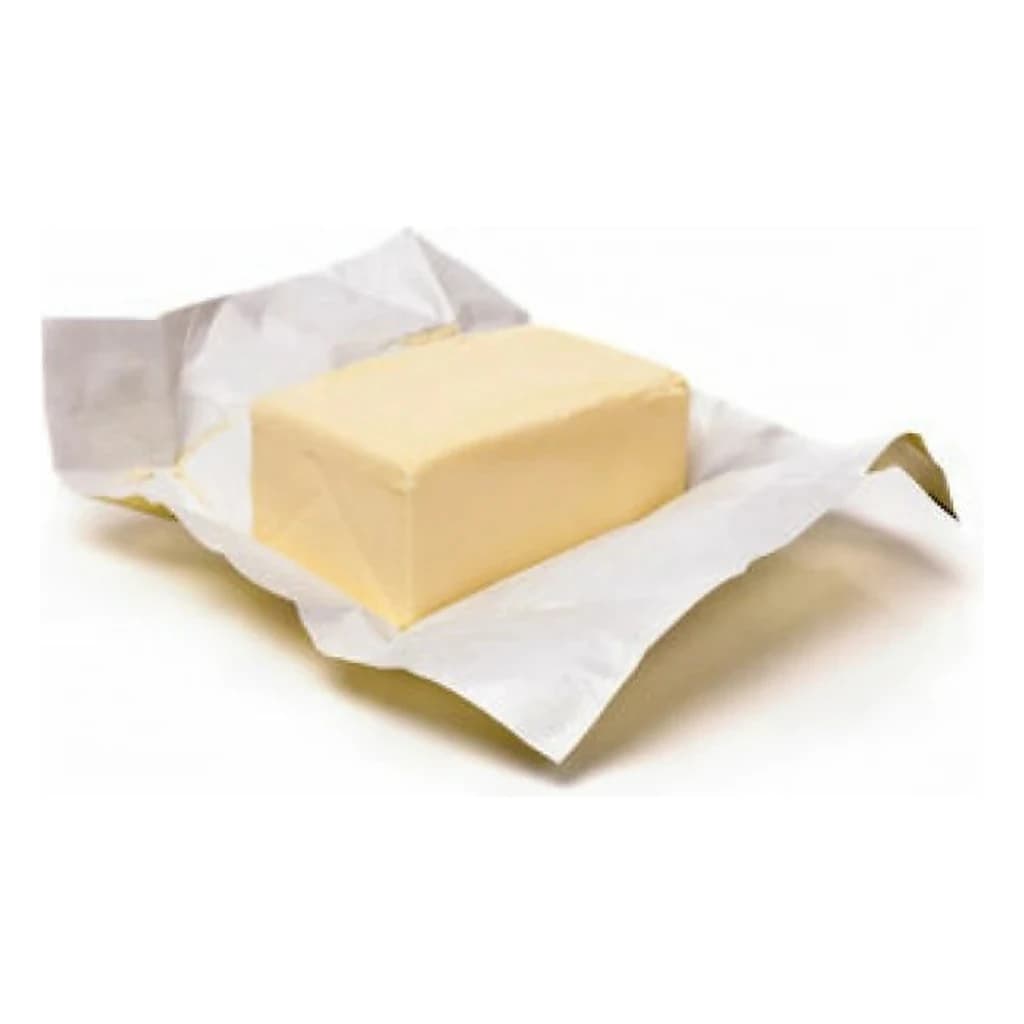
Marina Cake Margarine 80% 10 kg (Solidarity Recipe)
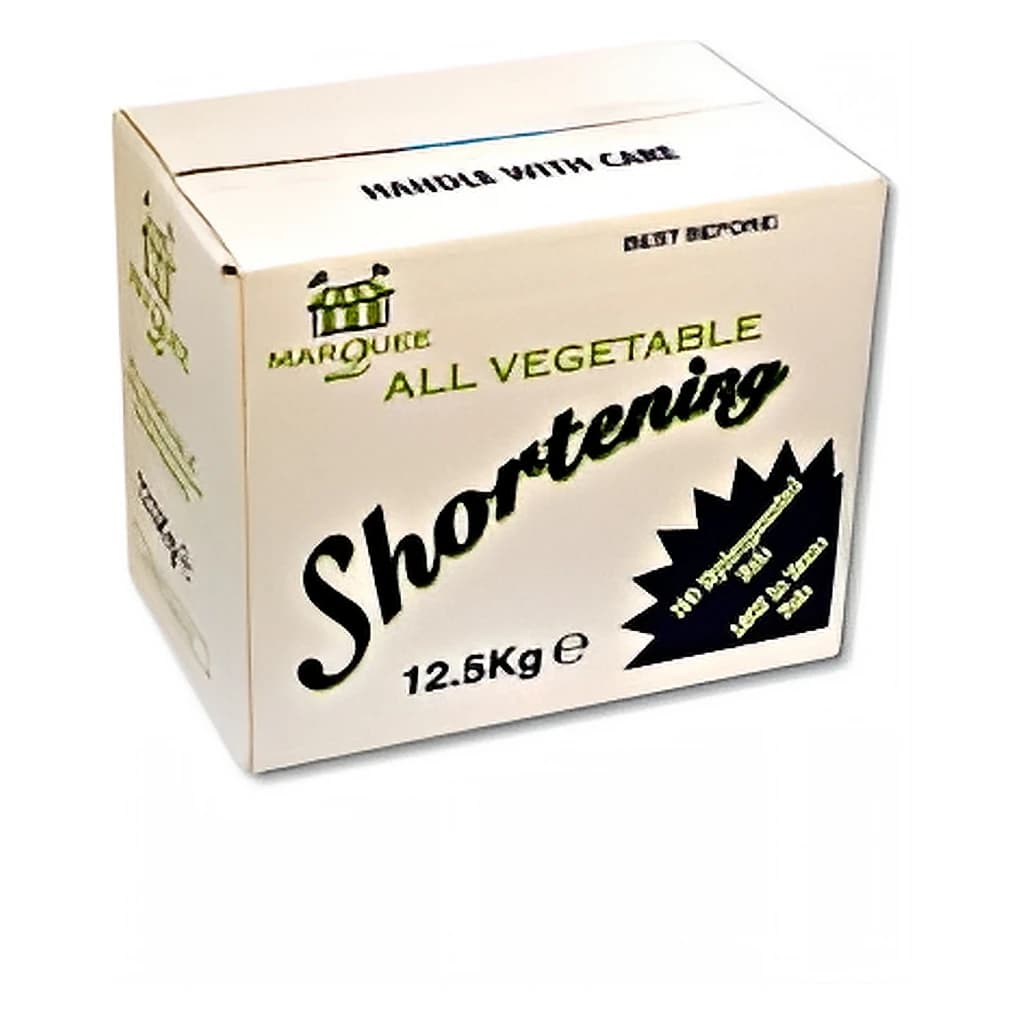
High Ratio Vegetable Shortening 12.5 kg
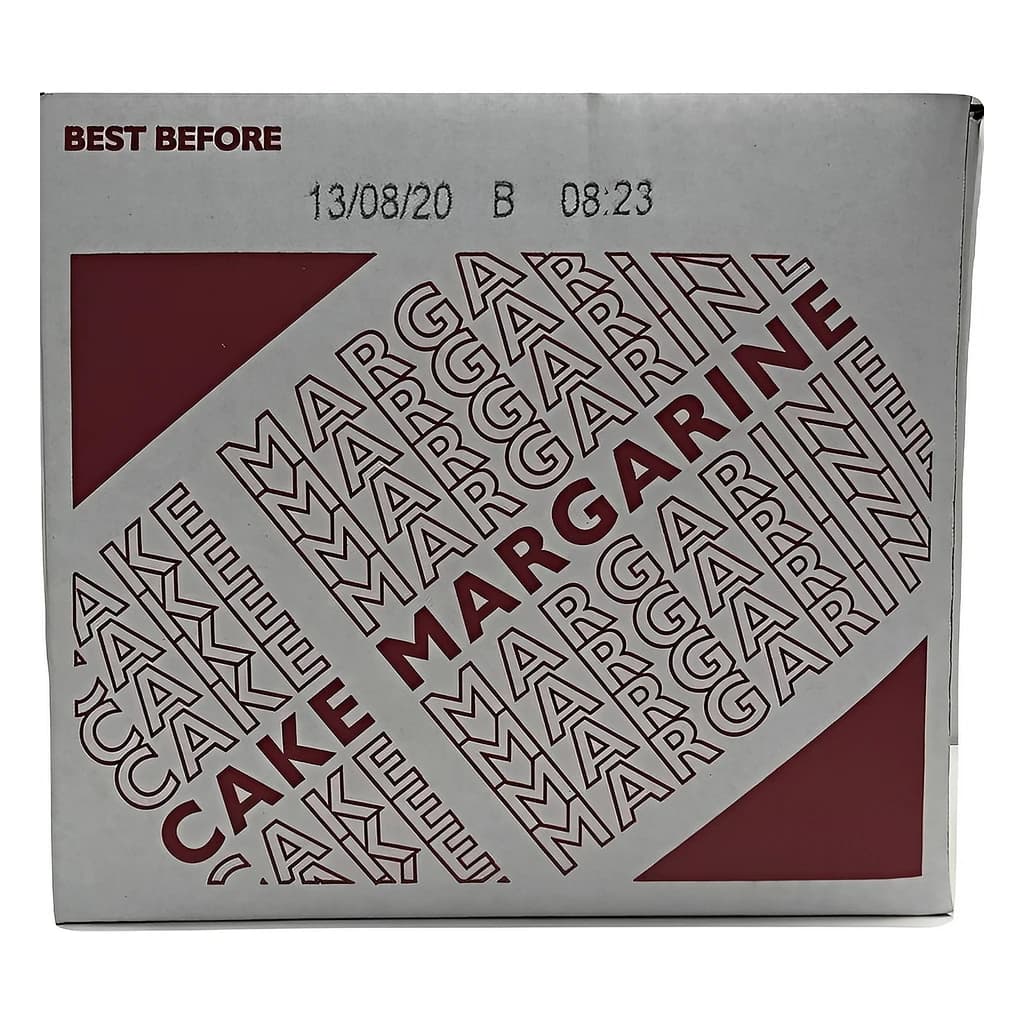
Unsalted Cake Margarine 12.5 kg
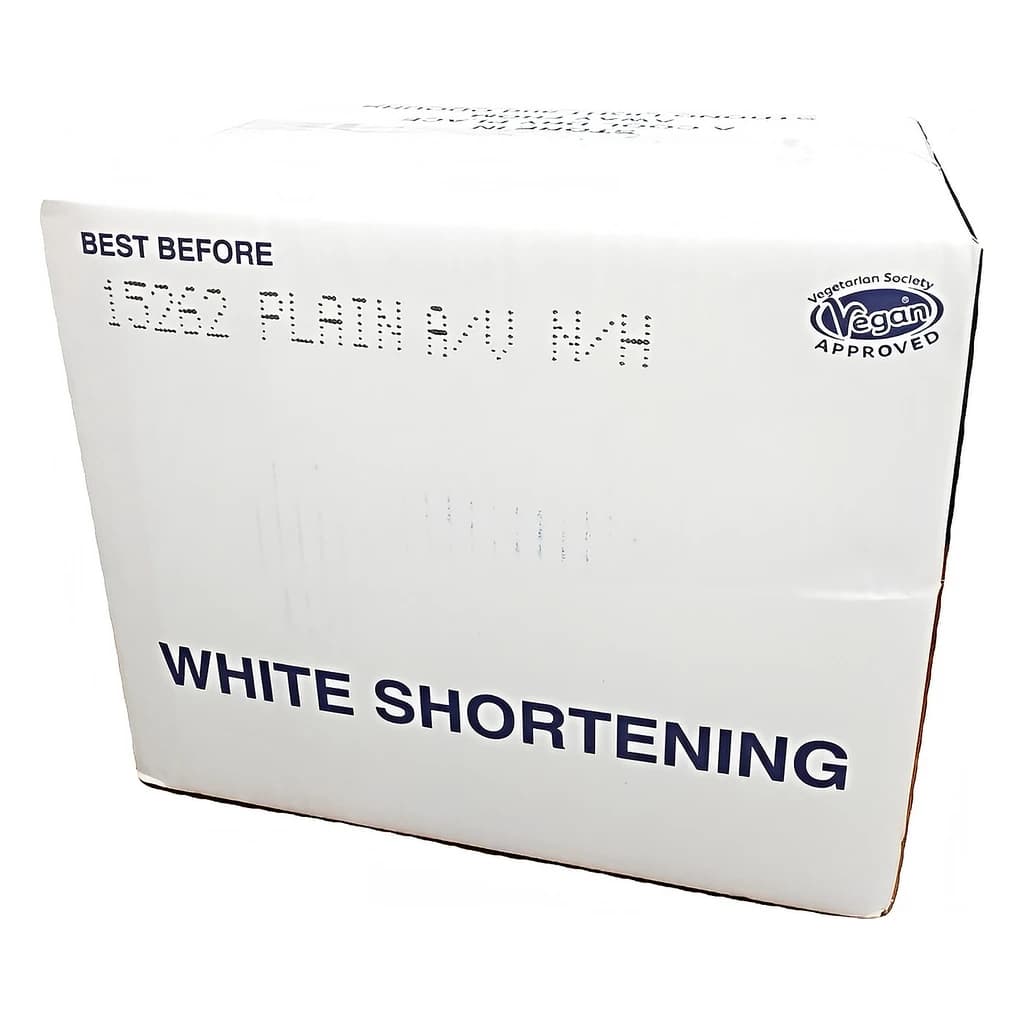
Vegetable Shortening 12.5 kg
Puff Pastry Margarine 12.5 kg
Marvello Cake Margarine 12.5 kg