
Three empires on a cake plate: Ottoman, Habsburg and French influences on Romanian confectionery
A Romanian pastry case is a history lesson you can eat. Three empires left three layers on it: the Ottoman south (baclava, sarailie, cataif, halva and rahat — filo, ground walnut and honey syrup, strongest in Dobrogea); the Habsburg west (tort Doboș, cremșnit, ștrudel, Gerbeaud and kürtőskalács — the Viennese-Hungarian torte world of Transylvania and the Banat); and the French Belle Époque of Bucharest, "Micul Paris" (savarină, ecler, amandină and the Joffre cake, built by Casa Capșa and its French-trained rivals). This dossier gives a UK baker the authentic picture, mined from Romanian-language gastro-history and cross-checked against the platform's supplier specifications, then wires every family to the Domson catalogue a Romanian patisserie actually orders — filo (a range gap), kataifi, walnuts, honey, dark couverture, apricot glaze, custard, choux and fondant — and flags the honest sourcing gaps (no filo, rahat, halva or rose water). Cross-linked to the Pillar A craft behind each layer (A6-sugar-work-techniques, A6-choux-eclair-technology, A6-pastry-creams-fillings, A6-chocolate-selection-couverture, A6-marzipan-fondant-sugar-pastes, A7-icings-and-buttercreams, A7-fondant-types-and-uses, A7-seeds-nuts-toppings) and to its sister Romanian articles (B4-savarins-eclere-and-cafe-pastry, B4-transylvanian-kurtoskalacs, B4-cozonac-enriched-dough, B4-papanasi-and-cheese-pastry).
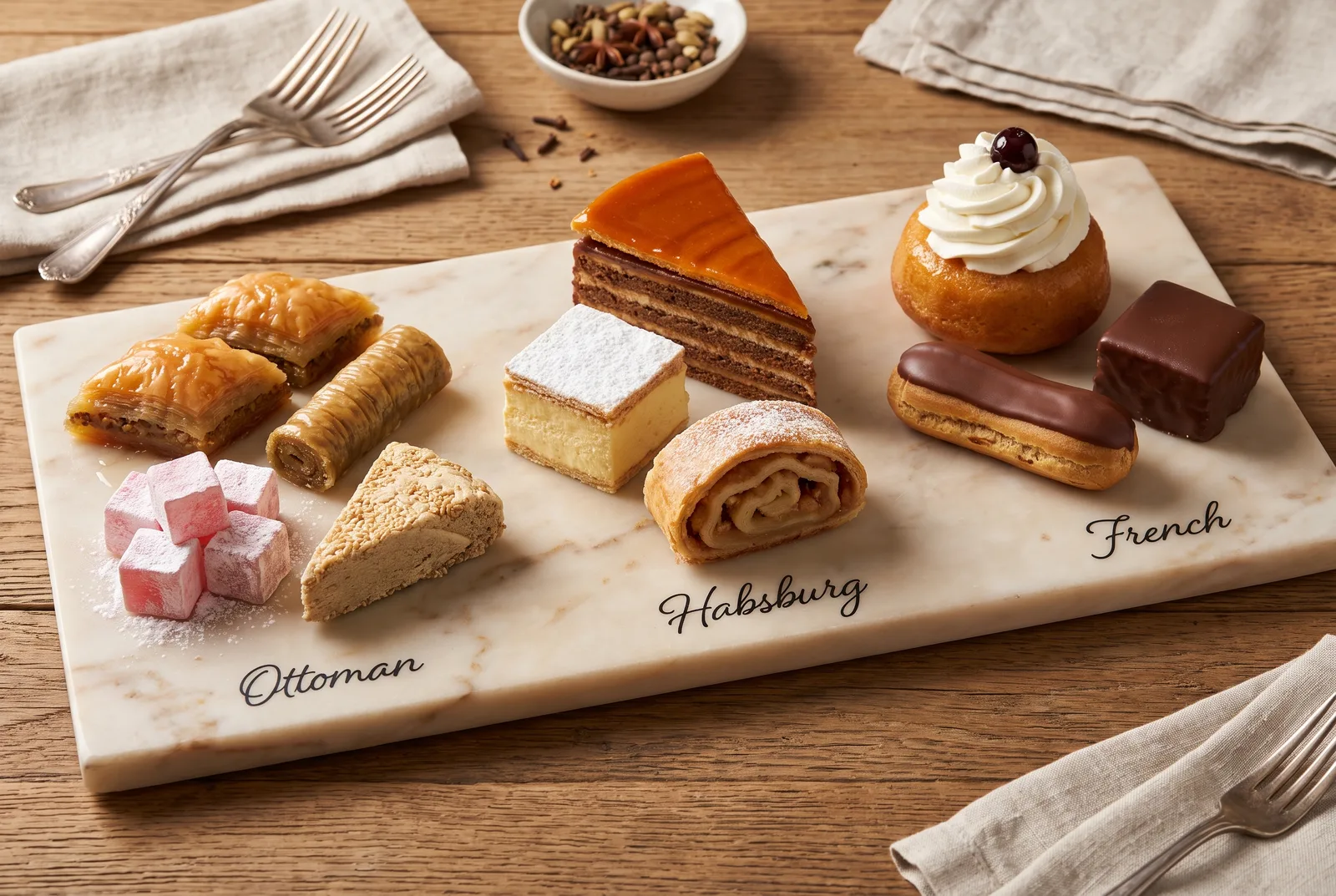
A Romanian pastry case is a history lesson you can eat
Look into the window of a good Romanian cofetărie and you are looking at three empires at once (see the figure below). A tray of baclava and sarailie glistening with honey syrup, and cubes of rahat (Turkish delight), came up from the Ottoman south. A slice of tort Doboș with its hard-caramel top, a cremșnit and a coil of ștrudel came in from the Habsburg west — the Vienna-and-Budapest world of Transylvania and the Banat. And a savarină crowned with whipped cream, a fondant-glazed ecler and an amandină are the legacy of the French Belle Époque, when Bucharest called itself Micul Paris ("Little Paris"). The visible arc of the last two centuries is that the elite palate moved from oriental honey-and-nut sweets to French pastry and chocolate — while the Ottoman and Habsburg layers survived, and still thrive, regionally .
This is the practical map of that inheritance for a UK baker or distributor serving Romanian customers: what each family is, where it lives, how it is built, what it must declare — and exactly what to buy for it on the Domson platform, including the honest gaps in the range. The deeper craft sits in Pillar A: sugar and syrup work in A6-sugar-work-techniques, choux in A6-choux-eclair-technology, pastry creams in A6-pastry-creams-fillings, couverture in A6-chocolate-selection-couverture, marzipan and fondant in A6-marzipan-fondant-sugar-pastes, buttercreams in A7-icings-and-buttercreams, and the nut craft in A7-seeds-nuts-toppings.
1. The frame: three imperial layers over one country
The three layers map cleanly onto Romania's regions and history (see the figure and table below):
- Ottoman / oriental — over Wallachia, Moldova and, most densely, multiethnic Dobrogea. Oriental sweets arrived across the 16th–19th centuries, above all in the Phanariot period and through Levantine and Constantinople merchants; rahat was introduced in the 18th century alongside bragă, nougat and baclava.
- Habsburg / Austro-Hungarian — over Transylvania, the Banat and Bukovina, under Habsburg rule from the turn of the 18th century and Austro-Hungarian until 1918. Here the case is Viennese-Hungarian.
- French — over the elite of 19th–20th-century Bucharest, carried by French-trained confectioners into the cafés of Micul Paris.
2. The Ottoman layer: filo, ground nuts and honey syrup
This is the oldest layer and the one a Dobrogean baker knows in their hands (see the figures and table below):
- Baclava (baklava). Many very thin filo leaves brushed with butter, strewn with ground walnut (Romanians favour walnut over pistachio) and cinnamon, baked, then flooded with a honey/sugar syrup or rose water after baking. The trick is temperature: cool syrup onto hot pastry (or the reverse) so the layers stay crisp, not soggy (see the formula card and fault table below). The word filo/phyllo simply means "leaf" in Greek . The syrup craft is A6-sugar-work-techniques; nut toasting and rancidity control are in A7-seeds-nuts-toppings.
- Sarailie (sarayli). The same walnut-and-filo composition rolled into a ridged cylinder and syrup-soaked — "more a technique than a separate recipe." The name comes from serai / palace (Persian sarāy → Turkish, "pastry of the palace").
- Cataif (kadayıf).Shredded pastry layered with ground almond, sugar and butter, baked about "three fingers" thick, then syrup-soaked; a detailed recipe appears in a 1902 Romanian cookbook by Ecaterina Dr. S. Comșa. This is the one syrup pastry the range serves cleanly — Roasted Kataifi Pastry is stocked.
- Halva / halviță. From the Arabic ḥalwā ("sweet"); the first written recipes were recorded in 13th-century Baghdad (the Kitab al-Tabikh), and it became an Ottoman court sweet — Süleyman the Magnificent's palace even had a dedicated halva kitchen, the Helvahane. Sesame halva was brought to the Danube mouths by Turkish and Tatar merchants and sold in Dobrogean markets (Constanța, Babadag, Tulcea).
- Rahat (lokum). Turkish delight; the name is from Arabic "rahat ul-hulküm" ("to soothe the throat"). Made since the 15th century (first honey, molasses and flour; later sugar and starch), it is the ingredient Romanians shortened from rahat lokum to just "rahat", and it is folded into the Moldovan cozonac (B4-cozonac-enriched-dough) and salam de biscuiți.
- The wider sugar legacy — șerbet (a sweet drink, the root of "sorbet"), dulceață (spoon fruit-preserves), magiun (fruit butter — the Romanian magiun de Topoloveni is a protected adaptation of the Turkish model), acadea (a boiled sweet, from Turkish akide), nougat and bragă. Turkish gave Romanian a whole vocabulary of sweetness.
3. The Habsburg layer: Vienna and Budapest in Transylvania
In Transylvania, the Banat and Bukovina the case reads like a Viennese Konditorei: sponge, buttercream, chocolate, puff pastry and stretched-dough strudel. The names alone point back to the Austro-Hungarian route (see the figures and table below). The earliest documented Transylvanian noble desserts are already Central-European: the 1680 recipe manuscript of Princess Anna Bornemisza — a Hungarian translation (by János Keszei) of Marx Rumpolt's 1581 Ein new Kochbuch — lists marțipan (marzipan), a Hungarian apple torte and meringues.
- Tort Doboș. The benchmark. Created by the Hungarian confectioner József C. Dobos (1847–1924) in 1884, shown at the 1885 Budapest National Exhibition where Emperor Franz Joseph and Empress Elisabeth ("Sissi") tasted it. It is six thin sponge layers with chocolate buttercream and a hard caramel top; Dobos kept the recipe secret until 1906. It is a fixture across Transylvania and the Banat through the Hungarian community (see the formula card below). Use a proper dark couverture — the platform's Barima 72% is min 72% cocoa solids, 43% fat; buttercream is A7-icings-and-buttercreams, the caramel top A6-sugar-work-techniques.
- Cremșnit (German Cremeschnitte; Hungarian krémes; Transylvanian cremeș). Puff pastry layered with thick vanilla cream, first described in a Vienna cookbook of 1856 and arriving by the Austro-Hungarian route. Puff-pastry margarine and ready custard cream are both in range; lamination is A6-laminated-dough-fundamentals.
- Ștrudel (strudel). The Viennese pastry of paper-thin stretched dough — a handwritten recipe survives in Vienna from the late 17th century (c. 1696), and Apfelstrudel became a symbol of Austrian baking. Its stretched leaf links it to Ottoman börek/baklava filo (a documented theory of 16th-century Turkish transmission) — a neat reminder that the two empires shared a dough family.
- Gerbeaud / zserbó (nicknamed "Greta Garbo" in Romania). Tender dough layered with walnut and apricot jam under a chocolate glaze, named after Café Gerbeaud in Budapest (opened 1858 by Henrik Kugler; the Geneva-born Emil Gerbeaud joined in 1884 and later took over, keeping the name). Apricot glaze, couverture and walnut are all in range.
- Beigli (bejgli). A walnut- or poppy-filled tender roll of Central-European Ashkenazi Jewish origin (the name is Yiddish) — the Hungarian festive cousin of cozonac. Note the useful accident in the catalogue: the datasheet filed under "Marzipan 50%" is actually a white-poppy-and-walnut filling (poppy 20%, walnut 10%, on a wheat-germ/semolina base) — a ready filling that suits exactly this roll, but a high-priority allergen hazard to resolve before labelling: its real declarable set is cereals containing gluten (wheat) + tree nut (walnut), may contain peanuts — materially different from what "marzipan" implies (tree nut = almond, no gluten), so do not carry the allergen declaration across from the title. (White poppy seed itself is not one of the 14 named UK/EU allergens and needs no declaration.)
- Kürtőskalács (cozonac secuiesc, "chimney cake"). The Székely (Magyar) spit-roasted, caramel-coated coiled sweet dough — the region's most emblematic street sweet, covered in its own dossier B4-transylvanian-kurtoskalacs. Kaiserschmarrn and Linzer round out the Banat/Transylvania Austro-Hungarian repertoire.
4. The French layer: Belle-Époque Bucharest
From the mid-19th century the elite of Bucharest — Micul Paris — swapped oriental sweets for French pastry and chocolate. The city had about 35 patisseries in 1882, a number that roughly doubled by 1897; foreign-trained confectioners such as Fialkowski (a Pole, brought to Bucharest by the Italian Comorelli), Giovanni, Nestor and the Capșa house competed for the fashionable trade (see the figures and table below; see also B4-savarins-eclere-and-cafe-pastry).
- Casa Capșa. Founded in 1852 as La Doi Frați by the Capșa brothers (of Aromanian family). Grigore Capșa trained in Paris at the celebrated Maison Boissier and, on 23 April 1868, reopened the house on French lines — importing Parisian bonbons, fondant and chocolate, hiring French workers — deliberately replacing oriental baclava and sarailii with Western confectionery. It won a gold medal at the 1881 Carol I coronation exhibition and earlier recognition at the 1873 Vienna exposition.
- The Joffre cake (1920). Capșa's most famous creation: a cylindrical dark-chocolate cake shaped like the military kepi of French Marshal Joseph Joffre, made for his visit to Bucharest — with a reduced-/sugar-free version devised because the marshal was diabetic. The house also made the "Réjane" ice cream for the French actress.
- Savarină. A syrup-soaked (rum) yeast cake crowned with whipped cream and a jelly dot, descended from the French baba/savarin — named by the Julien brothers of Paris after the gastronome Brillat-Savarin (see the formula card below). Rum aroma and whipping cream are in range; the choux/enriched-dough craft is in A6-choux-eclair-technology.
- Ecler (éclair), indiene, profiterol. The choux family: éclair fingers filled with custard and glazed with chocolate fondant; indiene — two round choux domes joined with whipped cream and coated in chocolate (a Nestor speciality); and profiteroles. Choux mix, ready éclair shells, custard cream and fondant are all in range.
- Amandină (amandine). A benchmark of the Romanian canon, documented in state confectionery manuals from the 1960s: a sponge coloured with burnt sugar (zahăr ars), not cocoa, layered with a butter–fondant–cocoa–rum cream and finished with a burnt-sugar fondant glaze. The oldest recipes contained no chocolate at all — the depth comes from cocoa, burnt sugar and rum — and the authentic version is denser than modern bakery copies (see the formula card below). Fondant work is A7-fondant-types-and-uses.
5. Allergens and food safety
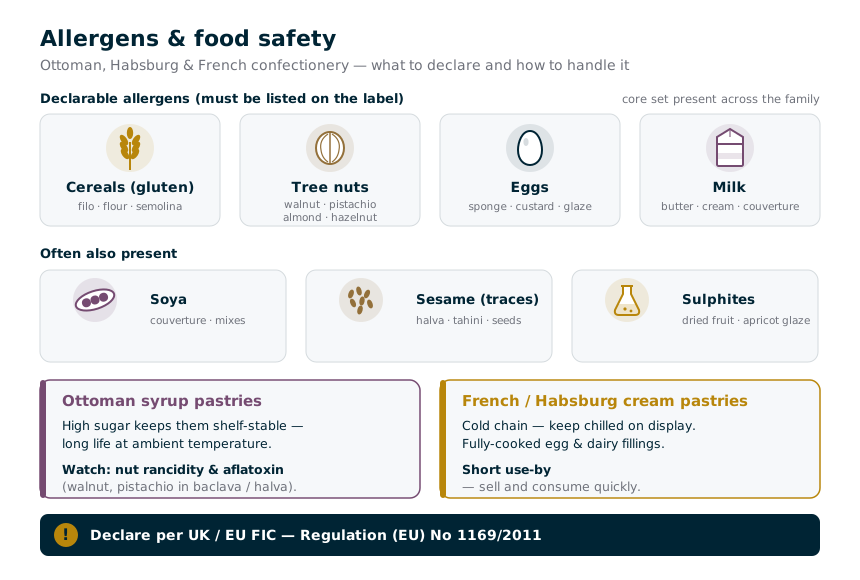
A finished product from any of these families will typically need to declare, under UK/EU FIC (Reg (EU) 1169/2011): cereals containing gluten (filo, wheat flour, semolina, mixes), tree nuts (walnut, pistachio, almond, hazelnut), eggs and milk (buttercream, custard, choux) — and, depending on components, soya (couverture lecithin and mixes), sesame (traces) and sulphur dioxide/sulphites (dried fruit and the apricot-flavoured glaze base) (see the figure below). Two points the labeller must not miss: sulphites/SO2 are declarable only above 10 mg/kg total (a threshold — unlike the other 13 allergens, which have none), and a "vegan" or Lenten (de post) item is dairy- and egg-free but NOT automatically gluten-free — a de-post baclava or beigli still carries wheat gluten (and often tree nuts). Map these to your own recipe before labelling.
There are two food-safety regimes on the same plate (see the fault table below):
- Ottoman syrup pastries (baclava, sarailie, cataif) are largely shelf-stable thanks to their high sugar/syrup — but their nut load demands rancidity and mycotoxin control: buy fresh, low-aflatoxin nuts (the platform's ground-almond spec pins aflatoxin B1 max 8 ppb) and store cool and dry.
- French and Habsburg cream pastries (cremșnit, ecler, indiene, savarină, custard fillings) are high-risk perishables: they need a cold chain (typically ≤5–8 °C), fully cooked/pasteurised egg and dairy, and a short use-by — set the exact chill temperature and use-by from your own HACCP plan.
One label caution worth repeating: the range's "Apricot Jam High Fruit" is in fact an apple-based, apricot-flavoured glaze base carrying azo colours (E102 tartrazine, E129 Allura Red — with the children's-attention warning) and residual sulphites. It works as a glaze, but for a clean apricot label use a true-fruit preserve and declare the additives.
6. What to buy — and the gaps to flag
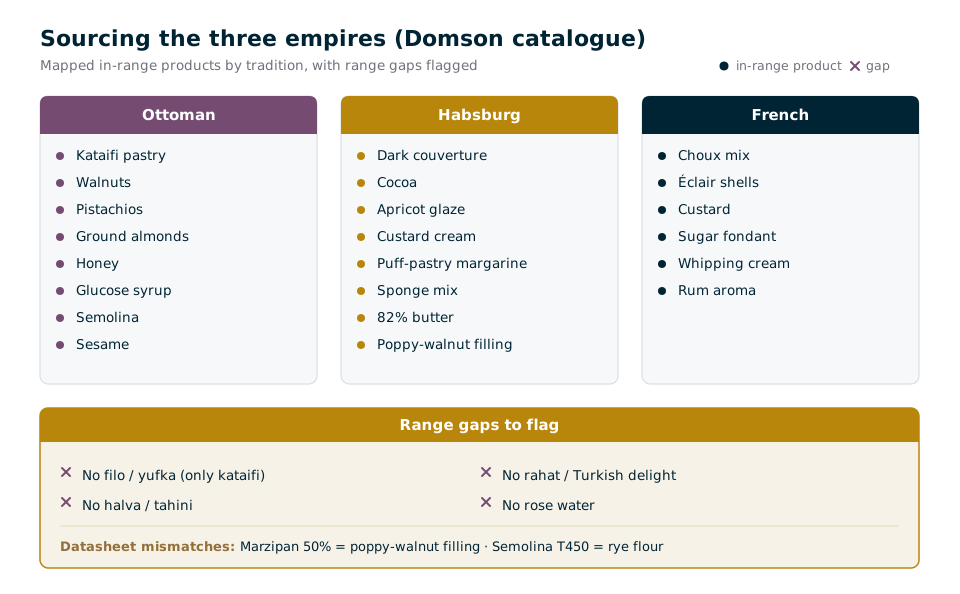
The three-empire shopping list maps largely onto the Domson catalogue (see the figure below, the sourcing-gaps table, and the products at the end of this article):
- Ottoman:Roasted Kataifi Pastry (for cataif), walnuts, roasted pistachios, ground and shelled almonds, multifloral honey, glucose syrup, wheat semolina and sesame seeds, with cinnamon and sugar.
- Habsburg:Barima 72% dark couverture and Callebaut 811, Dutch cocoa, apricot glaze/preserve, custard cream, puff-pastry margarine, sponge mix, 82% butter, blue poppy seed, and — usefully — the mislabelled poppy-walnut filling for beigli .
- French:Zeelandia choux mix and ready éclair shells, Delice Patissière and Napoli custard, Sugar Fondant and Fondant Premium, UHT whipping cream and rum aroma .
Four range gaps to flag for the buyer: there is no filo/yufka pastry in the range (only kataifi) — the very sheet baclava and sarailie are built from; no rahat/lokum (Turkish delight); no halva or tahini; and no rose water. All four are core to an authentic Ottoman programme, and the first three also matter to the wider Romanian repertoire (rahat to cozonac; halviță to the mucenici calendar sweets in B4-mucenici-and-calendar-pastries). Two smaller data issues to fix: the "Marzipan 50%" datasheet is actually a poppy-walnut filling, and the "Wheat Semolina T450" datasheet is a rye-flour type-720 sheet — catalogue title/datasheet mismatches worth correcting so buyers order the right thing. Both are allergen-relevant: the "Marzipan" line swaps almond for wheat + walnut (see §5), and wheat and rye — while both cereals containing gluten — are distinct declarable cereals, so a wheat/rye title-vs-datasheet swap can misstate which gluten cereal is named. Resolve these before either datasheet is used to label finished goods.
The formulas, comparison tables and fault guide for all three families are below; the full recipe language is in A8-cake-and-pastry-formulas and A8-chocolate-confectionery-formulas, and the sister café-pastry, kürtőskalács and cheese-pastry articles carry the deep dives (B4-savarins-eclere-and-cafe-pastry, B4-transylvanian-kurtoskalacs, B4-papanasi-and-cheese-pastry).
Figures
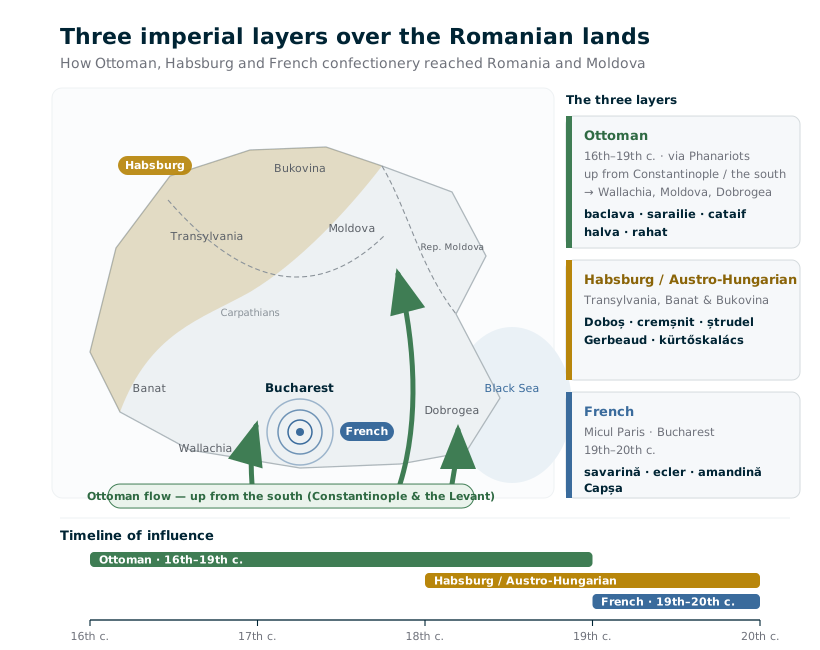 Map of Romania showing Ottoman influence in the south and Dobrogea, Habsburg influence in Transylvania, Banat and Bukovina, and French influence centred on Bucharest
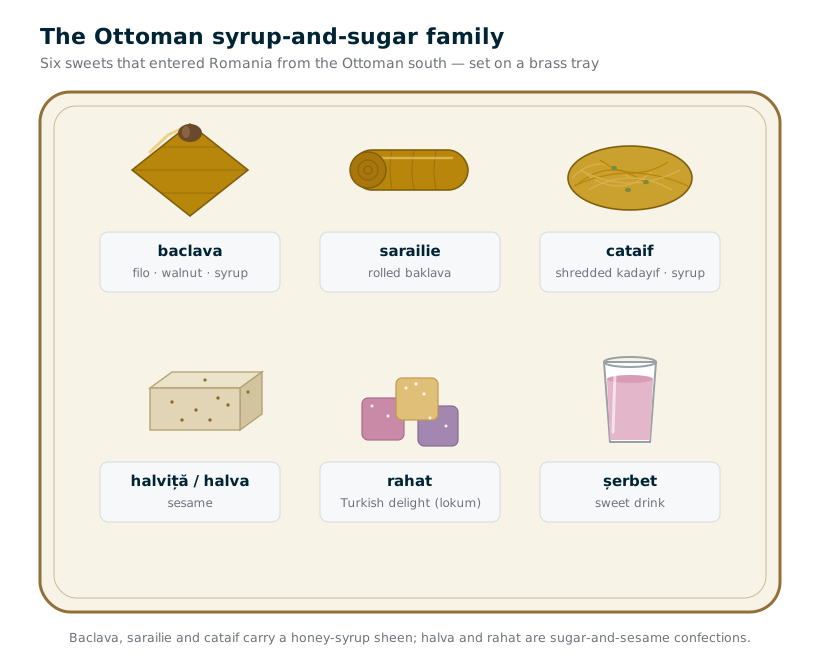 Six labelled Ottoman sweets: baklava, sarailie, cataif, sesame halva, Turkish delight cubes and a glass of sherbet
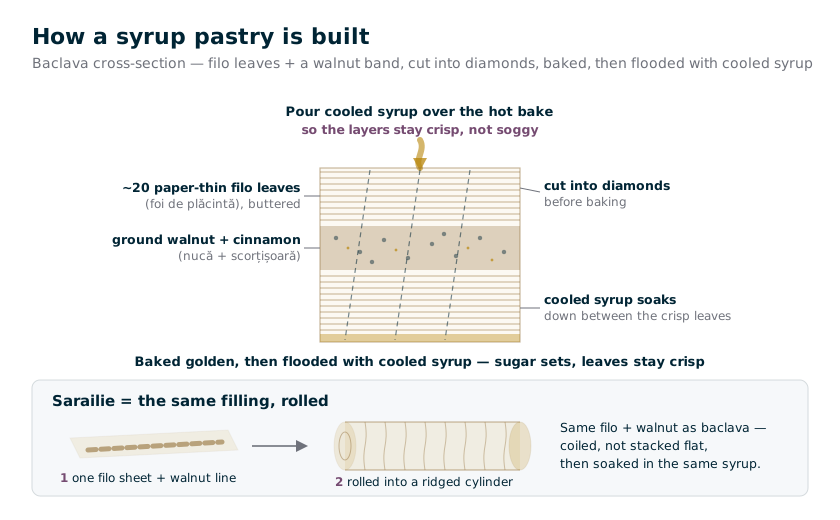 Cross-section of baklava showing stacked filo leaves with a walnut layer, cut into diamonds and soaked in syrup, with a sarailie roll inset
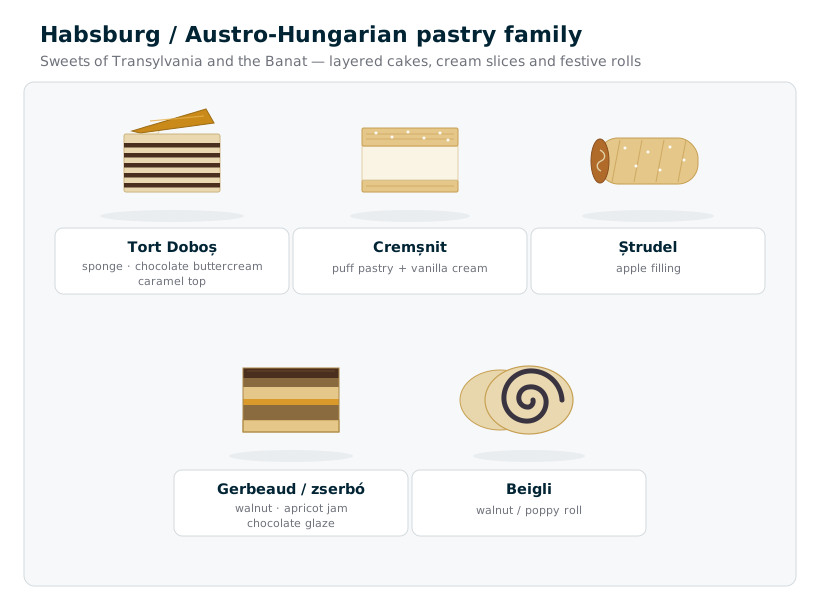 Five labelled Habsburg pastries: Dobos torte, cremeschnitte, apple strudel, Gerbeaud slice and a walnut-poppy beigli roll
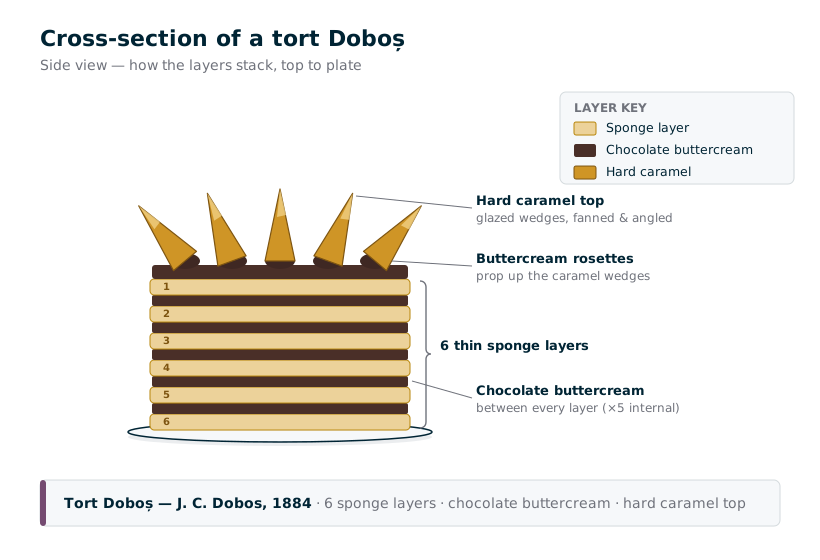 Cross-section of a six-layer Dobos torte with chocolate buttercream and a caramel-glazed wedge fanned on top
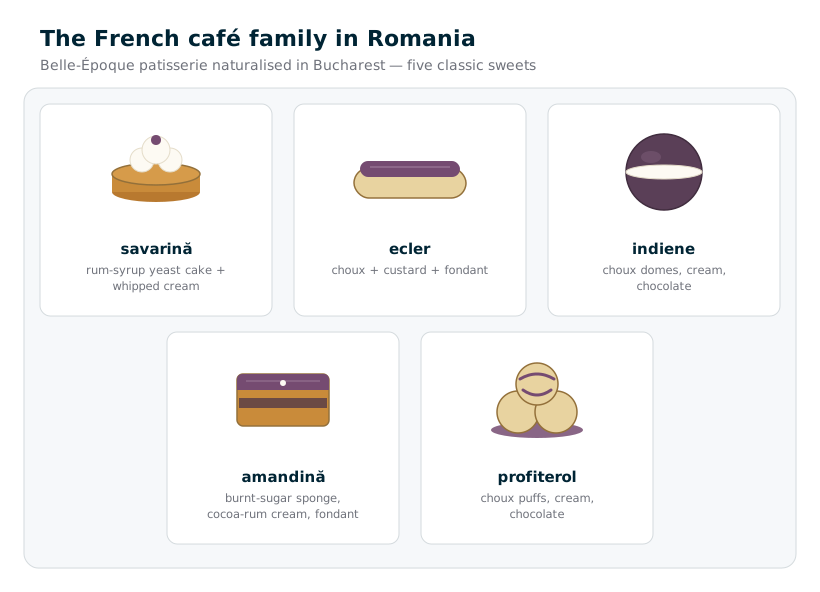 Five labelled French-style pastries: savarin, eclair, indiene, amandine and profiteroles
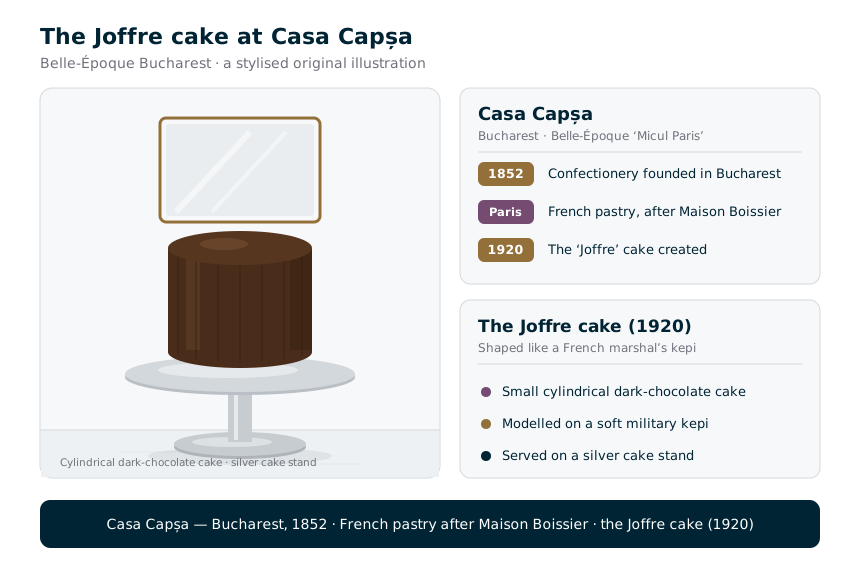 Period illustration of the Casa Capsa confectionery with a cylindrical chocolate Joffre cake shaped like a military kepi on a silver stand
 Allergen and food-safety panel: gluten, tree nut, egg, milk, soya, sesame and sulphite icons with syrup-stable vs cream-perishable notes and a FIC declaration flag
 Panel mapping Ottoman, Habsburg and French confectionery ingredients to Domson catalogue products, flagging gaps for filo, Turkish delight, halva and rose water
Baclava — representative traditional build (Ottoman)
Presented as a representative traditional method, not a single sourced gram formula — the Romanian sources describe baclava qualitatively (thin filo, walnut/pistachio, cinnamon, honey/syrup or rose water). Sarailie is the same filling rolled into a ridged cylinder. The nut craft (toasting, rancidity, aflatoxin) is in A7-seeds-nuts-toppings and the syrup work in A6-sugar-work-techniques. RANGE NOTE: buy filo separately — only kataifi is stocked.
| Ingredient | Baker's % | Weight |
|---|---|---|
| Thin filo/pastry leaves (foi) | ~50% of the tin (GAP — not in range) | |
| Ground walnut (RO) or pistachio | ~50% of the tin | |
| Melted butter (min 82% fat) | brushed between all leaves | |
| Sugar + cinnamon (in the nut layer) | to taste | |
| Honey/sugar syrup (+ lemon, optional rose water) | to soak | |
| Total | n/a (a layered assembly, then syrup-soaked) |
Worked example
Brush ~20–30 thin filo leaves with melted butter, stacking about half of them; strew a thick, even layer of ground walnut (or pistachio) mixed with a little sugar and cinnamon; stack the rest of the buttered leaves on top. Score into diamonds BEFORE baking; bake until deep gold and crisp. As it comes out, flood with a cooled honey/sugar syrup (roughly equal sugar and water simmered to a light syrup, honey and a little lemon added; rose water optional). Hot pastry + cool syrup keeps the layers crisp, not soggy.
Yield: one tray
Tort Doboș — the Habsburg benchmark
The classic Dobos is J. C. Dobos's 1884 creation: sponge + chocolate buttercream + a signature hard-caramel top, six layers. Use a proper dark couverture (the platform's Barima 72% is min 72% cocoa solids / 43% fat). Buttercream craft is in A7-icings-and-buttercreams; the caramel top is A6-sugar-work-techniques; couverture selection is A6-chocolate-selection-couverture.
| Ingredient | Baker's % | Weight |
|---|---|---|
| Thin sponge layers | 6 discs | |
| Dark couverture (Barima 72%) | into the buttercream | |
| Butter (min 82% fat) + sugar/egg | the buttercream base | |
| Sugar (for the caramel top) | cooked to light amber | |
| Total | n/a (a layered torte) |
Worked example
Bake six thin, equal sponge discs. Sandwich them with a chocolate buttercream (dark couverture melted into a butter-and-sugar/egg cream). Reserve the neatest top disc: coat it with a hard caramel (sugar cooked to a light amber), and while still soft cut it into equal wedges; set the wedges at an angle on small buttercream rosettes around the top. Mask the sides with buttercream and press on chopped nuts if wished.
Yield: one torte
Amandină — the Romanian-French classic (representative 1960s-style formula)
A benchmark of the Romanian confectionery canon, documented in state confectionery manuals from the 1960s: the sponge is coloured with burnt sugar, not cocoa (giving a dark-yellow, not brown, crumb), and the OLDEST recipes contained no chocolate at all — the depth comes from cocoa + burnt sugar + rum. The fondant work is in A7-fondant-types-and-uses and A6-marzipan-fondant-sugar-pastes; pastry-cream/cream fundamentals in A6-pastry-creams-fillings. Numbers are one representative published formula, not a canonical standard.
| Ingredient | Baker's % | Weight |
|---|---|---|
| Eggs | 4 | |
| Sugar (sponge) | 120 g | |
| Flour | 140 g | |
| Oil | 10 ml | |
| Butter (cream) | 200 g | |
| Vanilla fondant (cream + glaze) | 200 g + 180 g | |
| Cocoa (cream + glaze) | 20 g + 30 g | |
| Burnt sugar (zahăr ars) + rum | to colour/flavour | |
| Total | n/a (assembled bar) |
Worked example
SPONGE: 4 eggs, 120 g sugar, 140 g flour, 10 ml oil, coloured with burnt-sugar syrup (zahăr ars) — NOT cocoa. Bake, cool, cut into three layers and soak lightly with syrup. CREAM: 200 g soft butter beaten with 200 g vanilla fondant, 20 g cocoa and rum essence. Layer sponge/cream/sponge/cream/sponge. GLAZE: 180 g vanilla fondant warmed with burnt-sugar syrup and 30 g cocoa; glaze the top and portion into ~100 g pieces.
Yield: ~10 pieces of ~100 g
Savarină — soaking syrup (French café classic)
The savarină descends from the French baba/savarin (named by the Julien brothers after Brillat-Savarin) — a syrup-soaked cake finished with whipped cream. Rum aroma and whipping cream are in range; the apricot glaze base in range is apple-based with colours/sulphites — read the label. See B4-savarins-eclere-and-cafe-pastry and A6-choux-eclair-technology.
| Ingredient | Baker's % | Weight |
|---|---|---|
| Sugar: water syrup | ~1:1, simmered | |
| Rum / rum aroma | to taste | |
| Apricot glaze (optional) | thin brush | |
| Sweetened whipped cream | to crown | |
| Total | n/a |
Worked example
Bake small ring/cup savarins from an enriched yeast dough. Make a hot syrup of roughly equal sugar and water, simmered a few minutes, off the heat stir in rum (or rum aroma) to taste. Dunk the just-warm savarins in the warm syrup until swollen and glossy; drain. Glaze with a thin apricot glaze if wished, then crown with piped sweetened whipped cream and a dot of red jelly.
Yield: fills a tray of savarins
Romanian confectionery is a layered inheritance. Use this to place any product before you build it: which empire, which region, and what it left in the case.
| Layer | Where it lives in Romania | Era / route in | Signature sweets | What it left behind |
|---|---|---|---|---|
| Ottoman / oriental | Wallachia, Moldova, and above all multiethnic Dobrogea | 16th–19th c.; Phanariots + Levantine/Constantinople merchants | Baclava, sarailie, cataif, halva/halviță, rahat (lokum), șerbet | Filo, walnut & syrup; honey; rose water; the sweet-word vocabulary (rahat, halva, acadea, magiun) |
| Habsburg / Austro-Hungarian | Transylvania, Banat, Bukovina | 18th c.–1918 (Habsburg from ~1699/1718) | Tort Doboș, cremșnit, ștrudel, Gerbeaud/zserbó, beigli, kürtőskalács | Viennese torte culture: sponge, buttercream, chocolate, puff pastry, marzipan |
| French / Belle Époque | Elite Bucharest — 'Micul Paris' (Little Paris) | Mid-19th–20th c.; French-trained confectioners | Savarină, ecler, indiene, profiterol, amandină; the Joffre cake | Choux, pastry cream, fondant, chocolate; the café-patisserie itself |
Oriental sweets came up from the south and settled most deeply in Dobrogea. They are built on filo, ground nuts, honey/sugar syrup and rose water — and several have no clean product match in the range (see the sourcing table).
| Sweet (Romanian) | What it is | Key ingredients | Sourcing note |
|---|---|---|---|
| Baclava (baklava) | Many thin filo leaves strewn with ground walnut/pistachio + cinnamon, baked, then syrup-soaked | Filo, walnut (RO preference) or pistachio, honey/sugar syrup, rose water, cinnamon | GAP: no filo/yufka in the range — walnuts, pistachios, honey, glucose syrup and cinnamon are stocked |
| Sarailie (sarayli) | The same walnut-and-filo composition rolled into a ridged cylinder and syrup-soaked; a technique more than a recipe | Filo, walnut, syrup | GAP: needs filo |
| Cataif (kadayıf) | Shredded pastry with ground almond/nut, sugar and butter, baked ~three fingers thick, then syrup-soaked; in a 1902 RO cookbook | Kataifi/shredded pastry, ground almond, butter, syrup | IN RANGE: Roasted Kataifi Pastry; ground almonds, 82% butter, sugar |
| Halva / halviță | Sesame (or semolina) sweet; an Ottoman court sweet (the Helvahane) sold in Dobrogean markets | Sesame/tahini or semolina, sugar/syrup | GAP: no halva or tahini — sesame seeds and semolina are stocked |
| Rahat (lokum) | Turkish delight — sugar/starch gel, historically honey/molasses; folded into cozonac | Sugar, starch, water, flavour, nuts | GAP: no rahat/lokum/Turkish delight in the range |
| Șerbet | A sweet drink of the Ottoman table; root of the word sorbet/sherbet | Sugar syrup, fruit/flower flavour | Made from sugar + aromatics; no dedicated product |
In Transylvania, the Banat and Bukovina the case reads like a Viennese Konditorei: sponge, buttercream, chocolate, puff pastry and stretched-dough strudel. Names alone (Doboș, cremșnit, zserbó, kürtőskalács) point back to the Austro-Hungarian route.
| Sweet | Origin | What it is | Notes |
|---|---|---|---|
| Tort Doboș | József C. Dobos, Budapest, 1884 | Six thin sponge layers + chocolate buttercream + a hard caramel top | Shown at the 1885 Budapest exhibition to Franz Joseph & 'Sissi'; secret until 1906; a Transylvania/Banat fixture |
| Cremșnit (Cremeschnitte / krémes / cremeș) | Vienna, first described 1856 | Puff pastry layered with thick vanilla cream | Came via the Austro-Hungarian route; popular in Transylvania & Banat |
| Ștrudel (strudel) | Vienna; a late-17th-c. recipe (c. 1696) survives | Paper-thin stretched dough rolled with apple (or cheese, cherry) | Its stretched leaf links to Ottoman börek/baklava filo — the empires overlap |
| Gerbeaud / zserbó ('Greta Garbo') | Café Gerbeaud, Budapest (Kugler 1858; Gerbeaud from 1884) | Tender dough layered with walnut + apricot jam under chocolate glaze | Apricot glaze + couverture + walnut all in range |
| Beigli (bejgli) | Central-European Ashkenazi Jewish (Yiddish name) | A walnut- or poppy-filled tender roll — the Hungarian cousin of cozonac | The on-file 'Marzipan 50%' datasheet is actually a poppy-walnut filling that suits this |
| Kürtőskalács (cozonac secuiesc) | Székely / Magyar, Transylvania | Spit-roasted, caramel-coated coiled sweet dough | Covered in B4-transylvanian-kurtoskalacs |
From the mid-19th century the elite palate turned to Paris. French-trained confectioners (Capșa, Fialkowski, Nestor) built a café-patisserie on choux, pastry cream, fondant and chocolate that is now simply 'Romanian'. See B4-savarins-eclere-and-cafe-pastry.
| Sweet (Romanian) | French origin | What it is | Notes |
|---|---|---|---|
| Savarină | Baba/savarin — named by the Julien brothers of Paris after Brillat-Savarin | A syrup-soaked (rum) yeast cake crowned with whipped cream and a jelly dot | Choux/enriched dough + rum aroma + whipping cream in range |
| Ecler (éclair) | French choux pastry (Carême tradition) | Choux fingers filled with custard, glazed with chocolate fondant | Choux mix + custard cream + fondant all in range |
| Indiene | French choux/patisserie | Two round choux domes joined with whipped cream, coated in chocolate | A Nestor speciality; choux + cream + couverture |
| Profiterol | French choux | Small choux buns with cream/chocolate | Nestor speciality |
| Amandină (amandine) | Romanian classic on French lines; state manuals from the 1960s | Burnt-sugar sponge, butter–fondant–cocoa–rum cream, burnt-sugar fondant glaze | Old recipes used NO chocolate; denser than modern copies |
| Joffre (tort/prăjitură) | Casa Capșa, 1920 | A cylindrical dark-chocolate cake shaped like Marshal Joffre's kepi | A sugar-free version was made for the diabetic marshal |
What a Romanian patisserie needs, mapped to catalogue products — and the gaps a buyer should note.
| Need | In the Domson range? | Product / note |
|---|---|---|
| Filo / yufka sheets (baclava, sarailie) | NO — range gap | Only Roasted Kataifi Pastry is stocked; source filo separately |
| Shredded kataifi pastry (cataif) | Yes | Roasted Kataifi Pastry 10 kg |
| Rahat / lokum (Turkish delight) | NO — range gap | Not stocked; core to the Moldovan cozonac and oriental case |
| Halva / tahini | NO — range gap | Not stocked; sesame seeds and semolina are |
| Rose water | NO — range gap | Not stocked; a classic baclava/oriental aromatic |
| Walnuts / pistachios / almonds | Yes | Walnuts halves; roasted diced pistachios; ground & shelled almonds |
| Dark couverture / cocoa (Doboș, Joffre, amandină) | Yes | Barima Dark 72%; Callebaut 811; Dutch cocoa |
| Apricot glaze (Gerbeaud, Sachertorte-style) | Yes — but read the label | 'Apricot flavoured jam' is apple-based with azo colours + sulphites |
| Pastry cream / custard (cremșnit, ecler) | Yes | Delice Patissière; Napoli Vanilla Custard |
| Choux (ecler, savarină, indiene, profiterol) | Yes | Zeelandia Basis choux mix; ready éclair shells |
| Fondant glaze (amandină, ecler) | Yes | Sugar Fondant (Soft); Zeelandia Fondant Premium |
| Poppy/walnut filling (beigli) | Yes — but mislabelled | The 'Marzipan 50%' line's datasheet is a poppy-walnut filling |
| Fault | Likely cause | Remedy |
|---|---|---|
| Baclava/cataif goes soggy, not crisp | Hot syrup on hot pastry, or too much syrup | Pour COOL syrup over HOT pastry (or vice-versa); use a measured amount; drain |
| Baclava filling tastes stale/bitter | Rancid nuts; old walnuts | Use fresh, well-stored nuts; buy low-aflatoxin stock (ground-almond spec: aflatoxin B1 max 8 ppb) |
| Dobos caramel top shatters or won't cut | Caramel cut cold; overcooked to dark | Cut the caramel-coated disc while still soft/warm into wedges; cook sugar only to light amber |
| Chocolate buttercream splits/greasy | Butter and melted couverture at different temps | Bring both near ~26–28°C; add couverture gradually (see A7-icings-and-buttercreams) |
| Cremșnit/ecler cream weeps or sours | Under-set custard; broken cold chain | Set the pastry cream fully, chill fast, keep cold, short use-by (cream is a high-risk perishable) |
| Amandină comes out brown, not dark-yellow | Cocoa used in the sponge instead of burnt sugar | Colour the sponge with burnt sugar (zahăr ars); keep cocoa to the cream/glaze |
| Fondant glaze dull or too thick | Overheated above ~60°C, or wrong dilution | Warm fondant gently to no more than 60°C; thin with a little water/syrup (Vortumnus fondant: 50–100 ml water per 1 kg) |
| Apricot glaze colour/label surprises the customer | The stocked 'apricot jam' is apple-based with azo colours + sulphites | Check the spec; for a clean label use a true-fruit apricot preserve and declare colours/sulphites |