Arab flatbreads decoded: khubz, markook, taboon and tannour — doughs, ovens and regional differences
A working baker's guide to the Arab flatbread family — from the puffed Levantine pocket khubz arabi and the paper-thin markook/shrak of the saj, to Palestinian taboon on hot pebbles, Iraqi khubz al-tannour slapped onto clay walls, Egyptian bran-dusted aish baladi and the lacy Gulf regag. It maps each bread to its dough, its oven and its region, gives baker's-percentage starting formulas, and links the Domson flours, yeasts, salt, oils and seeds a UK Arab bakery would buy.
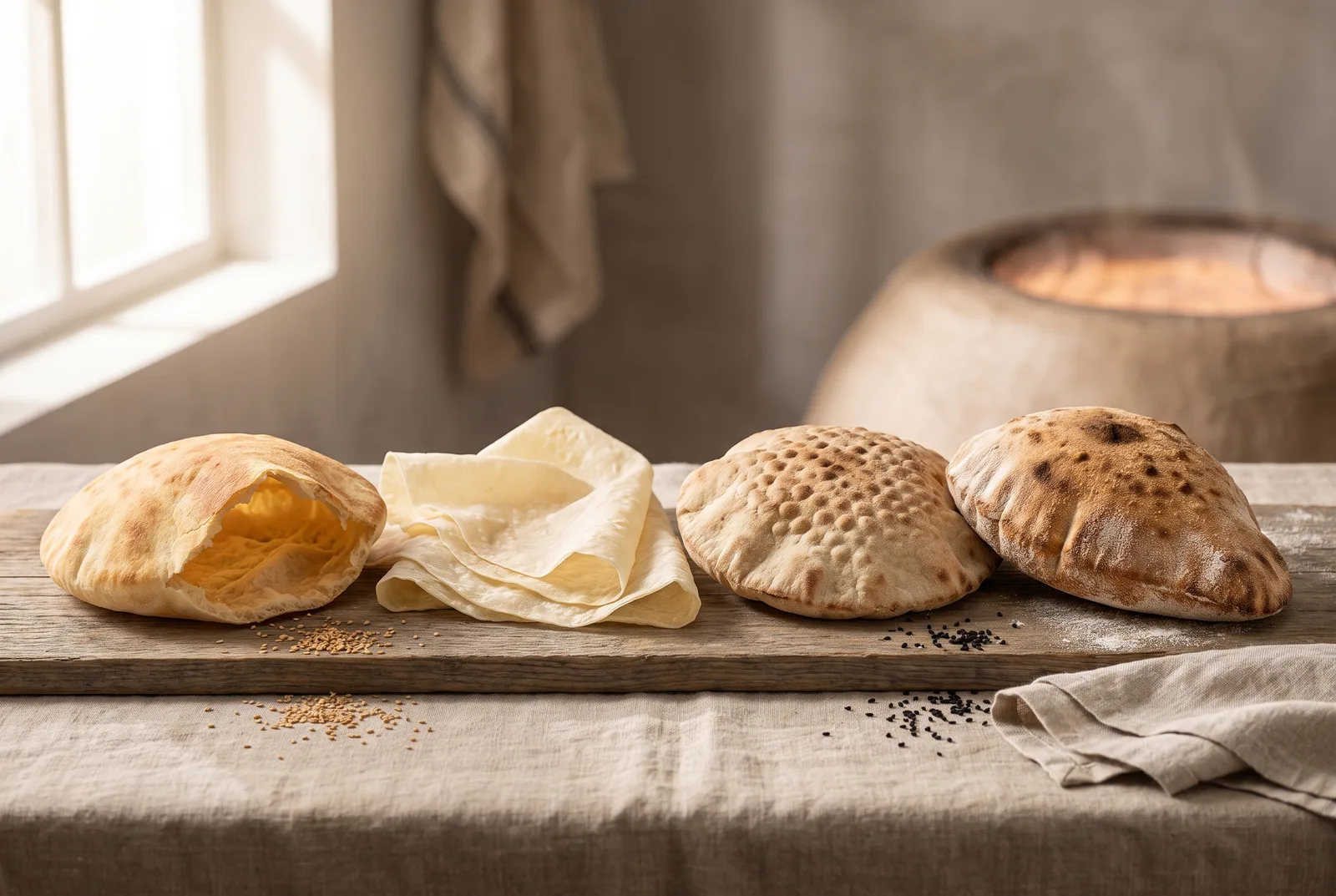
Why one word — "khubz" — hides a dozen breads
To an Arab baker, khubz (خبز) is simply "bread", and across the Arab world that almost always means flatbread. But the single category splits into very different products the moment you ask two questions: is the dough leavened, and which oven bakes it? Get those two right and everything else — the pocket, the char, the chew, the keeping quality — follows. Get them wrong and a Levantine pocket loaf comes out flat, or a paper-thin markook tears in your hands.
This dossier decodes the four archetypes named in the title and their regional cousins, then ties each to the flour, yeast and oven it actually needs. For choosing between white wheat, wholemeal and durum in more depth see B3-flour-and-semolina-selection; for the savoury topped-flatbread world of manakish see B3-zaatar-manakish-and-savoury-flatbreads; and for the closely related Turkish sac breads (lavaş, yufka, bazlama) see B2-flatbreads-and-sac.
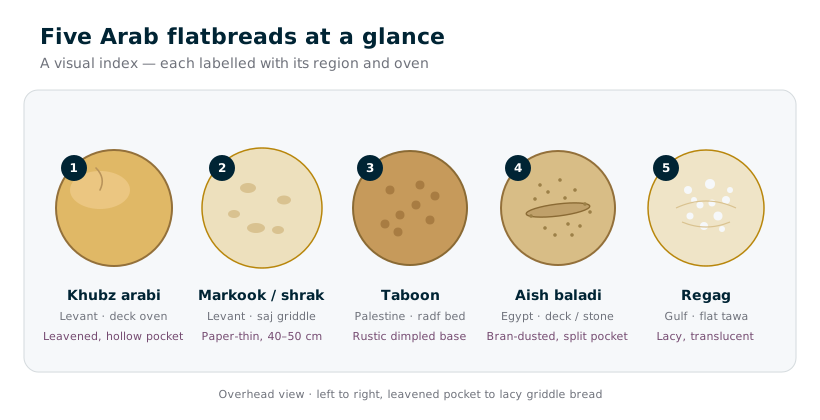 Five Arab flatbreads side by side labelled by region and oven.
The four ovens (this is the real story)
Arab flatbread is defined by fire, not just flour. Four traditional ovens dominate, each delivering heat to the dough in a different way. This is exactly the oven-stage physics covered in A5-baking-oven-science — radiant vs conducted heat, steam and crust formation — applied to bread that is often baked in under a minute.
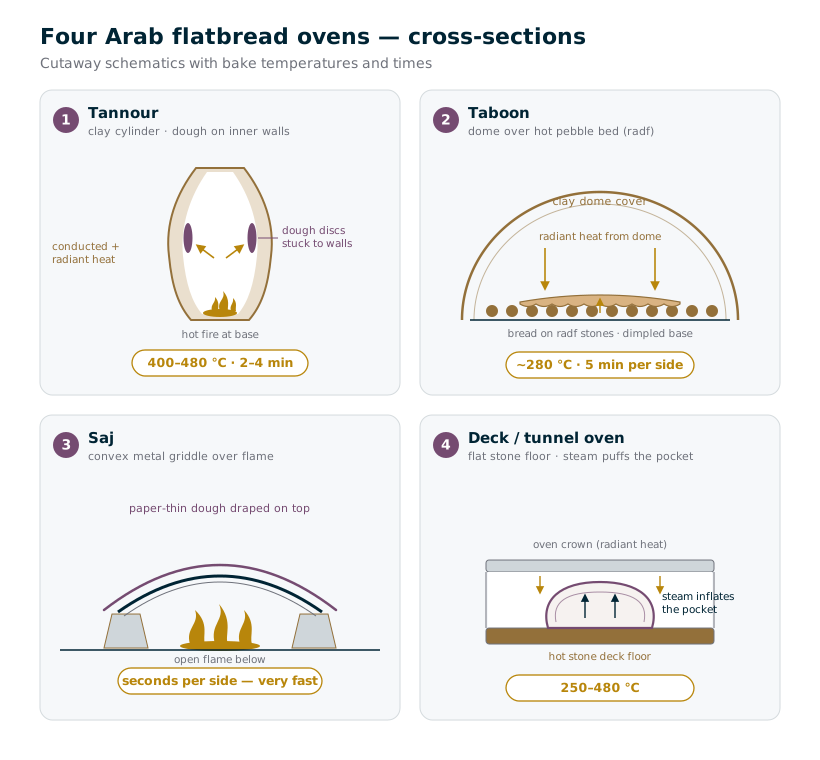 Four labelled oven cross-sections: tannour, taboon, saj and deck oven.
- Tannour / tanoor (تنّور) — a vertical cylindrical clay (or metal) oven with the fire at its base. The baker slaps a rolled disc onto the glowing inner wall, where it bakes by conduction on the wall side and radiant heat on the exposed face. It is one of the oldest ovens on earth: dough baked on tannour walls has been a staple from Mesopotamia to the Indus Valley since at least ~3000 BCE, and Arabic sources name Iraq as its home. A traditional tannour runs ~400–480 °C (≈750–900 °F) — the "≈900" belongs in Fahrenheit, not Celsius — baking bread in 2–4 minutes.
- Taboon (طابون) — a domed or pit oven whose floor is a bed of hot pebbles called radf (رضف). The loaf is laid directly on the stones, which imprint the bread's signature dimpled underside and radiate stored heat. Palestinian practice preheats the pebble bed ~30 minutes, then bakes at ~280 °C, roughly 5 minutes a side — crisp outside, soft within. Taboon bread is the traditional base of musakhan (مسخّن), the sumac-and-onion chicken dish.
- Saj / sac (صاج) — a convex, domed metal griddle set over an open flame. Thin dough is draped over the hot dome and cooked in seconds. This is the oven of the thinnest breads (markook, shrak, regag).
- Deck / tunnel oven (فرن) — the modern professional workhorse with a hot stone or steel floor. It bakes pocket pita, aish baladi and manakish; its intense floor heat is what pops the pocket. Commercial pita tunnels run ~425–480 °C with a bake of about a minute.
Regional map: who bakes what
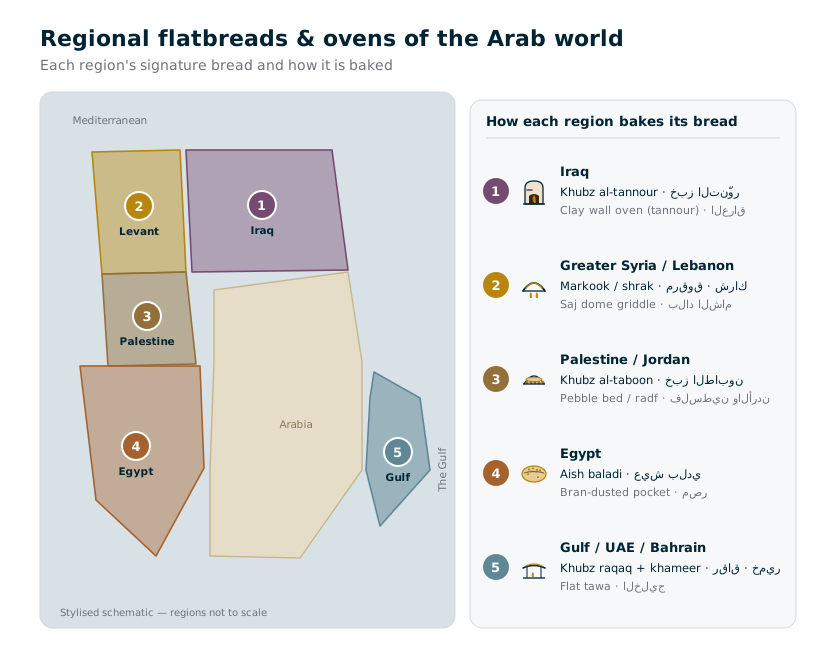 Map of the Middle East labelling each region's characteristic flatbread and oven type.
Levant (بلاد الشام): pocket bread and paper-thin markook
Two breads dominate the Levantine bakery. The first is the familiar leavened pocket loaf — khubz arabi (خبز عربي), also called kmaj (كماج) or, when made with a higher-extraction flour, khubz baladi (خبز بلدي) — the "pita" of the West. It is a lean dough (flour, water, yeast, salt, a touch of sugar and oil), and its hollow pocket is a pure baking-physics trick, described below.
The second is markook / marqooq (مرقوق), also known as shrak (شراك) or simply khubz saj (خبز الصاج) — an unleavened, tissue-thin bread stretched to 40–50 cm and cooked on the saj in about 30 seconds. Its craft lives entirely in the dough: white or brown wheat flour, water and a little salt and sugar are kneaded hard for at least 10 minutes to build a strong, extensible gluten (the baker's word is that the dough has strong "عرق"), rested for an hour or more, then tossed and stretched over the backs of the fists until nearly transparent. Weak or under-rested dough tears. Bedouin communities around Idlib in Syria give the same saj bread the local names lazzaqi (لزاقي) and masali (مصالي).
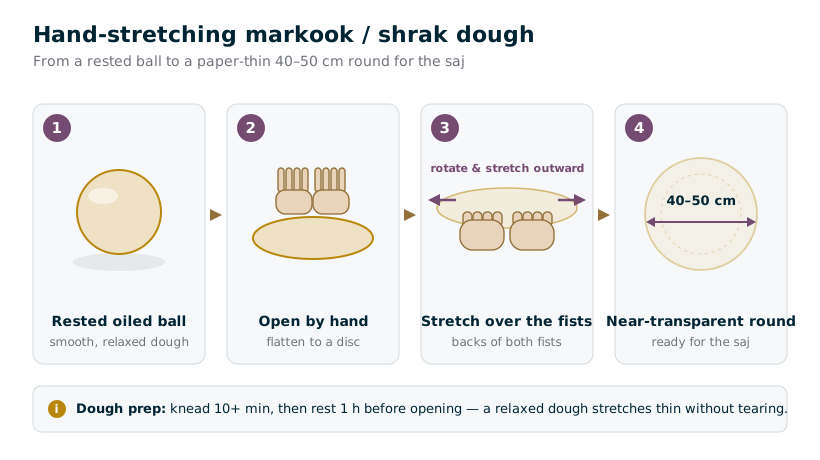 Sequence of hands stretching dough thin for markook bread.
The gluten demand here is why flour choice matters — see A1-protein-gluten-and-strength for extensibility vs elasticity, and A5-dough-mixing-methods for developing that long, tough gluten.
Palestine & Jordan: khubz al-taboon
Same family, different oven. Khubz al-taboon (خبز الطابون) is a leavened, usually wholemeal bread baked on the radf pebble bed (see the oven section). In Syria the equivalent wall-baked loaf is called khubz al-tannour (خبز التنور) — Arabic sources treat tannour (Syria) and taboon (Palestine) as regional names for closely related countryside breads.
Iraq & the wider tannour belt
Khubz al-tannour (خبز التنور) — thick, brown, blistered, wall-adhered — is the heartland Iraqi loaf, though it is baked across Syria, Jordan, Lebanon, Palestine, Egypt, Libya and parts of the Gulf. It is typically made from whole-wheat, high-extraction flour and often fermented overnight, giving a browner, chewier loaf than saj bread; barley, maize or oats are blended in when wheat is short. For special occasions Syrian bakers finish the loaf with olive oil and aromatics such as wild thyme — za'tar barri (صعتر بري) — or terebinth berries, batam (بطم) — a Pistacia (pistachio-relative) berry and therefore a tree-nut allergen risk (see Food safety & allergens below).
Egypt: aish baladi
Egypt's national loaf is aish baladi (عيش بلدي) — and note the word: "aish" (عيش) literally means "life", which tells you everything about bread's place on the Egyptian table. It is a leavened pocket bread made from high-extraction flour (about 80–90%, commonly 82%) with added wheat bran, giving its distinctive bran-dusted crust. Baked in fierce stone/deck ovens — a traditional Egyptian furna runs far hotter and faster (roughly 400–500 °C in 1–2 minutes), while home recipes vary widely (~180–250 °C for 8–15 minutes) — the discs balloon and split into a pocket just like pita, but with a nuttier, wholegrain character. Egyptians also bake a whiter, pita-style aish shami (عيش شامي) from refined flour.
The Gulf: regag and khameer
Gulf flatbreads split into the ultra-thin and the soft. Khubz raqaq / regag (خبز الرقاق) — heritage bread of the UAE, Bahrain and Qatar — is not rolled: a loose, pourable batter of brown flour, water and salt is spread only ~2 mm thin on a hot flat or convex tawa-saj and peeled off in seconds, giving a lacy, crisp sheet eaten with egg, honey or savoury toppings. No fermentation is involved. Its opposite number is khameer (خمير), a leavened, soft Emirati/Omani round often enriched and perfumed with dates, saffron or cardamom.
Savoury topped flatbread: manakish
The Levantine breakfast bakery lives on manakish (مناقيش) — a soft leavened round baked in a deck oven under a topping. The classic is za'atar (زعتر) — a blend of dried wild thyme/thyme, sumac and sesame — bound with olive oil into a spreadable paste at roughly equal volumes (a common ratio is 1/3 cup za'atar to 1/4 cup oil). A representative dough is 3 cups flour, 1 cup warm water, 1 tsp instant yeast, 1 tsp sugar, 1 tsp salt and 2 tsp olive oil, proofed 45–55 minutes and baked ~10–13 minutes hot. The full topping repertoire (cheese, keshek, minced meat "lahm bi ajin") is covered in B3-zaatar-manakish-and-savoury-flatbreads.
How the pocket forms (and how to guarantee it)
The puffed pocket of pita/khubz arabi and aish baladi is not leavening — it is steam. When a thin, well-proofed disc hits a very hot floor, the top and bottom surfaces set into skins almost instantly while the water trapped inside flashes to steam. The steam inflates the loaf and the two skins separate into a hollow pouch; when it cools, the pocket stays. Arabic sources put the home threshold around 232–246 °C (450–475 °F) and commercial tunnels at ~425–480 °C (800–900 °F), ~1 minute. The practical levers — bake hot, sheet even and thin, and never let the skin dry during proof — map directly onto A5-baking-oven-science and A5-proofing-science.
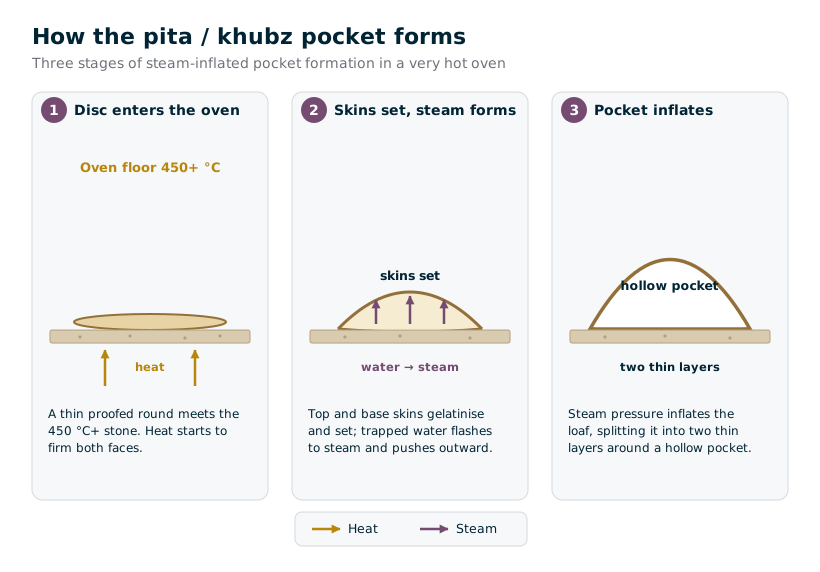 Three-step diagram showing steam inflating a pita into a hollow pocket.
Buying the ingredients: flour, yeast, salt, oil, seeds
All of these formulas are lean doughs, so formula literacy (see A8-bakers-percentage-fundamentals and A8-lean-bread-formulas) plus the right raw materials do most of the work.
Flour. For leavened pocket khubz and for markook you want a strong white bread flour with good extensibility. The Domson White Strong Wheat Flour datasheet (a Type 550) shows wet gluten 28–32 %, gluten index 75–99, falling number ≥220 s and ash 0.51–0.58 % (dm) — a solid pocket-bread spec. Very strong flours (Titan, Centurion Canadian) help build the tough, stretchy dough markook needs. For a brown flatbread flour, Lion Atta Medium Chapatti Flour is purpose-milled: protein 9–11.2 %, fibre 5.7 g/100 g, and UK-fortified with calcium carbonate, niacin, iron and thiamine under the Bread and Flour Regulations 1998. For taboon, tannour and aish baladi, reach for wholemeal — Doves Farm organic strong wholemeal runs 12.6 g protein and 11.2 g fibre per 100 g; Egyptian baladi's ~82 % extraction plus bran is the authentic target. Where a recipe blends in durum semolina for bite, the Allied Mills coarse durum (~100 % durum, protein min 11 % dm, ash max 0.8 % dm, 40–60 % retained on a 425 µm sieve) is the grade to use. Choosing across these is the subject of A1-wheat-flour-types-by-application and A1-wholemeal-and-high-extraction.
Yeast. Leavened khubz, aish baladi and manakish are lean, so use a yeast built for low-sugar dough: Fermipan Red instant dried yeast is specified for "lean dough bread types with limited sugar contents (0–10 %) requiring high fermentation power", stores up to two years unopened, and carries 1 % emulsifier (E491). Fresh yeast (Benevia) is the traditional alternative — see A2-yeast-types-comparison for the format trade-offs. Markook and regag are unleavened and need no yeast at all.
Salt, oil and seeds. Fine bakery salt (99.5–99.9 % NaCl) at roughly 1.5–2 % of flour seasons and tightens the dough. Olive oil brushes into markook balls and binds the za'atar paste; the pomace/olive blend's smoke point (~230 °C) is comfortably above finishing temperatures. Sesame and black seed (nigella) are the classic coatings for tannour and taboon loaves and manakish.
Food safety & allergens
- Gluten (wheat) is present in every bread here — a named allergen. Wholemeal taboon/tannour/aish versions also carry more bran.
- Barley and oats (extra gluten cereals): when wheat is short, tannour bread is blended with barley, maize or oats. Barley and oats are themselves named gluten-containing cereal allergens distinct from wheat (maize is gluten-free), so the allergen declaration changes with the blend.
- Sesame used as a coating or in za'atar is a named UK/EU allergen; segregate and label it.
- Tree nuts: the terebinth berries (batam, بطم) used to finish some Syrian tannour loaves come from Pistacia — the same genus as pistachio, a named tree-nut allergen. Any loaf finished with batam needs a tree-nut allergen assessment and likely declaration.
- Egg: Gulf regag is frequently served with egg (a named allergen); flag it on menus and labels when plated that way.
- Certification: Lion Atta chapatti flour is not Halal- or Kosher-certified and shares packing lines with barley and maize — check certification and cross-contact for a Halal-observant customer base before specifying it.
- Flour is a raw ingredient — datasheets state it "can't be eaten raw" and "must be cooked or baked before eating".
- Over-charring & pomace oil: the very high heat of tannour, saj and taboon baking is authentic, but bakers should avoid burning the surface (char/acrylamide); control bake time and lift thin breads (markook, regag) at first colour. Olive-pomace oil is separately subject to EU PAH / benzo(a)pyrene maximum limits — a raw-material contamination check, distinct from its smoke point.
(Verify allergen handling, certification, charring and oil-contamination controls against your own HACCP plan before production.)
Leavened pocket khubz arabi / pita (illustrative professional formula)
| Ingredient | Baker's % | Weight |
|---|---|---|
| Strong white bread flour | 100 | |
| Water (warm) | 60 | |
| Instant dried yeast | 1 | |
| Salt | 2 | |
| Sugar | 1.5 | |
| Olive/vegetable oil | 2 |
- Mix and develop to a smooth, extensible dough; bulk ~45-60 min; divide and ball; short bench rest; sheet to 3-5 mm; final proof; bake on a very hot stone floor (~450-480 C) ~1 min until it balloons; cool covered to keep supple.
Lean-dough starting point corroborated by general lean-bread practice; verify against your flour and oven. High bake heat is what forms the pocket.
Markook / shrak — thin unleavened saj bread
| Ingredient | Baker's % | Weight |
|---|---|---|
| White or brown wheat flour | 100 | |
| Water (warm) | 56 | |
| Salt | 1.5 | |
| Sugar | 1 | |
| Oil (to coat balls) | 1 |
- Knead hard >=10 min to a strong elastic dough; divide, oil, cover, rest ~1 h; hand-stretch/toss to near-transparency, ~40-50 cm; bake on a convex saj over strong heat and lift the moment light-brown spots appear (~30 s); stack under a cloth.
From Levantine method sources; the craft variable is a long hard knead + full rest so the dough stretches paper-thin without tearing.
Egyptian aish baladi — bran-dusted pocket bread
| Ingredient | Baker's % | Weight |
|---|---|---|
| Wheat flour (mix of brown/high-extraction + white) | 100 | |
| Wheat bran (surface + dough) | 10 | |
| Water (warm) | 68 | |
| Instant yeast | 1 | |
| Salt | 1.5 | |
| Sugar | 1 | |
| Oil | 2 |
- Mix soft dough; ferment; shape rounds and dust generously with bran; proof; bake in a very hot stone/deck oven (~250 C+, 10-15 min) so discs balloon into a pocket.
Single home-recipe basis; ratios approximate. Uses high-extraction (~82%) flour and added bran. Authentic furna/tannour baking is far hotter and faster (~400-500 C, 1-2 min); home ovens vary (~180-250 C, 8-15 min). Scale/verify before production.
Gulf khubz raqaq / regag — lacy poured batter bread
| Ingredient | Baker's % | Weight |
|---|---|---|
| Brown wheat flour | 100 | |
| Water | 130 | |
| Salt | 2 | |
| Sugar (optional) | 1 |
- Whisk to a thin pourable batter (no rest needed); pour and spread ~2 mm thin on a very hot flat/convex tawa-saj over fire; peel off in seconds when set; serve with egg, honey or savoury toppings.
Batter, not dough; poured/spread not rolled. Hydration is high and loose; no fermentation.
Manakish bi za'atar (topping ratio; see za'atar dossier)
| Ingredient | Baker's % | Weight |
|---|---|---|
| Za'atar blend (dried thyme + sumac + sesame) — Ratio by volume: 1/3 cup | ||
| Extra-virgin olive oil — Ratio by volume: 1/4 cup |
- Combine za'atar and olive oil to a loose spreadable paste (~equal volumes); spread over docked, part-proofed rounds; bake at high heat until the base is set and edges golden.
Dough: 3 cups flour, 1 cup warm water, 1 tsp instant yeast, 1 tsp sugar, 1 tsp salt, 2 tsp olive oil; proof 45-55 min; bake ~10-13 min high heat. Topping is za'atar blend + olive oil.
| Bread (Arabic) | Region | Leavened? | Flour | Oven | Bake | Signature |
|---|---|---|---|---|---|---|
| Khubz arabi / kmaj / khubz baladi (خبز عربي / كماج) | Levant, widespread | Yes (light) | Strong white wheat | Deck / stone oven | ~450-480 C, ~1 min | Puffs into a hollow pocket for stuffing |
| Markook / marqooq / shrak / khubz saj (مرقوق / شراك / خبز الصاج) | Levant, bedouin, Arabian Peninsula | No | White or brown wheat | Convex saj (صاج) over fire | ~30 sec | Paper-thin, ~40-50 cm; used to wrap |
| Khubz al-taboon (خبز الطابون) | Palestine, Jordan | Yes | Wholemeal / mixed wheat | Taboon on radf pebble bed | ~280 C, ~5 min/side | Dimpled underside; base of musakhan |
| Khubz al-tannour (خبز التنور) | Iraq (origin), Syria, Gulf | Yes (often overnight) | Whole-wheat, high extraction | Cylindrical clay tannour walls | 400-480 C, 2-4 min | Thick, brown, blistered; wall-adhered |
| Aish baladi (عيش بلدي) | Egypt | Yes | High-extraction (~82%) + bran | Very hot stone / deck oven | furna hot/fast (~400-500 C, 1-2 min); home ~180-250 C, 8-15 min | Bran-dusted pocket loaf; national staple |
| Khubz raqaq / regag (خبز الرقاق) | Gulf: UAE, Bahrain, Qatar | No | Brown flour batter | Flat / convex tawa-saj over fire | seconds | Lacy, ~2 mm thin; poured, not rolled |
| Khameer (خمير) | Gulf: UAE, Oman | Yes | White/wholemeal wheat | Griddle / oven | few min | Soft leavened round, often spiced (saffron, cardamom, dates) |
| Manakish (مناقيش) | Levant | Yes | White wheat | Deck oven | ~10-13 min high | Topped with za'atar+oil or cheese (see za'atar dossier) |
| Oven (Arabic) | Form | Heat path | Typical temp | Bake time | Breads |
|---|---|---|---|---|---|
| Tannour / tanoor (تنّور) | Vertical clay/metal cylinder, fire at base | Dough slapped on inner wall: conduction (wall) + radiant (exposed face) | ~400-480 C (≈750-900 F) | 2-4 min | Khubz al-tannour, thick wall breads |
| Taboon (طابون) | Dome/pit over a bed of hot pebbles (radf, رضف) | Conduction from stones below + trapped radiant heat | ~280 C | ~5 min/side | Khubz al-taboon |
| Saj / sac (صاج) | Convex domed metal griddle over open flame | Direct conduction on a very hot convex surface | very hot, surface-baked | seconds (~30 s) | Markook, shrak, regag |
| Deck / tunnel oven (فرن) | Flat hot stone/steel floor, enclosed | Radiant + conducted floor heat; steam flashes the pocket | 250-480 C | 1-15 min by product | Pita/khubz arabi, aish baladi, manakish |
| Bread | Flour type needed | Key spec | Catalogue example |
|---|---|---|---|
| Pocket khubz arabi / pita | Strong white bread flour | Wet gluten 28-32%, gluten index 75-99, falling number >=220 s | Domson White Strong Wheat Flour; Windrush / Titan strong white |
| Markook / shrak | Strong-ish white or brown wheat (needs extensible, tough gluten) | Medium-high protein; strong hand-stretch tolerance | Domson White Strong; Lion Atta chapatti (brown) |
| Taboon / tannour / aish baladi | Wholemeal / high-extraction wheat | Doves wholemeal: 12.6 g protein, 11.2 g fibre /100 g; Egyptian baladi ~82% extraction + bran | Organic Strong Wholemeal; Domson Brown; Grampian Wholemeal |
| Semolina-blended flatbreads | Coarse durum semolina (partial blend) | ~100% durum, protein min 11% dm, ash max 0.8% dm, 40-60% on 425 µm | Durum Wheat Semolina; Extra Coarse Semolina |
| Chapatti / roti-style flatbread | Brown atta / chapatti flour | Protein 9-11.2%, fibre 5.7 g/100 g, UK-fortified | Lion Atta Medium Chapatti Flour |
| Fault | Likely cause | Remedy |
|---|---|---|
| Pita won't puff / no pocket | Oven too cool; dough too thick or dry; skin dried during proof | Bake hotter (450 C+ stone); sheet even and thin; keep dough covered; ensure adequate hydration |
| Pocket forms but collapses / gummy inside | Under-baked; pulled too early; over-proofed | Bake full ~1 min until set; slightly under-proof; cool on a rack briefly then stack covered |
| Markook tears while stretching | Weak/under-kneaded gluten; too little rest; too dry | Knead hard >=10 min; rest a full hour; nudge hydration up; use extensible strong flour |
| Markook / regag too brittle after cooling | Over-baked / left on saj too long; no cover | Lift at first colour (~30 s); stack immediately under a thick cloth to trap steam and keep supple |
| Taboon base burns before top cooks | Pebble bed / floor too hot; loaf too thin | Temper stone temperature; thicker disc; shorter contact then flip |
| Tannour bread falls off the wall | Dough too wet or over-oiled; wall not hot/clean enough | Slightly firmer dough; dampen the dough face for adhesion; ensure wall is hot and residue-free |
| Aish baladi pale / no bran crust | Insufficient bran dusting; oven not hot enough | Dust rounds well with bran; preheat stone thoroughly; load fast |
| Manakish soggy / oily | Too much oil in topping; base under-baked | Loosen topping toward ~equal za'atar:oil, not oil-heavy; bake base until set on a hot deck |