Za'atar, manakish and savoury Arab flatbreads: spice blends, olive oil ratios and the breakfast-bakery opportunity
The practical, authenticity-first guide to the Levantine breakfast bakery for a UK operator. It untangles the single most-confused point — za'atar (زعتر) names both a wild herb (Origanum syriacum, NOT common thyme) and the sesame-sumac spice blend spread on bread — then builds the man'ousheh (منقوشة) from the ground up: a lean yeasted dough, the fingertip 'naqasha' docking that gives the bread its name, the za'atar-to-olive-oil paste ratio (~1:1 to 1.3:1), and a hot, fast bake. It maps the wider savoury family — cheese manoushe with akkawi, lahm bi ajin/sfiha, kishk, and the fatayer (spinach triangles) — and the regional flatbread-and-oven landscape (khubz arabi pocket bread, saj markook, taboon, tannour, Egyptian aish baladi). Regional names, ratios and history are mined from Arabic-language sources (Coroli, Mawdoo3 and other Arabic-language culinary references) and corroborated in English references; flour, yeast, sesame and oil figures are read first from Domson's first-party supplier spec sheets. It flags a real commercial opening — manoushe has commercialised worldwide and London already has specialist mana'eesh bakeries — and wires every technique to the Domson catalogue and to the Pillar A craft articles and sibling B3 dossiers a Middle-Eastern baker leans on.
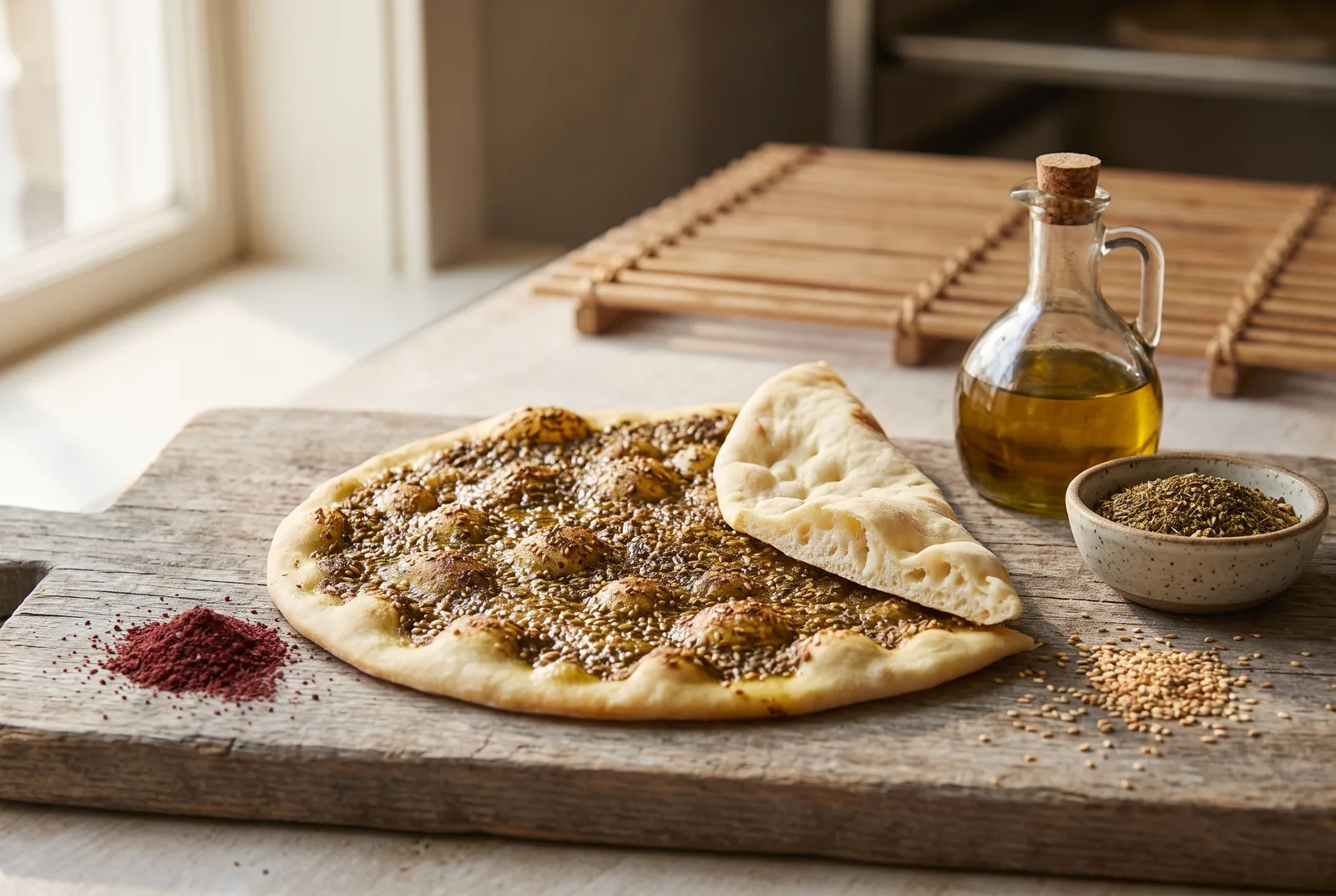
Za'atar, manakish and savoury Arab flatbreads
For a huge share of the UK's Arab and Levantine customers, the day starts with a man'ousheh (منقوشة): a hot, thin round of dough painted with za'atar (زعتر) and olive oil, folded in half, and eaten on the way to work. It is the Middle-Eastern equivalent of a bacon roll — and it is a bakery product, not a restaurant dish. In 2023 the tradition was even inscribed on the UNESCO Representative List of the Intangible Cultural Heritage of Humanity as "Al-Man'ouché, an emblematic culinary practice in Lebanon". This dossier is the practical guide to making it authentically at commercial scale.
First, clear up the biggest confusion: za'atar
More mistakes are made here than anywhere else. Za'atar is three different things, and getting them straight is the first mark of authenticity (see the herb-vs-blend table below):
- Za'atar the herb — the wild Levantine plant Origanum syriacum (also called Bible hyssop or Arabic oregano; regionally the closely related Thymbra spicata or Satureja thymbra are used). Botanically it is an oregano, not a thyme, even though it is loosely called "wild thyme". Its flavour sits between thyme, oregano and marjoram, and is more intense than any one of them.
- Za'atar the blend (خلطة الزعتر) — the spice mix that actually goes on the bread: the ground dried herb + toasted sesame (سمسم) + salt, sharpened with sumac (سمّاق).
- Common thyme — Thymus vulgaris, which is what most UK spice shelves (and Domson's Dried Thyme, Floramex) actually hold. It is a perfectly legitimate substitute base where the true herb is unavailable, but it is not identical — cleaner and sharper, less oregano-like.
There is a cultural weight here worth knowing when you serve this community: the wild herb was declared a protected plant in 1977 in Israel, criminalising Palestinian foraging, and it is listed "vulnerable" on Jordan's Red List. That history is one reason the diaspora leans on cultivated herb and packaged blends — and why an authentic, well-made blend matters.
Sumac — the red that makes it za'atar
Sumac is the ground, deep red-purple fruit of Rhus coriaria. Its tart, slightly fruity sourness comes chiefly from malic acid (the acid of green apples), and it was the Levant's souring agent long before lemons arrived. Without sumac, a "za'atar" blend tastes flat and one-dimensional.
The blend, by region
Blends are regional and personal — but the pattern is clear (see the regional-blends table and the Lebanese blend formula card below):
- Lebanese — austere and balanced: roughly equal parts by volume of hand-rubbed dried herb, toasted sesame and sumac, plus about a teaspoon of salt for the whole batch (not per cup).
- Syrian — richer and more aromatic: about 1 cup herb, ½ cup toasted sesame, ½ cup crushed Aleppo pistachio, 2 tbsp sumac, 1 tbsp ground cumin and 1 tbsp dried coriander. The pistachio makes this blend a tree-nut allergen — see Food safety, below.
- Palestinian / Jordanian — typically sumac-forward, sometimes with caraway.
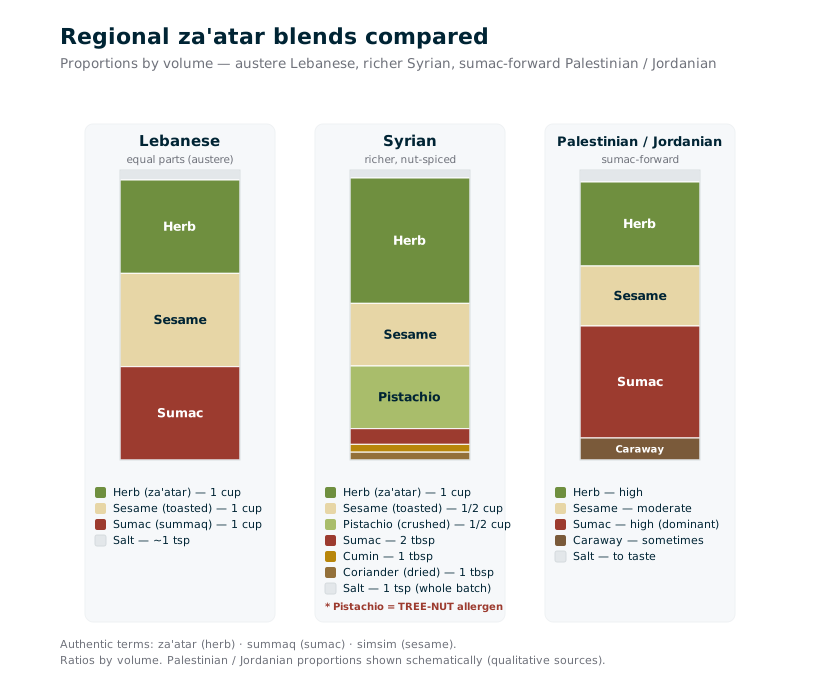 Diagram comparing Lebanese, Syrian and Palestinian za'atar blend proportions.
Toast the sesame in a dry pan to light golden and cool it before mixing — that is where the nutty aroma comes from (the seed is ~61% oil, so it carries flavour). Store the finished blend cool, dark and airtight; stale herb and faded sumac are the commonest reasons a blend "tastes of nothing".
Catalogue reality check. Domson stocks the two anchors of a blend — Dried Thyme (Floramex) and Sesame Seeds (Global Grains) — but no sumac and no ready-made za'atar blend. To make your own you will need to source sumac (and, for a Syrian blend, Aleppo pistachio) from a specialist importer. Cross-link: seeds and toasted toppings are covered in A7-seeds-nuts-toppings.
The man'ousheh dough
A man'ousheh is built on a lean yeasted wheat dough — closer to a pizza base than to an enriched bun (see A8-lean-bread-formulas and A8-bakers-percentage-fundamentals). The two cited home recipes converge on the same shape: 3 cups flour to 1 cup water, which is about 58–63% hydration, a little olive oil, ~1–3% sugar to feed the yeast, and ~1.5–2% salt. Coroli keeps it very lean (~2–3% oil); Simply Lebanese enriches with about a third of a cup of oil (~15–19%) for a softer, richer bread. Both are "correct" — pick the texture you want.
The name itself is the method. Manakish (مناقيش) is the plural; the singular man'ousheh (منقوشة) comes from the root naqasha (نقش), "to engrave" — because the flattened dough is pressed with the fingertips to create little dips that hold the topping. Skip that docking step and the topping slides off.
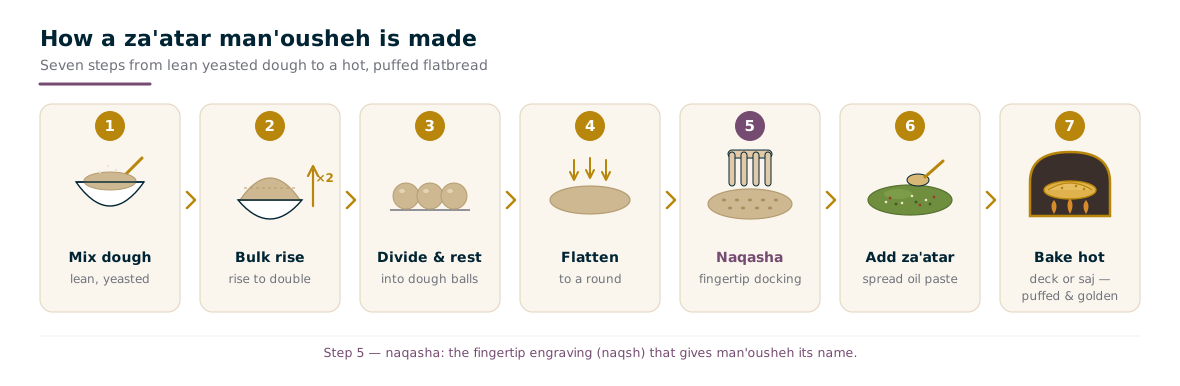 Seven-step diagram from mixing dough to a baked, puffed za'atar man'ousheh.
Illustrative professional formula (see the manoushe-dough formula card below, expressed in baker's %):
| Ingredient | % on flour |
|---|---|
| Wheat flour (Type 550, or Tipo 00 for thin rolling) | 100 |
| Water (warm) | 58–63 |
| Olive oil (dough) | 3–8 lean · up to ~15–19 rich |
| Fresh yeast (or ~⅓ as instant) | ~2–3 |
| Sugar | 1–3 |
| Salt | 1.5–2 |
Process: activate yeast + sugar in part of the water (~10 min) → combine with flour, remaining water and salt, work in the oil, knead smooth and soft → bulk-rise ~45–60 min to double → divide into balls, bench-rest 30–45 min → flatten to rounds, dock with the fingertips, top, and bake hot and fast: 218–245°C (425–475°F) for 10–13 min until light golden and puffed.
Flour and yeast choices (from the spec sheets)
- Domson Wheat Flour Type 550 (GoodMills/Domson) is the natural default: ash 0.51–0.58% (d.m.), wet gluten 28–32% / protein 11.5–12.5%, Hagberg falling number ≥220 s — a strong, cleanly fermenting white bread flour. For very thin rounds an extensible Italian Tipo 00 (ROMEL) rolls out more easily. On matching flour strength to product, see A1-wheat-flour-types-by-application and A1-protein-gluten-and-strength; the Arab-baking flour picture in depth is in the sibling B3-flour-and-semolina-selection.
- Yeast: Domson's Fresh Yeast Benevia (Lesaffre, S. cerevisiae, dry matter >29%, store 1–10°C, 35-day life) or instant Fermipan Red both leaven this dough well. Format trade-offs are in A2-yeast-types-comparison; the fermentation itself in A5-bulk-fermentation.
The olive-oil question (and a catalogue warning)
The za'atar topping is simply the dry blend loosened with olive oil into a spreadable paste, then swiped over the docked dough before baking. The working ratio runs from about 1:1 to 1.3:1 za'atar:olive oil by volume — Coroli uses ⅓ cup blend to ¼ cup oil (~1.3:1); Simply Lebanese uses 6 tbsp to 6 tbsp (1:1). Go drier (nearer 2:1) if your blend is already oily; go looser (1:1) for a glossy, oil-forward finish (see the oil-ratios table and the topping-paste formula card below).
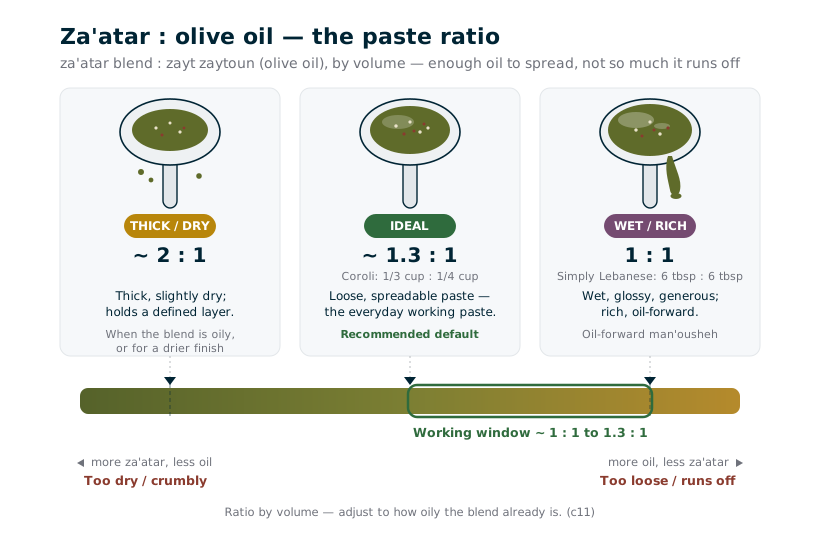 Diagram of za'atar-to-olive-oil paste consistency from dry to ideal to runny.
Authenticity warning on oil. The olive flavour is half the point of a man'ousheh, so the oil must be real olive oil — ideally extra-virgin. Note that Domson's line labelled "Olive Pomace Oil" (Olympic Oils) is, per its spec sheet, a blend of olive-pomace oil and rapeseed oil with an antifoam (E900), smoke point 230°C — a budget frying/utility oil, not an extra-virgin finishing oil. Use it for greasing trays or frying if you like, but finish the za'atar with genuine olive oil. Fat selection generally is covered in A4-fat-types-and-selection; for the clarified-fat (samneh/ghee) side of Arab baking, see B3-ghee-and-baking-fats-in-arab-baking.
Beyond za'atar: the savoury topping family
One dough, a whole breakfast menu (see the toppings table below):
- Cheese man'ousheh (منقوشة جبنة) — the classic cheese is akkawi (عكاوي), a soft white salty brine cheese that melts well; the firmer, saltier Nabulsi (نابلسي) is also used, though it melts less readily (it is more at home in the knafeh shredded-pastry cheese dessert). Both are salty and must be desalted by soaking in changes of water before use, kept refrigerated (they are perishable), and are usually blended with mozzarella for melt and stretch. Domson stocks grated mozzarella (and an economical mozzarella/cheddar blend) for the melt component, but not akkawi — source that from a Levantine cheese importer.
- Lahm bi ajin / sfiha (لحم بعجين / صفيحة) — spiced minced lamb or beef with diced tomato, onion and oil, spread thin on the round; because the meat goes on raw, bake until it is cooked through to a safe core temperature (see Food safety, below).
- Kishk (كشك) — a paste of fermented drained yogurt and cracked wheat, sometimes with walnut (a tree-nut allergen) and onion.
Fatayer and sfiha (the folded pies)
Closely related are the fatayer (فطاير) — stuffed pies from the same dough family. Shape signals filling: spinach fatayer (fatayer sabanekh, فطاير سبانخ) — seasoned with sumac, onion and lemon — is folded into a closed three-cornered triangle; cheese is often left open as a boat; sfiha meat pies are open-faced or pocket-shaped. The make-or-break for spinach fatayer is a dry filling: salt and wring the spinach hard, or the parcel leaks and unseals (see the spinach-fatayer-filling formula card, and the fault-finder table below).
The breads and the ovens beneath the toppings
Manakish sit on top of a whole tradition of Arab flatbread (full detail in the sibling B3-flatbreads-types-and-ovens; the oven physics in A5-baking-oven-science). The essentials (see the regional-flatbreads table below):
- Khubz arabi / pita (خبز عربي, also kmaj/كماج) — the two-layer pocket bread. The pocket forms because, at high heat, the dough's water flashes to steam and forces the top and bottom skins apart.
- Markook / shrak (مرقوق / شراك) — paper-thin bread baked on a saj (صاج), a convex metal dome heated from below; no pocket, endlessly pliable.
- Khubz taboon (خبز الطابون) — Palestinian bread baked on a floor of hot pebbles in a taboon oven, which dimple its surface.
- Khubz tannour (خبز التنور) — thicker, wall-baked bread from the upright clay tannour cylinder; often wholemeal.
- Aish baladi (عيش بلدي) — Egypt's staple, made from higher-extraction (~82%) wholemeal flour, versus roughly 72–76%-extraction flour for the refined shami and fino breads (shami ~72%, fino a little higher).
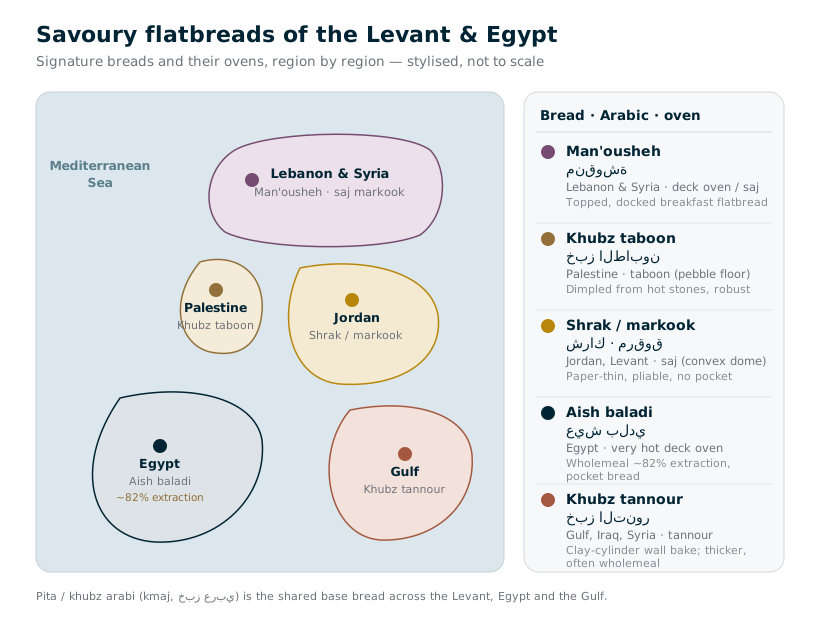 Map of the Levant and Egypt showing signature savoury flatbreads and their ovens by region.
A note on relatives: the Turkish griddle breads (gözleme, lavaş) and the meat-topped lahmacun overlap heavily with this world — see B2-flatbreads-and-sac.
The commercial opportunity: a breakfast bakery
This is not a niche. Over recent decades manoushe has commercialised worldwide — moving from home and village ovens to dedicated urban and diaspora bakeries — and London (especially West London) already has specialist mana'eesh bakeries serving a large Lebanese community. For a UK bakery the pitch is compelling: one lean dough, a rack of cheap, shelf-stable dry toppings (za'atar blend, sesame, nigella), a short 10–13-minute bake, and a product with strong morning demand and low waste (bake to order). Add cheese, sfiha and fatayer from the same dough and you have a full Levantine breakfast counter.
What to buy from Domson (and what to source elsewhere)
| Need | Domson product | Notes |
|---|---|---|
| Dough flour | Domson Wheat Flour Type 550; Tipo 00 for thin rounds | Strong, clean-fermenting |
| Yeast | Benevia fresh or Fermipan Red instant | |
| Blend herb base | Dried Thyme (Floramex) | Substitute for Origanum syriacum |
| Sesame | Sesame Seeds (Global Grains) — toast before use | Sesame allergen |
| Nigella topping | Black Seeds (FGS) | Habbat baraka on khubz |
| Cheese melt | Grated Mozzarella (PGD) | Blend with desalted akkawi |
| Sugar | Granulated Sugar | Small dough addition |
| Sumac | — (not stocked) | Source from a specialist importer |
| Za'atar blend (ready-made) | — (not stocked) | Or mix your own (above) |
| Akkawi / Nabulsi cheese | — (not stocked) | Levantine cheese importer |
| Extra-virgin olive oil | — (catalogue oil is a pomace/rapeseed blend) | Finish za'atar with real EVOO |
(Full mapping among the products at the end of this article.)
Food safety and allergens (flagged for review)
- Allergens (the obvious ones): the blend and core toppings carry sesame (a declarable allergen under Regulation (EU) No 1169/2011, retained in UK law as the Food Information Regulations 2014 / "Natasha's Law"), gluten (wheat dough), and milk (cheese man'ousheh). Label and separate accordingly.
- Tree nuts (easy to miss): two variants add a declarable tree-nut allergen — the Syrian za'atar blend contains Aleppo pistachio and kishk is sometimes made with walnut (both are named tree nuts under Annex II item 8, EU 1169/2011). Flag tree nuts wherever these appear on the menu.
- Raw minced meat (lahm bi ajin / sfiha): the mince is spread on the dough raw, so bake until it is cooked through to a safe core temperature — UK FSA guidance for comminuted (minced) meat is around 70°C held for 2 minutes, or an equivalent time/temperature combination.
- Akkawi / Nabulsi are high-salt brine cheeses — desalt before use (both for flavour and to keep salt declarations honest) and keep them refrigerated (cold-chain); they are perishable chilled products.
- The catalogue "Olive Pomace Oil" is a pomace + rapeseed blend with an E900 antifoam — a permitted additive that must be declared where it remains functional — and it is not extra-virgin: an authenticity and labelling point, not just a flavour one.
- Authenticity caveat: the herb-blend ratios (Lebanese 1:1:1; the detailed Syrian recipe) and the Egyptian extraction grades each rest on a single reference — treat them as indicative regional examples, not fixed standards. Likewise the numeric supplier specs here come from single manufacturer datasheets (read verbatim, not independently cross-checked).
Authenticity note: this English dossier was researched from Arabic-language sources (Coroli, Mawdoo3 and other Arabic-language culinary references) alongside English references, and from Domson's first-party supplier spec sheets. Arabic names are kept in transliteration (with the Arabic script on first use) and glossed in English. Cross-links point to the Pillar A craft articles and the sibling B3 Arab dossiers.
Man'ousheh dough — professional baker's % (illustrative)
| Ingredient | Baker's % | Weight |
|---|---|---|
| Strong/white wheat flour (e.g. Type 550, or Tipo 00 for extensibility) | 100% | |
| Water (warm) | 58-63% | |
| Olive oil (dough) | 3-8% lean, up to ~15-19% for a rich manoushe | |
| Fresh yeast (or ~1/3 of that as instant) | ~2-3% fresh (≈0.8-1% instant) | |
| Sugar | 1-3% | |
| Salt | 1.5-2% | |
| Total | ~168-185% depending on oil level |
- Dissolve yeast + sugar in part of the water (10 min). Combine with flour, remaining water and salt; add oil and knead to a smooth, soft dough. Bulk-rise ~45-60 min to double. Divide into balls, bench-rest 30-45 min. Flatten to rounds, dock with fingertips (naqasha), top, bake hot 218-245°C / 425-475°F for 10-13 min (c13, c14).
Yield: About 12 x ~60 g man'ousheh bases from ~1 kg flour
Converted (approximately, cup-to-gram) from the cited home recipes and expressed on flour weight; treat the ranges, not the single figures, as the guide. Coroli is lean (~2-3% oil); Simply Lebanese is richer (~15-19% oil) for a softer bread (c11, c12, c14).
Lebanese-style za'atar blend (by volume)
| Ingredient | Baker's % | Weight |
|---|---|---|
| Dried thyme/za'atar herb (hand-rubbed) | 1 cup | |
| Sesame seeds (toasted, cooled) | 1 cup | |
| Sumac | 1 cup | |
| Salt | ~1 tsp | |
| Total | ≈ 3 parts + salt |
Yield: About 3 cups of blend
The austere classic; equal parts herb: sesame: sumac (c7). Toast the sesame to light golden and cool before mixing (c28).
Za'atar topping paste
| Ingredient | Baker's % | Weight |
|---|---|---|
| Za'atar blend | 1/3 cup (100%) | |
| Olive oil (extra-virgin preferred) | 1/4 cup (~75%) | |
| Total | + ~75-100% olive oil |
Yield: Tops several man'ousheh
Mix to a loose, spreadable paste. Use real olive oil (ideally extra-virgin) for authentic flavour — not a pomace/rapeseed frying blend (c11, c25).
Spinach fatayer filling (fatayer sabanekh) — typical
| Ingredient | Baker's % | Weight |
|---|---|---|
| Spinach (chopped, salted and drained) | 100% | |
| Onion (finely diced) | to taste | |
| Sumac | prominent | |
| Lemon juice | a generous burst | |
| Olive oil + salt | to taste | |
| Total | + onion, sumac, lemon, oil, salt |
Yield: Fills a batch of triangles
Sumac and lemon give the signature tartness; drain the salted spinach hard before filling to keep a crisp, sealed triangle (c17).
The single most-confused point for a UK bakery. 'Za'atar' names both a wild herb and a spice mix, and neither is common thyme.
| What | Botanical / composition | Flavour | Notes for a UK bakery |
|---|---|---|---|
| Za'atar the herb (زعتر بري) | Origanum syriacum (Bible hyssop / Arabic oregano); regionally also Thymbra spicata, Satureja thymbra | A cross between thyme, oregano and marjoram, more intense than any one | Rarely sold fresh in the UK; wild-picking is legally restricted in parts of the Levant (c21) |
| Za'atar the blend (خلطة الزعتر) | Ground dried herb + toasted sesame + salt + sumac (± cumin, coriander, pistachio) | Herbal, nutty, tangy, salty | This is what goes on a man'ousheh; buy a good pre-made blend or mix your own |
| Common thyme (زعتر إفرنجي) | Thymus vulgaris (Domson 'Dried Thyme', Floramex) | Cleaner, sharper, more medicinal | A legitimate SUBSTITUTE base for the herb, not identical (c6, c24) |
Authentic ratios differ by country and household. Lebanese blends are austere; Syrian blends are richer; Palestinian/Jordanian lean harder on sumac and sometimes caraway.
| Style | Herb | Sesame | Sumac | Extras | Salt |
|---|---|---|---|---|---|
| Lebanese | 1 cup | 1 cup (toasted) | 1 cup | — | ~1 tsp |
| Syrian | 1 cup | 1/2 cup (toasted) | 2 tbsp | 1/2 cup crushed Aleppo pistachio (TREE-NUT allergen), 1 tbsp cumin, 1 tbsp dried coriander | 1 tsp (whole batch) |
| Palestinian / Jordanian (typical) | high | moderate | high (dominant) | sometimes caraway | to taste |
One lean dough, many toppings — the core of a Levantine breakfast bakery menu.
| Topping | Arabic | What it is | Key ingredient a UK baker buys |
|---|---|---|---|
| Za'atar | منقوشة زعتر | Herb blend loosened with olive oil to a spreadable paste | Za'atar blend + real olive oil |
| Cheese | منقوشة جبنة | Soft white salty akkawi (melts well; the firmer, saltier Nabulsi is also used but melts poorly), desalted, often blended with mozzarella; keep refrigerated | Akkawi (specialist); mozzarella for melt/stretch |
| Lahm bi ajin / sfiha | لحم بعجين / صفيحة | Spiced minced lamb or beef with diced tomato, onion and oil, spread on RAW — bake to a safe core temp | Minced meat + warm spices |
| Kishk | كشك | Fermented drained yogurt + cracked wheat, sometimes with walnut (TREE-NUT allergen) and onion | Kishk powder (specialist) |
| Za'atar + cheese ('cocktail') | كوكتيل | Half-and-half, folded | Both of the above |
Enough oil to spread, not so much it runs off the dough and pools. Adjust to how oily the blend already is.
| Ratio (za'atar: oil, by volume) | Result | Use |
|---|---|---|
| ~2: 1 | Thick, slightly dry, holds a defined layer | When the blend is oily already, or for a drier finish |
| ~1.3: 1 (Coroli: 1/3 cup: 1/4 cup) | Loose spreadable paste | The everyday working paste (c11) |
| 1: 1 (Simply Lebanese: 6 tbsp: 6 tbsp) | Wet, glossy, generous | Rich, oil-forward man'ousheh (c11) |
The base breads a Middle-Eastern bakery makes, and where each belongs. See the sibling dossier B3-flatbreads-types-and-ovens for the full oven deep-dive.
| Bread | Arabic | Region | Oven | Character |
|---|---|---|---|---|
| Khubz arabi / pita (kmaj) | خبز عربي / كماج | Levant, Egypt, Gulf | Hot deck oven | Two-layer pocket bread that puffs on steam (c19) |
| Man'ousheh | منقوشة | Lebanon, Syria | Deck oven / saj | Topped, docked breakfast flatbread (c1) |
| Markook / shrak | مرقوق / شراك | Levant, Jordan | Saj (convex dome) | Paper-thin, pliable, no pocket |
| Khubz taboon | خبز الطابون | Palestine | Taboon (pebble floor) | Dimpled from hot stones, robust |
| Khubz tannour | خبز التنور | Iraq, Syria, Gulf | Tannour (clay cylinder) | Thicker, wall-baked, often wholemeal |
| Aish baladi | عيش بلدي | Egypt | Very hot deck oven | Wholemeal ~82%-extraction pocket bread (c20) |
| Fault | Likely cause | Remedy |
|---|---|---|
| Za'atar tastes bitter/harsh after baking | Oven too hot / too long — the herb and sesame scorch | Bake hot but fast (218-245°C, 10-13 min); keep the paste well-oiled so it doesn't dry and burn |
| Topping slides off, oil pools | Paste too loose (too much oil) or dough not docked | Move toward ~1.3:1 or 2:1 za'atar:oil; dock firmly with fingertips so the paste sits in the dips (c10, c11) |
| Dry, crumbly topping that falls off when folded | Paste too dry (too little oil) | Loosen toward 1:1 with more olive oil |
| Dough tears / won't stretch thin | Under-developed or under-rested; flour too weak | Fuller knead, longer bench-rest; use a strong flour (Type 550) or an extensible Tipo 00 for thin rounds |
| Base bakes pale and tough | Oven not hot enough / bread too thick | Preheat fully; use a stone or heavy tray; roll thinner |
| Cheese manoushe too salty | Akkawi not desalted | Soak/change the water on akkawi 30 min+ before use; balance with mozzarella (c15) |
| Meat sfiha / lahm bi ajin undercooked (food-safety hazard) | Mince spread too thick or oven not hot enough — raw meat not reaching a safe core temperature | Spread the mince thin and bake until fully cooked through (UK FSA: ~70°C for 2 min or equivalent for comminuted meat) (c16) |
| Spinach fatayer leaks and unseals | Wet filling | Salt and wring the spinach; seal seams firmly (c17) |
| Blend tastes flat / stale | Old herb or untoasted sesame; sumac faded | Toast sesame fresh; use fresh sumac; store the blend cool, dark and airtight (c28) |