
The Romanian professional bakery market: flour standards, premix adoption, key ingredient suppliers and modernisation trends
A commercial map of the Romanian baking trade for a UK Romanian baker or patisserie: how big the market is (~12.9 billion lei / ~7,015 firms in 2024, worth roughly 3 billion euro), who leads it (Vel Pitar — owned by Bimbo since 2023 — Boromir, Oltina, Dobrogea, Șapte Spice, GoodMills, Pambac, Băneasa), and how it is changing (bread consumption down to ~82 kg/capita but demand rising for wholegrain, sourdough and traditional products such as cozonac). It explains the trade's realities — a ~30% grey economy, the VAT story (24%→9% in 2013, now a single 11% reduced rate since August 2025), the flour standards (ash-based Type numbers, cross-linked to B4-flour-classification-romanian), the mandatory iodized salt (HG 568/2002) and the contrast with UK flour fortification — and then the ingredients: the yeast duopoly (Pakmaya/Rompak vs Lesaffre/Fala), and the multinational improver/premix/sourdough houses (Puratos, Lesaffre, Zeelandia, Ireks, Backaldrin, Uldo, Böcker) whose products Domson stocks in the UK. Every premix, improver, sourdough, malt and yeast figure is taken from a first-party datasheet, and each is mapped to the exact Domson catalogue product to buy.
Why a UK Romanian baker should read the home market first
If you bake for Romanian customers in Britain, the fastest way to get your bread, cozonac and pastry right is to understand what "normal" looks like back home — which flour grades bakeries actually buy, which yeast and improvers they trust, and how the trade is modernising. This dossier is the commercial map: the size and shape of the Romanian baking market, its rules and quirks, and — most usefully — a direct mapping from the ingredients a Romanian bakery uses to the exact products you can order from Domson in the UK. It sits on top of the technical siblings: the flour system is decoded in Romanian flour types decoded: Type 480, 000, 550, 650, 800, 1250 and whole-grain — ash, protein and choosing for each application, the regional loaves in Romania's regional bread map: from Transylvanian pâine bătută to Oltenian pâine la țest, the sourdough culture in Maia: Romania's sourdough culture — starter management, fermentation biology and wood-fired oven protocols and the festive enriched bread in Cozonac: mastering Romania's festive enriched bread — dough formula, gluten development and regional fillings.
How big the market is, and who runs it
Romanian milling and bakery is a large, consolidating industry. In 2024 around 7,015 companies filed accounts with a combined turnover of about 12.9 billion lei and total net profit near 738.5 million lei — up from under 2.8 billion lei in 2008, roughly a 367% increase over the period. The trade body ROMPAN (Patronatul Român din Industria de Morărit, Panificație și Produse Făinoase, founded 1991) characterises the milling-and-bakery sector as worth about 3 billion euro — first in the Romanian food industry — with roughly 4,500 active firms, and puts its own members at about 65% of milling, 40% of bakery, 70% of pasta and 55% of biscuits.
The market is sharply polarised: a handful of large industrial groups sit above thousands of small family bakeries. The sector average is only about 10 employees per firm, yet the top two players alone employ more than 3,200 people. At the top:
- Vel Pitar (headquartered in Râmnicu Vâlcea) is the market leader, with turnover of 841.4 million lei (~€170 million) in 2023. Since March 2023 it — together with Trei Brutari — has been owned by the Mexican multinational Bimbo.
- Oltina Impex Prod (~723 million lei, 2023) and Boromir Ind (~494 million lei; the Boromiz family) follow.
- Other major names span both bread and milling: Dobrogea Grup, Șapte Spice, Pambac (Bacău), Băneasa Moara, Sam Mills, Fornetti, Chipita, Titan and Croco.
On the milling/flour side specifically, a milling-segment revenue ranking (the underlying figures are ~2017-vintage, so read it for order-of-magnitude, not for the latest year) runs Vel Pitar (~396.5 M lei), Boromir (254.8), Șapte Spice (213.7), GoodMills România (~210), Fornetti (179.3), Sam Mills (178.5), Dobrogea (163.6), Pambac (163.4), Oltina (154.3) and Băneasa Moara (119.4). Boromir runs 5 mills grinding wheat and corn at about 1,500 t/day — roughly 10% of the specialised milling market; Șapte Spice has 4 mills; GoodMills România belongs to the Austrian GoodMills group, one of Europe's largest millers; Dobrogea Grup is 100% Romanian with plants in Constanța, Mangalia, Eforie and Medgidia. See the table below.
Demand: less bread, more quality
Romanians eat less bread than they used to. Per-capita consumption has fallen to about 82 kg/year from around 92 kg a decade ago — still above the EU average of ~78 kg — against total annual production of roughly 1.5 million tonnes. But the decline is a premiumisation story, not a collapse: ROMPAN reports demand shifting toward wholegrain (integrală), sourdough (cu maia) and traditionally made products. In one year-on-year snapshot, plain bread fell (~-2.2%) and flour (~-2.3%) while cozonac rose ~9.3% and biscuits & pasta ~12.5%. For a UK bakery this is the opening: the customer who buys less supermarket white bread will pay for a proper pâine cu maia or a well-made cozonac.
The grey economy and the VAT story
Two commercial realities shape pricing. First, a large grey economy: ROMPAN estimates about 30% tax evasion, with roughly 500,000 tonnes of bread (about 23 kg per person a year) missing from the national statistics against ~1.5 Mt produced. Second, VAT has been the main lever against it: cutting bread VAT from 24% to 9% in 2013 sharply reduced evasion. From 1 August 2025 Romania replaced its 5% and 9% reduced rates with a single 11% reduced rate (and raised the standard rate from 19% to 21%), so bread and most staple foods now sit at 11%. Watch the sting for sweet products, though: under Law 141/2025 the new rules push foods with ≥10 g added sugar per 100 g — including festive lines such as cozonac and biscuits — up to the standard 21% rate, with only a narrow carve-out (infant milk powder) kept at 11%, and cozonac prices reportedly rose after the change. (Earlier reporting that cozonac was kept at the reduced rate described the pre-2025 9%/19% regime, not the current one.) This legal/pricing point should be confirmed — check current rates and product-by-product treatment with an accountant. (UK VAT rules differ — price from your own jurisdiction.)
Flour standards: read the Type as ash, and know the cozonac trap
Romania grades wheat flour by ash content, where the Type number (tip) = ash % × 1000: white (albă) ≤0.65% covers Types 480 / 000 / 550 / 650, semi-white (semialbă) 0.66–0.90% covers 800 / 900, dark (neagră) 0.91–1.40% covers 1250 / 1350, and dietary/graham 1.41–2.2% covers 1750. The system is fixed by Ordin 250/531/83/2002. The full grade-by-grade decode, the international crosswalk (Romanian Type = Polish T = German number) and the flour spec (gluten umed, indice glutenic, W, P/L, falling number) live in Romanian flour types decoded: Type 480, 000, 550, 650, 800, 1250 and whole-grain — ash, protein and choosing for each application and, generically, in Flour type numbers decoded: Polish T-codes, French T45–T150, German 550, Italian 00 and Reading the flour spec sheet: ash content, Hagberg falling number, Zeleny, farinograph and alveograph — this article does not repeat them.
The one point worth restating because it drives purchasing: cozonac needs a white BUT strong flour. It is called a "000" job, and bakers from other traditions mis-read "000" as "the weakest, softest pastry flour" and end up with a dense loaf that will not "se desface în fâșii" (peel into silky strands). The resolution is the 000 superioară grade — ash ≤0.48% and wet gluten ≥28% — so Romanian millers sell dedicated cozonac flour: Boromir's făină albă superioară pentru cozonaci, Șapte Spice Făină Cozonac Lux, and Lesaffre's Inventis Cozonac premix. In the UK, buy a strong white (Allied Mills Coniston Strong White or Carr's Centurion), never a pastry flour; the science is in Flour type numbers decoded: Polish T-codes, French T45–T150, German 550, Italian 00 and the full formula in Cozonac: mastering Romania's festive enriched bread — dough formula, gluten development and regional fillings.
Because Romanian crops vary year to year, flour rheology moves too — a Puratos survey of 30+ Romanian flours in the record-harvest year of 2021 found wet gluten averaging ~26%, W ~190 for Type 650, P/L ~1.85 and a high falling number of 350–400 s. That variability is exactly why bakeries lean on improvers (below).
Iodized salt is mandatory — and that is the fortification story
A crucial regulatory difference from the UK. Romania mandates iodized salt in bread and bakery manufacturing under HG 568/2002 (reinforced by HG 1904/2006); iodized salt must carry about 30 mg iodine/kg (range 25–40) to prevent iodine-deficiency disorders (endemic goitre). But Romania has no equivalent to the UK's mandatory flour-fortification scheme — the UK Bread and Flour Regulations require calcium, iron, niacin and thiamin in white and brown flour (with mandatory folic acid being added), whereas Romanian-market flour is generally not fortified with those micronutrients. The practical consequence: the UK-milled and Polish flours you buy from Domson (e.g. Domson Wheat Flour Type 550, G22006, labelled "Fortified") are fortified, while the flour your customers know from home usually is not. This regulatory/allergen point should be confirmed before any customer-facing nutrition claim.
Yeast: a two-name market (Pakmaya vs Lesaffre)
Fresh yeast (drojdie) in Romania is dominated by Rompak in Pașcani, which began production on 1 March 1998 and is the only yeast factory in Romania. It belongs to Turkey's PAK Group (the Pakmaya brand, established 1973) and represents over €30 million of investment; Pakmaya held about 60% of the market in 2003 and today supplies over half the yeast used by Romanian bakeries, patisseries and confectioners. Its main rival, Lesaffre, competes largely as an importer and ingredient house — its Romanian yeast brands include Fala (a well-known local name) alongside Saf-Instant.
For the Domson shelf, the fresh-yeast equivalent is Lesaffre Fresh Yeast Benevia (G25216). Its first-party datasheet: fresh compressed Saccharomyces cerevisiae, dry matter >29%, fermentative activity 125 ±10 ml CO₂, stored at 1–10°C (optimum 4°C) with a 35-day shelf life; no allergens declared present (sulphites may carry over from the molasses used in production); not for direct consumption. Yeast formats, fresh-vs-dry conversions and osmotolerant yeast for enriched cozonac/gogoși doughs are covered in Fresh, Active Dry & Instant Yeast: Formats, Performance & When to Use Each and Ready-to-Use Sourdough Preparations: Devitalized, Liquid & Powdered Forms for Industrial Bakeries; see the spec below.
Premix and improver adoption: the modernisation engine
Here is where the Romanian trade has changed most. The same multinational ingredient houses a Romanian baker knows from home — Lesaffre România, Puratos România, Zeelandia, Ireks, Backaldrin, Uldo and Böcker — supply yeast, sourdough, improvers (amelioratori) and premixes across Romania, mostly alongside the domestic millers. Adoption is driven by two forces: a severe shortage of skilled bakers, and the need for consistent results across variable wheat crops. The general theory — what an improver contains and why every commercial bakery uses one — is in What is a bread improver and why does every commercial bakery use one?, Baking enzymes demystified: amylases, xylanases, lipases, proteases and oxidoreductases and Choosing and dosing the right improver: a troubleshooting guide for bread, rolls, frozen dough and par-bake; the clean-label direction (enzyme-only, no DATEM/SSL) is in Clean-label and enzyme-only improvers: replacing DATEM, SSL and L-cysteine without losing performance.
The useful mental model is a dosage ladder (see the dosage-ladder table below and ):
- Improvers, 0.2–2% of flour. Puratos promotes its clean-label CL Fresh range in Romania at 0.2% (Jocker CL Fresh), 0.3% (Tigris Gold CL Fresh) and 0.5% (S 500 CL Fresh) — no synthetic additives . At the concentrated end, the first-party datasheet for Zeelandia Optimax Free (G22326), a mix/rye improver, reads WHEAT gluten 50% / RYE flour 39% / potato starch 10% / E300 (ascorbic acid) / enzyme, dosed about 0.1 kg into ~6 kg flour (≈1.5%) — see the mixed-rye application card below. Other Domson options are Lesaffre Magimix (G22531 — Magimix is Lesaffre's own improver brand in Romania), Puratos Purapan (G22677) and Backaldrin L-1 Liquid (G25375).
- Malt extract, 1–3%. For colour, flavour and enzyme activity, Ireks Somex (G23193, first-party) is barley malt and water, added at 1–3%, pH 4.7–5.8, "for wheat morning goods and coarse-grain bread" . Diastatic vs non-diastatic malt is explained in Malt and malt extracts in baking: diastatic vs. non-diastatic, enzymatic activity and crust colour.
- Premixes, ~25%. A premix carries most of the recipe, so a bakery gets a repeatable product with minimal skilled labour. First-party examples: Uldo Magnus mixed-bread mix (G22604) is dosed at 25% (rye flakes, wheat grain, soy, graham flour, gluten, barley & wheat malt, cumin, coriander, plus amylase + xylanase enzymes; 21.5 g protein/100 g); Zeelandia Berliner 2500 doughnut premix (G24408) is used at 25 kg per 100 kg wheat Type 550 (plus 7 kg yeast, 7 kg oil, 52 L water) and fried at 180°C ~7 min — see the doughnut formula card below; and Ireks Multiseed (G23688) is a seed/grain blend (sunflower, oat, linseed, pumpkin, soya, sesame). Scaling artisan recipes to this kind of semi-industrial consistency is the subject of Scaling up: translating artisan bread processes to industrial or semi-industrial production without losing quality, and baker's-percentage thinking underpins all of it (Baker's percentage: the universal language of professional formulas).
Sourdough: from live maia to ready-to-use
Romanian bread flavour comes from maia — the natural sourdough whose management, biology and wood-fired oven protocols are the subject of Maia: Romania's sourdough culture — starter management, fermentation biology and wood-fired oven protocols. Increasingly, bakeries supplement or replace a live culture with ready-to-use sourdoughs in active-liquid, devitalised-paste and dried-powder forms (the industrial forms are catalogued in Ready-to-Use Sourdough Preparations: Devitalized, Liquid & Powdered Forms for Industrial Bakeries). The first-party datasheet for Uldo Dark Sauer (G22574) shows a typical devitalised rye paste: rye bran, water and rye flour with citric, lactic and acetic acids plus barley malt, dosed 2–8%, pH 2.5–4.5, total acidity 140–150°, contains gluten. Lesaffre România sells Crème de Levain (active liquid) and Secară Natură (an inactive paste); on the Domson shelf the equivalents are Puratos Sapore Softgrain Rye (G22562) and Sapore Fidelio (G23733), Zeelandia Sourdough Dry (G22058) and Amore Wheat Sourdough (G24102), and Böcker cultures (G25417 pure starter; G25423 organic liquid). This lets a UK bakery deliver the taste of home without maintaining a temperamental culture through busy weeks — while still keeping a maia going for the premium loaves.
If a flour comes in weak for the strong-gluten jobs (cozonac, braided colaci for Pască, colaci and ritual breads: the Orthodox liturgical calendar's baking demands), fortify it with vital wheat gluten — Beneo BeneoPro VWG 75 (G22839) — as explained in the improver family; the general principle is in Reading the flour spec sheet: ash content, Hagberg falling number, Zeleny, farinograph and alveograph.
Modernisation trends to watch
Three shifts define the modern Romanian trade:
- Frozen and bake-off are growing. Supermarkets — Kaufland, Metro, Penny, Auchan — run in-store bake-off because it is more efficient than baking on site and because there are too few qualified bakers to sustain in-store production; the frozen category itself is premiumising, with growth in frozen artisanal sourdough, wholemeal, rye and seeded products.
- The skills shortage is structural, and the trade is responding with training: Puratos opened Romania's first dual-system (sistem dual) Bakery School, at Târtășești (Dâmbovița, 2020) and Cluj-Napoca (2022) — about 61 students and a combined investment over €350,000 — training brutari, cofetari, patiseri and ciocolatieri.
- Premiumisation and tradition together. As plain-bread volume slips, the money moves to wholegrain, sourdough, and calendar specialities (cozonac, pască, mucenici) — the exact repertoire a UK Romanian bakery is best placed to sell.
Buying the Romanian shelf from Domson
The commercial punchline is simple: the brands a Romanian baker already trusts are on the Domson shelf in the UK. Use the ingredient-suppliers and Domson-mapping tables below:
- Flour → Domson/Komplexmłyn Type 550 (G22006), Type 750 (G22099), Type 500 (G22179), rye Type 720 (G22811), plus Agrol Corn Flour (G22567) for mălai; cozonac → a strong white (Coniston / Centurion). Full flour mapping in Romanian flour types decoded: Type 480, 000, 550, 650, 800, 1250 and whole-grain — ash, protein and choosing for each application.
- Yeast → Lesaffre Benevia (G25216) — the Domson analogue to Pakmaya/Fala.
- Improvers → Zeelandia Optimax Free (G22326), Lesaffre Magimix (G22531), Puratos Purapan (G22677), Backaldrin L-1 (G25375).
- Premixes → Uldo Magnus (G22604), Ireks Multiseed (G23688), Zeelandia Berliner 2500 (G24408) and Berliner Complete (G22221) for gogoși.
- Sourdough / maia → Uldo Dark Sauer (G22574), Puratos Sapore (G22562, G23733), Zeelandia (G22058, G24102), Böcker (G25417, G25423).
- Malt & gluten → Ireks Somex (G23193) and Beneo VWG 75 (G22839).
Food safety, allergens and caveats
Essentially every item in this dossier contains gluten (wheat, and often rye, barley or oat) and is unsuitable for coeliacs. Premixes and improvers commonly list or "may contain" EGG, MILK, SOYA and SESAME (the Berliner doughnut premix contains milk and egg; the Optimax improver and Uldo pastes carry "may contain" allergens) — declare allergens from each finished recipe under UK/EU food-information law. Fresh yeast, improvers, premixes, sourdough concentrates and malt extracts are raw or intermediate products, not for direct consumption, and must be baked. Iodized salt (mandatory in Romanian bread) adds iodine; and remember the fortification contrast — UK-bought flour is fortified, Romanian-market flour generally is not. Finally, the market figures here are moving targets from trade press and are given as orientation, not audited accounts, and two catalogue datasheets were found mismatched (the "Intenso" improver PDF is a chocolate cake mix; the "Böcker Bio Le Chef" PDF is a puffed-rice product) — those are flagged for catalogue review and not used as evidence. All allergen, fortification, nutrition and food-safety points above should be confirmed before customer-facing use.
Figures
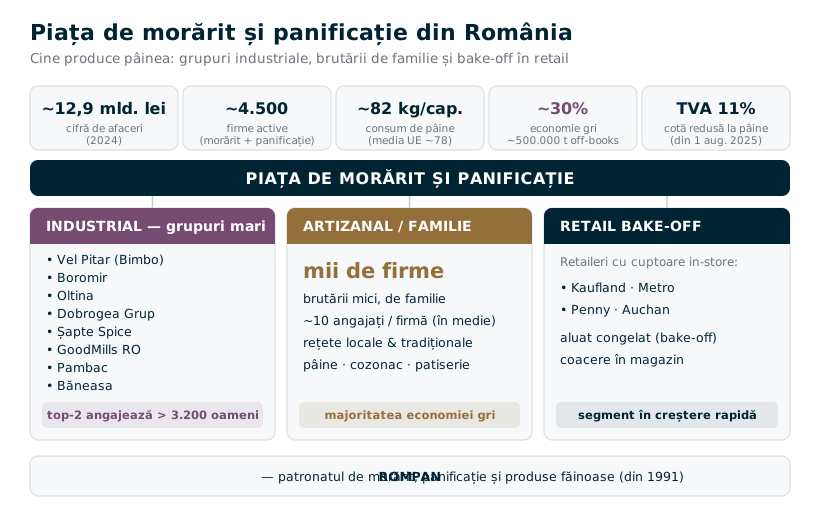 Orientation diagram of the Romanian bakery and milling market: a few large industrial groups (Vel Pitar/Bimbo, Boromir, Dobrogea, Șapte Spice, GoodMills), thousands of small family bakeries, a growing retail bake-off segment, and the ROMPAN employers' association, annotated with headline figures — ~12.9 billion lei turnover, ~82 kg/capita bread, ~30% grey economy.
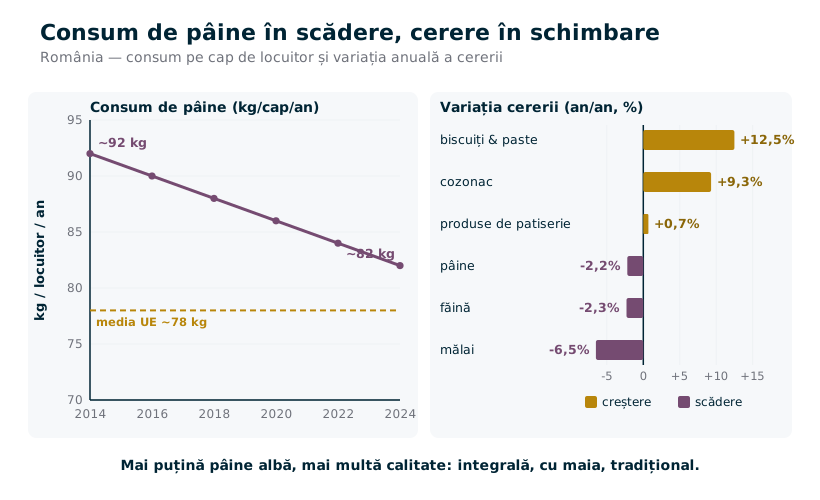 A line chart of Romanian bread consumption falling from about 92 kg to about 82 kg per capita per year (with the EU average of 78 kg marked), beside a bar showing demand rising for cozonac (+9.3%), biscuits & pasta (+12.5%) and falling for plain bread (-2.2%) and flour (-2.3%).
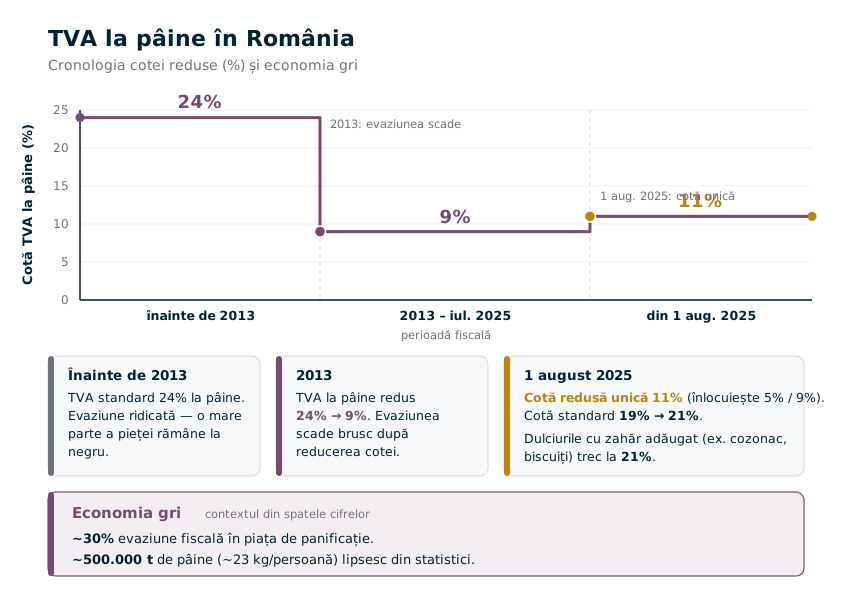 A timeline of VAT on Romanian bread — 24% before 2013, cut to 9% in 2013 (evasion falls), then a single 11% reduced rate from 1 August 2025 (standard rate 21%) — alongside a note that about 30% of the market and 500,000 tonnes of bread stay off the books.
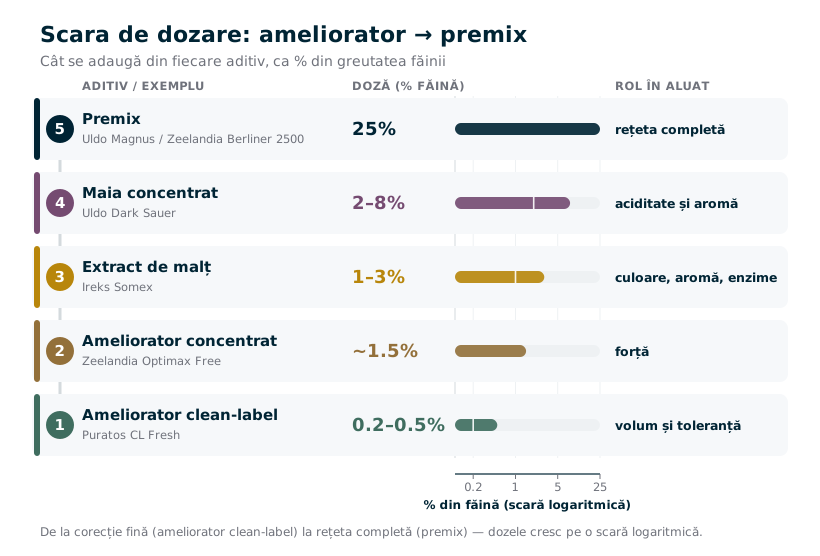 A ladder diagram showing how much of each additive goes into a dough by flour weight — clean-label improver 0.2–0.5%, concentrated improver about 1.5%, malt extract 1–3%, sourdough concentrate 2–8%, and premix 25% — with a first-party product example on each rung.
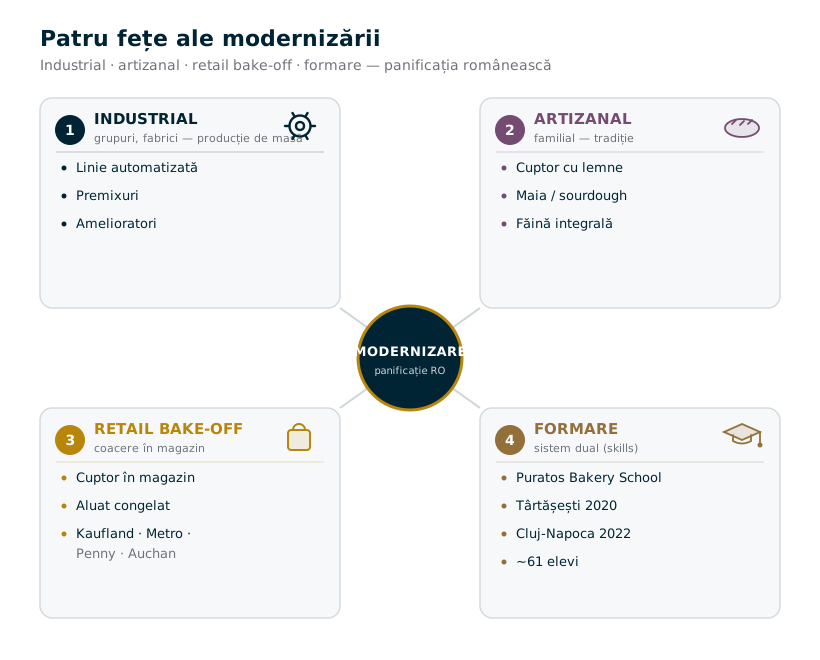 A quadrant illustrating modernisation in Romanian baking: an industrial plant line, a traditional maia sourdough bench, a supermarket in-store bake-off oven, and a dual-system training school.
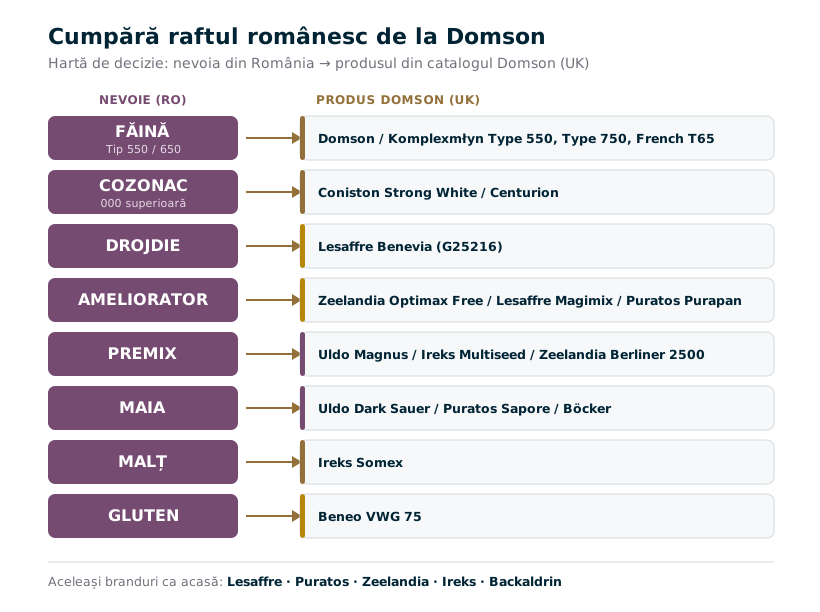 A decision map matching Romanian bakery needs — flour, cozonac flour, fresh yeast, improver, premix, sourdough, malt, gluten — to specific Domson UK catalogue products and brands.
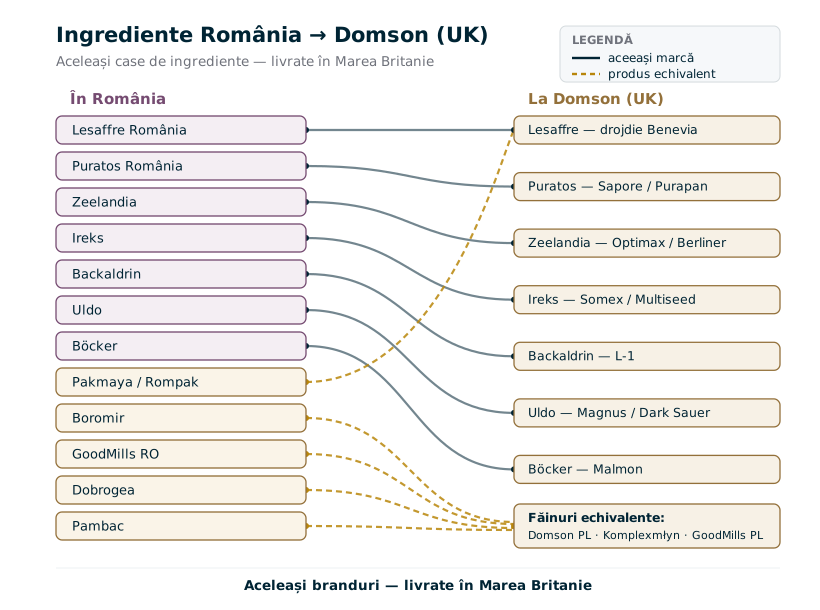 A two-column mapping showing the ingredient houses a Romanian baker uses at home — Lesaffre, Puratos, Zeelandia, Ireks, Backaldrin, Uldo, Böcker, Pakmaya, Boromir, GoodMills — linked to the same or equivalent brands available from Domson in the UK.
Gogoși / Berliner from a doughnut premix (first-party application recipe)
| Ingredient | Baker's % | Weight |
|---|---|---|
| 100 kg wheat flour Type 550 | ||
| 25 kg Berliner 2500 premix (whey/MILK, EGG yolk+white, emulsifiers, ascorbic acid, enzyme) | ||
| 7 kg yeast | ||
| 7 kg oil | ||
| 52 L water (approx.) |
- Mix all ingredients 4 min low + 6 min high (dough ~26–28°C); first proof ~15 min; divide into 1,500 g pieces; rest ~10 min; divide each into 30; mould; final proof ~35 min in chamber + 20 min outside; fry at 180°C ~7 min, turning twice. Contains gluten, MILK, EGG; may contain rye/barley/oat/soya/sesame. See A2-osmotolerant-yeast-enriched-doughs and B1-paczki-and-deep-fried-pastry for the dough science.
Zeelandia Berliner 2500 premix (G24408) — an example of how a premix carries the recipe so a bakery gets a consistent enriched fried dough with minimal skilled labour. Quantities from the datasheet. Not baker's % — a scaled shop recipe.
Mixed rye bread with a concentrated improver (first-party application recipe)
| Ingredient | Baker's % | Weight |
|---|---|---|
| 1.0 kg wheat flour Type 850 | ||
| 5.0 kg rye flour Type 720 | ||
| 6.4 kg rye sourdough | ||
| 0.23 kg salt (iodized — mandatory in RO) | ||
| 0.25 kg yeast | ||
| 0.1 kg Optimax Free improver | ||
| ~5.6 kg water |
- Mix 8 min low + 2 min high; dough ~28°C; first proof ~15 min; scale 0.58 kg into tins; final proof ~50 min; bake 250°C→230°C with steam for the first 5 min, ~45 min total. Improver is WHEAT gluten 50% / RYE flour 39% / potato starch 10% / E300 / enzyme. See A3-what-is-a-bread-improver, A3-enzymes-in-bread and B4-maia-and-sourdough-tradition.
Zeelandia Optimax Free (G22326) mix/rye improver — shows how a small improver dose plus a rye sourdough delivers a consistent mixed loaf. Quantities from the datasheet. Not baker's %.
| Indicator | Figure | Note / source |
|---|---|---|
| Sector turnover (2024, panification & pastry) | ~12.9 billion lei | ~7,015 companies filing accounts; +367% vs 2008 (c1) |
| Sector value (ROMPAN characterisation) | ~3 billion euro | First in the Romanian food industry (c2) |
| Active firms | ~4,500 | ROMPAN; sector average ~10 employees/firm (c2, c3) |
| ROMPAN membership | 300+ companies | Founded 1991; members ≈65% milling / 40% bakery / 70% pasta / 55% biscuits (c2) |
| Bread consumption | ~82 kg/capita/yr | Down from ~92 kg a decade ago; EU average ~78 kg (c6) |
| Annual bread production | ~1.5 million tonnes | ROMPAN (c6, c8) |
| Grey economy | ~30% evasion; ~500,000 t off-books | ~23 kg/person of unregistered bread (c8) |
| VAT on bread | 11% (since 1 Aug 2025) | Was 24%→9% in 2013; standard rate now 21%; high-added-sugar sweets e.g. cozonac pushed to 21% — confirm with accountant (c9) |
Moving figures from trade press and ROMPAN; scope differs by source (2024 filers vs ROMPAN member share vs milling-only). Treat as orientation, not audited accounts. Sources c1, c2, c6, c8, c9.
| Company | Turnover / scale | Ownership / note |
|---|---|---|
| Vel Pitar (+ Trei Brutari) | 841.4 M lei (~€170M) 2023; milling ~396.5 M lei | Râmnicu Vâlcea; owned by Mexican group Bimbo since March 2023 — market leader |
| Oltina Impex Prod | ~723 M lei 2023; milling ~154.3 M lei | Fully Romanian private capital |
| Boromir Ind | ~494 M lei 2023; milling ~254.8 M lei | Boromiz family; 5 mills, ~1,500 t/day, ~10% of specialised milling |
| Șapte Spice | milling ~213.7 M lei | Miller (4 mills); 'Făină Cozonac Lux' among products |
| GoodMills România | milling ~210 M lei | Part of the Austrian GoodMills group — one of Europe's largest millers |
| Dobrogea Grup | milling ~163.6 M lei | 100% Romanian; plants in Constanța, Mangalia, Eforie, Medgidia |
| Pambac (Bacău) | milling ~163.4 M lei | Milling, flour & pasta |
| Sam Mills / Fornetti / Chipita / Titan / Croco | 179.3 / 178.5 / — M lei (various) | Sam Mills (corn/gluten-free), Fornetti (frozen bake-off), Chipita (croissants), Croco |
| Băneasa Moara | milling ~119.4 M lei | Bucharest-area miller |
Bakery-group turnover is 2023; milling-segment revenue is a separate ranking whose underlying figures are ~2017-vintage (a firm appears in both with different figures because the two segments are counted separately). Read the milling figures for order-of-magnitude, not the latest year. Sources c3, c4, c5.
| Category | Leading names in Romania | Domson UK-stock brand/equivalent |
|---|---|---|
| Flour (millers) | Boromir, GoodMills RO, Dobrogea, Pambac, Băneasa, Șapte Spice, Vel Pitar | Domson Poland / Komplexmłyn / GoodMills Polska (Types 500/550/750, rye 720, graham 1850); French T65 |
| Cozonac flour (000 superioară) | Boromir superioară, Șapte Spice Cozonac Lux, Lesaffre 'Inventis Cozonac' premix | Allied Mills Coniston Strong White / Carr's Centurion (strong white stand-ins) |
| Fresh yeast (drojdie) | Pakmaya/Rompak (>50% share), Lesaffre (Fala) | Lesaffre Fresh Yeast Benevia (G25216) |
| Bread improvers (amelioratori) | Puratos (S 500 / Tigris / Jocker CL Fresh), Lesaffre (Magimix), Zeelandia, Backaldrin | Zeelandia Optimax Free (G22326); Lesaffre Magimix (G22531); Puratos Purapan (G22677); Backaldrin L-1 (G25375) |
| Premixes / mixes | Puratos, Zeelandia, Ireks, Backaldrin, Uldo, DI-GO | Uldo Magnus (G22604); Ireks Multiseed (G23688); Zeelandia Berliner 2500 doughnut premix (G24408) |
| Sourdough (maia, ready-to-use) | Lesaffre (Crème de Levain, Secară Natură), Puratos (Sapore), Böcker | Uldo Dark Sauer (G22574); Puratos Sapore Softgrain Rye (G22562); Zeelandia Sourdough Dry (G22058); Böcker (G25417/G25423) |
| Malt & malt extract | Ireks, local maltsters | Ireks Somex Liquid Malt Extract (G23193) |
| Vital wheat gluten | Beneo and others | Beneo BeneoPro VWG 75 (G22839, via Hortimex) — to strengthen weak flour |
| Fats / margarine | Orkla (LaMinut), Bunge | Domson laminating & pastry margarines (see A4 / A6) |
The multinationals a Romanian baker knows from home are the SAME brands Domson stocks in the UK. Romanian millers (Boromir, GoodMills RO, Dobrogea, Pambac, Băneasa, Șapte Spice) have Polish/UK flour equivalents on the Domson shelf. Sources c5, c11, c15, c17, c20.
| Ingredient class | Typical dosage | First-party example (SKU) | What it does |
|---|---|---|---|
| Clean-label improver | 0.2–0.5% | Puratos Jocker/Tigris/S 500 CL Fresh (0.2/0.3/0.5%) | Volume, dough tolerance, freshness — no synthetic additives |
| Concentrated improver | ~1–2% | Zeelandia Optimax Free (G22326) ~1.5% | Gluten + rye + starch + E300 + enzyme; strengthens mixed/rye dough |
| Malt extract | 1–3% | Ireks Somex (G23193) | Colour, flavour, enzyme activity for morning goods / coarse-grain bread |
| Sourdough concentrate (paste) | 2–8% | Uldo Dark Sauer (G22574) | Acidity, flavour, crumb of rye/mixed bread without maintaining a live culture |
| Premix / complete mix | 25% (or 25 kg per 100 kg flour) | Uldo Magnus (G22604); Zeelandia Berliner 2500 (G24408) | Carries most of the recipe — grains, gluten, malt, emulsifier, enzymes |
Rough guide to how much of each additive/ingredient goes into a dough, expressed on flour weight unless stated. First-party datasheet values read on disk this session. Sources c18, c19, c20, c21.
| Parameter | Value |
|---|---|
| Product | Fresh, compressed baker's yeast (Saccharomyces cerevisiae) |
| Dry matter | >29% |
| Fermentative activity | 125 ±10 ml CO2 (Lesaffre risograph); max 100 min (PN-A-79002) |
| Storage | 1–10°C (optimum 4°C) |
| Shelf life | 35 days from production |
| Nutrition (per 100 g) | 464 kJ / 111 kcal; protein 15 g; fibre 8.5 g; salt 0.05 g |
| Allergens | None declared present (SO2/sulphites may be present from molasses used in production) |
| Note | Not for direct consumption — must be baked |
Read on disk this session. Fresh compressed baker's yeast — the workhorse leavening a Romanian bakery buys, here as the Domson UK equivalent to Pakmaya/Fala. Cold-chain product.
| Symptom / decision | Root cause | Fix |
|---|---|---|
| Cozonac dense, won't peel into strands | Bought a soft '000/480' pastry flour, reading 000 as 'weak' | Buy a strong white (Coniston / Centurion) or Romanian 000 superioară; see B4-flour-classification-romanian & B4-cozonac-enriched-dough |
| Loaf quality drifts batch to batch | Wheat crop varies year to year (W, P/L, falling number) | Standardise with a dosed improver (0.2–0.5% clean-label or ~1.5% concentrated); see A3-improver-selection-guide |
| Bread tastes flat vs 'the bakery back home' | Missing the acidity/flavour of maia | Add a ready-to-use sourdough (Uldo Dark Sauer 2–8%, Puratos Sapore) or run a maia; see B4-maia-and-sourdough-tradition & A2-ready-use-sourdough-industrial |
| Can't hire enough skilled bakers | Structural skills shortage across the trade | Lean on premixes/frozen bake-off for consistency; train via dual-system models (Puratos Bakery School); see A5-scaling-artisan-to-industrial |
| Allergen / label gaps | Premixes carry hidden EGG/MILK/SOYA/SESAME; UK flour is fortified, RO flour usually isn't | Read every datasheet; declare allergens from the finished recipe; note iodized salt (RO) vs UK fortification |
| Wrong VAT / pricing assumptions | VAT changed (RO bread now 11%, standard 21% since Aug 2025) | Price from current rates; note UK VAT differs — confirm with an accountant |
Practical decisions a Romanian baker in the UK gets wrong, with the fix. Sources c11, c12, c13, c14, c17, c22, c23.