Production deep-dive: Polish rye and mixed-rye loaves — flour types, dough structure and baking parameters
A working baker's guide to producing authentic Polish rye (żytni) and mixed rye-wheat (mieszany) bread: choosing the right rye flour type, why rye must be soured rather than kneaded, how to run a multi-phase zakwas, and the dough and baking parameters behind loaves from chleb razowy to chleb baltonowski — wired to the Domson catalogue.
Why rye is a different craft
Rye is the backbone of the Polish bread basket, and it does not behave like wheat. Rye flour does contain gluten-forming proteins, but they never build the elastic network that gives a wheat loaf its structure: the proteins are crowded out by pentozany (pentosans, also called śluzy — mucilages), of which the water-extractable fraction makes up roughly 1–4% of the flour and swells into a gel that competes with the protein for water. So the structure of a rye loaf comes not from a gluten web but from that swollen pentosan gel wrapped around acidified, gelatinised starch (see the figure below). Two practical rules follow immediately, and both separate rye work from the wheat technology covered in A5-dough-mixing-methods and A5-bulk-fermentation:
- You do not knead rye dough — you mix it. High-rye dough is mixed only until the ingredients combine. Working it like wheat tears the delicate pentosans and gives a sticky, "clayey" loaf (see the figure below).
- You must sour rye dough. Rye flour is enzymatically lively: its α-amylase keeps attacking starch unless you stop it. A sourdough's low pH inactivates that amylase faster, protecting the starch so the crumb sets instead of staying gummy. This is exactly the Hagberg falling-number story from A1-key-quality-parameters: a low falling number means high amylase and sprout-damaged or old grain, and rye runs naturally lower than wheat — which is why acidification is non-negotiable, not optional.
This is the same acidification logic developed in A2-rye-sourdough-multi-stage and A5-sourdough-technology; here we apply it to specifically Polish loaves and the Domson flour range.
Choosing the rye flour: the Polish type ladder
Polish flour is graded by typ (type) number, which is essentially the ash content × 1000 — so a higher number means a darker flour carrying more of the mineral-rich outer grain. (For the full cross-country decode of T-numbers see A1-flour-classification-systems; for rye's baking behaviour and blending rules see A1-alternative-grain-flours, and for the razowa end of the range see A1-wholemeal-and-high-extraction.)
The Domson catalogue carries the working rye ladder from GoodMills Polska, and the first-party spec sheets give the hard numbers (see the figure below):
- mąka żytnia typ 720 (pytlowa/chlebowa) — ash <0.78%, falling number >90 s, protein 6.5 g, fibre 7.4 g per 100 g. The everyday bread-and-sourdough rye.
- typ 997 (chlebowa) — ash <1.20%, protein 7.3 g, fibre 6.7 g. (Note: the dietary-fibre value for typ 997 is anomalously lower than the lighter typ 720 — likely a batch-specific result or transcription anomaly in the supplier spec sheet ZN-15/VK/10; verify before using in labelling contexts.)
- typ 1150 (starogardzka) — ash ≤1.4%, falling number ≥90 s.
- typ 1400 (sitkowa) — ash <1.60%, protein 9.2 g, fibre 13.8 g; "white-grey with a part of bran".
- typ 2000 (razowa, wholemeal) — ash <2.0%, protein 8.4 g, fibre 14.4 g.
A lighter typ 500 (jasna) sits below 720 for pale rye and blending. GoodMills' specs also pin the keeping and safety baseline: rye flour has a 4-month shelf life and is sold as a semi-finished product not for gluten-sensitive consumers.
Food-safety flag. Rye is the cereal most prone to ergot (Claviceps purpurea). GoodMills supplier spec sheets (ZN-xx/VK/10 series, c.2010 vintage) cite ergot alkaloids ≤500 µg/kg and DON ≤750 µg/kg; however, both figures are superseded by current EU law . As of 1 July 2024, EU Regulation 2021/1399 (as amended) sets the maximum for ergot alkaloids in rye flour at 250 µg/kg — the spec's 500 µg/kg is twice the legal ceiling. EU Regulation 2023/915 (amended by 2024/1022) sets the maximum for DON in cereal milling products at 600 µg/kg — the spec's 750 µg/kg now exceeds the current EU legal maximum. Bakers must obtain updated GoodMills spec sheets and verify incoming rye flour against the current regulatory limits before use.
The zakwas: multi-phase rye sourdough
The heart of Polish rye baking is the zakwas (rye sourdough). Traditionally it is run in stages — prowadzenie wielofazowe — each stage steering the balance between yeast (for lift) and lactic acid bacteria (for acidity and flavour). The full vocabulary, start to finish, is: zaczątek (the carried-over starter) → przedkwas (pre-sour) → półkwas (half-sour) → kwas (the mature sour) → ciasto właściwe (the final dough). Bakeries pick how many stages to run:
- 3-phase ("short"): półkwas → kwas → dough.
- 4-phase: przedkwas → półkwas → kwas → dough, about 16-18 h.
- 5-phase: all stages, about 22-24 h.
Each phase has its own temperature, time and wydajność (yield = dough mass ÷ flour mass × 100; higher = wetter), shown in the figure below and the data table:
| Phase | Temp | Time | Yield |
|---|---|---|---|
| Przedkwas | 24-26 °C | 5-9 h | ≥200 |
| Półkwas | 26-28 °C | ~6 h | ~165 |
| Kwas | 28-30 °C | ~3 h | 190-200 |
| Ciasto właściwe | 29-32 °C | ~20-30 min | — |
The starter (zaczątek) is built from rye flour and water 1:1, with no salt, and the przedkwas adds about 1-2% of the total rye flour. A key production lever is the "sour size" (wielkość kwasu) — the share of the total flour that ferments in the sour before final mixing. For a sifted rye (chleb pytlowy) bakers run about 50%; the practical minimum for a good 100% rye is ~40%; chleb sitkowy runs ~56% and chleb razowy ~45-55% . More sour = more acidity, more flavour, better keeping — but also a denser crumb, so it is a balance.
Two professional tricks worth keeping:
- Żurki (slow half-sours): a high-yield (300-400) półkwas led ~20 h at ~25 °C gives a stable, mild base; the kwas is then taken to yield ~220 for 3 h at 28-30 °C. Refresh a żurek only 2-3 times.
- Przesuszanie ciasta (drying-back): mix the dough with all the planned water but 2-10 kg less flour per 100 kg (≈5% held back), then work the reserved flour in. It improves handling of slack rye dough.
For starter microbiology and maintenance generally, lean on A2-sourdough-cultures-science; the day-to-day care of a Polish rye starter is the subject of its own dossier, B1-zakwas-sourdough. At industrial scale, spontaneous wholemeal-rye fermentation can be standardised with selected lactic acid bacteria starter cultures, which also locks in microbial safety and shelf-life — the acids themselves suppress spoilage and rope.
Buying the sour ready-made
Not every bakery maintains a multi-phase zakwas, and the catalogue covers that. Ready acidulants supply controlled acidity to top up or stand in for the sour:
- IREKS Natural concentrated liquid rye sour — dose 1-7%, pH 2.8-3.4, degree of acidity 190-210; store 15-20 °C (see the figure below).
- Uldo Dark Sauer rye paste sour — dose 2-8%, pH 2.5-4.5, total acidity 140-150° (see the figure below).
- IREKS 100% Rye-Bread Mix — a complete 100%-addition mix of rye flour, salt, rye malt flour, dried rye sourdough and lactic acid; pH 4.1-5.0.
Backaldrin BAS liquid rye sourdoughs, Lesaffre Rye Sourdough AS ECOL and the Zeelandia/Komplet/Puratos rye mixes give further off-the-shelf routes (see the linked products).
Mixed-rye loaves: balancing rye and wheat
Most loaves sold in a Polish piekarnia are mieszany (mixed rye-wheat), not pure rye. The rule of thumb: lead the rye on a sourdough and add the wheat late, because the more rye in the blend, the more readily the dough acidifies . Three classic balances (see the comparison table and the regional map below):
- Chleb mieszany żytnio-pszenny ~60:40 — rye-dominant; rye sour built on ~45-50% of the flour, wheat folded in at the final dough.
- Chleb baltonowski — a soft, mild wheat-dominant sandwich loaf, roughly 30-40% rye / 60-70% wheat (commercial blends run around wheat typ 750 at ~67.5% with rye typ 720 at ~22.5%). The name is widely said to derive from the PRL-era "Baltona" shops; this is a popular attribution repeated across consumer-tier Polish food writing but has not been corroborated by a primary historical source.
- Chleb mazowiecki — wheat-led at 70:30 or 80:20, built on a wheat sponge (rozczyn) into which a diluted rye sour at 15-17 kg per 100 kg flour is dosed for a better result.
Hydration is style-dependent; note that dough for tin baking can run slacker than dough for hearth baking — about 4 L more water per 100 kg flour. For blending strong wheat into rye loaves, the strength concepts in A1-alternative-grain-flours apply, and Domson's GoodMills wheat and graham (typ 1850) flours partner the rye range.
Shaping, proofing and the bake
Because there is no gluten to set up, rye and high-rye dough are handled with wet hands and tools, smoothed rather than tightened, and proofed warm and humid until the surface just shows fine fermentation cracks. The proofing fundamentals (humidity, reading readiness, over- vs under-proof) carry over from A5-proofing-science.
In the oven the dough runs through a fixed sequence of changes as the temperature climbs (see the figure below): gas expansion, loss of dissolved CO₂, ethanol evaporation, a brief surge then halt of yeast activity, growth/oven rise, starch gelatinisation (kleikowanie), protein coagulation, and finally caramel and dextrin/crust (Maillard) formation. The oven-science behind oven spring, steam and crust is detailed in A5-baking-oven-science.
Practical parameters:
- Heritage tin loaf (Staropolski Chleb Żytni): bulk 12-14 h at 24-26 °C, proof 2-3 h, then bake 220 °C for 10 min, dropping to 190 °C for 40-50 min — see the formula card below.
- Professional rye / mixed-rye: load at ~230 °C with steam for the first 15-20 min, then drop towards 200-210 °C to finish; steam drives volume and a deep caramel crust.
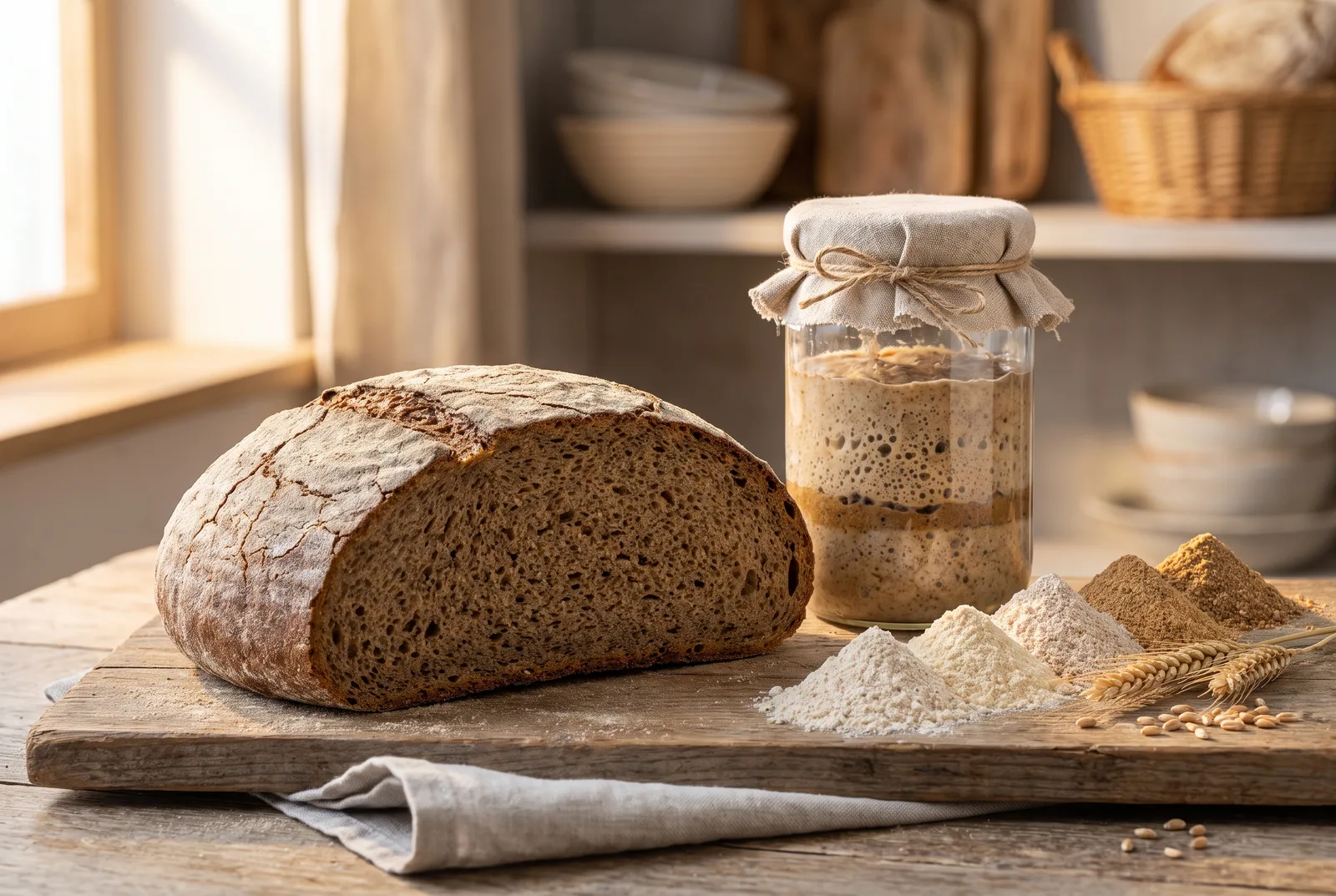
A 100% rye loaf is best left several hours before slicing — the crumb continues to set as it cools, and rye keeps and even improves over days thanks to its acidity. The finished article is a dense, moist, gently sour loaf (see the figure below).
A note on the regional canon
The production methods above are the engine behind Poland's regional rye loaves (fuller map and history in B1-bread-landscape). Two carry official traditional-product status:
- Chleb prądnicki — an oval/round rye-sourdough loaf with a rye-bran-dusted dark crust (~6 mm), traditionally a giant 4500 g at ~500 mm across, from Prądnik (now a district of Kraków, Małopolska); on the national List of Traditional Products since 10 October 2005 and holding EU Protected Geographical Indication (PGI) status since 12 March 2011 (EU Implementing Regulation 242/2011) (see the figure below). Legal note: the name is protected under EU Regulation 1151/2012 and equivalent retained UK law — only producers in the defined Kraków area may legally use it; bakeries outside that area must not label their product "chleb prądnicki".
- Kaszubski chleb żytni na ziemniakach — a rectangular ~1 kg rye loaf enriched with potato, light-grey crumb, slightly sour; from Kaszuby (Pomerania), where poor sandy soils and a harsh climate made rye the sensible grain; registered 3 September 2006.
Faults — the rye-specific shortlist
Most rye problems trace back to the two opening rules. The full diagnostic is in the fault table below and complements the universal guide in A5-bread-faults-causes-remedies; the headline cases:
- Sticky, gummy crumb → too little acid, low-falling-number flour, or over-mixing. Raise the sour size/acidity, check the flour, mix only to combine.
- Dense, low loaf → weak/cold sour, under-proof, or sour size below 40%.
- Too sour → fermentation too long or too warm (excess acetic acid); cool and shorten the sour to favour the milder lactic note.
Buy the ingredients for this
Rye flours: GoodMills Polska typ 720 / 997 / 1150 / 1400 / 2000 and Komplexmłyn typ 720; GoodMills graham typ 1850 for mixed loaves. Sours & acidulants: Uldo Dark Sauer, IREKS Natural liquid rye sour, Backaldrin BAS dark/light liquid rye sourdough, Lesaffre Rye Sourdough AS ECOL. Complete mixes: IREKS 100% Rye, Zeelandia Kołodziej & Hearty Rye, Komplet Żytniak CL, Puratos Sapore Softgrain Rye. Colour, malt & texture: Zeelandia Rye Stabil, IREKS Naturin rye colour/flavour, Uldo and Bakels dark rye malt extracts, Agrol cracked rye & rye flakes. Plus Lesaffre fresh yeast and Polish fine salt for the mixed-dough formulas. (See the products at the end of this article for SKUs.)
Figures
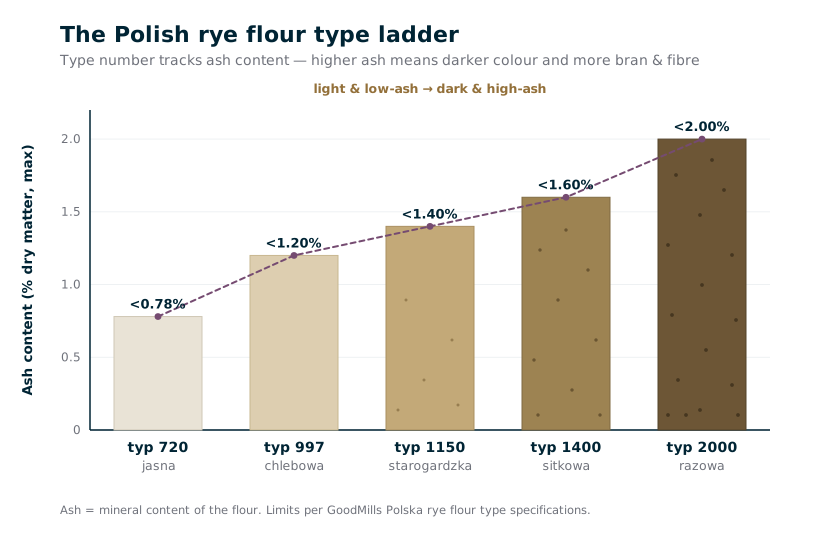 Five samples of rye flour from light type 720 to dark wholemeal type 2000 with their ash percentages.
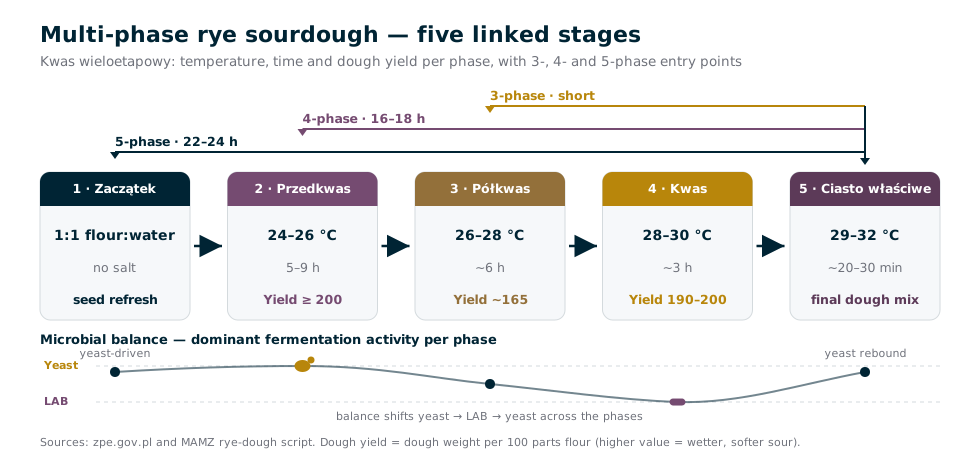 Flow diagram of the five-phase rye sourdough leading with temperatures and times for each stage.
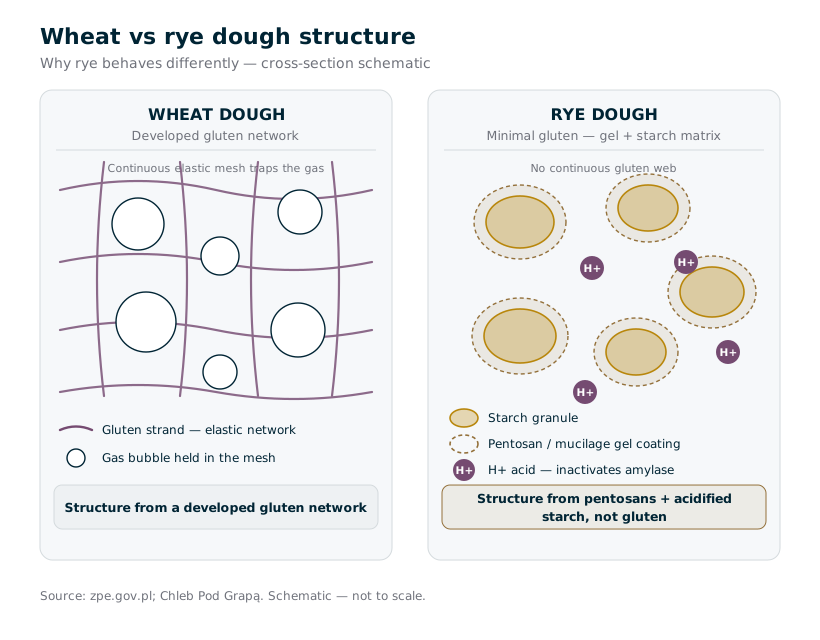 Side-by-side schematic of an elastic gluten web for wheat versus a pentosan-and-starch gel matrix for rye.
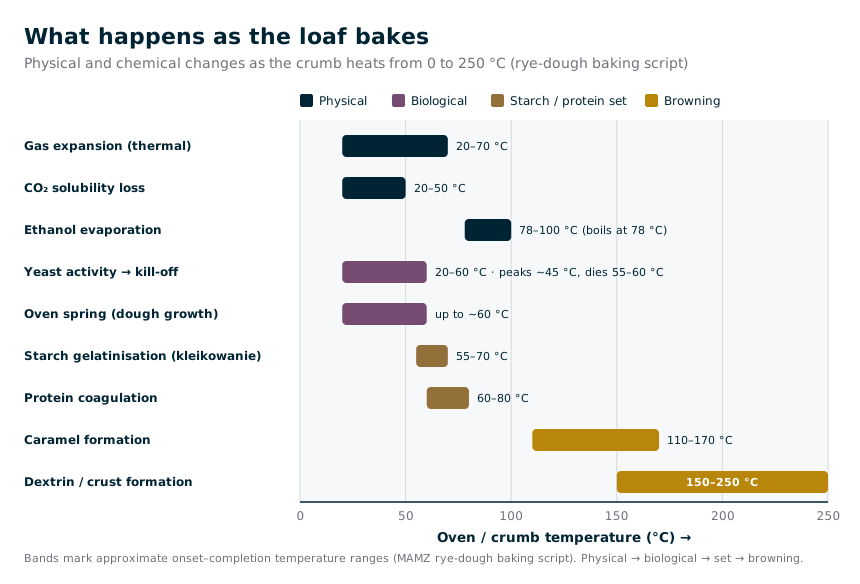 Temperature axis from 0 to 250 C with labelled bands for each physical and chemical change during baking.
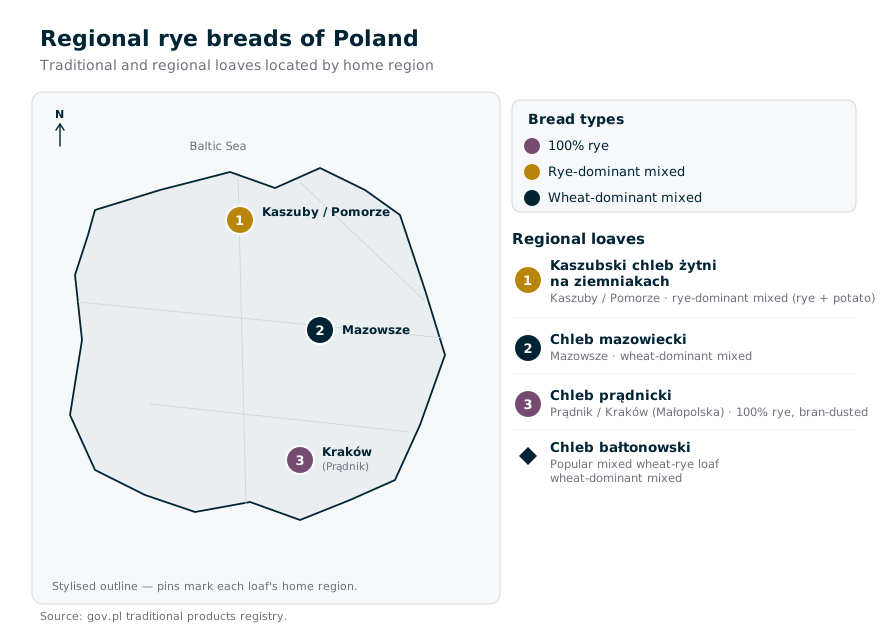 Outline map of Poland with pins marking regional rye breads and their home regions.
Staropolski Chleb Żytni — heritage 100% rye sourdough (baker's %)
| Ingredient | Baker's % | Weight |
|---|---|---|
| Rye flour typ 720 — ≈ 500 g | 58.8 | |
| Wholemeal rye flour typ 2000 — ≈ 250 g | 29.4 | |
| Prefermented rye flour (in starter) — ≈ 100 g flour, from the 5-day zakwas | 11.8 | |
| Water (total) — ≈ 600 g incl. starter water | 70.6 | |
| Salt — ≈ 15 g | 1.8 | |
| Honey or beet molasses (optional) — ≈ 20 g, flavour/colour | 2.4 |
- Build a rye starter over 5 days: each day mix 100 g typ 2000 + 100 ml ~35 °C water, keep ~25 °C, until thick and bubbly.
- Mix 200 g active starter with the water; add salt (and honey/molasses), then both rye flours. Mix only until combined — dough is dense and sticky; do NOT knead.
- Bulk ferment 12-14 h at 24-26 °C (overnight) until risen.
- Scale into a greased, floured tin; smooth the top with a wet hand.
- Final proof 2-3 h until the surface just shows fermentation cracks.
- Bake with steam: 220 °C for 10 min, then 190 °C for 40-50 min. Cool fully before slicing.
Yield: One ~1.0 kg tin loaf
Chleb mieszany żytnio-pszenny 60:40 on rye sour (professional outline)
| Ingredient | Baker's % | Weight |
|---|---|---|
| Rye flour typ 720/997 (total) — part in the sour, part in the dough | 60 | |
| Wheat bread flour typ 750 — added at the final-dough stage | 40 | |
| Water — adjust to flour absorption; ~4 L/100 kg less for hearth than tin | 62 | |
| Salt — added when converting kwas to dough | 1.8 | |
| Yeast (optional) — dosed into przedkwas/kwas to firm up rise | 0.5 |
- Lead the rye sour (kwas) so that ~45-50% of the total flour ferments in it; keep kwas yield ~200-220, ~3 h at 28-30 °C.
- At final dough, combine the mature kwas with the wheat flour, remaining rye flour, the rest of the water and dissolved salt.
- Mix only to a homogeneous, slightly sticky dough; rest (leżakowanie) ~20-40 min.
- Divide, shape; proof tins/baskets warm and humid until ready.
- Bake ~230 °C with steam for the first 15-20 min, then drop to ~210-200 °C to finish.
Yield: Per 100 kg total flour
100% rye using a liquid sour shortcut (catalogue acidulant)
| Ingredient | Baker's % | Weight |
|---|---|---|
| Rye flour typ 997/1150 — bread rye | 100 | |
| Liquid rye sour (e.g. IREKS Natural) — dosage range 1-7% | 5 | |
| Water — adjust to type/absorption | 70 | |
| Salt | 1.8 | |
| Fresh yeast — for leavening when not using a full multi-phase sour | 2 |
- Disperse the liquid/paste sour and yeast in the water.
- Add rye flour and salt; mix only to combine (no gluten development).
- Short floor time, then scale to tins; proof warm/humid.
- Bake with steam at ~230 °C falling to ~200 °C; verify a sticky-free, set crumb before pulling.
Yield: Per 100 kg rye flour
| Type (typ) | Traditional name | Total ash limit | Falling number | Protein (g/100 g) | Dietary fibre (g/100 g) | Typical use |
|---|---|---|---|---|---|---|
| 500 | jasna (light) | ≤ ~0.58% | — | — | — | Light rye, home baking, pierogi/naleśniki, blending |
| 720 | pytlowa / chlebowa | < 0.78% | > 90 s | 6.5 | 7.4 | Workhorse bread rye, sourdough, mixed loaves |
| 997 | chlebowa (medium) | < 1.20% | > 90 s | 7.3 | 6.7 | Everyday rye and rye-wheat bread |
| 1150 | starogardzka | ≤ 1.4% | ≥ 90 s | — | — | Darker bread rye, full-flavoured loaves |
| 1400 | sitkowa (sifted) | < 1.60% | > 90 s | 9.2 | 13.8 | Dark sifted rye bread and rolls |
| 2000 | razowa (wholemeal) | < 2.0% | > 90 s | 8.4 | 14.4 | Wholemeal/razowy rye, pumpernickel-style, healthy lines |
Type number ≈ ash content × 1000. Ash/protein/fibre figures are from GoodMills Polska supplier spec sheets (single-source, first-party); traditional Polish names and the typ 500 entry from PL flour-classification references. Protein/fibre are supplier-published typical values and are not strictly monotonic with type. ANOMALY: typ 997 dietary fibre (6.7 g/100 g) is unexpectedly lower than the lighter typ 720 (7.4 g/100 g) — likely a batch-specific result or transcription error in spec sheet ZN-15/VK/10; verify before use in labelling.
| Phase | Temperature | Time | Yield (wydajność) | Dominant microflora | Purpose |
|---|---|---|---|---|---|
| Zaczątek (starter) | ~26-30 °C | many hours | 200-400 | starter culture | Carry/seed the culture; rye:water 1:1, no salt |
| Przedkwas (pre-sour) | 24-26 °C | 5-9 h | ≥ 200 | mainly yeast | Wake and multiply yeast & bacteria; +1-2% of total flour |
| Półkwas (half-sour) | 26-28 °C | ~6 h | ~165 | lactic acid bacteria | Build acidity; firmer, bacteria-favoured stage |
| Kwas (mature sour) | 28-30 °C | ~3 h | 190-200 | yeast (with LAB) | Final leavening power + flavour; salt added when going to dough |
| Ciasto właściwe (final dough) | 29-32 °C | ~20-30 min | — | — | Combine remaining flour, water, salt; short rest only |
Wydajność (yield) = dough mass ÷ flour mass × 100; higher = wetter. From zpe.gov.pl and the MAMZ rye-dough script.
| Bread | Rye: wheat | Leavening | Character |
|---|---|---|---|
| Chleb żytni / razowy (100% rye) | 100: 0 | Rye sourdough (kwas), ≥40% sour | Dense, moist, sour, long-keeping |
| Chleb sitkowy / pytlowy | 100: 0 (sifted rye) | Rye sourdough, ~50-56% sour | Lighter dark rye, fine crumb |
| Chleb mieszany żytnio-pszenny | ~60: 40 (rye-dominant) | Rye sour; wheat added at dough | Balanced, everyday loaf |
| Chleb baltonowski (pszenno-żytni) | ~30-40: 60-70 (wheat-dominant) | Wheat sponge + rye sour/yeast | Mild, soft, sandwich loaf |
| Chleb mazowiecki | 20-30: 70-80 (wheat-dominant) | Wheat sponge (rozczyn) + diluted rye sour | Soft wheat-led mixed bread |
Rye-dominant breads need sourdough; wheat-dominant mixed breads can run on a wheat sponge with a small rye sour added. Ratios from MAMZ/zpe and PL references.
| Product | Form | Dosage | pH / acidity | Brand |
|---|---|---|---|---|
| IREKS Natural liquid rye sour | Concentrated liquid | 1-7% | pH 2.8-3.4; acidity 190-210° | Ireks |
| Uldo Dark Sauer | Rye paste sour | 2-8% | pH 2.5-4.5; total acidity 140-150° | Uldo Polska |
| IREKS 100% Rye-Bread Mix | Complete mix | 100% addition | pH 4.1-5.0; ash 2.3-3.5% | Ireks |
| Zeelandia Kołodziej Classic Wholegrain Rye Mix | Complete mix | per supplier | — | Zeelandia |
| Backaldrin BAS Dark Liquid Rye Sourdough | Liquid sour | per supplier | — | Backaldrin Polska |
Dosages, pH and acidity from supplier datasheets. Acidulants replace or top up the sourdough's acidity to control rye's amylase and crumb.
| Fault | Likely cause | Remedy |
|---|---|---|
| Sticky, gummy, 'clayey' crumb | Insufficient acidification; low falling number flour (sprouted/old, high amylase); over-mixing damaging pentosans | Raise sour size/acidity; check falling number; mix only to combine; lower dough temperature |
| Dense, low-volume loaf | Under-active sour; under-proof; too cold; too little prefermented flour | Refresh/warm the sour; extend proof; ensure ≥40% sour for 100% rye |
| Flat top / collapse | Over-proof; dough too slack; weak sour structure | Proof less; firm the dough; strengthen the kwas |
| Large cracks / 'flying crust' | Under-proof; oven too hot at load; no steam | Proof fully; load with steam; moderate top heat |
| Too sour / sharp flavour | Long/warm fermentation; too much acetic (heterofermentative) acid | Shorten/cool the sour; favour lactic (warmer, wetter) over acetic (cooler, firmer) |
| Pale, soft crust | Low bake temperature; no/late steam; low sugars | Bake hotter at load with steam; consider rye malt for colour/flavour |
| Rope / mould in storage | Insufficient acidity; high summer temperatures | Ensure adequate sour acidity; cool and store dry; acidity itself improves keeping |