
Mazurek: Easter shortcrust base, kajmak caramel topping and confectionery decoration
Mazurek (the flat, richly decorated Polish Easter cake) is a confectioner's set-piece built on three skills: a short, crisp shortcrust base (kruche ciasto), a rich topping — most famously kajmak (Polish dulce de leche) — and the decoration that makes it a centrepiece. This dossier gives the authentic background (the name traces to Mazowsze/Mazovia; the cake itself descends from oriental almond confectionery that reached Poland's noble manors by the 17th century), the load-bearing craft (the 3:2:1 flour:fat:sugar shortcrust rule, three routes to the kajmak layer including the can-boiling explosion hazard, and royal-icing/bakalie decoration), five baker's-percentage formula cards, fault tables, and the Domson catalogue products a Polish baker buys to make it — anchored to seven first-party supplier spec sheets (Zeelandia kajmak, Type 450 flour, Polmlek 82% butter, baking powder, Martin Braun plum filling, ground almonds and cake margarine).
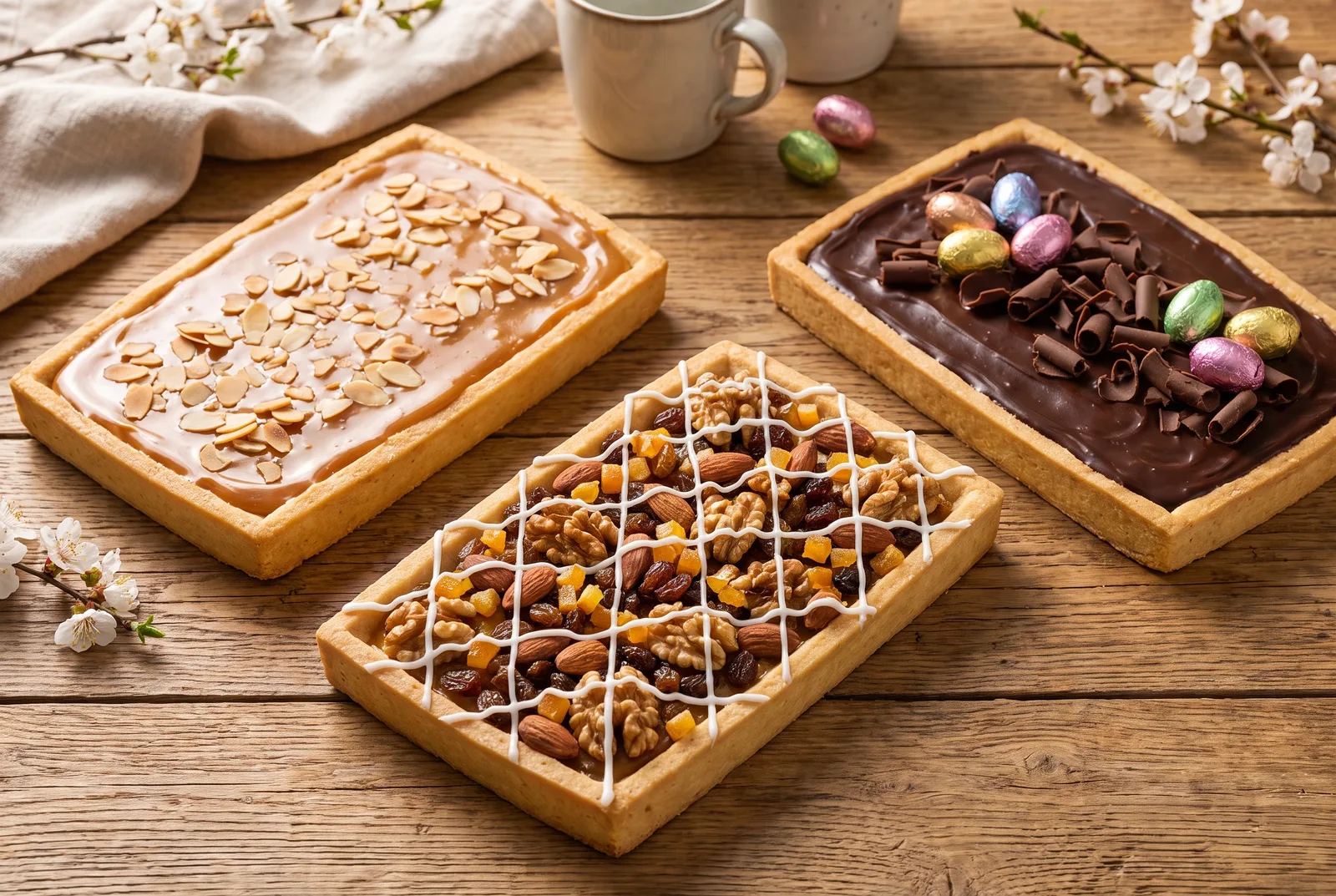
Mazurek: Easter shortcrust base, kajmak caramel topping and confectionery decoration
For most Polish households the mazurek is the cake of Wielkanoc (Easter): flat, thin, almost all surface, and decorated until there is barely a gap left. It is also one of the most commercial things a Polish bakery makes — short shelf-window, high decoration value, sold by the tray. Under the icing it is three separate skills stacked together: a short, crisp base (kruche ciasto), a rich topping (above all kajmak, Polish dulce de leche), and the decoration that earns the price. This dossier covers all three, with the authentic background a Polish baker's customers expect you to know (see the figure above).
What "mazurek" means, and where it comes from
The name is older than the Easter habit. Mazurek comes from Mazur — the historical word for an inhabitant of Mazowsze (Mazovia) — so mazurek literally means "a Mazovian cake", exactly as the dance mazurek means "a Mazovian dance". Tellingly, the oldest Polish dictionaries did not connect it to Easter at all: Linde defined a mazurek as "a cake made of almonds" (placek z migdałów), the Vilnius Dictionary as "a flat cake sprinkled with raisins and almonds", and the Warsaw Dictionary as a cake of almonds, sugar and flour. The firm Easter association only crystallised after the Second World War (Doroszewski's dictionary onward).
The cake's lineage runs east. Chronicles put mazurki on the tables of Polish noble manors (dwory szlacheckie) by the 17th century, with monastery kitchens baking mazurek-type cakes earlier still in the medieval period. Its distant ancestor is Turkish/oriental almond confectionery, which reached Europe in the era of the Crusades and was popularised in the Polish-Lithuanian Commonwealth through Ottoman trade contacts (see the map below). That history is why the defining form of a mazurek is a thin, flat, crisp base carrying a rich topping — not a tall risen cake.
Kruche ciasto: the 3:2:1 shortcrust base
Almost every mazurek sits on kruche ciasto (shortcrust). The Polish trade rule every confectioner
knows is 3:2:1 — three parts flour, two parts fat, one part sugar by weight (read the other way,
1:2:3 sugar:fat:flour). In the baker's-percentage language of A8-bakers-percentage-fundamentals
that is flour 100% / fat 67% / sugar 33%; a textbook batch is 300 g flour, one 200 g block of
butter, 100 g icing sugar. The formula card below builds it (see the figure below).
Shortcrust is the inverse of bread: here you want to suppress gluten so the paste eats short, not
chewy (this is the same short-paste family covered in A8-cake-and-pastry-formulas). Four rules
deliver it:
- Keep everything cold and mix only until it just comes together — chop cold butter into the flour, bind last, stop the moment it clumps. Over-working warms the fat and develops gluten, and the base bakes hard.
- Yolks, not whole eggs. Egg white, especially in quantity, kills shortness and toughens the paste — use the yolks (catalogue: Egg Yolk Liquid Domson). Food-safety note for commercial sale: raw shell-egg yolks carry the same Salmonella risk as raw whites — use a pasteurised liquid-yolk product such as Egg Yolk Liquid Domson.
- Use 82% butter. High-fat butter gives the flavour and the shortest crumb; the Polmlek Unsalted
Butter 82% spec confirms minimum 82% fat and 16% water (see
A4-butter-grades-and-specialist-types). - Chill, roll thin, dock. Rest the wrapped dough at least 30 minutes (ideally ~1 hour), roll to 4–6 mm, and prick the base with a fork so it does not dome.
Bake a thin base at ~180–200°C (top–bottom) for ~18–22 minutes until golden; a thick, bakalie-laden
base goes lower and longer, ~160°C for ~35 minutes. The flour to reach for is a low-ash
cake/pastry flour: Polish Type 450 ("mąka tortowa"), ash ≤0.48%, protein ≥8% — the
A1-flour-classification-systems T-number is simply the ash content ×1000, and choosing it is exactly
the application logic in A1-wheat-flour-types-by-application. The spec also flags trace
cross-contamination risk for soy, lupine and mustard — all EU Annex II allergens — so final
product labels must carry the appropriate may-contain advisory. A small dose of baking powder
(~3% on flour, i.e. the spec's 1 kg per 32 kg flour) lightens a thicker base — note it is a phosphate
type, E500(ii) + E450(i) on a wheat carrier, so it is another source of gluten (see
A2-chemical-leaveners-baking-powder). For production volumes, cake & cookie margarine
(Milama/Ajax, 80% fat, allergen-free) is the standard butter alternative (A4-fat-types-and-selection).
Kajmak: the signature caramel topping
The most iconic mazurek is kajmakowy — the shortcrust spread with kajmak, which is simply Polish dulce de leche: the Zeelandia kajmak spec even gives its descriptive name as "Dulce de leche". There are three ways to get it (see the figure below, and the kajmak-routes table):
- Ready-to-use (industrial). Stir and spread straight from the bucket. The Zeelandia Kajmak is a ready-to-use mass: pH 5.2–6.2, solids 69–72%, a 6-month shelf life and milk as its only declared allergen. Agart Classic Kajmak and Gostyń Kajmak are equivalents.
- Pan-cook condensed milk. Cook sweetened condensed milk (catalogue: Gostyń Condensed Milk) with a little butter and vanilla over low heat, stirring constantly, ~10–20 minutes to a thick, spreadable mass — see the formula card below.
- Boil the sealed can. The traditional home route: simmer the unopened can fully submerged in water for 2–3 hours. This works, but it is the one genuine hazard in the whole cake — the can must stay submerged at all times; if it is exposed and over-heats it can explode. Use a can without a ring-pull lid, top the water up constantly, and cool the can fully before opening .
Whichever route, the kajmak goes on a cooled base that has first been sealed with a thin layer of
melted chocolate or jam, so the moist topping does not turn the crumb soggy. The classic finish
is flaked or whole almonds — toast them and add after baking so they do not scorch (the toasting
and allergen logic of A7-seeds-nuts-toppings). The assembled cake is shown in the formula card
and figure below. For a caramel/toffee variant, IRCA Toffee D'Or
works the same way (and the caramel-cooking science sits in A6-sugar-work-techniques); for cream or
custard layers see A6-pastry-creams-fillings.
The other styles: bakaliowy, czekoladowy, makowy, cygański
Beyond kajmak, a Polish bakery runs several mazurek styles at Easter (see the styles table):
- Bakaliowy — the fruit-and-nut mazurek. A shortcrust base spread with powidła (thick plum jam) or fruit filling, then heaped with bakalie (the dried-fruit-and-nut mix): walnuts, almonds, raisins, candied orange peel, dried plum, apricot or fig. The formula card below uses the Martin Braun Plum Filling Śliwidło — bake-stable, plum 50%, ~35°Bx, pH 3.5 — which (once opened) must be kept at 0–4°C and used within 48 hours (see the figure below).
- Czekoladowy — chocolate-topped, finished with curls and Easter chocolate motifs; seal the base
with chocolate first (
A6-chocolate-tempering-crystallisation,A7-chocolate-decorations-inclusions). - Makowy — a poppy-seed (mak) layer on shortcrust, enriched with dried plum, apricot, cranberry and candied orange or figs.
- Cygański ("gypsy") — a near-flourless nut-and-egg baked mass (chopped nuts, yolks/whites, minimal flour or cocoa), often spread on a wafer (opłatek) and baked at ~170–180°C for ~20–30 minutes.
Decoration: lukier, bakalie and symbolism
Decoration is where the mazurek earns its place on the table (see the figure below). The
backbone is lukier — royal icing, beaten from egg white and icing sugar and sharpened with
lemon — piped into a lattice (kratka), zigzag or diamond mesh (the icing family is detailed
in A7-icings-and-buttercreams). FOOD SAFETY: classic lukier (and the cygański topping) use
raw egg white, a Salmonella risk — for commercial sale use pasteurised egg-white powder
(catalogue: Ovopol Egg White Powder) or a cooked/Italian-meringue icing.
The nut-and-fruit decoration is not only flavour: in Polish folk tradition almonds laid in a cross symbolise the Resurrection, walnuts symbolise wisdom, and the abundance of bakalie signifies plenty and joy. For seasonal finishing, the catalogue carries the expected Easter pieces — Barbara Luijckx hollow chocolate eggs and a "Wesołego Alleluja" chocolate plaque, MagMart sugar Easter lambs, Credin gold sprinkles and an apricot glaze to make the bakalie shine (see the figure below).
Buying the ingredients
Every card maps to catalogue products — see the products at the end of this article, the flour/fat table and the figures below: Komplexmłyn Wheat Flour Type 450 (or Domson Type 500) and Polmlek 82% butter (or Milama/Ajax cake margarine) for the base; Icing Sugar CP (Kent) and Domson Baking Powder as adjuncts; Egg Yolk Liquid Domson to bind and Ovopol egg-white powder for safe icing; Zeelandia / Agart / Gostyń Kajmak (or Gostyń condensed milk to make your own) for the topping; Martin Braun Śliwidło plum filling, Global Grains ground / flaked / whole almonds, walnuts, raisins, Agrobakal candied orange and dried prunes for bakalie; and the Barbara Luijckx / MagMart / Culpitt Easter decorations to finish.
Food-safety note: the can-boiling kajmak route is an explosion hazard unless the can stays submerged — keep it underwater, use a non-ring-pull can and cool it before opening . Classic lukier and the cygański topping use raw egg white (Salmonella) — use pasteurised egg-white powder or a cooked icing for sale. Kajmak is a perishable milk product — refrigerate after opening and keep within shelf life. The shortcrust, baking powder and poppy-seed filling all declare gluten (wheat); the toppings declare tree nuts (almonds, walnuts) and the poppy filling may contain peanuts; the plum filling carries soy + milk cross-contamination. Raw flour is not ready-to-eat — always bake the base fully.
Figures
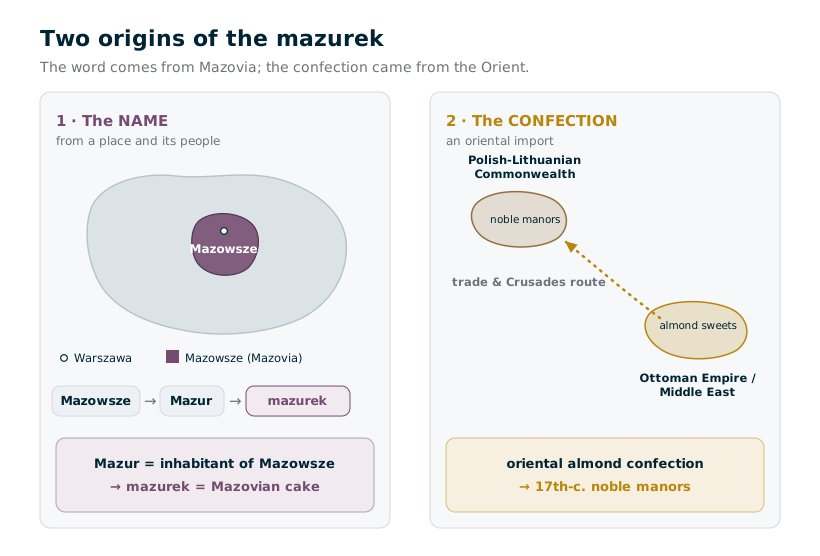 Diagram linking the name mazurek to Mazovia and the Ottoman/oriental origin of the cake
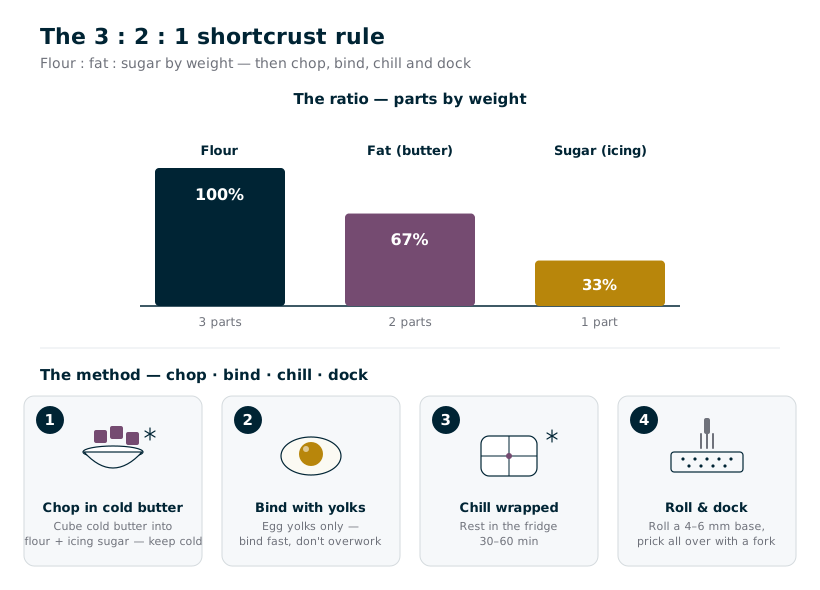 Diagram of the 3:2:1 shortcrust ratio and the chop-bind-chill-dock method
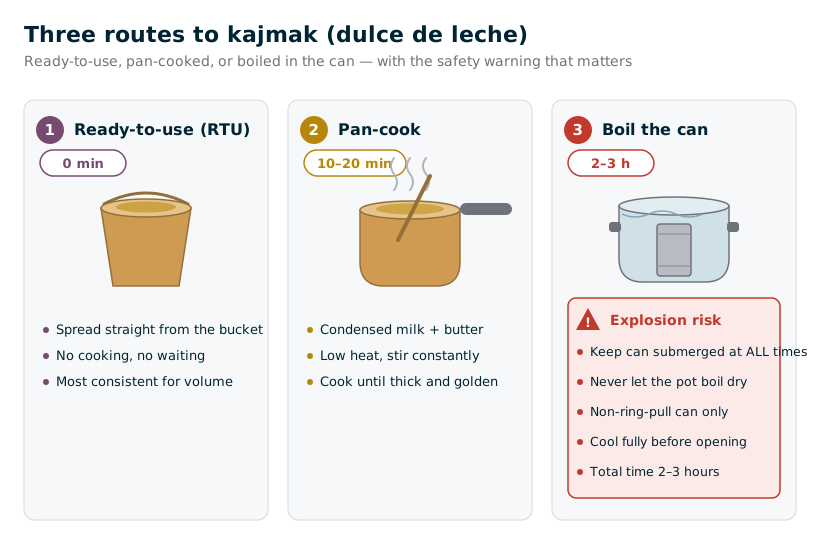 Diagram comparing three ways to make kajmak with a can-explosion safety warning
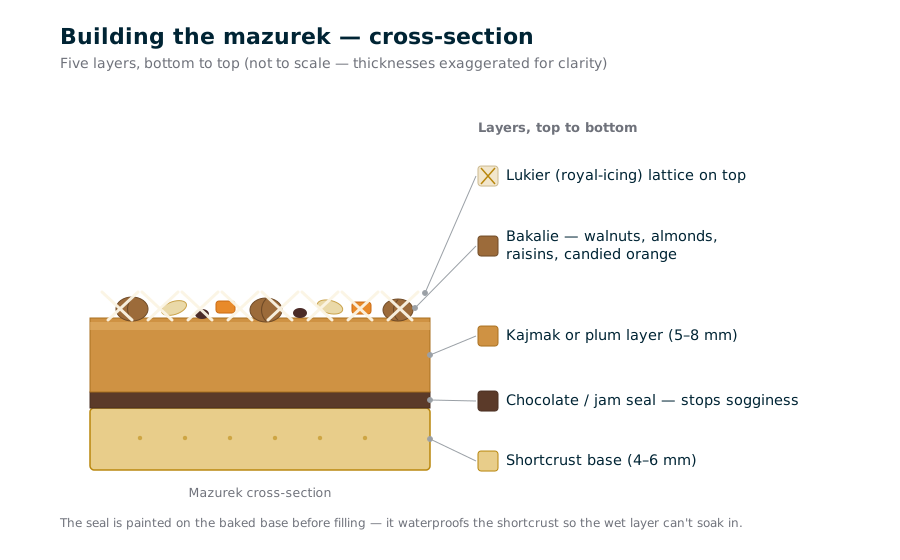 Cross-section diagram of a mazurek showing base, seal, filling and decoration layers
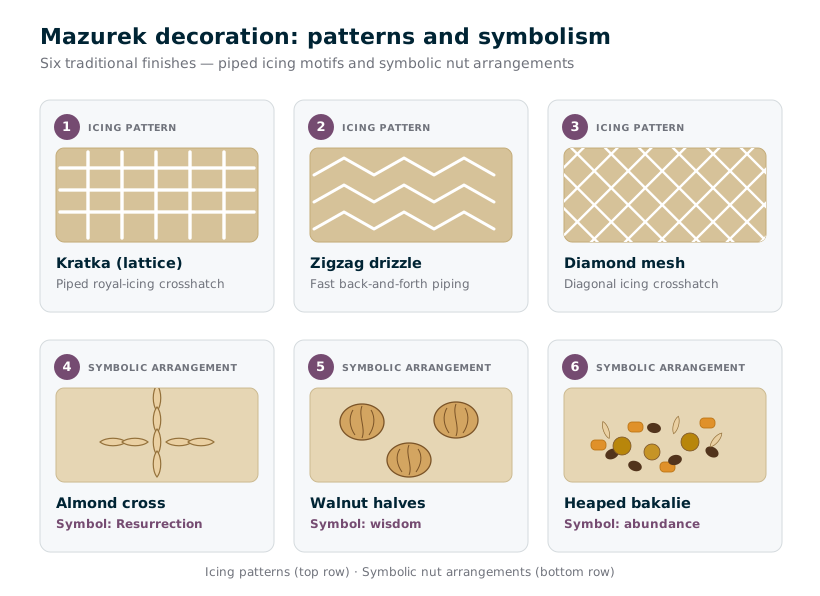 Diagram of mazurek icing patterns and symbolic nut arrangements
Kruche ciasto — the classic 3:2:1 mazurek shortcrust base
| Ingredient | Baker's % | Weight |
|---|---|---|
| Wheat flour Type 450 (mąka tortowa) | 100 | 300 |
| Cold butter 82% (or cake margarine) | 67 | 200 |
| Icing sugar | 33 | 100 |
| Egg yolks (~2) | 13 | 40 |
| Salt | 0.5 | 1.5 |
| Baking powder (optional, for a thicker base) | 1.5 | 4.5 |
| Total | 215 |
- Sift flour with icing sugar and salt; chop in cold butter until sandy (keep everything cold).
- Add yolks and bring together FAST — mix only until it just clumps (over-working = tough base).
- Wrap and chill 30–60 minutes.
- Roll to 4–6 mm, line the tray, dock (prick) the base with a fork.
- Bake ~180–200°C top–bottom ~18–22 min until golden (a thick/rich base: ~160°C ~35 min).
- Cool, then seal with a thin layer of melted chocolate or jam before a wet topping.
Yield: ~640 g dough — one 24×34 cm tray base
3:2:1 = flour: fat: sugar by weight. Yolks only for shortness. Salt and baking powder are optional adjuncts.
Masa kajmakowa — homemade dulce de leche (pan method)
| Ingredient | Baker's % | Weight |
|---|---|---|
| Sweetened condensed milk (1 can) | 100 | 400 |
| Butter | 12 | 50 |
| Vanilla / vanilla sugar | 2 | 8 |
| Total | 114 |
- Pour condensed milk into a heavy/non-stick pan with the butter and vanilla.
- Cook on LOW heat, stirring constantly, ~10–20 min to a thick, spreadable, pudding-like mass.
- Spread warm onto the cooled, sealed base; finish with flaked/whole almonds or chopped walnuts.
- Industrial shortcut: skip cooking and use ready-to-use Zeelandia/Agart/Gostyń Kajmak straight from the bucket.
Yield: ~430 g spread — enough to top one 24×34 cm base
Can route (2–3 h submerged simmer) is traditional but carries an EXPLOSION HAZARD if the can is exposed — keep it submerged, use a non-ring-pull can, cool before opening. RTU kajmak spec: dulce de leche, pH 5.2–6.2, solids 69–72%.
Mazurek kajmakowy — assembled build (per 24×34 cm tray)
| Ingredient | Baker's % | Weight |
|---|---|---|
| Baked shortcrust base (formula-kruche-321) | 600 | |
| Chocolate/jam seal | 40 | |
| Kajmak layer (RTU or formula-kajmak) | 400 | |
| Flaked/whole almonds, toasted | 60 | |
| Chocolate decoration / Easter motifs | 40 |
- Bake and cool the base.
- Brush a thin chocolate or jam seal so the kajmak does not soak in.
- Spread the kajmak to an even ~5–8 mm layer.
- Scatter toasted almonds; add chocolate/Easter decorations.
- Keep cool; the kajmak (milk product) and any cream must stay within shelf life.
Yield: 1 tray, ~24 portions
Toast nuts and add them after baking so they do not scorch (A7 cross-link). Milk allergen in kajmak; tree nuts in the topping.
Mazurek bakaliowy — shortcrust + plum + bakalie + lukier (per 24×34 cm tray)
| Ingredient | Baker's % | Weight |
|---|---|---|
| Baked shortcrust base (formula-kruche-321) | 600 | |
| Bake-stable plum filling (Śliwidło) or powidła | 300 | |
| Mixed bakalie: walnuts, almonds, raisins, candied orange, dried plum/apricot/fig | 250 | |
| Lukier (royal icing) for drizzle | 120 |
- Spread plum filling over the cooled base.
- Arrange bakalie generously — almonds in a cross, walnuts for accent.
- Drizzle/pipe lukier in a lattice (kratka) once the surface is set.
- Store the opened plum filling at 0–4°C and use within 48 h.
Yield: 1 tray, ~24 portions
Kwestia Smaku's worked base uses 170 g wheat + 80 g potato/rice flour, 50 g sugar, 150 g butter, 2 yolks, baking powder + cinnamon, baked 160°C ~35 min — a softer, lower-sugar variant of the 3:2:1 rule.
Lukier — royal icing for mazurek decoration (A7 cross-link)
| Ingredient | Baker's % | Weight |
|---|---|---|
| Icing sugar | 100 | 200 |
| Egg white (raw) OR reconstituted pasteurised egg-white powder | 15 | 30 |
| Lemon juice | 3 | 6 |
| Total | 118 |
- Beat egg white (or reconstituted egg-white powder) with sifted icing sugar to a stiff, pipeable icing; sharpen with lemon.
- Pipe lattice/zigzag/diamond patterns; let set before packing.
Yield: ~230 g piping icing
FOOD SAFETY: raw egg white carries a Salmonella risk — prefer pasteurised egg-white powder (Ovopol) or a cooked/Italian-meringue icing for commercial sale.
| Style | Base | Topping / masa | Decoration | Notes |
|---|---|---|---|---|
| Mazurek kajmakowy | Shortcrust (kruche) | Kajmak / dulce de leche | Flaked/whole almonds, walnuts, chocolate | The classic; richest seller |
| Mazurek bakaliowy | Shortcrust (kruche) | Powidła / plum or fruit jam | Mixed dried fruit & nuts, candied orange, lukier | 'Bakalie' = dried-fruit-and-nut mix |
| Mazurek czekoladowy | Shortcrust (kruche) | Chocolate ganache / spread | Chocolate curls, gold, Easter chocolate motifs | Seal base with chocolate first |
| Mazurek makowy | Shortcrust (kruche) | Poppy-seed mass (mak) | Candied orange, dried plum/apricot/cranberry, figs | Poppy mass enriched with dried fruit |
| Mazurek cygański ('gypsy') | Wafer (opłatek) / minimal flour | Nut-and-egg baked mass (± cocoa) | Nuts, light icing | Flourless-style; bake ~170–180°C ~20–30 min |
| Mazurek królewski / florentynkowy | Shortcrust (kruche) | Florentine nut-caramel layer | Heavy nut and candied-fruit load | 'Royal'/Florentine, very nut-rich |
| Route | Method | Time | Control / safety | Catalogue product |
|---|---|---|---|---|
| Ready-to-use (industrial) | Stir, spread straight from the bucket | 0 min | Consistent, food-safe, 6-mo shelf; refrigerate after opening | Zeelandia Kajmak 12 kg; Agart Classic Kajmak; Gostyń Kajmak |
| Pan-cook condensed milk | Cook sweetened condensed milk + butter on low heat, stirring | ~10–20 min | Stir constantly; stop at thick spreadable stage so it does not grain/split | Condensed Milk Sweetened Gostyń 5 kg + butter |
| Boil the sealed can | Simmer the unopened can fully submerged in water | ~2–3 h | DANGER: keep submerged at ALL times or the can can explode; non-ring-pull can only; cool before opening | Condensed Milk Sweetened Gostyń 5 kg |
| Job | Product | Why | Spec anchor |
|---|---|---|---|
| Base flour (classic) | Wheat Flour Type 450 (Komplexmłyn) | Low-ash (≤0.48%) fine cake/pastry flour = tender, short crumb; Polish 'mąka tortowa' | ash ≤0.48%, protein ≥8% |
| Base flour (alt.) | Domson White Flour Type 500 | All-purpose Polish base flour where a touch more body is wanted | |
| Fat (premium) | Polmlek Unsalted Butter 82% 10 kg | 82% fat / 16% water = flavour and the shortest crumb; keep cold | min 82% fat, 16% water |
| Fat (production) | Milama Cake & Cookie Margarine 80% (Kruszwica) | Plastic, cost-stable, allergen-free; consistent shortcrust at scale | 80% fat, trans <2% |
| Leavener (optional) | Domson Baking Powder 5 kg | A small dose lightens a thicker base; ~3% on flour | E500(ii)+E450(i), 1 kg/32 kg flour |
| Binder | Egg Yolk Liquid Domson 10 kg | Yolks (not whites) keep the paste short |
| Type | Ash (%) | Polish name | Use |
|---|---|---|---|
| 450 | ≤0.48 | mąka tortowa | Cake & shortcrust — the mazurek base |
| 500 | ~0.50 | mąka poznańska/luksusowa | All-purpose; firmer shortcrust |
| 550 | ~0.55 | mąka wrocławska | General baking; not ideal for the shortest crumb |
| Fault | Likely cause | Fix |
|---|---|---|
| Base hard / tough, not short | Over-worked dough; whole egg/too much egg white; warm butter; too much liquid | Mix only to clumps; yolks only; keep everything cold; chill before rolling |
| Base domes / puffs unevenly | Base not docked; dough not rested | Prick with a fork; rest chilled 30–60 min |
| Base goes soggy under topping | Wet topping (kajmak/jam) on bare crumb | Blind/fully bake, then seal with melted chocolate or jam |
| Kajmak grainy / split | Cooked too hot or too long | Low heat, stir constantly, stop at spreadable stage; or use RTU kajmak |
| Kajmak too runny | Under-cooked / under-reduced | Cook longer to ~69–72% solids equivalent (thick, holds a line) |
| Lukier cracks or yellows | Icing too thick/dry; raw whites browning | Loosen with lemon/water; pipe thinner; use stabilised/pasteurised icing |
| Bakalie scorch on top | Added before a long/hot bake | Toast nuts separately and add to the topping after baking |
- Descriptive name:
- Dulce de leche
- pH:
- 5.2–6.2
- Extract Bx:
- 66–69
- Solid mass pct:
- 69–72
- Trans fat:
- <2 g/100 g fat
- Energy:
- 1424 kJ / 339 kcal per 100 g
- Fat g 100g:
- 14.5
- Sugars g 100g:
- 44.5
- Allergens:
- Milk (incl. lactose)
- Shelf life:
- 6 months; refrigerate after opening
- Format:
- 12 kg bucket, ready to use
- Ash max pct:
- 0.48
- Protein min pct:
- 8
- Protein nutritional g 100g:
- 9.2
- Gluten min pct:
- 23
- Falling number s min:
- 220
- Moisture max pct:
- 15
- Allergens:
- Gluten; trace soy/lupine/mustard risk
- Origin:
- Poland
- Fat min pct:
- 82
- Water pct:
- 16
- Saturates g 100g:
- 55
- Allergens:
- Milk (incl. lactose)
- Storage:
- 0–10°C ≤60 days; -18 to -22°C 12 months
- Raising agents:
- E500(ii) sodium bicarbonate + E450(i) disodium diphosphate
- Carrier:
- wheat flour
- P2O5 pct:
- 18.02–18.45
- Dosage:
- 1 kg per 32 kg flour (~3%)
- Allergens:
- Gluten (wheat carrier)
- Shelf life:
- 9 months
- Fruit QUID:
- Plum 50%
- Bake stable:
- true
- Bx:
- 35 ± 2
- pH:
- 3.5 ± 0.2
- Sugars g 100g:
- 27.04
- Allergens:
- Soy + milk cross-contamination
- After opening:
- 0–4°C, use within 48 h
- Shelf life:
- 210 days
- Composition:
- 100% almonds (Prunus dulcis)
- Grind:
- 1.25–2 mm
- Allergens:
- Tree nuts (almonds)
- Suitable for:
- vegetarian, vegan, halal, kosher, coeliac
- Shelf life:
- 12 months
- Fat pct:
- 80
- SFC 20C:
- 20–25
- SFC 35C:
- max 5
- Trans fat pct:
- <2
- Allergens:
- None as ingredient or cross-contamination
- Storage:
- 4–15°C