
The Bulgarian festive baking calendar: banitsa on New Year's Eve, kozunak at Easter, koledna pitka at Christmas and mekitsi every morning
A working baker's tour of the Bulgarian baking year — from the Christmas Eve ritual loaf and the New Year banitsa with charms, through the white halva of Sirni Zagovezni to the braided Easter kozunak — plus mekitsi as the everyday breakfast bake. Authentic names, native-sourced formulas in baker's percentage, fault tables and a catalogue map of the flours, yeasts, fats and dairy a Bulgarian bakery in the UK actually buys.
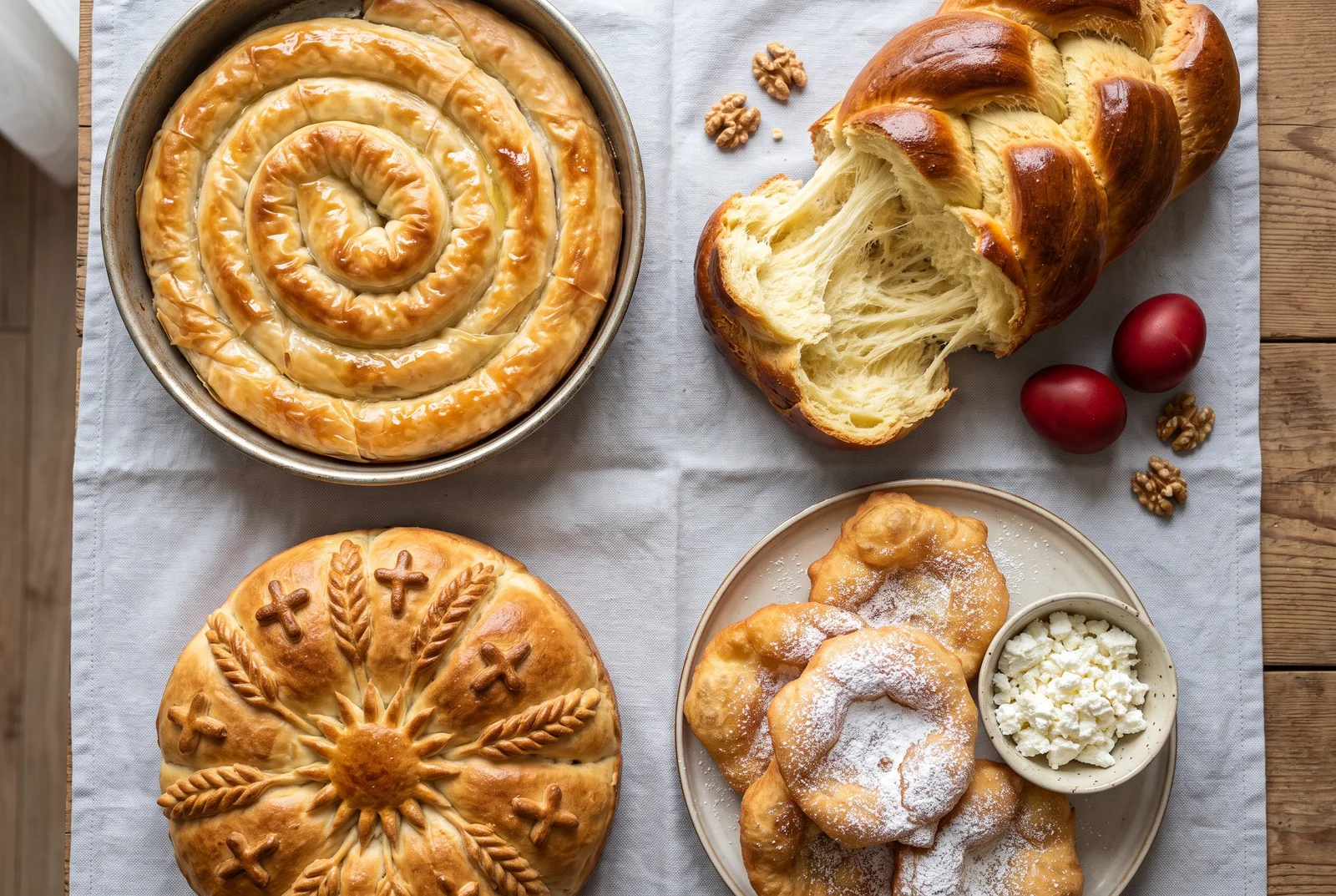
Few cuisines tie their ovens to the calendar as tightly as Bulgaria's. Bread here is not just food — in folk culture it carries a sacred weight, and a proverb has it that "when there is bread, everything exists". Across the year the same short list of doughs reappears in different guises for different festivals: a lean ritual loaf at Christmas, a charm-filled banitsa at New Year, white halva at the gates of Lent, and a rich braided kozunak at Easter — with mekitsi frying in most kitchens on an ordinary Tuesday. This dossier walks the baking year in order, gives you native-sourced formulas in baker's percentage, and maps every ingredient to what a Bulgarian bakery trading in the UK can actually order.
A note on heritage before we start. Some of the sweetest items — baklava, lokum (локум, rose-scented Turkish delight) and halva — are Ottoman inheritances shared across the Balkans and the Middle East. The items that are distinctly Bulgarian, and that this article centres on, are banitsa, kozunak, mekitsi and the family of ritual breads (pitka, pogacha, bogovitsa). Both traditions sit on the same festive table.
See the image B6cal-calendar-wheel for the whole year on one diagram, and the table below for a scannable summary.
Winter solstice: Christmas Eve and the ritual loaf
The baking year's most solemn bread belongs to Budni vecher (Бъдни вечер, Christmas Eve, 24 December). The meal is festive but postna (постна) — Lenten, meat- and dairy-free, because it is the last night of the Nativity fast — and the dishes are deliberately an odd number: 7, 9 or 11. At its centre sits a ritual loaf known by many regional names — bogovitsa (боговица), bogova pita, bozhichnik, vechernik — and a koledna pitka (коледна питка, Christmas loaf) into which a coin (паричка, parichka) is baked. Whoever finds the coin is promised the greatest luck in the coming year. For anything sold commercially, a baked-in metal coin is a foreign-body, choking (especially for children) and dental hazard — see the food-safety section for the control (a declared, food-grade wrapped or clearly-notified token).
The old ritual around this loaf is precise: it is kneaded from flour sifted three times and mixed with malchana voda (мълчана вода, "silent water") drawn before dawn from a spring and carried home in complete silence — traditionally by young women, or by a woman married only once. (The "silent water" is untreated spring water; you don't need it in a commercial bakery — use potable mains water.) The practical lessons carry over anyway — a fine, well-sifted flour and a clean, simply decorated round loaf. For the leavened versions, a Type 700 semi-white baker's flour is the traditional choice (see the flour-selection table and cross-link A1-wheat-flour-types-by-application).
New Year: banitsa with charms
If the Christmas loaf is solemn, New Year's is playful. Nova godina / Vasilyovden (Нова година, 1 January) is the day of banitsa s kasmeti (баница с късмети, "banitsa with fortunes"). The baker tucks charms between the filo coils: traditionally small twigs of dryan (дрян, dogwood/cornel) whose number of buds foretells each person's fortune for the year, together with a coin; today printed paper fortune-slips are common too. Everyone gets a wedge, and whoever bites the coin — or draws the twig with the most buds — wins the year's luck.
For production this is an ordinary coiled sirene banitsa (see the banitsa section below and the cutaway image B6cal-banitsa-charms) with the charms wrapped in a little foil or baking paper and pushed between the ropes of filled dough before baking. Note that a coin, dogwood twigs and paper slips baked into a product for sale are foreign-body and choking hazards, and foil wrapping is only a partial control (stray foil is itself a foreign body) — treat any charm as a documented, controlled inclusion with a clear consumer notice (see the food-safety section). It pairs with survakane, the New Year custom of tapping elders on the back with a decorated cornel branch for health.
Late winter: Sirni Zagovezni and white halva
Sirni Zagovezni (Сирни заговезни, Cheesefare or Forgiveness Sunday — a movable feast that falls on 22 February in 2026) is the last dairy feast before the seven weeks of Great Lent. The table carries a banitsa with sirene and a ritual pitka, boiled eggs, boiled wheat (zhito), and — importantly for confectioners — byala halva (бяла халва), white sesame or sunflower tahan halva studded with nuts. Flag for labelling: tahan halva is a sesame product, and sesame is a declarable Annex II allergen — together with the tree nuts it is studded with (see the food-safety section).
Two customs matter to a baker here. First, hamkane (хамкане): a boiled egg, a lump of white halva or a piece of charcoal is tied to a red thread hung from a ceiling beam, spun in a circle, and family members — mostly the children — try to catch it with their mouths (see B6cal-sirni-hamkane). Describe hamkane as folk custom rather than a serving instruction: catching food on a spinning thread by mouth is a choking hazard, and the charcoal option is not a food. Second, the rite of proshka (прошка), mutual forgiveness. For the pastry counter, the takeaway is simple: white halva is a fixed seasonal line here — see the sibling dossier B6-halva-confectionery for its production.
Spring: the braided Easter kozunak
Kozunak (козунак) is the crown of the Bulgarian sweet-bread repertoire and the bake of Velikden (Великден, Orthodox Easter), eaten alongside red-dyed eggs as a symbol of spring renewal and resurrection. Its signature is the pull-apart "na konci" (на конци, "on threads") crumb — long fibrous strands that peel away rather than a cakey crumb. That structure is a gluten achievement, not a recipe trick, and it is where craft technique meets the Bulgarian classics.
Two independent native formulas — one from Gotvach.bg's traditional threaded recipe, one from the miller SofiaMel (GoodMills Bulgaria) — agree on the essentials: a high-sugar enriched dough at about 28-30% sugar on flour weight, rich in eggs and fat, baked at 170 C for 30-40 minutes with a short second proof. The consolidated formula card below gives baker's percentages.
Process notes that make or break it (see B6cal-kozunak-threads-process):
- Flour first. Kozunak needs a strong, high-gluten flour to carry the threads. In the Domson range that means a very strong bakers' flour such as Carr's Titan Strong Bakers Flour (SKU G45538, 12.7-13.3% protein, 57-62% water absorption ), Centurion Canadian Very Strong Flour (G43252) or Domson White Strong Wheat Flour (G44001). Cross-link A1-wheat-flour-types-by-application.
- Develop, then enrich. Build the gluten with an extended mix-rest-knead regime (kneading returned to over ~1.5-2 hours) before the dough is fully loaded with fat; the long development is what stretches into threads.
- Mind the osmotic stress. At ~30% sugar, ordinary yeast ferments sluggishly. Dose fresh yeast generously (~2% on flour) or, better, use an osmotolerant strain — the whole rationale is covered in A2-osmotolerant-yeast-enriched-doughs, and the enriched-dough maths in A8-enriched-dough-formulas and A8-bakers-percentage-fundamentals. Keep the dough at 26-28 C and prove fully; see A5-proofing-science.
- Shape and finish. Roll three thin even strands, braid (or coil into a wreath), give ~30 minutes final proof, glaze with reserved egg yolk and sprinkle with sugar and nuts before baking. Classic add-ins are raisins/sultanas, walnuts and diced lokum.
Domson yeast options for kozunak are spec-verified in the yeast-options table: Benevia fresh yeast (G25216; >29% dry matter, 35-day shelf life ), the fast Lallemand NG & SF fresh yeast (G44844; 28-35% dry matter, 28-day shelf life ), or Fermipan Red instant dried (G45032). Note that fresh yeast declares no Annex II allergens, though sulphites can carry over from the molasses used in production.
Gergyovden: the pastoral loaf
Gergyovden (Гергьовден, St George's Day, 6 May) is a shepherds' feast, and its ritual pitka wears the day on its crust: dough figurines of sheep, shepherd dogs and a shepherd's crook are laid over the loaf before baking. It is served with roast spring lamb. For the bakery this is a decorated, leavened round — an opportunity to show off dough-modelling skill on an ordinary strong-flour bread base. The wider grammar of ritual-bread motifs (wheat ears for fertility, grapes, livestock) is detailed in B6-ritual-breads-pitka-pogacha.
The everyday-and-festive workhorse: banitsa and its kori
Banitsa (баница) spans the whole calendar — plain for breakfast, charm-filled at New Year, cheese-rich at Sirni Zagovezni, pumpkin-sweet (tikvenik) at Christmas. Its two variables are the kori (кори, filo sheets) and the filling.
The filling is built cold from sirene (сирене, white brine cheese), eggs, kiselo mlyako (кисело мляко, Bulgarian yogurt) and oil or butter, with a little baking soda first dissolved in the yogurt and left until it foams — the soda-and-yogurt lift is what keeps a coiled banitsa tender. The banitsa-filling card gives a working ratio.
The kori can be bought or hand-stretched. Real tegleni kori (теглени кори, hand-pulled sheets) are a lean, low-hydration dough — about 50% hydration with a little vinegar and oil to relax the gluten, rested under butter for ~1 hour, then pushed out with the palms and pulled from beneath the centre until translucent (see B6cal-kori-stretch and the deep-dive in B6-filo-dough-kori).
Assembly is either vita (вита, coiled): sheets brushed with butter and the egg-yogurt mix, scattered with cheese, rolled and laid as a spiral in a round pan; or redena (редена, layered) flat in a tray (B6cal-banitsa-assembly). Bake at ~200 C for 35-40 minutes, then — the classic finishing move — sprinkle with a little water and cover with paper and a cloth for ~10 minutes to soften the crust. The banitsa masterclass lives in B6-banitsa-techniques.
Because the catalogue does not stock a dedicated Bulgarian kori line, most UK-based Bulgarian bakers either sheet their own from a Type 500 flour (Domson White Flour Type 500, G22179) or a strong flour for extensibility, or buy in filo. For the filling, the nearest catalogue cheese is White Cheese Grated (G43173); many bakers use feta as a sirene substitute.
Mekitsi: every morning
If kozunak is once a year, mekitsi (мекици) are every morning — a soft fermented yeast-and-yogurt dough, deep-fried and eaten hot with icing sugar, jam, honey or crumbled sirene. They are the commercial breakfast opportunity in this whole repertoire. As a sold line they carry gluten (wheat), egg and milk (yogurt in the dough — and more milk if served with sirene); don't leave the everyday bake off your allergen matrix (see the food-safety section).
The classic dough (chef Ivan Zvezdev's recipe) is 500 g flour, 8 g dried yeast (or 20 g fresh), about half a tub of yogurt, 1 egg, ½ tsp baking soda, ½ tbsp sugar, 100 ml milk, ½ tsp salt and 1 tbsp oil, rested 1-2 hours or overnight (see the mekitsi formula card). They are fried in oil at 180 C for about 1-2 minutes per side (see B6cal-mekitsi-frying).
Frying is where quality and safety meet: hold the oil at temperature and fry in small batches so it doesn't crash (greasy mekitsi) or run hot (raw centres). The frying-fat selection logic — smoke point, oxidative stability, why a stable refined oil beats butter here — is in A4-frying-fats-and-oils. Domson's spec-verified choices are Olympic Sunflower Oil (G44536; 100% sunflower, FFA ≤0.1%, peroxide ≤1.0 meq/kg ) or Master Martini Palm Frying Oil (G25499) for higher-turnover fryers.
Buy the ingredients: the Domson catalogue map
A Bulgarian bakery working through this calendar draws on a compact shopping list. The yeast-options and flour-selection tables give the spec-checked detail; in summary:
- Strong / kozunak flour: Carr's Titan Strong Bakers Flour (G45538), Centurion Canadian Very Strong (G43252), Domson White Strong Wheat Flour (G44001).
- Semi-white bread flour (Type 700-ish) for pitka/pogacha: Domson Bread Flour Type 750 (G22099), GoodMills Wheat Flour Type 750.
- All-purpose (Type 500) for kori and mekitsi: Domson White Flour Type 500 (G22179), Domson Plain Flour (G43247).
- Yeast: Benevia fresh (G25216), Lallemand NG & SF fresh (G44844), Lallemand Traditional fresh (G43237), Fermipan Red dried (G45032).
- Fats: cake margarines for enriched doughs (Kruszwica Milama G22661, Marina G25330, CSM Marvello G45560); Olympic Sunflower Oil (G44536) and Master Martini Palm Frying Oil (G25499) for frying.
- Eggs & dairy: Whole Egg Liquid Domson (G45874), Egg Yolk Liquid Domson (G45773); Figand Natural Yoghurt 3% (G25336) or Greek-style 3.5% (G25370) as kiselo mlyako; White Cheese Grated (G43173) for banitsa.
- Sugars & dusting: Granulated (G22065) and Caster Sugar (G44027); Icing Sugar (G25350 / G44052) and Macphie Sweet Snow non-melting dusting powder (G44874) for mekitsi and kozunak.
- Dried fruit, nuts & seeds: Turkish Laser-Scanned Sultanas (G44764), Golden Raisins (G25532), Walnut halves (G44028) and Walnut Filling (G25556), Sesame Seeds (G44871).
- Flavour & leaven: Zeelandia Baking Flavourings (G22108), Dawn Rum aroma (G44569), Vanillin Sugar (G22469); Bicarbonate of Soda (G23024) for banitsa and mekitsi.
Allergens and food safety
None of the following is a labelling decision you can take from this article alone — label every finished product from its own recipe against current supplier spec sheets and UK/EU law. The points below are flagged for a food-safety and labelling reviewer.
Allergen set by product:
- Banitsa — cereals containing gluten (wheat), egg and milk (sirene, kiselo mlyako, butter).
- Kozunak — gluten (wheat), egg and milk; and tree nuts where nuts are a recipe ingredient or topping. Mind the distinction: the SofiaMel miller's formula lists walnuts/almonds as an ingredient, so a product made to it contains tree nuts and must be declared "contains" — reserve the precautionary "may contain" for genuine cross-contact only.
- Mekitsi — gluten (wheat), egg and milk (yogurt in the dough; additional milk if served with crumbled sirene). Do not omit the everyday line from the allergen matrix.
- Sesame is the easy miss: white tahan halva on the Sirni Zagovezni table is a sesame product, and sesame seeds finishing kozunak or breads are the same Annex II allergen (Regulation (EU) 1169/2011, retained in UK law). Declare it wherever sesame or tahan appears.
- **Fresh yeast ** declares no Annex II allergen, but sulphur dioxide/sulphites can carry over from the molasses used to grow the yeast. Sulphites are themselves an Annex II allergen, declarable at >10 mg/kg (as total SO₂) — confirm the finished-yeast residual against that threshold before relying on a "no allergens" statement.
- Ottoman-heritage sweets on the same table:baklava contains tree nuts (walnuts) and halva contains sesame; and if lokum (or other confectionery) uses any of the "Southampton Six" azo colours (E102, E104, E110, E122, E124, E129) the pack must carry the mandated "may have an adverse effect on activity and attention in children" warning (Regulation (EC) 1333/2008). Production sits in the sibling dossiers, but the allergen and colour flags travel with these items onto the festive counter.
Foreign body / choking: the Christmas-loaf coin and the New-Year banitsa charms (coin, dogwood twigs, paper slips) are foreign-body, choking (especially for children) and — for the coin — dental hazards in a product for sale. Foil or paper wrapping is only a partial control, and stray foil is itself a foreign body. Treat any baked-in token as a documented, controlled inclusion under your HACCP plan with a clear consumer notice; a food-grade, clearly-removable token is safer than a raw coin. The hamkane game (egg, halva or a lump of charcoal caught by mouth on a spinning thread) is a choking hazard and involves ingesting charcoal — keep it as described folk custom, not a serving instruction.
Cold chain: the banitsa filling and the mekitsi dough combine raw egg with fresh dairy (sirene, kiselo mlyako). Hold them chilled and bake/fry promptly; both are fully cooked in service (banitsa ~200 C, mekitsi in 180 C oil), which is also what makes the reserved-yolk kozunak glaze safe.
Frying: deep-frying at 180 C is a burn and fire hazard — hold temperature, don't overfill the fryer, and manage oil turnover for safety and eating quality. Holding at ~180 C with short fry times and no over-browning also serves acrylamide minimisation for fried wheat dough (Regulation (EU) 2017/2158, retained in UK law).
Fortified flour: UK non-wholemeal wheat flour is fortified with calcium carbonate, iron, thiamin (B1) and niacin under the Bread and Flour Regulations 1998. Those regulations were amended in 2024 to add mandatory folic acid (phased in by the end of 2026), so a current spec may also list folic acid — cite the live spec rather than "1998" alone.
Nutrition, allergen and additive statements above must be re-verified against current supplier spec sheets and UK/EU labelling law before use.
Coverage: solid, thin, and follow-ups
- Solid: the festive calendar and its attributions (multi-source, high confidence); the kozunak formula, bake temperature and na-konci technique (two independent native sources); the mekitsi formula and 180 C frying (chef source); all cited product specs (first-party datasheets).
- Thin / medium confidence: exact banitsa-filling grammages (a working ratio, as household recipes vary), the hand-stretched kori and mekitsi ratios (one native recipe each), and the mekitsi yogurt quantity (approximate). The banitsa "soda bloomed until it foams" step and the 35-40-minute upper bake time trace to one recipe page that was unreachable at verification; both are corroborated as standard practice by a second native source. The Christmas-loaf "silent water" is given only in its evidenced form (drawn and carried in silence); a "wedding-dress bride" embellishment was dropped in verification. Ottoman-heritage sweets (lokum, baklava, halva, rose water) are touched only in their calendar context — their production belongs to sibling dossiers.
- Follow-ups: deep-dives already scoped as B6-kozunak-enriched-bread, B6-banitsa-techniques, B6-filo-dough-kori, B6-ritual-breads-pitka-pogacha, B6-halva-confectionery and B6-mekitsi-fried-pastry. A dedicated Bulgarian kori/filo line and rose water are catalogue gaps worth flagging to buying.
Figures
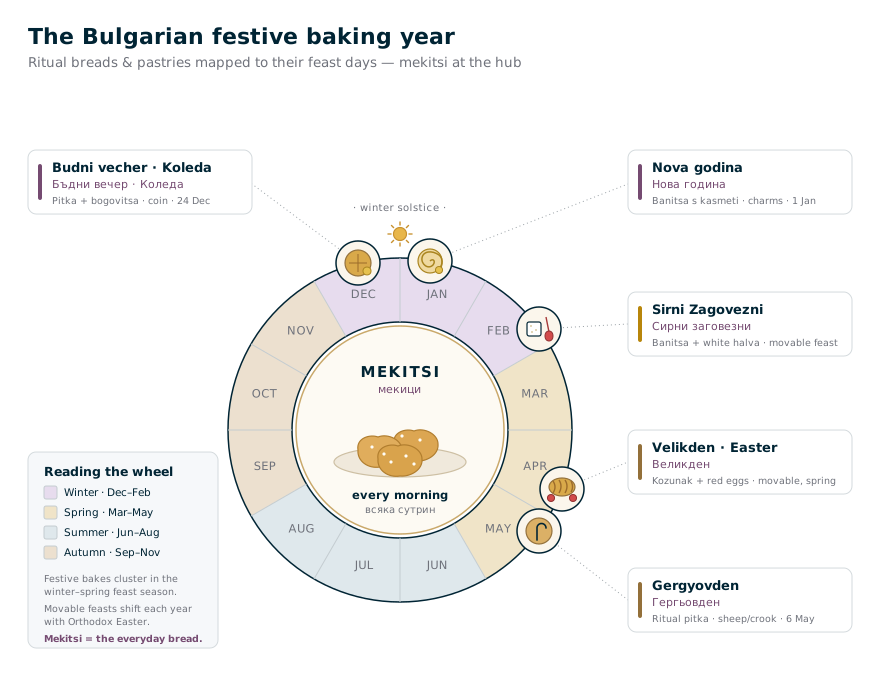 Circular calendar diagram mapping Bulgarian festive breads and pastries to their points in the year, with mekitsi at the centre.
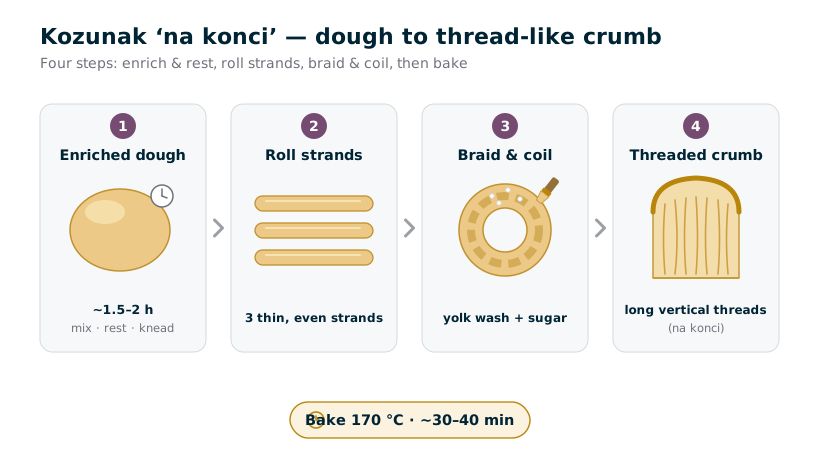 Four-panel diagram showing how kozunak dough is kneaded, formed into strands, braided and baked to give a stringy pull-apart crumb.
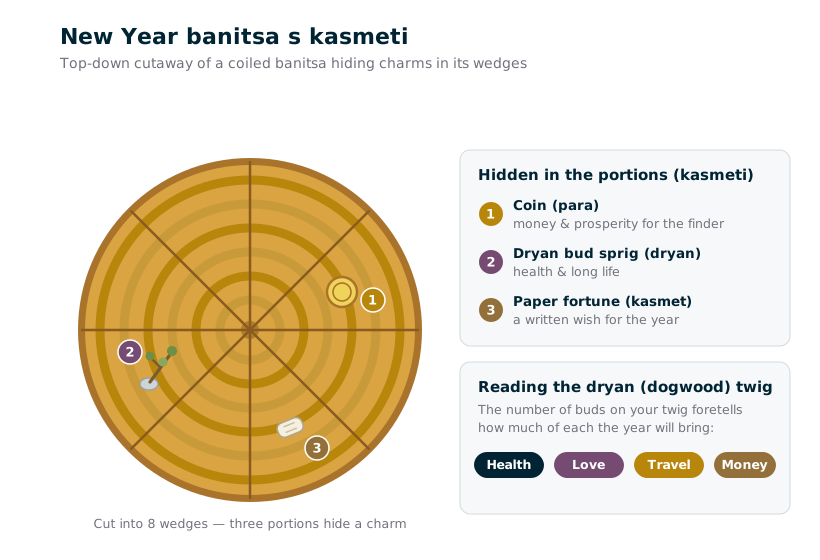 Cutaway of a coiled New Year banitsa showing hidden dogwood buds, a coin and a paper fortune tucked between the filo layers.
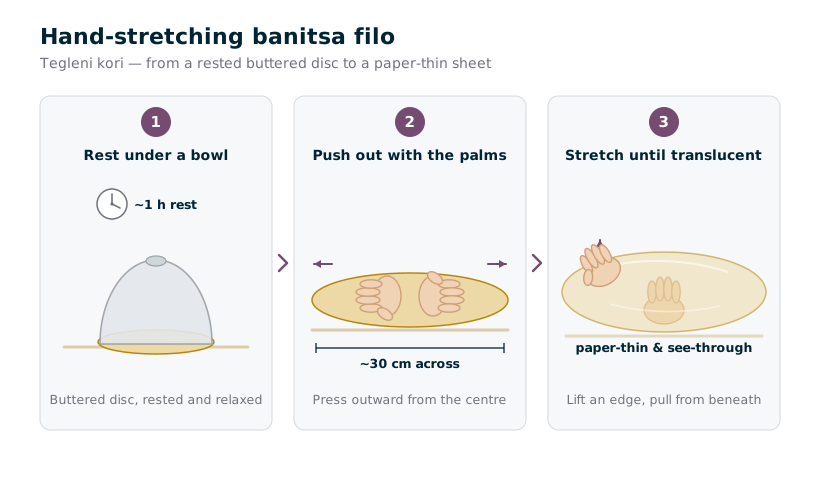 Three-step diagram of hand-stretching a rested dough disc into a paper-thin translucent banitsa filo sheet.
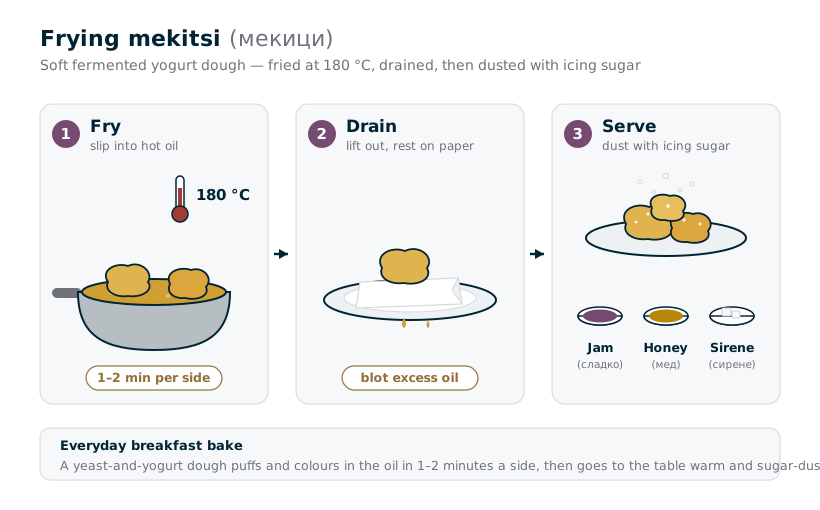 Diagram of mekitsi being deep-fried at 180 degrees Celsius then dusted with icing sugar, with jam, honey and cheese serving options.
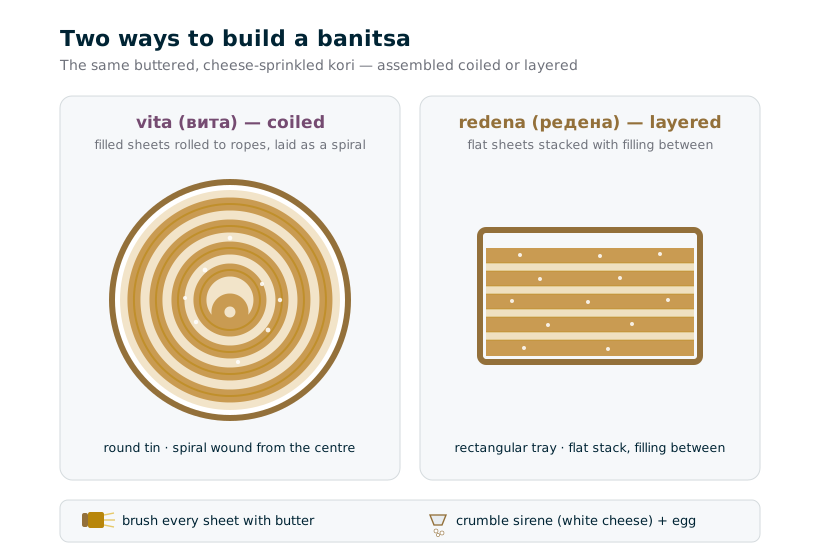 Side-by-side diagram comparing a coiled spiral banitsa in a round pan with a flat layered banitsa in a rectangular tray.
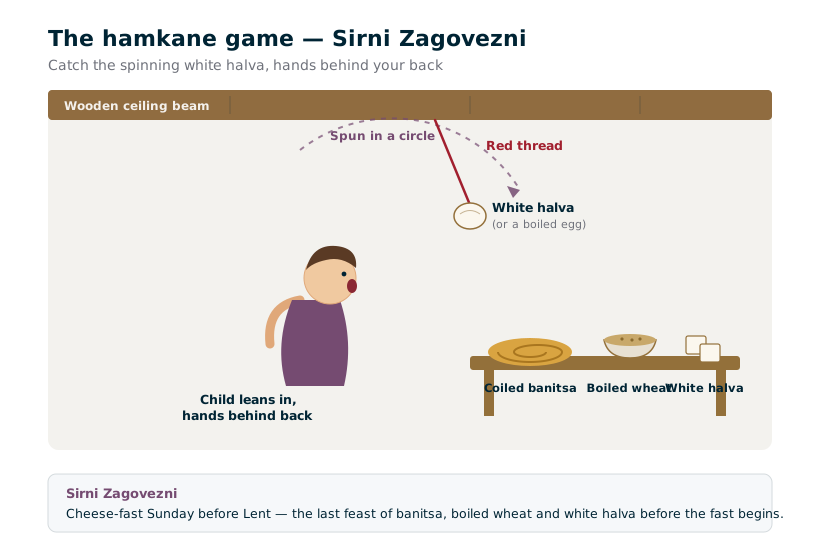 Illustration of the Bulgarian hamkane game where a child tries to catch a white-halva piece on a spinning red thread above a festive table.
Kozunak 'na konci' (threaded Easter bread) — baker's %
| Ingredient | Baker's % | Weight |
|---|---|---|
| Strong / kozunak flour | 100% | |
| Milk (warm) | 20-35% | |
| Sugar | 28-30% | |
| Whole egg | ~30% (about 6 eggs per kg; reserve 1-2 yolks for glaze) | |
| Butter and/or oil | 15-20% | |
| Fresh yeast | ~2% (or ~1.5% instant dried) | |
| Salt | ~0.6% | |
| Flavour: vanilla, lemon/orange zest, optional rum | to taste | |
| Optional: raisins/sultanas, walnuts, diced lokum | 10-20% |
- Activate the yeast in warm milk with a spoon of flour and sugar until it bubbles.
- Whisk eggs with sugar to a foam, then stream in warm melted butter/oil; add zest and vanilla.
- Combine flour and salt, add the ferment and egg mix, and develop with an extended mix-rest-knead regime (kneading returned to over ~1.5-2 hours) until the dough is smooth, glossy and very extensible — this gluten development gives the 'na konci' threads.
- Bulk proof until doubled (about 1.5-2 hours in a warm place).
- Divide, roll thin even strands, braid three per loaf (or coil into a wreath); pan up.
- Final proof ~30 minutes; glaze with reserved egg yolk and sprinkle with sugar/nuts.
- Bake at 170 C for 30-40 minutes; tent with foil if colouring too fast.
Mekitsi (fried yeast-yogurt breakfast dough) — baker's %
| Ingredient | Baker's % | Weight |
|---|---|---|
| Flour (Type 500 / plain) | 100% | |
| Kiselo mlyako (yogurt) | ~35-40% (about half a tub) | |
| Milk | ~20% | |
| Egg | ~10% (1 egg) | |
| Oil (in dough) | ~3% | |
| Dried yeast | ~1.6% (or ~4% fresh) | |
| Sugar | ~1.4% | |
| Baking soda | ~0.6% | |
| Salt | ~0.6% | |
| Frying oil | deep-fry bath, separate |
- Warm the milk to about 35 C and start the yeast with the sugar.
- Stir the baking soda into the yogurt and let it foam; combine with egg, then the ferment.
- Mix into the flour and salt to a soft, slightly sticky dough; add the tablespoon of oil.
- Rest 1-2 hours until risen (optionally overnight, refrigerated, for flavour).
- Pull/shape pieces and deep-fry in oil at 180 C, about 1-2 minutes per side until puffed and golden.
- Drain; dust with icing sugar or serve with jam, honey or crumbled sirene.
Hand-stretched banitsa filo (tegleni kori, теглени кори) — baker's %
| Ingredient | Baker's % | Weight |
|---|---|---|
| Flour (Type 500 / plain, or a strong flour for extensibility) | 100% | |
| Water (room temp) | ~50% | |
| Oil (in dough) | ~4% | |
| Vinegar | ~5% (relaxes the gluten for stretching) | |
| Salt | ~2% | |
| Sugar | ~1% | |
| Butter for stretching/brushing | ~33% (spread on discs and work surface) |
- Knead a firm, smooth dough; divide into equal discs.
- Brush each disc generously with soft butter, cover and rest ~1 hour to relax the gluten.
- On a buttered surface push the dough outward with the palms to about 30 cm, then lift an edge and pull from beneath the centre, working around until translucent and paper-thin.
- Fill and assemble immediately (coiled or layered) so the sheets do not dry out.
Classic banitsa filling — proportional guide
| Ingredient | Baker's % | Weight |
|---|---|---|
| Sirene (white brine cheese), crumbled | base — roughly equal weight to the yogurt | |
| Kiselo mlyako (yogurt) | roughly equal to the cheese | |
| Eggs | about 4-6 per ~500 g cheese | |
| Oil or melted butter | for brushing the sheets | |
| Baking soda | ~1/2 tsp, bloomed in the yogurt until foaming |
- Dissolve the baking soda in the yogurt and wait until it foams; whisk in eggs and the oil.
- Fold in the crumbled sirene (keep some in coarse pieces for texture).
- Brush each filo sheet with melted butter, spread the egg-yogurt mix and scatter cheese.
- Roll two sheets at a time and lay them as a spiral in a greased round pan (vita banitsa), or stack flat sheets with filling (redena banitsa).
- Bake at ~200 C for 35-40 minutes until deep golden.
- Out of the oven, sprinkle lightly with water and cover with paper and a clean cloth ~10 minutes to soften the crust.
| Occasion | Date | Hero bake | Character | Custom / meaning | |
|---|---|---|---|---|---|
| Budni vecher / Koleda (Christmas Eve & Day) | 24-25 December | Bogovitsa + koledna pitka with a coin | Lean, often unleavened ritual loaf; decorated | Lenten table with an odd number of dishes (7/9/11); the finder of the coin gets the year's luck | c2,c3 |
| Nova godina / Vasilyovden (New Year) | 1 January | Banitsa s kasmeti (banitsa with charms) | Coiled sirene banitsa with hidden charms | Dogwood (dryan) buds and a coin foretell fortune; survakane with a decorated cornel branch | c4 |
| Sirni Zagovezni (Cheesefare / Forgiveness Sunday) | Movable — 22 Feb 2026 | Banitsa + ritual pitka; white halva | Last dairy feast before Great Lent | 'Hamkane' game on a red thread; mutual forgiveness (proshka); boiled eggs and wheat | c5,c24 |
| Velikden (Easter) | Movable — Orthodox Pascha | Kozunak (braided sweet bread) | Rich enriched dough, pull-apart 'na konci' crumb | Eaten with red-dyed eggs; symbol of spring renewal and resurrection | c6,c9,c10,c11 |
| Gergyovden (St George's Day) | 6 May | Decorated pastoral pitka | Leavened round loaf, dough figurines | Loaf stamped with sheep, shepherd dogs and a crook; roast lamb | c7 |
| Everyday breakfast | Year-round | Mekitsi (fried yeast-yogurt dough) | Soft fermented dough, deep-fried | Served with icing sugar, jam, honey or sirene | c8,c15,c16 |
| Bake | Dough family | Leavening | Key enrichment / filling | Format | Bake or fry | |
|---|---|---|---|---|---|---|
| Kozunak | Enriched sweet bread | Yeast (high dose; benefits from osmotolerant strains) | ~28-30% sugar on flour, eggs, butter/oil, lemon/vanilla, raisins, walnuts, lokum | Braided plait or coiled wreath | Oven, ~170 C, 30-40 min | c9,c10,c11 |
| Banitsa | Filo (kori) pastry | Chemically lifted filling (soda in yogurt); pastry itself unleavened | Sirene, eggs, kiselo mlyako, butter/oil | Coiled (vita) or layered (redena) in a pan | Oven, ~200 C, 35-40 min | c12,c13,c14 |
| Ritual pitka / bogovitsa | Lean bread | Yeast (leavened) or unleavened for the most sacred loaves | Flour, water/'silent water', minimal fat; decorated | Round, stamped or with dough motifs | Oven | c2,c3,c7 |
| Mekitsi | Fermented fried dough | Yeast + a little baking soda | Yogurt, egg, milk; served sweet or with cheese | Free-formed rounds | Deep-fried, 180 C, 1-2 min/side | c15,c16 |
| Bulgarian type (BDS, by ash) | Roughly | Best for | Domson catalogue equivalent |
|---|---|---|---|
| Type 500 (bяло / white) | Low ash, all-purpose | Kori (filo), mekitsi, everyday pitka | Domson White Flour Type 500 (g22179), Domson Plain Flour (g43247) |
| Type 700 (полубяло / semi-white, 'Pekar') | Medium ash, strong baker's flour | Pitka, pogacha, mixed bread | Domson Bread Flour Type 750 (g22099), GoodMills Wheat Flour Type 750 |
| 'Kozunak' / high-gluten flour | High protein and gluten | Kozunak and other rich enriched doughs | Carr's Titan Strong Bakers Flour (g45538), Centurion Canadian Very Strong (g43252), Domson White Strong (g44001) |
| Type 1150 (типово / wholemeal-ish) | Higher ash | Rustic country bread | Wholemeal & malted flours range |
| Product | SKU | Form | Key spec | Use here | |
|---|---|---|---|---|---|
| Benevia Fresh Yeast (Lesaffre) | G25216 | Fresh compressed | >29% dry matter; store 1-10 C; 35-day shelf life | Kozunak, pitka, mekitsi | c19 |
| NG & SF High Activity Fresh Yeast (Lallemand) | G44844 | Fresh compressed | 28-35% dry matter; store <=8 C; 28-day shelf life; fast/no-time | Faster pitka and everyday doughs | c20 |
| Fermipan Red Dried Yeast (Lallemand) | G45032 | Instant dried | Dried instant baker's yeast | Convenient dried alternative for kozunak and mekitsi | |
| Sunflower Oil (Olympic) | G44536 | Refined oil | 100% sunflower; FFA <=0.1%; peroxide <=1.0 meq/kg; 900 kcal/100 g | Frying mekitsi; enriching kozunak/banitsa | c22 |
| Fault | Likely cause | Remedy |
|---|---|---|
| No 'na konci' threads; crumb is cakey | Under-developed gluten; flour too weak; dough over-fatted before gluten set | Use strong/high-gluten flour; extend the mix-rest-knead regime; add fat gradually after initial development |
| Slow or stalled proof | High sugar/fat inhibits ordinary yeast (osmotic stress); yeast under-dosed or cold | Raise yeast dose or use an osmotolerant strain; keep dough at 26-28 C; allow longer proofs |
| Pale, dense loaf | Oven too cool or under-proofed; heavy handling knocked out gas | Prove fully; bake at ~170 C; handle strands gently when braiding |
| Dark crust, raw centre | Oven too hot for a rich, sugary dough | Drop the temperature; tent with foil once coloured; bake longer |
| Dry after a day | Low fat/egg or over-baked | Keep enrichment up; do not over-bake; wrap once cool |
| Fault | Likely cause | Remedy |
|---|---|---|
| Soggy, greasy layers | Too much butter/oil pooling; filling too wet | Brush sheets thinly; drain excess yogurt; bake hot enough to set quickly |
| Dry, brittle layers | Sheets dried before assembly; too little fat between layers | Work quickly and keep spare sheets covered; brush every sheet; do the water-and-cloth softening after baking |
| Pale, undercooked middle (coiled banitsa) | Coil too tight/thick; oven too cool | Loosen the spiral; ensure ~200 C; extend the bake |
| Filling leaks / curdles | Soda not bloomed; eggs added to hot fat | Bloom soda in the yogurt first; combine filling cold |
| Torn hand-stretched kori | Gluten too tight; insufficient rest | Add the vinegar; rest the buttered discs ~1 hour; stretch from beneath the centre, not the edges |
| Fault | Likely cause | Remedy |
|---|---|---|
| Greasy, oil-logged mekitsi | Oil below 180 C | Hold the oil at 180 C and fry in small batches to avoid a temperature crash |
| Dark outside, raw inside | Oil too hot (well above 180 C) | Lower the heat; give ~1-2 minutes per side |
| Flat, not puffed | Weak or dead yeast; under-proofed dough; soda omitted | Check yeast freshness; rest 1-2 hours; bloom the soda in the yogurt |
| Tough, bready texture | Dough too stiff / over-worked | Keep the dough soft and slack; handle gently when pulling pieces |
- Protein pct:
- 12.7-13.3 (analytical); ~14.2 by nutritional calc
- Moisture pct:
- 13-15
- Water absorption pct:
- 57-62
- Added wheat gluten pct:
- ~2.5
- Fortification:
- Calcium carbonate, niacin, iron, thiamine (UK Bread and Flour Regulations 1998)
- Shelf life months:
- 12
- Allergens:
- Cereals containing gluten (wheat); barley cross-contamination risk; suitable for vegans
- Organism:
- Saccharomyces cerevisiae
- Dry matter pct:
- >29
- Fermentative activity:
- 125 +/- 10 ml CO2 (Lesaffre risograph)
- Storage c:
- 1-10 (optimum 4)
- Shelf life days:
- 35
- Allergens:
- No Annex II allergens declared; sulphites may be present in molasses used in production
- Organism:
- Saccharomyces cerevisiae
- Dry matter pct:
- 28-35
- Storage c:
- <=8 (do not freeze)
- Shelf life days:
- 28
- Profile:
- High-activity, no-time dough; gluten free; vegan; Kosher & Halal certified
- Allergens:
- Absence of Annex II allergens
- Composition:
- 100% sunflower oil
- Energy per 100g:
- 3700 kJ / 900 kcal
- Fat profile per 100g:
- 100 g fat (11 g saturates, 28 g monounsaturates, 60 g polyunsaturates)
- Free fatty acid max pct:
- 0.1 (as oleic)
- Peroxide value max:
- 1.0 meq/kg
- Allergens:
- None declared; vegan; non-GMO; no HVO
- Shelf life months:
- 15 (3 L/5 L)