Bulgarian halva: sunflower vs sesame tahan, nuga (white halva), production stages and quality markers
"Halva" in Bulgaria is two unrelated crafts, and a UK baker selling to Bulgarians has to keep them apart. The first is tahan halva (тахан халва) — a paste of hulled, roasted, stone-ground oilseed (тахан) that is roughly half oil, folded into a soapwort-aerated pulled sugar. Bulgaria's everyday version is made from sunflower seed (слънчогледов тахан), not sesame — a genuinely Balkan signature driven by the country's sunflower crop — while sesame (сусамов тахан) is the dearer classic. The second is the sugar family — нуга (nuga) and бяла халва (white halva) — an egg-white nougat, often pressed between wafer sheets. This dossier, built from Bulgarian-language producer, recipe, standards and cultural sources and cross-checked against the platform's supplier specifications, gives the authentic picture: the production stages (sugar+glucose syrup cooked to a ~120°C firm-ball stage with citric acid; a soapwort/чувен root extract whipped in to whiten and aerate; the tahan kneaded until it "strings" into fine threads — на конци; industrial finishing around 135°C); the quality markers a Bulgarian customer applies in one bite ("къса се на конци" and melts in the mouth); the sesame-vs-sunflower trade-off including the allergen advantage of sunflower; and the real regulatory catch — that soapwort (чувен), like Turkish çöven and Arab shirsh al-halawa, is not an authorised GB/EU food additive. It is wired to the Domson catalogue a Bulgarian halva kitchen actually orders (sesame and sunflower seed, sugar, glucose, egg albumen for nuga, cocoa, nuts, dark coating) and cross-linked to the Pillar A craft behind it (A6-sugar-work-techniques, A8-chocolate-confectionery-formulas, A7-seeds-nuts-toppings, A4-fat-types-and-selection) and to its sister traditions (B2-helva-sesame-tahini, B3-tahini-halva-and-sesame- confections, B6-oriental-sweets-baklava-lokum, B6-festive-baking-calendar).
Bulgarian halva: sunflower vs sesame tahan, nuga and the threads that prove it
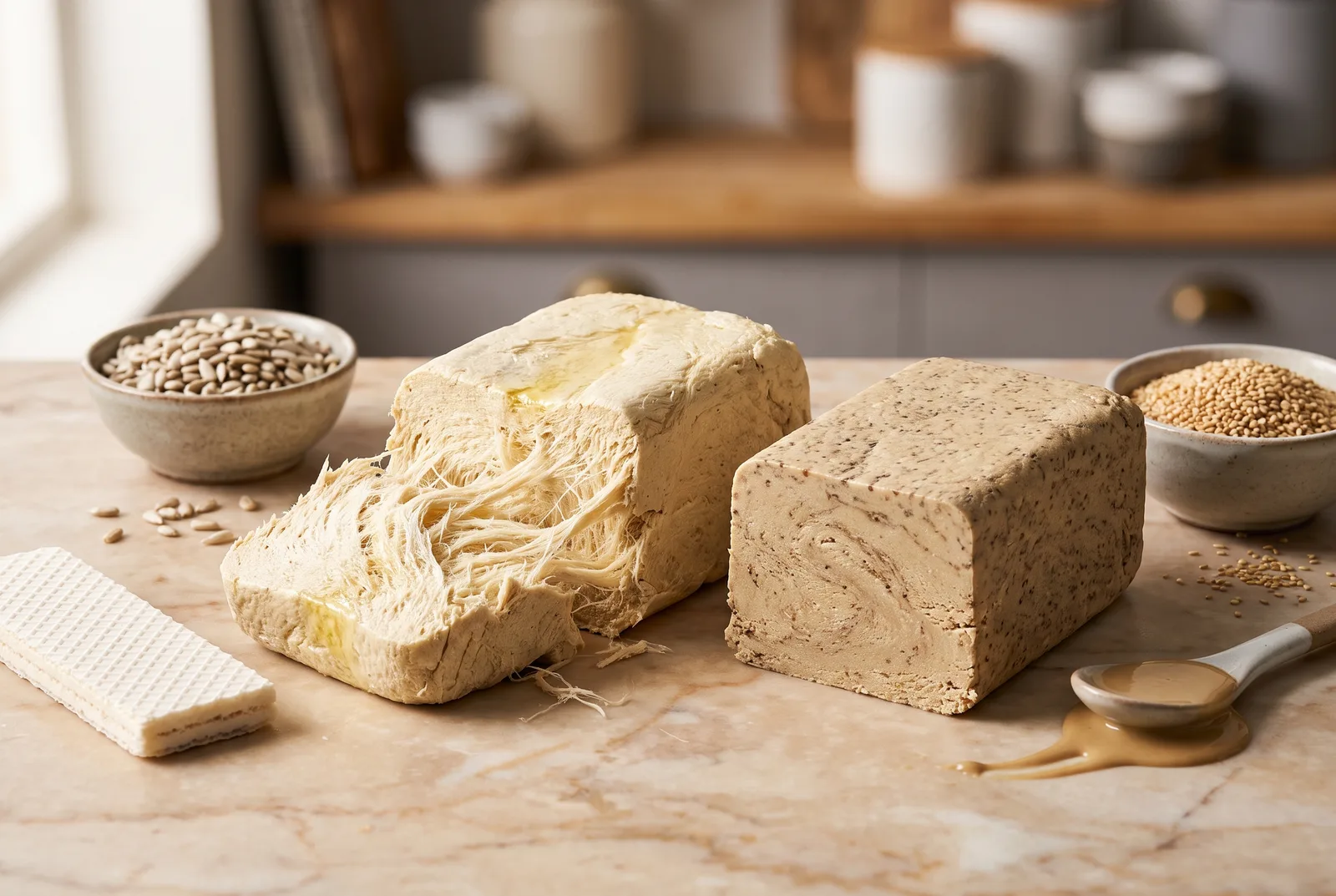
Ask a Bulgarian to judge a halva and they will do it in one bite: they break a piece and watch whether it pulls apart into fine threads — "къса се на конци" — and whether it then melts on the tongue. Get those two things right and you have made halva; miss them and you have made sweet paste. This dossier is about how a UK kitchen serving Bulgarian (and Romanian, and wider Balkan) customers gets them right — and about the one authenticity decision, the aerator, that also carries a real regulatory catch. (See the figure below — a cut block of sesame tahan halva showing the fibrous cross-section.)
A note on the word, honestly told. Halva (халва) is an Arabic word — from the root meaning "sweet" — that entered Bulgarian through Ottoman Turkish, and the sweet itself is part of the Ottoman-heritage confectionery Bulgaria shares with Türkiye and the Levant, historically made and sold by the halvadžija (халваджия), the halva-maker. You will read that halva "comes from Persia in the 5th century BCE"; treat that as legend, not documented history. Sell halva as the old Balkan/Ottoman sweet it is, and keep it in the same family as the baklava and lokum covered in B6-oriental-sweets-baklava-lokum.
1. Two things called "halva" — keep them apart
The single most useful fact for a buyer is that "halva" covers two unrelated crafts, and confusing them is how you disappoint a customer. (See the figure below.)
- Tahan halva (тахан халва) — the one most people mean. A paste of hulled, roasted, stone-ground oilseed (тахан, i.e. tahini-type paste) — either sunflower (слънчогледов тахан) or sesame (сусамов тахан) — is folded into a soapwort-aerated pulled sugar. It is aerated by a plant saponin, so it is vegan.
- Nuga (нуга) / white halva (бяла халва) — a sugar-and-glucose nougat aerated with egg white, usually pressed between two wafer sheets (вафлени кори). It is the torrone/montélimar family and it contains egg.
They share a shelf and a name; they do not share a base, an aerator, an allergen profile, or a fasting status. The comparison table below lays the whole contrast out.
2. Sunflower vs sesame: the choice that makes it Bulgarian
Here is the detail outsiders miss. In Türkiye and the Arab world, tahan halva means sesame (see B2-helva-sesame-tahini and B3-tahini-halva-and-sesame-confections). In Bulgaria, the everyday halva is sunflower — слънчогледова тахан халва — because sunflower is one of the country's big field crops, so the seed is local and cheap. Sesame halva is the dearer "classic"; sunflower is what most people grew up on. (See the figures below.)
Both pastes are roughly half oil, which is the whole reason halva behaves as it does (all that free oil has to be held in suspension — that is the aerator's job, Section 4). The platform's first-party seed specs make the trade-off concrete:
- Sesame (Global Grains hulled):631 kcal, 61.21 g fat and 20.45 g protein per 100 g, ~61% oil, moisture ≤6%, purity ≥99.9%, and — important — ethylene oxide <0.05 ppm (sesame is a high-risk import for the banned EtO fumigant, so buy to that certificate). It declares the sesame allergen, and hulling uses a sodium-hydroxide processing aid.
- Sunflower (Bioveri shelled):571 kcal, 48.4 g fat and 18.9 g protein per 100 g, ~48% oil, purity ≥99.95% — and it is grown partly in Bulgaria. Crucially it declares none of the 14 allergens: a sunflower halva is a genuine option for sesame-allergic customers, which a sesame halva can never be.
For milling tahan yourself you need a stone or colloid mill; the seed craft (wet-hulling by salt-water flotation, a moderate roast to a mid — not burnt — colour, and the fact that a separated oil layer in stored tahan is normal, not spoilage) is the seed-handling of A7-seeds-nuts-toppings, and the reason rancidity is the real shelf-life limit is the polyunsaturated-oil chemistry of A4-fat-types-and-selection — store cool, dry, dark and sealed. (See the figure below.)
Sourcing reality. Domson stocks the seed (sesame and sunflower) but not finished tahan paste. You either mill your own or buy ready tahan from a Turkish/Balkan importer.
3. The production stages of tahan halva
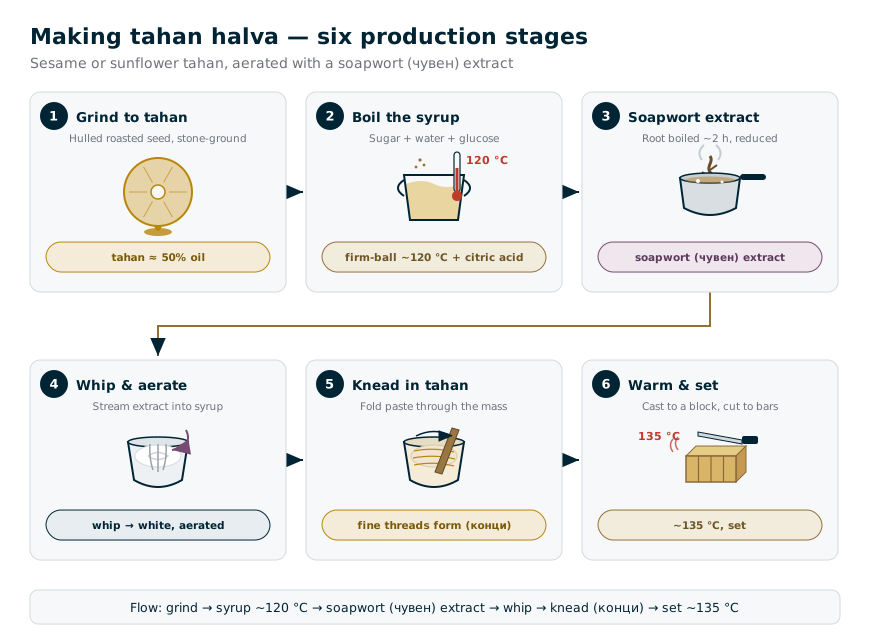
The build has a strict order, and each stage maps onto a Pillar A craft. (See the figure below; syrup work: A6-sugar-work-techniques.)
- Cook the syrup. Boil sugar + water + glucose to a dense ~120°C firm-ball stage (a drop forms a firm ball in cold water — note this is hotter than the classic ~110°C "thread" stage that some recipes loosely name), then stir in a pinch of citric acid and drop to low heat. The glucose and citric acid together stop the sucrose graining up — the same invert/anti-crystallisation logic as A8-chocolate-confectionery-formulas.
- Make the soapwort extract. Boil the soapwort (чувен) root for about 2 hours and reduce it to a small amount (~30 ml) of concentrated liquor.
- Whiten and aerate. Whip the syrup, then stream in the soapwort extract while beating hard until the mass turns white and fluffy. This is the pivotal step (Section 4).
- Knead in the tahan. Fold/knead the tahan into the aerated mass until fine threads (конци) form — "образуват се конците." Over-kneading makes it hard; stop as the strings appear.
- Finish and set. The mass is warmed/finished (one documented Bulgarian factory in Stambolovo, Ruse region, running ~1 tonne/day, works it at around 135°C and judges the mix by hand), then pressed into a block and left to set.
A worked ratio from a Bulgarian source: ~350 g tahan: 300 g sugar: 50 g glucose: ~30 ml soapwort extract : a pinch of citric acid, plus water for the syrup — i.e. tahan is about half the finished mass (see the formula card below).
4. Çöven's Bulgarian cousin: soapwort (чувен) — and the regulatory catch
The ingredient that turns paste-and-syrup into halva is the aerator, and the authentic one is a plant saponin. In Bulgarian it is чувен (also сапуниче, пенявец) — the saponin-rich roots of the soapwort family (Saponaria officinalis / Gypsophila spp., family Caryophyllaceae). Its saponins whiten, aerate and emulsify the mass: they beat air in, turn it white, build the fibrous crumb, and — the make-or-break function — hold the ~50% oil in suspension so it never weeps out. It is the very same "halva-root" saponin used as çöven in Türkiye (B2-helva-sesame-tahini) and as shirsh/'irq al-halawa in the Arab world (B3-tahini-halva-and-sesame-confections). (See the figure below and the comparison table below.)
A commercial Bulgarian label reads exactly this way — the RAHAT sunflower tahan halva declares слънчогледов тахан 50%, захар, отвара от чувен (soapwort decoction), лимонена киселина (citric acid), емулгатор (emulsifier), ароматизант: ванилия (vanilla). Many factories now also add an E-number emulsifier alongside or instead of the soapwort for the same emulsifying function.
The authenticity paradox. Used for its foaming/emulsifying function, a soapwort (чувен, Saponaria/Gypsophila) saponin extract meets the UK/EU definition of a food additive — but it is not an authorised additive in Great Britain or the EU. The only authorised saponin additive is quillaia extract (E999), from a different plant and permitted only in some drinks and cider/perry, not confectionery; soapwort saponins are also gastro-intestinally irritant in quantity. So although чувен is the authentic ingredient (and is used lawfully in halva made in Bulgaria/Türkiye), a UK-based maker should take regulatory advice before using it directly or before selling imported halva made with it — exactly the position set out for çöven and shirsh al-halawa in the sister articles. The egg-white route (Section 6) and permitted E-number emulsifiers are the lawful alternatives.
5. Quality markers and faults
A good tahan halva is judged by texture, not sweetness. It should:
- break into fine threads (на конци) and melt in the mouth — the sign it was properly whipped and kneaded;
- be slightly soft, homogeneous and free of gritty sugar crystals;
- show no weeping oil on the cut face.
The two classic failures are graininess (sucrose crystallised — fix with enough glucose + citric acid and by working the mass warm) and oil weeping (under-aerated — boil a stronger soapwort extract and whip to a fully white mass before adding the tahan). A dense, thread-less slab means the syrup was under-whipped or the tahan was folded in too hot or over-kneaded. The full diagnostic tree is in the fault table below.
6. Nuga (нуга) and white halva (бяла халва): the egg-white family
The other "halva" on a Bulgarian counter is a different confection entirely. Nuga — and the harder бяла халва — is a sugar-and-glucose nougat aerated with egg white, the torrone/montélimar family. (See the figure below.) The method: boil sugar + glucose + water to a very thick syrup, whip it into beaten egg whites (for commercial work, rehydrated pasteurised dried albumen — see the safety flag below) to a stiff white foam, fold in roasted nuts (peanuts around 8%, or walnuts), and spread the soft mass between two wafer sheets (вафлени кори) before cutting (see the formula card below).
For a UK bakery the practical aerator is dried egg-white powder. The platform's Ovopol albumen is hen egg white min 98.5% + citric acid, protein ≥80% (panel 82 g/100 g), 335 kcal/100 g; you rehydrate it 1:9 with water and 1 kg replaces ~316 fresh whites, with a 24-month shelf life. Note the consequence: nuga therefore carries the EGG allergen (and, from the wafer, gluten), whereas the soapwort-aerated tahan halva is vegan. That single difference matters for both labelling and fasting (Section 7).
Food safety — raw egg. In a nougat the egg-white foam is only partly cooked by the hot syrup (an Italian-meringue-style set), not reliably pasteurised. For any commercial batch, aerate with pasteurised dried egg albumen (the Ovopol powder above is a spray-dried, pasteurised albumen) rather than raw fresh egg whites, to control the Salmonella risk in an unbaked confection. Confirm your process against your own food-safety plan.
7. Halva on the calendar: Sirni Zagovezni and Lent
Halva is not only an impulse buy — it is a calendar fixture, which means predictable demand spikes you can plan production around (full context in B6-festive-baking-calendar).
- Sirni Zagovezni (Сирни Заговезни) — Cheesefare / Forgiveness Sunday, the seventh Sunday before Easter (in 2026, 22 February for the Orthodox), the eve of Great Lent — is the halva day. After the evening meal comes hamkane (хамкане, also лямкане/люскане): a boiled egg, cheese, a piece of coal and — since the late 19th century in the towns — a piece of white halva are tied to a red thread hung from the ceiling; the eldest man swings it and everyone, children especially, tries to catch it by mouth, no hands; the thread is then used to divine the year ahead. (See the figure below.)
- Because soapwort-aerated tahan halva has no animal products, it is a fasting (постно/Lenten) sweet — so it sells right through Great Lent and the Easter fast, and among Orthodox Romanian customers too (a link back to the fasting baking of B4-cozonac-de-post-vegan-baking). Nuga made with egg white is not Lenten — keep the two clearly separated on a fasting-season order.
8. Variants a customer will ask for by name
Merchandise the range Bulgarians recognise (see the comparison table below): обикновена/sade (plain), какаова (cocoa — cocoa blended into the tahan before the syrup), с ядки (with walnuts, pistachios, peanuts or pine nuts), ванилова (vanilla), and the нуга/бяла халва nougat lines. Premium tiers are the nut and chocolate-coated bars — for enrobing, see A6-chocolate-selection-couverture on couverture vs compound coating. Halva also sits comfortably beside the rose-water aromatics some makers use (B6-rose-water-culinary-use) and, as a sugar-paste confection, shares kinship with A6-marzipan-fondant-sugar-pastes.
9. Food safety and allergens
Halva is an allergen-variable category — declare per line, not per counter:
- Sesame tahan halva contains sesame (one of the 14 UK/EU allergens); buy sesame to an EtO certificate.
- Sunflower tahan halva carries no seed allergen — its main advantage — unless nuts are added.
- Nut-studded halva adds tree nuts and/or peanuts.
- Nuga / white halva adds egg (albumen) and, from the wafer, cereals/gluten, plus nuts — and, because the foam is only part-cooked, use pasteurised dried albumen rather than raw whites (Section 6).
- Cocoa or chocolate-coated lines can add milk and soya.
Separately, the traditional soapwort (чувен) aerator is not an authorised GB/EU food additive (Section 4) — a regulatory, not merely allergen, question. All allergen, additive and nutrition statements must be confirmed against your own finished-product testing, the current supplier specifications and current GB/EU law before any customer-facing label or claim. Nutrition is a wide band — a commercial 100%-sunflower halva reports 487 kcal, 21 g fat and 50 g sugars per 100 g, while a Bulgarian reference cites up to ~644 kcal (there quoted for the richer sesame type; independent sunflower products cluster nearer ~520–586 kcal) — so use a tested panel, not a web figure.
10. Buy the ingredients for this (Domson catalogue)
A UK Bulgarian halva kitchen builds the range from these stocked lines (full list at the end of this article):
- Tahan base:Sunflower Seeds 25 kg (Bioveri) — the everyday Bulgarian base, ~48% oil, no seed allergen, grown partly in Bulgaria — or Sesame Seeds 25 kg (Global Grains) for the classic sesame halva (~61% oil, EtO-certified). Bulk alternatives: Ros-Sweet sesame and Chelmer Foods sunflower.
- Syrup:Granulated Sugar 25 kg (sucrose ≥99.7%, 400 kcal/100 g, no allergens) or Kent Foods Caster Sugar 25 kg, plus Ratos Natura Glucose Syrup 14 kg as the anti-crystallisation binder.
- Nuga aerator & sweeteners:Ovopol Egg White Powder 20 kg (rehydrate 1:9) for the nougat foam; Ratos Natura Multifloral Honey 14 kg for a honey-nougat note.
- Flavour & inclusions:JAR Dark Dutch Cocoa GT78 for cocoa halva; PGD Roasted Peanut Halves, Walnut Halves, Giuso Pistachio Paste, Polmarkus Roasted Diced Pistachios and Kluman Shelled Almonds for nut lines.
- Coating:Terravita Bambo Prima Dark Compound Coating Flakes 20 kg for chocolate-enrobed bars.
Sourcing honesty. Domson stocks the commodities — seed, sugar, glucose, egg albumen, cocoa, nuts, coating — but not finished tahan paste and not soapwort (чувен) extract, the two things that most define authentic tahan halva. Mill your own tahan or import it; and treat soapwort as a regulatory question (Section 4) — the lawful UK alternatives are egg-white (for nuga) and permitted E-number emulsifiers.
Cross-links
Pillar A craft concepts: A6-sugar-work-techniques (syrup to the thread stage, aeration), A8-chocolate-confectionery-formulas (glucose/citric-acid anti-crystallisation, water activity, shelf life), A7-seeds-nuts-toppings (roasting sesame/sunflower, rancidity, allergen control), A4-fat-types-and-selection (the ~50% oil and why halva goes rancid), A6-marzipan-fondant-sugar-pastes (the sugar-paste family), A6-chocolate-selection-couverture (coating the bars). Sister Bulgarian articles: B6-oriental-sweets-baklava-lokum (the wider Ottoman-heritage sweet range and the halvadžija trade), B6-festive-baking-calendar (Sirni Zagovezni and Lent), B6-rose-water-culinary-use (aromatics). Cross-tradition halva cousins: B2-helva-sesame-tahini (Turkish tahin helvası, çöven), B3-tahini-halva-and-sesame-confections (Arab halawa tahiniyya, shirsh al-halawa).
Figures
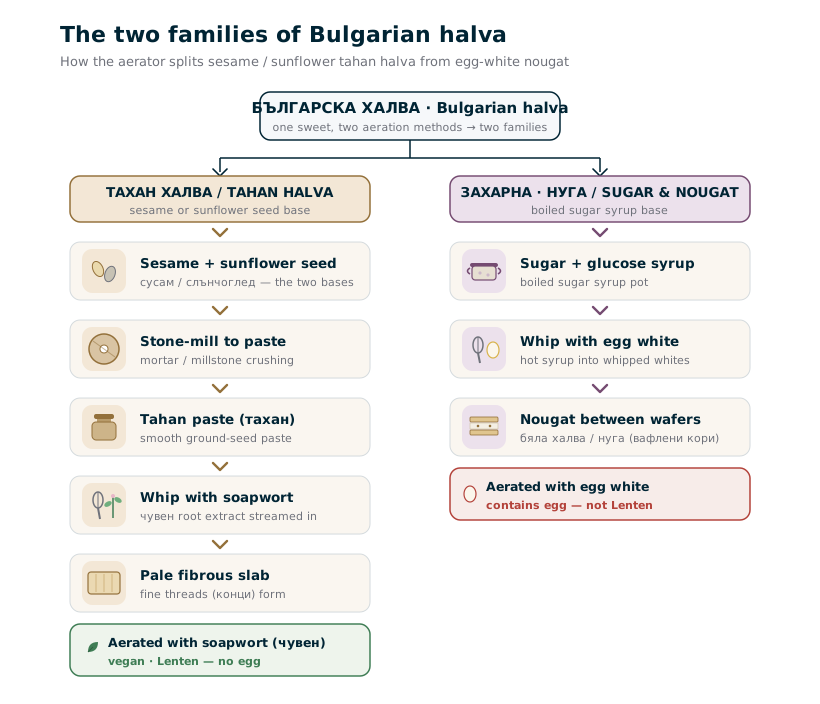 Diagram of the two Bulgarian halva families: soapwort-aerated tahan halva vs egg-white-aerated nuga
 Six-step process flow diagram for making tahan halva with a soapwort aerator
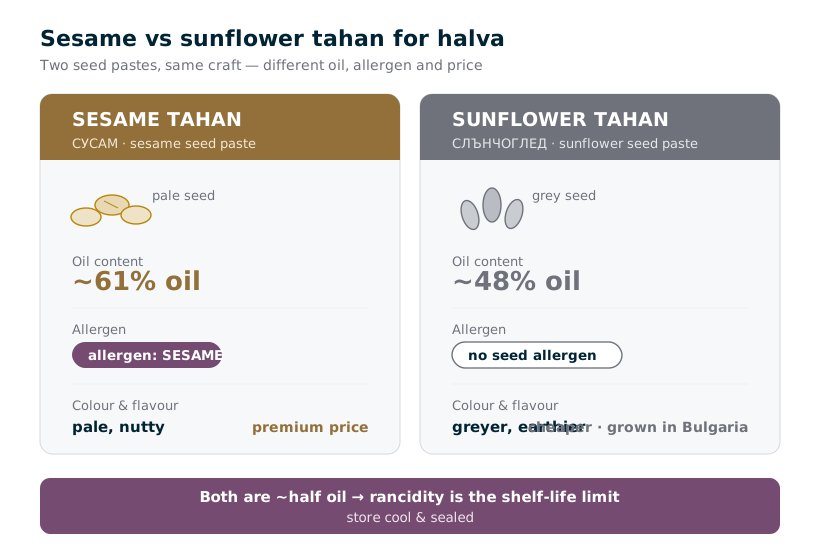 Comparison card of sesame tahan versus sunflower tahan for halva
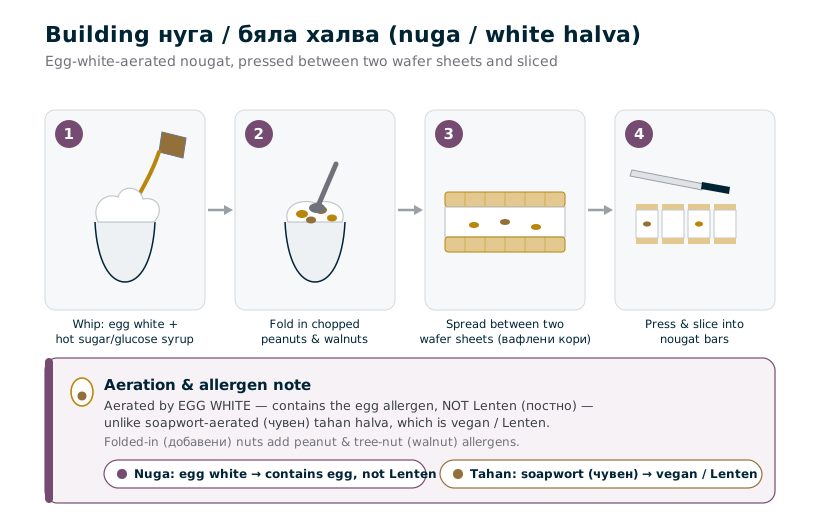 Diagram of nuga (white halva) built between two wafer sheets, aerated with egg white
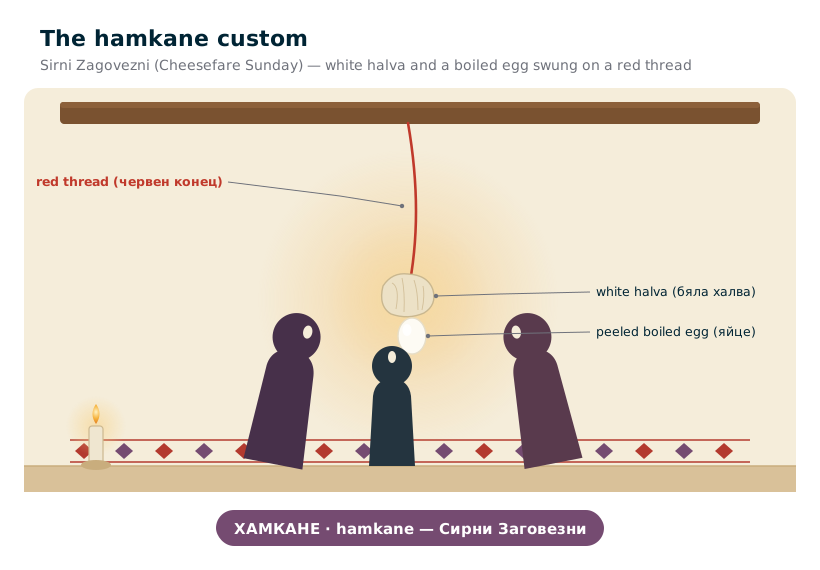 Illustration of the Bulgarian hamkane custom: white halva on a red thread at Sirni Zagovezni
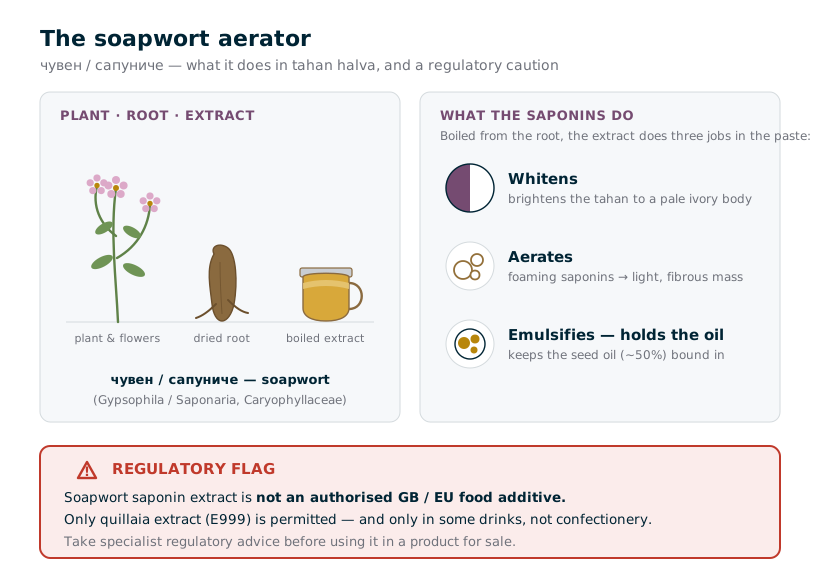 Card showing the soapwort plant, root and extract with its role and a UK/EU regulatory warning
Authentic tahan halva (sunflower or sesame) — soapwort-aerated
Total: Tahan is roughly half the finished mass
- 1) Boil sugar + water + glucose to a dense ~120°C firm-ball stage (a drop forms a firm ball in cold water — hotter than the classic ~110°C 'thread' stage some recipes loosely name); stir in a pinch of citric acid and drop to low heat. 2) Separately boil soapwort (чувен) root ~2 h and reduce to ~30 ml concentrated extract. 3) Whip the syrup, then stream in the soapwort extract while beating hard until the mass turns white and fluffy. 4) Fold/knead in the tahan until fine threads (конци) form. 5) Warm/finish (industrial ~135°C), press into a block and set.
Worked example
350 g tahan (слънчогледов or сусамов) · 300 g sugar · 50 g glucose · ~30 ml soapwort (чувен) extract · a pinch of citric acid · water for the syrup.
Glucose + citric acid stop the sugar graining up (see A6-sugar-work-techniques, A8-chocolate-confectionery-formulas). Vegan and Lenten. REGULATORY: soapwort extract is not an authorised GB/EU additive — see the flag and B2-helva-sesame-tahini / B3-tahini-halva-and-sesame-confections.
Home / small-batch tahan halva — egg-white aerated (soapwort substitute)
Total: Egg white replaces the soapwort foam
- 1) Whip the egg white with a pinch of salt to stiff peaks. 2) Boil sugar + water to the firm-ball stage (~120°C). 3) Stream the hot syrup into the whipping egg white (Italian-meringue style) to a stiff white foam. 4) Fold in the tahan. 5) Press into a lined tin and set.
Worked example
300 g sunflower tahan · 150 g sugar · 1 egg white (~20 g) · 40 ml water · pinch of salt.
This is the domestic workaround where soapwort is unavailable — it introduces the EGG allergen and makes the halva NON-Lenten, so it is not the same product as the vegan tahan halva sold in shops. Food safety: the hot syrup only part-cooks the egg white, so for any COMMERCIAL batch use pasteurised dried albumen rather than raw fresh whites (Salmonella control in an unbaked confection).
Нуга / бяла халва (nougat / white halva) with peanuts
Total: Egg-white nougat between two wafer sheets
- 1) Boil sugar + glucose + water to a thick syrup. 2) Whip the egg whites; stream in the hot syrup and beat to a stiff, white, fluffy nougat. 3) Fold in the roasted nuts. 4) Spread the soft mass between two wafer sheets, press, cool and cut.
Worked example
Sugar · glucose · water (boiled ~15 min to a very thick syrup) · rehydrated pasteurised dried egg albumen (fresh raw whites are a Salmonella risk in this part-cooked confection — commercial batches should use pasteurised albumen) · roasted peanuts (~8%) or chopped walnuts · vanillin; 2 wafer sheets (вафлени кори).
The torrone/montélimar family. Contains EGG and (from the wafer) GLUTEN plus nuts — declare all three. Food safety: the hot syrup only part-cooks (Italian-meringue-style) the foam, so use pasteurised dried albumen, not raw fresh whites. Dried albumen (Ovopol) rehydrates 1:9 with water; 1 kg ≈ 316 fresh whites.
The word халва covers two unrelated crafts in Bulgaria. Keep them apart — the aerator, the base, the allergens and the fasting status all differ.
| Тахан халва (tahan halva) | Нуга / бяла халва (nuga / white halva) | |
|---|---|---|
| Base | Ground roasted seed paste — сусамов (sesame) or слънчогледов (sunflower) тахан | Cooked sugar + glucose syrup |
| Aerator | Soapwort (чувен) root extract — saponins whiten/aerate/emulsify | Whipped egg white / dried albumen |
| Texture mark | Breaks into fine threads (на конци), melts in the mouth | Soft, chewy white nougat, usually between two wafer sheets |
| Allergens | Sesame type: sesame; sunflower type: none (unless nuts added) | Egg; plus gluten (wafer) and nuts |
| Fasting (Lenten)? | Yes — no animal products; the Sirni Zagovezni / Lent sweet | No — egg white makes it non-Lenten |
The choice that most defines Bulgarian halva. Both pastes are roughly half oil; sunflower is the everyday Bulgarian default. Seed figures are from the platform's first-party specs.
| Attribute | Sesame (сусамов тахан) | Sunflower (слънчогледов тахан) |
|---|---|---|
| Seed oil / fat | ~61% (631 kcal, 61.21 g fat/100 g) | ~48% (571 kcal, 48.4 g fat/100 g) |
| Seed protein | 20.45 g/100 g | 18.9 g/100 g |
| Seed allergen | SESAME (one of the 14) | None declared — safe for sesame-allergic customers |
| Colour / flavour | Paler, nutty, more aromatic | Greyer/earthier, distinct sunflower note |
| Cost & supply | Dearer; imported seed | Cheaper; sunflower is a major Bulgarian crop |
| Role in Bulgaria | The 'classic' / premium tahan halva | The most common, everyday halva |
Whitening and aeration are what turn a paste-and-syrup mix into halva. The traditional agent carries a real UK/EU regulatory question.
| Aerator | What it does | Allergen / label / regulatory |
|---|---|---|
| Soapwort extract — чувен / сапуниче (Gypsophila/Saponaria) | Saponins whiten, aerate and emulsify; holds the ~50% oil so it never weeps; gives the threaded crumb | Vegan; but NOT an authorised GB/EU additive — take legal advice (see flag) |
| Whipped egg white / albumen | Protein foam sets the white nougat body of nuga/бяла халва | EGG allergen; not Lenten; lawful and simple to use |
| E-number emulsifier (industrial) | Modern factory substitute/adjunct for the emulsifying function | Declared as 'емулгатор'; lawful; changes the 'natural' story |
Stock and merchandise for these; the nut and cocoa lines are the premium tier.
| Variant | What it is | Allergen note |
|---|---|---|
| Обикновена / sade (plain) | Plain sesame or sunflower tahan halva | Sesame (sesame type only) |
| Какаова (cocoa/chocolate) | Cocoa blended into the tahan before the syrup | Sesame; cocoa |
| С ядки (with nuts) | Walnuts, pistachios, peanuts or pine nuts folded in | Adds tree nuts / peanuts |
| Ванилова (vanilla) | Vanilla-flavoured | As base |
| Нуга / бяла халва | Egg-white nougat, often wafer-sandwiched, with peanuts/walnuts | Egg; gluten (wafer); nuts |
| Fault | Likely cause | Remedy |
|---|---|---|
| Gritty / sugary (crystallised), not smooth | Too little glucose/citric acid; syrup crystallised; over-worked | Add glucose and a pinch of citric acid to invert some sucrose; work the mass warm, not cold |
| Oil weeps / greasy surface | Under-aerated — not enough soapwort saponin to emulsify the ~50% oil | Boil a stronger soapwort extract and whip longer to a fully white mass before adding tahan |
| Dense, no threads (не се къса на конци) | Under-whipped syrup; tahan folded in too hot or over-kneaded | Whip to a light white foam first; fold tahan at the right temperature, stop as threads appear |
| Bitter / burnt note | Seed over-roasted, or syrup caught/caramelised too dark | Roast seed to an even mid colour; cook syrup to the firm-ball stage (~120°C), not beyond |
| Rancid / stale-oil smell in storage | Polyunsaturated seed oil oxidised (warm, light, air) | Store cool, dry, dark and sealed; rotate stock; buy to a fresh-oil spec |
| Nuga too hard / too soft | Syrup cooked too far / not far enough; egg-white foam collapsed | Cook syrup to the correct thick stage; keep the meringue stiff and warm while combining |
| Nuga sticky, won't hold shape | Humidity pickup; too little glucose control | Sandwich between wafer sheets; wrap airtight; balance sugar:glucose |