
Banitsa masterclass: filo layering methods, sirene-egg-yogurt filling ratios and baking parameters for the ultimate Bulgarian cheese pastry
Banitsa (баница) — a coiled or layered filo cheese pastry — is Bulgaria's defining daily bake and its New Year centrepiece, and a UK Bulgarian baker will be judged on it in a single bite. This dossier, built from Bulgarian-language recipe, trade and standards sources and cross-checked against the platform's supplier specifications, gives the authentic picture: the three assembly methods (redena/layered, vita/coiled, smesena/mixed); the classic filling ratio (roughly 500 g kori: 300–350 g sirene: 400–500 g kiselo mlyako: 3–4 eggs: ~150 ml fat: 1 tsp bicarbonate of soda); why the yogurt-acid-plus-soda reaction and the sparkling-water trick give the light, juicy interior; the baking window (180°C fan / 200°C conventional, ~30–40 min); the difference between Bulgarian sirene and Greek feta and how to substitute; kori sourcing from hand-stretched to machine-sheeted (≥0.15 mm); and the regional and festive variants (tikvenik, mlechna banitsa, zelnik, and the New Year banitsa s kasmeti with dogwood-and-coin fortunes). Every technique is wired to the Domson catalogue a Bulgarian kitchen actually orders (strong white flour, 82% butter, sunflower oil, yogurt, white cheese, liquid egg) and cross-linked to the Pillar A craft concepts behind it (A6-laminated-dough-fundamentals, A5-baking-oven-science, A4-fat-types-and-selection, A1-protein-gluten-and-strength, A2-chemical-leaveners-baking-powder, A8-bakers-percentage-fundamentals) and to its sister Bulgarian articles (B6-filo-dough-kori, B6-dairy-in-baking, B6-flour-types-milling, B6-festive-baking-calendar).
Banitsa: the layered cheese pastry Bulgaria measures its bakers by
Ask a Bulgarian what they miss most from home and banitsa (баница) will be on the short list. It is the pastry of the everyday breakfast, of the New Year's Eve table, of the name-day and the funeral wake. For a UK bakery serving a Bulgarian community, it is also the single most scrutinised product you can put in the case: everyone's grandmother made it, everyone has an opinion, and a soggy or bland one is noticed immediately. The good news is that banitsa is not hard once you understand what each component is for. This dossier takes you from the name and the three builds through the sirene-egg-yogurt filling, the fat choice, the kori (filo sheets) and the oven, to the regional and festive variants a Bulgarian customer will ask for by name.
Authenticity note on the name. Banitsa is a Slavic word, not a Turkish loanword. The Institute for Bulgarian Language (Bulgarian Academy of Sciences) traces it through Proto-Slavic *gybanica > *gbanica > banitsa, from the Indo-European root *gheub(h)- "to bend, to fold" — a direct reference to how the leaves are bent and wrapped. Dialects preserve the older form (гибаница in the Vidin region, гибайница elsewhere), and Serbian keeps the cognate гибаница. By contrast, baklava and byurek (бюрек) are genuinely Turkish-origin names, and plakenda, langida and mastopita are Greek. Banitsa sits in the same Balkan filo family as Turkish börek (see B2-borek-phyllo) and Greek/Arab phyllo work (B3-phyllo-kataifi-production), but its name and its dairy identity are its own.
A word on history, honestly told: you will read online that banitsa was "documented in the 10th century." The Bulgarian History Foundation, reviewing the evidence, states plainly that there is no reliable record of the pastry's early history — what is certain is that it is old and sits at almost every point of the folk calendar (Easter, St Peter's Day with fresh cheese, Christmas Eve, New Year). Sell it as an ancient, living tradition; don't attach a false date to it.
(See the hero figure above: a golden baked banitsa with a glass of yogurt, the classic pairing.)
1. The three builds: redena, vita, smesena
Every banitsa is one of three assemblies. Choose by labour and by look — the filling barely changes. (See the assembly diagram below.)
- Redena (редена) — layered. Loosely scrunched "roshavi" (ruffled) sheets are laid flat in an oiled tray and alternated with ladles of the egg-yogurt-sirene mixture, layer on layer, finishing with a fat-brushed top. This is the fastest, most forgiving, most production-friendly build — the one to reach for when you are filling trays for a case. (See the figure below.)
- Vita (вита) — coiled/rolled. A sheet is brushed with fat, a second laid on top, filling piped in lines, then the whole thing rolled into a long cylinder and coiled into a spiral — на охлюв, "like a snail" — in a round tray. It is the show-piece build and the one that gives pull-apart portions.
- Smesena (смесена) — mixed. A layered base, a few rolled sheets through the middle, a layered top. This family also includes the klin (клин — a square sheet folded into a triangular wedge) and the mantiya (мантия — a large sheet draped over the filling), both regional/household forms.
The redena/vita choice is the banitsa equivalent of the lamination decisions covered in A6-laminated-dough-fundamentals — but note the important difference: banitsa is not laminated dough. There is no butter block folded into a dough and no gluten-layer/fat-layer structure built by rolling. Banitsa is assembled lamination: pre-made thin sheets stacked with fat brushed between them. The crispness comes from many thin sheets each sealed by a film of fat and dried by oven heat, not from a rolled-in fat that steams the layers apart. Keep that mental model and the faults become obvious.
2. The filling: sirene, egg, yogurt and the soda reaction
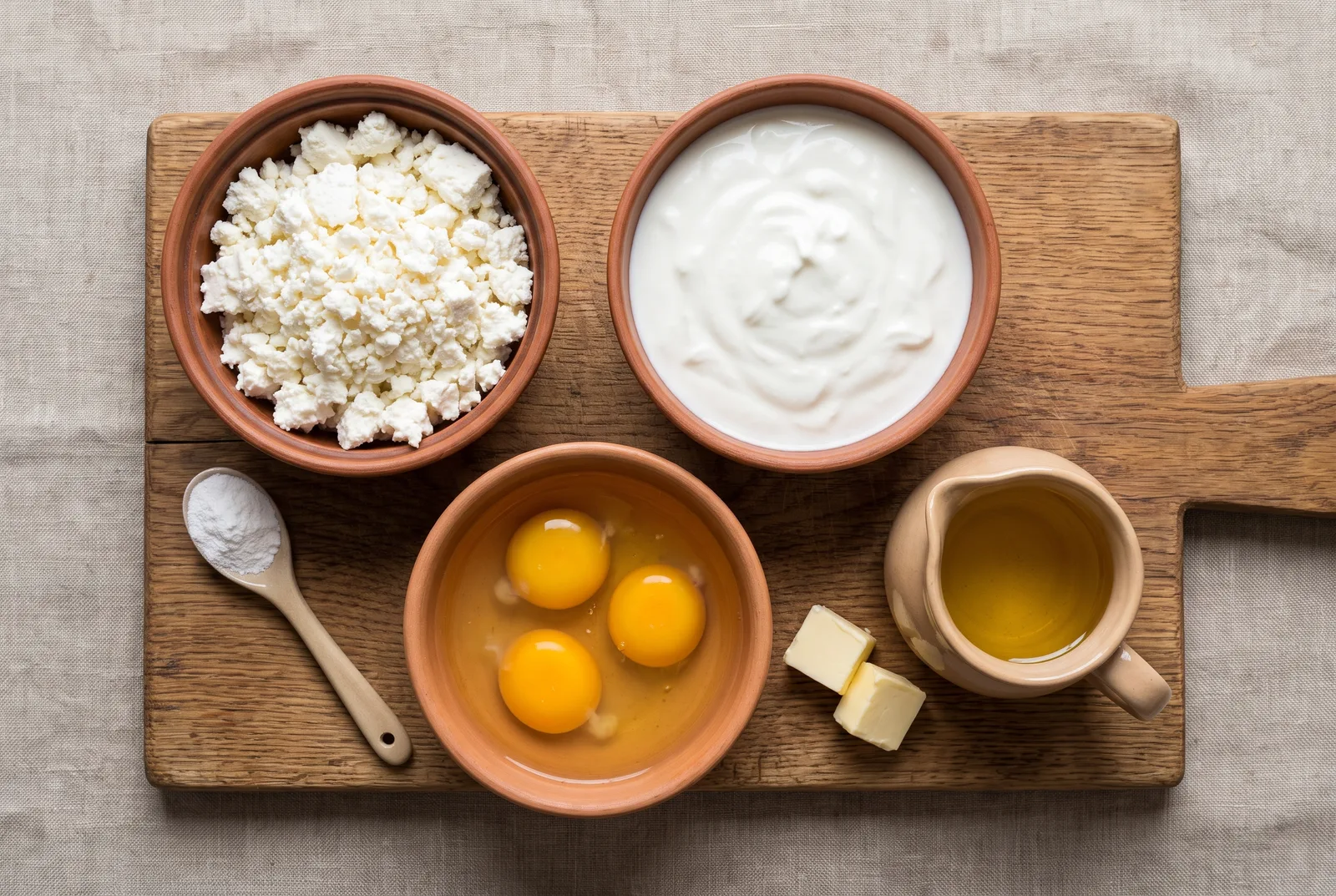
The soul of a classic banitsa is a loose, pourable mixture of egg, Bulgarian yogurt and crumbled white cheese, lifted with a little bicarbonate of soda. A reliable working ratio, cross-checked across several Bulgarian recipe authorities, is:
≈ 500 g kori: 300–350 g sirene: 400–500 g kiselo mlyako: 3–4 eggs: ~150 ml fat: 1 tsp bicarbonate of soda (see the ratio infographic below and the formula card below).
Mixing order matters. Beat the eggs first; whisk in the yogurt until smooth; stir in the bicarbonate of soda and the oil; and fold in the crumbled sirene last, so it stays in distinct nuggets rather than dissolving into paste.
Why the soda. Bulgarian kiselo mlyako (кисело мляко) is properly acidic — the national standard BDS 12 defines it as milk fermented with Lactobacillus delbrueckii subsp. bulgaricus and Streptococcus thermophilus. That lactic acid does two jobs in the filling: it reacts with the bicarbonate of soda to release CO₂ (a gentle chemical lift that tenderises the layers), and its water flashes to steam in the oven to keep the interior moist. This is the same acid-base chemistry set out in A2-chemical-leaveners-baking-powder, and the steam-and-set behaviour of A5-baking-oven-science. For the full functional role of Bulgarian dairy in the bakery, see B6-dairy-in-baking.
The sparkling-water trick. Many Bulgarian bakers add газирана вода (sparkling/carbonated water) to the mixture — sometimes as much as ~500 ml in a vita formula — and/or spritz the assembled banitsa with it before baking. The dissolved CO₂ and the extra steam give a noticeably lighter, fluffier interior while the outside still crisps. It is cheap, authentic, and the single easiest upgrade to a heavy banitsa.
On salt — a food-safety and seasoning point. Do not add salt to a cheese banitsa until you have tasted it. Bulgarian white brined cheese under BDS 15:2010 carries up to 3.5 ± 0.5% salt, which is usually all the seasoning the filling needs; the same figure is why banitsa should be counted as a high-salt line for nutrition labelling.
3. Sirene vs feta: get the cheese right
This is where authenticity is won or lost, and where a UK baker most often goes wrong. Bulgarian sirene (сирене) is not the same product as Greek feta.
- Milk: Greek feta is a PDO cheese made chiefly from sheep's milk (up to 30% goat's). Bulgarian sirene under BDS 15:2010 can be cow, sheep, buffalo, goat or mixed — and in practice is most often cow's milk.
- Texture and flavour: sirene is softer, creamier and milder/less tangy than feta; it holds together but still crumbles. Its casein/fat ratio is standardised (0.70–0.73 for cow and goat; 0.64–0.66 for sheep and buffalo), fat-in-dry-matter carries a minimum of about 44% (cow/goat) to 48% (sheep/buffalo) (the standard sets a floor, not a 40–50% band), dry matter is ≥46%, and it is matured ≈45 days in brine for cow's-milk sirene — the most common type — rising to ≈60 days for sheep, goat, buffalo or mixed-milk cheese.
- Substitution for a UK kitchen: use real Bulgarian sirene if you can source it. If you cannot, a cow's-milk feta-style white cheese is the closest substitute — its milk base matches sirene better than a sheep's-milk cheese does. Note the legal point, and the wording trap: genuine feta is a Greek PDO product made from sheep's (plus up to 30% goat's) milk and is never cow's milk, so a cow's-milk cheese is a feta-style analogue that cannot legally be labelled "feta" at all. In the Domson range the nearest stocked analogue is a grated white cheese (see the products at the end of this article), which you crumble/grate into the filling.
(See the figure below.)
4. The fat between the sheets
After the cheese, the brushing fat is the biggest lever you have — it decides crispness, colour, flavour and cost. This is a direct application of A4-fat-types-and-selection.
- Sunflower oil is the traditional Bulgarian choice: lightest and crispest sheets, neutral flavour, spreads thinnest, cheapest per tray, and vegan-friendly. The platform's sunflower oil is 100% sunflower, 900 kcal/100 g, with no declared allergens.
- Melted butter gives the richest flavour and the deepest golden crust, but sets firmer when cold. The platform's 82% unsalted butter is 744 kcal/100 g with 55 g saturated fat/100 g; it carries the milk allergen. Store at 0–10 °C and use within 60 days of production.
- A 50/50 oil-and-butter blend is the common professional compromise: butter flavour with the crispness and workability of oil. Around 150 ml of total fat per ~500 g of kori is a typical dose.
Brush thinly and evenly — pooled fat, not a thin sealing film, is the classic cause of a greasy, dense banitsa. For a butter-/puff-dough banitsa (a richer, less common style), a puff-pastry margarine is the roll-in fat and the oven runs hotter (below).
5. The kori (filo sheets)
Kori (кори) are the thin sheets. How you get them defines your product and is the subject of its own deep-dive, B6-filo-dough-kori. In brief:
- Hand-stretched tocheni kori (точени кори) are the craft benchmark — a rested wheat dough pulled by hand over a floured cloth until it is translucent and sub-millimetre thin. This needs a strong, extensible white flour: enough protein to take the stretch without tearing, enough extensibility to thin out. The platform's Domson Strong White (ADM 4380) fits — protein 12.0% (N×5.7; range 11.8–12.4), water absorption 59.5%, moisture 14.2%, per its first-party supplier datasheet — and is a reasonable approximate analogue for Bulgarian Type 500 flour. Treat that equivalence loosely: the Bulgarian Type number classifies flour by ash/extraction (Type 500 ≈ 0.5% ash), not by protein, so a UK strong white is matched to it on whiteness/grade rather than as an exact legal equivalent (see B6-flour-types-milling and the strength concepts in A1-protein-gluten-and-strength / A1-wheat-flour-types-by-application). A softer Type 550 can be used where you want more extensibility and less snap-back. (See the figure below.)
- Ready "gotovi kori" (готови кори) — packaged machine-made sheets, chilled or frozen — are what most bakeries use day to day: even thickness, consistent, fast.
- Industrial machine-sheeted lines (e.g. Bulgarian equipment makers) produce continuous kori down to ≥0.15 mm for high-volume frozen-banitsa manufacture.
Whichever you use, keep unused sheets covered with a barely-damp cloth so they don't dry and crack — the same handling discipline as any phyllo work (B3-phyllo-kataifi-production).
6. Assembly and baking
Redena (tray) assembly. Oil the tray. Lay 2 loosely scrunched sheets, ladle over ~1 ladle of the egg-yogurt-cheese mixture, then repeat sheets + mixture to the top. Brush the top with fat; optionally spritz with sparkling water. The scrunching ("roshavi") is deliberate — the ruffles trap fat and air and give the crisp, craggy top.
Vita (coil) assembly. Brush a sheet with fat, lay a second on top, spread 3–4 tbsp of filling in lines, roll tightly into a cylinder, and coil into an oiled round tray as one continuous spiral. Pour a reserved egg-yogurt-sparkling-water mix over, brush the top with butter, and bake.
The oven. The standard window, consistent across Bulgarian sources, is 180 °C fan (≈200 °C conventional) for ~30–40 minutes, to a crisp, deep-golden crust; rotate the tray once for even colour. Butter-/puff-dough banitsa is baked hotter and faster — 230–250 °C for ~20–25 minutes — and yeasted-dough versions sit at 200–240 °C. What is happening in the oven is exactly the sequence in A5-baking-oven-science: the fat-sealed sheets dry and crisp, the yogurt water and sparkling-water CO₂ steam the interior, and Maillard browning colours the top (butter browns best). Pull it when it is crisp and golden, not when it is merely set — an under-baked banitsa is a soggy banitsa.
See the fault table below for the full soggy/dry/pale/salty diagnostic tree.
7. Regional and format variants a customer will ask for
Bulgarian customers order banitsa by type. Stock and merchandise for these (see the regional map below):
- Tikvenik (тиквеник) — sweet pumpkin banitsa: grated pumpkin, sugar and crushed walnuts, rolled and coiled like a vita. An autumn/Christmas line. Contains tree nuts (walnut). See the sweet formula card below.
- Mlechna banitsa (млечна баница) — "milk banitsa": sheets soaked in a milk-egg-sugar-vanilla custard and baked to a soft, almost bread-pudding interior. A sweet breakfast/tea item.
- Zelnik (зелник) and spanachena (спаначена) — leafy-green fillings (spinach, nettle, sorrel). (See the figure below.)
- Luchnik / praz (лучник / с праз) — onion/leek. Patatnik (пататник) — the Rhodope potato banitsa. Ribnik (рибник) — fish; plus meat versions.
The savoury cheese banitsa is the daily staple; the sweet and vegetable versions widen the range and map neatly to Bulgarian meal occasions (see B6-festive-baking-calendar).
8. New Year banitsa s kasmeti (with fortunes)
The one banitsa every Bulgarian household still makes to a rule is the New Year's Eve banitsa s kasmeti (баница с късмети — "banitsa with fortunes"). Small tokens are tucked between the layers before baking, or inserted on toothpicks afterwards, and each portion's token foretells the year: the oldest form uses dogwood (дрян / dryan) buds and twigs (a bud count/arrangement standing for health, luck, fertility, money, travel, study, work), plus coins (парички) for prosperity. The now-familiar paper fortunes are a more recent, roughly early-20th-century addition. It is a production planning fixture — expect a demand spike on 31 December — and a lovely retail story. Full calendar context lives in B6-festive-baking-calendar. (See the figure below.)
Food-safety flag (commercial sale). Baking metal coins and dogwood twigs/buds between the layers is a genuine folk tradition, but for a UK food business it is a foreign-body and choking hazard, and coins in direct contact with food raise contamination/HACCP concerns. If you sell banitsa s kasmeti, control it under your HACCP plan: use food-grade, clearly-detectable tokens (e.g. foil-wrapped charms), prefer the insert-after-baking toothpick method, and put a prominent "contains hidden charms — eat with care" allergen-style warning on the product. Confirm the approach with your EHO/food-safety adviser before commercial sale.
9. Food safety and allergens (flagged for review)
Classic cheese banitsa contains 3 of the 14 UK/EU major allergens: cereals containing gluten (wheat kori), egg, and milk (sirene, kiselo mlyako, butter); sweet variants such as tikvenik add tree nuts (walnut). Because the pre-bake filling contains raw egg, the banitsa must be baked through to a set, golden interior before service — do not sell under-baked. Butter is a chilled product (store 0–10 °C, use within 60 days of production); hold finished banitsa hot or cool and store per your HACCP plan. Sirene is a high-salt ingredient (~3.5% salt), so a cheese banitsa is a high-salt line for nutrition purposes. Additional allergen check for the butter-/puff-dough variant: puff-pastry margarine is not covered by the butter and oil specs cited here and commonly carries milk and/or soya, so read the specific margarine datasheet and declare its allergens before selling that style. These allergen, food-safety and nutrition statements must be confirmed against your own finished-product testing and the current supplier specifications before any customer-facing label or claim.
10. Buy the ingredients for this (Domson catalogue)
A UK Bulgarian kitchen builds banitsa from the following stocked lines (full list among the products at the end of this article):
- Kori flour: Domson White Strong Flour 16 kg (ADM) or Domson White Strong Wheat Flour 25 kg for hand-stretched kori; Domson Wheat Flour Type 550 25 kg for a softer, more extensible sheet.
- Brushing fat: Sunflower Oil 15 L (Olympic Oils) for the crispest traditional result; Unsalted Butter 82% 10 kg (Polmlek) for flavour and colour; Puff Pastry Margarine 80% 10 kg (Kruszwica) for butter-dough banitsa.
- Filling dairy: Yoghurt Natural 3% 5 kg (Figand) or Yoghurt Greek Style 3.5% 5 kg (OSM Bieruń) as the kiselo-mlyako analogue; White Cheese Grated 2 kg (Lallemand) as the nearest sirene analogue where Bulgarian sirene is not stocked.
- Egg: Whole Egg Liquid Domson 10 kg for the filling and top wash; Egg Yolk Liquid Domson 10 kg for a richer filling or deeper wash.
Sourcing honesty: the platform does not currently stock ready kori/filo or genuine Bulgarian sirene; the products above are the closest working analogues. For the most authentic product, pair catalogue flour and fats with imported Bulgarian sirene and (where possible) hand-stretched or imported kori.
Cross-links
Pillar A craft concepts: A6-laminated-dough-fundamentals (assembled vs rolled lamination), A5-baking-oven-science (steam, crisping, Maillard), A5-proofing-science, A4-fat-types-and-selection (oil vs butter), A1-protein-gluten-and-strength & A1-wheat-flour-types-by-application (kori flour), A2-chemical-leaveners-baking-powder (soda + yogurt-acid lift), A8-bakers-percentage-fundamentals (reading the formula cards). Sister Bulgarian articles: B6-filo-dough-kori (making the sheets), B6-dairy-in-baking (sirene, kiselo mlyako, kashkaval roles), B6-flour-types-milling (Type 500/700/1150), B6-festive-baking-calendar (New Year banitsa and the calendar). Regional filo cousins: B2-borek-phyllo, B3-phyllo-kataifi-production.
Figures
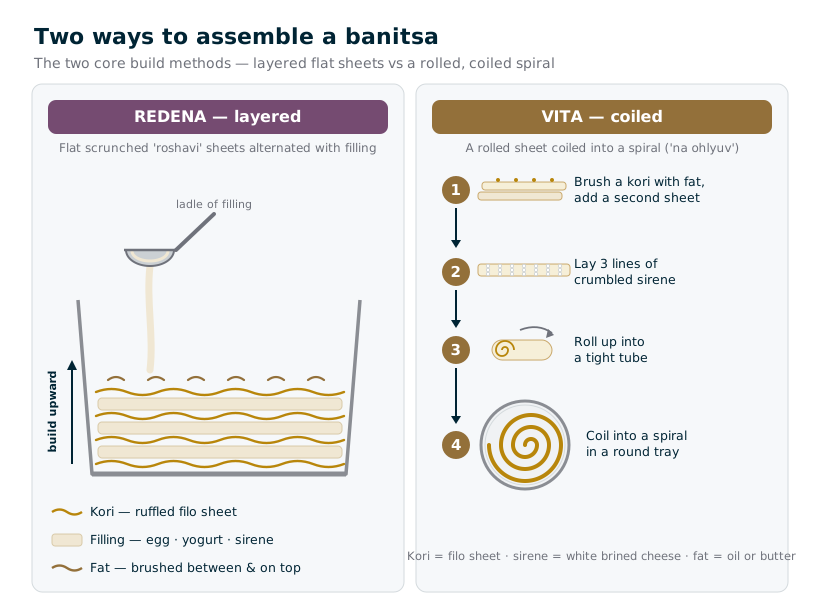 Diagram comparing layered (redena) and coiled (vita) banitsa assembly methods
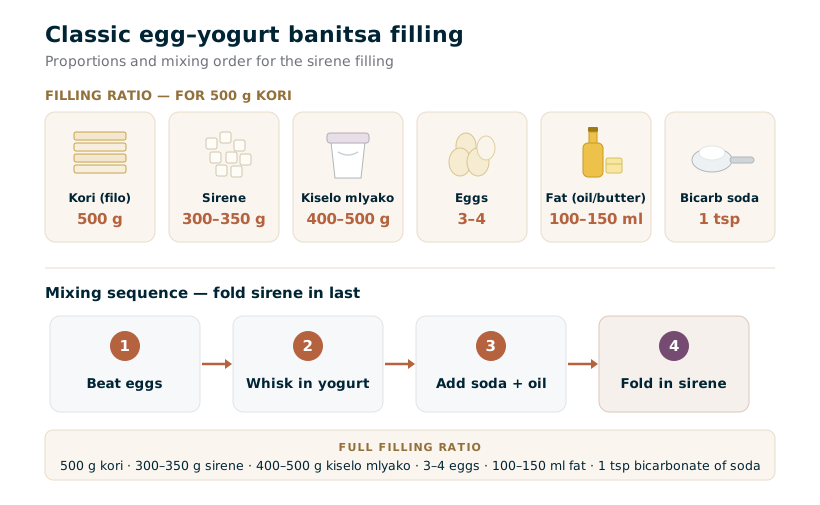 Infographic of banitsa filling proportions and mixing sequence
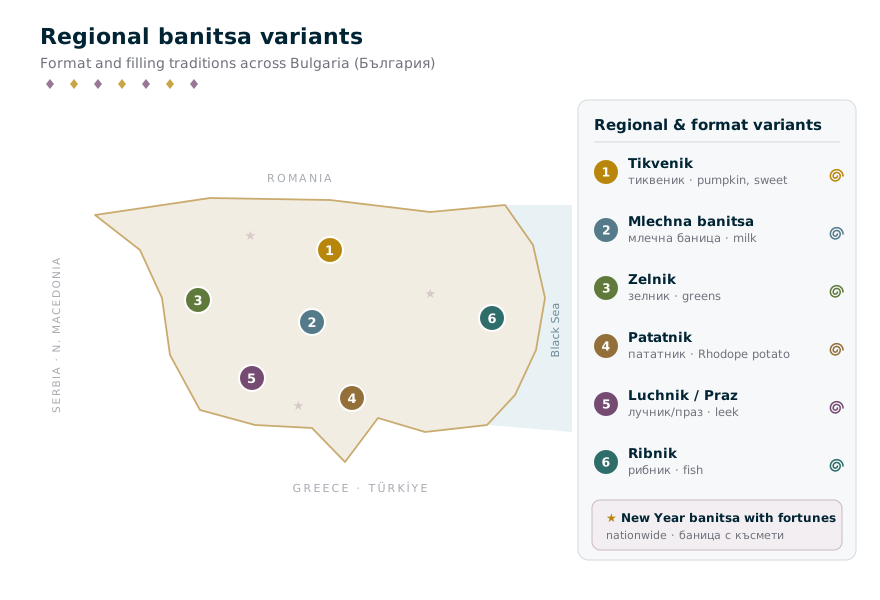 Stylised map of Bulgaria showing regional banitsa variants
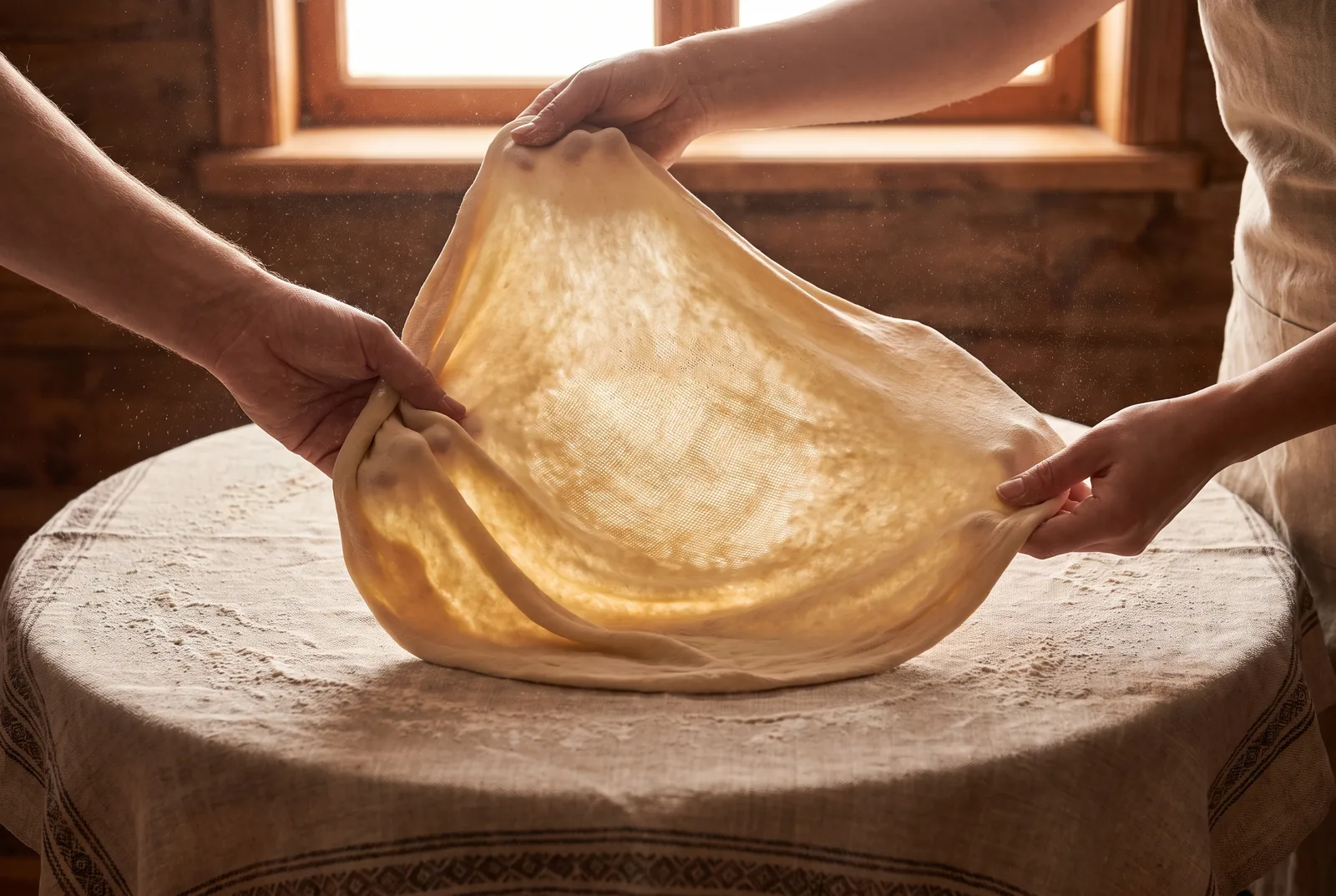 Hands stretching wheat dough thin enough to see through, making hand-pulled filo sheets
Classic egg-yogurt cheese banitsa (redena) — professional tray formula
Total: Filling and fat expressed against kori weight
- 1) Beat the eggs. 2) Whisk in the yogurt until smooth. 3) Stir in the bicarbonate of soda and the oil (and sparkling water, if used). 4) Fold in the crumbled sirene LAST so it stays in nuggets. 5) Line the oiled tray with 2 loosely scrunched 'roshavi' sheets, ladle over ~1 ladle of mixture, repeat sheets + mixture to the top. 6) Brush the top with fat; optionally spray with sparkling water. 7) Bake 180°C fan (200°C conventional) ~30–40 min, rotating once, to a crisp golden crust.
Worked example
500 g kori (≈1 standard pack) · 300–350 g crumbled sirene (60–70% of kori) · 400–500 g kiselo mlyako (yogurt, 80–100%) · 3–4 eggs (~180–220 g) · 100–150 ml sunflower oil or 50/50 oil+butter (20–30%) · 1 tsp bicarbonate of soda · optional 200–300 ml sparkling water for a lighter interior.
Salt from the sirene is usually enough — taste before adding any. The soda + yogurt-acid reaction plus the yogurt's steam are what lift and tenderise the layers (see A2-chemical-leaveners-baking-powder, A5-baking-oven-science).
Vita (coiled) banitsa with sparkling water
Total: Same filling family; assembled as coils
- 1) Make the egg-cheese mixture (reserve 1 egg + some yogurt + sparkling water for the pour). 2) Brush a sheet with fat, lay a second on top, spread 3–4 tbsp filling in lines, roll tightly into a cylinder. 3) Coil into an oiled round tray as a continuous spiral. 4) Pour the reserved egg/yogurt/sparkling-water mix over; brush the top with butter. 5) Bake ~40 min at 180°C to a crisp, juicy result.
Worked example
1 pack kori · 300–350 g sirene · 3–4 eggs · ~500 ml sparkling water · 125 g butter (melted) · optional 100–200 g yogurt.
The sparkling water gives the airy interior; the coil format is the show-piece build.
Tikvenik — sweet pumpkin banitsa (rolled)
Total: Sweet filling, no eggs/cheese
- Squeeze excess liquid from grated pumpkin; mix with sugar, walnuts and cinnamon. Brush sheets with fat, spread filling in lines, roll and coil (like vita). Bake 180°C until golden; dust with icing sugar.
Worked example
1 pack kori · ~1 kg grated pumpkin · ~150–200 g sugar · ~100 g crushed walnuts · 1 tsp cinnamon · fat for brushing.
Contains tree nuts (walnut) — allergen. A Christmas/Advent-season line rather than a savoury daily item.
Every banitsa is one of three assemblies. The base dough (kori) and filling are broadly the same; the method changes labour, look and how the filling is held.
| Method | How it is built | Look / format | Best for |
|---|---|---|---|
| Redena (layered) — редена | Loosely scrunched 'roshavi' sheets laid flat, alternated with ladles of the egg-yogurt-sirene mixture, layer on layer; top brushed with fat | Rectangular tray, cut into squares; ruffled crisp top | Fast tray production, canteen/retail volume, most forgiving |
| Vita (coiled/rolled) — вита | Sheet brushed with fat, second sheet on top, filling piped in lines, rolled into a cylinder, coiled into a spiral 'на охлюв' (snail) | Round tray, dramatic spiral; pull-apart portions | Show pieces, hand-made positioning, individual coils |
| Smesena (mixed) — смесена | Layered base, a few rolled sheets in the middle, layered top; also клин (folded triangular wedge) and мантия (draped sheet) | Hybrid; regional and household styles | Traditional/regional presentations |
The fat between the sheets is the single biggest flavour-and-texture lever in banitsa. Bulgarian home practice leans on sunflower oil (or an oil/butter blend); butter gives more flavour and colour.
| Fat | Effect on the pastry | Notes / spec |
|---|---|---|
| Sunflower oil (traditional) | Lightest, crispest sheets; neutral flavour; easiest to spread thin; cheapest per tray | Olympic Oils: 100% sunflower, 900 kcal/100 g, no declared allergens, vegan |
| Melted butter | Richest flavour and deepest golden colour; slightly heavier, can set firm when cold | Polmlek 82% butter: 744 kcal/100 g, 55 g sat fat, allergen: milk |
| 50/50 oil + butter (common pro choice) | Butter flavour with the crispness and workability of oil; balanced cost | ~150 ml total fat per ~500 g kori is a typical dose |
Authenticity note. Bulgarian sirene is not the same product as Greek feta, and the difference is tastable in banitsa.
| Attribute | Bulgarian sirene (BDS 15:2010) | Greek feta (PDO) |
|---|---|---|
| Milk | Cow / sheep / buffalo / goat / mixed; cow most common | Sheep's milk, up to 30% goat's |
| Texture | Softer, creamier, holds together; still crumbly | Firm, sharply crumbly |
| Flavour | Milder, less tangy, clean salt | Tangier, more piquant |
| Salt | Up to 3.5 ± 0.5% | Higher, brine-forward |
| Maturation | ~45 days in brine (cow's milk); ~60 days for sheep/goat/buffalo/mixed | Min ~2 months (60 days) in brine |
| Substitution | First choice; if unavailable use a cow's-milk feta-STYLE cheese (cannot be labelled 'feta') | Legal 'feta' name is PDO-protected (sheep/goat milk, never cow) |
Most UK bakeries buy ready kori; the craft benchmark is hand-stretched. Thickness is the key spec.
| Kori source | Thickness / character | When to use |
|---|---|---|
| Hand-stretched точени кори | Pulled sub-millimetre, translucent; irregular, very crisp | Artisan/craft banitsa, show product; needs a strong extensible flour |
| Ready 'gotovi kori' (packaged) | Machine-made, even ~0.5–1 mm; sold chilled/frozen | Everyday tray production; consistent, fast |
| Industrial machine-sheeted line | Down to ≥0.15 mm, continuous, uniform | High-volume, frozen banitsa manufacture |
| Fault | Likely cause | Remedy |
|---|---|---|
| Soggy, dense, greasy layers | Too much liquid filling; fat pooled not brushed; oven too cool; under-baked | Balance filling to kori weight; brush fat thinly and evenly; bake at 180°C fan / 200°C conventional and finish crisp |
| Dry, brittle, no juiciness inside | Too little yogurt/liquid; too many dry sheets; over-baked | Raise yogurt to ~80–100% of kori; add sparkling water; pull when golden not dark |
| Pale, no crisp crust | Oven too low; no fat on top; overcrowded oven | Brush top with fat (butter browns best); raise/finish hotter; rotate tray |
| Filling too salty | High-salt sirene plus added salt | Do not add salt — BDS sirene carries up to ~3.5% salt; taste first |
| Layers slide / no lift | Old soda, or soda without acid; sheets too wet | Use fresh bicarbonate with the acidic yogurt; keep mixture pourable not runny |
| Sheets tear during hand-stretch | Weak or under-rested dough; flour too low in extensibility | Use a strong extensible white flour and rest the dough fully before pulling |
| Coil (vita) cracks / dries at edges | Roll too loose; edges unbrushed; oven hot spot | Roll snug, brush the whole surface with fat, rotate the tray mid-bake |