
Tahini, halva and sesame in Arab confectionery: production chemistry, quality specs and professional applications
Sesame is the backbone of Arab confectionery, and this dossier follows it from seed to slab. It explains how tahini (طحينة) is really made — sesame wet-hulled by salt-water flotation, roasted around 150°C, then stone-ground into a paste that is ~50-60% oil (so oil separation is normal, not spoilage) — and why the best tahini, from Nablus and East Jerusalem family houses, is prized region-wide. It then unpacks tahini halva (حلاوة طحينية, halawa tahiniyya): the three-part build of tahini, a cooked sugar syrup and — the ingredient that makes it authentic — an extract of soapwort root ('irq/shirsh al-halawa, Saponaria officinalis) whose saponins whiten, aerate and emulsify the mass so the sesame oil never weeps out. It covers the regional names (halawa tahiniyya, tahniyya, halwa shamiyya, al-rahsh, halawet al-sha'r), the crystallisation control (citric acid and glucose), and the wider sesame-sweet family — simsimiyah (sesame brittle) and barazek (sesame-and- pistachio biscuits). Crucially for a UK maker it flags two hard commercial realities: the 2020-2021 EU ethylene-oxide sesame recalls (buy EtO-certified), and that soapwort is not an authorised GB/EU food additive. Every step is wired to the Domson basket — hulled sesame, sugar, glucose, honey, pistachio, almond, cocoa and coating chocolate — and cross-linked to the craft behind it (A7-seeds-nuts-toppings, A6-sugar-work-techniques, A8-chocolate-confectionery-formulas) and to sister traditions (B2-helva-sesame-tahini, B6-halva-confectionery, B3-attar-sugar-syrup-science).
Tahini, halva and sesame in Arab confectionery
Sesame (سمسم, simsim) is to Arab confectionery what butter is to French pastry — the one ingredient that runs through the whole tradition. Grind it and you have tahini; aerate tahini with sugar and soapwort and you have halva; set it in boiled sugar and you have brittle; scatter it on a biscuit and you have barazek. For a UK baker or patisserie serving Arab and Levantine customers, getting sesame right — sourcing, food safety, and technique — is the difference between an authentic product and a supermarket imitation. This dossier follows sesame from seed to finished sweet, with the numbers and the buying checklist a professional kitchen needs.
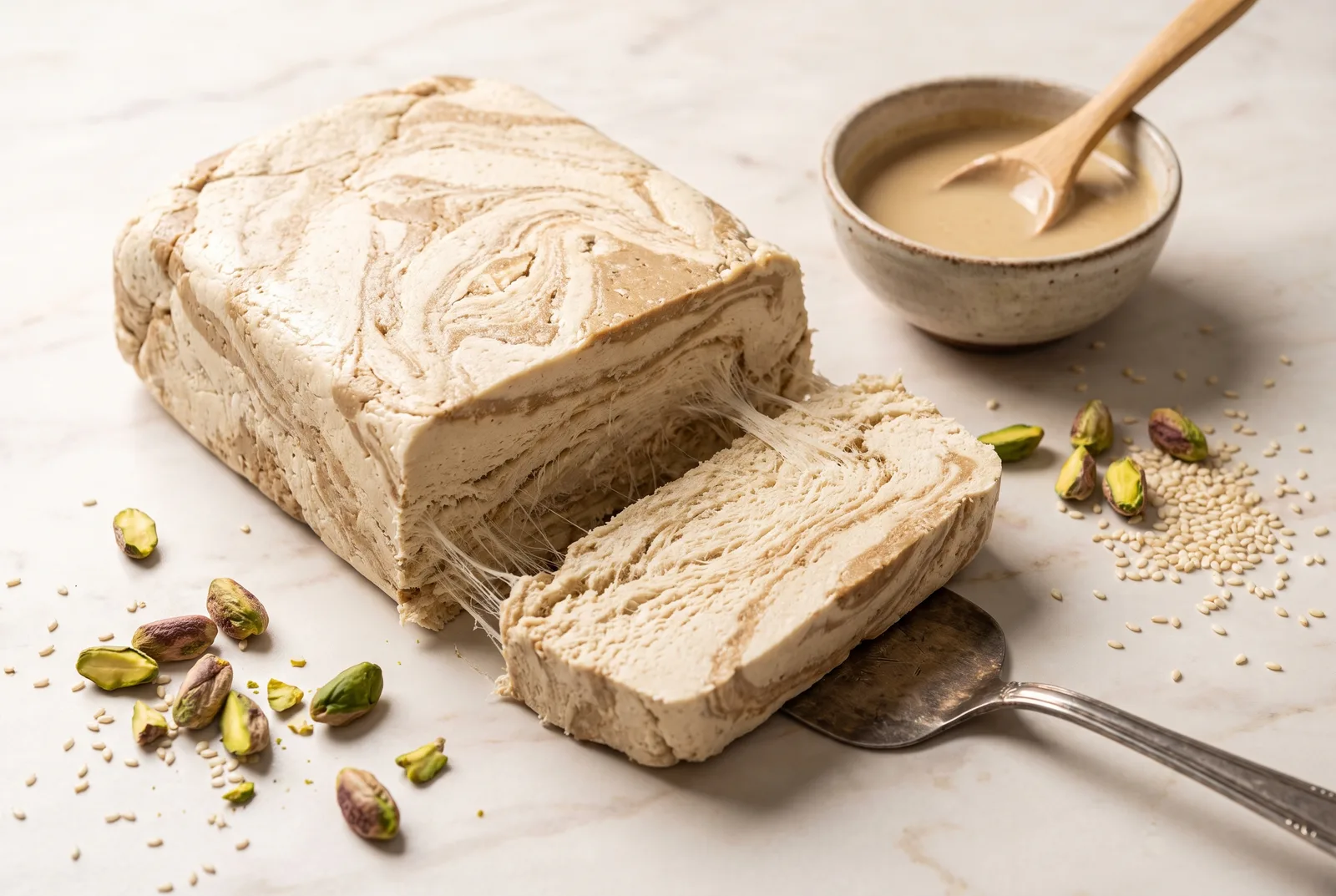
Cut slab of tahini halva showing its fibrous layered structure, with tahini, pistachios and sesame seeds beside it
1. Tahini (طحينة): how the paste is really made
Tahini is deceptively simple — ground roasted sesame, nothing else — but the processing is precise. The seed is first wet-hulled: it is soaked and rubbed, then steeped in salt water so the heavier bran (nukhala) sinks while the hulled kernels float to the top and are skimmed off. Those kernels are drained, roasted (commonly around 150°C, industry range roughly 100-150°C — the roast level is what separates a pale, mild tahini from a dark, intense one) and then stone-ground into a smooth, pourable paste. Unroasted paste is sold as raw tahini. Iraqis call it al-rashi (الراشي); in Persian it is ardeh (أرده).
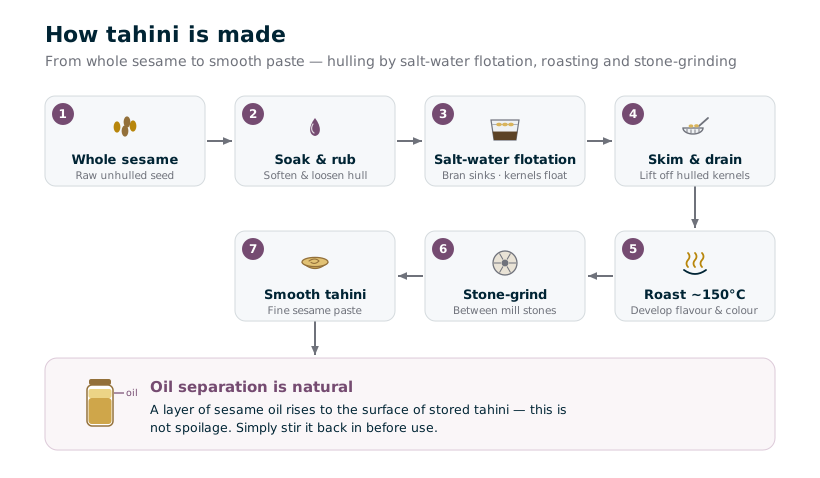 Step-by-step flow diagram of tahini production from whole sesame through salt-water hulling, roasting and stone-grinding to finished paste
The single most important fact about tahini is that it is an oil paste. Sesame seed is ~50-60% oil and ~18-28% protein, and a characterised traditional stone-milled tahini analysed about 61.5% fat, 23.3% protein, 0.47% moisture and 4.4% sugars — figures that match the Domson hulled-sesame datasheet's 61.21 g fat per 100 g. Two consequences follow directly:
- Oil separation is normal. With ~60% liquid oil holding suspended solids, tahini naturally stratifies into a top oil layer over time. This is not spoilage — you simply stir it back in before use. Customers who reject a "split" jar are misreading a healthy product.
- Rancidity is the real enemy. All that unsaturated oil (see A4-fat-types-and-selection for why poly-unsaturated fats oxidise fastest) means tahini keeps best cool and well sealed, and you should buy to a peroxide-value / free-fatty-acid spec.
For authenticity, know your source. Tahini from Nablus and East Jerusalem — made in small, multi-generational family factories rather than mass plants — is prized across the region for its creaminess and pure flavour, often from imported Ethiopian (Humera) sesame that is peeled, soaked, washed and roasted. Nablus is also home to an inky black tahini called qizha (قزحة), made with nigella (black seed).
2. Halawa tahiniyya (حلاوة طحينية): the three-part build
Tahini halva is where the craft gets interesting, because it is not just tahini and sugar. Authentic halawa tahiniyya is a three-part build:
- Tahini — the body and flavour, and the oil that carries everything. It makes up about 50% of the finished halva (industry uses roughly 450-550 kg of tahini per tonne).
- A cooked sugar syrup — sucrose and water (industry: roughly 100 kg sucrose to 18 L water) that provides the sweetness and the structural sugar matrix.
- Soapwort extract — the ingredient that makes halva halva.
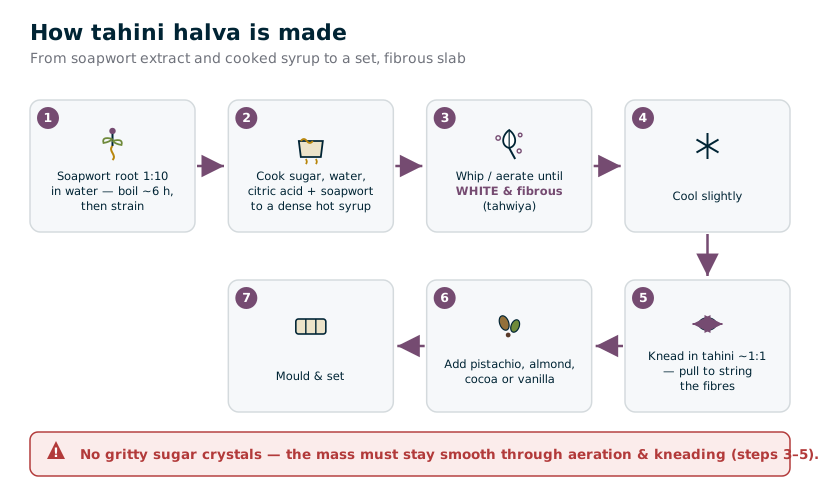 Flow diagram of tahini halva production from soapwort extract and cooked syrup through aeration and kneading with tahini to a set slab
The soapwort secret ('irq al-halawa / shirsh al-halawa)
The aerating and whitening agent is an extract of soapwort root — 'irq al-halawa or shirsh al-halawa (عرق الحلاوة / شرش الحلاوة), botanically common soapwort, Saponaria officinalis (الصابونية), of the carnation family (Caryophyllaceae). Its roots are rich in saponins, natural surfactants that behave like a plant-based foaming and emulsifying agent. The extract is made by breaking up the dried root, covering it with water at about 1:10 and boiling it for roughly 6 hours (some traditional methods use ~45 L of water per kg of root, boiled 3-4 days), then cooling and straining to a concentrated liquor.
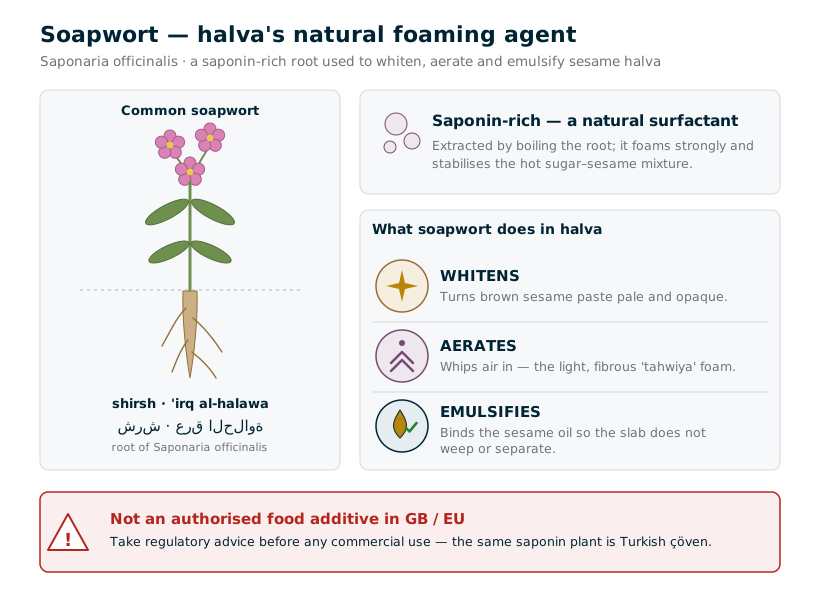 Card explaining soapwort root (Saponaria) — its saponin content and its whitening, aerating and emulsifying role in halva, with a UK/EU regulatory flag
In production, this extract is boiled together with the sugar (and a little citric acid) to a dense, high-temperature stage in jacketed tanks fitted with mechanical beaters. Whipping air in — tahwiya (التهوية) — is the pivotal step: it whitens the mass, raises its viscosity, and builds the characteristic fibrous, layered structure. The cook is judged done when the mass turns white. Only then, after the syrup has been aerated and cooled slightly, is the tahini kneaded in at about 1:1 and pulled until it strings into fine fibres. The three functions the saponin performs — whiten, aerate, emulsify — are exactly why the finished slab is pale, light-textured and does not weep oil.
Crystallisation control
A correctly made halva is homogeneous and fine-fibred with no gritty sugar crystals; graininess is treated as a defect in the regional standards. Two tools keep the sucrose from graining up: citric acid (~50 g per 100 kg of sugar) inverts part of the sucrose, and many producers also replace 10-25% of the sucrose with glucose syrup for the same anti-crystallisation and humectant effect. This is the same invert-sugar logic that governs Arab syrup (see B3-attar-sugar-syrup-science) and confectionery generally (A8-chocolate-confectionery-formulas); for the underlying sugar-cooking stages behind that "dense syrup," see A6-sugar-work-techniques. This whole method — soapwort-aerated pulled sugar plus sesame paste — is the direct Arab cousin of Turkish tahin helvası (B2-helva-sesame-tahini) and Balkan/Bulgarian tahan halva (B6-halva-confectionery); it also shares the fine-crumb, sugar-paste family with A6-marzipan-fondant-sugar-pastes.
Nutritionally, halva is dense: roughly 520-540 kcal per 100 g, with an indicative composition of ~30% sesame oil, ~11% protein and ~53% sugars, plus useful calcium, iron and phosphorus.
3. Regional names and heritage
The same confection travels under different names, and using the right one signals authenticity to the community you serve:
- Egypt, the Levant and Saudi Arabia: halawa tahiniyya (حلاوة طحينية) — the mainstream name.
- Sudan: tahniyya (طحنية).
- The Maghreb: al-halwa al-shamiyya (الحلوى الشامية) — literally "the Levantine sweet," naming its origin.
- The Gulf: al-rahsh (الرهش).
- The aerated floss version: halawet al-sha'r (حلاوة الشعر), "hair halva."
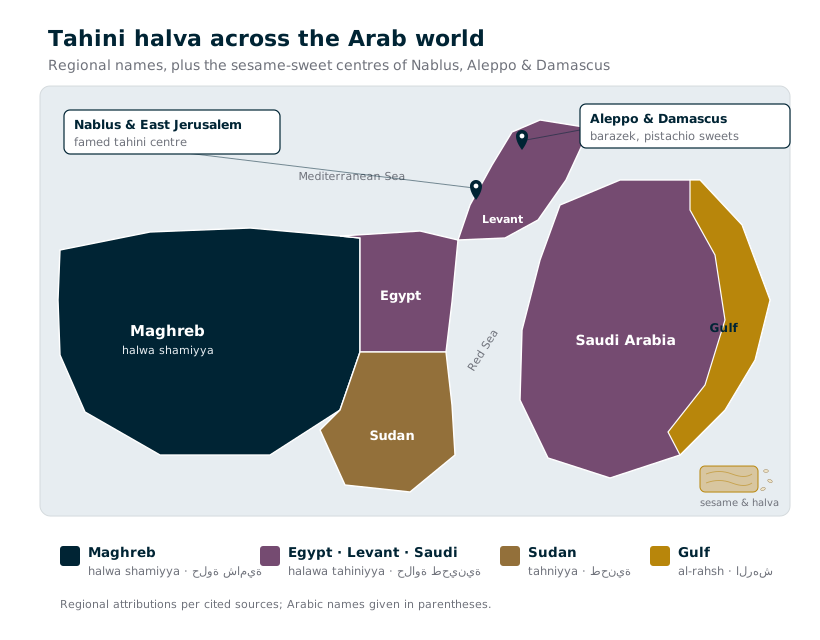 Map of the Arab world showing regional names for tahini halva and key tahini and sesame-sweet centres
Confections resembling tahini halva are, by tradition, traced to Abbasid Baghdad in the 8th-9th centuries, though this early dating is a widely repeated attribution rather than a firmly documented one — the earliest securely recorded halva recipes appear later, in the 13th-century Arabic cookery book Kitab al-Tabikh. Either way, the sweet spread through the Ottoman world and later reached Eastern Europe via trade and migration. Its most famous industrial standard-bearer is Egypt's El Rashidi El Mizan (الرشيدي الميزان), founded in 1889 by Muhammad Husayn al-Rashidi in Cairo's Sayyida Zaynab district; by 2023 the brand reported reaching about 90% of Egyptian consumers and exporting to 45 countries — a useful benchmark for what "the real thing" tastes like to your Egyptian customers. Standard varieties to offer are plain (sada), pistachio (Aleppo fustuq halabi), almond (lawz), cocoa/chocolate (kakaw) and vanilla; nut and chocolate-coated lines are the premium tier .
4. The wider sesame-sweet family
Halva is not the only sesame sweet an Arab bakery sells. Two more belong on the counter:
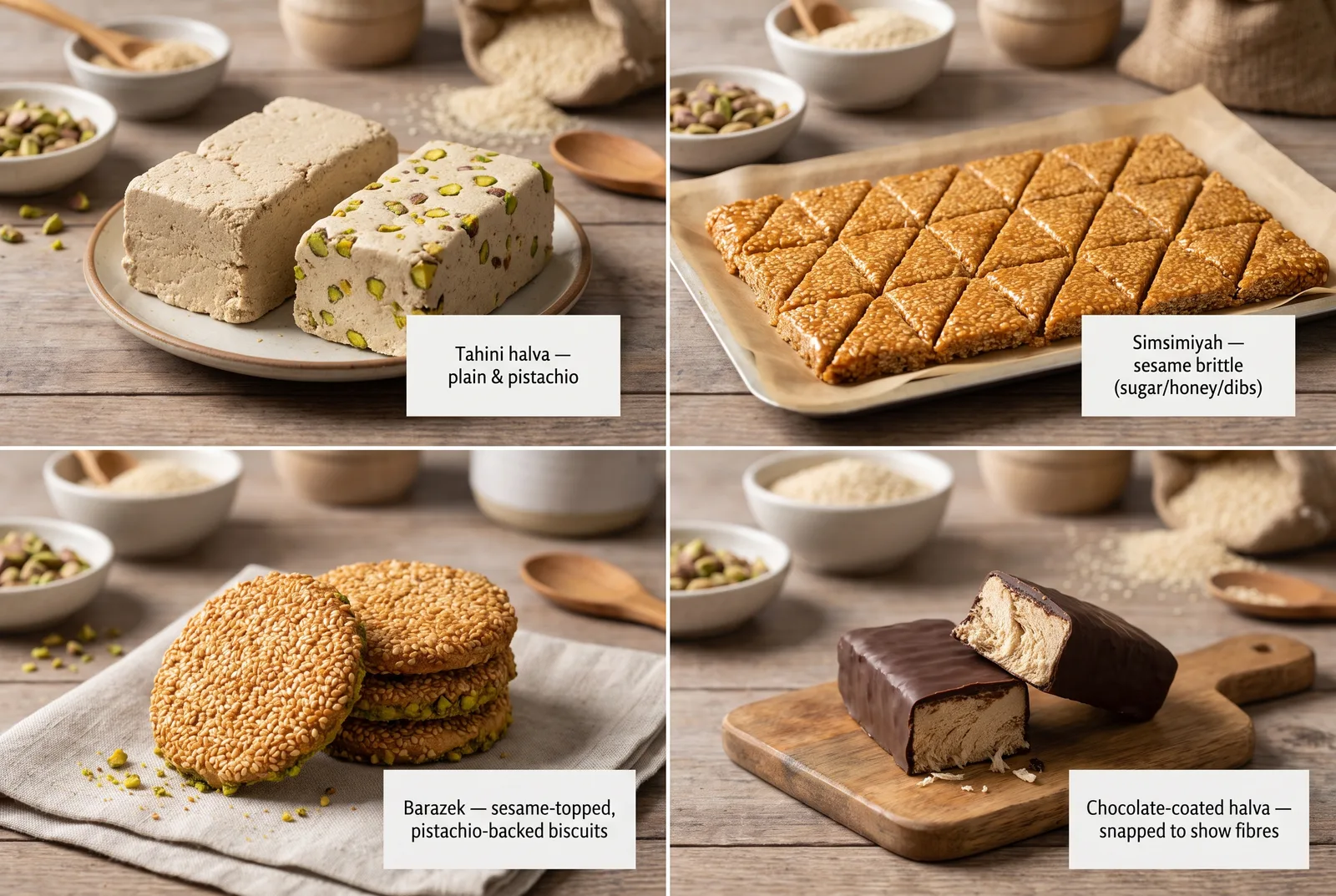 Grid of four Arab sesame sweets: tahini halva, simsimiyah sesame brittle, barazek biscuits and chocolate-coated halva
- Simsimiyah (سمسمية) — sesame brittle. Roasted sesame set in a cooked sweetener (sugar, honey, glucose, or grape/date molasses, dibs) with a squeeze of lemon, pressed thin and cut into diamonds or bars. It is a classic Egyptian Prophet's-birthday (Mawlid) sweet — halawet al-mawlid — and is often studded with pistachios. This is a brittle, not a pulled halva: the sesame is the aggregate and the boiled sugar is the binder, so it belongs with the sugar-work of B3-attar-sugar-syrup-science and the seasonal production of B3-ramadan-seasonal-specialities.
- Barazek (برازق) — sesame-and-pistachio biscuits. Crisp round biscuits from a rich butter-sugar-flour dough, coated in sesame on top and pressed onto Aleppo pistachios underneath. They trace to Ottoman-era Damascus (the al-Midan quarter) and are common across Bilad al-Sham — Syria, Lebanon, Jordan and Palestine . Here sesame is a coating, so the relevant craft is A7-seeds-nuts-toppings (toasting, adhesion, allergen handling). An optional floral note comes from B3-aromatic-flavourings-rosewater-orange-blossom-mastic. Tahini itself also appears in adjacent semolina and shortbread sweets — see B3-semolina-desserts-basbousa-maamoul.
5. Buying sesame and tahini into a UK kitchen: the food-safety brief
Sesame is a high-risk import commodity, and a UK B2B buyer must treat it as one. Four checks belong on every purchase, and this section must be checked against your own HACCP and the live product spec.
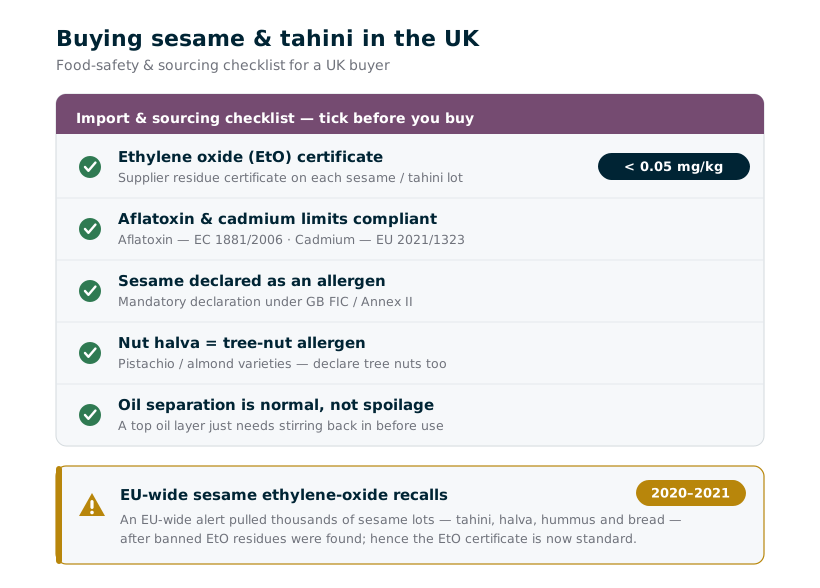 Sourcing and food-safety checklist card for buying sesame and tahini in the UK, including ethylene oxide, aflatoxin, cadmium and allergen points
- Ethylene oxide (EtO). This is the big one. Ethylene oxide is a banned, carcinogenic fumigant used abroad to control Salmonella in stored sesame. From September 2020, the EU's RASFF system logged hundreds of notifications of EtO in sesame — the great majority from India — against a maximum residue limit of just 0.05 mg/kg, with some batches exceeding it more than 1,000-fold. The result was a wave of recalls of tahini, halva, hummus, bread and bakery products across Europe. Insist on an ethylene-oxide certificate. The Domson hulled-sesame datasheet certifies EtO <0.05 ppm for exactly this reason.
- Mycotoxins and heavy metals. Buy to spec: the sesame complies with mycotoxin limits (now Commission Regulation (EU) 2023/915, which recast the former EC 1881/2006 with the limits carried over unchanged), and ground almond for nut halva carries aflatoxin controls (B1 ≤8 ppb, total ≤10 ppb). Cadmium in sesame is controlled under EU 2021/1323.
- Allergens.Sesame is one of the 14 declarable allergens in UK/EU law — the datasheet declares "sesame — yes." Nut halva, pistachio-studded simsimiyah and barazek all add a tree-nut allergen; barazek further carry cereals containing gluten (wheat) and milk (butter), and — where an egg wash is used to make the seeds adhere — egg, while cocoa or chocolate-coated halva lines can introduce milk and soya. Label and segregate per line, and note that honey-sweetened simsimiyah is unsuitable for infants under 12 months. Reconcile the full allergen matrix against your own HACCP and the live product spec .
- The soapwort question. This is the authenticity paradox for a UK maker. Soapwort/Saponaria saponin extract works as a foaming and emulsifying agent, so under UK/EU law it meets the definition of a food additive — but it is not an authorised additive (the related saponin additive quillaia extract, E999, is a different plant, Quillaja saponaria, permitted only in certain flavoured drinks and cider/perry; only quillaia and yucca are approved saponin sources, and Saponaria is not among them). Soapwort saponins are also gastro-intestinally irritant and haemolytic in quantity, a further reason their food use is tightly controlled. A UK producer importing halva, or wishing to use shirsh al-halawa directly, should take regulatory advice before selling. This exactly parallels the position for Turkish çöven (B2-helva-sesame-tahini).
6. The Domson basket: buy the ingredients for this
Everything except the finished tahini paste and the soapwort extract can be sourced from the catalogue. The core buys:
- Hulled sesame seed — the base for tahini, halva and the coating on barazek/simsimiyah. The Global Grains Sesame Seeds 25 kg (handle g44871) is the pick: Sesamum indicum, hulled, 631 kcal / 61.21 g fat / 20.45 g protein per 100 g, moisture ≤6%, purity ≥99.9%, EtO-certified, Kosher-certified and Halal-suitable . Ros-Sweet Sesame Seeds 25 kg (g24758) is an alternative bulk line.
- Sugar — the sucrose matrix. Kent Foods Caster Sugar (g44027, 100 g sugars/100 g, ICUMSA ≤32, finer crystal, Halal + Kosher Pareve) or Granulated Sugar (BS) (g45060).
- Anti-crystallisation binders — Glucose Syrup 14 kg (g22120) to replace 10-25% of the sucrose in halva, and Multifloral Honey 14 kg (g23652) as the traditional binder for simsimiyah.
- Nuts and flavour — Giuso Pistachio Paste (g25316) and Roasted Diced Pistachios (g25401) for pistachio halva and barazek; Ground Almonds (g44748, aflatoxin-controlled) and Shelled Almonds (g43057) and Walnut Halves (g44028) for nut halva; Dark Dutch Cocoa GT78 (g25075) for cocoa halva; Dawn flavouring compounds (g44542) for vanilla halva.
- Coating — for chocolate-coated halva bars, a dark compound coating such as Bambo Prima Dark Compound Coating Flakes (g25441); see A6-chocolate-selection-couverture on couverture vs compound.
What Domson does not stock: finished tahini paste and soapwort extract. Source tahini from a Levantine/Egyptian specialist (with an EtO certificate), and treat soapwort as a regulatory question before use.
Faults at a glance
The most common failures — oil weeping, graininess, a dense (not fibrous) slab, rancidity, and sesame coats that fall off barazek — and their fixes are tabulated in the fault table below. The recurring themes: enough soapwort and enough aeration to emulsify and lighten; citric acid and/or glucose to stop crystallisation; cool, sealed storage to hold off rancidity; and, for tahini itself, remembering that a separated oil layer is normal, not a fault.
Halawa tahiniyya — tahini halva (indicative industrial method)
The two authenticity levers are the tahini (an oil-rich ~50-60% sesame-oil paste ) and the soapwort extract (the saponin surfactant that whitens, aerates and emulsifies so the sesame oil does not weep out ). Citric acid — and often a little glucose — inverts/dilutes the sucrose so it will not grain up. See A6-sugar-work-techniques for the sugar-cooking stages behind the dense syrup, and A8-chocolate-confectionery-formulas for the invert/anti-crystallisation logic. Note the GB/EU regulatory position on soapwort in the spec table below.
| Ingredient | Baker's % | Weight |
|---|---|---|
| Sucrose (granulated/caster sugar) | syrup base (100 parts) | |
| Water | ~18 parts | |
| Citric acid | ~0.05% of sugar | |
| Glucose syrup (optional) | 10-25% of the sugar | |
| Soapwort extract ('irq al-halawa) | ~0.8% of sugar (~800 ml/100 kg) | |
| Tahini (≥50-55% sesame oil) | ~1:1 to the whipped syrup mass (~50% of finished halva) | |
| Pistachio / almond / cocoa / vanilla | to variety | |
| Total | n/a (assembly of two cooked/whipped phases) |
Worked example
1) Extract: break up dried soapwort root, cover with water ~1:10 and boil ~6 h, then cool and strain to a concentrated extract. 2) Cook ~100 kg sucrose: 18 L water with ~50 g citric acid (and optionally 10-25% of the sugar as glucose syrup) to a dense high-temperature stage; whip in ~800 ml soapwort extract (tahwiya) until the mass turns WHITE and fibrous. 3) Let it cool slightly, then knead in tahini at ~1:1, pulling until it strings into fine fibres. 4) Fold in pistachio/almond/cocoa/vanilla; mould and set. The finished slab must be homogeneous with NO gritty crystallisation.
Yield: Sets into a sliceable, fine-fibred slab; shelf-stable low-moisture confection
Simsimiyah — sesame brittle (indicative)
A brittle, not a pulled halva: the sesame is the aggregate and the boiled sweetener is the binder, so this is closer to a nut brittle than to soapwort halva. Grape molasses (dibs) or date syrup give the traditional darker, less-sweet Mawlid version. See B3-attar-sugar-syrup-science for the sugar-syrup control and A7-seeds-nuts-toppings for toasting and allergen handling of the seeds/nuts.
| Ingredient | Baker's % | Weight |
|---|---|---|
| Roasted sesame seed | the bulk (aggregate) | |
| Sugar and/or honey (or grape/date molasses, dibs) | binder to a firm set | |
| Lemon juice | trace (anti-crystallisation) | |
| Aleppo pistachios (optional) | to taste | |
| Total | n/a (a boiled-sugar brittle) |
Worked example
Roast ~2.5 cups (≈350 g) sesame, stirring so it colours evenly without burning. Separately cook ~½-1 cup sugar and/or honey (or grape/date molasses, dibs) with a squeeze of lemon to a firm sticky stage. Off the heat, stir in the hot sesame (and optional pistachios), tip onto oiled paper, press thin under a second oiled sheet, then cut while just warm and cool to a crisp/chewy brittle.
Yield: One thin pressed sheet, cut into diamonds/bars
Barazek — sesame-and-pistachio biscuits (indicative)
Barazek are a biscuit, not a confection — the sesame is a coating, so they belong with the seeds-and-nuts toppings craft. Buy hulled sesame for the coat and Aleppo/roasted pistachios for the base. See A7-seeds-nuts-toppings for glazing/toasting and B3-aromatic-flavourings-rosewater-orange-blossom-mastic for the optional floral note.
| Ingredient | Baker's % | Weight |
|---|---|---|
| Wheat flour | 100% | |
| Butter | ~40-60% | |
| Sugar | ~30-40% | |
| Milk (+ optional pinch of yeast) | to bind | |
| Sesame seed (top coat) | generous | |
| Aleppo pistachios (base) | to cover | |
| Total | enriched short/soft dough |
Worked example
Make a rich dough of flour, butter, sugar and a little milk (some recipes add a pinch of yeast). Roll into balls; press one face into whole sesame seeds (dipped via a little syrup/egg so they stick) and set the other face onto a bed of chopped Aleppo pistachios. Bake until golden and crisp.
Yield: Crisp round biscuits, sesame on top, pistachio underneath
The oil is the whole story: tahini is essentially ground roasted sesame with nothing added, so its ~50-60% oil drives both its behaviour (separation, richness) and its food-safety profile (rancidity, allergen, EtO).
| Parameter | Value | Why it matters |
|---|---|---|
| Sesame seed oil | ~50-60% of the seed | Tahini inherits this — an oil paste, not a dry powder |
| Sesame seed protein | ~18-28% | Nutrient density; tahini ~23% protein |
| Stone-milled tahini (typical) | ~61.5% fat, 23.3% protein, 0.47% moisture, 4.4% sugars | Very low moisture + high oil = long keeping but rancidity risk |
| Roasting temperature | ~150°C (range ~100-150°C) | Sets flavour/colour; light vs dark tahini |
| Hulling | Salt-water flotation (bran sinks, kernels float) | Hulled kernels give pale, fine tahini |
| Kernel moisture for fine grind | ≤ ~1.3% | Too wet = gritty paste |
| Oil separation | Natural; stir back in | Not spoilage — expected in a high-oil paste |
Authentic halawa tahiniyya is not just tahini + sugar. The soapwort extract is what makes it whiten, aerate and hold together without the oil weeping out — and it is the ingredient a UK maker must treat with regulatory care.
| Component | Role | Indicative amount / detail |
|---|---|---|
| Tahini (طحينة) | Body, flavour, the oil that carries everything | ~50% of the finished halva (≈450-550 kg/tonne) |
| Sugar syrup (sucrose + water) | Sweetness + the structural sugar matrix | ~100 kg sucrose: 18 L water (industry) |
| Soapwort extract ('irq/shirsh al-halawa) | Whitens, aerates, emulsifies the oil in | ~800 ml extract per ~100 kg sugar; root boiled 1:10 ~6 h |
| Citric acid | Inverts some sucrose to control crystallisation | ~50 g per ~100 kg sugar |
| Glucose syrup (optional) | Extra anti-crystallisation + humectant | Replaces ~10-25% of the sucrose |
| Vanilla / nuts / cocoa | Flavour and variety | Pistachio, almond, cocoa, vanilla lines |
Get the name right for the community you serve. The same tahini-and-soapwort confection is called different things from the Nile to the Gulf.
| Region | Name (Arabic) | Notes |
|---|---|---|
| Egypt, Levant, Saudi Arabia | halawa tahiniyya (حلاوة طحينية) | The mainstream name; El Rashidi El Mizan is the emblematic Egyptian maker |
| Sudan | tahniyya (طحنية) | Local contraction of the same word |
| Maghreb (North Africa) | al-halwa al-shamiyya (الحلوى الشامية) | 'Levantine sweet' — names its origin |
| Gulf (Khaleeji) | al-rahsh (الرهش) | Distinct Gulf term for tahini halva |
| Flossy/'hair' halva | halawet al-sha'r (حلاوة الشعر) | Highly aerated, pulled into fine floss |
Sesame runs through a whole family of Arab sweets. Decide which one the customer means before you quote or produce; each has a different technique and Domson basket.
| Sweet | What it is | Tradition / origin | Cross-link |
|---|---|---|---|
| Halawa tahiniyya (tahini halva) | Pulled tahini + soapwort-aerated sugar; fine-fibred slab | Levant / Egypt / Gulf; Abbasid roots | This dossier |
| Simsimiyah (sesame brittle) | Roasted sesame set in cooked sugar/honey/dibs, pressed & cut | Egyptian Mawlid sweet; region-wide | B3-attar-sugar-syrup-science, B3-ramadan-seasonal-specialities |
| Barazek | Crisp biscuit, sesame-topped, Aleppo-pistachio-backed | Ottoman-era Damascus (al-Midan); Bilad al-Sham | A7-seeds-nuts-toppings |
| Tahin helvası | Turkish pulled sesame halva with çöven (soapwort) | Turkish | B2-helva-sesame-tahini |
| Tahan / white halva | Sesame or sunflower paste + soapwort or egg-white | Bulgarian / Balkan | B6-halva-confectionery |
Sesame is a high-risk import commodity. These are the four things a UK B2B buyer must check on the datasheet before ordering. Food-safety and allergen content — verify against your own HACCP and the live product spec.
| Risk | Control / limit | Practical action |
|---|---|---|
| Ethylene oxide (EtO) | Banned; MRL 0.05 mg/kg on sesame | Insist on an EtO certificate; the catalogue sesame is certified <0.05 ppm |
| Aflatoxin / mycotoxins | (EU) 2023/915 limits (recast of EC 1881/2006; ground almond B1 ≤8 ppb) | Buy to spec; store cool & dry |
| Cadmium (heavy metal) | EU 2021/1323 limits | Check compliance clause on the spec |
| Sesame / nut allergens | Declarable allergens (UK/EU 14) | Label 'sesame'; nut/pistachio lines add tree-nut; barazek also wheat/gluten, milk & egg-wash; cocoa lines milk/soya; segregate per line |
| Rancidity / oil separation | High-oil paste; PV & FFA guards on nut specs | Cool sealed storage; stir separated oil back in |
| Fault | Product | Likely cause | Remedy |
|---|---|---|---|
| Sesame oil weeps / separates out of the slab | Halva | Too little soapwort, or emulsification/kneading incomplete | Increase soapwort extract; whip fully to white; knead adequately at the right temperature |
| Grainy, gritty, crystallised texture | Halva | No/low invert; over-cooked or over-cooled syrup | Add citric acid (and/or 10-25% glucose) to control crystallisation; watch the cook stage |
| Slab is dense/hard, not fibrous | Halva | Under-aerated, or tahini and syrup combined too hot/cold | Whip more air in; knead/pull to string the fibres at the right temperature |
| Slab won't bind / crumbles | Halva | Syrup too soft, or too little pulling | Cook the syrup denser; knead further; let it set fully |
| Rancid / painty off-flavour | Tahini & halva | Old or warm-stored high-oil paste | Buy to PV/FFA spec; store cool and sealed; rotate stock |
| Tahini looks 'split' with an oil layer | Tahini | Natural phase separation | Stir the oil back in — it is not spoilage |
| Brittle crystallises / turns sugary | Simsimiyah | No acid; sugar cooked without invert | Add a little lemon/honey/glucose to the boil |
| Brittle too hard to bite or sticky | Simsimiyah | Sweetener over- or under-cooked | Cook to a firm-but-not-glassy set; cut while warm |
| Sesame coat falls off | Barazek | Dough surface too dry when dipped | Dip in a little syrup/egg wash so seeds adhere before baking |