Žagarėliai, spurgos and skruzdėlynas: Lithuanian fried pastry — dough types, frying oils and assembly
Lithuania's fried-pastry canon runs from thin, brittle žagarėliai (crisp fried "brushwood" twists), to spurgos (doughnuts — both jam-filled yeast pončkos and softer varškė/curd-cheese rings), to skruzdėlynas ("anthill"): a festive cone built from fried žagarėliai glued with honey and snowed with poppy seeds. This dossier gives a UK bakery the authentic picture, mined from Lithuanian-language recipe and reference sources (lamaistas.lt, 15min.lt, beatosvirtuve/skanauk.lt, Lithuanian reference works, and food historian Rimvydas Laužikas on Užgavėnės) and cross-checked against the platform's supplier spec sheets. It covers the three dough families (spirit-crisped egg dough, chemically leavened curd dough, osmotolerant yeast dough); the one control that makes or breaks a fried line — oil at 170-180 °C; frying-fat selection (refined rapeseed and sunflower oil, dedicated palm frying fat, solid vegetable shortening) with real spec numbers; the slit-and-twist shaping of žagarėliai and the honey-and-poppy cone assembly of skruzdėlynas; and the calendar these pastries live in (Užgavėnės pre-Lenten feasting; the poppy-seed link to Kūčios). Every step maps to the Domson catalogue a Lithuanian baker actually orders and cross-links the Pillar A craft concepts behind it (A4-frying-fats-and-oils, A4-fat-types-and-selection, A2-osmotolerant-yeast-enriched-doughs, A2-chemical-leaveners-baking-powder, A8-enriched-dough-formulas) plus its sister Lithuanian and Polish articles.
Žagarėliai, spurgos and skruzdėlynas: Lithuanian fried pastry
Fried pastry sits at the heart of the Lithuanian festive table, and for a UK bakery serving Lithuanian customers it is one of the highest-recognition, lowest-ingredient-cost lines you can run. Three names cover almost the whole field:
- žagarėliai — thin, brittle, deep-fried "brushwood" twists (the crisp end of the family);
- spurgos — doughnuts, in two quite different guises: jam-filled yeast pončkos and softer, cake-like varškės spurgos (curd-cheese rings);
- skruzdėlynas — the "anthill", a showpiece cone built from fried žagarėliai bound with honey and dusted with poppy seeds.
All three are just wheat dough cooked in hot fat, so the craft is almost entirely in two places: the dough family you choose and oil temperature control. This dossier treats them as a production system, maps each to the Domson catalogue, and ties the technique back to the Pillar A fundamentals — above all A4-frying-fats-and-oils and A2-osmotolerant-yeast-enriched-doughs.
Naming and diacritics matter. Keep the Lithuanian names: žagarėliai (sing. žagarėlis), spurgos (sing. spurga), skruzdėlynas, varškė (curd cheese), grietinė (sour cream), degtinė (vodka/spirit), aguonos (poppy seeds), medus (honey). The figures below show the hero shot and the process diagrams.
1. Žagarėliai — the crisp "brushwood" twists
What the name tells you
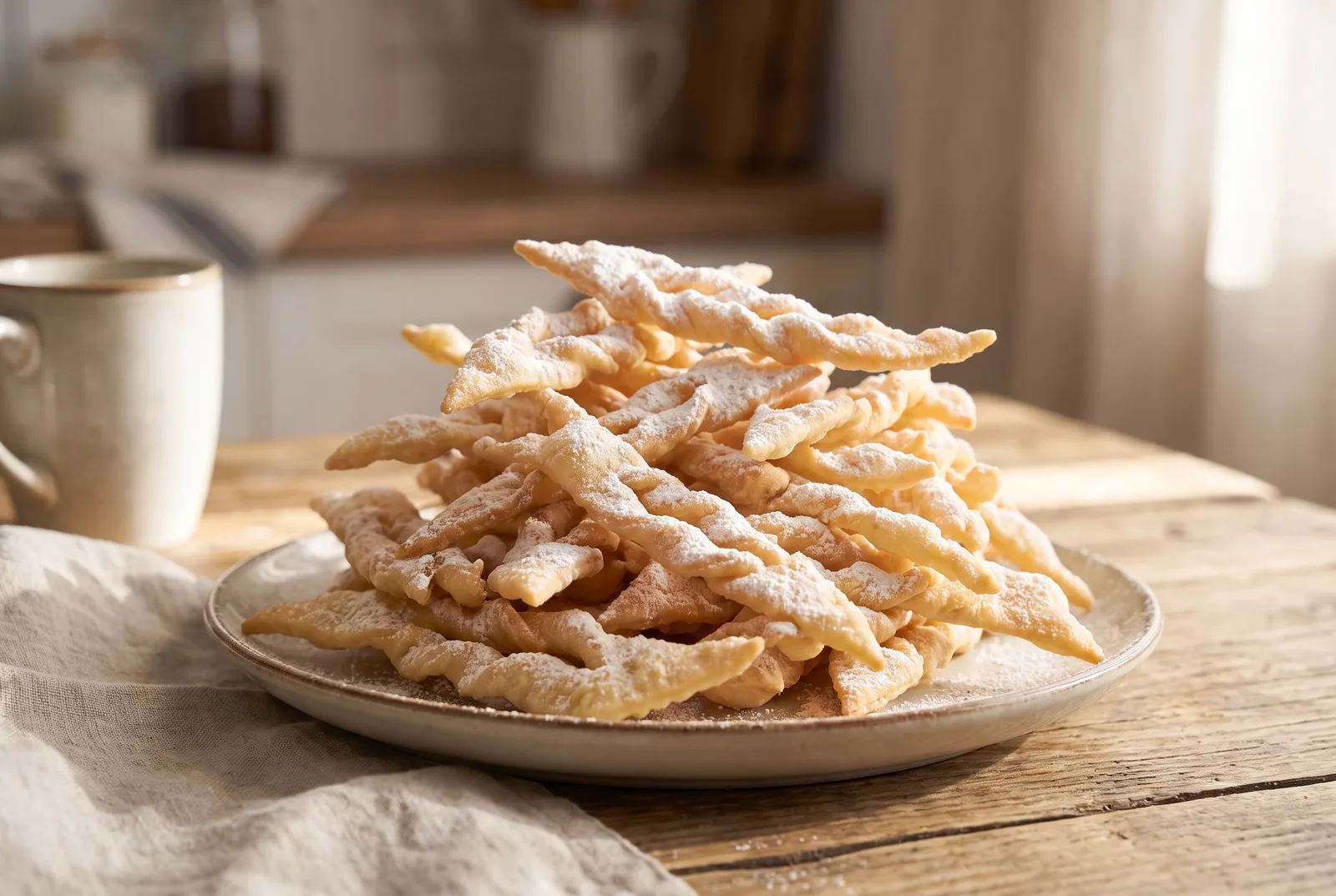
Žagarėliai is a diminutive of žagaras — a dry, leafless twig or a piece of brushwood/kindling. The pastry is named for the way a plate of the crisp, pale, twisted ribbons looks like a little pile of dry twigs — pictured below. This is the same pastry the Poles call faworki / chrust / chruściki and Belarusians favorki / chruščy — the žagarėliai are the Lithuanian member of a pan-Central/Eastern-European fried-ribbon family. For the Polish sibling, cross-refer B1-paczki-and-deep-fried-pastry.
The classic dough (spirit-crisped egg dough)
The defining trick is a splash of strong spirit (degtinė/vodka, or spiritas) — or a little vinegar — in an egg-rich, low-sugar dough. The alcohol interferes with fat uptake, so the ribbons fry up crisp and light and absorb less oil, then it flashes off during frying. This is the authentic reason žagarėliai are trapūs (brittle), not doughy.
A double-confirmed classic formula (see the formula card below):
- 1 whole egg + 3 egg yolks
- 100 g sour cream (grietinė)
- 300 g wheat flour
- 2 tbsp vodka (degtinė)
- 1 tsp baking powder
- 2 tbsp sugar + pinch of salt
Whip egg, yolks, sugar and salt; stir in sour cream and spirit; work in flour and baking powder to a soft, non-sticky dough; rest 30-40 minutes at room temperature. Roll as thin as you possibly can — about 1 mm, almost translucent ("so you can see the table through it"). This thinness is the single biggest quality lever: thick žagarėliai are chewy, not brittle.
Shaping — the slit-and-twist bow
Cut the sheet into strips, make a lengthwise slit down the middle of each, and pull one end back through the slit to form the classic twisted bow/knot — pictured below. Fry in hot oil until golden — they cook in well under a minute and often flip themselves. Drain on paper and dust with icing sugar while just warm.
A moisture-resistant / non-melting dusting sugar (see catalogue) is worth specifying for retail: on a warm, slightly oily fried surface, ordinary icing sugar weeps and greys within the hour, while a fat-coated dusting sugar stays snow-white on the shelf.
2. Spurgos — doughnuts in two families
"Spurga" covers any fried dough ball/ring, but two very different products share the word.
2a. Yeast doughnuts (mielinės spurgos / pončkos)
These are the enriched, jam-filled doughnuts. A workable dough (see the formula card below): ~750 ml (≈450 g) wheat flour, 360 ml milk, 40 ml oil, 2 tbsp sugar, 2 tsp dried yeast, 1 tsp salt. Warm the milk to blood heat, foam the yeast, knead an elastic dough, prove, fill with thick jam through a piping tip, and fry both sides to gold.
Because the dough is enriched and sweet, use an osmotolerant yeast or a doughnut yeast/dough concentrate — the sugar and fat otherwise slow a standard yeast. This is exactly the territory of A2-osmotolerant-yeast-enriched-doughs and A8-enriched-dough-formulas. The jam-filled spurga (pončka) is the guise most tied to the Polish-influenced festive table — the name mirrors the Polish pączek, and food historian Rimvydas Laužikas groups both pončkos and žagarėliai with that tradition (most characteristic of the Vilnius region). Read the direct "imported from Poland" framing as a plausible linguistic-cultural link rather than a firmly documented history — it rests on a single source and is why the pončka looks and eats like a Polish/German filled doughnut rather than a ring.
2b. Curd-cheese doughnuts (varškės spurgos)
The home-baking staple: small, quick, chemically leavened curd doughnuts, softer and more cake-like than the yeast version. Formula (see the formula card below): 500 g varškė (curd cheese), 250 g flour, 150 g sugar, 1 tsp baking powder, vanilla, salt. Rub the varškė smooth (no lumps), mix in sugar/salt/vanilla, sift over the flour + baking powder, and knead a stiff dough. Roll ~40-50 g pieces into short ropes joined into rings, and fry at moderate heat — they first sink, then rise to the surface as they set — until golden both sides. Dust warm with icing sugar and cinnamon.
Varškė is graded by fat in Lithuania (from riebi/rich down to liesa/lean); a medium curd (~9%) is typical for these doughs and for žagarėliai su varške (a curd version of the twists, baking-powder leavened, rolled thicker at ~1 cm and cut into slit-and-turned parallelograms). Curd selection is covered in depth in B5-varske-in-baking.
Crisp vs soft — the dividing line. Spirit-and-egg dough rolled to 1 mm = brittle žagarėliai. Baking-powder curd dough = soft, cakey spurgos/žagarėliai. Yeast dough = light, filled pončkos. Same fryer, three textures — see the comparison table below.
3. Skruzdėlynas — the "anthill" showpiece
Skruzdėlynas (from skruzdėlė, ant) is a festive "cake" with no baking of its own: you fry a batch of small žagarėliai-type ribbons, bind them with honey, and stack them into a tall cone, sprinkling poppy seeds (and sometimes chopped nuts) over each layer. The finished dark-speckled mound looks like an anthill — hence the name. It is a traditional, old-style celebration centrepiece (Lithuanian recipes call it senovinis, "old-style") and a strong seasonal SKU. (The recipe sources attest the "old-style" framing; treat any specific "centuries-old" antiquity as unsourced romanticised phrasing.)
Assembly (pictured below): lay the fried ribbons like spokes with the prettier, pointed ends facing outward; drizzle each layer with warm honey and dust with poppy seeds as you build upward; finish with a few ribbons stood vertically at the peak.
Honey binding syrup (see the formula card below): a typical mix is 200 g honey + 100 g sugar + 30 ml water, warmed together. If the honey has crystallised, loosen it over a bain-marie with a little water to a sticky, slowly-flowing consistency — do not add too much water or the cone will not hold. A neutral artificial/invert honey is a legitimate cost-down for the binder where floral aroma is not the selling point.
4. The one control that matters: oil at 170-180 °C
Every product here lives or dies on frying temperature — see A4-frying-fats-and-oils for the full science; pictured below.
- Target 170-180 °C. A quick test: drop a scrap of dough — if bubbles gather around it immediately and it rises within a couple of seconds, foaming nicely, the oil is right.
- Too cool → the pastry sits, soaks up fat and comes out heavy and greasy.
- Too hot → the outside darkens before the inside cooks (a real risk for thicker yeast spurgos), and thin žagarėliai scorch.
- Fry in small batches so the oil temperature does not crash when you load it; drain on paper immediately.
Choosing the frying fat (spec-backed)
The platform's frying fats were checked against their supplier spec sheets:
- Refined rapeseed oil (Olympic Oils): 99.9997% rapeseed oil plus an antifoaming agent, E900 (dimethylpolysiloxane, ~3 ppm) — this additive is included specifically to suppress foaming and slow oxidation during deep-frying, and at ~3 mg/kg is well within the 10 mg/kg EU maximum for frying oils and fats (Reg (EC) 1333/2008). 900 kcal/100 g, low saturates (7.5 g), high monounsaturates (63 g); FFA ≤0.1%, peroxide value ≤1.0 meq/kg; nut-free and vegan. A neutral flavour and high smoke point make it a strong default for žagarėliai.
- Refined sunflower oil (Olympic Oils): 100% sunflower, 900 kcal/100 g, 11 g saturates / 28 g mono / 60 g poly per 100 g; FFA ≤0.1%, PV ≤1.0 meq/kg; nut-free, vegan. Also neutral; slightly higher polyunsaturates mean it oxidises a little faster than rapeseed on a long fry-day.
- Solid vegetable shortening (Cardowan, palm+rapeseed): white block, slip melting point ~45 °C, 38.8 g saturates/100 g, RSPO segregated/mass-balance available (SG/MB pack suffix), citric acid (E330) present — the datasheet treats it as a processing aid, but confirm whether it must be declared on the finished-fat label (a true processing aid with no technological function in the fat as sold need not be, but if it acts as an antioxidant/acidity regulator it must appear as E330). A solid fat gives a drier, less greasy finish and longer fry-life for high-volume doughnut production — see A4-fat-types-and-selection.
- Dedicated palm frying oil (Master Martini) and RSPO palm oil (KTC Palmax SG) are the high-throughput options where palm's frying stability is wanted; weigh against sustainability (A4 covers RSPO).
See the key-specs table below for the side-by-side.
5. Where these pastries live: the calendar
Fried pastry in Lithuania is bound to the calendar (fuller treatment in B5-seasonal-festive-baking):
- Užgavėnės (Shrovetide) is the fried-food festival. Food historian Rimvydas Laužikas describes it as a deliberate pre-Lenten feast of rich, fatty food — meat, lašiniai (cured pork fat), šiupinys, and fried pastries — eaten to excess before the 40-day Lenten fast (Gavėnia) to Easter (Laužikas states a 40-day fast; not the seven-week Orthodox Great-Lent count, since Lithuania is Catholic). He notes that pancakes (blynai) only became the dominant Užgavėnės dish after 1990; before that the feast centred on meat, fat and fried goods. Jam-filled spurgos/pončkos are the variety most tied to the Polish-influenced festive table (Laužikas groups both pončkos and žagarėliai here — read "from Poland" as a cultural link, not a documented import), while žagarėliai were popular festive pastries throughout historic Prussia / Lithuania Minor (Prūsija) — this Prussia point Laužikas states explicitly. Note that his account rests on a single (mirrored) press interview, so treat the calendar attributions as one authoritative voice rather than independently corroborated.
- Kūčios (Christmas Eve) is the poppy-seed counterpoint: the tiny kūčiukai breads are eaten with aguonų pienas (poppy-seed milk). Note they are baked, not fried — but the poppy-seed thread links them to the poppy topping of skruzdėlynas (see B5-kuciukai-christmas-biscuits).
6. Food safety and allergens
The points below are the known regulatory and allergen hooks; verify each against the actual recipe, supplier spec sheets and current UK/EU law before any product goes on sale.
- Deep-frying is a hot-oil, ~180 °C process — a burn and fire hazard. Monitor oil temperature, never heat past the fat's smoke point, keep water away from the fryer, and drain hot goods on paper.
- Acrylamide (a legal obligation, not just quality). Enriched deep-fried doughs — above all the yeast spurgos/pončkos — fall under the "fine bakery wares" scope of Reg (EU) 2017/2158, which makes acrylamide-mitigation measures mandatory for food business operators: fry to a golden, not dark colour and control time/temperature. The "until golden" endpoint throughout this dossier is the mitigation, not just an aesthetic.
- Used-oil degradation. The supplied oils specify fresh FFA ≤0.1% and peroxide ≤1.0 meq/kg — a starting quality benchmark, not a used-oil limit. In-use frying oil degrades; several EU member states cap total polar materials (TPM) at ~24–25 % as a discard trigger that FFA/peroxide alone will not catch. Filter and rotate oil on a schedule and check TPM if you run a high-volume fry line; consider the antifoam-stabilised rapeseed for a longer working life.
- Shared-fryer allergen cross-contact. Frying a nut-topped or nut-containing line and a plain line in the same oil transfers allergens between them — segregate oil/fryers or manage this in your allergen plan.
- Honey binder — infant-botulism advisory. Skruzdėlynas is a children-facing festive cake bound in honey. UK FSA/NHS guidance is that honey must not be given to infants under 12 months (risk of infant botulism from C. botulinum spores) and should be labelled accordingly; warming honey over a bain-marie does not reliably destroy the spores.
- Poppy seed — contaminant limit, not (mainly) an allergen. The heavy poppy-seed load on skruzdėlynas (and in aguonų pienas) is regulated for opium alkaloids: Reg (EU) 2021/2142 (consolidated into Reg (EU) 2023/915) sets maxima — 20 mg/kg for poppy seeds placed on the market and a tighter limit for bakery products (morphine + codeine expressed as morphine equivalents). Specify a food-grade low-alkaloid poppy seed for any high-poppy product.
- Added alcohol in žagarėliai dough. The degtinė/spirit is a functional added-alcohol ingredient. Most flashes off in the sub-minute fry, but complete evaporation is not guaranteed, so trace ethanol can remain — an ingredient/labelling consideration for a retail product (a small vinegar substitution avoids it).
- Fresh-dairy cold chain. Varškė (curd cheese) and grietinė (sour cream) are fresh, perishable dairy — hold refrigerated and observe use-by discipline before they go into the mix.
- Allergens (EU FIC 1169/2011 / UK). Standard žagarėliai and skruzdėlynas contain wheat (gluten) and egg; sour-cream, varškė and yeast-doughnut versions add milk; jam-filled spurgos carry whatever the filling declares. Two corrections for the label: (1) poppy seed is not one of the 14 mandatory declarable allergens (sesame is; poppy is not) — flagging it is prudent advisory language, but its real legal hook is the opium-alkaloid limit above; tree nuts (if used on skruzdėlynas) are a mandatory allergen. (2) Check fillings, fat blends and doughnut concentrates for soya (soya lecithin, E322) and sulphites — both are declarable allergens and are common, easily-missed additions. Confirm every finished-product label against the actual recipe and supplier spec sheets.
7. Buy the ingredients (Domson catalogue)
See the products at the end of this article for the mapped SKUs. In short:
- Frying fats: Olympic Oils Rapeseed Oil 20 L / Sunflower Oil 15 L; Ajax Rapeseed Oil 5 L; Master Martini Palm Frying Oil 25 L; KTC Palmax SG RSPO palm oil; Cardowan Vegetable Shortening 12.5 kg.
- Flour: Komplexmłyn Domson White Flour Type 500 / Type 550; Emix Wheat Sponge Cake Flour (soft flours for a tender crisp dough — A1-wheat-flour-types-by-application).
- Yeast for spurgos: Lesaffre Fresh Yeast Benevia, Lallemand Fermipan Red dried; Ireks Global Yeast Doughnut Concentrate / Backaldrin Doughnut & Yeast Dough Concentrate (osmotolerant, purpose-built).
- Eggs: Domson Egg Yolk Liquid 10 kg (žagarėliai are yolk-heavy) and Whole Egg Liquid 10 kg.
- Dairy: Figand Sour Cream 18% 5 kg (grietinė); Figand Curd Cheese 4% and OSM Bieruń Curd Cheese 1 kg (varškė) — see B5-varske-in-baking.
- Finishing:Icing Sugar 10 kg and moisture-resistant Mont Blanc / Sonn Snow / Macphie Sweet Snow dusting sugars; Emix Vanillin Sugar; Agart / Global Grains Blue Poppy Seeds 25 kg; Ratos Natura Multifloral Honey 14 kg (and Artificial Honey 14 kg as a binder cost-down).
- Doughnut fillings: Vortumnus Raspberry Seedless / Multifruit Thick Jam, Prospona Fruzelina Raspberry, Martin Braun Plum Filling; Polmarkus stainless doughnut filling tips.
Figures
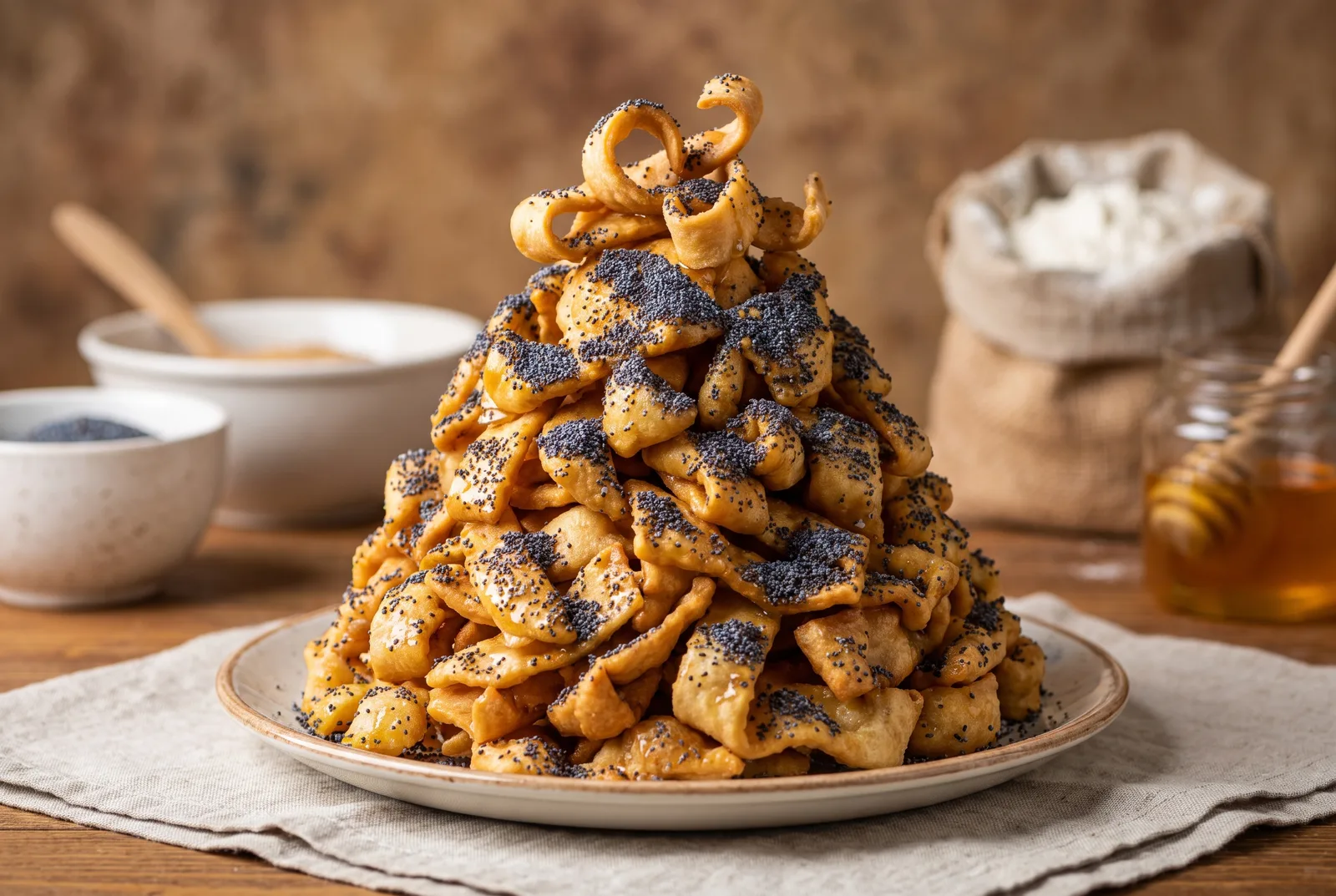 Lithuanian skruzdėlynas anthill cake — a honey-bound cone of fried pastry ribbons dusted with poppy seeds
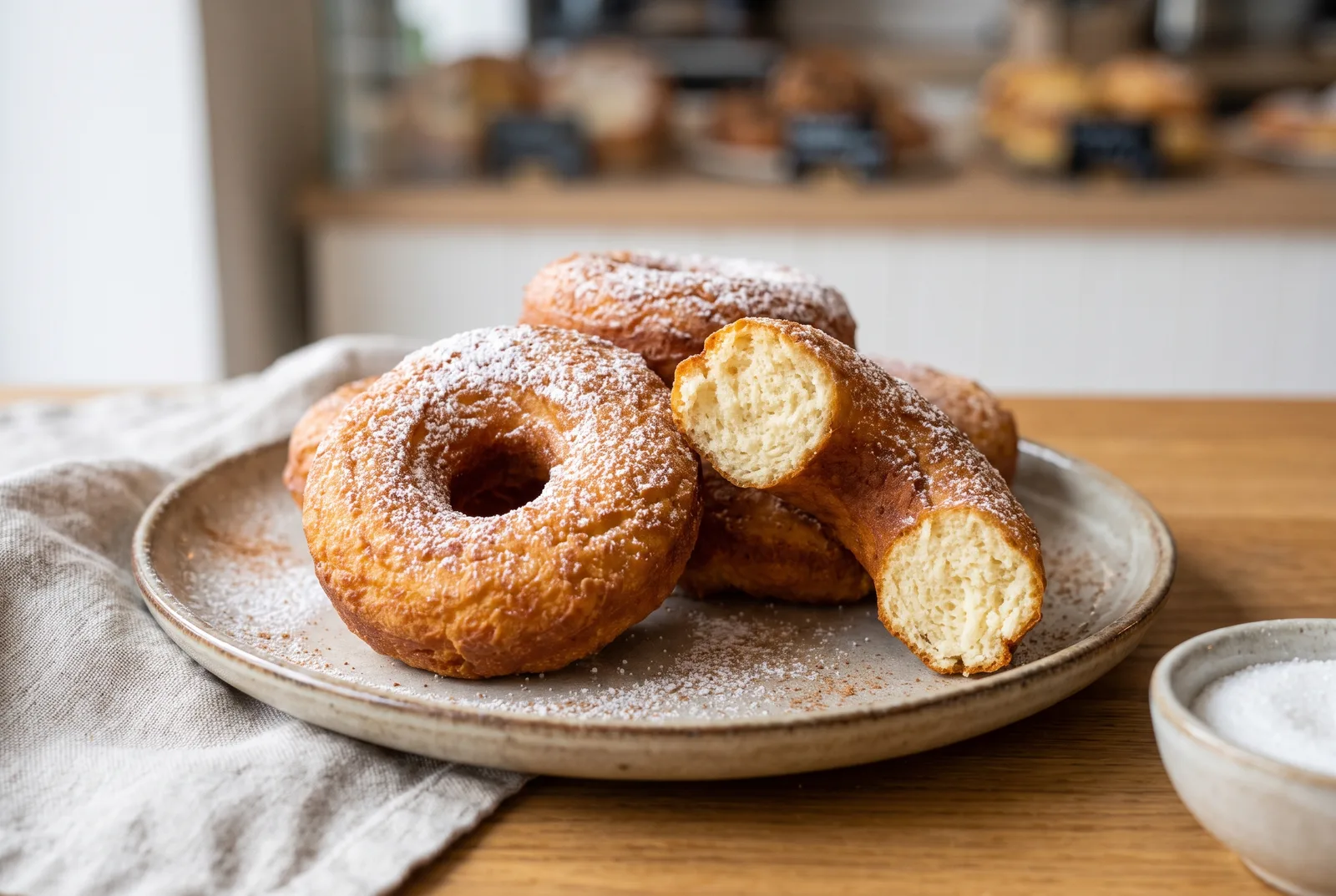 Lithuanian varškės spurgos curd-cheese doughnut rings dusted with sugar and cinnamon
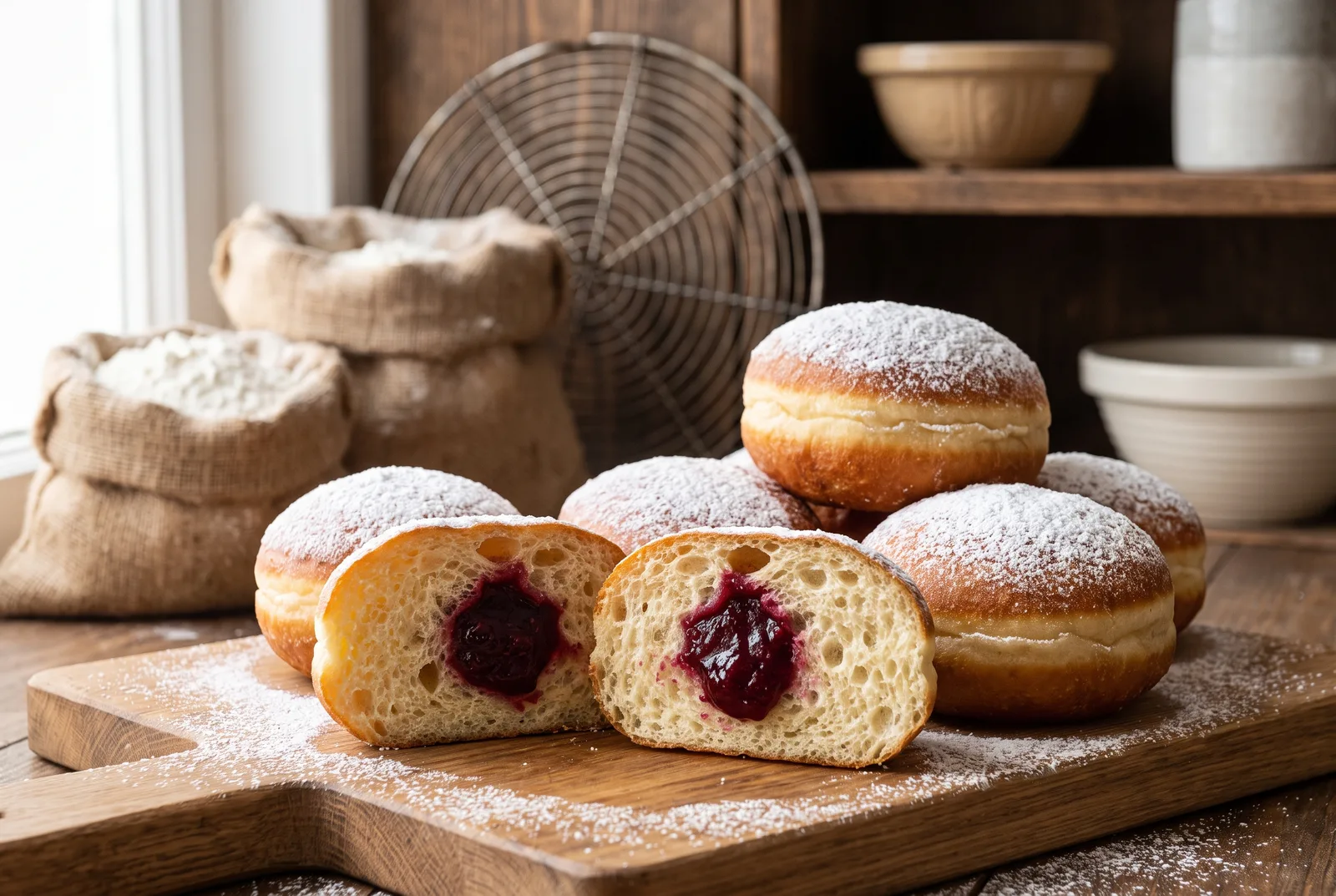 Jam-filled Lithuanian yeast doughnuts (mielinės spurgos) with airy crumb
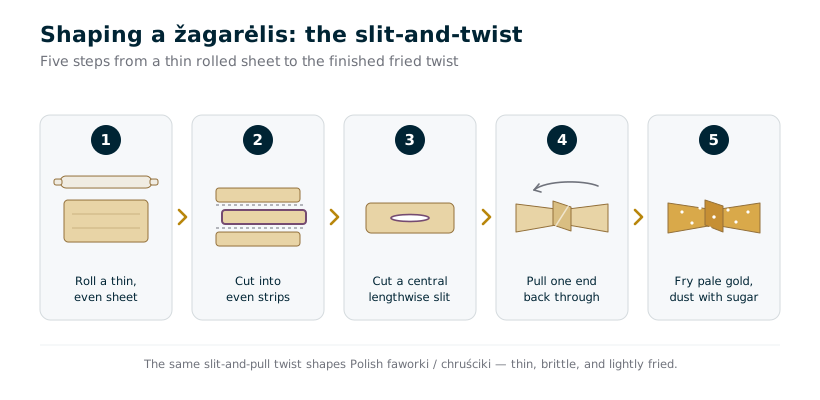 Five-step diagram of the slit-and-twist shaping of a žagarėlis pastry
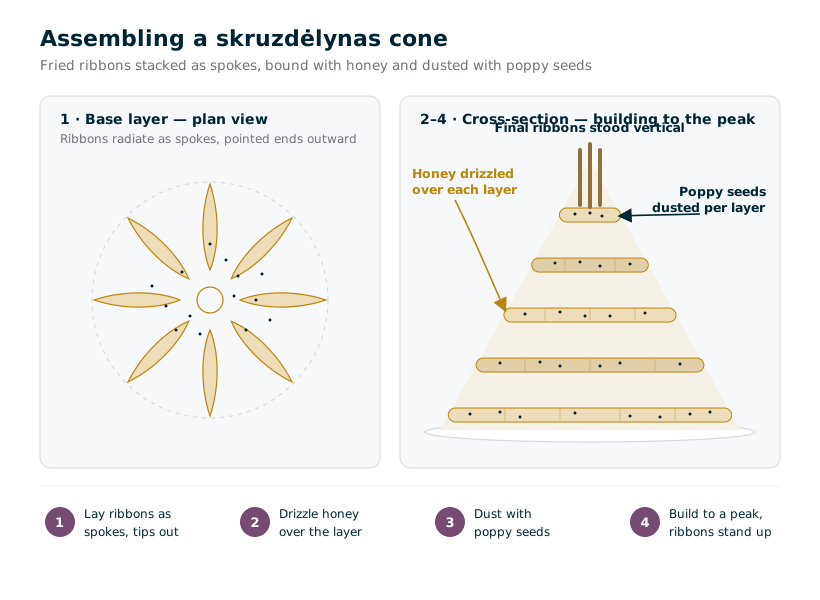 Diagram of assembling a skruzdėlynas cone from fried ribbons with honey and poppy seeds
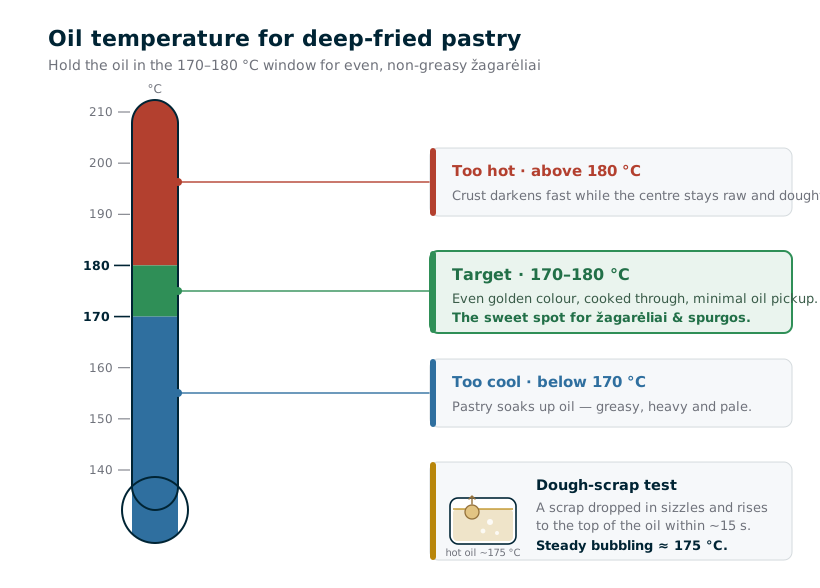 Diagram of the 170-180 °C frying window for Lithuanian fried pastry
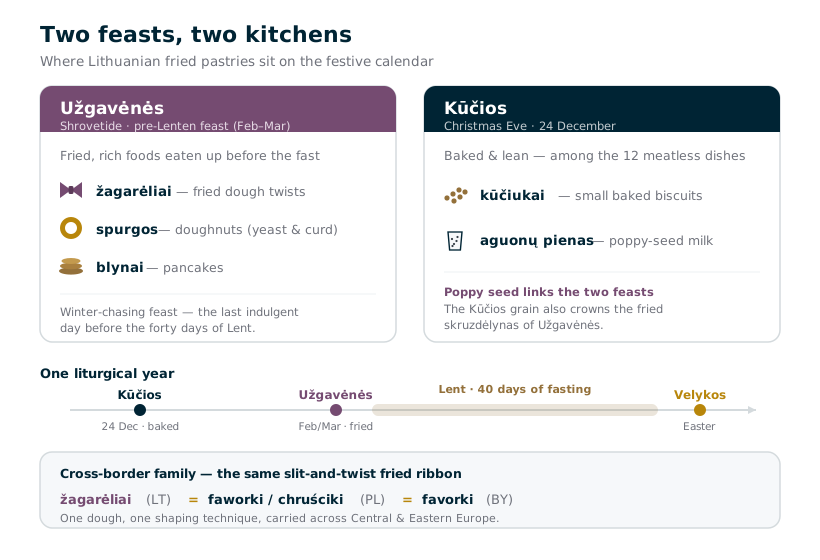 Calendar diagram linking Lithuanian fried pastries to Užgavėnės and the poppy-seed link to Kūčios
Classic žagarėliai (crisp spirit dough)
| Ingredient | Baker's % | Weight |
|---|---|---|
| Wheat flour (soft, Type 500/550) | 100% | 300 g |
| Whole egg | 1 | |
| Egg yolks | 3 | |
| Sour cream (grietinė) | 33% | 100 g |
| Vodka / spirit (degtinė) | ~7% | 2 tbsp |
| Sugar | ~9% | 2 tbsp |
| Baking powder | 1 tsp | |
| Salt | pinch | |
| Frying oil (rapeseed/sunflower) | to deep-fry, 170-180 °C | |
| Icing sugar | to dust |
- Whip egg, yolks, sugar and salt.
- Stir in sour cream and spirit.
- Work in flour + baking powder to a soft, non-sticky dough.
- Rest 30-40 min at room temperature.
- Roll as thin as possible — ~1 mm, near-translucent.
- Cut into strips; slit each down the middle and pull one end through to twist.
- Deep-fry at 170-180 °C until golden (well under a minute); drain on paper.
- Dust with icing sugar while just warm.
Yield: ~1 large plateful (approx. 250-300 pieces at 1 mm)
Bakers'-% not the natural language here (egg-led, near-zero water); given as-mixed. The spirit is functional, not for flavour.
Varškės spurgos (curd-cheese doughnut rings)
| Ingredient | Baker's % | Weight |
|---|---|---|
| Varškė (curd cheese, ~9%) | 500 g | |
| Wheat flour | 250 g | |
| Sugar | 150 g | |
| Baking powder | 1 tsp | |
| Vanilla | 2 g / to taste | |
| Salt | 1 tsp | |
| Frying oil | ~1 L, moderate heat | |
| Icing sugar + cinnamon | to dust |
- Rub varškē smooth (no lumps); mix in sugar, salt, vanilla.
- Sift over flour + baking powder; knead a stiff dough.
- Roll 40-50 g pieces into short ropes, join into rings.
- Fry at moderate heat — pieces first sink, then rise as they set — until golden both sides.
- Drain on paper; dust warm with icing sugar and cinnamon.
Yield: ~8 portions
Mielinės spurgos / pončkos (jam-filled yeast doughnuts)
| Ingredient | Baker's % | Weight |
|---|---|---|
| Wheat flour | 100% | ~750 ml (≈450 g) |
| Milk | ~80% | 360 ml |
| Oil | ~9% | 40 ml |
| Sugar | ~5% | 2 tbsp |
| Dried yeast (osmotolerant) | ~1.5% | 2 tsp |
| Salt | ~1.5% | 1 tsp |
| Thick jam (raspberry/plum/multifruit) | to fill | |
| Frying oil / shortening | to deep-fry, 170-180 °C |
- Warm milk to blood heat; dissolve sugar and yeast; leave to foam.
- Add flour, salt and oil; knead an elastic dough; prove until doubled.
- Shape, prove again; fry at 170-180 °C both sides to gold.
- Cool slightly; fill with thick jam through a piping tip; finish with sugar or icing.
Yield: batch dough (~450 g flour base)
Enriched, sweet dough — use osmotolerant yeast or a doughnut yeast/dough concentrate (A2-osmotolerant-yeast-enriched-doughs).
Skruzdėlynas (honey-and-poppy anthill cone)
| Ingredient | Baker's % | Weight |
|---|---|---|
| Fried žagarėliai ribbons | 1 large batch | |
| Honey (medus) | 200 g | |
| Sugar | 100 g | |
| Water | 30 ml | |
| Poppy seeds (aguonos) | to dust each layer | |
| Chopped nuts | optional |
- Warm honey + sugar + water to a sticky, slowly-flowing syrup (loosen crystallised honey over a bain-marie — do not over-water).
- Lay fried ribbons like spokes, pointed ends outward.
- Drizzle each layer with warm honey; dust with poppy seeds; build upward into a tall cone.
- Finish with a few ribbons stood vertically at the peak; dust the whole cone with poppy seeds.
Yield: 1 festive cone
No baking of its own — a construction from fried žagarėliai ribbons. Ribbon dough follows fc-zagareliai-classic (or a plainer flour/egg/sour-cream dough).
| Product | Leavening / crisping agent | Texture | Roll thickness | Typical fat | Finish |
|---|---|---|---|---|---|
| Žagarėliai (classic, trapūs) | Egg + spirit (degtinė); baking powder pinch | Thin, brittle, crisp | ~1 mm (near-translucent) | Neutral oil (rapeseed/sunflower), 170-180 °C | Icing sugar dusting |
| Žagarėliai su varške (curd) | Baking powder + varškė | Soft, cake-like | ~1 cm | Neutral oil, 170-180 °C | Icing sugar dusting |
| Varškės spurgos (curd doughnuts) | Baking powder + varškė | Soft, dense, cakey | Hand-rolled ~40-50 g ropes/rings | Neutral oil, moderate heat | Icing sugar + cinnamon |
| Mielinės spurgos / pončkos (yeast doughnuts) | Yeast (osmotolerant for enriched dough) | Light, airy, filled | Cut/rolled rounds, proofed | Neutral oil or shortening, 170-180 °C | Sugar / jam-filled / iced |
| Skruzdėlynas (anthill) | Uses fried žagarėliai bound in honey | Crisp ribbons in sticky honey | Ribbons rolled thin then fried | Neutral oil for the ribbons | Honey + poppy seeds (+ nuts) |
| Country / region | Name | Notes |
|---|---|---|
| Lithuania | žagarėliai (žagaras = twig) | Egg + spirit dough, slit-and-twist, icing sugar |
| Poland | faworki / chruściki / chrust | Direct counterpart; see B1-paczki-and-deep-fried-pastry |
| Belarus | favorki / chruščy | Same twist-and-fry family |
| Wider C/E Europe | angel wings / crostoli / frappe | Same thin fried-ribbon idea across many cuisines |
| Product / brand | Type | Saturates /100 g | Melting / state | Notes for frying |
|---|---|---|---|---|
| Rapeseed Oil 20 L — Olympic Oils | Refined rapeseed + E900 antifoam | 7.5 g | Liquid | Neutral, high smoke point; antifoam suppresses foaming/oxidation; strong default |
| Sunflower Oil 15 L — Olympic Oils | Refined sunflower | 11 g | Liquid | Neutral; higher polyunsaturates oxidise a little faster on long fry-days |
| Vegetable Shortening 12.5 kg — Cardowan | Palm + rapeseed blend | 38.8 g | Solid block, slip m.p. ~45 °C | Drier, less greasy finish; longer fry-life; RSPO SG/MB available |
| Palm Frying Oil 25 L — Master Martini | Palm frying fat | n/a (not spec-read) | Semi-solid/liquid | High-throughput frying stability; weigh sustainability |
| Palmax SG 12.5 kg — KTC | RSPO sustainable palm | n/a (not spec-read) | Solid | Palm stability with RSPO segregated sourcing |
| Fault | Likely cause | Fix |
|---|---|---|
| Greasy, heavy žagarėliai/spurgos | Oil too cool; batch too large (temperature crash) | Hold oil at 170-180 °C; fry small batches; test with a dough scrap |
| Dark outside, raw inside (spurgos) | Oil too hot; pieces too thick | Drop oil toward 170 °C; roll/scale thinner; give yeast dough a full proof |
| Žagarėliai chewy, not brittle | Sheet rolled too thick; no spirit | Roll to ~1 mm (near-translucent); add the spoon of degtinė/vinegar |
| Icing sugar weeps/greys on shelf | Ordinary icing sugar on a warm, oily surface | Use moisture-resistant/non-melt dusting sugar; dust once fully cool |
| Skruzdėlynas cone collapses | Honey syrup too thin (over-watered) | Reduce to a sticky, slowly-flowing syrup; add ribbons gradually |
| Off / rancid fried flavour | Old oil; high free fatty acids / peroxides | Filter and rotate oil; start from fresh oil (FFA ≤0.1%, PV ≤1.0 meq/kg); consider antifoam-stabilised rapeseed |
| Yeast spurgos dense, poorly risen | Standard yeast stalled by sugar/fat; under-proof | Use osmotolerant yeast / doughnut concentrate; full two-stage proof |
- Product:
- Rapeseed Oil 20 L (Olympic Oils, G44625)
- Composition:
- 99.9997% rapeseed oil + antifoaming agent E900 (dimethylpolysiloxane) ~3 ppm
- Energy:
- 3700 kJ / 900 kcal per 100 g
- Fat profile:
- 100 g fat: 7.5 g sat / 63 g mono / 28 g poly / 0 trans
- Quality:
- FFA ≤0.1% (as oleic); peroxide ≤1.0 meq/kg
- Allergens:
- nut-free, vegan
- Product:
- Sunflower Oil 15 L (Olympic Oils, G44536)
- Composition:
- 100% sunflower oil
- Energy:
- 3700 kJ / 900 kcal per 100 g
- Fat profile:
- 100 g fat: 11 g sat / 28 g mono / 60 g poly / 0 trans
- Quality:
- FFA ≤0.1% (as oleic); peroxide ≤1.0 meq/kg
- Allergens:
- nut-free, vegan
- Product:
- Vegetable Shortening 12.5 kg (Cardowan, G45065)
- Composition:
- Vegetable oil: palm, rapeseed; citric acid E330 processing aid
- Energy:
- 3700 kJ / 900 kcal per 100 g
- Fat profile:
- 100 g fat: 38.8 g sat / 43.5 g mono / 15.5 g poly
- Quality:
- Slip melting point ~45 °C; air content ~12%; FFA 0.10; PV 1.0; shelf life 5 months
- Allergens:
- no declared allergens; kosher/vegetarian/vegan/halal; RSPO SG/MB
- Oil temperature:
- 170-180 °C
- Batch size:
- small
- Fresh-oil quality benchmark:
- FFA ≤0.1%, peroxide ≤1.0 meq/kg