
Professional Turkish pastry training: schools, certifications, and skill pathways
How Turkish bakers and pastry chefs are actually trained — from the centuries-old usta–çırak (master–apprentice) workshop system rooted in the Ahilik guilds, through the formal Law 3308 apprenticeship (kalfalık/ustalık certificates), the MYK national vocational qualifications, private culinary academies (MSA, TCA, Chef's Table), municipal free courses (İSMEK), university degrees (Özyeğin × Le Cordon Bleu) and industry platforms (Pakmaya). Written to give UK-based Turkish bakeries a map of the standards and assumed knowledge their staff were trained in — and which Domson ingredients let them reproduce that training on British soil.
Professional Turkish pastry training: schools, certifications, and skill pathways
Why this article exists
Domson serves a large community of Turkish bakers and pastry chefs (pastör/pastacı) in the UK. When one of your staff talks about "the way the usta taught it," or asks whether a British flour will "open" for baklava the way the flour back home did, they are drawing on a training culture that is genuinely different from the British bakery-college model. This dossier maps that culture — the workshop tradition, the state qualifications and the modern academies — so that the rest of the Baking Academy (and your buying decisions) can speak the same language your team already speaks.
It is a pathways article, not a recipe article. The techniques themselves live in the sibling dossiers: baklava production, börek & phyllo, Turkish flour grades, lokum, Ottoman syrup sweets and the Turkish bread map. This article is the "who taught them, and to what standard" layer underneath all of those.
1. The oldest school: the usta–çırak workshop
Long before there were culinary academies, Turkish craft was organised around the Ahilik system — the 13th-century Anatolian guild network institutionalised by Ahi Evran, itself grown out of the older fütüvvet (chivalric brotherhood) tradition. Ahilik gave every trade the same three-rung ladder that Turkish bakers still use today:
- çırak — apprentice: sweeps, kneads, watches, is trusted with nothing sharp or hot for a long time;
- kalfa — journeyman: can execute independently, is a candidate for mastery;
- usta — master: fully competent, and — crucially — the person who raises the next çırak and kalfa.
Ahilik also embedded quality enforcement into the culture: a shop caught selling sub-standard goods had its offender's shoe thrown onto the roof — the still-current Turkish idiom "pabucu dama atılmak" ("to have one's shoe thrown on the roof," i.e. to be disgraced). When your usta obsesses over a torn sheet of yufka or a syrup that "sat" a second too long, that is a 700-year-old accountability reflex, not fussiness.
This system is not a museum piece. In Gaziantep, the heartland of baklava, mastery is still transmitted almost entirely through the workshop (imalathane), which working baklavacılar openly call "the school." The workshop tradition there is described (in the trade's own accounts) as reaching back some 140–145 years — an indicative family/workshop history rather than a documented, unbroken apprenticeship record — and the timescale is brutal: becoming a fully-fledged baklava usta takes 10–15 years (ten at the very least). By one Gaziantep workshop's own account, of roughly ten would-be apprentices who arrive in a season only about two typically survive the path to mastery — the rest either quit or are let go (a single workshop owner's anecdote, not an official statistic). A baklava master will often have started as a child (nine years old is a commonly-cited age) and rotated through several respected shops before being called usta.
Practical takeaway for a UK employer: a "baklava usta" or "börek ustası" on your team carries a decade-plus of tacit, workshop-transmitted knowledge that no 8-week course replicates — the feel of correctly rested dough, the sound of the right syrup. Treat that as senior craft skill. Conversely, a young hire with an academy diploma has broad, formalised technique but may never have opened 40 sheets of yufka by hand.
2. The formal apprenticeship: Law 3308, MEB and the ustalık belgesi
Turkey overlaid the traditional ladder with a state system run by the Ministry of National Education (Millî Eğitim Bakanlığı, MEB) under Law No. 3308 (Çıraklık ve Mesleki Eğitim Kanunu, the Apprenticeship and Vocational Training Law). Bakery, pastry and sugar-confectionery are all in scope. It works like this:
- The apprentice enrols at a Mesleki Eğitim Merkezi (Vocational Training Centre, "MESEM"), spending 1–2 days a week in the classroom and the remaining days working in a real bakery/pastane. The programme runs ~4 years.
- At the end of the 11th grade the apprentice sits the kalfalık (journeyman) exam; passing earns the Kalfalık Belgesi.
- At the end of the 12th grade comes the ustalık (master) exam; passing earns the Ustalık Belgesi.
- A master who wants to teach takes a further 40-hour usta öğreticilik (master instructor) course, after which they may legally train apprentices in their own trade.
The commercial punchline: an MEB-recognised ustalık belgesi is a legal requirement to open a fırın (bakery), pastane (pâtisserie) or unlu mamuller business in Turkey — the requirement can be met either by the owner personally or by a responsible master they employ. So the certificate is not a nicety — it is the licence to trade. Many of your first-generation Turkish bakery owners hold one (or employ someone who does).
Alongside MEB, the Mesleki Yeterlilik Kurumu (Vocational Qualifications Authority, MYK) issues competency certificates against national occupational standards within an 8-level framework (aligned to the European Qualifications Framework). The relevant ones for your trade:
- Pastacı (pastry maker) — standardised at Seviye 3 / Seviye 4. For the Seviye 4 certificate a candidate must pass the mandatory units (occupational health & safety, business organisation, hygiene/food safety) plus optional pastry units, answering ≥70% of theory questions correctly.
- Fırın ve Unlu Mamuller Üretim Operatörü Seviye 4 (Bakery & Flour-Products Production Operator, Level 4) — covers dough preparation, shaping and baking; the certificate is valid for 5 years and is assessed by written/oral plus performance exams.
If a job applicant lists an "MYK Seviye 4 Pastacı belgesi" or an "ustalık belgesi," those are verifiable, state-issued credentials — the MEB and MYK both run public certificate-lookup portals.
3. Private culinary academies
Turkey's modern academy sector trains the chefs who staff hotels, patisseries and industrial bakeries. The flagship is Mutfak Sanatları Akademisi (MSA), founded in 2004 by Mehmet Aksel in Maslak, Istanbul; it trains over 1,200 professional chef candidates a year and holds international accreditations from City & Guilds (UK), Scottish SQA and Pearson/EdExcel. MSA describes itself as the only Turkish institution to hold all three — treat that as a self-reported/promotional claim (other academies, e.g. Chef Akademi below, also carry City & Guilds accreditation); City & Guilds named MSA among the world's leading culinary schools in 2010. Its two most relevant programmes:
- Profesyonel Pastacılık (Professional Pastry): 250 hours total (226 practical + 24 theory), run as roughly 3 months in-class + 3 months internship (staj) for ages 18–40 (a shorter no-internship track exists for 41–49). Graduates receive an MSA diploma, a CTH Level 2 diploma (on the internship track), an MEB-approved certificate and an international HACCP food-safety certificate.
- Profesyonel Ekmekçilik ve Fırıncılık (Professional Bread & Baking): 118 hours (102 practical + 16 theory) over 8 weekends, explicitly teaching baker's formulas (i.e. baker's percentage — see A8), ekşi maya (sourdough — see A5), enriched doughs and viennoiserie/lamination (see A6).
Other established players:
- Turkish Culinary Academy (TCA), Ankara — its Professional Bakery & Pastry programme runs a published 994 hours over ~5 months (368 practical + 540 sectoral internship + 32 theory + 96 professional-language hours as listed by TCA — note the components as published do not sum exactly to the stated 994 total, so treat the breakdown as indicative), awarding MEB-approved pastry, bakery and vocational-English certificates.
- Chef's Table (Maslak, Istanbul) — professional pastry & bread over ~8 months (4 months in-academy + 4 months placement).
- Chef Akademi (est. 2011) — MEB-affiliated with City & Guilds accreditation.
And the free / subsidised route many career-changers actually use: İSMEK / Enstitü İstanbul, the Istanbul metropolitan municipality's academy, runs free vocational bakery & pastry courses for residents aged 16+, awarding MEB-approved certificates; graduates can even access KOSGEB small-business start-up support.
4. The university route: Özyeğin × Le Cordon Bleu
For those who want a degree, Özyeğin University's Gastronomy and Culinary Arts is a 4-year bachelor's run in partnership with Le Cordon Bleu (agreement signed 2012), awarding both an Özyeğin diploma and a Le Cordon Bleu certificate, taught by LCB chefs across dedicated production kitchens and a training restaurant. This is the academic, management-and-technique end of the spectrum — the graduates who become R&D chefs, food stylists and bakery-business founders. Academic food-history scholarship (e.g. the work of Assoc. Prof. Özge Samancı on Ottoman palace confectionery and the helvahane) also lives in this university sector and underpins the "heritage" framing your customers expect around lokum, helva and syrup sweets.
5. Industry & supplier training (the layer Domson sits closest to)
Ingredient manufacturers run their own professional academies — the model Domson's own Baking Academy follows. In Turkey the dominant one is yeast-maker Pakmaya, whose Pakmaya Profesyoneller Dünyası is a digital platform of recipes, technical product guidance and food-safety training for bakers and pastry chefs, backed by the physical Pakmaya baking centre (PUM) in Istanbul (founded 2013) and its FAGEM R&D unit. Unilever Food Solutions Türkiye similarly publishes professional Ottoman-dessert concept guides for foodservice. Trade bodies — the Türkiye Fırıncılar Federasyonu (Bakers' Federation), the Türkiye Ekmek Sanayi İşverenler Sendikası and the miller's federation TÜSAF — set the sector standards those platforms teach to, and BAKTAD (the Baklava & Dessert Producers' Association, founded 2001) does the same for industrial baklava.
6. The heritage benchmark: Şekerci Hacı Bekir
No account of Turkish pastry training is complete without its most famous "graduate institution." Şekerci Ali Muhiddin Hacı Bekir, founded in 1777 in Bahçekapı, Istanbul by Bekir Efendi (originally from Araç, Kastamonu), is regarded as Turkey's oldest surviving company; its master was appointed şekercibaşı (chief confectioner) to the Ottoman court. Hacı Bekir is credited with developing modern lokum (Turkish delight) in its present starch-and-sugar form once refined starch became available in the early 19th century — the direct ancestor of the product covered in B2-lokum-production. When a Turkish confectioner invokes "saray usulü" (palace-style) work, this is the lineage being claimed.
7. Buying to reproduce the training in the UK
The training above assumes access to specific flour and ingredient grades. Here is how it maps onto the Domson catalogue for a Turkish bakery operating in Britain — with the honest caveats a well-trained usta would want.
Flour: get the protein/gluten right first
Turkish pastry training is unusually protein-spectrum aware (see A1-protein-gluten-and-strength and the Turkish grade guide in B2-flour-and-milling). Two catalogue anchors:
- Domson White Strong Flour 16 kg (ADM) — a fortified strong white flour at 12.0% target protein, 59.5% water absorption, treated with ascorbic acid (E300), milled in BRC-certificated mills. A sound base for simit, pide, poğaça and börek doughs.
- Centurion Canadian Very Strong Flour 16 kg (Carr's Maldon Mill) — a very strong flour for the highest-extensibility work. Baklava-grade baklavalık un in Turkey is chosen for high protein and a high gluten index precisely so the yufka can be pulled paper-thin without tearing; the strongest UK flour is the closest off-the-shelf analogue when a dedicated baklava flour is not to hand (see B2-baklava-production).
Semolina (irmik): for revani, irmik helvası and şöbiyet dusting
- Durum Wheat Semolina 16 kg (Allied Mills, "360-Coarse") — 100% durum wheat (may contain up to 3% common wheat), creamy-yellow and coarsely granular; BRCGS-certified, 183-day shelf life. Coarse durum semolina is the correct choice for semolina-set desserts and helva (see B2-helva-sesame-tahini).
Sesame (susam): for simit and tahini-based sweets
- Sesame Seeds 25 kg (Global Grains, hulled Sesamum indicum) — moisture ≤6%, purity ≥99.9%, ~20.4 g protein and 61.2 g fat per 100 g. Kosher-certified, halal suitable but not certified. Note the allergen: sesame is a declarable allergen (see §8). Simit's crust is dipped in dilute grape-molasses (pekmez) water and then coated heavily in sesame — the coating volume is real, so buy in bulk.
Pistachio: know what you are actually buying
Authentic Gaziantep baklava uses pure ground Antep pistachio (Antep fıstığı) and nothing else. Two catalogue realities to teach your team:
- Roasted Diced Pistachios (Polmarkus) and Pistachio Granules 2/4 mm (Master Martini) are real pistachio and appropriate for authentic filling and finishing.
- Kranfil's "Pistachio" filling (Martin Braun) is a pistachio-flavoured filling cream — only ~12% roasted pistachios, plus biscuit pieces, soy oil and colour E141 — a fine industrial cake/viennoiserie filling but not a substitute for pure Antep pistachio in baklava. An usta will spot the difference instantly; label it correctly on your menu.
The figure below maps each training route to the B2 technique dossiers it prepares a baker to execute.
8. Food-safety, allergen and certification notes (flagged for review)
- Allergens (verify on current spec sheets before labelling): Domson White Strong Flour, the Allied Mills durum semolina, and any wheat product declare cereals containing gluten (wheat) — durum wheat and any common-wheat fraction are both wheat. Global Grains sesame declares sesame. Kranfil's Pistachio filling declares cereals/gluten (wheat, barley), milk, soya and pistachios (with "may contain" traces of other nuts). Sesame and tree nuts (pistachio) are among the 14 UK/EU declarable allergens and are central to Turkish baking — allergen control is not optional in a simit-and-baklava bakery.
- Halal/kosher: several catalogue items are "suitable but not certified" for halal (e.g. Domson Strong White, Global Grains sesame). If your customers require certified halal, confirm certification per batch — do not infer it from "suitable."
- Professional certification you can require of staff: MEB ustalık/kalfalık belgesi, MYK Pastacı Seviye 3/4 or Fırın ve Unlu Mamuller Üretim Operatörü Seviye 4, plus the HACCP/hygiene certificates bundled into academy diplomas. In the UK these sit alongside your Level 2 Food Safety obligations — they demonstrate craft competence, not UK legal food-hygiene compliance, which is separate.
Cross-references
Craft foundations: A8 Baker's percentage · A1 Protein, gluten & strength · A5 Sourdough technology · A6 Laminated dough fundamentals · A2 Yeast fermentation science. Turkish techniques trained in these pathways: Baklava · Börek & phyllo · Flour grades · Lokum · Ottoman syrup sweets · Bread map · Helva, tahini & sesame.
Figures
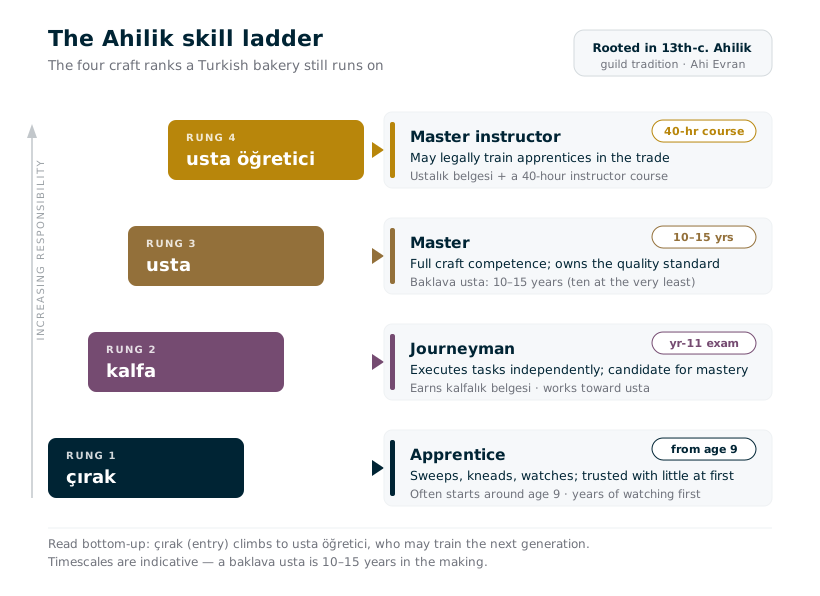 Four-rung diagram: çırak (apprentice), kalfa (journeyman), usta (master), usta öğretici (master instructor), with the years and responsibilities at each stage.
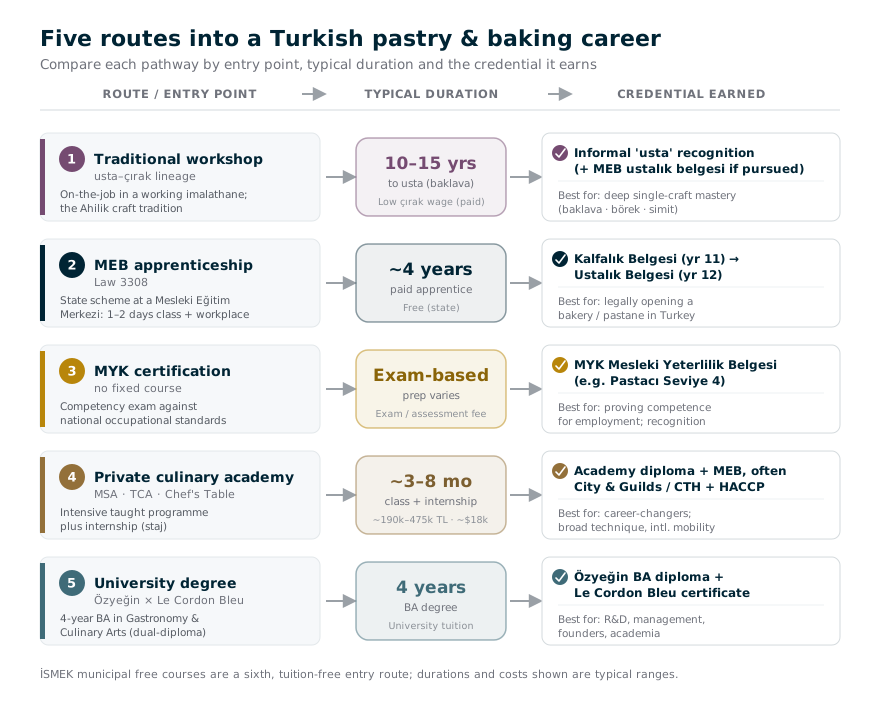 Flowchart comparing five routes: traditional workshop, MEB Law-3308 apprenticeship, MYK certification, private academy, and university degree, showing duration and credential for each.
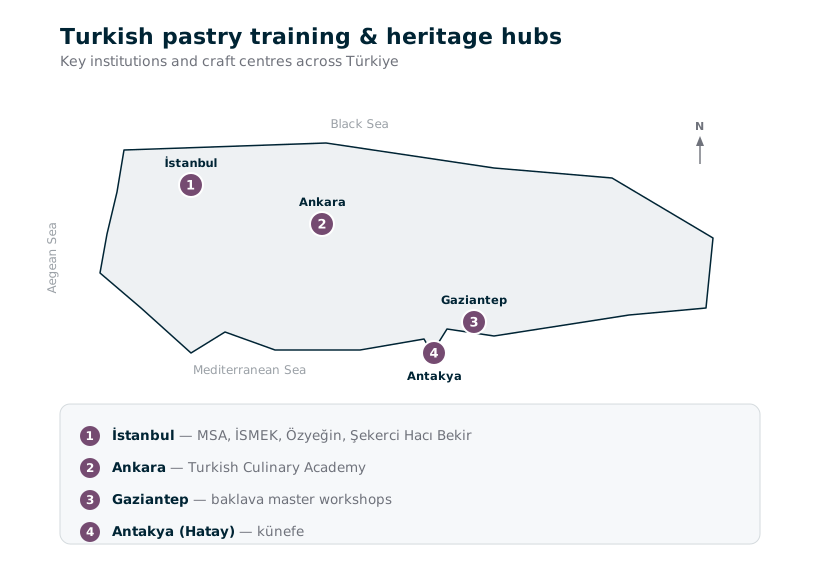 Outline map of Turkey with pins: Istanbul (MSA, İSMEK, Özyeğin, Şekerci Hacı Bekir), Ankara (Turkish Culinary Academy), Gaziantep (baklava master workshops), Hatay/Antakya (künefe).
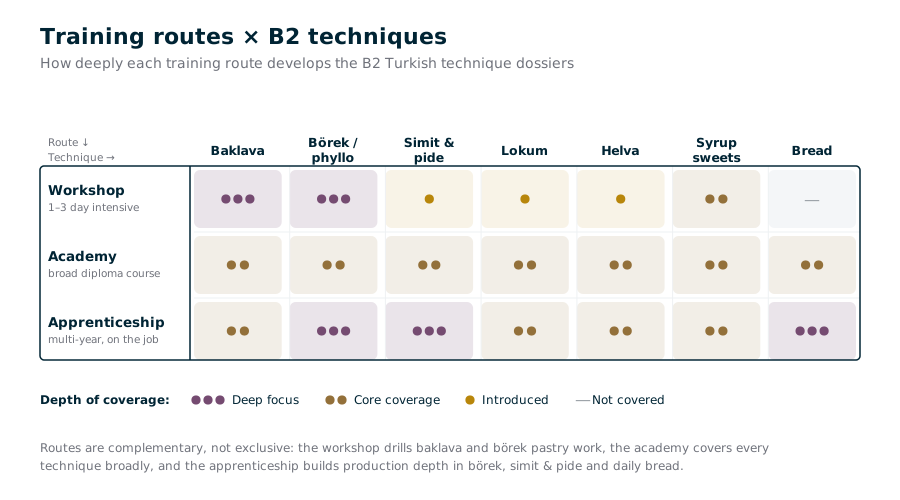 Matrix linking training routes (workshop, academy, apprenticeship) to techniques: baklava, börek, simit, lokum, helva, syrup sweets.
What an usta checks on a baklava-flour spec (baklavalık un)
| Protein | High protein → strong gluten network that survives being pulled paper-thin — Domson Strong White = 12.0% (a strong bread flour); dedicated Turkish baklavalık un is chosen higher still |
| Gluten index / quality | Extensible-yet-elastic dough that opens without tearing — Choose the very-strong tier (e.g. Centurion Canadian) when no baklava-specific flour is available |
| Water absorption | Sets the starting hydration for a workable, not sticky, dough — Domson Strong White absorption = 59.5% → start savoury doughs near ~58–61% and refine on the bench |
Numbers are supplier-spec targets and craft benchmarks, not a fixed recipe. Bench-test every delivery; flour behaviour varies by harvest and blend.
Illustrative strong-flour savoury base (baker's %) — starting point only
| Ingredient | Baker's % | Weight |
|---|---|---|
| Strong white flour | 100 | |
| Water | 58–61 (start from the flour's water-absorption spec) | |
| Salt | 1.8–2.0 | |
| Fresh yeast | adjust to product & time (see A2) |
Yield: Illustrative template to show the 'baker's formula' language academies teach; NOT a validated production recipe — see B2 technique dossiers for tested formulas.
Domson White Strong Flour's stated 59.5% water absorption is the rational starting hydration; final water, salt and yeast depend on the specific product (simit vs pide vs poğaça) — consult the dedicated B2 dossiers, which carry tested figures.
| Route | What it is | Typical duration | Cost | Credential earned | Best suited to |
|---|---|---|---|---|---|
| Traditional workshop (usta–çırak) | Learning on the job inside a working imalathane (workshop), Ahilik lineage | 10–15 years to usta (baklava); shorter for simpler trades | Paid work (low wage as çırak) | Reputation + eventual 'usta' recognition (informal, plus MEB ustalık if pursued) | Deep single-craft mastery (baklava, börek, simit) |
| MEB apprenticeship (Law 3308) | State apprenticeship via a Mesleki Eğitim Merkezi: 1–2 days class + workplace | ~4 years | Free (state); apprentice is paid | Kalfalık Belgesi (end of yr 11) → Ustalık Belgesi (end of yr 12) | Legally opening a bakery/pastane in Turkey |
| MYK certification | Competency exam against national occupational standards (no fixed course) | Exam-based; prep varies | Exam/assessment fee | MYK Mesleki Yeterlilik Belgesi (e.g. Pastacı Seviye 4) | Proving competence for employment; formal recognition |
| Private culinary academy | Intensive taught programme + internship (MSA, TCA, Chef's Table) | ~3–8 months | ~190k–475k TL (MSA); ~US$18k (TCA) | Academy diploma + MEB + often City & Guilds/CTH + HACCP | Career-changers, fast broad technique, international mobility |
| Municipal free course (İSMEK) | Free vocational courses run by Istanbul metropolitan municipality | Weeks–months (part-time) | Free (residents 16+) | MEB-approved certificate (+ KOSGEB start-up support) | Entry-level access without tuition |
| University degree (Özyeğin × Le Cordon Bleu) | 4-year BA in Gastronomy & Culinary Arts, dual-diploma | 4 years | University tuition | Özyeğin BA diploma + Le Cordon Bleu certificate | R&D, management, business founders, academia |
| Rung (TR) | English | What they do | Progression |
|---|---|---|---|
| çırak | Apprentice | Kneading, cleaning, watching; trusted with little at first | Years of observation before independent tasks |
| kalfa | Journeyman | Executes tasks independently; candidate for mastery | Sits/earns kalfalık; works toward usta |
| usta | Master | Full craft competence; owns the quality standard | Recognised by peers; may hold MEB ustalık belgesi |
| usta öğretici | Master instructor | May legally train apprentices in the trade | Ustalık/business-opening cert + 40-hour instructor course |
| Credential | Issuing body | Framework level | Validity | Legal / practical effect |
|---|---|---|---|---|
| Kalfalık Belgesi | MEB | Journeyman | Ongoing | Recognised journeyman status; step toward ustalık |
| Ustalık Belgesi | MEB | Master | Ongoing | Legally required to open a fırın/pastane/unlu mamuller business in Turkey |
| Usta Öğreticilik Belgesi | MEB | Master instructor | Ongoing | Right to train apprentices in the trade |
| Pastacı — Seviye 3 / 4 | MYK | 3 / 4 of 8 | Set by the qualification (typically 5 yrs) | National competence certificate; ≥70% theory pass for Seviye 4 |
| Fırın ve Unlu Mamuller Üretim Operatörü — Seviye 4 | MYK | 4 of 8 | 5 years | National competence certificate for bakery production operators |
| Programme | Provider | Total hours | Practical / theory / internship | Duration | Certificates |
|---|---|---|---|---|---|
| Profesyonel Pastacılık | MSA (Istanbul) | 250 | 226 practical + 24 theory + 3-mo staj | ~3 mo class + 3 mo staj | MSA diploma, CTH L2, MEB, HACCP |
| Profesyonel Ekmekçilik ve Fırıncılık | MSA (Istanbul) | 118 | 102 practical + 16 theory | 8 weekends | MSA diploma, MEB, HACCP, hygiene, OHS |
| Professional Bakery & Pastry | TCA (Ankara) | 994 | 368 practical + 32 theory + 96 language + 540 internship | ~5 months | MEB pastry + bakery + vocational-English certs |
| Profesyonel Pastacılık ve Ekmekçilik | Chef's Table (Istanbul) | n/a | ~4 mo academy + 4 mo placement | ~8 months | Academy + MEB-recognised |
| Gastronomy & Culinary Arts (BA) | Özyeğin × Le Cordon Bleu | 4-year degree | Kitchens + training restaurant | 4 years | Özyeğin BA + Le Cordon Bleu certificate |
| Turkish use | What the training assumes | Domson product | Key spec | Note |
|---|---|---|---|---|
| Simit / pide / poğaça / börek base | Strong white flour | Domson White Strong Flour 16 kg (ADM) | 12.0% protein, 59.5% water absorption, E300 | Fortified UK strong flour; sound general Turkish savoury base |
| Baklava yufka (paper-thin, no tears) | Very high protein + high gluten index (baklavalık un) | Centurion Canadian Very Strong Flour 16 kg | Very strong wheat | Closest UK analogue to a dedicated baklava flour |
| Revani / irmik helvası / şöbiyet dusting | Coarse durum semolina (irmik) | Durum Wheat Semolina 16 kg (Allied Mills, 360-Coarse) | 100% durum (≤3% common wheat), BRCGS | Creamy-yellow, granular; 183-day shelf life |
| Simit coating; tahini/helva base | Clean hulled sesame (susam) | Sesame Seeds 25 kg (Global Grains, hulled) | moisture ≤6%, purity ≥99.9%, ~61% fat | Sesame allergen; kosher-certified |
| Baklava filling & finishing | Pure Antep pistachio | Roasted Diced Pistachios (Polmarkus); Pistachio Granules 2/4 mm (Master Martini) | Real pistachio | Use pure pistachio, not a flavoured filling, for authentic baklava |
| Assumption | Reality | What to do |
|---|---|---|
| 'Pistachio filling' = pistachio for baklava | Many industrial pistachio fillings are flavoured creams (~12% nut, coloured with E141) | For authentic baklava buy pure pistachio (diced/granules); label filled products honestly |
| An ustalık belgesi covers UK food-hygiene law | It certifies craft competence in Turkey, not UK food-safety compliance | Require UK Level 2 Food Safety separately; treat ustalık as a craft credential |
| 'Suitable for halal' means certified halal | Several specs say 'suitable but not certified' | If certified halal is required, confirm certification per batch |
| An 8-week academy course equals a workshop-trained usta | Academies give broad formal technique; usta = 10–15 yrs of tacit single-craft skill | Match the hire to the job: production breadth vs specialist mastery |
| A strong UK bread flour behaves like baklava flour | Baklava flour is chosen for very high protein AND high gluten index/extensibility | Bench-test; step up to a very-strong flour and refine, or source dedicated baklavalık un |