
Decoration & Finishing
Chocolate, glazes and sugar work
8 articles · 58 diagrams · avg 13 min read
Articles in this section
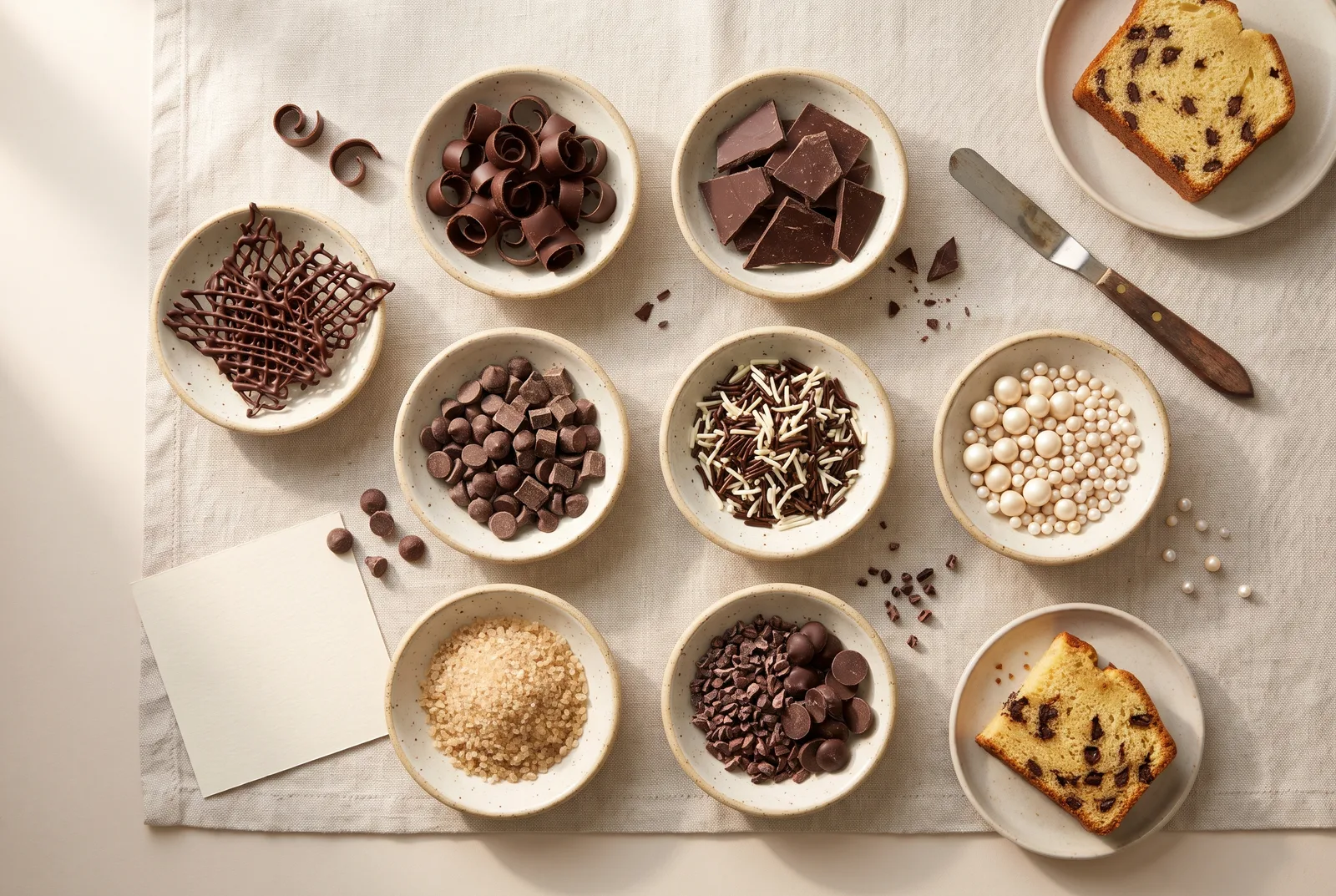
Ready-made chocolate decorations & inclusions: curls, shards, filigrees, sprinkles & dragees
A buyer-and-bench guide to the ready-made finishing range a bakery actually orders: real chocolate decorations (curls, shards, filigrees, plaques, cups), bake-stable chocolate inclusions (chips and chunks), compound coatings, and the sugar side of the cabinet - dragees, pearls, strands, imitation "chocolate" vermicelli, nibbed sugar and wafer flowers. It is built to answer the questions that cost money: is this actually chocolate or a vegetable-fat compound or a cocoa-flavoured sprinkle? Will it hold up in an ambient display, a chilled entremet, or inside the oven? What allergens and warning-label additives am I bringing onto my product? Numbers come first from first-party supplier spec sheets (Barbara Luijckx, Zeelandia, Culpitt, Emix, Kent Foods) and are cross-checked against EU/UK food law and pastry references. It also shows how to make the same decorations in-house from tempered couverture.
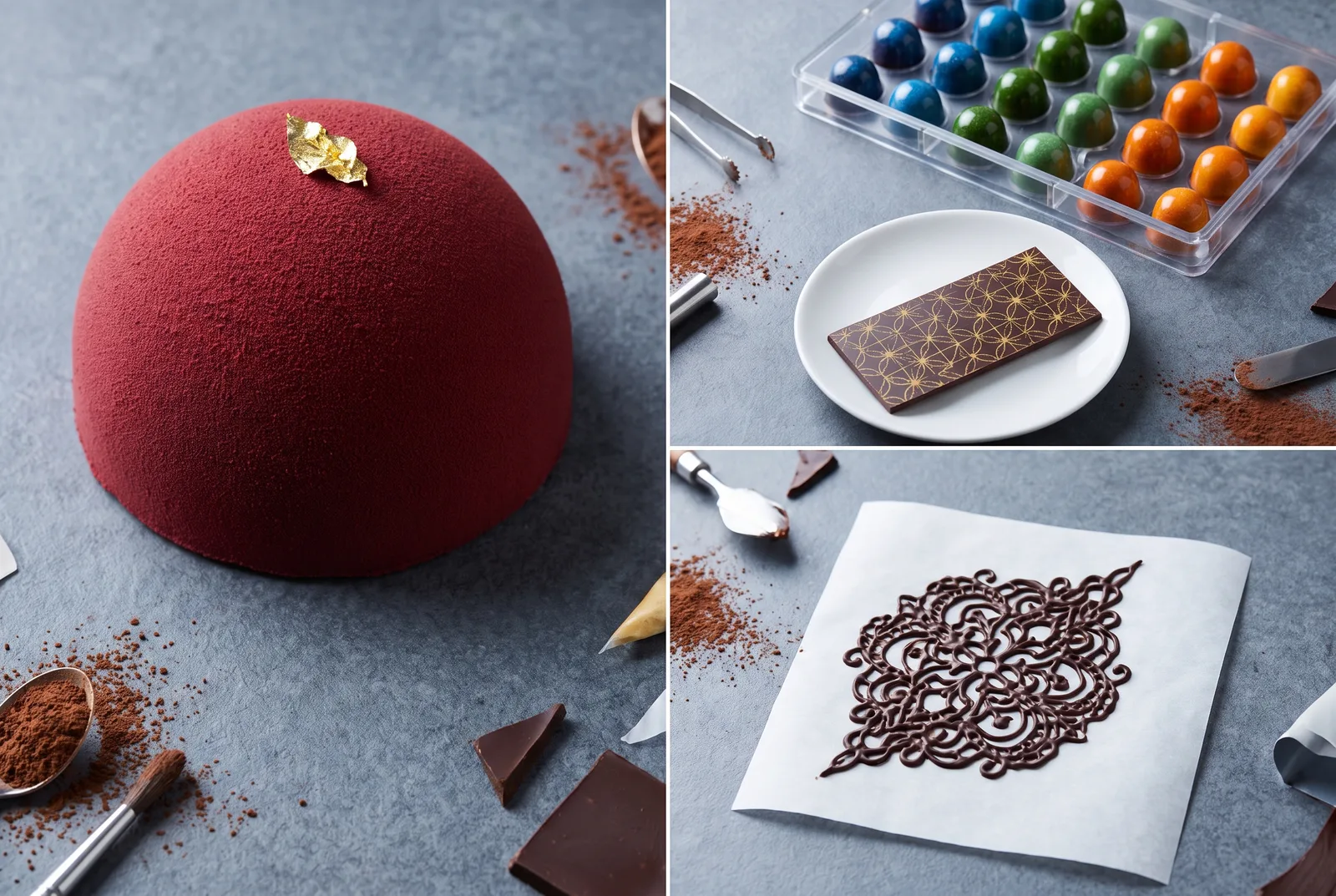
Chocolate tempering & decor: couverture, cocoa butter, transfer sheets, and velvet spray
The decorator's chocolate workbook: how tempered couverture becomes a finishing medium, and how to run the four signature professional finishes — coloured cocoa-butter airbrushing, velvet/flocking spray, transfer sheets and hand garnishes. Built around manufacturer temper curves and first-party spec-sheet numbers for the Domson couverture, cocoa butter, colour and ready-made decoration range. Cross-links to A6 for the full crystallisation science.
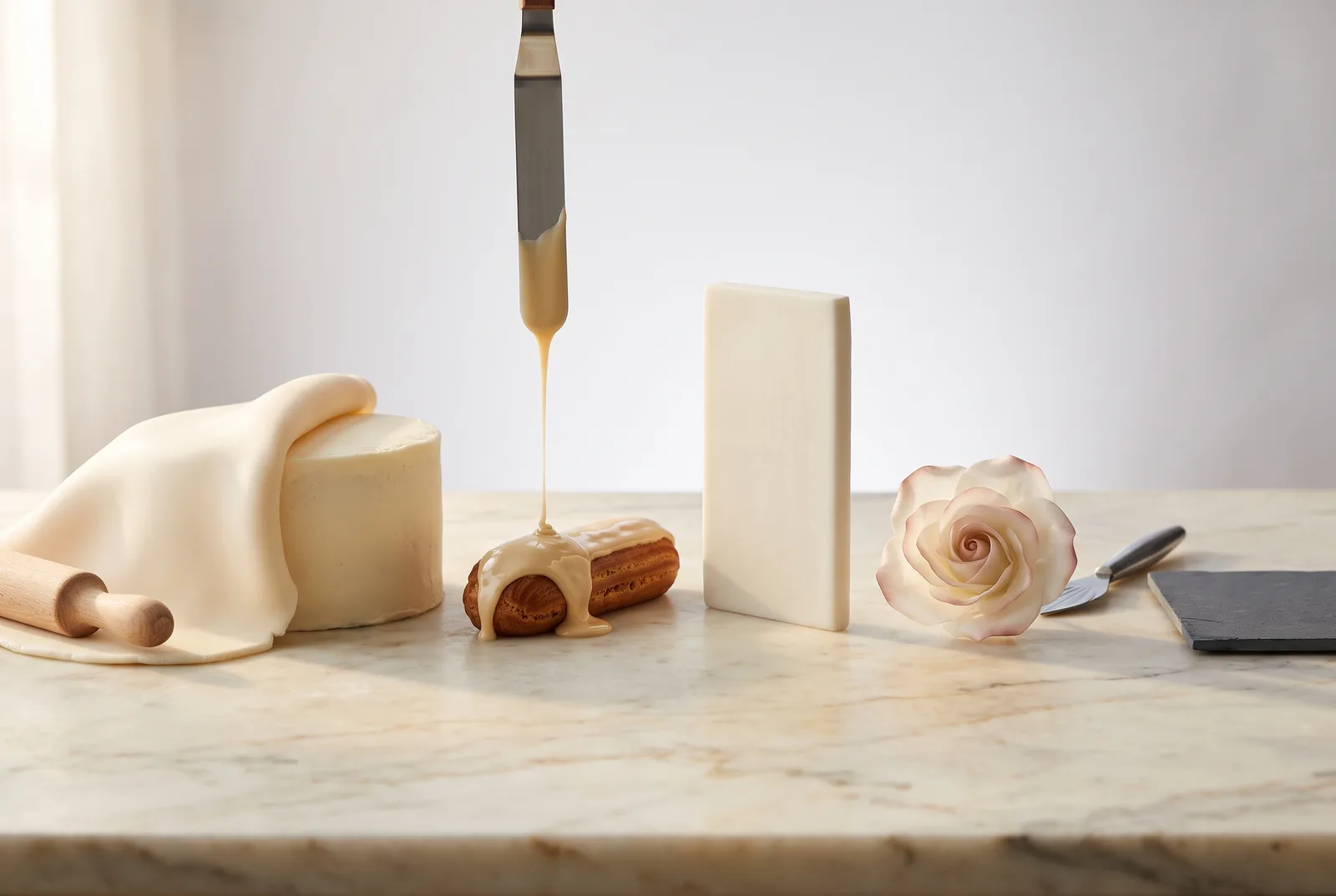
Fondant types in practice: rolled fondant, poured fondant, pastillage & gum paste
A working decorator's guide to the four sugar media that share the word "fondant" but behave like four different materials. It separates ROLLED fondant (UK sugarpaste — the pliable sheet you drape over a cake) from POURED confectioner's fondant (the glossy warmed glaze for éclairs and fondant fancies), then sets both against the firmer, gum-loaded modelling pastes — PASTILLAGE (sugar + gum, no fat, dries rock-hard for structures) and GUM / FLOWER paste (sugarpaste + extra gum, rolls translucently thin for lifelike sugar flowers). The single property that controls each one is made explicit — humectant + gum for rolled fondant, ~20 µm sucrose crystal size for poured fondant, the absence of fat for pastillage, extra gum for flower paste — and turned into bench rules: roll sugarpaste to 3-4 mm, warm ready-made poured fondant to 40-48°C (never above 50°C, scratch fondant even cooler), knead about 1 tsp CMC into 250 g of paste for modelling, and colour with gel/paste rather than liquid. Numeric composition, allergen, dosage and additive data are extracted from fourteen Domson-catalogue spec sheets (Zeelandia Roll Dekor, PA Foods and Doric ready-to-roll sugarpaste, CSM White Wrap Ice, Zeelandia, Arctos and Vortumnus poured fondants, Kilo glycerine, Food Colours and Culpitt colours, Culpitt gum-paste flower and PhotoCake fondant sheet, MagMart figures) and cross-checked against BAKERpedia, Yeners Way, professional cake-craft sources and EU/UK regulations. Food-safety flags cover the Southampton-Six colour warning, the titanium-dioxide (E171) EU ban vs UK status, hidden-allergen labelling and hot-sugar burns. For marzipan and the composition fundamentals see A6-marzipan-fondant-sugar-pastes; for icings & buttercreams, food colours & metallics, and piping & sugar-work see the A7 siblings.
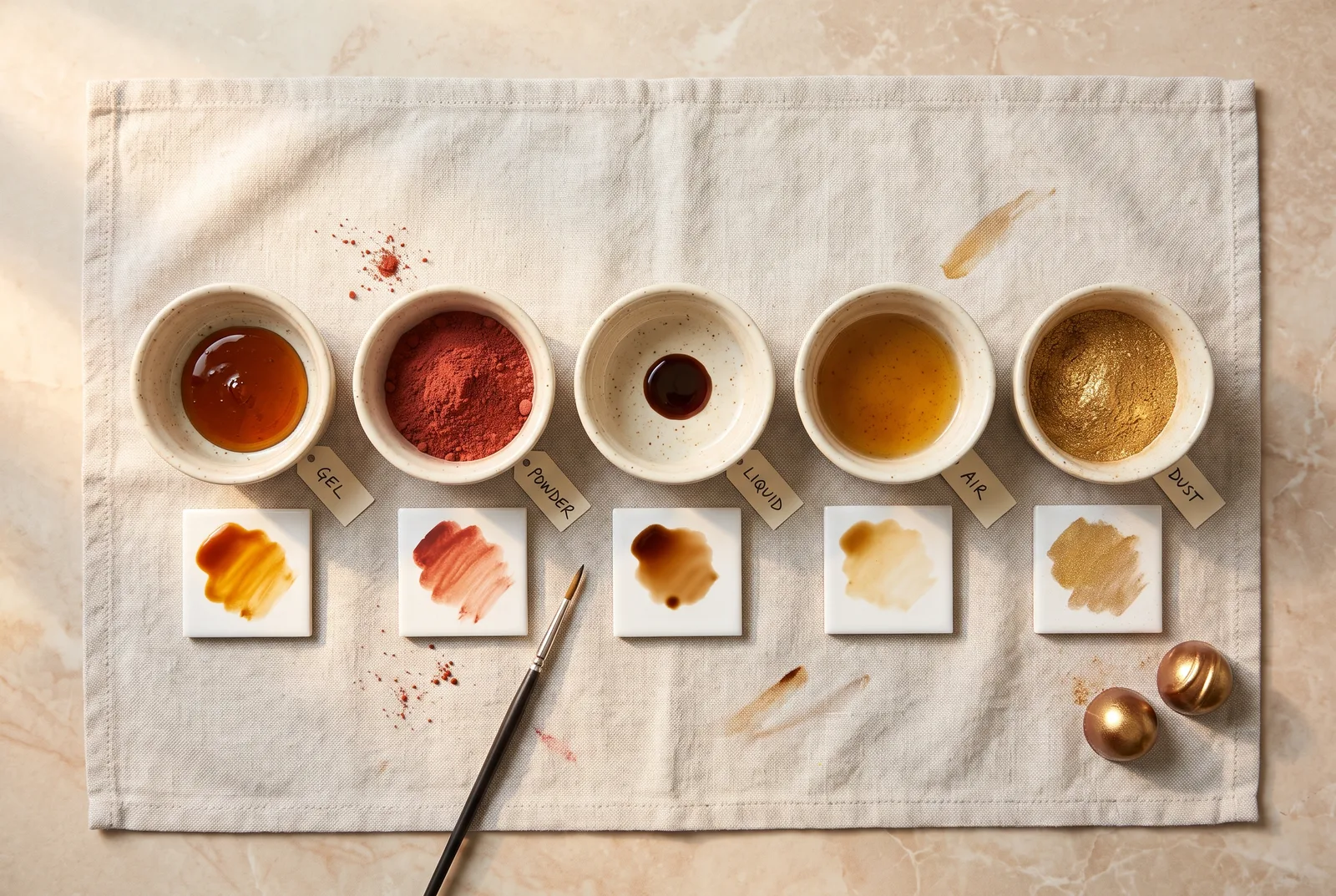
Food colours, luster dusts & edible metallics: gels, powders, airbrush, and EU/UK regulatory limits
A practical, inspiration-led guide for professional bakers and confectioners to colouring and metallic finishing. Covers every colour format in the catalogue — powder, liquid, drops, gel and concentrated paste, airbrush, lustre/metallic dust and aerosol sprays — what is actually in them, and which to reach for. Explains the no-seize rule for colouring chocolate, airbrush settings, three ways to use lustre dust, and synthetic-vs-natural colour stability. A full regulatory section covers the EU/UK divergence on titanium dioxide E171, the Southampton-six warning, edible gold/silver (E175/E174), 'edible vs non-toxic' glitter, and allergen/faith flags. Numbers read directly from first-party supplier spec sheets (Food Colours, Targroch, Culpitt/PME/Sugarflair) in the Domson catalogue.
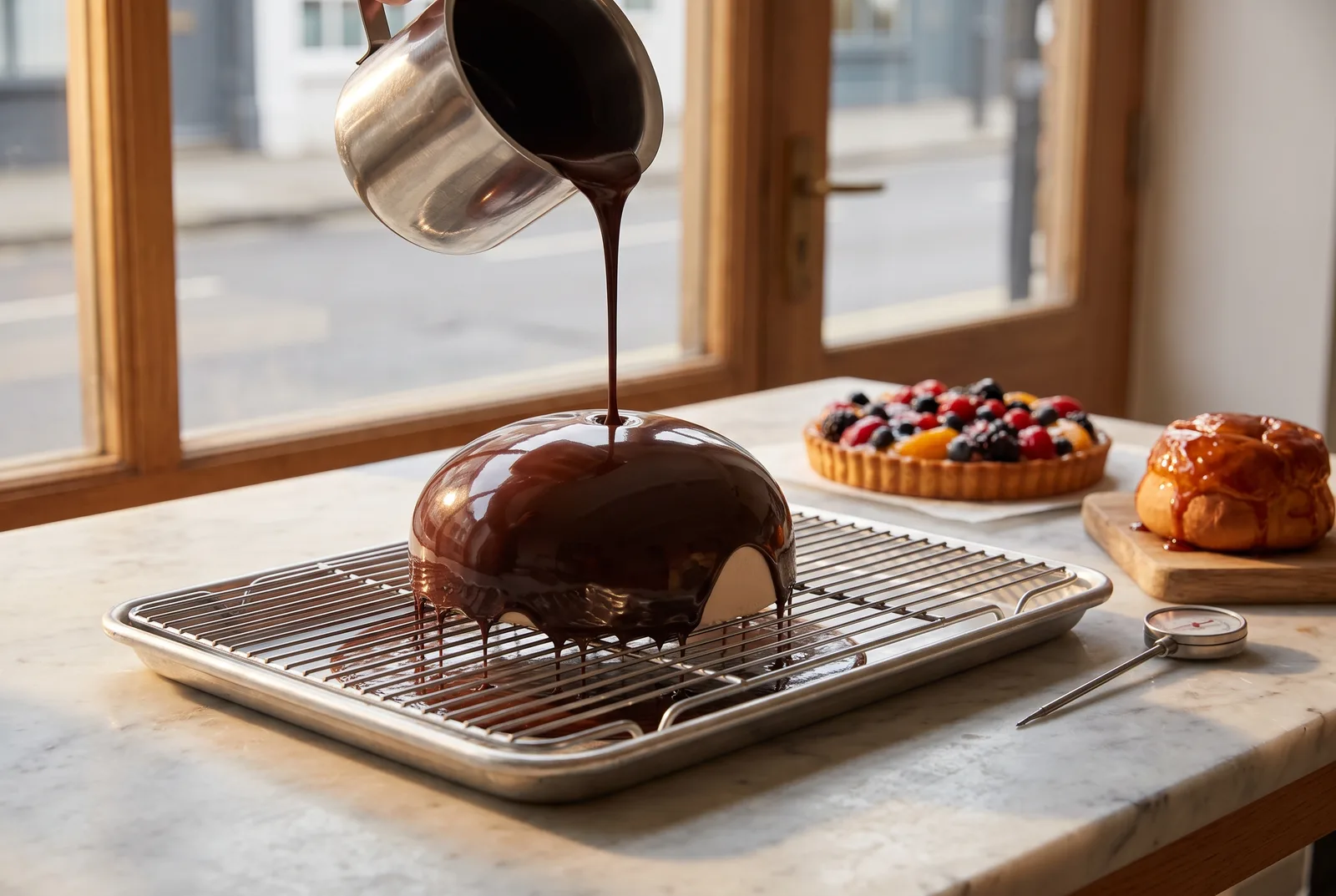
Glazes decoded: mirror, neutral, fruit & hot glazes — choosing and applying the right finish
A decoration-led guide to choosing and applying the right finishing glaze. It starts with a finish decision matrix — which glaze suits a frozen mousse entremet, a fresh fruit tart, a baked fruit Danish, a hot cross bun or an eclair — then walks the application of each: the high-gloss mirror glaze (poured at 28-35°C onto a -18°C frozen surface in one centre-out pass), the everyday satin neutral / cold gel glaze (brushed or machine-sprayed cold), fruit and apricot nappage (brushed thin and warm), thermostable fruit-in-gel that survives the oven, the sticky hot / bun (dextrin) glaze, the no-temper compound chocolate glaze, and the matte velvet spray as the mirror's suede cousin. It is wired for inspiration (leopard, marble and drip effects) and for production (ready-to-use reheating ceilings, machine spraying), with a finish-quality fault-finder and ready-to-buy Domson catalogue products. First-party numbers come from supplier spec sheets (Zeelandia Paletta, CSM Merjel, Dawn Decorgel, Bakels Bun Glaze, Helios, Martin Braun bake-stable cherry gel, Vortumnus apricot, GIL fruit-in-jelly); the deeper gelling chemistry (gelatin/agar/pectin, Bloom grades, glucose) lives in the sister article A6-glazes-finishes.
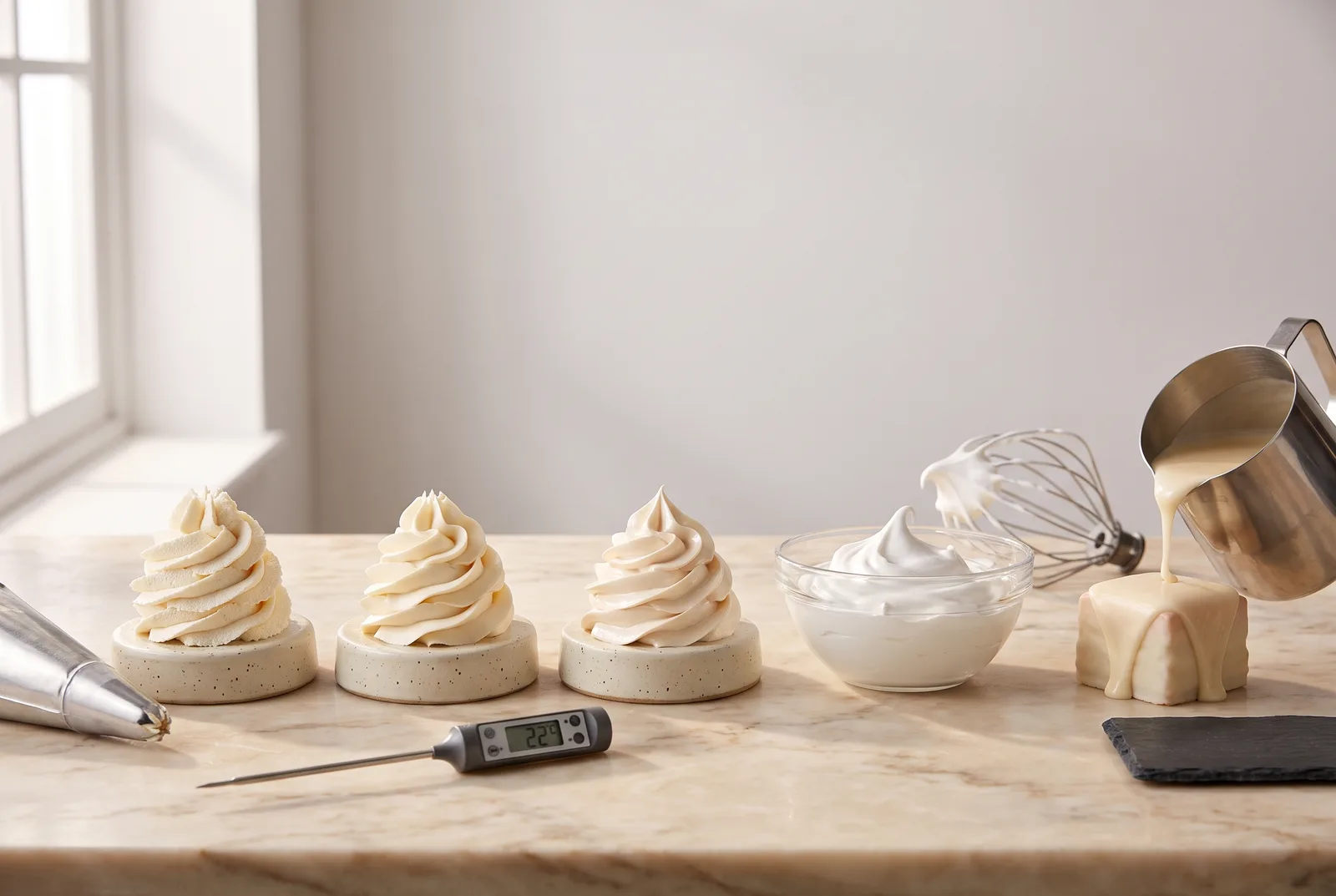
Icings & buttercreams: American, Swiss, Italian meringue, royal icing, and flat donut icing
A practical, bench-level guide to the icings and buttercreams a finishing bakery lives on, and to picking the right one instead of swapping them blindly. It covers the three buttercreams every decorator should know — American (butter + icing sugar, ≈1:2, very sweet, crusts and pipes crisp), Swiss meringue (whites + sugar warmed to 60-71°C, silky, no crust) and Italian meringue (whites whipped with a 118-121°C sugar syrup, the most heat-stable) — plus royal icing (albumen + icing sugar, piped stiff or flooded at a ~15-20 second run-out consistency, dried hard) and flat/poured fondant ("donut icing") warmed to ~37°C for a glossy skin. Temperature is treated as the master variable: it decides whether a meringue buttercream goes silky or splits, whether royal icing floods smooth, and whether poured fondant sets glossy or dull. Includes a buttercreams comparison (incl. French, German, ermine), formula cards, a fault-finder, food-safety notes (raw-egg Salmonella risk, pasteurised albumen, dairy perishability), allergen and sulphite flags, and ready-to-buy Domson catalogue products. Numbers are drawn first from first-party supplier spec sheets (Kent Foods icing & caster sugar, Ovopol albumen, Polmlek butter, Zeelandia/Arctos/Vortumnus fondants, CSM and Dawn frostings/fudge icings) and cross-checked against baking references.
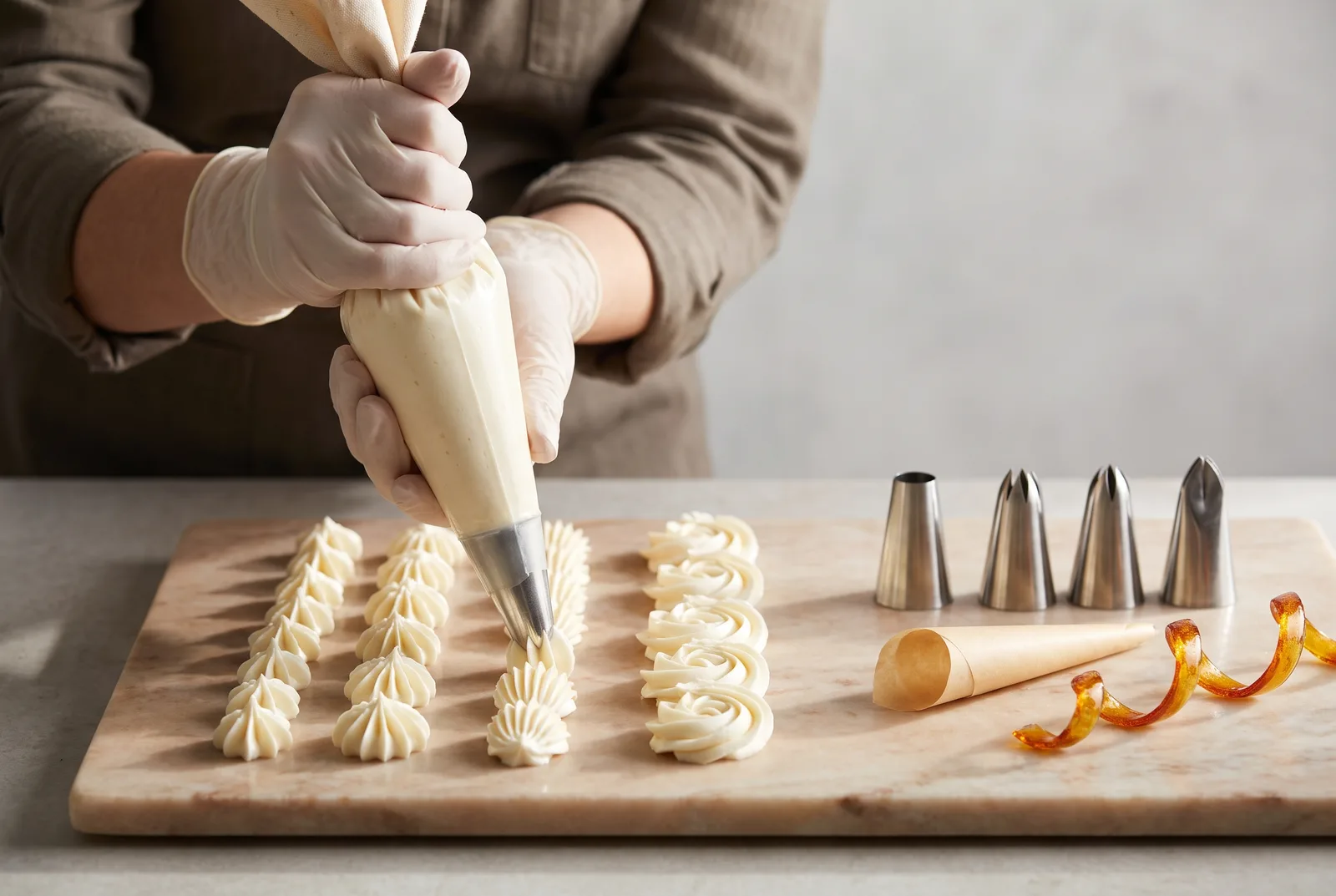
Piping & sugar-work: pressure control, nozzle selection, and a path to pulled sugar & isomalt
The decorating skill with the highest return on practice — and a clear path from a first star tip to a showpiece. It starts with the two controls behind every piped shape (pressure and bag angle: 90° for upright stars and rosettes, 45° for shells, lines and writing), then the bag itself (disposable, reusable, parchment cornet, coupler) and a full nozzle-family chart (round, open/closed star, French, drop flower, petal, leaf, basketweave, grass, Russian). It then chooses the medium: buttercream (Italian meringue and Korean pipe sharpest; French should not be piped), royal icing (stiff/medium/soft peak for piping; the 5-10s / 15-20s seconds-count for flooding; Lambeth overpiping for inspiration), piped meringue, and stabilised whipped cream. Colour is covered as a format decision (powder for hot sugar and deep shades, gel for icing) with first-party EU dose limits, and the article bridges into showpiece sugar-work — pulled sugar at hard crack (~150°C) and isomalt cooked ~170°C and worked ~135°C — handing the deep chemistry to the sister article A6-sugar-work-techniques. First-party numbers come from supplier spec sheets (Ovopol egg-white powder, Zeelandia Beza Bianca meringue mix, Emix cream stabiliser, BENEO isomalt, Food Colours gel and powder). Food-safety flags: pasteurised egg for royal icing, pork gelatin in the cream stabiliser, the Carmoisine (E122) child-attention colour warning, sulphite carry-over in gel colour, and hot-sugar burns.
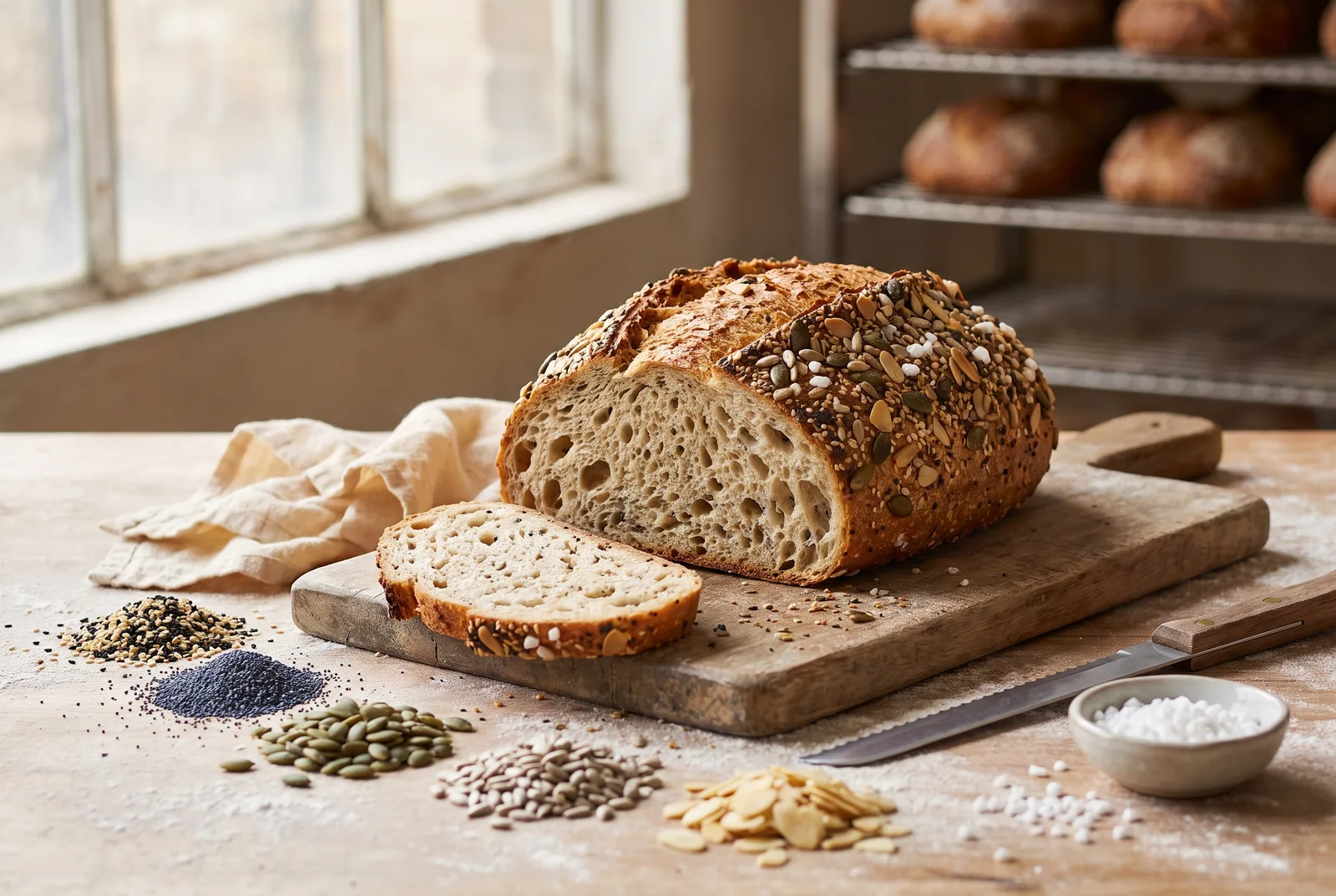
Seeds, nuts & crunchy toppings: glazing, toasting, coating and allergen management
A practical, bench-level guide to the fastest visual upgrade in any bakery: seeds, nuts and crunchy toppings. It is organised around the one decision that drives everything else — WHEN the topping goes on (before, in, or after the bake) — because that dictates the adhesive, whether to toast, and whether the topping must survive oven heat. It covers getting seeds to STAY ON (water vs egg wash vs starch vs glaze), the egg-wash finishes that give gloss or colour, toasting temperatures and times (sesame ~175°C 4-5 min; nuts ~160°C), heat-stable pearl/nibbed sugar grades (C20 chouquettes to C40 Liege waffles), crunchy inclusions that stay crisp (praline-feuilletine, biscuit crumb, streusel), and the two compliance topics this subject really is — oxidative rancidity (peroxide value, cold/dark/airtight storage, aflatoxins) and the 14 allergens (peanut and tree nuts as SEPARATE declarations, sesame and Natasha's Law). Numbers are drawn first from first-party supplier spec sheets (Zeelandia, Ireks, Global Grains, Chelmer, Bioveri, Loper, Kent Foods/Couplet, Kluman) and cross-checked against baking references and EU/UK food law, then mapped to ready-to-buy Domson catalogue products.